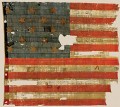
Class of 1828
James F. Izard – son of Major-General George Izard. First Lieutenant of the 1st Dragoons, on the frontier and in the Black Hawk War; killed in the Second Seminole War at the Battle of the Withlacoochee River.
Birth: Feb. 28
Saint Augustine
St. Johns County
Florida, USA
Death: Mar. 5, 1836
Burial:
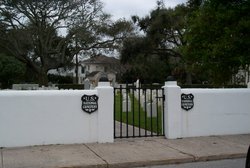
Saint Augustine National Cemetery
Saint Augustine
St. Johns County
Florida, USA
Plot: Memorial Pyramids
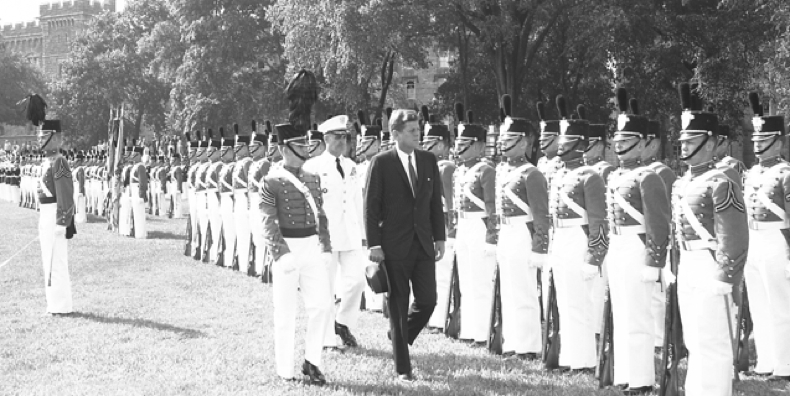
Battalion Staff and Cadet Companies E1, F1, G1 and H1 US Signal Corps Photo
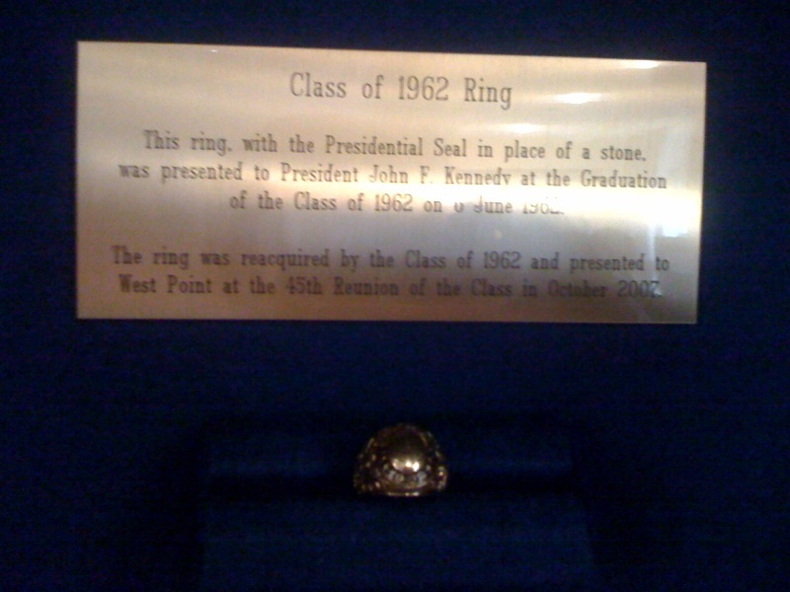
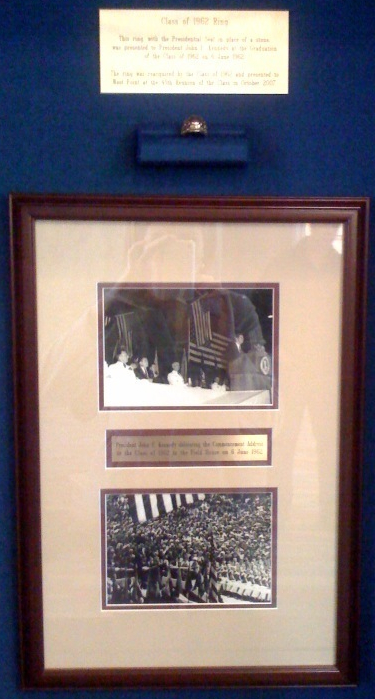
President Kennedy Trooping the Line May 1962
Most college graduates when asked who gave their graduation address and what did they say do not have any recollection. Well, for some unknown reason, I have a copy of the White House press release of President Kennedy’s remarks to us. Each time I read them they become more timeless. Inasmuch as we just passed the 36th anniversary of our graduation, I’m sending JFK’s remarks in their entirety. I have no idea how this came into my possession, but I thought you all might like a copy of it.
Provided by Len Butler to Jim Malley
Graduation Address by President John F. Kennedy
to the Class of 1962
US Military Academy
(As delivered, Wednesday, 6 June 1962)
General Westmoreland, General Lemnitzer, Mr. Secretary, General Decker, General Taylor, members of the graduating class and their parents, gentlemen: I want to express my appreciation for your generous invitation to come to this graduating class. I am sure that all of you who sit here today realize, particularly in view of the song we just heard, that you are part of a long tradition stretching back to the earliest days of this country’s history, and that where you sit sat once, some of the most celebrated names in our nation’s history, and also some who are not so well known, but who, on 100 different battlefields in many wars involving every generation of this nation’s history, have given very clear evidence of their commitment to their country.
So that I know you feel a sense of pride in being part of that tradition, and as a citizen of the United States, as well as President, I want to express our high regard to all of you in appreciation for what you are doing and what you will do for our country in the days ahead.
I would also like to announce at this time that as Commander-in-Chief I am exercising my privilege of directing the Secretary of the Army and the Superintendent of West Point to remit all existing confinements and other cadet punishments, and I hope that it will be possible to carry this out for the day.
General Westmoreland was slightly pained to hear that this was impending in view of the fact that one cadet, who I am confident will someday be the head of the Army, has just been remitted for eight months, and is about to be released. But I am glad to have the opportunity to participate in the advancement of his military career.
My own confinement goes for another two and a half years, and I may ask for it to be extended instead of remitted.
I want to say that I wish all of you, the graduates, success. While I say that, I am not unmindful of the fact that two graduates of this Academy have reached the White House, and neither was a member of my party. Until I am more certain that this trend will be broken, I wish that all of you will be generals and not Commanders-in-Chief.
I want to say that I am sure you recognize that your schooling is only interrupted by today’s occasion and not ended, because the demands that will be made upon you in the service of your country in the coming months and years will be really more pressing, and in many ways more burdensome, as well as more challenging, than ever before in our history. I know that many of you may feel, and many of our citizens may feel that in these days of the nuclear age, when war may last in its final form a day or two or three days before much of the world is burned up, that your service to your country will be only standing and waiting. Nothing, of course, could be further from the truth. I am sure that many Americans believe that the days before World War II were the golden age when the stars were falling on all the graduates of West Point, that that was the golden time of service, and that you have moved into a period where military service, while vital, is not as challenging as it was then. Nothing could be further from the truth. The fact of the matter is that the period just ahead in the next decade will offer more opportunities for service to the graduates of this Academy than ever before in the history of the United States, because all around the world, in countries which are heavily engaged in the maintenance of their freedom, graduates of this Academy are heavily involved; whether it is in Vietnam or in Laos or in Thailand, whether it is a military advisory group in Iran, whether it is a military attache’ in some Latin American country during a difficult and challenging period, whether it is the commander of our troops in South Korea — the burdens that will be placed upon you when you fill those positions as you must inevitably, will require more from you than ever before in our history. The graduates of West Point, the Naval Academy, and the Air Academy in the next ten years will have the greatest opportunity for the defense of freedom than this Academy’s graduates have ever had, and I am sure that the Joint Chiefs of Staff endorse that view, knowing as they do and I do, the heavy burdens that are required of this Academy’s graduates every day. General Tucker in Laos, or General Harkins in Viet Nam, and a dozen others, who hold key and significant positions, involving the security of the United States and the defense of freedom — you are going to follow in their footsteps and I must say that I think that you will be privileged in the years ahead to find yourselves so heavily involved in the great interests of this country.
Therefore, I hope that you realize – and I hope every American realizes – how much we depend upon you. Your strictly military responsibilities, therefore, will require a versatility and an adaptability never before required in either war or peace. They may involve the command and control of modern nuclear weapons and modern delivery systems, so complex that only a few scientists can understand their operation, so devastating that their inadvertent use would be of world wide concern, but so new that their employment and their effects have never been tested in combat conditions.
On the other hand, your responsibilities may involve the command of more traditional forces, but in less traditional roles. Men risking their lives, not as combatants, but as instructors or advisors, or as symbols of our nation’s commitments. The fact that the United States is not directly at war in these areas in no way diminishes the skill and the courage that will be required, the service to our country which is rendered or the pain of the casualties which are suffered.
To cite one final example of the range of responsibilities that will fall upon you, you may hold a position of command with our special forces, forces which are too unconventional to be called conventional, forces which are growing in number and importance and significance, for we now know that it is wholly misleading to call this the “nuclear age”, or to say that our security rests only on the doctrine of massive retaliation.
Korea has not been the only battle ground since the end of the Second World War. Men have fought and died in Malaya, in Greece, in the Philippines, in Algeria and Cuba, and Cyprus and almost continuously on the Indo-Chinese Peninsula. No nuclear weapons have been fired. No massive nuclear retaliation has been considered appropriate. This is another type of war, new in its intensity, ancient in its origin – war by guerrillas, subversives, insurgents, assassins, war by ambush instead of by combat; by infiltration instead of aggression, seeking victory by eroding and exhausting the enemy instead of engaging him. It is a form of warfare uniquely adapted to what has been strangely called “wars of liberation”, to undermine the efforts of new and poor countries to maintain the freedom that they have finally achieved. It preys on economic unrest and ethnic conflicts. It requires in those situations where we must counter it, and these are the kinds of challenges that will be before us in the next decade if freedom is to be saved, a whole new kind of strategy, a wholly different kind of force, and therefore a new and wholly different kind of military training.
But I have spoken thus far only of the military challenges which your education must prepare you for. The non-military problems which you will face will also be most demanding, diplomatic, political and economic. In the years ahead, some of you will serve as advisors to foreign aid missions or even to foreign governments. Some will negotiate terms of a cease-fire with broad political as well as military ramifications. Some of you will go to the far corners of the earth, and to the far reaches of space. Some of you will sit in the highest councils of the Pentagon. Others will hold delicate command posts which are international in character. Still others will advise on plans to abolish arms instead of using them to abolish others. Whatever your position, the scope of your decisions will not be confined to the traditional tenets of military competence and training. You will need to know and understand not only the foreign policy of the United States, but the foreign policy of all countries scattered around the world who 20 years ago were the most distant names to us. You will need to give orders in different tongues, and read maps by different systems. You will be involved in economic judgments which most economists would hesitate to make. At what point, for example, does military aid become burdensome to a country and make its freedom endangered rather than helping to secure it. To what extent can the gold and dollar cost of our overseas deployments be offset by foreign procurement? Or at what stage can a new weapons system be considered sufficiently advanced to justify large dollar appropriations?
In many countries, your posture and performance will provide the local population with the only evidence of what our country is really like. In other countries, your military mission, its advice and action, will play a key role in determining those people will remain free. You will need to understand the importance of military power and also the limits of military power, to decide what arms should be used to fight and when they should be used to prevent a fight, to determine what represents our vital interests and what interests are only marginal.
Above all, you will have a responsibility to deter war as well as to fight it. For the basic problems facing the world today are not susceptible of a final military solution. While we will long require the services and admire the dedication and commitment of the fighting men of this country, neither our strategy nor our psychology as a nation, and certainly not our economy, must become permanently dependent upon an ever-increasing military establishment.
Our forces, therefore, must fulfill a broader role as a complement to our diplomacy, as an arm of our diplomacy, as a deterrent to our adversaries, and as a symbol to our allies of our determination to support them.
That is why this Academy has seen its curriculum grow and expand in dimension, in substance and in difficulty. That is why you cannot possibly have crowded into these four busy years all of the knowledge and all of the range of experience which you must bring to these subtle and delicate tasks which I have described, and that is why you will go to school year after year so you can serve this country to the best of your ability and your talent.
To talk of such talent and effort raises in the minds, I am sure, of everyone, and the minds of all of our countrymen, why – why should men such as you, able to master the complex arts of science, mathematics, language, economy, and all the rest devote their lives to a military career, with all of its risks and hardships? Why should their families be expected to make the personal and financial sacrifices that a military career inevitably brings with it? When there is a visible enemy to fight in open combat, the answer is not so difficult. Many serve, all applaud, and the tide of patriotism runs high. But when there is a long, slow struggle, with no immediate visible foe, your choice will seem hard indeed. And you will recall, I am sure, the lines found in an old century box in Gibraltar, “God and the soldier all men adore, in time of trouble and no more; for when war is over and all things righted, God is neglected and the old soldier slighted.”
But you have one satisfaction, however difficult those days may be: when you are asked by a President of the United States or by any other American what you are doing for your country, no man’s answer will be clearer than your own. And that moral motivation which brought you here in the first place is part of your training here as well. West Point was not built to produce technical experts alone. It was built to produce men committed to the defense of their country, leaders of men who understand the great stakes which are involved, leaders who can be entrusted with the heavy responsibility which modern weapons and the fight for freedom entail, leaders who can inspire in their men the same sense of obligation to duty which you bring to it.
There is no single slogan that you can repeat to yourself in hard days or give to those who may be associated with you. In times past, a simple phrase, “55-40 or fight”, or “to make the world safe for democracy” – all that was enough. But the times, the weapons and the issues are now more complicated than ever.
Eighteen years ago today, Ernie Pyle, describing those tens of thousands of young men who crossed the “ageless and indifferent” sea of the English Channel, searched in vain for a word to describe what they were fighting for. And finally he concluded that they were at least fighting for each other.
You and I leave here today to meet our separate responsibilities, to protect our nation’s vital interests by peaceful means if possible, by resolute action if necessary, and we go forth confident of support and success because we know that we are working and fighting for each other and for all those men and women all over the globe who are determined to be free.
I asked earlier this month if anyone knew who was the beneficiary of the amnesty granted by President Kennedy at our graduation in 1962. In his remarks the President mentioned that someone in the class had recently been punished and was being relieved of a great load due to the amnesty that the President was granting.
I received replies from two individuals. Charlie (“C.O.”) Bennett of Company M-2 thought he might have been the person but in a second message to me remembered that he was finished with his punishment prior to graduation.
Sam (“Sammy”) Steele told me that his roommate, Charlie (“Bud”) Merriam of Company C-2 was probably the person, as he had been caught off post about a week before graduation and was serving punishment when we were graduated.
That’s all I know so, by default it looks like Charlie Merriam was the classmate who could thank President Kennedy for allowing him to graduate in a timely manner.
In our Register of Graduates it shows that Charlie Merriam retired in 1988 as a Lieutenant Colonel.
Much of the material for the site is taken from the on line Cullum Register created and maintained by Bill Thayer.
Is there an appropriate way to Honor the Fallen? The New Zealand Military has a unique way. It may be offensive to some yet the link is added. Sometimes it is hard to express what the loss of a Friend, a Classmate, a Soldier you are Responsible For, really means –
Haka Farewell
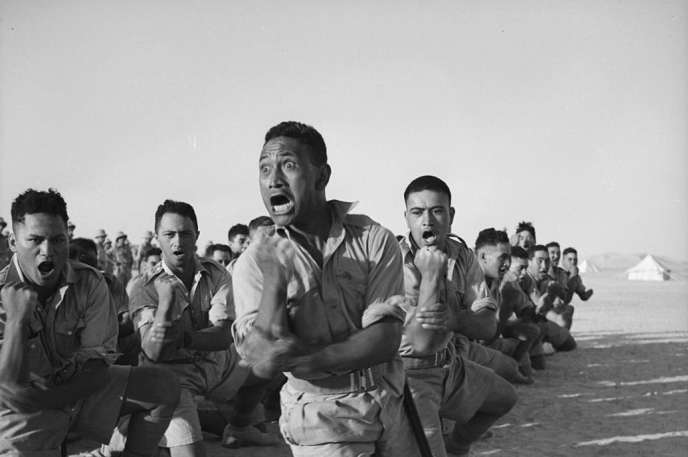
Maori Troops in North Africa 1941
New Zealand’s Maori soldiers performing a haka during World War II in North Africa.
Web site which contains material used on this page
However Bill’s listings only cover the years 1802 to 1861. The Cullum Register maintained by the Special Collections & Archives Section at the West Point Library lists Graduates from 1802 to 1950.
The reason this effort is being made is due to a recent visit to the Naval Academy to attend the Army – Navy Wrestling Match in Alumni Hall. As I sat down I observed a brass plaque on the arm rest. It named a Naval Academy Graduate with the following – Cruiser USS Houston 1942. It was sobering as I knew exactly what it meant – that graduate had gone down with The Galloping Ghost of the Java Coast – sunk by the Japanese in 1942.
Please Note – this Web Site does not advertise, however many of the links which are listed do advertise. The historical material they provided is essential, requiring us to list the sites.
West Point Graduates who died in captivity are included in this listing. As an example of why Captives are listed – After his capture, “Bill Kellum” organized resistance to Chinese indoctrination at Camp Five. His punishment was confinement to the camp hospital, where he was systematically killed. Big Bill Kellum died in June 1951.
The Oryoku Maru, Shinyo Maru, and perhaps the 8 Americans on the Juny Maru involved killing of prisoners by Japanese guards and Japanese machine gun crews on shore as the Prisoners swam away from the ship.
Cadets are surrounded by and live in the shadow of some of West Points greatest Graduates. The Class of 1939 provided 2 volumes listing recipients of the Medal of Honor while Plaques of each are on the walls throughout the Academy. In the War of 1812 of the total 120 Graduates 9 were Killed in Action, with another dying as a prisoner; several went down in the Eastern Indian Wars; 105 in the Civil War; some 500 died in World War II, 157 in Korean, 273 Vietnam and, over 81 have been killed in Iraq and Afghanistan in the global war on terror.
The Civil War/World War II Connection
By Stuart Zelman
Here are famous World War II personalities who are connected in one way or another to famous (and not famous) Civil war personalities. Some of the names you should recognize; others will surprise you. By no means is this list complete.
Confederate General Nathan Bedford Forrest, great (?) grandfather of…
Brig. General Nathan Bedford Forrest III, USAAF – Shot down over the Baltic Sea while leading a bombing raid on the submarine yards at Kiel in June of 1943. His body was found when it washed up at a German Seaplane base in September of that year. He was buried by a detail of the German Navy, but was disinterred in 1947 to be reburied in Arlington National Cemetery.
Major General Arthur MacArthur – 24th Wisconsin Infantry, Medal of Honor recipient for planting the flag on Missionary Ridge, fought in the Indian wars and the Spanish-American War. He was the father of…
General Douglas MacArthur
General Adna R. Chaffee, Sr. – 1st Lt. in the 6th US Cavalry at the end of the Civil War. He was brevetted Captain at the end of the Civil War because of his conduct at Dinwiddie Court House. He fought in the Indian Wars and the Spanish-American Wars, finally serving as Chief of Staff of the U.S. Army. He is the father of…
Major General Adna R. Chaffee, Jr. – He and Patton are considered to be the father of the WWII-era Armored Corps.
Confederate Lt. Col. Waller Tazewell Patton – led the 7th Virginia during Pickett’s charge at Gettysburg where he was mortally wounded, great uncle of…
Major General George S. Patton, Jr.
Col. George S. Patton, killed at 3rd Winchester, grandfather of…
Major General George S. Patton, Jr.
Confederate Col. Charles Marshall, Gen. Lee’s aide-de-camp/adjutant, present with Lee at the McLean House at Appomattox, uncle of…
WWII U.S. Chief of Staff, and creator of Marshall Plan, Major General George C. Marshall.
Confederate Major General Fitzhugh Lee, Cavalry leader, nephew of Robert E. Lee, grandfather of…
Captain Fitzhugh Lee III, USN – Pilot on the pre-war carrier USS Enterprise, commanded Escort Carrier CVE 61 (USS Manila Bay) at the Battle of Leyte Gulf, present at surrender ceremonies on the USS Missouri, aide to Secretary of the Navy John L. Sullivan during the Truman Administration, retired in 1962 with the rank of Vice Admiral.
Lt. General U.S. Grant, grandfather of…
General U.S. Grant III, WWII-era Civil Defense Planner.
Confederate Major General Simon Bolivar Buckner, surrendered Fort Donelson to Grant, father of…
Lt. General Simon Bolivar Buckner, Jr. – WWII-era USMC General, killed by a sniper at Okinawa.
Confederate Major Manning H. Kimmel, Lt. in the 2nd US Cavalry in the pre-Civil War army and had been involved in an excursion into Mexico by Texas Rangers and U.S. Regulars after a raid led by Mexican Bandito Juan Nepomuceno “Cheno” Cortina on Brownsville, Texas (Lee, Stoneman, and Heinzelman were also present), AAG to Brig. Gen. Frank Anderson CSA, father of…
Admiral Husband E. Kimmel, of Pearl Harbor fame.
Also the Grandfather of Lt. Commander Manning M. Kimmel, commanding officer of the submarine USS Robalo (SS-273). Survived the sinking of his submarine after hitting a mine off of Borneo but was one of those prisoners burnt alive in “Massacre of Palawan” in December of 1944.
Also the Grandfather of Captain Thomas K. Kimmel (brother of Manning M.), commanding officer of the submarine USS Bergall. Pulled from combat duty by Admiral Christie after Lt. Commander Kimmel was reported MIA. He commanded the Fleet Submarine Training School at Portsmouth, NH until the conclusion of hostilities whereupon he returned to the command of the USS Bergall. After holding various other commands he finally retired (circa 1960s) from a career in the Navy and began to focus his efforts to clear his father’s name. He was finally successful but had passed away by the time Admiral Kimmel (and General Short) were finally exonerated in August of 1995.
Confederate Private William A. McCain, 5th Mississippi Cavalry, grandfather of…
Admiral John S. “Slew” McCain, Sr. – commander of Task Force 58 in Halsey’s Third Fleet, and present at surrender ceremonies on the USS Missouri. He died only four days afterward. (He was also the grandfather of Republican Presidential candidate Senator John S. McCain III.)
Major General George E. Pickett – one of three Generals that led the charge on the Union center on the third at Gettysburg, an event that has come down through history as “Pickett’s Charge.” Forever afterward blamed Lee for the decimation of his Division. Great grandfather of…
Colonel George E. Pickett IV – graduated from West Point in 1942, serving in World War II and the Korean War.
The Wilson home located in Rice, Virgina, was used as a hospital for both Union and Confederate troops during and after the Battle of Saylor’s Creek.
In 1940 Sam Wilson, stirred by one of Churchill’s most rousing speeches after the debacle of Dunkirk, jogged 7 miles in the pouring rain to the National Guard Amory in Farmville where he enlisted. In 1942 he was sent to OCS after which he taught guerrilla tactics at Fort Benning. By 1943 he found himself in Burma as a 19 year old 1st Lieutenant and Chief Reconnaissance Officer in the 5037th Composite Unit (Provisional) otherwise known as… Merrill’s Marauders. He served the military for 37 years (three of them as a civilian) and retired from the army as a Lieutenant General in 1977. He is also an inductee in the Army Ranger Hall Of Fame and the Military Intelligence Hall Of Fame. As of this writing he enjoys his retirement at his family homestead still in Rice, Virginia.
Helen Dortch Longstreet, General Longstreet’s second wife (1863-1962) contributed to the war effort. In 1943 at the age of 80 she worked at Bell Aircraft as a riveter! (Photo here.)
Captain Jonathan Mayhew Wainwright II commanded the USS Harriet Lane, taking part in the Battle of New Orleans. He also took part in the operations against Vicksburg. He was killed on January 1, 1863 attacking coastal batteries and forts at Galveston, Texas. He is the great-grandfather of…
General Jonathan Mayhew “Skinny” Wainwright IV – Commander of Allied forces in the Philippines during WWII, who had to surrender Allied forces on Bataan to the Japanese. He was held as a P.O.W. until liberated by forces with the Red Army in August 1945. Medal of Honor recipient. Died September 2, 1953.
Rufus King held a Brigadier General’s commission in the Union Army where he commanded Wisconsin militia and organized what would become the famed “Iron Brigade.” Unfortunately his bouts of epilepsy forced him to resign his commission. Abner Doubleday would replace him.
Rufus King, Jr. started out as a Private in Colonel Marshall Leffert’s 7th NY Militia. He managed to get commissioned as a lieutenant in the 4th US Artillery, eventually commanding Battery A. He is noted for his bravery during the Seven Days Battles when he took command of Batteries A and C at the battle of White Oak Swamp on June 30, 1862. Because of his actions, he would win the highest award, the Medal of Honor. He would eventually retire with the rank of Major.
Brigadier General Archibald Gracie III, though NY born and bred, threw his lot in with the Confederacy when the war broke out. He received a commission as a major in the 11th Alabama Infantry. He eventually commanded a Brigade; his most notable battles being fought under Longstreet at Bean’s Station and at Chickamauga. He was killed by an artillery shell on Dec. 2, 1864 while observing the enemy during the Seige of Petersburg.
These two men were related and were ancestors of…
Admiral William F. “Bull” Halsey, Jr., Vice Admiral. He was on his flagship the USS Enterprise (CV-6) when the Japanese attacked Pearl Harbor. He planned and led raids on Japanese installations in the early part of the war. Just before the Midway campaign he was side-lined with a chronic skin condition forcing him to take medical leave and giving up his command to Admiral Spruance. He returned in time to take command during the Guadalcanal campaign and the subsequent battles in the Solomon Islands chain. He then received command of the Third Fleet, leading it in the Battles of the Palaus, Leyte Gulf and Luzon. He retired from active service in 1947. As a civilian he served on the board of ITT. He passed away at the age of 76 on August 16, 1959.
General Thomas J. “Stonewall” Jackson, great grandfather of…
Col. Thomas J. Jackson Christian, Jr. – Graduate of West Point, Class of 1939, where he was assigned to the artillery as a 2nd Lt. He shortly transferred to the Army Air Corps. Upon graduation in 1941 he was assigned to the Philippines. When war broke out he flew various missions in the South Pacific area (Bataan, Mindanao, Australia) until shot down. Given up for dead, he survived living with the natives until rescued. He returned to duty flying 60 combat missions over Guadalcanal. He was granted leave and returned to the States where he married and was assigned the command of the 361st Fighter Group. While in the European Theater he flew 70 combat missions earning the DSC, Air Medal, and Purple Heart. He was shot down August 12, 1944 in a P-51 Mustang over Arras, France. His body was never recovered.
General Robert Edward Lee, CSA, cousin of…
Vice Admiral William Augustus “Ching” Lee, Jr., USN
Graduated from the US Naval Academy, Class of 1904. Earned the nickname “Ching” because of his love of the Orient. Participated on the Academy’s rifle team. In World War I he served on destroyers. He also participated in 14 events in the 1920 Olympics winning 7 medals; 5 of them the Gold Medal. In WWII he commanded Battleship Division 6 at Guadalcanal (USS Washington and South Dakota) battering IJN Battleship Kirishima in a decisive night-time engagement in November of 1942. This was the first naval battle fought mostly by radar. The Kirishima was so badly damaged that she had to be scuttled by her own forces. In 1944 he was promoted to Vice Admiral, Commander Battleships Pacific Fleet. He died of a sudden heart attack on August 25, 1945.
Major John William Puller, 5th Virginia Cavalry, grandfather of…
Lt. General Lewis. B. “Chesty” Puller
Puller was influenced from the tales of Confederate Veterans and the exploits of Stonewall Jackson growing up in his home state of Virginia.
He attended VMI and enlisted in the Marines after graduation. Superiors recognized his abilities; he was sent to the NCO and OC Schools. He graduated with the rank of 2nd Lt., but in the streamlining of the Armed Forces after the war he was demoted to the rank of Corporal. In this capacity he served in Haiti fighting the Rebels. He returned to the States and regained his officer’s commission. A stint fighting in Nicaragua followed. He then commanded a detachment of the China Marines and then served as the head of the Marine Basic Training School based in Philadelphia. During World War II, Puller led Marines at Guadalcanal, Cape Gloucester, and Peleiu racking up an impressive array of decorations: 5 Navy Crosses, the Silver Star, The Legion of Merit and the Distinguished Service Cross, to name a few. Puller served in the Korean War and was forcibly retired with the rank of Lt. General in 1955 after suffering a stroke. He passed away on October 11, 1971.
Richard L. Ewell, a Lieutenant in the 24th Kentucky Infantry (Union) and kin to Confederate General Richard S. Ewell; grandfather of…
Lt. Col. Julian Ewell, commanding the 3rd Battalion of the 501st of the 101st Airborne Division, then the entire regiment. He landed with his men in the early morning hours of D-Day June 6 behind the Utah beach sector. He fought with his men in Operation Market Garden and the Battle of the Bulge, most notably at Bastogne. Col. Ewell served in Korea as Colonel in the 9th infantry Regiment. In Vietnam, Major General Ewell commanded the 9th Infantry Division during Operation Speedy Express. He later was promoted to Lt. General and commanded the II Field Force. After the war he served as Chief of Staff of the NATO Southern Command until his retirement in 1973. He passed away in 2009 at the age of 93.
Pvt. Samuel E. Johnson of Company B, 26th Texas Cavalry. Patrolled along the Rio Grande and participated in the Red River Campaign. Great-grandfather of…
Lyndon Banes Johnson, President of the United States, 1963-1969. In World War II, he was a Commander in the USNR. He was part of a three-man team that and monitored and reported on conditions in the South Pacific; reporting back to the Department of the Navy, Congress and President Roosevelt. He also was Chairman of a Naval Affairs committee that made recommendations to upgrade the efficiency of Naval commands, personnel and ships.
Private George Nixon, 73rd Ohio, mortally wounded at Gettysburg and dying July 10, 1863. Grandfather of…
Richard Nixon, President of the United States, 1969-1974. In World War II he was commissioned a Ensign in the USNR. After attending school in Quonset Point, RI, he got posted as an aide to the Executive Officer at the Naval Reserve Aviation base in Ottumwa, Iowa. He requested and got posted to Guadalcanal and Green Islands as the Officer In Charge of the South Pacific Combat Air Transport Command. In the summer of 1944 he returned to California where he assigned to Fleet Air Wing 8 until December of that year. Until the close of the war he served in various capacities in the Bureau of Aeronautics. He retired from active duty in 1946 with the rank of Lt. Commander.
Lt. General Nelson A. Miles, father of…
Major General Sherman Miles. Sherman Miles was born in 1882 and was named after his Uncle, Major General William T. Sherman. He was a graduated of the USMA at West Point, class of 1905, and was commissioned as a 2nd lt. in the 11th Cavalry.
In WWI he served as a military attaché in the Balkans and an observer in Russia until 1916. He was promoted to the rank of Major and attached to the General Staff. He then was sent Western Front continuing the role of observer during the Argonne Offensive. By the Armistice he had attained the rank of Brevet Lt. Colonel.
After WWI, he was a member of the Coolidge Mission. At the conclusion of that task he attended various schools and posts eventually landing the job as Commander of the United States Army Field Artillery School at Fort Sill until September 1, 1939. He then was promoted to Brigadier General, being posted to London as military attaché. A year later he returned to the U.S. where he was given the job as the head of the Military Intelligence Division on General Marshall’s Staff. The debacle of Pearl Harbor and intelligence failures resulted in his being reassigned from Marshall’s staff to the First Service Command; but still attaining the rank of Major General. Miles served in this capacity until his retirement in 1946 after forty-one years of military service.
Major General Sherman Miles died in 1966.
Guidance
The information provided for each Graduate should start with the circumstances surrounding his or her action including awards, Cadet days and last in order personnel information including family.
Navy’s first offensive touchdown in 10 Army-Navy games proved to be a big one, handing the Cadets a 7-0 defeat. This also evened the all-time series mark at 11-11-2. Army was unable to convert on any of its three first-half field goal attempts, forcing the teams into halftime deadlocked in a scoreless tie. This remained until Vic Noyes tossed a seven-yard touchdown to Ben Koehler for the score. The Midshipmen nullified any hopes of an Army comeback with an interception at midfield to end the game.
Navy 7, Army 0 Nov. 26, 1921 – New York, N.Y.
Allowing just 124 yards of total offense, Navy posted its sixth shutout in its last-seven wins with a 7-0 victory over Army. Vince Conroy gave Navy all the points it needed with a short touchdown run midway though the first quarter. The Midshipmen defense sealed the deal with a superb effort, halting the Cadets on two key occasions. Army had driven to the Navy 33-yard line in the fourth quarter, as Denis Mulligan’s field goal attempt fell short. The Midshipmen’s Ira McKee spoiled Army’s next hope with an interception at the Navy eight-yard line. This win was Navy’s third-straight victory over its archrival. In addition to outscoring Army 20-0 in the last three quarters, Navy had a 40-13 advantage in first downs and had outgained the Cadets, 683-230.
Army 17, Navy 14 Nov. 25, 1922 – Philadelphia, Pa.
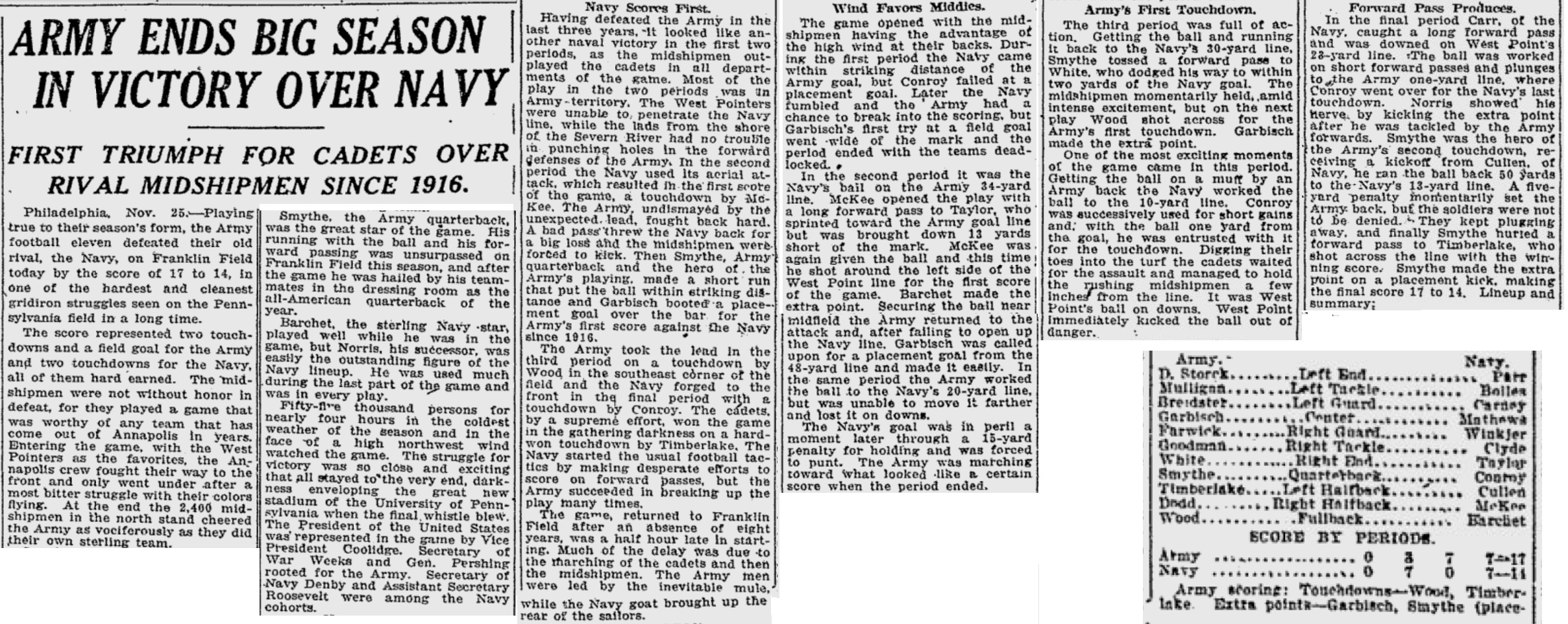
Army’s George Smythe proved to be a thorn in Navy’s side, as his 47-yard punt return set up his seven-yard touchdown pass to Fran Dodd and gave the Cadets a 17-14 win before 55,000 fans at Philadelphia’s Franklin Field. Trailing 10-7, momentum swung to Navy’s side as Vince Conroy’s one-yard touchdown run gave the Midshipmen a 14-10 lead at the start of the fourth quarter. However, the excitement shifted back to the Army sideline, as Smythe’s punt return and touchdown pass gave the Cadets a lead they would not relinquish. The Army defense clinched the victory by stopping Navy at the Cadet 22-yard line late in the game. Despite the final outcome, the Midshipmen won the statistical battle, outgaining Army, 283-154.
Coolidge, Weeks and Denby to Be on Hand for Army-Navy Clash…- Boston Daily Globe – Nov 22, 1922
CHEERING THRONGS GREET ARMY TEAM; West Point Delegation Gets a Great Welcome Upon Arrival in Philadelphia. – New York Times – – Nov 24, 1922
PHILADELPHIA, Nov. 23.–From the time the West Point football squad, thirty-six strong, arrived at the Reading Terminal at 1:25 o’clock this afternoon until it arrived at Green Hill Farms. Overbrook, the players were greeted lavishly. http://query.nytimes.com/mem/archive-free/pdf?res=F40910F6355A1B7A93C6AB178AD95F468285F9
ARMY PLAYERS OUT ON FRANKLIN FIELD – Boston Daily Globe – Nov 24, 1922
PHILADELPHIA, Nov 23–Behind holted and guarded gates, the Army football team went through a snappy practice on Franklin Field this afternoon in preparation for the annual struggle with the Navy Saturday.
Walter Camp Looks for Much Passing When Army and Navy Elevens Clash – Middies Will Rely on Long Heaves, While Army Will Shoot Over Many Shorter Ones -Atlanta Constitution – Nov 24, 1922
The Army and Navy game at Philadelphia will hold the center of interest in the football world Saturday. This will be due to the fact that the Army has not been defeated and that this is the Year…
ARMY-NAVY TEAMS READY FOR CLASH; Arrive in Philadelphia and Put on Finishing Touches for Today’s Football Struggle.55,000 EXPECTED AT GAME Hotels in Quaker City, Are Full,Streets, Are Crowded and Service Uniforms Everywhere. – New York Times – Nov 25, 1922
PHILADELPHIA, Nov. 24.–This city was invaded without a struggle today, the civil population giving way gracefully to the advance guard of the Army and the Navy. …The usual phrase that Philadelphia Is football mad on the eve of tomorrow’s, the twenty-fifth , Army and Navy game would not be true… http://query.nytimes.com/mem/archive-free/pdf?res=F50715F7355A1B7A93C7AB178AD95F468285F9
ARMY TRIUMPHS BY MIGHTY EFFORT, 17-14 – First Score Against Navy Since 1916–Colorful Scenes For 55,000–Smythe Stars- Boston Daily Globe – Nov 26, 1922
PHILADELPHIA, Nov 25–Playing true to form, the Army football eleven defeated the Navy on Franklin Field today, 17 to 14, in one of the hardest and cleanest gridiron struggles seen on the Pennsylvania field in a long time..
Army Team Stages Rally In Final Period…-Atlanta Constitution – Nov 26, 1922
Playing true to the season’s form the Army football elevens defeated their old rivals, the Navy, on Franklin field today by the score of 17 to 14, in a hard, clean gridiron struggle.
DALY OVERJOYED AT ARMY’S SHOWING; West Point Coach Proud of His Team–Refuses Credit for Victory Over Navy – New York Times – Nov 26, 1922
PHILADELPHIA, Nov. 25–There was a riotous scene within the dressing quarters of the Army players shortly after their victory over the Navy eleven at Franklin Field this afternoon. http://query.nytimes.com/mem/archive-free/pdf?res=F50C1FFD355D14738DDDAF0A94D9415B828EF1D3
Army 0, Navy 0 Nov. 24, 1923 – New York, N.Y.
The 1923 Army-Navy game may have resulted in a scoreless tie, but that doesn’t mean the afternoon was lacking in excitement. After all, when the two teams combine to punt 26 times, something is bound to happen – maybe even more than once. On the first play of the fourth quarter, Army’s Henry Baxter blocked Navy punter Carl Cullen’s kick. The alert Cullen scrambled to recover the punt inside his own 10-yard line, which under the rules allowed Navy to retain possession. Although this was long before instant replay existed, the 65,000 fans were treated to the same incident on Navy’s next punt. Again, the Mids were inside their own 10-yard line as August Farwick got a hand on Cullen’s kick, which the Navy punter also recovered. Navy closed its season with a 14-14 tie against Washington in the Rose Bowl to finish 5-1-3 on the year.
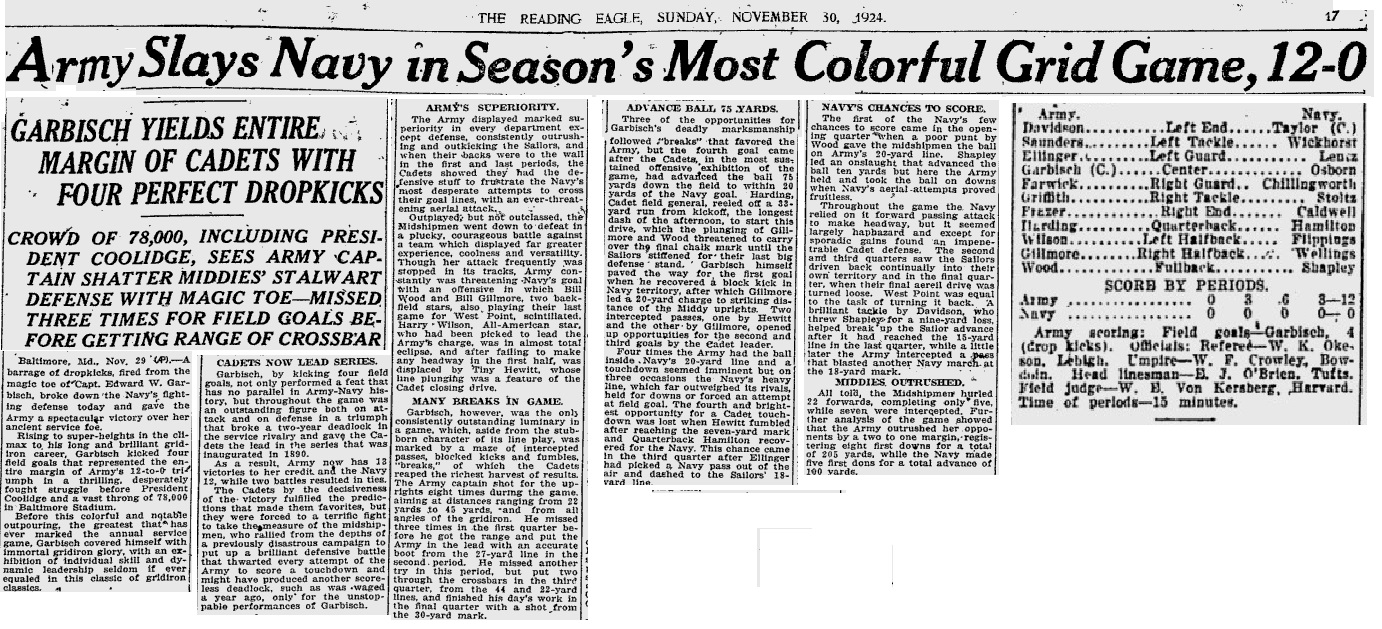
Army 12, Navy 0 Nov. 29, 1924 – Baltimore, Md.
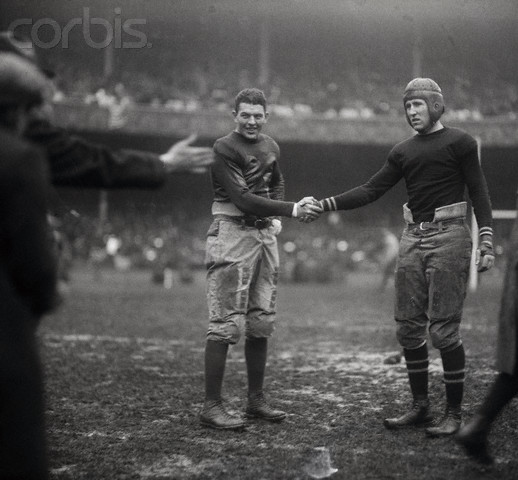
Given the choice of where to play the 1924 Army-Navy game, Annapolis officials chose Baltimore’s 80,000-seat stadium. But this supposed home field advantage did not pay the dividends the Mids had hoped, as Edgar Garbisch booted four field goals to give Army a 12-0 win. He may have accounted for all 12 points, but Garbisch had the opportunity to score 21 against the Mids. Army’s opening drive ended with Garbisch attempting a 30-yard dropkick field goal, however, it was blocked. Garbisch recovered the block, but his 40-yard attempt four downs later fell short. He also had a 45-yard attempt midway through the second quarter that sailed wide. Navy may not have reached the end zone, but it wasn’t due to a lack of effort. The Mids set a then series record by completing 12-of-22 passes for 50 yards. The Army victory gave the Cadets a 13-12-2 series advantage, a lead it would not relinquish for 56 years.
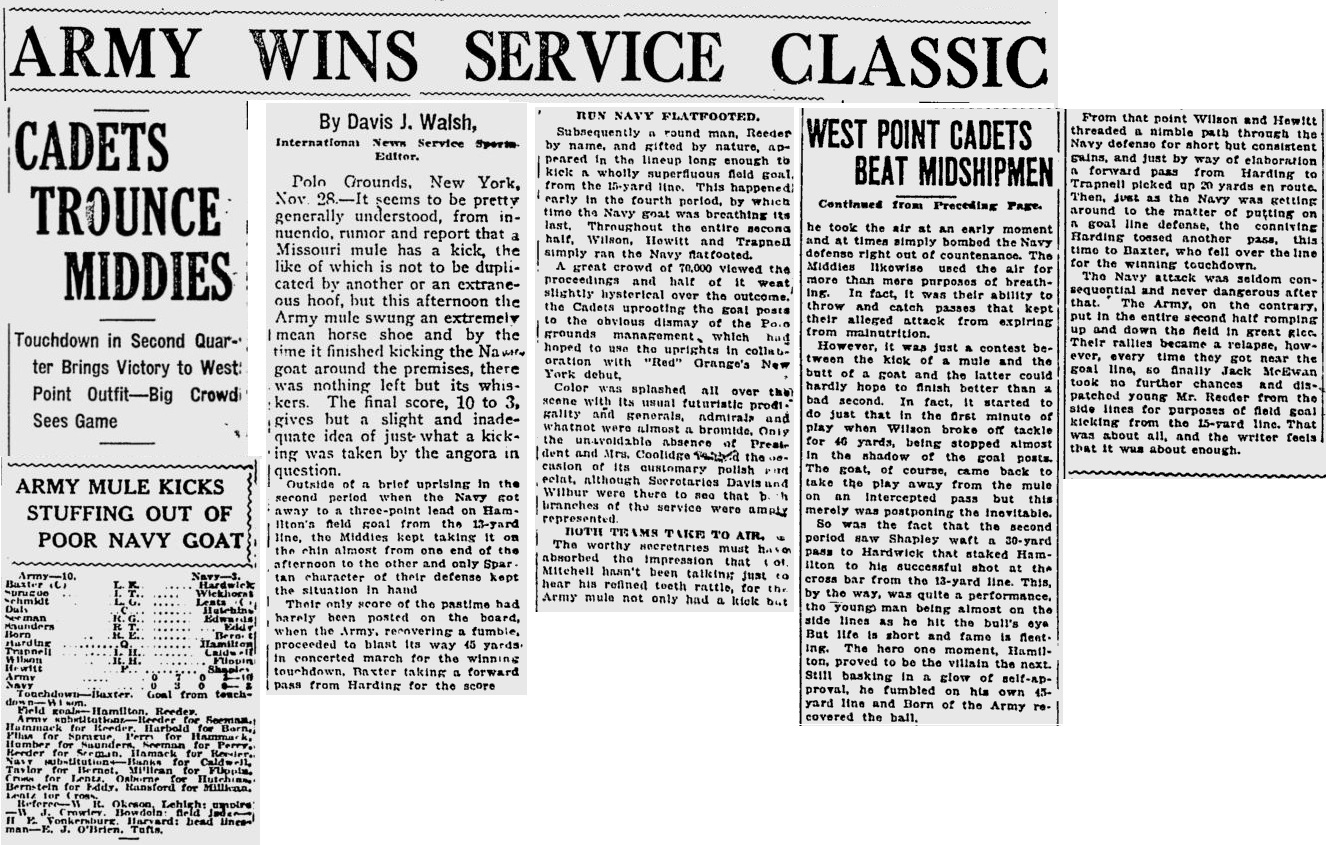
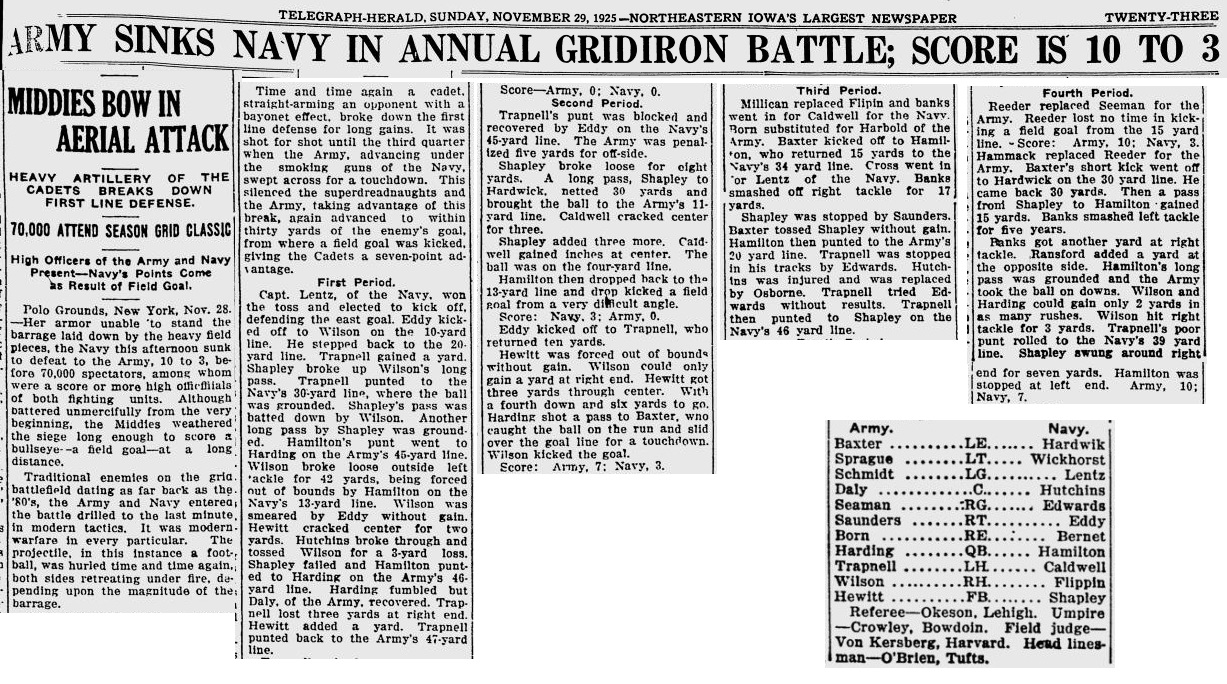
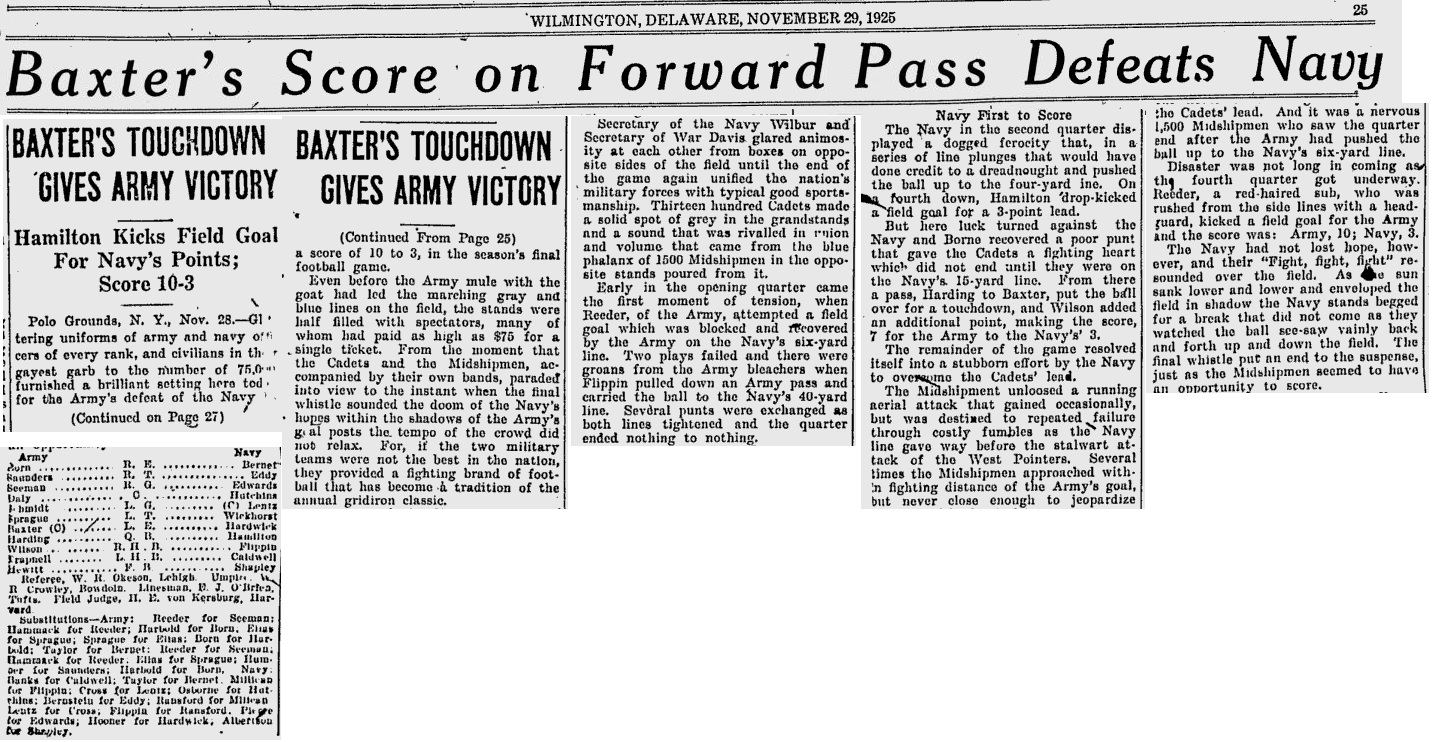
Army 10, Navy 3 Nov. 28, 1925 – New York, N.Y.
Six turnovers proved to be Navy’s demise, as Army held on for a 10-3 triumph before 60,000 fans at the Polo Grounds. After driving to the Army three-yard line early in the second quarter, Navy had to settle for a 12-yard field goal by Tom Hamilton. The Cadets, on the other hand, were able to capitalize upon a fourth down situation just before halftime. On fourth-and-four from the nine, Neil Harding hit Henry Baxter for the touchdown and the 7-3 win. Russell Reeder tacked on a field goal in the fourth quarter for the victory.
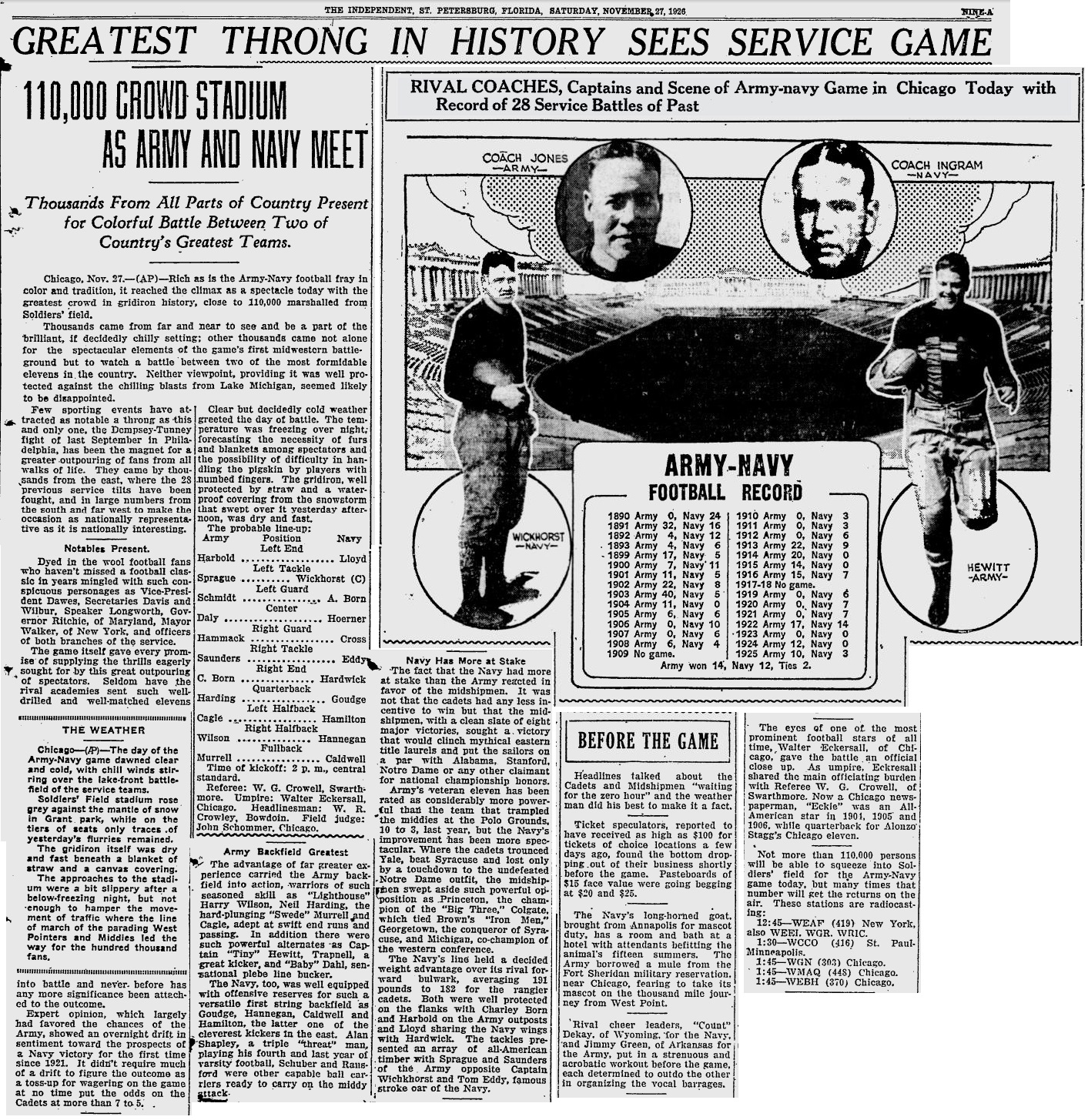
Army 21, Navy 21 – Nov. 27, 1926 – Chicago, Ill.
In his first season as head coach at his alma mater, West Point graduate Biff Jones used an intriguing strategy for the Army-Navy game. By starting his second-team units against the Midshipmen, he hoped to give Navy a false sense of confidence. The Mids took full advantage of the “mismatch,” as touchdown runs by Henry Caldwell and James Schuber handed Army an early deficit. The Cadets responded with three touchdowns, the last a 44-yard run by Chris Cagle, to take the lead by the end of the third quarter. Nonetheless, an eight-yard touchdown run by Alan Shapley in the fourth quarter salvaged a 21-21 tie for Navy. Army may have spoiled the Midshipmen’s bid for a 10-0 record, but coach Bill Ingram’s club still laid claim to the national title.
THE GREATEST ARMY–NAVY
By Ray Schmidt
“…No single game in college football history has ever so completely combined the color, spectacle, national media coverage, public popularity, and top-flight level of play as the Army-Navy battle of 1926 at Soldier Field.
Robert Kelley of the New York Times defined the game’s significance when he wrote that day:
“Football had the greatest pageant, its high spot of color, and so did sport in the United States.” http://www.la84.org/SportsLibrary/CFHSN/CFHSNv17/CFHSNv17n2e.pdf
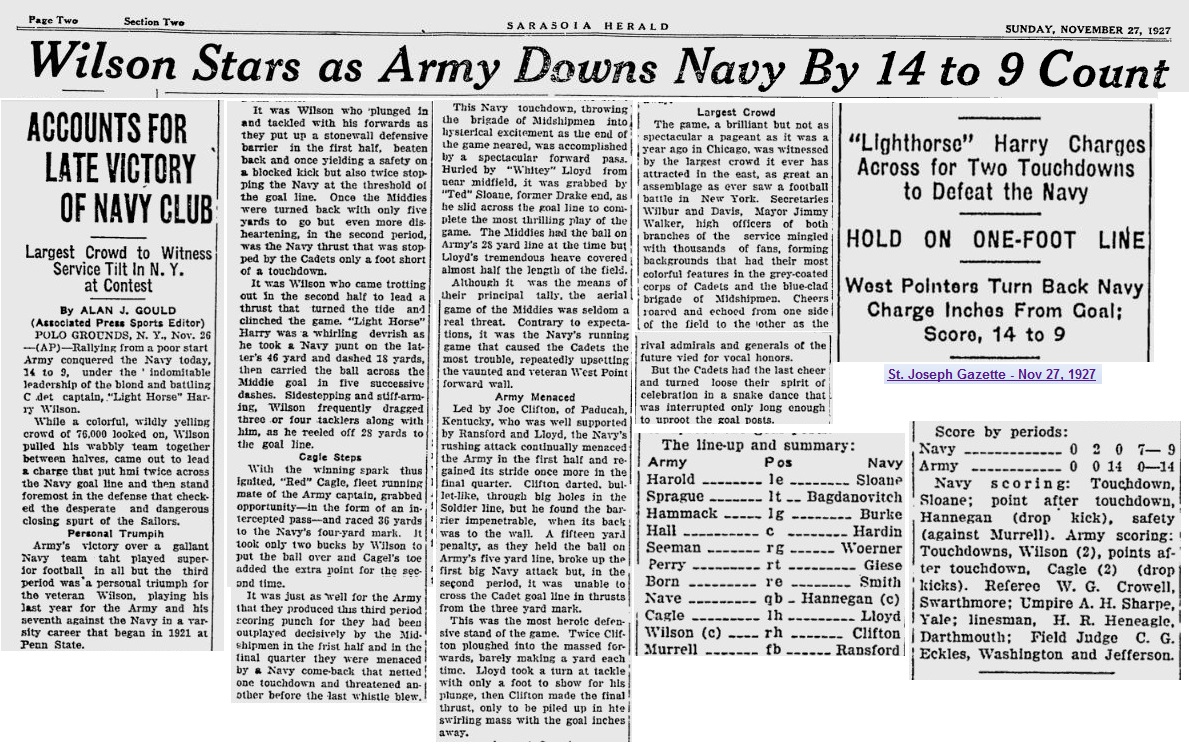
Army 14, Navy 9 Nov. 26, 1927 – New York, N.Y.
In the last Army-Navy game played at the Polo Grounds, the Cadets overcame a pesky Midshipmen club to claim a 14-9 victory. Navy held a 2-0 lead at halftime, but it could have just as easily been 16-0. On its first possession, Navy reached the Army eight-yard line, but came away without a point. Midway through the second quarter, the Mids’ Carl Giese blocked a punt out of the end zone to give Navy a 2-0 lead. Navy had another chance to reach the end zone just before halftime, but Army stopped Joe Clifton on a fourth-and-goal from the one-yard line. A two-yard run by Lighthorse Harry Wilson gave the Cadets a 7-2 advantage early in the third quarter. Army added another touchdown to its lead when Chris Cagle intercepted an Ed Hannegan pass and returned it 41 yards to the Navy four-yard line. Wilson scored again, and Army was on its way to the win.
Navy scored its touchdown when Russell Lloyd hit Ted Sloane on a 28-yard touchdown, but it wasn’t enough.
ArmyFB_1927_vsNavy_SarasotaHeraldTribune_Nov271927
Time Magazine When the U. S. Academies at West Point and Annapolis agreed last summer, after a three-year breach (Editors note – 2 years 1928 & 1929) of athletic relations, to resume playing football with each other, they failed to settle the differences on which the breach was based. Navy like other colleges observes the three-year eligibility rule; at West Point cadets who have played three years of varsity football elsewhere are still eligible for the team. This gives West Point an obvious advantage in Army-Navy games. Navy has not won since 1921.
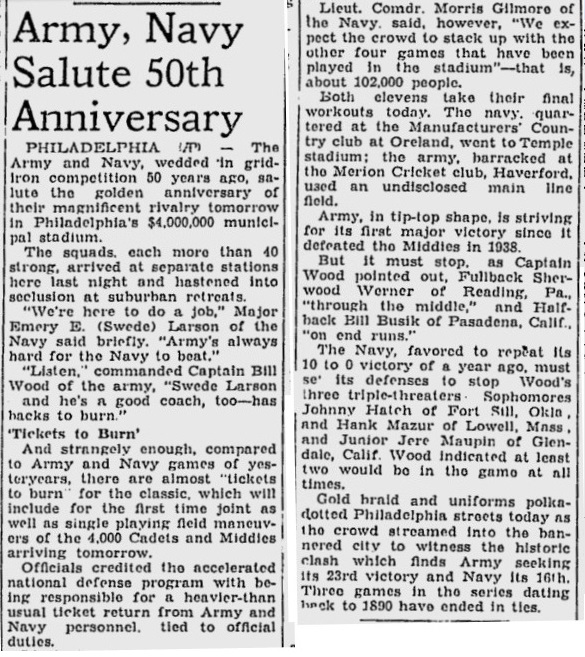
Navy celebrated the 50th anniversary of the Army-Navy game with a solid, all-around effort, resulting in a 14-0 triumph. Navy scored on its first drive, as Bill Busik went the final-two yards for the touchdown to make it 7-0. The Midshipmen covered 54 yards in 12 plays, with Busik accounting for 50 of those 54 yards. Although the Army offense could muster just 107 yards of total offense on the afternoon, the Cadet defense held Navy without a point on its next-two drives, which were halted deep in Army territory. However, the Midshipmen tallied their final score in the third quarter when Howie Clark tossed a nine-yard touchdown pass to Everett Malcolm.
–
–
Navy 14, Army 6 Nov. 29, 1941 – Philadelphia, Pa.
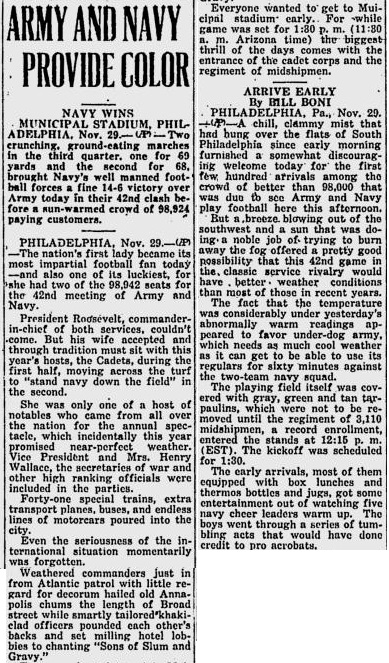
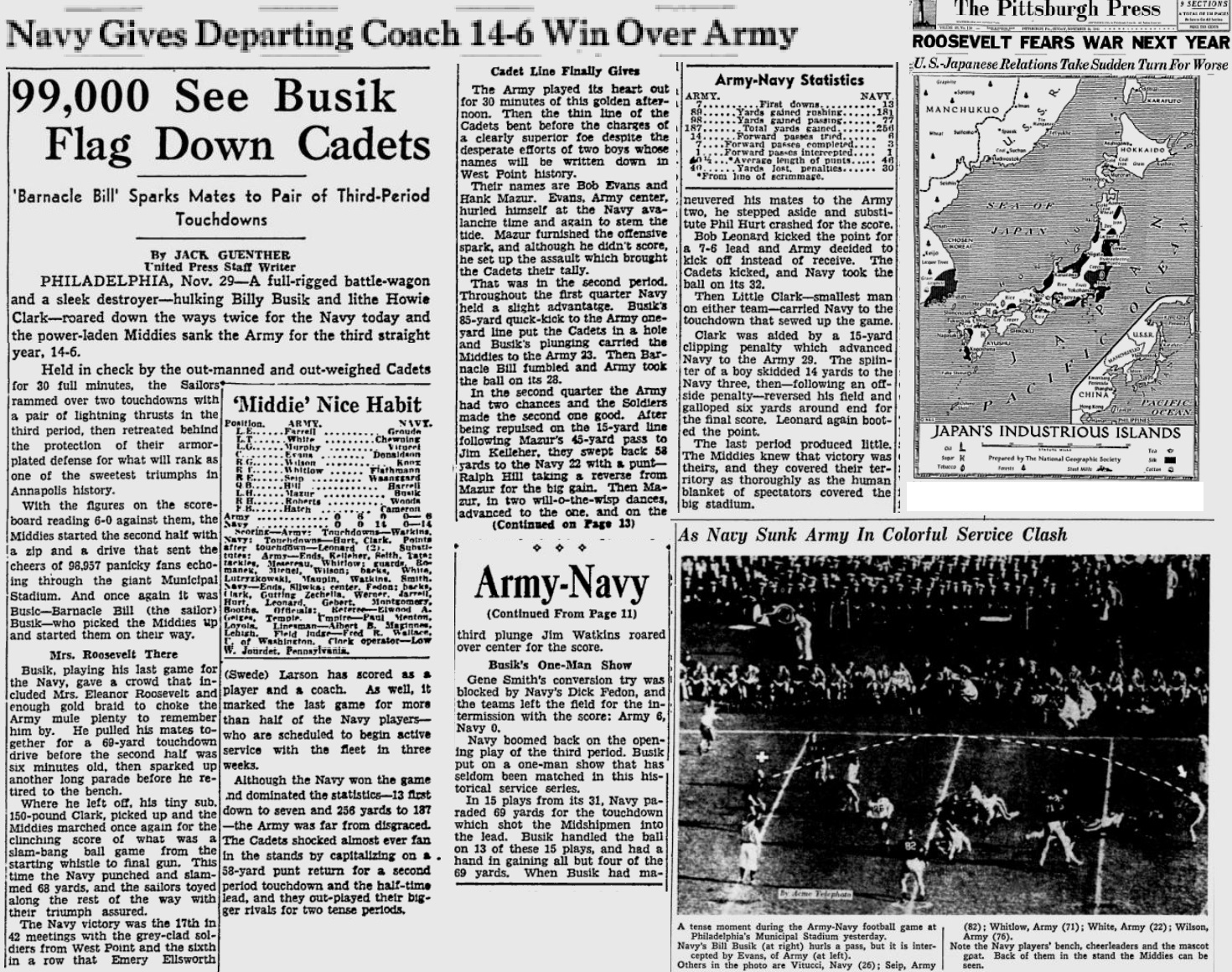
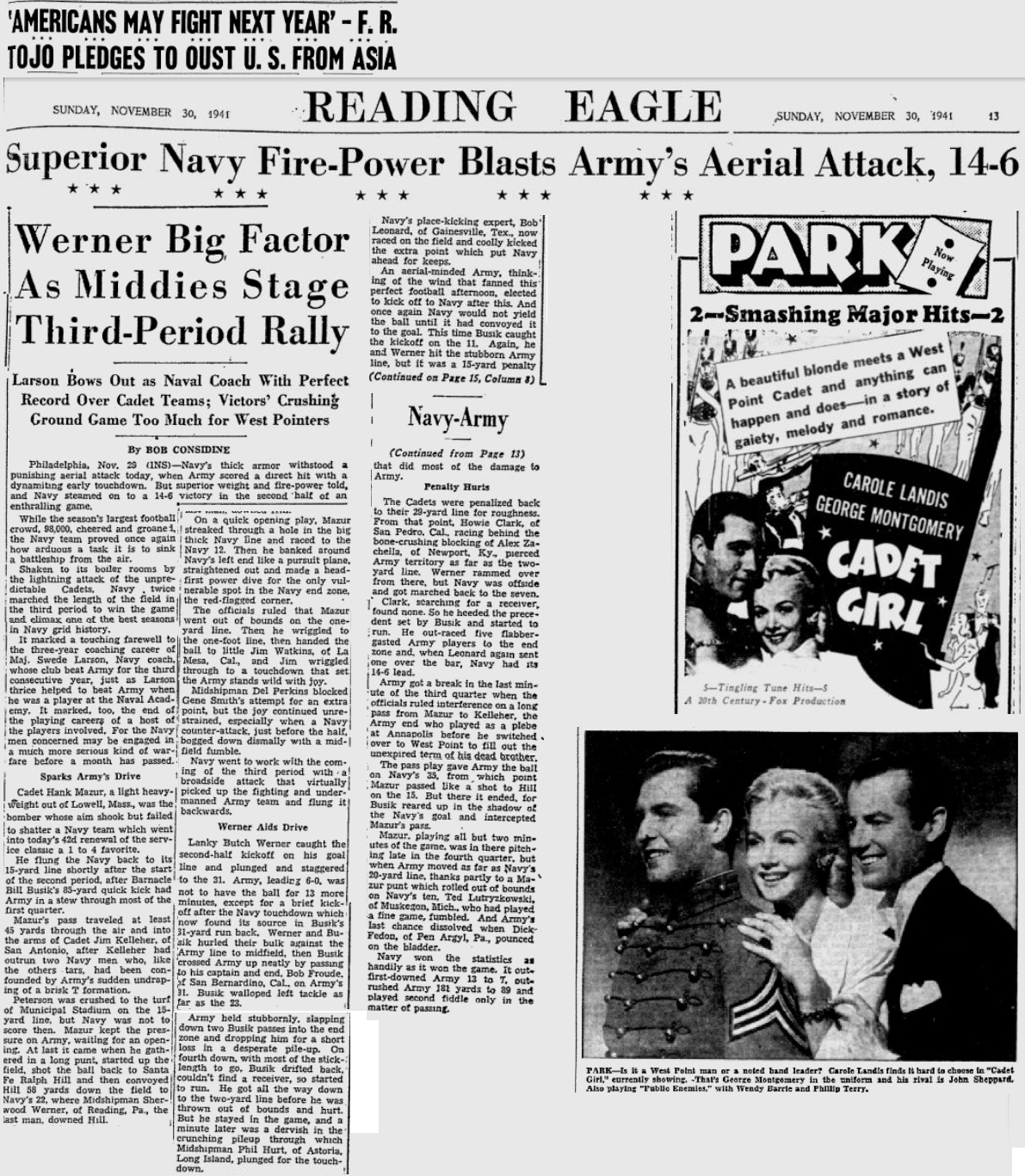
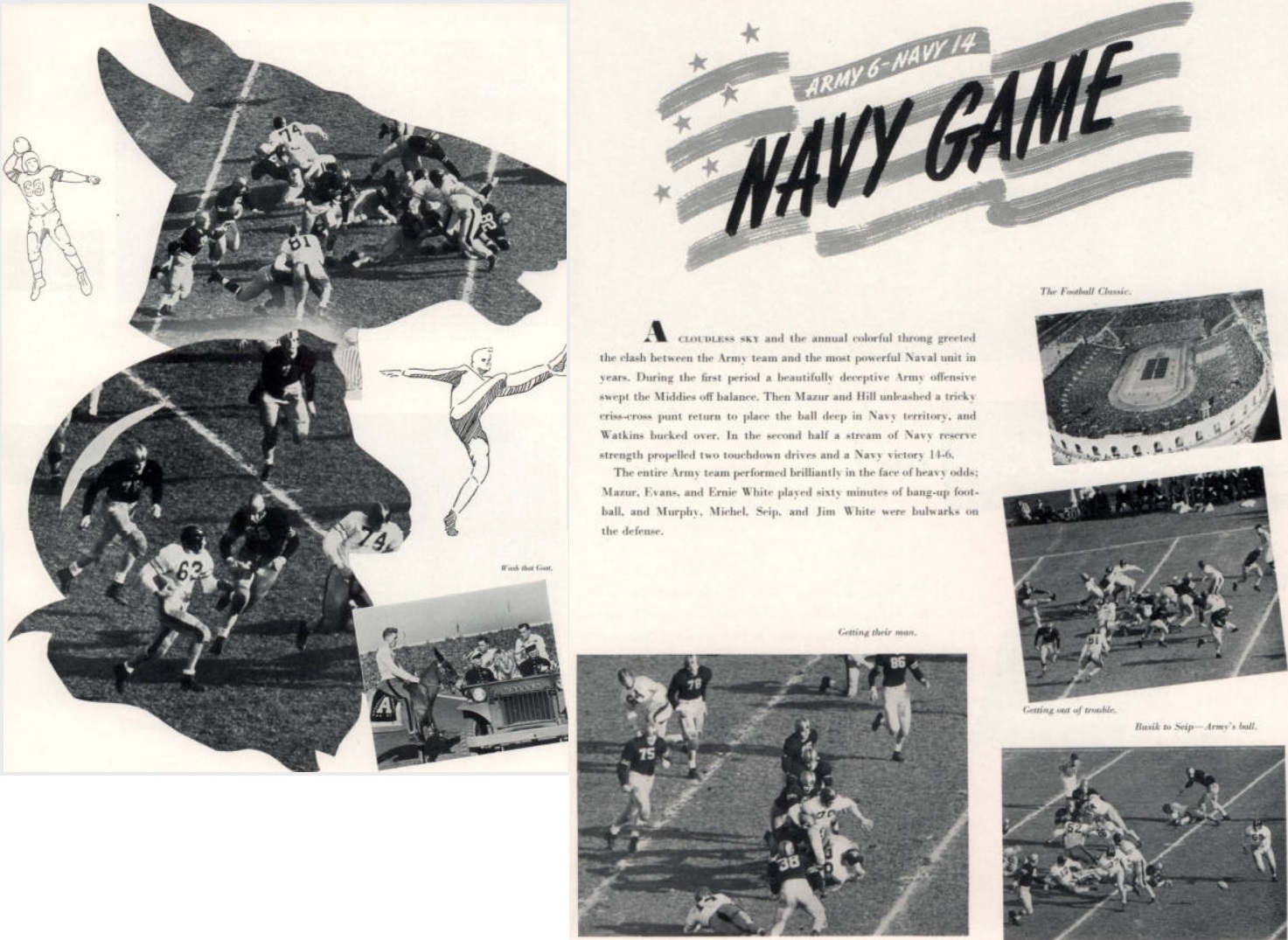
As a Naval Academy player from 1919-21, Swede Larson never lost to Army. And in his first-two years as head coach, his teams shut out the Cadets by a combined score of 24-0. But prior to the 1941 Army-Navy contest, the Marine major was informed he was being sent to the Naval War College in Newport, R.I., immediately after the football season. As you can imagine, he wanted nothing more than a final victory over Army, which is why he was less than pleased when his club trailed West Point, 6-0, at halftime. Challenging his team to win its last battle on the football field, the Midshipmen answered the call in the second half. Bill Busik’s effective running and passing set up touchdowns by Phil Hurt and Howie Clark, which led to a 14-6 Navy win.
–
–
–
–
Col Blaik’s Teams were to lose to Navy in 42 & 43 before Army would win 4 straight.
–
–
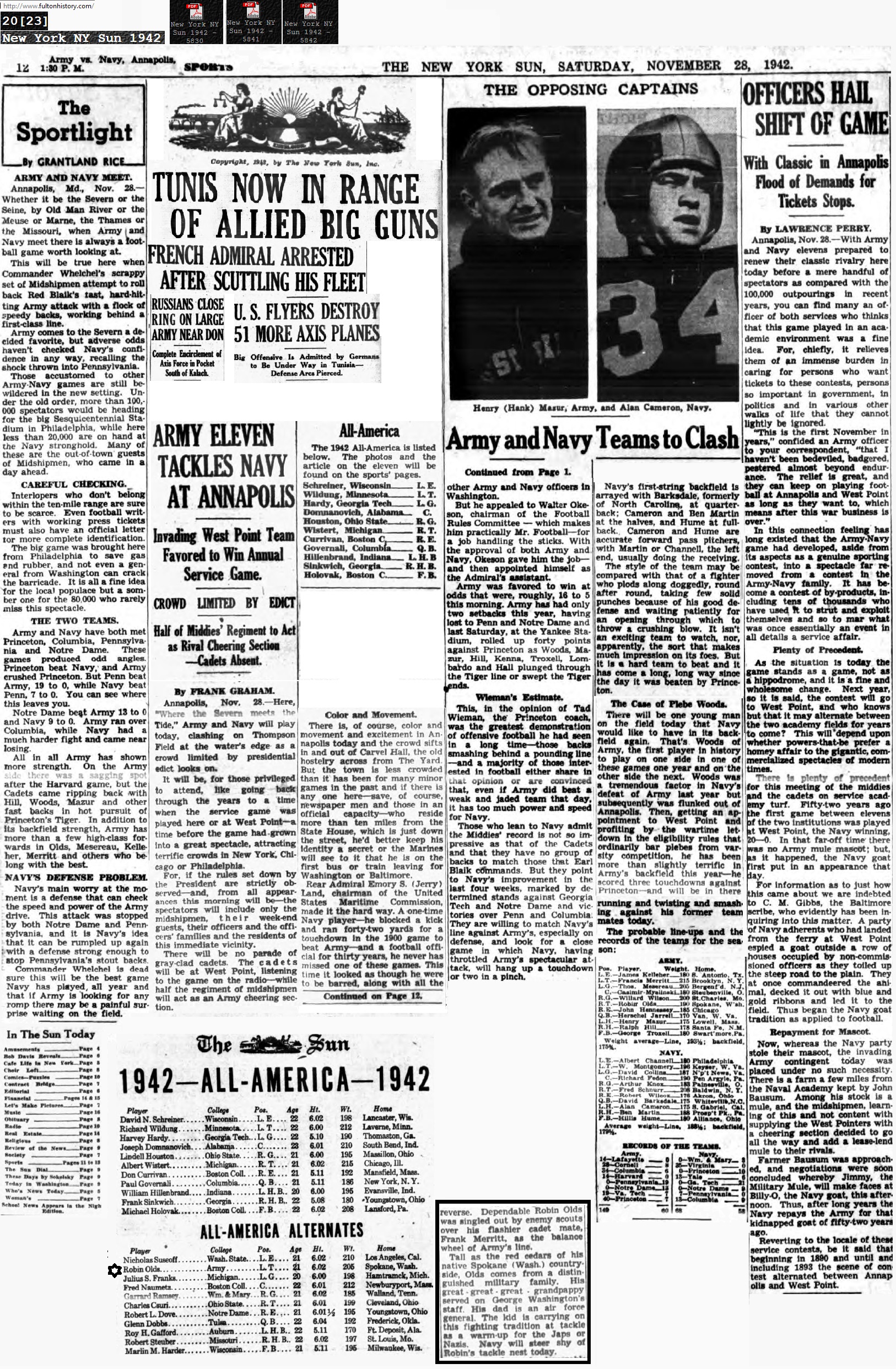
Navy 14, Army 0 Nov. 28, 1942 – Annapolis, Md.
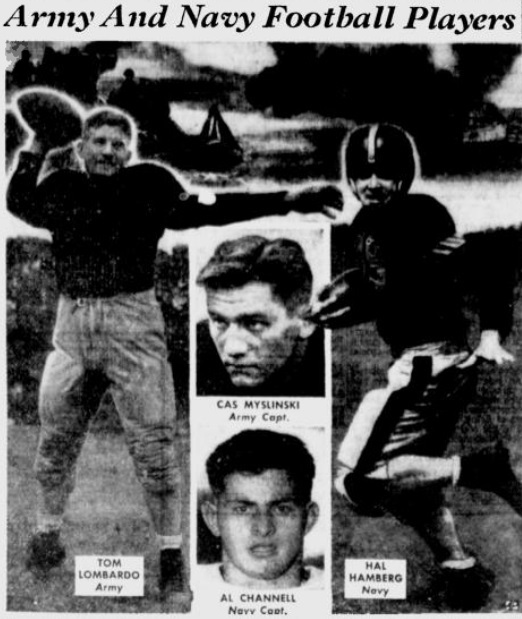
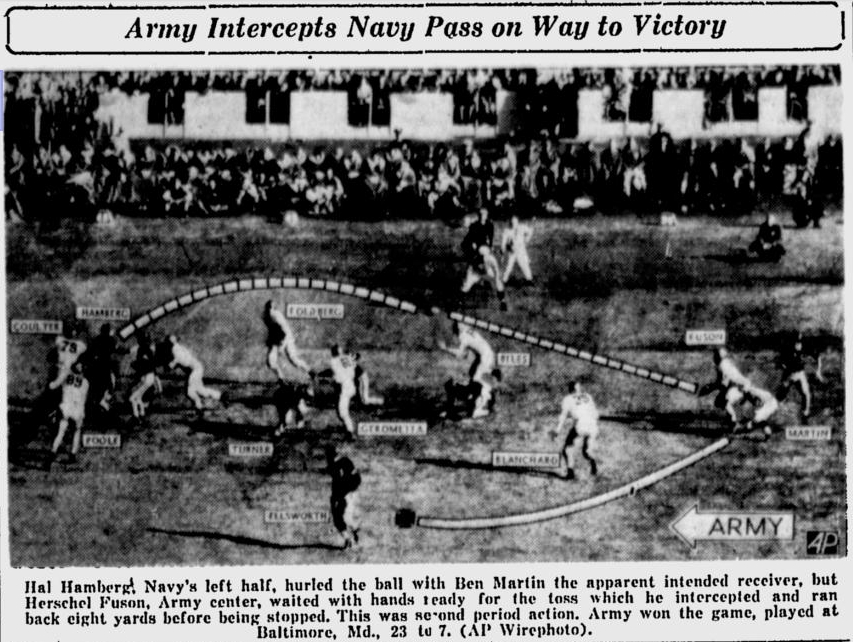
In an effort to conserve transportation resources due to World War II, the Army-Navy game was moved to Annapolis in 1942 and West Point for 1943. This meant the West Point Corp of Cadets, with the exception of two cheerleaders, would not be permitted to attend the game, nor would anyone else outside a 10-mile radius of the Maryland state capital. Thus, half of the Brigade of Midshipmen would serve as the Army cheering section, while the other half would root for the Mids. As it turns out, the Cadets would need much more help than this, as Navy turned back Army, 14-0. Backup halfback Joe Sullivan opened the scoring with a short touchdown run in the second quarter. Hillis Hume set up the other touchdown with an interception deep in Cadet territory midway through the third stanza. Hal Hamberg proceeded to hit Ben Martin with an 18-yard scoring strike. Hume clinched the win with another interception of Army quarterback Doug Kenna at the Navy seven-yard line.
–
no film of the stateside game – meanwhile there was a war on! but overseas – a “not your average” Army – Navy game took place –
–
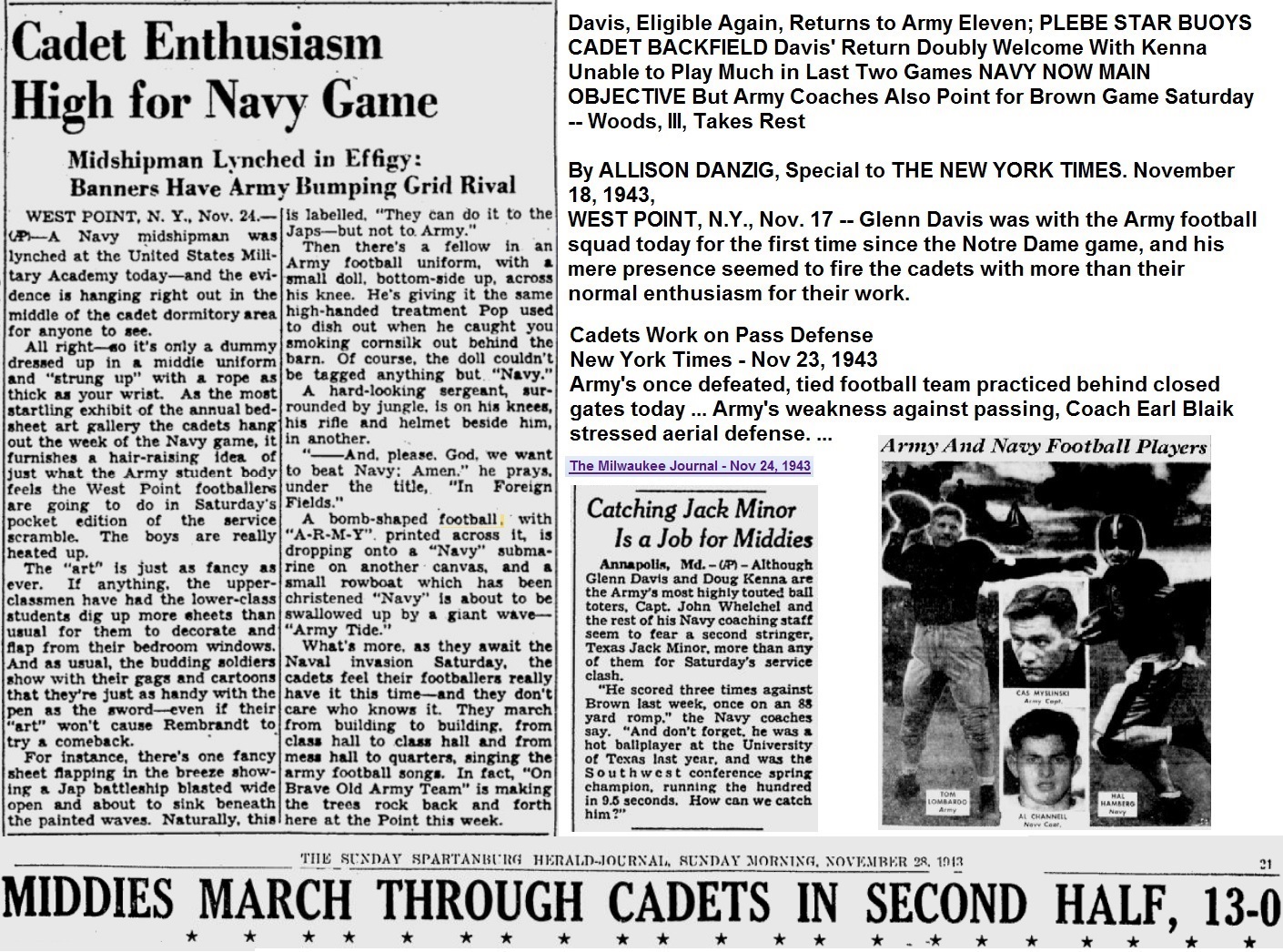
Navy 13, Army 0 Nov. 27, 1943 – West Point, N.Y.
For the first time in 50 years, West Point, N.Y., played host to an Army-Navy game. The Midshipmen were less than gracious guests on the field, however, scoring two touchdowns in the second half of a 13-0 triumph. In the first half, Army got inside the Navy 40-yard line three times but failed to reach the end zone. Navy finally cracked the scoreboard midway through the third quarter when Bob Jenkins capped a 42-yard drive with a one-yard touchdown run. Jim Pettit then contributed two of the game’s biggest plays, one on each side of the ball. His one-yard touchdown run stretched the lead to 13-0, and he halted an Army drive at the Navy 24 when he intercepted Doug Kenna’s pass.
–
–
Army 23, Navy 7 Dec. 2, 1944 – Baltimore, Md.
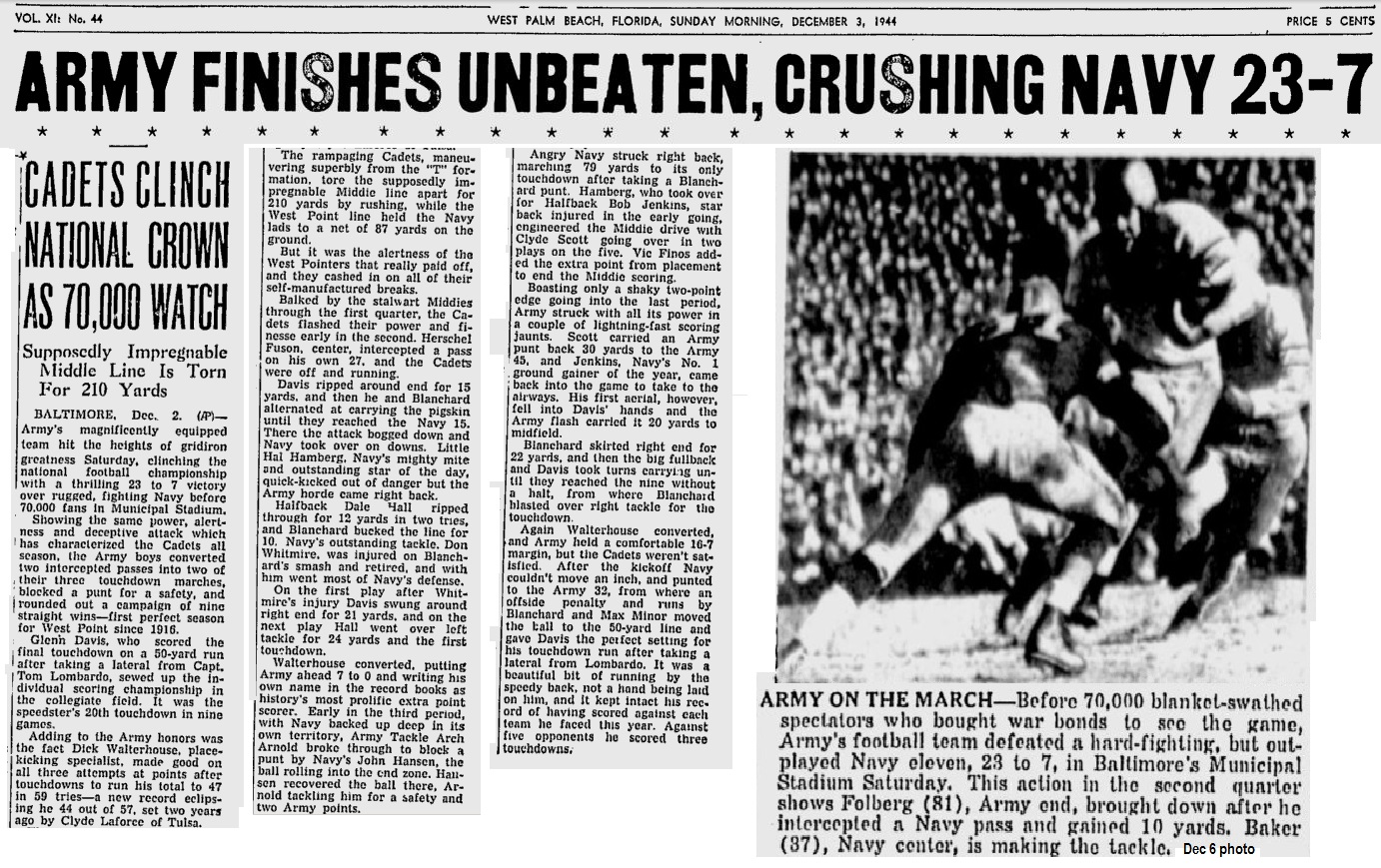
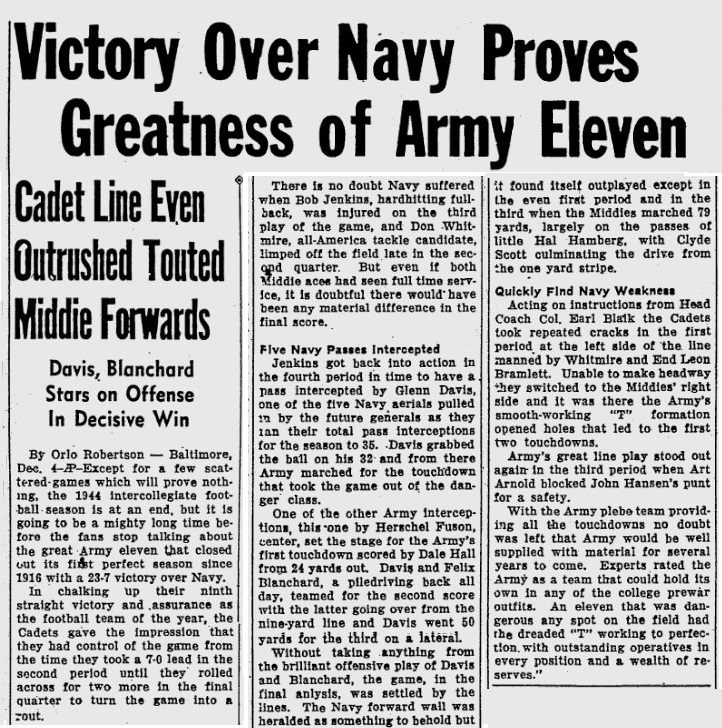
Two weeks prior to the 1944 Army-Navy game, President Franklin D. Roosevelt announced the contest would be moved from Annapolis to Baltimore as part of the “Sixth War Bond Drive.” The U.S. Treasury Department designated 20,000 seats as War Bond Seats. In other words, buy a war bond and get a free ticket to the game. The arrangement not only generated $58.6 million in war bonds, but also allowed 70,000 fans to see a 23-7 Army win. “Dale Hall” put Army on the scoreboard with a 20-yard touchdown run, and Joe Stanowicz’s blocked punt in the end zone stretched the lead to 9-0 in the third quarter. Clyde Scott’s one-yard touchdown run cut the deficit to 9-7, but “Mr. Inside,” “Doc Blanchard”, and “Mr. Outside,” “Glenn Davis”, each scored fourth-quarter touchdowns to put the game out of reach. The 9-0 Cadets closed the fall atop the Associated Press poll, while 6-3 Navy finished fourth.
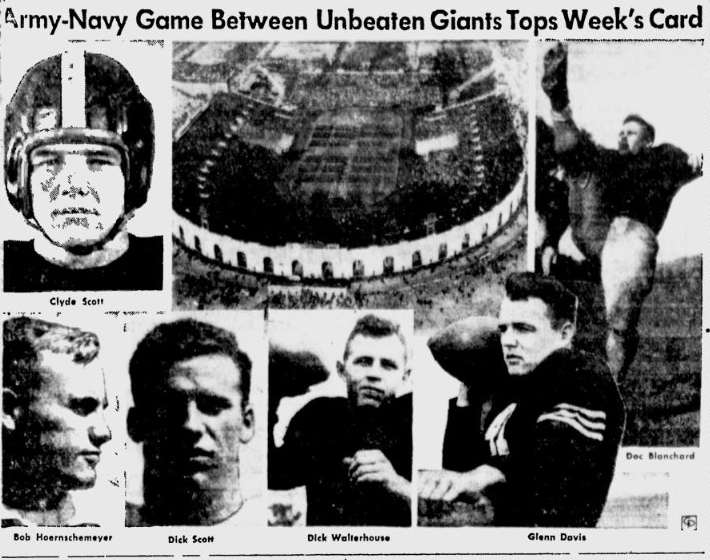
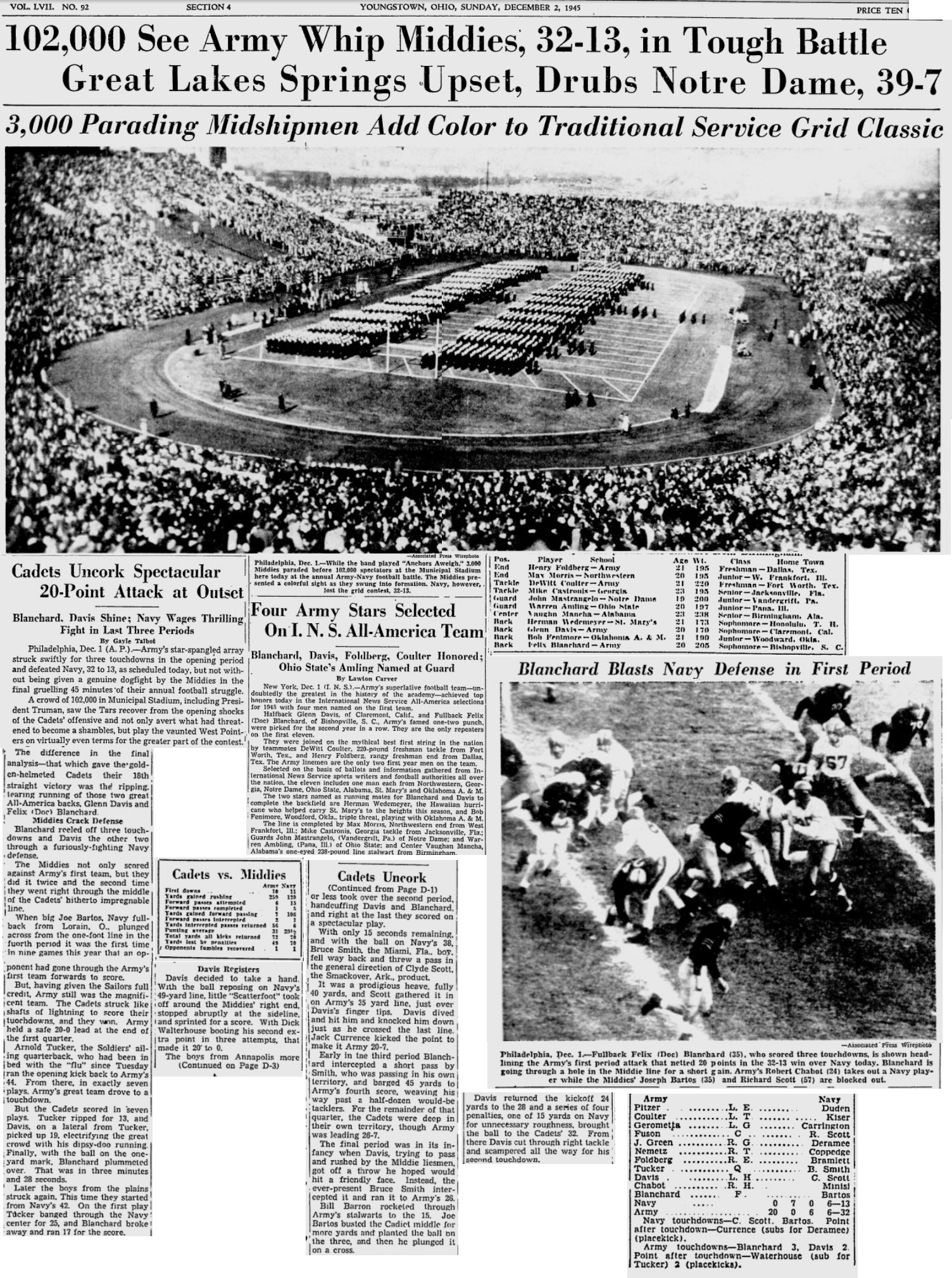
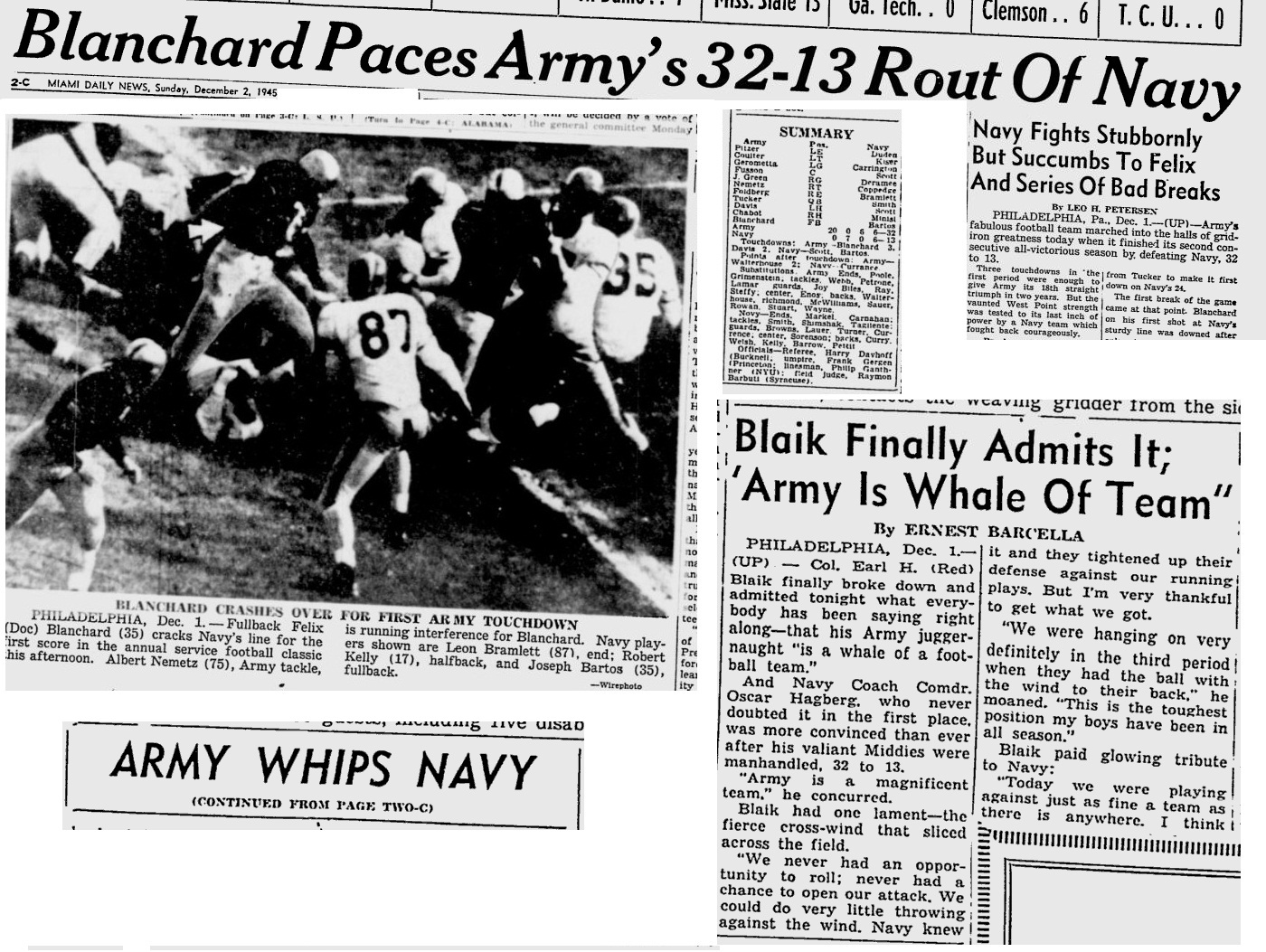
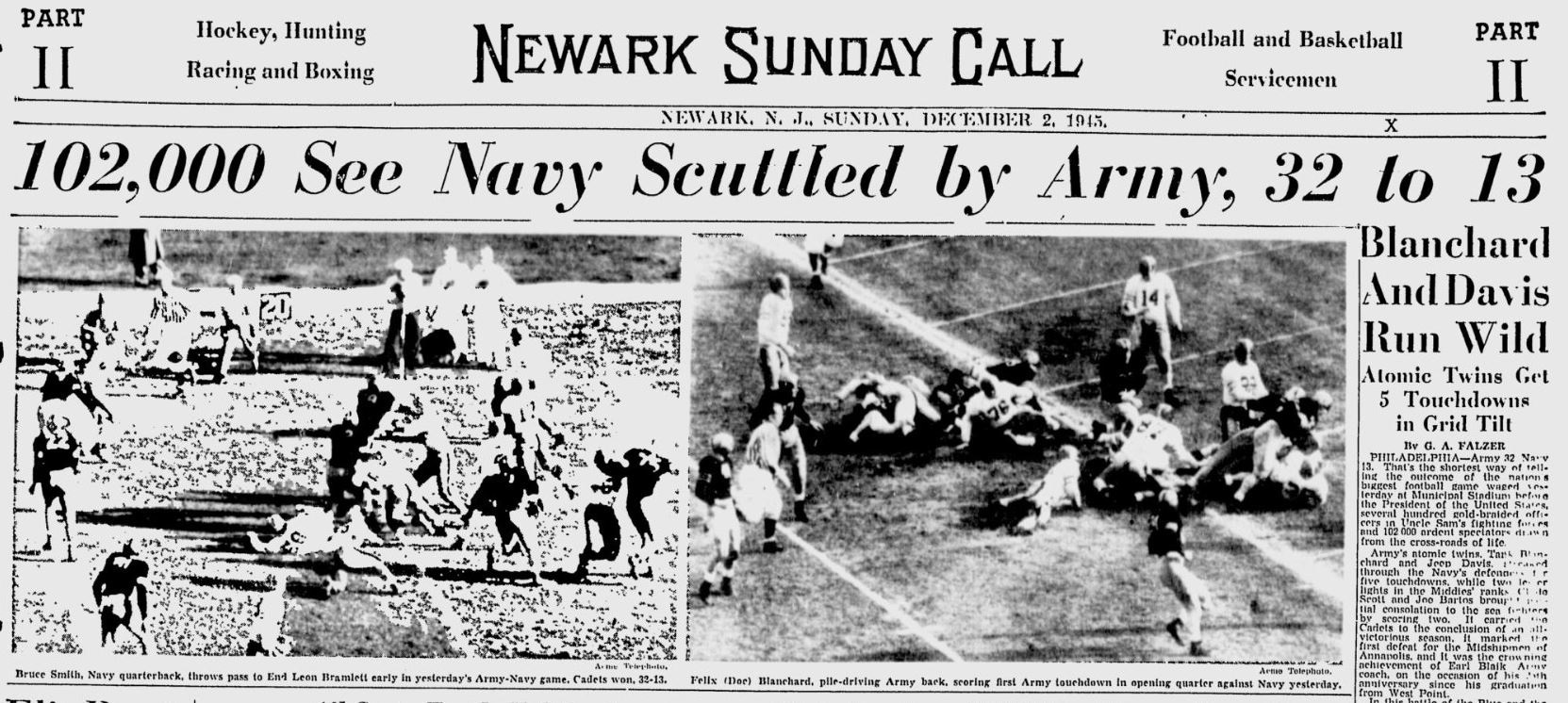
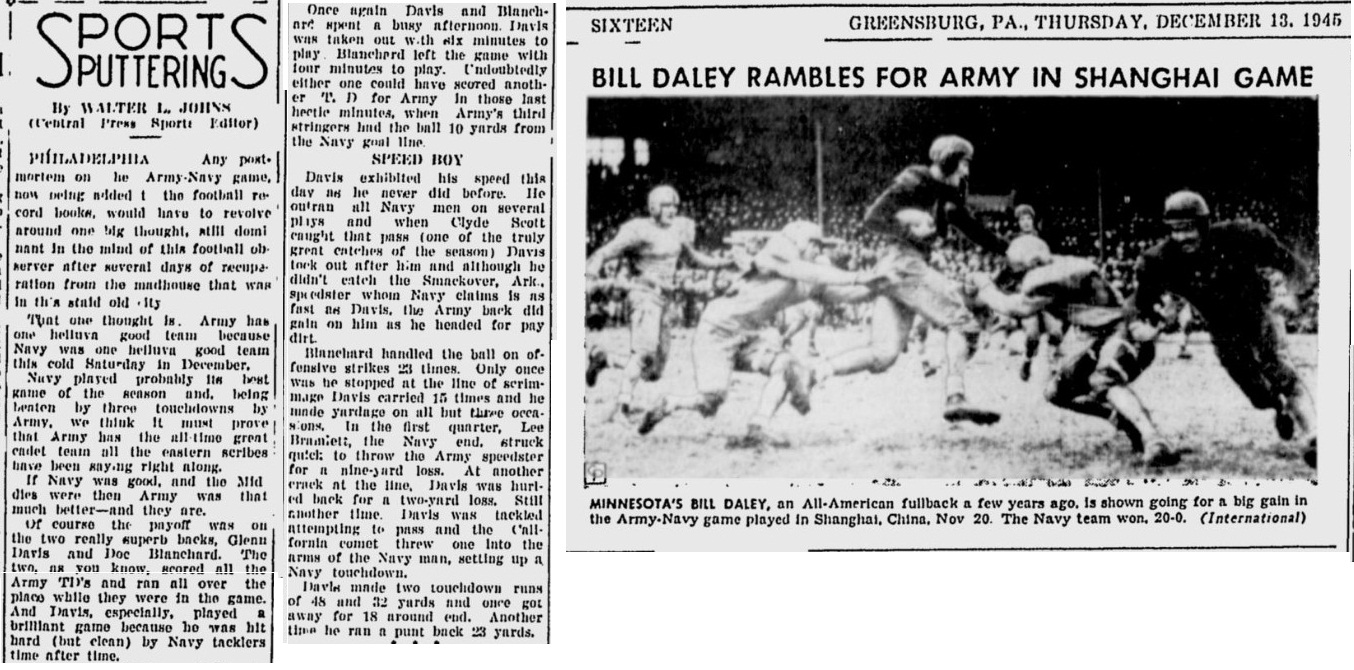
Navy entered the 1945 season finale toting a 7-0-1 record. The No. 2 Midshipmen defense opened the season with three-consecutive shutouts and had never allowed more than one touchdown in any of the following five contests. However, it hadn’t played an offense as potent as No. 1 Army, who posted a decisive 32-13 win. Felix “Doc Blanchard” caught the attention of the Heisman Trophy voters, who awarded the Army halfback with the honor days after his three-touchdown performance. The Cadets jumped out to a 20-0 lead, and the Mids were unable to recover. They scored their first touchdown on a 39-yard Bruce Smith-to-Clyde Scott touchdown to cut the halftime deficit to 20-7. Blanchard erased any hope of a Navy comeback when he intercepted Smith’s pass and returned it 52 yards for his last touchdown of the game. Smith returned the favor by intercepting a “Glenn Davis” pass to set up Navy’s second touchdown, a Joe Bartos three-yard plunge. Finally, Davis atoned for his aerial miscue by scampering 28 yards for the final score to give Army the win and eventual national title.
–
–
–
–
–
–
couldnt find a A-N 45 hilite – but here is an intersting film on the 1945 team in training
–
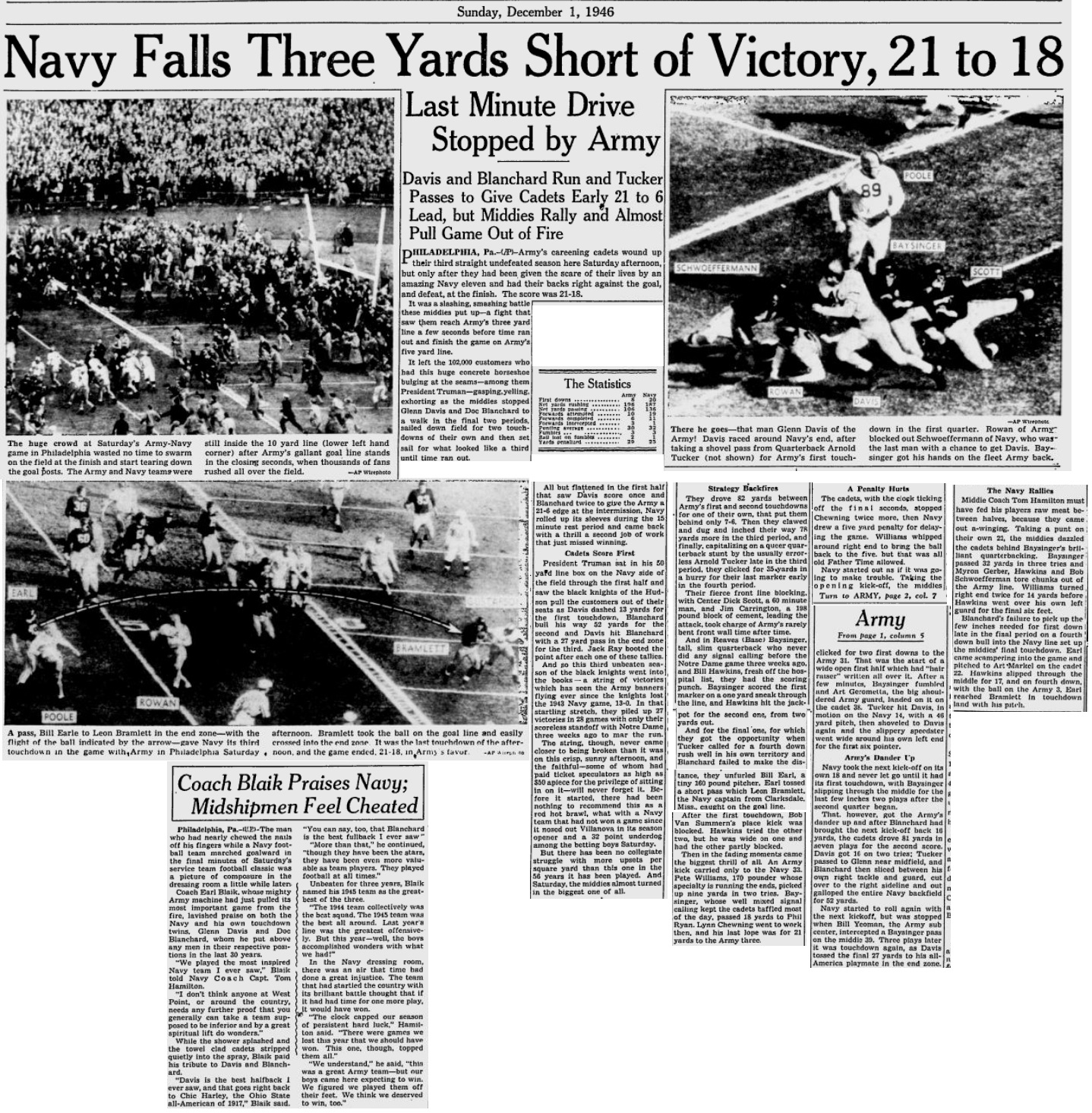
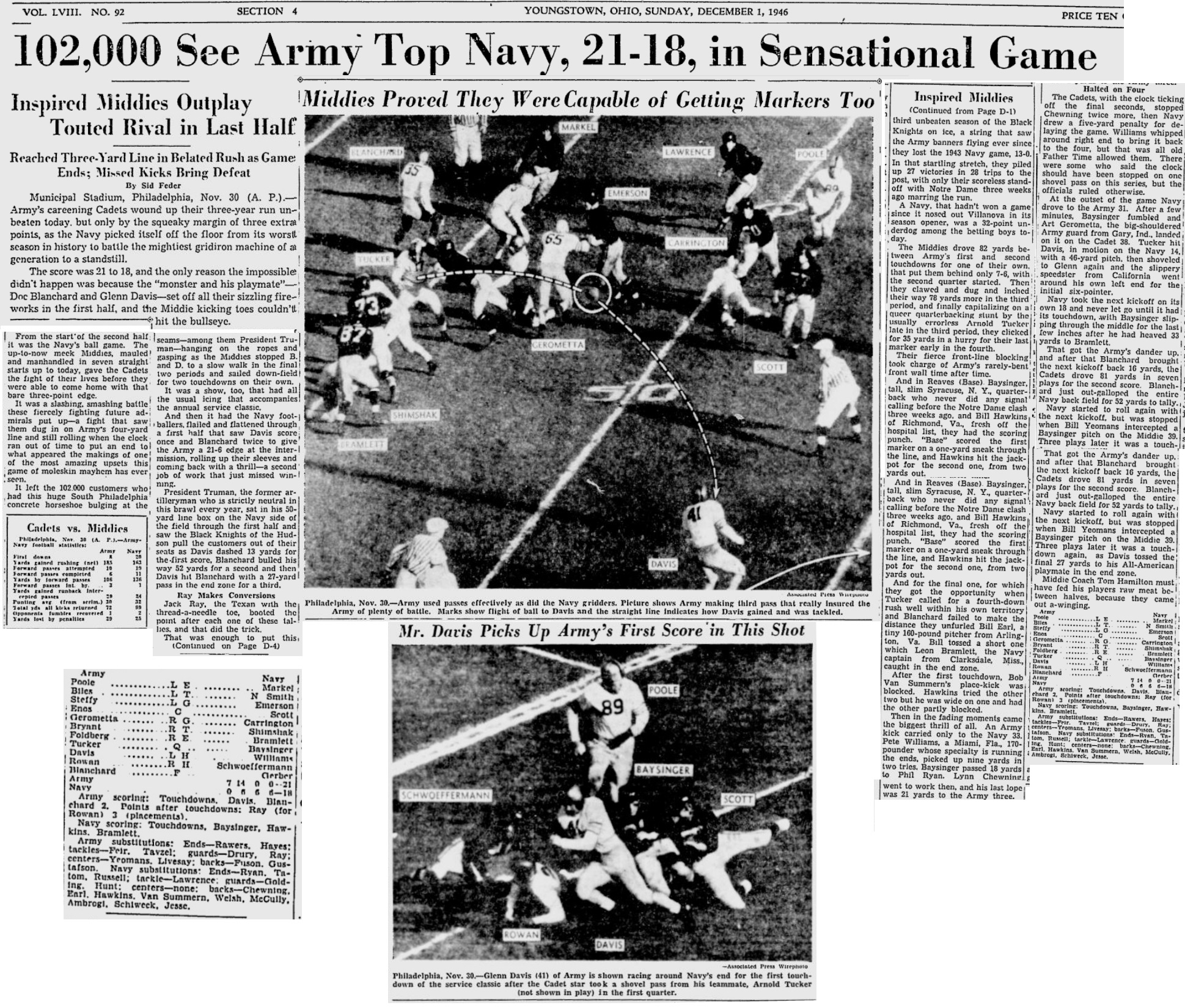
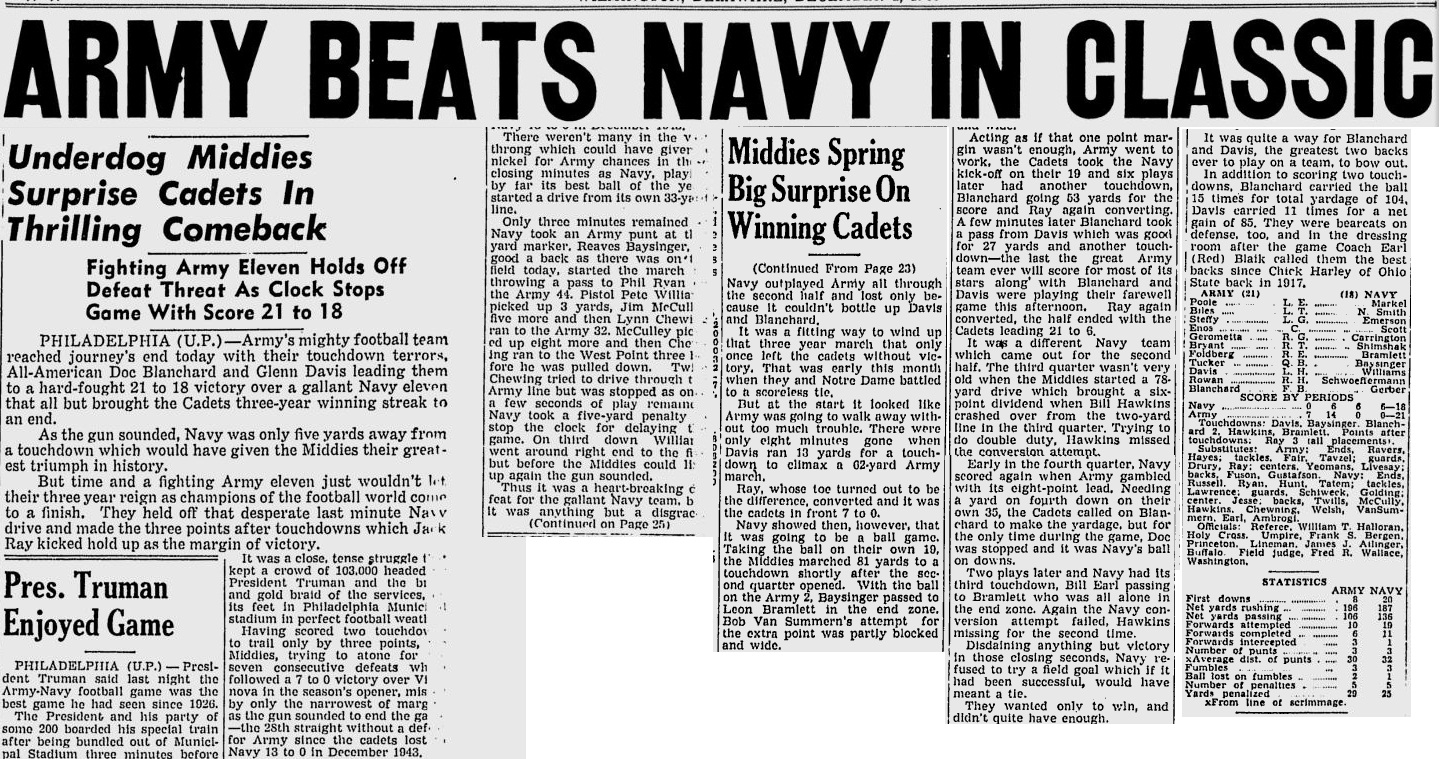
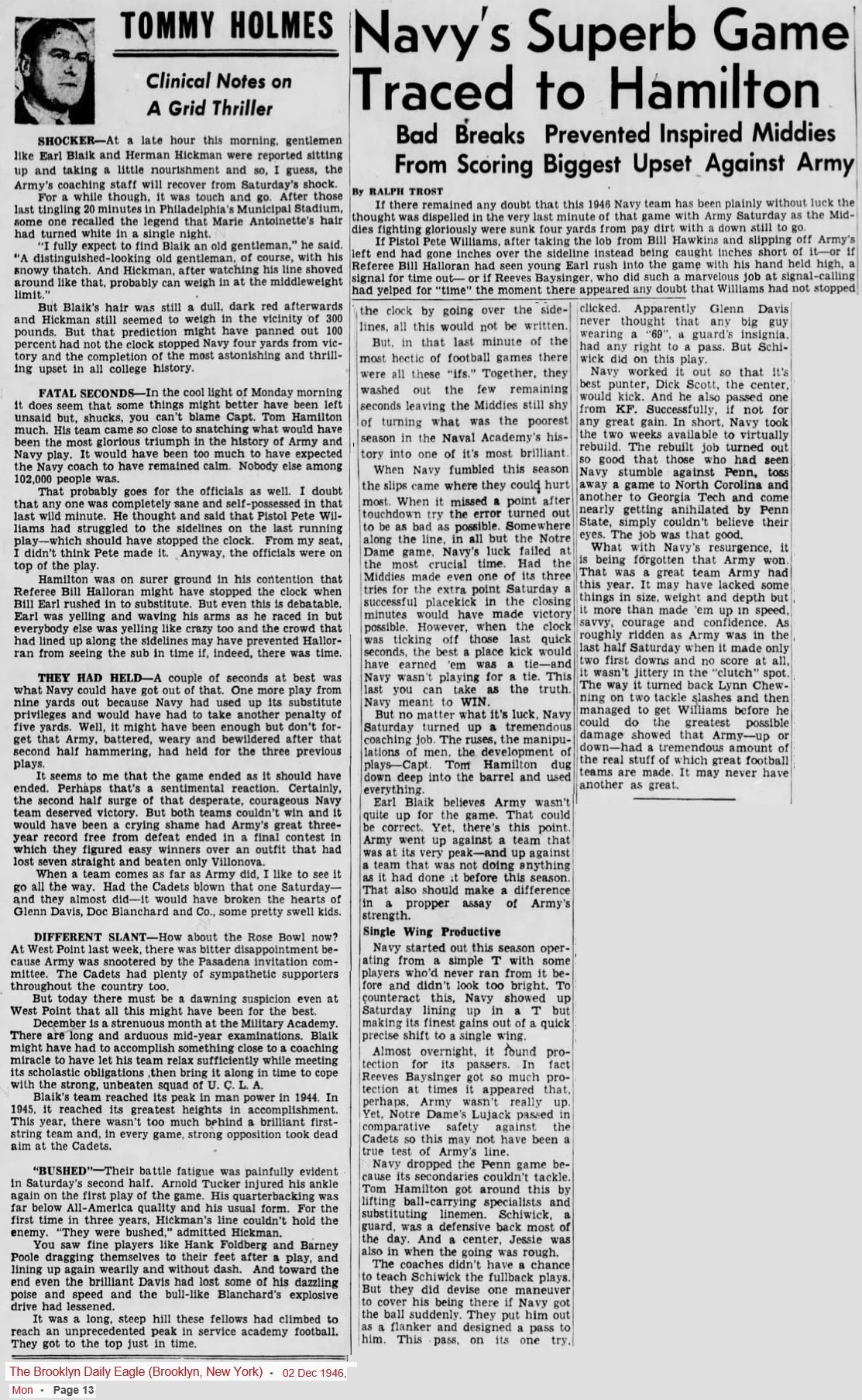
Army 21, Navy 18 Nov. 30, 1946 – Philadelphia, Pa.
After finishing second in the final 1945 AP poll, Navy endured the other end of the spectrum in 1946. With just eight returning lettermen, Navy struggled to a 1-8 campaign. While these eight losses included a 21-18 defeat at the hands of rival Army, it was the Cadets who held the short end of the stick when all was said and done. Three weeks before its annual grudge match against Navy, No. 2 Army and No. 1 Notre Dame played to a scoreless tie. And while the Cadets would battle the Mids on Nov. 30, the Fighting Irish were set to meet Southern California. Thus, the outcomes on this day were critical to the final AP polls. Down 21-6 at halftime, Navy came back with a pair of touchdowns in the third quarter Bill Hawkins had a two-yard rushing touchdown, and Reaves Baysinger hit Leon Bramlett for a short touchdown to bring the Midshipmen within three points. Unfortunately for the Mids, they were unable to convert on any of the extra points, and the Cadets prevailed. Unfortunately for Army, AP voters took more notice of Notre Dame’s 26-6 victory than they did of Army’s narrow triumph, voting Notre Dame first in the final AP poll.
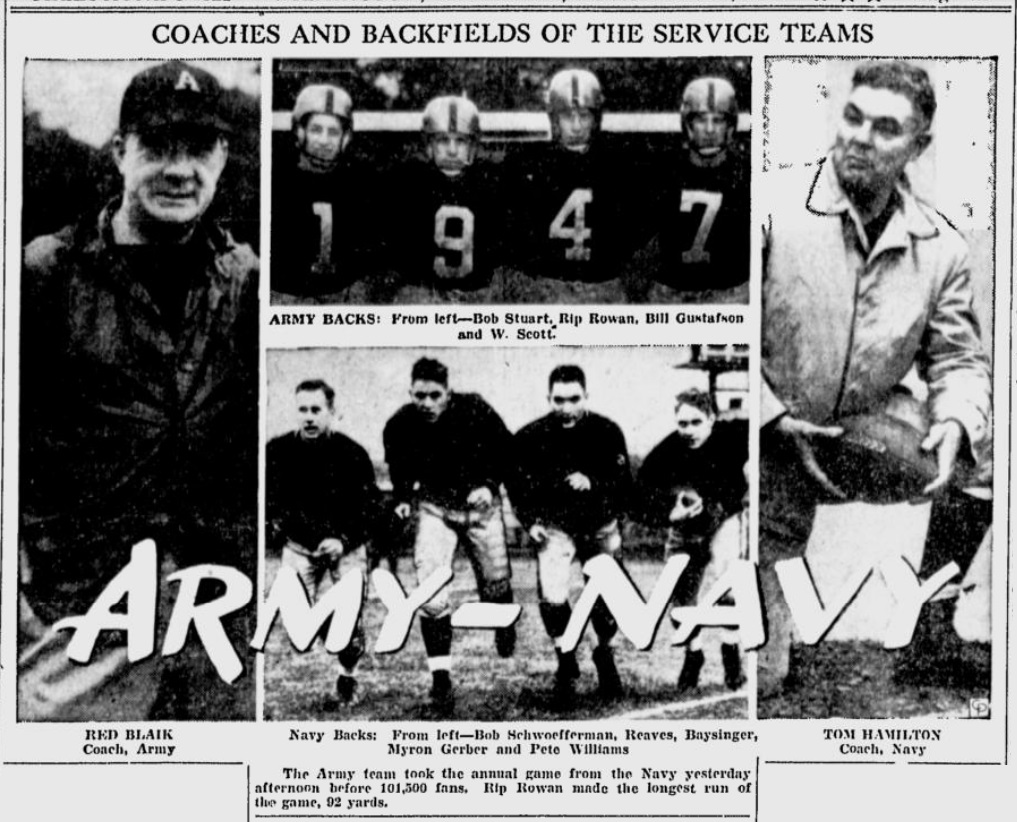
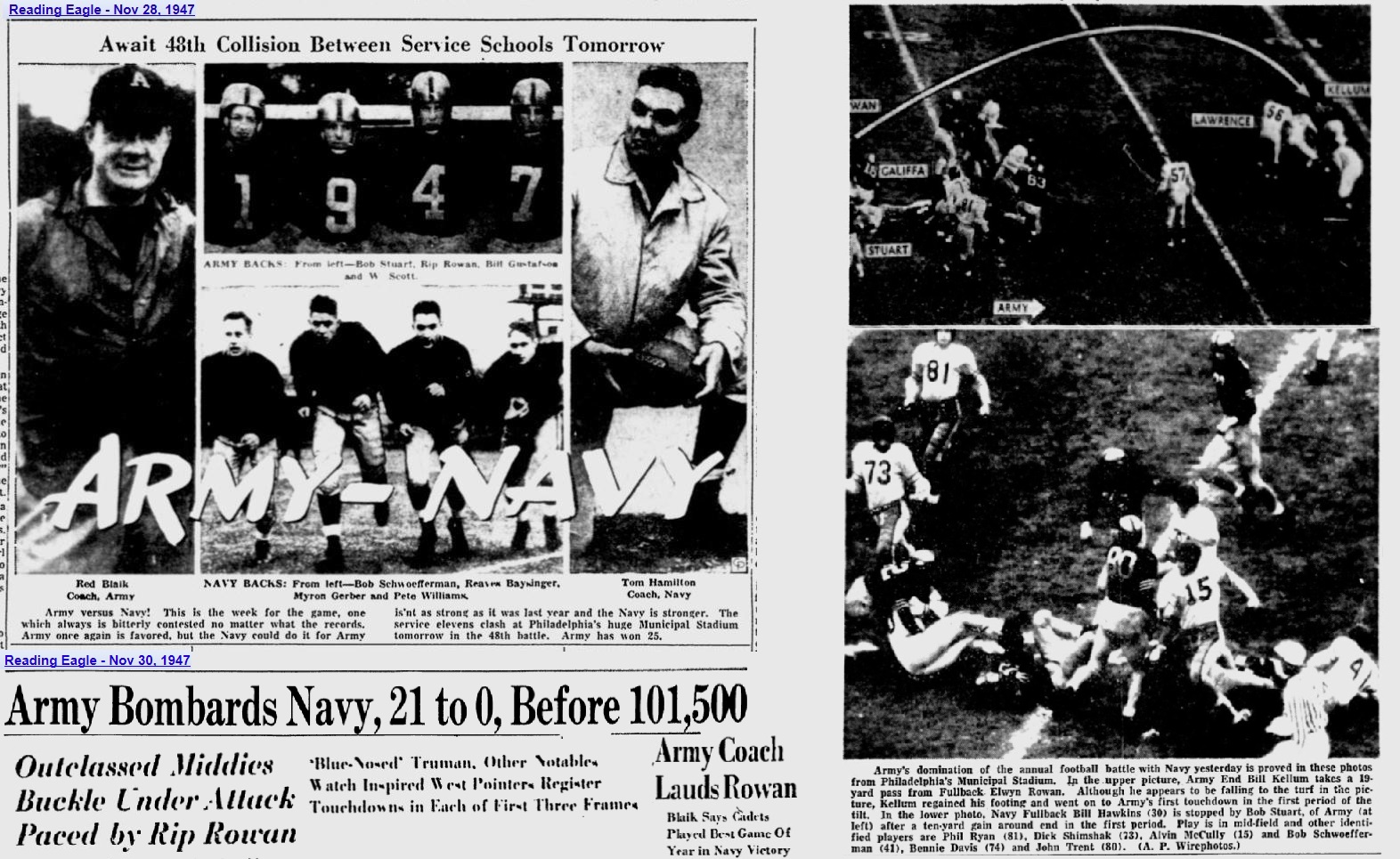
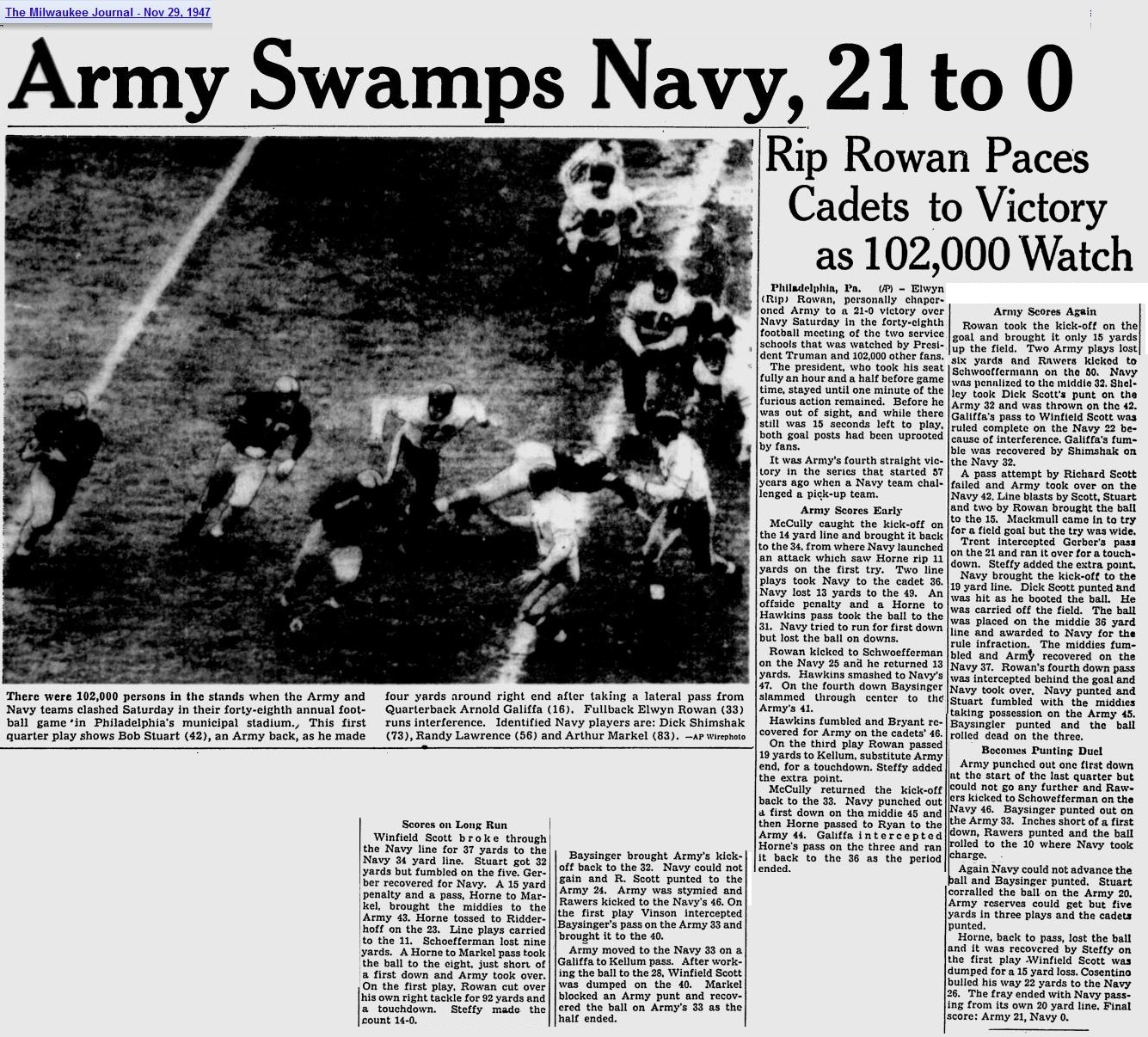
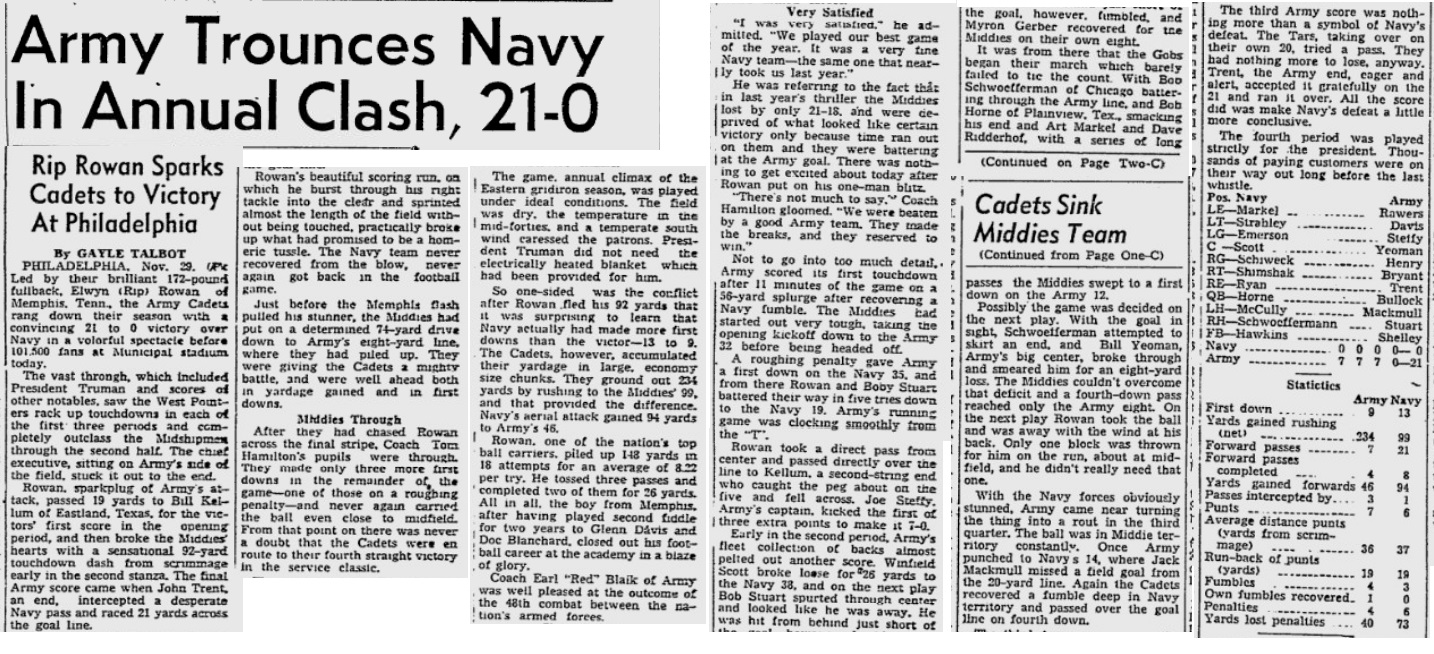
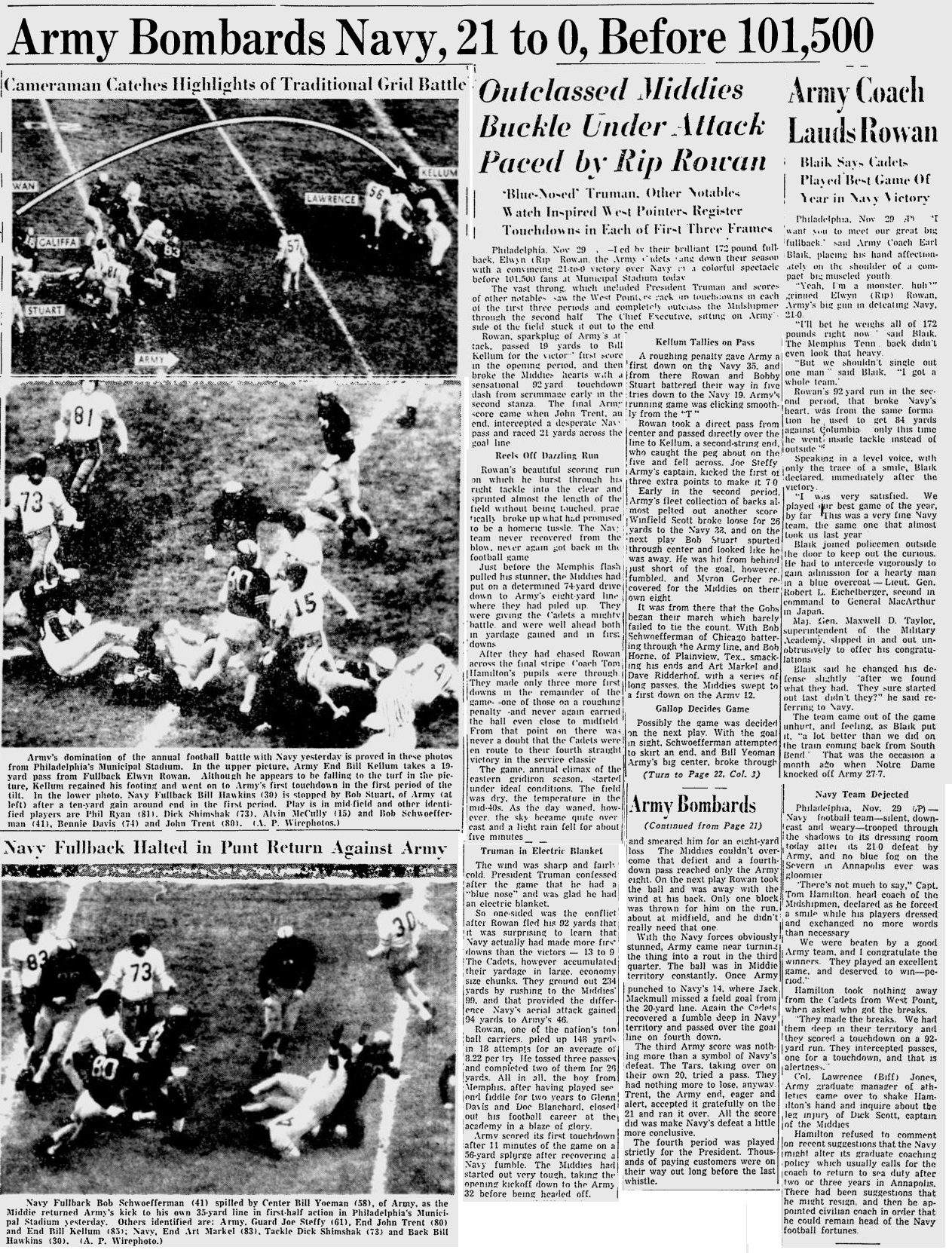
In front of 103,000 fans, including President Harry S. Truman, Army scored one touchdown in each of the first-three quarters to cruise to a 21-0 victory over Navy. A Bill Hawkins fumble led to Army’s first touchdown, as “Bill Kellum” caught an 18-yard touchdown pass from quarterback Elwyn Rowan. Navy drove right back down the field on the next possession, but turned the ball over on downs inside the Army 10-yard line. On Army’s first play from scrimmage, “Rip Rowan” went around the end and down the field 92 yards for the go-ahead score. He finished the afternoon with 148 yards rushing. ( “Joe Steffy” once asked Col Blaik what his Greatest Thrill was in Coaching — Rip Rowan’s 92 yard run from scrimmage)
ArmyFB_1947_vsNavy_ReadingEagle_Nov301947
Army 21, Navy 21 Nov. 27, 1948 Philadelphia, Pa.
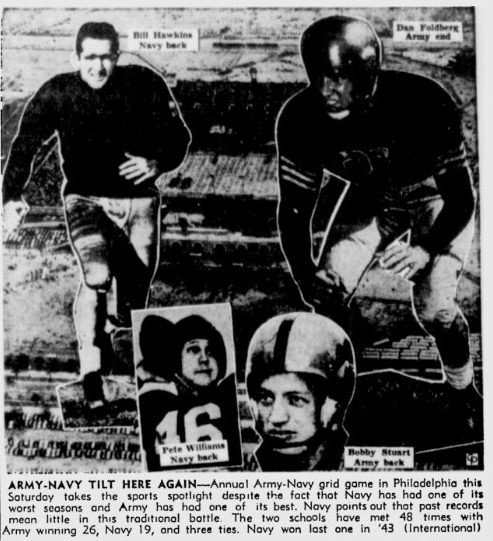
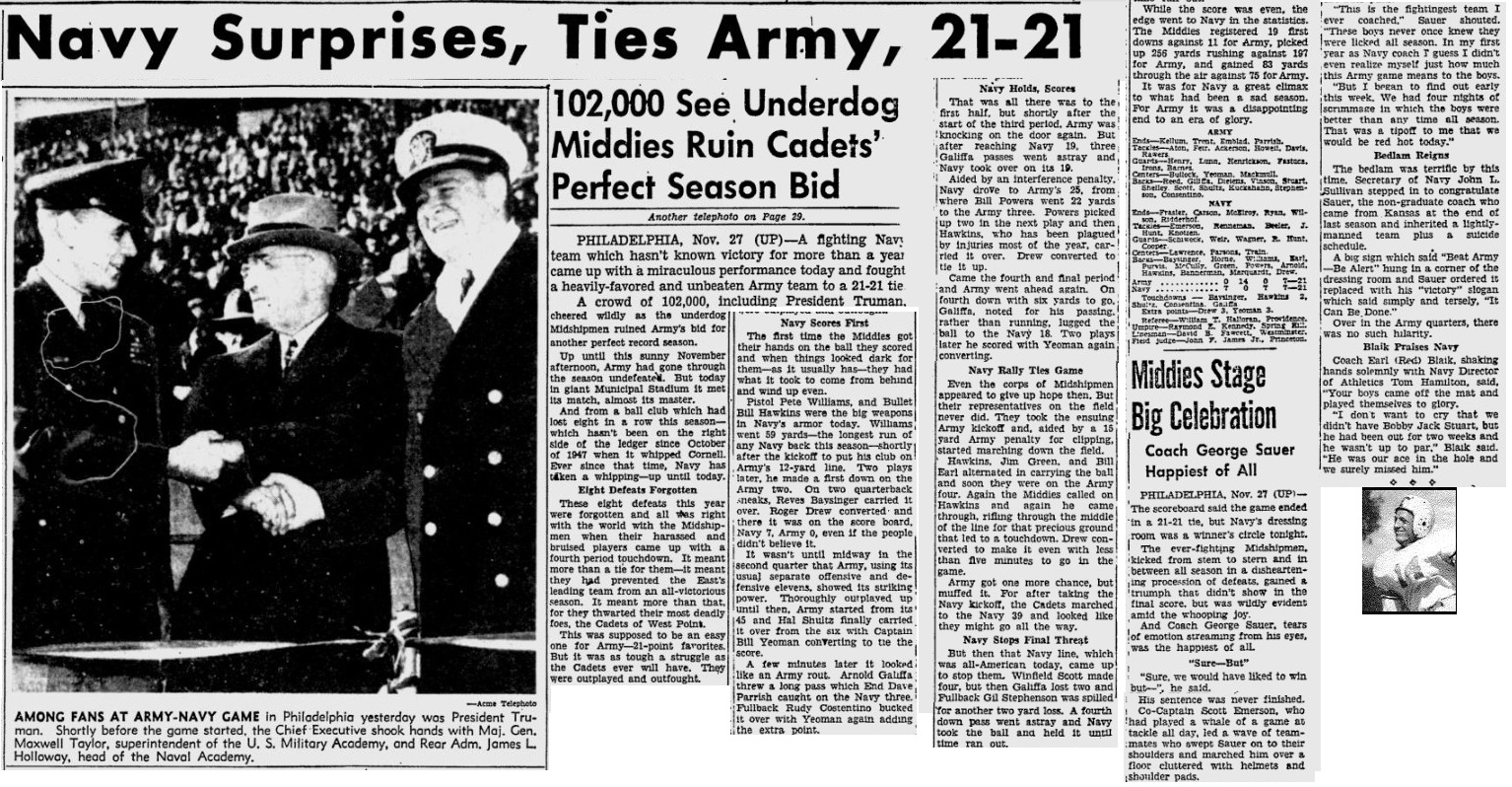
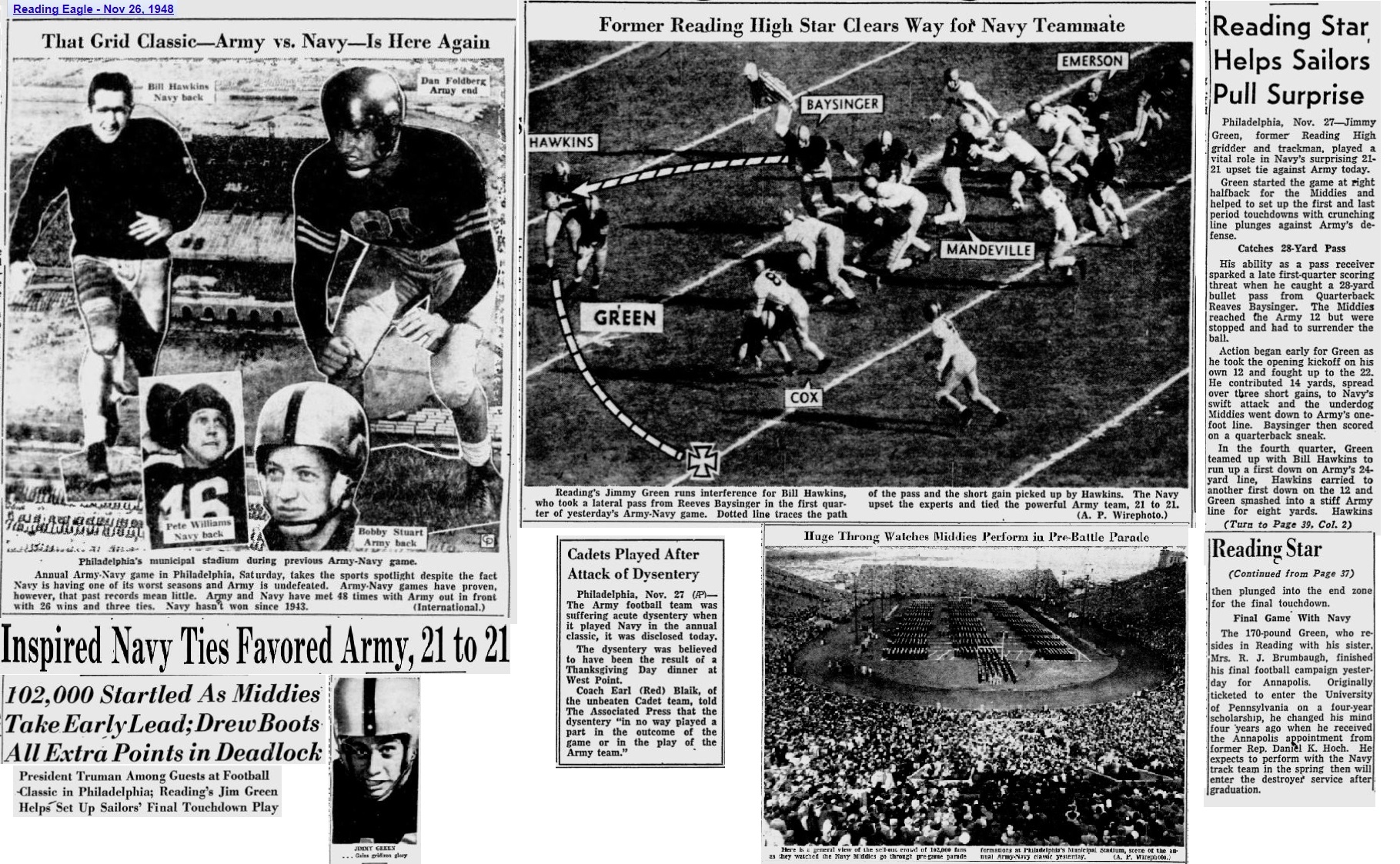
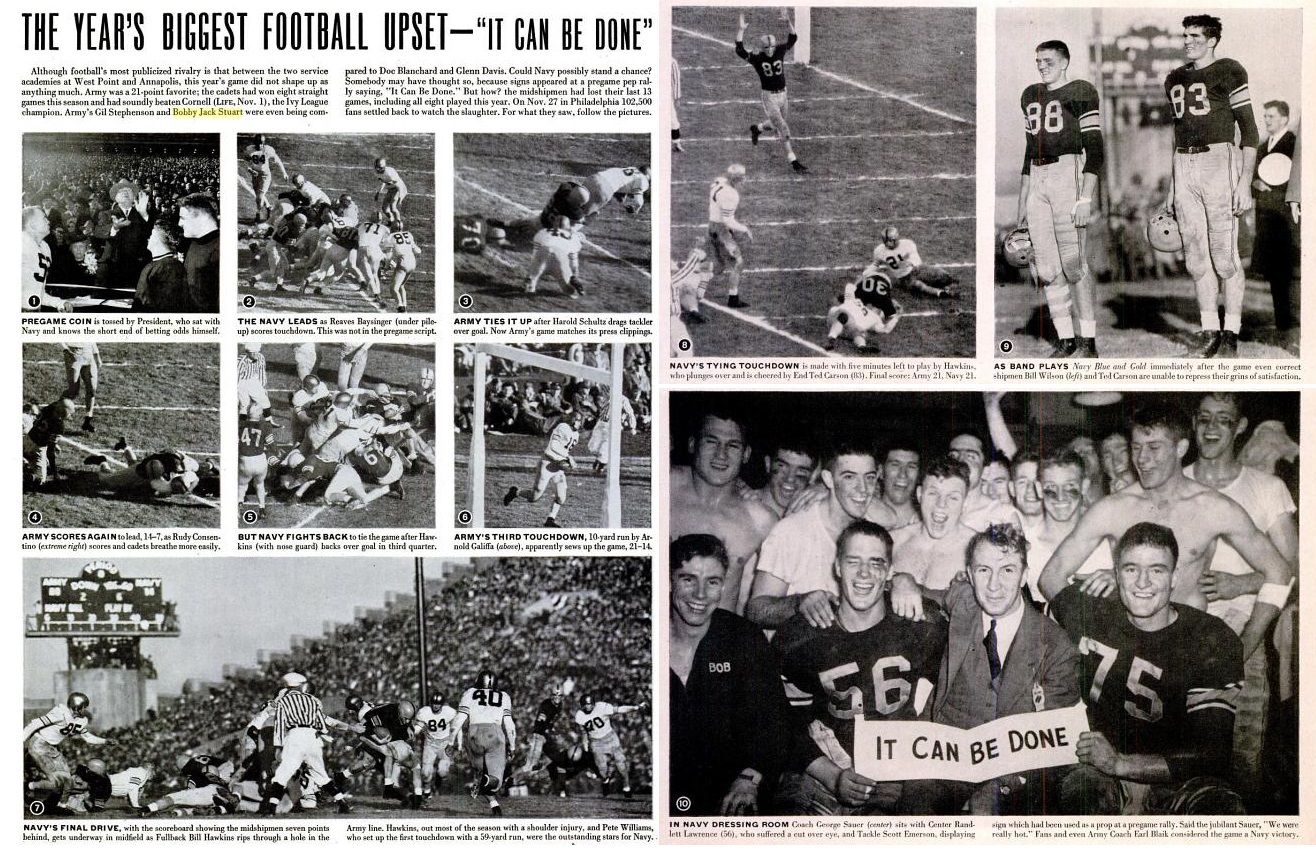
Considering Army entered the 1948 season finale with an 8-0 mark, as opposed to Navy’s 0-8 record, it should not be a surprise that the Cadets were a 20-point favorite. Yet, the Midshipmen proved the oddsmakers wrong by battling Army to a 21-21 tie. Navy quarterback Reaves Baysinger opened the scoring with a two-yard touchdown run midway through the first quarter. However, short touchdown runs by Rudolph Cosentino and Harold Shultz enabled the Cadets to take a 14-7 lead at the half. Navy responded with a one-yard Bill Hawkins touchdown run to tie the game at 14 in the third quarter. Army then took its second lead of the game when quarterback Arnold Galiffa scored on a 10-yard bootleg. Finally, Hawkins preserved the tie with clutch plays on both sides of the ball. He followed a one-yard touchdown run by knocking away a Galiffa pass on fourth down to end the game.
–
ArmyFB_1948_vsNavy_PittsburgPress_Nov281948
ArmyFB_1948_vsNavy_ReadingEagle_Nov26-281948
ArmyFB_1948_vsNavy_Life_Dec61948
–
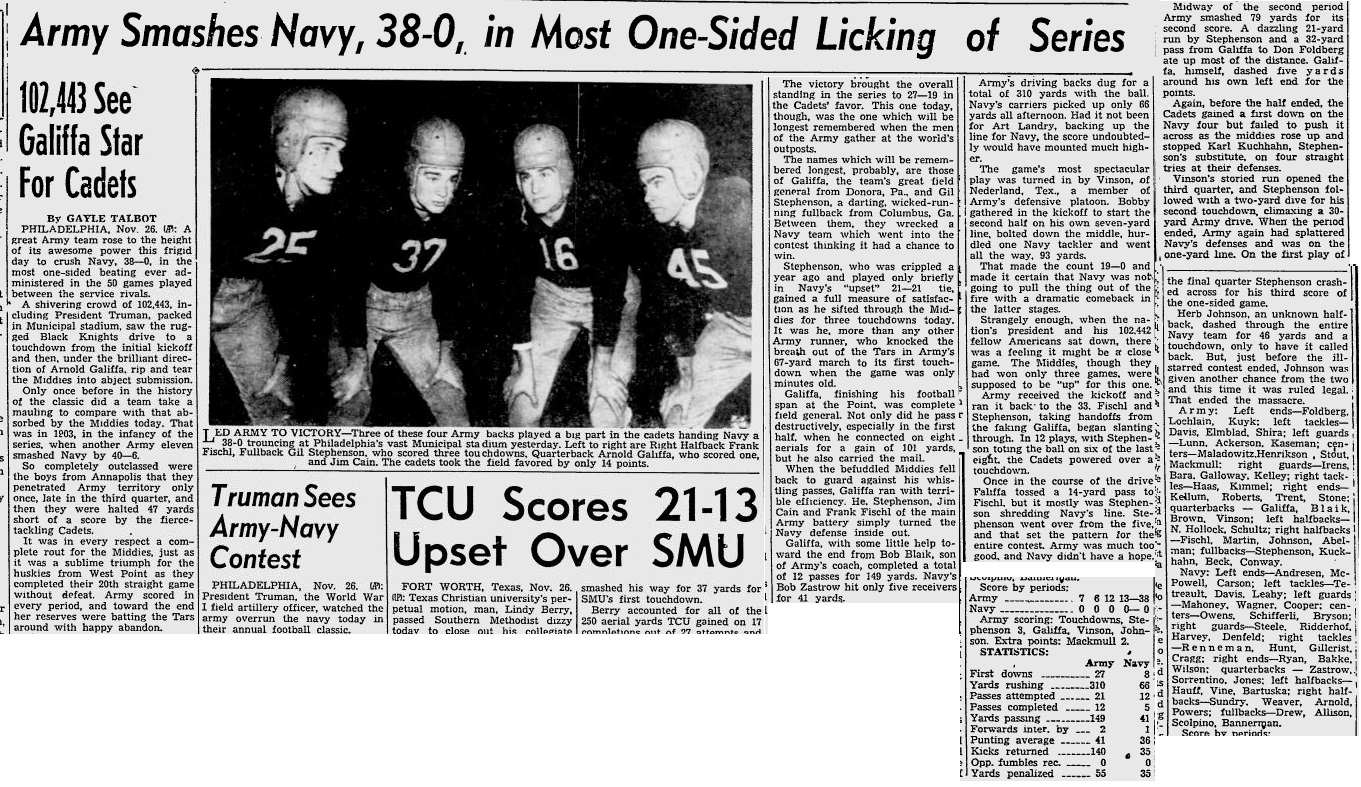
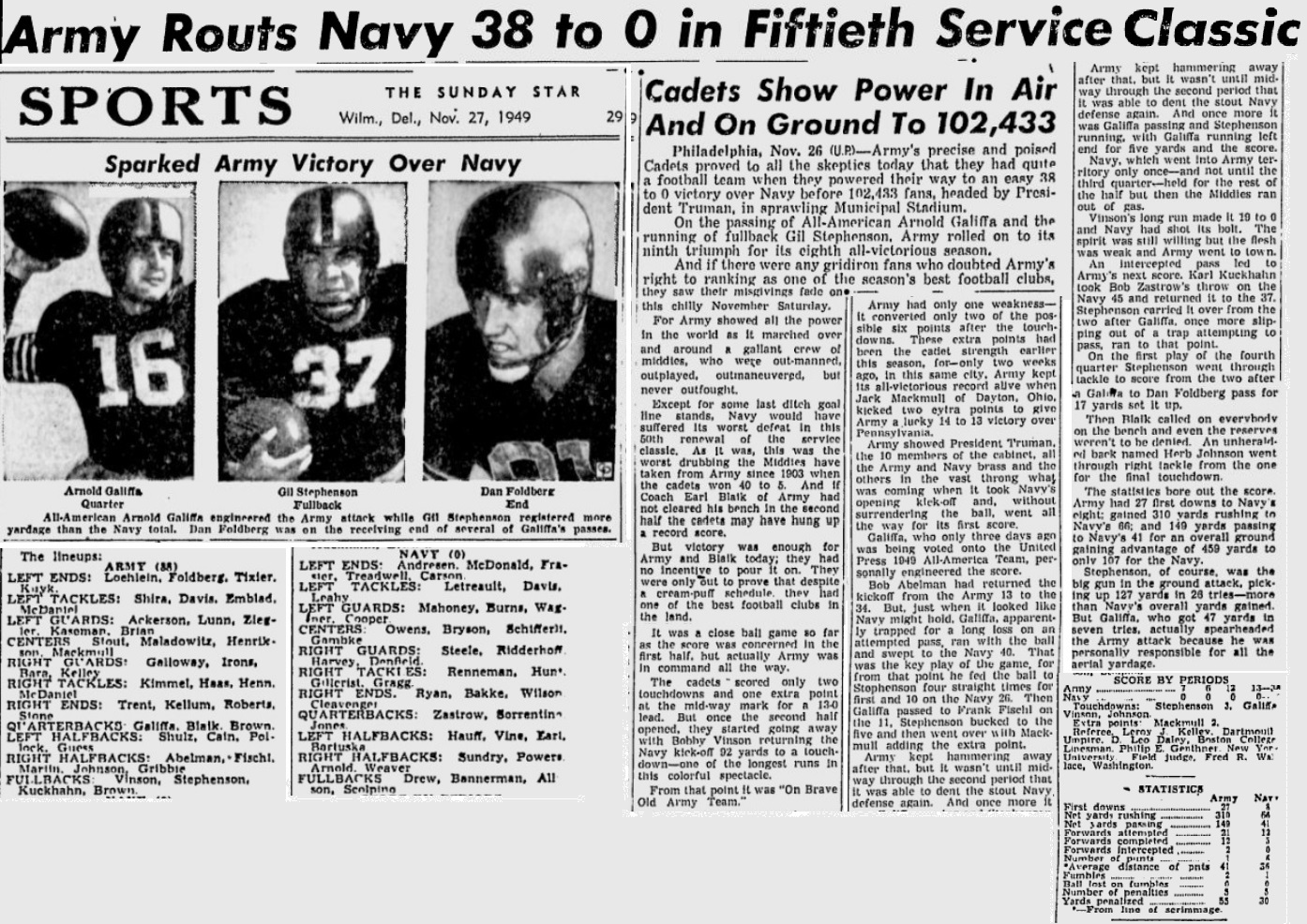
Army 38, Navy 0 Nov. 26, 1949 – Philadelphia, Pa.
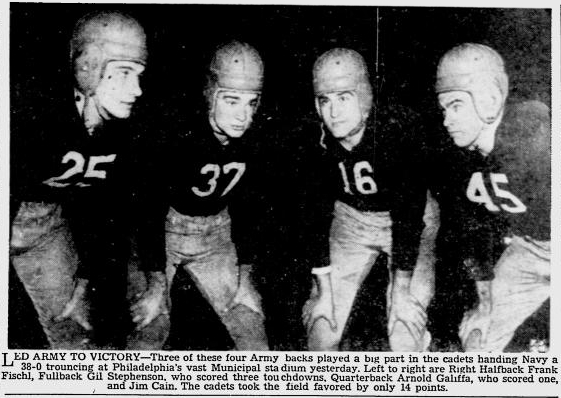
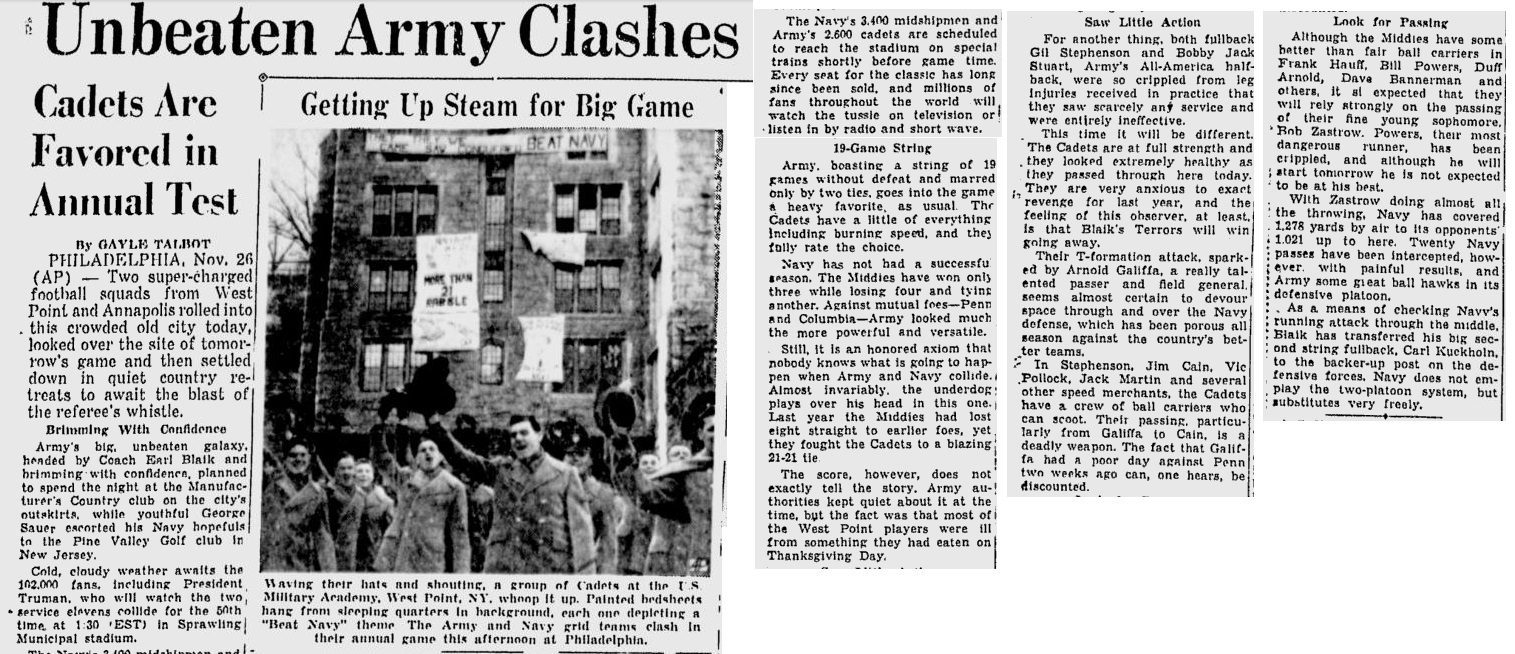
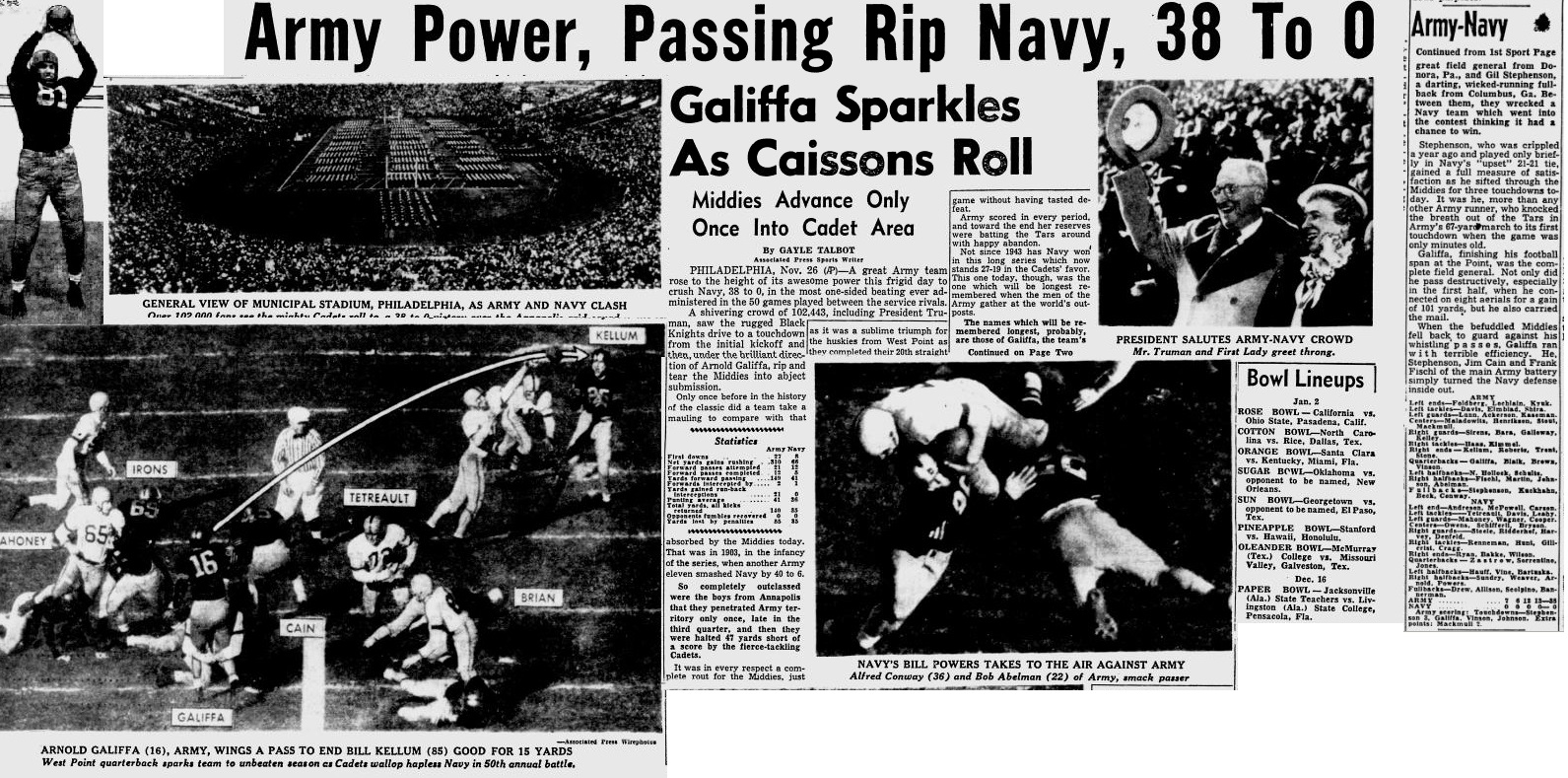
If Navy had any question about Army’s No. 4 national ranking in 1949, the Cadets erased those doubts with a 38-0 trouncing of the Midshipmen in the 50th meeting between the two academies. The statistics certainly told the story on this afternoon Army had 27 first downs compared to eight for Navy, not to mention a 459-107 advantage in total offensive yardage. The Mids advanced no further than the Army 47-yard line, as Cadet fullback “Gil Stephenson” gained 127 yards on 26 attempts.
Seven proved to be a lucky number for both Jack Dalton and his Midshipmen teammates. After missing his first-six field goal attempts in the 1910 Army-Navy game, Dalton connected on his seventh, which was all Navy needed in a 3-0 triumph. This field goal was also valuable in that it capped the Mids’ first undefeated season, a year that saw them outscore all nine opponents, 99-0. Dalton’s field goal was the lone offensive highlight in a game that saw both clubs combine to punt 40 times.
Navy 3, Army 0 Nov. 24, 1911 – Philadelphia, Pa.
On paper, the 1911 Army-Navy game was slated to be an even matchup. Army entered the season finale 6-0-1, while Navy was 5-0-3. Each team had surrendered less than two points per contest, while averaging two touchdowns per outing. The game lived up to its billing, with Jack Dalton’s second-quarter field goal proving to be the difference in a 3-0 win. Dalton did much more than kick a field goal, however. He had a pair of 15-yard runs on the Mids’ scoring drive and also recorded a 72-yard punt.
Navy 6, Army 0 Nov. 30, 1912 – Philadelphia, Pa.
At 6-2, 228 pounds, Navy’s John “Babe” Brown was not your typical placekicker. In fact, he used his imposing frame to his advantage in the 1912 Army game, and the result benefitted all of the Midshipmen. With five minutes left in the game, he lined up to attempt a field goal. But rather than dropkick the ball when it was snapped to him, he took off running before the Cadets tackled him at the five-yard line. He booted a 12-yard field goal two plays later and tacked on a 35 yarder with less than a minute left to give Navy a 6-0 victory. The triumph was Navy’s sixth in nine decisions and dropped Army’s final record to 5-3.
Army 22, Navy 9 Nov. 29, 1913 – Philadelphia, Pa.
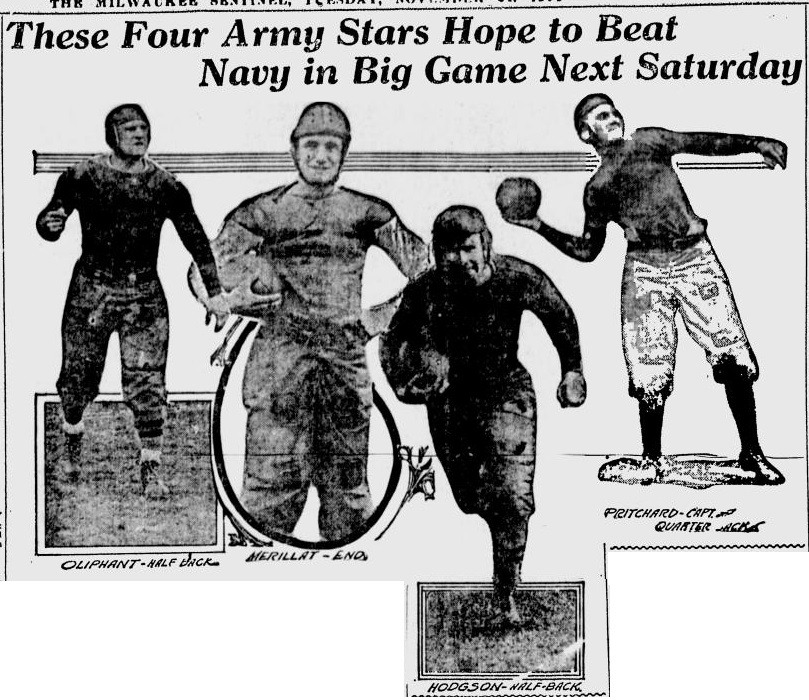
Navy coach Doug Howard could look at the 1913 season from two perspectives. His defense allowed a total of 29 points in nine games, which is quite impressive. But when you consider the Midshipmen allowed 22 in one game, and it was the game against Army, Howard’s club did not end the year on a solid note. Indeed, Navy would need more than three Babe Brown field goals to overcome the Cadets. Vernon Prichard and Louis Merrilat caught the Midshipmen defense off-guard with two touchdown passes, and Merrilat’s 60-yard run set up West Point’s other score in the 13-point victory.
Cadets Final Practice – Army Eleven Ready for Big Game in Gotham Saturday – The News and Courier – Nov 27, 1913 http://news.google.com/newspapers?id=MAFgAAAAIBAJ&sjid=AwsNAAAAIBAJ&dq=football%20philadelphia&pg=4578%2C2443191
OPEN FOOTBALL IS PROVED THE BEST; West Point Victory Is Another Verdict for Open Game as Played This Season – New York Times – Dec 1, 1913
A decisive triumph for the open style of play, as compared with the more conservative and less spectacular line bucking species, stands out as the main feature of the 1913 football season, which came to a close Saturday at the Polo Grounds, when the Army and Navy elevens clashed in their annual battle.
There is little doubt that football in the future will far excel that of the past … The main reason for the transfer from Philadelphia to New York was that… http://query.nytimes.com/mem/archive-free/pdf?res=FA0B1EFF3C5913738DDDA80894DA415B838DF1D3
Army 20, Navy 0 Nov. 28, 1914 – Philadelphia, Pa.
Army capped its first undefeated season (9-0) with a “textbook perfect” 20-0 triumph over Navy. The Cadets took advantage of a blocked punt and two Navy fumbles to score their first-14 points. After forcing Navy to punt on its opening possession, Louis Merillat blocked the punt in the end zone for a safety.
The Mids’ H.C. Blodgett fumbled a second-quarter punt that “Robert Neyland” picked up at the Navy 20-yard line. One play later, Louis Merillat was in the end zone after catching a 20-yard touchdown pass from Vernon Prichard. Finally, Blodgett fumbled a second punt that quarter which resulted in a Paul Hodgson one-yard touchdown run.
ArmyFB_1914_Stars_MilwaukeeSentinel_Nov241914
ARMY TEAM WELCOMED.; Annual Homecoming Scenes at West Point ;- Wyand Elected Captain.- New York Times – Nov 30, 1914
WEST POINT, N.Y., Nov. 29. — The victorious Army football team reached home at 4 o’clock this afternoon and received a rousing welcome. The scenes which annually feature the homecoming of the football men, whether they are winners or losers, were enacted, although, if possible, with a little more enthusiasm than in the past.
The football men brought with them from Philadelphia the blue and gold blanket which has adorned the back: of the Navy;s mascot goat for many years… http://query.nytimes.com/mem/archive-free/pdf?res=F0071FF63C5C13738DDDA90B94D9415B848DF1D3
ARMY SHUTS OUT NAVY BY 20 TO 0. – Boston Evening Transcript – Nov 29, 1914 – PHILADELPHIA, Nov 28
The West Point football players today beat Annapolis, 20 to 0, this afternoon before the biggest crowd ever assembled on Franklin Field, the Cadets superiority being even greater than indicated by the…
Boston Daily Globe – Nov 29, 1914
PHILADELPHIA, Nov 28–The West Point football players today beat Annapolis, 20 to 0, this afternoon before the biggest crowd ever assembled on Franklin Field…
Army 14, Navy 0 Nov. 27, 1915 – New York, N.Y.
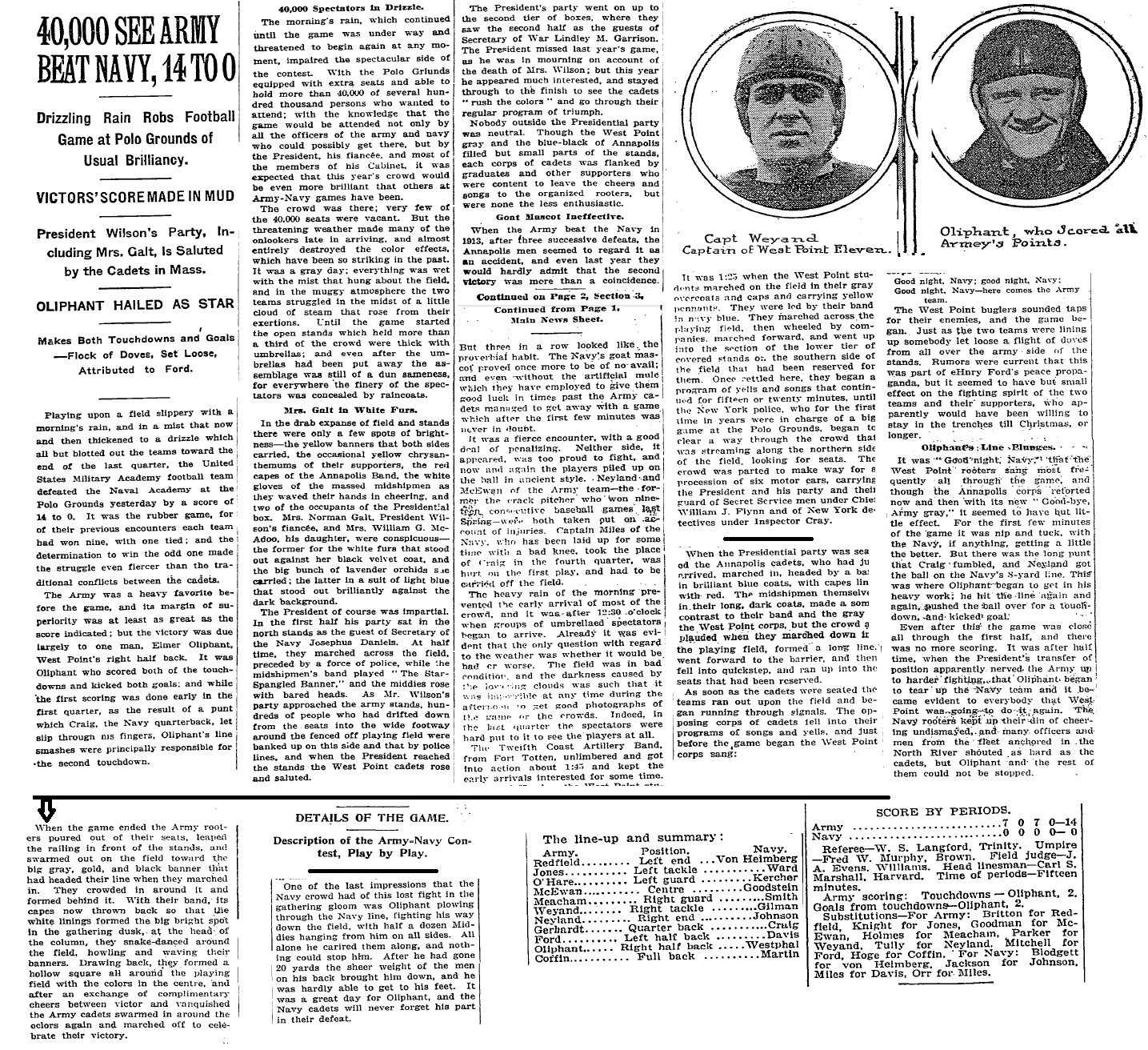
The 1915 Army-Navy game marked the first time each team wore numbered jerseys for identification. However, the Navy offense finished with the same number it had a year ago, 0, as Army blanked the Midshipmen, 14-0. Elmer “Ollie” Oliphant certainly left his impression on the Navy defense, accounting for 130 of his team’s 196 total offensive yards, along with 11 punt returns for 114 yards. The contest once again fell victim to bad weather, which factored into a combined 30 punts and 10 turnovers between the two teams.
Army VS. Navy On Saturday – Reading Eagle – Nov 26, 1915 http://news.google.com/newspapers?id=7lorAAAAIBAJ&sjid=a50FAAAAIBAJ&dq=football%20philadelphia&pg=6364%2C3771085
Army Mule and Navy Goat In Annual Game at Gotham – Atlanta Constitution – Nov 27, 1915
The football elevens of the United States Naval and Military academies will close the eastern gridiron season with their annual contest here tomorrow afternoon. Indications point to a hard-fought game.
Service Game Today May Break Existing Series Tie. Army and Navy Have Each Won Nine Games .. – Lewiston Daily Sun – Nov 27, 1915 http://news.google.com/newspapers?id=nbogAAAAIBAJ&sjid=i2kFAAAAIBAJ&dq=football%20philadelphia&pg=2346%2C3427013
40,000 SEE ARMY BEAT NAVY, 14 TO 0; Drizzling Rain Robs Football Game at Polo Grounds of Usual Brilliancy. VICTORS’ SCORE MADE IN MUD President Wilson’s Party, Including Mrs. Galt, Is Saluted by the Cadets in Mass. OLIPHANT HAILED AS STAR Makes Both Touchdowns and Goals ;- Flock of Doves, Set Loose, Attributed to Ford. 40,000 SEE ARMY BEAT NAVY IN MUD; WILSON ATTENDS In Fog and Drizzle West Point Piles Up 14-0 Score, with Oliphant as Star. MRS. GALT WITH PRESIDENT Cheers and Music Resound at Polo Grounds, but Weather Mars the Spectacle. FLOCK OF DOVES SET LOOSE Rumored They Are Furnished by the Ford Peace Promoters, but the Teams Fight On.
SPECIAL TO THE NEW YORK TIMES
Playing upon a field slippery with a morning’s rain, and in a mist that now and then thickened to a drizzle which all but blotted out the teams toward the end of the last quarter, the United States Military Academy football team defeated the Naval Academy at the Polo Grounds yesterday by a score of 14 to 0.
November 28, 1915 Front Page http://query.nytimes.com/mem/archive-free/pdf?res=980CE4DB153BE233A2575BC2A9679D946496D6CF
Army 15, Navy 7 Nov. 25, 1916 – New York, N.Y.
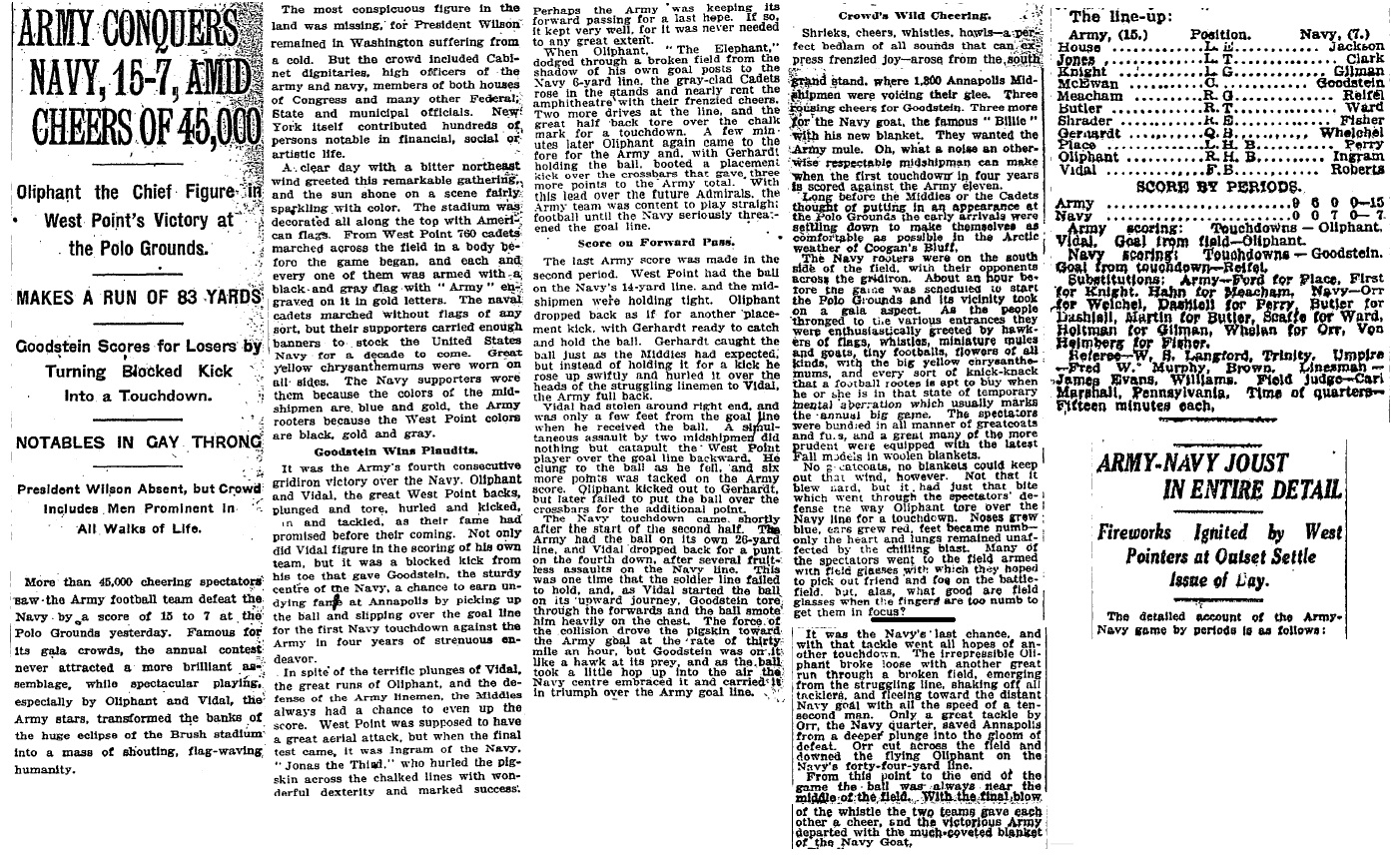
Through 103 Army-Navy games, there has been one constant – neither team can ill-afford to miss an extra point. Of course, there are exceptions to this standard. Take 1916, when “Ollie Oliphant” missed the extra point on Army’s first score of the afternoon. Army coach Charles Daly could not have been that upset, considering Oliphant had carried the ball three times for 89 yards during that drive. It was just a sign of things to come for Navy, which suffered a 15-7 defeat at the hands of the Cadets. Oliphant added a field goal late in the first quarter, and the Cadets used a trick play for their final score of the day. Army was attempting a field goal when holder Charles Gerhardt took the snap and threw to fullback Eugene Vidal for the touchdown. Navy scored its first series touchdown since 1907 when Harry Goodstein blocked a punt and returned it for a touchdown
ARMY CONQUERS NAVY, 15-7, AMID CHEERS OF 45,000; Oliphant the Chief Figure in West Point’s Victory at the Polo Grounds. MAKES A RUN OF 83 YARDS Goodstein Scores for Losers by Turning Blocked Kick Into a Touchdown. NOTABLES IN GAY THRONG President Wilson Absent, but Crowd Includes Men Prominent in All Walks of Life.
– New York Times – Nov 26, 1916
More than 45,000 cheering spectators saw the Army football team defeat the Navy by a score of 15 to 7 at the Polo Grounds yesterday. Famous for its gala crowds, the annual contest never attracted a more brilliant assemblage, while spectacular playing, especially by Oliphant and Vidal, the Army stars, transformed the banks of the huge eclipse of the Brush stadium into a mass of shouting, flag-waving humanity..
After a two-year series hiatus due to World War I, Army and Navy renewed their heated rivalry in 1919. Despite posting seven times as much total offensive yardage as the Cadets, Navy could only manage a pair of Clyde King field goals. Fortunately for Naval Academy fans, that was enough for a 6-0 win. The victory marked the fourth time in 10 years that Navy had beaten Army strictly by kicking field goals. Although the game was played in a steady downpour, neither team lost a fumble or committed a turnover. The Midshipmen finished the year 6-1, while the Cadets were 6-3.
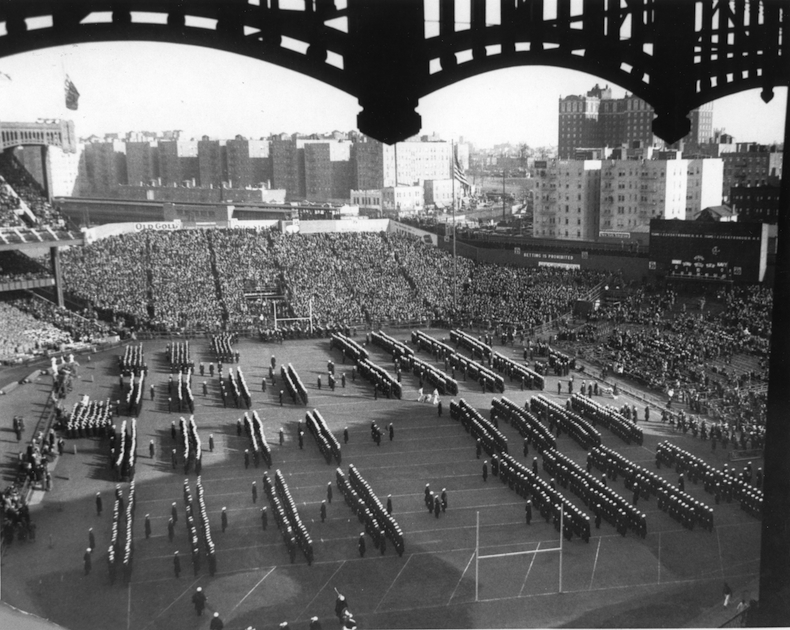
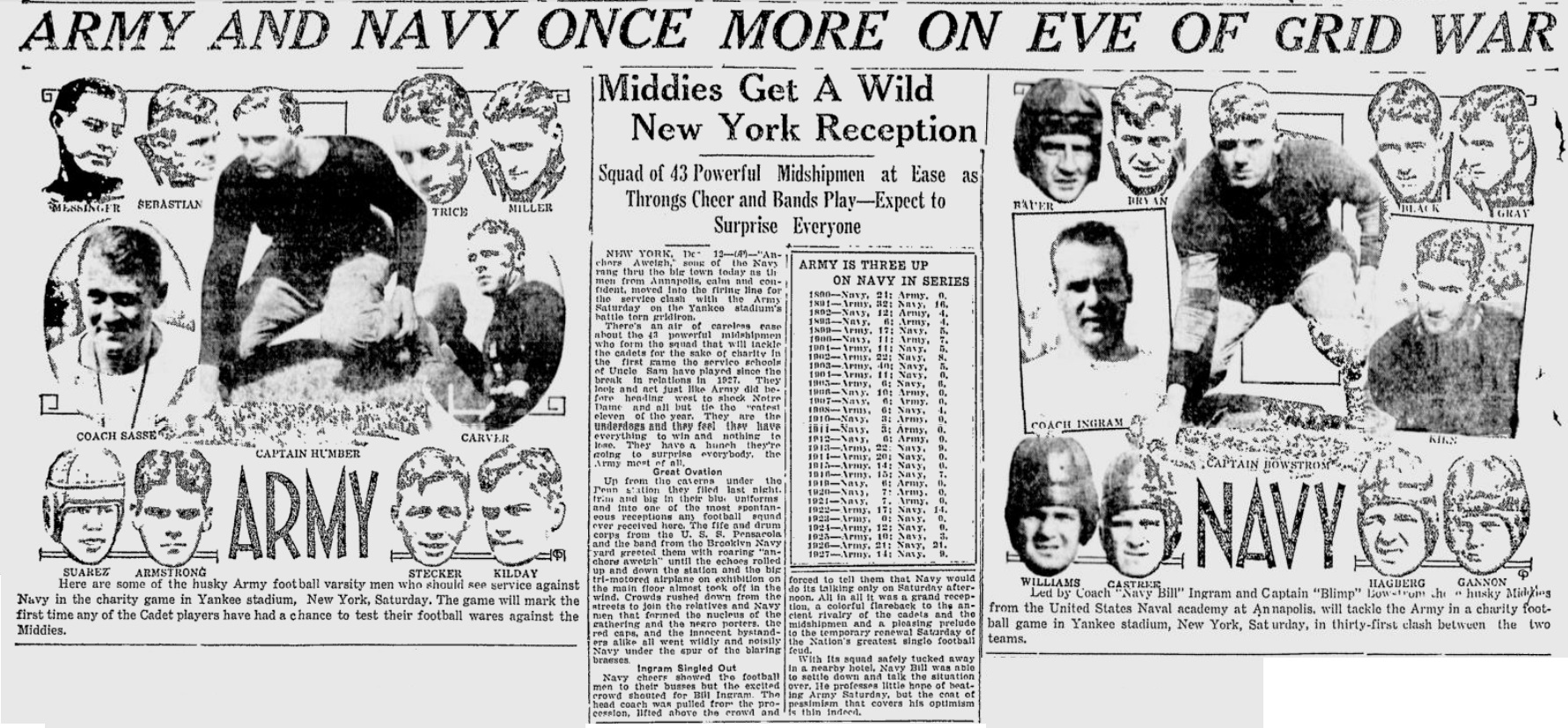
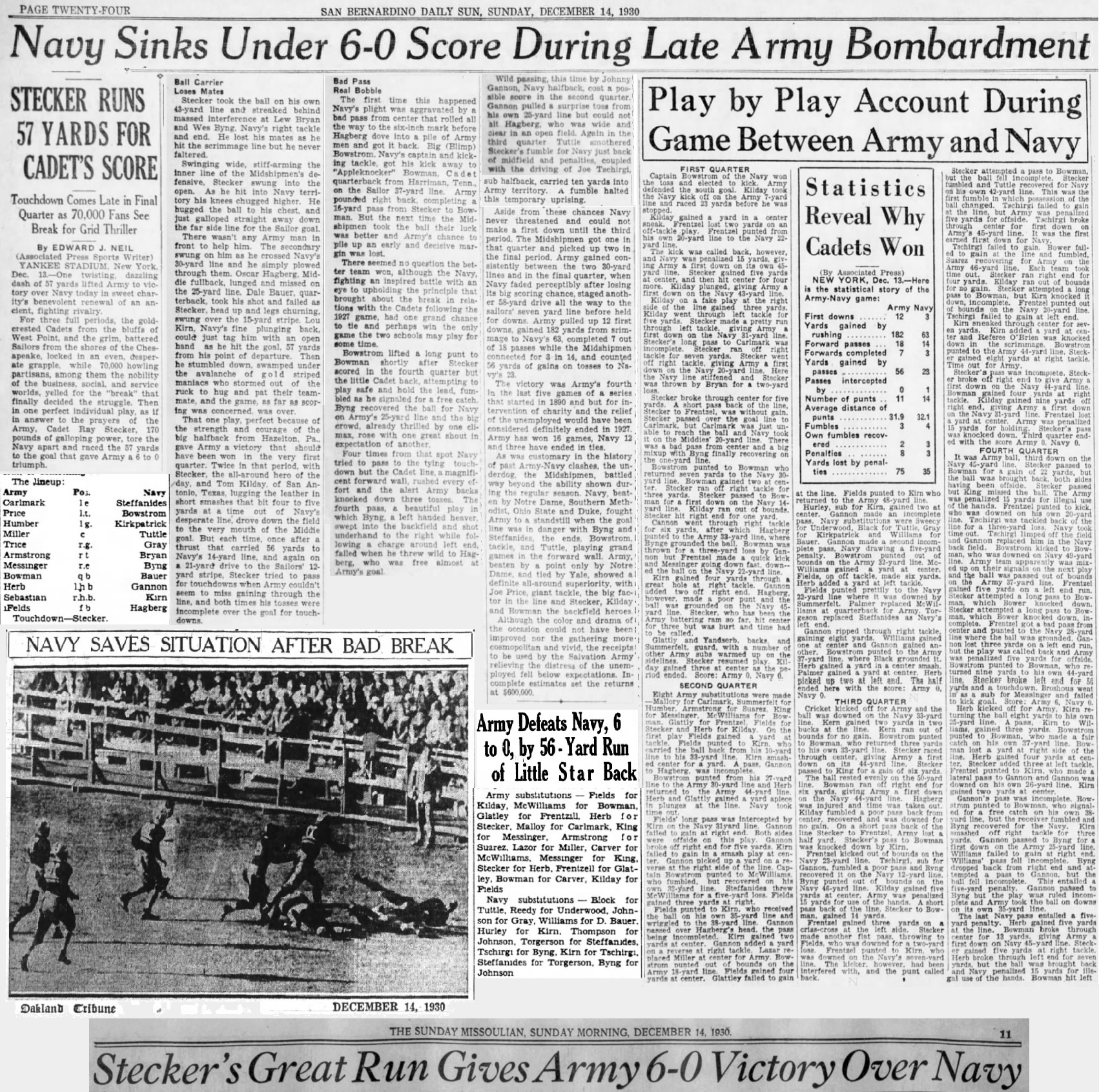
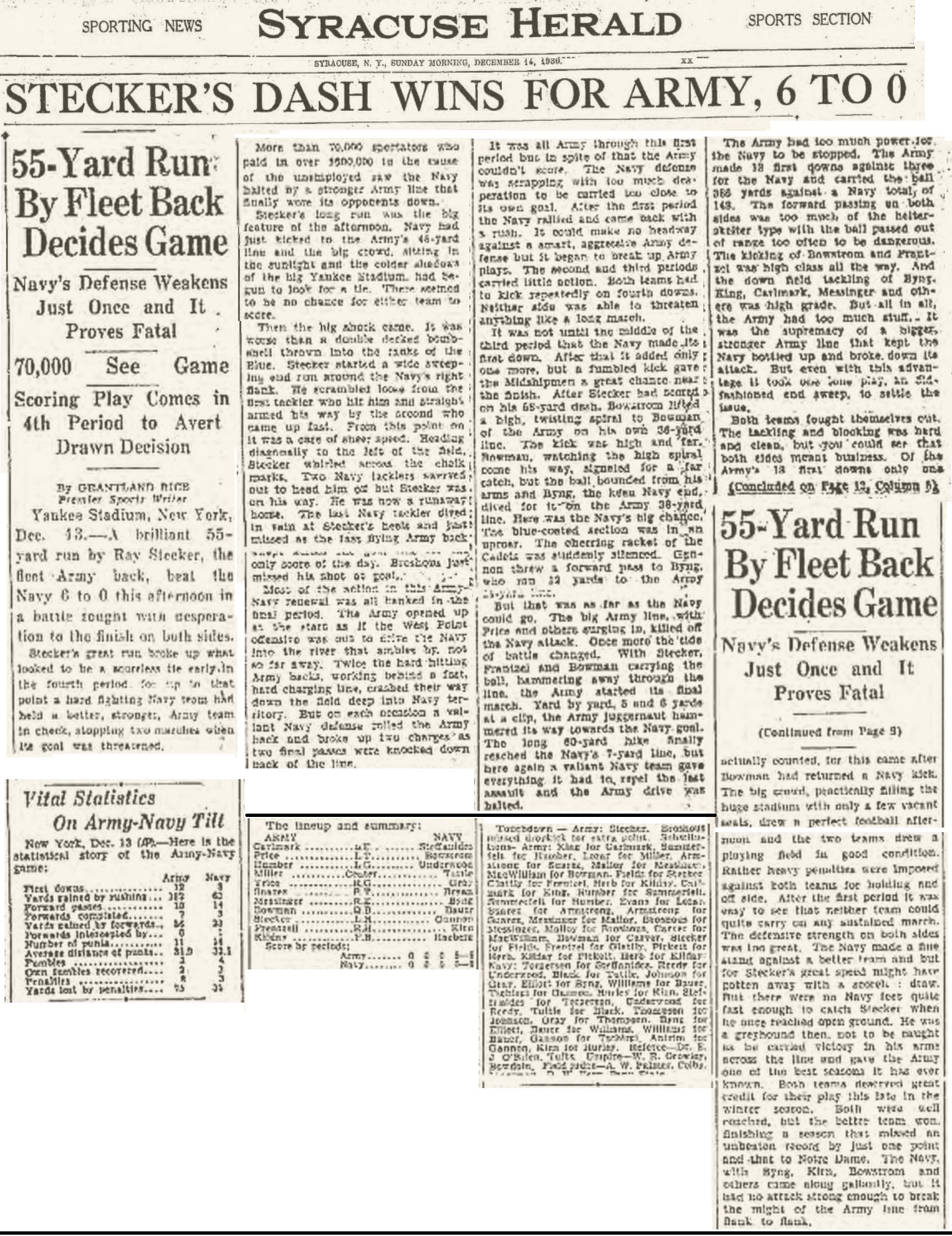
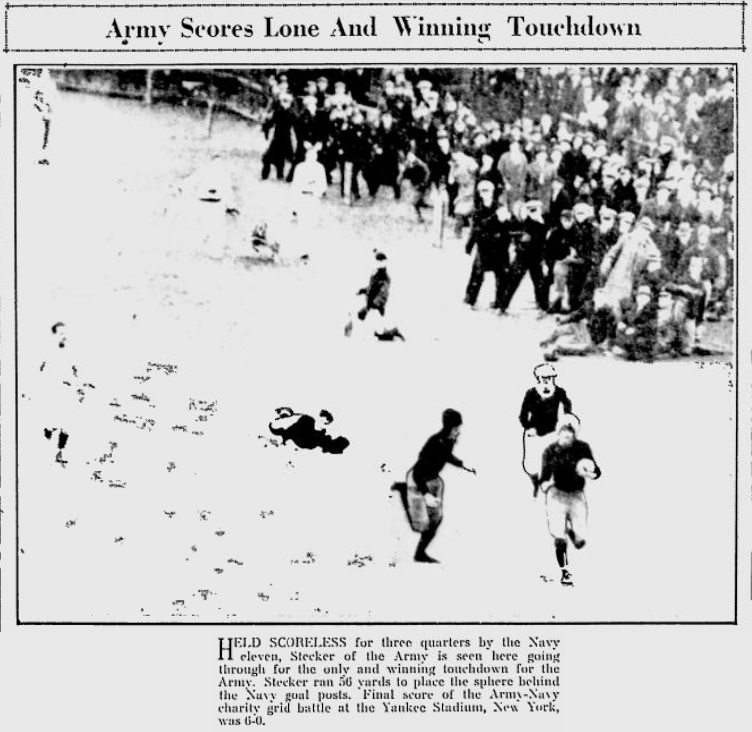
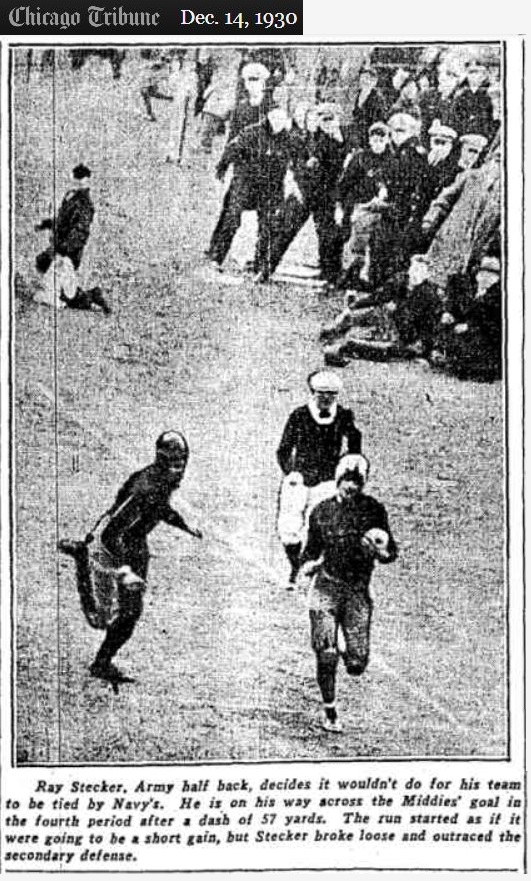
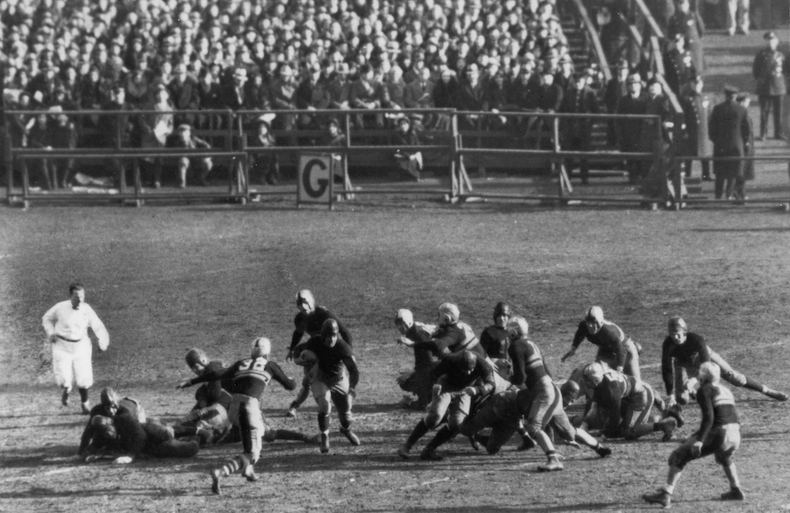
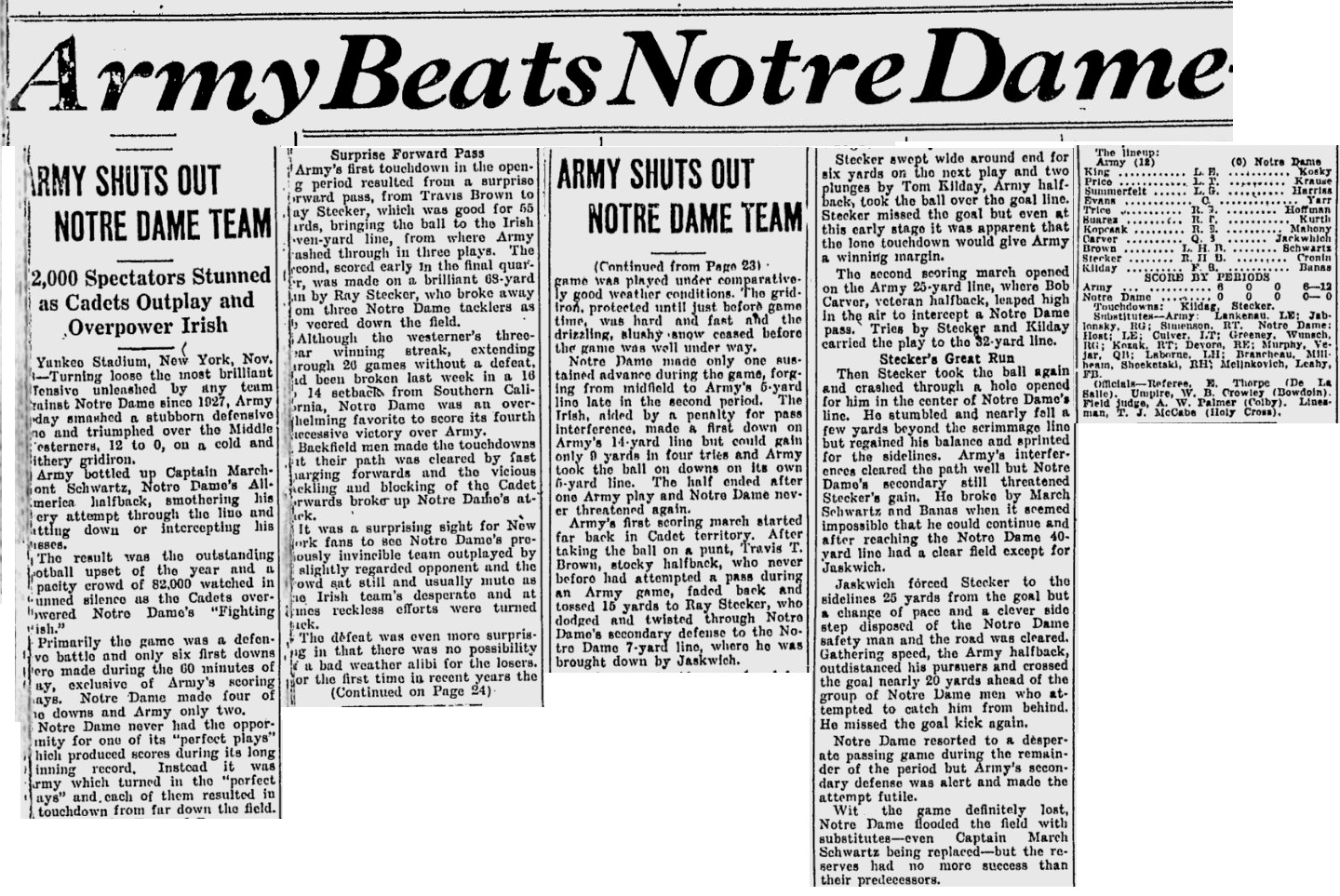
A disagreement regarding eligibility policies may have cancelled the 1928 and ’29 Army-Navy games, but a capacity crowd at Yankee Stadium welcomed the rivalry’s return Dec. 13, 1930. Unfortunately for Navy, Army retained its recent series dominance with a 6-0 victory. The final score certainly doesn’t reflect Army’s commanding performance, as the Cadets finished the afternoon with 265 yards of total offense, compared to 63 for the Midshipmen. Yet, Navy was able to keep Army off the scoreboard until the fourth quarter, when Ray Stecker ran 56 yards for the game’s lone score. Navy had a chance to win the game on its final possession. Army’s Wendell Bowman fumbled a punt on his own 37-yard line, and the Midshipmen’s John Byng recovered. The Mids drove 12 yards, but were stopped on downs. The Cadets took over and advanced to the Navy seven-yard line as time ran out.
Midshipmen – Yankee Stadium December 13, 1930
–
–
–
–
–
1930 Army Navy Football Game Stock Footage HD
–
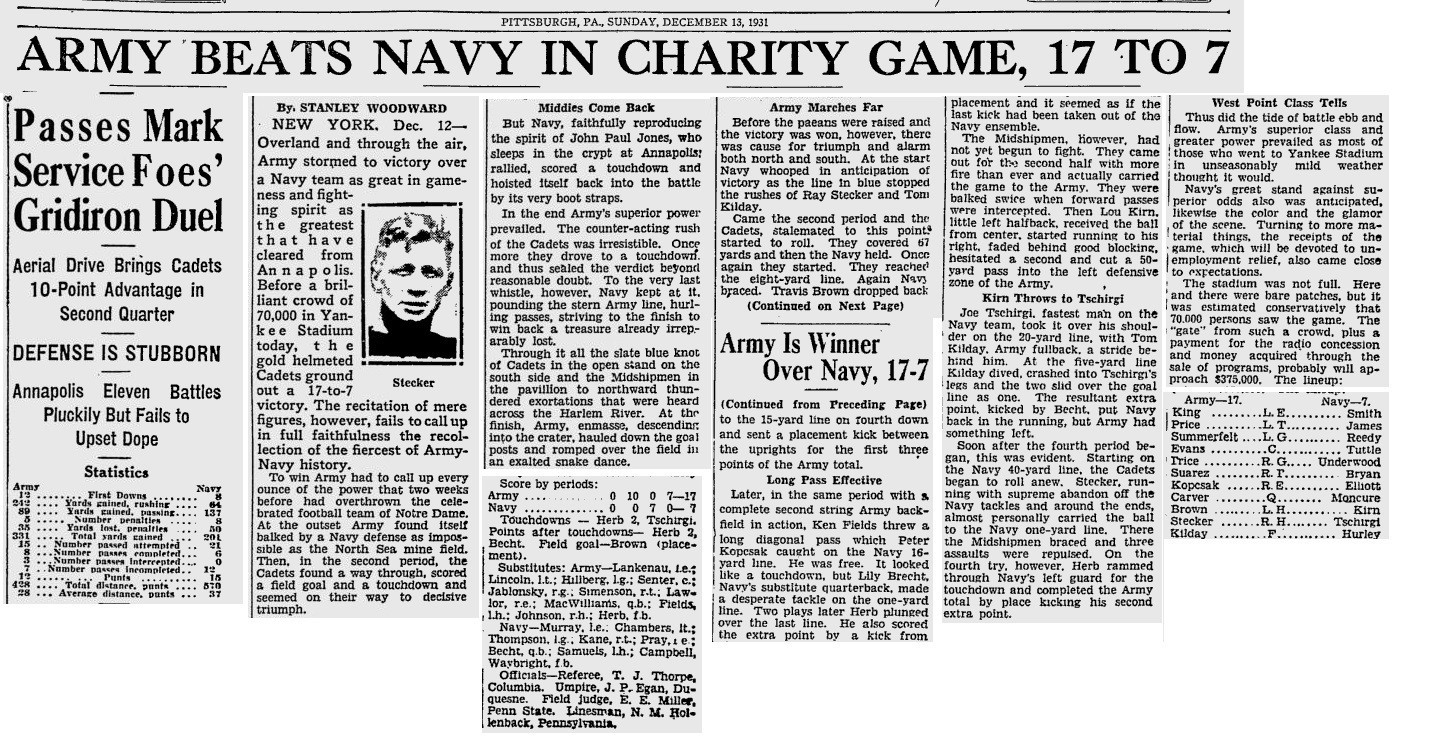
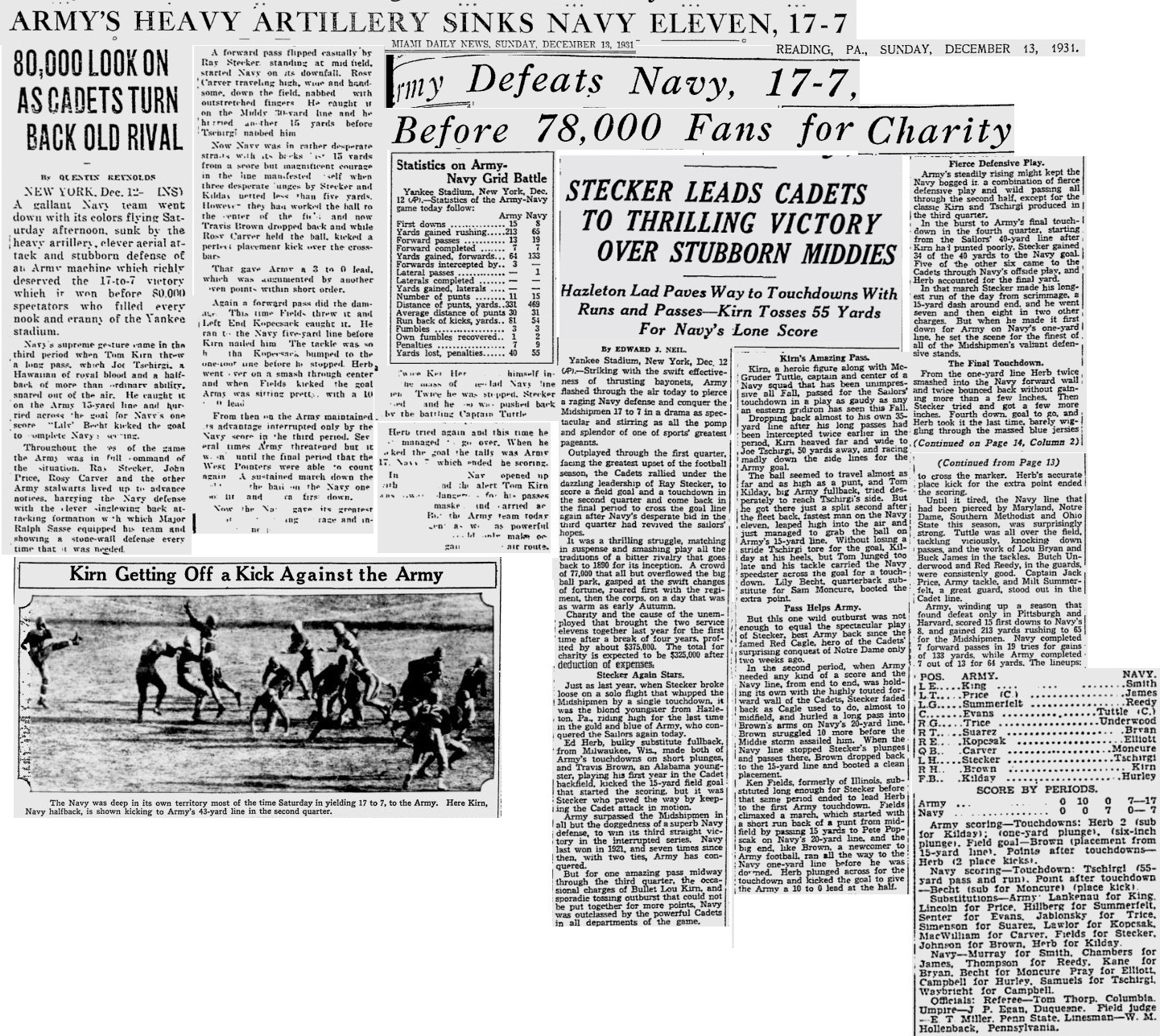
Army 17, Navy 7 Dec. 12, 1931 – New York, N.Y.
The running of Ed Herb and Ray Stecker paced Army to a 17-7 win over Navy at Yankee Stadium. The first of Herb’s touchdown runs and a Travis Brown 25-yard field goal gave the Cadets a 10-0 halftime lead. Navy cut the deficit to 10-7 in the third quarter when Lou Kirn and Harvey Tschirgi connected on a 55-yard scoring strike. Herb then erased any hopes of a Navy triumph when he went up and over from the one-yard line late in the final stanza. By reaching the end zone twice, Herb certainly garnered a majority of the headlines. However, the real hero was Stecker, who turned in a workman-like 141 yards on 29 carries.
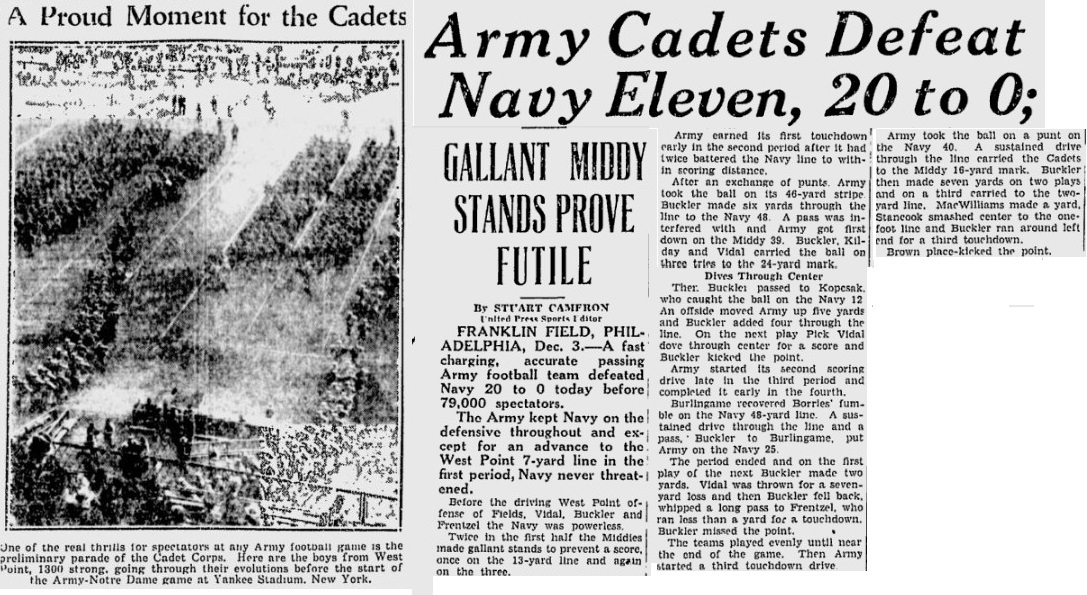
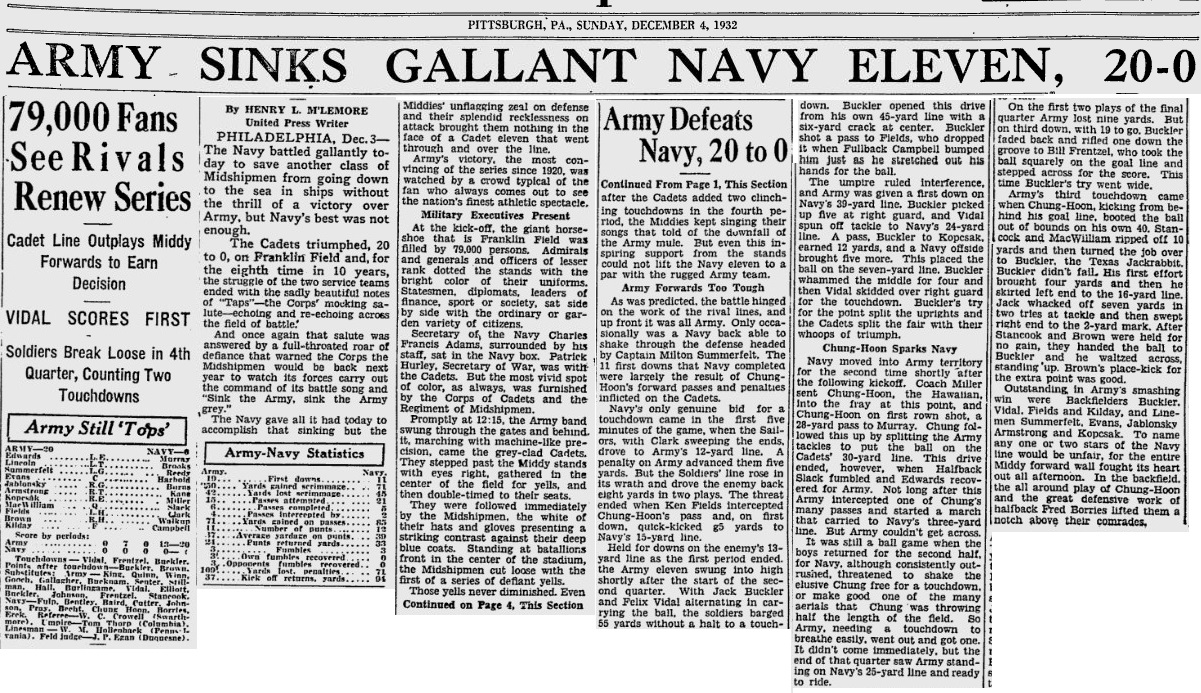
Army 20, Navy 0 Dec. 3, 1932 – Philadelphia, Pa.
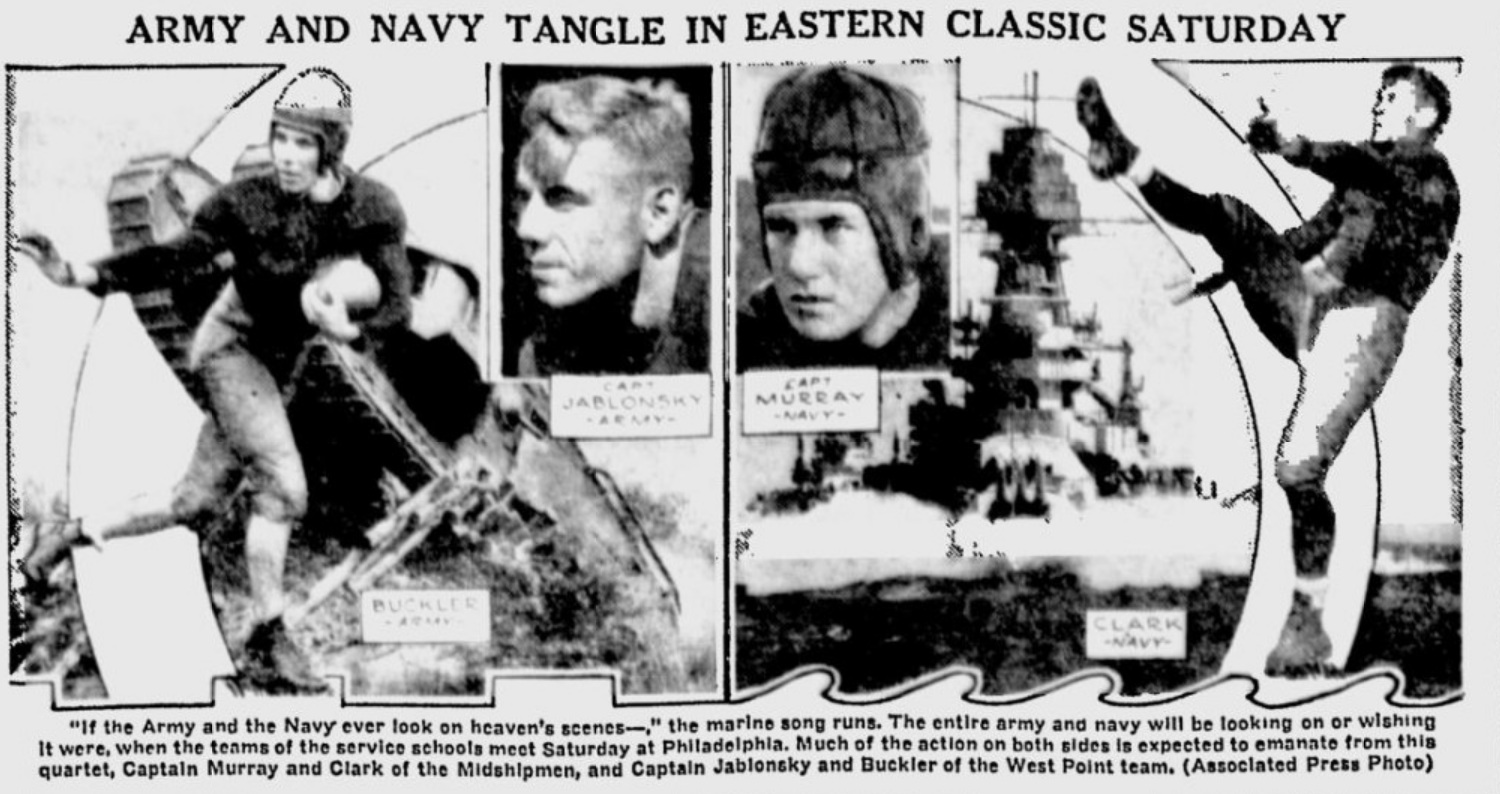
Thanks in large part to a Navy offense that mustered just 15 yards on the ground and turned the ball over seven times, Army rolled to a 20-0 win over the Midshipmen. Rip Miller’s club had an early indication this may not be its day when its opening drive was halted by an interception at the Army six-yard line. On first down, the Cadets’ Kenneth Field “quick-kicked” the ball 85 yards to the Navy 15-yard line. Peck Vidal opened the scoring with a two-yard touchdown run in the first quarter, and Army added two more scores in the final half. Jack Buckler scored one on a short run and took a lateral from Tom Kilday and passed 43 yards to Bill Frentzer for the other touchdown.
No sound:
–
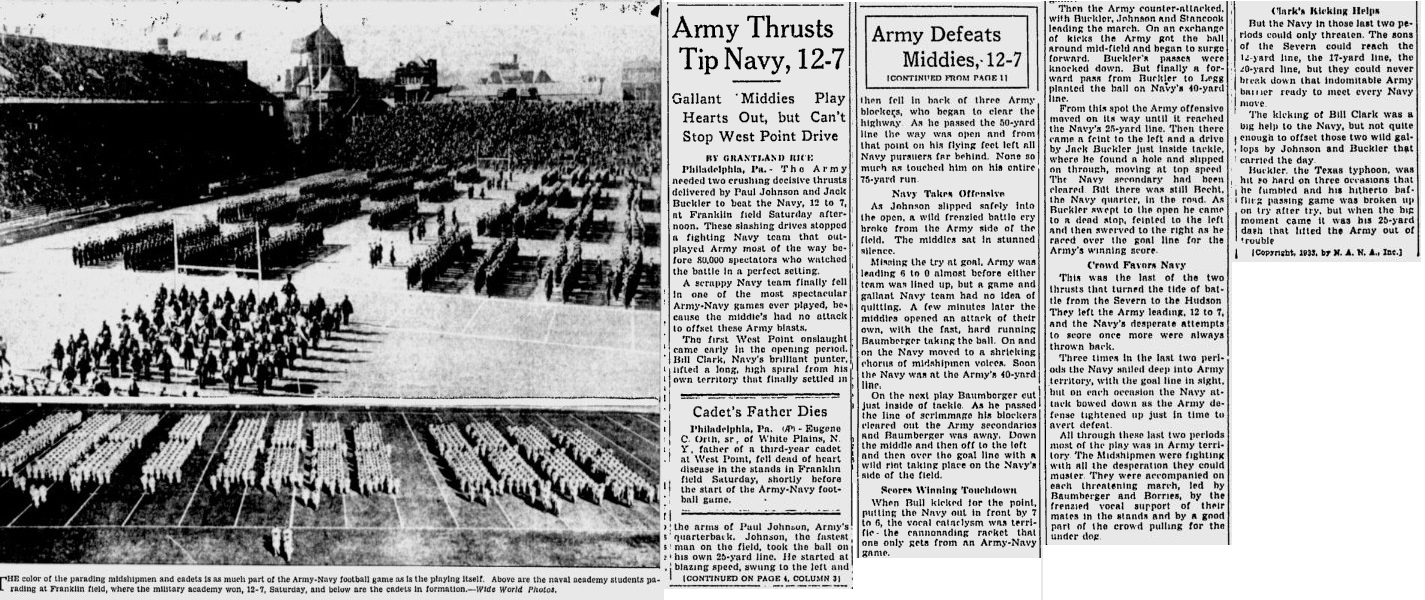
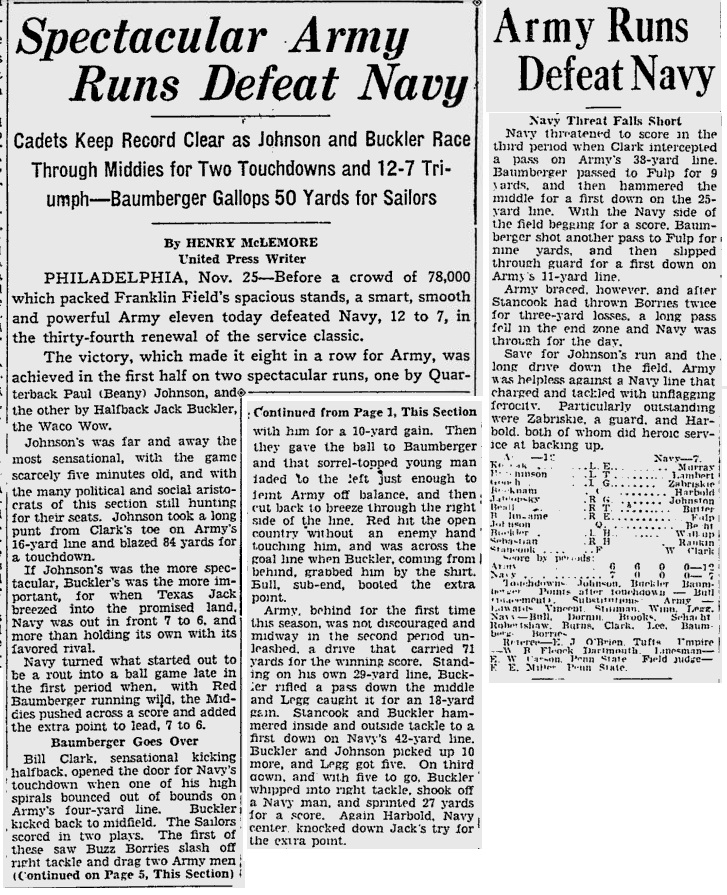
Army 12, Navy 7 Nov. 25, 1933 – Philadelphia, Pa.
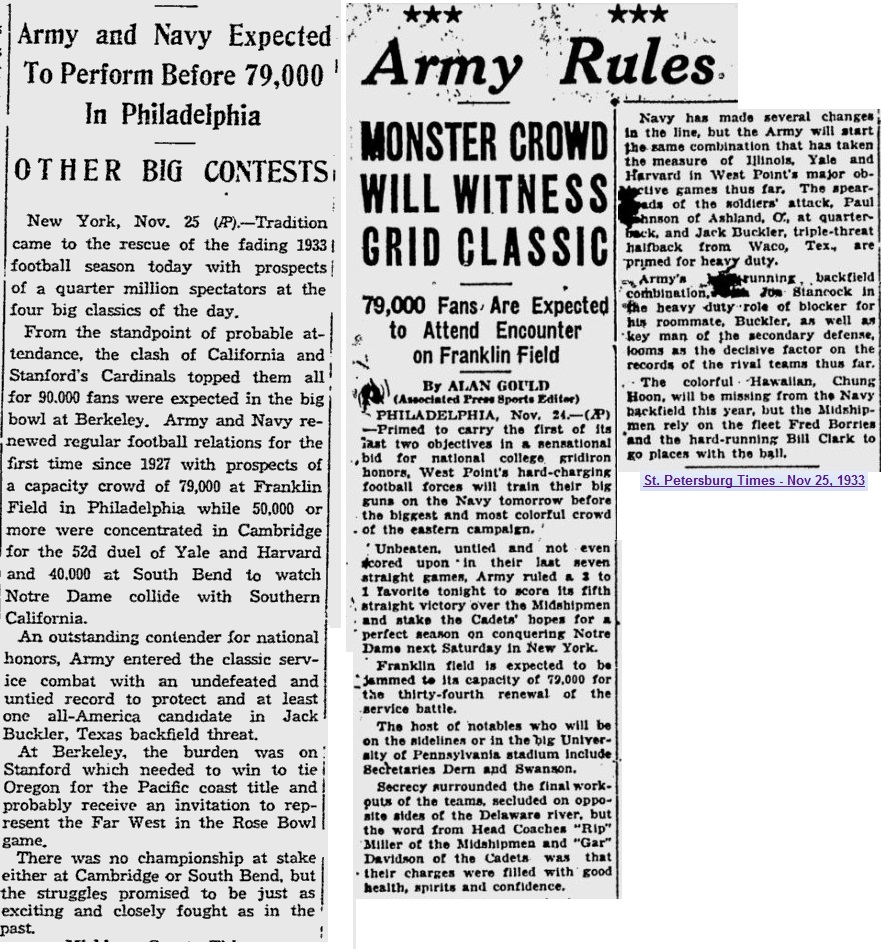
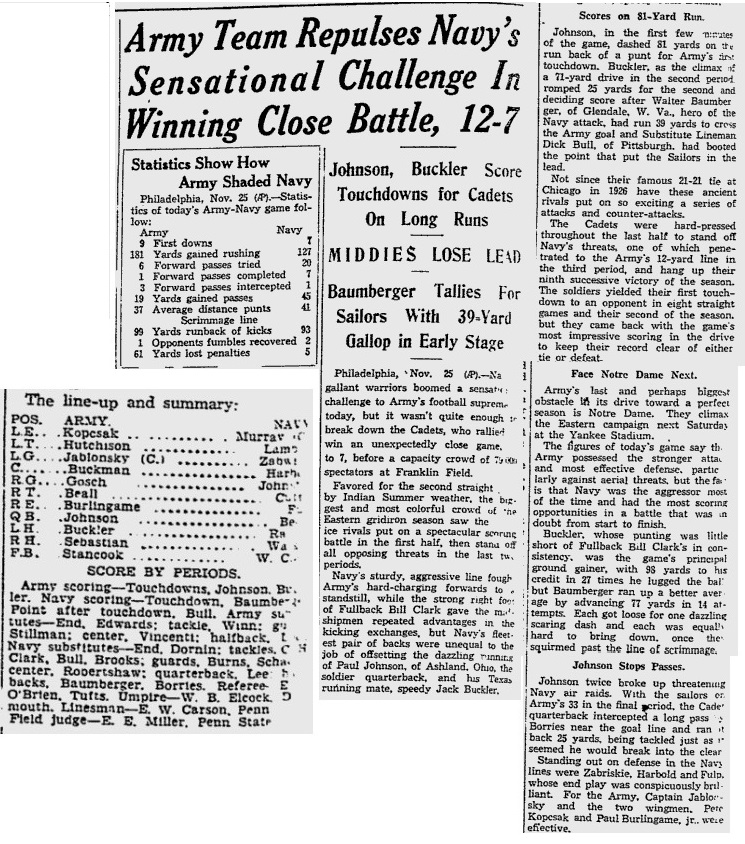
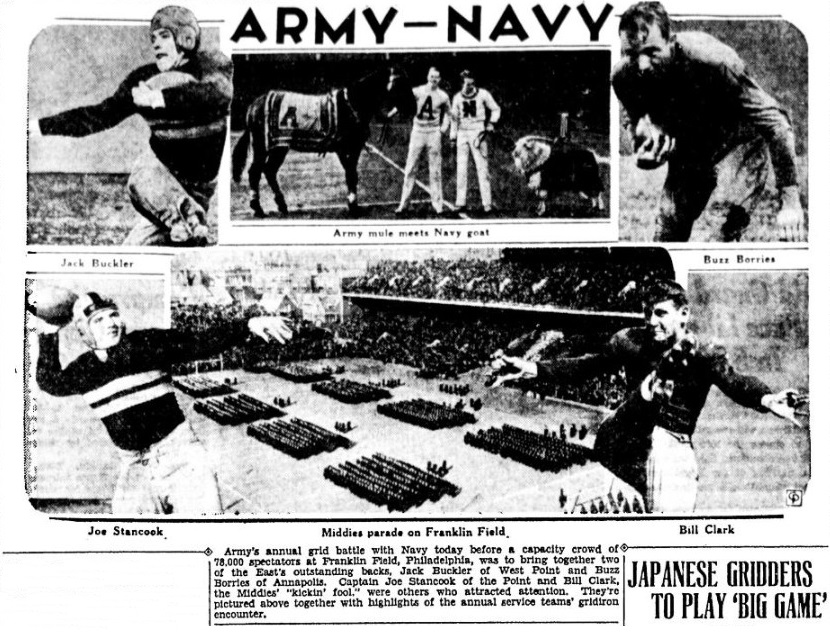
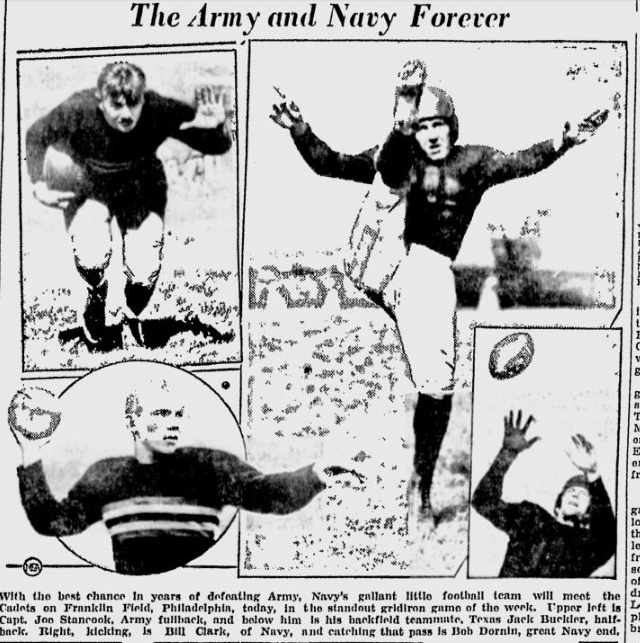
Army scored a pair of first-half touchdowns and held on for a 12-7 win over a feisty Rip Miller-coached Navy club. The win was Army’s ninth in as many games, and a Dec. 2 victory over 2-5-1 Notre Dame would all but guarantee the Cadets the 1933 national title. However, the Fighting Irish spoiled these hopes by handing Army a 13-12 setback. For the first time since 1916, Army scored in the opening quarter against Navy. Paul Johnson took Bill Clark’s punt and returned it 81 yards for the touchdown. But the extra point was blocked, which enabled Navy to take a 7-6 lead when Red Baumberger galloped 38 yards to the Cadet end zone. Nonetheless, Army’s Jack Buckler, whose extra point was blocked on his team’s first score, raced 25 yards for the winning touchdown in the second half.
–
–
–
–
–
–
Navy 3, Army 0 Dec. 1, 1934 – Philadelphia, Pa.
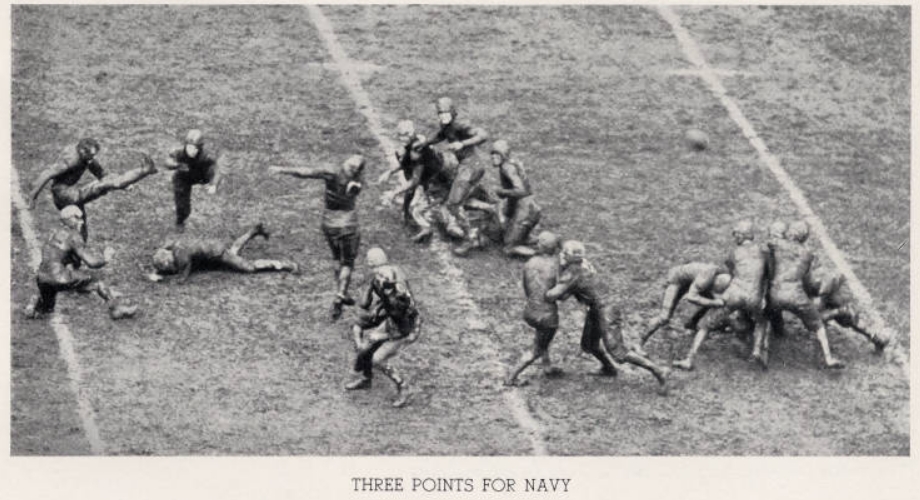
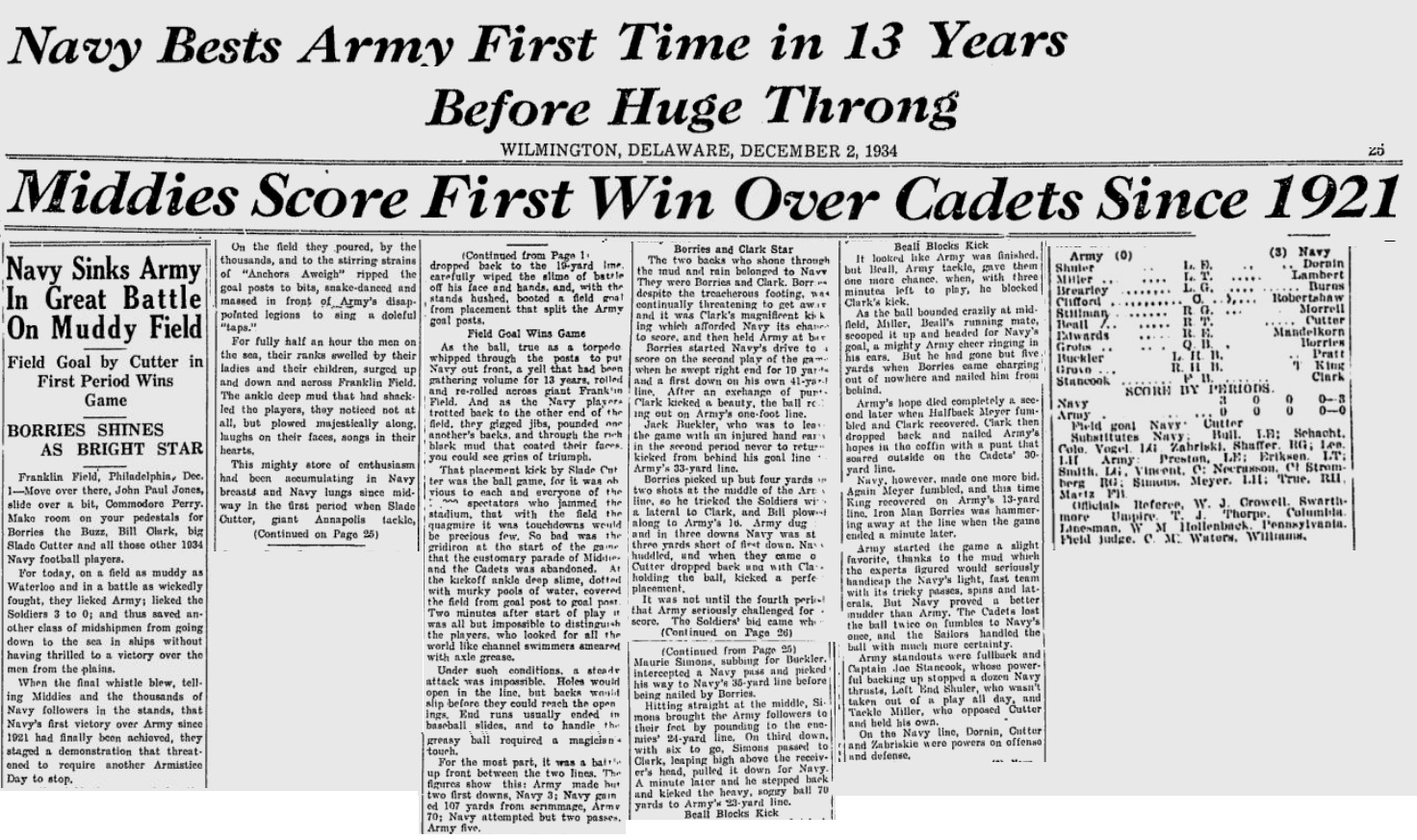
Despite the driving rainstorm at Franklin Field, Navy kicker Slade Cutter’s 28-yard field goal ended an 11-game drought, as the Midshipmen’s 3-0 win marked their first triumph over Army since 1921. Nothing indicates the treacherous weather conditions better than the final statistics. Army and Navy combined to record five first downs and 132 yards of total offense between them. Collectively, they also completed three-of-eight passes and punted 25 times.
–
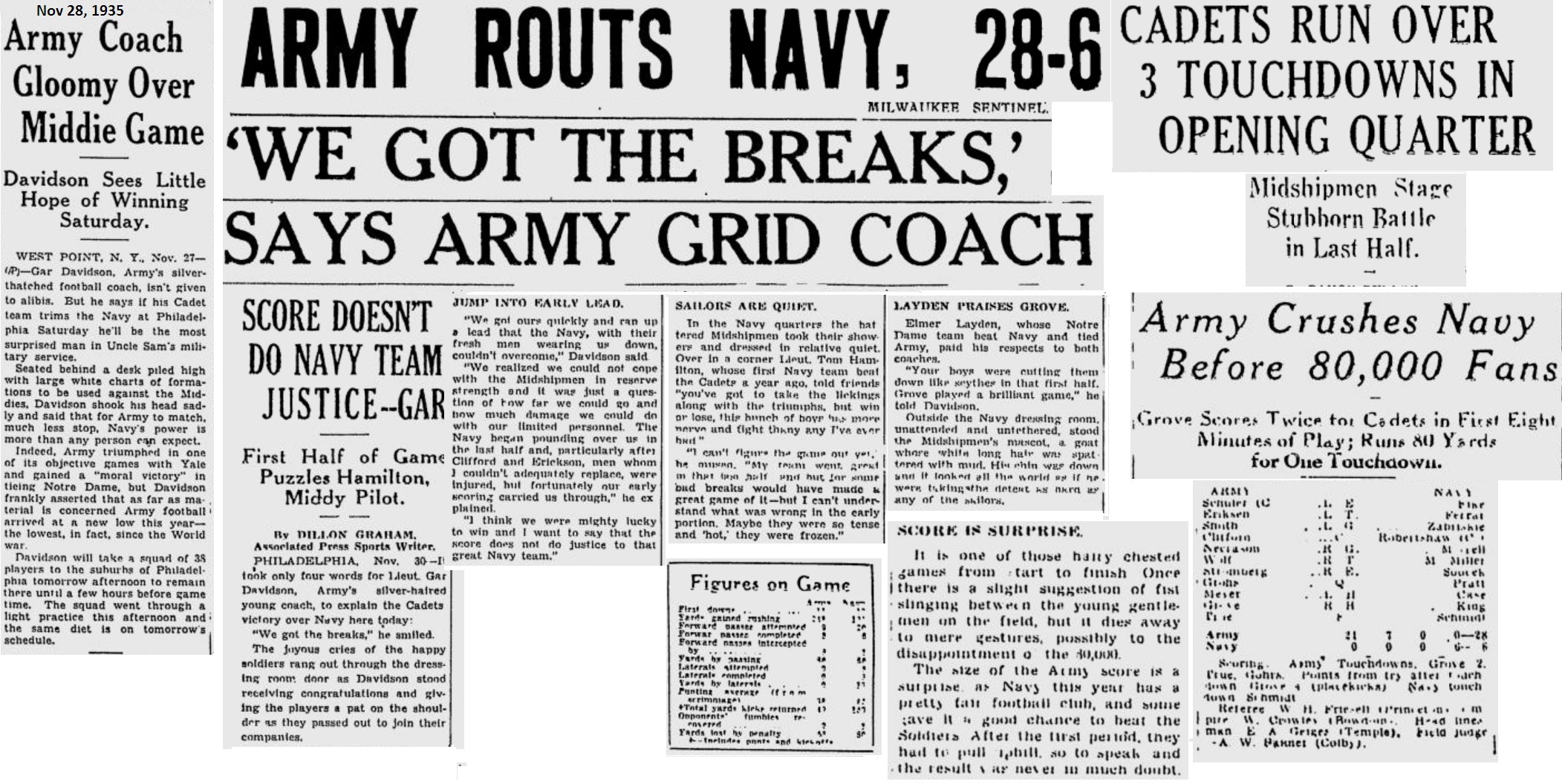
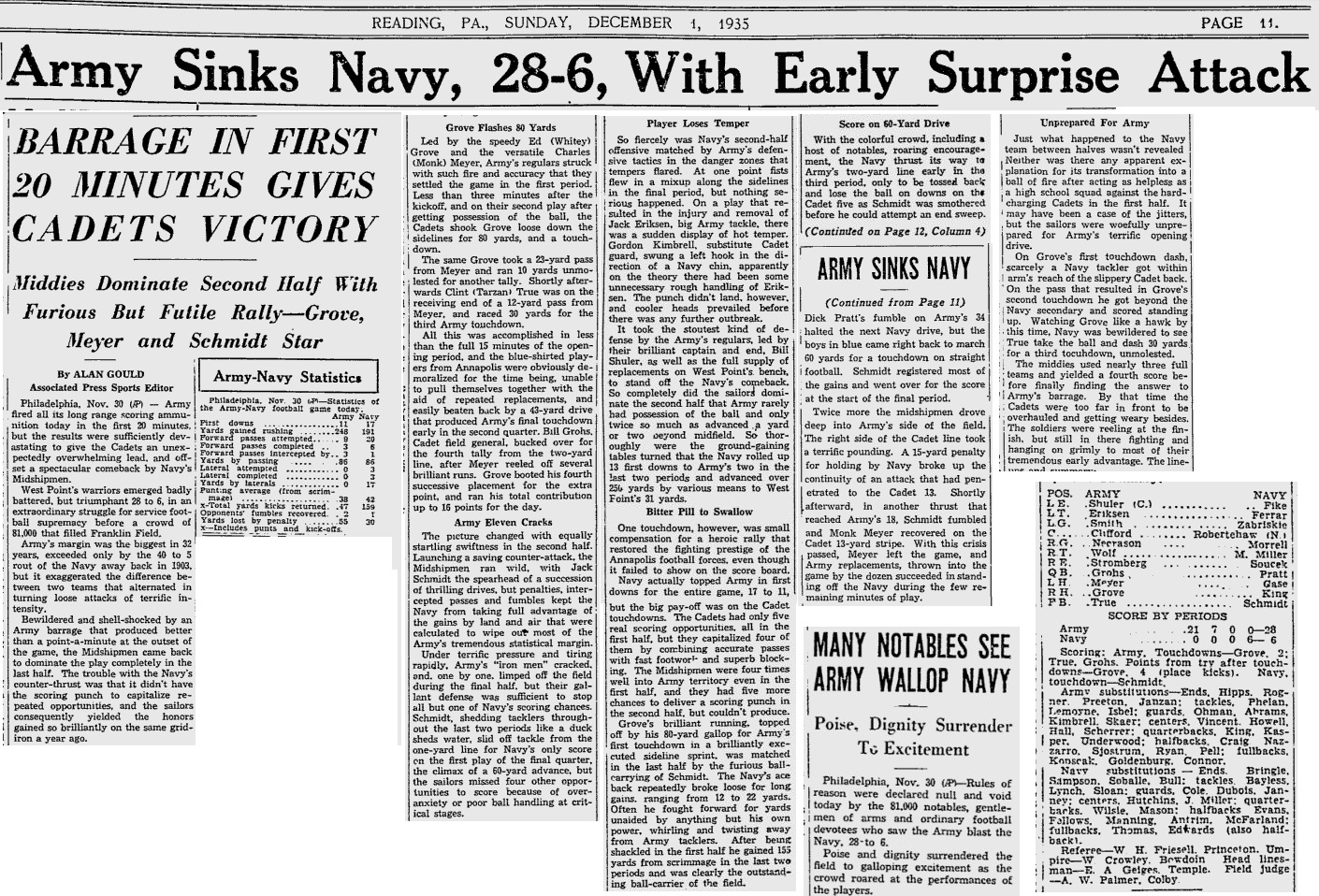
Army 28, Navy 6 Nov. 30, 1935 – Philadelphia, Pa.
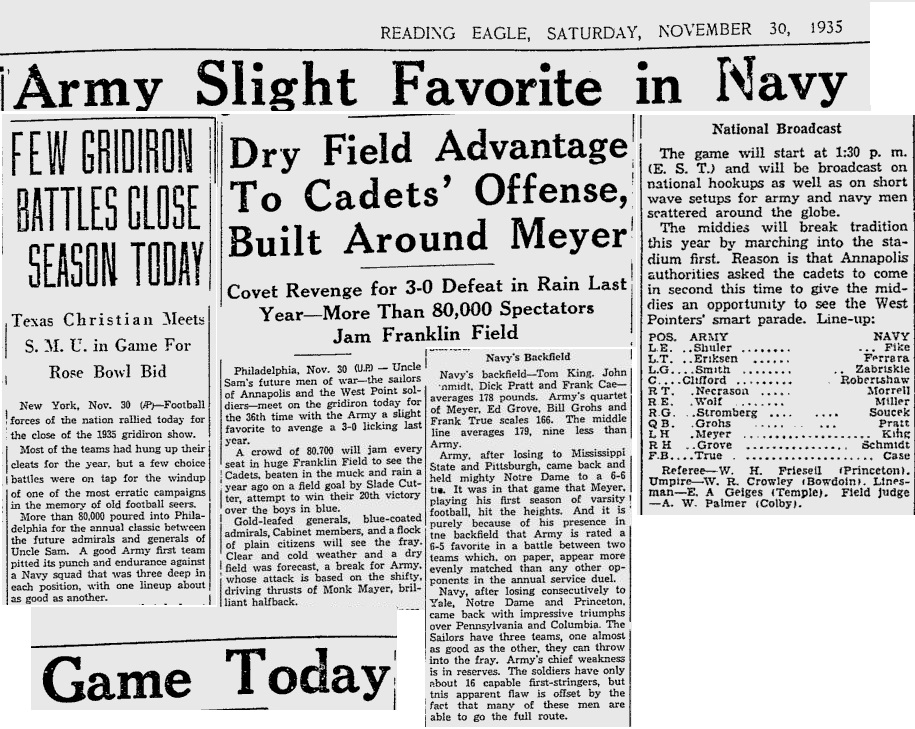
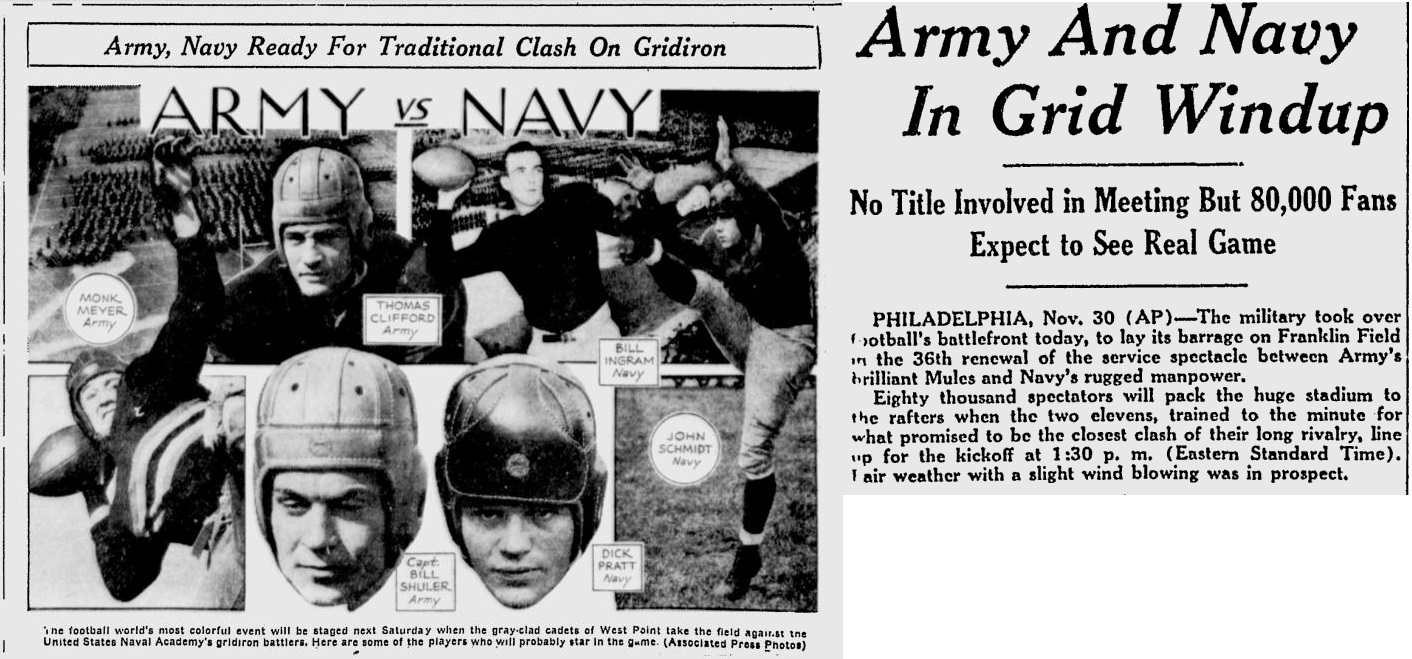
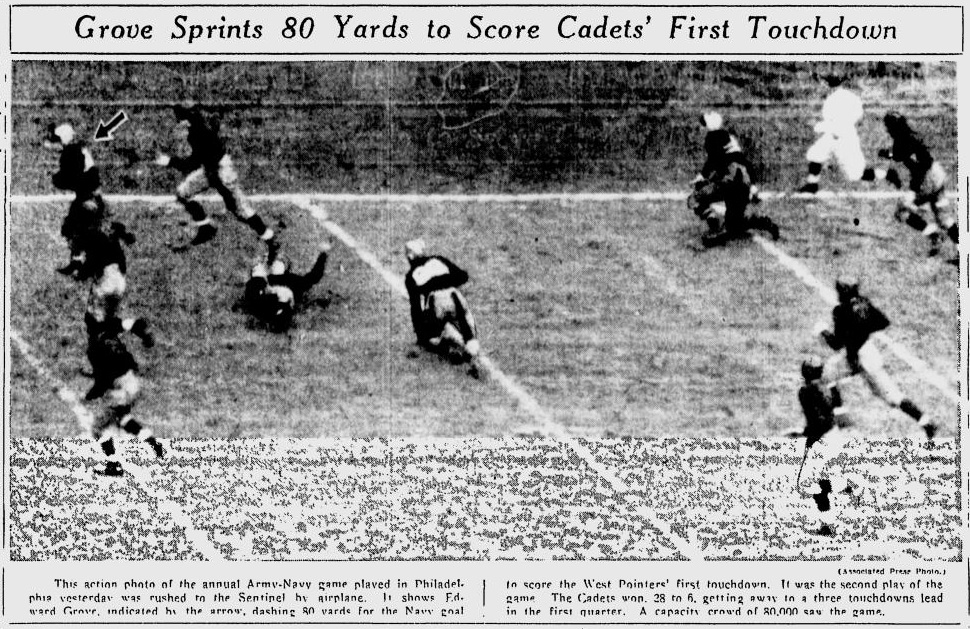
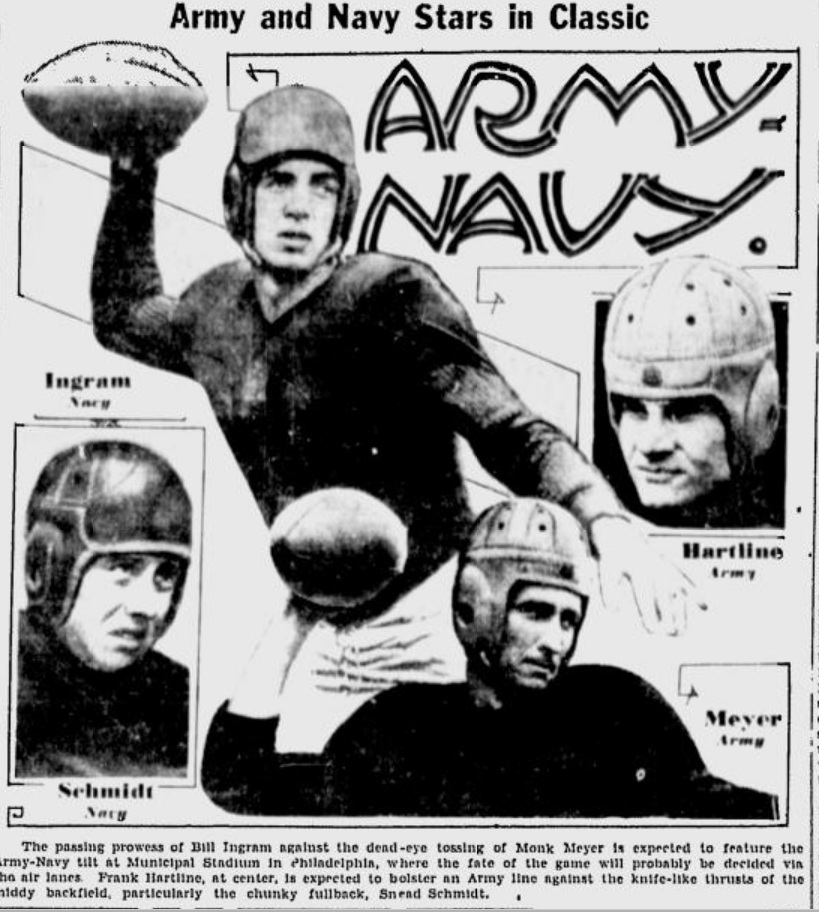
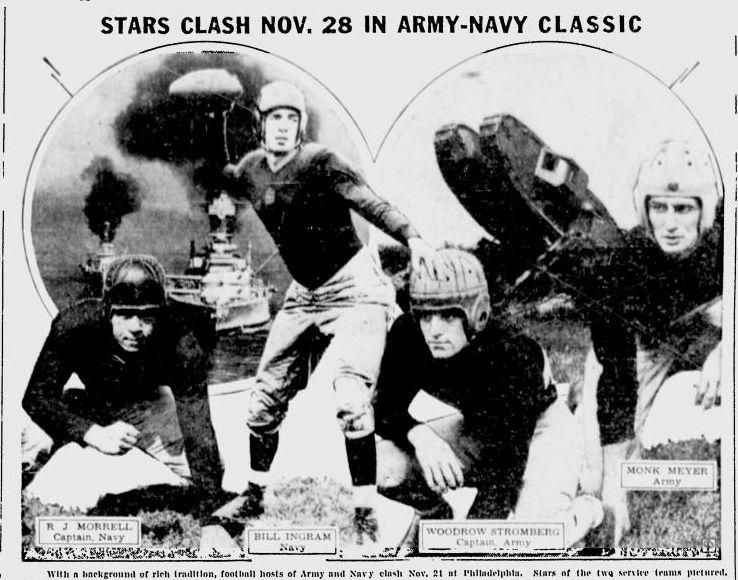
The 1935 matchup was a tale of two halves. In the first two quarters, Army piled up 303 yards of total offense, holding Navy to just 37. Yet, in the second half, the Mids had more than eight times the total offense than that of the Cadets – 259 yards to 31 for Army. Despite these similarities, there was also one visible difference. Army scored four times in its half, while the Mids were unable to reach the end zone. Final score: Army 28, Navy 6. Quarterback “Monk Meyer” had 35- and 40-yard touchdown passes in the opening half, while Whitey Grove added an 80-yard touchdown run on a reverse. Sneed Schmidt’s four-yard touchdown plunge in the fourth quarter was the only offensive highlight in the Midshipmen’s season finale.
–
No sound version –
–
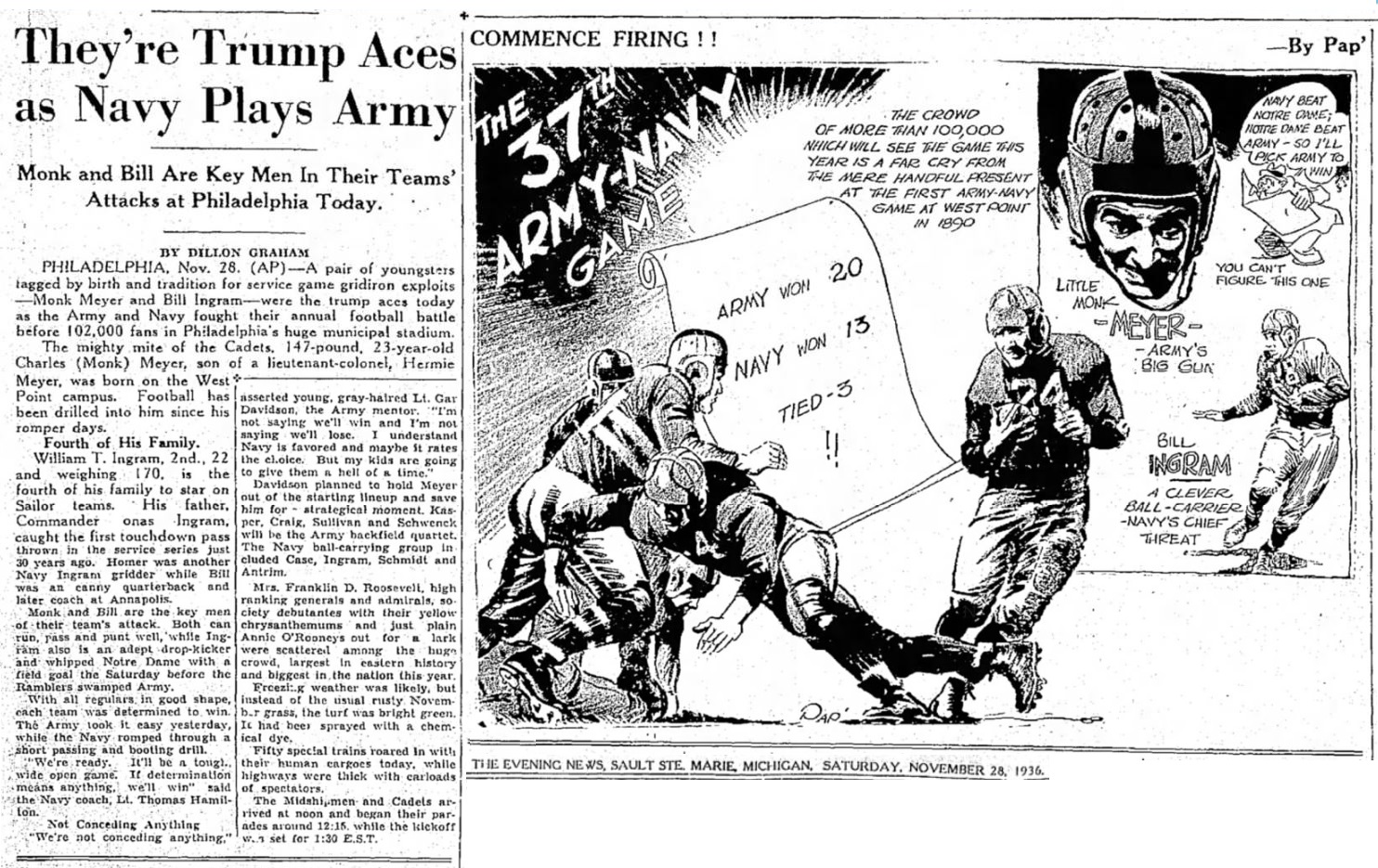
Navy 7, Army 0 Nov. 28, 1936 – Philadelphia, Pa.
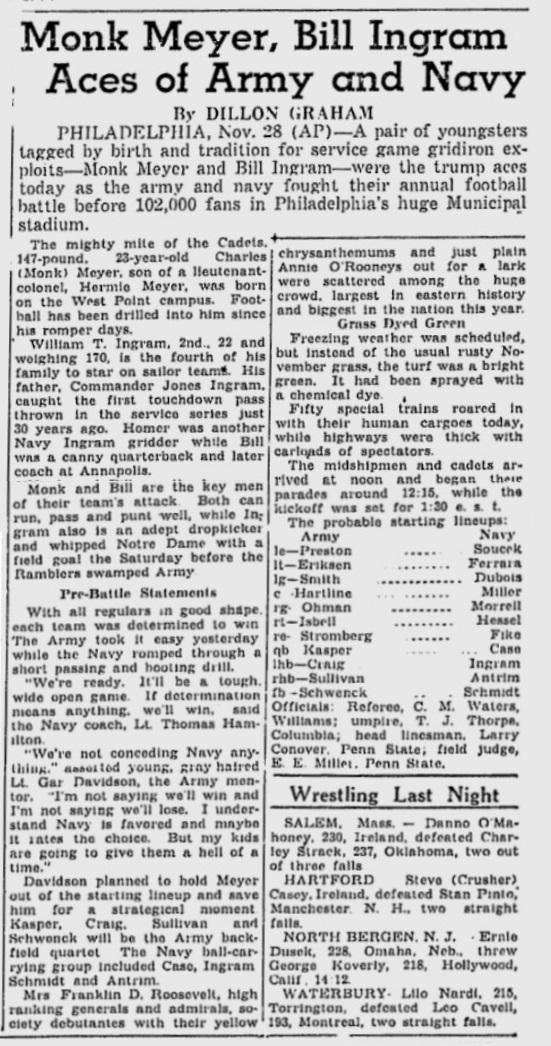
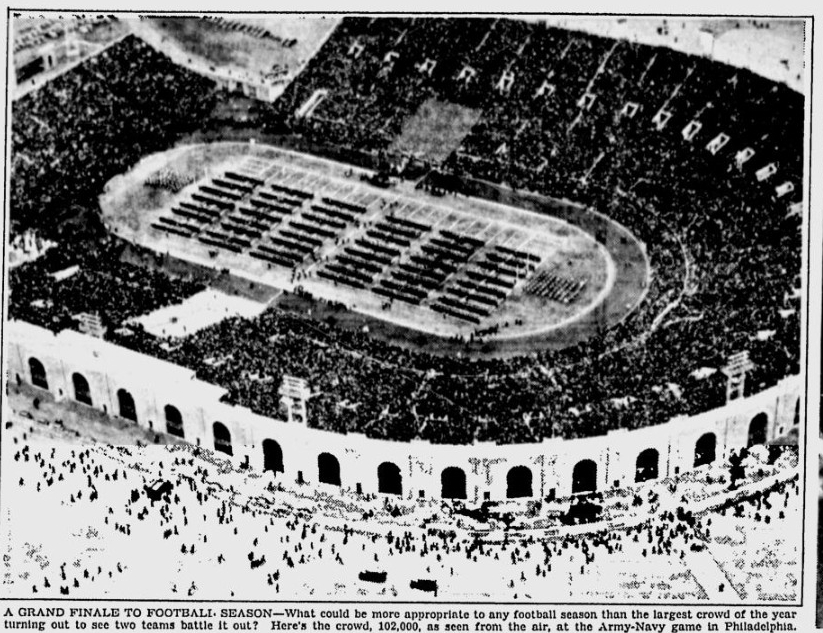
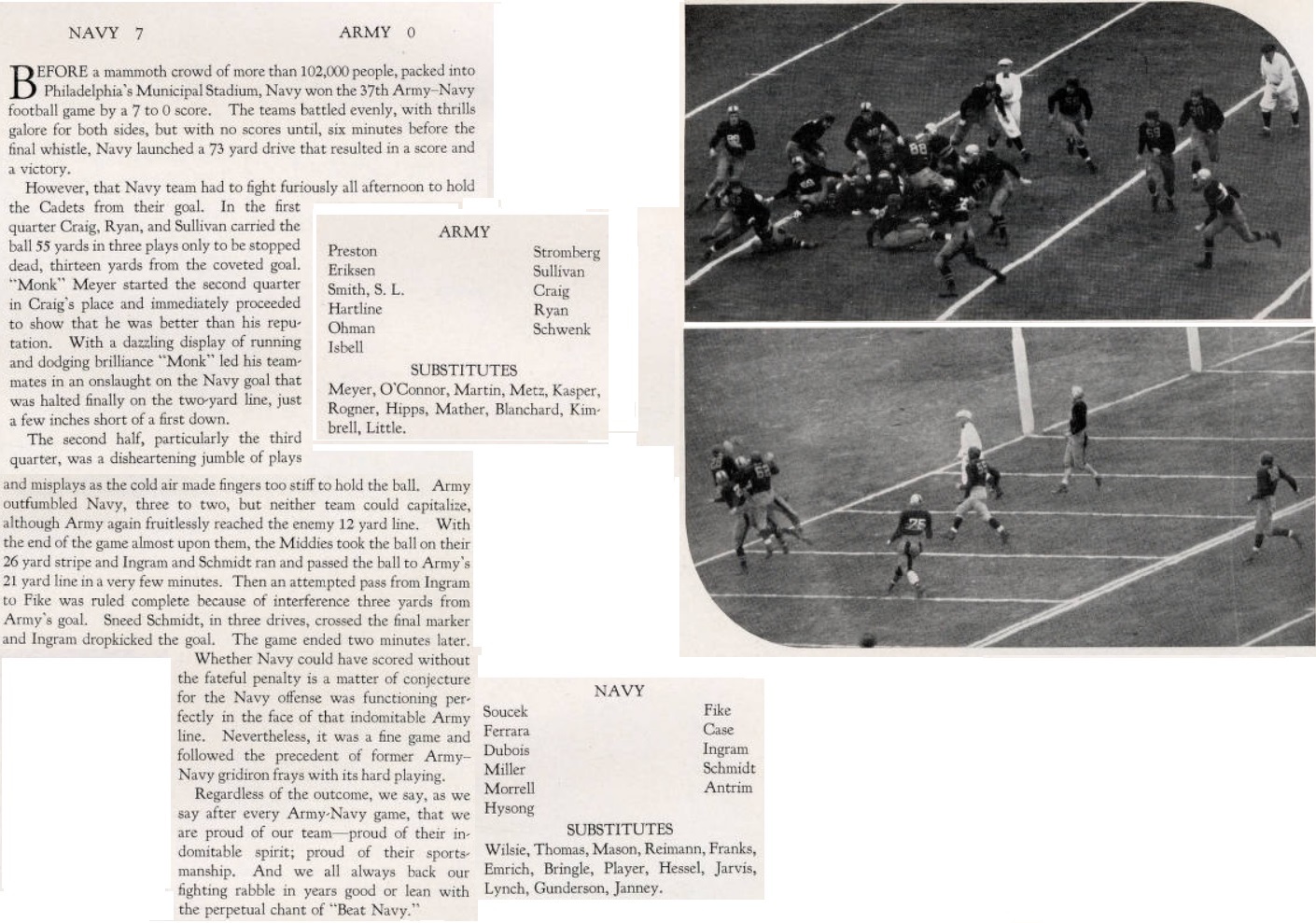
In an effort to meet the supreme ticket demand, the 1936 game was moved from 88,000-seat Franklin Field to 102,000-seat Municipal Stadium. Despite driving deep into Navy territory in the first half, Army was unable to capitalize, as John Schmidt’s three-yard touchdown run in the fourth quarter was all Navy needed for a 7-0 win over the Cadets. Following the series’ first scoreless opening half since 1930, the third quarter was even less exciting. Army fumbled the football away on three of its next-four possessions, while the Midshipmen were unable to reach the Cadet end zone on three possessions. However, Navy was able to take advantage of a “Monk Meyer” fumble in the fourth quarter. Aided by a pass interference call against the Cadets’ Jim Craig, Schmidt scored his touchdown with two minutes left.
–
–
–
–
–
Another version of 1936 A-N game – although no date stated
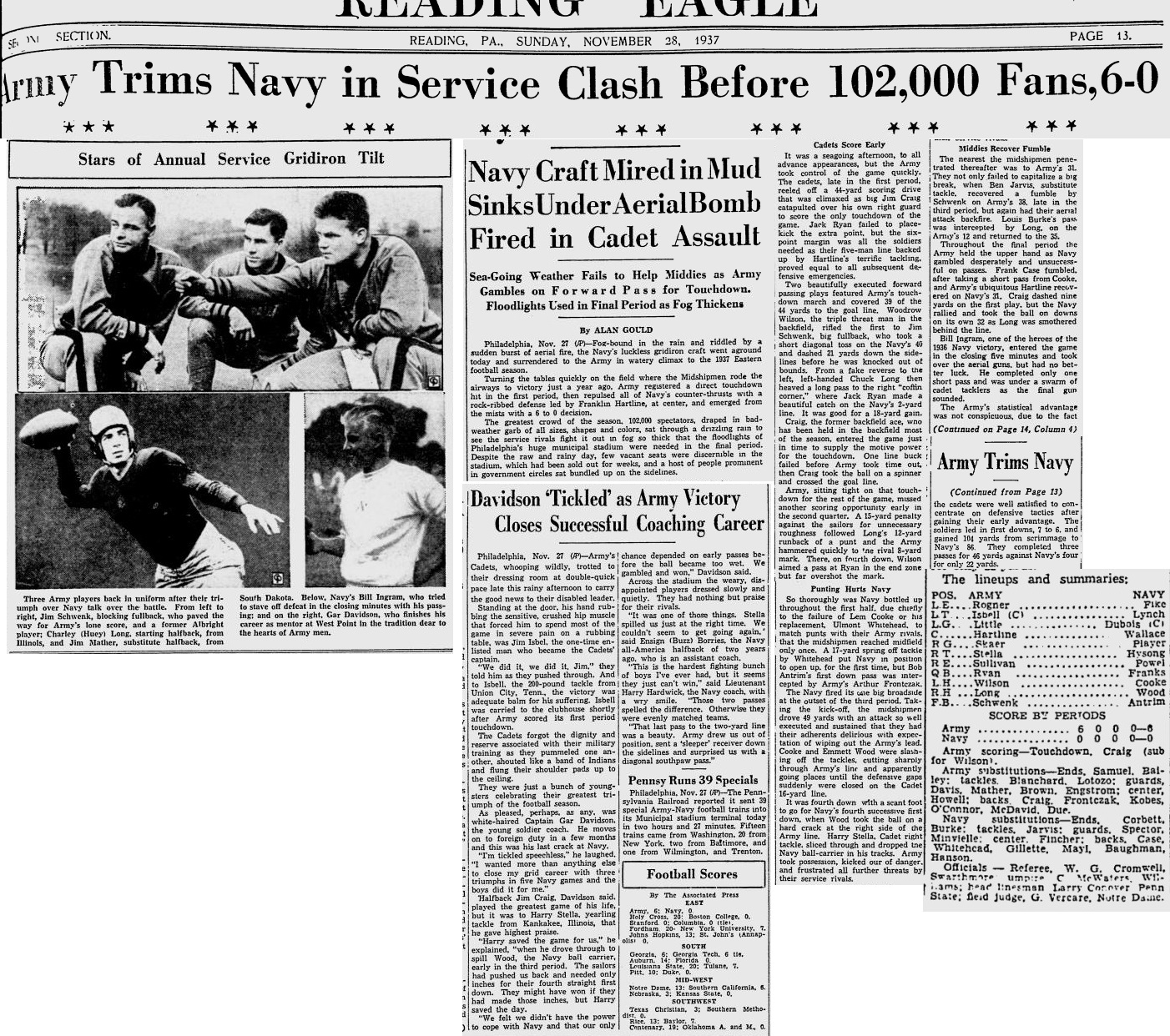
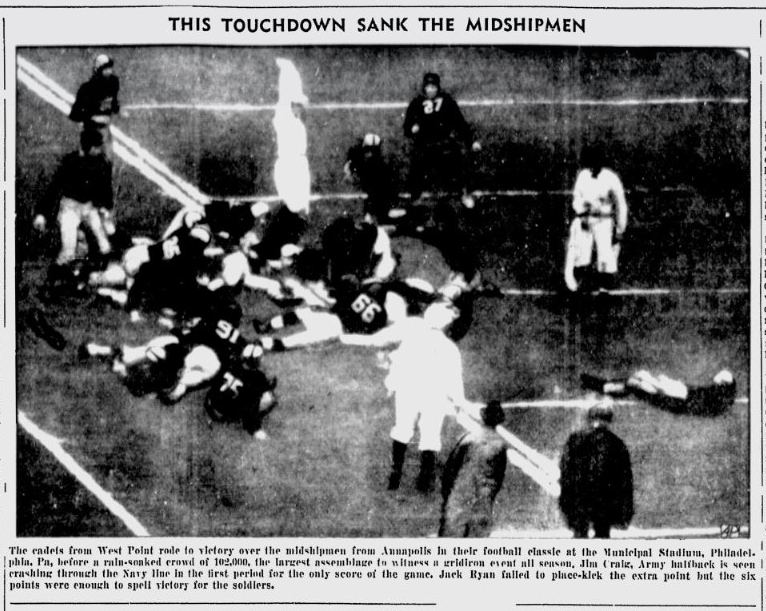
Army 6, Navy 0 Nov. 27, 1937 – Philadelphia, Pa.
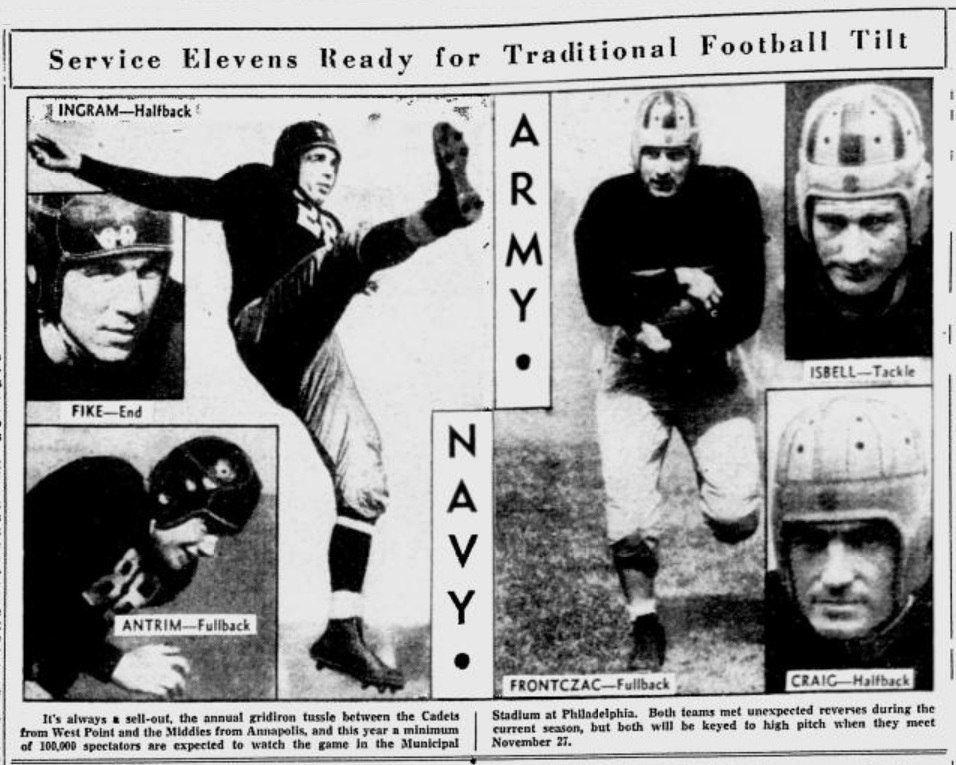
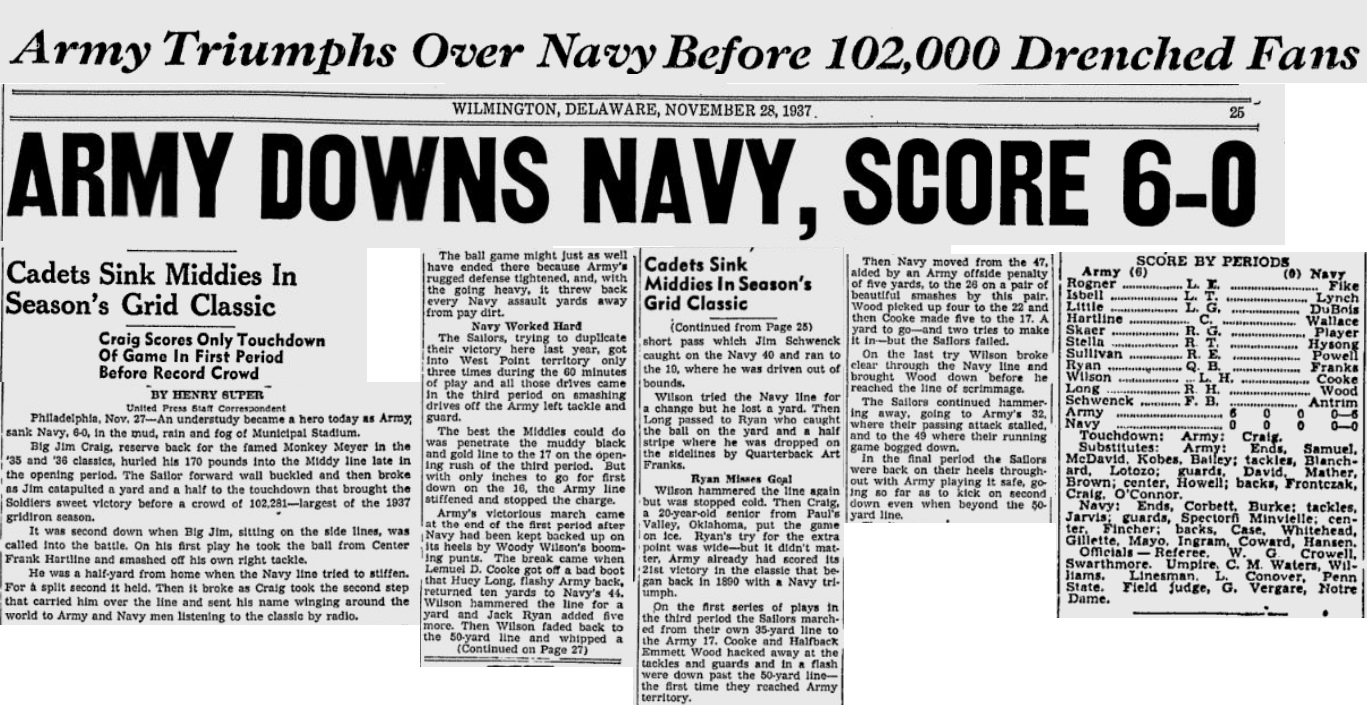
In a game that saw the two teams punt a combined 32 times, Army’s Jim Craig managed to score a three-yard touchdown run to give his team a 6-0 victory. Craig’s run capped off a 44-yard scoring drive highlighted by a 19-yard pass from Woody Wilson to Jim Schwenk. The teams had a combined 255 yards of total offense, as Craig was the game’s high rusher with 47 yards on 20 carries.
–
–
–
–
–
no date stated
–
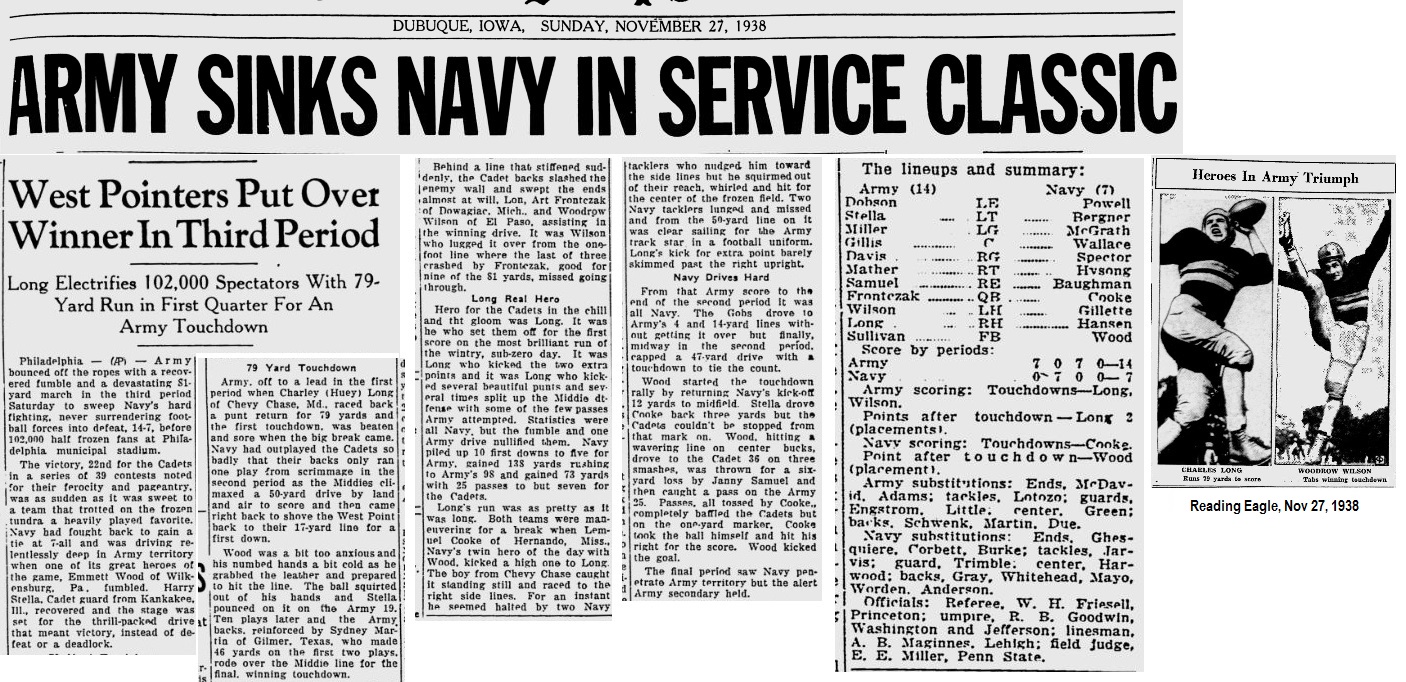
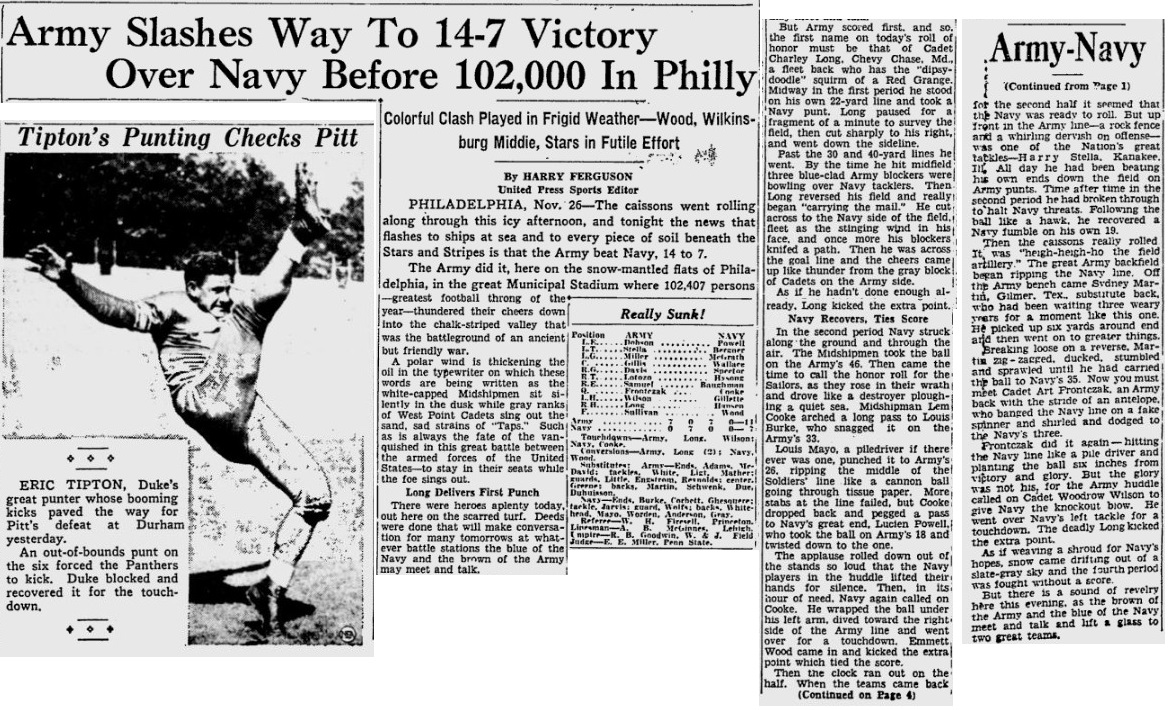
Army 14, Navy 7 Nov. 26, 1938 – Philadelphia, Pa.
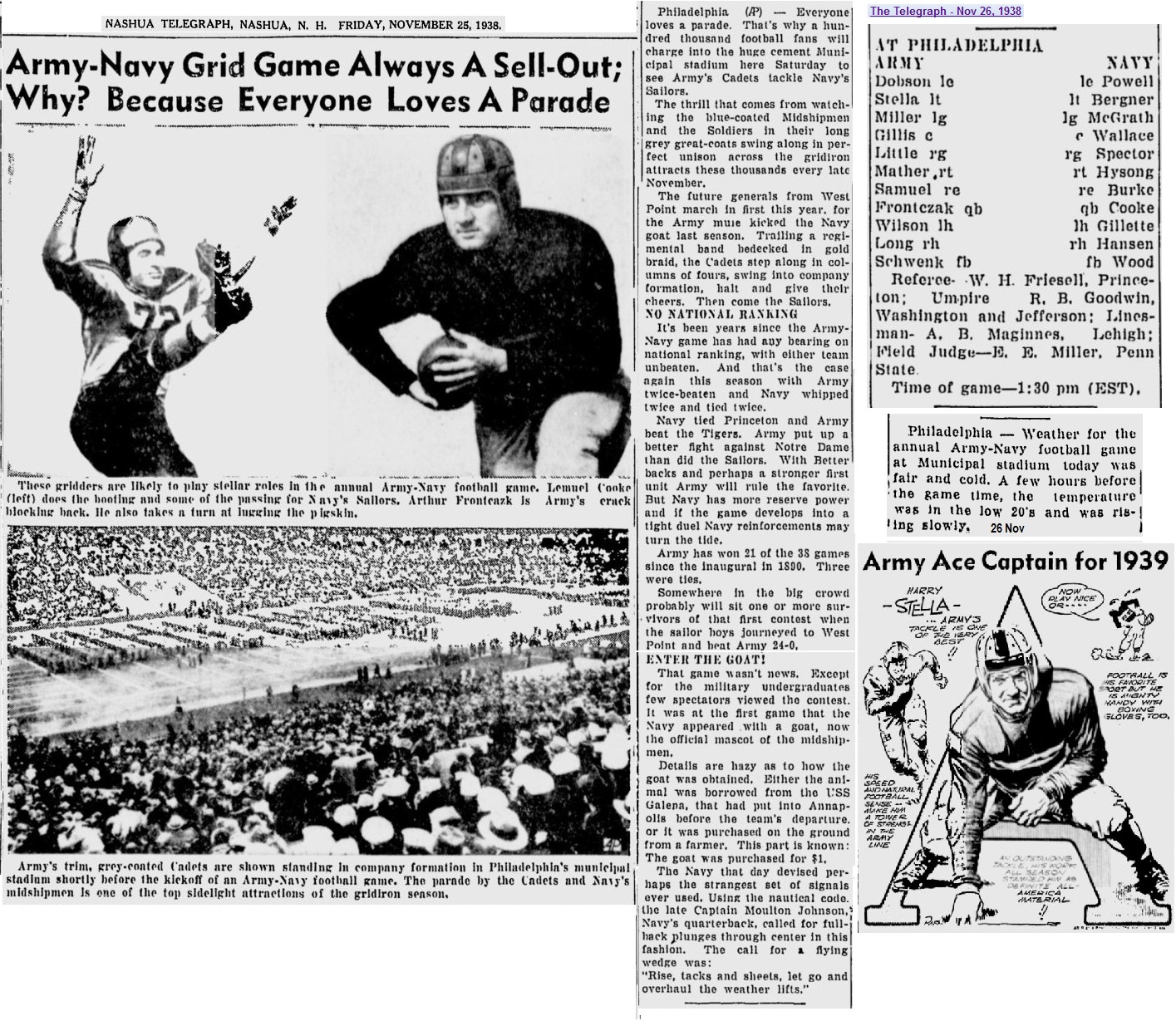
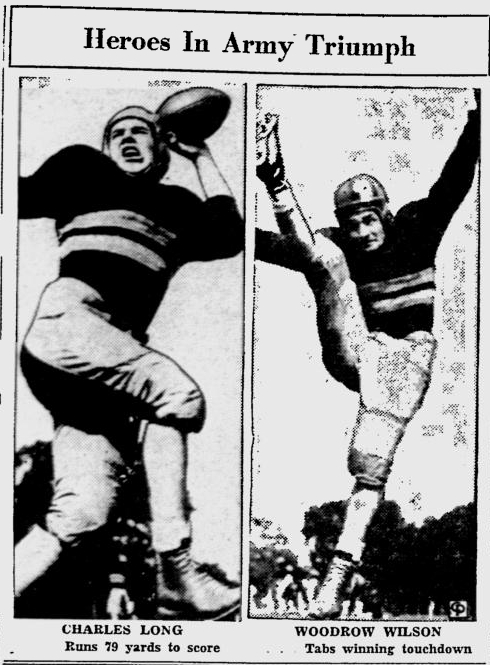
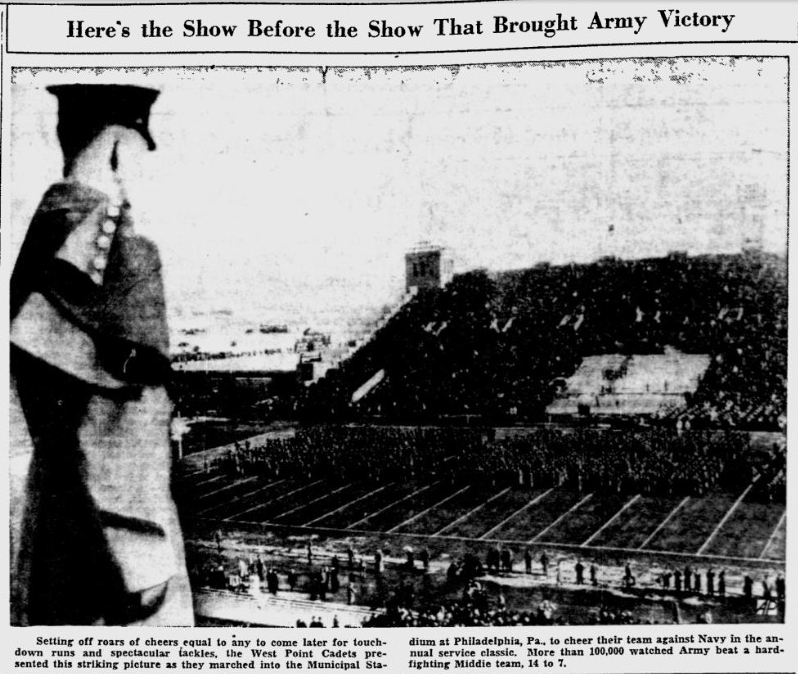
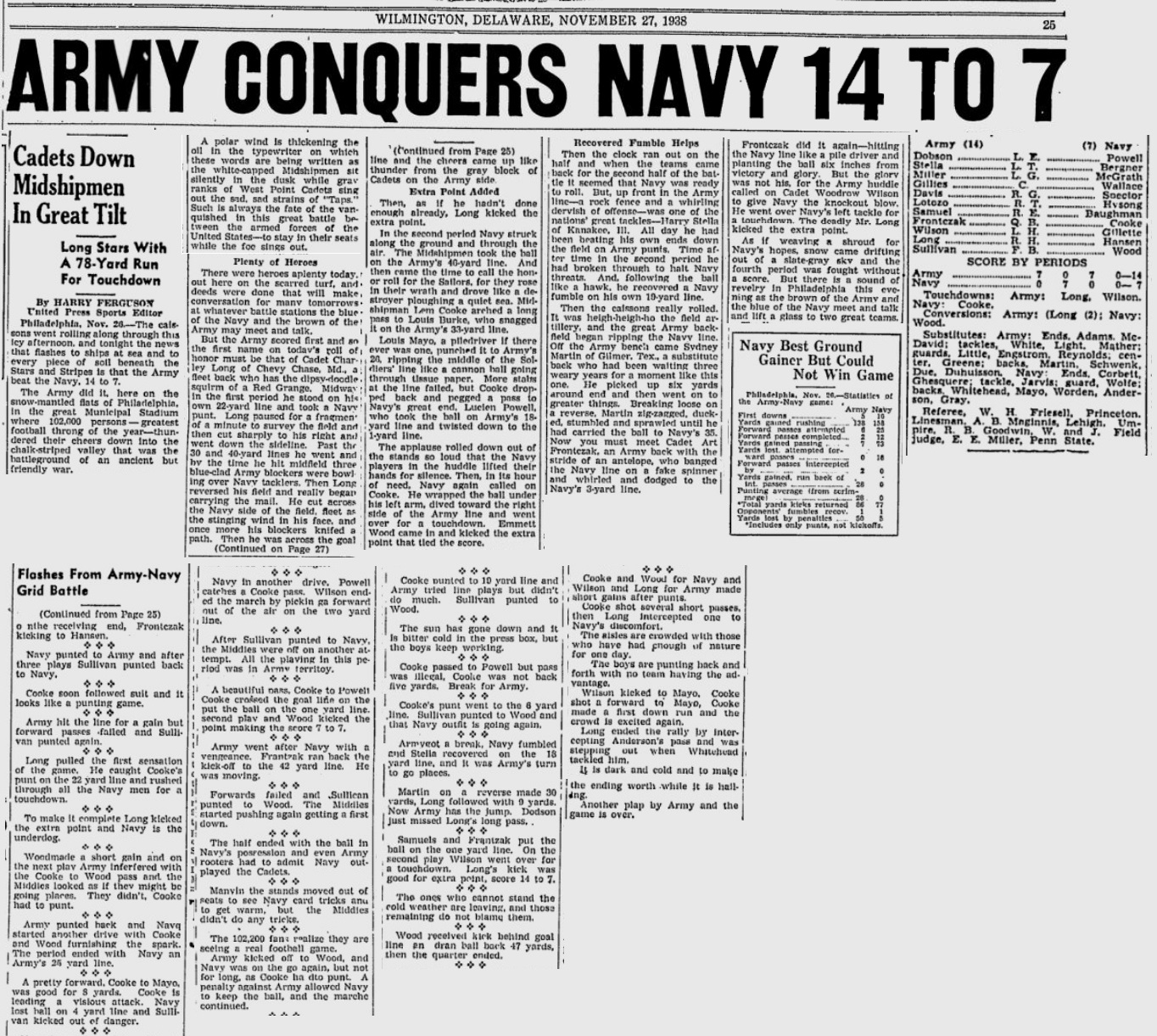
In front of 102,000 fans, the largest crowd to see a sporting event in 1938, Woody Wilson scored on a one-yard touchdown run in the third quarter to help Army to a 14-6 win over Navy. Army’s Charley Long brought Cadet faithful to their feet in the first quarter when he returned Lem Cooke’s punt 79 yards for a touchdown. Navy drove deep into Army territory on each of its next-two possessions, only to be stopped once on downs and once on a Wilson interception. However, Cooke tied the score with a one-yard touchdown run before halftime. Navy opened the third quarter poised to take the lead, but Emmette Wood fumbled on the Cadet 17-yard line. Army more than capitalized on this miscue, driving the length of the field to take the lead, and eventually the win, on Wilson’s touchdown.
–
–
–
–
–
–
–
–
–
Navy 10, Army 0 Dec. 2, 1939 – Philadelphia, Pa.
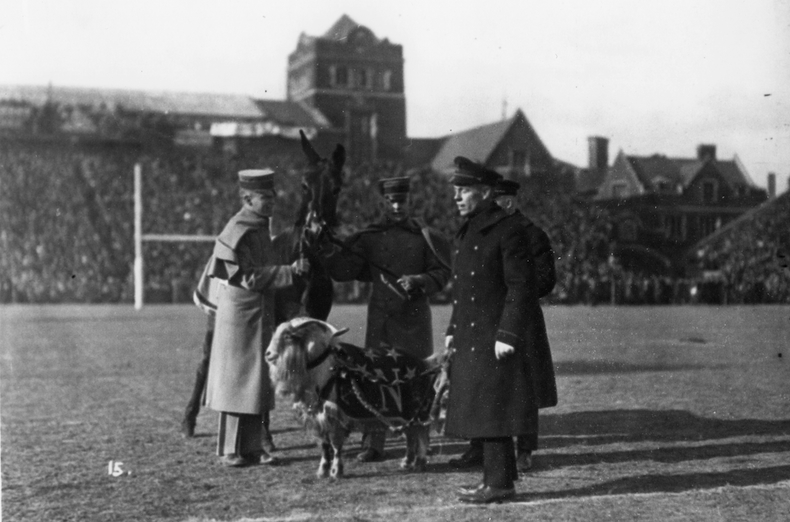
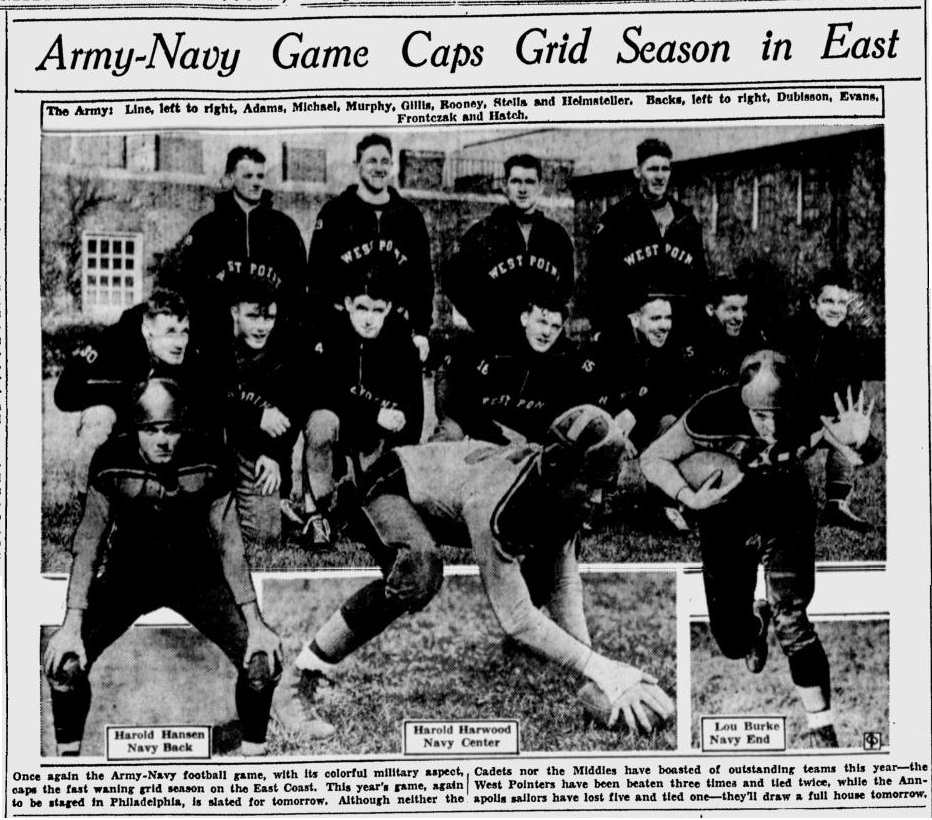
When Emory “Swede” Larson took over the Navy program in 1939, no one had to define the magnitude of the Army-Navy rivalry to him. A three-year letterwinner (1919-21), Larson had played on three teams victorious over the Cadets. In fact, Larson arranged to have Billy VIII, Navy’s mascot, wear the same blanket that adorned the 1921 goat. This superstition must have paid off, as the Midshipmen shut out Army, 10-0. Navy scored on its opening drive, as Ulmont Whitehead booted a 33-yard field goal between the uprights to give the Mids a 3-0 lead. Halfback Dick Shafer added a 22-yard touchdown run in the last quarter, as Navy utilized six Army turnovers to finish 3-5-1 on the season.
=
–
–
–
–
no A-N game film found but here is the game with Notre Dame
The material below this point is a site a work area.
The '54 Crest
28th Infantry Regiment Black Lion Award is intended to go to the person on his team "who best exemplifies the character of Don Holleder: leadership, courage, devotion to duty, self-sacrifice, and - above all -
an unselfish concern for the team ahead of himself."
"The Army moves as a team, eats as a team, and fights as a team."
The '55 Crest
Don Holleder Remember - The Soldiers you will lead Always Come First
Vann and Holleder
9 Army A's
The '56 Crest
The '57 Crest
Can Do
Gen Van Fleet addressing the Corps prior to the Navy Game
Constructed under supervision of Jay Gould "54 and the Ord Dept from a German Rocket Gun captured at Kasserine Pass. First used in the Duke Game.
COL "Red" Reeder granted the Cheerleaders Corps Squad status to obtain financial support for their spirit-inducing initiatives.
Bob Mischak - - It should be pointed out that Bob was an All American selection, but is not recognized by the Academy as such because of the organization which selected him.
Ubel scores 3 Times against Navy - Vann's facking results in Peter getting tackled - #10 on the ground behind Ubel
Vann to Sisson
Army's B Squad
Vann to Mischak.
Uebel Intercepts
Cody to Don Holleder
Lasley
Frank Hicks
Burd
Bill Purdue
Cody
Meador Mgr
Ron Melnick
Ralph Chesnauskas
Pat Uebel
Tommy Bell
Sisson headed for another score
Peter Vann stuffs the ball in Jerry's gut
Leroy Lunn & Jerry Lodge
Uebel after taking the handoff from Hagan
Attaya - Army's Fullback
Sisson - one of 3 Great Ends
Bob Mischak
Ralph Chesnauskas
Bob Farris
Vann moving out of the pocket
Peter Vann 10, Billy Chance 38, Herdman 68
Ken Kramer
Joe Lapchick
Kirk Cockrell
Lodge going down tosses to Paul Schweikert for score.
Dick Zeigler
Bob FarrisPlayed the 2d half of the Navy Game blind in one eye.
Pat Uebel
Tommy Bell
Peter Vann
Freddie Attaya
Mike Zeigler
Jerry Lodge wearing #67, playing fullback.
Johnny Wing
Lowell Sisson
Norm Stephen
Jack Krause
Dick Ziegler
Jerry Lodge
Leroy Lunn
Norm Stephen
Jerry Lodge
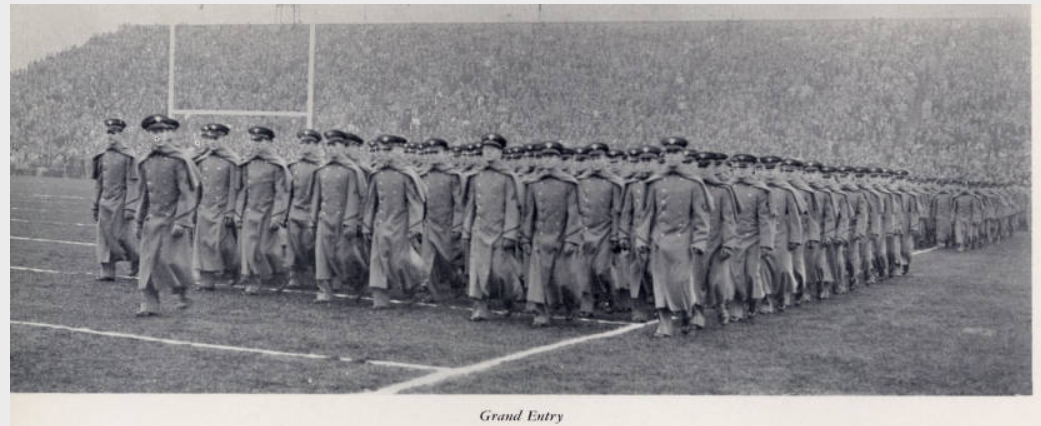
Corps of Cadets for Navy Game
Can Do
"The Army moves as a team, eats as a team, and fights as a team."
The '54 Crest
The '55 Crest
28th Infantry Regiment Black Lion Award is intended to go to the person on his team "who best exemplifies the character of Don Holleder: leadership, courage, devotion to duty, self-sacrifice, and - above all - an unselfish concern for the team ahead of himself."
 Battalion Staff and Cadet Companies E1, F1, G1 and H1 US Signal Corps Photo