Category Archives: Uncategorized

George Handy

George & Marilyn Handy
M2 Honor Rep, Soccer – A Friend who will stand with you.  George continues to be a part of teams – currently involving East Europeans and Americans in economic growth and stronger security.

  • President, Supervisory BoardPresident, Supervisory BoardAlliance for Innovation Alliance for Innovation Jan 2017 – Present · 5 yrs 6 mosJan 2017 – Present · 5 yrs 6 mosWarsaw, PolandWarsaw, Poland
      • The Alliance for Innovation advances innovation in scientific and economic growth through increased US-Poland cooperation, with emphasis on Polish-American cultural bonds and a focus on cooperation at local levels enabled by public-private sector partnerships. The Supervisory Board plays an active role in project selection and development as well as monitoring and advising the Management Board.

        The Alliance for Innovation advances innovation in scientific and economic growth through increased US-Poland cooperation, with emphasis on Polish-American cultural bonds and a focus on cooperation at local levels enabled by public-private sector partnerships. The Supervisory Board plays an active role in project selection and development as well as monitoring and advising the Management Board.
  • Senior AssociateSenior AssociateGeorge W. Handy & Associates, LLCGeorge W. Handy & Associates, LLCJul 2007 – Present · 15 yrsJul 2007 – Present · 15 yrsWashington, DCWashington, DC
      • Provide practical advice and assistance for government and private sector organizations engaged in international cooperation on economic, scientific and security opportunities with a focus on the Euro-Atlantic community. Provide practical advice and assistance for government and private sector organizations engaged in international cooperation on economic, scientific and security opportunities with a focus on the Euro-Atlantic community.
  • Owner and Managing DirectorOwner and Managing DirectorActivity for Innovation and Economic GrowthActivity for Innovation and Economic GrowthJul 2007 – Dec 2018 · 11 yrs 6 mosJul 2007 – Dec 2018 · 11 yrs 6 mos
      • This nonprofit organization assisted in economic growth and strengthening of security in Central and Eastern Europe and the Black Sea region through practical projects and ventures that had near-term impact and with emphasis on government and private sector cooperation.This nonprofit organization assisted in economic growth and strengthening of security in Central and Eastern Europe and the Black Sea region through practical projects and ventures that had near-term impact and with emphasis on government and private sector cooperation.
  • Program DirectorProgram DirectorCenter for Startegic and International StudiesCenter for Startegic and International StudiesJul 1992 – May 2006 · 13 yrs 11 mosJul 1992 – May 2006 · 13 yrs 11 mosWashington, DCWashington, DC
      • Directed International Action Commission Program active in Russia and 10 Central and Eastern European countries


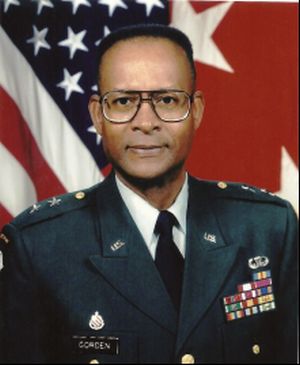
Fred Gorden

majgen copy 2.jpg Fred & Marcia Gorden  25th Inf.jpeg  USMA Shoulder Patch 
Battery, Battalion, and DivArty Commander; ADC 7th Division(IDL), 61st Commandant of Cadets(first African American), CG 25th Division(IDL), CG, Military District of Washington, his boots were always dusty & dirty.

General Fred A. Gorden was the first black Commandant of Cadets, the officer in charge of the training, discipline, and physical condition of the Corps of Cadets at the United States Military Academy at West Point.  The Commandant of Cadets position is second only to the position of Superintendent of the Academy.

Born in Anniston, Alabama in 1940, Gorden’s family moved shortly afterward to Atlanta, Georgia.  Gorden was the fourth of five children and was raised by his childless aunt, who lived around the corner from his family.  When she moved to Battle Creek, Michigan to marry, he went with her.  There he attended the local high school and excelled in both academics and athletics.  He was in the National Honor Society and played on an all-city basketball team.

Gorden had been attending a local junior college in 1958 when he was notified about his appointment to West Point as a cadet.  He received the call from a lawyer from his hometown who in turn had been contacted by the area’s Congressman about the appointment.  Gorden was to be the only black cadet in his class.

Graduating with a Bachelor’s Degree in Science and Engineering in 1962, Gorden shortly thereafter married Marcia Ann Stewart, whom he had met during his freshman year.  He then earned his Ranger tab and parachutist badge at Fort Benning, Georgia, before being assigned to the U.S.-controlled Panama Canal Zone as a field artillery second lieutenant.  Marcia, who was expecting the couple’s first child, stayed with her parents at Fort Ord in California, before joining him in Panama.

Beginning in 1966, Gorden had two tours of Vietnam followed by an assignment in Korea. In 1968, Gorden earned a master’s degree in Spanish literature, language, and civilization from Middlebury College in Vermont.  The couple spent a year living in Madrid, where their second daughter was born.

Gorden and his family returned to the United States where he attended both the Armed Forces Staff College in Norfolk, Virginia and the National War College in Washington, D.C.

By 1980 Gorden was assigned as executive officer in the office of the US Army chief of legislative liaison.  Two years later he became commander of division artillery of the Seventh Infantry at Fort Ord, California.  There he was promoted to Brigadier General in 1984.  Three years later in 1987 he was appointed Commandant of Cadets at West Point at the age of 47.

By the late 1980s virtually all of the West Point Cadets were relatively young high school graduates as opposed to older cadets who previously reached the Academy after work experience in civilian or military life. Gorden led the effort to accommodate their interests in technology with the values and skills that had traditionally been associated with a West Point education.

General Fred Gorden stepped down as Commandant in 1989; his next assignment was commander of the 25th Infantry Division at Schofield Barracks, Hawaii.  From 1993 to 1995, he served as commander of the Army Military District of Washington.

In 1996 General Fred Gorden retired from the United States Army as a Major General after 34 years of military service. He spent five years in the private sector before fully retiring in 2001.  He currently lives in Georgia with his wife, where he is active in his community and spends his time studying African American military history.

Dick Gary

Marlene Garvey for Dick  
A man of intellect, good humor, and calm demeanor, with a wonderful sense of family, and a great friend – John Easterbrook 

Denny Flint

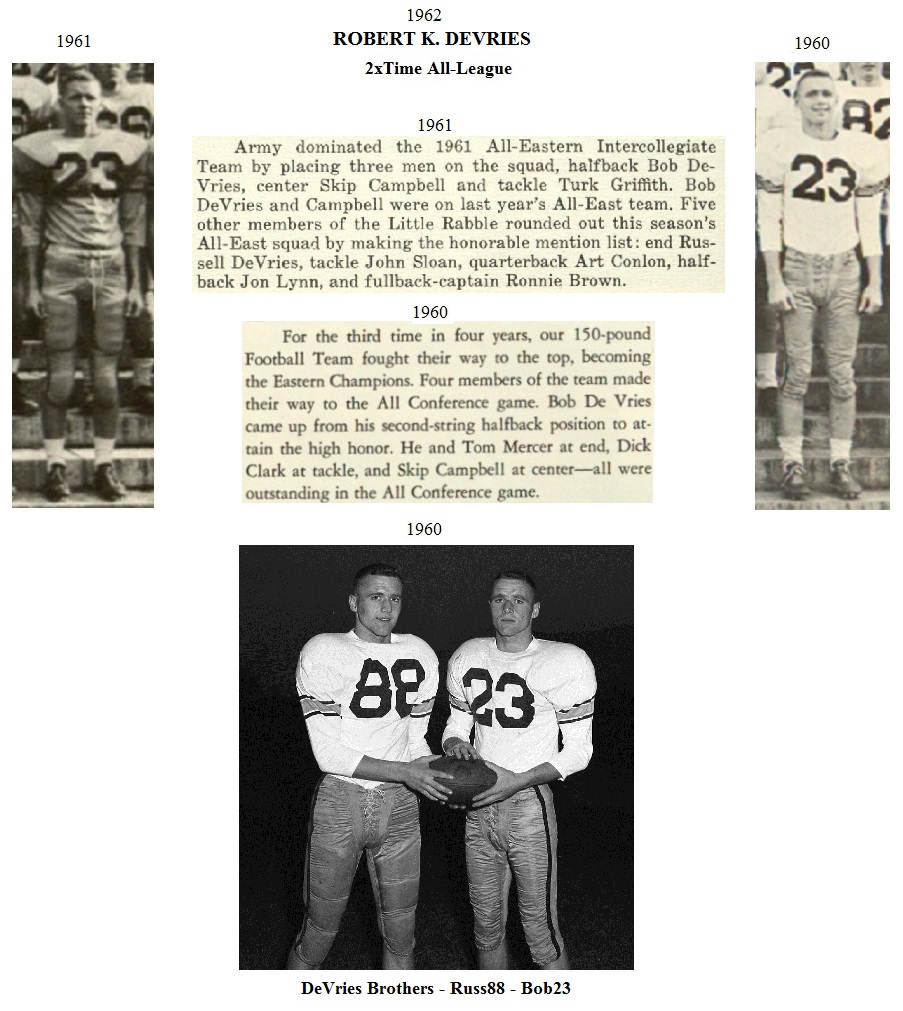
Robert & Nancy DeVries      
Army Football Player  Inspired by John Taylor, coached by Rick with the nucleus of Tank, Russ, Bob, Bill, Dave, Paul, Dennis, Wayne & Mike, ’62 gave West Point Rugby, a team that has dominated the sport since its inception.

Wayne  & Kathy Downing
Wayne

“I want you to think like a bank robber”  “Rangers Lead the Way”   “Sua Sponte” Commanded the 26,000 Joint Special Operations Command, an Elite Organization of Delta Force, Navy Seals, Army Rangers, and Special Forces, that for years the Pentagon refused to acknowledge its existence. His vision established the Combating Terrorism Center at West Point, while the General Wayne A Downing Scholarship program offers Army Officers a fully funded graduate education at universities around the world. He was my friend — by  Jim Kimsey

** John & Hanh Easterbrook     

Grandson of  Joe Stilwell the Commanding General China Burma India Theater WW II  
I was basketball manager. My fondest memories were watching Stu Sherard perform. He had the smoothest jump shot I have ever seen, and witnessing him pile up Academy and National records was a real pleasure. He certainly was a very consistent performer.   I will also never forget Bob Loupe scoring the winning basket in our victory over Navy in 1962. After three years of losing to Navy, it was a very emotional win.  Added by a Friend – John has traveled to China on a number of occasions and has assisted in 1991 the People’s Republic of China establishment of the Stilwell Museum in Chongqing to honor his service to China.  John Retired as a Colonel after 22 years in the Signal Corps. 

** LTG  Jim  & Carol Ellis 3d US army copy
Cadet Brigade Commander, Star Man, Lacrosse, Responsible for the recording of General of the Army Douglas MacArthur‘s Duty Honor Country Farewell Address to the Cadet Corps – on 12 May 1962.  Commanded 3d Army, “Patton’s Own”  The team is more important than any individual. While individuals may perform outstandingly (we have awards); it is the success of the team that determines the outcome of the battle and the war. As General Patton said, “The Army moves as a team, eats as a team, and fights as a team.”

Dennis & Kathy Flint                           

Bob DeVries

Robert & Nancy DeVries  
150 Football Player  Inspired by John Taylor, coached by Rick with the nucleus of Tank, Russ, Bob, Bill, Dave, Paul, Dennis, Wayne & Mike, ’62 gave West Point Rugby, a team that has dominated the sport since its inception.

BobDeVries_1962_ArmyLFB-1961_2-Time-All-League60-61

Bob Cooper

Bob & Paulette Cooper
His first swim was early Beast Barracks along with EK Whiting. His second swim with black paint bucket was with Bob G., Rusty and Eddie to paint ’62 on a Constitution Island rock. The rocks were gray, the 6 was perfect but as he was hanging upside down the 2 was backward. During the swim a barge passed with the wake nearly sending Bob G. to the bottom.  Coop now does Volunteer work in Sudan – Darfur, Nuba Mountains – Hand Pump Repair for clean abundant and disease free water for those who suffer genocide.

Marsh Carter

Marsh & Missy Carter

 Marsh & Missy Carter  First Marine.jpeg
Hockey 4 Years, 3d Generation Grad.  Two Tours in Vietnam as a Marine – received the Navy Cross.  White House Fellow, Retired Colonel USMCR, President & CEO State Street Bank & Trust, becoming Chairman of the New York Stock Exchange. Distinguished Graduate

Ralph Burr

Ralph & Noel Burr

Phil Burns

Phil & Molly Burns

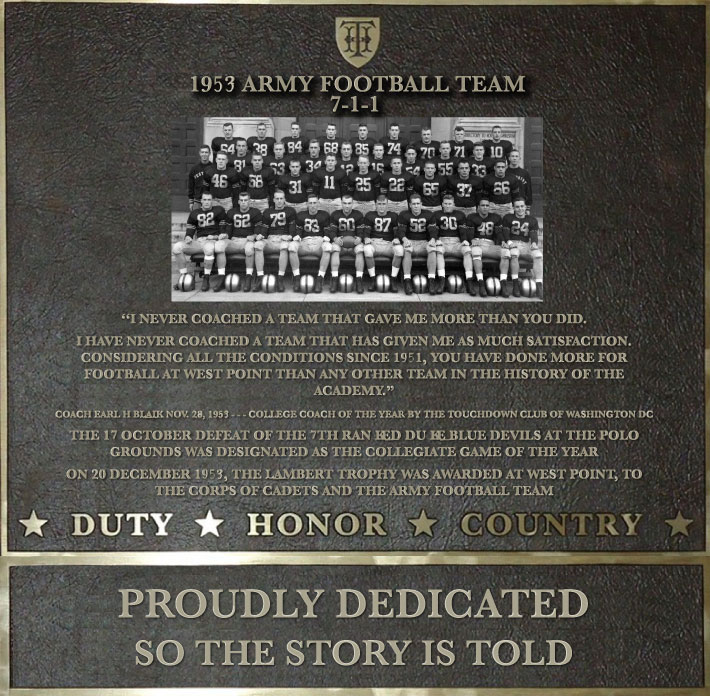
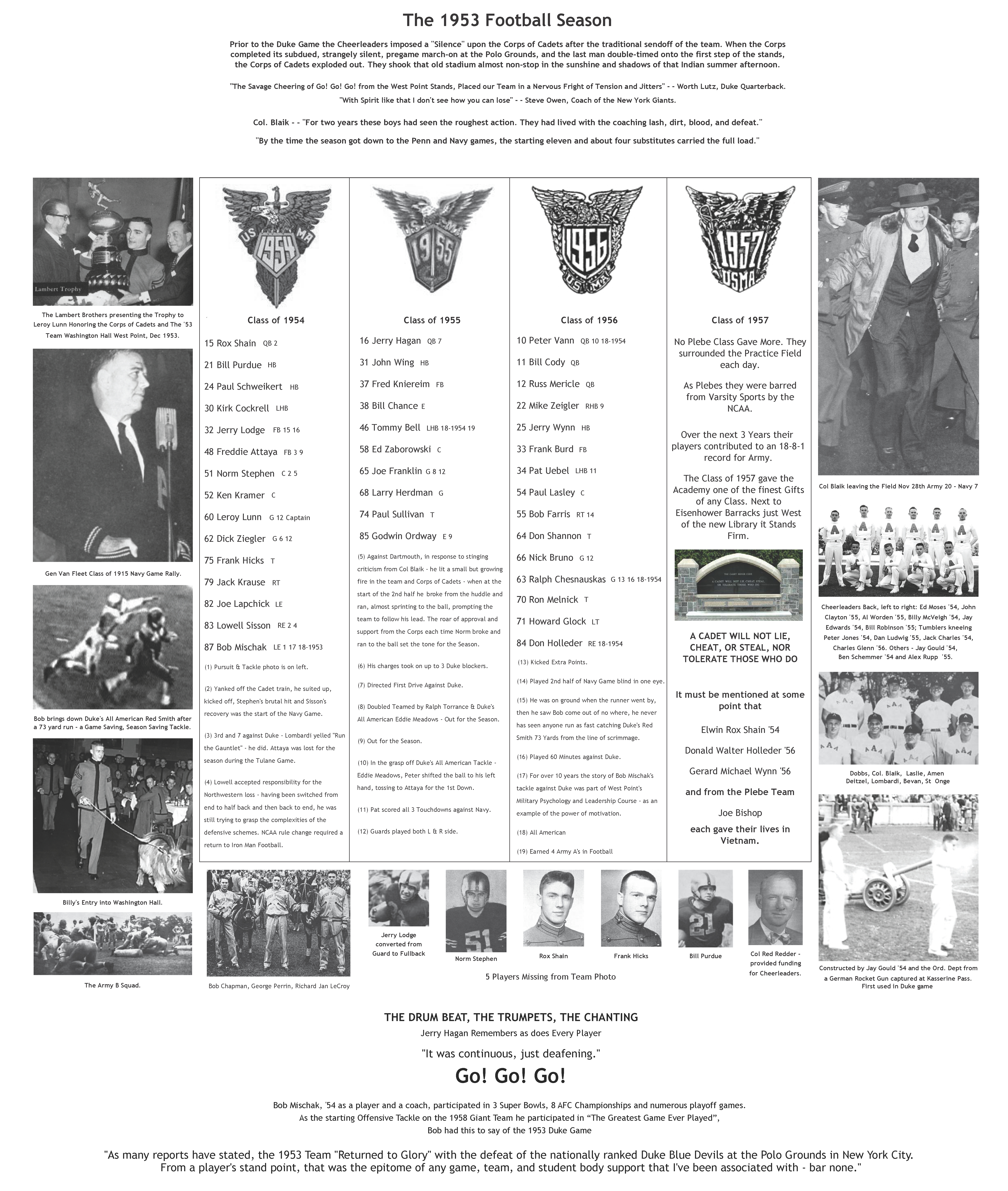
Cut 30 to Wrestle 123, 2 Army As, 1 with Star, L1 Honor Rep; 2d Bn 48th Inf, 3d A Div, MACV, Charlie 5/7 1st Cav, 82d A B Div, SHAPE Hq, createdForWhatTheyGaveOnSaturdayAfternoon.com Web Site, Founding Member for Hotel Thayer Room, 405 Honoring the 1953 – 1954 Corps of Cadets and their Football Team.

Wrestling

George Schein Chairman of the Cadet Honor Committee.
During June Week 1962, at the corner of Grant Hall,  John Selby and Jim Kays bumped into George Schein as George was headed out to meet his soon to be wife Diana.  George asked how I was doing – studying for an Ordnance Department Turnout.  John said something like – He is in the rack and has not been studying.  George immediately turned around running back into South Area, asking which Room?   I was in the rack wrapped in my “Brown Boy”when the door crashed open and I heard the leather soles hit the concrete floor as I pretended to be asleep – maybe he would go away.  Suddenly my bed was lifted and I was thrown against the wall. I got up saw who it was laughed and said “George!”.  He said get over at that desk and study.  He returned once and I was at the desk. The Turnout was easy.  To this day whenever a woman with spikes hits a concrete floor, I flinch.  Note it was my 5th Turnout and I could not believe they would do that to me June Week.

Because I was the lowest ranking member (Private finally Sergeant) of the Honor Committee, I stayed after the meetings sweeping up the floor. Note – there was no dust pan so I swept the dust under Col Blazey’s Rug. George never asked me where I put it.

Note to Current Wrestlers

The first point I want to make is you must stay proficient. You are no good to the Team if you can not Wrestle or you are required to exit the Academy. My Best Friend, Jim Kays who we recently loss to Football concussions, literally dragged me through academics. He would have stood much higher in the Class if he did not have to spend so much time with me.Get immediate help if you need it. Oh, if you take Systems Engineering, Jim Kays created that department. He also spent 26 years as a Player, Coach, and OR of what were once the 150s.

Next, behave. I was always on my best behavior from September to early Spring. After wrestling season, I reverted to my more normal self, ending with demerits, hours on the area, and confinement. I will say, of my 24 Classmates, the majority voted for me to be L1’s Honor Rep.

Our Gift to the Academy is the Fitness Center. There is a picture of my teammate, Frank Reasoner on the wall. (More about Frank later) During our 3 years of eligibility we beat Navy 3 times. It was 45 years before another Team beat Navy. Our Team consisted of Mike Natvig ’63, two time National Champion, Al Rushatz, (Our Fullback) an All American in Football and Wrestling, and Dale Kuntz, a 3 year starting Tackle and Wrestler who never lost a dual meet Firstie year. You will find their names on lockers. The rest filled out nicely – all except me. And another note, I pounded on my Classmates to secure the funds for Al & Dale’s plaques. I also initiated Coach Alitz’s Plaque. I did because I wanted Army Wrestlers to know what went before .

I cut 30 pounds to Wrestle 123. Why – because I knew I would always make weight, and I was the best we had to offer at 123. In the 5 hours between weigh in and the match I would pick up 5 to 7 pounds, most of which was water. I was ahead taller than my opponents. On Mondays, I would start back down. I would stop eating on Wednesday. I stopped drinking on Thursday. By Friday, I had no spit, just cotton mouth.You might find it hard to believe, but I was allowed to suck on a lemon in class. However, on Mondays, Tuesdays, and into Wednesday, They put me through my paces.

I ran a mile before practice, and a mile after practice every day. Why, because I needed to lose weight and I want the 3d period to be mine. Except for the best, the 3d was always mine. I once went 9 minutes bridging against an All American out of Pittsburg. It wasn’t really 9, as he would let me escape so he could practice his moves and counter my relentless attacks. I have been so disappointed with so many wrestlers today who dance around the First Period. I hope to never see an Army Wrestler waste minutes. During the Fall, I would run the 3 flights of the back stairs, which no longer exist. My Teammates knew I would never give up more than 3.

Let me tell you about Frank. Frank was a Marine. He spent several years in the Corps prior to entering the Academy.
I developed a vicious cross face. I was never a dirty wrestler, but when you cut 30, you want someone to pay. I hit Frank with it once and he bite me. Believe me Frank was one tough Marine. He was a Golden Gloves Champion and a 4 time Cadet Brigade Champion. Frank told me, he wanted 3 things. To Retire after 30 years, Own a Bar outside the Main Gate of a Marine Base and earn the Medal of Honor. Frank was the type of team mate I needed. No Quarter. When General MacArthur spoke to us, he told us what to expect and what he expected of us. There were many Officers and NCOs who were veterans of World War II in attendance. Many had tears in their eyes. Several times Frank had tears in his eyes.

Coach Alitz yelled at me once. He would put us in for 12 or 15 minutes, giving us a fresh man every 3. After 12, my head was down, and I was forced to suck in the foul air coming from under my rubber jacket. He yelled “Hold your Head up!” My head immediately shot up and I began with my last 3 minutes against another fresh man. None beat me.

In those days wrestling started at 123 and went up in order to Heavy Weight.

The real reason for the above. The lead up to the point I want to make. The night before the Lehigh match, Coach Alitz found me in the pool. I had all the water I wanted, I just could not drink it. Coach Alitz told me I could beat my opponent. He never asked anything of me, but I knew the Team absolutely needed my win. He was to become an All American. It went 9 minutes. While I wrestled I always heard Al’s direction toward what my next move should be – nearly always followed by an “OH NO!” This time I heard Coach Alitz say “Pin him right there!” I felt it but I was too slow. When I walked off the mat, I knew we had lost. We lost because of my failure. I was so ashamed that I could not sit with the Team. I grabbed a towel and climbed to the top of the bleachers, buried my face in the towel and just sobbed. I failed and my team lost because of me. Lehigh 19 Army 14

To wrap up, in the Navy Match at Navy that year, the Navy Coach went on their Academy radio and was specific about how they would win the next day. He was wrong about one match. When I walked off the mat, I looked to the right then back to the left where I found the Army Navy Brass. I raised my right thumb in salute. Coach Alitz hugged me and said “Thanks Phil”. Army 15 Navy 14

Years later we had a Mimi Class reunion and invited General Westmoreland. In the middle of the meal our eyes met. He raised his right thumb.

One last thing before I wrap this up. On the bus ride back from the Easterns, Coach Alitz called me to the front of the bus to question me about holding weight for 2 days. In my consolation match which was against a Penn State opponent who I had lost my first ever Varsity Match to the previous fall, I won. I replied “It is good that it only went 6 minutes.” He asked “Were you hurting?” I said “I would have killed him”. Coach Alitz smiled.

When you practice remember Frank, Mike, Al and Dale. When you wrestle for Army you will be wrestling for All that have Gone Before.

Upon Graduation you will be responsible for a group of men. You can – – – – NEVER EVER FAIL THEM.


Wrestling

Frank Horton

 Frank & Patricia Horton  200px-SAC_Shield.svg  United_States_Air_Force_Academy_shield CIA    44th m S wing  544  150px-351st_Missile_Wing  dia_symbol_trans100
Third in the Class, Frank wore Stars on his collar for 3 years.  He participated in 11 different social and athletic activities as a Cadet.  First assignment was 544 Aero Sp Recn Wg; then Harvard PhD in 69; USAF Academy 70; 7th AF RVN 70-71; USAFA again 71-73; ODCSP&O; 351st SMWg; 44MSWg: Cdr 44MSWg, HqSAC 84-85; DDr JSTPS: CIA86-87; DDir DIA 87-90; DCS Intel SAC; Ret ’93 MG General.  (Jerry Garwick spoke to USAF officers who served with MG Horton. They said he was the most focused person they ever knew. Just like Cadet Horton)  By Bill Kosco

Dave Swick

awaiting data

Pete Peterson

Awaiting data

Tom Moore

Thomas & Barbara Moore

Tom served on active duty in the Army (Artillery) for 8 years, resigning in 1970, with the rank of Major. He then served in the California Army National Guard, CAARNG, retiring in 1990 with the rank of Brigadier General. His first assignment was with the 377th Artillery, 82nd Airborne Division at Fort Bragg, NC. He then served in Vietnam (MACV) Fort Sill, OK (Staff and Faculty, S&F, Army and Missile School, A&MS), Turkey (Detachment Commanding Officer, DetCO, U.S. Logistics Group, TUSLOG), Fort Belvoir, VA(Army Combat Development Command, ACDC, Field Artillery), California (40 Armored Brigade), Fort Leavenworth, KS (Command and General Staff College, CGSC), California (Commander 3-144th Field Artillery, California (40th Division Artillery), California (G4, 40th Division), California (Commander, 40th Division Support Command DISCOM).

After leaving the National Guard, he worked in the Los Angeles County Sheriff’s office. Tom passed away on 28 September 2018, from cancer.

Footnote from classmate Corkie Rittgers – “Oh Barbara, such an incredible loss for all of us who knew, served with, and loved Tom. He has been another brother, a comrade in arms and a role model for me. Nothing will be the same now. He was supposed to always be there for all of us…..I’ll think of Tom whenever I hear the pipes playing.”

Room 405 The Thayer

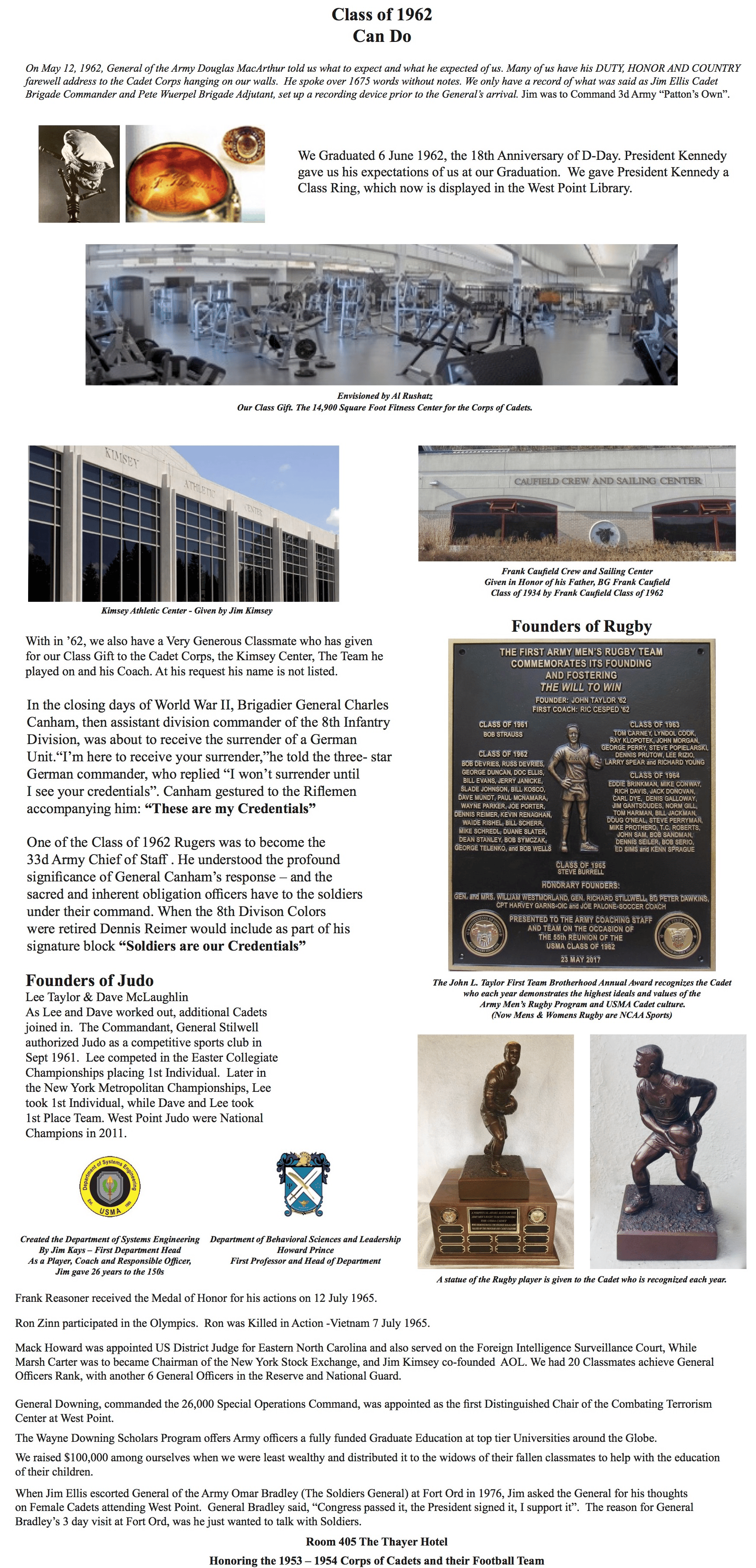
 Envisioned by Al Rushatz
                   An All American in both Football & Wrestling

Our Class Gift. The 14,900 Square Foot Fitness Center for the Corps of Cadets. 
Frank Reasoner’s Medal Of Honor Citation and Photo are on the wall.
Paul Steucker’s Painting of  General  Mac Arthur’s Address hangs in the room,
along with over 350 Can Do Class Mate signatures below the Painting.  

Frank Reasoner was awarded the Medal of Honor for his actions on 12 July 1965; when he repeatedly exposed himself to enemy fire, being mortally wounded going to the aid of a down Marine.  The US Navy Frigate USS Reasoner was named in his honor.

Ron Zinn was the first cadet to be selected to a USA Olympic team; competing in race-walking at the 1960 and 1964 Olympics.  The Academy honored Ron with a Brigade Parade. He placed 6th in the 1964 20K race. Ron was killed in Vietnam, 7 July 1965.

Officer Representative / Dave Harkins

Mack Howard, USAR LTC, Ret. received the Silver Star and Purple Heart;  was appointed for life as US District Judge for Eastern North Carolina and has served on the Foreign Intelligence Surveillance Court.  

Marsh Carter, Colonel, USMCR Ret. was severely wounded, received the Navy Cross; became CEO of State Street Bank and Trust and upon retirement became Chairman of the New York Stock Exchange. 

“Establishing The Brotherhood” by Bill Kosco and Mike Schredl provides the account of the 1961- 1962 Creation of Rugby.

Jim Kimsey served three Combat Tours, co-founded AOL, served on numerous boards including The National Symphony Orchestra.  

We had 20 Classmates achieve General Officers, Rank, with another six General Officers in the Reserve and National Guard. 

“General Downing, as Commander of the 26,000 member Special Operations Command, helped create the world’s best special forces ever.  Wayne created chaos for the enemy” (By D. Reimer)  Wayne was a Presidential Advisor and was the first Distinguished Chair of the Combating Terrorism Center at West Point. The Wayne Downing Scholars Program offers Army officers a fully funded Graduate Education at top-tier Universities around the globe. 

We raised $100,000 among ourselves when we were least wealthy and distributed it to the widows of our fallen classmates to help with the education of their children.  

When Jim Ellis escorted General of the Army Omar Bradley (The Soldiers General) at Fort Ord in 1976, Jim asked the General for his thoughts on female cadets attending West Point.  General Bradley said, “Congress passed it, the President signed it, I support it”.  The reason for General Bradley’s three day visit at Fort Ord, was he just wanted to talk with soldiers.  

                                          Room 405 The Thayer Hotel
                    Honoring the 1953 – 1954 Corps of Cadets and their Football Team 

Frank Reasoner, Dennis Reimer, Wayne Downing, and Jim Kimsey, have Dedicated Rooms while Ron Zinn is included in the Olympic Room

These 2 Plaques are outside the door to room 405 of the Thayer.

Temp

JAMES KAYS

JAMES L. KAYS

BRIGADIER GENERAL, UNITED STATES ARMY

1941 – 2021  

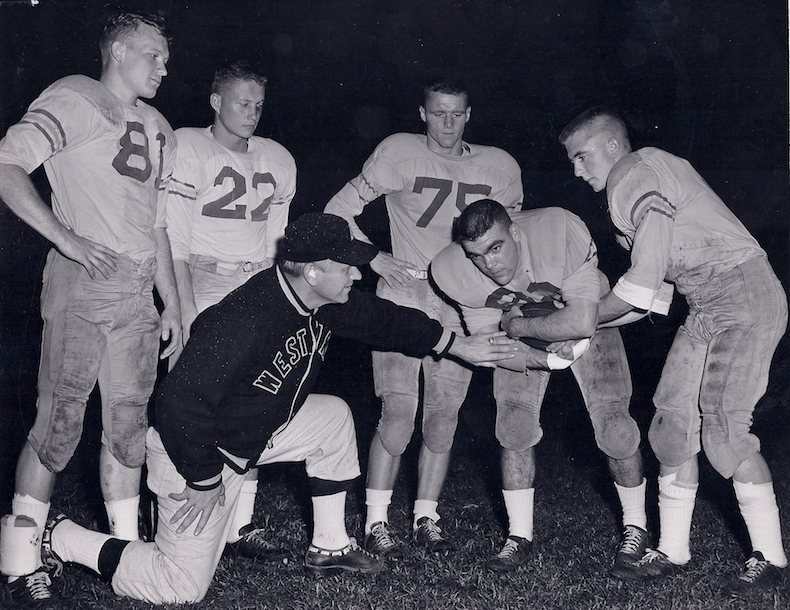
  As a Quarterback, Coach and Officer Representative, Jim gave 26 years to 150 / Lightweight / Sprint Football. Jim has always given his time to others and in creating and resolving issues and problems. In the years since 1958, I have never know Jim to ask for anything in response to his help. You, You are the only ones he ever asked. He asked you to give. To give all that you have to the Game he loved.

The 1985 Princeton 150 Game – he gave 26 years to the 150s
When he points that finger, you had better listen

For the two Plebes Teams he coached against the Hive and Goat Teams, Jim created the Tight Butt Formation, bring linemen in tight to prevent the much larger Upper Class men from breaking into the backfield. During the 19 years, even when Jim was Department Head of the Systems Engineering Department he created, there were two constants. Col. Kays on the sideline and winning Football.

  Jeane was at the Fort Bragg Officers Club Pool on July 3, 1961, when Jimmy met the love of his life. Jimmy was to depend on Jeane for the next 59 years. He graduated 9th in his Classes as an Artillery Officer on June 6, 1962. Just prior to Graduation, Jim stood before an Officers Board to determine his fitness for Commissioning. His medical record implied the knee injury he sustained in the last game of the 1960 season would prevent active duty. Jim stated he had quarterbacked the 150s in the last game of the 1961 season without difficulty and had guided the Team to the win. He further stated that he would attend and graduate from both Ranger and Airborne Schools. Jeane and Jimmy were married on June 10th.

  Jim completed Airborne training without difficulty, but the knee which he blew out required several attempts to complete Ranger School. In 1964 the Ranger Tab was sown on. The first assignment with the 82d was shortened when Jim Volunteered for Military Assistance Command Vietnam, receiving the Bronze Star, Commendation Medal with V and Combat Infantryman Badge. 

  Upon his return he was assigned to USATC, Fort Campbell; Rensselaer Polytechnic Institute; Math. Dept. USMA; back to the Far East with an Arty Bn in Korea; CGSC; ODCSOPS Army General Staff; Rensselaer Polytechnic Institute; Math. Dept. USMA; Director, Operations Research Center, Office of the Dean, USMA where Jim created The Systems Engineering Department, becoming the Department Head. Jim Retired in 1998.

  Jim accepted a position as the Mathematics Department Head, Auburn University, Montgomery. 

Jim was to created one more Systems Engineering Department as Dean, Graduate School of Engineering and Applied Sciences, Naval Post Graduate School.

  As a Professor in the Academy Math Department, Jim became an Assistant Coach with the 150s. His appointment to Plebe Coach in 1970, resulted in those two teams contributing to a record of 29 & 1, beating Navy each year.

  Jim returned to West Point as an Associate Professor in 1978. In 1987 Jim began the process of creating the Systems Engineering Department. He was to become the Head, of the Department and the Director, USMA Operations Research Center.

  There are 3 points of interest relating to USMA Systems Engineering Department. Jim would visit the Army Staff searching for projects for his Cadets. One such one was the Cadet proposal presented to the Army Staff of an all terrain wheeled vehicle similiar to the Humvee. The Army’s Armored Divisions had great success with the Half Track used by the Armored Rifle Battalions during World War II. The Systems Engineering Department was compensated by the Army for Cadet Research, until the Dean became aware of compensation and accepted it for all Departments. 

  Even more significant was the first Accreditation by the Board for Engineering and Technology. The lead evaluator was Dr. Yaco Y. Haime. During the presentation to the Staff and Faculty Dr. Haime indicated that he evaluated programs both in the US and abroad. He went on to say that the Academy’s Systems Engineering Program was the finest he had ever evaluated.

  The 5 year requirement for Instructors impacted an Officer’s Career.  Jim spoke to the Dean. He received a commitment by Branch to release an officer once his replacement was in. Jim discussed with at least one University Department Head to provide an accelerated  program.  Jim’s agreement to release officers early, allowed the length to approach 3.5 years. The Cadets got the Officers Jim wanted.

  Jim rejoined the 150s becoming the Officer Responsible. For 19 years Jim provided continuity for the program, specifically Head Coaches, Larry Henley, (1980-81), Bob Knapp (1982-84), Tim Mingey (1984-86) and Bob Thompson (1986-1998); Jim recruited the assistant coaches from the Academic and Tactical Departments. Many of these assistant coaches were former Army 150 players who sustained and reinforced the 150 / Lightweight /Sprint Culture – dedication to excellence, a winning tradition, and commitment to team. These assistant coaches were the reasons the Army 150 / Lightweight Football Program was one of the most successful at the Academy. The teams during that period won over 80% of their games, won league championships, beat Navy regularly and won several bowl games. The most significant accomplishment of these teams was that they consistently won the Academy’s award to the athletic team with the best combined performance in all areas of cadet development — academics, military aptitude and athletics. 

  The Kays Trophy, awarded annually to the outstanding player in the Eastern Lightweight Football League, was established in honor of Colonel James L. Kays in 1990. 

  As a Department Head, Jim was faced with issues he had little need to address up to that point of his career. At the start of each Academic Year Jim would explain his expectations. Each year he would state Inappropriate Acts would not be tolerated. Each of 2 complaints would be evaluated, but a third would be automatic release. One officer stood in front of Jim twice before he got the message.

  Cadets turned to Jim. One night he received a phone call from a concerned Cadet, requiring him to go to the roof of Cullum Hall to curtail a Spirit Mission. The Young Lady Cadet was clad in only 2 pieces of clothing. The first knock at his back door was by a Cadet who had visited a campus as an exchange student, and as she was unpacking her door was opened and 4 or 5 individuals entered threatening to rape her. The verbal abuse she yelled at them and the threats of bodily harm she would inflict drove them from the room. She packed and returned to West Point. Jim handled the situation giving her some satisfaction. The second knock at his back door was by a Cadet with a complaint against her Team Officer Responsible. Jim again met with the Commandant and was told to investigate the complaint. Jim was able to reach a Graduate in Germany who confirmed the officer’s conduct. The Officer immediately was relieved of duty and departed West Point.

  In 1980 when Jim received his Ph.D. from Rensselaer Polytechnic Institute, he was awarded the 1980 Joaquin B. Diaz Award, presented by Rensselaer Polytechnic Institute annually to a doctoral student in recognition of outstanding academic achievement and research in mathematics. Jim contributed to over 17 Publications and spoke at over 21 Academic Presentations; he was a 1980-1982 Co-principal investigator conducting classified research in underwater acoustics for the Office of Naval Research; and 1985 Who’s Who in Frontier Science and Technology, Who’s Who in America. In 2020, Jim was inducted into the Army Operations Research Society of America Hall of Fame.

  Jim’s Service contribution is represented by his three Army Commendation Medals (one for Valor),  Bronze Star Medal, Meritorious Service Medal w/Oak Leaf Cluster, Legion of Merit and Distinguished Service Medal. The Navy, even the Navy appreciated his contribution by naming him Chair of Naval Systems Engineering in 2008.

  To look at numbers, Jim was a mentor to Cadets, and the 150 / Lightweight / Sprint Football Players of 29 West Point Classes. Take it a step further he was a mentor for the Women and Men he served with, but especially those of the System Engineering Department.

  Six years ago, Jeane realized Jimmy was beginning to fail (Too Many Concussions). Jeane was at his side, caring for him every day. On 6 January, in Jimmy’s last hours, Jeane dressed him in a Beat Navy T-Shirt.

  Sam Mills a linebacker and Assistant Coach gave the Carolina Panthers their Motto – “Keep Pounding” I failed the two times I Nominated Jim. I want you to Keep Pounding year after year until my Classmate, my Roommate, my Friend, the man who dragged me through Academics, (6th from the bottom) is inducted into the Army Sports Hall of Fame.

  When you succeed, I will not speak. Nor will I attend. It is between you and Jim Kays.

Jim earned 2 Army As – Yearling and Cow Years

Nomination for the Army Sports Hall of Fame

JAMES L. KAYS
BRIGADIER GENERAL, UNITED STATES ARMY
1941 – 2021
As a Quarterback, Coach and Officer Representative, Jim gave 26 years to 150 / Lightweight / Sprint Football. Jim has always given his time to others and in creating and resolving issues and problems. In the years since 1958, I have never know Jim to ask for anything in response to his help. You, You are the only ones he ever asked. He asked you to give. To give all that you have to the Game he loved. For the two Plebes Teams he coached against the Hive and Goat Teams, Jim created the Tight Butt Formation, bring linemen in tight to prevent the much larger Upper Class men from breaking into the backfield. During the 19 years, even when Jim was Department Head of the Systems Engineering Department he created, there were two constants. Col. Kays on the sideline and winning Football.

Jeane was at the Fort Bragg Officers Club Pool on July 3, 1961, when Jimmy met the love of his life. Jimmy was to depend on Jeane for the next 59 years. He graduated 9th in his Classes as an Artillery Officer on June 6, 1962. Just prior to Graduation, Jim stood before an Officers Board to determine his fitness for Commissioning. His medical record implied the knee injury he sustained in the last game of the 1960 season would prevent active duty. Jim stated he had quarterbacked the 150s in the last game of the 1961 season without difficulty and had guided the Team to the win. He further stated that he would attend and graduate from both Ranger and Airborne Schools. Jeane and Jimmy were married on June 10th.

Jim completed Airborne training without difficulty, but the knee which he blew out required several attempts to complete Ranger School. In 1964 the Ranger Tab was sown on. The first assignment with the 82d was shortened when Jim Volunteered for Military Assistance Command Vietnam, receiving the Bronze Star, Commendation Medal with V and Combat Infantryman Badge.

Upon his return he was assigned to USATC, Fort Campbell; Rensselaer Polytechnic Institute; Math. Dept. USMA; back to the Far East with an Arty Bn in Korea; CGSC; ODCSOPS Army General Staff; Rensselaer Polytechnic Institute; Math. Dept. USMA; Director, Operations Research Center, Office of the Dean, USMA where Jim created The Systems Engineering Department, becoming the Department Head. Jim Retired in 1998.

Jim accepted a position as the Mathematics Department Head, Auburn University, Montgomery.
Jim was to created one more Systems Engineering Department as Dean, Graduate School of Engineering and Applied Sciences, Naval Post Graduate School.

As a Professor in the Academy Math Department, Jim became an Assistant Coach with the 150s. His appointment to Plebe Coach in 1970, resulted in those two teams contributing to a record of 29 & 1, beating Navy each year.

Jim returned to West Point as an Associate Professor in 1978. In 1987 Jim began the process of creating the Systems Engineering Department. He was to become the Head, of the Department and the Director, USMA Operations Research Center.

There are 3 points of interest relating to USMA Systems Engineering Department. Jim would visit the Army Staff searching for projects for his Cadets. One such one was the Cadet proposal presented to the Army Staff of an all terrain wheeled vehicle similiar to the Humvee. The Army’s Armored Divisions had great success with the Half Track used by the Armored Rifle Battalions during World War II. The Systems Engineering Department was compensated by the Army for Cadet Research, until the Dean became aware of compensation and accepted it for all Departments.

Even more significant was the first Accreditation by the Board for Engineering and Technology. The lead evaluator was Dr. Yaco Y. Haime. During the presentation to the Staff and Faculty Dr. Haime indicated that he evaluated programs both in the US and abroad. He went on to say that the Academy’s Systems Engineering Program was the finest he had ever evaluated.

The 5 year requirement for Instructors impacted an Officer’s Career. Jim spoke to the Dean. He received a commitment by Branch to release an officer once his replacement was in. Jim discussed with at least one University Department Head to provide an accelerated program. Jim’s agreement to release officers early, allowed the length to approach 3.5 years. The Cadets got the Officers Jim wanted.

Jim rejoined the 150s becoming the Officer Responsible. For 19 years Jim provided continuity for the program, specifically Head Coaches, Larry Henley, (1980-81), Bob Knapp (1982-84), Tim Mingey (1984-86) and Bob Thompson (1986-1998); Jim recruited the assistant coaches from the Academic and Tactical Departments. Many of these assistant coaches were former Army 150 players who sustained and reinforced the 150 / Lightweight /Sprint Culture – dedication to excellence, a winning tradition, and commitment to team. These assistant coaches were the reasons the Army 150 / Lightweight Football Program was one of the most successful at the Academy. The teams during that period won over 80% of their games, won league championships, beat Navy regularly and won several bowl games. The most significant accomplishment of these teams was that they consistently won the Academy’s award to the athletic team with the best combined performance in all areas of cadet development — academics, military aptitude and athletics.

The Kays Trophy, awarded annually to the outstanding player in the Eastern Lightweight Football League, was established in honor of Colonel James L. Kays in 1990.

As a Department Head, Jim was faced with issues he had little need to address up to that point of his career. At the start of each Academic Year Jim would explain his expectations. Each year he would state Inappropriate Acts would not be tolerated. Each of 2 complaints would be evaluated, but a third would be automatic release. One officer stood in front of Jim twice before he got the message.

Cadets turned to Jim. One night he received a phone call from a concerned Cadet, requiring him to go to the roof of Cullum Hall to curtail a Spirit Mission. The Young Lady Cadet was clad in only 2 pieces of clothing. The first knock at his back door was by a Cadet who had visited a campus as an exchange student, and as she was unpacking her door was opened and 4 or 5 individuals entered threatening to rape her. The verbal abuse she yelled at them and the threats of bodily harm she would inflict drove them from the room. She packed and returned to West Point. Jim handled the situation giving her some satisfaction. The second knock at his back door was by a Cadet with a complaint against her Team Officer Responsible. Jim again met with the Commandant and was told to investigate the complaint. Jim was able to reach a Graduate in Germany who confirmed the officer’s conduct. The Officer immediately was relieved of duty and departed West Point.

In 1980 when Jim received his Ph.D. from Rensselaer Polytechnic Institute, he was awarded the 1980 Joaquin B. Diaz Award, presented by Rensselaer Polytechnic Institute annually to a doctoral student in recognition of outstanding academic achievement and research in mathematics. Jim contributed to over 17 Publications and spoke at over 21 Academic Presentations; he was a 1980-1982 Co-principal investigator conducting classified research in underwater acoustics for the Office of Naval Research; and 1985 Who’s Who in Frontier Science and Technology, Who’s Who in America. In 2020, Jim was inducted into the Army Operations Research Society of America Hall of Fame.

Jim’s Service contribution is represented by his three Army Commendation Medals (one for Valor), Bronze Star Medal, Meritorious Service Medal w/Oak Leaf Cluster, Legion of Merit and Distinguished Service Medal. The Navy, even the Navy appreciated his contribution by naming him Chair of Naval Systems Engineering in 2008.

To look at numbers, Jim was a mentor to Cadets, and the 150 / Lightweight / Sprint Football Players of 29 West Point Classes. Take it a step further he was a mentor for the Women and Men he served with, but especially those of the System Engineering Department.

Six years ago, Jeane realized Jimmy was beginning to fail (Too Many Concussions). Jeane was at his side, caring for him every day. On 6 January, in Jimmy’s last hours, Jeane dressed him in a Beat Navy T-Shirt.

Sam Mills a linebacker and Assistant Coach gave the Carolina Panthers their Motto – “Keep Pounding” I failed the two times I Nominated Jim. I want you to Keep Pounding year after year until my Classmate, my Roommate, my Friend, the man who dragged me through Academics, (6th from the bottom) is inducted into the Army Sports Hall of Fame.

When you succeed, I will not speak. Nor will I attend. It is between you and Jim Kays.

1961 Winter Track & Field

1962 Winter Track & Field

1962 Track and Field

1962 Track and Field

2009 Team

This is the page for the 2009 Team.