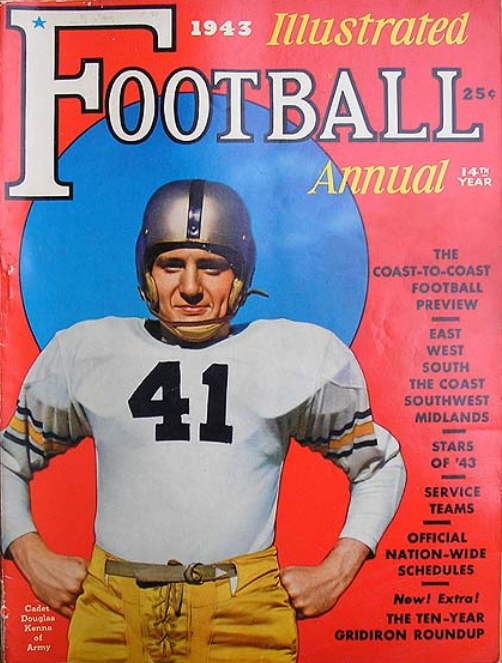
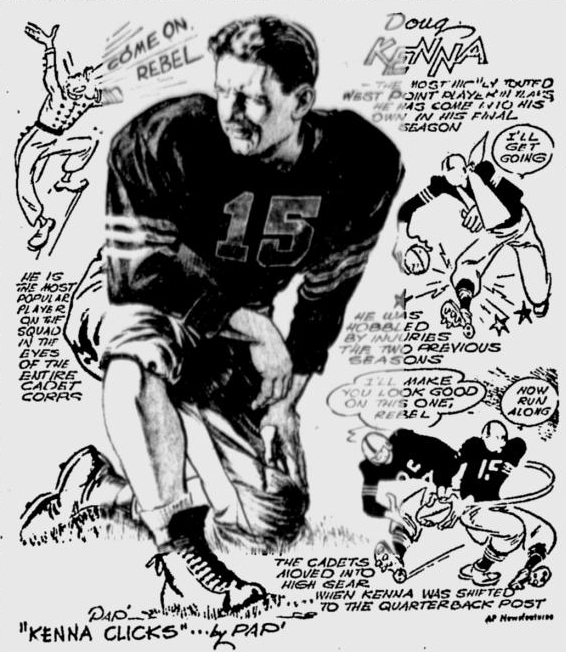
Army Football Captain
Team went 7-3 under Coach Paul Dietzel


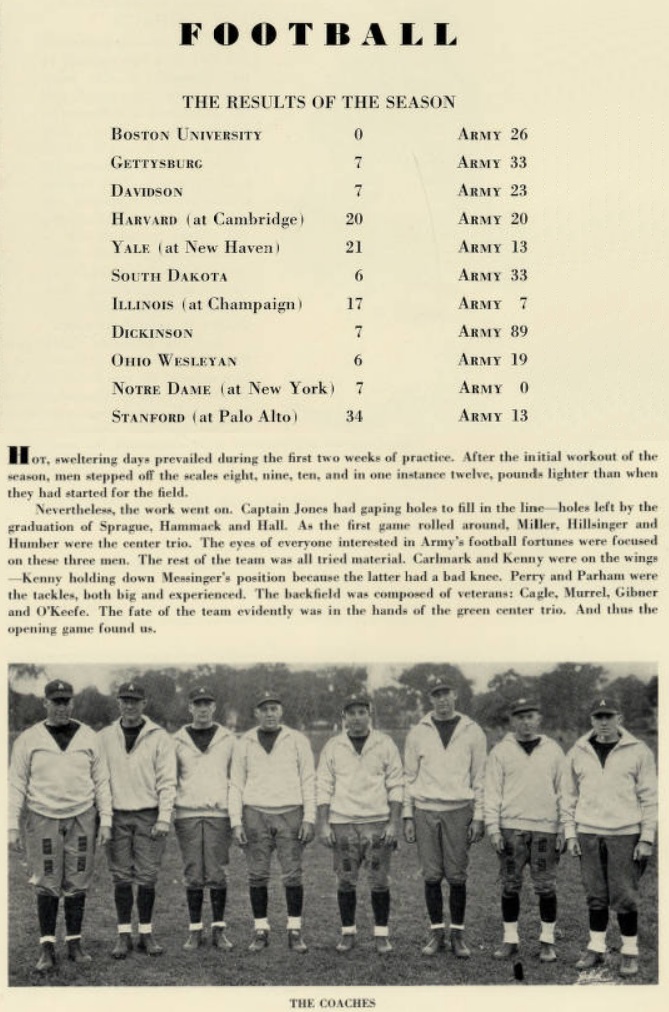
1929 Army 6-4-1
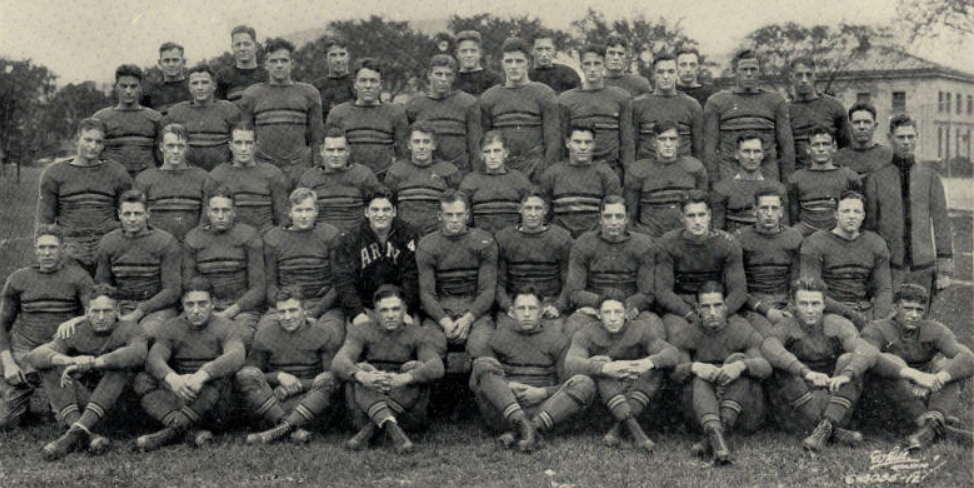
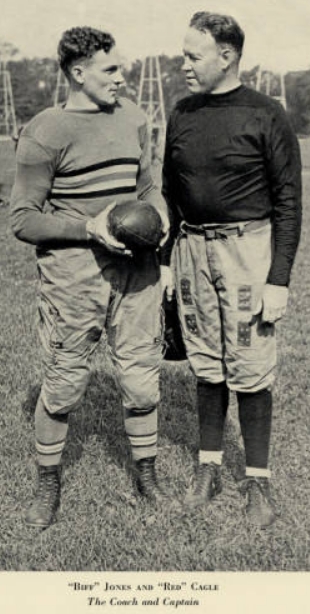
Coach: Lawrence McCeney “Biff” Jones (October 8, 1895 – February 12, 1980)
Army 1926-1929
1926 Army 7-1-1
1927 Army 9-1
1928 Army 8-2
1929 Army 6-4-1
Army: 30-8-2
LSU 1932-1934 – 20-5-6
Oklahoma 1935-1936 – 9-6-3
Nebraska 1937-1941 – 28-14-4 (1940 Rose Bowl vs Stanford AP#7)
Total: 87-33-15
Called back to service during World War II as graduate manager of athletics at USMA
source: http://en.wikipedia.org/wiki/Biff_Jones
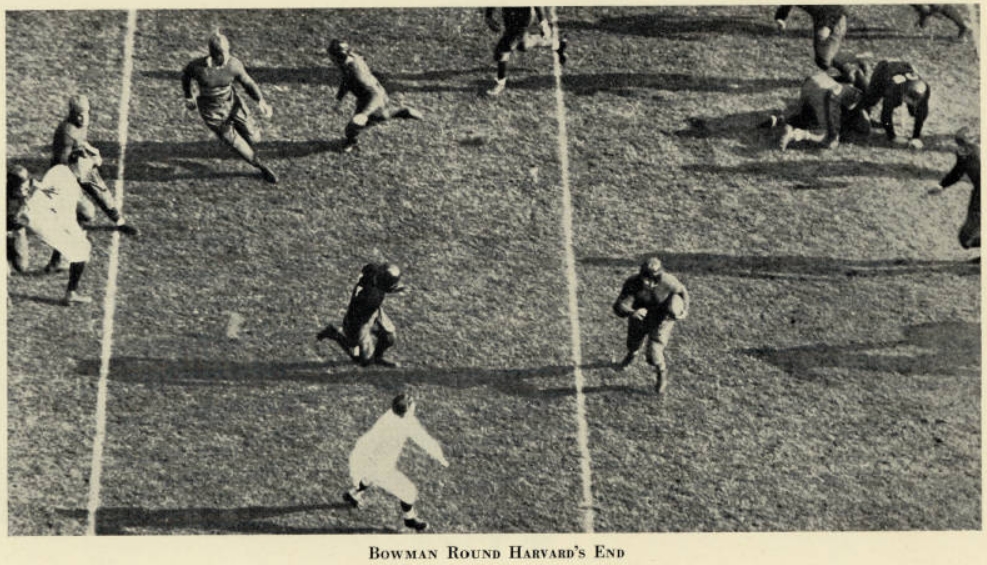
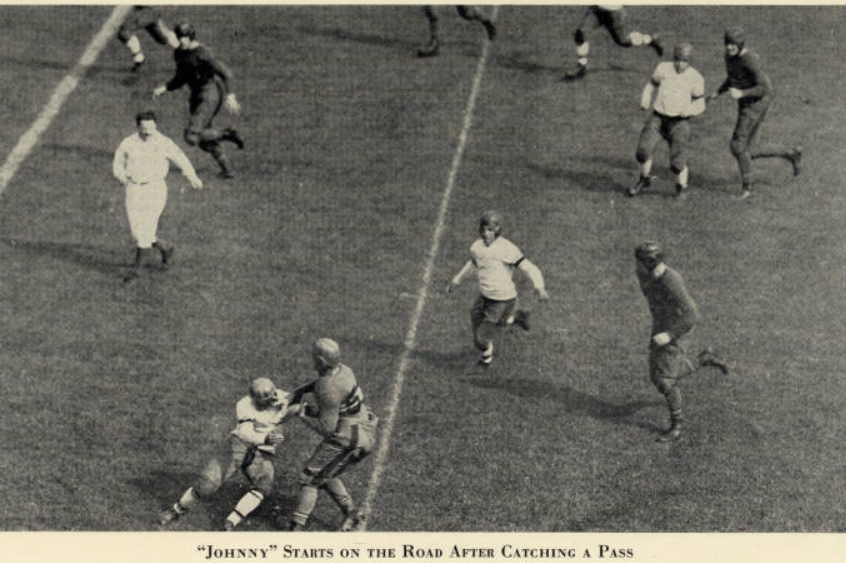
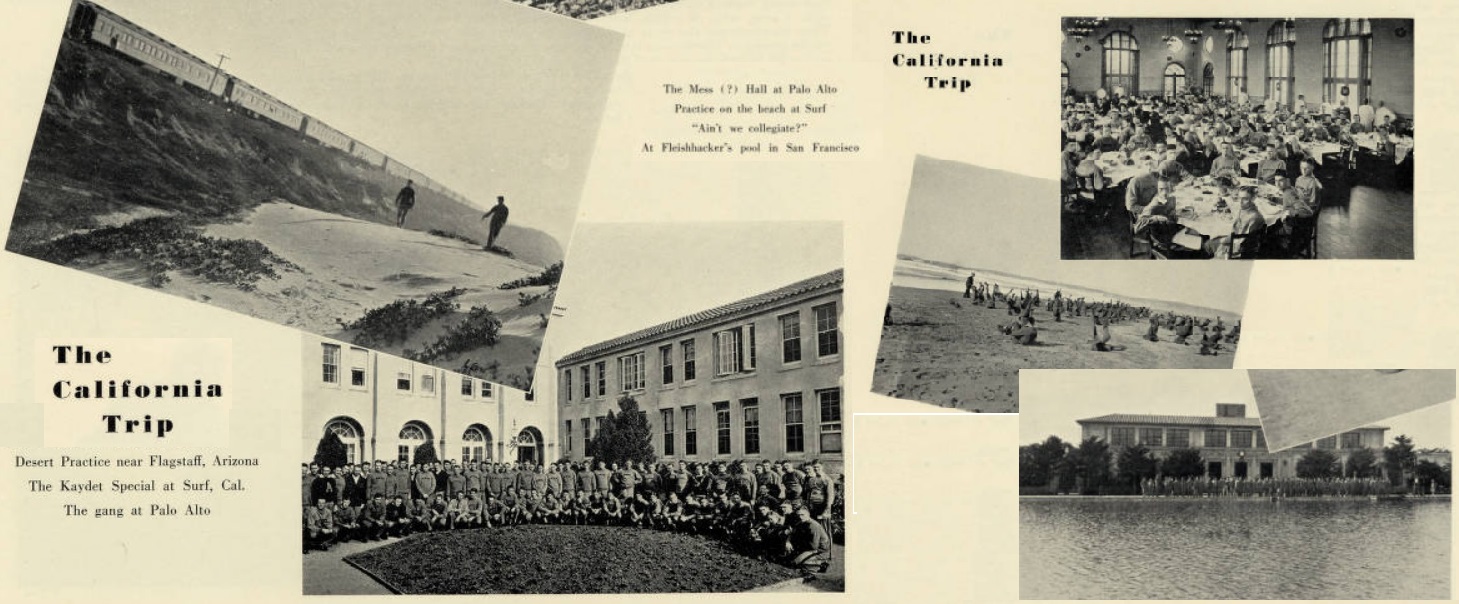
Howitzer 1930
http://digital-library.usma.edu/cdm/compoundobject/collection/howitzers/id/1875/
–
–
–
–
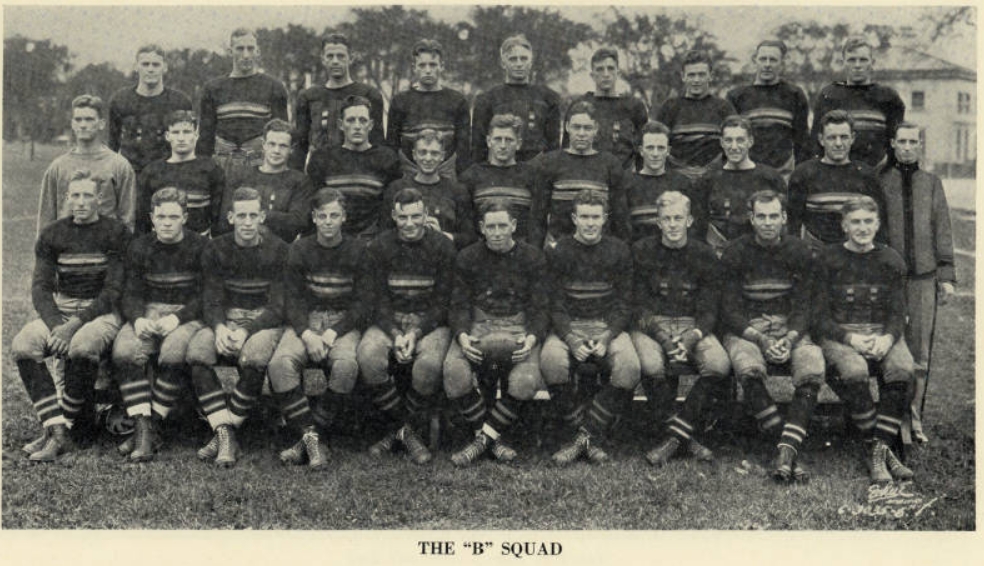
–
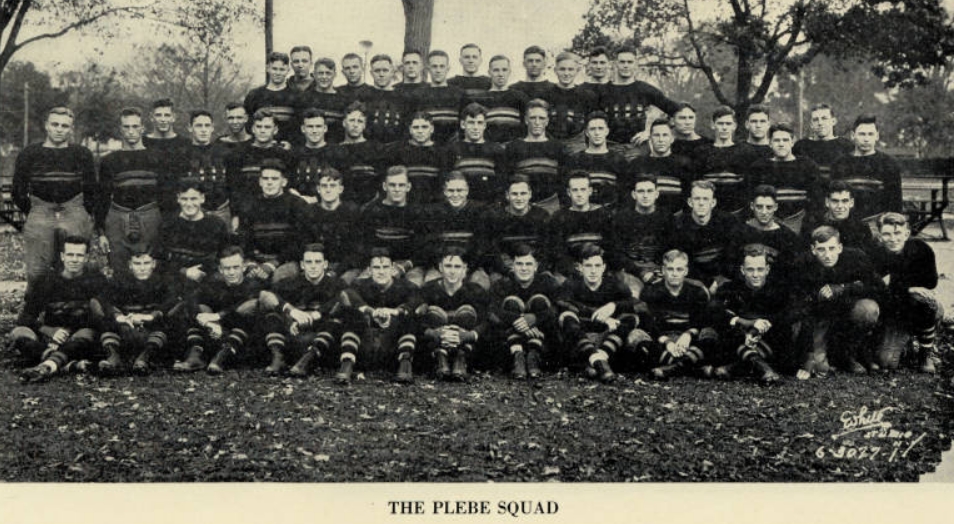
–
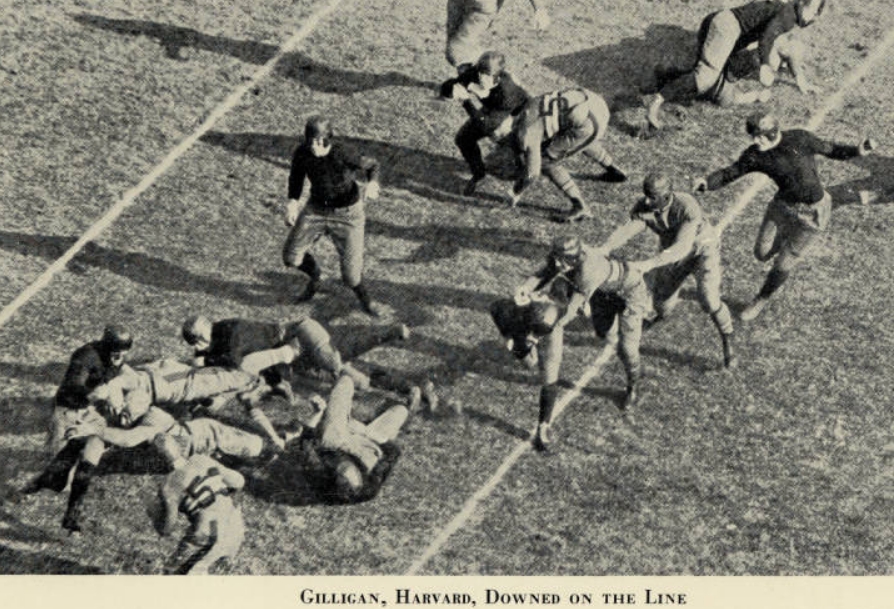
–
–
–
–
Click below for the Army Yale Game
1955 Army 6-3 Coaches#15 AP#20
1955/11/26 Army 14 – Navy 6 W
Coach: Earl Henry “Red” Blaik (February 15, 1897 – May 6, 1989)
Dartmouth 1934-1940 – 45-15-4
Army: 1941-1958 – 121-33-10
Overall: 166-48-14
Awards:
All-American, 1919
AFCA Coach of the Year (1946)
College Football Hall of Fame Inducted in 1964
–
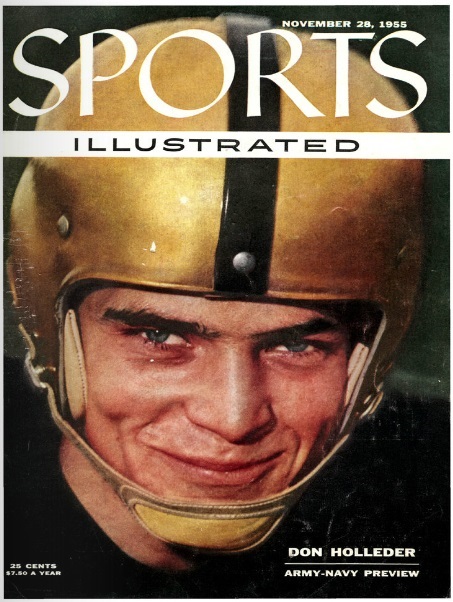
Army-Navy preview – SI
http://sportsillustrated.cnn.com/vault/edb/reader.html?magID=SI&issueDate=19551128&mode=reader_vault
Click below for Donald Walter Holleder Documentary Part 1 of 2 Video on you tube
http://www.youtube.com/watch?v=VmHZ9deXiYc
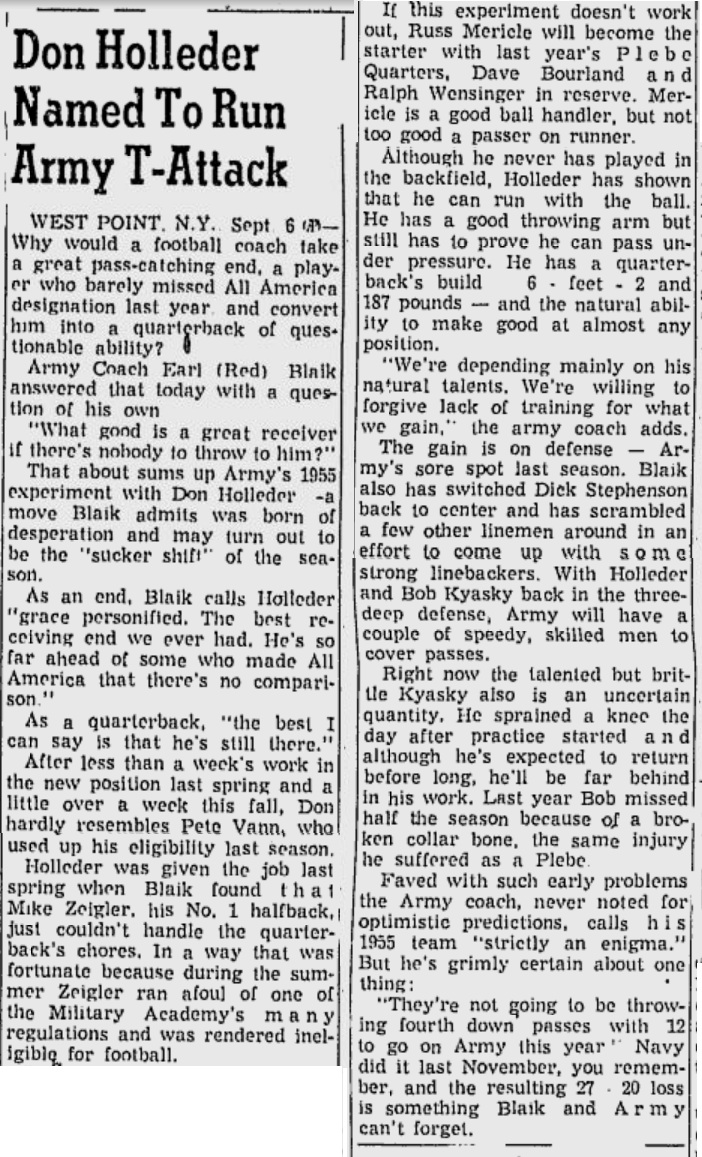 ArmyFB_1955_DonHollederatQB_MeridenRecord_Sep71955
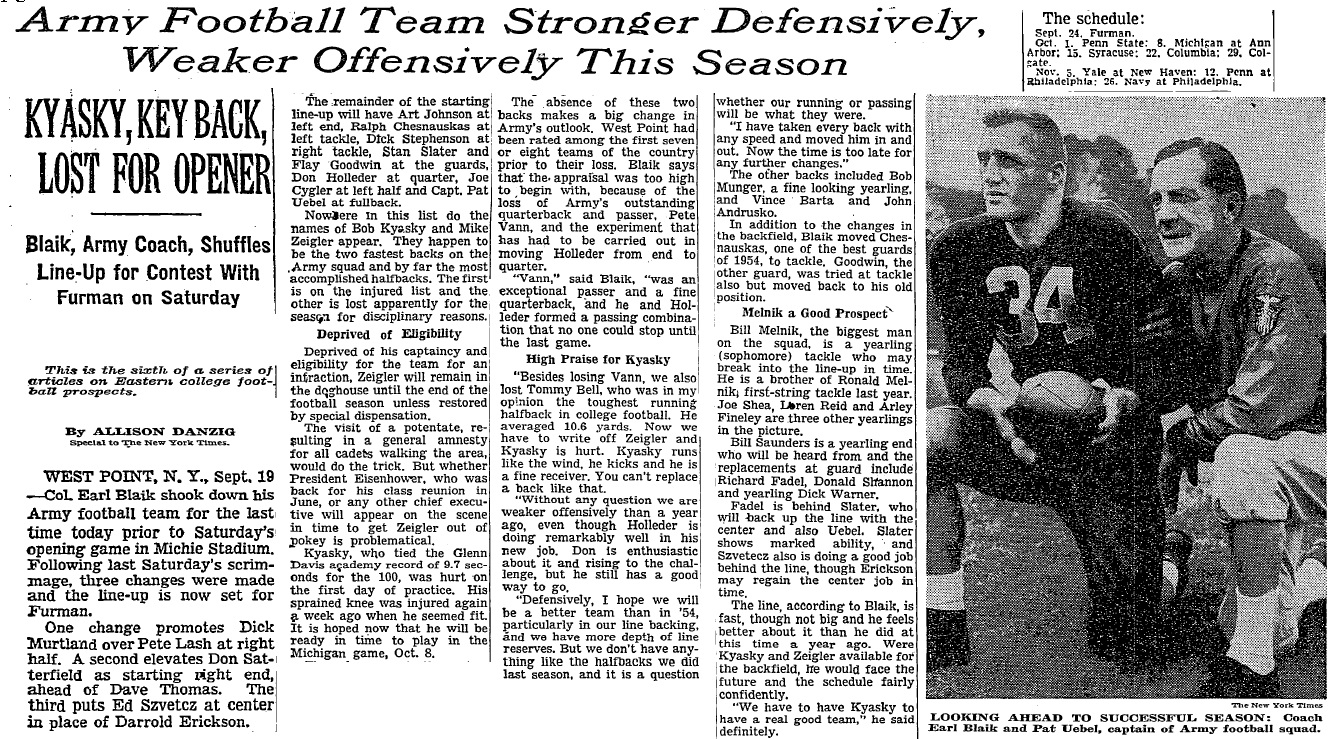
ArmyFB_1955_forecast_NYT_Sep201955
–
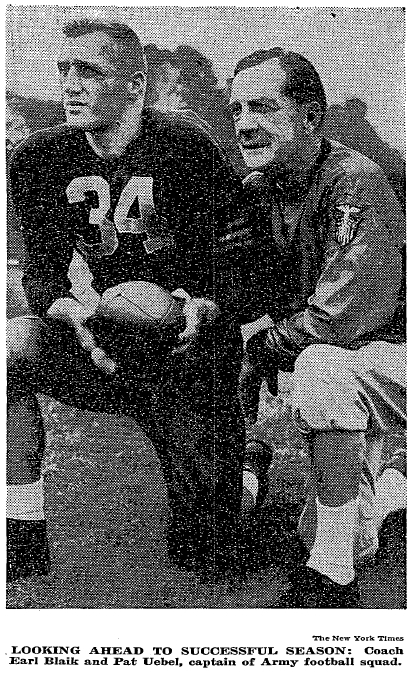
ArmyFB_1955_Blaik-PatUebelCaptain_NYT_Sep201955
–
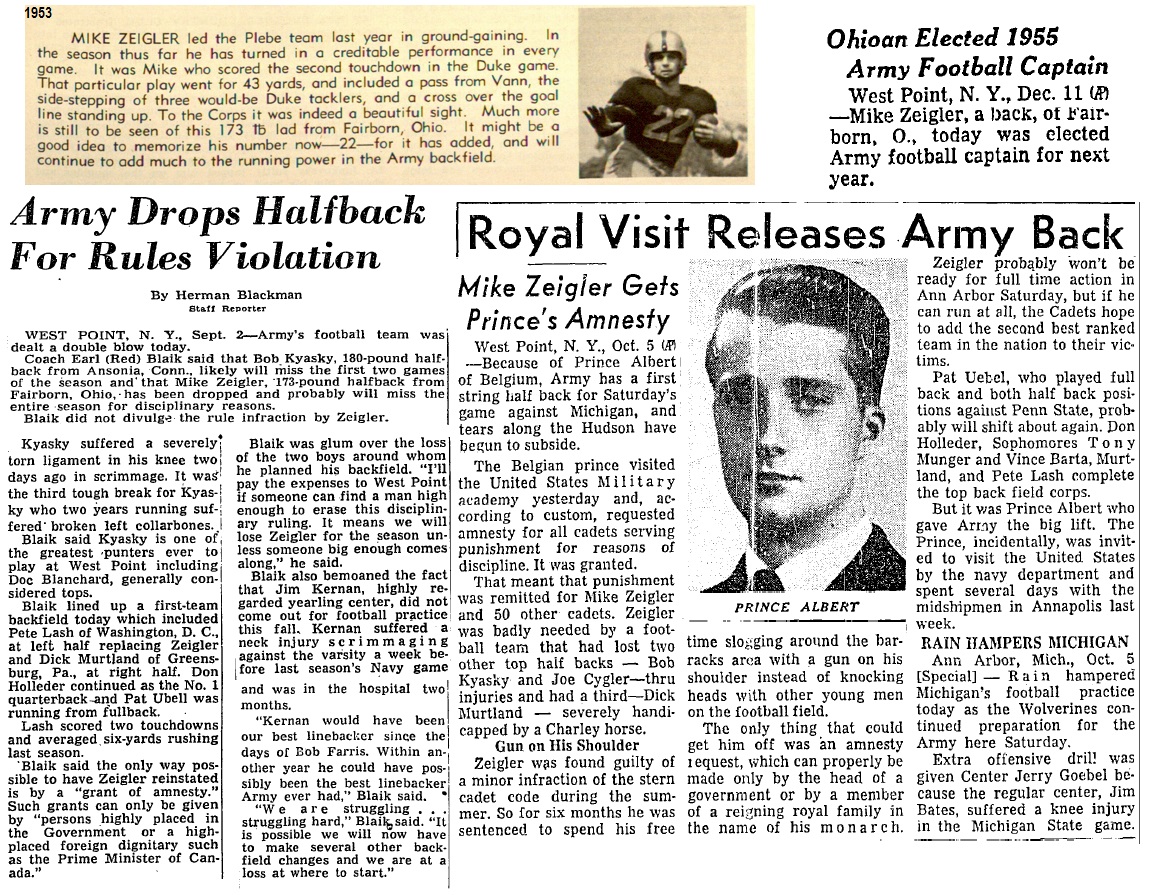
ArmyFB_1955_MikeZeigler-saga1_various
–
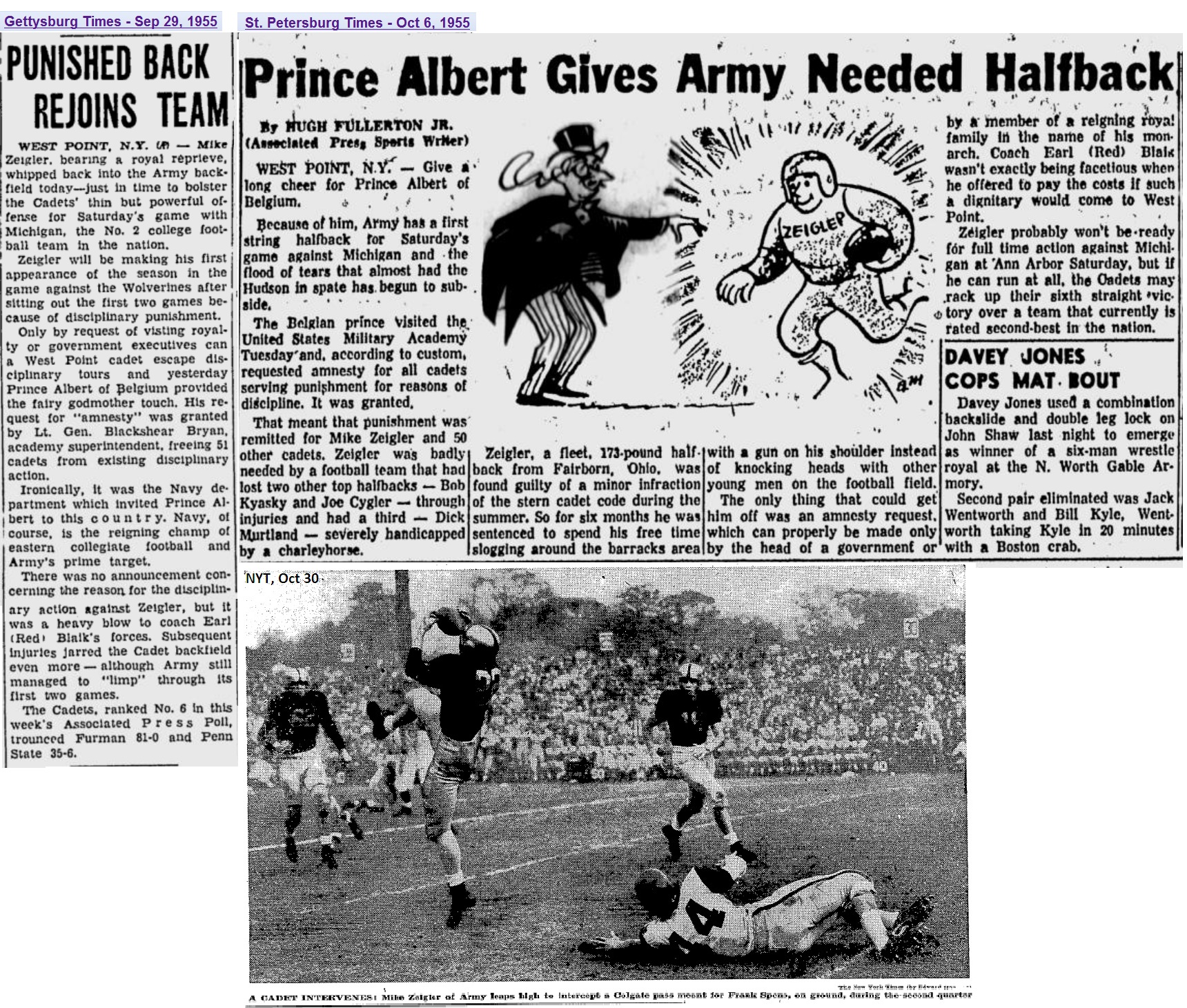
ArmyFB_1955_MikeZeigler-saga2_various
–
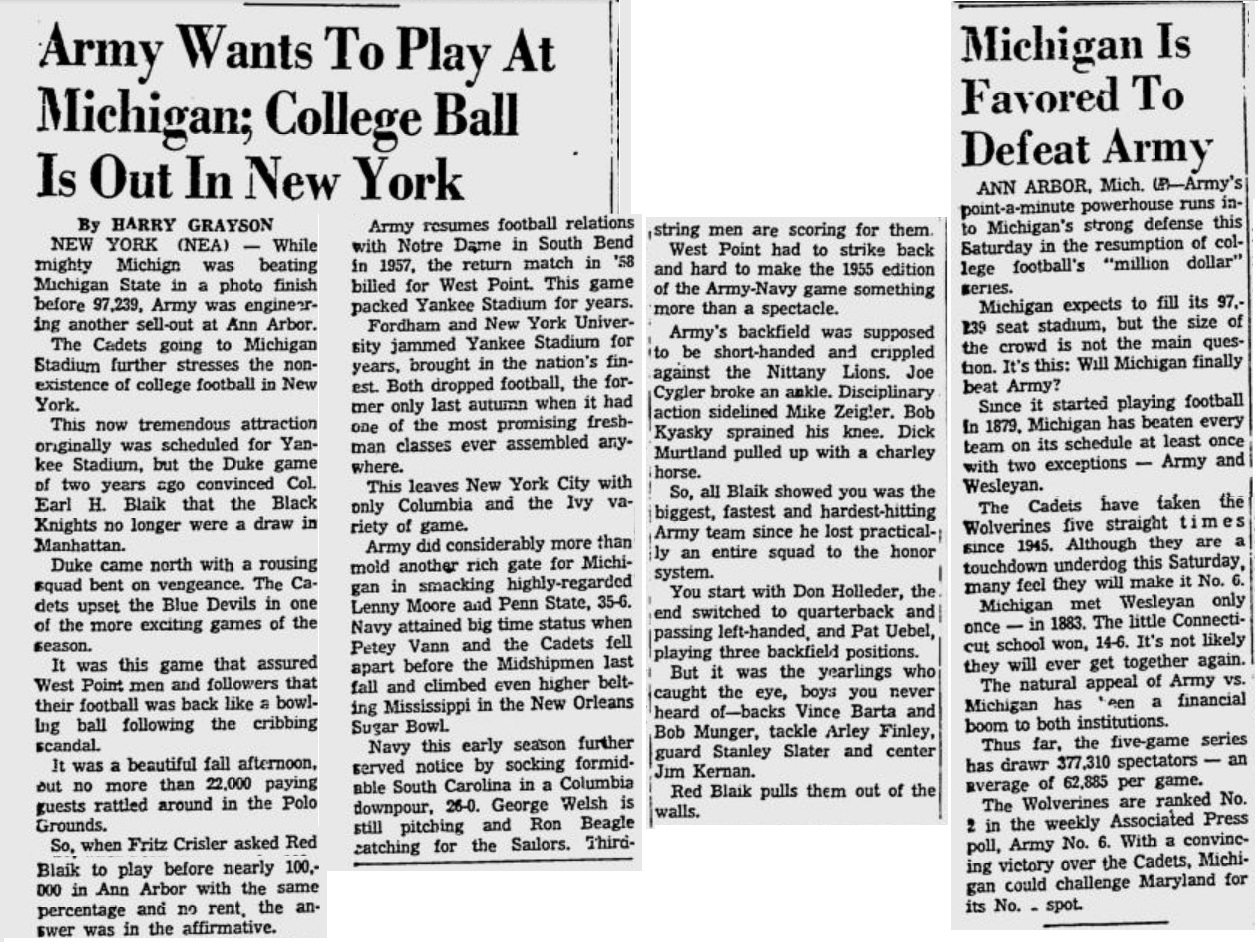
ArmyFB_1955_venues_PortsmouthTimes_Oct61955
–
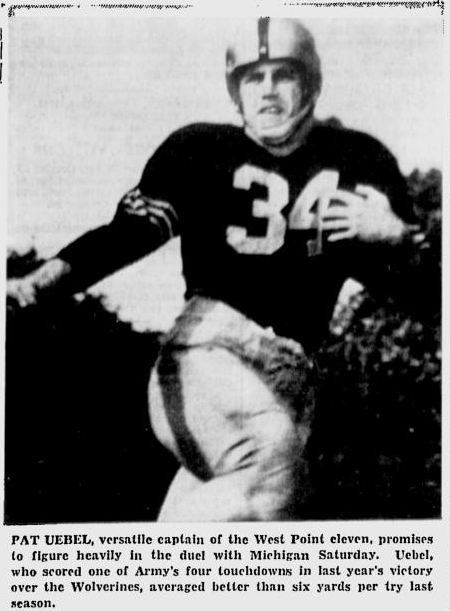
ArmyFB_1955_PatUebel_MichiganDaily_Oct61955
–
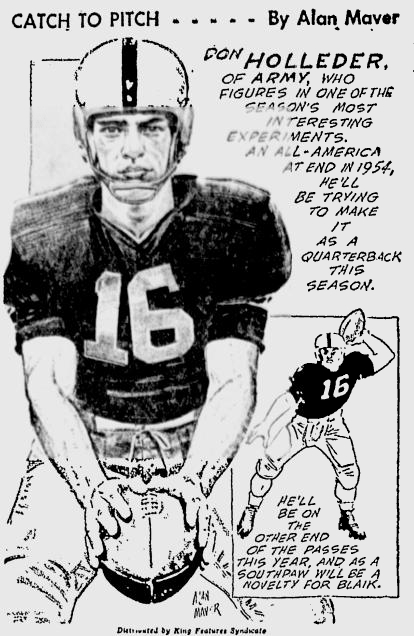
ArmyFB_1955_DonHolleder_byAlanMaver_NewsSentinel_Oct151955
–
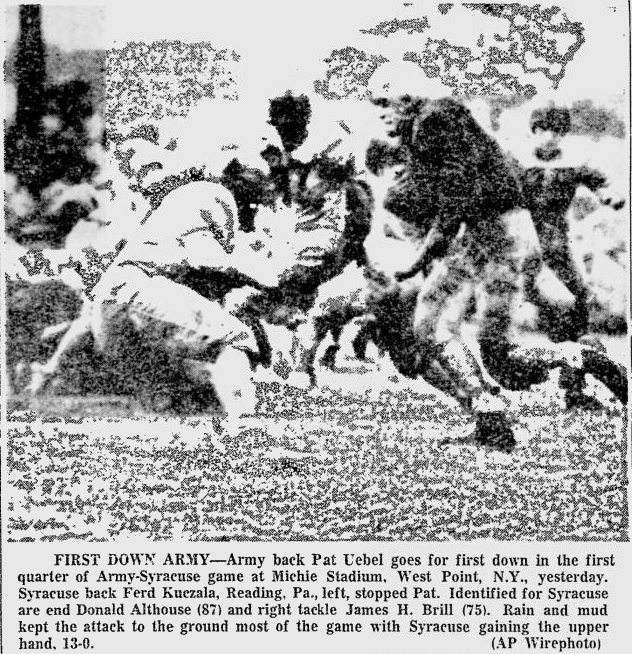
ArmyFB_1955_PatUebel_ReadingEagle_Oct161955
Click here for Video
http://www.searchforvideo.com/watchclip.php?title=Michigan+Defeats+Army+At+Last+++1955&link=http%3A%2F%2Fwww.efootage.com%2F%2Fplay_clip.php%3Fclip_id%3D54251&description=Michigan+rolls+against+the+Army+Cadets+to+produce+football%26%23039%3Bs+big+upset+of+the+week+as+97%2C000+fans+see+the+Wolverines+manhandle+Army+in+a+powerhouse+performance.++26-2+is+the+score+as+Michigan+satisfies+its+10-year+dream+of+beating+the+West+Pointers.&source=E+Footage+Historical&image=http%3A%2F%2Fwww.efootage.com%2F%2Fimages%2Fsnapshots%2F1955%2F112069.jpg&category=search&searchterm=army+football
–
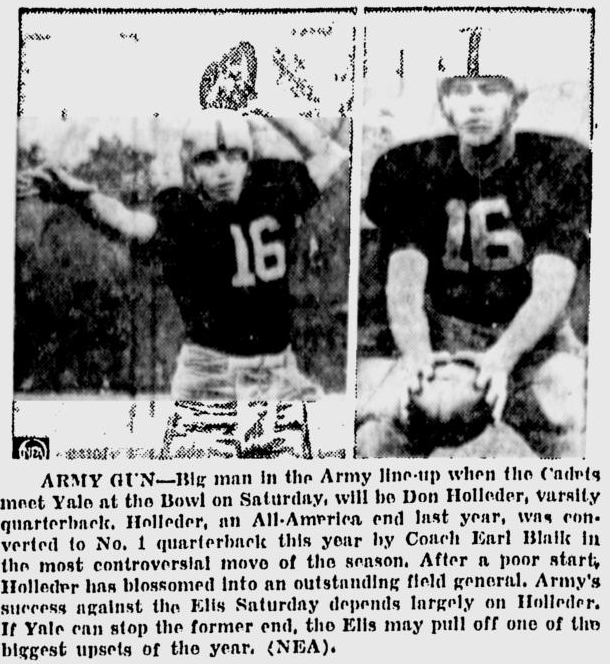
ArmyFB_1955_DonHolleder_MeridenJournal_Nov11955
–
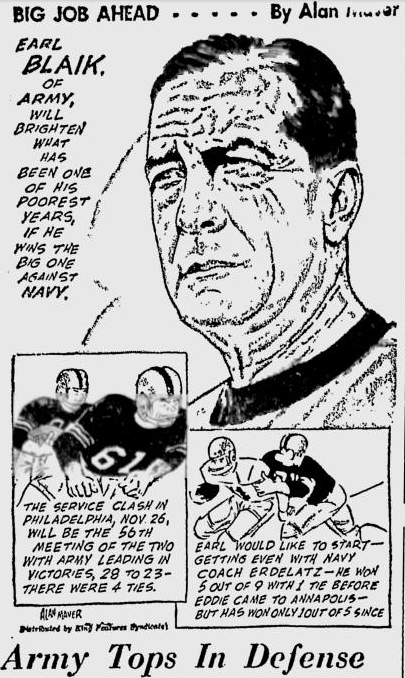
ArmyFB_1955_Blaik_byAlanMaver_NewsDispatch_Nov171955
–
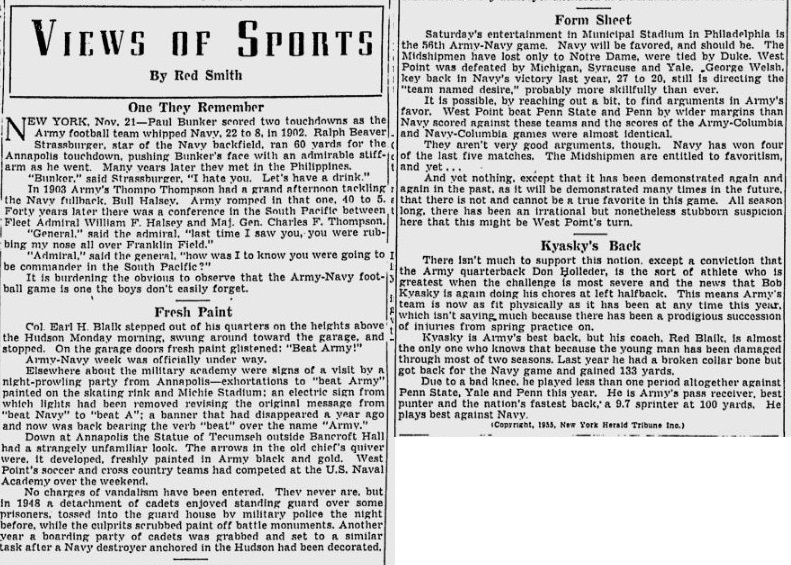
ArmyFB_1955_vsNavy_RedSmith_SarasotaJournal_Nov211955
–
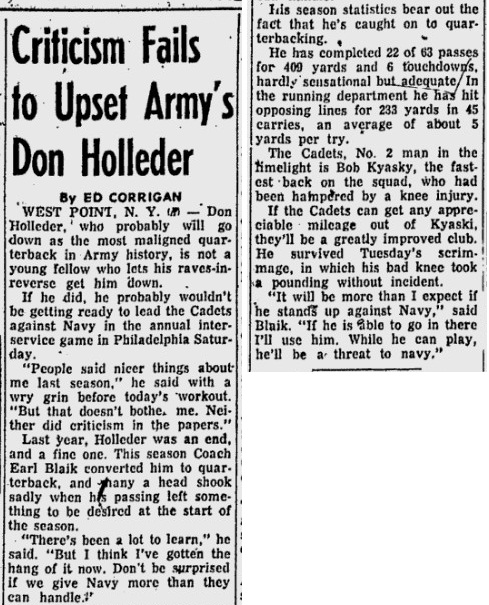
ArmyFB_1955_DonHolleder_NewburghNews_Nov231955
–
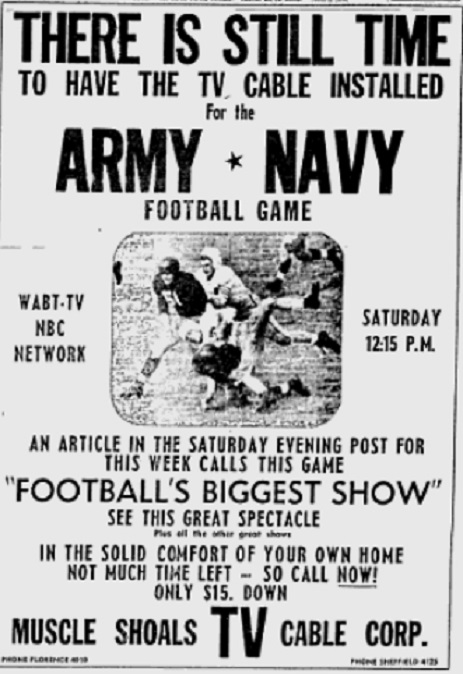
ArmyFB_1955_vsNavy-pre_TV-sale_TimesDaily_Nov231955
–
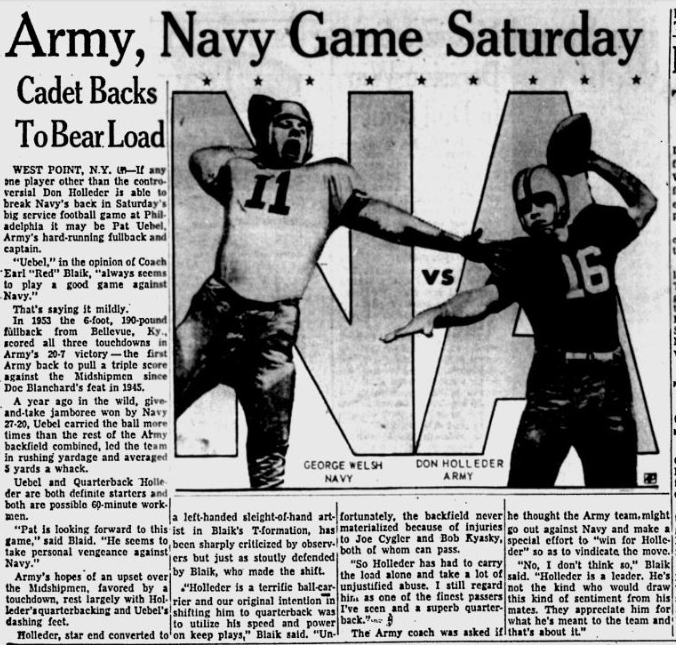
ArmyFB_1955_vsNavy_EugeneRegisterGuard_Nov241955
–
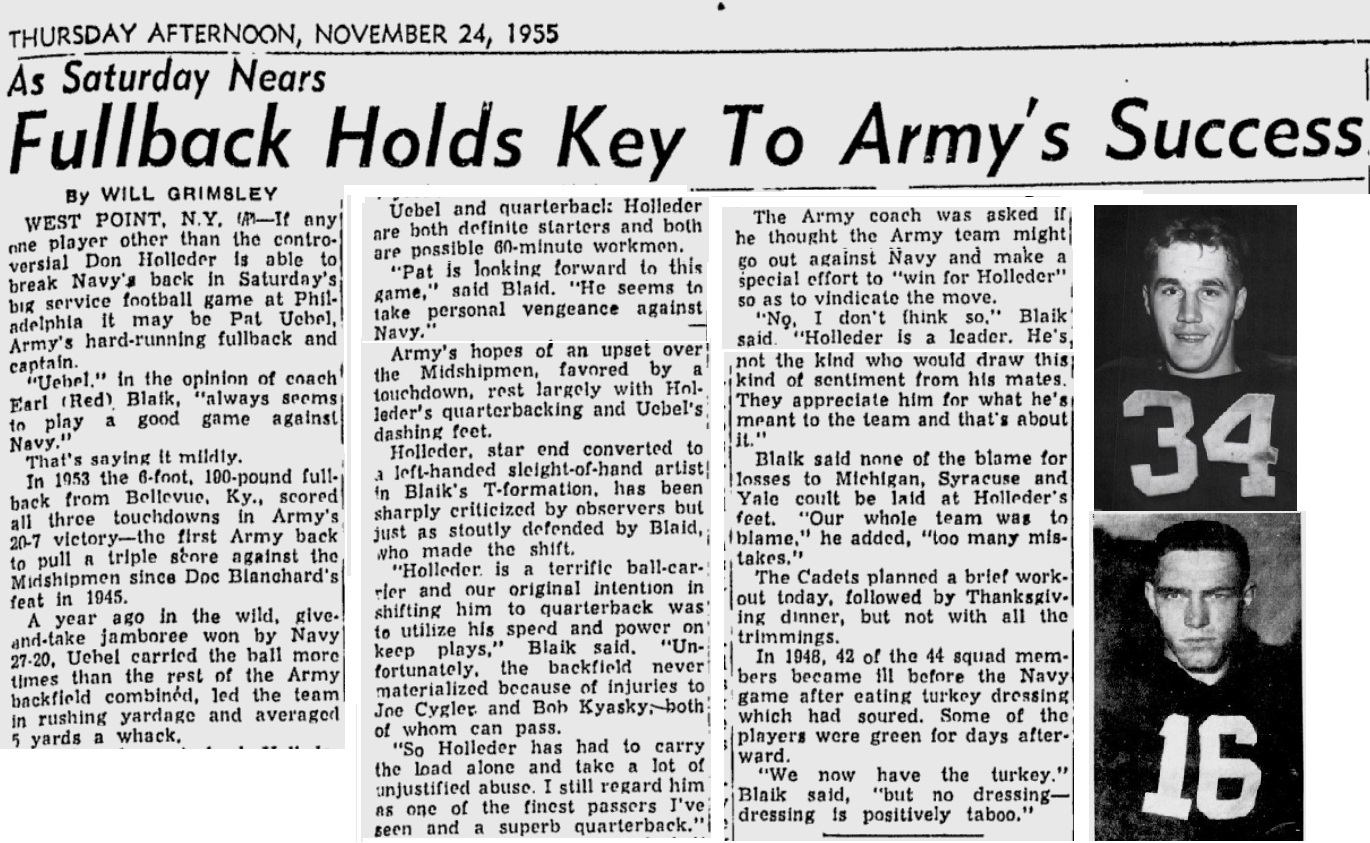
ArmyFB_1955_vsNavy-pre_Uebel-Holleder_TimesDaily_Nov241955
–
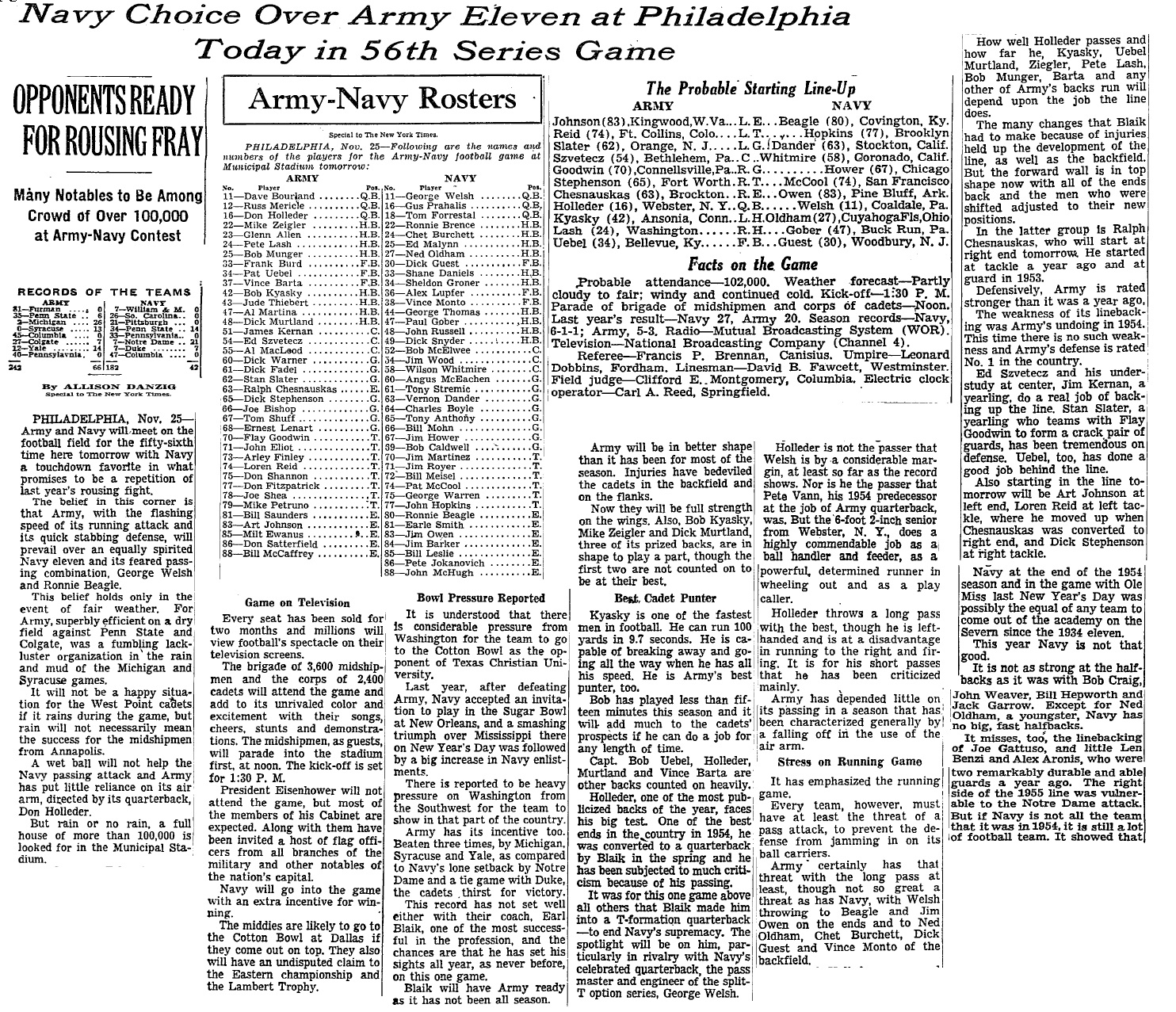
ArmyFB_1955_vsNavy-preview_NYT_Nov261955
–
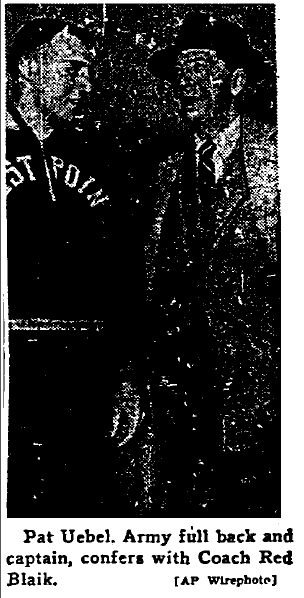
ArmyFB_1955_Blaik-PatUebelCaptain_ChicagoDailyTribune_Nov261955
–
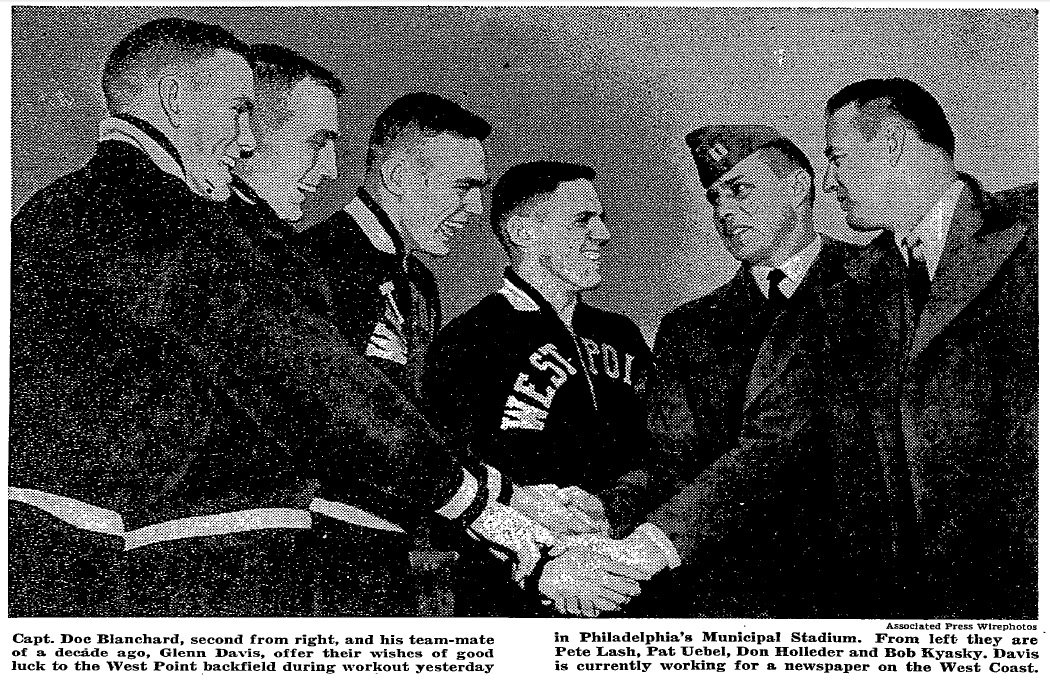 ArmyFB_1955_backswBlanchard-Davis_NYT_Nov261955
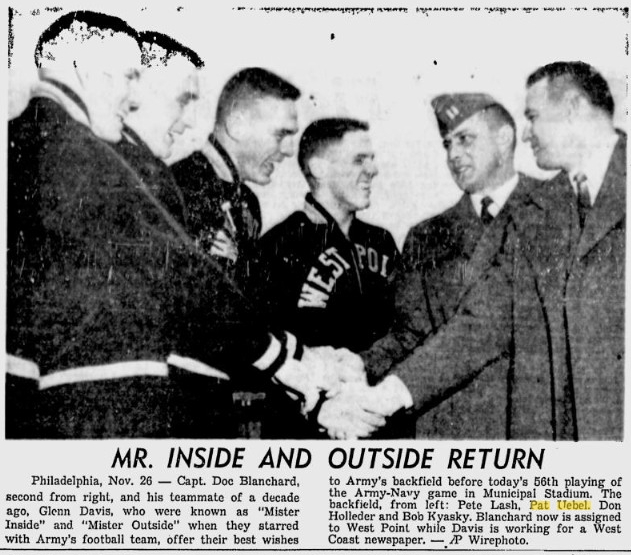
ArmyFB_1955_backswBlanchard-Davis_MiamiNews_Nov2y61955
–
–
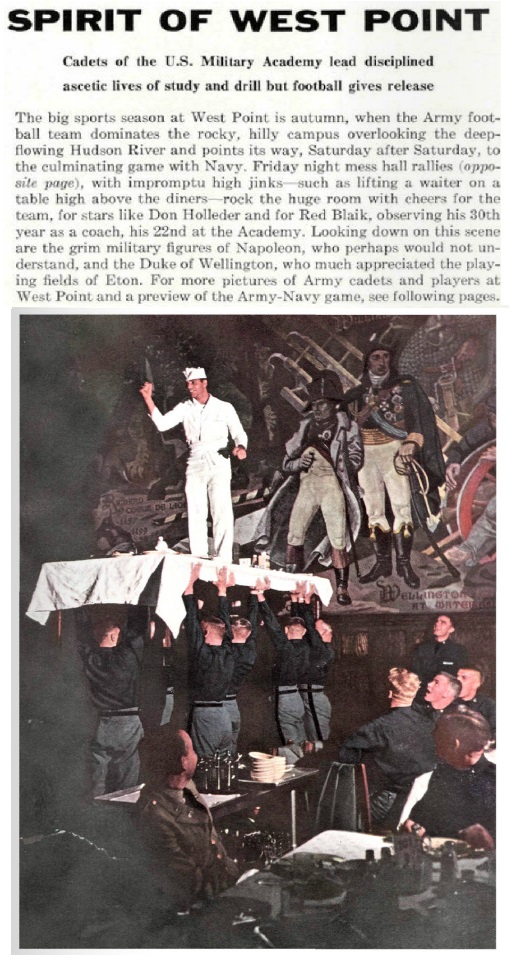
–
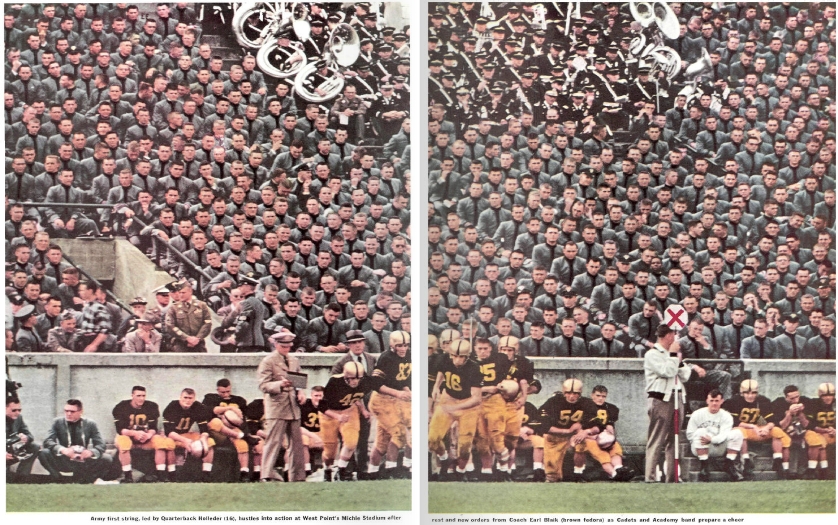
http://sportsillustrated.cnn.com/vault/edb/reader.html?magID=SI&issueDate=19551128&mode=reader_vault
–
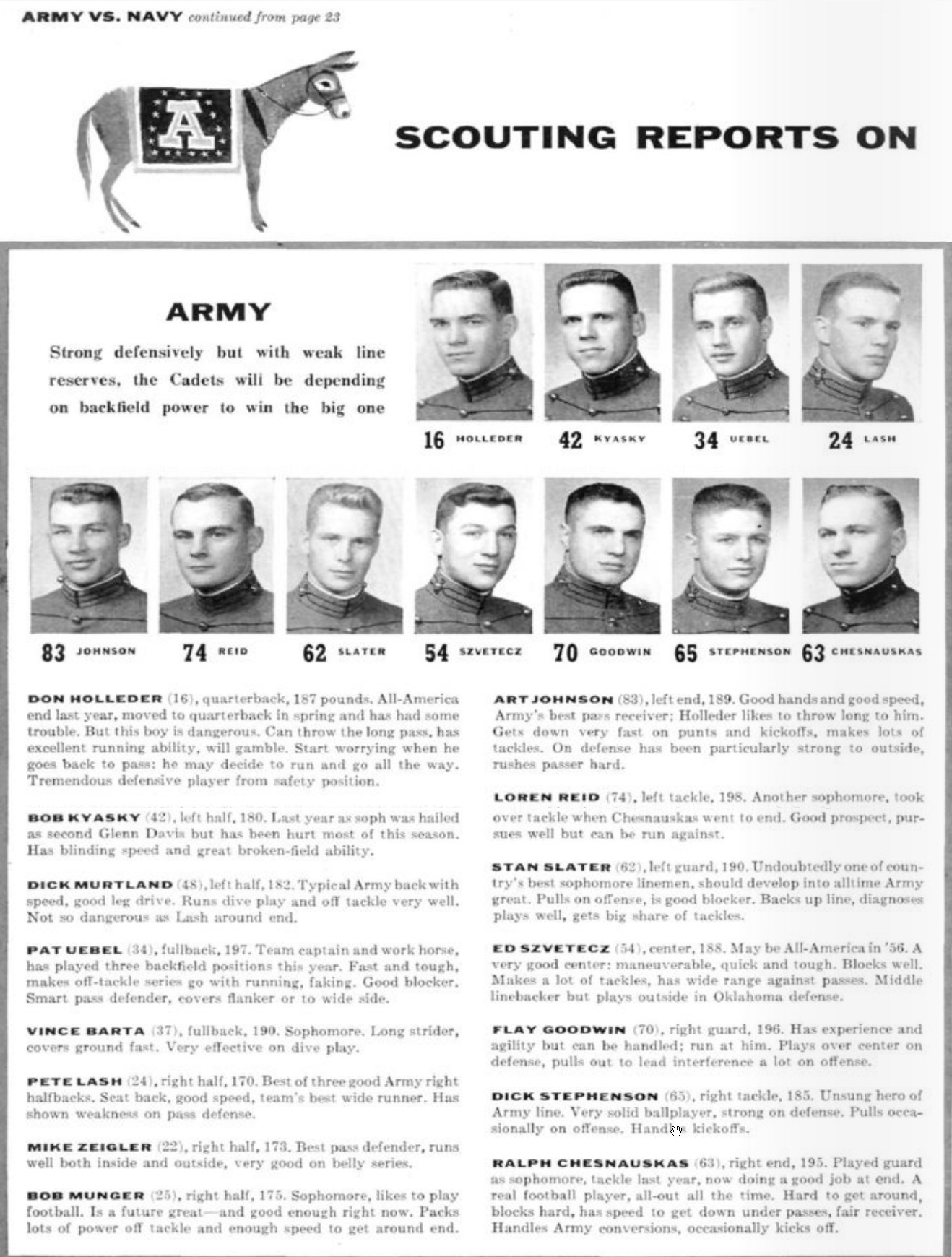
–
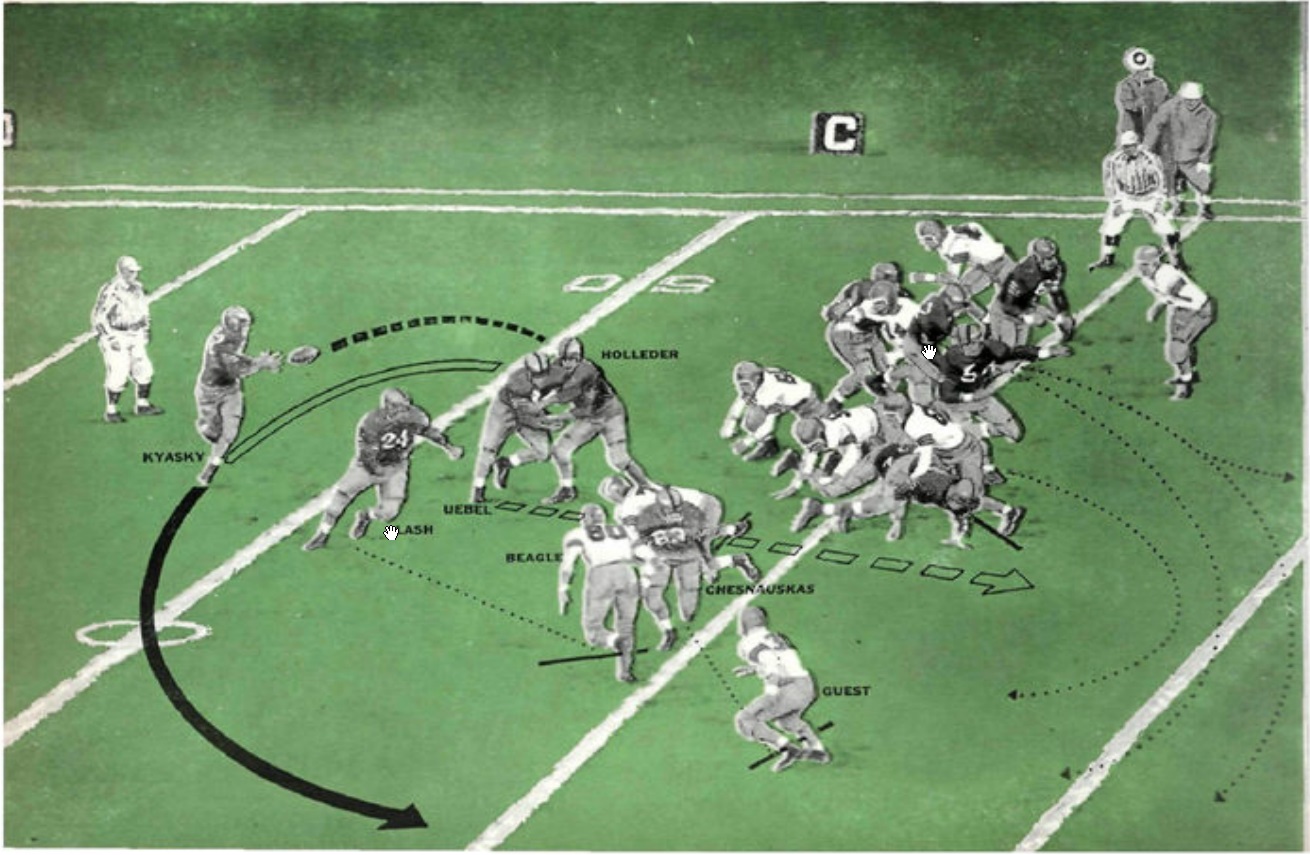
–
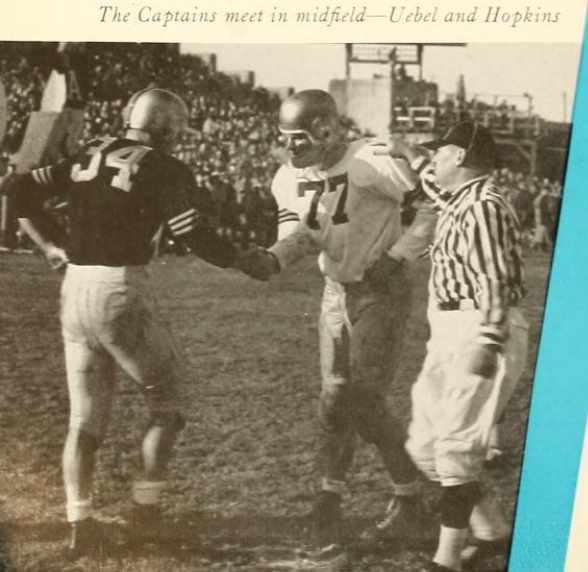
ArmyFB_1955_Uebel-Hopkins_56USNALuckyBag_yrbk
–
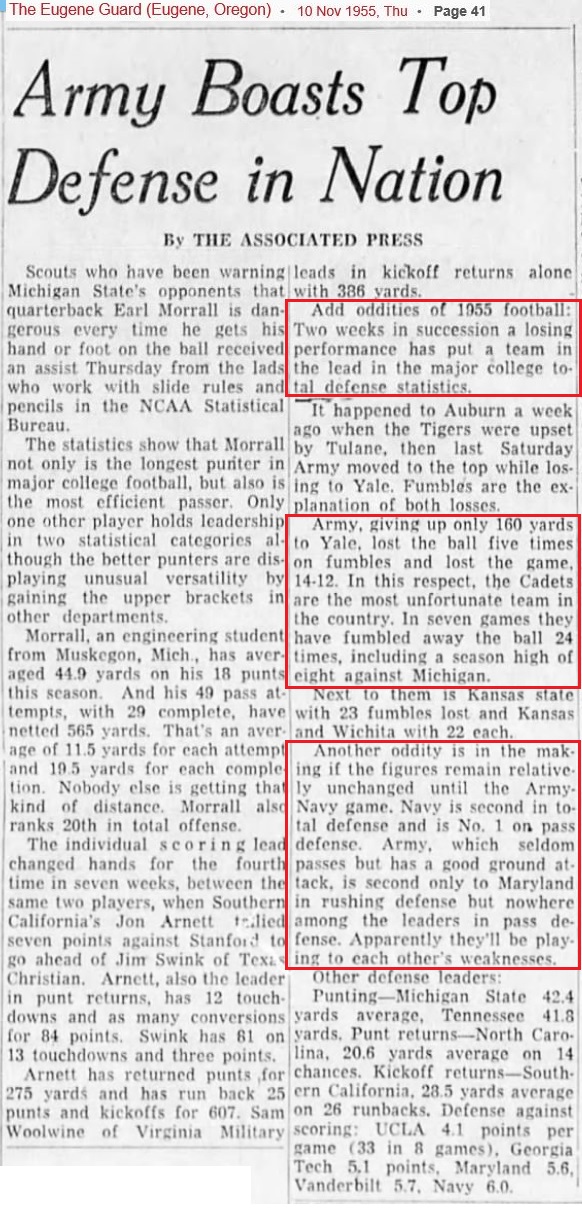
ArmyFB_1955_Defense_EugeneGuardOR_Nov101955
–
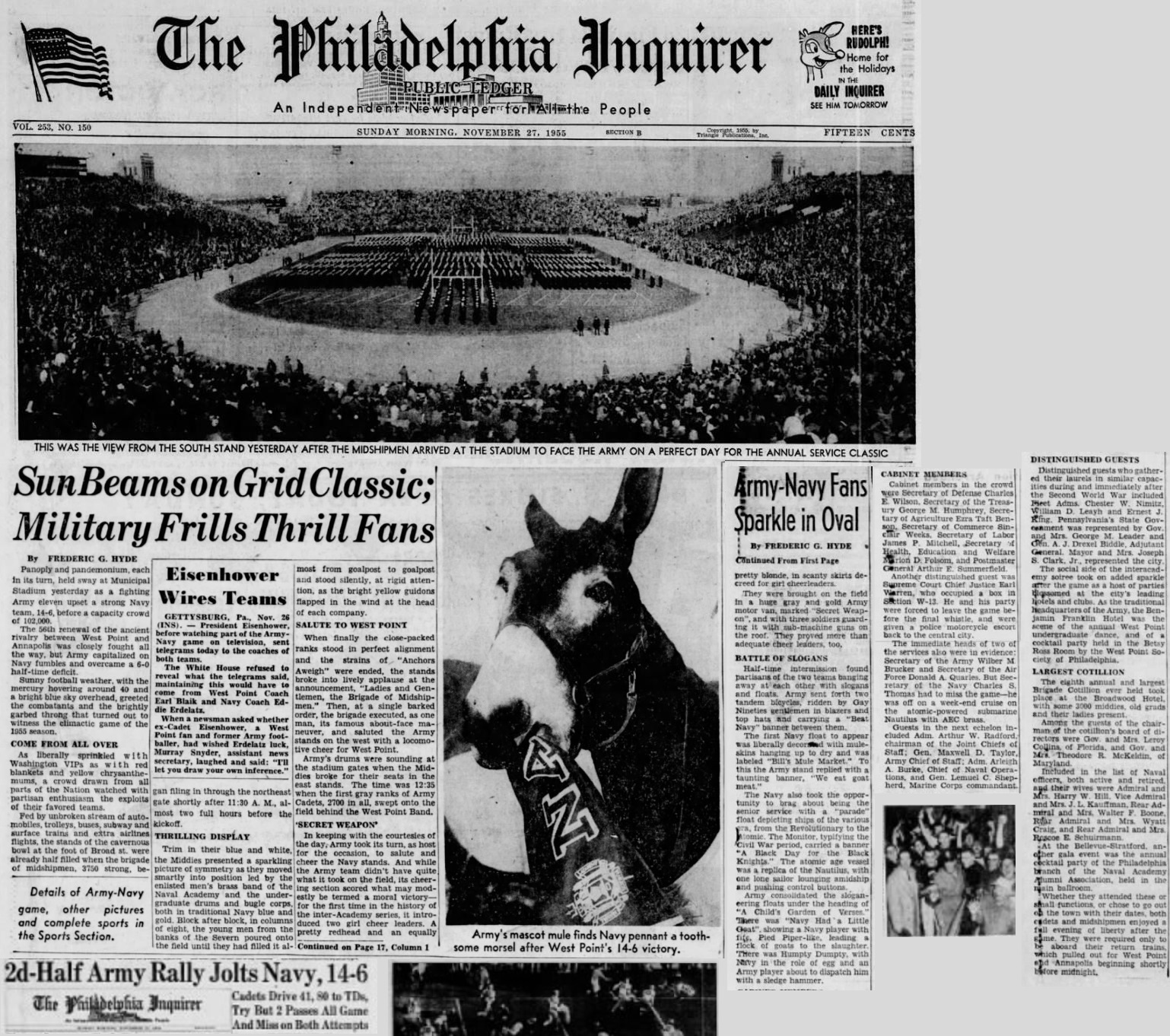
ArmyFB_1955_vsNavy_PhiladelphiaInquirer_Nov271955
–
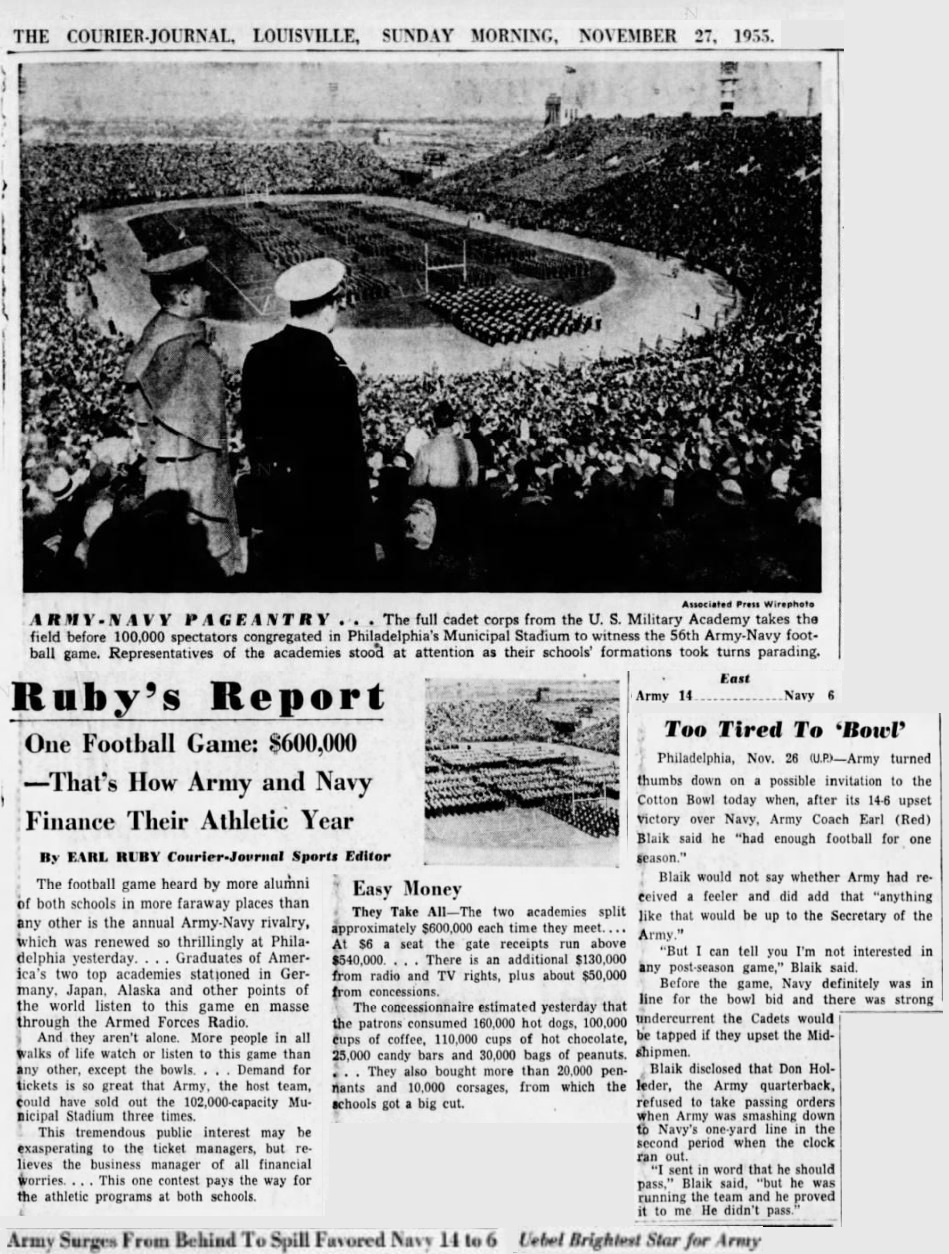
ArmyFB_1955_vsNavy_GateSales_CourierJournal-LouisvilleKY_Nov271955
–

ArmyFB_1955_vsNavy_TheTelegraphHerald_Nov271955

ArmyFB_1955_vsNavy_HeraldJournal_Nov271955
–
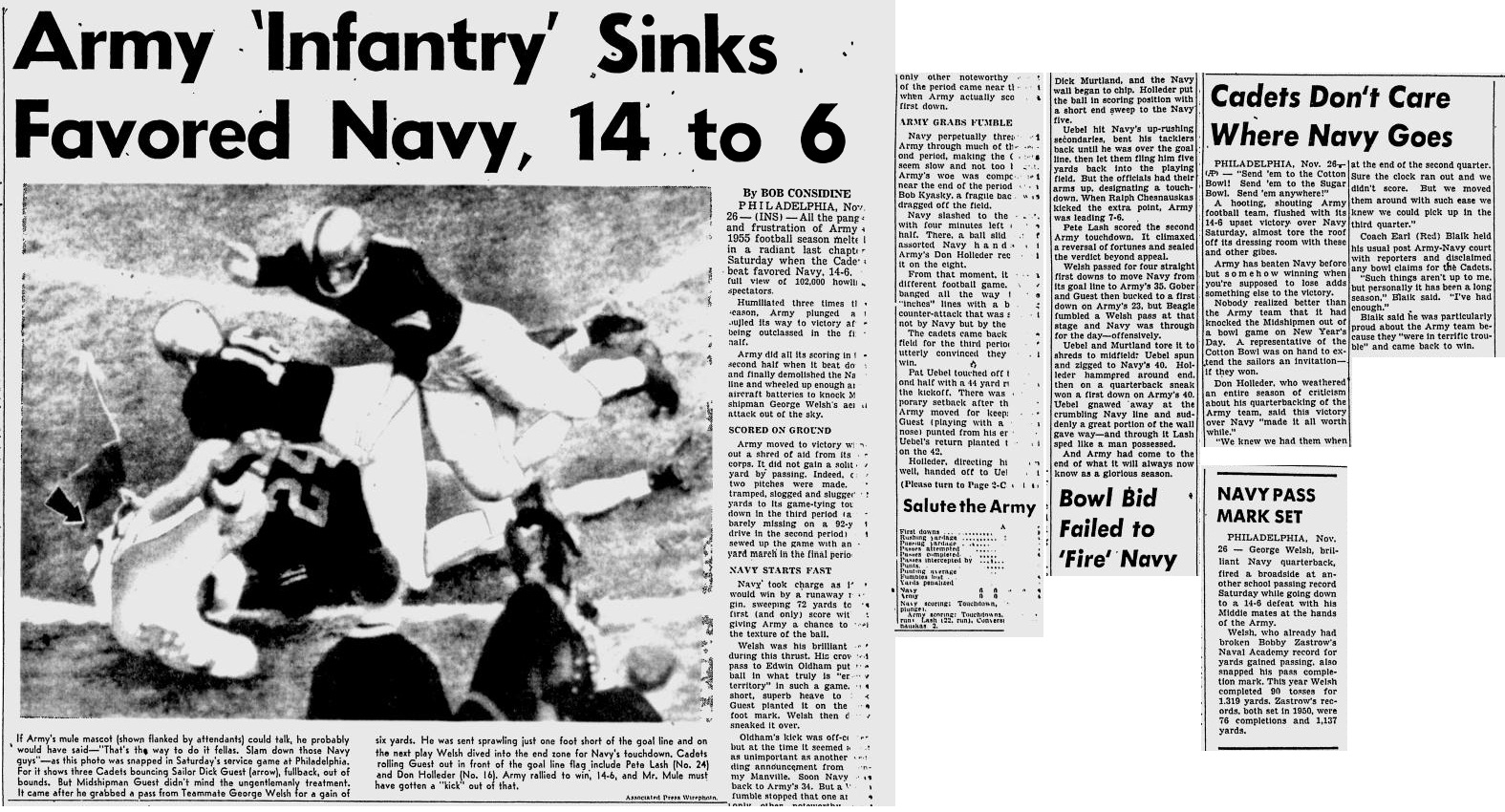
ArmyFB_1955_vsNavy_NewburghNews_Nov271955

ArmyFB_1955_vsNavy_MiamiNews_Nov271955pics
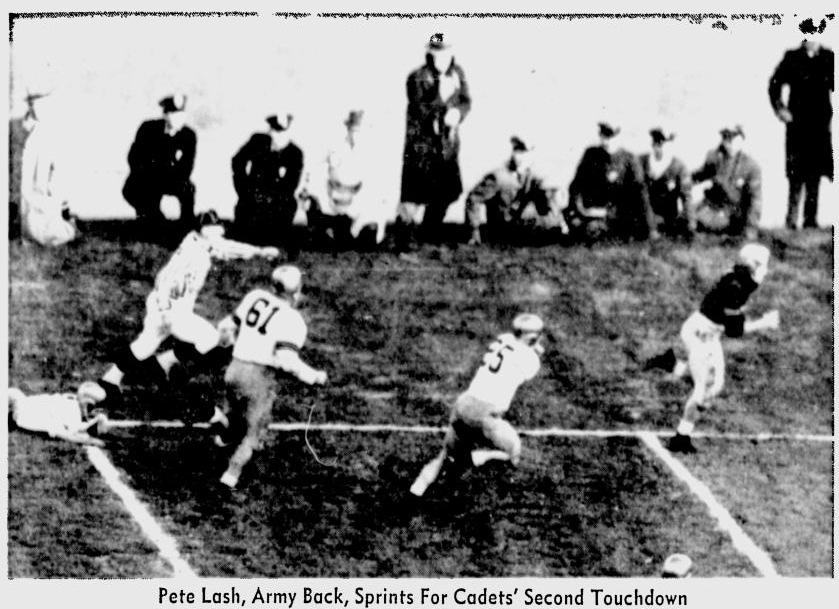 ArmyFB_1955_PeteLashvsNavy_NewsandCourier_Nov271955
–
–
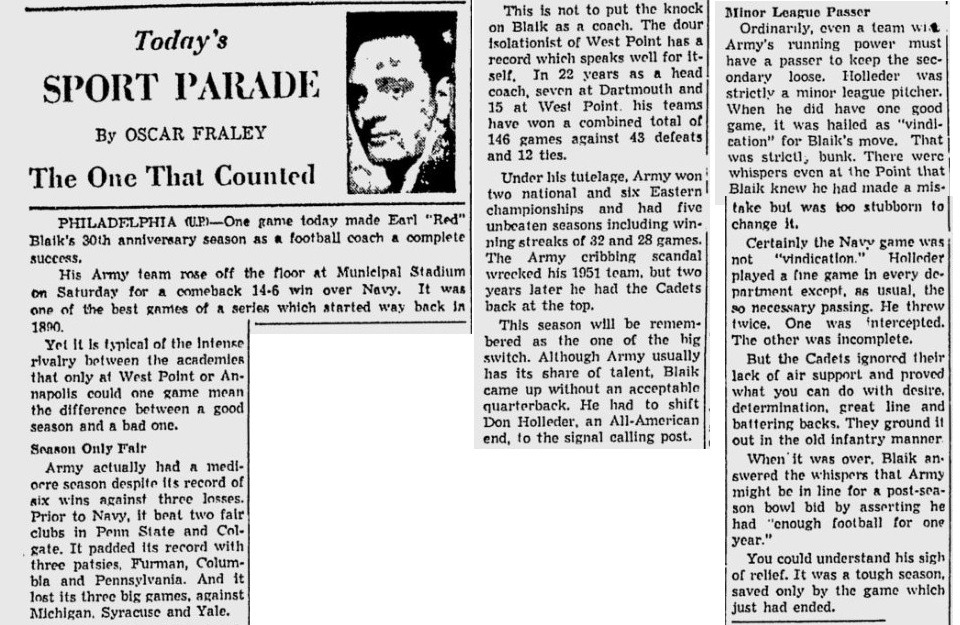
ArmyFB_1955_vsNavy_NewsDispatch_Nov281955
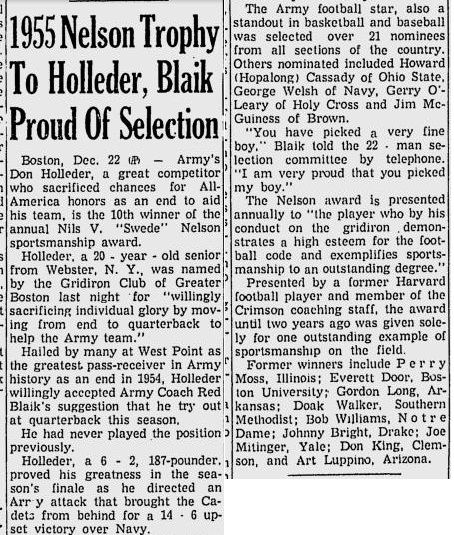
ArmyFB_1955_DonHolleder_NewburghNews_Dec221955
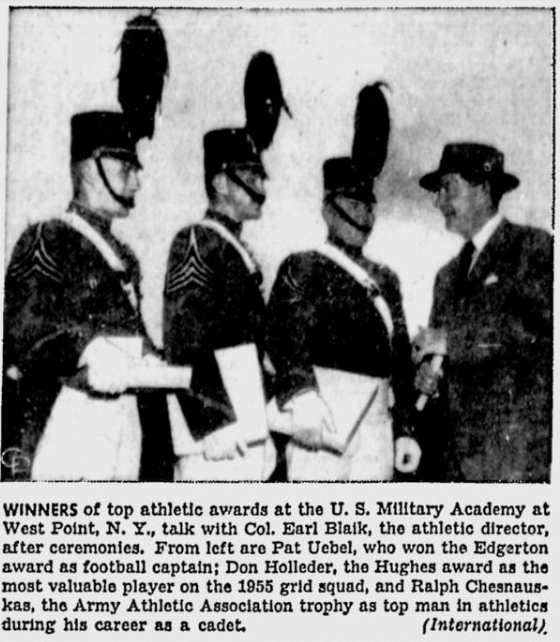
ArmyFB_1955_Uebel-Holleder-Chesnauskas-
Blaik_WashingtonObserver_Jun81956
articles provided by Russ “Skip” Grimm – Class of ’76
————————
May 14, 2003
Army vs Navy, 1955 – RABBLE takes a look back on the 1955 Army-Navy game.
1955 was the year of Red Blaik’s “Great Quarterback” Experiment. Faced without a proven quarterback since Pete Vann had graduated earlier that spring, Blaik remained in a quandry. “Who do I play at QB for my team this season?” The Master came up with the idea that he would take his best athlete on the team and place him at the position. That job fell to All-American End Don Holleder. Was Holleder up to the task? He was most certainly up to that task.
Sailors cold until the game was in the bag. They solved Navy’s new defense for this game, a wlde 6-2. And they hammered Navy’s weak spots relentlessly.
Heroes on both sides were numerous. Besides Uebel, Holleder and Lash, there was Dick Murtland, who piled up yardage on the dive play; Chesnauskas at right end, Flay Goodwin and Stan Slater at the guards and Dick Stephenson at tackle.
For Navy, it was Welsh, as expected, who overshadowed his teammates with his passing. His 18 for 29 and 176 yards was a great effort. Ron Beagle was tremendous at left end. So were John Hopkins at left tackle, Dick Guest at fullback, Wilson Whitmire at center and Ned Oldham at halfback.
Navy’s Score
At the outset Navy looked like even more than the one touchdown favorite it was. The Sailors won the toss, received the kickoff and went all the way without giving up the ball. Welsh threw his first pass from his own 30-yard line to Beagle and it brought a first down on the Navy 38. Even a 15-yard penalty couldn’t stop the Tars. Welsh more than made it up by throwing to Gober, moving the ball to midfield.
Gober, Guest and Oldham ran to the 35, from where Gober got away and in two efforts reached the Army 12. With the running game momentarily clogged, Welsh threw to Guest in the flat for a first down on the 1, and on the next play sneaked over through guard for the touchdown. With Welsh holding the ball, Oldham’s’ kick for the seventh point went to the left of the posts and it was 6-0.
At the moment that missed point didn’t seem important, but it grew larger as the game went on. Navy fumbled and Slater; recovered for Army on the 21.
From there the, Soldiers battered and smashed their way to the clinching touchdown in four plays. Uebel, Murtland and Holleder took the biggest bites until Uebel reached Navy’s 23-yard line. At that point Lash started inside Navy’s vulnerable right tackle, slid around when the hole jammed, and went all the way.
Only 3 minutes, 45 seconds were left at that time, and when the final whistle shrilled with Army again on the march, Cadet elation knew no bounds. A wave of gray surged on the field, engulfed the Army player and swept them to the Navy side of the field. When It reversed, it bore Holleder on its shoulders, then Uebel, then Chesnauskas, and all but carried them to the dressing room exit. This was the 29th Army victory in the series, to 23 for Navy and four ties.
ARMY
LE-Johnson, Saunders
LT-Reid
LG-Slater, Bishop
C–Szvtecz, Kernan
RG-Goodwin, Shannon
RT-Stephenson
RE-Chesnauskis, Butterfield
QB-Holleder,Mericle
LH-Murtland
RH-Lash, Zeigler
FB-Uebel
NAVY
LE-Beagle
LT-Hopkins
LG-Dander, Mohn
C–Whitmire, Wood
RG-Stremic, Hower
RT-McCooL Royer
RE-Owen, Smith
QB-Welsh
LH-Oldham, Malynn
RH-Burchett, Gober
FB-Guest, Monto
NAVY 6 0 0 0 – 6
ARMY 0 0 7 7 – 14
ARMY- – Touchdowns: Uebel (4-yard Plunge) ; Lash (23-yard run)
Conversions: Chesnauskas 2.
Navy- – Touchdown: Welsh (1-yard sneak)
/////////////////////////////////////////////////////
The 1955 Army Navy game link previously posted is no longer available
it night be viewed with appropriate plugins or ordered at
ARMY DEFEATS NAVY IN 56TH FOOTBALL CLASSIC – 1955
http://www.efootage.com/stock-footage/54179/Army_Defeats_Navy_In_56th_Football_Classic_-_1955/
——————
Provided by Russ “Skip” Grimm – Class of ’76
1983 Army 2-9
1983/11/25 Army 13 – Navy 42 L
Coach – Jim Young (born April 21, 1935)
1973-1976 Arizona: 31-13
1977-1981 Purdue: 38-19-1
1983-1990 Army: 51-39-1
1992-1994 Arizona (assistant)
Total: 120-71-2
Championships
1 WAC (1973)
Awards
WAC Coach of the Year (1973)
Big Ten Coach of the Year (1978)
College Football Hall of Fame – Inducted in 1999
1983 Army 2-9
1984 Army 8-3-1 W Cherry
1985 Army 9-3 W Peach
1986 Army 6-5
1987 Army 5-6
1988 Army 9-3 L Sun
1989 Army 6-5
1990 Army 6-5
Army: 51-39-1
source: http://en.wikipedia.org/wiki/Jim_Young_%28American_football_coach%29
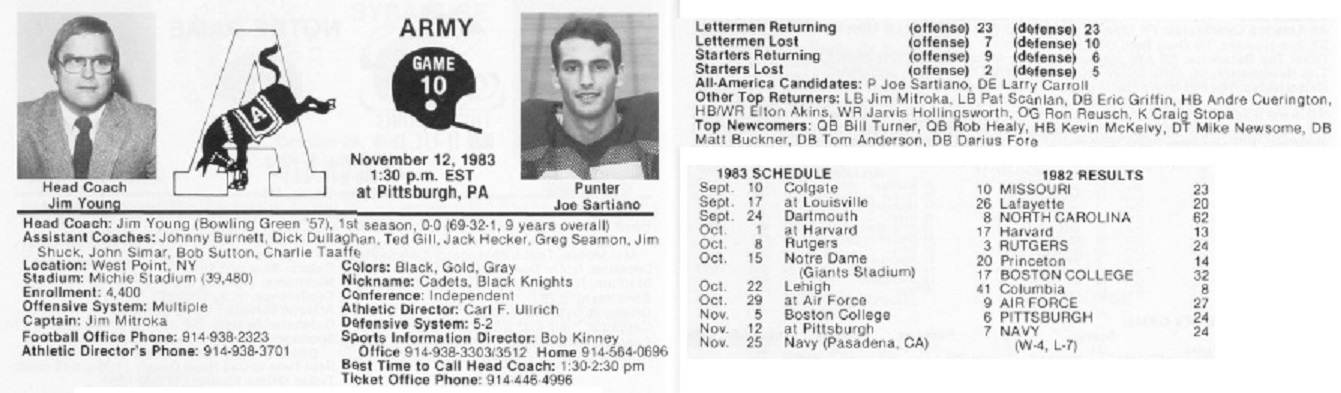
ArmyFB_1983_editfromPittsburgh-guide


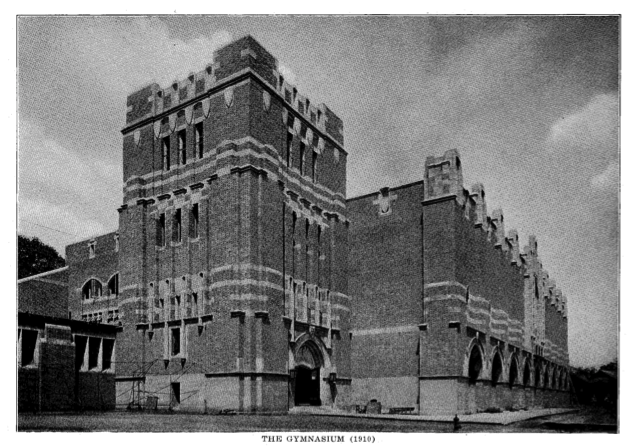
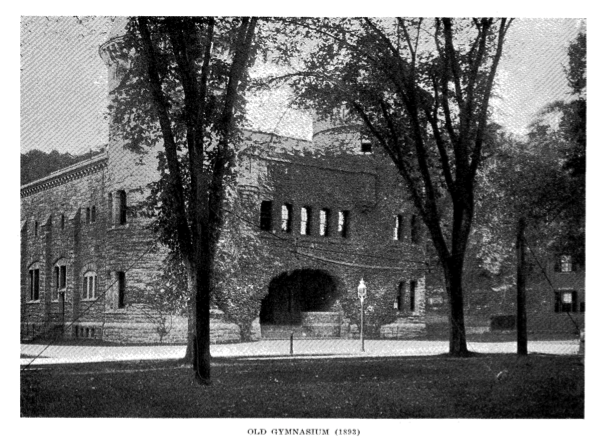
The Arvin Cadet Physical Development Center is actually six buildings constructed between 1910 and 1975. The facility’s six stories and 30 floor levels currently have a footprint of approximately 455,000 square feet. The center is currently undergoing a five-year, $85 million phased renovation which is needed to ensure facilities keep pace with developments in programs. West Point has one of the world’s best physical development programs, and facility modernization is necessary to keep pace in this critical area.

Note Old Central Barracks on the left

Art & Karen Brown
Soccer — Team Captain Fall of 1961


A Florida couple who met in 7th grade and have always put God first have just celebrated their 60th wedding anniversary—and they are still as smitten as ever. Their love story is a testament to a happy marriage rooted in faith, togetherness, and forgiveness.
Arthur Brown, 82, a veteran of the U.S. Army Corps of Engineers, and his wife Karen Brown, 80, a retired administrative assistant, are both cancer survivors and true patriots who are grateful for their blessed family life. Originally from Teaneck, New Jersey, they now live in Orlando, Florida—their home of 35 years.
“We got married at West Point three days after graduation, on June 9, 1962. I didn’t want to rush into it, so we waited three days,” Arthur told The Epoch Times, jokingly.

The couple celebrated 60 years together on Karen’s 80th birthday in February, turning the special day into a family reunion at a holiday home in Holland, Michigan.
Their 21-year-old granddaughter, Sydney, who lives in New York City, shared footage of the lovebirds blowing out their candles on TikTok, captioned, “They’re still as in love as ever.” The clip went viral.
“Poppy still flirts with Gammy!” Sydney told The Epoch Times. “While they’re blowing out their candles to make a wish, Poppy says he wishes for another 100 years and then kisses her; everyone says that every couple should be doing that, even 60 years later.
“People love that their love is still so alive, and they’re such an inspiration to me. It was actually crazy; someone from their church saw the video and commented on it, then a bunch of people replied … it’s such a testament to their love, how they serve everyone in their community, which [is] so great.”


Be it people who have lost their grandparents or others, many are inspired by Arthur and Karen’s love. Some are even motivated to be “more self-sacrificial” in their own relationships.
Karen was just 14 years old when she saw Arthur for the first time. Arthur’s brother was her classmate and, after 12 months, introduced the couple on Memorial Day 1957. Arthur was 17.
It wasn’t customary for girls to ask boys on a date in the ’50s, Karen said, but she summoned the courage to invite Arthur to her New Jersey sorority’s annual dance and cookout. Arthur suggested they meet sooner.
“We went to a drive-in movie,” recalled Karen. “I probably fell asleep the minute the movie started … I was just over the flu. The car started and I said, ‘I’m so sorry!’ He said, ‘I know you’ve been sick.’ I thought, what a nice guy.”

Karen enrolled at Katharine Gibbs College in New York, close to home, and got a job as an admin assistant for Time Magazine’s travel department. Arthur proposed with a “beautiful diamond” in front of her parents, sisters, and grandmother.
“He actually proposed in my parents’ home which was the most wonderful, memorable place,” Karen said. “We both came from wonderful examples of parents. We are blessed.”
The couple tied the knot and, after Arthur completed Airborne Ranger Training, they moved to Fort Campbell, Kentucky, where they welcomed a daughter. Two sons were born in Ohio. Arthur served in Thailand and Vietnam before returning to West Point for an advanced engineering course, and eventually a teaching post. Karen was president of the Wives’ Club for two years.
The couple’s love deepened as time passed, and they never stopped surprising one another.
Arthur tells a story: “[Karen] wrote a poem about me before I ever met her. Her best friend showed me, but wouldn’t show me who wrote it, so I promptly forgot about it. Ten years later, five years after we were married, I heard [Karen] telling somebody about this poem that she wrote about me and I said, ‘You wrote that poem? So how’s that!’”

Arthur spent 24 years in the Army, during which his family moved 23 times. In 1986, he left the Army for a unique opportunity with the Walt Disney Company.
Arthur said: “This guy came along, he had just fired his project manager for Pleasure Island. He called and said, ‘I’ve got an offer for you. Think about it, pray about it. I’ll call you back in two weeks.’ I crunched numbers and I decided, go for it. That’s how I got 23 years at Disney.”
Over two decades, Arthur was involved in design and building at every single Disney theme park, backstage area, and resort property. He retired after a prostate cancer diagnosis and sickness owing to Agent Orange exposure. Karen is also a cancer survivor; she battled colon cancer and is now seven years in remission.
With six decades of happy marriage under their belts, Arthur and Karen claim the key to harmony is quite simple: be best friends, put God first, trust, forgive, and never go to bed angry.
Arthur said: “The two most important words are, ‘Yes dear!’ We just serve each other, we truly do care about each other, and we do anything that we can to make the other one more comfortable, more happy.”

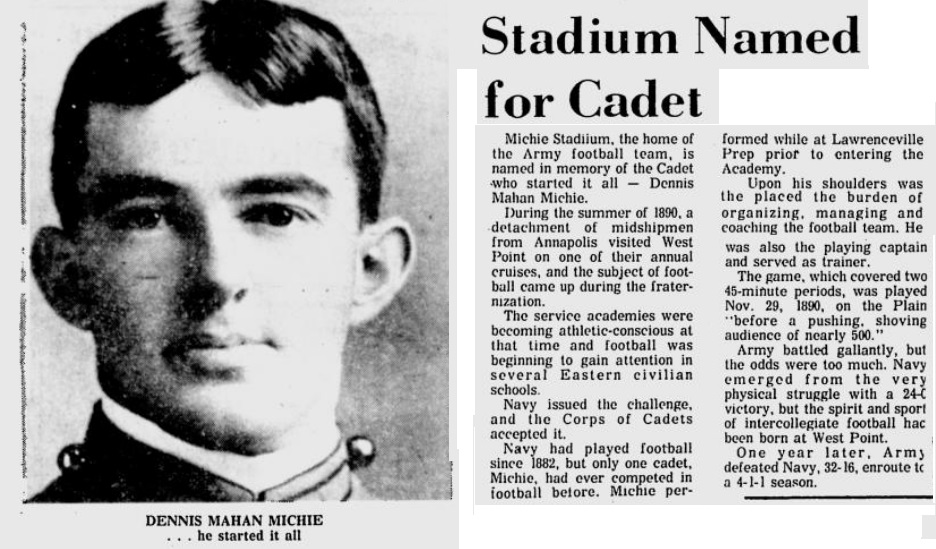
Named after “Dennis Michie” Class of 1892 who brought Football to West Point


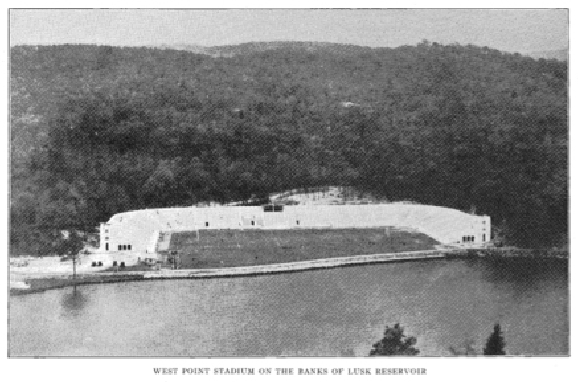
Sports Illustrated named Michie Stadium #3 in the world in its list of the top 20 sports venues of the century. “It’s a scene straight from The Long Gray Line, surpassed only by the view of the Hudson River from the west stands at Michie Stadium. The Corps of Cadets, seated together and dressed in gray and black, evokes memories of when Army was one of the most formidable of college football powers, and cannon blasts shake the 76-year-old edifice to its foundation every time the Black Knights score.”

Michie Stadium as it is today

For Years Cadets seating started at the 40 yard line behind the Army Team, (so a player coming off the field could look up into the eyes of the Corps of Cadets) however in recent year Cadets have been moved toward the NW corner. The new seating will place the Corps in the East Stands – no longer behind the Team.
–


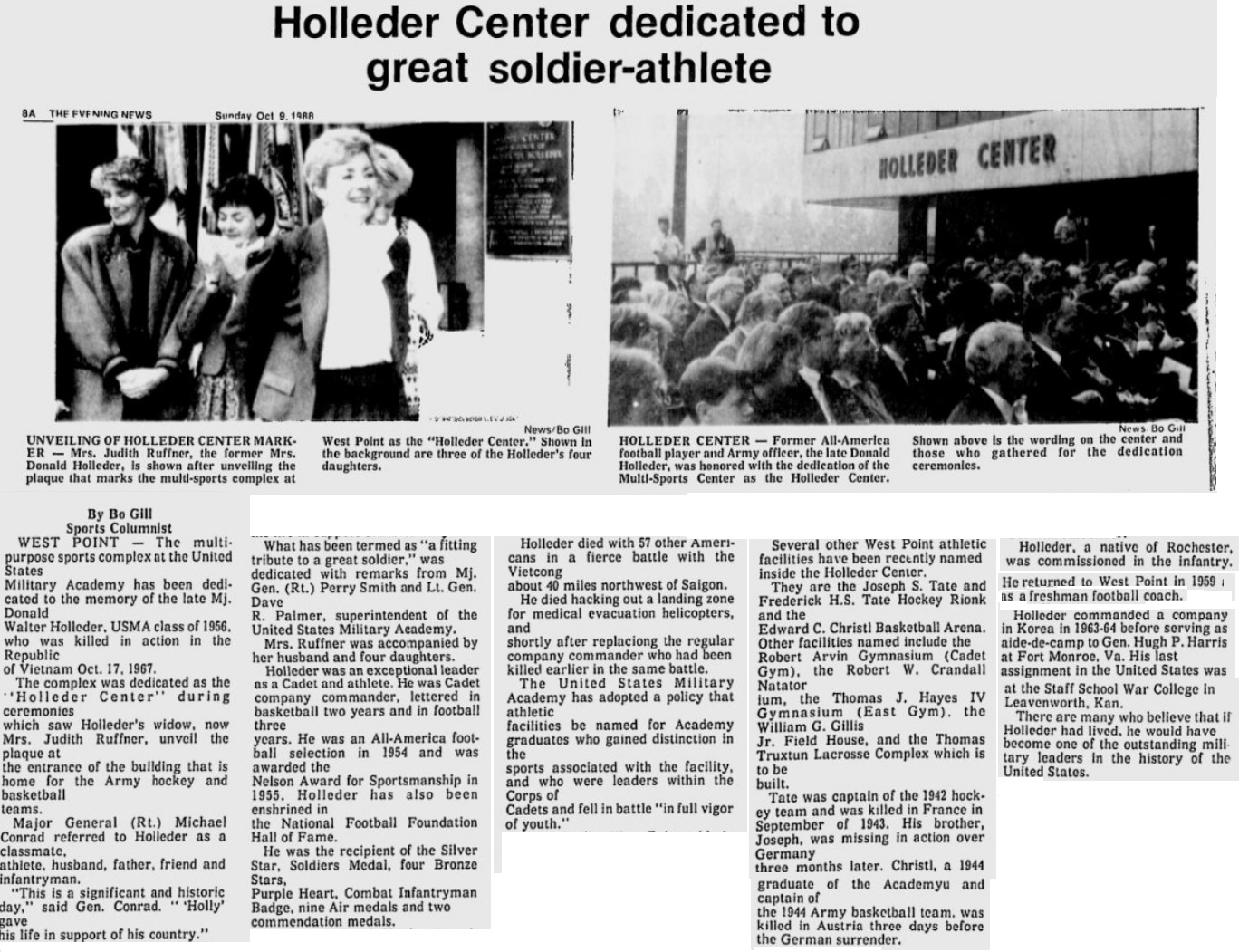
Holleder Center, home of West Point’s hockey and basketball programs, begins its 14th year as the venue for Army’s premiere winter sports teams. The 131,000-square-foot building, located adjacent to picturesque Michie Stadium, opened on Oct. 1, 1985, after a 30-month construction period. The $16-million building houses “Tate Rink”, the home of the Army ice hockey team, “Christl Arena”, the venue for the men’s and women’s basketball squads.
Holleder Center was named in honor of Maj. Donald W. Holleder ’56, who was killed in action in Vietnam in 1967. While at West Point, Don Holleder excelled both in basketball and football. He earned All-America honors in the latter, and has been enshrined in the NCAA Hall of Fame.

Tate Rink seats 2,746 and continues to attract fans in record numbers while providing the Cadets with a comfortable home-ice advantage. Since their debut in Tate Rink, a 5-0 win over Ryerson Tech on Oct. 25, 1985, the Cadets have enjoyed much success in their new home. In each of the past nine seasons, the Cadets have drawn paid attendance of more than 35,000 patrons per year.
In 1996-97, the Cadets set a third consecutive attendance mark, attracting 42,929 fans to surpass the previous mark of 42,565 established in 1995-96. Ten times in 1997-98, the Cadets played before a home crowd of more than 2,000 ardent supporters, with five of those crowds surpassing 2,500 fans. The all-time single-game attendance mark for Tate Rink is 3,147, established in 1988-89 when Army edged Rensselaer 4-3.
Seating in the rink is comprised of chairback seats, fixed bench bleachers, standing room areas and handicapped-access platforms. All seating is close to the ice, giving the rink a cozy feel that continues to make Tate Rink one of the most popular rinks on the East Coast.
The Edward C. Christl Jr. Arena seats 5,043 and was named for 1st Lt. “Edward C. Christl” Jr. (USMA ’44), who was killed in Austria in 1945. Elected basketball team captain during his senior year, Christl led the Cadets to a perfect 15-0 record.
Christl Arena possesses a Horner hardwood basketball floor, which was refurbished in 1999 and measures 149×116 feet. The arena also contains six Hydra-Rib basketball supports, fixed chair and bench seating for spectators and a four-sided overhead scoreboard at midcourt, easily visible at any angle.
Christl Arena has been host to other sporting events such as international volleyball and gymnastics meets and exhibition basketball contests. It has also been the site of various intercollegiate and high school championship tournaments and has served as home to Army’s women’s basketball team the past six years.
——–


MILITARY CADETS VERSUS NAVAL CADETS.
ANNAPOLIS
November 20, 1891,
http://query.nytimes.com/mem/archive-free/pdf?res=F60A10FF385E10738DDDA90A94D9415B8185F0D3


Richard William Irwin
Nickname : Dick
Class : 1962
Company : L-1
Home Town: Lutherville, Maryland
High School : Milford Mill
Prior College Attendance : Georgia Tech, 1957-58
Date of Entry to Academy : July 1, 1958
Date of Graduation : June 6, 1962
Age at Graduation : 22
Cullum Number : 23912
Cadet Rank & Military Position
Rank : Lieutenant
Position : Platoon Leader
Height
Entry : 5’11”
Graduation : 5″11″
Weight
Entry : 178
Playing weight : 185
Graduation : 185
Teams :
o 1958: C Squad (Plebe) Soccer Team
o 1958-59: Off-season Lacrosse Team
o 1959: Off-season Soccer Team
o 1959: B Squad (JV) Soccer Team
o 1960: Off-season Soccer Team
o 1960: A Squad (Varsity) Soccer Team
o 1961: Off-season Soccer Team
o 1961: A Squad (Varsity) Soccer Team
Soccer Coaches
o Head Coach: “Joe Palone”
o Assistant: “Scotty Adams”
Team Captain :
o 1960 “Kaiser Bazan”
o 1961 Art Brown
Positions Played
o Plebe: Inside Left
o B-Squad: Left Halfback
o A-Squad: Center Halfback & Left Fullback
Award of Army A
o Plebe : 62 numerals
o Yearling: None
o Cow : Major A
o Firstie : Major A
As you can see from the lack of entries directly above, I was a “journeyman” soccer player (usually a starter) on teams that did not compete in any NCAA tournaments. In those days, soccer did not compete in any league, but we did play a lot of the best teams in the northeast and middle-Atlantic states.
Relationship with Tactical Department :
I managed to keep a “healthy distance” between myself and the tactical department for most of my Cadet years except for one month during plebe year when I was room orderly for two weeks during a single month. I went over in demerits and only my soccer team status saved me from walking the area. I recall that I had to serve one weekend of confinement.
The only other “brush” with the tactical department was several weeks before graduation. The Board of Visitors, headed by General of the Army Omar Bradley, were at West Point for their annual visit. On Friday afternoon (two days after we firsties had taken delivery on our new cars) we marched in a Brigade Review for the Board. I was platoon leader of 2nd platoon, L-1, for the parade.
As we passed in review, all went well until “ready front” after passing the reviewing party. Disaster occurred as I brought my saber back up and snapped my head back around. My saber slipped out of my grip and went twirling up in the air out in front of the platoon and fortunately landed pointy end in the turf, and my “tarbucket” (Editor’s note – hat with plume of feathers for Officer Cadets) spun off my head and fell to the ground. I managed to kick the hat out in front of me, removed my saber from its temporary roost in the grass as I marched by, and finally scooped-up my tarbucket which was lying in our direction of march.(Editor’s note – Tarbuckets, especially ones with feathers are deliberately kicked along the field of march by succeeding ranks of Cadets. Tarbuckets with feather are expensive)
As soon as we broke ranks in South Area, I raced up to my room, changed into civilian clothes and ran all the way down to the parking lot across from the Thayer Hotel where my new TR-4 was parked. I was determined not to miss out on a planned weekend leave trip down to Maryland to visit my soon-to-be fiance’, Sharon Lenz. Somehow, although my ineptness had been seen by all, I did not suffer any tangible consequences. ((Editor’s note – If he had not cleared the area, he would have as a minumin been required to report to his Tactical Officier – so the urgency of getting in the car and off Post)
However, the following weekend, when General of the Army Douglas MacArthur received the Thayer Award, I did have a “one-sided” conversation with the Tactical Department. As we were forming up for parade, Major “Dutch” Shultz, our L-1 Tac officer came over to me. After we saluted, he said only the following few words: “Mr. Irwin, you owe me one!” I said: “Yes sir.”
Recreation
Clubs:
o KDET
o Rocket Society
o Yearbook
o Skeet
Intramurals :
o Handball
o Squash
Class Standing : 97 out of 602
Officer Assignment to the Academy
Department : Earth, Space & Graphic Sciences, 1969-72
Coaching Duties
o Head coach, B-Squad Soccer, 1970
o Assistant coach (for Joe Palone), A-Squad Soccer, 1971
http://forwhattheygaveonsaturdayafternoon.com/wp-teams/150-lightweight-football
Draft Reunion Page

Celebrate 50 years of Army 150s/Lightweight/Sprint football.
Let former players meet and mentor current players
Let former player reminisce
Raise money and awareness for the program
BG(R) James L. Kays, LTG Franklin L. “Buster” Hagenbeck
LTC Mike Kwinn (chair), Mr. Gene McIntyre (ODIA), Mr. Doug Fillis (A-Club), LTC(R) Vince McDermott (DAA), MAJ Matt Cuviello, MAJ Will Freds, LTC Dan McCarthy, CPT Jay Shell, COL Doug Boone, COL Tom DiBeradino, COL Tom Kastner.
MAJ Mark West (Head Coach), MAJ James Chastain (Acting Head Coach)
22 Oct 08 Arrive
23 Oct 08
Potential golf outing
Practice at Shea
Mentors meet players after practice
Barbeque gathering (with players until 1930, without players
thereafter)
24 Oct5 08
Reunion tours (gym, Kimsey, Library)
Supe Presentation
Memorial Service
Pre-game tailgate in Kimsey (Silent auction)
Sprint football beats Cornell
25 Oct 08
Parade (reserved seating)
Army Fatboys beat La Tech
Pre- or post-game (likely) tailgate at 49er Lodge (depending on
game time)
Introduction of 150s at Fatboy game
They were badly mauled in the first half. Just prior to the start of the 2d half they were told. Steve will quarterback. You will have to figure out how you are going to protect him since he will play with his separated shoulder in a sling. On the first offensive play he took the snap and went untouched for the score. The rout was on.
Leading 14 to zero it was 4th Down, on their own 38. The play had been sent in. They were operating out of the Texas Wishbone and he saw that the middle was clogged with defenders. He checked off to a slant pass to his wide open split end. Ten men momentarily stiffened, for if the play failed, each knew they would all be in for punishing comments. Number 51 snapped the ball, as he raised up to pass Coach Tipton nearly swallowed his cigar; but then was to never say a word as Donnie took the pass for 61 yards to the 1 yard line. The Army defense led by numbers 83 & 67 dominated the field. Number 40 piled up yards resulting in a 41 to 0 score. Glynn Mallory a 150 player, Class of 61 enjoyed the humor when Mrs. Tipton ordered Crab Cakes that evening in Annapolis.
He took himself out of the game. The trainer wrapped his arm. He went back in making tackle after tackle with his broken arm.
Coach Tipton wanted to cut him because he could not make weight over four years. His Plebe Coach said no; that player would never let the 150’s down. For 3 years, he was the starting fullback. In his last game against Navy at Annapolis, his former Plebe Coach watched him run out onto the field in front of thousands of screaming Navy fans. He consistently slashed through the front 7 and into the Navy secondary that afternoon. There was no more screaming.
As Plebes each Team played both the Goats and Engineers to a standstill. Although they did not score the points, it was the line standing calf to calf, ankle to ankle out weighted 50 to 75 pounds that won the games. Their coach called them a line of tight butts. As Upper Classmen, members of these two teams contributed to the domination of the league over the next four years, losing only one, but never to Navy.


At West Point, a Cadet is far more than a mere face in the crowd. Small classes– usually 12 to 18 cadets — assure individual participation and individual attention. Cadets are expected to participate daily and are evaluated frequently. If unsure of the material taught on any given day, or if one desires to move beyond the material, extra one-on-one instruction is available. The present curriculum reflects more than 195 years of evolutionary change both in the military profession and in higher education. Today’s balanced offering of courses in the arts and sciences leads to a Bachelor of Science degree and builds a foundation for continuing education and professional development. Approximately 80% of West Point graduates who remain in the Army beyond their initial commitment do attend graduate school, usually funded by the Army.
Behavioral Sciences & Leadership
http://www.dean.usma.edu/departments/bsl/default.htm
Chemistry and Life Science
http://www.dean.usma.edu/departments/chem/default.htm
Civil & Mechanical Engineering
http://www.dean.usma.edu/departments/cme/
Electrical Engineering & Computer Science
http://www.eecs.usma.edu/outreach/
English
http://www.dean.usma.edu/departments/english/
Foreign Languages
http://www.dean.usma.edu/departments/dfl/
Geography & Environmental Engineering
http://www.dean.usma.edu/departments/geo/gene.htm
Department of History
http://www.dean.usma.edu/departments/history/web03/links/index.htm
Law
http://www.dean.usma.edu/departments/law/
Mathematical Sciences
Physics
http://www.dean.usma.edu/departments/physics/physics.htm
Social Sciences
http://www.dean.usma.edu/departments/sosh/
Systems Engineering
http://portal.dean.usma.edu/departments/se/default.aspx
Military Instruction
Physical Education
Combating Terrorism Center
Civil Engineering Research
Economic & Manpower Analysis
Enhanced Performance
Environmental & Geographical Sciences
Information Technology Operations
Leadership & Organizations Research
Mathematical Sciences
Mechanical Engineering Research
Molecular Sciences
Operations Research (ORCEN)
Photonics Research
Teaching Excellence
Technology-Enhanced Language Learning
Information and Educational Technology Division (IETD)
USMA Library
USMA Digital Collections

Nestled among several of the U.S. Military Academy’s showcase athletic facilities, sparkling Kimsey Athletic Center serves as the new home to Army’s storied football program. The massive 120,000-square-foot, four-story facility houses Army’s state-of-art strength development and athletic training centers, spacious locker rooms, coaches’ offices, meeting rooms, equipment room, media room and multi-purpose rooms, among others. Kimsey Athletic Center will also serve as the home to the Earl Blaik Gallery and Doug Kenna Hall of Army Sports, a thorough depiction of West Point’s rich athletics heritage.


To educate, train, and inspire the Corps of Cadets so that each graduate is a commissioned leader of character committed to the values of Duty, Honor, Country and prepared for a career of professional excellence and service to the Nation as an officer in the United States Army.”

The best source of information on the Academic Board’s selection
of the USMA motto in 1898 is found in the U.S. Military Academy Staff
Records which are available in the USMA Archives. There is very little information on the reason for the selection of the motto and no
discussion of why a committee was originally established in 1896 to
consider the subject of a so called “Device for the Military Academy.”
At an Academic Board Meeting of 31 January 1898 the committee
appointed to consider the subject of a “Device for the Military Academy” submitted a report dated 14 January 1898. After amendment, the report was ultimately adopted. This committee, which selected both the Academy’s crest and motto, stated that: “The selection of a
satisfactory motto includes some of the foregoing, such as significance, propriety, intelligibility, and suitability, as well as dignity, conciseness, and to a certain extent sonorousness and tradition.”
Although some discussion of the reason for the selection of the crest is included, the following is the only mention in the Staff Records of the reasoning behind the selection of the words for the motto:
“After much thought and inviting the opinion of many others, the
Committee is satisfied that the sentiment expressed by the words:
‘Duty, Honor, Country’ more clearly and concisely express the genius of the institution than that embodied in any other motto or quotation which has suggested itself or has been suggested by others. It has met the approval of those to whom it has been submitted.”
Charles W. Larned, Professor of Drawing, Chairman
E.W. Bass, Professor of Mathematics
S.E. Tillman, Professor of Chemistry
At the following meeting of the Board on 4 February 1898 it was decided, by a vote of 5 3 with three members absent, that the words for the motto should be arranged as “Duty, Honor, Country.” The amended report of the committee was then formally adopted.
At the 31 August 1898 meeting of the Academic Board it was resolved:
“that the Academic Board recommend to the Honorable Secretary of War
that the design for a Seal and Arms and the Motto submitted and
recommended by the Committee of the Academic Board appointed for its
consideration and preparation, be adopted as the Seal, Arms, and Motto
of the U.S. Military Academy.”
That approval was evidently forthcoming because at the 15 December 1898 meeting of the Board the following resolution was adopted:
“Resolved that the sum of one dollar and five cents ($1.05) be allotted from the Contingent Fund of the Military Academy appropriations for the current fiscal year, to be expended under the direction of the Academic Board for the payment of the fee for copyrighting the Arms, Motto, and Seal of the Military Academy, and Descriptive Text of same.”
Office of USMA Historian 25 February 1980
Dr. Stephen Grove — USMA Historian, Office of Policy, Planning and Assessment


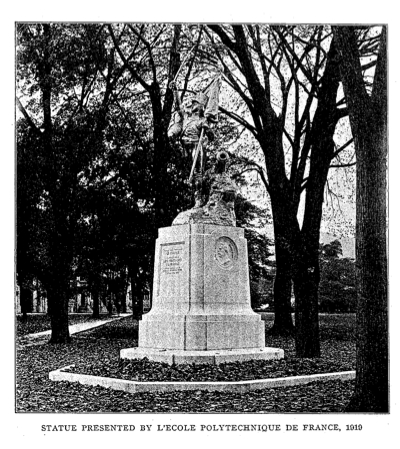
Located in Central Area, the monument was presented to the Academy in 1919 by the Cadets of the French School. It is a replica of a statue standing on the grounds of that school and is tribute to the French Cadets who took part in the defense of France in 1814. Originally Gold Plated.
In The early 40’s the Middies from the Naval Academy sneaked onto West Point and painted the Statue prior to an Army Navy Game. When the Academy removed the paint, the Gold Plating was worn off and was never replaced.
Cadet Lore further states that whenever the cannon fired, (reason for firing known only to Cadets) the French Cadet would come to attention salute and the Flag would wave back & forth.
It should be noted the cannon balls are too large for the cannon, the Cadet’s scabbard is straight while the saber is curved, the wind is blowing the tails of the Cadet’s uniform backward while it is blowing the Flag forward and his coat is unbuttoned.
The Statue now stands inside Central Area next to the original 1st Division, an area restricted to only Cadets. It once stood outside just to the North of the Old Central Area, on the South edge of the Plain right across the street from the North Sally Port.
Why the Statue was removed from public access can only be speculated
That cannon fire was damaging Cadet Barracks
Or
Academy Officials decided to end a piece of Cadet Lore by removing the Statue from public access.
Additional information about the Statue is restricted Cadet knowledge. If any Cadet would like more information relating to Cadet Lore associated with cannon fire, they should contact Roy Thorsen or Stan Harvill Class of 1955.

L’Ecole Polytechnique Monument as it stands today — The public protected from it


The French Monument
(AOG Gray Matter)
Previously it had graced old Diagonal Walk, before the near doubling of the size of the Corps of Cadets in the mid-sixties forced the movement onto The Plain of that esteemed walk. It now stands next to the 1st Division of Old Central Barracks, the only portion of that ancient structure to survive the expansion of Washington Hall and the addition of the MacArthur and Eisenhower wings of barracks necessitated by the larger Corps. It officially is known as The French Monument, but in an earlier day it was nicknamed “The Gold Tooth” because it was coated in gold leaf. Unfortunately, it was not immune to a midshipman’s prank that doused the statue in Navy blue paint prior to an Army-Navy football game many years ago. It, like the original in France, now boasts a blue-green patina. (Note since this publication the Statue has been painted)
Many older graduates recall, as plebes, being required to cite the mistakes attributed to the sculptor of the statue: the cadet’s saber is curved but his scabbard is straight; the wind is blowing his coat tails in one direction and the flag in another; the cannon balls at the base are larger in diameter than the bore of the cannon behind the cadet; and, horror of horrors, the brave cadet has a button unbuttoned! And in combat, no less. And thereby hangs a tale.
For the original statue of the staunch little French cadet, proudly holding his colors and bravely brandishing his saber, was created by Corneille Theunissen and dedicated in July 1914 to mark the centennial and commemorate the courage of the cadets of L’Ecole Polytechnique in France when they were mobilized to help defend Paris in 1814. The motto upon the statue reads, “Pour la Patrie, les sciences et la glorie” In the end, Paris fell, and Napoleon was forced to abdicate. Nevertheless, the 1814 statue stands proudly on the Court of Honor at L’Ecole Polytechnique. The cadets, however, again would play a role in the Revolution of July 1830 that deposed Charles X.
In December 1830, no less a personage than the aged Marquis de Lafayette visited L’Ecole Polytechnique to present a letter of fraternal congratulations from the West Point cadets to the Twenty-ninth of July cadets “our brothers in arms and our co-partners in the defence of that sacred Liberty”. The French cadets sent an equally cordial and respectful reply. Sometime in 1918, the discovery of these letters in the papers of Marshall Bosquet, one of the French cadets who signed the 1830 letter, led to two independent actions.
In May of 1918, the cadets of L’Ecole Polytechnique sent a letter of gratitude confirming the ties between France and the United States in the Great War. They also had a miniature of the 1814 statue created for presentation to the cadets of West Point. The Corps sent a warm letter back, citing the historic links between the two countries. Both letters were published in the Howitzer, along with a photograph of the statuette. The West Point cadets who answered the letter on behalf of the Corps, however, soon graduated a year early in June 1918 and were preparing to assist France in battle. The next two classes were combined into a mega class and graduated soon afterwards, on 1 November 1918 – just ten days before the Armistice. After a tour of the European battlefields, the younger class was recalled to West Point for additional academic training, graduating again on 11 June 1919.
Also in 1918, Les Amis de l’Ecole Polytechnique (equivalent to our Association of Graduates) determined that they would raise funds to present a full-size casting of the statue to West Point. On 21 October 1919, after Douglas MacArthur had arrived as Superintendent (12 June 1919), France sent a military mission to help dedicate the statue at West Point. Among the delegation was Marshal Foch. The base is said to be of stone from Verdun, with relics from the Marne battlefield inside. When the Washington Hall mural was painted in the thirties, represented in the lower right corner is Joffre at the Marne. An earlier proposal depicted Foch at the Marne.
The Class of 1920 that presided over the dedication of the statue had not yet reported to West Point when the letter of May 1918 and the miniature statue had been received. The installation of the full-sized statue evidently was considered a minor event in the great sweep of things and received only a mention, sans photo, in their 1920 Howitzer. No specific date, no mention of dignitaries in attendance – although much was made of the autumnal visits by King Albert and Crown Prince Leopold of Belgium and the Prince of Wales. Of course, these personages were able to grant amnesty to the Corps, and the statue was not. While King Albert was the first reigning monarch to have visited West Point, the Prince of Wales took the added step of joining the Corps of Cadets for dinner in the mess hall. After delivering a short address, he was honored with a Long Corps Yell.
Looking deeper into the 1920 Howitzer, however, one finds another mention of the statue in the History of the Class of 1922. It is a facetious reference to upper classmen “crawling” the French cadet for not wearing a B-plate until a plebe informs them that the statue represents a “French soldier, Revolution of 1830, sir.” Of course, the plebe is wrong, but there is a reason (not an excuse) for his confusion. It was the letters regarding the Revolution of 1830 that prompted two separate groups to provide statues commemorating the 1814 defense of Paris to West Point. Fortunately, this 1922 class history does include a photograph of the installed statue, beneath a tree and facing the barracks, with The Plain, the flagpole, and Battle Monument in the background.


Joe Steffy comments about Col Earl Blaik‘s greatest thrill in Army Football.
COL Blaik said there were two: One was the 93 yard touchdown by Rip Rowan in the Army Navy Game.
The other was a touchdown run to win the game against Navy in 1955. RB Pete Lash ran for 30-40 yards to paydirt during which every Navy player had a shot at him, but he run through them all. Joe said that Lash was a walk-on. Small and played high school FB; Joe said he really did not have the attributes of a great player. BUT, he was tenacious and worked harder than anyone on the team. He succeeded in making the starting team his senior year. Went on to become a three star general.

Cadet will not Lie, Cheat, Steal, or Tolerate Those Who Do

USMA at West Point

We have changed the wording of our Alma Mater to reflect the fact that our Women Graduates have also given their lives serving this Nation.
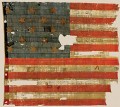
Our Flag in 1812

----- Class of 2012 Motto ------
"For More Than Ourselves"
Thank you Class of 2012 for the Honor of Marching with you The Class of 62 - Can Do

Remember - The Soldiers you will lead Always Come First

Motto -- Duty Honor Country

The Cadets of West Point

They played perhaps Army's Greatest Game. They were the Team that Gave The Most

Washington's Letter recommending the establishment of the Academy and the History of West Point

The Oaths We Take

West Point's Medal of Honor Recipients

Jefferson Hall - the Academy's new Library.

Douglas MacArthur

Vinegar Joe Stilwell cleaning his Thompson -The Walkout -Burma 1942

George Patton

The Monuments of West Point

Kosciuszko Monument - Guarding the Hudson ensuring there is no passage of British Man of War

Forts of the Hudson

So we'll sing our reminiscences of Benny Havens, Oh!

Academic Excellence

Colonel Thayer

West Point

Trophy Point

"L'Ecole Polytechnique Monument", or The French Monument by Cadets

Superintendent's Quarters viewed from Thayer Road

Superintendant was not Happy Black '57

Home of the Dean

Quarters 104

Cadet Chapel

Michie Stadium

Arvin Gym

Kimsey Athletic Center

Holleder Center

Washington Monument

United States Military Academy Band

Cadet Barracks

Rugby Complex

Great Chain

Plain looking toward Washington Hall

Battle Monument

Washington Hall with Cadet Chapel on rocks above

Hudson River

Captured Trophies

Battle Monument

West Point Cemetery

Plain

Cost to this Nation of Differing Views

Trophy Point -- Our Flag

Corps of Cadets Formed in Companies early 1960s

Sending the Army Team off to Beat Navy

Army Mule

Color Guard

Band Box Review Early 1950's in Central Area

Battalion Mass Early 50's

Flirtation Walk

Class of 2008 Class Crest & Motto "No Mission Too Great" Their Commencement "Here am I; Send me."
Thank you Class of 2008 and Please Thank the Men & Women --- the Soldiers you will lead --- The Class of 62.
Duty Honor Country
The '54 Crest

28th Infantry Regiment Black Lion Award is intended to go to the person on his team "who best exemplifies the character of Don Holleder: leadership, courage, devotion to duty, self-sacrifice, and - above all -
an unselfish concern for the team ahead of himself."
"The Army moves as a team, eats as a team, and fights as a team."

The '55 Crest

Don Holleder Remember - The Soldiers you will lead Always Come First

Vann and Holleder

9 Army A's

The '56 Crest

The '57 Crest

Can Do

Gen Van Fleet addressing the Corps prior to the Navy Game

Constructed under supervision of Jay Gould "54 and the Ord Dept from a German Rocket Gun captured at Kasserine Pass. First used in the Duke Game.

COL "Red" Reeder granted the Cheerleaders Corps Squad status to obtain financial support for their spirit-inducing initiatives.

Bob Mischak - - It should be pointed out that Bob was an All American selection, but is not recognized by the Academy as such because of the organization which selected him.

Ubel scores 3 Times against Navy - Vann's facking results in Peter getting tackled - #10 on the ground behind Ubel

Vann to Sisson

Army's B Squad

Vann to Mischak.

Uebel Intercepts

Cody to Don Holleder

Lasley

Frank Hicks

Burd

Bill Purdue

Cody

Meador Mgr

Ron Melnick

Ralph Chesnauskas

Pat Uebel

Tommy Bell

Sisson headed for another score

Peter Vann stuffs the ball in Jerry's gut

Leroy Lunn & Jerry Lodge

Uebel after taking the handoff from Hagan

Attaya - Army's Fullback

Sisson - one of 3 Great Ends
Bob Mischak

Ralph Chesnauskas

Bob Farris

Vann moving out of the pocket

Peter Vann 10, Billy Chance 38, Herdman 68

Ken Kramer

Joe Lapchick

Kirk Cockrell

Lodge going down tosses to Paul Schweikert for score.

Dick Zeigler

Bob FarrisPlayed the 2d half of the Navy Game blind in one eye.
Pat Uebel
Tommy Bell

Peter Vann

Freddie Attaya

Mike Zeigler

Jerry Lodge wearing #67, playing fullback.

Johnny Wing

Lowell Sisson

Norm Stephen

Jack Krause

Dick Ziegler

Jerry Lodge

Leroy Lunn

Norm Stephen

Jerry Lodge

Corps of Cadets for Navy Game
Can Do
"The Army moves as a team, eats as a team, and fights as a team."
The '54 Crest
The '55 Crest
28th Infantry Regiment Black Lion Award is intended to go to the person on his team "who best exemplifies the character of Don Holleder: leadership, courage, devotion to duty, self-sacrifice, and - above all - an unselfish concern for the team ahead of himself."