http://www.goarmysports.com/pdf2/42042.pdf&ATCLID=530435&SPSID=48157&SPID=4610&DB_OEM_ID=11100
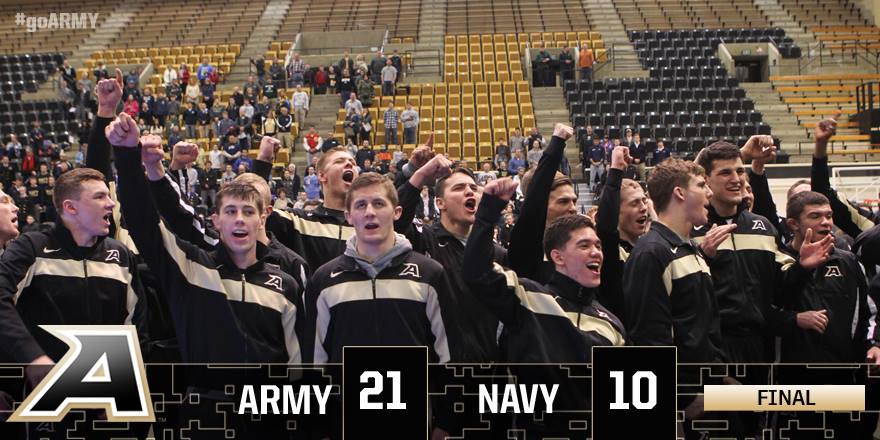
We took each of our 3 years of eligibility. Since 1962, after 45 years Army won again. This is the 2d Victory since our 3 year run.
http://www.goarmysports.com/pdf2/42042.pdf&ATCLID=530435&SPSID=48157&SPID=4610&DB_OEM_ID=11100
We took each of our 3 years of eligibility. Since 1962, after 45 years Army won again. This is the 2d Victory since our 3 year run.
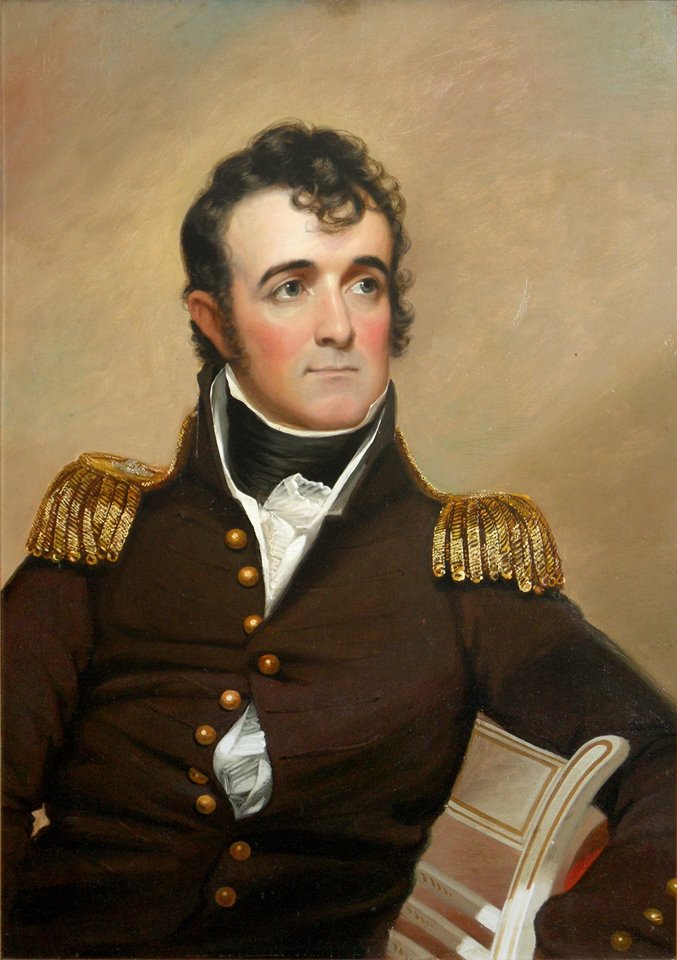
Joseph G Swift – 1802 – first Graduate of West Point – Superintendent 1812 – 1814


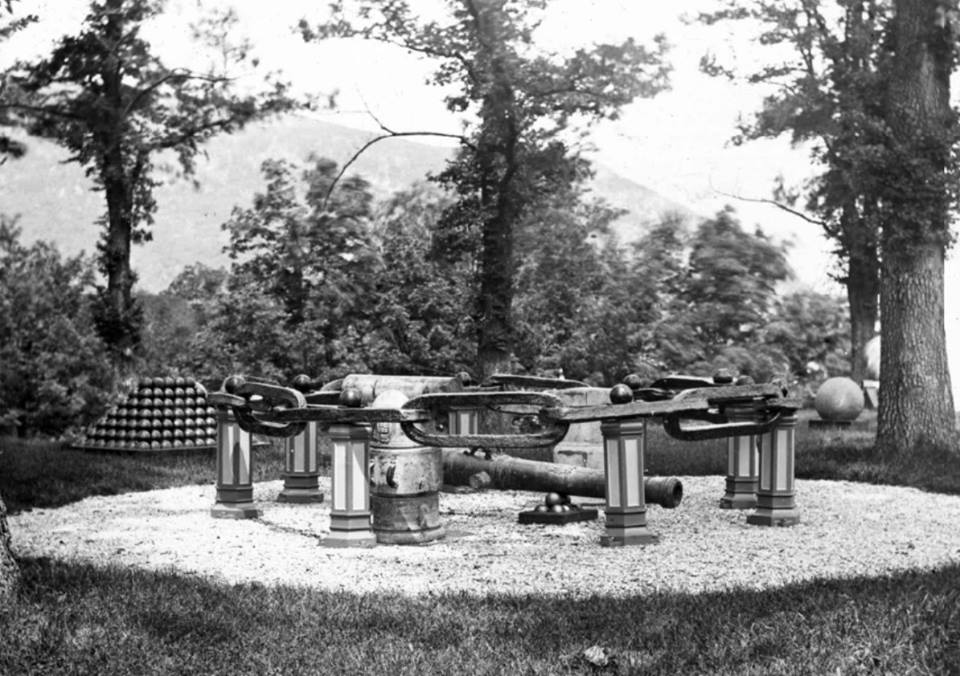
The Cannon Balls went toward either the 1st World War or Second World War

Captured Cannon can be see at — http://forwhattheygaveonsaturdayafternoon.com/wp-photos/large-cannon1
Links from the Great Chain are at — http://forwhattheygaveonsaturdayafternoon.com/wp-photos/large-chain
More information at — http://forwhattheygaveonsaturdayafternoon.com/wp-photos/large-bat-mon52
More information and Cadet Tradition at — to http://forwhattheygaveonsaturdayafternoon.com/wp-photos/large-sedgwick1


Army A’s in Football Cow & Firstie Years with 2 Navy Gold Stars

The purpose of the Cadet Honor Code is to foster a commitment to honorable living in cadets in preparation for their service as leaders of character for the Army. It is a baseline standard of behavior to which all cadets are expected to adhere. But, as part of their moral-ethical development at USMA, cadets are expected to go beyond this baseline and develop an understanding of the “spirit of the Code.”
After ingraining the prohibitions of the Code in cadets, the Honor education program focuses on inculcating this related principle. Instead of teaching cadets just not to lie (a prohibition), the spirit of the Code emphasizes being truthful in all matters. The same goes for fairness (cheating), respect for others and their property (stealing), and professional responsibility (toleration). Cadets who live and abide by the spirit of the Code will never have to worry about violating the prohibitions of the Code.
The spirit of the Code is embodied in the positive principle behind each of the Code’s four prohibitions. As an affirmation of the way of life that marks true leaders of character, the spirit of the Code goes beyond the mere external adherence to rules. Cadets who live only by the Honor Code do not lie, cheat, steal, or tolerate. Cadets who live by the spirit of the Code will be truthful, fair, respectful, and professionally responsible.
Honor has always been and will continue to be the foundation of cadet development at West Point. USMA’s Honor Code originated from a gentleman’s Code of Honor prevalent in the early officer corps. This “Code of Honor” was a broad concept, and in the Academy’s application it meant that a cadet was fundamentally honest and was to be accepted at his word. Not everyone agreed about what constituted a violation of the early Code, and until the mid-1920s, no attempts were made to place the Code into written form. Sylvanus Thayer stressed the importance of honor as an essential component of the character development of an officer and gentleman. Over time, the West Point community recognized that honor was the essential component of an environment in which discipline and education could develop the leaders of character for the Army and nation. The four tenets of the Honor Code originated at different times and were codified separately.
LYING. Lying is the only one of the four tenets that has been a part of the Honor Code from West Point’s founding through today. Initially, the Honor Code was confined to rules against lying and requirements for integrity in the written and spoken word.
CHEATING. The first attempt to expand the early Code beyond lying occurred when Sylvanus Thayer was Superintendent of the Academy. He considered cheating to be a violation of the Honor Code and announced that violators would be expelled. Expulsion for cheating faded out in the late 1800s. The USMA Adjutant in 1905 stated that if a cadet were caught cheating, his punishment would be severe, but would not necessarily warrant dismissal. He further stated that the Honor System at the time addressed only the standard that the word of a cadet is never questioned. However, two years later, in 1907, the Superintendent issued a written directive that placed cheating under the Honor Code, changing the Code to formally proscribe cheating. Acceptance and implementation, however, was not immediate. It was not until 1926 that the Academic Board responded with the particulars of how honor would apply in the classroom. But that same year the Superintendent stated in writing that initial honor violations in the classroom would be ignored; in effect, he granted cadets an automatic second chance. When the General Committee of the Academic Board requested clarification, the resulting policy established that if the first violation were flagrant, no second chance would be given. These rulings caused dissent and confusion, and as a result some instructors continued to give an automatic second chance at their own discretion for the next several years.
(The statement that cheating became part of the unwritten honor code in 1907 is incorrect. The correct date is 1905. The Superintendent acted soon after he learned of the adjutant’s response.)
STEALING. For many years, the Academy considered stealing a matter for the Uniform Code of Military Justice (UCMJ) or Army regulations. Stealing, the third tenet of the present Honor Code, was not included in the early Code but was rather a matter of regulations. Offenders were court-martialed; if found guilty, they were separated from the Academy as a minimum. Stealing did become a part of the Honor Code in the mid-1920s, though serious violators were then (as they are now) referred to court martial. With the addition of stealing as an honor violation, the Honor Code became “A cadet does not lie, cheat, or steal” and remained so until 1970.
TOLERATING. It was not until after the Civil War that a sense of non-toleration of violations of the Code became common. The first formal institutional statements on that issue occurred during Douglas MacArthur‘s superintendency. Prior to MacArthur’s formation of an Honor Committee and formalization of the Honor System in 1922, honor enforcement was conducted primarily through cadet Vigilance Committees that took matters into their own hands.
Throughout the 20th Century, West Point required non-toleration, though the policy was not officially promulgated until quite recently. While not formally declared initially, cadets were certainly aware that toleration was proscribed.
During the 1951 cheating incident, numerous cadets who had not cheated themselves but merely knew of occasions when other cadets had done so chose to resign in lieu of separation. —
(The White Paper is mistaken here, please read the small print below)
During the period, beginning in 1923, the year the Honor System was officially sanctioned, on through the 1951 incident, non-toleration was expressed differently than today. Annually, during those 28 years, “General Principals upon which the Honor Code was founded — ,” were restated in the Bugle Notes, the book of Plebe Knowledge given to each Cadet entering the Academy. Non-Toleration was expressed as “Every man is Honor Bound to report any breach of Honor which comes to his attention.”
By the late 50’s the phrase “nor tolerate those who do” had became an equal part of the Code and in 1970 the phrase was formally added. In 1998 The Cadet Honor Committee made the grammatical correction so that the Code became “A Cadet will not Lie, Cheat, Steal, or Tolerate those who do” thus insuring no misunderstanding as to the obligation of a Cadet to report violations..
References are at the end of this White Paper.
Note information relating to the 1976 Cheating Scandal is at
http://forwhattheygaveonsaturdayafternoon.com/wp-honor/1976-cheating
The informal non-toleration policy became more official as time went by. The 1958 Honor Guide for Officers stated that each cadet is responsible for assuring compliance with the Honor Code and System and that if he does not do so, he too is violating the Honor Code. In 1970, the non-toleration clause, “nor tolerate those who do,” was formally added to the Honor Code.
Throughout the history of the Honor Code and system, the concept of non-toleration has been the most problematic and the most difficult of the four tenets for cadets to internalize. Today, cadets continue to find non-toleration to be an uncomfortable issue–some have trouble with the critical notion that members of a profession must choose loyalty to the profession over loyalty to friends. Currently, cadet honor education emphasizes the concept that the non-toleration clause is a vehicle for cadets to develop the personal responsibility and obligation to enforce the ethical standards of character, conduct, and competence within the profession of arms. Reporting a suspected violation is necessary to maintain the collective integrity of the Corps and the Army, not a personal act directed at an individual.
Exceptional provisions like the Non-toleration Clause, which hold the cadet to standards of behavior above and beyond societal norms, provide concrete and constant, if not always gentle, reminders of the extraordinary nature of their moral duty to the people they have freely chosen to serve. . .The way to be is to do. And unless the cadet can do, and ultimately be, all that is required morally, he or she will not have attained the moral-ethical standards required of a professional officer in our Army.
A grammatical correction was made to the statement of the Honor Code in 1998. For several years, the grammatical imperfection in the previous version of the Cadet Honor Code (A cadet will not lie, cheat, or steal, nor tolerate those who do) had been a subject of discussion among the Cadet Honor Committee, the Corps of Cadets, and the Staff and Faculty. In the spring of 1998, the Executive Staff actively explored the possibility of correcting the grammar without changing the meaning of the Code. Two events helped spur this action: 1) the planning for a Class of 1957 memorial to the Cadet Honor Code, and 2) the creation of the Center for the Professional Military Ethic. The Cadet Honor Committee wanted a properly worded code before it was carved into the memorial and before CPME began its outreach initiatives to the Army and the nation. In August 1998, the Executive Staff presented a recommended correction to the entire Cadet Honor Committee for discussion within their individual companies. On 29 September 1998, after careful consideration, the full Cadet Honor Committee, in a nearly unanimous vote, changed the statement as it read at that time (“A cadet will not lie, cheat, or steal, nor tolerate those who do”) to the current statement: “A cadet will not lie, cheat, steal, or tolerate those who do.” This correction has not altered the meaning or the Spirit of the Honor Code. The grammatical correction adds clarity and strengthens the importance of non-toleration by making it co-equal to the other three tenets in the statement of the Code.
The old wording implied that non-toleration was an added, perhaps optional, element of the code. The current wording undercuts that belief by connecting non-toleration in a grammatically tighter way to the first three forbidden acts. More important, cadets initiated and completed the action.
Just as the statement, interpretation, and scope of the Honor Code have not remained static and unchanging, the procedures included in the Honor System to enforce the code have changed through the years.
During the early period, when the Honor Code was generally concerned with lying, the Honor System was an informal enforcement process conducted first on a cadet-to-cadet basis and later through a cadet Vigilance Committee. The Academy became involved only in serious cases that had some official interest or impact. Otherwise, it appears that a “guilty” cadet was usually confronted by the cadet chain of command and asked to leave the Academy.
In 1922 Superintendent Douglas MacArthur established the Cadet Honor Committee and formalized the Honor System. A two-tiered due process Honor System existed from 1926 until 1976. The first tier was a cadet hearing conducted by the Cadet Honor Committee when a violation was reported. In the second tier, a cadet found guilty by his peers could request a hearing before a board of officers or a court martial.
If found not guilty at this second tier, the cadet was returned to the Corps but faced the unofficial punishment of the “silence” (before 1973). Since the “silence” was such harsh punishment, almost all cadets found guilty by the Cadet Honor Committee elected to resign rather than have a hearing before a Board of Officers.
The “silence” ended in 1973 in the aftermath of a contentious honor case. The year before, the Corps voted on silencing a cadet who had been “found” as a result of a cheating incident but had been reinstated after an official review. Even though the results of the vote were decisive (80% in favor of silencing, 12% opposed, 8% not voting), the “silence” was not strictly observed. The ineffectiveness of the “silence” imposed in this case signaled the end of this practice. An important side effect of the end of the “silence” was the marked increase in the number of requests for a Board of Officers following “found” verdicts from honor boards. From September 1965 to June 1973, a total of 305 cadets were found guilty by the Cadet Honor Committee. Of those, only 15 elected to go before officer boards. During AY 1973-74, 10 of 25 cadets found guilty requested officer boards; during AY 1974-75, 14 of the 24 cadets found guilty at cadet boards requested officer boards. The end of the “silence,” in effect, made the option to select a Board of Officers a viable alternative to resignation.
Later, following a 1976 cheating scandal, the USMA administration and the Corps of Cadets adopted several reforms, proposed in a series of reviews and studies commissioned to look at the Honor Code and System. USMA modified various academic procedures, including the practice of giving the same examination to cadets at different times during the class cycle. The Academy also became sensitive to the temptation to rely upon the special constraints imposed on cadets by the Honor System to enforce relatively insignificant requirements. “Using the Honor System to enforce regulations” by relying on the requirement for cadets to always tell the exact and whole truth also undermined the purpose of the System.
With more and more cadets requesting officer boards, the cadet honor hearing had less impact and was becoming less and less a critical stage in the separation process. With 85% of the Cadets voting in favor of the proposed revisions, the Corps completely eliminated the two-tier system in 1977 in favor of a single “due Process” hearing at the cadet Full Honor Board level, now called the Full Honor Investigative Hearing (FHIH). From the Academy point of view, the two-tier system had become a procedural and administrative liability. It also had become a tremendous source of antagonism between the cadets and the Academy administration. Although there was one Honor Code, the two-tier system seemed to create different standards of enforcement, something that neither the Academy nor the Corps of Cadets could tolerate.
Another key change to the Honor System after 1976 was the reintroduction of the concept of an alternative to the “single sanction” associated with a “found” verdict. Allowing “second chances” has a long history at the Academy, but such “discretionary” practices had disappeared in the 1940’s. The 1976 reviews and studies linked the single sanction of separation to an extremely serious underlying issue: cadet unwillingness to support the non-toleration clause of the Honor Code. Each of these studies recommended that West Point consider sanctions other than separation based on the individual facts of each case. Perhaps the most famous of these studies was the Report of the Borman Commission which recommended that “sanctions other than dismissal should be authorized for violations of the Honor Code.” In response to these recommendations, the Superintendent in 1977 began to exercise his discretion in deciding whether the sanction of separation or some developmental alternative was appropriate in any given case. This practice became a formal part of the Honor SOP in that year.
Initially the Superintendent received little guidance on the exercise of discretion. In 1992, the Secretary of the Army provided specific guidance to the Superintendent directing him to evaluate all honor cases for possible discretion by applying the following criteria: intent, manner reported, resolve to live honorably, severity of the violation, and unusual duress at the time of the violation.
These changes to the Honor System adopted in 1976, modified and streamlined in 1979 and 1988, fundamentally shaped the Honor System that exists today. The current procedures serve the needs of both the Academy and cadets — and most importantly ensure that the basic purpose of the Honor Code is still fulfilled. In addition the current System is designed to fully protect the rights of our cadets as they are being interpreted in the law and by the courts. A healthy balance has been struck between the essential demands that we place on the Code as an instrument of character development and the need to ensure fairness, thoroughness, and efficiency of process.
Today, a 76-member Cadet Honor Committee fulfills two main functions – Honor Education of the Corps of Cadets and enforcement of the Cadet Honor Code. Current Committee composition includes an Executive Staff consisting of: Chairperson, Executive Officer, Secretary, Vice Chair for Investigations, Vice Chair for Education, Vice Chair for Liaisons, Vice Chair for Special Projects, Vice Chair for Mentorship, four Regimental Honor Representatives; and two company honor representatives, a Firstie (senior) and a Cow (junior), for each company.
The Cadet Honor Committee investigates allegations of violations of the Cadet Honor Code brought to its attention. The investigative process begins with a company team (CT) initial inquiry. Following the inquiry, an investigative team (IT) from another company within the regiment conducts a thorough investigation and makes a recommendation. The Regimental Honor Representative (RHR) reviews the inquiry and investigation and makes a recommendation to the Vice-Chair for Investigations (VCI). If the three (IT, RHR, VCI) are not in agreement about whether to forward the case to an Honor Investigative Hearing (HIH) or to drop the case, the Chairperson of the Cadet Honor Committee will make the final recommendation to the Commandant.
Once an investigation leaves the Cadet Honor Committee, the Special Assistant to the Commandant for Honor Matters (SAH) will review the case for completeness. After receiving legal advice on the case from the Chief of Special Actions in the office of the Staff Judge Advocate, the SAH takes the case to the Commandant. The Commandant reviews it and makes the decision to refer the case to an HIH, drop it, or send it back to the VCI for additional investigation. In practice, the Commandant normally accepts the recommendation of the Cadet Honor Committee.
If the decision is to refer the case, an HIH is scheduled. The Cadet Board President (a First Class Honor Representative) and a Hearing Officer (from the SJA) run the HIH. The nine voting members of the HIH Board are the Board president, three other honor representatives, and five members of the Corps at large. The purpose of the HIH is to determine whether a cadet violated the Cadet Honor Code. To “find” a cadet in violation of the Honor Code requires a vote of six of the nine members. The standard of proof is defined as “more likely than not” for each element of the allegation.
The Superintendent determines what sanctions to impose on all cadets found by an HIH Board to have committed an honor violation. The standard sanction for a violation of the Cadet Honor Code remains separation.
Prior to deciding the disposition of a “found” cadet, the Superintendent reviews the entire case file. This file includes recommendations from the HIH board members, the Chair of the Honor Committee, the cadet company commander, the tactical officer chain of command, the Special Assistant to the Commandant for Honor Matters (SAH), and the Commandant.
After receiving all of the recommendations and using the general criteria listed above, the Superintendent makes a decision on whether or not to grant discretion. He may grant discretion if he determines the violation does not represent that cadet’s overall character and it was an isolated mistake which the cadet can overcome with proper mentoring and guidance. If, however, the Superintendent determines the cadet has not fully accepted responsibility for his or her dishonorable act, cannot or will not live honorably in the future, or will not develop stronger character through the Mentorship program, then the Superintendent will not grant discretion and the cadet will be separated.
Cadets receiving discretion are generally either turned back an entire class year, or their graduation is delayed until the December after their normal graduation date. In some cases cadets are sent to the Army, where a commanding officer in a “line” unit mentors the cadet and makes a recommendation regarding readmission. In a few special cases, especially for cadets early in their development cycle, the found cadet may be allowed to remain on track for graduation with his or her class.
Though not always referred to as “discretion,” the notion of a “second chance” in select cases was not new to the Honor System when adopted in the 70’s. In the mid-nineteenth century, it was not uncommon to give a second chance to cadets who committed a violation of honor. In the 1920’s and 1930’s the second chance was not an espoused policy but still a possibility. The 1924 Chairman stated that cases of a minor nature were disposed of by disciplinary means. The 1930 Chairman said that while his committee would not offer a second chance, if an offense was a “small matter” the Honor Committee would not find the cadet guilty. The 1935 Chairman stated that a man with a record of truth and veracity would not be dismissed for a minor slip.
If discretion is exercised, the “found” cadet is placed in a suspended separation status and enrolled in a mandatory USMA Honor Mentorship Program. The USMA Honor Mentorship Program is the keystone for helping cadets given discretion to overcome their mistake and to learn and grow from it. This program is a six-month process completed through one-on-one mentoring from an officer or senior non-commissioned officer. Some of the requirements of this program may include such actions as: conduct a self-evaluation using West Point’s Leader Characteristics (these are based on the current Army Officer Evaluation Report and include the Army Values and Leader Attributes, Skills, and Actions); participate in at least seven counseling sessions with the mentor; maintain a journal; write their own case in the first person for others to review, analyze, and learn from; present honor instruction; prepare a developmental project; conduct a role model emulation; and write a summary essay of their experience in the program. In some cases, separated cadets enter an Army Mentorship Program. In this program, a cadet serves in the active duty army as an enlisted soldier under the mentorship of a field grade officer. Upon successful completion of the mentorship program, they may reapply for admission to the Academy.
To date, the Honor Mentorship program has been an overwhelming success. Those cadets successfully completing the program show greater understanding of their moral-ethical development and quite often assist other cadets in avoiding moral-ethical failures.
When General Douglas MacArthur institutionalized the Honor System and USMA formally adopted the Honor Code, USMA also recognized to the need to educate cadets about the System while strengthening their character. The responsibility for education fell to the cadet Honor Committee. The Honor Committee conducted both formal and informal classes until 1982 when West Point implemented the Honor Education Program. Today, as part of the Center for the Professional Military Ethic’s (CPME’s) 67 hours of Values Education Training over four years, the Honor Committee conducts 20 hours of Honor instruction over a cadet’s first three years. In addition to the honor classes, the training consists of classes on respect issues, the Army Values, and the Professional Military Ethic. During the first year, the lessons focus on USMA Rules and Policies for Honor and Respect and their application to the academic, athletic, and barracks environment. During the second year, the theme is our Army Ethics Doctrine. The third year’s lessons focus primarily on Army Values and Ethical Leadership. In the culminating fourth year, the Values Education Program centers on the Professional Military Ethic and its practical application. Company Values Education Teams, consisting of both cadets and members of the staff and faculty, conduct this instruction, which includes the following topics:
–Temptations to act dishonorably that lieutenants may experience in the Army, e.g., false reporting to meet standards, careerism, and deception by omission.
–Moral dilemmas as contrasted with self-interested behavior.
–The requirements of the nation’s moral values, treaties, and laws.
–The responsibilities of leaders in establishing an ethical climate in their units.
The formal four-year Values Education program is a significant improvement over similar previous Academy efforts. Of all the changes from times past that have led to the Honor System as we know it today, it is this enhancement in education and training that is having the most dramatic and positive effect. Values Education of the Corps of Cadets is a partnership effort of volunteer staff and faculty (officers, NCOs, and civilians) with the Cadet Honor and Respect Committees. The curriculum is professionally and progressively structured and designed to produce the leaders of character that our Army demands from West Point. The mandatory Values Education classes, which are the centerpiece of the moral-ethical education of today’s Corps, are a necessary step beyond and a far cry from the Academy’s earlier education efforts which often consisted of only a few formal classes for new cadets during “Beast Barracks” followed by informal cadet discussions in the “sinks” or hallways of the divisions during the academic year.
The Superintendent has several means at his disposal to review, assess or otherwise obtain feedback on the health and vitality of the honor code and system. They include:
The SHRC, consisting of cadets and members of the Staff and Faculty, meets monthly and publishes an annual report on various aspects of the Cadet Honor System. At the end of each academic year, the Superintendent mandates a charter to the SHRC from which the committee derives the tasks it will accomplish during the upcoming academic year.
The major finding in the most recent SHRC Report was that “The Honor System continues to play a prominent, productive role in the West Point Experience by providing the foundation for the process of character development.”
Corps Honor Survey. The Office of Plans, Policy, and Analysis (OPA) administers an Honor survey for the Corps of Cadets every two years in January. The survey gathers information about cadet attitudes and perceptions relating to the Honor Code and System. The statistical analysis of the Corps Honor survey provides the Superintendent with an assessment from the Corps on the state of the Honor Code and System.
In the most recent (1998) Corps Honor Survey, 92% of the Corps provided a positive response to the following two questions (with only 2 % providing a negative response):
I am confident I have the ability to apply the ethical principles of the Honor Code to situations I will encounter as a commissioned officer.
I will live by the spirit of the Honor Code once commissioned.
Commandant’s Sensing Sessions. The Special Assistant to the Commandant for the Respect Program coordinates sensing sessions between the Commandant and different cadet populations. During the academic year, between six to eight sensing sessions take place. The Commandant uses these sessions to receive input on cadet perceptions and attitudes on a wide variety of topics, to include the Honor Code and System.
Cadet feedback summarized in minutes from recent sessions completed this Academic Year includes the following:
“All agreed that honorable people do not lie, cheat, or steal.”
” — the Corps internalizes the Code and they are glad that it is in place.”
Battalion Commander’s Survey. The Office of the Dean coordinates an annual survey of recent Battalion Commanders at the Army War College. Ethical conduct and values of West Point graduates are two of the topics surveyed.
On those subjects the Survey reported: “West Pointers are thought to exemplify Army values, approaching their jobs and soldiers with integrity and respect. Moreover, they can reason through ethical dilemmas.”
Middle States Accreditation Assessment. The Academy receives its academic accreditation from the Middle States Association of Colleges and Schools. Every ten years, the Academy conducts an extensive self-study and hosts an accreditation team from Middle States that evaluates the Academy’s success in achieving its mission. The most recent MSA report, while not specifically reviewing the Honor Code and System, highlighted them as a key aspect of the USMA experience.
“The commitment to moral-ethical development engages all members of the West Point community. The establishment of the Center for the Professional Ethic, has great potential as a source of integrating and coordinating activities and initiatives in the areas of honor, respect, values based education and leadership development.”
First Class Survey. OPA conducts a survey of First Class cadets every spring to measure their perceptions of the four-year developmental experience at USMA.
The vast majority of the Class of 1999 who responded to the First Class survey indicated their moral and ethical development (i.e., sense of integrity, honor, service, respect for others, etc.) was important to them while at USMA.
The Honor Code will always be more than just the baseline standard of ethical conduct expected from all cadets while they are at USMA. As it always has in the past, it will continue to serve as an inspiration to cadets to go beyond simple proscriptions, and, once they graduate, to live an honorable life, abiding by the spirit of the Code, while serving as commissioned leaders of character in the United States Army. The Honor System will continue to maintain its two major purposes at West Point — educating the Corps on the concept of honorable service and investigating allegations against members of the Corps who may not have upheld the standards of the Code. The Cadet Honor Committee, with assistance from the Center for the Professional Military Ethic and the chain of command, will remain the primary administrators of the Honor System and the Corps’ vanguard for communicating and upholding the principles embodied in the spirit of the Code. All three — the Honor Code, System, and Committee — must be continually guarded and shaped by those who recognize the critical balance that must be struck between time-honored principles and the need to adapt certain procedural aspects to meet the demands of changing conditions.
And, while the Honor Code and System have undergone changes over the last two centuries, the mission of West Point to produce leaders of character to serve our Army and our nation, and to fight and win the nation’s wars will never change. The Code and System, so critical to leader development at the Academy, will be subject to constant review and vigilance to ensure its most important functions are fulfilled. There is no higher priority for the leadership of the Academy than to ensure the viability, relevance, and integrity of Honor at West Point.
References
Chapters 8 & 10 of “A Return to Glory” by Bill McWilliams —
http://www.aberjonapress.com/catalog/artg/
A two-part series article published Nov-Dec 2001 and Jan-Feb 2002 issues of the Assembly titled “The 1951 Honor Incident: Myths, Facts, and Lessons.”
A Sports Illustrated article in the 13 November 2000 issue seriously mishandled the truth. Some of the former Cadets interviewed for the Article provided information which did not correspond to their testimony before the Collins Board. (The 1951 Academy Investigative Board) In addition the article was completely lacking in fundamental knowledge or understanding of the code and system of that era.
The Academy has steadfastly refused to release the names of the cadets discharged. It was a long standing policy not to release the names of cadets discharged for honor violations. In 1951, when the absolutely unprecedented incident blew up in everyone’s face, the Academy stuck determinedly to that policy – for three primary reasons. The institution wanted the men involved to be able to start their lives anew somewhere else, and not be dogged publicly, or labeled as criminals. The Academy was also well aware that families and friends would also be besieged by media if the names were released. And last, it was simply the right thing to do. Although some of the discharged Cadets have come forward on their own. This was the policy and is the policy today — a principal established long before our current attitudes toward our “Rights to Privacy”.
In fact, the Academy was so determined not to release their names, the public affairs officer, when confronted by phone, by a muckraking journalist, who had obtained some volunteered names and called to say he was “going public” with them, then proceeded to demand the rest of the names be released, drew a sharp response from the Public Affairs Officer — the response was that the Academy would join with the parents of the discharged Cadets in court action against him if he released the names. Another group of associated (organized) journalists, threatened to sue the Academy to obtain release of the names. The Army and the Academy refused, and probably told them the same thing.
Soccer Yearling Cow & Firstie Year, Army A Cow & Firstie Year.
Awaiting data for input.
http://www.battleshipmovie.com/?__source=ggl|battleship|Brand|G_Battleship&sky=ggl|battleship|Brand|G_Battleship#
http://www.goarmysports.com/ViewArticle.dbml?DB_OEM_ID=11100&ATCLID=1370702
January 22, 2008
Lieutenant Colonel Greg Gadson Is Giants’ Inspirational Co-Captain
By Mike Lupica
As edited
He earned 4 Army A’s along with 3 Navy Stars
Ltc Gadson was with the Second Battalion and 32nd Field Artillery, on his way back from a memorial service for two soldiers from his brigade when he lost both his legs to a roadside bomb in Bahgdad. It was the night of May 7, 2007, and Lt. Col. Gadson didn’t know it at the time because he couldn’t possibly have known, but it was the beginning of a journey that brought him to Lambeau Field Sunday night.
He was there as an honorary co-captain of the Giants, there on the sideline at Lambeau because this Giants’ season has become his season now and he wasn’t going to watch from some box. This is a Giant at the Super Bowl worth knowing about, as much as any of them.
“Me being a part of this team,” Gadson was saying Monday night from his home in Virginia, having made it back there from Green Bay, “really starts with the team I played on at West Point.”
He played at West Point between 1985 and 1988, and one of his teammates was Mike Sullivan, who played cornerback and some safety and is now one of Tom Coughlin’s assistants with the Giants. When Sullivan and so many other of Gadson’s teammates found out what had happened on the night of May 7, found that Gadson had first lost his left leg to arterial infections and then his right, it brought that old Army team back together.

“My injury turned out to be a catalyst event,” Gadson said. “These were guys who hadn’t talked in years, but now were rallying around me, and my family. Some of us had stayed in contact, but not to any great degree. But now an incident in a war reminded us that we were still brothers.”
Sullivan visited Gadson at Walter Reed, came back in June, this time with a No. 98 Giants jersey, Gadson’s own name on the back, signed by several Giants players. When Sullivan left that day in June, he said to Gadson, “What else can we do?”
Greg Gadson said he’d love to take his family to a Giants game.
It was the Giants-Redskins game, in Washington, third Sunday of the season, Giants 0-2 by then. The tickets were arranged and then the Friday before the game Mike Sullivan called and asked if Gadson would be interested in addressing the team on Saturday night.
Gadson’s wife Kim drove him to the Giants’ hotel. Lt. Col. Greg Gadson, Second Battalion, 32nd Field Artillery, old outside linebacker from Army, spoke to the Giants. And just as no one knew that the Giants would begin a 10-game road winning streak the next day, just as no one knew this could ever become a Super Bowl season, no one in that room including Gadson himself knew that the soldier in the wheelchair was joining the season that night.
“I just spoke from the heart, as a soldier and as a former football player,” he said, “for about 10 or 15 minutes. I talked to them about appreciating the opportunities in their lives, how special and privileged they were, how everybody needs to understand what they truly have. And I talked to them about the power of sports in people’s lives, especially soldiers’ lives, how many times I’d watched soldiers get up in the middle of the night after a 12-hour shift if there is a chance to watch a game, or how soldiers would do anything to watch a game before they went on that kind of shift.
“I told them that of course after all the exteriors had been stripped away, they played the game for themselves. But that they had to play the game for each other. Then I talked about myself, how my old teammates came to my need, and how I was reminded again the power of a team, the emotional commitment teammates have for each other, that when a team finds a way to do things greater than they thought they could do, that they couldn’t have done individually, that a bond is formed that can live forever.
“I told them that truly great teams usually form that bond by going through something together, and how whatever they were going through at that point in the season that no success ever came easy. And finally I reminded them that nothing is promised to anybody in this life, starting with tomorrow.”

Greg Gadson
The Giants won the next day against the Redskins, and began a six-game winning streak, and began that road winning streak that now takes them on the road to Super Bowl XLII. It began Greg Gadson’s road to Lambeau, and being wheeled out by his 13-year old son Jaelen as an honorary co-captain of the Giants along with the great Harry Carson.
“I can’t even remember the last time I was actually out on the field,” he said. “Maybe when I played.”
Gadson had been on the sidelines when the Giants won their first playoff game against the Bucs. The team wanted him in Dallas, but he was having more surgery, on what is left of his right leg, and his right arm, which had also been damaged by the IED. But he was well enough to travel to Green Bay, and strong enough to spend the whole game on the sideline with his son, the players calling him what they have all along: “Sir”
“I wouldn’t say I was warm,” he said. “But I was comfortable enough not to be hugging one of those heaters all day.”
He watched from the sidelines at Lambeau as the team he met at 0-2 played the way it played against the Packers and played itself to the Super Bowl watched as the Giants came back from that missed field goal at the end of regulation, finally saw Lawrence Tynes kick it through from 47 yards out.
“When the ball went through, you could feel the elation on our sidelines, and hear the stadium go quiet at the same time,” Gadson said. “It was like the air being let out of a whole state’s soul. And then the next thing I saw was my son jumping in the air and running on that field.”
The boy ran for both of them.
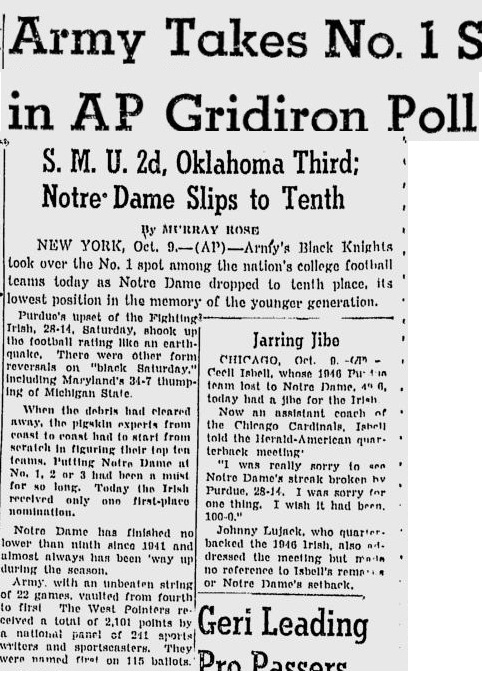
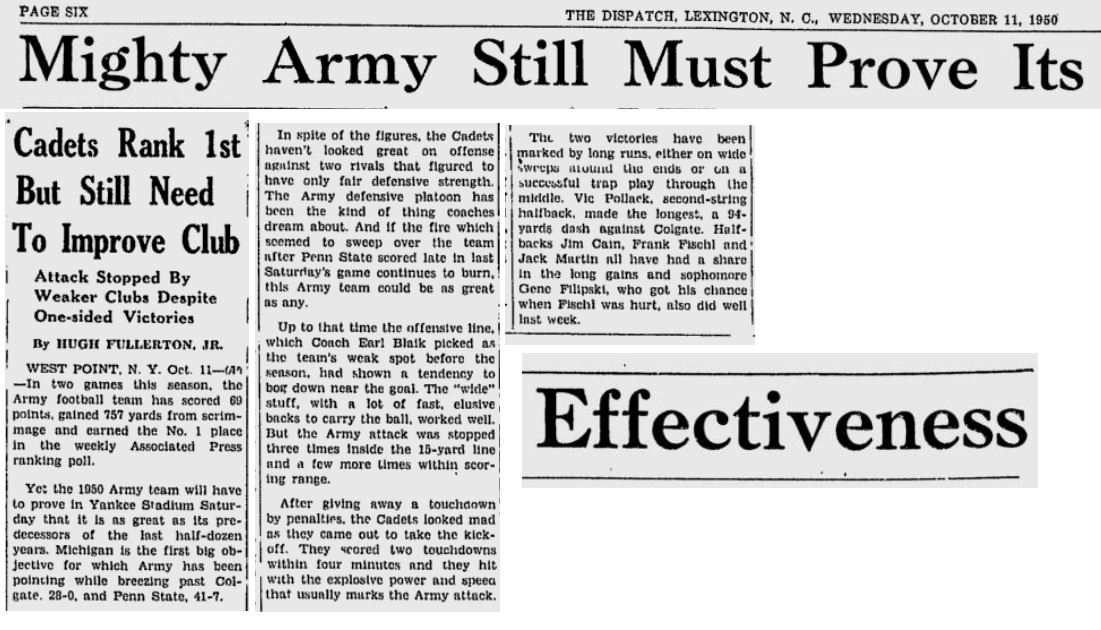
1950 Army 8-1 Coaches#5 AP#2
09/30 Army 28 – Colgate 0
10/07 Army 41 – Penn State 7
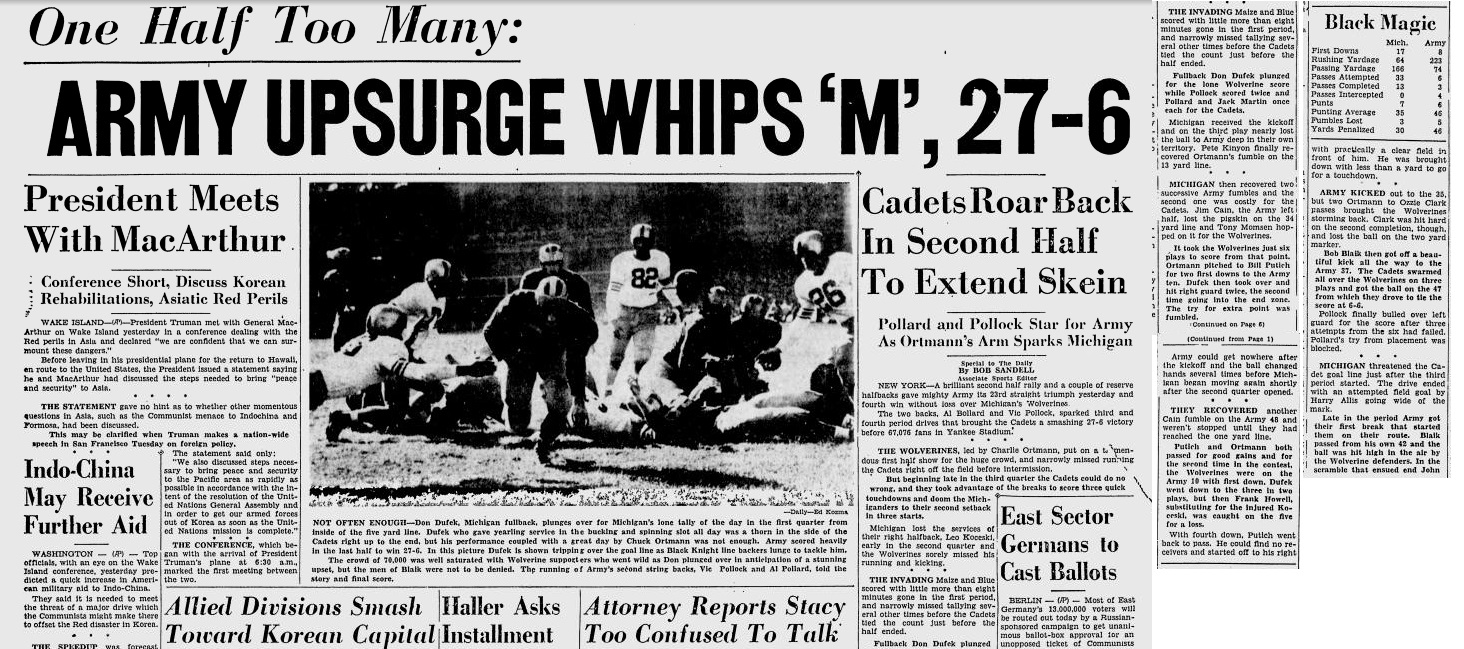
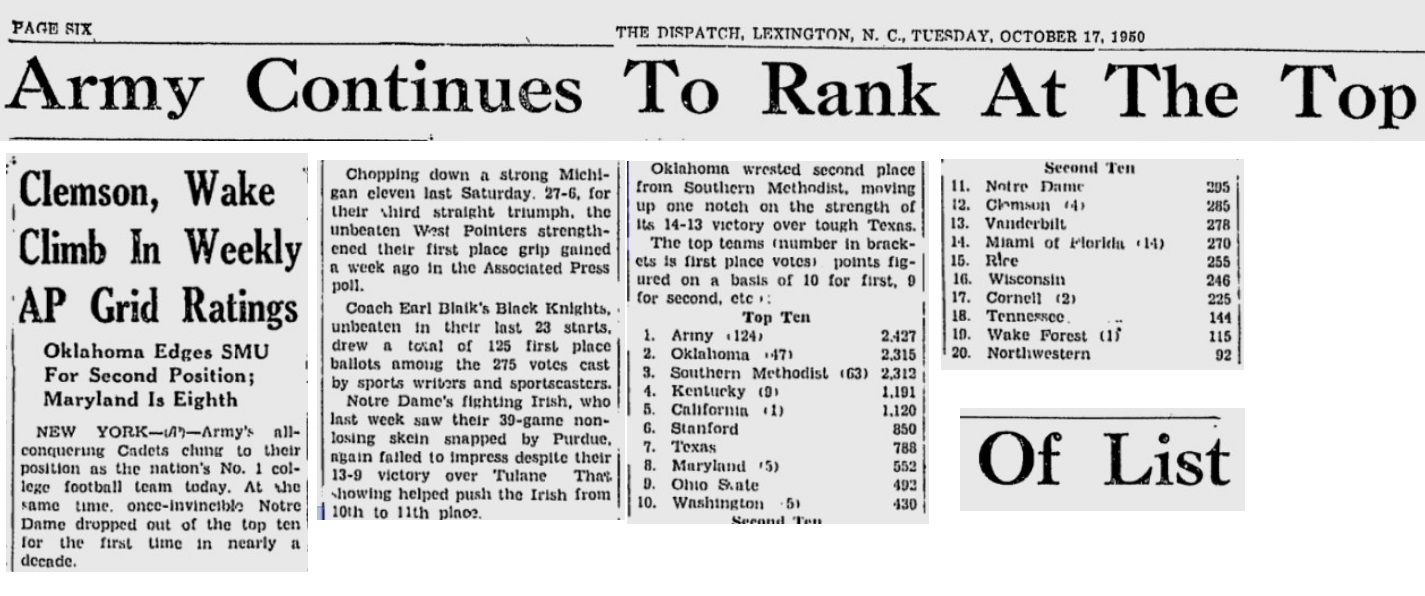
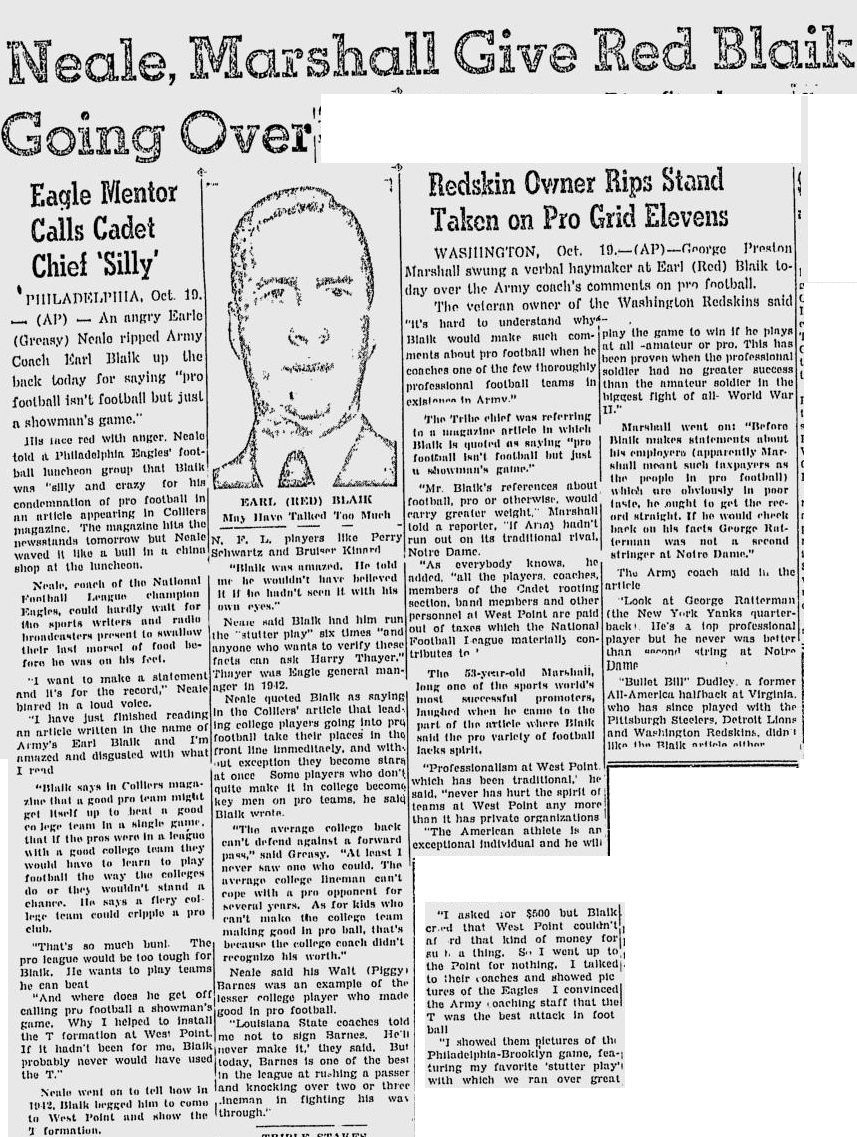
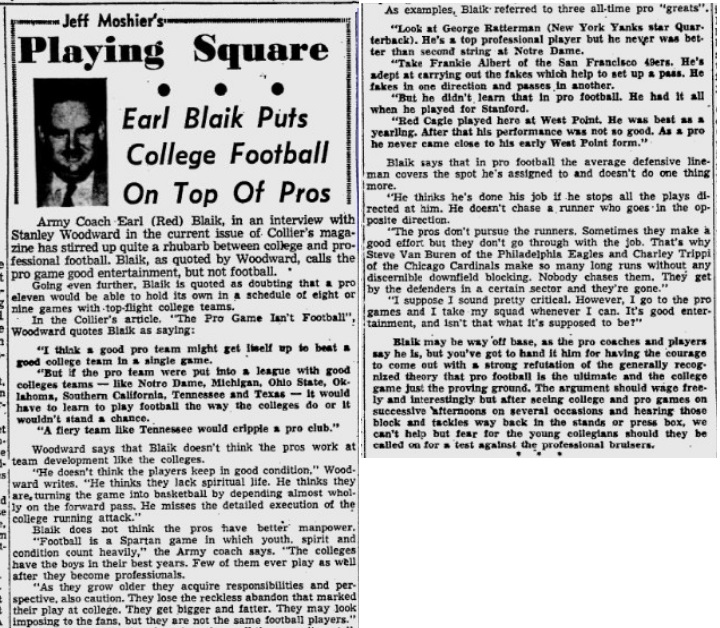
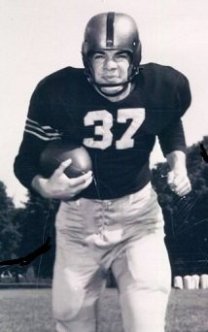
10/14 Army 27 – Michigan 6
10/21 Army 49 – Harvard 0
10/28 Army 34 – Columbia 0
11/04 Army 28 – Pennsylvania 13
11/11 Army 51 – New Mexico 0
11/18 Army 7 – Stanford 0
12/02 Army 2 – Navy 14 L Philadelphia, PA
–
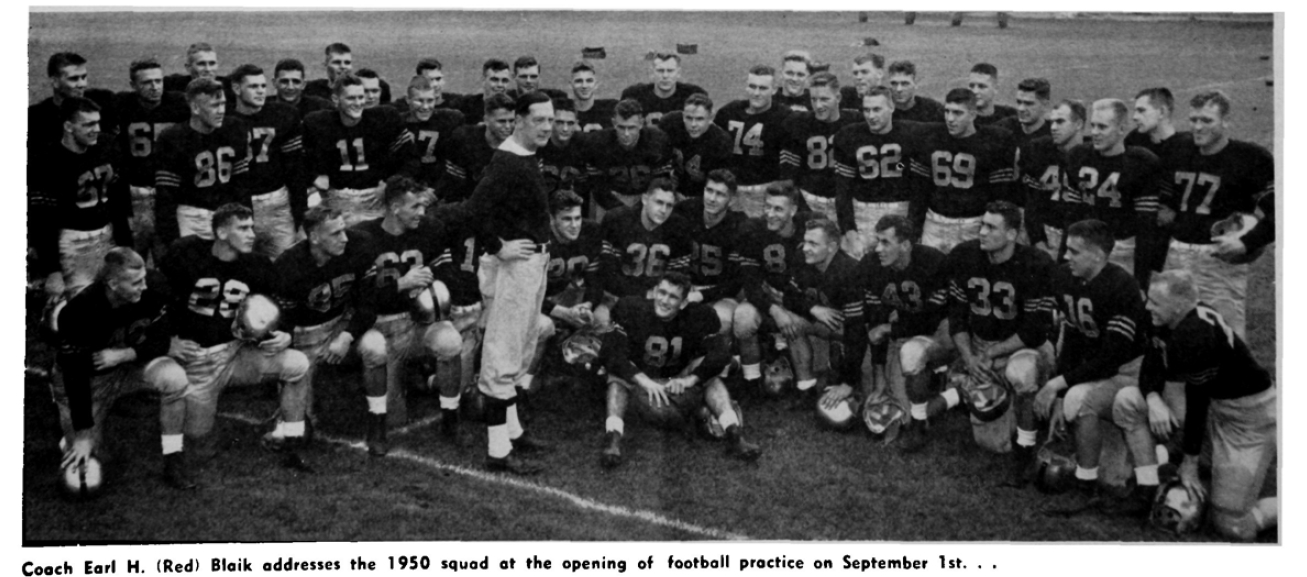
Assembly Vol 9, No 3, Oct 1950
News Articles
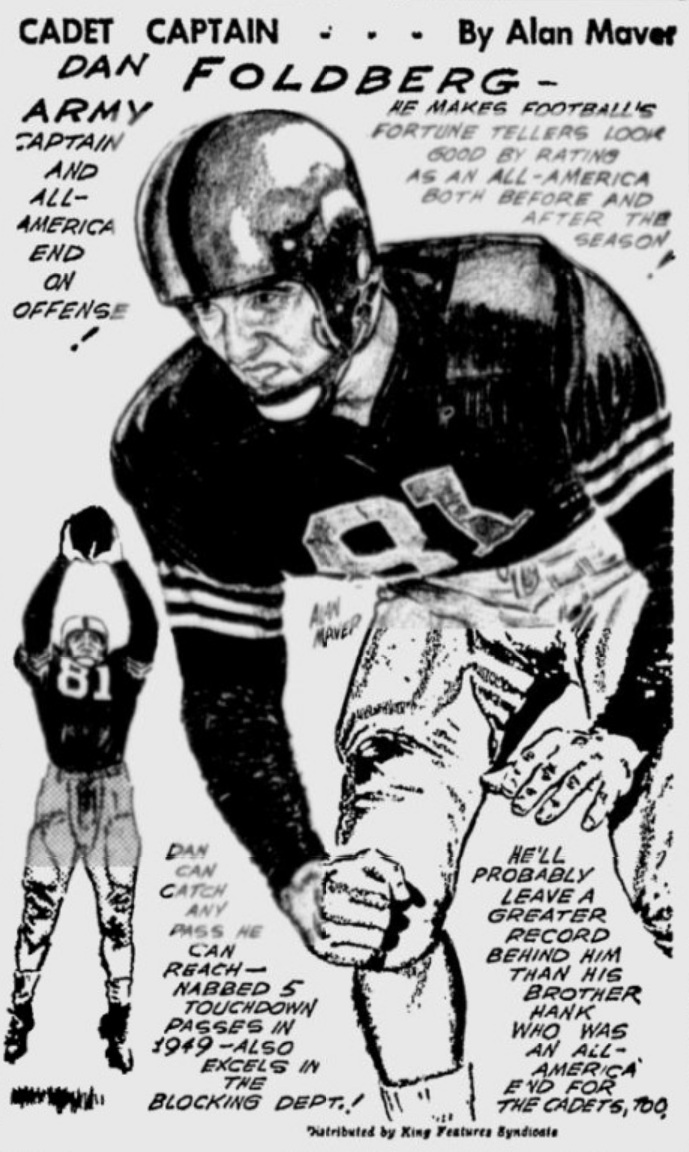
ArmyFB_1950_DanFoldberg_byAlanMaver_TheDispatch_Sep201950
–
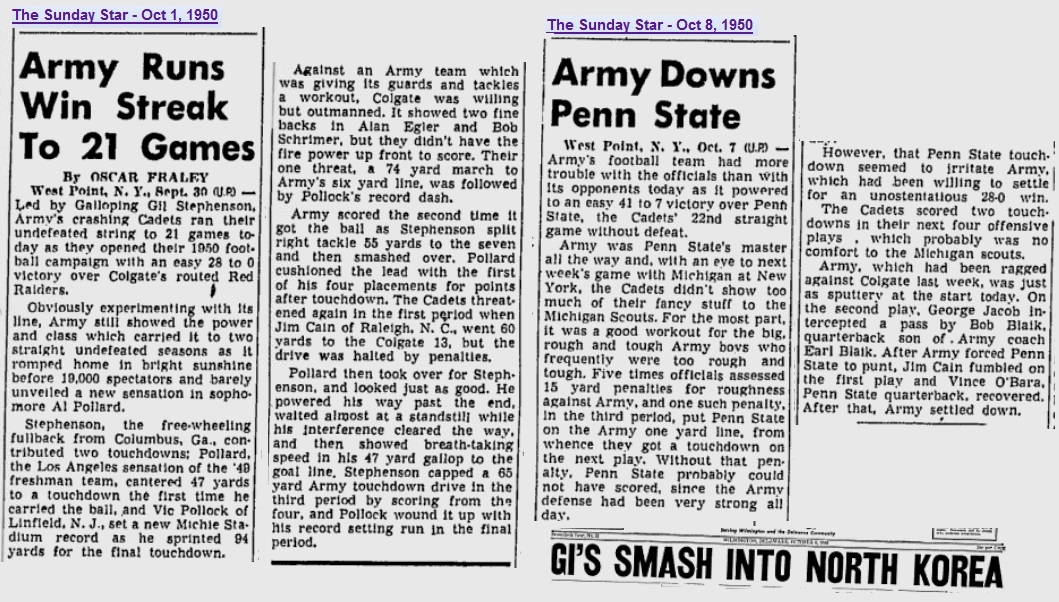
ArmyFB_1950_various_SundayMorningStar_Oct1-8_1950
–
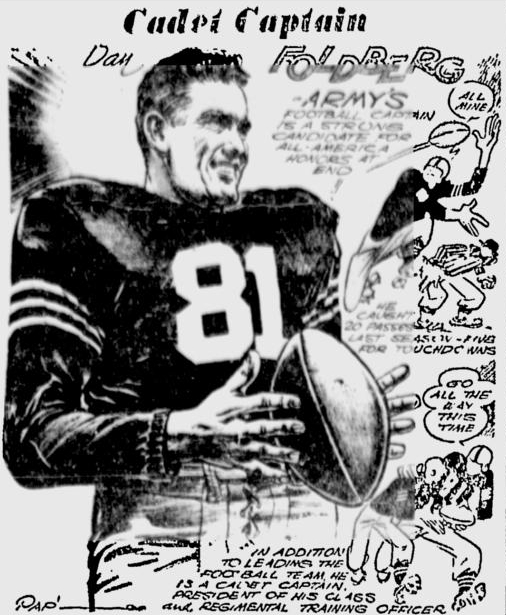
ArmyFB_1950_DanFoldberg_byPap_StJosephGazette_Oct61950
–
–
–
–

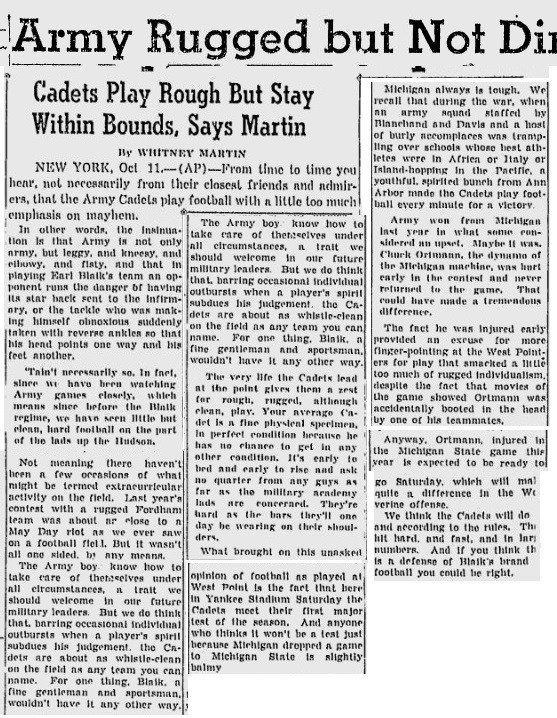
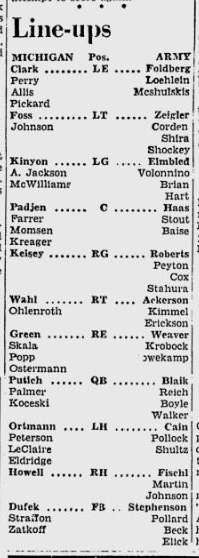
Army 27 Michigan 6
–
–
–
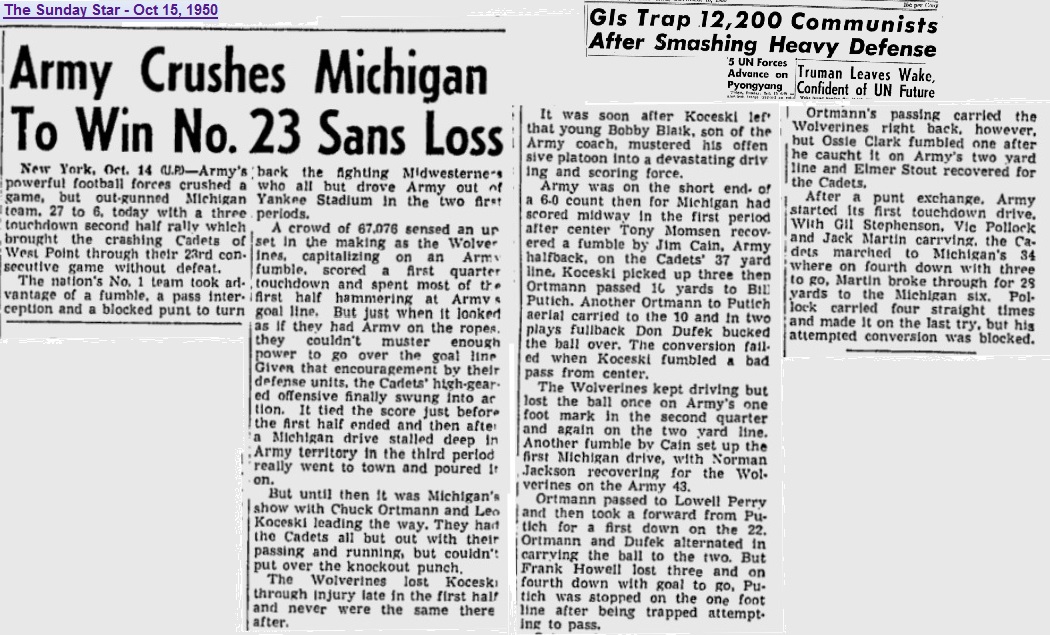
ArmyFB_1950_vsMichigan_SundayMorningStar_Oct151950
–
no sound
The return of Army to the Michigan schedule marks the resurgence of
The two met nine times between 1945 and 1962 with Army winning the first five games and Michigan winning in 1955, ’56, ’61 and ’62. It was a past series that was twice played at Yankee Stadium (1945, ’50) and on four occasions marked a matchup of two top-10 teams (1945, ’46, ’49, ’55).
–
–
–
–
–
–
–
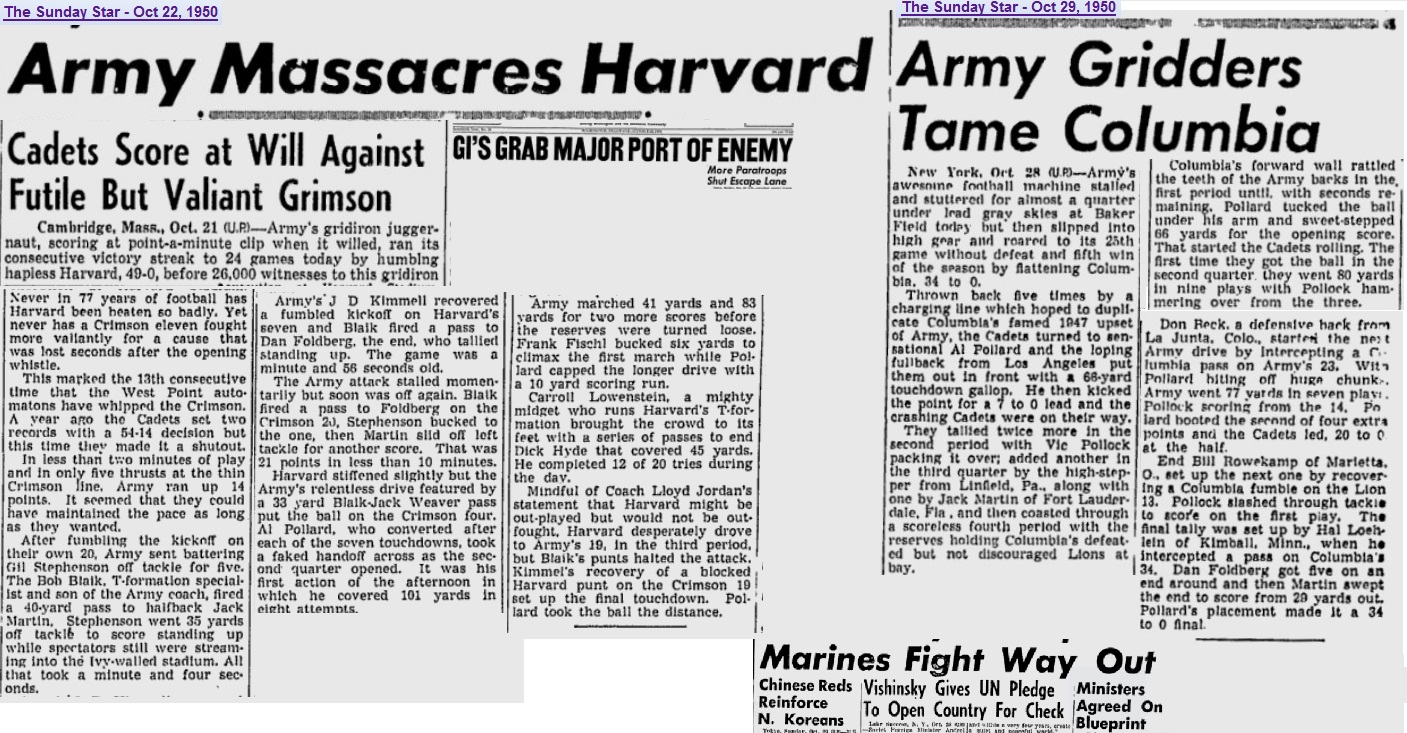
ArmyFB_1950_various_SundayMorningStar_Oct22-291950
–
–
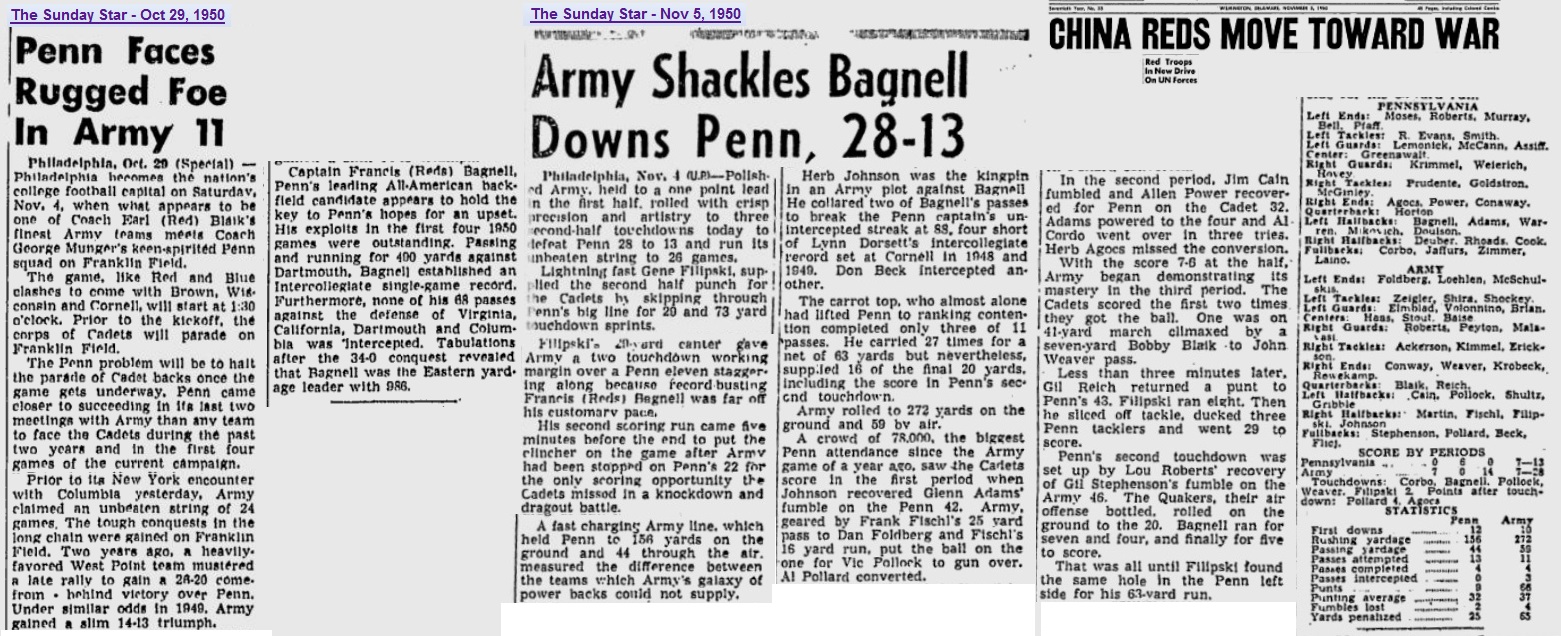
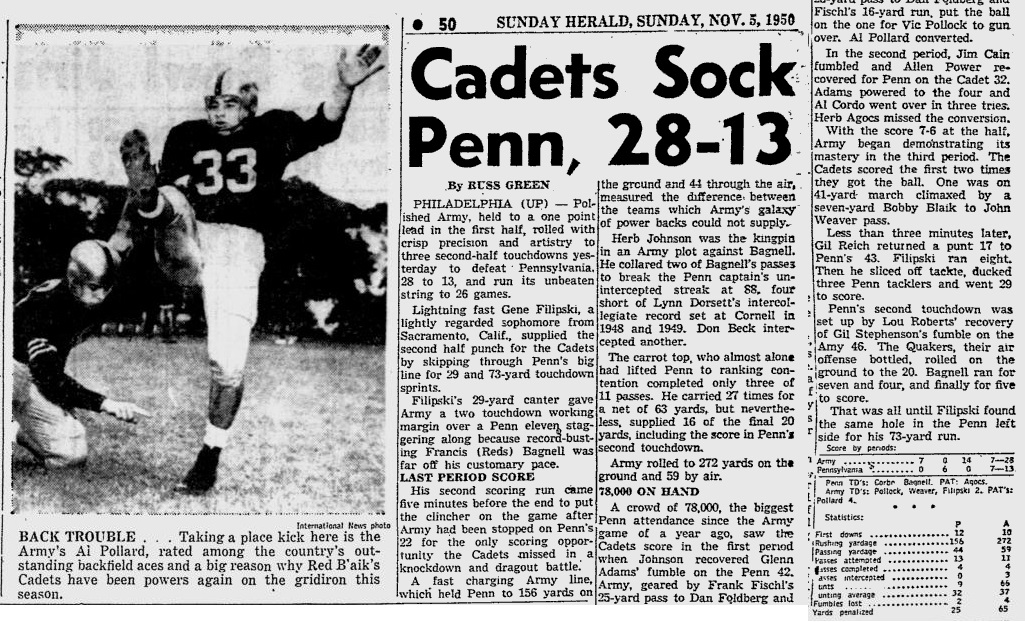
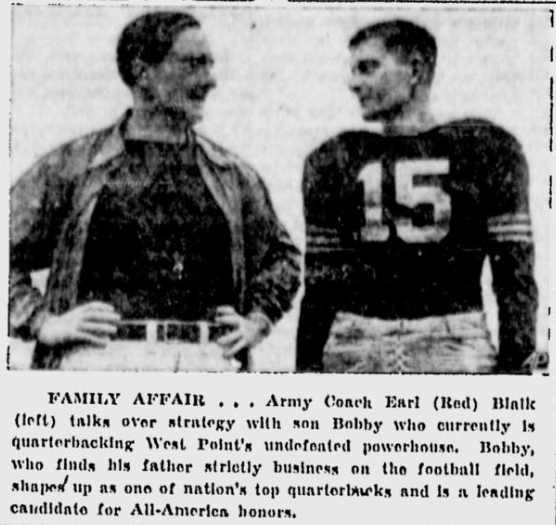
ArmyFB_1950_vsPenn_SundayMorningStar_Oct29-Nov51950
–
–
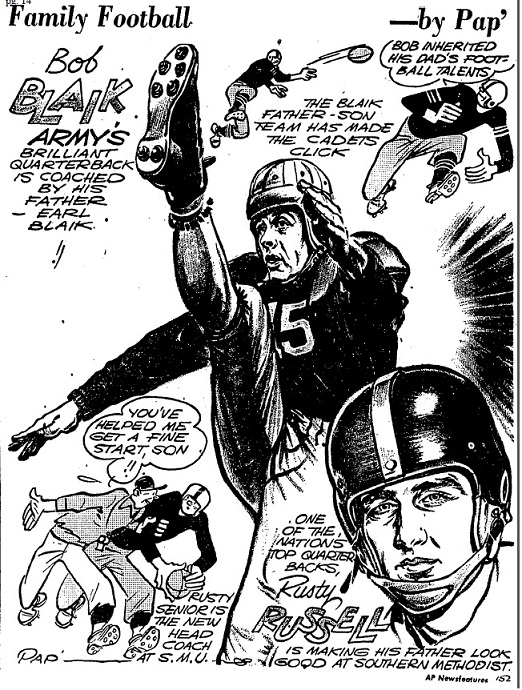
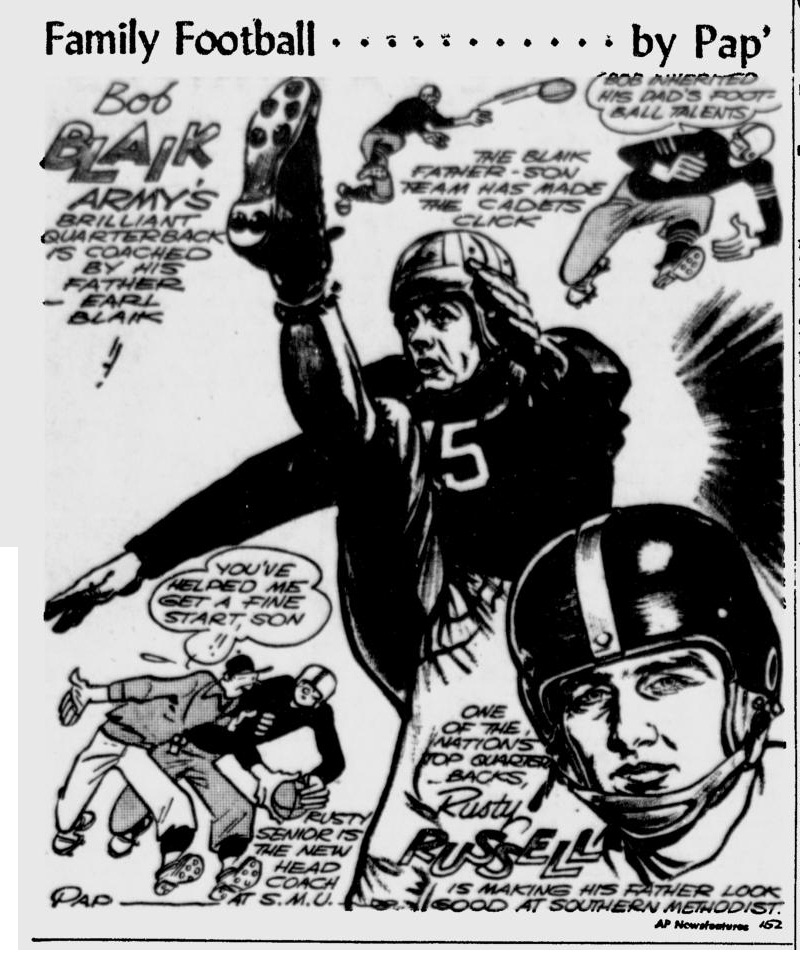
ArmyFB_1950_Blaik_FamilyFootball_byPap_CSM_Nov41950
–
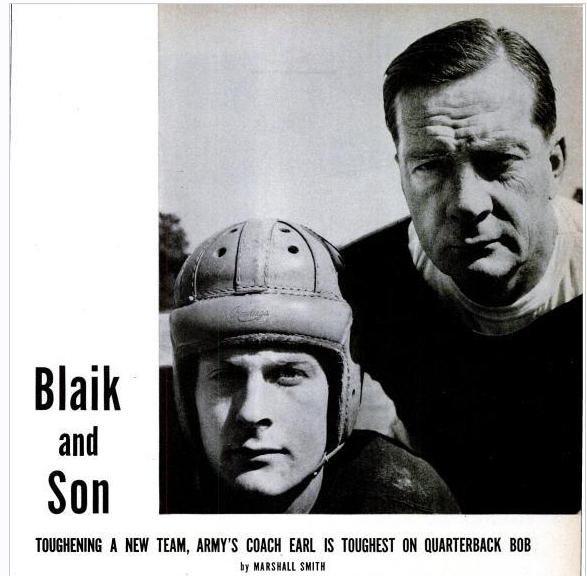
–
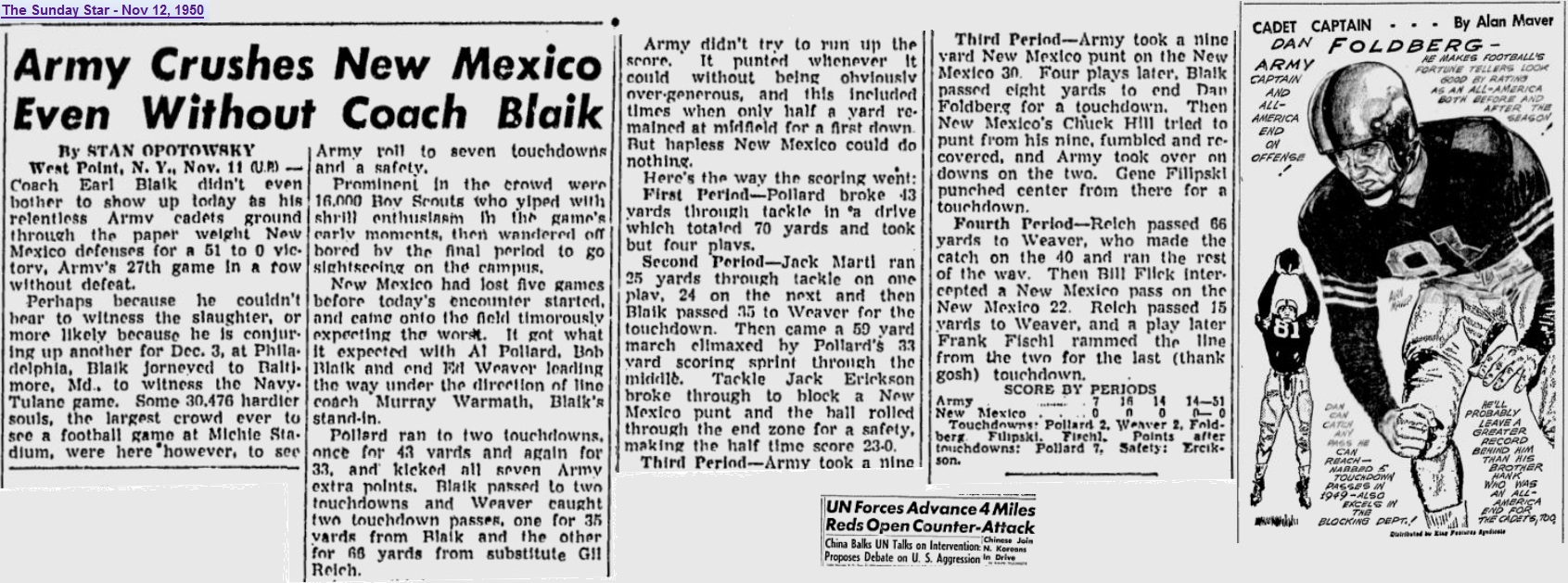
ArmyFB_1950_vsNewMexico_SundayMorningStar_Nov121950
–
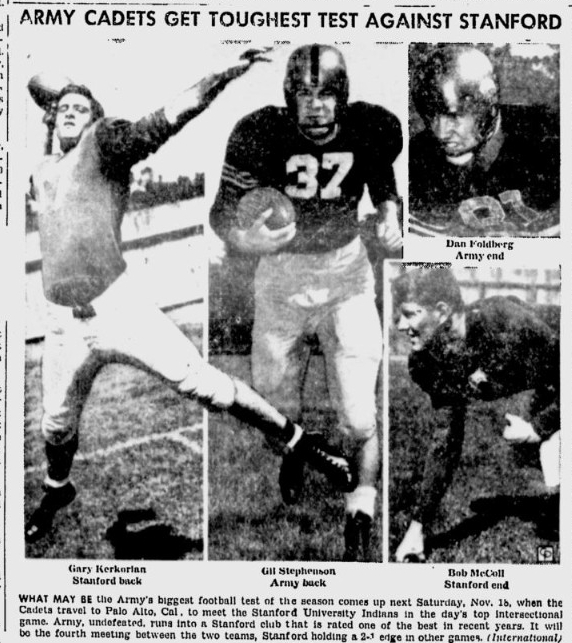
–
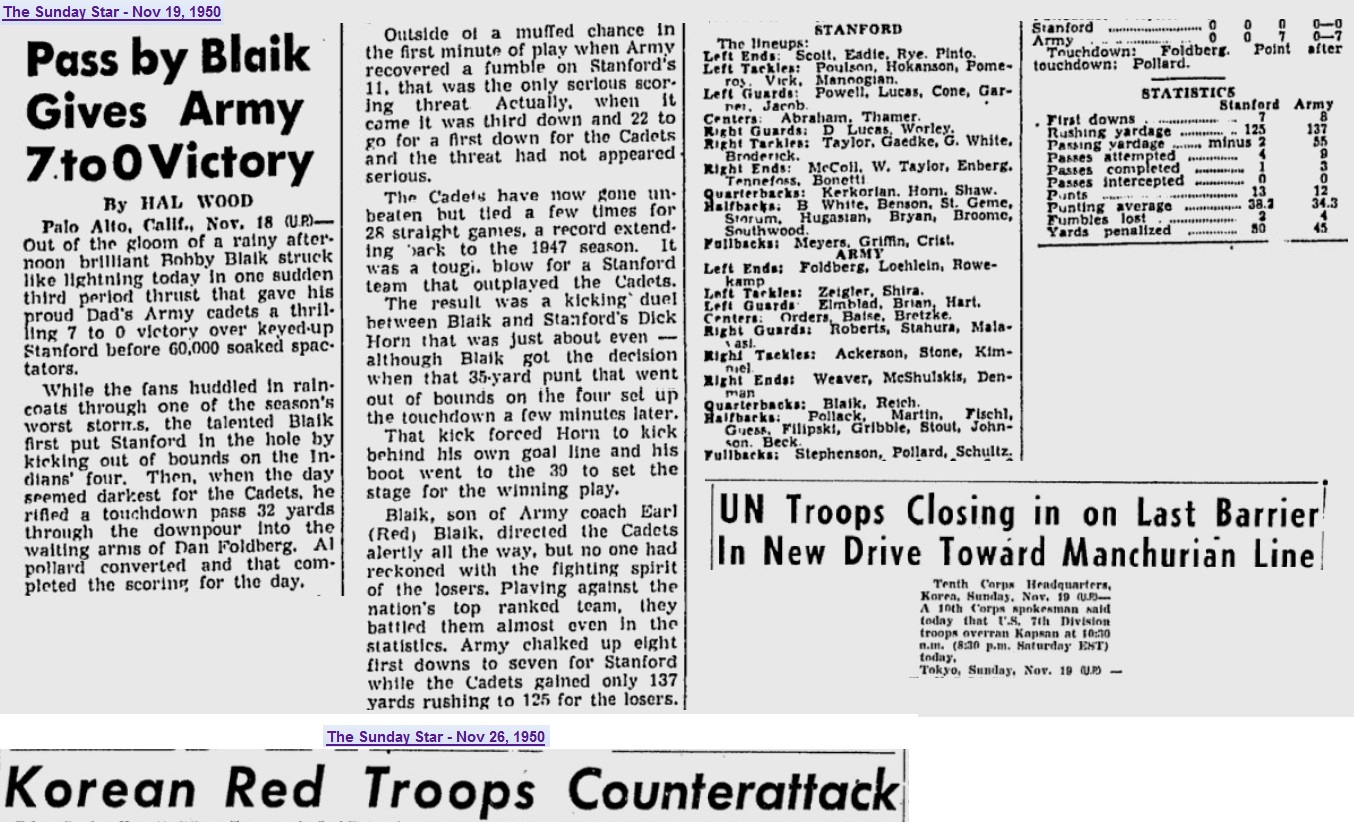
ArmyFB_1950_vsStanford_SundayMorningStar_Nov191950
–
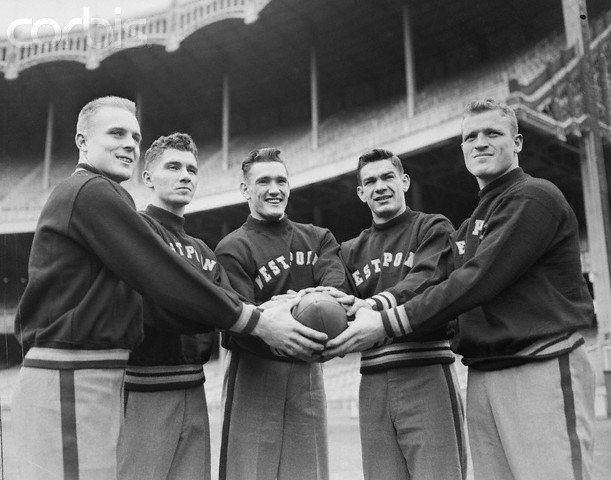
–
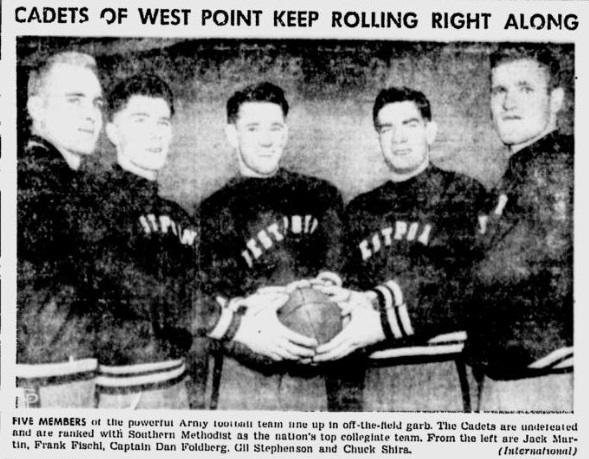
–
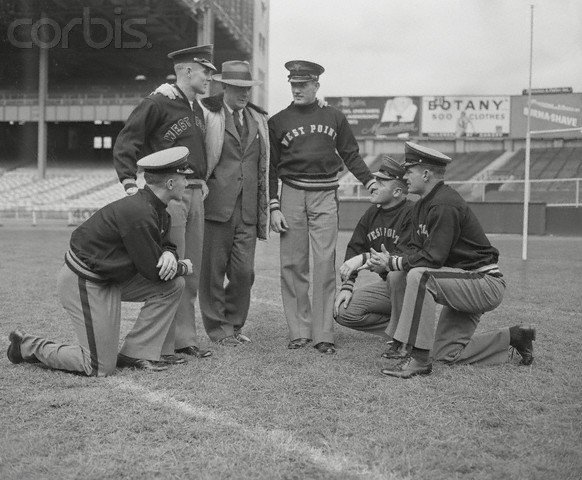
–
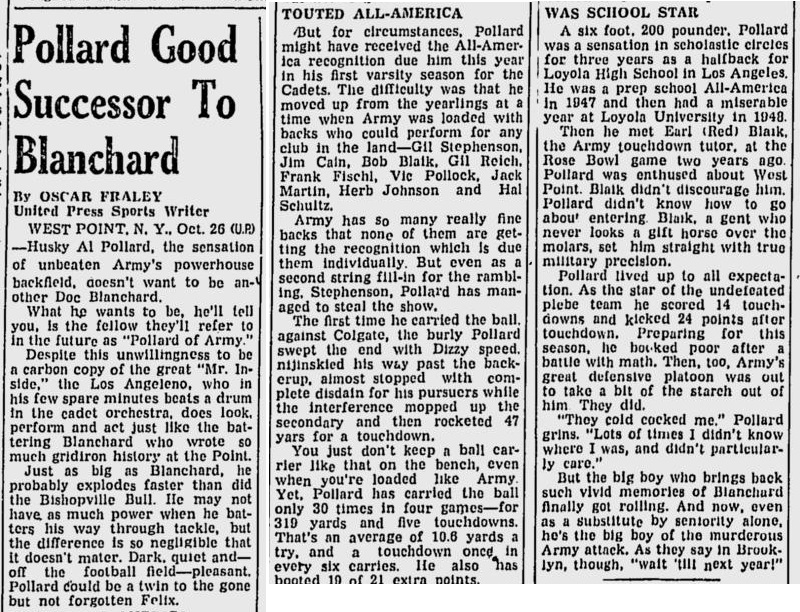
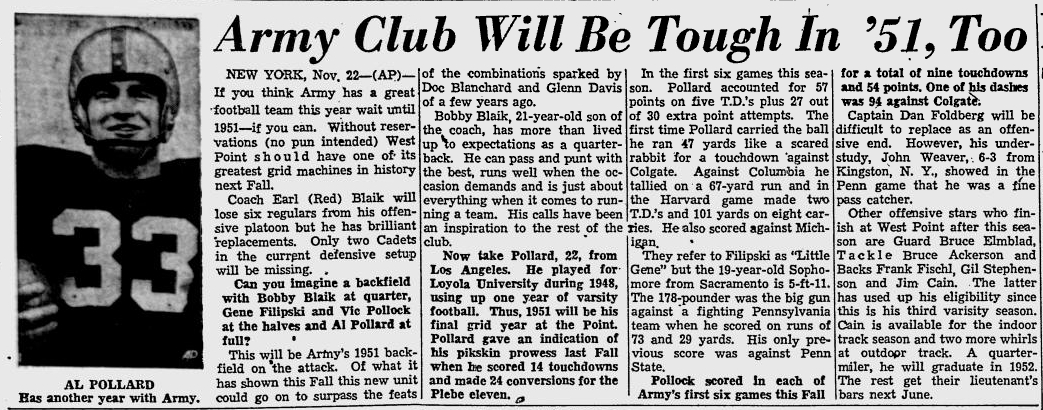
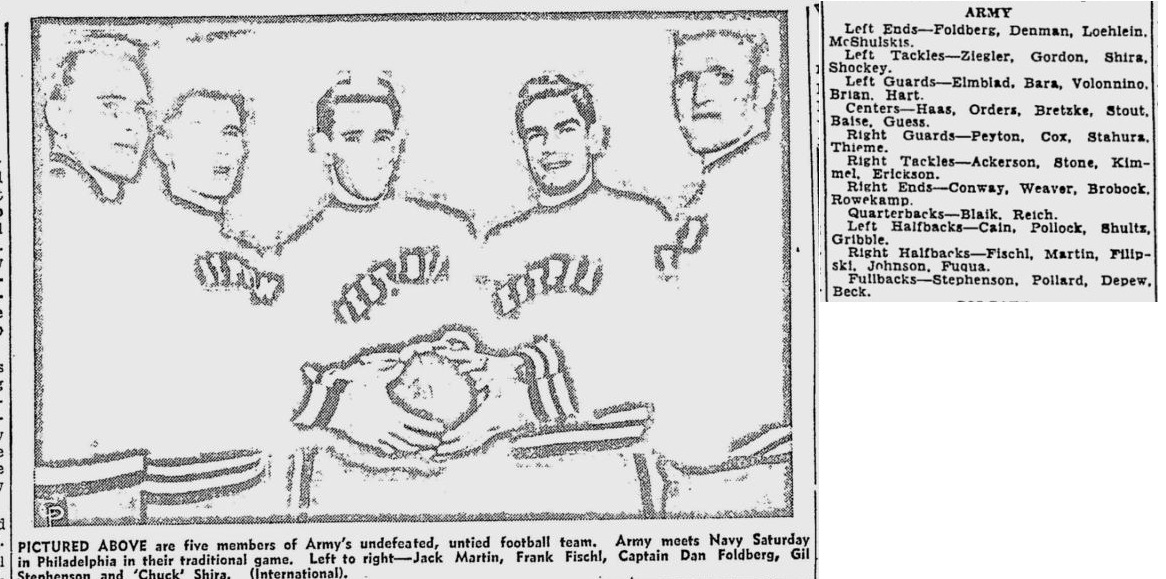
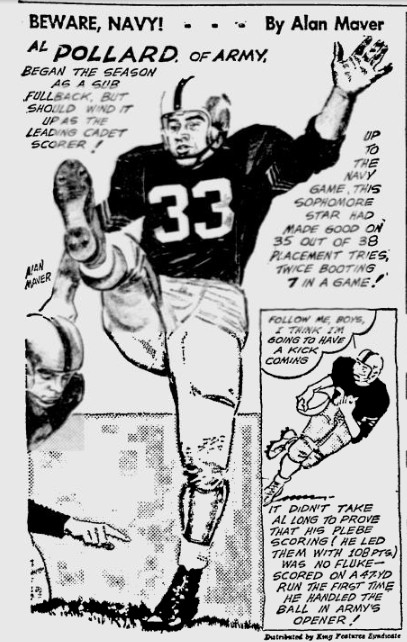
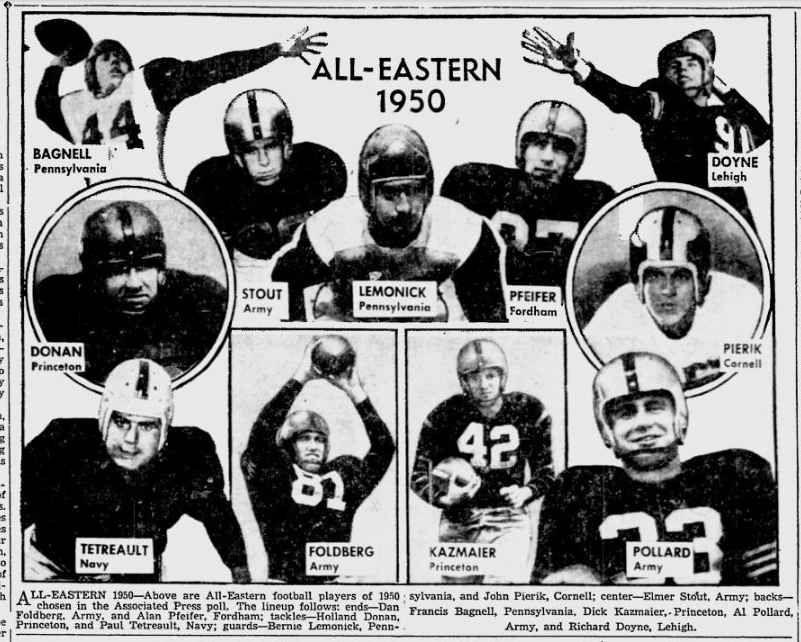
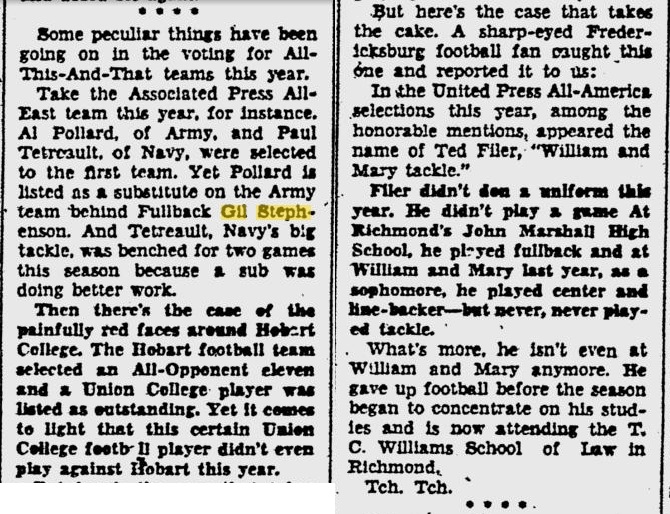
ArmyFB_1950_AlPollard_byAlanMaver_NewsandCourier_Dec21950
–
–
–
–
–
–
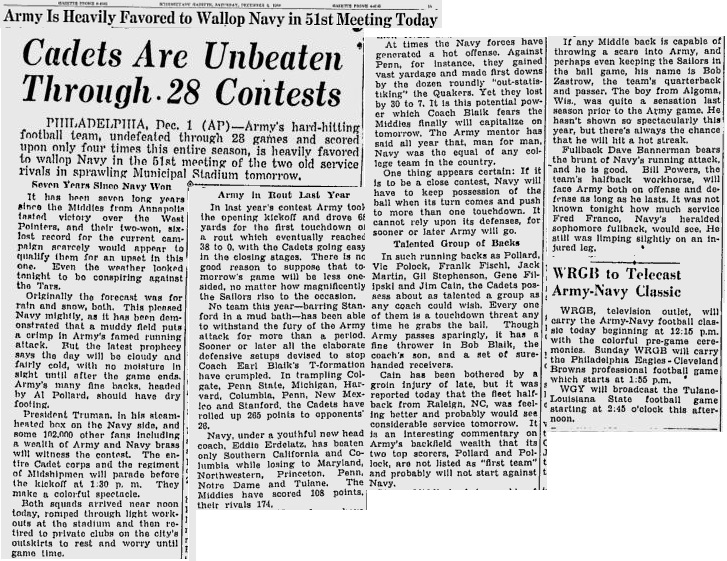
ArmyFB_1950_vsNavy-pre_SchenectadyGazette_Dec21950
–
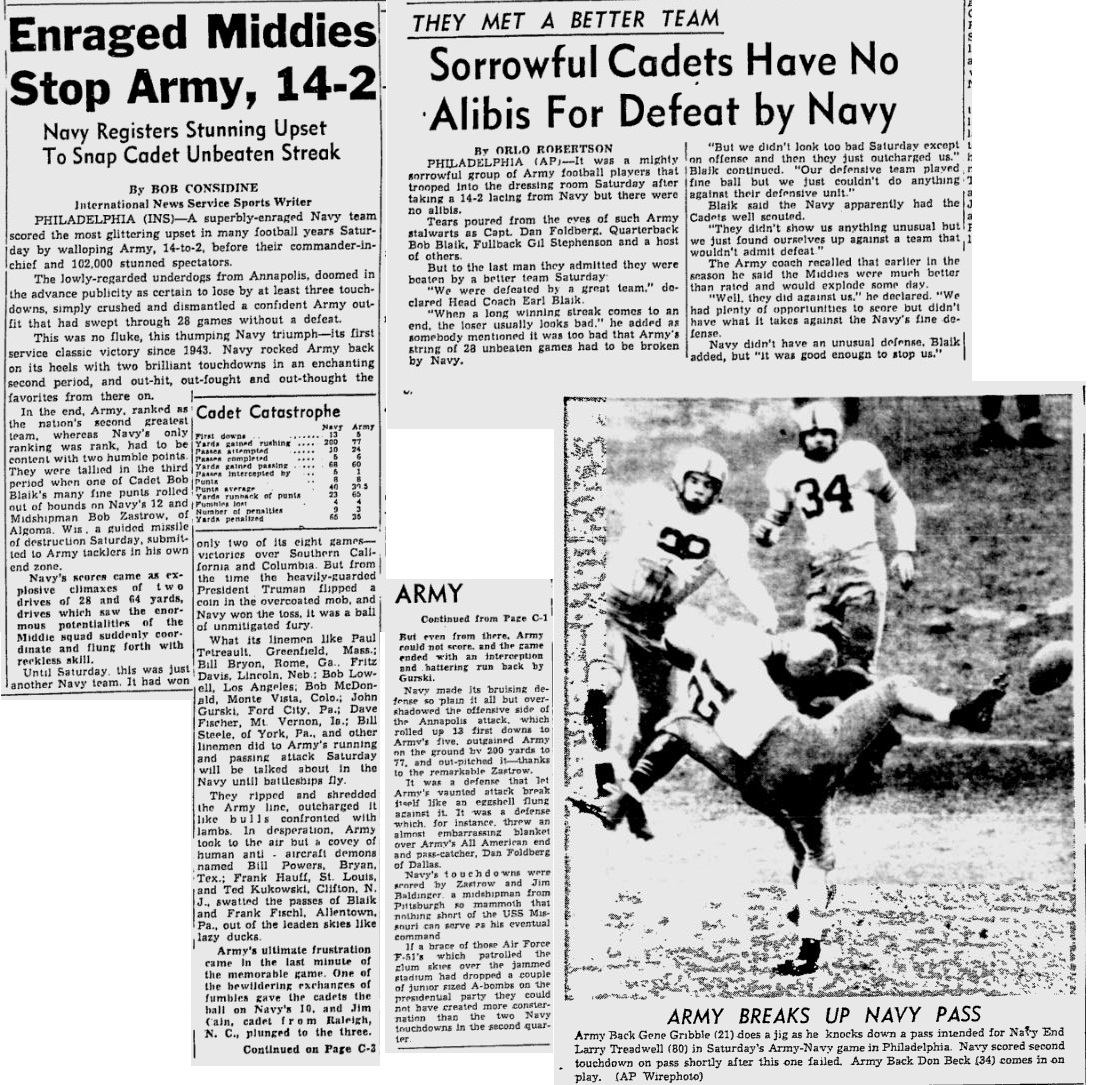
ArmyFB_1950_vsNavy_DeseretNews_Dec21950
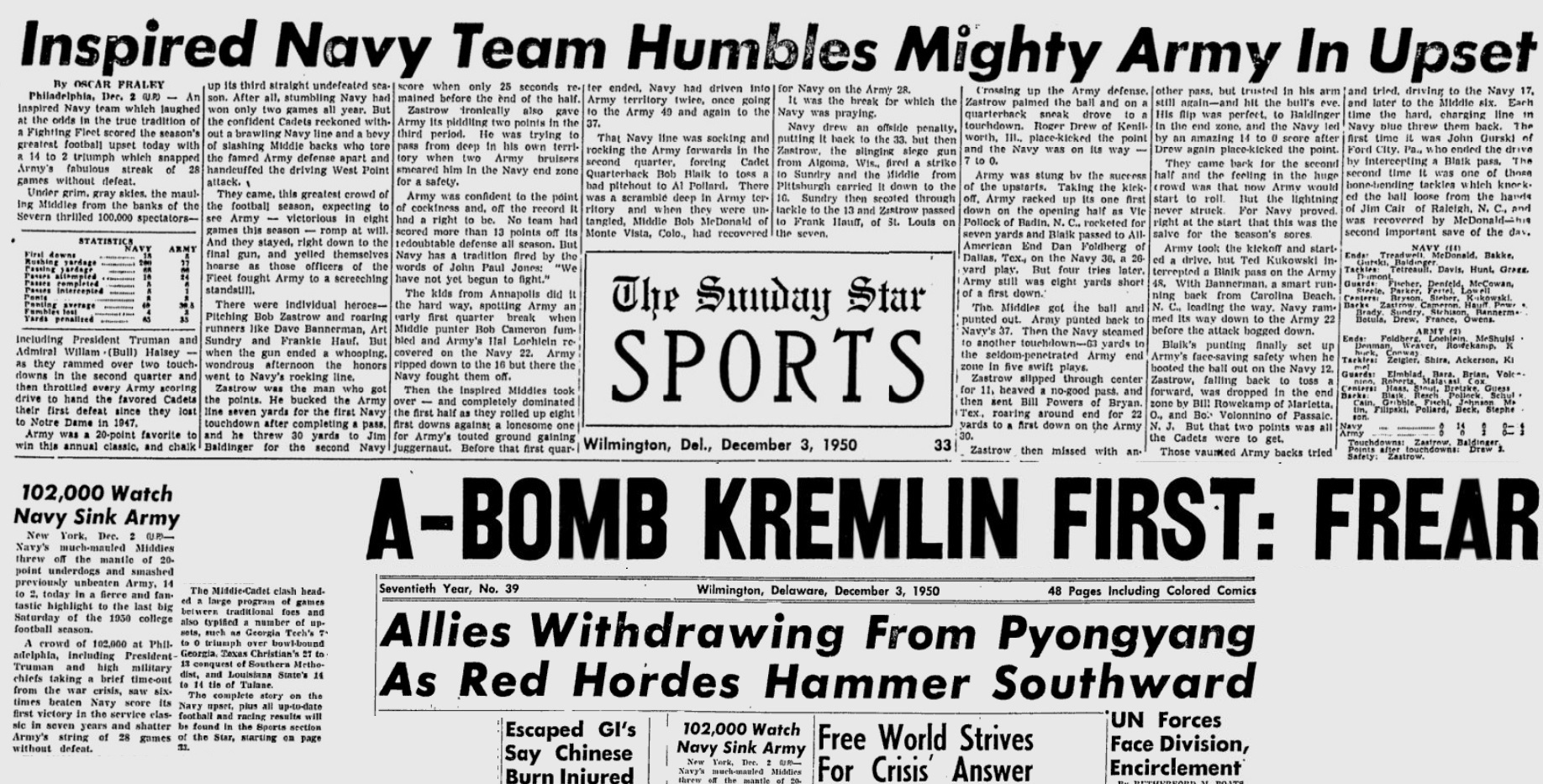
ArmyFB_1950_vsNavy_SundayMorningStar_Dec31950
–
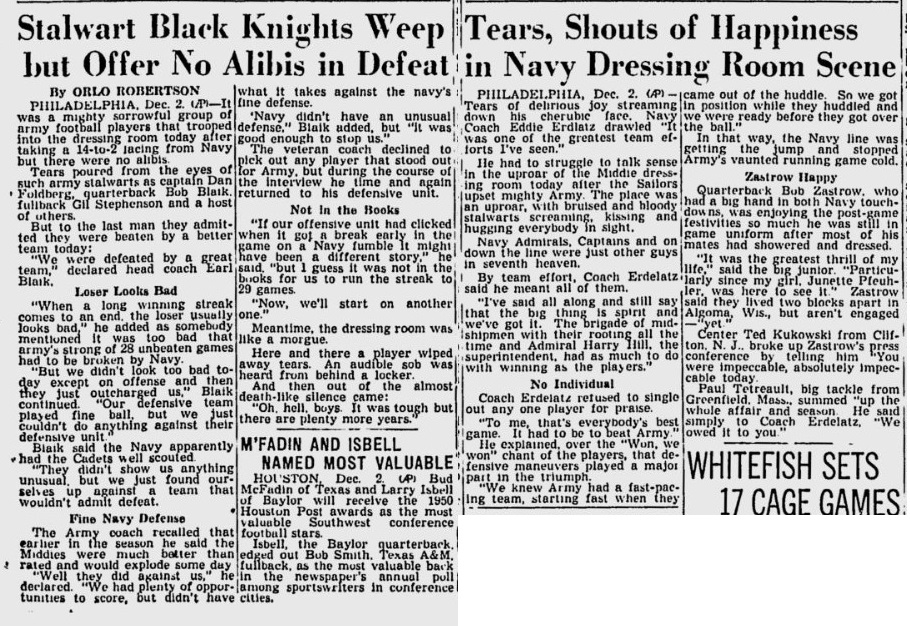
ArmyFB_1950_vsNavy_SpokesmanReview_Dec31950
–
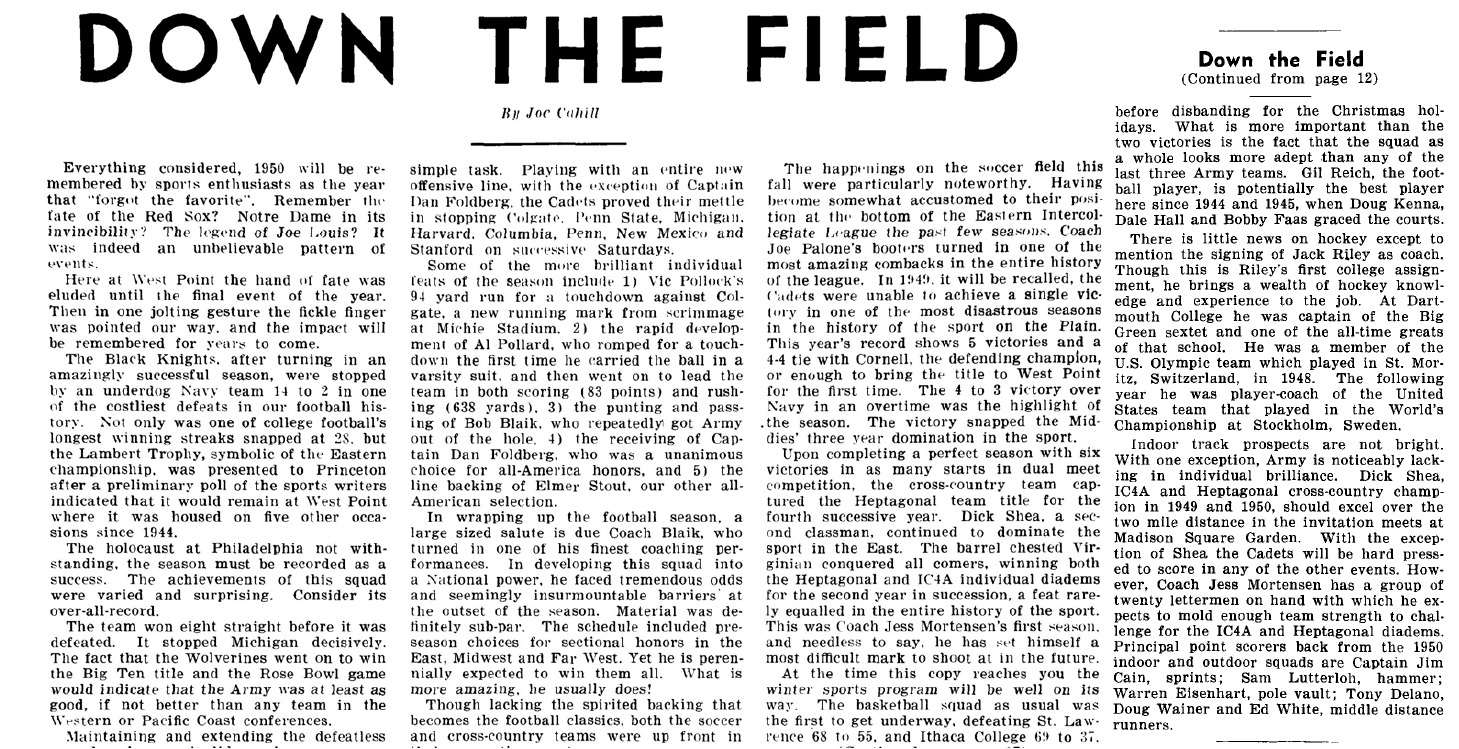
ArmyFB_1950_season-recap_AssemblyVol9No4_Jan1951
–
http://forwhattheygaveonsaturdayafternoon.com/wp-1953/football-team-roster
If you play for Army, always remember what these Cadets did.

“Freddie Attaya” ’54 – FB & Punter; Tommy Bell ’55 – LHB; Ralph Chesnauskas ’56 – RG (played the entire game – 60 minutes, kicked the 2 extra points); Cockrell – LHB; Bob Farris ’56 – RT, “Howard Glock” ’56 – LT, Jerry Hagan ’55 – QB, Don Holleder ’56 – RE; Krause – RT; Lapchick – LE; Lasley – C; Jerry Lodge ’54 – FB, RHB; Def G & LB, “Leroy Lunn” – LG; Ordway- LE; Melnick – LT; Bob Mischak ’54 – LE, Lowell Sisson ’54 – RE, “Norm Stephen” ’54 – C, Pat Uebel ’56 – LHB, Peter Vann ’56 – QB, “Mike Zeigler” ’54 – RHB, “Dick Ziegler” ’54 – LG, Joe Franklin ’55 – RG (Tore up right knee when doubled teamed by Ralph Torrance & Eddie Meadows in 2d Quarter – Out for the Season)
Col Blaik called it “The Game never to be forgotten”
It was perhaps Army’s Greatest Game
The Corps’ preparation for the game had been more than unusual, including a “silence” imposed by the cheerleaders at the meal following Blaik’s talk. The “silence” which began after the traditional pregame sendoff of the team – proved potent. The cheerleaders had put a cork in the bottle of more than two years of pent up frustration. When the Corps completed its subdued, strangely silent, pregame march-on at the Polo Grounds, and the last man double-timed onto the first step of the stands, the men in gray exploded out. They shook that old stadium almost non-stop in the sunshine and shadows of that Indian summer afternoon.
http://forwhattheygaveonsaturdayafternoon.com/wp-53/nom-team
http://forwhattheygaveonsaturdayafternoon.com/wp-letters/bob-class
http://forwhattheygaveonsaturdayafternoon.com/wp-53/draft-nomination
For additional details of that season please go to —
1. Last Years Hall of Fame Nomination is at
http://forwhattheygaveonsaturdayafternoon.com/wp-nomination/1953-fb
2. The Reasons for The Class of 1962‘s Nomination of the 1953 Team for the Hall of Fame
http://forwhattheygaveonsaturdayafternoon.com/wp-1954/reasons-for-nomination
3. Bob Mishak’s Letter to the Hall of Fame Selection Committee
http://forwhattheygaveonsaturdayafternoon.com/wp-1954/mischak-letter
4. Bill McWilliams letter supporting ’62’s Nomination of the 1953 Football Team.
http://forwhattheygaveonsaturdayafternoon.com/wp-53/bill-nom-letter
5. Jim Morgan Remembers General James Van Fleet‘s Comments to the Corps
http://forwhattheygaveonsaturdayafternoon.com/wp-1954/van-fleet-15
6. Lowell Sisson remembers his 4 Years and his Teammates
http://forwhattheygaveonsaturdayafternoon.com/wp-1954/lowell-sisson
7. Joe Franklin Army Guard had his knee torn up in the 1st half of the Duke Game when Ralph Torrance and Eddie Meadows (Duke’s All American) double teamed him.
http://forwhattheygaveonsaturdayafternoon.com/wp-1955/joe-franklin
8. Peter Vann’s switching the ball to his left hand as Eddie Meadows grabbed his right — then the wobbly pass straight to Freddie Attaya to keep the drive alive
http://forwhattheygaveonsaturdayafternoon.com/wp-1956/peter-vann
9. Bob Farris played the entire 2d half of the Navy Game blind in one eye? (even though he was Captain – as a Cow – of the 1954 Team, he was never again to play another down of football)
http://forwhattheygaveonsaturdayafternoon.com/wp-1956/bob-farris
10. An Army Cheer Leader Remembers the preparation
http://forwhattheygaveonsaturdayafternoon.com/wp-1954/jay-gould
11. Bob Mischak’s 73 yard run down
http://forwhattheygaveonsaturdayafternoon.com/wp-1954/bob-mischak
12. Poor quality clips of that 73 yard play are at —
http://forwhattheygaveonsaturdayafternoon.com/armylore/50
Worth Lutz, Dukes quarterback said after the Game, “The savage cheering of Go!GO!GO! from the West Point stands placed our team in a nervous fright of tension and jitters.” (see page 9 of Army Lore)
“He (Attaya) also took a 17-yard pass, amazingly thrown left-handed by Vann, immediately preceding the 43-yard scoring aerial.”
Peter Vann rolling to his right to throw, had been confronted by Duke’s All-American left tackle Ed Meadows. Peter had to slow and reverse direction, slanting to his left toward the line of scrimmage, to evade Meadows’ charge. As he lunged past, Meadows grabbed for Vann’s right arm, and Peter instinctively switched the ball to his left hand. Meadows then caught hold of Vann’s right arm, but Peter, still moving to his left, pulled free and threw a short, wobbly, but accurate left-handed strike.
“But from well back an Army figure set out in pursuit. With the place in an uproar, Bob Mischak cut down the gap between them, and finally leaped upon Smith and dragged him down on the 7 yard mark, 73 yards from the line of scrimmage.”
Bob had run down Duke’s All American Red Smith. For nearly 15 years afterward the story Army’s win and Bob Mischak’s tackle was part of West Point’s Military Psychology and Leadership Course – as an example of the power of motivation.
( 24 clips of Bob’s run down & the Team’s Goal Line Stand are at ( http://forwhattheygaveonsaturdayafternoon.com/armylore/50 )
Army held taking over an inch from the Goal Line. Attaya quick kicked out of the end zone and Army stopped Duke’s frantic passes in the closing seconds. The Cadet Corps poured onto the field lifting their heroes onto their shoulders. Army had returned to Glory.
“A Third was “Ralph Chesnauskas”, Yearling right guard who played the entire sixty minutes”
After the Game a number of the players who had played nearly the entire Game — both sides of the ball had to have their Triple A shirts cut off with sissors as they were stuck to the Skin.


By Bill McWilliams
NCAA Rule Change — What made the rule change more difficult for Army was two prior years of rebuilding which had already caused turmoil on the team. Earl Blaik and his assistants constantly shifted players from one position to another, and promoted and demoted between the varsity and junior varsity, trying to strengthen the varsity. Now, just as things were beginning to settle down, the coaching staff had to determine who could perform best playing both ways. It was painful, because players who had just begun to feel they had secured starting positions on either offensive or defensive units found themselves tested again. And while the 1952 recruiting effort resulted in some talented new Yearling players in 1953, a few of the first and second classmen who had struggled through the two prior seasons found themselves shunted aside.

Lowell Sisson‘s experiences prior to the 1953 season typified the Army coaching staff’s scramble to find players best suited to go both ways and provide the team its best overall strength and balance.
In spring practice, Blaik and Vince Lombardi moved Lowell ’54 from end to offensive halfback. His high school senior year in Waterloo, IA, he had been a standout halfback on a state championship team. He was tall and fast, good material for Vince’s backfield.
Then, ten days before the season opener, Lowell received word to report to “The Colonel’s” office. Blaik and Lombardi wanted to see him. He was worried. “Why do they want to see me?” he wondered. Lombardi said, “Lowell, we want to switch you back to end. We wanted to ask you about it, if you would object.” Sisson was surprised, but relieved. “I have absolutely no objection. All I want to do is play football. However I can do it is great “at end or anywhere else.”
In a rather erratic first three games of the season, Army rolled over an out-manned Furman team 41-0, lost at Northwestern 33-20, and after a 0-0 first half, overcame a winless Dartmouth 27-0.


There were, however, interesting footnotes to the win over Dartmouth. Sports writer William J. Briordy, in a 10 Oct special to the New York Times, noted that Peter Vann completed 12 of 15 passes that day, three for touchdowns. Vann’s aerials that afternoon were uncharacteristically short, but that wasn’t important. Two touchdown throws were to Bob Mischak, the only player to receive any All-American recognition at season’s end. The other was to a Yearling named Don Holleder ’56, who in 1954 earned All-American honors at end, quarterbacked the 1955 Army team, and gave his life in Vietnam on 17 Oct 1967. Don’s name now is memorialized in the Holleder Center, adjacent to Michie Stadium.
The Times reporter couldn’t know that there were other matters buried in the history of the 1953 Dartmouth game. Earl Blaik wasn’t a coach who gave emotional, fire and brimstone speeches at halftime. Rather, he was analytical. He identified mistakes and taught his team how to correct them. Not so against Dartmouth. He was frustrated by a flat, lackluster first half and gave his team a tongue lashing.

Blaik’s offensive play routine required the Army center to be the first man out of the huddle after the quarterback called the play. As the center trotted up over the ball, the rest of the team would pause, then break from the huddle, and jog to the line of scrimmage. Not so the second half against Dartmouth, or against any other team the remainder of the 1953 season.
Center “Norm Stephen” ’54 was so energized by Blaik’s blistering remarks, that on the first offensive play of the second half he bolted from the huddle and raced to the ball – and the other ten men followed his lead. The Corps roared their approval, and that pattern continued the rest of the afternoon. A new method for calling up “the twelfth man” had been established. Perhaps it was the spark that lit next Saturday’s fire.
For then came The College Football Game of the Year, “the game never to be forgotten” as Earl Blaik called it – a heart-stopping 14-13 upset of No. 7 ranked Duke at the Polo Grounds.
Tuesday before the game, Peter Vann, who was a confident, pinpoint-accurate, long ball passer at quarterback – and had fast developed into a ball handling magician under Lombardi’s tutelage – sprained an ankle in practice. The injury was a severe blow, for Blaik and his staff knew the Duke contest was pivotal in Army’s attempts to recover from the honor scandal. Peter’s start was doubtful. He was unable to practice during the week. In spite of Blaik’s sixth football axiom, – Games are not won on the training table,- physical therapy became vital.
When the team went to New York on Friday for a final, light workout in the Polo Grounds, Vann was up to half speed. The practice plan included drop-back passes, the quarterback’s typical three steps back and throw, from the T-formation.
Blaik, ever sensitive to opposing teams’ and sports writers’ intelligence gathering, didn’t want anyone to know Pete might not be able to play against Duke. He and Lombardi also didn’t want Pete to aggravate his injury. Each time he took a practice snap from center “Norm Stephen”, Blaik and Lombardi were close beside him, one on each side, fading back with Peter, ready to catch him, to ensure he didn’t reinjure his ankle. They also were concealing the injury from prying eyes.
Their caution, and Peter’s determination and persistence, paid off. The next day, Peter Vann played perhaps the game of his life, along with a small band of cadets who had labored two and a third seasons learning how to consistently win. Vann’s game against Duke accelerated his rise to football glory at Army. Under Lombardi he sharpened his ball handling wizardry, which repeatedly confused and misled defenses. By the end of the season, his pass completion percentage climbed to 56. Lombardi was drawing Peter’s best from him, and when Lombardi left West Point, Peter continued along the path laid out for him. In 1954, Vann was eighth in the nation in total offense, named second team All-American, and ninth in Heisman Trophy voting.

The 14-13 decision over Duke was the victory of a truly inspired team. Memories of the 1953 Duke game are vivid for those fortunate enough to have been in the disappointingly small crowd of 21,284, anticipating a Blue Devil walkover. Earl Blaik had spoken to the Corps during the noon meal on Thursday and stirred them as he never had before. Referring to what some had seen as a growing division between the Corps and the football team in the years preceding the cheating incident, Blaik intoned, “The Corps and the football team are one unit. You cannot separate them.”

The Corps’ preparation for the game had been more than unusual, including a “silence” imposed by the cheerleaders at the meal following Blaik’s talk. The “silence” which began after the traditional pregame sendoff of the team – proved potent. The cheerleaders had put a cork in the bottle of more than two years of pent up frustration. When the Corps completed its subdued, strangely silent, pregame march-on at the Polo Grounds, and the last man double-timed onto the first step of the stands, the men in gray exploded out.


They shook that old stadium almost non-stop in the sunshine and shadows of that Indian summer afternoon. This was also the game in which a band of enterprising 1954 and 1955 cheerleaders first rolled out and fired the now-traditional Army victory cannon. The first blast of the cannon culminated months of planning and scheming, in which the cheerleaders prevailed upon COL “Red” Reeder, the Graduate Manager of Athletics, to grant them Corps Squad status to obtain financial support for their spirit-inducing initiatives.

Memories of Duke 1953 are equally vivid for the men on Army’s small squad. Jerry Hagan ’55 quarterbacked the cadets 76 yards on the ground for their first touchdown, with the running of Tommy Bell, Pat Uebel ’56, “Fred Attaya”, and “Mike Zeigler” ’54. Bell, who hadn’t played since the season opener because of injuries, tore straight ahead through the Duke line nine yards for a first-quarter touchdown to put Army ahead 7-0.

He remembers at game’s end being lifted off his feet onto the shoulders of deliriously happy men in cadet gray, and being carried off the field, excited and exhausted. He also remembers that his little Irish mother attended the game and “after seeing the Corps carry him off the field” told Tommy she decided she, too, was a fan of his. Tom was off and running toward All-American recognition at the end of the 1954 season.

Big, handsome, fleet-footed Yearling “Patrick Uebel”, playing left halfback, remembers taking a 5-yard flare pass from Peter Vann, in the right flat, and weaving 38 yards down the sidelines for the second Army score, to put the cadets back in the lead to stay, 14-7. But his touchdown against Duke was only the beginning for Pat that year. Against Navy, he scored all three Army touchdowns in a magnificent win. Two of those touchdowns came on identical running plays from the Navy 5- and 3-yard lines, plays that bedeviled Army opponents nearly all season, and involved flawless ball handling and faking by Peter Vann, “Gerry Lodge” ’54, and Pat Uebel.
Ralph Chesnauskas ’56, a Yearling guard who played 60 grueling minutes, remembers the two extra points he kicked. The second one gave Army the margin of victory. Outwardly, he was icy calm.
Bob Farris was also one that stood out that day.(Editor’s Note – Bob played the entire 2d half totally blind in one eye. He never played another down of Football. As the Football Team Captain for the 1954 Season he dressed for every practice and Game.)
“Freddie Attaya” remembers Vince Lombardi’s shouted advice to him as he ran onto the field in a third and seven situation. “Run the gauntlet” yelled Lombardi.
Vince was reminding his fullback of a drill he put his backfield through in practice. Running backs, carrying the ball pressed against their gut, ran hard between two lines of eight players each. The ball carriers’ forearms protected the ball, and their hands tightly gripped opposite ends of the pigskin, every player in the gauntlet aggressively tried to “tackle the ball.” Freddie ripped the middle of Duke’s line for nine yards and a first down. When he came off the field, Lombardi rushed to hug him, telling him he had done a great job.
Peter Vann and “Freddie Attaya” both remembered a most unusual pass just before Pat Uebel rumbled 38 yards with another Vann pass to give Army the winning margin.
A right-handed passer, rolling eight yards deep, to his right to throw, Peter was confronted by Duke’s hard charging, All-American left tackle Ed Meadows. Peter cocked his arm to throw as Meadows closed in but had to slow and reverse direction, slanting to his left toward the line of scrimmage, to evade Meadows’ charge. As he lunged past, Meadows grabbed for Vann’s right arm, and Peter instinctively switched the ball to his left hand. Meadows then caught hold of Vann’s right arm, but Peter, still moving to his left, pulled free and threw a short, wobbly, but accurate left-handed strike to “Freddie Attaya”, good for 17 yards to the Duke 43. A left-handed throw by a right-handed passer kept the drive moving.
“Gerry Lodge”, converted from guard to fullback during spring practice, remembered the Duke game for a different reason. He played fullback on offense and guard on defense when Army was in a six-man line, and moved into linebacker when Army went to a five-man line. On defense, he played alongside the few linemen who were in the game nearly the entire 60 minutes and was in Army’s dramatic goal line stand following Bob Mischak’s game-saving tackle. With first and goal on Army’s 7-yard line, the cadets held Duke on a fourth down quarterback sneak from the two, with 40 seconds to play.
Throughout the final two minutes of play, especially during Duke’s four thrusts at the Army goal, it was almost impossible to hear or think because of the roar from the crowd. Cadets had come down out of the stands, were pressing around the Army bench and close to the sidelines, imploring their defense to hold.
Army’s always thorough scouting reports helped exploit Duke’s weaknesses and patterns.
Jerry Lodge remembered what Blaik had told the team. When the Blue Devils get inside an opponents’ 10-yard line, they run the ball between their own tackles on 95% of plays. And when they get close to the goal line, they run quarterback sneaks. Prior to the fourth down play, a Duke assistant threw a kicking tee onto the field, indicating a field goal attempt.
Lutz picked up the tee and threw it back, disdaining the field goal.
Jerry Lodge had seen his teammate, left guard “Dick Ziegler” ’54, playing magnificently all afternoon, often absorbing the energy of three Duke blockers because of his hard charges in the middle of their line. As Duke huddled for Lutz to call the fourth down play, Jerry Lodge said to Dick Ziegler, “Remember, he’s going to try to sneak.”
Lutz did, but he was met by a wall of white jerseys. Army took over on downs, inches from the goal line, while the Corps of Cadets shouted their frenzied approval. But the game wasn’t yet over. On first down, “Freddie Attaya”, on orders from Blaik, punted from deep in his end zone. Duke had 30 more seconds and four more plays from the Army 37-yard line – all passes – all knocked away. Peter Vann, Army’s quarterback, batted away the last pass in the end zone, a pass thrown by Gerry Barger, Duke’s quarterback, to starting quarterback Worth Lutz.
Army football fans had one other lasting memory to take with them -Bob Mischak’s incredible, game-saving tackle just prior to Army’s goal line stand.
With two and one half minutes left in a game that was already emotionally and physically exhausting, Duke took the ball on downs just inside their own 20-yard line with Army leading 14-13. Worth Lutz knew he needed a long gain. His team didn’t have the energy for a long, grinding drive, so he called a double reverse. Lutz handed the ball to halfback Bob Pascal, indicating a sweep around Army’s left side. Pascal then slipped the ball to “Red” Smith, Duke’s speedy All-American candidate, heading in the opposite direction. Army’s defense over commited, and Smith broke into the secondary. After sidestepping a linebacker, he was in the clear, ten yards beyond pursuing Army defenders, sprinting toward the southeast corner of the field.
Earl Blaik years later described reactions on the Army sidelines.
“We on the bench and the Corps of gray in the lower stands behind us shot to our feet in sudden silent, stunned consternation. Smith looked home free. I felt our heads were being pushed down once more into the ashes of 1951.”
Then, from out of the pack of pursuers, came left end Bob Mischak. He had an angle on Smith and rapidly began closing the gap at the 50-yard line. By the time Smith crossed the Army 20, Mischak had closed to 3 yards. The Army stands were coming alive, shouting encouragement to him, but it was important that he not commit too soon. Blaik held his breath, muttering to himself, – “Not yet! Not yet!” As Smith crossed the 12-yard line, Earl Blaik was saying “Now! Now!” Bob Mischak leaped far and high, caught Smith around the shoulders at the 10, and downed him on the 7-yard line.
Earl Blaik remembered Bob Mischak‘s game-saving tackle for the rest of his life.
“In somehow catching and collaring [Smith], Mischak displayed heart and a pursuit that for one single play I have never seen matched. Yet his feat, one of the great defensive plays of football, would have soon been forgotten, had it not been for the [goal line stand that] followed.”
In the locker room after the game, Earl “Red” Blaik, his eyes glistening with tears, presented Bob Mischak the game ball. As he handed the ball to Mischak, Blaik, a man of few but always impressive words, said simply, “Don’t ever give up.”
For nearly 15 years afterward the story of Bob Mischak’s tackle against Duke was part of West Point’s Military Psychology and Leadership Course – as an example of the power of motivation.
One day, at the end of the 1953 season, Bob Mischak was told to report to the office of the Athletic Director. Quietly, without ceremony, he was handed a certificate saying he had been named to the National Broadcasting Company’s All-American team.
The evening following the Duke game, Peter Vann entered the hotel elevator and headed out for a bite to eat. He was alone when the elevator stopped at the next floor. The door opened and in stepped Vince Lombardi – alone.
As the doors closed, Lombardi, still elated over the game’s outcome, once again complimented Peter on his play that afternoon. Then, after a brief exchange about where Pete was going, Vince reached for his billfold and handed Peter a $5 bill. “Here,” he said, “go buy yourself a beer – and don’t tell the Colonel.”
Army went on to their “football miracle” that year, winning four of their remaining five games, a record marred only by the 0-0 tie at Tulane. The sterling 20-7 win over Navy – a story in itself – capped an emotional season of inspired football, and put Vince Lombardi back on his mountain top.
–
–
–


General James Van Fleet speaking to the Corps prior to the Navy Game


Navy fumbles attempting to return the opening kickoff. The photo,
taken by a photographer for the Philadelphia Inquirer, incorrectly
identified the Army player recovering the ball, as Howard Glock, when
in fact it was Lowell Sisson (83) who is on his feet facing the
camera lens as the ball squirts past his thighs. Glock (71), Bell
(46), Mischak (87), Farris (55) and Uebel (34) are identifiable.
(Photo courtesy of Urban Archives, Temple University, Philadelphia, PA.)
But this was a special team, a team of heroes without individual stars, with different heroes each Saturday, all playing for the love of the game, a team about which the famed sports writer Grantland Rice said, “They came up the hard way, and there probably has never been a team with a finer spirit.”
In the locker room after the win over Navy, with no newspaper reporters present, players on the 1953 team heard marvelous, complimentary words from Earl Blaik.
“I never coached a team,” he told them, “that gave me more than you did. I never have coached a team that has given me as much satisfaction. Given all the conditions since 1951, you have done more for football at West Point than any other team in the history of the Academy . . .”


As the years went by, Earl Blaik frequently noted that coaching the 1951 – 53 Army teams brought him the greatest professional satisfaction in his career. Vince Lombardi‘s step to glory on the professional gridiron began in earnest during those three years. Under Earl Blaik he learned what was necessary to turn adversity to triumph, and he applied those lessons to great effect at Green Bay.
By observing Blaik, the irrepressible Lombardi also improved his ability to organize, discipline, and inspire a team. “My – football is your – football,” he later wrote Blaik. “My approach to a problem is the way I think you would approach it.”
Recalled Blaik, “He may have learned a few things during our years together, but he didn’t learn that magnetism at West Point. It was always in him. You don’t put magnetism into people.”
Jim Lee Howell, the New York Giants’ head coach who hired Lombardi after the 1953 season at Army, said, “If Lombardi can do that kind of job in three years at West Point – he could do a helluva job in the pros where he would have an experienced base to work with.”
For the men who played on those Army teams, and particularly in his last backfield, there would be memories of a complex, fiery man, who came to West Point as a “diamond in the rough.” They undoubtedly would agree with the words about Vince Lombardi, penned by one of his great players at Green Bay, Jerry Kramer. In his book, Instant Replay, Jerry wrote, “Lombardi was a cruel, kind, tough, gentle, miserable, wonderful man whom I often hate and often love and always respect.”
Dedication
In memory of Richard “George Inman” ’52, who was killed in action leading his platoon to safety on “Pork Chop Hill”, in Korea, on 7 Jul 1953, three weeks before the armistice was signed. Dick was a letterman on the 1951 Army football team.
Army 20 – Navy 7


Army’s Year

Adjustments Required

Col Blaik

Yearlings of the 53 Team

53 Team
<a

B Squad

Col Reeder — to the Corps

Two of Army’s Greats

A Tough Schedule

Then Navy

Furman & Northwestern Games

Getting Ready for Duke


Army 40 – Columbia 7

A Tie – – – The Corps was not There

Army over Penn

The Last Game for the Class of 54

Army – Navy Rosters

Peter Vann — Pin Point Passing

Army will win

Great Army Navy Games

Navy in Review

Amen’s Report

Army Navy Series

It is More Than A Ball Game

Army 20 – Navy 7

Winners of the Lambert Trophy
Various sports articles provided by Russ “Skip” Grimm – Class of ’76
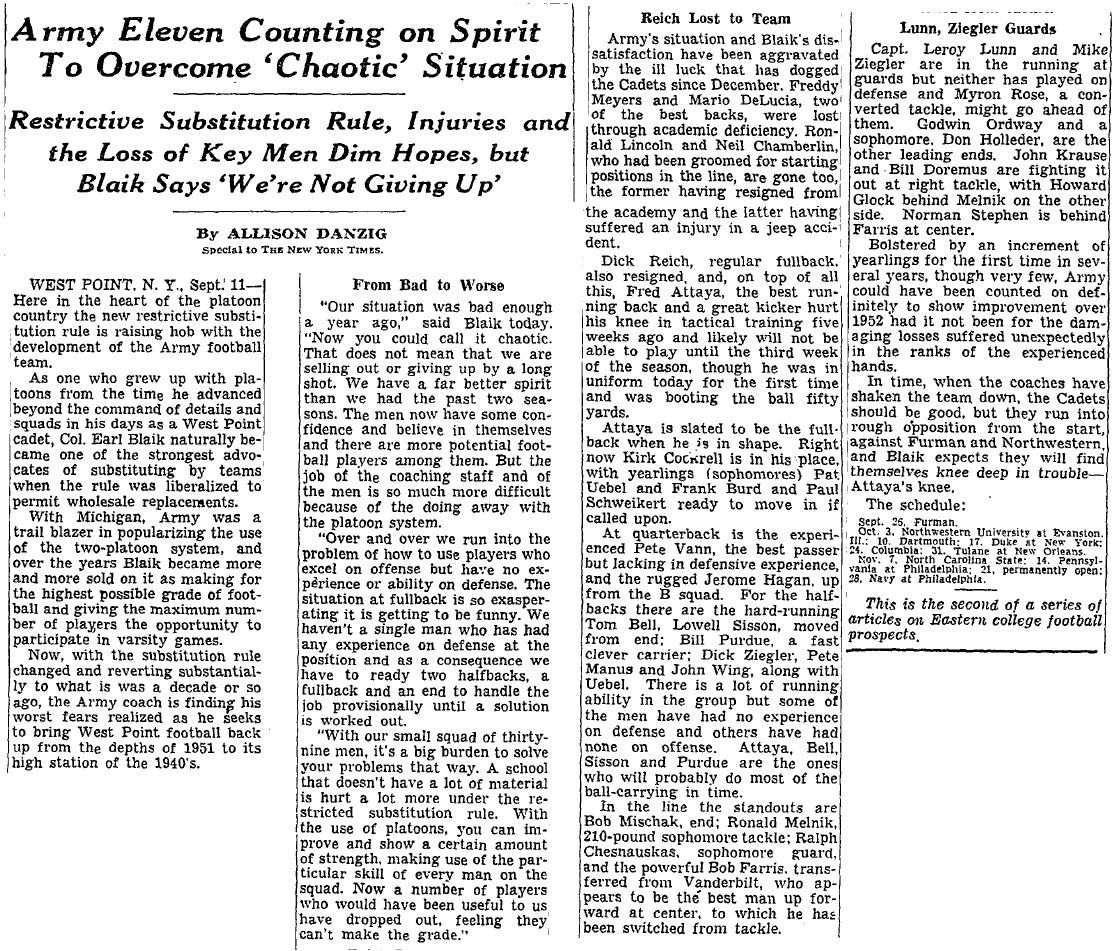
ArmyFB_1953_forecast_NYT_Sep121953
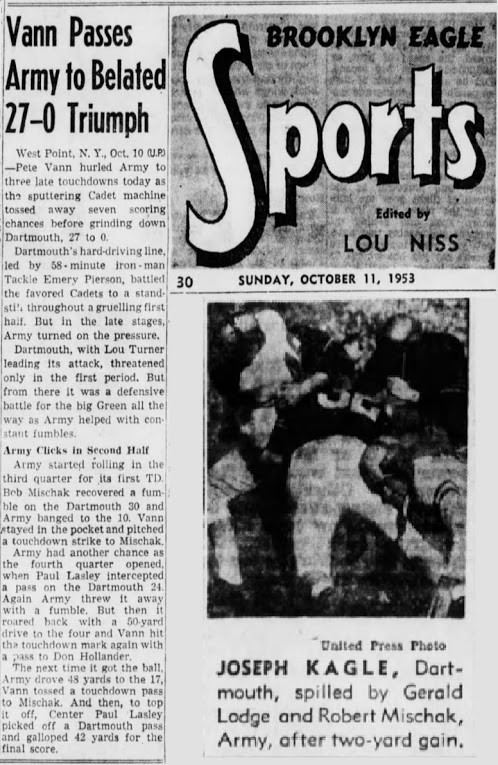
ArmyFB_1953_vsDartmouth_BrooklynDailyEagle_Oct111953
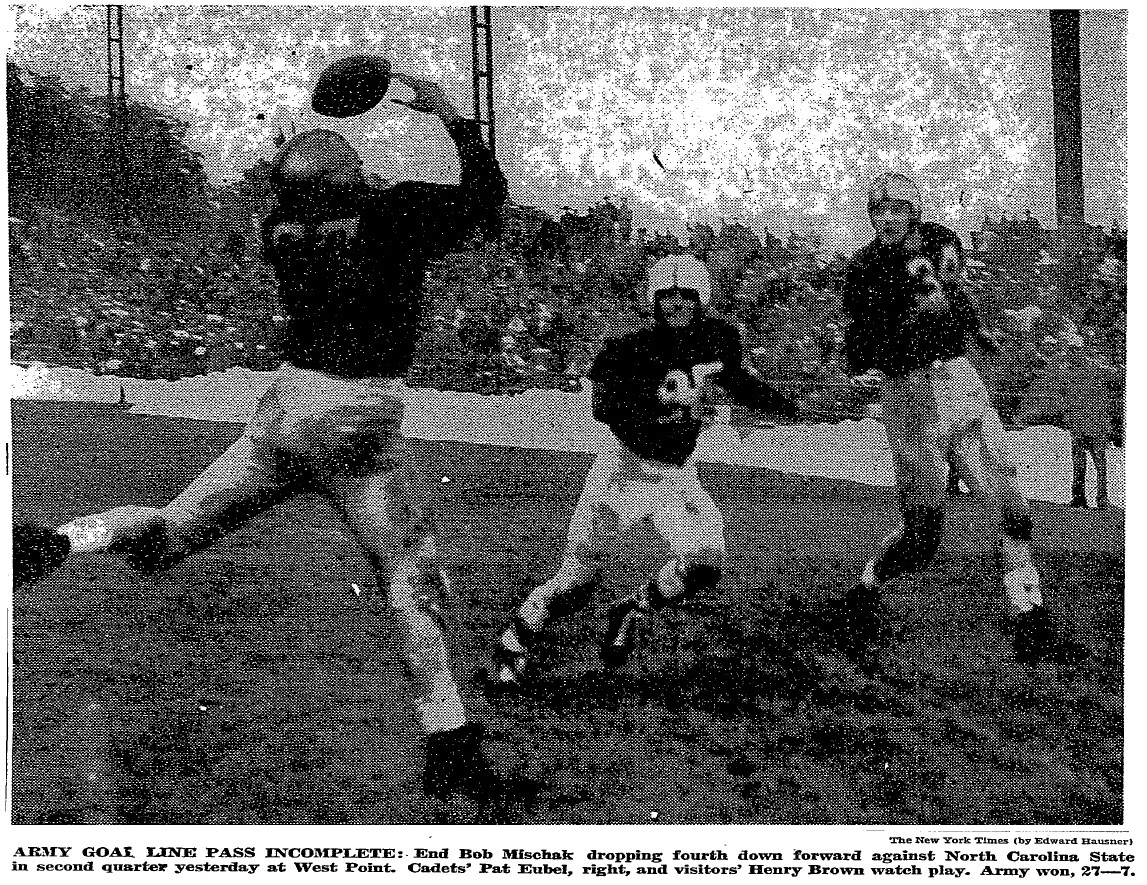
ArmyFB_1953_vsNCState-Mischak_Nov81953
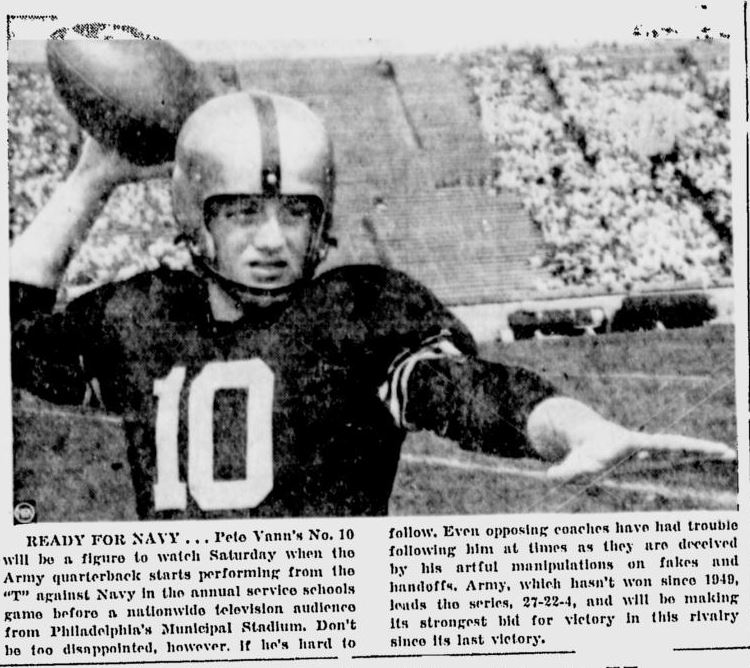
ArmyFB_1953_PeteVann_StJosephGazette_Nov261953
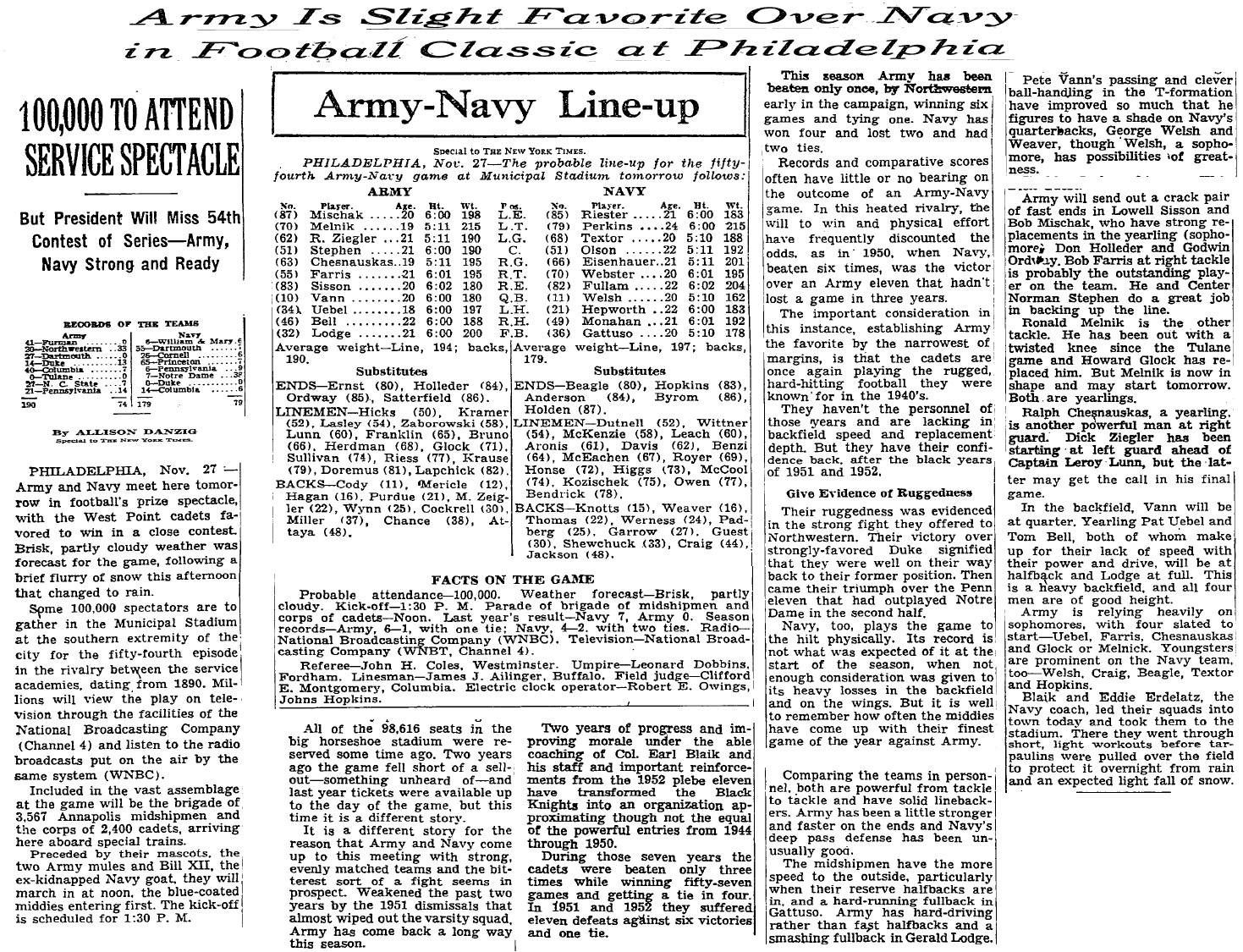
ArmyFB_1953_vsNavy-preview_NYT_Nov281953
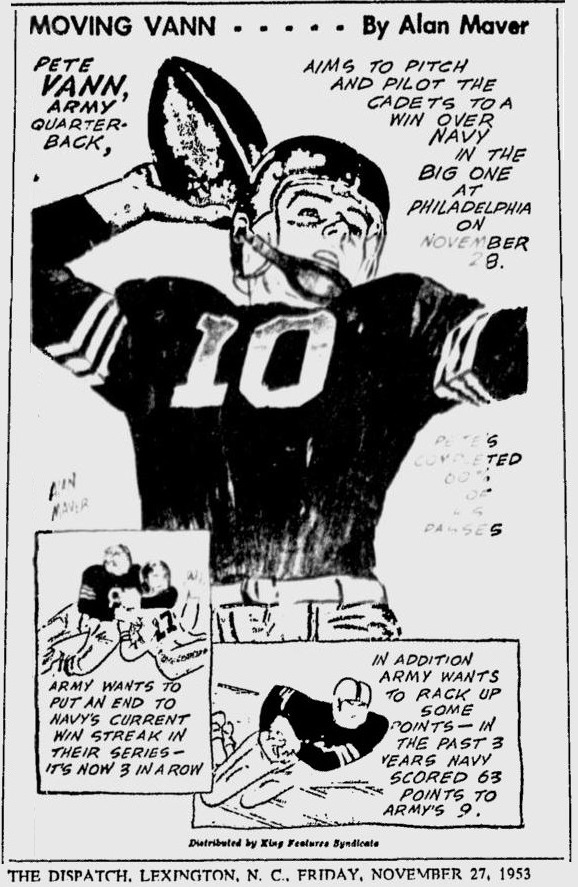
ArmyFB_1953_PeteVann_byAlanMaver_TheDispatchNC_Nov281953
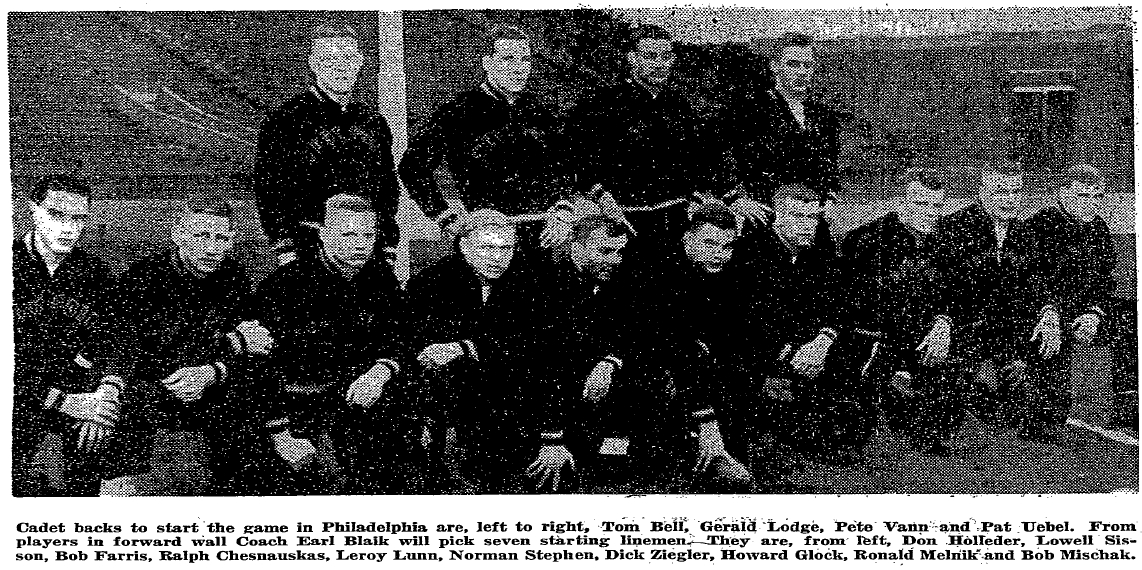
ArmyFB_1953_vsNavy-starters_NYT_Nov281953
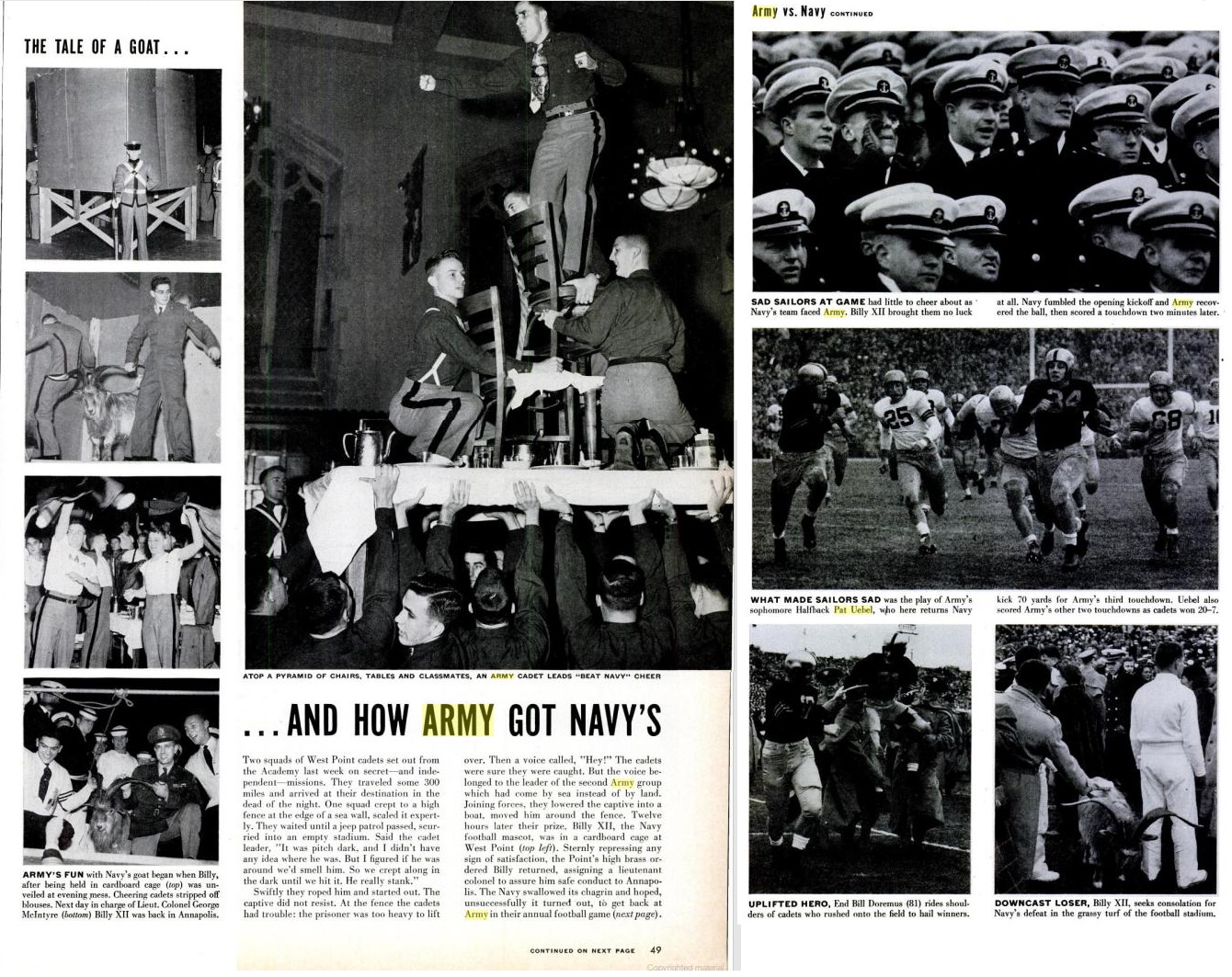
ArmyFB_1953_vsNavy_Life_Dec71953
http://books.google.com/books?id=O0kEAAAAMBAJ&lpg=PP1&pg=PA49#v=onepage&q&f=false
–
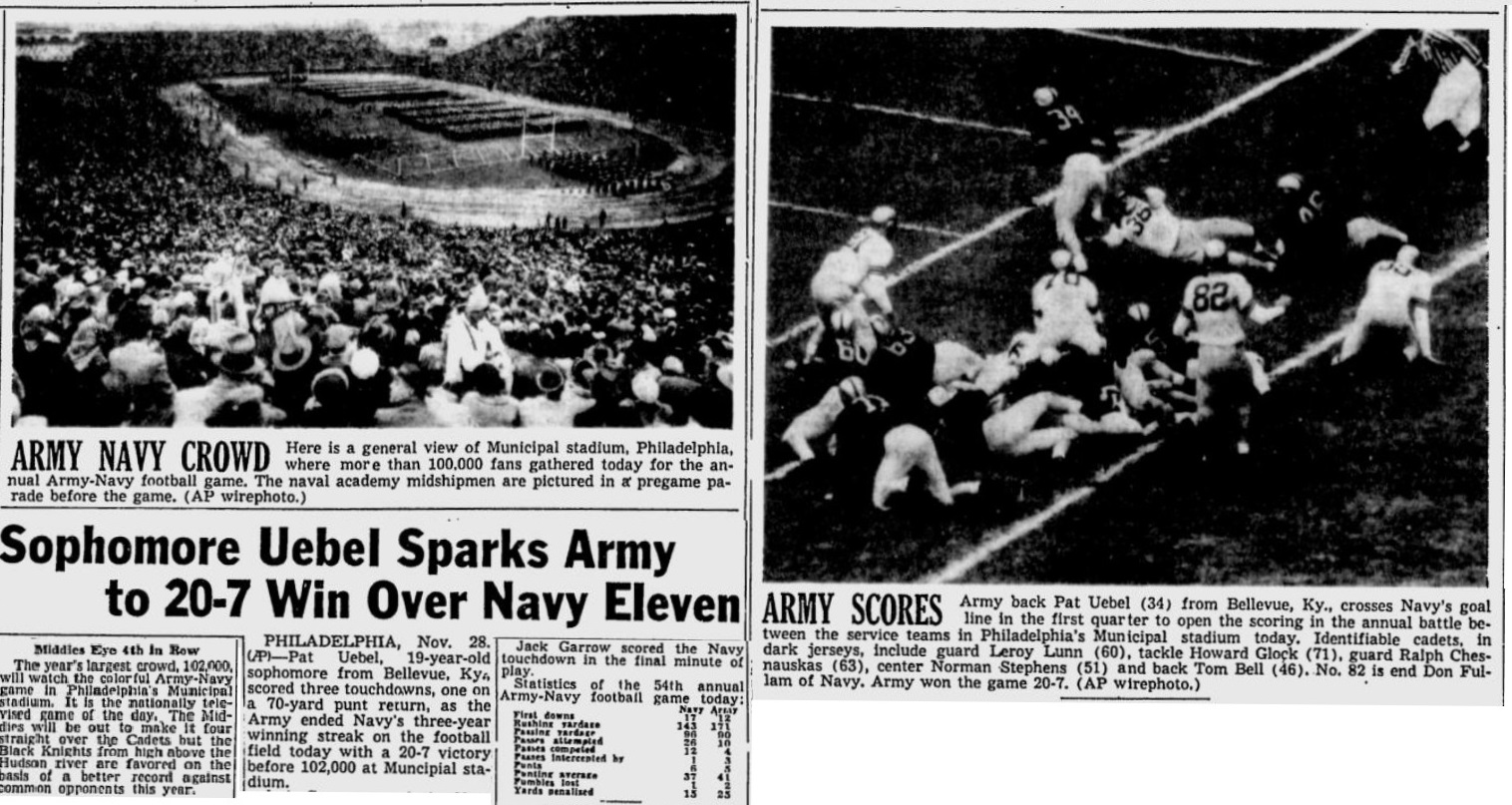
ArmyFB_1953_vsNavy_SpokaneDailyChronicle_Nov281953
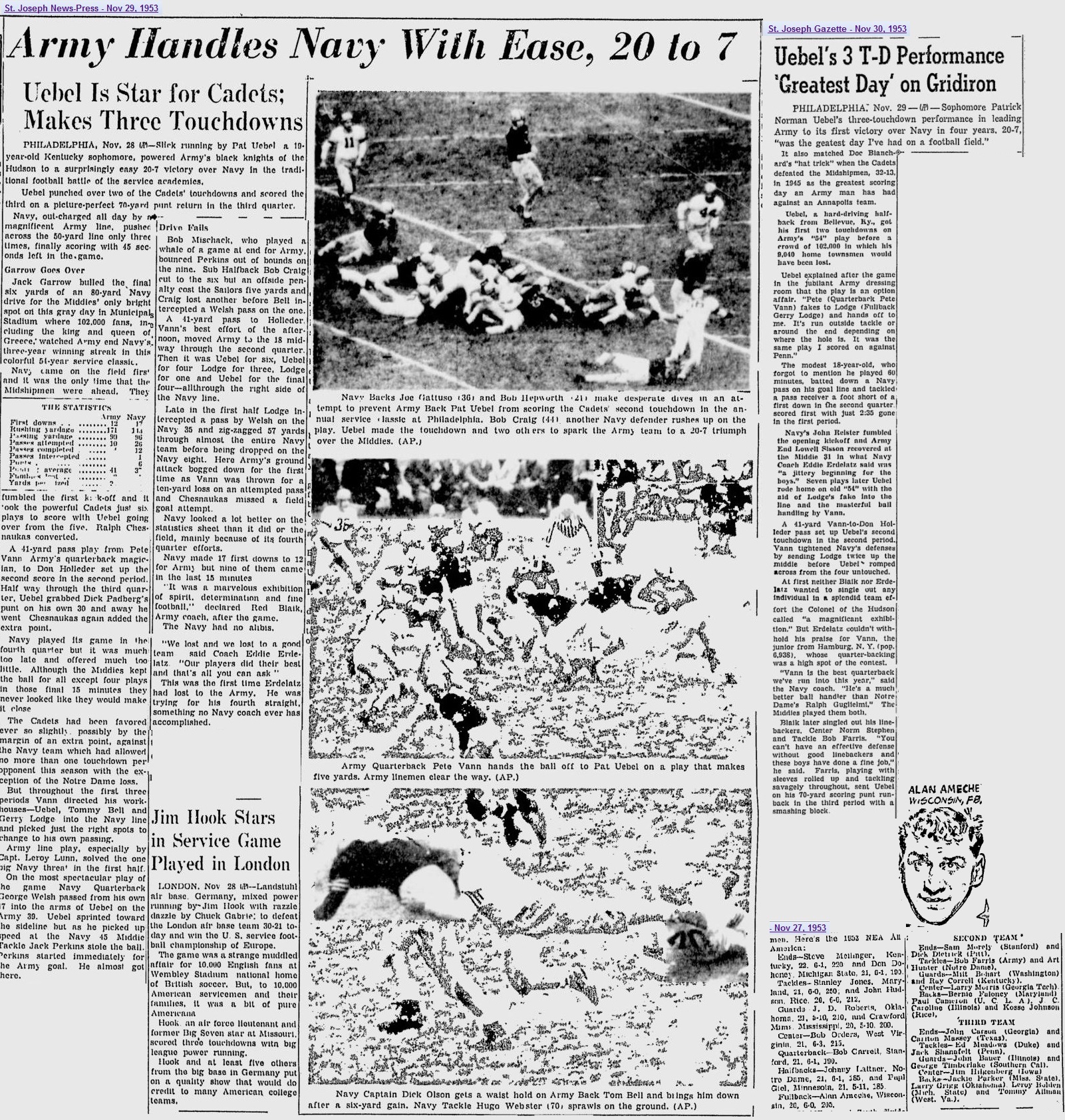
ArmyFB_1953_vsNavy_StJosephNews-Press_Nov291953
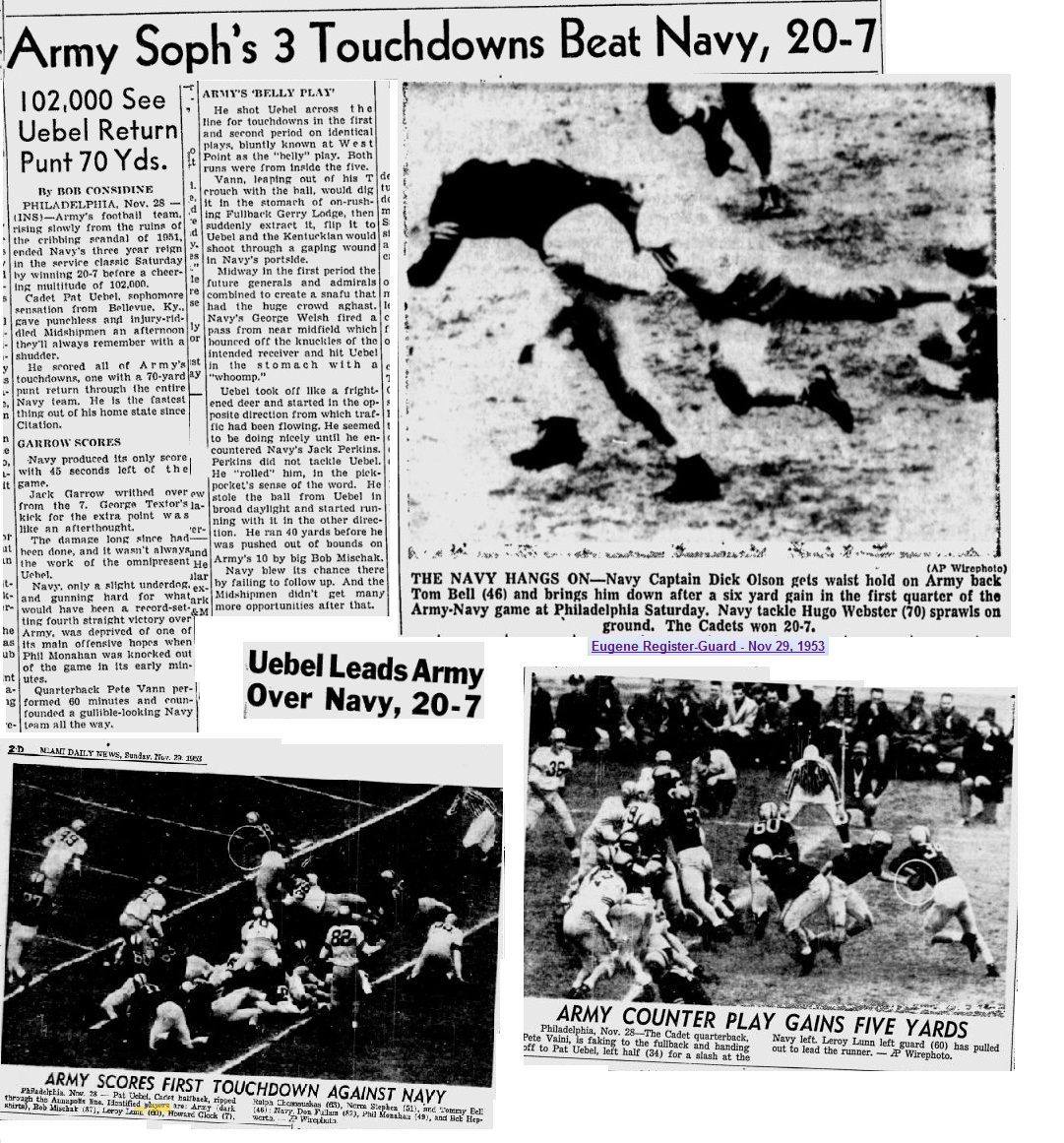
ArmyFB_1953_vsNavy_MilwaukeeSentinel_Nov291953
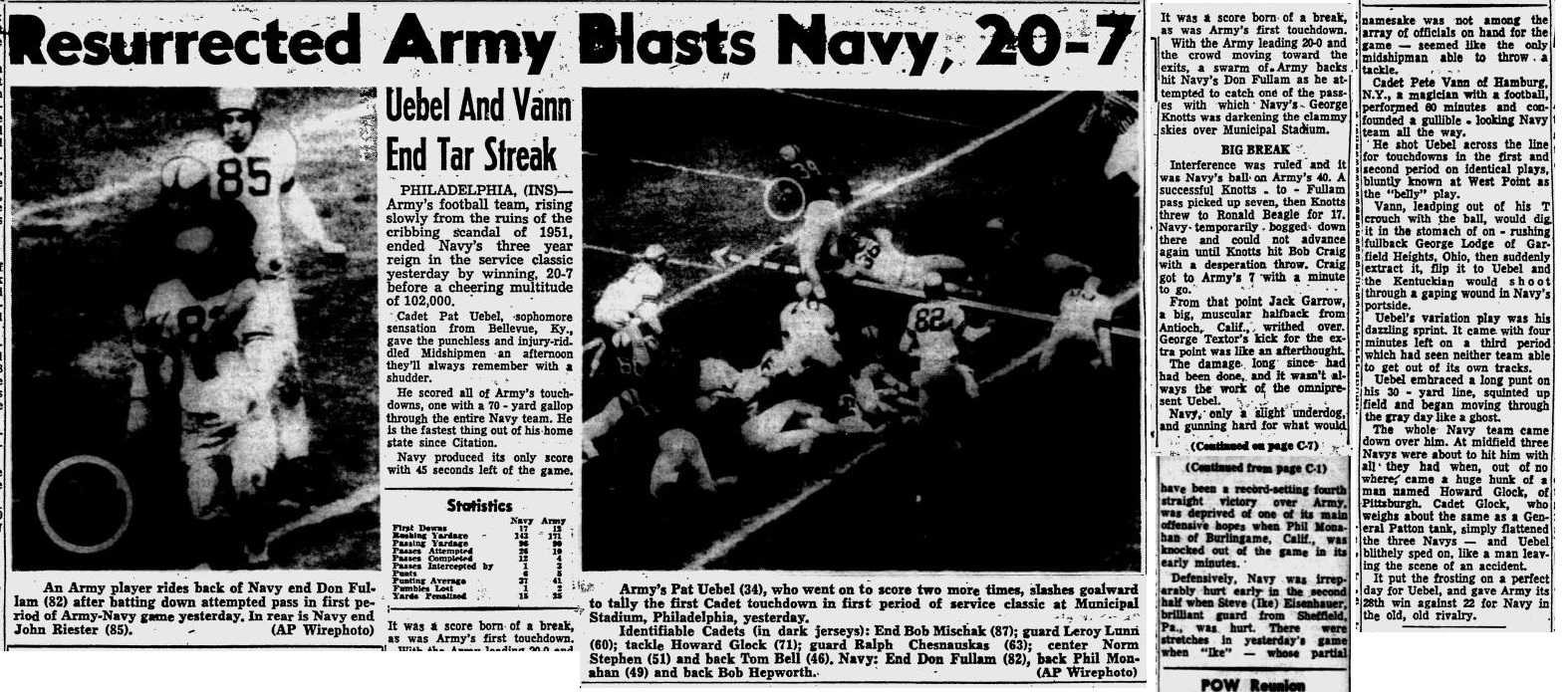
ArmyFB_1953_vsNavy_StPetersbrugTimes_Nov291953
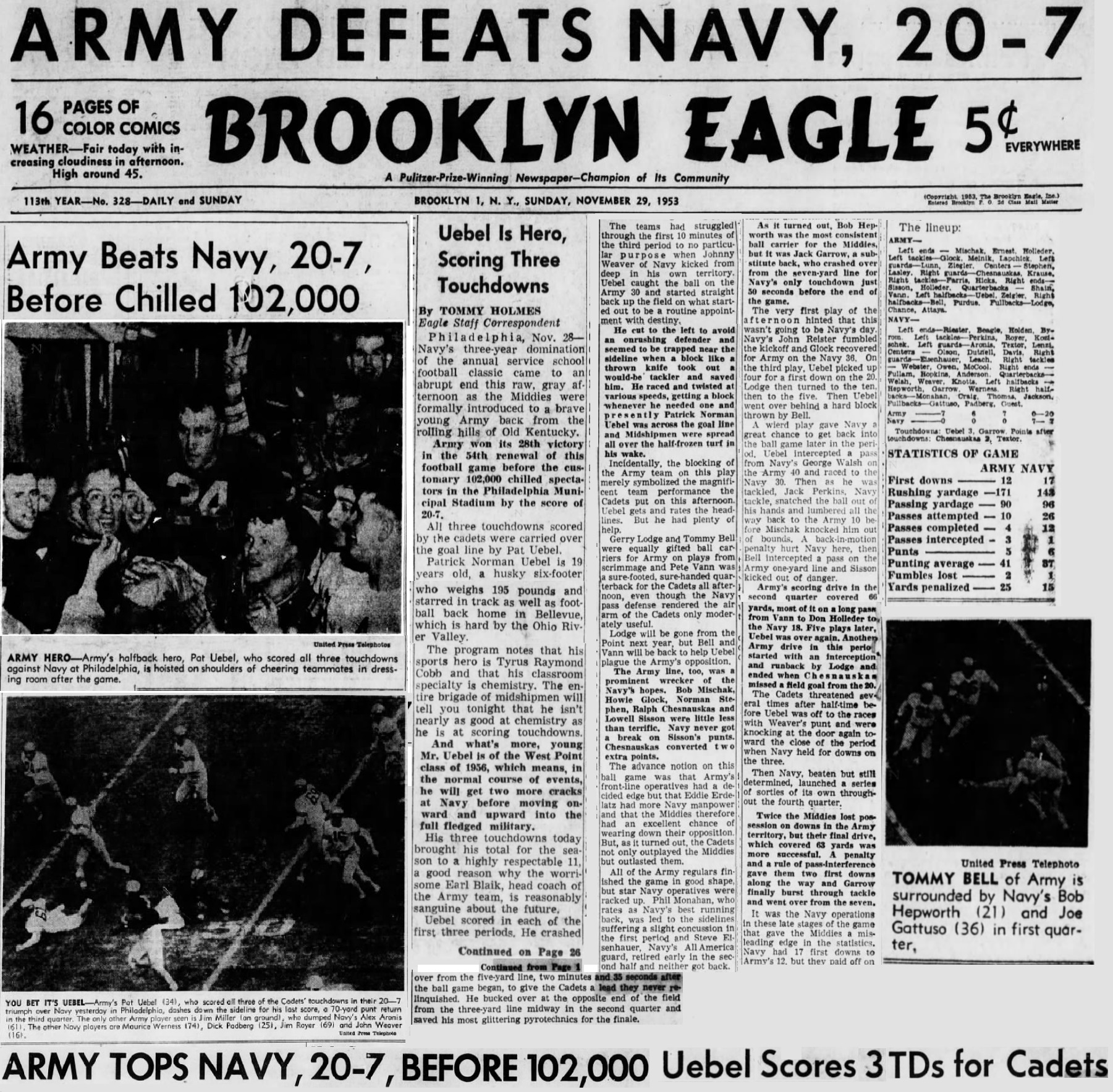
ArmyFB_1953_vsNavy_BrooklynDailyEagle_Nov301953
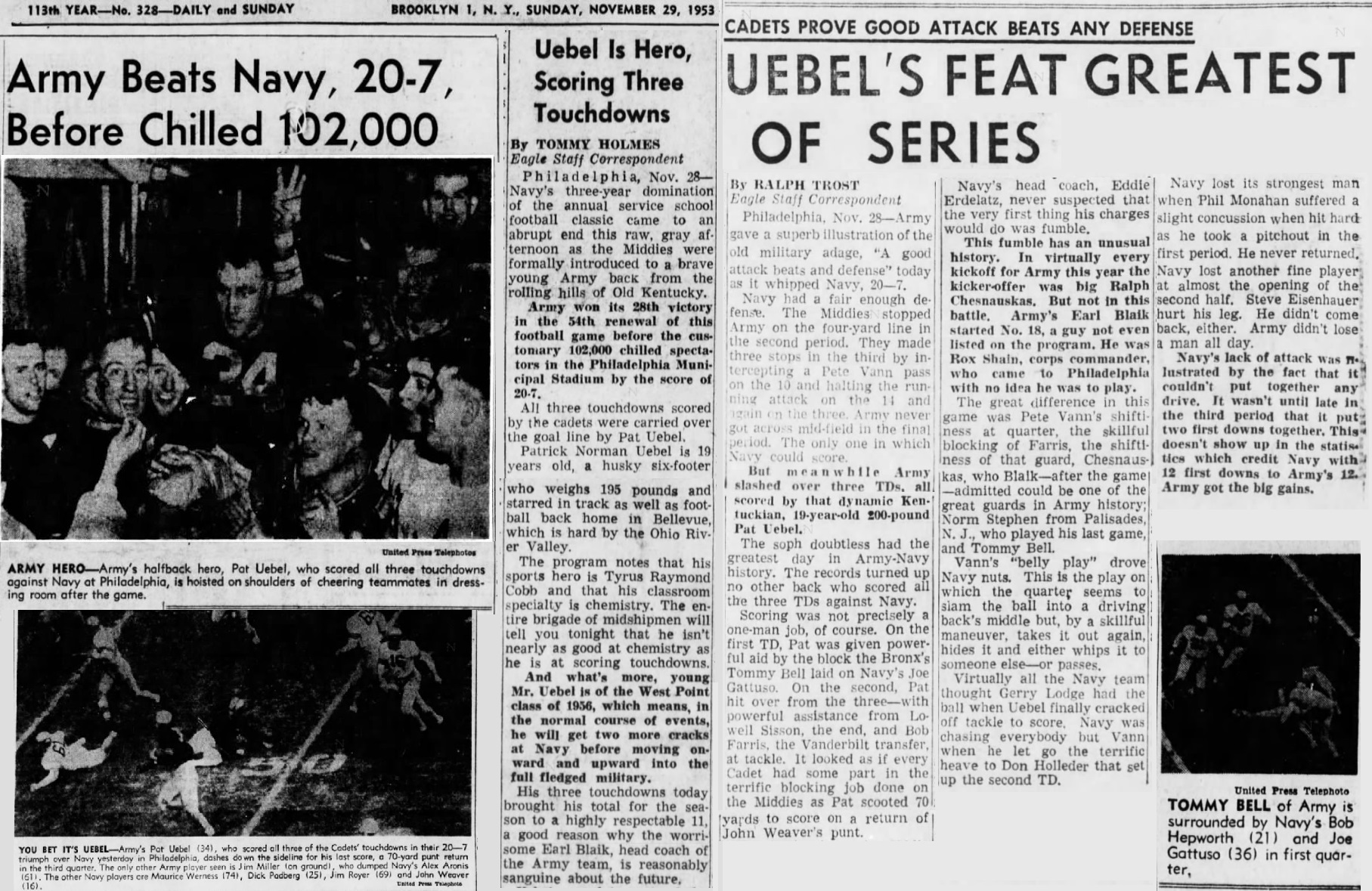
ArmyFB_1953_Uebel_3TDs_BrooklynDailyEagle_Nov301953
Photos


Complete
–
–
1945 Army 9-0 AP#1
09/29 Army 32 – Louisville Field 0
10/06 Army 54 – Wake Forest 0
10/13 Army 28 – Michigan 7
10/20 Army 55 – Melville PT Boats 13
10/27 Army 48 – Duke 13
11/03 Army 54 – Villanova 0
11/10 Army 48 – Notre Dame 0
11/17 Army 61 – Pennsylvania 0
12/01 Army 32 – Navy 13 W Philadelphia, PA
Unanimous choice for the nation’s number one team by the 116 voters in the Associated Press writers’ poll. The runner up was Navy.
Coach: Earl Henry “Red” Blaik (February 15, 1897 – May 6, 1989)
Dartmouth 1934-1940 – 45-15-4
Army: 1941-1958 – 121-33-10
Overall: 166-48-14
Awards:
All-American, 1919
AFCA Coach of the Year (1946)
College Football Hall of Fame, Inducted in 1964
Howitzer 1946 – not available online
–
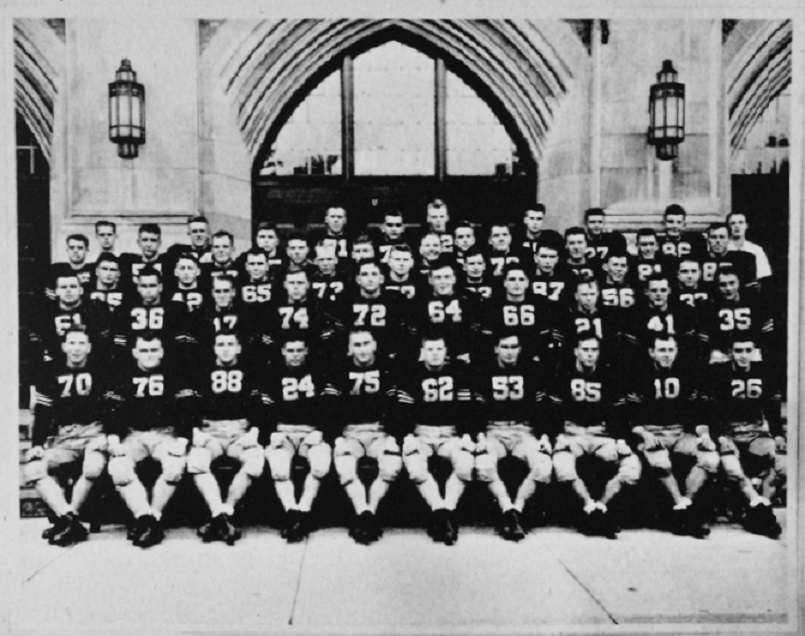
ArmyFB_1945_team-NationalChamps_AssemblyJan46
–
–
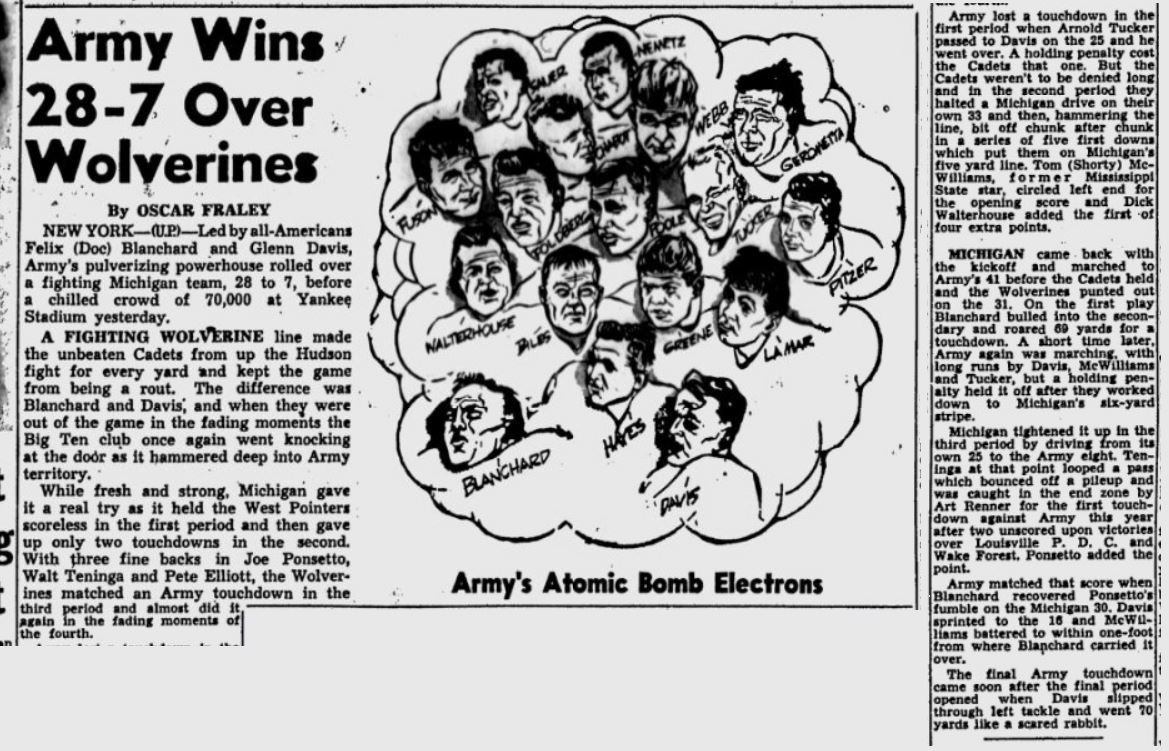
ArmyFB_1945_vsMichigan_StPetersburgTimes_Oct141945
–
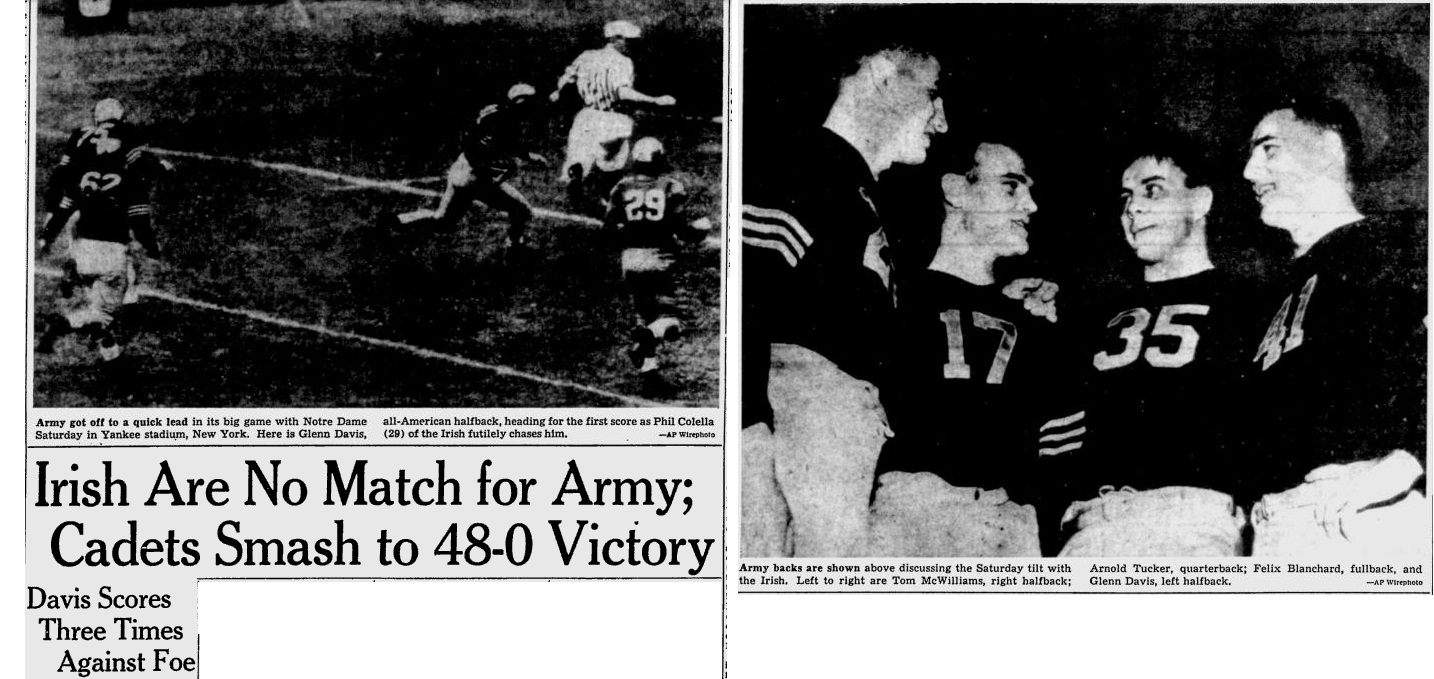
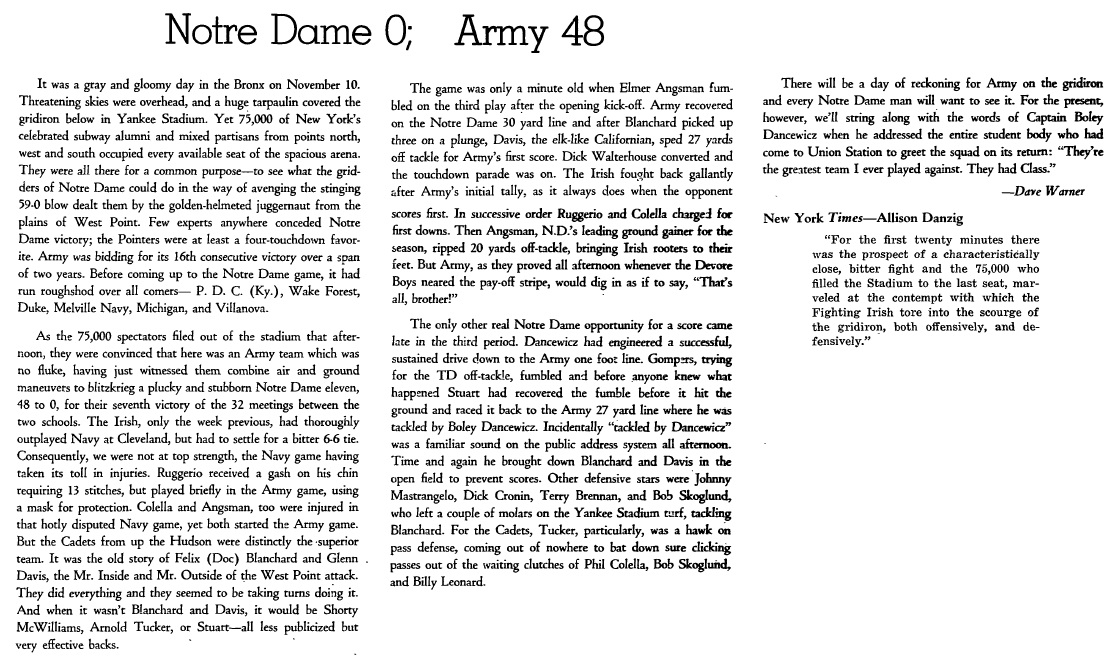
ArmyFB_1945_vsNotreDame_MilwaukeeJournal_Nov101945
–

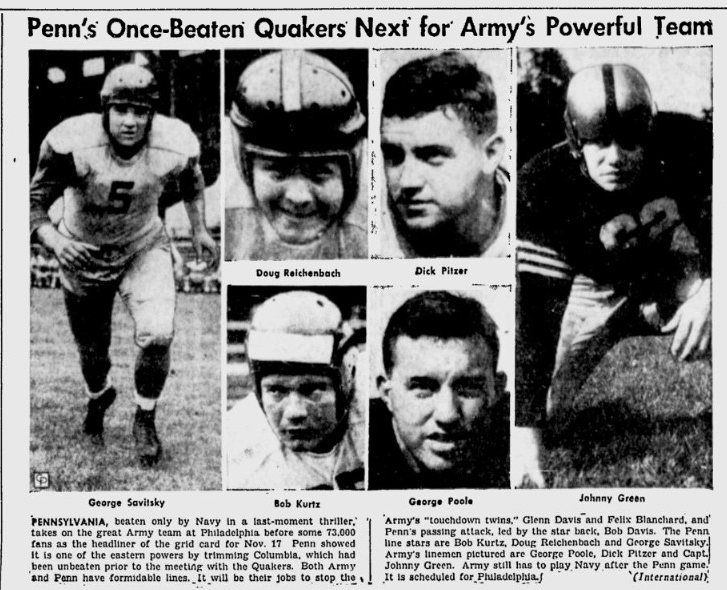
ArmyFB_1945_vsPenn-Linemen_DailyTimesPa_Nov151945
–
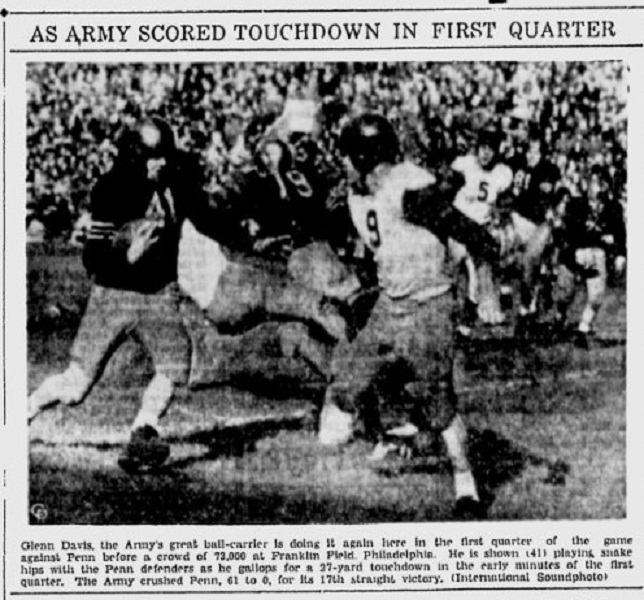
ArmyFB_1945_vsPenn-GlennDavis_DailyTimes_Nov171945
–
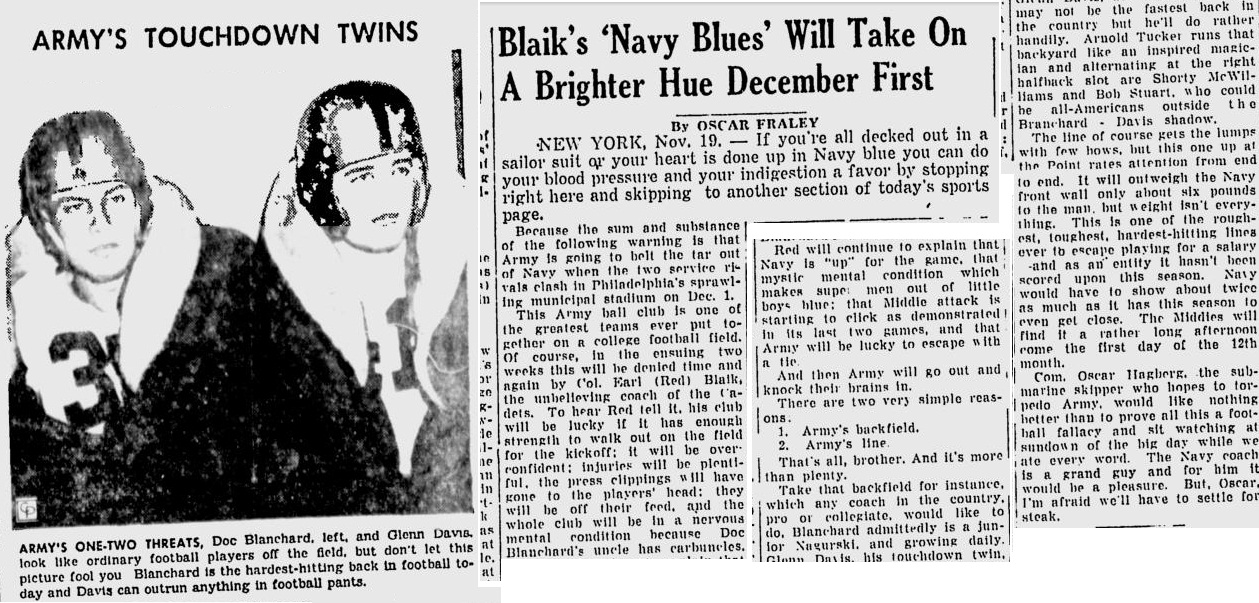
ArmyFB_1945_Blanchard-Davis_PainesvilleTelegraph_Nov191945
–
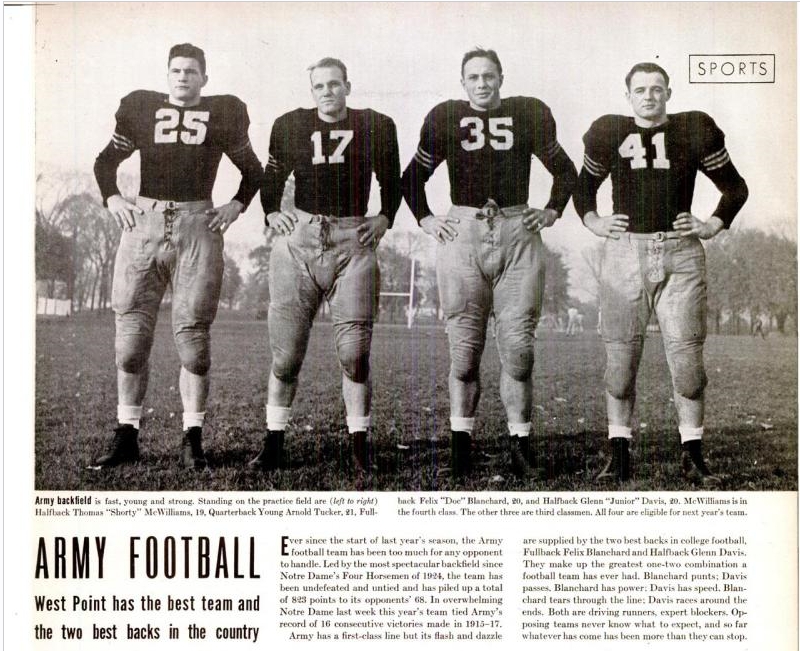
ArmyFB_1945_backs_LIFE_Nov191945
–
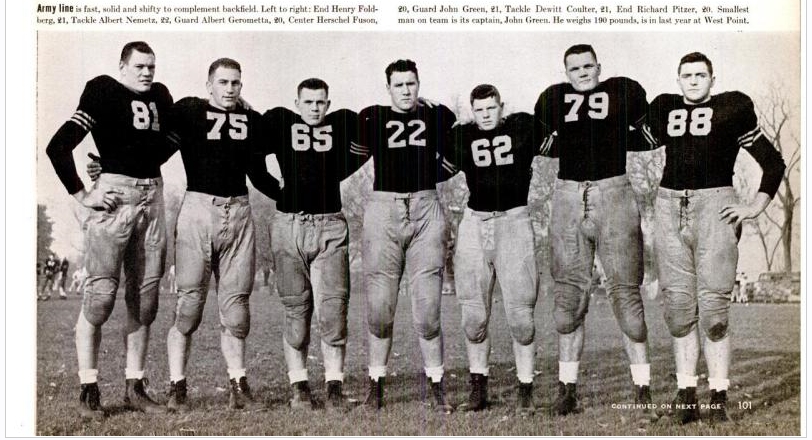
ArmyFB_1945_line_LIFE_Nov191945
–
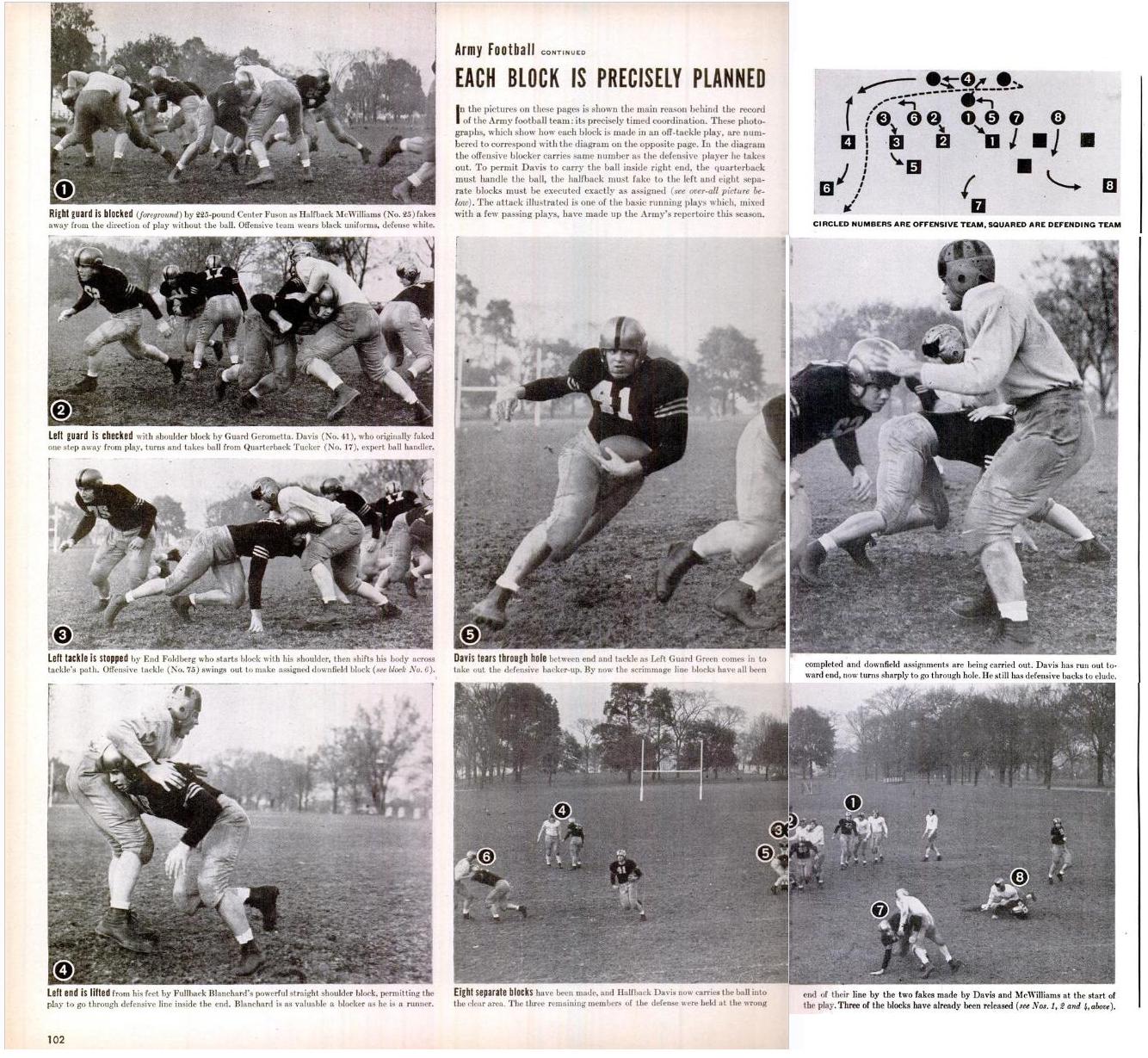
ArmyFB_1945_plays_LIFE_Nov191945
–
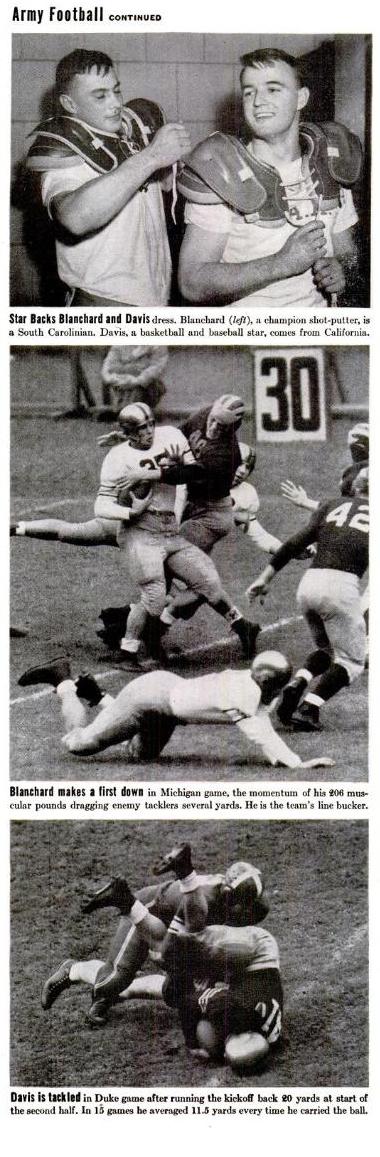
ArmyFB_1945_BandD_LIFE_Nov191945
–
News Articles
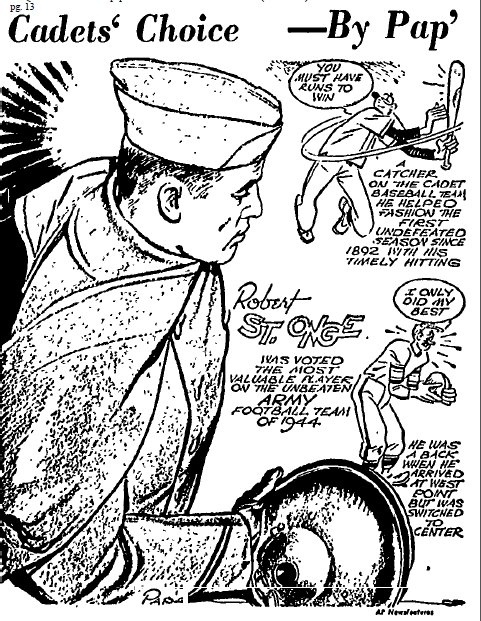
ArmyFB_1945_RobertStOnge_byPap_CSM_Jun111945
–
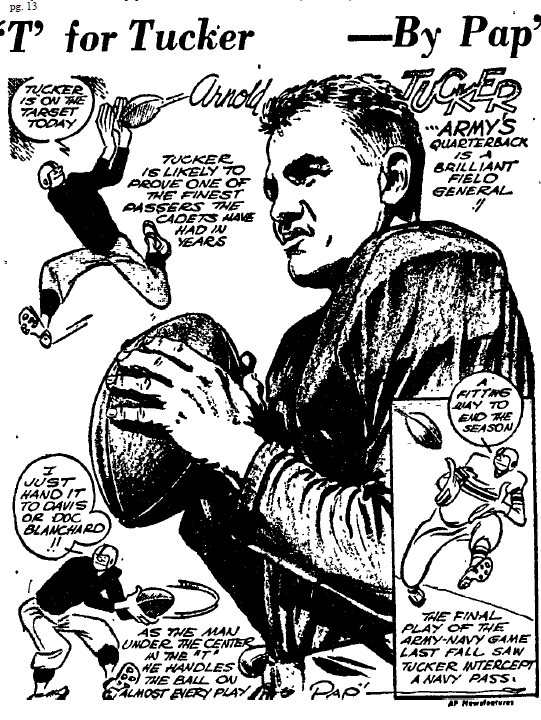
ArmyFB_1945_ArnoldTucker_byPap_CSM_Oct131945
–
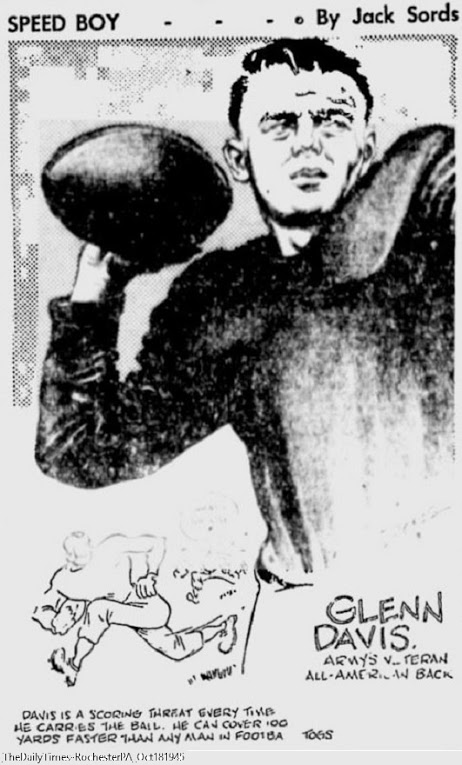
–
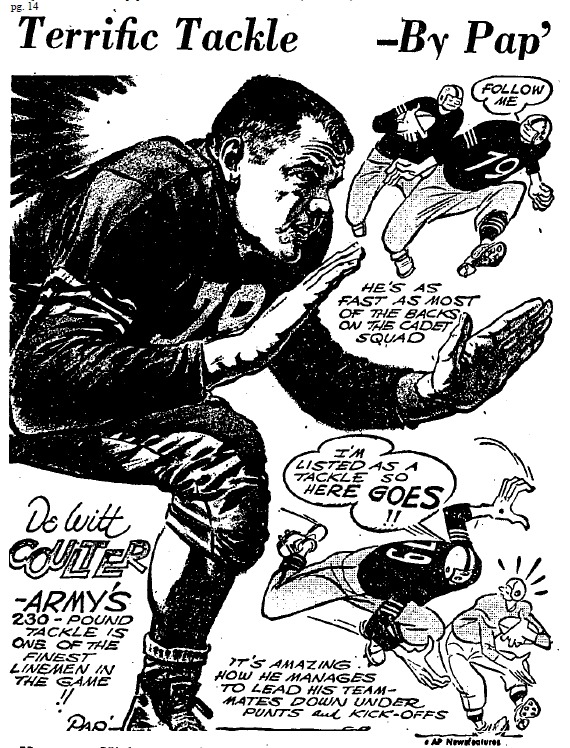
ArmyFB_1945_DewittTEXCoulter_byPap_CSM_Nov61945
–
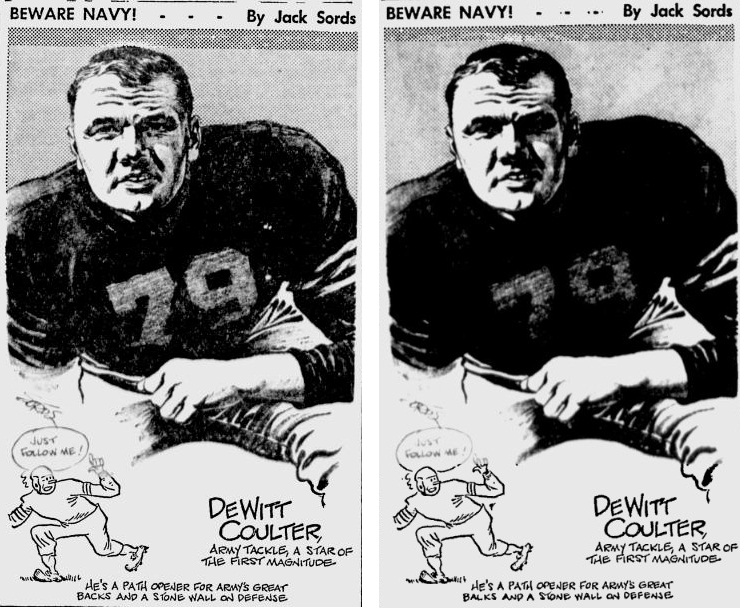
ArmyFB_1945_DewittCoulter_byJackSords_PainesvilleTelegraph_DailyTimesPa_Nov17-23-241945
–
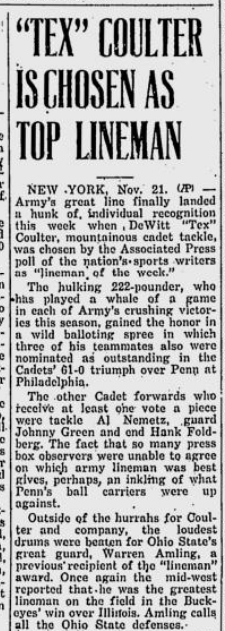
ArmyFB_1945_TexCoulter_PrescottEveneingCourier_Nov231945
–
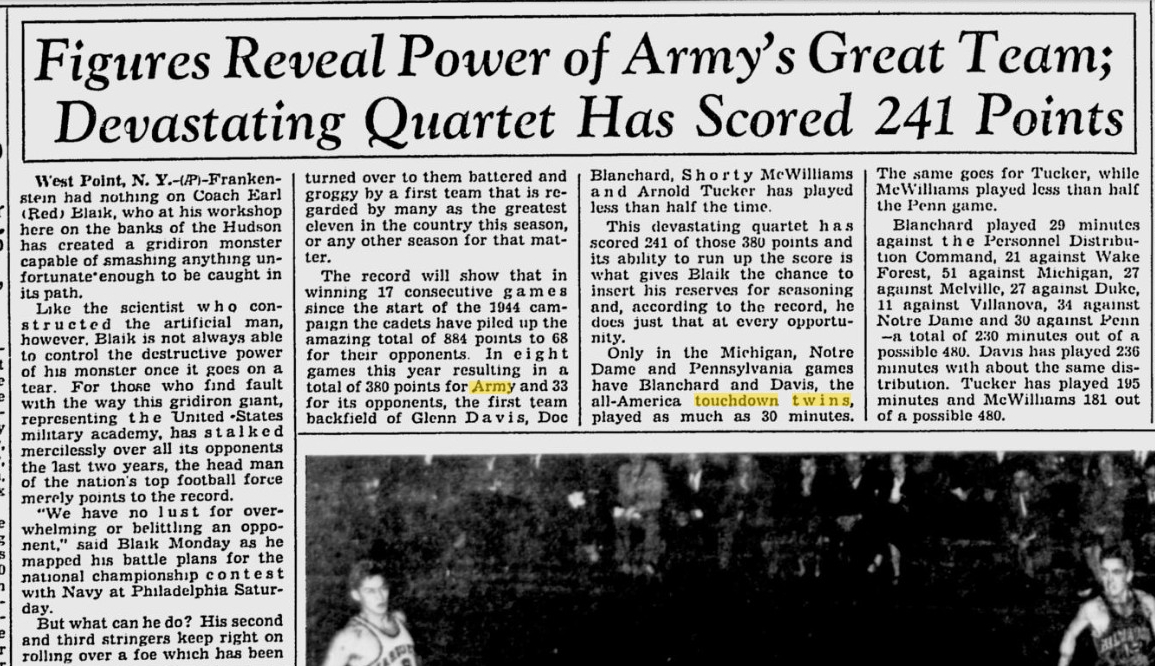
ArmyFB_1945_GreatestTeam_MilwaukeeJournal_Nov271945
–
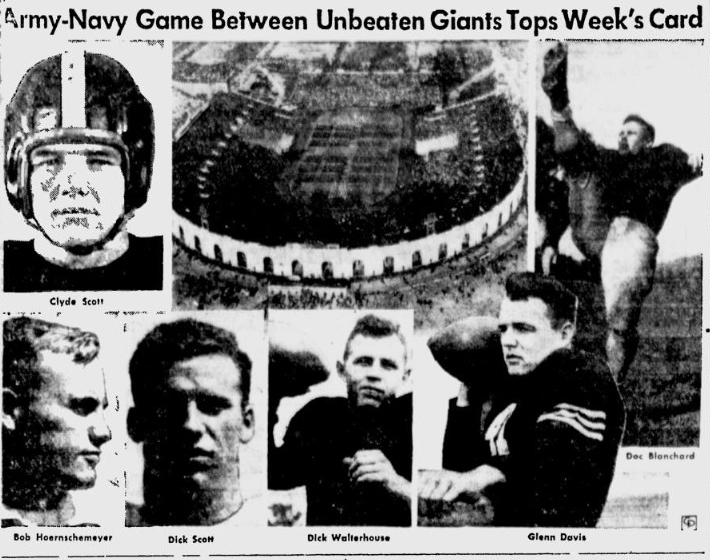
ArmyFB_1945_vsNavy_PainesvilleTelegraph_Nov291945
–
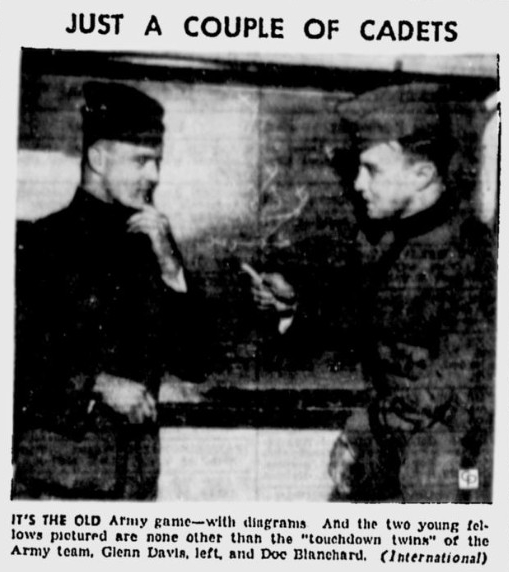
ArmyFB_1945_Blanchard-Davis_GreensburgDailyTribune_Nov291945
–
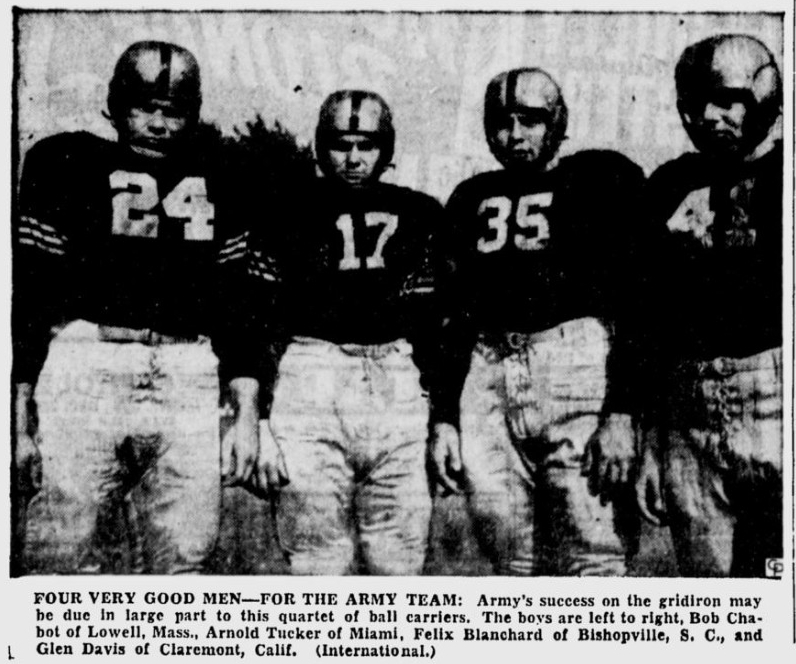
ArmyFB_1945_Backfield_DeseretNews_Nov301945
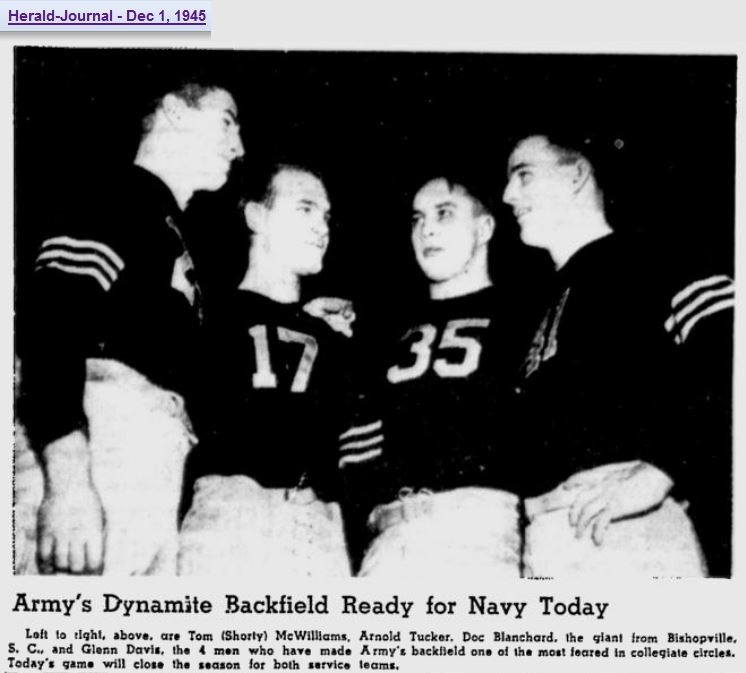
ArmyFB_1945_BackfieldvsNavy_Herald-Tribune_Dec11945
–
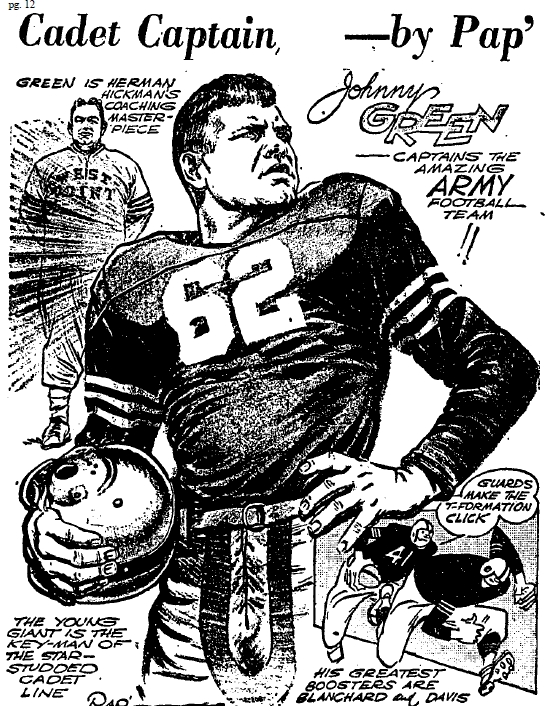
ArmyFB_1945_JohnGreen_byPap_CSM_Nov301945
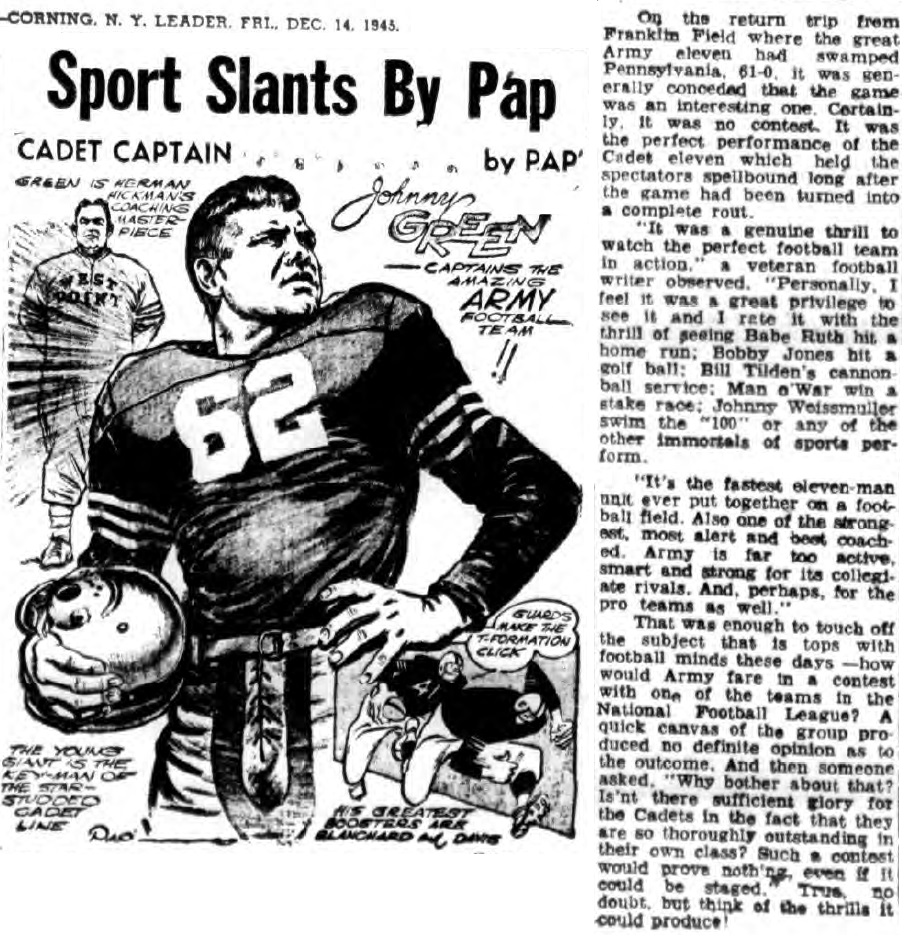
ArmyFB_1945_JohnGreen_byPap_CorningNYLeader_Dec141945
–
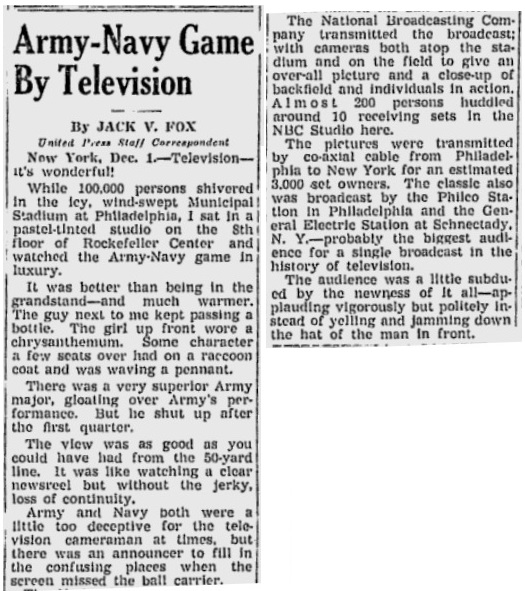
ArmyFB_1945_onTV_vsNavy_SundayMorningStar_Dec21945
–
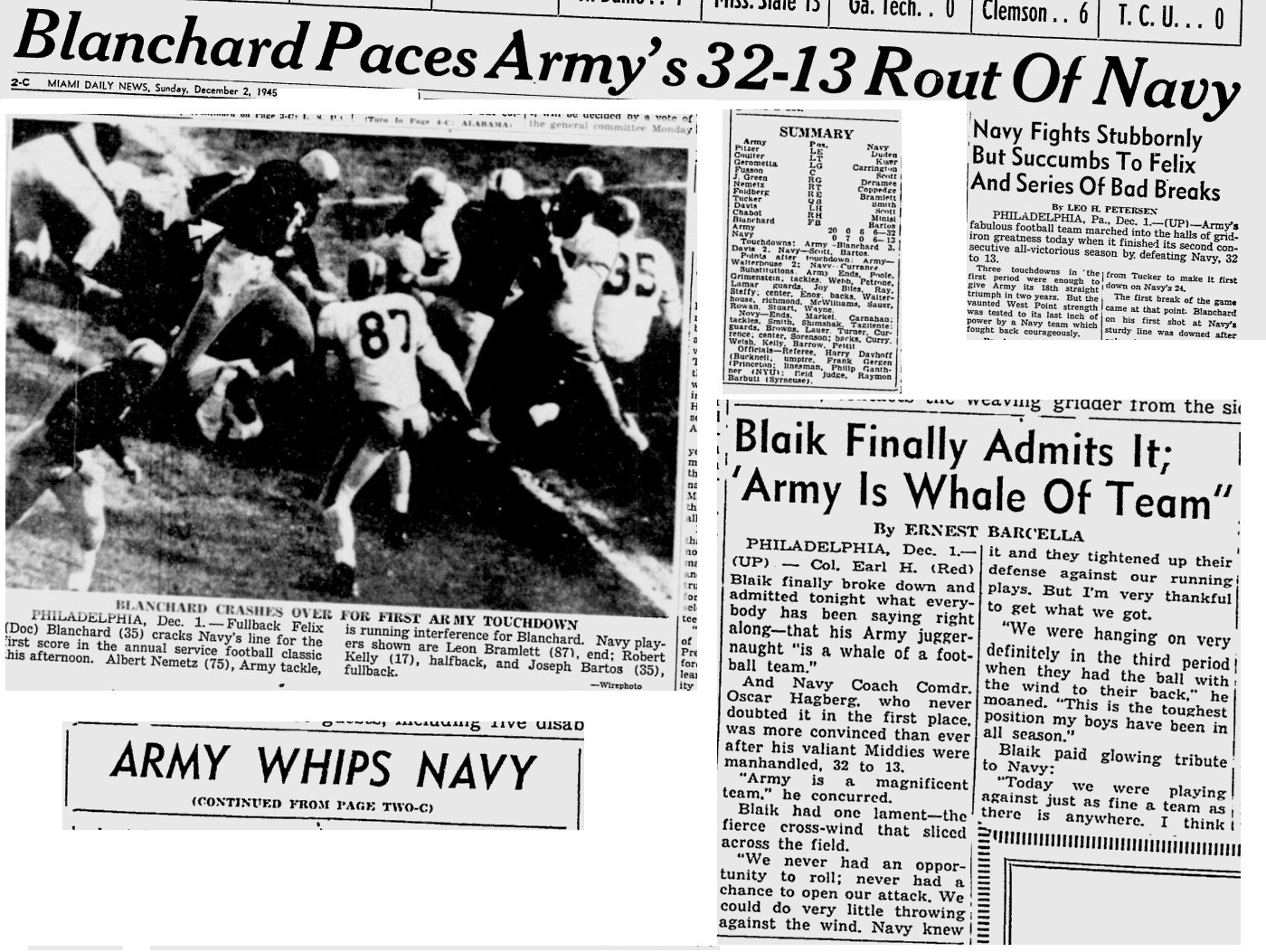
ArmyFB_1945_vsNavy_MiamiNews_Dec21945
–
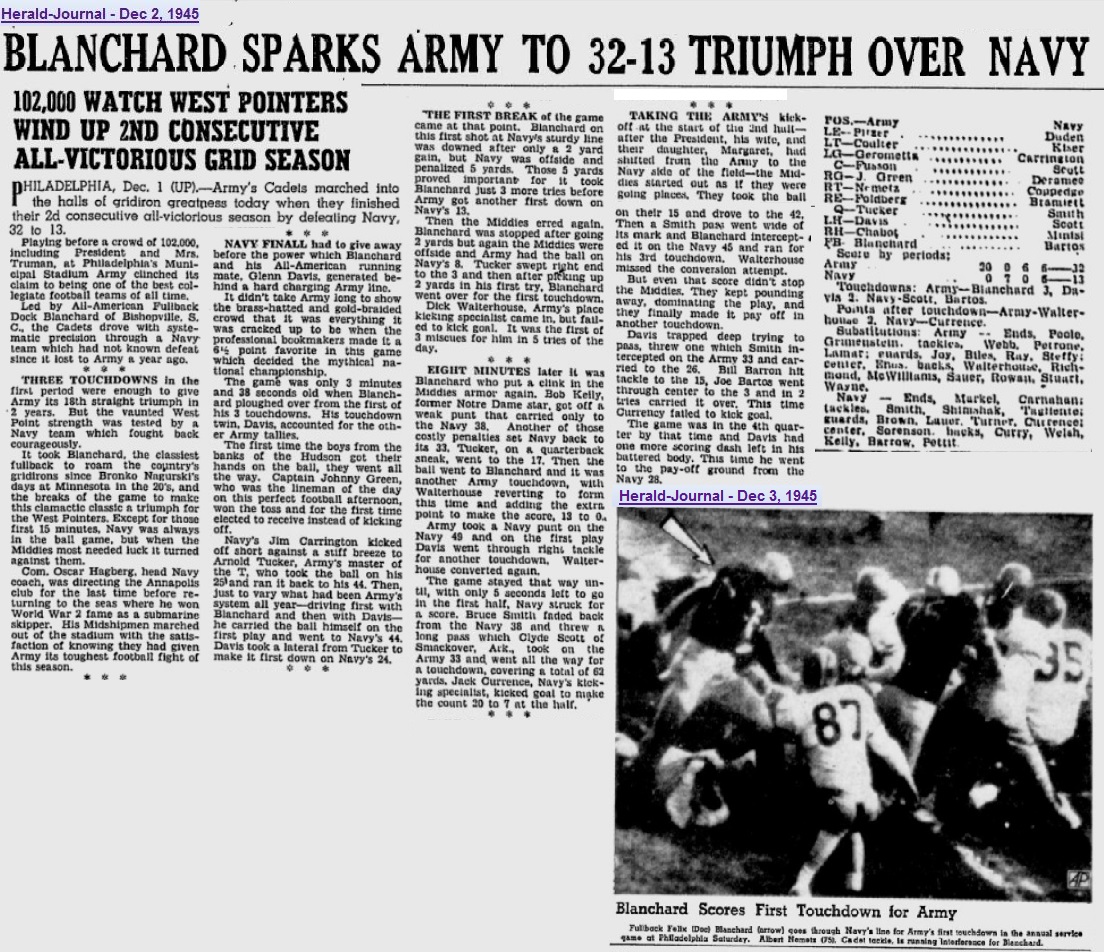
ArmyFB_1945_vsNavy_Herald-Tribune_Dec21945
–
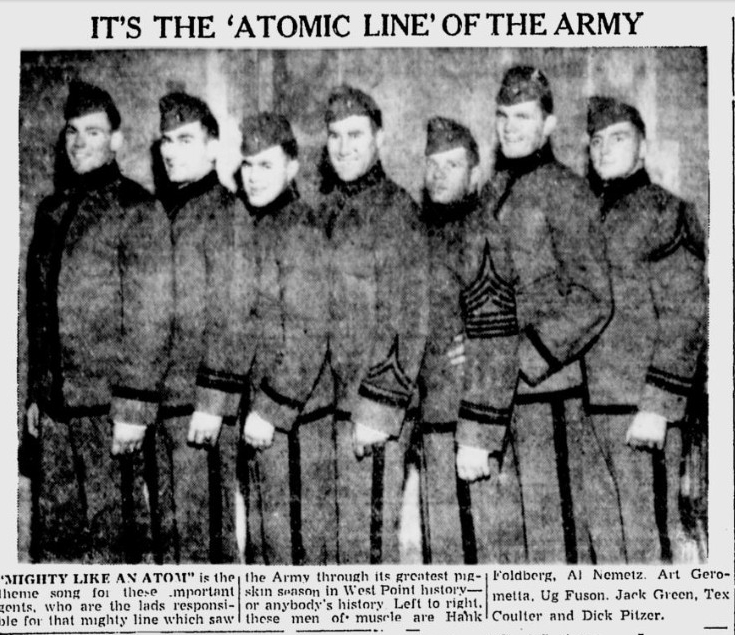
ArmyFB_1945_Line_PainesvilleTelegraph_Dec61945
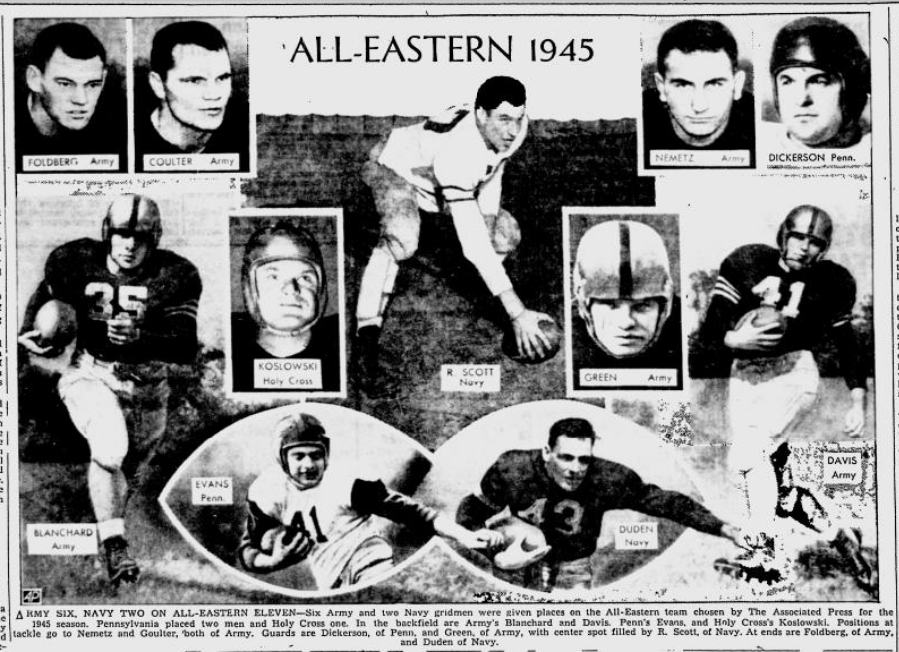
ArmyFB_1945_All-Eastern_NewsandCourier_Dec51945
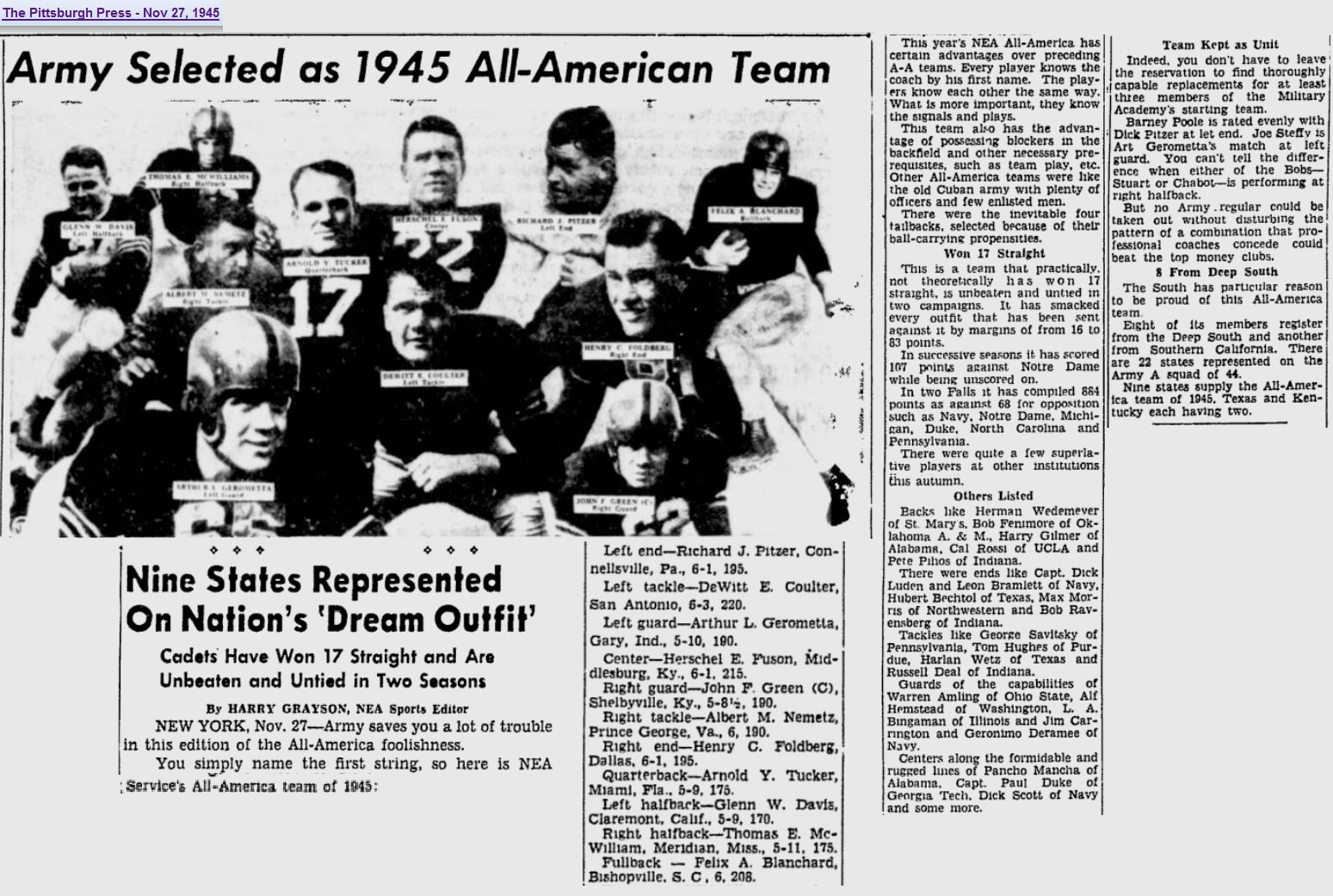
NEA_1945_All-AmericanTeam_EntireArmyFirstTeam_PittsburghPress_Nov271945
–
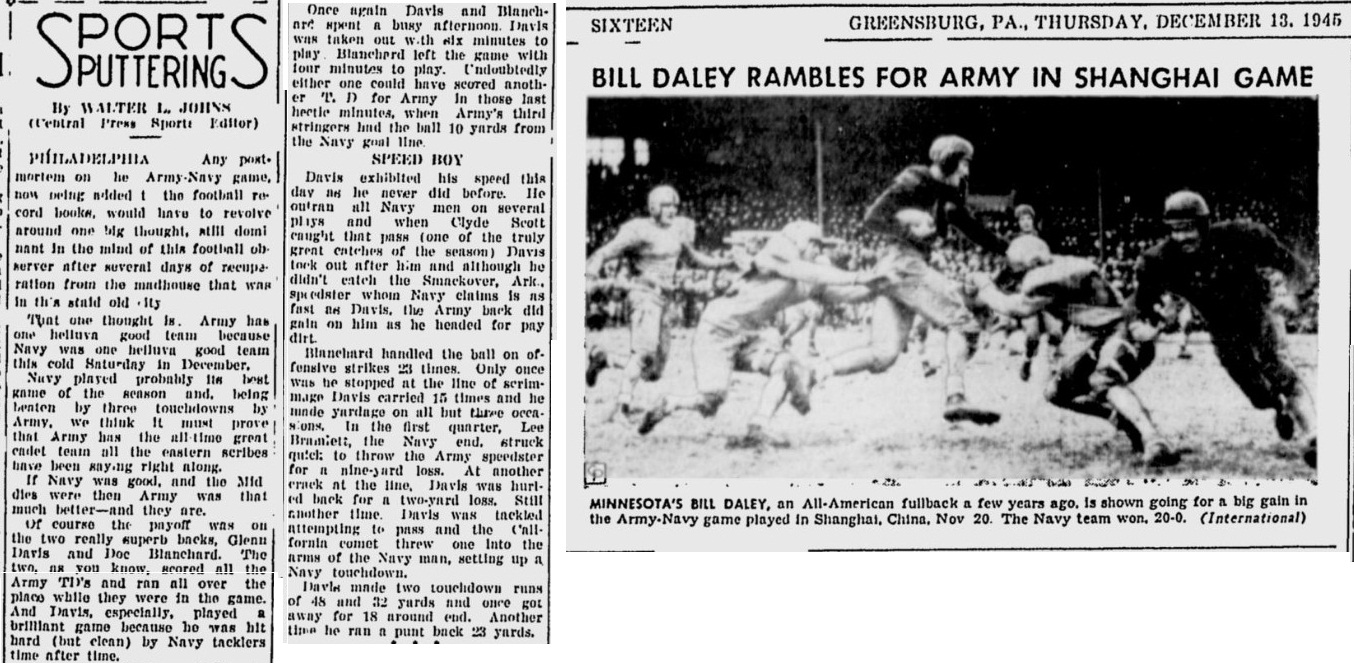
ArmyFB_1945_vsNavy-ServiceGameinShanghaiChina_GreensburgDailyTribune_Dec131945
–
A closeup of the team in 1945 (misleading title) – awesome highlight film by legendary sportscaster Bill Stern
–
–
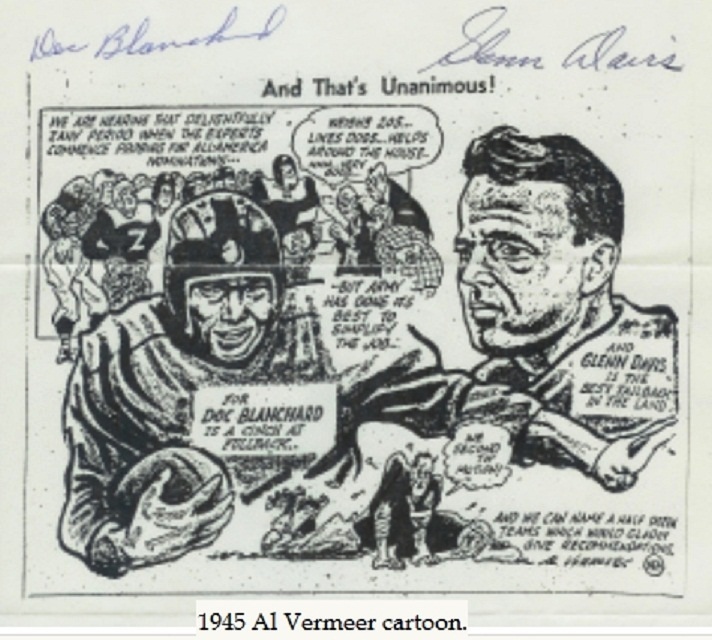
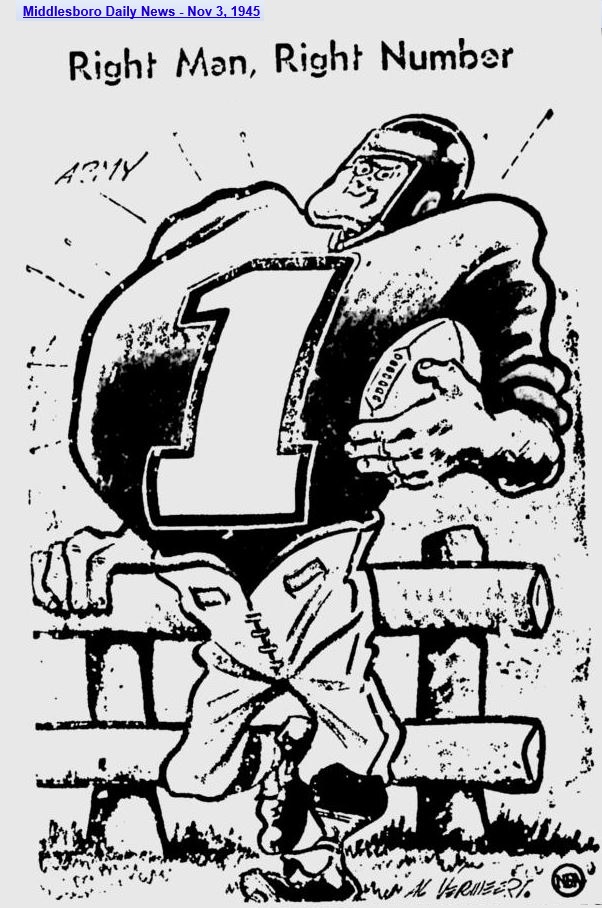
ArmyFB_1945_DocBlanchard-GlennDavis_byAlVermeer


–
________________________________________________________________
Football’s Greatest Decade by Bernie Mcarty
http://www.la84foundation.org/SportsLibrary/CFHSN/CFHSNv01/CFHSNv01n1b – see page 5
This writer (Bernie Mcarty) believes West Point 1945 is the greatest team of all time. The 1944 Army team may actually deserve that title, but it was never tested. Army was also undefeated in 1946, 1948 and 1949.
Army’s top stars during 1945-1949 were the effulgent “Touchdown Twins”, Glenn Davis and “Doc” Blanchard, Arnold Tucker, Arnold Galiffa, “Rip” Rowan, Bobby Jack Stuart and Gil Stephenson in the back-field, and up front Joe Steffy, Art Gerometta, Jack Green, Bill Yoemans, Joe Henry “Tex” Coulter, Al Nemetz, and the sterling end duo of Hank Foldberg and Barney Poole.
In 1945 the Newspaper Enterprise Assoc. simply picked the entire Army team as its All-American team, stating no group of All-Americans could beat the Cadets.
Only a world war could have brought together such a collection of players to one institution. But it took the coaching genius of Col. Earl Blaik to mold the players into a cohesive unit.
In truth, Navy personnel was equal to Army’s on an individual basis. The Middies never jelled as a team, however.
The 1951 Army outfit might have been as good as the 1945 Cadets, but the infamous cribbing scandal wiped out the team.

Sports articles provided by Russ “Skip” Grimm – Class of ’76
–
–

Cadet will not Lie, Cheat, Steal, or Tolerate Those Who Do

USMA at West Point

We have changed the wording of our Alma Mater to reflect the fact that our Women Graduates have also given their lives serving this Nation.
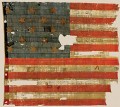
Our Flag in 1812

----- Class of 2012 Motto ------
"For More Than Ourselves"
Thank you Class of 2012 for the Honor of Marching with you The Class of 62 - Can Do

Remember - The Soldiers you will lead Always Come First

Motto -- Duty Honor Country

The Cadets of West Point

They played perhaps Army's Greatest Game. They were the Team that Gave The Most

Washington's Letter recommending the establishment of the Academy and the History of West Point

The Oaths We Take

West Point's Medal of Honor Recipients

Jefferson Hall - the Academy's new Library.

Douglas MacArthur

Vinegar Joe Stilwell cleaning his Thompson -The Walkout -Burma 1942

George Patton

The Monuments of West Point

Kosciuszko Monument - Guarding the Hudson ensuring there is no passage of British Man of War

Forts of the Hudson

So we'll sing our reminiscences of Benny Havens, Oh!

Academic Excellence

Colonel Thayer

West Point

Trophy Point

"L'Ecole Polytechnique Monument", or The French Monument by Cadets

Superintendent's Quarters viewed from Thayer Road

Superintendant was not Happy Black '57

Home of the Dean

Quarters 104

Cadet Chapel

Michie Stadium

Arvin Gym

Kimsey Athletic Center

Holleder Center

Washington Monument

United States Military Academy Band

Cadet Barracks

Rugby Complex

Great Chain

Plain looking toward Washington Hall

Battle Monument

Washington Hall with Cadet Chapel on rocks above

Hudson River

Captured Trophies

Battle Monument

West Point Cemetery

Plain

Cost to this Nation of Differing Views

Trophy Point -- Our Flag

Corps of Cadets Formed in Companies early 1960s

Sending the Army Team off to Beat Navy

Army Mule

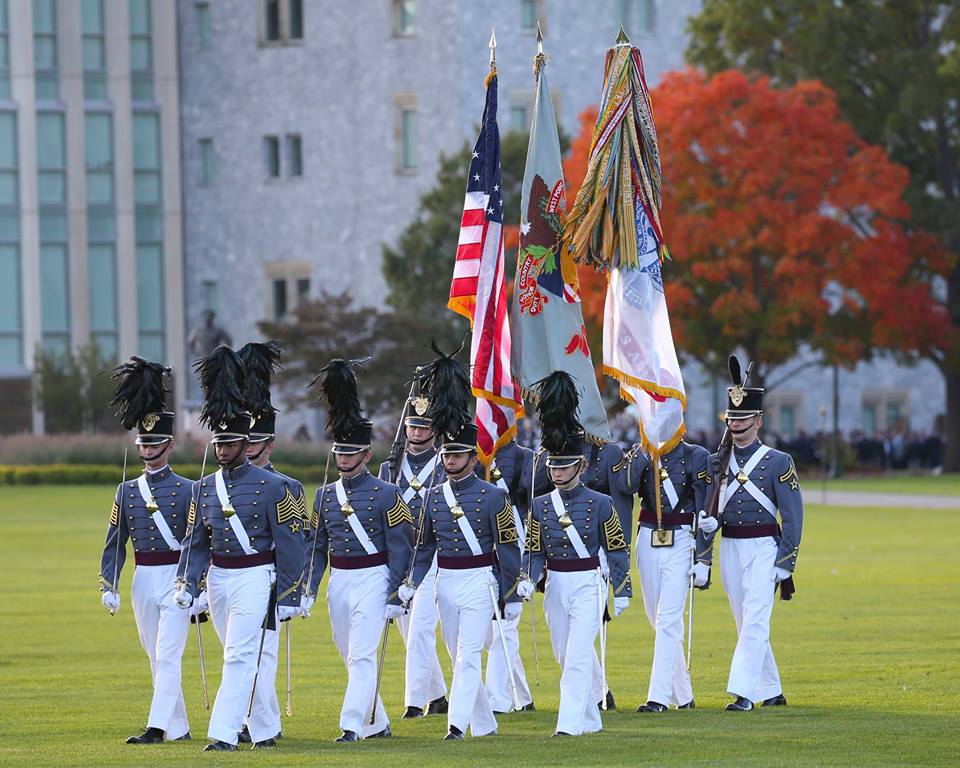
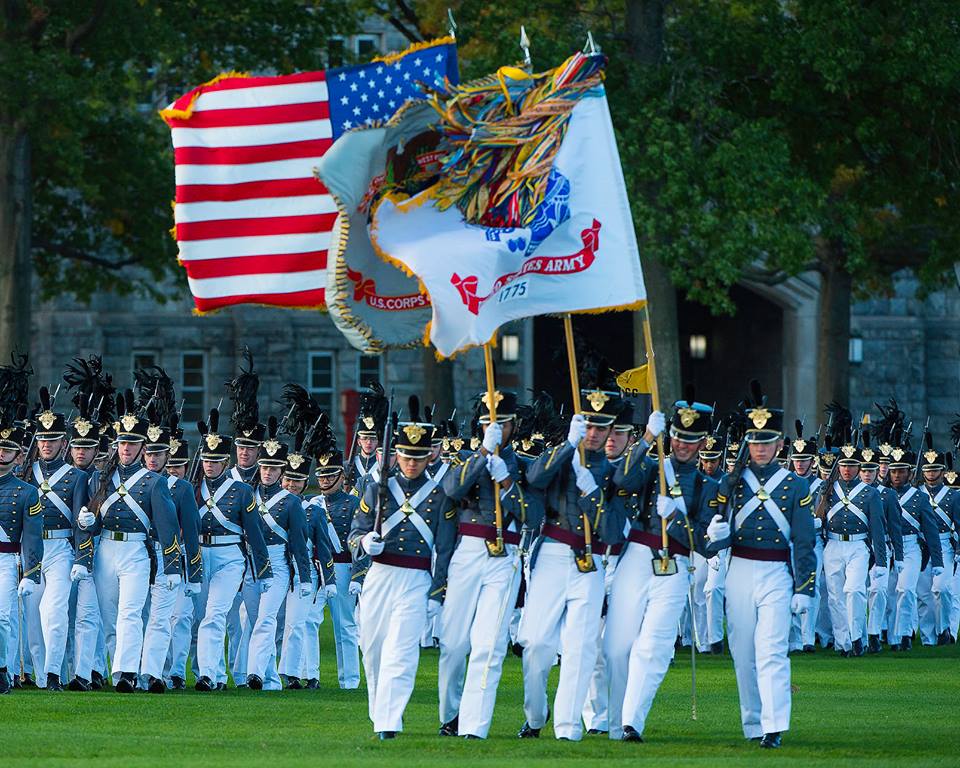
Color Guard

Band Box Review Early 1950's in Central Area

Battalion Mass Early 50's

Flirtation Walk

Class of 2008 Class Crest & Motto "No Mission Too Great" Their Commencement "Here am I; Send me."
Thank you Class of 2008 and Please Thank the Men & Women --- the Soldiers you will lead --- The Class of 62.
Duty Honor Country
The '54 Crest

28th Infantry Regiment Black Lion Award is intended to go to the person on his team "who best exemplifies the character of Don Holleder: leadership, courage, devotion to duty, self-sacrifice, and - above all -
an unselfish concern for the team ahead of himself."
"The Army moves as a team, eats as a team, and fights as a team."

The '55 Crest

Don Holleder Remember - The Soldiers you will lead Always Come First

Vann and Holleder

9 Army A's

The '56 Crest

The '57 Crest

Can Do

Gen Van Fleet addressing the Corps prior to the Navy Game

Constructed under supervision of Jay Gould "54 and the Ord Dept from a German Rocket Gun captured at Kasserine Pass. First used in the Duke Game.

COL "Red" Reeder granted the Cheerleaders Corps Squad status to obtain financial support for their spirit-inducing initiatives.

Bob Mischak - - It should be pointed out that Bob was an All American selection, but is not recognized by the Academy as such because of the organization which selected him.

Ubel scores 3 Times against Navy - Vann's facking results in Peter getting tackled - #10 on the ground behind Ubel

Vann to Sisson

Army's B Squad

Vann to Mischak.

Uebel Intercepts

Cody to Don Holleder

Lasley

Frank Hicks

Burd

Bill Purdue

Cody

Meador Mgr

Ron Melnick

Ralph Chesnauskas

Pat Uebel

Tommy Bell

Sisson headed for another score

Peter Vann stuffs the ball in Jerry's gut

Leroy Lunn & Jerry Lodge

Uebel after taking the handoff from Hagan

Attaya - Army's Fullback

Sisson - one of 3 Great Ends
Bob Mischak

Ralph Chesnauskas

Bob Farris

Vann moving out of the pocket

Peter Vann 10, Billy Chance 38, Herdman 68

Ken Kramer

Joe Lapchick

Kirk Cockrell

Lodge going down tosses to Paul Schweikert for score.

Dick Zeigler

Bob FarrisPlayed the 2d half of the Navy Game blind in one eye.
Pat Uebel
Tommy Bell

Peter Vann

Freddie Attaya

Mike Zeigler

Jerry Lodge wearing #67, playing fullback.

Johnny Wing

Lowell Sisson

Norm Stephen

Jack Krause

Dick Ziegler

Jerry Lodge

Leroy Lunn

Norm Stephen

Jerry Lodge

Corps of Cadets for Navy Game
Can Do
"The Army moves as a team, eats as a team, and fights as a team."
The '54 Crest
The '55 Crest
28th Infantry Regiment Black Lion Award is intended to go to the person on his team "who best exemplifies the character of Don Holleder: leadership, courage, devotion to duty, self-sacrifice, and - above all - an unselfish concern for the team ahead of himself."