Tag Archives: 1962

Tom Brewer

Tom & Sharon Brewer 
The Bear, Football & Wrestling; XVIII Airborne Corps, Desert Storm

I started with the class of 61 and graduated with 62. In the fall of 1957 we were playing football at the academy and were getting beat. At half time some staff cars stopped at the field, a four star General got out and opened the back door and immediately stood at attention as a gentleman exited the vehicle. We were all called to attention. This gentleman then proceeded to tell us about the fields of friendly strife etc – now get out there and kick their ass!

Yes Sir! We replied and with some extra effort, sweat and blood, we won the game.

The gentleman then asked for all the plebes that played to line up. He then went slowly down the line, stopping in front of each of us, extending his right hand he said in a firm voice: “my name is Doug MacArthur” His look directly in your eyes made the words: Duty, Honor, and Country seem to flow from him directly to your heart.

I extended my right hand and with humble words I said: “My name is Tom Brewer”.

The other Generals there were a little amazed, I believe.

Later in the mess hall as I was performing my plebe duties, the long awaited question was asked:

“Dumb smack, who was here today?”

With all the gusto I could muster: “Sir, Doug MacArthur was here today!”

What did you say? Then with all my strength and a voice that filled the mess hall, I again said:

“Sir, Doug MacArthur was here today!”

Dumb smack, he is a general, get on the floor and do push ups!

There was pandemonium as upper classmen were rushing to my location. I then said: “Sir, may I make a statement?” It had better be a good one!

“Sir, he recognized me today!”

Shock, silence, and time seemed to stand still as the words I uttered started to soak in their minds. During this period Dough was on the poop deck with the first captain, laughing at all the commotion on the floor. He told the first captain to call the corps to attention before they kill that plebe and announce that all the plebes he recognized today could be at ease for a month.

There have been occasions in my military career that I had the honor to tell this true story. I tell them with a hand shake, a hand that was gripped by Dough, to keep passing it on: Duty, Honor, and Country. I have done my duty to God and Country. I am grateful for all my classmates and the memories.
Tom Brewer, LTC(Ret)
Better know as:
Bear ’62
Woo Poo U

Mistaken Identity — Two Plays During the fall of 1958 a left guard on defense was injured and after football trials I was selected by the line coach to play at the next game I believe was Villanova Univ. On the kick off I was extremely hyper and ran down the field, first through one blocker and 15 yards later through a second blocker and end up making a tackle on the ball carrier. I looked back and saw the two blockers being carried off the field. I grinded a little then but today I hope they were not seriously injured. During subsequent defensive plays I found myself quickly through the line and making tackles on the quarterback. Howard Cosell was the radio announcer and numerous times said: “That boy really wants to play football but his number and name is not on the roster” Everything was going great until the third quarter. When I came up to the defensive line my left leg developed a Charlie Horse causing me to fall to the ground. Since we were next to our side line the trainer, Ed Pillings, saw what had happened and immediately said: “Brewer roll off! (Blank) roll on” (There was a picture in the N.Y. paper showing Ed working on my leg. He also the following weekend took a picture with a young lady and me, which became a full page in Sports Illustrated). Shortly I went back close to the side line and at that time I heard Col Blaik talking to the line coach about a problem on defense. I then ran back in and shortly we regained our dominance on the field. After the game I was going to get on the bus when the line coach ran up to me and said: “Brewer, you played a fantastic game except for two plays! Why? My mouth wanted to say: “It wasn’t me!” but my plebe training kicked in: “No excuse Sir!” He responded with words that sounded a little like Dumb Smack etc but ended with: “you are back on B squad!” Shocked I climbed on the bus and sat next to my 2 play substitute, who was also in shock. He had heard what was said. We rode back in silence. I felt in my heart that once they reviewed the football films the truth would come out but this did not happen. My substitute had played his heart out but he did not have the signals when to slant left or right. He was also a victim of circumstances. He later played outstandingly in many Army games. However, next year on the first day of spring practice the line coach had all of us report to the film room to watch the film of this historical game. Numerous players said: “Who is that person who is moving through the line so quickly etc?” I looked at the line coach and with no words but with a smile on our faces we made peace with each other. The future in football looked bright but as luck would have it I separated my right shoulder in tackling practice on Bob Miller, Tackle and later four star general. Spring practice was over for me. I continued on in football later that year. It was a great honor to play that day and be a small part of a team with real heroes: five All-Americans. Since that time of “friendly strife” many of our classmates have performed heroic service to our county. Some have been duly recognized to include recipients of the Medal of Honor. But many acts are not seen nor reported. Most see it as just doing their duty. On a soldier’s tomb stone it says: “I have done my Duty” May we all do the same.
Dick Duncan

awaiting data

Bill Scherr

Bill & Jeane Scheer   
Inspired by John Taylor, coached by Rick with the nucleus of Tank, Russ, Bob, Bill, Dave, Paul, Dennis, Wayne & Mike, ’62 gave West Point Rugby, a team that has dominated the sport since its inception.

Name William A. Scherr III

Class 1962

Company E-2

Home Town Valley Stream, New York

High School Chaminade High School, Mineola, New York

Date of Entry to Academy 1 July 1958

Date of Graduation 6 June 1962

Age at Graduation 21

Cullum Number 24204

Cadet Rank Cadet Sergeant

Height

  • Entry 5′ 10″
  • Graduation 5″ 10″

Weight

  • Entry 135
  • Graduation 165

Teams

  • Plebe Track
  • Rugby A Squad

Team Captain

Positions Played

  • Hurdles in Track
  • Scrum Half in Rugby

Relationship with

  • Tactical Department Adversarial

Class Standing 388

Turn Out Stars Spanish Yearling Year

George Tank Telenko

awaiting data

Dean Stanley

awaiting data

Mike Schredl

awaiting data

Dick Sklar

awaiting data

John Taylor

JOHN LESLIE TAYLOR

Class 1962

Company I-2

Home Town – BURAW, NORTH CAROLINA

High School – BURGAW HIGH SCHOOL

Prior College – NORTH CAROLINA STATE COLLEGE RALEIGH, N. C.

Prior Military Service – ENLISTED ARMY RESERVIST, TWO YEARS

Date of Entry to Academy – 1 JULY 1958

Date of Graduation – 6 JUNE 1962

Age at Graduation – 23

Cullum Number – 24293

Cadet Rank & Military Position

  • CADET SERGEANT
  • ACTING PLATOON SERGEANT

Height – 71″

Weight – 165 LBS.

Teams

  • ARMY RUGBY TEAM/CLUB
  • FOUNDER AND CLUB PRESIDENT, 1961-1962

Officer Representative

  • CPT CARNES, ECONOMICS DEPARTMENT, USMA: OIC

Team Captain

  • BILL SCHERR

Positions Played

  • SCRUM LOCK, C, OR D SIDE AND TEAM MANAGER

Team Recognition

  • Cow Year

    JOINED THE MANHATTAN RUGBY LEAGUE BY INVITATION.
    THE FIRST ARMY RUGBY SET THE BEST WINNING TRADITION OF ANY SPORT IN THE HISTORY OF WEST POINT. THUS, GIVING RUGBY A PERMANENT PLACE AT WEST POINT.

  • Firstie Year

    WON THE MATCH WITH THE NATION’S BEST TEAM, THE MANHATTAN RUGBY TEAM, FOLLOWING GENERAL DOUGLAS MACARTHUR’S “DUTY. HONOR. COUNTRY.” SPEECH ON 12 MAY 1962.

Academy Recognition

  • THE RUGBY SPORTS COMPLEX, THE FOUNDING SPONSORS OF WHICH ARE MR AND MRS. LEE ANDERSON, USMA CLASS OF 1961, IS CERTAINLY AN OUTSTANDING TRIBUTE TO THE RECOGNITION OF RUGBY AT THE USMA.

  • TEAM HISTORY WRITTEN IN THE “1962 POINTER” AND IN THE “ASSEMBLY”,
    AUGUST/SEPTEMBER, 2003 ISSUE, “EARLY BEGINNINGS” BY RIC CESPED.

Class Standing

LOWER 200 0F 601 GRADUATES: AFFECTIONATELY “A GOAT”.

Ricardo Cesped

awaiting data

Frank Caufield

Gave the Caufield Crew and Sailing Center, Honorring his Father, General Frank J. Caufield Class of 1934  Attended Harvard and began a very successful Financial Career – Oak Grove Ventures 1971 and in 1978 Kleiver, Perkins, Caufield & Byers.

Frank Joseph Caufield was born on November 21, 1939 to Captain Frank J. and Mrs. Catherine Lallande Caufield at Fort Benning, GA. Frank’s father was a member of the Class of 1934. Frank grew up as an Army brat on posts in the United States and in foreign assignments in Spain and England. His father’s assignment in Spain from 1947 to 1950 was pivotal in Frank’s life; he developed a deep knowledge of Spanish culture and became fluent in Spanish. Later, his father served with the Military Assistance Group in London in the early 1950s. Frank was sent to a British boarding school where he was exposed to British humor and the rigors of boarding school discipline, two traits that would serve him well throughout his life.

Frank, at his father’s urging, obtained an appointment to West Point, where he joined the Class of 1962. At the end of Beast, Frank was assigned to Company F-1. Frank said that the four years he spent in F-1 forged friendships that lasted for his lifetime.

After graduation in 1962, Frank was assigned to an Air Defense Artillery battalion in Germany. Frank transferred to Military Intelligence and was assigned as head of the U.S. section of a multi­national center for the debriefing of East European refugees arriving in West Germany. This assignment gave Frank an in-depth understanding of the political, social and economic conditions in Eastern Europe.

In 1966, Frank resigned his commission and was admitted to Harvard Business School (HBS). By that time, Frank was married to Ronnie Morseth, a woman he met while stationed in Germany. Shortly before he started HBS in the fall of 1966, their first child, Frank Robert, was born. During his second year at HBS, their second child, Kirsten Nicole, was born. Frank said, “Getting through a demanding academic program and having two young children involved lots of learning, friendships and a hopeful future.”

After graduation from HBS in 1968, he took a job with a management consulting firm in New York City. During his second year in New York, Frank decided to get into the venture capital business. The field barely existed at that time and was principally located in the San Francisco Bay area. In 1970, he transferred to the firm’s San Francisco office and began looking for a venture capital job.

In 1972, Frank got a fortuitous call from an F-1 classmate, Dave Francis, who alerted him to an ad in the Wall Street Journal placed by Paul Cook, a legendary investor. The ad said that Cook, the CEO of a hi-tech company called Raychem, was looking for a financial manager. Later, Cook established a venture capital firm (Oak Grove Ventures) that Frank would run.

In 1978, with several years as a successful investment manager under his belt, Frank was asked to join what would become the world’s premier venture capital firm, Kleiner, Perkins, Caufield and Byers (KPCB). Frank helped the firm perfect its approach to investing in entrepreneurs who were building innovative technology and life sciences companies.

Over the next 20 years, KPCB was, by general agreement, the most successful venture capital firm in the country. One of the high points of this period was in the mid-1980s when Frank and classmate Jim Kimsey combined to start AOL.

Frank served on the boards of numerous companies and always played a key role in their success. After AOL merged with Time Warner in 2000, Frank continued on that board for many years.

In the late 1990s, Frank began to pull back from venture capital to pursue other things he wanted to do. He phased out of KPCB but kept on making venture investments on his own, and he began to devote more time to philanthropy and public and foreign policy issues. It also gave him time to take many trips with his classmate and former roommate from F-1, Buzz Kriesel. They travelled extensively for the next 15 years, to India, Burma, Thailand, Laos, Costa Rica, the Yucatan Peninsula in Mexico and Southern Italy.

Frank’s many philanthropic activities included Chairman of the Child Abuse Prevention Society, Director of the U.S. Russia Investment Fund (the U.S. Russia Foundation), Refugees International, the Council on Foreign Relations, and the San Francisco Film Society.

In addition to his venture activities, Frank was the former owner of Slim’s, a San Francisco club that he started with musician Boz Scaggs. He also worked with Scaggs and investor Warren Hellman to preserve San Francisco’s Great American Music Hall.

In May of 2002, Frank donated the Caufield Crew and Sailing Center at West Point to honor the memory of his father, Brigadier General Frank J. Caufield (Retired), Class of 1934. The Caufield Center is a state-of-the-art facility equipped with rowing tanks, a weight room, two locker rooms with showers and boat maintenance bays.

The West Point Class of 1962 has been blessed by some remarkably accomplished graduates. Frank Caufield, an entrepreneur who defined venture capital and American enterprise, is ranked with these distinguished graduates. His exceptional character and remarkable accomplishments make him one of West Point’s most distinguished graduates. He embodied and lived by West Point motto: Duty, Honor, Country

Frank is survived by his son, Frank Robert Caufield, and his daughter, Kirsten Nicole Caufield. Well Done, Frank Caufield; Be Thou at Peace.

—His F-1 classmates  

Paul Zmuida

awaiting data

Ernie Webb

150 Football – Army A

Latest Book – – “Rescuing America”

Author — Ernie Webb served two years as a US Army enlisted soldier, then entered West Point through an Army wide competitive appointment. After graduation, he held a variety of Infantry and Armor troop leadership positions in Vietnam, Germany and the U.S. During his two years in Vietnam, he was awarded the Purple Heart and five decorations for valor, including two Silver Stars.

After his military service, Ernie spent 12 years as a financial planner and stock-broker, and 20 years as a leadership consultant for Fortune 500 companies around the world. Ernie has written extensively on management, leadership, ethics, and inter-personal relationships. As Editor-in-Chief of Military Review, he edited and produced an award winning issue on leadership. This issue received the largest request for reprints of any issue in the magazine’s 74-year history.

While teaching at West Point, he also co-produced a unique book on life at the Academy, titled “West Point Sketch Book.” He is currently working on a book about finding inner peace titled, “The Inner Core.”

In addition to a B.S. from West Point, Ernie earned an MA in English Literature from Columbia University in New York. He is a graduate of the U.S. Naval College of Command and Staff with advanced studies in Qualitative and Quantitative Analysis.

Ernie lives with Pat, his beautiful wife of 48 years, in Pensacola, Florida. They have two grown children. In his spare time Ernie enjoys walking on the beach with Pat, weight-lifting, recreational runs, and playing with his two fantastic grandchildren, Makenna and Miller.

Sonny Sloan

awaiting data

Larry Sanders

awaiting data

Art Pattarozzi

awaiting data

John Lynn

awaiting data

John Landry

John & Margaret
Four years with the 150s earning 2 Army As.

MGLandry-243x300

BY CAROLYN HOLTZMAN

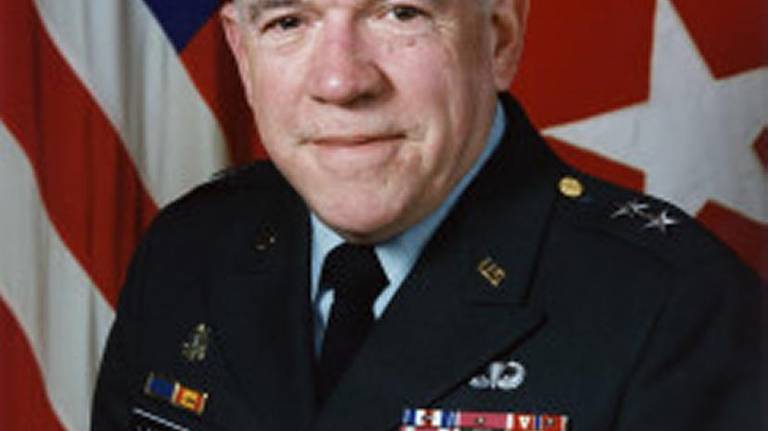
In 1966, John Ryan Landry deployed to Vietnam with the 11th Armored Cavalry Blackhorse Regiment. He was awarded the Bronze and Silver Stars. The Silver Star is the third-highest U.S. combat-only award. The Bronze Star is awarded for meritorious service and combat actions. Landry, 76, a major general, died June 13 at Fairfax Hospital in Virginia of cancer. Born and raised in Miami, Landry attended Miami Senior High and the University of Miami. Landry played cornerback for the Miami High football team. Roland Gomez, a friend of Landry’s since seventh grade and Miami High teammate, said Landry was a “tenacious” player. “He was 135 pounds and playing highly competitive high school football,” Gomez said. “He was a tough little guy.” In 1958, Landry was appointed to the U.S. Military Academy at West Point. He graduated in 1962. A year before graduating, he met his wife, Margaret Hans, at a fraternity party at Columbia University in New York.

“He was the man that always had a smile on his face,” Hans said. “He never met a stranger.” Landry’s military service began in Bindlach, Germany, where he commanded A Troop of the Second Armored Cavalry Regiment. While serving in Vietnam in 1966, Landry was also awarded the Presidential and the Republic of Vietnam Gallantry Cross Unit Citations while commanding B Troop. Landry attended the John F. Kennedy School of Government at Harvard University before teaching at West Point in the Social Sciences department. Landry also served two tours in Amberg, Germany, from 1974 to 1979, with the Third Squadron/Second Armored Cavalry Regiment. He first served as the squadron executive officer and later as the squadron commander.

Landry also served as a speech writer for the Supreme Allied Commanders Europe (SACEUR) at the Supreme Headquarters Allied Powers Europe (SHAPE) near Belgium during this time. He was assigned in 1989 as chief of staff of VII Corps in Germany, which he held during Operation Desert Storm. He also served as the deputy assistant secretary of defense for Guard/Reserve affairs before retiring from the Army in 1993 after a 32-year military career. He was later named as a national intelligence officer and worked as an adviser to the director of national intelligence. Landry’s other passion was his family. “His son actually served in Operation Iraqi Freedom in Kuwait,” said Gomez. “I remember how proud he was of his son. He had a fantastic relationship with his children and his grandchildren.” Landry is survived by his wife, son Sean and daughter-in-law Sumataya, son Scott and daughter-in-law Jacki, and hisgrandchildren Sara, Kylie and Samantha. He is also survived by his sister Diane Gill, his brother Louis Landry and his sister Maria Wellisch.

Trooper Down Major General (ret.) John R. Landry
The Blackhorse Association

Steve Kott

 STEPHEN J. KOTT  1962

Cullum No. 23916-1962 | October 31, 1967 | Died in Died in Hanoi, No. Vietnam 

Interred in Arlington National Cemetery, VA


It really was a dark and stormy night when Stephen Jay Kott’s A6 Intruder took off from the Marine Airbase at Da Nang, South Vietnam. On Oct 31, 1967, Steve’s mission would take him over Hanoi, North Vietnam, for dangerous low level bombings. Steve’s aircraft could fight and survive under the worst of night flying conditions, but on this evening, it was not to be. During Steve’s low level run, his wingman saw a bright flash in the vicinity of the target and nothing again was heard from Steve or his fellow Marine crew member.

Steve never took the easy way out. He spent his life for the very military mission that unfortunately took his life. He was born in Nassau County, NY, on May 12, 1940, to Samuel and Thelma Kott, but moved to Greenville, SC, when he was ten years old. While there, he became a boxer and rose to be a Golden Gloves Champion. He graduated from Staunton Military Academy in Virginia and received a Congressional appointment to West Point, where he joined Company K2 with the Class of 1962.

Life at the Academy was rarely a challenge for Steve. He was bright, tough, and determined. He would often bounce into classmates’ rooms with that big smile and share funny and relevant stories. He left his mark on Company K2 as a great football player on the 150 pound team and as a Corps’ Champion boxer, winning both Regimental and Corps Championships for his weight class. He was quick, had a terrific right hook, and coached the K2 boxing team his First Class year. Not only was Steve very successful in his studies, but he was always ready to provide help to those company classmates struggling in theirs. Academic departments identify cadets who demonstrate potential to be future instructors—in Steve’s case, the then Department of Military Psychology and Leadership wanted him to return to West Point to teach its courses.

Steve married Julie following graduation and, because of his toughness and determination for something different, chose a Marine Corps commission. The two headed for Quantico, VA, where Steve attended The Basic School (TBS). They loved every minute of the grind of being a Marine family. After graduation from TBS, they left for Ft. Sill, OK, where he attended Officer’s Basic Artillery School. There he would take his new Studebaker Golden Hawk over the Oklahoma prairie chasing buffalo and long horns; Julie took it all in stride with their first baby, little Stevie, in her arms. After Ft. Sill, they were off to the Fourth Marine Brigade at Kaneohe Bay, HI, where Steve was assigned to “H” Battery, 3rd Battalion, 12th Marine Artillery Regiment. In addition to other duties, Steve coached the Marine Pacific Boxing Team and was as a competition marksman for the Marine Corps. While there, they grew their family with the birth of Tara.

Steve loved artillery but longed to be a Marine aviator. After a year as a “cannon cocker,” he applied for flight school at Pensacola, FL, and while there welcomed his third child, Jack. From the T28 to carrier qualifications, Steve loved flight school. After graduating he was trained in the A6 Intruder as a bombardier navigator and assigned to the 2nd Marine Air Wing at Cherry Point, NC, where he was promoted to captain. In August of 1967, he was assigned to the I Corps at Da Nang, South Vietnam, and was assigned to his A6 squadron, the VMA (all weather) 225, 2nd Marine Air Wing. He was with his squadron only three months when shot down.

He was declared Missing in Action, and his family hoped and prayed he was safe and alive and would return home when the war was over. When the POWs returned, Steve was not among them, and his status was changed from MIA to Presumed Dead. Then in 1984, North Vietnam returned the remains of eight Americans, including Steve’s. As sad as it was to bury his remains, the family felt fortunate to at last have him home because many were still unaccounted for. Steve was laid to rest with full military honors at Arlington National Cemetery on Aug 13, 1984. His military awards include the Distinguished Flying Cross with one gold star, four Air Medals, Purple Heart, Presidential Unit Citation, Navy Unit Commendation, Republic of Vietnam Meritorious Unit Citation with Gallantry Cross Colors, Republic of Vietnam Unit Citation with Civil Actions Colors First Class, and the Republic of Vietnam Campaign Medal.

At his funeral, many classmates and close friends came to welcome Steve home and say goodbye. Steve’s parents never gave up hope that he was alive and would come home, but they passed away before his remains were returned. Steve’s final resting site is near the intersection of Patton and Eisenhower streets and in view of Headquarters, Marine Corps, which is quite fitting. After the ceremony, many classmates gathered Steve’s children and regaled them with stories of mischief, adventure, toughness, and brilliance that they had experienced with their father. In the proud tradition of West Point, his classmates were there to comfort and assuage the painful sense of loss and grief of 18 years of hope extinguished and to share in the bittersweet realization of his children’s prayers answered, “Please bring Daddy home”.

It was our personal loss as well as our Nation’s when Steve died. But his memory and devotion to country, Corps, and family was carried on by his loving wife, Julie. To this day, his children: Steve, Tara, and Jack; as well as his grandchildren, hold his memory dear to their hearts.

When you, his classmates, visit Steve’s grave at Arlington, place a stone on his headstone in the Jewish tradition and say a prayer for him, affirming that he is respected, remembered, and revered for his service and sacrifice. He would love that.

When you visit the Vietnam Memorial, you can find Steve’s name on Panel 28E, Line 104.

—Tom Faley ’62, Jerry Garwick ’62, and Steve Kott’s Family

Erv Kamm

awaiting data

Turk Griffith

turk3_19 copy


ThurstonAGriffith_1962_

–


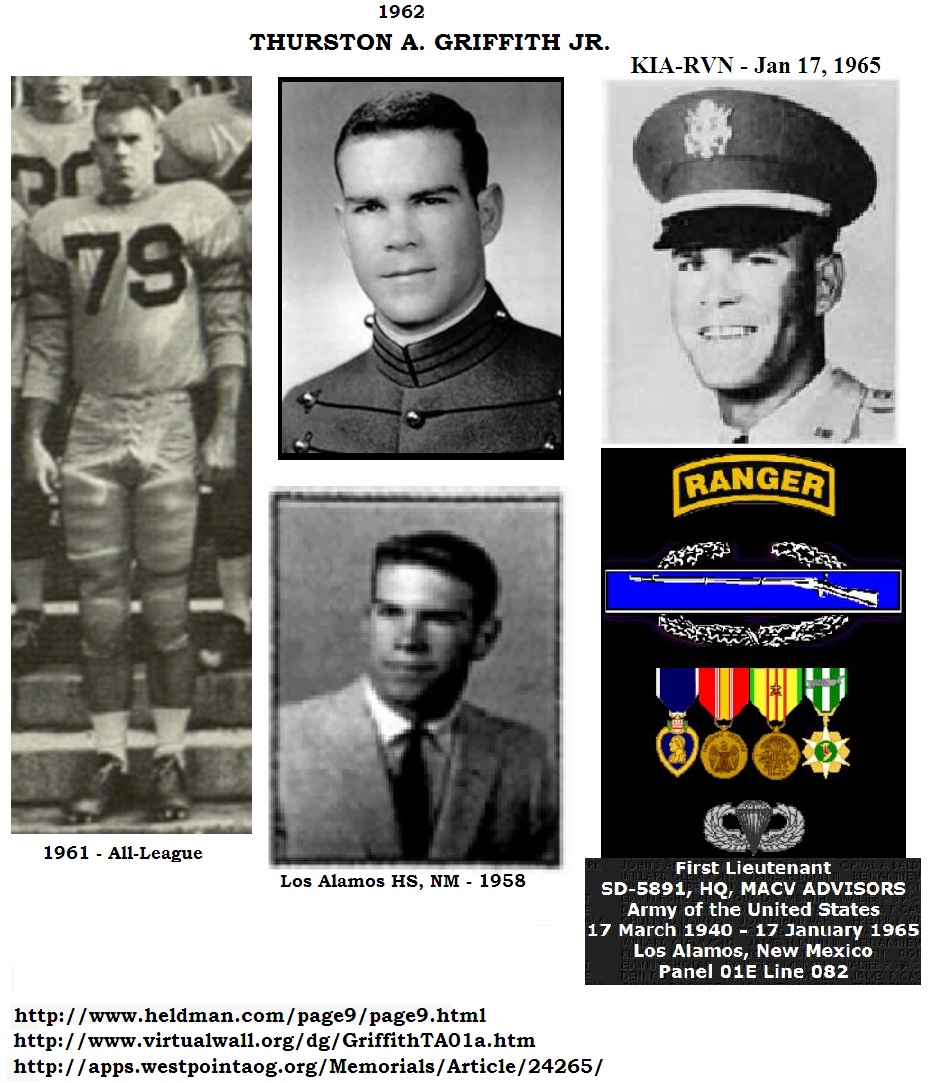
150 Tackle who wore low cuts. Army A Cow and firstie Year. Killed in Vietnam

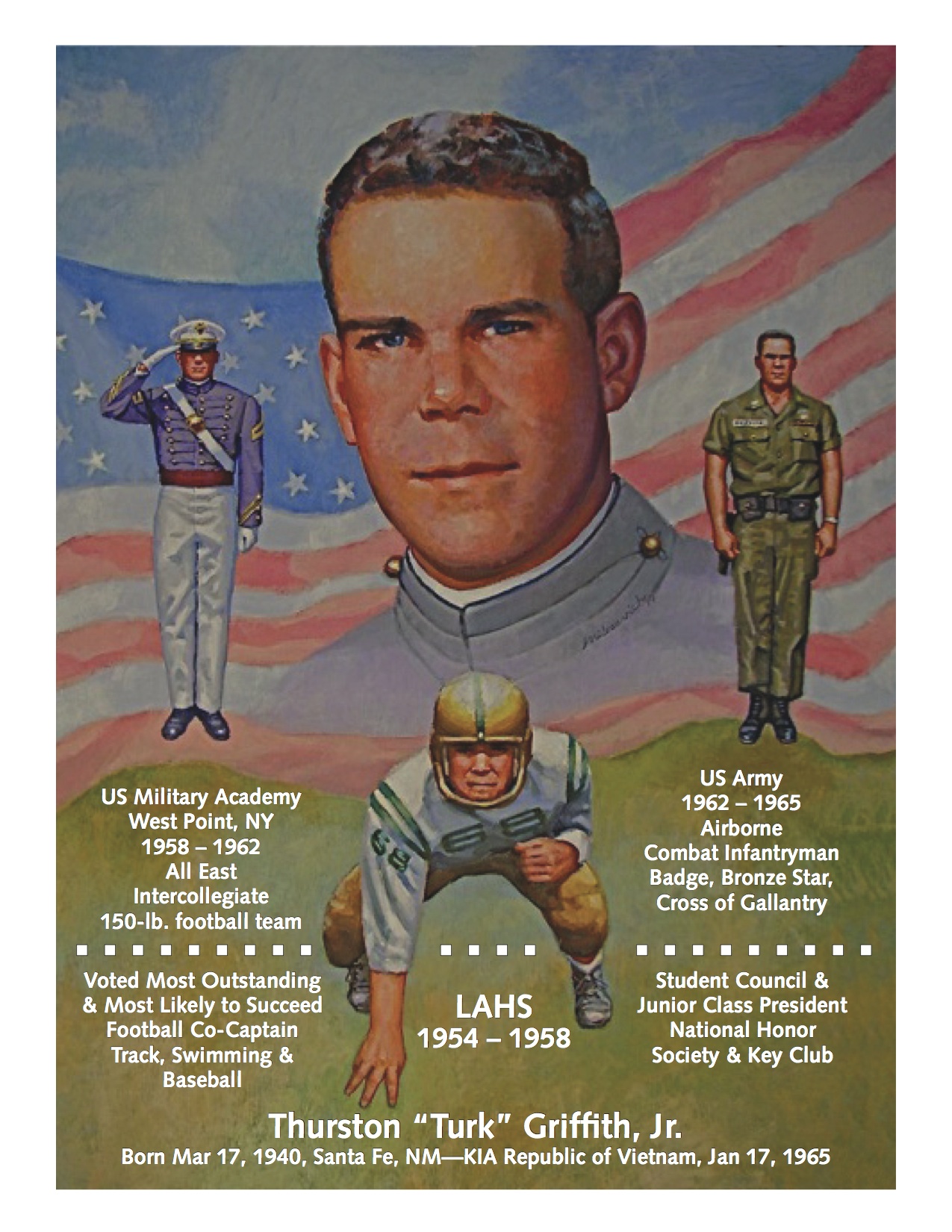
Thurston A. Griffith Jr.
http://apps.westpointaog.org/Memorials/Article/24265/

Thurston Algee Griffith Jr.., was born in Sante Fe, New Mexico, on 17 March 1940. He and his family moved first to Raton, and then to Los Alamos, New Mexico, where he attended high school, was active in church and Sunday school work at the Methodist church, and was a member of the Boy Scouts of America.

At Los Alamos High School, “Turk’s” interests were varied. He participated in sports, stood 12th in his class scholastically, and was awarded the Junior Citizenship Award in 1958. He was a member of the National Honor Society; a delegate to Boy’s State; president of the senior class and the Los Alamos Student Council, as well as the North Central District Student Council. He was also a talented amateur photographer.

Athletics were important to Turk from the time he played little league baseball to the time he graduated from West Point. Swimming, ice skating, ice hockey, and fishing were all a major part of his extracurricular activities. He was co-captain of his high school football team and lettered in track, baseball, and football. At West Point he played football on the 150-pound team, and was named on the Eastern Intercollegiate All-League team for 1961 as a tackle.

When Turk was a junior in high school his father, Turk Griffith Sr., was killed in an accidental explosion, and Turk Jr., assumed responsibilities beyond his years. His friends and neighbors said that Turk was “born to be a leader,” and that his perseverance, integrity, and high moral standards would certainly help him in His ambition to go to West Point.

When Thurston A. ‘Turk” Griffith Jr., was elected the “outstanding senior boy” at Los Alamos High School, he was also voted the “most likely to succeed.” He did succeed in his desire to go to West Point, and when he graduated in June 1962, he was commissioned a second lieutenant in the Signal Corps. He then completed a series of training courses fitting him for the Army’s Special Forces arid an assignment to the Military Assistance Command in Vietnam, where he lost his life on 17 January 1965.

In Vietnam, Turk was greatly admired by his associates, both American and Vietnamese. After his death, which occurred while on a combat patrol for which he volunteered, the Republic of Vietnam awarded him the Vietnamese Gallantry Cross with Palm Leaf Cluster and the Vietnamese National Order Medal Fifth Class. Also awarded to Turk posthumously were the Purple Heart, the Combat Infantryman’s Badge, and the Bronze Star Medal with “V” device for valor.

Turk’s many friends in Los Alamos petitioned the Los Alamos School Board to name the new high school gymnasium after him, and they were successful in their appeal. It is a fitting memorial for a fine young man. a New Mexican who gave his life in the war in Vietnam.

At Fort Gordon, Georgia, a multi-storied bachelor officers’ quarters building has been named Griffith Hall in honor of Turk. The building, scheduled for completion in mid-

1966, was dedicated to Lieutenant Griffith in memory of his tours of duty at that post and in recognition of his “outstanding service to the U.S. Army and the ultimate sacrifice of his life to his country in Vietnam. …”

First Lieutenant Thurston A. Griffith Jr., is remembered proudly by his mother, Mrs. W. O. Connor Jr., his brother, Dudley Griffith, and his host of friends.

Requiescat in pace.

A Friend”

Note – Jim Ellis asked Harry Hagerty to sign for Turk on the Class of ’62 listing in the ’62 Room – Arvn Gym.
(The Class listing is just under the pictorial of General MacArthur’s expectation of us – Duty Honor Country – May 1962) the 2d picture of the ’62 Room.

Shadow box and picture from Virtual Wall
http://www.virtualwall.org/dg/GriffithTA01a.htm

HS Gymnasium Dedication and program from Jim Heldman’s ’62 webpage
http://www.heldman.com/page9/page9.html

Starting guard and key contributor on Army’s 150-pound 1961 football team. KIA Vietnam 1/17/65.  Turk and  I were in the basic officer’s course together at Fort Gordon, GA. Turk (and others) played on a touch football team. The team was stacked with former college players and had its way with the other teams in the league.Turk played on the inside of the offensive line and had a much larger varsity college player on his outside. The other teams would frequently complain that Turk was not abiding by the rules and I can vividly remember the referee getting right up on the line to try to catch Turk doing something illegal.Now I am sure Turk would never do anything outside the rules, but since the referee was shielded from seeing everything by the player to Turk’s outside, Turk was never called for an infraction.Griffith Hall at Fort Gordon is, of course, named for Turk. It is a BOQ or VOQ and, I am told, has recently been renovated – – by John Easterbrook