Tag Archives: 1962

Phil Costain

Champion

We were Eastern League gymnastics champions in 1960 and in 1962. The latter team, the last under Coach Maloney, was the last Eastern League championship for Army (although Maloney resigned after the first meet!). Phil Costain, team captain, was Eastern League champion in the horizontal bar in 1962. Howitzer states that Phil was named national champion in that event in 1962 but there is no mention of this accomplishment in the media guide. Furthermore, one would think that the national champion would also be named All-American, but,
according to the guide, no Army gymnast made All-American between 1958 and 1994. Is this an oversight?

Ken Wallace

The media guide identifies letter winners from our class: Phil Costain (2 letters), Warren (Steve?) Foote (1 letter in 1962 but he did not graduate with us; does anyone know why?), Ed Hendren (2), Larry Mooring (1), Ken Wallace (2), Merle Williams (2), and Will Worthington (1). Of those I knew, I always considered them the fittest looking of the fittest.

STU SHERARD

A Non Pareil

John added more to Stu’s Nomination. The stats were compiled by Dave.

Note: A Classmate was asked if he knew how Stu was nominated for the Hall of Fame.  His reply –

“The nominations for the Hall of Fame are active/valid for two years.  As a result on August 1 every other year I sent in a new nomination.  I don’t know how he was accepted as a member of the 2020 cohort for the HOF, Phil, but like to think that the committee finally realized Stu was a special guy who deserved induction for his great accomplishments on the basketball court plus a sterling career and life after graduation.”

12454 Dover Court
Saratoga, CA 95070
January 28, 2013

Mr. Bob Beretta, Executive Athletic Director
ATTN: HOF Nomination
U.S. Military Academy
639 Howard Road
West Point, NY 10996

Dear Bob,

A classmate has compiled the enclosed information regarding the Hall of Fame nomination for Stewart “Stu” Sherard and I am forwarding it to you in case it will be of use to the Committee.

Sincerely,

John E. Easterbrook

STEWART “STU” SHERARD

When a member of the Class of ’62 asked John Havilecek if he remembered Stu from the 1962 East-West All-Star game, he replied, “Oh, yes!” The media guide does not mention this all-star game but members of the Class of 1962 watched the game on TV in the Weapons Room or First Class Club.

Five Army basketball players who graduated after 1962 have been inducted into the Army Sports Hall of Fame: Kevin Houston, Randy Cozzens, Gary Winton, Mike Silliman, and Bill Schutsky All were members of the “1,000 Career Points Club”. If any other Army player is to be inducted, he will surely also be a member of that club. Although it was a much slower game, John Roosma ’26 established his record over 5 years.

If one eliminates from consideration freshman year statistics, since Stu played in an era when freshmen were not eligible to play varsity sports, and if all three-point goals scored by 1,000-point scorers are counted as two points, since the three-point goal was introduced to college basketball long after Stu graduated, our classmate ranks among 1,000-point scorers not already in the HOF as follows:

  • Career total points: second
  • Single season total points: sixth
  • Number of 30+ points in a game: 13th [The Army media guide does not credit Stu with even one 30-point game but we found two with little effort. Six of those ahead of Stu in this category played during the three-point goal era but we had no way to count their three pointers as only two points.]
  • Career points per game average: Second
  • Single season points per game average: Second
  • Career field goals made: Fourth
  • Single season field goals made: Sixth
  • Career free throws made: Second
  • Single season free throws made: Seventh
  • Career free throw percentage: Third
  • Single season free throw percentage: Fifth

When we, members of the Can Do Class, think basketball, we think Stew Sherard. After all these years, his name — the media guide calls him Stu, but Howitzer confirms the correctness of Stew — is found all over the Army record book as follows:

*Named All-American (honorable mention) by the Converse Yearkbook.

*One of 24 members of the 1,000-point club. (His entry contains an error in the calculation of his free-throw percentage.)

*Number 10 all-time career scoring leader and was number one upon graduation. Only one player with just three years of varsity eligibility, Mike Silliman, scored more points. Only three players finished their careers with more average points per game than Stew (19.4). (Another error appears in his career ppg average.)

*Number 7 all-time in points per game and third upon graduation.

*Had seventh best season points per game average, 22.7, second upon graduation.

*One of only three Army basketball players who led their teams in scoring each year of eligibility.

*Number six in career free throws made, number one upon graduation.

*Number five in career free throw percentage, number one upon graduation.

*Had sixth best season free throw percentage, number one upon graduation.

*One of only four Army basketball players who led their teams in free throw percentage each year of eligibility. (Another error appears in this chart.)
*Stew making 15 of 15 free throws against Rider College is surpassed only by 16 for 16 by Kevin Houston.

That comes to five Academy records held at graduation.

The sleepy-eyed, rail-thin, hunched shouldered jump-shooting Missourian thrilled us for three years on Wednesday afternoons (I went to almost every game) and Saturdays.

He was team captain First Class year, never scored 30 points in a game (according to the media guide) but the 1960 Howtizer credits him with a 34-point performance against Massachusetts.

Stu was the Most Valuable Player of the 1962 East-West All-Star game, draining long jumpers over all those future pros.

When asked several years ago by Tom Culver if he remembered Stew from that game, John Havilecek replied, “Oh, yes!” Oddly, the media guide does not mention this all-star game but we who watched the game on TV in the Weapons Room (or maybe it was the First Class Club) will not forget it. My personal recollection includes a brief spell where Stew was having difficulty guarding Nate Archibald, but that in no way tarnishes the luster of this roundball hero.

Al DeJardin

The Straw That Stirs the Drink

The 1961-62 basketball team was 10-11 but we will long remember how we beat Navy in the Field House. Stew Sherard had fouled out and the straw that stirred the drink for the Army offense, Al DeJardin, had also been disqualified. No matter. One of the five players we had on the floor was Bob Loupe — can anyone name the others? — and his famous scoop shot in the last few seconds was all we needed. Absolutely unforgettable. Navy did have one more chance, but I think they threw the ball away.

The list of basketball lettermen includes Larry Crane (1960 and 1962 — we would like Larry to tell us about 1961), Al DeJardin (1960 and 1962 — same question), Bob Loupe (1962), and Stew (1960, 1961, and 1962).

Another 2 Sport Man

In scrutinizing the on-line baseball archives, I found no mention of any member of the USMA Class of 1962 or any of the three teams to which that Class contributed other than the list of lettermen: Crane, LT; DeJardin, AR; Eccleston, TF; Fox, RM; Lilley, RJ; McRae, WD; Schmidt, JL

(Photo from Col Red Reeder’s Book – Pointers on Athletes)

Al, if memory serves, played a steady shortstop for Army and earned at least one major A for his service.

Plebe year: received class numerals for corps squad plebe teams in baseball and basketball

Received 6 “Major A” letters during the 3 years of eligibility as shown below:

Yearling year: received a “Major A” in baseball and basketball

Cow year: received a “Major A” in baseball and basketball

Firstie year: received a “Major A” in baseball and basketball (received a gold star on the “A” for beating Navy in basketball)

In April 1963 played in the Pan American Games as a member of the USA Baseball Team. The games were played in Sao Paulo, Brazil. The other teams were Cuba, Mexico, Venezuela and Brazil. Was the starting shortstop and played every inning of all games. We played Cuba in the gold medal game and lost 3-1. We received the “silver medal). The Cuban team had a number of players that had played in our “Major Leagues” but were kept in Cuba once Castro became the leader of Cuba.

Baseball highlights: Playing in Ebbetts Field (Home of the Brooklyn Dodgers) in 1956 and 1957 for the Catholic High School Championship. Won in 1957. Winning the Eastern league title Yearling year, Being selected Captain of the baseball team after the 1961 season, Being selected All Eastern League 2nd team SS Firstie year. Playing in the 1963 Pan American Games for the USA baseball team and receiving the silver medal for a second place finish..

Basketball highlights: Playing against Ohio State @ Ohio State when they were rated #1 in the country, Playing UCLA, West Virginia and U of Washington in a Christmas tournament in Los Angeles, Beating Boston College @ West Point, playing in Madison Square Garden in the NIT and last but certainly not least, the exciting victory over Navy Firstie year with Bob Loupe scoring the winning basket as time was running out.

Johnnie Nau

awaiting data

Ron Borrello

Ron & Kathryn Borrello

awaiting data

1962 Baseball Team

Tom on the Mound against Navy 1961. “Gordon Dopsloff” Class of “1963” is probably on First> (Sports Illustrated photo by A Triolo)

(Photo from Col Red Reeder’s Book – Pointers on Athletes)

John Schmidt

61 Baseball Team

Bob Lilley

and Roger Maris

In the eye of my mind, I can still see Bob Lilley staggering under the longest, highest fly ball ever hit at Doubleday Field, post Babe Ruth. The ball was struck by Roger Maris during the exhibition game against the Yankees. Bob was holding down right field and had moved back towards the Library Tennis Courts fence out of respect for Maris. Now, if this happened in 1962, Maris was coming off the year he hit 61 home runs. If it happened in 1961, it was just after the major league season had begun, the season in which Maris would break the record. In fact, if it was 1961, it would have happened about
the time Maris began his run at the record, because he did not hit his first homer until game 9 of the season. (He hit 61 homers in his last 154 games of the season, just as Ruth had hit 60 in his 154 games.)

The overflow crowd had leeched onto the playing field and more or less surrounded Bob as he followed the arc of the ball, gauging its trajectory with geometric logic and experience gained from hundreds of games of baseball. I heard someone yell, “Go back further!” Bob heeded this advice, camped under the high-flying missile and actually got his glove on it but could not hold it. Maris strolled into third base. The ball struck the ground perhaps 20 feet from the fence, a monstrous shot.

It is like it happened yesterday.

Robert Fox

In scrutinizing the on-line baseball archives,I found no mention of any member of the USMA Class of 1962 or any of the three teams to which that Class contributed other than the list of lettermen:

Crane, LT
DeJardin, AR
Eccleston, TF
Fox, RM
Lilley, RJ
McRae, WD
Schmidt, JL

Tom Eccleston

Tom & Jean Eccleston

Baseball Player and Class Legend

Tom on the Mound – Doubleday Field against Navy 1961. It is probably “Gordon Dopsloff” Class of 1963 on First. (Photo A Triolo Sports ILLustrated)

In scrutinizing the on-line baseball archives,I found no mention of any member of the USMA Class of 1962 or any of the three teams to which that Class contributed other than the list of lettermen:

Crane, LT DeJardin, AR Eccleston, TF Fox, RM Lilley, RJ McRae, WD Schmidt, JL

As for Tom’s legendary status, details are best obtained from him.


In scrutinizing the on-line baseball archives,I found no mention of any member of the USMA Class of 1962 or any of the three teams to which that Class contributed other than the list of lettermen:

Crane, LT
DeJardin, AR
Eccleston, TF
Fox, RM
Lilley, RJ
McRae, WD
Schmidt, JL

As for Tom’s legendary status, details are best obtained from him.

Larry Crane

Two Sport Man

Cracked a loud bat on the Diamond.  Basketball 4, 3, 2 & 1 (Army A 3, 2 & 1); Baseball 4, 3 & 2 (Army A 3)

The list of basketball lettermen includes Larry Crane (1960 and 1962 — we would like Larry to tell us about 1961), Al DeJardin (1960 and 1962 — same question), Bob Loupe (1962), and Stu Sherard (1960, 1961, and 1962).

The media guide includes a rather odd one of Larry Crane found in”’62 Can Do” in the basketball section on the 1962 Class page.

In scrutinizing the on-line baseball archives, I found no mention of any member of the USMA Class of 1962 or any of the three teams to which that Class contributed other than the list of lettermen:

Crane, LT

DeJardin, AR

Eccleston, TF

Fox, RM

Lilley, RJ

McRae, WD

Schmidt, JL

Larry Crane lives in Newagen, ME, with his wife, Jan. Both are playwrights and have published several works, some of which have won awards. by Dave Phillips – ’62

Dave Harkins

Dave & Sheryll Harkinslacrosscrossed-hockey-sticks-1usma-shoulder-patch.jpeg
Dave Wore 18, Earning 5 Army As, Playing both Hockey and Lacrosse while involved in 6 Academy Clubs.


Ron Chisholm

We have nominated Ron for the Army Sports Hall of Fame.

’62’s Only All-Time Record Holder

In his final year, Ron Chisholm held opponents to 2.18 goals per game, an Academy record that has stood for 46 years. This was the last Academy individual or team record belonging to the Class of 1962.

Ron had a sensational career but this writer is only now realizing it.

His 50 career wins in goal is third all-time and put him first by 13 wins at graduation.

His 1639 career saves is 11th all-time but was first by 41 saves at graduation.

His career goals-against average of 2.53 is 4th all-time but was first by about a full goal at graduation.

His career save percentage of .905 is fifth all-time but was tops at graduation.

His ten career shutouts is second all-time but was first by six shutouts at graduation.

In addition to his all-time record for goals-against per game in First Class year (now 2nd), his Cow year mark is still 9th best and his Yearling year mark is 13th. Ron stood first, second, and third in this category at graduation!

His save percentage in his last year puts him second all-time but he was first at graduation.

His five shutouts First Class year puts him second but first at graduation.

He received the Henry “Hal” Beukema Award as the most valuable player on the hockey team in 1962.

By my count, then, Ron Chisholm held ten all-time Army hockey records when we graduated. That includes most wins in a season -17 (twice – 60-61 and 61-62). Ron also held the most saves in a season at around 605 (exact number not available). Was it just me who did not know this?

The hockey media guide is a good one and mining this Ron Chisholm data from it resulted in the discovery of a very interesting sub-story, one that might support a mini-series.

The goalie for the 1962-63 season was Jack Shephard,Class of 1963. The year after that, the goalie was Neil Mieras, Class of 1964. So each of those guys got to start in goal for one year. Well, Shephard eclipsed Ron in three of the all-time goalie records and Mieras tied him for another! These three goalies put together a five-year run of excellence unequalled in the annals of Army hockey history.

So visualize Shepard and Mieras, top goalies, riding the bench for two full years waiting for the man ahead to graduate. There is a story there and I hope someone will come forward with it.


ARMY HOCKEY AND THE CAN DO CLASS OF 1962 (DRAFT)

Army has fielded a hockey team since 1904. That is 118 years of history, 2,484 games, with a winning percentage of .516 (incorrectly calculated as .514 in the Record Book).

Sixteen men, three of them with surname Riley, have coached these teams. The Rileys account for 71 of these seasons. Jack, who coached the ’62 hockey players, was at the helm for 36 years, won 543 games, and led the US hockey team to an Olympic Gold Medal in 1960.

Army’s season records during our classmates’ three varsity seasons were 16-5-1,17-8, and 17-6-1 with victories over RMC each year. That final season included victories over Boston University and Boston College.

A review of the individual contributions by ’62 starts with our varsity lettermen. In alphabetical order:

Fred Avis did not graduate with ’62 but received a letter from the 1959-60 season: 11 goals and 14 assists. Presumably, Fred continued his college hockey career elsewhere but nothing comes up on the internet.

The six additional athletes earned letters all three of their varsity years.

Marty Bilafer: 24 goals and 28 assists.

Russ Broshous: 20 goals and 43 assists.

Ron Chisholm: more on this champion goalie will follow.

Paul Dobbins: 16 goals and 61 assists.

Dave Harkins: 30 goals and 34 assists, including one Hat Trick.

Albie Symes: 35 goals and 43 assists. His four career Hat Tricks places him 22d all time. He also had a four goal game and a five goal game. [these two performances are likely included in the four Hat Tricks]

Army hockey fans were treated to over a decade of phenomenal goal tending: Larry Palmer ’59 (three years), our Ron Chisholm (three years), Jack Shepard ’63 (one year), Neil Mieras ’64 (one year), Dick Newell ’67 (three years). Palmer, Chisholm, Shepard, and Mieras all were recipients of the Hal Beukema Award presented annually to the most outstanding member of the Army hockey team. Their names appear frequently in the Record Book.

Ron Chisholm held eight Academy goal tending records in three years of eligibility upon his graduation:

His 50 career wins broke the previous record by 13 wins. This mark was eclipsed twice, first in 1977 after 15 years, by men with four varsity years. He remains third all time in this category.

His 1639 career saves broke the previous record by 41 saves. Ron is no longer in the top ten all time in this category but his record stood for perhaps 15 years and the top 10 goalies in this category all played for four years.

Ron broke the record for career goals against average by almost a full goal: 2.53. The record was broken the next year by the aforementioned Shepard and again a year later by Mieras. Ron remains fifth all time in this category.

Ron is ninth all time in career save percentage but was first upon graduation. Shepard ’63 is second all time in this category.

The Record Book is in error when Ron appears twice in the list of career shutouts leaders, once with 10 and again with eight. Eight is the correct number, a number that exceeds the previous record holder by three. This record stood for 36 years and Ron stands fifth all time in this category behind goalies with four years of eligibility.

The list of record holders in the category of single season shutouts, Ron held the record with five by himself for two years until Mieras tied him. Ron’s mark of five was unbroken for 34 years.

In single season goals against average, Ron was first at graduation with 2.18 and remains third all time. His record stood for 46 years.

In single season save percentage, Ron’s mark of .919 was first all time upon his graduation. Shepard eclipsed this mark the next year by .001 and 45 years passed before any goalie surpassed the .919/.920 records.

All information contained in this article was taken from the 2021-22 Army Hockey Record Book.

Wayne Downing

He wore 4 Stars, Commanded the Joint Special Operations Command, an Elite Organization of Delta Force, Navy Seals, Army Rangers, and Special Forces, that for years the Pentagon refused to acknowledge its existence.

General Downing was born May 10, 1940, in Peoria, Illinois and graduated from Spalding High School.

He received an appointment to the United States Military Academy at West Point. He graduated from West Point in June 1962 with a Bachelor of Science degree. He later earned a Master of Business Administration degree from Tulane University.

He served in Vietnam from 1964-67.

In 1984, he was chosen to form and lead the 75th Ranger Regiment; Downing is considered to be the father of the modern Rangers.

In 1989, he was appointed commanding general of Joint Special Operations.

During Operation Desert Storm in 1991, Downing commanded 1,200 U.S. Special Forces that halted Iraq’s SCUD missile attacks and eased missile threats in the war zone.

In 1993, he was appointed to the rank of four-star general.

In 1996, he retired as the head of the U.S. Special Operations Command, where he was in charge of the special operations forces of each military service. That same year he led a task force to investigate the terrorist attack on part of a housing complex in the city of Khobar, Saudi Arabia, where foreign military, including U.S. Air Force personnel, were housed.

In 1999, he became a member of the National Commission on Terrorism.

In 2001, Downing came out of retirement to coordinate the national campaign “to detect, disrupt and destroy global terrorist organizations and those who support them.” He held the title of National Director and Deputy National Security Advisor for combating terrorism.[3] He reported to then-National Security Advisor Condoleezza Rice and Homeland Security director Tom Ridge.

From 2003 until his death he held the Distinguished Chair at the Combating Terrorism Center at West Point.

Downing was formerly a director of Metal Storm and a senior executive with Science Applications International Corporation (SAIC). He also performed various speaking engagements.

Besides working for the US government in his retiree years, he also worked for NBC News as a military analyst and performed various speaking engagements.

In 2006, he received the United States Military Academy’s 2006 Distinguished Graduate Award.

July 18, 2007 General Downing died at the age of 67 at Proctor Hospital, of meningitis. He is buried in the West Point Cemetery, West Point, New York on September 27, 2007. His grave is just north of the main cemetery building.

On September 24, 2008, the Metropolitan Authority of Peoria voted unanimously to change the name of the Greater Peoria Regional Airport to the “General Wayne A. Downing Peoria International Airport”.

Military Honors Include:

  • Defense Distinguished Service Medal
  • Army Distinguished Service Medal
  • Silver Star Medal
  • Defense Superior Service Medal
  • Legion of Merit
  • Distinguished Flying Cross
  • Soldier’s Medal
  • Bronze Star Medal
  • Purple Heart
  • Defense Meritorious Service Medal
  • Meritorious Service Medal
  • Air Medal
  • Army Commendation Medal
  • National Defense Service Medal
  • Armed Forces Expeditionary Medal
  • Vietnam Service Medal
  • Southwest Asia Service Medal
  • Army Service Ribbon
  • Army Overseas Service Ribbon
  • Vietnam Gallantry Cross with 3 Bronze Stars
  • Vietnam Campaign Medal
  • Kuwait Liberation Medal (Saudi Arabia)
  • Army Presidential Unit Citation
  • Joint Meritorious Unit Award
  • Army Meritorious Unit Commendation
  • Vietnam Gallantry Cross Unit Citation
  • Combat Infantryman Badge
  • Master Parachutist Badge
  • Pathfinder Badge
  • Jumpmaster Military Free Fall Parachute Badge
  • Ranger Tab
  • Office of Secretary of Defense Identification Badge
  • Recipient of the 2006 Distinguished Graduate Award from the U.S. Military Academy

New York Times Article on Wayne’s Passing

Wayne’s Assignments are at  – – -Wayne A. Downing – Wikipedia

PEORIA, ILLINIOIS

International Airport

Mike Grebe and Wayne headed to West Point – July 1958

Cadet Days


Wayne was not always serious

Harry and Wayne against our Citroen on a Paris Street
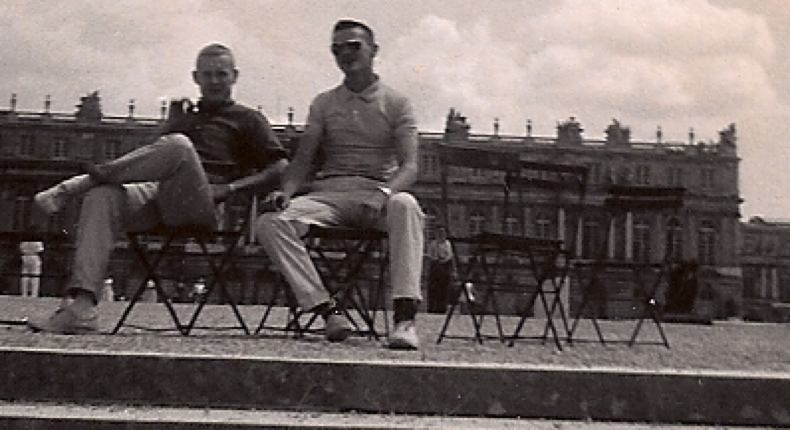
In July of 1960 Wayne, Harry and Phil spent 30 days with the 187 Airborne Battle Group at Fort Bragg. Can not remember who had the idea, but we went to Mcguire AFB in August to catch a ride to Europe. There were several stops going over, one of which was in Ireland where we had a glass of Irish Coffee at 4 in the morning. Harry and Wayne discussed the failure of the French during World War I – note it was to lay a seed in Harry’s mind which he was to remember.

We finally arrived in Paris and went out that night – somehow we got seperated. The next morning when Wayne and I awoke we found each other we could not find Harry. He arrived at the hotel mid-morning with a bandage and a bump on his head.

Harry had remembered Wayne’s history lesson and finding himself in a Communist Quarter bar had tried to rally the French Cowards to follow him to the Western Front in an effort to save Paris from the Attacking Hun.

Harry had to discuss his actions with the Gendarmerie, but first they administered a crack to the head. Harry was passed on to the Military Police resulting in his having to report to Versailles Hqs each day. Wayne and I waited over looking the Gardens at the Versailles Palace.

We were asked to leave Paris and not come back, we are on the way to climb the Matterhorn.

The weather was bad so we could not climb – we climbed a ridge south of town.

Harry and his Guide

Wayne, Harry and Harry’s Guide, as we rest. The corrective action taken by the Gendarmerie can be seen on the back of Harry’s head.

The walk with the sheer climb in the haze – Harry kept throwing rocks over the side – but we could never hear them hit. Must have been the fog that drowned out the noise.

The next day we look at the Matterhorn as we ready to leave Zermatt

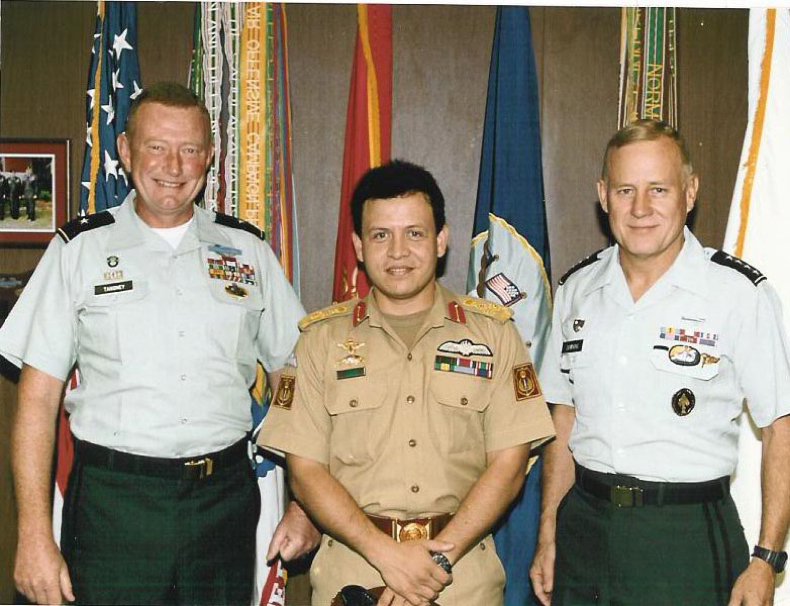
Two of our Classmates near the end of their Military Careers – One Army Chief of Staff, the other Commander of The Joint Special Operations Command.

Surrounded by Classmates and Friends & Family — Wayne is Escorted to his Final Resting Place.

Carl Morin

Carl Rolland Morin, JR

Nickname Curly

Class 1962

Company L-1

Home Town Eau Gallie, Fl.

High School Melbourne High

  • Played against “Bob Anderson” in High School and Beat Cocca Beach.

Date of Entry 1 July 1962

Date of Graduation 6 June 1962

Cadet Rank & Position

  • Lieutenant
  • Platoon Leader

Cullum Number 23899

Height 6′

Weight 185

Teams Football 4,3,2

  • Defensive Half Back, Full Back
  • Too many quailified Players Firstie Year

Coaches

  • “Col Blaik” Head Coach Plebe Year
  • “Dale Hall” Yearling & Cow

Team Captain

  • “Bill Carpenter” Yearling Year
  • “Al Vanderbush” & “Frank Gibson” Cow Year

Injuries Dislocated Right Elbow Wrestling

Athletic Awards

  • Numerals Plebe Year
  • Monogram Yearling & Cow Years

Few Demerits

Academic Star once as Firstie

Intramurals

  • Soccer, Wrestling and Volleyball

Recreation/Activities

  • Class Committee 3,2,1
  • Russian Club 4,3,2,1
  • Pistol Club 3,2,1
  • Ski Club 4,3,2

Vin Murphy

Vincent Edward Murphy

Class 1962

Company L-1

Home Town Winchester, Ma.

High School Winchester High

  • Attended with Joe Belinno, Navy’s Great Back
  • Designated the most underrated Football player in the state

Prep School Columbia Prep – Wash D.C.

  • Sent by Navy as was Joe Belinno the previous year
  • Missed the Navy cutoff score in English by 5 points
  • Recruited by Army which had a lower English score requirement than Navy but a 20 higher Math Score -(see Turnout Stars)

Date of Entry to Academy 1 July 1958

Date of Graduation 6 June 1962

Age at Graduation 23

Cullum Number 24400

Cadet Rank Sgt

Height

  • Entry 5′ 10″
  • Graduation 5′ 10″

Weight

  • Entry 185
  • Playing weight 170
  • Graduation 185

Teams

  • Plebe Football
  • Plebe Lacrosse

Coaches

  • Col Blaik Head Coach Football
  • It was either Academics or Football

Position Played End in Football

No significant amount of Demerits

3 Turnout Stars Earned- Math, Thermodynamics, the 3d is for some reason locked out of his mind.

Will Worthington

awaiting data

Merle Williams

awaiting data

Ken Wallace

awaiting data

Larry Mooring

awaiting data