Tag Archives: 1962

Bob DeVries

Robert & Nancy DeVries
Army Football Player  Inspired by John Taylor, coached by Rick with the nucleus of Tank, Russ, Bob, Bill, Dave, Paul, Dennis, Wayne & Mike, ’62 gave West Point Rugby, a team that has dominated the sport since its inception.

75 Bill Yost, 73 Bob Odd, 11 Pete King, 45 George Kirschenbauer, 58 Dick Buckner, 65 Harry Miller, 64 Al Vanderbush, 56 Ozzie Oswandel, 40 Russ DeVries, 94 Bob DeVries, 61 Jerry Clements

Bob Lilley

and Roger Maris

In the eye of my mind, I can still see Bob Lilley staggering under the longest, highest fly ball ever hit at Doubleday Field, post Babe Ruth. The ball was struck by Roger Maris during the exhibition game against the Yankees. Bob was holding down right field and had moved back towards the Library Tennis Courts fence out of respect for Maris. Now, if this happened in 1962, Maris was coming off the year he hit 61 home runs. If it happened in 1961, it was just after the major league season had begun, the season in which Maris would break the record. In fact, if it was 1961, it would have happened about the time Maris began his run at the record, because he did not hit his first homer until game 9 of the season. (He hit 61 homers in his last 154 games of the season, just as Ruth had hit 60 in his 154 games.)

The overflow crowd had leeched onto the playing field and more or less surrounded Bob as he followed the arc of the ball, gauging its trajectory with geometric logic and experience gained from hundreds of games of baseball. I heard someone yell, “Go back further!” Bob heeded this advice, camped under the high-flying missile and actually got his glove on it but could not hold it. Maris strolled into third base. The ball struck the ground perhaps 20 feet from the fence, a monstrous shot.

It is like it happened yesterday.
Bob stayed in the lineup because of his bat, playing Cather, First Base & Outfield.

There is a photo of Bob, Al DeJardin & Mickey Mantle on the wall of Fame connecting Kimsey Center & with the Hockey Rink & Basketball Arena.

Bob was drafted by the Cleveland Indians out of High School.

Russ DeVries

Russell & Marcia DeVries

75 Bill Yost, 73 Bob Odd, 11 Pete King, 45 George Kirschenbauer, 58 Dick Buckner, 65 Harry Miller, 64 Al Vanderbush, 56 Ozzie Oswandel, 40 Russ DeVries, 94 Bob DeVries, 61 Jerry Clements

–

Russ DeVries


–

–

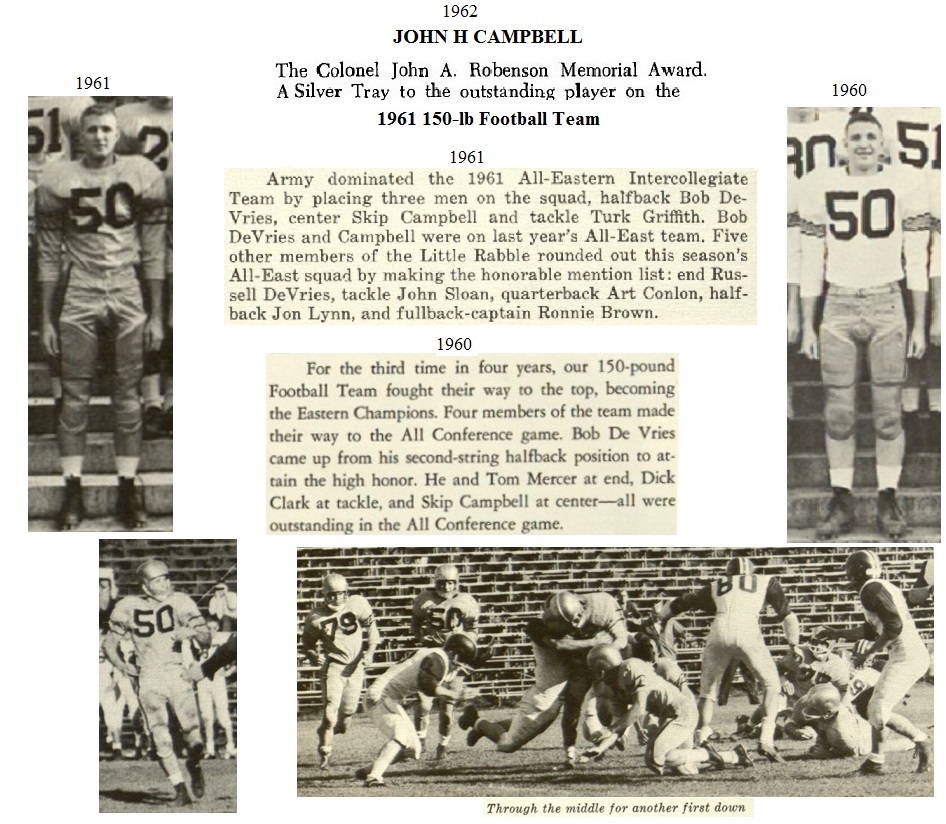
Skip Campbell

Skip & Marlene Campbell

JohnCampbell_1962_ArmyLFB-1961_RobensonMVP61

–

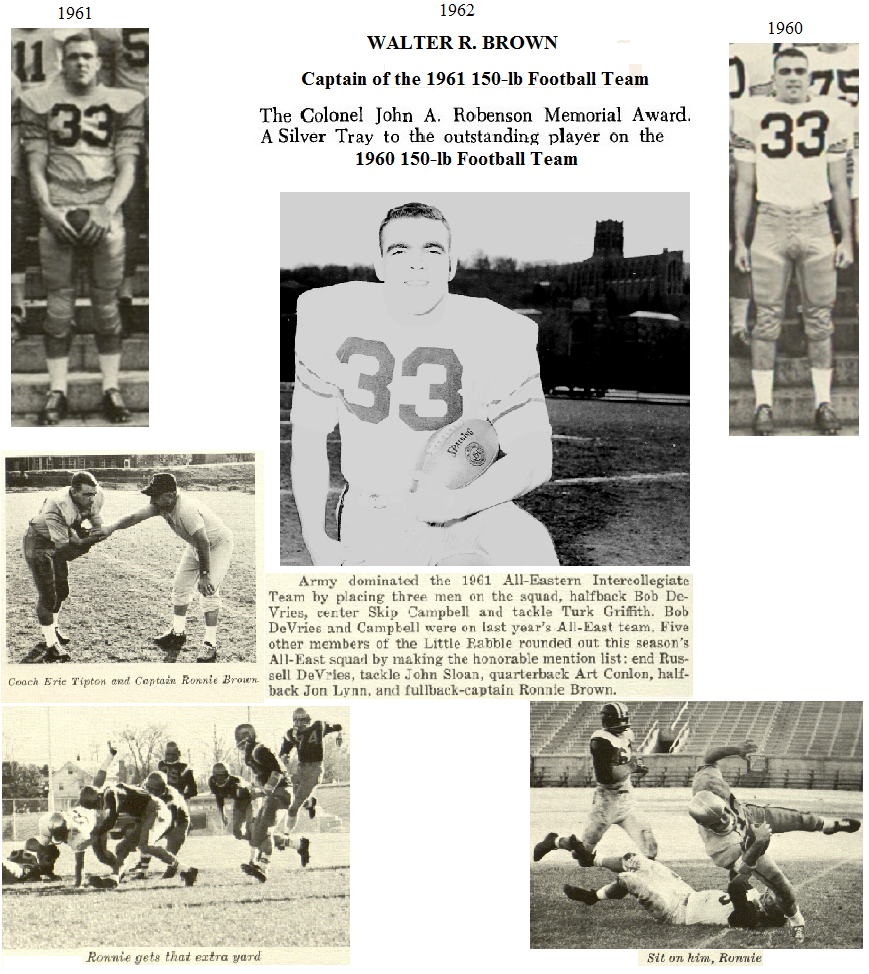
Ron Brown

Ron Brown – 150 Captain

Jim Kays told me “I Love Ronnie Brown” If you depend on someone to get 1 yard or 9 yards when you need it, and protects you from Vicious Linebackers, there is no other way to say it. Phil

Ron Receiving 150 Award in Spring of 1961


–
WalterBrown_1962_ArmyLFB_1961_Captain61_RobensonMVP60

Distinguished Service Cross

AWARDED FOR ACTIONS
DURING Vietnam War
Service: Army
Rank: Captain
Battalion: 2d Battalion (Airborne)
Division: 101st Airborne Division
GENERAL ORDERS:

Headquarters, U.S. Army, Vietnam, General Orders No. 5896 (October 3, 1966)

CITATION:

The President of the United States of America, authorized by Act of Congress, July 9, 1918 (amended by act of July 25, 1963), takes pleasure in presenting the Distinguished Service Cross to Captain (Infantry) Walter Ronald Brown (ASN: 0-95811), United States Army, for extraordinary heroism in connection with military operations against an armed hostile force in the Republic of Vietnam, while serving with Company A, 2d Battalion (Airborne), 502d Infantry, 1st Brigade, 101st Airborne Division. During the period 9 June 1966 to 11 June 1966, Captain Brown, the company commander of Company A, had the mission of reinforcing a company that was surrounded by a Viet Cong battalion near Dak To. Upon receiving the mission, Captain Brown immediately assembled his company and began the 3,000 meter move through darkness and treacherous terrain to the battle area. As his company reached the top of the mountain overlooking the beleaguered company, it received intense hostile fire. With complete disregard for his safety, Captain Brown led a squad to the flank of the insurgent positions and initiated an assault that killed nine Viet Cong and forced the remainder of the insurgents to flee. During the assault, Captain Brown charged a machine gun emplacement and personally killed three Viet Cong. Although the situation was extremely tense, Captain Brown positioned himself with the lead element and continued to advance toward the stricken company. Upon entering a valley, the lead element again received Viet Cong fire from the surrounding high ground. While the rest of the company continued forward, Captain Brown maneuvered his machine guns into a position where they placed suppressive fire on the insurgents. As his unit reached the perimeter of the beleaguered company, the rear element was attacked by a determined Viet Cong force and one trooper fell seriously wounded. Captain Brown immediately raced 30 meters down the slope to the wounded trooper and carried him to safety. He then assumed command of the perimeter and positioned his men to repel the repeated Viet Cong attacks. Throughout the next 30 hours, Captain Brown continuously exposed himself to carry ammunition, call in air strikes, and adjust artillery fire. During a mortar attack on 10 June 1966, Captain Brown moved about the battlefield helping move wounded soldiers from exposed positions. Working against superior odds, he organized his company and rallied his men to successfully fight their way through the Viet Cong encirclement. Although confronted with the arduous task of transporting 45 litter casualties over rough terrain to an evacuation point 1,000 meters away, he never relented from his determined efforts to accomplish his mission. while moving toward the landing zone, they were again hit by a Viet Cong element. Despite the fact that he was wounded by a grenade explosion, Captain Brown ordered a charge that overran the insurgent position. After reaching the landing zone, he returned down the mountain to help his comrades carry the litter patients to the extraction point. Through his courage and outstanding leadership, he contributed immeasurably to the defeat of the Viet Cong force. Captain Brown’s extraordinary heroism and devotion to duty in close combat against a numerically superior hostile force were in keeping with the highest traditions of the military service and reflect great credit upon himself, his unit, and the United States Army.

–

Harry Hagerty

“You Man Halt”   Twice he heard it, Harry halted for one ran at the other – he had well over 200 hours on “The Area” Harry Wayne Downing and I flew on Stand By to Europe. We were asked to leave Paris by the US MPs. We headed South to Switzerland to climb the Matterhorn. There was too much snow, so we made a Ridge Climb. Harry kept tossing rocks over the side of the narrow ledge, trying to determine the drop. There was a heavy fog. He never heard them hit. No one ever had a better Ranger Buddy – Phil

Vin Murphy

awaiting data

Bob Culp

Bob is 34

Mike Casp

11/14/1967 Mike Casp  

1962 – 24202

To get through the line I depended especially on three teammates and Classmates, Mike Casp (our team captain) – at Right Guard, Bill Whitehead – at Center, and Barry Butzer – at Left Guard. They were great Army football players. Bill and Mike were Killed in Vietnam.  Barry was Killed in an auto accident several years ago – – Al Rushatz

MICHAEL A. CASP 1962

Cullum No. 24202-1962 | November 14, 1967 | Died in South Vietnam
Interred in Arlington National Cemetery, Arlington, VA

Today is Memorial Day 2009 . . . a day when all Americans remember all of our comrades in arms that have made the ultimate sacrifice for our Country. More than 41 years ago, Michael Allen Casp, a loving son, brother and uncle; a good friend and classmate; and, most of all, a soldier who loved his fellow troopers, made that ultimate sacrifice for all of us.

Michael Allen Casp was born in Rochester, PA, the only son of Mike and Olga Casp. Mike was raised in Beaver County, where his father worked for J&L Steel and his mother was a dedicated homemaker.

As a baby, he received the nickname “Sluggo” because of his pug nose, a characteristic of a then popular, comic strip character. Growing up, Mike was always interested in playing ball—football and baseball. As a youngster, he collected baseball cards and set up teams and games. Often, he could be heard announcing imaginary games from his bedroom, and his family thought he would grow up to be a sportscaster. He was always playing some kind of ball with the neighborhood kids. He played Little League baseball and Midget Football. Growing up, he spent his summers on his grandparents’ farm near Lake Erie.

At Beaver High School, Mike was a hard hitting halfback and fullback. He helped his team compete for the Western Pennsylvania Interscholastic Athletic League (WPIAL) section championship. In baseball, he was a long ball hitter and played in the outfield. His school team won the WPIAL section championship four years in a row. He also played Junior American Legion baseball in the summer. One local newspaper said that the other teams breathed a sigh of relief when Mike left for West Point.

He was also a member of the National Honor Society and had 59 scholarship offers, including one from Navy. Seventeen years old when he left for West Point, Mike entered on 1 Jul 1958 as a member of the Class of 1962. While at the Academy and a member of Company H1, he managed to be involved in the Debate Council, Handball Club; and Dialectic Society. His Howitzer write up summarized Mike’s cadet experiences best: “Casper was known most for his aggressiveness and grim determination to win on the gridiron…His abundance of selfconfidence, along with his humility, will carry him a long way after graduation.”

Mike played fullback and linebacker before settling in as the team’s left guard. During the 1960 Army/Navy game, Mike made 15 tackles and led all players in that category. Because of these traits, Mike, wearing number 62, was elected by his teammates to become the 71st Captain of an Army football team. When he was elected Captain of the Army team, his hometown held a breakfast and a parade in his honor. Under Mike’s leadership from his position at left guard, the 1961 team completed the season with a 6-4 record that included a major upset of Penn State on the road.

Mike was commissioned in the Field Artillery and, after the prerequisite Army schools, stationed at Ft. Bragg, NC; with a Military Assistance Command—Viet Nam Advisory Team in Da Lat; and with the 1st Armored Division at Ft. Hood, TX. He then returned to South Viet Nam and commanded A Battery, 29th Field Artillery in the Central Highlands. His former battery executive officer, Dennis Dauphin, writes, “Words cannot express the admiration and respect I had for Mike Casp. He was a natural leader and allowed his officers and NCOs to do their jobs and prove their worth. Mike was never a “ring knocker” and never mentioned the honor of serving as the captain of the West Point football team.”

On 14 Nov 1967, within days of completing his second combat tour in South Viet Nam and while serving with the 4th Infantry Division as the Assistant S3 of the 3rd Brigade, Mike was killed in action near Tam Ky when his command and control helicopter was shot down while he was coordinating fire support for an Infantry unit. For his heroic actions, Mike received the Distinguished Flying Cross. He also was awarded two Bronze Star Medals and the Purple Heart. In a letter to Mike’s family, his former battalion commander wrote, “He always performed his duties as an officer in a superb manner . His loss was a severe blow to us, and we will long remember him.”

After his funeral in Beaver County at the Holy Trinity Lutheran Church (which he had attended since he was four years old), many relatives, friends, and former coaches took an overnight train to Washington, DC, for Mike’s burial in Arlington National Cemetery. The soldier sent from Arlington to drive the mourners was amazed at how many people there were. They initially had sent a sedan but had to order a military bus. Mike was buried with full military honors, surrounded by those who loved him.

Mike’s legacy lives on in Beaver. After his father died in 1991 and his sister, Jo Ann, was closing up the old homestead, much of Mike’s sports memorabilia was given to the local children who had looked up to Mike as they were growing up.

He is still greatly missed by all who knew and loved him. Well done, Sluggo. Be thou at peace.

Army Football, 3 Army A’s, Captain of the 1961 Team.

I was the Fire Direction Officer with A/2/9 in the Spring of 1967 when Cpt, Casp became the battery CO. If I remember correctly, Michael had served the 5 years he was obligated to serve because of going to West Point. He had requested to be released from active duty but was involuntarily extended to serve until December of 1967. Captain Casp was a great Battery Commander and person. I was privileged to serve with him. Pictured with Mike in the picture above is, Warrant Officer Franklin, counter mortar radar officer, CPT Casp, Lt. Dennis Munden, Fire Direction Officer (FDO), “Chief of Smoke” SFC Rollings, and Lt. Dennis Dauphin, Executive Officer.

CPT Michael A. Casp In memory of our fallen brother

“We few, we happy few, we band of brothers; for he to-day that sheds his blood with me shall be my brother”

HHC Company
1st Battalion
35th Infantry Regiment
Vietnam War

“Not For Fame or Reward
Not For Place or For Rank
But In Simple Obedience To
Duty as They Understood It”

The 35th Infantry Regiment Association salutes our fallen brother, CPT Michael A. Casp, who died in the service of his country on November 14th, 1967 in Quang Nam Province, Vietnam. The cause of death was listed as Helicopter Crash. At the time of his death Michael was 27 years of age. He was from Beaver, Pennsylvania. Michael is honored on the Vietnam Veterans Memorial at Panel 29E, Line 94.

The decorations earned by CPT Michael A. Casp include: the Combat Infantryman Badge, the Silver Star, the Purple Heart, the National Defense Service Medal, the Vietnam Service Medal, the Vietnam Campaign Medal and the Vietnam Cross of Gallantry with Palm Unit Citation.

——————————————————————————–

Captain Casp was the Commander of A Battery, 2/9th Artillery. He was temporarily filling-in for the regular LNO whom was on R&R.

Mike was the Captain of the 1961 West Point football team

Mike 2d from left was Captain of the 1961 Football Team. Mike was Killed in Action

62 Guard Fall of 59

POSTED ON 11.10.2011

POSTED BY: SGT. CHARLES R THEW

MY FRIEND

Capt. Casp was comander of the artillery battery I was in. Everybody liked him. He left os to go into the Infantry. He wanted more excitement. I sure miss him.

OSTED ON 9.25.2011

POSTED BY: THOMAS A. DUMAS

FOREVER YOUNG

Hey Cousin ‘Sluggo’ It’s hard to believe it’s been over 40yrs since you left us. Whenever I think of you I see that silly grin and realize that you will forever be that young handsome soldier in my mind. You are my hero – Until we meet again – Love, Cousin Tommy

POSTED ON 9.8.2011

POSTED BY: MARY BEERMAN

AN AMERICAN HERO

An American Soldier….. 

You can bet that I stand ready when the wolf growls at the door, 
Hey, I’m solid, I’m steady, I’m true down to the core, 
And I will always do my duty, no matter what the price, 
I’ve counted up the cost, I know the sacrifice, 
And I don’t want to die for you, But if dying’s asked of me, 
I’ll bear that cross with honor, ‘Cause freedom don’t come free. 
I’m an American Soldier, an American, 
Beside my Brothers and my Sisters I will proudly take a stand. 
When liberty’s in jeopardy I’ll always do what’s right. 
I’m out here on the front lines, sleep in peace tonight. 

Rest in Peace, dear Hero. 

(excerpt from Toby Keith’s song) 

POSTED ON 10.28.2007

POSTED BY: CLAY MARSTON

VIETNAM –

VIETNAM – ” ANOTHER TRAGIC DAY ” –

MAJOR GERARD MICHAEL WYNN

According to records uncovered during research for this biography, Major GERARD MICHAEL WYNN was the S-1 for the Third Brigade of the Fourth Infantry Division from 1 August 1967 to 25 October 1967. 

However, that starting date is at odds with Major Wynn’s casualty data from The Vietnam Veterans Mmeorial Wall, which shows he did not come in country until 2 September 1967.

The 3rd Brigade of the 4th Division consisted of three infantry battalions: 

1/35 (Cacti Green), 2/35 (Cacti Blue), and 1/14 (Golden Dragons) 

All three of these battalions had accomplished records in Vietnam, as well as Korea and WWII. 

Initially in the 25th Infantry Division, the three battalions became members of the 4th when those two divisions swapped third brigades on 1 August 1967. 

As brigade S-1, Major WYNN would have acted as the adjutant, being responsible for ensuring that matters involving personnel, finance, record keeping, orders, assignments, etc. were competently carried-out by each battalion’s S-1.

Major WYNN became the S-3 for the 1/35 on 26 October 1967. 

The 1/35 (First Battalion, Thirty-Fifth Infantry) consisted of: 
a HQ Company, four rifle companies (A, B, C, D) and a Company E which consisted of the Recon Platoon and Heavy Weapons group. 

As battalion S-3, Major WYNN was the operational planner, sorting through various intelligence gathered and deciding on missions and daily movement routes of the four rifle companies and the Recon Platoon.

At the time Major WYNN joined the 1/35, the battalion was attached to the First Brigade of the 101st Airborne during Operation WHEELER in Quang Tin province. 

On 4 November 1967 the 1/35 became attached to the Third Brigade, First Air Cavalry Division while participating in Operation WALLOWA in northern Quang Tin and southern Quang Nam provinces. 

At this time, the 1/35 was operating in, or slightly outside, the Que Son valley. 

That valley is 24 miles long and is nestled on the borders of Quang Tin and Quang Nam provinces. 

Surrounded on three sides by double-canopy jungled mountains, the valley was home to 60,000 people and very fertile rice paddies. 

With the twin attractions of a large population to recruit from and an excellent source of foodstuffs, the valley was coveted by the VC / NVA and was hotly contested for the duration of the American involvement.

The four rifle companies though usually operating in the same general area so as to be somewhat mutually supporting. Were usually separated by several kilometers. 

In addition to distance, the difficult terrain made the helicopter indispensable for the Battalion staff. Using the helicopters as a mobile command post, each company could be visited daily, if required, for consultation with individual commanders. 

Also, the ” big picture ” view from above during an actual fight afforded the Battalion staff the advantage of seeing nuances not always as readily noticeable to beleaguered troops on the ground.

The events leading to the death of Major WYNN began unfolding on the morning of 13 November 1967. 

A six-member First Air Cavalry Division Blue team from the 1/9 was operating in western Que Son valley. 

A Blue team was in essence a self-sustained reconnaissance unit. 

They would fly around looking for “hot spots”, had helicopter gunship support and additional infantry support prioritized to them, and also could call in the regular line companies if the action was too big for them. 

On this particular morning, the Blue team spotted an NVA standing in the middle of a rice paddy and making gestures as if he wanted to surrender. 

Coming closer for a better look, their chopper was shot down by an NVA anti-aircraft battalion dug into a nearby village. 

The NVA’s weapon of choice for such encounters was the 12.7-mm machine gun, their equivalent of our .50 caliber. 

The NVA’s ultimate goal that morning was not the Blue team but rather the choppers sent to rescue the team and to attack the village. 

Reliable reports fix the number of helicopters shot down that day at between fifteen and twenty. 

As the day wore on the Blue team’s position became more and more vulnerable. 

They were pinned-down with scant cover in a rice paddy outside the village and running very low on ammunition. 

Their parent unit was spread very thin trying to provide security at every downed chopper. 

Being the closest available line company, we (Company A, 1/35) were ordered to prepare to move by helicopters to their aid. 

Our sister company Bravo was also involved in securing a downed chopper and crew approximately one kilometer from the Blue team. 

They in fact suffered the loss of one lift ship on the way in resulting in four deaths.

At that time, we were located several miles to the west still near the site of a major engagement a few days before on 9 November. 

Supported by a squadron of Armored Personnel Carriers ( APC’s ), we had assaulted a suspected NVA hospital complex. 

The engagement lasted from dawn until dusk with much heroism shown on both sides. 

The Executive Officer for the APC’s, 1st Lieutenant JAMES ALLEN TAYLOR, was awarded the Army Medal of Honor that day and the NVA fought to a standstill a total of three American infantry companies supported by armor. 

Major WYNN and our Battalion Commander Lieutenant Colonel ROBERT GENE KIMMEL, were both overhead that day coordinating air strikes and lifting-in two other companies in an effort to completely cordon-off the complex.

The choppers picked us up at about 1730 hours and flew very low on the way in so as not to tip-off the NVA gunners of our approach. 

We still drew heavy fire as we neared the trapped team, the air being filled with green tracers from the 12.7-mm guns. 

Several of our lift ships took hits but, miraculously, we landed unscathed and were eventually able to reach the Blue team and spent the night with them in the rice paddy. 

During the night the NVA managed to get close enough to hit the Blue team’s downed ship with a recoilless rifle. 

The ship burned all night with ammunition still on board “cooking-off” at frequent intervals. 

In addition, the trip in had flown us completely off the field map Captain CHARLES CHAPLINSKI had; as a consequence we had no communication with our battalion Net and could not even call in artillery. 

All in all, it was a very restless night spent in that muddy, damp paddy.

At around 0730 the next morning, Colonel KIMMEL’s Command and Control chopper ( C&C ) appeared overhead. 

Rain had moved in during the night and the morning remained dark and dreary with low-hanging clouds. 

Aboard with Colonel KIMMEL were Major WYNN, the artillery liaison Captain MICHAEL ALLEN CASP, 1st Lieutenant RANDALL DALE SHAFFER, plus two pilots and two door gunners. 

Their chopper had just left Co B, 1/35’s position.

Colonel KIMMEL was talking to our company commander, Captain CHARLES CHAPLINSKI, by the radio. 

Apparently a large group of NVA had been spotted to the north and the colonel wanted us to move-out in pursuit of them. 

Captain CHAPLINSKI replied that we were first waiting for the Blue team to be extracted. 

The colonel insisted that we move-out immediately but Captain CHAPLINSKI refused, noting that he did not want to leave the Blue team by themselves. 

The exchange grew very heated and finally the Captain agreed to at least start one platoon moving toward the new objective.

All during the radio exchanges we could see green tracers from the southeast rising toward the C&C ship from quite a distance away. 

Though the NVA had deserted their original position in the village, they still had a presence in the area. 

Captain CHAPLINSKI repeatedly warned Colonel KIMMEL that they were taking fire, 

” Sir, you are taking fire, sir, please be advised that you are taking fire from the south east.” 

The Colonel finally acknowledged the danger and replied, ” We will attempt to rise above it.” 

Now the 12.7-mm had a range of about one mile, so that was easier said than done.

Shortly after Colonel KIMMEL’s last transmission, we heard a loud ” ping ” and looked up to see that the rear rotor had come-off the C&C ship; undoubtedly shot-off. 

The rear rotor was held on by a large nut, referred to by helicopter mechanics as the ” Jesus Nut “, it seems likely that a 12.7 round hit that nut. 

Without a rear rotor a helicopter has no lateral stability and is nearly impossible to control. 

However, it appeared for a few seconds that the pilot might succeed in landing it. 

At this point Major WYNN came on the radio and said, ” We are coming in.” 

Captain CHAPLINSKI replied that they were over our perimeter and they should attempt to come down where we were. 

That was the last transmission we heard. 

Shortly afterwards, the tail of the C&C ship swung completely around, the ship went into a spin, and spiraled, nose-first, straight down.

It hit about 75 yards from our perimeter; there was a brief fire on impact, but I seem to recall it being out by the time we reached the helicopter. 

Lieutenant SHAFFER’s body was outside and the others were in the wreckage. 

One of the door gunners had apparently tried to jump clear of the ship, his body was found in a clump of bamboo about 100-150 feet from the crash.

In addition to Colonel KIMMEL’s staff, the following men were also on the downed ship:

Specialist 5 PAUL EDWARD JOHNSON 
– DOOR GUNNER – 
Age 24 – Lookout, Kentucky

PFC RUSSELL FRANK McLAUGHLIN 
– DOOR GUNNER – 
Age 20 – Wheeling, West Virginia 

WO FRANK A. MURRIETTA 
– PILOT –
Age 22 – Phoenix, Arizona 

WO STEPHEN H. THORNTON 
– PILOT – 
Age 20 – Albuquerque, New Mexico

( The Vietnam Veterans Memorial Wall’s casualty data only shows one pilot but that is an error as there were two on the ship. The crash occurred in Quang Nam province, WO Thornton’s location is listed as Quang Tin and I feel that is a mistake and he was the other pilot involved )

Written by –

RICHARD (DICK) ARNOLD
Company A,1/35
3rd Brigade of the 4th Division.

The following also contributed to this article:
CHARLES CHAPLINSKI – Co A 1/35
DON REH – Co B 1/35
BRUCE PHILLIPS – Platoon Leader, Co A, 1/35
MATT BRENNAN – Blue Team Leader

POSTED ON 2.12.2005

POSTED BY: ROBERT SAGE

WE REMEMBER

Michael is buried at Arlington Nat Cem.

POSTED ON 6.12.2003

POSTED BY: BEN YOUMANS

CACTI FOREVER

img

2/9th Artillery assigned as Artillery Liasion Officer to HHC Company, 1/35th Infantry, 3rd Brigade, 4th/25th Inf Division. 
We few, we happy few, we band of brothers; 
For he to-day that sheds his blood with me 
Shall be my brother; be he ne’er so vile, 
This day shall gentle his condition; 
And gentlemen in England now-a-bed 
Shall think themselves accurs’d they were not here, 
And hold their manhoods cheap whiles any speaks 
That fought with us upon Saint Crispin’s day.
http://www.cacti35th.org 
35TH INFANTRY REGIMENT ASSOCIATION

POSTED ON 6.26.2002

POSTED BY: COL JAMES T. PIERSON

2ND OF THE 9TH ARTILLERY

Mike was a battery commander in the Mighty Ninth and was finishing his tour of duty when he was killed. He was performing the duties of Artillery Liason officer to the 1st of the 35th Infantry (Cacti Green) and riding in the command helecopter with the battalion commander (LTC Kimmel), S-3 and S-3 air when it was shot down and all aboard perished. He had taken my place while I was on mid-tour R&R. The incident occurred the day I left for R&R. Mike was an outstanding leader and commander.

POSTED ON 3.1.2022

POSTED BY: JOHN FABRIS

WE WILL REMEMBER

They shall grow not old, as we that are left grow old: 
Age shall not weary them, nor the years condemn. 
At the going down of the sun and in the morning, 
We will remember them. 

POSTED ON 7.6.2020

POSTED BY: RICHARD A MELKERSON

SP5 RICHARD A. MELKERSON, JR.

I grew up in Mike’s hometown of Beaver, Pa., and he was and still is, our hero. He grew up in the projects in Vanport and his nickname was SLUGGO. He will always be remembered! 

POSTED ON 11.4.2019

POSTED BY: RAY DAWSON

MY DAD’S BEST FRIEND

Only meet him once when I was four. He getting ready to go to Vietnam. Him patients where my neighbor. His dad would set on the backpoch puffing on his cigar. Watching us play football. I was never the player his son was.

POSTED ON 11.10.2017

POSTED BY: MARISSA SCHAEFER

UNCLE MIKE ALLEN CASP

I am the grand-daughter of Mrs. James Mathews (sister of Michael Casp). I wish I would have had the honor of meeting you. Thank you for your service

POSTED ON 10.18.2017

POSTED BY: LUCY CONTE MICIK

THANK YOU

Dear Captain Michael Casp, 
Thank you for your service as a Field Artillery Unit Commander. It is important for us all to acknowledge the sacrifices of those like you who answered our nation’s call. Please watch over America, it stills needs your strength, courage and faithfulness. Rest in peace with the angels.

A 57mm gun which was an unusually high caliber for the area, was guarding a headquarters of the 3rd NVA Regiment, 2nd NVA Division. The team shot down the helicopter at Dong Son. 

The commander of the 3rd NVA Regiment was later killed by B Troop, 1/9 Cavalry on 5 December in the Que Son Valley just north of LZ Ross. 

Writing a book on the Que Son Valley 
ltcpike@gmail.com

POSTED ON 1.7.2016

POSTED BY: KR

CPT M.A. CASP – USMA GRADUATE

img

CPT Michael A. Casp was an alumnus of the U.S. Military Academy at West Point, NY. He was one of 334 men from West Point who died or are MIA in Southeast Asia during the period October, 1957 – September, 1972. 

POSTED ON 11.19.2015

POSTED BY: DICK MELKERSON

BEAVER PA. FOOTBALL

Mike “Sluggo” Casp a legend in Beaver football will always be remembered as one of a kind. Moved from guard to fullback, and the rest is history. Should have been Gen. Michael A; Casp.

POSTED ON 5.22.2015

POSTED BY: GINA

CAPTAIN MICHAEL ALLEN CASP (SLUGGO)

Sluggo was my Dad’s (Ray E. Dawson) best friend (knew each other all their lives). They played football together at Beaver Highschool. My Dad always spoke highly of Sluggo. My Dad and your Dad were in the stands cheering you on at the Army / Navy game. I know that you & my Dad are having a fabulous time in heaven. Your parents Mr. & Mrs. Casp were our next door neighbors in Beaver for a very long time. Thank you for your service. You gave it all for your beloved country. GOD Bless America.

POSTED ON 12.13.2014

TOO YOUNG

Learned all about Mike when I was growing up from my mom, grandparents and his parents. God bless him and those others who lost their lives in combat.

POSTED ON 11.4.2014

FOR CAPT. MICHAEL ALLEN CASP, USA…ANOTHER OF BERAVER’S BRAVEST OF HEROES, WHO GAVE HIS ALL FOR US!

He loved us so. 
Every day, in a hundred ways, he told us so. 
In honesty, in affection, he told us so. 
He loved us so. 
Every day, in a hundred ways, he showed us so. 
With loyalty and bravery, he showed us so. 
He was our defender, and he kept us free! 
He took an oath to guard us, and fought for liberty! 
He loved us so, and we should know. 
For we loved him so. 
Captain Casp, you were the very essence of DUTY!…HONOR!…and COUNTRY! You had been there and done that in Vietnam! You were one brave man who did brave deeds for our America! You fought for the right, without question or pause! Your name and fame are the BIRTHRIGHT of EVERY American citizen! In your youth and strength…your love and loyalty…you had given all that mortality can give! You had given all to defend liberty everywhere! Beaver is very proud of you! I say again, Sir, very proud! You had lived up to the code of conduct and chivalry of those who guard this beloved land!…an ideal SO NOBLE that it arouses in all of us a sense of pride, and yet, of humility! I strongly believe and honestly, Captain, that Avonmore’s own Jill Corey, whom I greatly admire and immensely as one of my three top favorite songbirds of all time, the other two being Walton-on-Thames’s own Julie Andrews, England’s musical queen, and London’s own Dusty Springfield, another thrush from England, would be very proud of your service3 to America, and the sacrifices you made to keep us and our country free! Well done, Sir! Be thou at peace. ARMY STRONG

POSTED ON 9.18.2014

POSTED BY: JACALYN E MATHEWS

IT’S THE LITTLE THINGS

I REMEMBER HOW I LOOKED UP TO UNCLE MIKE AND THOUGHT HE WAS SO COOL… AND HE IS! 

POSTED ON 12.14.2013

POSTED BY: BETH FRENZEL EDWARDS

NEVER FORGOTTEN

Dear Michael (Sluggo) , 
I met you when I was 16 years old. I was spending the summer in Albion, Pa with my Aunt Ruth and Uncle Wayne. You came to the house to say goodbye as you were leaving for your final tour in Vietnam. What a fun night we all spent eating pizza, etc. 
I still have the picture you sent me while you were in Vietnam, sorry I don’t have the letter. I have always remembered you and wish we could have gotten to see one another again. I still remember what you called me, so I will sign off with the name. 
Your a true hero in my heart. I will see you again in another time. 
Your little Pixie, 
Beth Frenzel Edwards 

POSTED ON 4.14.2013

POSTED BY: DEBBIE CLINE

YOU ARE NOT FORGOTTEN

Thank you, may God bless and keep you in his loving arms; for you have made the ultimate sacrifice so that others are free.

POSTED ON 1.6.2013

FINAL MISSION OF U.S. ARMY HELICOPTER UH-1D TAIL NUMBER 66-01006

On November 14, 1967 U.S. Army helicopter UH-1D tail number 66-01006 was operating as a Command & Control ship. The crew consisted of aircraft commander WO1 Frank A. Murrietta, pilot WO1 Stephen H. Thornton, crew chief PFC Russell F. McLaughlin, and gunner SP5 Paul E. Johnson. Its four passengers included LTC Robert G. Kimmel, MAJ Gerard M. Wynn, CAPT Michael A. Casp, and 1LT Randall D. Shaffer. The aircraft received enemy 12.7mm fire which resulted in a tail rotor separation at 1,500 feet AGL. An eyewitness claimed that the aircraft subsequently got into severe mast bumping, leading to the loss of the main rotor. The ship went into a spin, and spiraled, nose-first, straight down. There were no survivors. [Taken from vhpa.org]

REMEMBERED

img

Photo Credit: Dennis Munden

Rest in peace with the warriors.

Bob Fuellhart

8/12/1965  Bob & Jan Fuellhart
Army’s Lonely End in 1960 and 1961 upon the Graduation of Bill Carpenter. In ’61 he was banged up with injuries but was still a hard nosed defensive back. Killed in Action 12 August 1965 the same day his Daughter was born.

ROBERT H. FUELLHART JR. 1962

Cullum No. 24324-1962 | August 12, 1965 | Died in Vietnam

Interred in West Point Cemetery, West Point, NY

“Although he became famous as Army’s ‘Lonesome End,’ the gridiron was not the only field on which he excelled.” In this thumbnail reference to Bob Fuellhart at graduation, the 1962 Howitzer added, “We will always remember his ready laugh and good humor.”

Three years later, war correspondent Jimmy Breslin reported from Vietnam: “Fuellhart, big boned and well over six feet…was a known sports page name…but he never talked about football. He talked about being a soldier and going into action.”

Born in Tionesta, Pennsylvania, on 12 January 1939, Bob, during his early schooling and through to his graduation at the Kiskiminetas Preparatory School, developed the stamina, the sense of timing, and the dynamism for “hard hitting” action, in short, the prowess and the mold of character which foreshadowed his impressive athletic record and his leadership accomplishments at the US. Military Academy.

Bracketed with these years of schooling and vigorous physical pursuits, the military service of Bob Fuellhart is in marked harmony with the philosophy of the Duke of Wellington’s capsuled critique: “The battle of Waterloo was won on the playing fields of Eton.”

Bob did not live to wear the stars of a general officer as predicted in the 1962 Howitzer. He was killed in the far south of Vietnam, as an advisor to a Vietnamese battalion, while directing an air strike in support of his group that was battling the Viet Cong at a place called Phong Hiep in the Mekong Delta area.

A memorial resolution, adopted by the Pennsylvania House of Representatives, referred to Bob’s last mission as “an inspiring story of duty, courage, and devotion to country, in the highest traditions of the Army.”

And behind this dedicated performance, there should be chronicled the serious bent of a mature, earnest young officer, with the athletic fields behind him as a distant memory, ever striving to deepen his knowledge and to strengthen his effectiveness as a leader of men in combat.

He elected to become and was accepted as a Ranger. He attended the Airborne, Jumpmaster, Ranger, and Special Warfare Schools, and he studied the Vietnamese language at the Defense Language Institute. After service with the 25th Division at Schofield Barracks, his final assignment was with the 44th Ranger Battalion, Can Tho, South Vietnam.

Recognition of his devoted service and outstanding military character came with a posthumous promotion to the rank of captain. He had also been awarded the Purple Heart, the Bronze Star with “V,” an Oak Leaf Cluster to the Bronze Star, and the Silver Star by his own country, and from Vietnam, that country’s Gallantry Cross with Palm Leaf, and National Order Medal, Fifth Class.

Beyond this story of an unusually creditable performance of a young combat officer, there lies a deeply touching feature.

Two hours before the fatal turn in Vietnam, back in the United States, a baby girl was born to Bob’s young and pretty wife Jan, an Armed Service Junior, daughter of Colonel John A. Bell, U. S. Air Force. Due to jungle battle conditions, word never reached Bob.

However, to this daughter he has left a legacy, and to the Army, another stone in the great mound of high tradition, the memory of a brief but outstanding military career, of epic devotion to duty.

He was buried at the U. S. Military Academy with full military honors. His attachment to West Point was deep and abiding.

In addition to his wife Jan, and daughter Jami Lee, Captain Fuellhart is survived by his parents Mr. and Mrs. R.H. Fuellhart Sr., of Tionesta, Pennsylvania, and by two sisters and two brothers.

—James Kepler Davis Rear Admiral, USN, Ret.

80 – End — Fall of 59

Bobby became first team All-American at close defense and won the Schmeisser Award as the outstanding defense man of 1962.

Former Classic Stars in Action

The list of ex-Army Players grows: Pete-Dawkins To Blanda, Bill Carpenter, Dick Eckert, Glenn Blumhard, Monk Hilliard, all in Viet Nam And there was Bob Fuellhart. Maybe not all the buffs among the 102,000 will remember the name quickly, although he came three times to Broad St. pageant. He was a lean-jawed, solid kid who grew up at Tionesta, a village in the bear and deer country of Western Pennsylvania. He had been a hurdler and broad jumper at Kiski Prep before going to West Point.

Because of his fine speed, Fuellhart played the “Lonesome End” behind Bill Carpenter his first season at Army, It was ironic. Carpenter an advisor in Viet Nam for 13 months when few people could even find the Mekong Delta on a map, was wounded twice. He is now an instructor at Fort Knox, KY. and wears the Bronze and Silver star.

Fuellhart’s trips to Philadelphia were not cheerful ones. His teams lost three times to Navy. The last one was in 1961, a day memorable because Of John Kennedy’s halftime promenade across a blustery, cold field without a topcoat. Navy took that one, 13-7, although cramped by injuries, was a rangy, bitter figure on defense.

That’s how they later remembered him in Viet Nam. His Vietnamese troops called Fuellhart “The Long One,” and not only because his six-foot height towered over the 100-Pound natives. With a long cigar and the red beret of the 44th Ranger Battalion, Fuellhart was not hard to spot and he astonished the Vietnamese by standing up in battle to direct air strikes.

Large Target, Big Courage

He did it at least twice. Once he climbed out of a water-filled ditch to Point out Viet Cong targets for striking fighters. He was a large target, and Viet Cong fire shattered a banana tree over him showering leaves and debris. “It took a lot of courage ” ,said an American captain who recommended the Bronze Star, “especially for an officer in his first combat.”

On Aug. 12 Fuellhart’s jungle fighting unit ran into strong Viet Cong fire near a hamlet of thatched shacks called Phung Heip. The Viet Cong had armored carriers and an American machine gun, and it was taking a toll.

“Not as much fire at my end,” Fuellhart radioed to Capt. Jerry Devlin. “Maybe we can move in.” “Wait for another air strike”, said Devlin. Fuellhart, standing up in the mud with the radio strapped to his back, was talking to the helicopters as they hit the tree line. He went to his knees, struck by a bullet. He died a n hour before his wife, Jan, home in Tionesta, gave birth to a girl. Rabble – 1965 By Tom Sargeant, Staff Writer

The ties that bind Army Athletes

In 1952, Cadet Joe Austin of the U.S. Military Academy Lacrosse Team used a six foot stick while playing crease attack. Joe made an all-time West Point record of ten goals in one game and had a career total of eighty goals for three years of play which (when the story was told) was still a school record. He was selected 1st team All-American at attack.

In 1962, the then Captain Joe Austin of the United States Air Force, was an assistant coach of the Army Lacrosse Team. Bob Fuellhart ’62, the second Lonely End, (following Bill Carpenter) on the Football Team, was playing on the Army Lacrosse Team as a defense man. Bob became very distressed when his favorite stick was broken in scrimmage. Assistant Coach Joe Austin, who had treasured his six foot high scoring attack stick for ten years generously loaned it to Fuellhart.

The head of the stick was much narrower than we liked for defensive use in those days but Bob felt that it helped his throwing and catching. (Today almost every defense stick has a head of this size which put Bobby much ahead of his time.) Appropriately, Fuellhart became first team All-American at close defense and won the Schmeisser Award as the outstanding defense man of 1962. Bill Carpenter was recipient of the Schmeisser Award in 1960.

This would seem to be quite a rarity for two players Joe and Bob, in two opposite positions, ten years apart, utilizing the same stick to become outstanding players of their times. Both Joe Austin and Bob Fuellhart were killed in the Vietnam War in the mid 1960’s.

Joe Austin, awarded 2 Silver Stars, Distinguished Flying Cross, and Purple Heart was first declared missing 19 March 1969, and confirmed Killed In Action 25 May 79.

Bill Carpenter was nominated for the Medal of Honor received the Distinguished Service Cross.

Bob Fuellhart, awarded a Silver Star, 2 Bronze Stars (V), and Purple Heart, was Killed in Action 12 Aug 65, the day his daughter was born.

A Half Century of Lacrosse by William H. (Dinty) Moore III, the long-time Lacrosse Coach at Navy. It was told to Moore by Army Coach Jim (Ace) Adams. Edited by Butch Darrell Captain 1962 Lacrosse Team

Pa. Team Members 1959

Tom Culver

Tom & DJ Culver  


Caught 10 passes against Michigan, as a defensive back out played many receivers, either intercepting or having the opponent called for offense interference.  Tom had said “I have the goal of becoming a hard-nosed football player”  He certainly was. When Glen Blumhardt went out spitting teeth, Coach Dale Hall asked Tom if he could block Mike Ditka – Tom said “Yes”? On the first play Tom was responsible for blocking Mike. When Tom returned to the huddle, he said “Well I blocked him but I can’t see”. Tom’s nose was sticking out the ear hole of the helmet.

T R Davis


Thomas Richard Davis (The Ridge Runner) was born in Mississippi to Eli and Bonnie Davis and was the older brother of Bonnie. After graduation from Holly Springs High School in 1957, Richard, as he was known to his family and hometown friends, or “T.R.,” as his classmates knew him, entered West Point. After Beast Barracks, T.R. was assigned to Company F2.

 THOMAS R. DAVIS  1962

Cullum No. 24323-1962 | March 24, 1973 | Died in Murfreesboro, TN

Interred in Hill Crest Cemetery, Holly Springs, MS

pastedGraphic.png

Although his size prevented him from playing football for Army, T.R. was able to take part in the sport he loved as a team manager, serving as head manager his last year. He also was active in the fencing club, and he boxed for his company (and got a broken nose for his effort). Those of us who knew him best appreciated his wonderful personality and his ability to get along with everyone.

Upon graduation in 1962, T.R. was commissioned in the Infantry and reported to Ft. Benning for the Basic Course and Airborne and Ranger schools. T.R’s initial troop assignment was with the 1st Airborne Battle Group, 506th Airborne Infantry Regiment (“Currahee”—Band of Brothers), 101st Airborne Division, at Ft. Campbell, KY. He was assigned to this unit during the reorganization of the Army, and the unit became the 1st Battalion, 506th Airborne Infantry Regiment. He initially served as a platoon leader.

While stationed at Ft. Campbell, T.R. and classmates Steve Arnold and Bob Douglas rented a house in Clarksville, TN. After several months, another classmate, Chris Robbins, joined them. T.R. served as the meticulous manager of the household, ensuring that everything was in good shape and that bills were paid. Then he would invoice Steve and Bob for their shares. Steve and T.R. went through Ranger training together (they were Ranger buddies) in the infamous frostbitten class 6 during the winter of 1962. Steve reflects that they helped each other survive the mental and physical demands of the course and kept each other moving during the night the temperature dropped well below zero in the Georgia mountains.

Steve and T.R. both had Triumph TR3s. When T.R. was not at work, you would find him behind the wheel of his beloved TR3, which he often drove in the local Triumph rallies in Clarksville. When he wasn’t out driving, he was often boating on the Cumberland River with classmates Ray Pendleton and Dave Treadwell.

While he was stationed at Ft. Campbell, T.R. met and fell in love with Delores “Dee” Barrett. In 1965, T.R. was reassigned to Ft. Ord, CA, with the Army Training Center, 2d Advanced Individual Training Brigade. In December 1965, T.R. and Dee married in Dee’s hometown of Woodbury, TN. 

During his Ft. Ord assignment, he was alerted for a tour in Viet Nam. Before he deployed, he began to experience some episodes of dizziness, but it did not prevent his movement to Viet Nam in the summer of 1966. While serving there, T.R. continued to experience dizziness, loss of memory, and seizures. After a few months, he was evacuated to Japan for medical treatment.

When he returned to the States, he was assigned to the staff and faculty of the Army Infantry Center at Ft. Benning. Although T.R’s condition worsened, he was assigned to Ft. Richardson, AK, in 1969. It was in 1970, while in Alaska that, as a result of his deteriorating health, T.R. had to resign from the Army as a captain with a medical disability.

After his discharge from the Army, T.R. convinced Dee that it would be a wonderful opportunity to travel from Alaska to the “lower 48” by driving down the AlCan Highway and camping all the way home to Mississippi and Tennessee. What followed was a special time for the couple. Here was T.R, the professional camper, along with Dee, whose idea of “roughing it” was to spend a week at the Holiday Inn, off on this great adventure, hauling a Scamp camping trailer behind their car. It was a trip that took them to some beautiful locations but under some of the most rugged and rustic conditions possible. It turned out to be a time that Dee would never forget.

Eventually, their trip led them home to Mississippi, where T.R. made arrangements for diagnostic tests with one of the top neurosurgeons in Memphis. Sadly, it was eventually determined that he had a very invasive, fast growing, malignant brain tumor that would result in his death.

Shortly after the initial exploratory surgery, additional surgery was performed to stop a life-threatening hemorrhage. The second surgery resulted in brain damage that affected his ability to perform many common daily activities. Although he spent the remainder of his life in a hospital setting, he defied the surgeons’ best predictions of what he would be able to do, including walking. Through sheer determination and the loving support of his and Dee’s families, he was able to make the best of the time he had left. This was a very difficult time for T.R, Dee, his sister Bonnie, his parents, and Dee’s family, to whom he was very close.

During the two-and-a-half years left to him after surgery, a tight knit group of his and Dee’s immediate and extended family remained close to him, providing encouragement and support. T.R.’s memorial service was held in his hometown of Holly Springs, MS, where he is buried in the family plot. Family, friends, and classmates agree that it is easy to say, “Well done; be thou at peace.”

Family and friends

Terry Murphy

Terry and Carol Murphy

PAUL T. MURPHY  1962

Cullum No. 23914-1962 | September 14, 1977 | Died in Albuquerque, NM 

 Interred in West Point Cemetery, West Point, NY

pastedGraphic.png


Paul Terry Murphy was born in Cincinnati, OH, on Jun 30, 1940, the first child of Paul and Myrtle Murphy. Terry’s father was an owner and manager of green­houses in Cincinnati, and Myrtle worked as an executive assistant at Kroger’s. Terry, along with his younger brother Chuck, spent many hours in the greenhouses and learned early the value of hard work.

Terry attended Western Hills High School and was a letterman in football, bas­ketball, and baseball. At Western Hills, he met the love of his life, Carol Ensminger, whom he would date throughout West Point and marry shortly after graduation.

Terry entered West Point on Jul 1, 1958 and graduated on Jun 6, 1962. He was privi­leged to hear General Douglas MacArthur’s acceptance of the Thayer Award and John F. Kennedy’s speech at graduation. Terry’s sons remember their dad’s actions always embodied “Duty, Honor, Country,” and he gladly accepted his responsibility of “fighting for each other.”

Terry, known to his classmates as P.T., loved West Point and always had a smile on his face. He was manager of the cross country team and participated in many activities. In the Howitzer, Terry was noted for keeping “busy on L1’s ‘field of friendly strife’, in the Debate Council and Forum, and writing letters to a certain blond in Cincinnati.” It goes on to say: “In his spare time he is well known for being the terror of the L1 bridge players.” He excelled in academics and finished 99th in his class. His mother teased him that bridge contrib­uted to a senior year drop in class standing. The Howitzer further notes that “P.T. will be certain to gain his goals.” All that knew him believed he would have, had his life not been cut short 15 years later.

Upon graduation in 1962, Terry was commissioned in the Field Artillery and attended the Field Artillery Officers Basic Course at Ft. Sill, OK. Afterward, he attended Airborne School at Ft. Benning, GA, before he was posted to Schofield Barracks, HI, to serve in the 13th Artillery, 25th Infantry Division, from 1963 to 1965. While there, Brian, the first of three sons, was born. After Hawaii, Terry attended the Field Artillery Career Course at Ft. Sill, where Douglas was born. Terry shipped off to Vietnam in 1967, and the family moved to Cincinnati. Terry served with the 23rd Artillery Group, 1966-68, at Ft. Sill and in Vietnam, was in country during the 1968 Tet offensive, and was awarded the Bronze Star. Upon return, he rarely spoke about Vietnam with the family.

Terry then attended UCLA and received his MS in Aerospace and Astrodynamics in 1970—a true rocket scientist. The family then moved to West Point, where Terry taught in the Department of Mechanics from 1970 to 1973 and Jeffrey was born.

“It is for us to be here dedicated to the great task remaining before us; that from these honored dead we take increased devotion to that cause for which they gave the last full measure of devotion. That we here highly resolve that these dead shall not have died in vain…”

—Abraham Lincoln, Address at Gettysburg, November 1863

Terry left West Point in 1974 to attend the Command & General Staff College in Leavenworth, KS, and then took a one year hardship tour as the S3 of the 4th Missile Command, Korea, receiving an Army Commendation Medal. Meanwhile, the family moved to Largo, FL, where both Terry’s and Carol’s parents had moved in retirement. After Korea, Terry took a posting at Headquarters, Readiness Command, at MacDill Air Force Base in Tampa, FL.

While in Florida, Terry was en route to a field training exercise in California on Sep 14, 1977 when he was killed in a tragic airplane accident at Kirkland AFB, NM. There is no doubt that Terry died doing what he believed and what he loved. Brian remembers spending a day at MacDill when his Dad pointed to a group of young men out on the exercise field and said, “If you ever wonder why I do this, it’s because of them.” Terry was awarded the Legion of Merit posthumously.

P.T. was interred at the Cemetery at West Point. His funeral service was held in the Old Cadet Chapel and attended by many of his classmates. After his death, Jim and Becky Acklin were instrumental in getting Carol and the three boys relocated to Northern Virginia from Florida. Carol eventually married a Naval Officer, Robert Bell, and settled in Omaha, NE. Carol, who for 20 years had provided the backbone for the family, sadly passed away on Aug 28, 1997, after a short but intense fight with cancer.

Terry and Carol were part of the fabric of the Class of ’62. Both left us too early but live every day through the accomplishments of their three sons. Brian graduated from Duke University in 1985 and the Harvard Business School in 1990. He currently lives in Hong Kong. Douglas graduated from the Naval Academy in 1988 and the Naval Post Graduate School in 1995. He served in the nuclear submarine fleet for 13 years and retired from the Navy Reserves as a commander. He currently lives in Richmond, VA. Jeffrey graduated from Northwestern University in 1992 and from the Harvard Business School in 1998. He currently lives in New York City and visits West Point as often as he can. Brian and Jeffrey benefited from the Class of ’62 scholarship program—for which they are forever grateful. All the boys have wonderful wives of whom Terry and Carol would be proud. There are five grandchildren—three boys and two girls—each with a certain resemblance to Terry and Carol. Jeffrey’s son is named Paul — a fitting legacy for a grandfather who sac­rificed all for “Duty, Honor, Country” and family.

—Sons, Brian, Douglas and Jeffery John Wagner ’62, company mate

Gus Gertsch

awaiting data

Stan Thompson

awaiting data

Fred LaRoque

Fred & Sue LaRoque

3 Army A’s Track and Cross Country

John Jones

62 Cross Country Team Captain

6 Army A’s in Cross Country and Track

John Jones

Bill Cross

awaiting data

Ray LoPresto

awaiting data

John Grimshaw

awaiting data