Author Archives: forwhattheygave.com

My site was placed on WordPress in 2013. Since then I have added a significant amount of material. Approximately 9 months ago my yearly bill was due. I was suddenly unable to access Forwhattheygave.com. A Wordpress Tech contacted me offering assistance. He simply tried to copy my material and assumed control of Forwhattheygave.com. My site still exists as the Tech recently copied material and created ForWhatTheyGaveOnSaturdayAfternoon.com which was my web site prior to setting umps site on Wordpresss. You can find the site as couple of Months ago a WordPress Tech found the site. Thank You. Phil

Wrestling Articles


Zinn Sets Record

Lacrosse – Can Do


Basketball Articles


Tennis Sports Articles

Golf Sports Articles


Army – Navy Golf

Track Sports Articles


Outdoor Track


Army over Navy – first since ’57

Baseball Spring 1962


Boston University Game

Army Welcomes Dietzel’s Three Team Football


Judo Spring of 1962


Rugby – Spring of 1962


Hockey 1961- 1962

St Nicholas Club over Army 5 – 2

Lee Taylor

Gymnastics Plebe & Yearling Year, Track Yearling Year and Judo Club all 4 Years

Getting Ready for Navy Fall 1961

—-continued

The Loss

—-continued

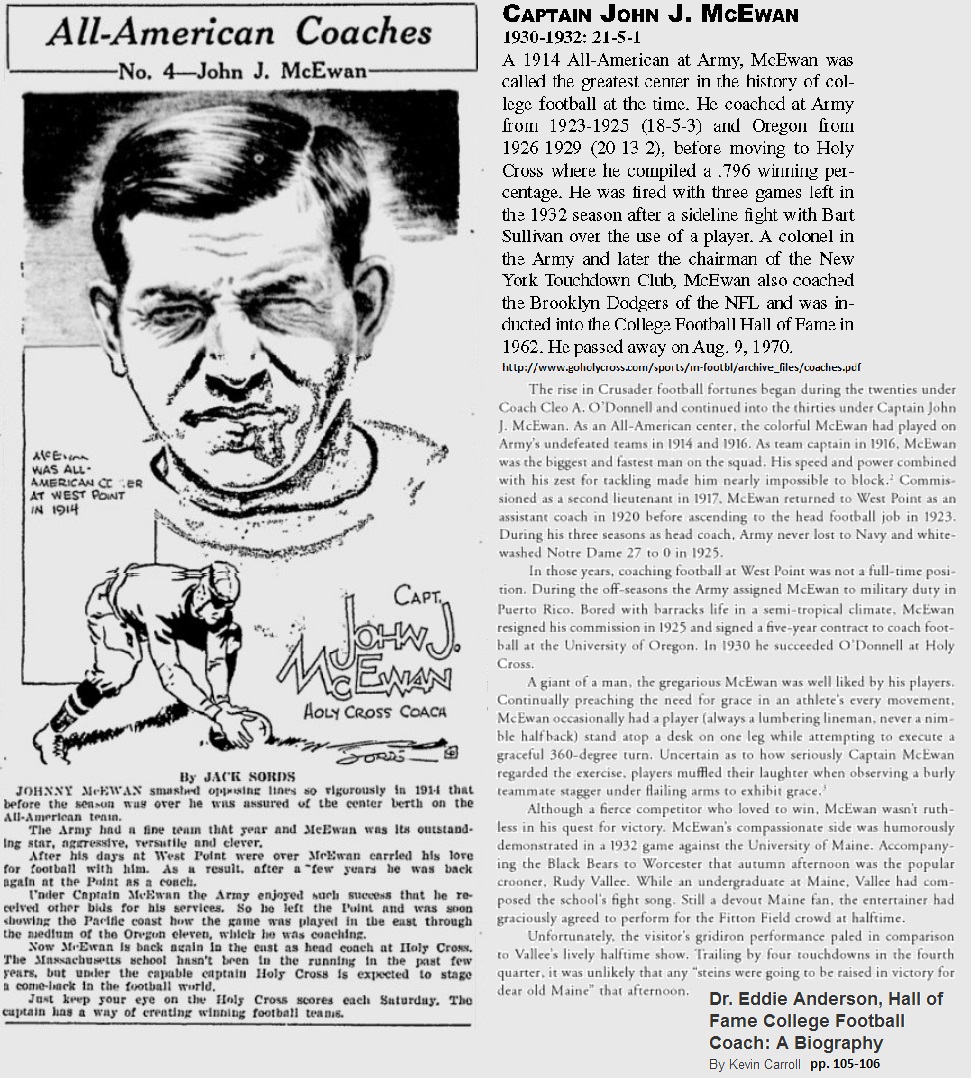
John McEwan

Class of April 1917 – 4 Army A’s in Football as a Center – The Football Teams beat Navy in 1913, 1914, 1915, and in 1916

In the anatomy of a game: football, the rules, and the men who made the game By David M. Nelson — it appears to be the same John and his name is listed as McEwen

http://en.wikipedia.org/wiki/John_McEwan

John McEwan player/coach

John J McEwan

Editors Note – Not sure which orientation is correct.

John J McEwan

College Football Hall of Fame Biography

John McEwan was an innovator among players of the early 1900’s, pioneering the spiral center-snap and introducing a primitive version of the defensive rover-back to Eastern football. Upon graduation from West Point in 1917, McEwan was hailed as the greatest football center the U.S. Military Academy ever had. Walter Camp labeled him first-team All- America in 1914.

As a senior in 1916, McEwan was elected team captain by his Cadet peers. Tim Cohane, longtime sports editor of LOOK MAGAZINE and author of “Gridiron Grenadiers”, described McEwan thusly: “Big Mac, in his prime, weighed from 195 to 205 and stood 6 feet, 4 inches tall. He was built like a heavyweight fighter. His broad shoulders tapered down to slim hips and comparatively thin legs, which brought him frequent but not inactivating knee injuries.” McEwan was unusually fast for a man of his size and became known for his ability to cover large areas of the field while exhibiting a tremendous tackling and blocking prowess. Seven years after his graduation, the Alexandria, Minnesota native returned to West Point as head football coach. During his three coaching seasons, his Army teams rolled to an 18-5- 3 record. He went on to coach Oregon, Holy Cross and the professional Brooklyn Dodgers. He died in 1970.

–

JohnJMcEwan_ArmyFB_andCoach

–

Ernest Graves

Class of 1905 – Army Head Coach 1906 and 1912 – Assistant Coach in 1905, 1913 – 1916, 1919 – 1921

Earned 4 Army A’s in Football

The Lineman’s Bible

The Link – His Book

Ernest Graves

1912 Football Team

The Carlisle Backfield (top) and the 1912 Army team (bottom). Dwight Eisenhower, second from left. 

The Greastest Grudge Game Ever

By: John Hall in State College Magazine 12/12/2009


November 9, 1912 – Cullum Field, West Point, N.Y.

The sky was ugly. The temperature hovered around freezing all day, and black angry clouds were swirling over the Hudson River, threatening at any minute to drop a torrent of sleet on the crowd that had gathered to watch the greatest grudge game in football history.

On one side of the field, in black and gold uniforms, stood the mighty Cadets of Army. For years Harvard, Yale and Princeton had dominated the college gridiron, and they were called the Big Three. But over the past couple of seasons, through sheer guts and determination, Army had kicked down the door of that exclusive club and taken a seat at the table, and now people talked about the Big Four.

Across the field in red and white stood another upstart team determined to enter the ranks of the elite. But where Army had bludgeoned their way in, this team was determined to dance their way in. They were the Carlisle Indian Industrial School. Their official nickname was the Pirates, but everyone called them the Indians.

The Indian School at Carlisle, Pa., was the brainstorm of Richard Henry Pratt, an American Army officer who led the African-American “Buffalo Soldiers” in genocidal warfare against Native-American Indians. Most white Americans at the time were comfortable with the notion that the Indians either had to be exterminated or turned into a new type of slave. But Pratt felt that there had to be a better way. First he convinced the Federal government to give him the school. Then he convinced the Indians that their children would have a better chance of survival if they learned to read and write as well as the white man.

Eisenhower in play action

Soon the Indians learned that they could also compete with the white man at his own game of football. The previous year Carlisle had beaten Pitt, Penn and Harvard. Going into the game at West Point they were 9-0-1. They were looking at nothing less than the national championship, and no one wanted it more than the Carlisle coach, Glenn Scobey “Pop” Warner. A brilliant strategist, he was also football’s first great innovator. In 1894 Warner was playing left guard for Cornell when their head coach, Marshall Newell, announced that he would be gone for a week to help his alma mater, Harvard, prepare for their annual showdown with Yale. Warner was named interim head coach and, seizing the opportunity to turn a game of brute force into a game of poetry and chess, he devised a trick play. Locked in a scoreless tie with Williams College late in the fourth quarter, Warner whispered “Number 39” in his quarterback’s ear. The quarterback took the ball and swung his arms toward the left halfback, and the whole team began sprinting left, except Warner. He took two steps back, pulled the ball out of the quarterback’s hands, and began running right into an open field. He was tackled from behind and fumbled the ball just short of the goal line. He failed to win the game, but had just invented the reverse.

When he took the coaching job at Carlisle, he found the Indians smaller than most college football players, but he also found them quick and athletic. He discovered ways to capitalize on this. He was the first coach to have backs start from a three-point stance and he invented what was called the Indian block, but today everyone calls it the cross body block. He also invented the wingback and single-wing formation. Then, in 1907, college football legalized the forward pass.

Pennsylvania football icon, Jim Thorpe

At the time quarterbacks hurled the ball end-over-end, threw it like a shot put, or lobbed it underhand like a softball. Predictably, it lost all accuracy after about five yards. Warner played with the ball all summer, looking for a better way. Then when practice started in 1907 he called his backs aside. “I want you to practice this,” he said. He then spread his hand, placed the stitches along his fingers and wrapped his thumb around the other side of the ball. “Hold it like this, bring it up behind your head, and when you bring it forward put a spin on it, and then you will be able to throw it with pinpoint accuracy for 30 or 40 yards.” Warner had just invented the technique for the forward pass.

Now Warner, in his quest for the 1912 National Championship, had two things going for him. One was a new formation he had invented. The other was Jim Thorpe. Four months earlier, Thorpe was in Stockholm, Sweden, where he won the Olympic pentathlon and decathlon. When he was presented with the gold medals, Gustav, the King of Sweden, leaned forward and told him, “Sir, you are the greatest athlete in the world.” Thorpe simply replied, “Thanks, King.”

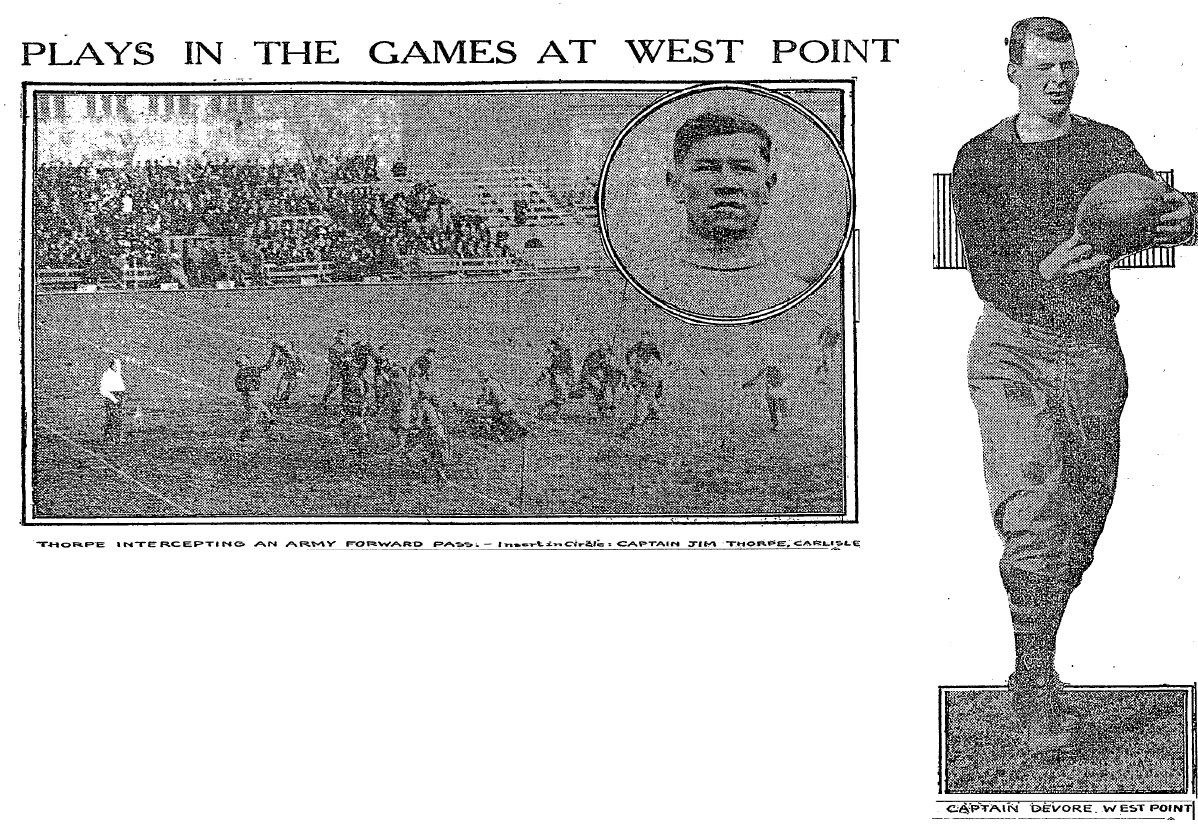
The American press agreed with the king. In the four months since then, Thorpe had received more coverage than Ty Cobb, Honus Wagner, and heavyweight boxing champion Jack Johnson. His reputation was not overrated. He could run, he could pass, he could kick. His high jumping and broad jumping ability enabled him to literally run over players, leaving bloody cleat marks on their thighs, torso and shoulders. During a game on September 28 against Dickinson, Thorpe had picked up a bungled snap in his own end zone and outran everyone for a 105-yard touchdown. The previous year at Forbes Field he had punted against Pittsburgh from deep in his own territory. Thorpe managed to race down the field, catch his own punt and run it in for a touchdown.

But on the other side of Collum Field this November day, there was a blue-eyed hardscrabble kid from Kansas who had plans of his own. It was only his first year as a starter, but he was already considered one of the hardest-running halfbacks and hardest-hitting linebackers in college football. He was determined to cement his reputation forever by using his bone-crushing tackles to put Jim Thorpe in the hospital. The kid’s name was Dwight Eisenhower.

Warner was taking no chances; he had been playing the race card for weeks. “These are the grandsons of the men who killed your grandfathers and raped your grandmothers at Wounded Knee,” he told his players in the pregame pep talk. “Today they will have their revenge. Today will be the day to make every Indian in America proud.” However, it is unlikely that Thorpe found much inspiration from such talk. In the first place, prodigies like Thorpe usually transcend petty prejudice. In the second place, Thorpe didn’t have any grandfathers at Wounded Knee. His one grandfather was Irish and his own father prided himself on a reputation as a hard-drinking, hard-fighting, quick-tempered “Irishman” His other grandfather was French and his mother Charlotte Vieux was a devout Roman Catholic, as was Thorpe his entire life. This made him a lightning rod for three of what were probably the top five prejudices in America at the time. Germans were securely in first place ahead of blacks, then, in no particular order, came Irish, Indians and Catholics.

Carlisle Team

At 3 o’clock on that gray and windy afternoon, Thorpe took the opening kickoff and returned it for 13 yards. Then he walked over to the huddle where Carlisle quarterback Gus Welch told the team it was time to unleash Warner’s secret weapon. The Indians lined up in their standard power formation, two halfbacks and a fullback behind the quarterback. Thorpe then moved left and closer to the line, where he lined up in a three-point stance outside the left tackle. Alex Arcasa did the same thing on the right. Nobody had ever seen this before, but anyone today would recognize it for what Warner had already named it: the double wing formation.

During the first half, the Indians ran at Army out of this new formation, using a variety of reverses, double reverses and fake reverses. It seemed that at least three Indian backs had to touch the ball on every play. Years later, after he retired as president, Eisenhower recalled that one of the most awesome things he had ever seen in his life was Jim Thorpe running at him out of the double wing. But no one was more impressed by Warner’s innovative formation than a New York sportswriter named Walter Camp. In 1876 Camp had taken an English game called rugby and revised it – adding set downs, a line of scrimmage, and a few other changes. When he was done he had invented American football. Now he was the most respected sportswriter in America. He alone selected the National Champion and the All-America Team, and no one questioned his judgment. But in all his years as player, coach and writer, he had never seen anything like this: it didn’t look like football; it was more like a circus, or basketball on grass.

Carlisle was clearly outplaying Army, but the Cadets, through sheer tenacity and luck, entered the locker room at halftime with Carlisle leading by only a point, 7-6. However, with the new formation, the greatest athlete in the world, and the frenzy of revenge that Warner had instilled in his team, Eisenhower knew that the game was about to get out of hand, unless Thorpe was eliminated. Eisenhower called another linebacker, Leland Hobbs, over to a corner where he laid out his battle plan. Hobbs was to watch Eisenhower for a signal. Then Eisenhower, with all the force he could muster, would run directly into Thorpe’s chest, while Hobbs would blindside Thorpe’s knees as hard as he could.

The second half did not start well for Army. On Carlisle’s first possession of the half, Welch pitched the ball to Arcasa, who ran behind Thorpe and tackle Joe Guyon. Army captain “Leland Devore” had a bead on Arcasa, but he was knocked down by Thorpe and Guyon, while Arcasa ran around him for a touchdown. On the ensuing kickoff a humiliated and enraged Devore ignored the play and blindsided Guyon like a runaway freight train. Devore was immediately ejected for unsportsmanlike conduct. With the Army captain out, Eisenhower realized that he had to do something soon. He noticed that on first down Thorpe invariably ran the ball for Carlisle, so on the next series of downs he gave the signal to Hobbs. The two hit Thorpe as planned and spectators later said that the collision sounded like a pair of two-by-fours being slammed together. All three players went down. Hobbs got up first, then Eisenhower, but Thorpe stayed down. Eisenhower, thinking his plan had worked, began celebrating, but then the big Indian got up and walked to the huddle.

Eisenhower was now more determined than ever. A few plays later he and Hobbs tried it again. But like all great players, Thorpe had an instinct for the game, and at this point he demonstrated one of his less-known but highly impressive athletic skills: an ability to go from full speed to a standstill in a single step. So Thorpe, sprinting with the ball, stopped suddenly, watched as the two Army linebackers collided in front of him, and then ran around them for a few more yards. Eisenhower and Hobbs were barely conscious. Hobbs got to his feet first and staggered to the bench for medical assistance. Eisenhower got up but could hardly walk. He pleaded to stay in the game, but his coach, Ernest Graves, ordered him to the bench. Without Devore, without Hobbs, and without Eisenhower, the game turned into a rout and Carlisle won 27-6. In the locker room, Devore told reporters: “That Indian is the greatest player I have ever stacked up against. He is super-human. There is nothing he can’t do.”

That night as the Indians rode the train back to Manhattan, Walter Camp walked into their car. He told them that they might indeed be the best team in the nation, and he congratulated Thorpe, calling him the most brilliant player he had ever seen. Then the man who invented American football turned to Warner and told him that after today the game would never be played the same again.

The following week Eisenhower, still limping, suited up for a game against Tufts. As he carried the ball and tried to surge forward for an extra yard, a Tufts player grabbed his ankle and twisted his leg as hard as he could. Something popped and Eisenhower flopped around the field like a fish on dry land. He left the field on a stretcher and never played another down. He finished his football career at West Point as a cheerleader. Editor’s Note – Eisenhower Coached the Cullum or Plebe Team

Pop Warner

Pop Warner’s hopes for a national championship were shattered a week later in Philadelphia when Carlisle was defeated by Penn, 34-26. The following week they beat Springfield, and then went to Providence to play Brown on Thanksgiving Day. It was now Thorpe’s turn for his luck to run out. On the day before Thanksgiving, Thorpe participated in his last practice ever as a Carlisle player. A local sportswriter, Roy Johnson, came to the practice looking for an angle on a story. While watching the workout he recognized Charley Glancy, a former professional baseball coach who had also come to watch the practice. As the two were talking, Glancy suddenly interrupted Johnson: “I know that guy,” he said, pointing to Thorpe. “He played for me a couple of years ago.” Johnson, stunned, was on the story like a dog on a bone. Jim Thorpe had received a salary for playing baseball, making him retroactively ineligible for the Olympics. The International Olympic Committee stripped him of his championships and forced him to return his medals. In 1982, almost 30 years after Thorpe’s death, the committee completed the farce by reinstating him. It mattered little. Thorpe’s reputation had been earned on the playing field and nothing could tarnish it.


–

ArmyFB_1912_NYT_Nov101912

–

Draft of proposed home page headline

CAUTION – Graduates should not mention this Web Site to High School Student Athletes. Compliance with both the letter and intent of NCAA Rules is an Academy Expectation. Questions can be resolved by contacting Ron Salvatore or his Staff at Army Athletics Association, Assistant Athletics Director – Compliance and Academics (845) 938-2576 Ron.Salvatore@usma.edu

Note – this is a Class of 1962 Web Site; it is NOT an Official United States Military Academy Web Site

Recognition of Teams

“When they first met nearly his first words were – “‘I don’t know anything about Football. Tell me something about it.” After a sentence or two he said “Let’s talk about something else.” He was a very cultured man. However, over the next two years he was to say more than once , “I will pattern my next Army Corps after the Army Team.” West Point’s 42d Superintendent came to appreciate an athlete’s subordination to team success is exactly the expectation for a graduate’s commitment to unit success.“You Have to Pay the Price” – Chapter XIV

The United States Military Academy exists for one purpose and one purpose only – to provide military officers for our Nation. Graduates are expected to have an unselfish concern for unit success ahead of one’s self.

John will take out two — Al will just have to run over the last Middie.

PURPOSE The purpose of the Army Sports Hall of Fame, located within the Kenna Hall of Army Sports, is to honor the athletes, coaches, teams, administrators and others who have brought distinction to Army athletics over its many years of existence. Those team and individual achievements deemed worthy of admittance, based on the established criteria, will be formally recognized with displays in a designated Hall of Fame area of the Kenna Hall of Army Sports, located within the Kimsey Athletic Center.

As General Patton stated

“The Army moves as a team, eats as a team, and fights as a team.”

The Class of ’62 and the Classes of the early sixties understand the importance of Teams.

In Vietnam individuals performed heroically and with great sacrifice. 58,000 dead–over 200,000 wounded. Thousands of individual awards for heroism and service (MOH, DSC, NavC, SS, etc).

But we lost! The team lost! Individuals performed extremely well–but the head coaches and the administration had the wrong strategy and play book–so we lost. Despite the tremendous effort, heroism and sacrifice the team lost.

How many medals for heroism and service would we have been willing to give back for victory. How many medals would we return to get back even a few of those 58,000 lives.

Individual efforts, achievement and heroism should be honored. But, Team Victory is the objective in any war and it should be the focus of the Army and of West Point. Out of all the hundreds of schools in America, if only one honored Team achievement it should be West Point!

Members from the Classes of the 50’s and 60’s believe it is important the Cadet Corps never be given the impression that individual accomplisment is more important than success of the unit.

We are asking Graduates to assist in establishing a suitable criteria to recognize Teams. We will be contacting the Colleges and Universities across the Nation which do recognize Teams to determine the criteria for their programs.

—– Must the success of the 2005 – 2006 Women’s Basketball Team be unknown to the Cadets of the 2019-2020 Cadet Corps?

—– Must the 6 & 0 seasons of the 1972, 1973, and 1974 150 Pound Football Teams go unrecognized?

—– Should the Corps of Cadets know that the “Class the Stars Fell On” went 9 – 0 in the Fall of 1914, beating Navy 20 – 0.

The success and National Recognition of our Alma Mater over the last several years is the result of an entire Staff and Faculty effort.

We understand West Point will probably never have another National Title. However, Colleges and Universities which do include Teams in their Hall of Fame do not require just National Titles for induction.

Below needs a lot of work

As we contact these schools to assist in developing a suitable criteria for West Point we ask that you contact the Academy to stress the importance of Team accomplishment above individual achievement in the training of the Cadet Corps
— Please go to the below web page —————————

A starting point is the Black Lion Award given to an Army Football Player each year and to Football Players throughout the Nation. Although then Award is intended to go to the person on his team – –

“who best exemplifies the character of Don Holleder: leadership, courage, devotion to duty, self-sacrifice, and – above all – an unselfish concern for the team ahead of himself.”

There are some teams in which every member deserves such recognition. Perhaps in the near future we will have an Army Football Team in which each player is recognized by all for

“an unselfish concern for the team ahead of himself”

That will be a Team in which upon Graduation every player will have earned —

“I want an officer for a secret and dangerous mission? I want a West Point Football player.”

That will be a Hall of Fame Team

Error in Cadet Lore

To whom it may concern,

I am a proud member of ’57 and was the roomie for four years on Wally Summers, referred to as the Company Commander of L-1 at the time of our Graduation P-rade in the following material extracted from your site. (Note: There was also a long-lived myth that Wally kept our company in line at the time the wave of chaos arrived on our right flank by saying he’d run anyone thru with his saber who broke ranks.

“The Class of 1957 was referred to as the Black Class and were not allowed to return to the Grounds of West Point for a number of years. I was told as a Plebe that the ’57 Company Commander of L-1 ordered his Classmates to remain in formation when the other companies broke and ran across the Plain. I do not know if it was fear or respect that held L-1 ranks, I do know that I was Proud to be a L-1 Plebe summer of 1958 (Attitudes change as one adjusts to Academy Life).”

In the interest of correcting the record and providing full disclosure, I’m providing the following comments:

1.The comment that our Class was not allowed to return to the Grounds of West Point is erroneous. Sounds like one of those cadet folklore myths. I, in fact, personally returned twice within the month of graduation to have some major dental work completed which had begun shortly before Graduation.

2. L-1 was one of four companies, along with I-1, L-2, and M-2) which maintained their formation during that parade. To help give you a fuller understanding of the events of that parade and subsequent fallout, please see the attached article. I prepared this article at the request of our Class Scribe, Max Kovel, to provide a definitive review of the P-rade “that will live in USMA infamy” for our 50th Reunion Yearbook. Material for the article was garnered from many ’57 Classmates, other Class members, Tac Officers, and archival research. (BTW – it was rewarding to read that whoever provided the material in the article on your site indicated that he was Proud to be a L-1 Plebe summer of 1958)

Hope you enjoy the attached.
http://forwhattheygaveonsaturdayafternoon.com/wp-1957/grad-prad

Regards, Nick Monaco ’57

BEAT NAVY!!