Tag Archives: Football

1950 Football Team

1950 Army 8-1 Coaches#5 AP#2

09/30 Army 28 – Colgate 0
10/07 Army 41 – Penn State 7
10/14 Army 27 – Michigan 6
10/21 Army 49 – Harvard 0
10/28 Army 34 – Columbia 0
11/04 Army 28 – Pennsylvania 13
11/11 Army 51 – New Mexico 0
11/18 Army 7 – Stanford 0
12/02 Army 2 – Navy 14 L Philadelphia, PA

–
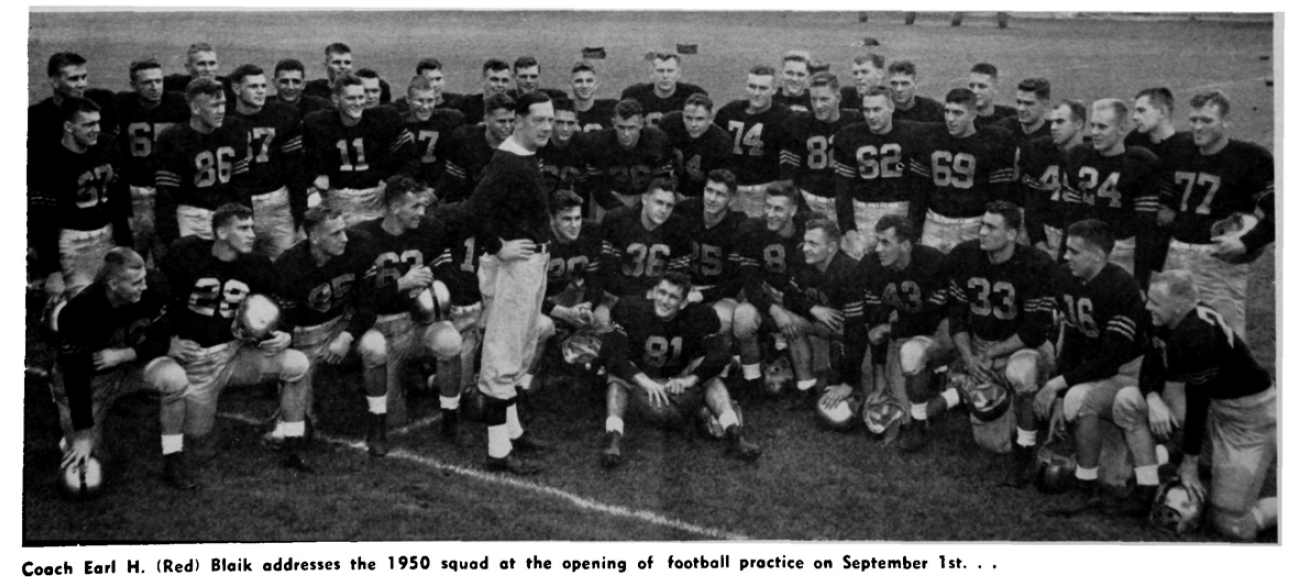
ArmyFB_1950_team_openingpractice

Assembly Vol 9, No 3, Oct 1950

News Articles
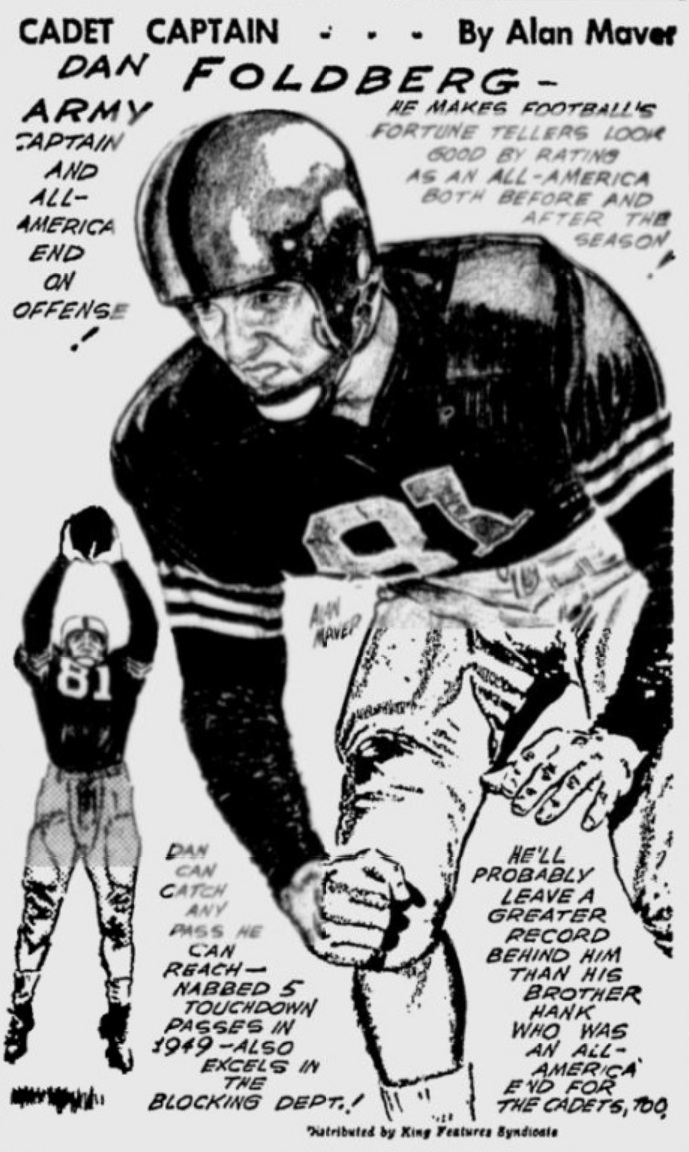
ArmyFB_1950_DanFoldberg_byAlanMaver_TheDispatch_Sep201950
–
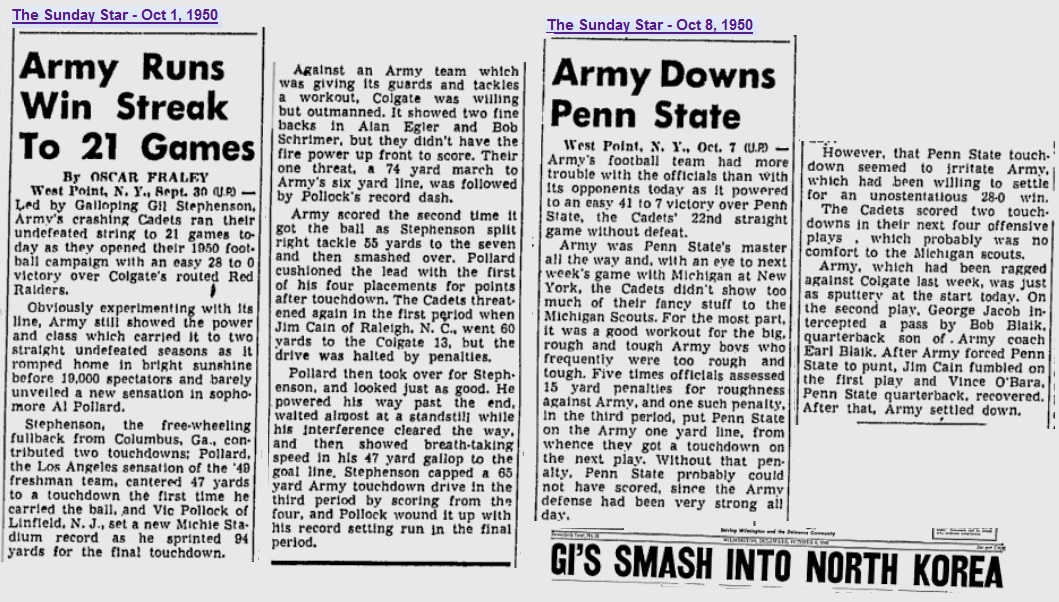
ArmyFB_1950_various_SundayMorningStar_Oct1-8_1950

ArmyFB_1950_various_SundayMorningStar_Oct1-8_1950

–
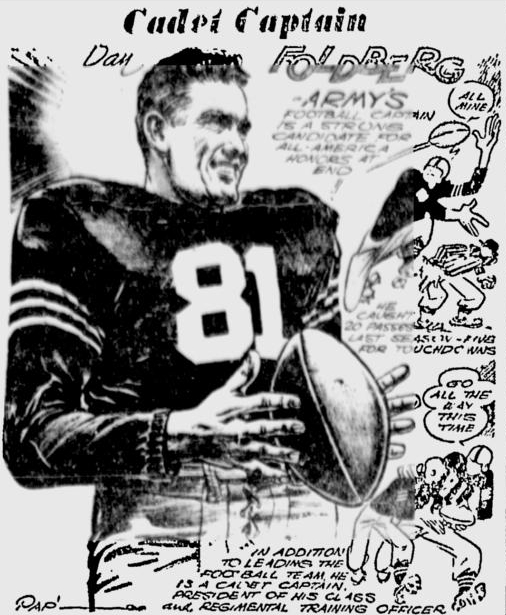
ArmyFB_1950_DanFoldberg_byPap_StJosephGazette_Oct61950

–
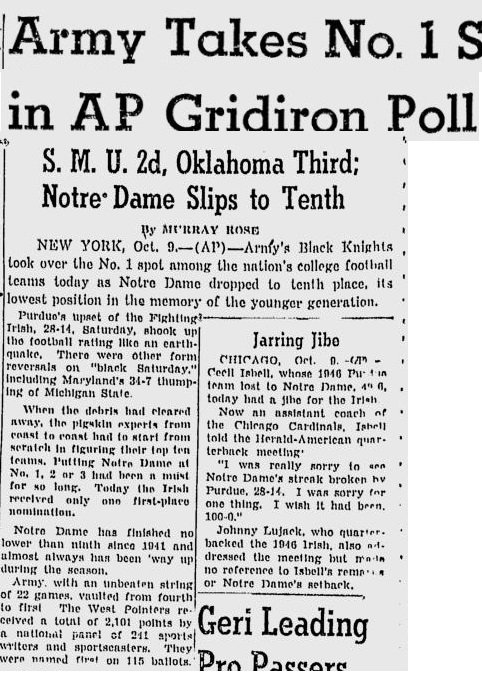
ArmyFB_1950_No1_StJosephGazette_Oct101950
–
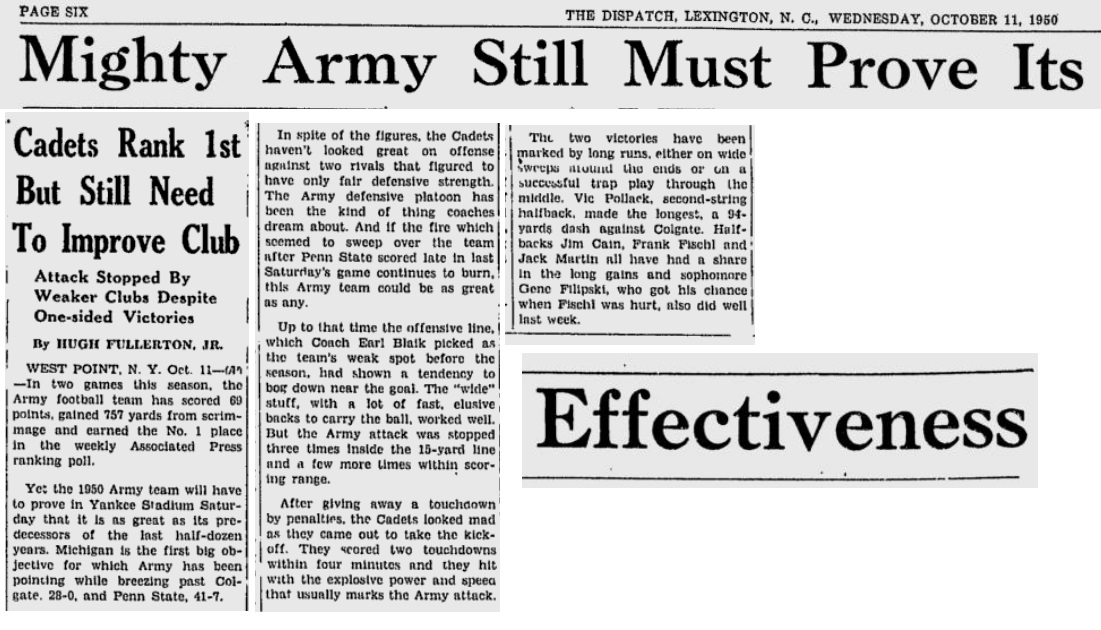
ArmyFB_1950_TheDispatch_Oct111950
–
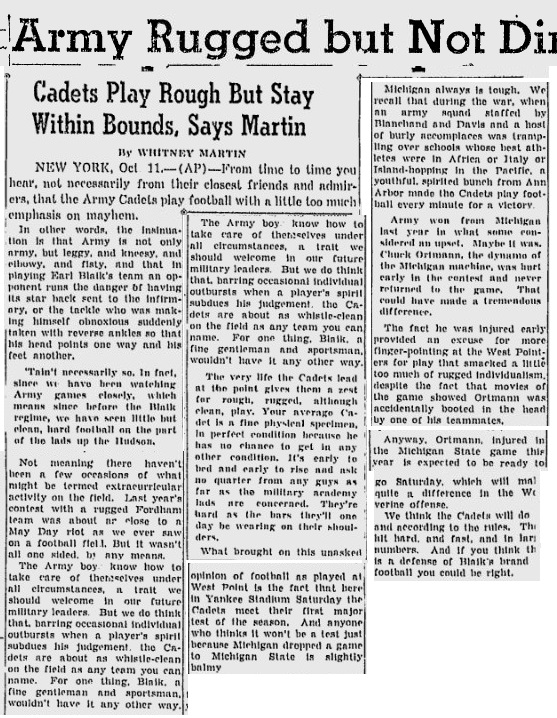
ArmyFB_1950_Rugged-notdirty_StJosephGazette_Oct121950
–

Michigan Game Yankee Stadium


Army 27 Michigan 6

–
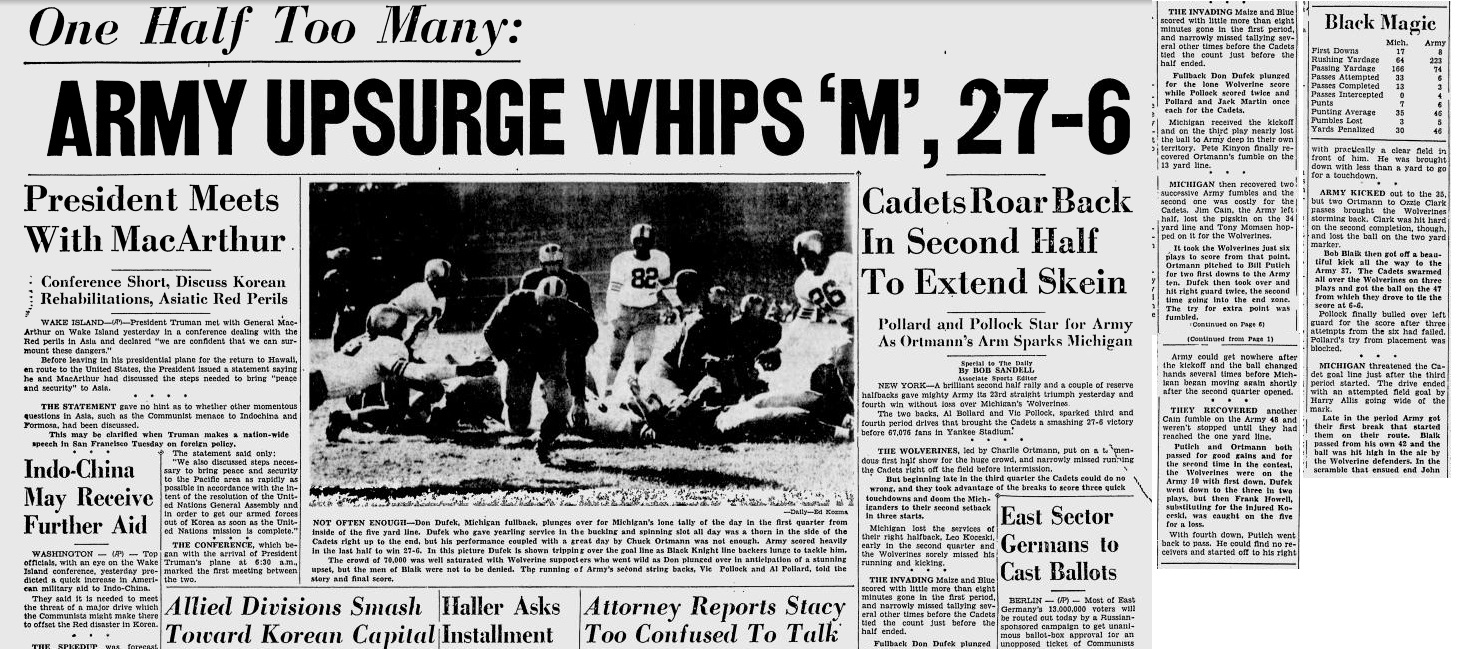
ArmyFB_1950_vsMichigan_MichiganDaily_Oct151950
–
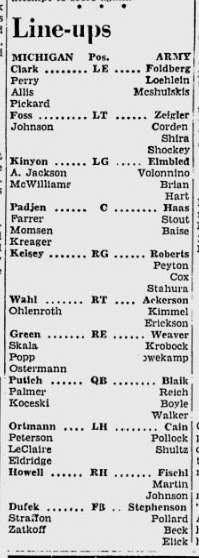
ArmyFB_1950_LineupvsMichigan_MichiganDaily_Oct151950
–

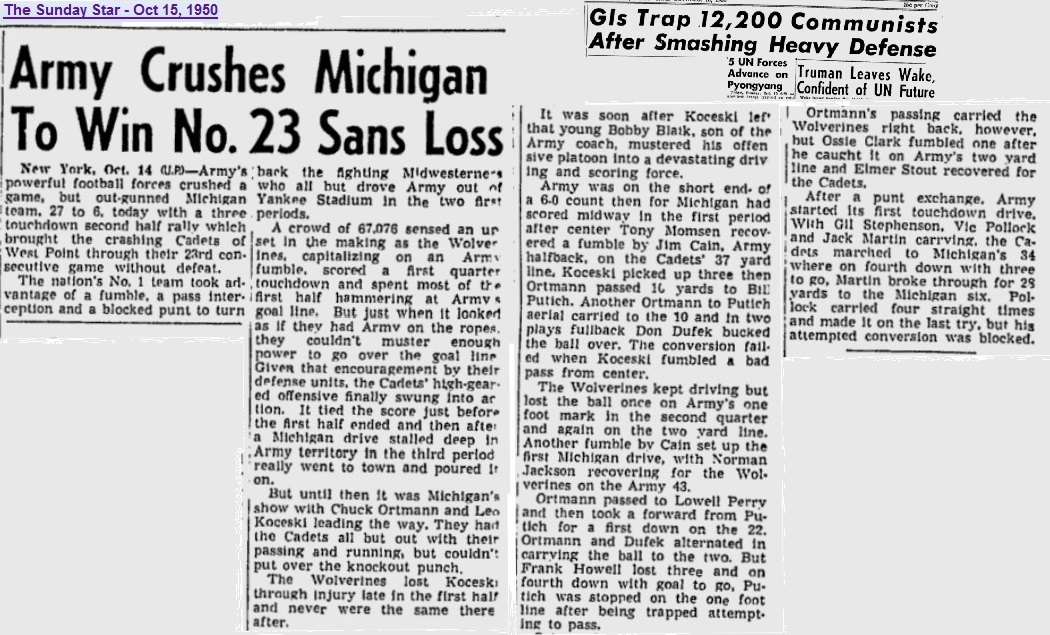
ArmyFB_1950_vsMichigan_SundayMorningStar_Oct151950

ArmyFB_1950_vsMichigan_SundayMorningStar_Oct151950

–

no sound

The return of Army to the Michigan schedule marks the resurgence of
The two met nine times between 1945 and 1962 with Army winning the first five games and Michigan winning in 1955, ’56, ’61 and ’62. It was a past series that was twice played at Yankee Stadium (1945, ’50) and on four occasions marked a matchup of two top-10 teams (1945, ’46, ’49, ’55).

–
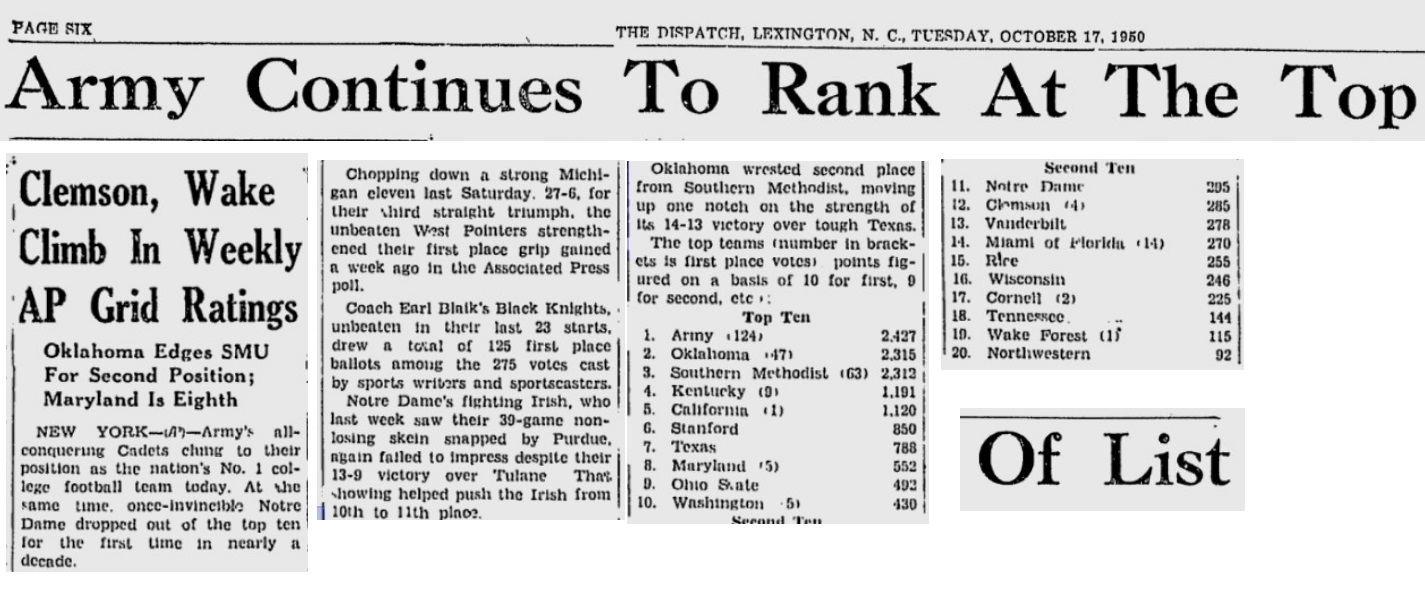
ArmyFB_1950_TheDispatch_Oct171950
–
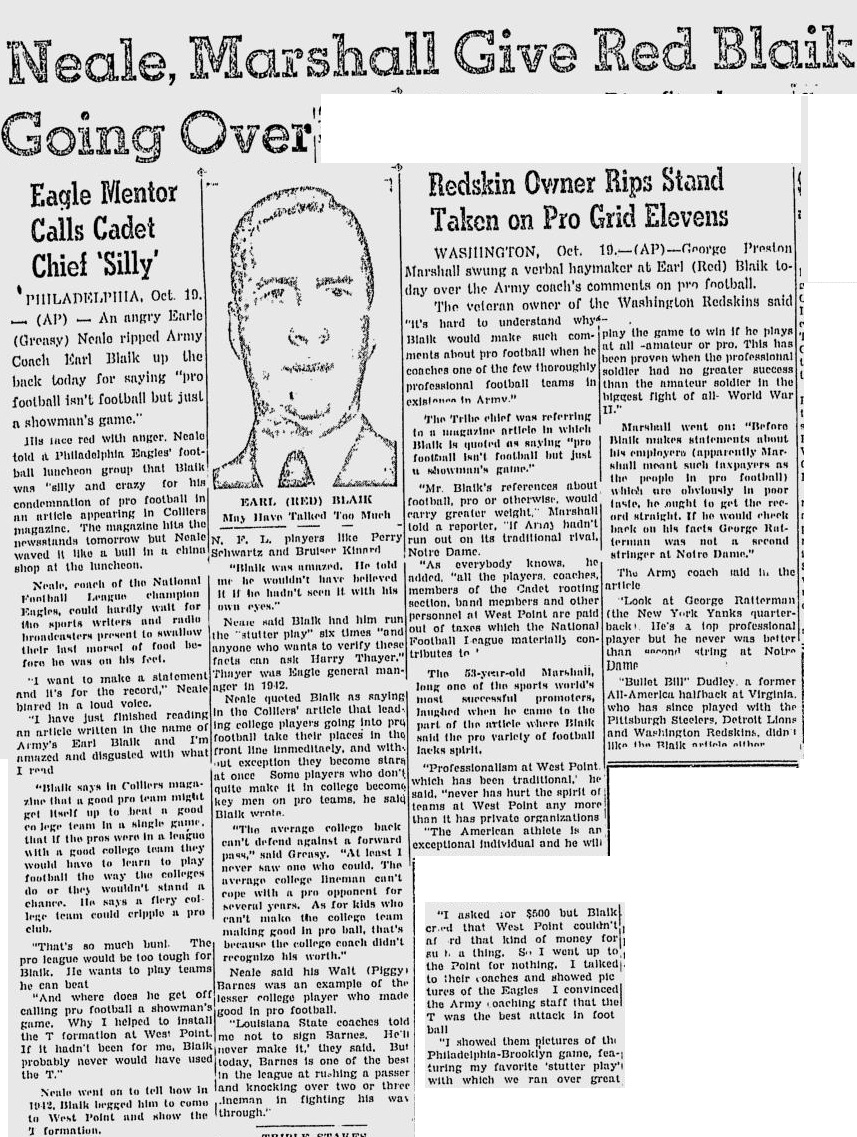
ArmyFB_1950_BlaikonProGame_StJosephGazette_Oct201950
–
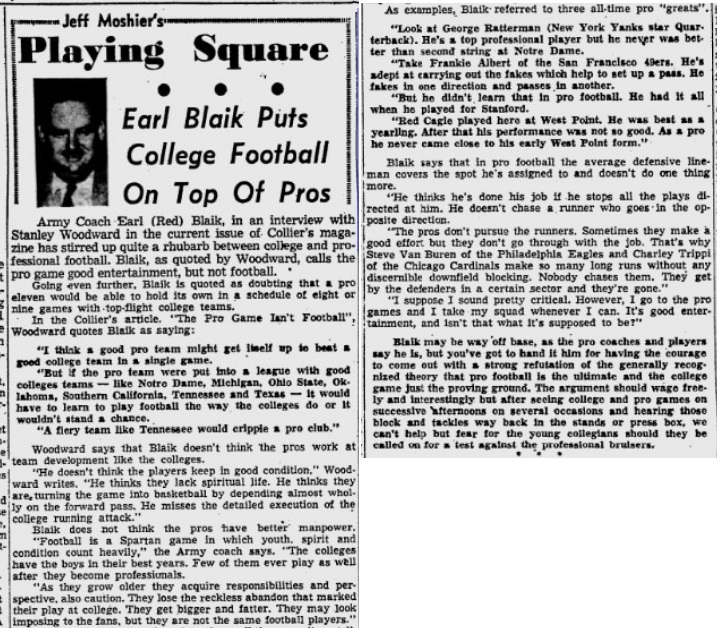
ArmyFB_1950_BlaikonProGame_EveningIndependent_Oct211950
–

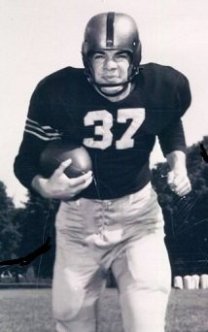
ArmyFB_1950_GilStephenson_photo

–
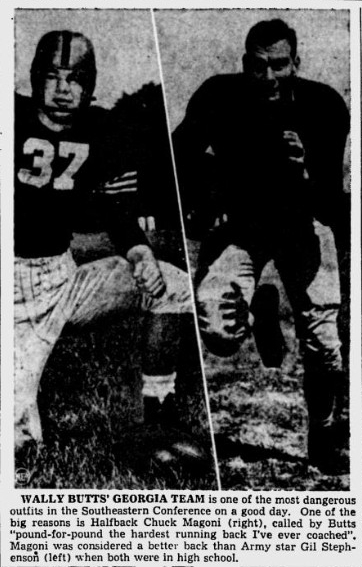
ArmyFB_1950_GilStephenson_PortsmouthTimes_Oct211950
–
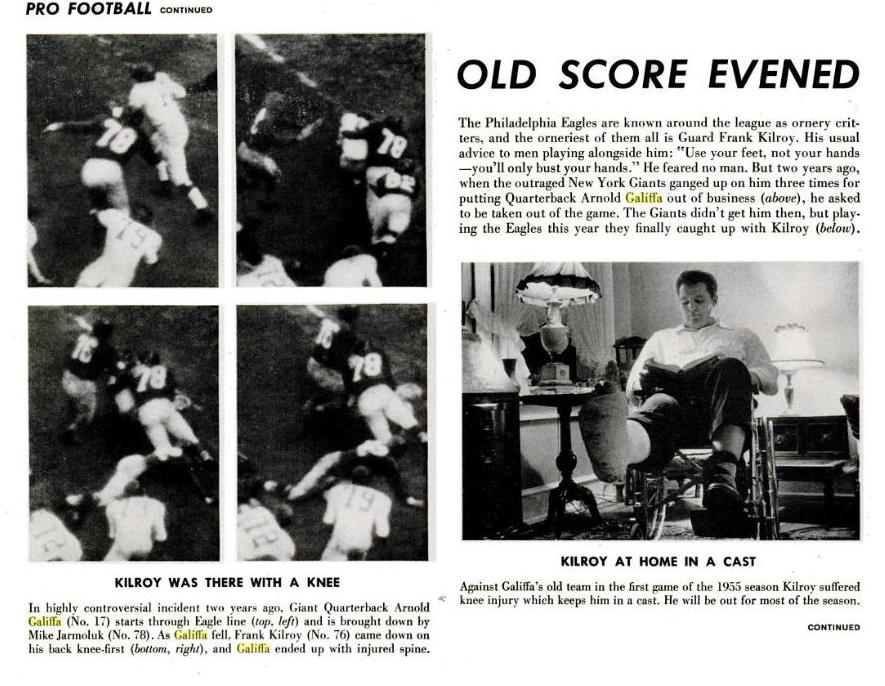
ArmyFB_1950_ArnoldGaliffa-injury_LIFE_Oct241955
–

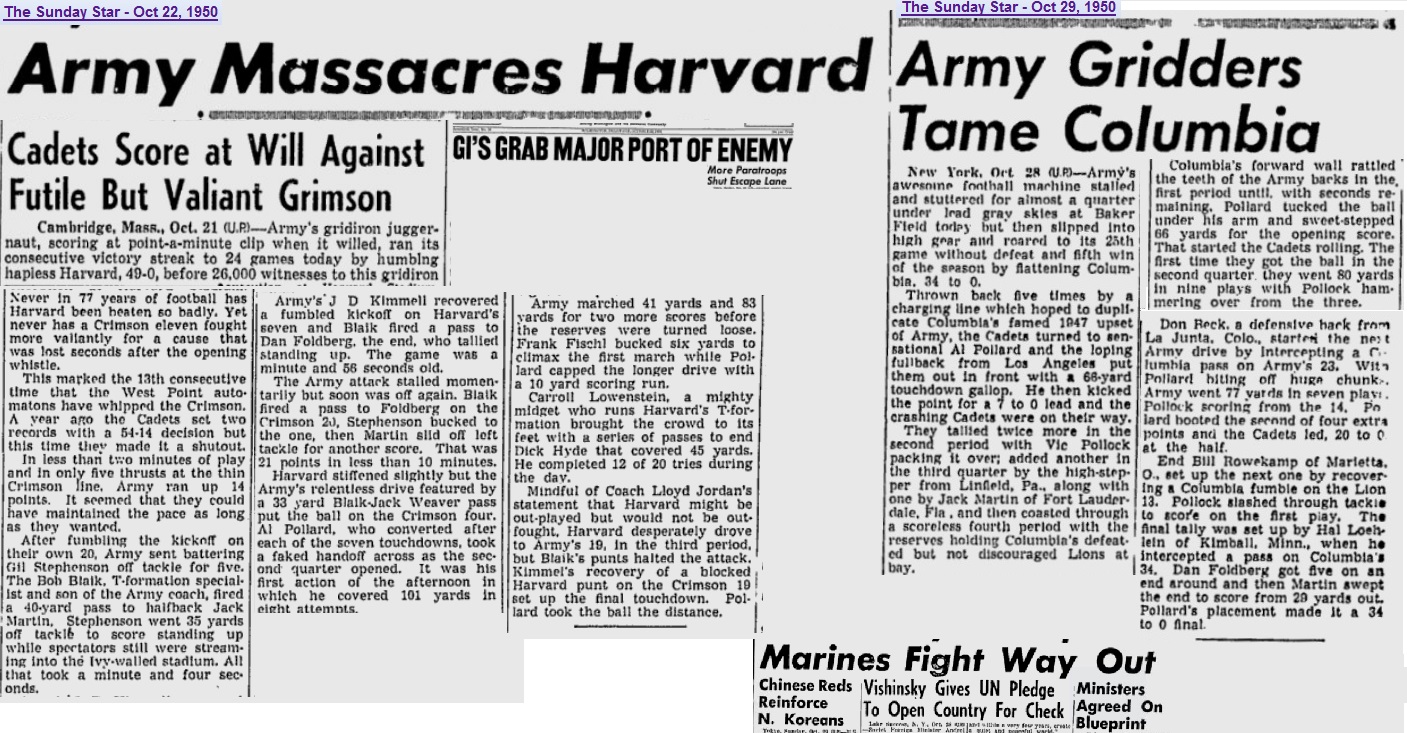
ArmyFB_1950_various_SundayMorningStar_Oct22-291950

ArmyFB_1950_various_SundayMorningStar_Oct22-291950

–
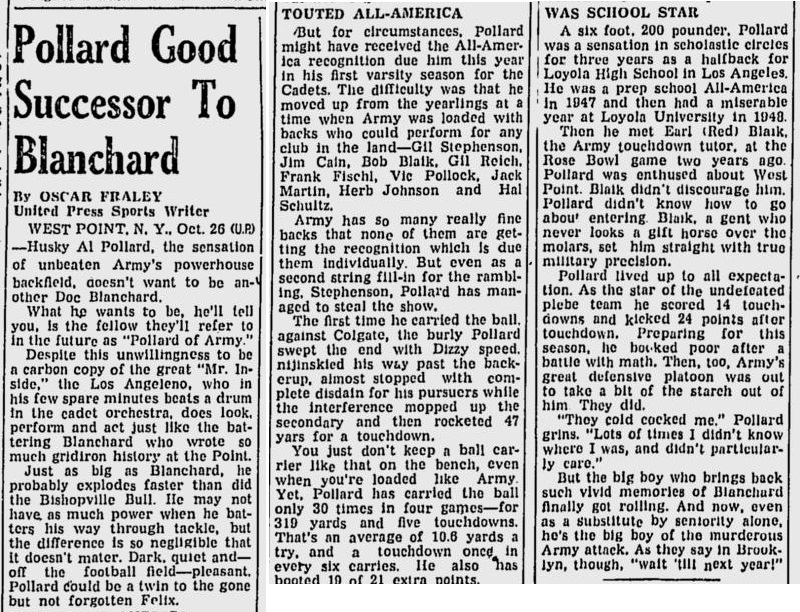
ArmyFB_1950_AlPollard_GreensburgDailyTribune_Oct261950
–

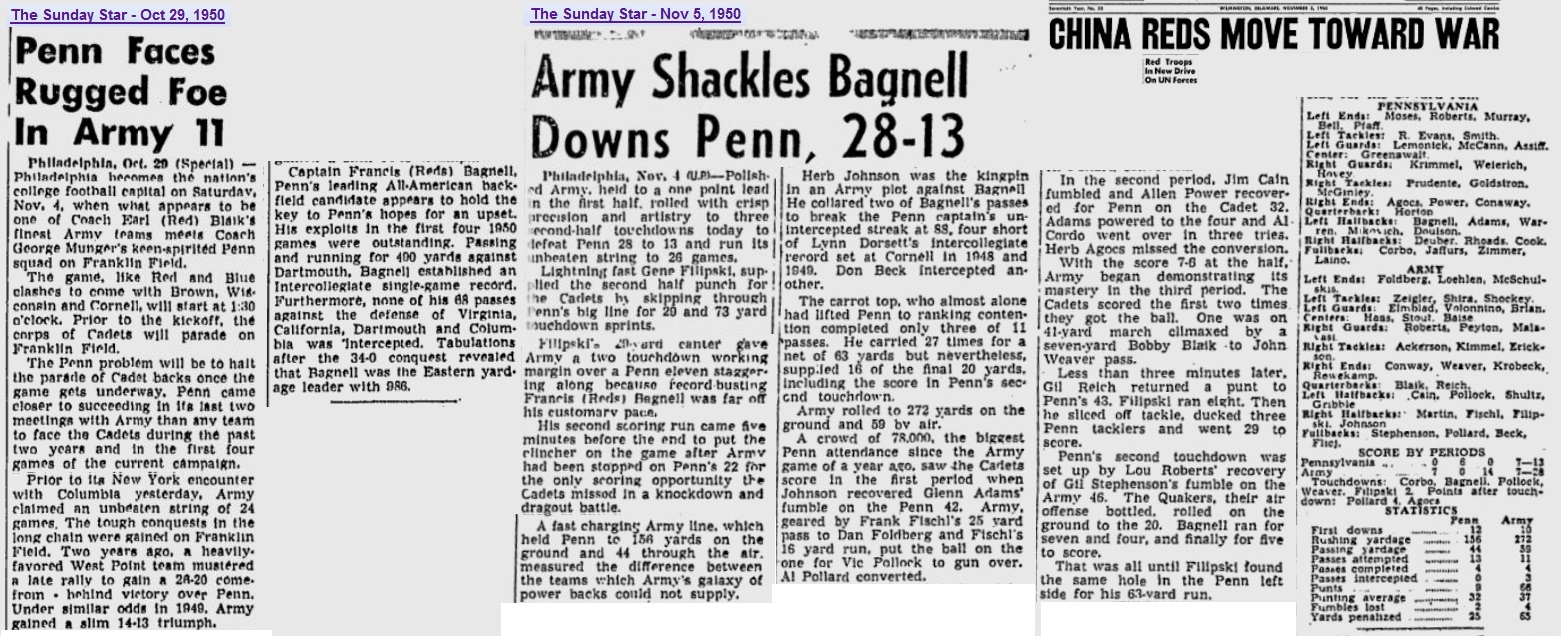
ArmyFB_1950_vsPenn_SundayMorningStar_Oct29-Nov51950
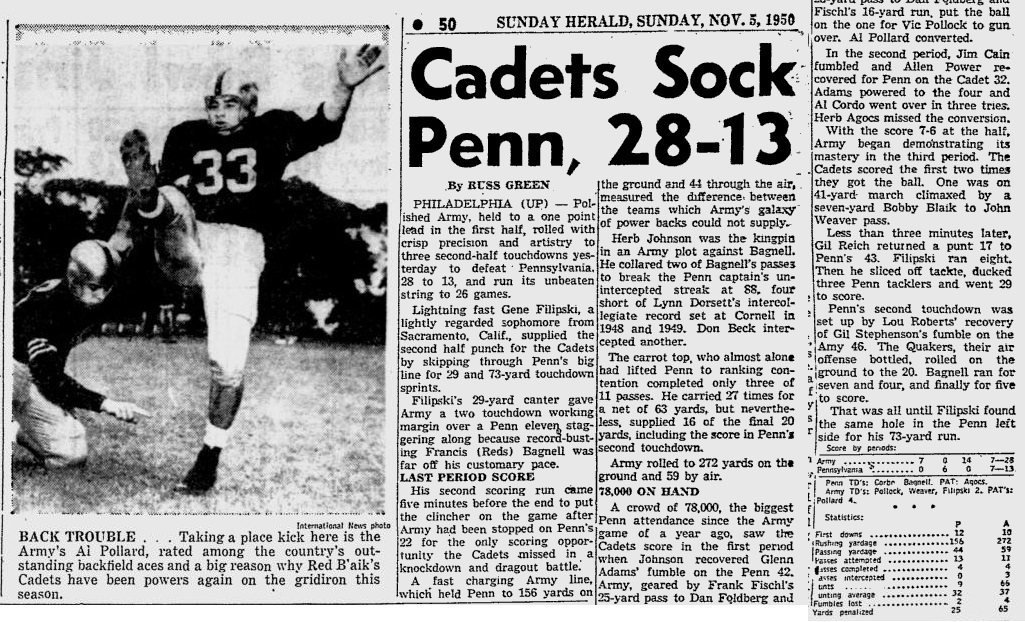
ArmyFB_1950_vsPenn_SundayMorningStar_Oct29-Nov51950

ArmyFB_1950_AlPollardvsPennState_SundayHerald_Nov51950

–
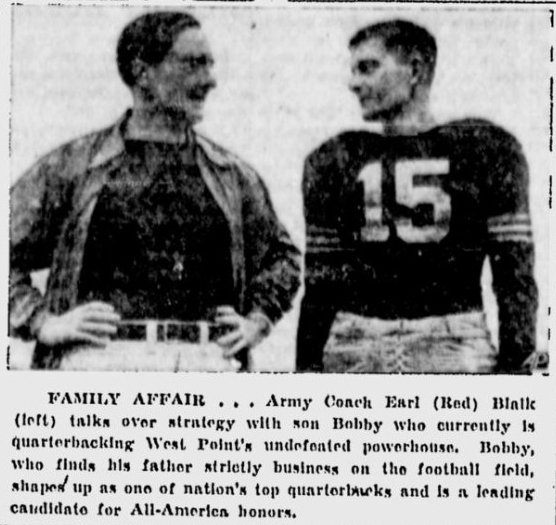
ArmyFB_1950_BlaikandSon_StJosephGazette_Oct301950

–
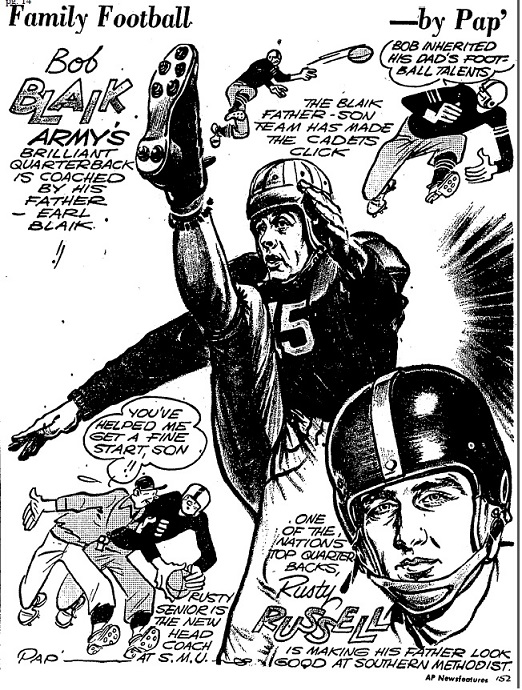
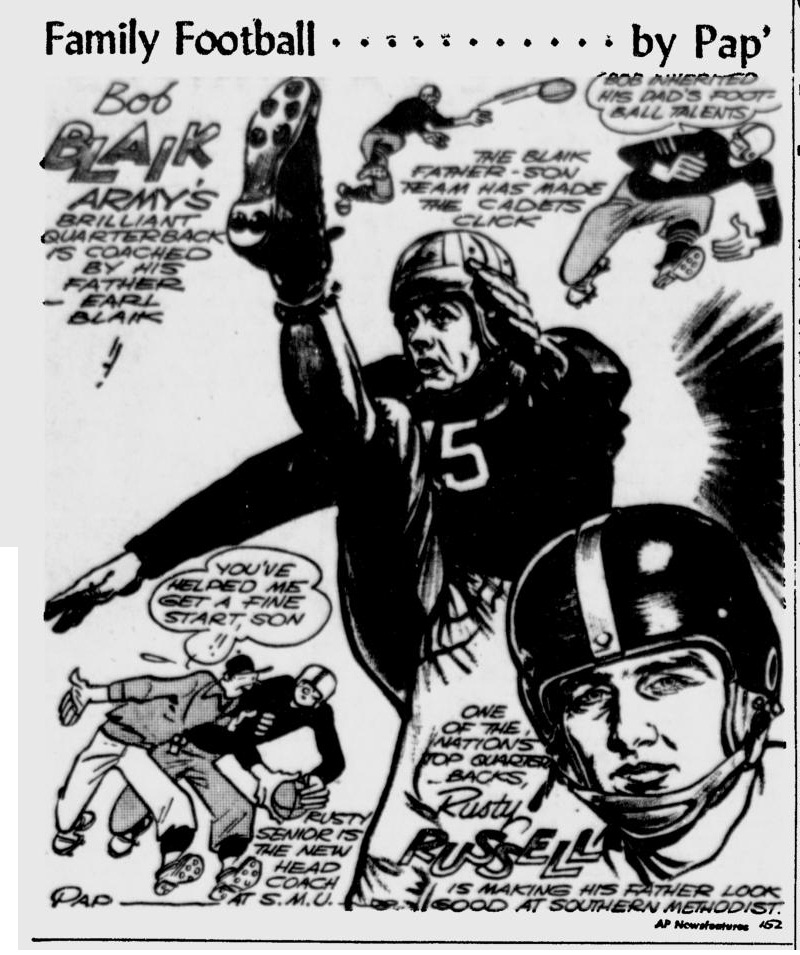
ArmyFB_1950_Blaik_FamilyFootball_byPap_CSM_Nov41950

–
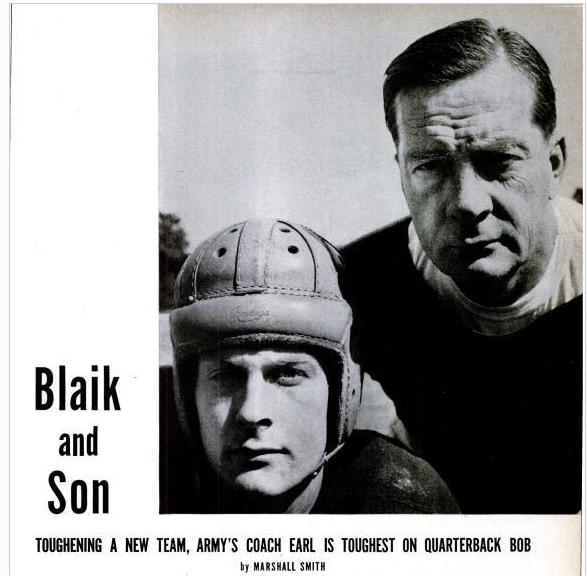
ArmyFB_1950_Blaik-son_LIFE_Oct91950

–

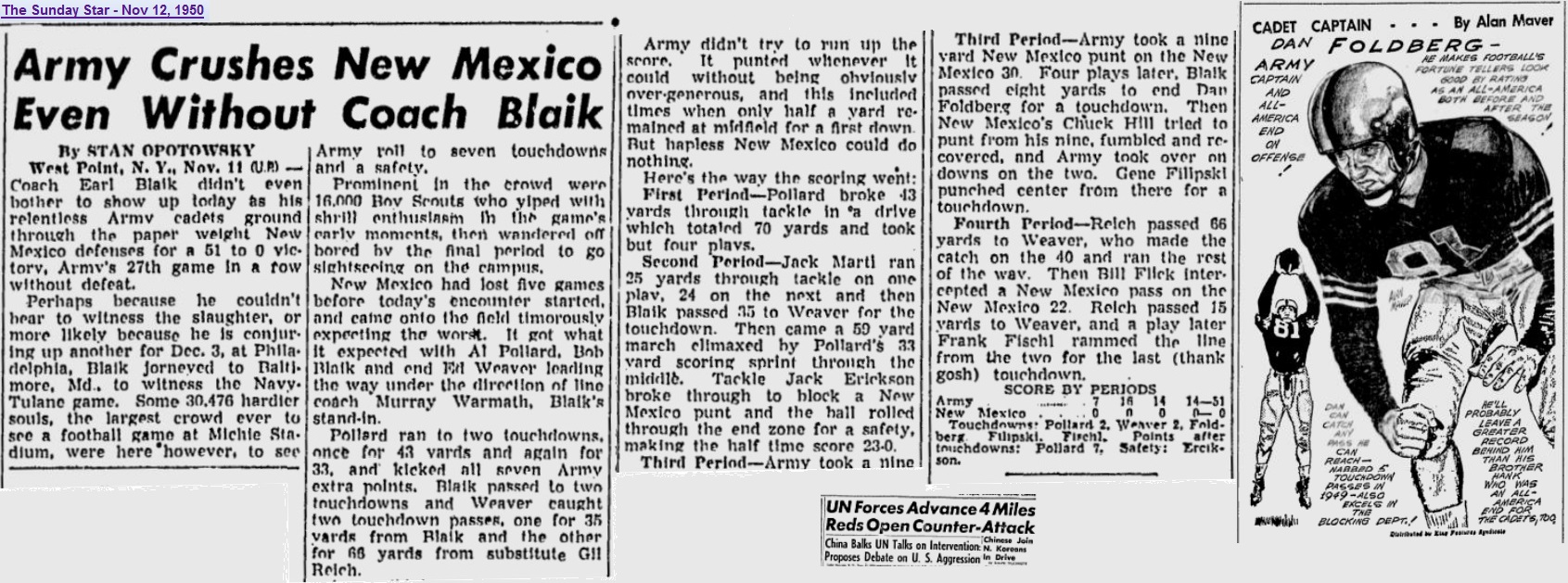
ArmyFB_1950_vsNewMexico_SundayMorningStar_Nov121950

ArmyFB_1950_vsNewMexico_SundayMorningStar_Nov121950

–
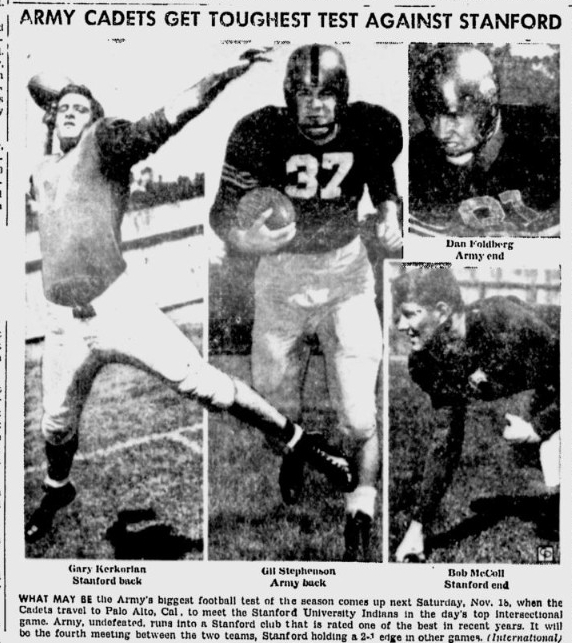
ArmyFB_1950_Stephenson-Foldberg_TheDispatch_Nov131950

–

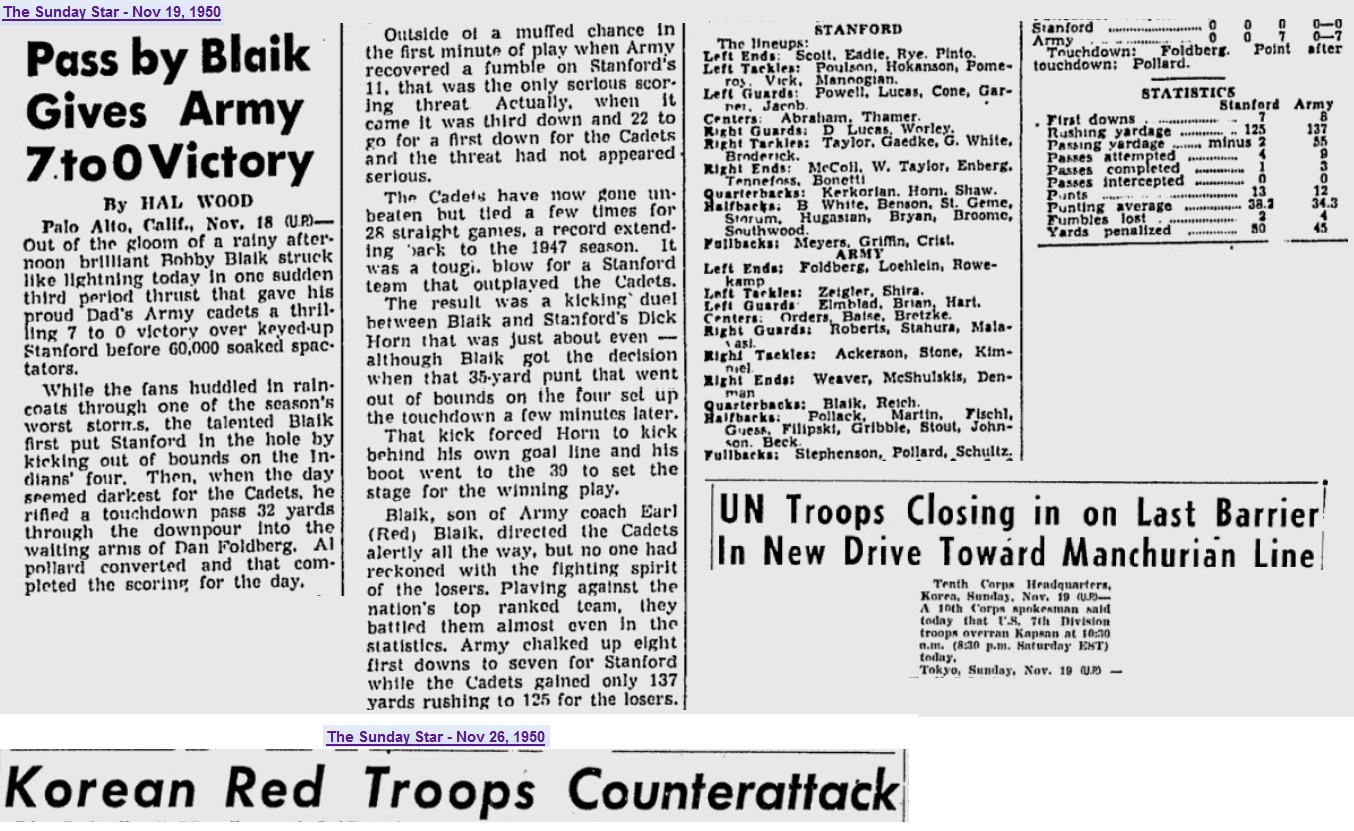
ArmyFB_1950_vsStanford_SundayMorningStar_Nov191950

ArmyFB_1950_vsStanford_SundayMorningStar_Nov191950

–
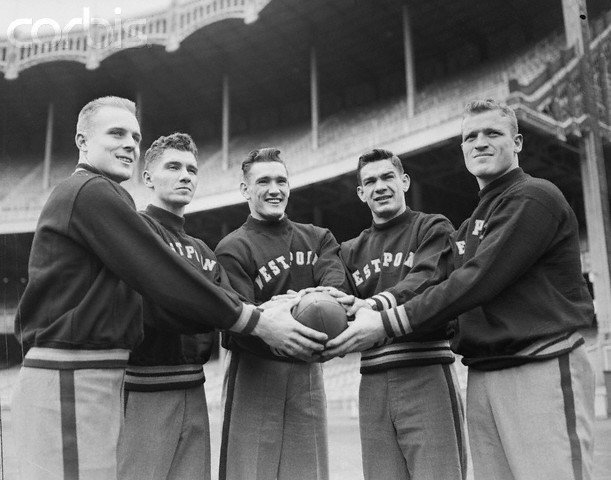
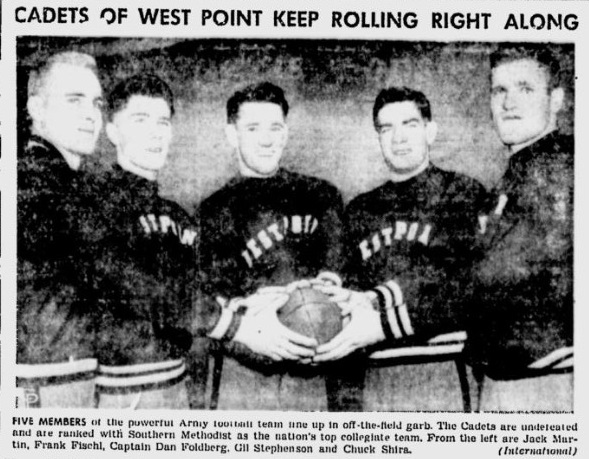
ArmyFB_1950_Stars_photo

–
ArmyFB_1950_Stars_TheDispatch_Nov41950
–

ArmyFB_1950_photo

–
ArmyFB_1950_BobBlaik_byPap_DeseretNews_Nov101950
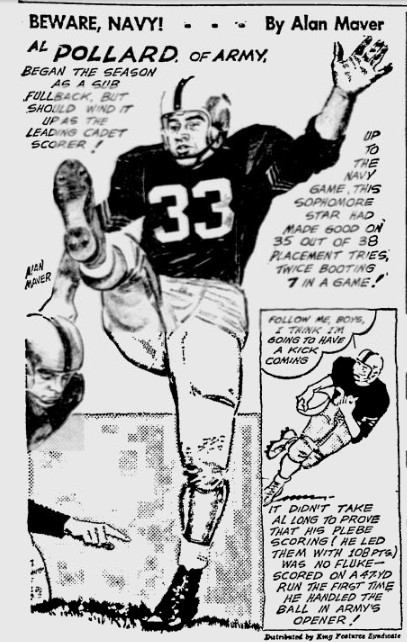
ArmyFB_1950_AlPollard_byAlanMaver_NewsandCourier_Dec21950

–
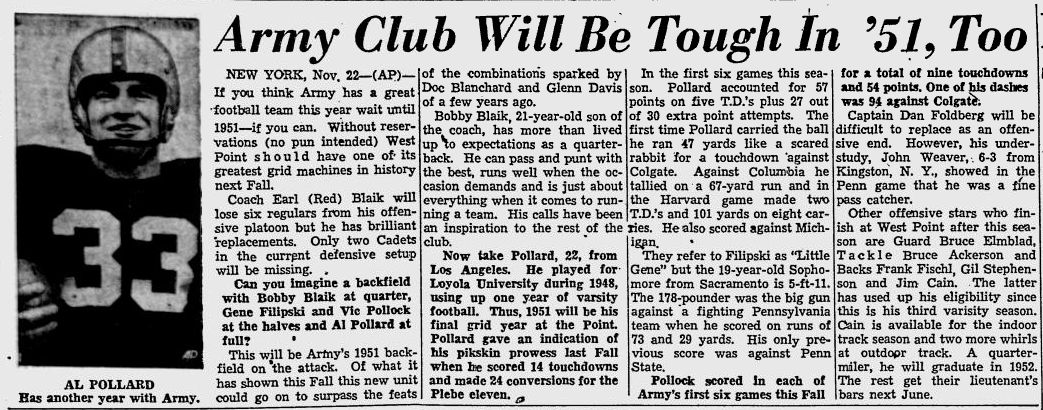
ArmyFB_1950_AlPollard_PortsmouthTimes_Nov231950
–
ArmyFB_1950_Stars_Fsview-FloridaFlambeau_Dec11950

–
ArmyFB_1950_AlPollard_byAlanMaver_NewsandCourier_Dec21950
–
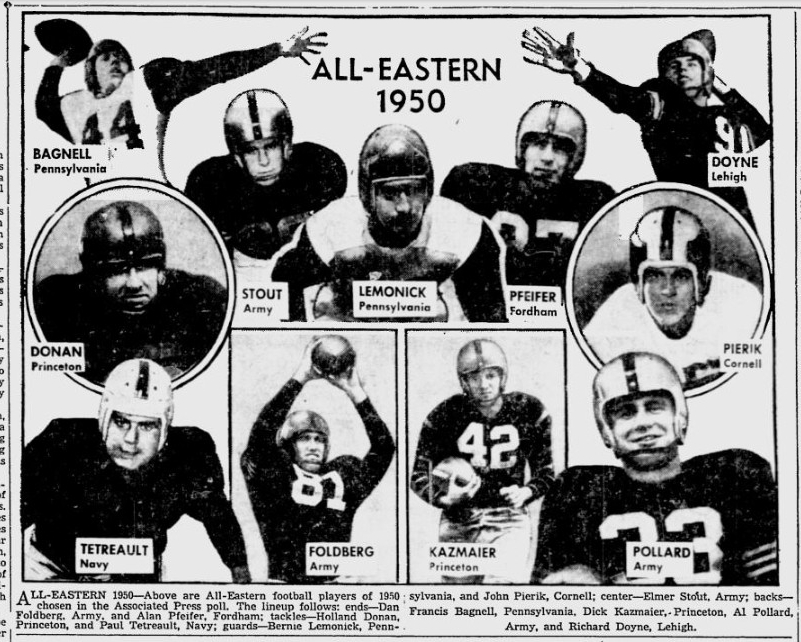
ArmyFB_1950_All-East_NewsandCourier_Dec21950
–
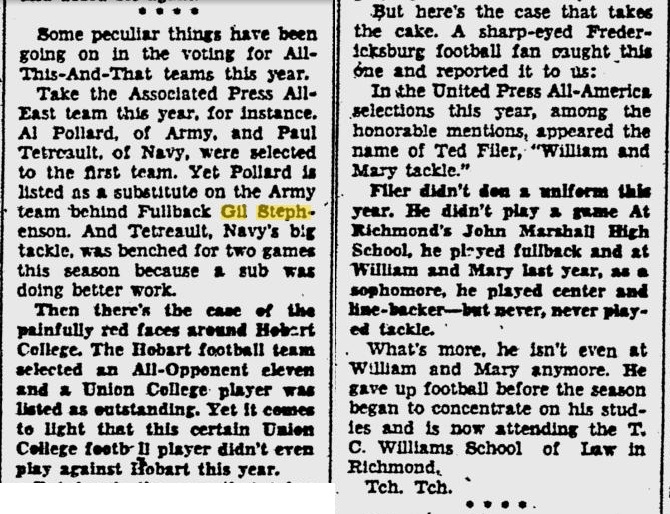
ArmyFB_1950_All-American-questions_FreeLanceStar_Dec51950
–

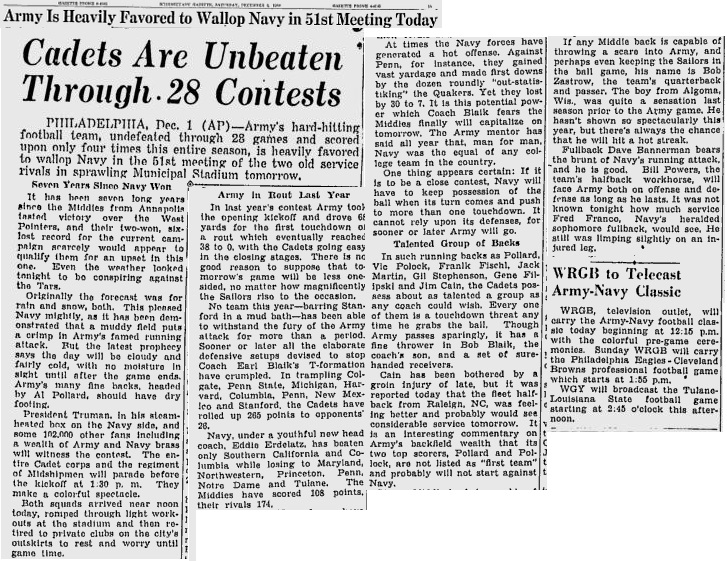
ArmyFB_1950_vsNavy-pre_SchenectadyGazette_Dec21950

ArmyFB_1950_vsNavy-pre_SchenectadyGazette_Dec21950

–
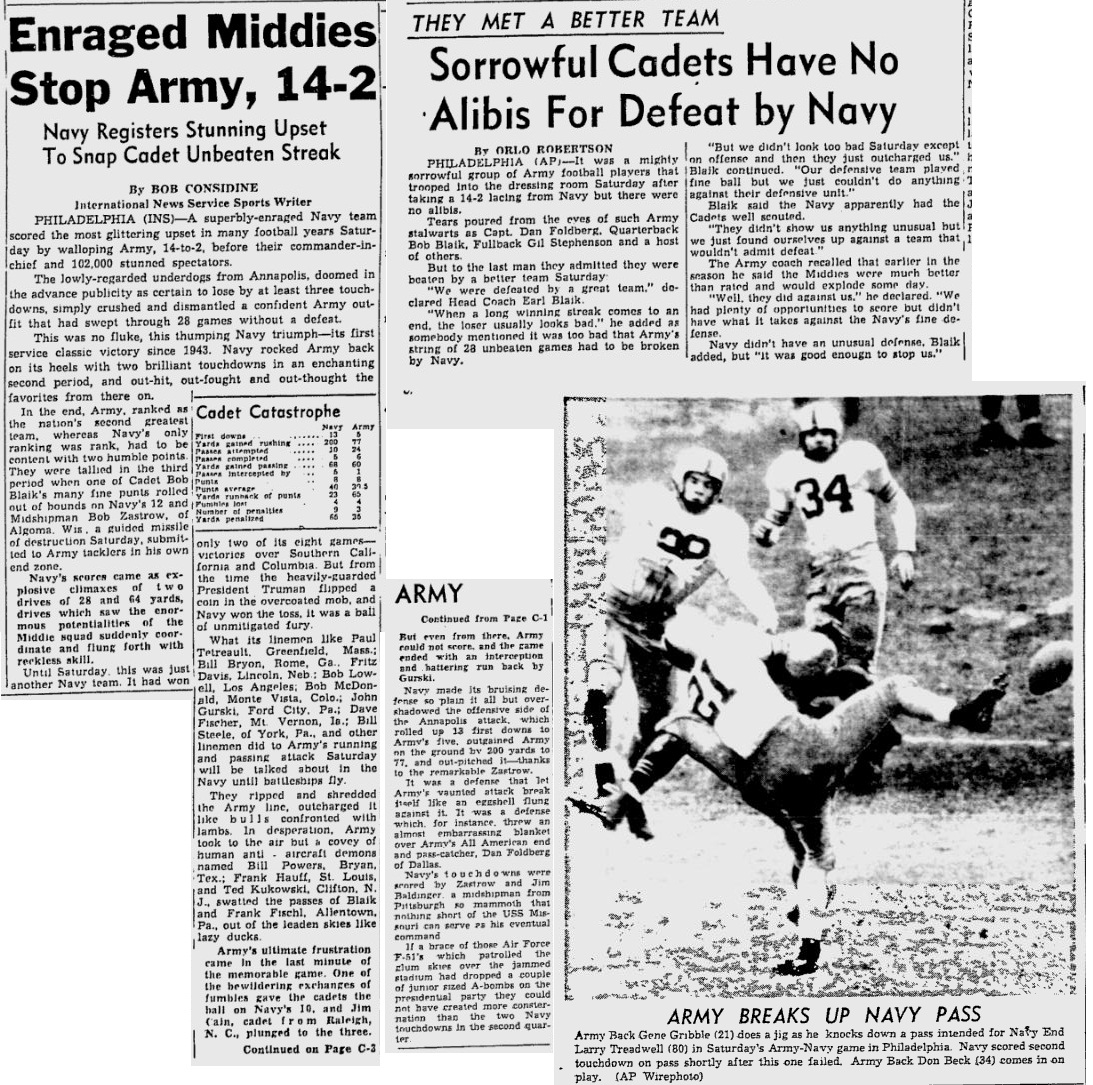
ArmyFB_1950_vsNavy_DeseretNews_Dec21950
ArmyFB_1950_vsNavy_DeseretNews_Dec21950

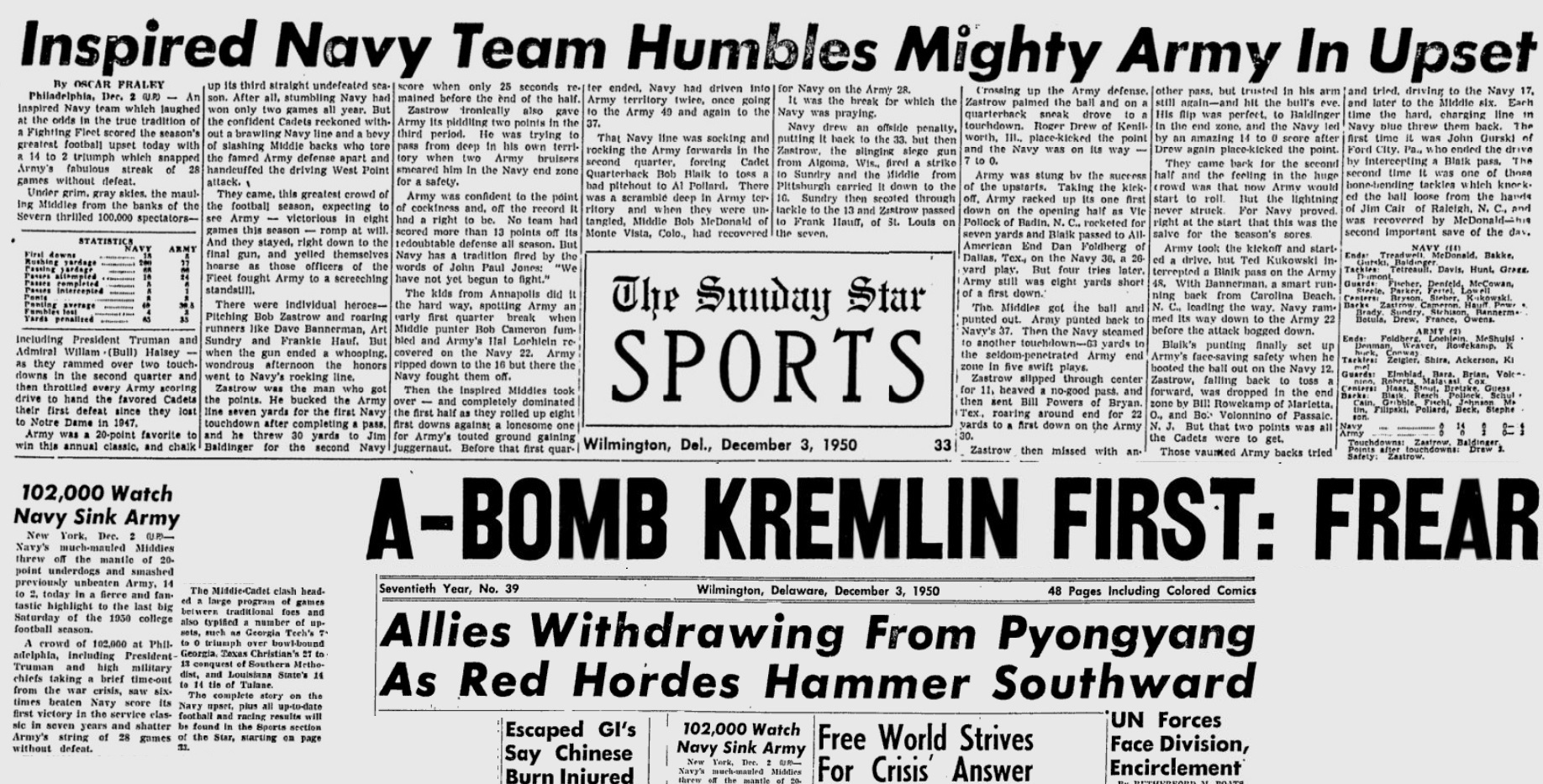
ArmyFB_1950_vsNavy_SundayMorningStar_Dec31950

ArmyFB_1950_vsNavy_SundayMorningStar_Dec31950

–
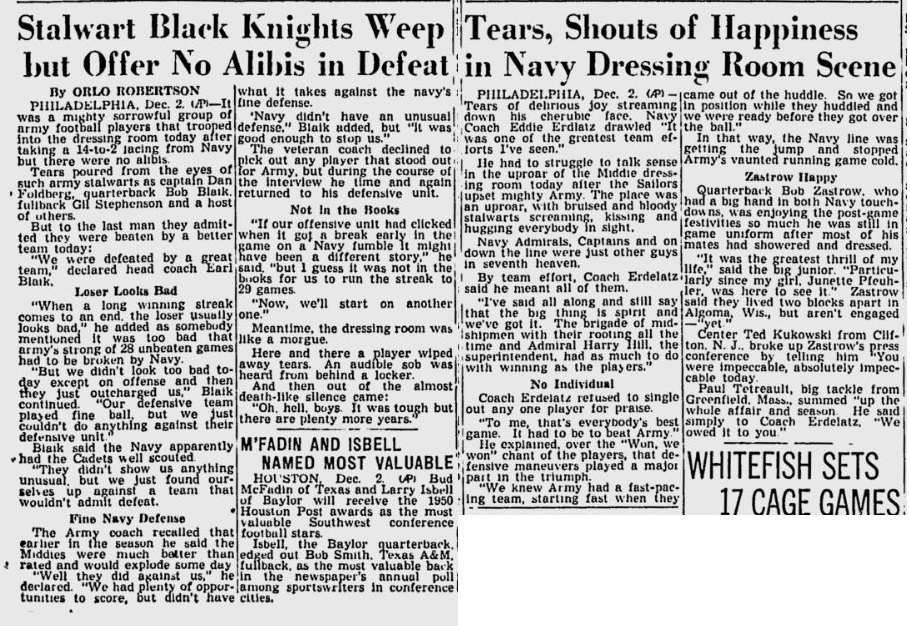
ArmyFB_1950_vsNavy_SpokesmanReview_Dec31950

ArmyFB_1950_vsNavy_SpokesmanReview_Dec31950

–
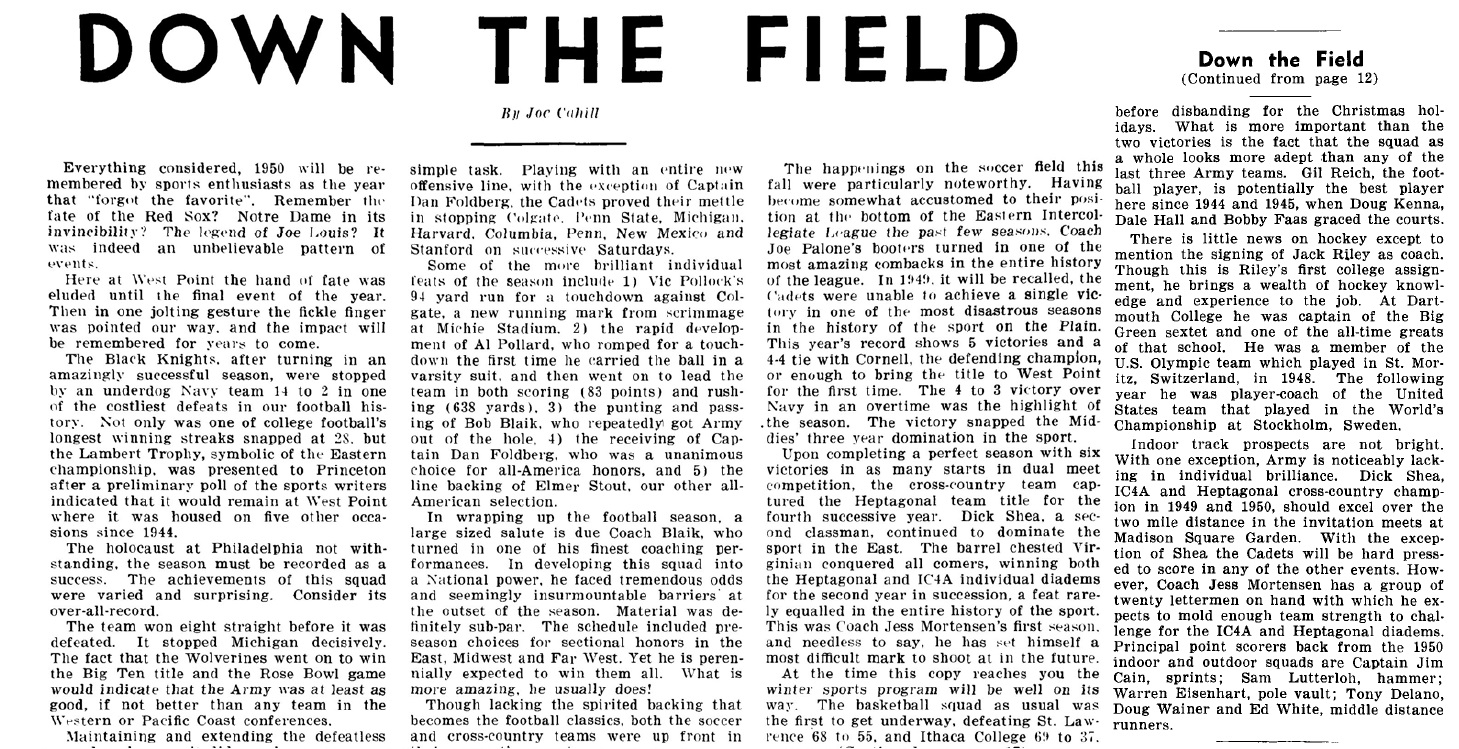
ArmyFB_1950_season-recap_AssemblyVol9No3Jan1951

ArmyFB_1950_season-recap_AssemblyVol9No4_Jan1951

–

1953 Football Team

The Plaque & Roster for the Thayer Hotel Room is at

http://forwhattheygaveonsaturdayafternoon.com/wp-1953/football-team-roster

After the Navy Game —- He ordered the door secured and as he turned to speak his eyes were misty. “I have never coached a team that give me more than you did. I never have coached a team that has given me as much satisfaction. Considering all the conditions since 1951, you have done more for football at West Point than any other team in the history of the Academy.”

If you play for Army, always remember what these Cadets did.

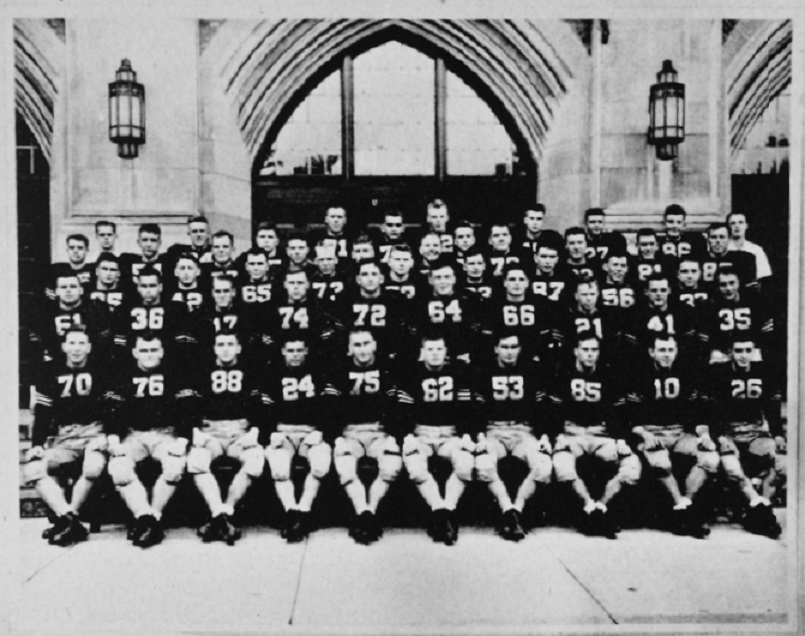
This is that Team – Winners of the Lambert Trophy

*Please note – Jerry Lodge – who wore #32 is missing from Photo as is Norm Stephen. 2d man 2d row next to Tommy Bell – Name is Zaborowski. Wynn #31 is actually in the 2d row not the 3d
The Cadets who played against Duke.

“Freddie Attaya” ’54 – FB & Punter; Tommy Bell ’55 – LHB; Ralph Chesnauskas ’56 – RG (played the entire game – 60 minutes, kicked the 2 extra points); Cockrell – LHB; Bob Farris ’56 – RT, “Howard Glock” ’56 – LT, Jerry Hagan ’55 – QB, Don Holleder ’56 – RE; Krause – RT; Lapchick – LE; Lasley – C; Jerry Lodge ’54 – FB, RHB; Def G & LB, “Leroy Lunn” – LG; Ordway- LE; Melnick – LT; Bob Mischak ’54 – LE, Lowell Sisson ’54 – RE, “Norm Stephen” ’54 – C, Pat Uebel ’56 – LHB, Peter Vann ’56 – QB, “Mike Zeigler” ’54 – RHB, “Dick Ziegler” ’54 – LG, Joe Franklin ’55 – RG (Tore up right knee when doubled teamed by Ralph Torrance & Eddie Meadows in 2d Quarter – Out for the Season)

Army Duke at the Polo Grounds — Army 14 Duke 13

Col Blaik called it “The Game never to be forgotten”

It was perhaps Army’s Greatest Game

Duke was ranked 7th in the Nation

The Corps’ preparation for the game had been more than unusual, including a “silence” imposed by the cheerleaders at the meal following Blaik’s talk. The “silence” which began after the traditional pregame sendoff of the team – proved potent. The cheerleaders had put a cork in the bottle of more than two years of pent up frustration. When the Corps completed its subdued, strangely silent, pregame march-on at the Polo Grounds, and the last man double-timed onto the first step of the stands, the men in gray exploded out. They shook that old stadium almost non-stop in the sunshine and shadows of that Indian summer afternoon.

The 2010 Nomination of the 1953 Team for the Army Sports Hall of Fame is at – –

http://forwhattheygaveonsaturdayafternoon.com/wp-53/nom-team

Nomination Letters by the Classes of 1954, 1955, 1957 and 1962 along with Nomination Letters by three members of the Class of 1956 who contributed to the Teams success and Bob Mischat’s Letter are at – –

http://forwhattheygaveonsaturdayafternoon.com/wp-letters/bob-class

Draft Nomination Material along with Video links of the Duke Game and the Navy Game are at – –

http://forwhattheygaveonsaturdayafternoon.com/wp-53/draft-nomination

For additional details of that season please go to —

1. Last Years Hall of Fame Nomination is at

http://forwhattheygaveonsaturdayafternoon.com/wp-nomination/1953-fb

2. The Reasons for The Class of 1962‘s Nomination of the 1953 Team for the Hall of Fame

http://forwhattheygaveonsaturdayafternoon.com/wp-1954/reasons-for-nomination

3. Bob Mishak’s Letter to the Hall of Fame Selection Committee

http://forwhattheygaveonsaturdayafternoon.com/wp-1954/mischak-letter

4. Bill McWilliams letter supporting ’62’s Nomination of the 1953 Football Team.

http://forwhattheygaveonsaturdayafternoon.com/wp-53/bill-nom-letter

5. Jim Morgan Remembers General James Van Fleet‘s Comments to the Corps

http://forwhattheygaveonsaturdayafternoon.com/wp-1954/van-fleet-15

6. Lowell Sisson remembers his 4 Years and his Teammates

http://forwhattheygaveonsaturdayafternoon.com/wp-1954/lowell-sisson

7. Joe Franklin Army Guard had his knee torn up in the 1st half of the Duke Game when Ralph Torrance and Eddie Meadows (Duke’s All American) double teamed him.

http://forwhattheygaveonsaturdayafternoon.com/wp-1955/joe-franklin

8. Peter Vann’s switching the ball to his left hand as Eddie Meadows grabbed his right — then the wobbly pass straight to Freddie Attaya to keep the drive alive

http://forwhattheygaveonsaturdayafternoon.com/wp-1956/peter-vann

9. Bob Farris played the entire 2d half of the Navy Game blind in one eye? (even though he was Captain – as a Cow – of the 1954 Team, he was never again to play another down of football)

http://forwhattheygaveonsaturdayafternoon.com/wp-1956/bob-farris

10. An Army Cheer Leader Remembers the preparation

http://forwhattheygaveonsaturdayafternoon.com/wp-1954/jay-gould

11. Bob Mischak’s 73 yard run down

http://forwhattheygaveonsaturdayafternoon.com/wp-1954/bob-mischak

12. Poor quality clips of that 73 yard play are at —

http://forwhattheygaveonsaturdayafternoon.com/armylore/50

Worth Lutz, Dukes quarterback said after the Game, “The savage cheering of Go!GO!GO! from the West Point stands placed our team in a nervous fright of tension and jitters.” (see page 9 of Army Lore)

There are two plays – three sentences from the New York Times of 18 October 1953 that exemplifies what this Team did —-

“He (Attaya) also took a 17-yard pass, amazingly thrown left-handed by Vann, immediately preceding the 43-yard scoring aerial.”

Peter Vann rolling to his right to throw, had been confronted by Duke’s All-American left tackle Ed Meadows. Peter had to slow and reverse direction, slanting to his left toward the line of scrimmage, to evade Meadows’ charge. As he lunged past, Meadows grabbed for Vann’s right arm, and Peter instinctively switched the ball to his left hand. Meadows then caught hold of Vann’s right arm, but Peter, still moving to his left, pulled free and threw a short, wobbly, but accurate left-handed strike.

“But from well back an Army figure set out in pursuit. With the place in an uproar, Bob Mischak cut down the gap between them, and finally leaped upon Smith and dragged him down on the 7 yard mark, 73 yards from the line of scrimmage.”

Bob had run down Duke’s All American Red Smith. For nearly 15 years afterward the story Army’s win and Bob Mischak’s tackle was part of West Point’s Military Psychology and Leadership Course – as an example of the power of motivation.

( 24 clips of Bob’s run down & the Team’s Goal Line Stand are at ( http://forwhattheygaveonsaturdayafternoon.com/armylore/50 )

Army held taking over an inch from the Goal Line. Attaya quick kicked out of the end zone and Army stopped Duke’s frantic passes in the closing seconds. The Cadet Corps poured onto the field lifting their heroes onto their shoulders. Army had returned to Glory.

“A Third was “Ralph Chesnauskas”, Yearling right guard who played the entire sixty minutes”

After the Game a number of the players who had played nearly the entire Game — both sides of the ball had to have their Triple A shirts cut off with sissors as they were stuck to the Skin.

Freddie Attaya -48, Bob Mischak - 87, Pat Ubel -34, Melnick - 70

Bob is number 87 on the left side of the line. Pat Uebel is number 34 coming out of the Backfield. It appears to be Melnick throwing the block in front of Bob and it probably is Attaya kicking.

The Team Went 7 – 1 – 1, Beating Navy for the First Time 3 Years

Leroy Lunn

“Leroy Lunn” Army Team Captain 1953 Season

By Bill McWilliams

NCAA Rule Change — What made the rule change more difficult for Army was two prior years of rebuilding which had already caused turmoil on the team. Earl Blaik and his assistants constantly shifted players from one position to another, and promoted and demoted between the varsity and junior varsity, trying to strengthen the varsity. Now, just as things were beginning to settle down, the coaching staff had to determine who could perform best playing both ways. It was painful, because players who had just begun to feel they had secured starting positions on either offensive or defensive units found themselves tested again. And while the 1952 recruiting effort resulted in some talented new Yearling players in 1953, a few of the first and second classmen who had struggled through the two prior seasons found themselves shunted aside.

Col Blaik, Leroy Lunn

Lowell Sisson‘s experiences prior to the 1953 season typified the Army coaching staff’s scramble to find players best suited to go both ways and provide the team its best overall strength and balance.

In spring practice, Blaik and Vince Lombardi moved Lowell ’54 from end to offensive halfback. His high school senior year in Waterloo, IA, he had been a standout halfback on a state championship team. He was tall and fast, good material for Vince’s backfield.

Then, ten days before the season opener, Lowell received word to report to “The Colonel’s” office. Blaik and Lombardi wanted to see him. He was worried. “Why do they want to see me?” he wondered. Lombardi said, “Lowell, we want to switch you back to end. We wanted to ask you about it, if you would object.” Sisson was surprised, but relieved. “I have absolutely no objection. All I want to do is play football. However I can do it is great “at end or anywhere else.”

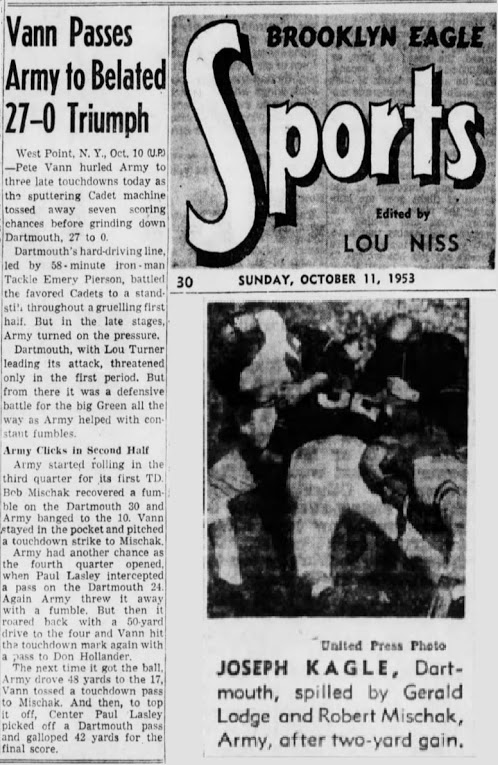
In a rather erratic first three games of the season, Army rolled over an out-manned Furman team 41-0, lost at Northwestern 33-20, and after a 0-0 first half, overcame a winless Dartmouth 27-0.

Pat Ubel - 34

Pat Ubel - 34, Tommy Bell - 46, possibly Jerry Lodge 67

There were, however, interesting footnotes to the win over Dartmouth. Sports writer William J. Briordy, in a 10 Oct special to the New York Times, noted that Peter Vann completed 12 of 15 passes that day, three for touchdowns. Vann’s aerials that afternoon were uncharacteristically short, but that wasn’t important. Two touchdown throws were to Bob Mischak, the only player to receive any All-American recognition at season’s end. The other was to a Yearling named Don Holleder ’56, who in 1954 earned All-American honors at end, quarterbacked the 1955 Army team, and gave his life in Vietnam on 17 Oct 1967. Don’s name now is memorialized in the Holleder Center, adjacent to Michie Stadium.

The Times reporter couldn’t know that there were other matters buried in the history of the 1953 Dartmouth game. Earl Blaik wasn’t a coach who gave emotional, fire and brimstone speeches at halftime. Rather, he was analytical. He identified mistakes and taught his team how to correct them. Not so against Dartmouth. He was frustrated by a flat, lackluster first half and gave his team a tongue lashing.

Peter Vann - 10, Billy Chance - 38, Herdman - 68, possibly Gerry Lodge - 32

Blaik’s offensive play routine required the Army center to be the first man out of the huddle after the quarterback called the play. As the center trotted up over the ball, the rest of the team would pause, then break from the huddle, and jog to the line of scrimmage. Not so the second half against Dartmouth, or against any other team the remainder of the 1953 season.

Center “Norm Stephen” ’54 was so energized by Blaik’s blistering remarks, that on the first offensive play of the second half he bolted from the huddle and raced to the ball – and the other ten men followed his lead. The Corps roared their approval, and that pattern continued the rest of the afternoon. A new method for calling up “the twelfth man” had been established. Perhaps it was the spark that lit next Saturday’s fire.

For then came The College Football Game of the Year, “the game never to be forgotten” as Earl Blaik called it – a heart-stopping 14-13 upset of No. 7 ranked Duke at the Polo Grounds.

Tuesday before the game, Peter Vann, who was a confident, pinpoint-accurate, long ball passer at quarterback – and had fast developed into a ball handling magician under Lombardi’s tutelage – sprained an ankle in practice. The injury was a severe blow, for Blaik and his staff knew the Duke contest was pivotal in Army’s attempts to recover from the honor scandal. Peter’s start was doubtful. He was unable to practice during the week. In spite of Blaik’s sixth football axiom, – Games are not won on the training table,- physical therapy became vital.

When the team went to New York on Friday for a final, light workout in the Polo Grounds, Vann was up to half speed. The practice plan included drop-back passes, the quarterback’s typical three steps back and throw, from the T-formation.

Blaik, ever sensitive to opposing teams’ and sports writers’ intelligence gathering, didn’t want anyone to know Pete might not be able to play against Duke. He and Lombardi also didn’t want Pete to aggravate his injury. Each time he took a practice snap from center “Norm Stephen”, Blaik and Lombardi were close beside him, one on each side, fading back with Peter, ready to catch him, to ensure he didn’t reinjure his ankle. They also were concealing the injury from prying eyes.

Their caution, and Peter’s determination and persistence, paid off. The next day, Peter Vann played perhaps the game of his life, along with a small band of cadets who had labored two and a third seasons learning how to consistently win. Vann’s game against Duke accelerated his rise to football glory at Army. Under Lombardi he sharpened his ball handling wizardry, which repeatedly confused and misled defenses. By the end of the season, his pass completion percentage climbed to 56. Lombardi was drawing Peter’s best from him, and when Lombardi left West Point, Peter continued along the path laid out for him. In 1954, Vann was eighth in the nation in total offense, named second team All-American, and ninth in Heisman Trophy voting.

Editors Note – For an explanation of Lombardi’s Royal “3Fs”; Peter’s comments about schooling by Vince Lombardi and a letter by Vince’s Son indicating that because of Peter’s success his Dad was able to climb the professional ranks – – see Peter Vann.

Pat Ubel - 34, Tommy Bell - 46

The 14-13 decision over Duke was the victory of a truly inspired team. Memories of the 1953 Duke game are vivid for those fortunate enough to have been in the disappointingly small crowd of 21,284, anticipating a Blue Devil walkover. Earl Blaik had spoken to the Corps during the noon meal on Thursday and stirred them as he never had before. Referring to what some had seen as a growing division between the Corps and the football team in the years preceding the cheating incident, Blaik intoned, “The Corps and the football team are one unit. You cannot separate them.”

Milton Caniff, Steve Canyon cartoonist, prepares the Corps for No. 7 Duke at the Thursday rally in Washington Hall.

The Corps’ preparation for the game had been more than unusual, including a “silence” imposed by the cheerleaders at the meal following Blaik’s talk. The “silence” which began after the traditional pregame sendoff of the team – proved potent. The cheerleaders had put a cork in the bottle of more than two years of pent up frustration. When the Corps completed its subdued, strangely silent, pregame march-on at the Polo Grounds, and the last man double-timed onto the first step of the stands, the men in gray exploded out.

The 1953 cheerleaders, standing, for the Army team, with tumblers in
the first row.
Cheerleaders, left to right: Ed Moses, ’54; John Clayton ’55, Al
Worden ’55, Billy McVeigh ’54, Jay Edwards ’54, Bill Robinson ’55;
Tumblers: Peter Jones ’54, Dan Ludwig ’55, Jack Charles ’54, Charles
Glenn ’56.

Corps March On, pre-game at the Polo Grounds, 17 October 1953.

They shook that old stadium almost non-stop in the sunshine and shadows of that Indian summer afternoon. This was also the game in which a band of enterprising 1954 and 1955 cheerleaders first rolled out and fired the now-traditional Army victory cannon. The first blast of the cannon culminated months of planning and scheming, in which the cheerleaders prevailed upon COL “Red” Reeder, the Graduate Manager of Athletics, to grant them Corps Squad status to obtain financial support for their spirit-inducing initiatives.

Memories of Duke 1953 are equally vivid for the men on Army’s small squad. Jerry Hagan ’55 quarterbacked the cadets 76 yards on the ground for their first touchdown, with the running of Tommy Bell, Pat Uebel ’56, “Fred Attaya”, and “Mike Zeigler” ’54. Bell, who hadn’t played since the season opener because of injuries, tore straight ahead through the Duke line nine yards for a first-quarter touchdown to put Army ahead 7-0.

He remembers at game’s end being lifted off his feet onto the shoulders of deliriously happy men in cadet gray, and being carried off the field, excited and exhausted. He also remembers that his little Irish mother attended the game and “after seeing the Corps carry him off the field” told Tommy she decided she, too, was a fan of his. Tom was off and running toward All-American recognition at the end of the 1954 season.

Deliriously happy Army players and cadets celebrate their stunning 14-13 upset of Duke University Blue Devils at the Polo Grounds in New York City’s Polo Grounds, 17 October 1953. Identified players are Lowell Sisson (83), right end; Bob Mischak (87), left end; Bill Cody (11), quarterback; Ed Zaborowski (58), center; Joe Franklin (facing Ed Zaborowski; Frank Burd (33),fullback; Peter Vann (10), quarterback.
(Photo courtesy of Associated Press.)

Big, handsome, fleet-footed Yearling “Patrick Uebel”, playing left halfback, remembers taking a 5-yard flare pass from Peter Vann, in the right flat, and weaving 38 yards down the sidelines for the second Army score, to put the cadets back in the lead to stay, 14-7. But his touchdown against Duke was only the beginning for Pat that year. Against Navy, he scored all three Army touchdowns in a magnificent win. Two of those touchdowns came on identical running plays from the Navy 5- and 3-yard lines, plays that bedeviled Army opponents nearly all season, and involved flawless ball handling and faking by Peter Vann, “Gerry Lodge” ’54, and Pat Uebel.

Ralph Chesnauskas ’56, a Yearling guard who played 60 grueling minutes, remembers the two extra points he kicked. The second one gave Army the margin of victory. Outwardly, he was icy calm.

Bob Farris was also one that stood out that day.(Editor’s Note – Bob played the entire 2d half totally blind in one eye. He never played another down of Football. As the Football Team Captain for the 1954 Season he dressed for every practice and Game.)

“Freddie Attaya” remembers Vince Lombardi’s shouted advice to him as he ran onto the field in a third and seven situation. “Run the gauntlet” yelled Lombardi.

Vince was reminding his fullback of a drill he put his backfield through in practice. Running backs, carrying the ball pressed against their gut, ran hard between two lines of eight players each. The ball carriers’ forearms protected the ball, and their hands tightly gripped opposite ends of the pigskin, every player in the gauntlet aggressively tried to “tackle the ball.” Freddie ripped the middle of Duke’s line for nine yards and a first down. When he came off the field, Lombardi rushed to hug him, telling him he had done a great job.

Peter Vann and “Freddie Attaya” both remembered a most unusual pass just before Pat Uebel rumbled 38 yards with another Vann pass to give Army the winning margin.

A right-handed passer, rolling eight yards deep, to his right to throw, Peter was confronted by Duke’s hard charging, All-American left tackle Ed Meadows. Peter cocked his arm to throw as Meadows closed in but had to slow and reverse direction, slanting to his left toward the line of scrimmage, to evade Meadows’ charge. As he lunged past, Meadows grabbed for Vann’s right arm, and Peter instinctively switched the ball to his left hand. Meadows then caught hold of Vann’s right arm, but Peter, still moving to his left, pulled free and threw a short, wobbly, but accurate left-handed strike to “Freddie Attaya”, good for 17 yards to the Duke 43. A left-handed throw by a right-handed passer kept the drive moving.

“Gerry Lodge”, converted from guard to fullback during spring practice, remembered the Duke game for a different reason. He played fullback on offense and guard on defense when Army was in a six-man line, and moved into linebacker when Army went to a five-man line. On defense, he played alongside the few linemen who were in the game nearly the entire 60 minutes and was in Army’s dramatic goal line stand following Bob Mischak’s game-saving tackle. With first and goal on Army’s 7-yard line, the cadets held Duke on a fourth down quarterback sneak from the two, with 40 seconds to play.

Throughout the final two minutes of play, especially during Duke’s four thrusts at the Army goal, it was almost impossible to hear or think because of the roar from the crowd. Cadets had come down out of the stands, were pressing around the Army bench and close to the sidelines, imploring their defense to hold.

Army’s always thorough scouting reports helped exploit Duke’s weaknesses and patterns.

Jerry Lodge remembered what Blaik had told the team. When the Blue Devils get inside an opponents’ 10-yard line, they run the ball between their own tackles on 95% of plays. And when they get close to the goal line, they run quarterback sneaks. Prior to the fourth down play, a Duke assistant threw a kicking tee onto the field, indicating a field goal attempt.

Lutz picked up the tee and threw it back, disdaining the field goal.

Jerry Lodge had seen his teammate, left guard “Dick Ziegler” ’54, playing magnificently all afternoon, often absorbing the energy of three Duke blockers because of his hard charges in the middle of their line. As Duke huddled for Lutz to call the fourth down play, Jerry Lodge said to Dick Ziegler, “Remember, he’s going to try to sneak.”

Lutz did, but he was met by a wall of white jerseys. Army took over on downs, inches from the goal line, while the Corps of Cadets shouted their frenzied approval. But the game wasn’t yet over. On first down, “Freddie Attaya”, on orders from Blaik, punted from deep in his end zone. Duke had 30 more seconds and four more plays from the Army 37-yard line – all passes – all knocked away. Peter Vann, Army’s quarterback, batted away the last pass in the end zone, a pass thrown by Gerry Barger, Duke’s quarterback, to starting quarterback Worth Lutz.

Army football fans had one other lasting memory to take with them -Bob Mischak’s incredible, game-saving tackle just prior to Army’s goal line stand.

With two and one half minutes left in a game that was already emotionally and physically exhausting, Duke took the ball on downs just inside their own 20-yard line with Army leading 14-13. Worth Lutz knew he needed a long gain. His team didn’t have the energy for a long, grinding drive, so he called a double reverse. Lutz handed the ball to halfback Bob Pascal, indicating a sweep around Army’s left side. Pascal then slipped the ball to “Red” Smith, Duke’s speedy All-American candidate, heading in the opposite direction. Army’s defense over commited, and Smith broke into the secondary. After sidestepping a linebacker, he was in the clear, ten yards beyond pursuing Army defenders, sprinting toward the southeast corner of the field.

Earl Blaik years later described reactions on the Army sidelines.

“We on the bench and the Corps of gray in the lower stands behind us shot to our feet in sudden silent, stunned consternation. Smith looked home free. I felt our heads were being pushed down once more into the ashes of 1951.”

Then, from out of the pack of pursuers, came left end Bob Mischak. He had an angle on Smith and rapidly began closing the gap at the 50-yard line. By the time Smith crossed the Army 20, Mischak had closed to 3 yards. The Army stands were coming alive, shouting encouragement to him, but it was important that he not commit too soon. Blaik held his breath, muttering to himself, – “Not yet! Not yet!” As Smith crossed the 12-yard line, Earl Blaik was saying “Now! Now!” Bob Mischak leaped far and high, caught Smith around the shoulders at the 10, and downed him on the 7-yard line.

Earl Blaik remembered Bob Mischak‘s game-saving tackle for the rest of his life.

“In somehow catching and collaring [Smith], Mischak displayed heart and a pursuit that for one single play I have never seen matched. Yet his feat, one of the great defensive plays of football, would have soon been forgotten, had it not been for the [goal line stand that] followed.”

In the locker room after the game, Earl “Red” Blaik, his eyes glistening with tears, presented Bob Mischak the game ball. As he handed the ball to Mischak, Blaik, a man of few but always impressive words, said simply, “Don’t ever give up.”

For nearly 15 years afterward the story of Bob Mischak’s tackle against Duke was part of West Point’s Military Psychology and Leadership Course – as an example of the power of motivation.

One day, at the end of the 1953 season, Bob Mischak was told to report to the office of the Athletic Director. Quietly, without ceremony, he was handed a certificate saying he had been named to the National Broadcasting Company’s All-American team.

The evening following the Duke game, Peter Vann entered the hotel elevator and headed out for a bite to eat. He was alone when the elevator stopped at the next floor. The door opened and in stepped Vince Lombardi – alone.

As the doors closed, Lombardi, still elated over the game’s outcome, once again complimented Peter on his play that afternoon. Then, after a brief exchange about where Pete was going, Vince reached for his billfold and handed Peter a $5 bill. “Here,” he said, “go buy yourself a beer – and don’t tell the Colonel.”

Army went on to their “football miracle” that year, winning four of their remaining five games, a record marred only by the 0-0 tie at Tulane. The sterling 20-7 win over Navy – a story in itself – capped an emotional season of inspired football, and put Vince Lombardi back on his mountain top.

–

–

–

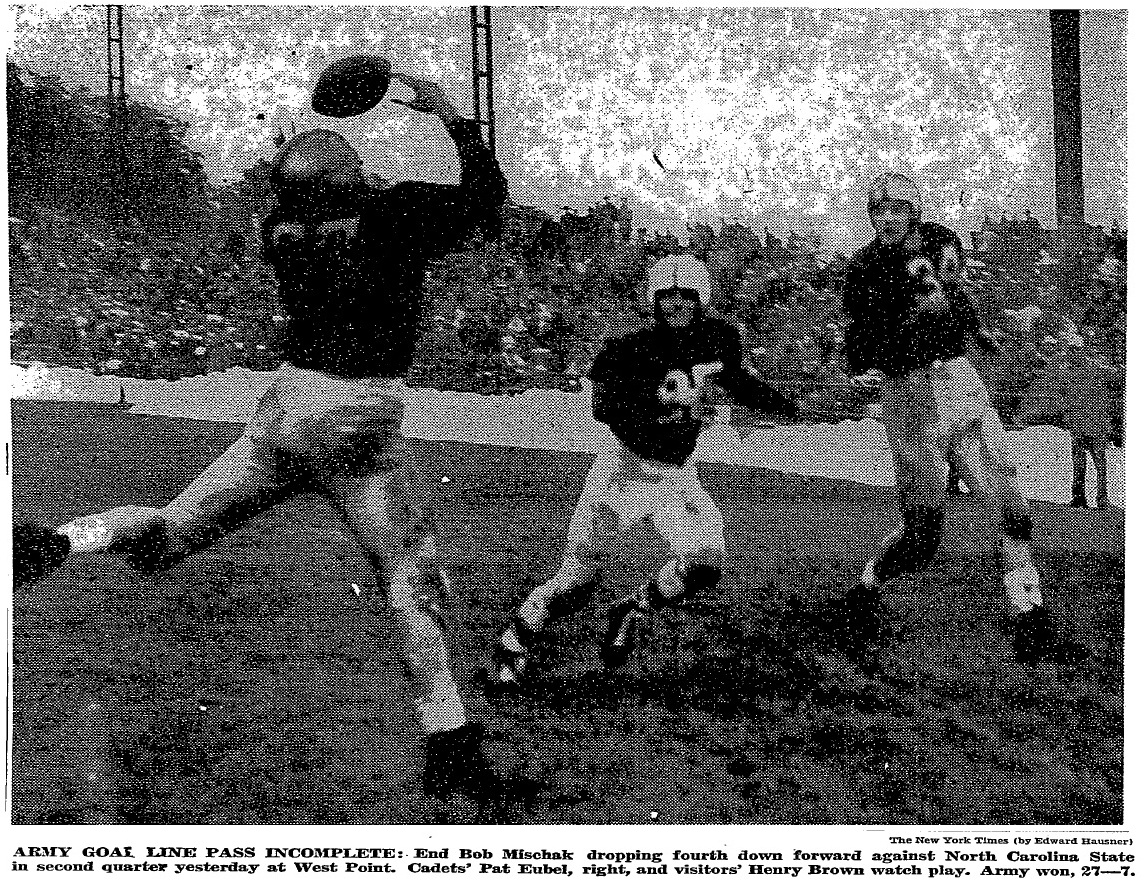
Jerry Lodge grinds out yardage against North Carolina State, in Michie Stadium. In the background is Bob Mishcak (87).

Peter Vann -10, Moose Krause - 79

Peter Vann-10, “Moose Krause” – 79

Below against NC State Pat Uebel – 34 and Jerry Lodge 32

Pat Ubel - 34, Bob Mischak - 87, possibly jerry Lodge is - 32

Bob Mischak - 87, probably Ralph Chesnauskas - 63

The Navy Game


General James Van Fleet speaking to the Corps prior to the Navy Game

Navy fumbles attempting to return the opening kickoff. The photo,
taken by a photographer for the Philadelphia Inquirer, incorrectly
identified the Army player recovering the ball, as Howard Glock, when
in fact it was Lowell Sisson (83) who is on his feet facing the
camera lens as the ball squirts past his thighs. Glock (71), Bell
(46), Mischak (87), Farris (55) and Uebel (34) are identifiable.
(Photo courtesy of Urban Archives, Temple University, Philadelphia, PA.)

But this was a special team, a team of heroes without individual stars, with different heroes each Saturday, all playing for the love of the game, a team about which the famed sports writer Grantland Rice said, “They came up the hard way, and there probably has never been a team with a finer spirit.”

In the locker room after the win over Navy, with no newspaper reporters present, players on the 1953 team heard marvelous, complimentary words from Earl Blaik.

“I never coached a team,” he told them, “that gave me more than you did. I never have coached a team that has given me as much satisfaction. Given all the conditions since 1951, you have done more for football at West Point than any other team in the history of the Academy . . .”

Peter Vann -10, Pat Ubel - 34

Peter Vann - 10, Leroy Lunn -60

As the years went by, Earl Blaik frequently noted that coaching the 1951 – 53 Army teams brought him the greatest professional satisfaction in his career. Vince Lombardi‘s step to glory on the professional gridiron began in earnest during those three years. Under Earl Blaik he learned what was necessary to turn adversity to triumph, and he applied those lessons to great effect at Green Bay.

By observing Blaik, the irrepressible Lombardi also improved his ability to organize, discipline, and inspire a team. “My – football is your – football,” he later wrote Blaik. “My approach to a problem is the way I think you would approach it.”

Recalled Blaik, “He may have learned a few things during our years together, but he didn’t learn that magnetism at West Point. It was always in him. You don’t put magnetism into people.”

Jim Lee Howell, the New York Giants’ head coach who hired Lombardi after the 1953 season at Army, said, “If Lombardi can do that kind of job in three years at West Point – he could do a helluva job in the pros where he would have an experienced base to work with.”

For the men who played on those Army teams, and particularly in his last backfield, there would be memories of a complex, fiery man, who came to West Point as a “diamond in the rough.” They undoubtedly would agree with the words about Vince Lombardi, penned by one of his great players at Green Bay, Jerry Kramer. In his book, Instant Replay, Jerry wrote, “Lombardi was a cruel, kind, tough, gentle, miserable, wonderful man whom I often hate and often love and always respect.”

Dedication
In memory of Richard “George Inman” ’52, who was killed in action leading his platoon to safety on “Pork Chop Hill”, in Korea, on 7 Jul 1953, three weeks before the armistice was signed. Dick was a letterman on the 1951 Army football team.

This article is based on the author’s research for a forthcoming book — A Retum to Glory: The Untold Story of Honor, Dishonor, and Triumph at the United States Military Academy, 1950-53.

Years later Col Blaik was to say the’51,’52 culminating with the success of the 1953 Football Team brought him the – – – “greatest professional satifaction of his career”

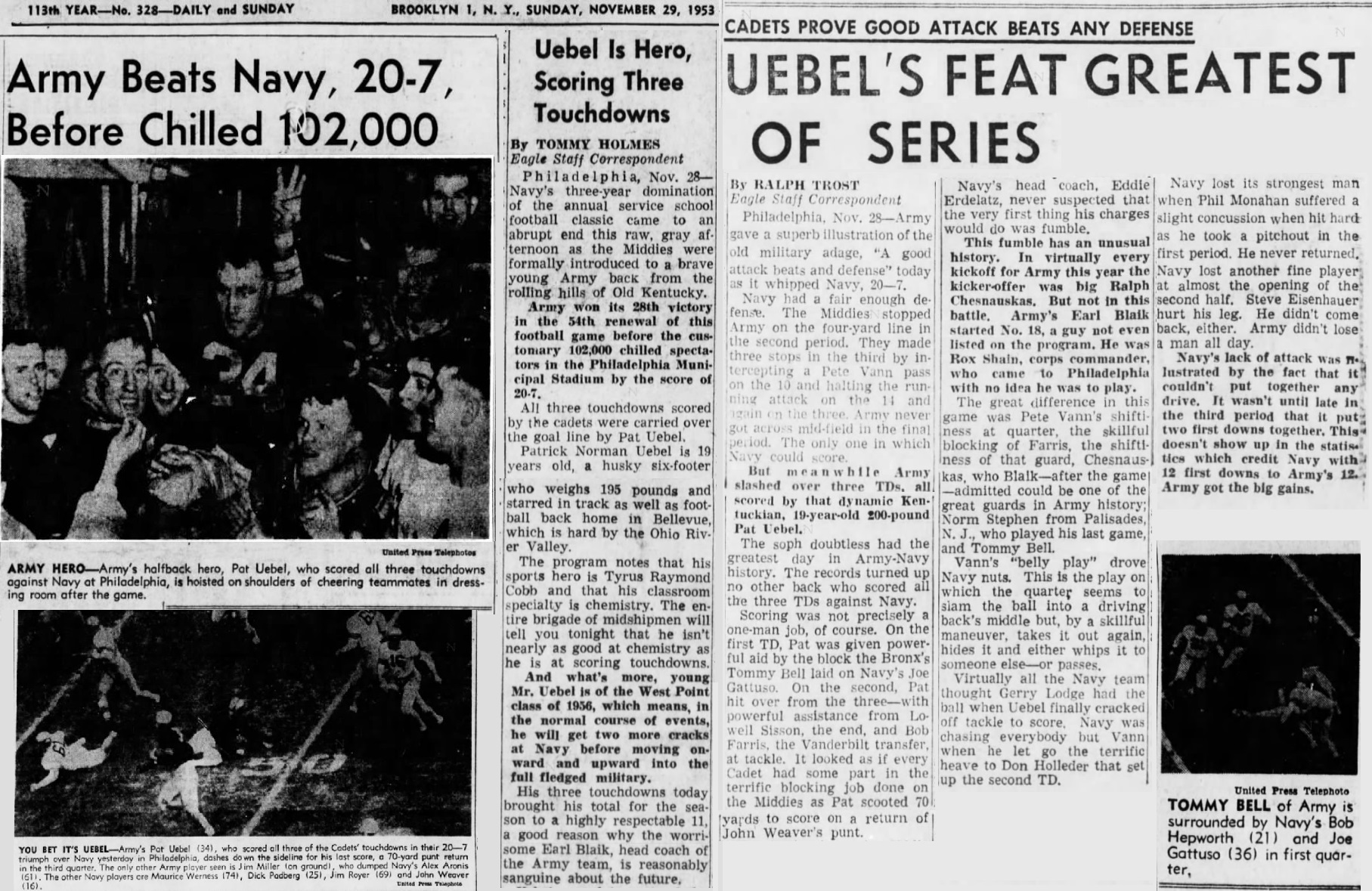
Army 20 – Navy 7

Pointer Articles 53 Season

Army’s Year

Adjustments Required

Col Blaik

Yearlings of the 53 Team

53 Team

<a

B Squad

Col Reeder — to the Corps

Two of Army’s Greats


A Tough Schedule

Then Navy

Furman & Northwestern Games

Getting Ready for Duke


Army Duke — Perhaps Army’s Greatest Game


Army 40 – Columbia 7

A Tie – – – The Corps was not There


Army over Penn

The Last Game for the Class of 54


Army – Navy Rosters

Peter Vann — Pin Point Passing


Army will win


Great Army Navy Games


Navy in Review

Amen’s Report


Army Navy Series


It is More Than A Ball Game


Yes, Yes, Yes

Army 20 – Navy 7

Col Blaik Paid the Price Coach of the Year

It was the Team that Gave the Most

Winners of the Lambert Trophy


Various sports articles provided by Russ “Skip” Grimm – Class of ’76

armyfb_1953_forecast_nyt_sep121953
ArmyFB_1953_forecast_NYT_Sep121953

ArmyFB_1953_vsDartmouth_BrooklynDailyEagle_Oct111953

ArmyFB_1953_vsDartmouth_BrooklynDailyEagle_Oct111953

armyfb_1953_vsncstate-mischak_nov81953

ArmyFB_1953_vsNCState-Mischak_Nov81953

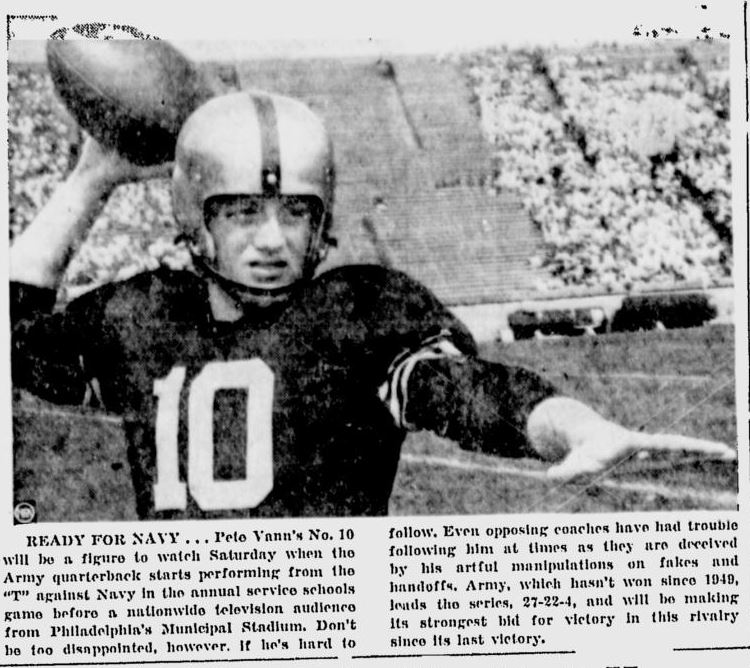
ArmyFB_1953_PeteVann_StJosephGazette_Nov261953

ArmyFB_1953_PeteVann_StJosephGazette_Nov261953

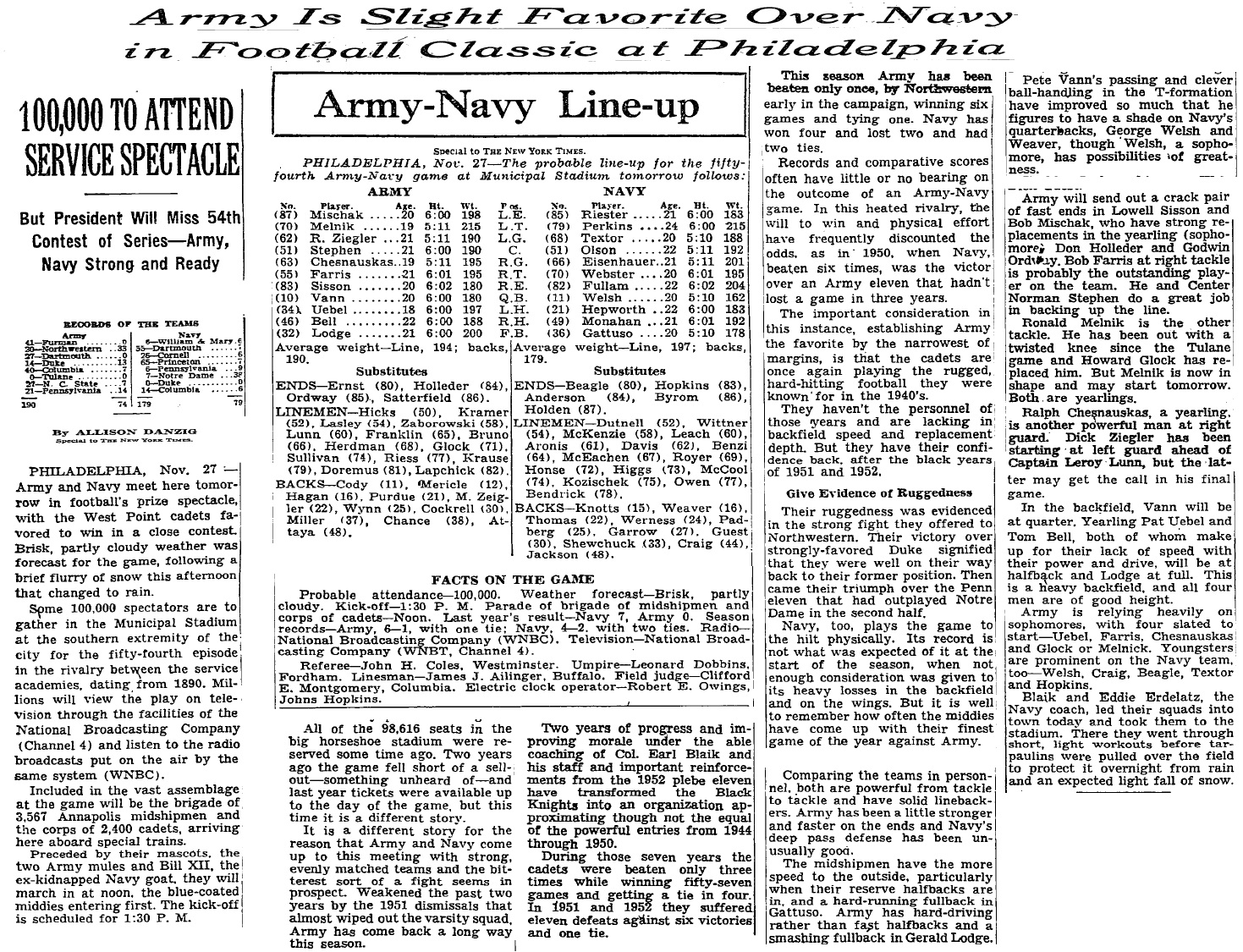
armyfb_1953_vsnavy-preview_nyt_nov281953
ArmyFB_1953_vsNavy-preview_NYT_Nov281953

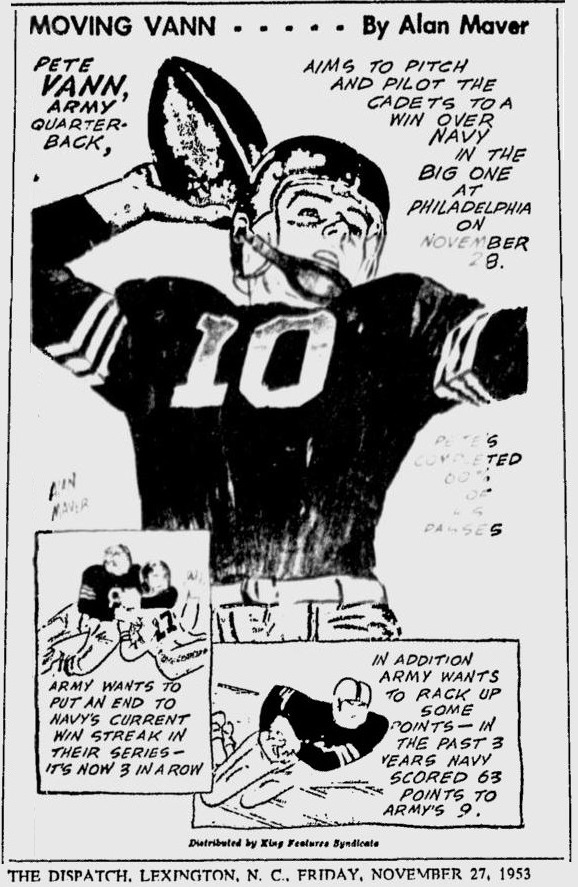
ArmyFB_1953_PeteVann_byAlanMaver_TheDispatchNC_Nov281953(1)

ArmyFB_1953_PeteVann_byAlanMaver_TheDispatchNC_Nov281953

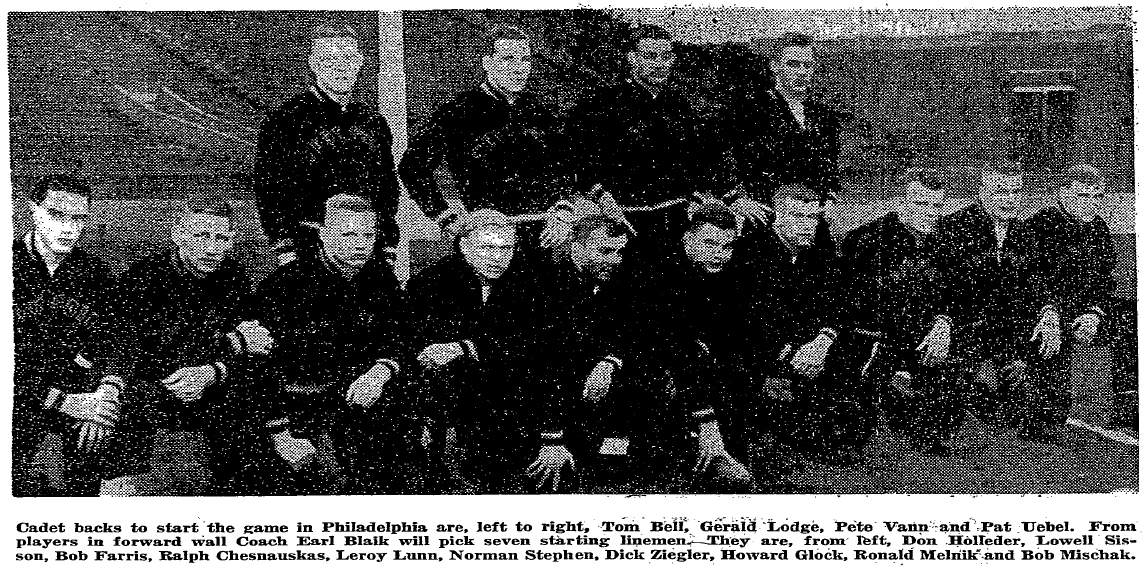
armyfb_1953_vsnavy-starters_nyt_nov281953
ArmyFB_1953_vsNavy-starters_NYT_Nov281953

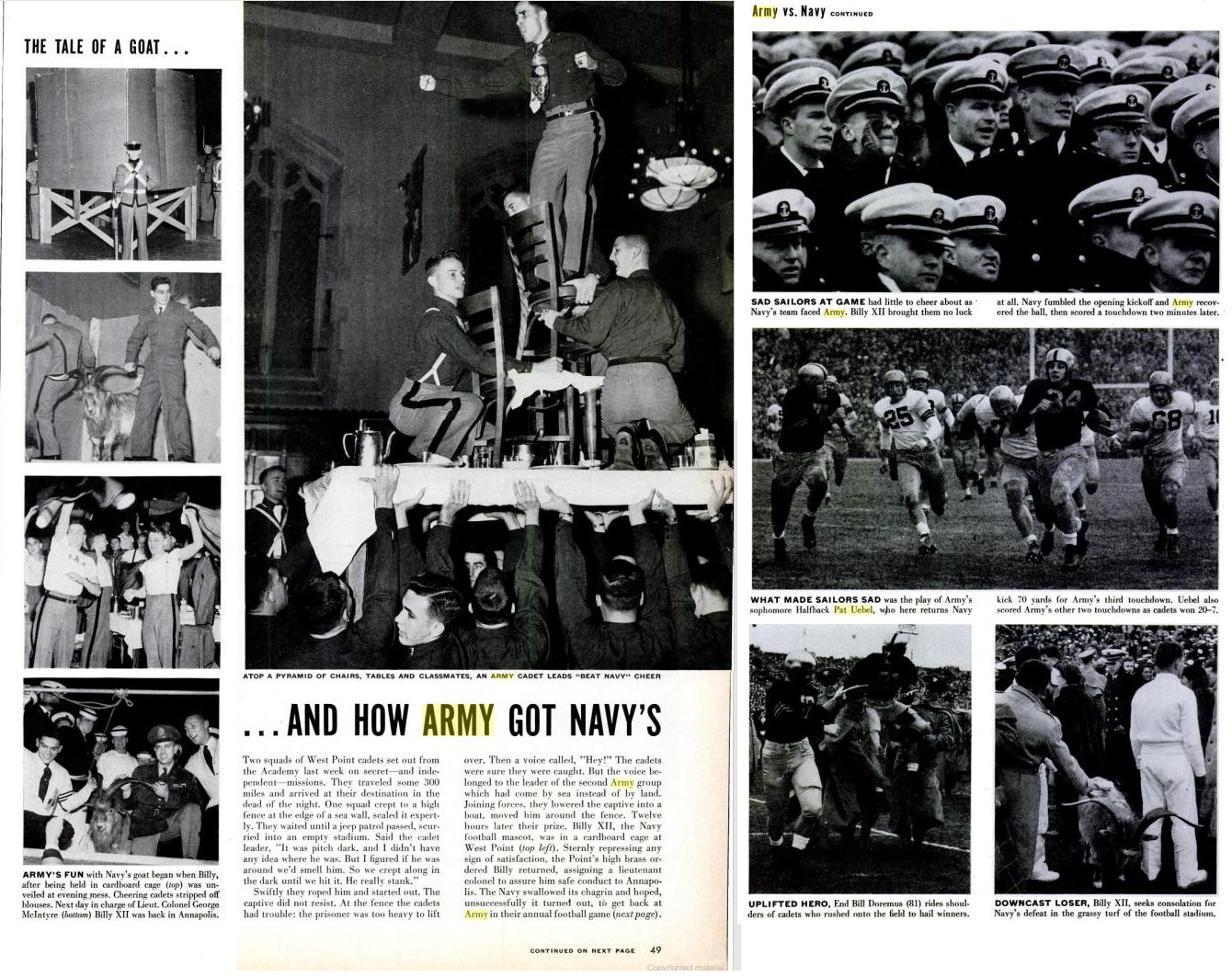
armyfb_1953_vsnavy_life_dec71953

ArmyFB_1953_vsNavy_Life_Dec71953

http://books.google.com/books?id=O0kEAAAAMBAJ&lpg=PP1&pg=PA49#v=onepage&q&f=false

–

armyfb_1953_vsnavy_spokanedailychronicle_nov281953
ArmyFB_1953_vsNavy_SpokaneDailyChronicle_Nov281953

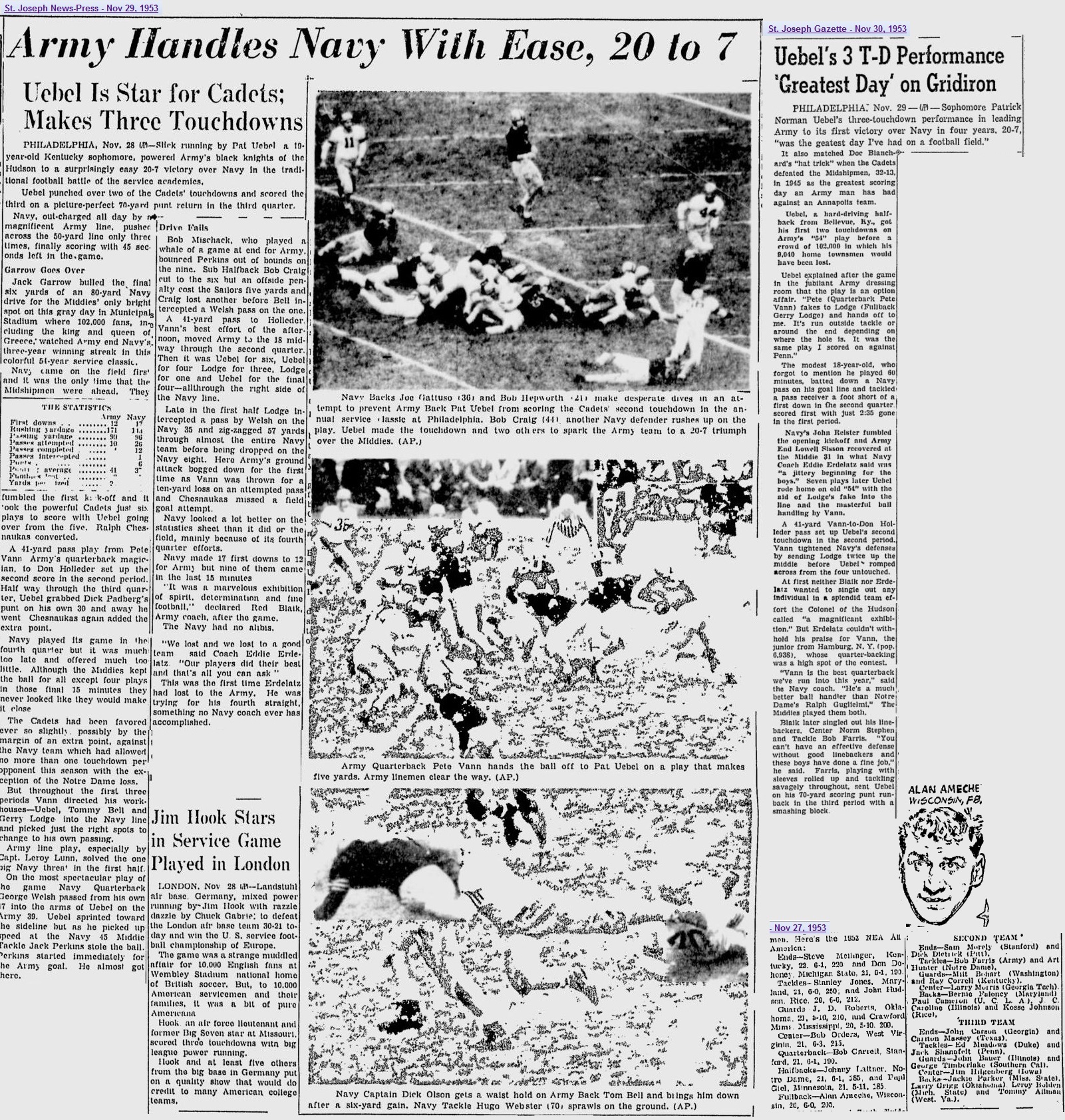
ArmyFB_1953_vsNavy_StJosephNews-Press_Nov291953

ArmyFB_1953_vsNavy_StJosephNews-Press_Nov291953

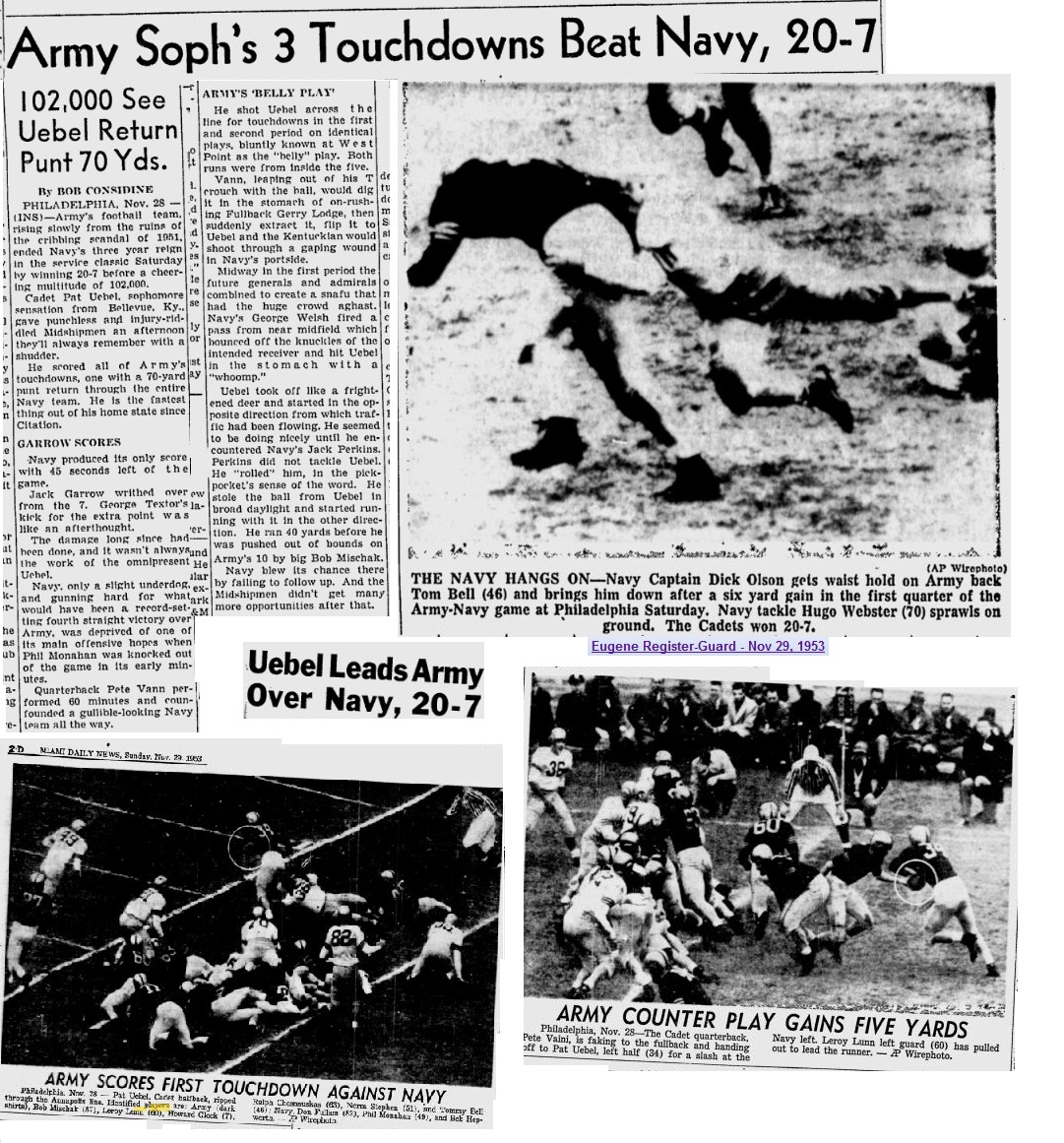
ArmyFB_1953_vsNavy_MilwaukeeSentinel_Nov291953
ArmyFB_1953_vsNavy_StPetersbrugTimes_Nov291953

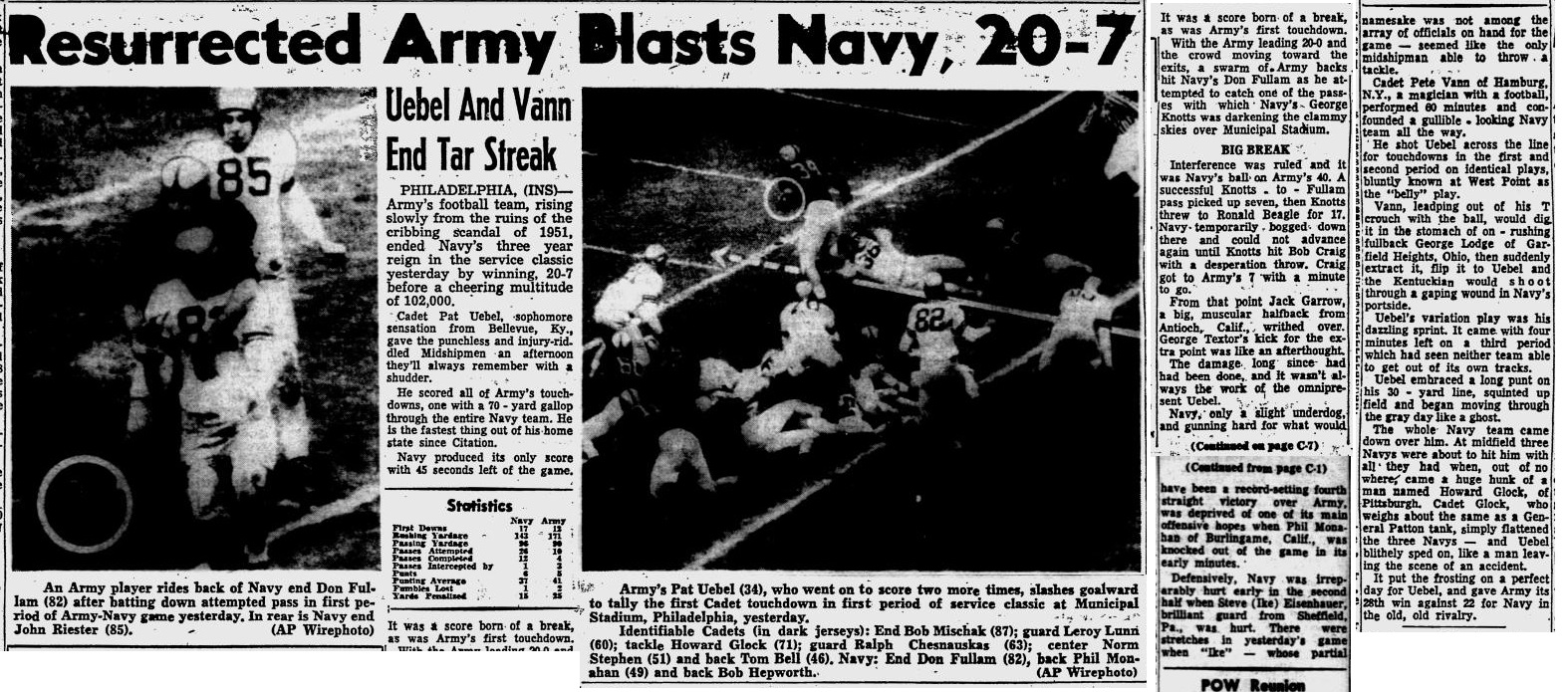
ArmyFB_1953_vsNavy_BrooklynDailyEagle_Nov301953

ArmyFB_1953_vsNavy_BrooklynDailyEagle_Nov301953

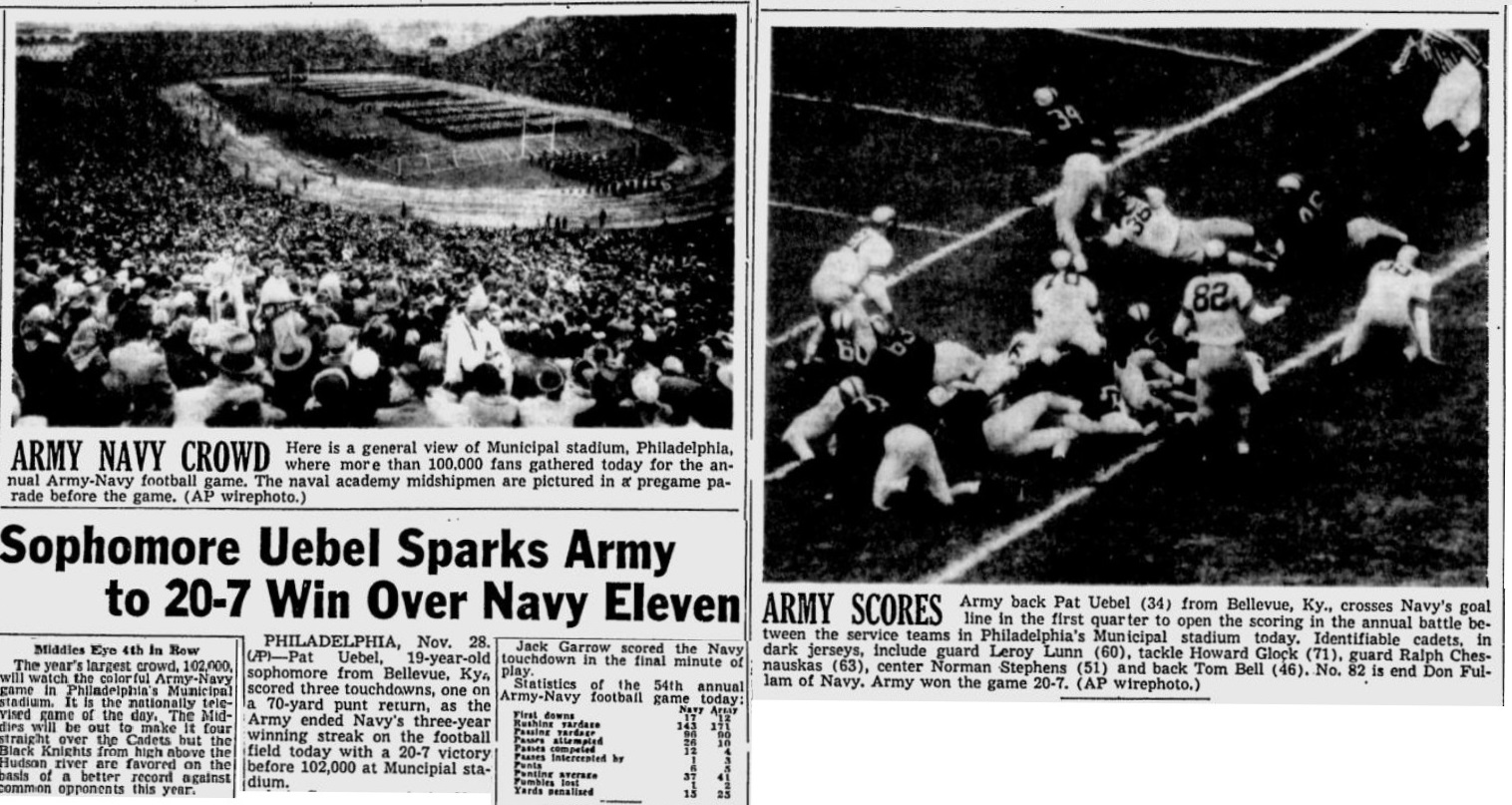
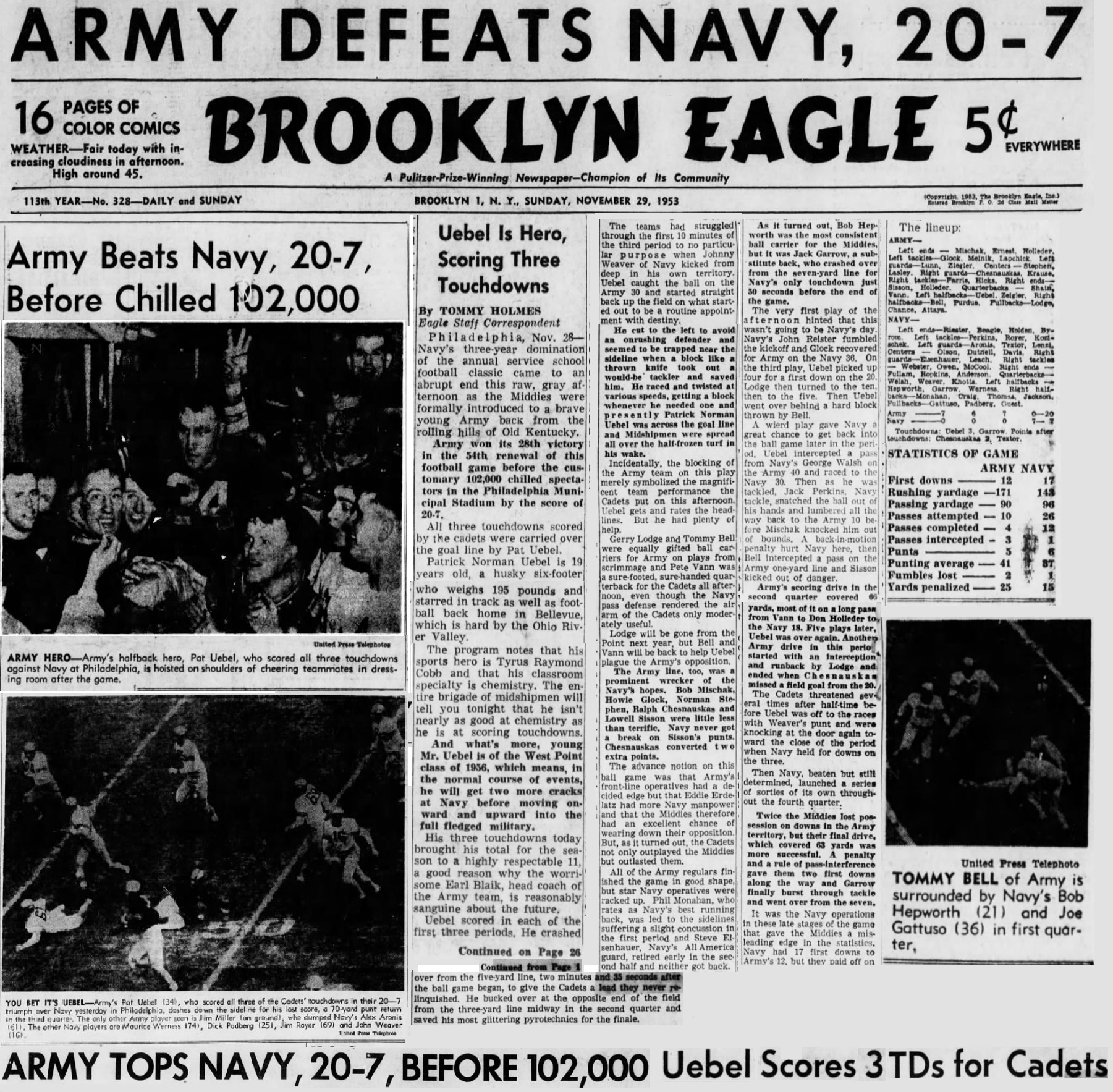
ArmyFB_1953_Uebel_3TDs_BrooklynDailyEagle_Nov301953

ArmyFB_1953_Uebel_3TDs_BrooklynDailyEagle_Nov301953

Photos

Complete

–

–

1954 Football Team


Continue reading →

1945 Football Team

1945 Army 9-0 AP#1

09/29 Army 32 – Louisville Field 0
10/06 Army 54 – Wake Forest 0
10/13 Army 28 – Michigan 7
10/20 Army 55 – Melville PT Boats 13
10/27 Army 48 – Duke 13
11/03 Army 54 – Villanova 0
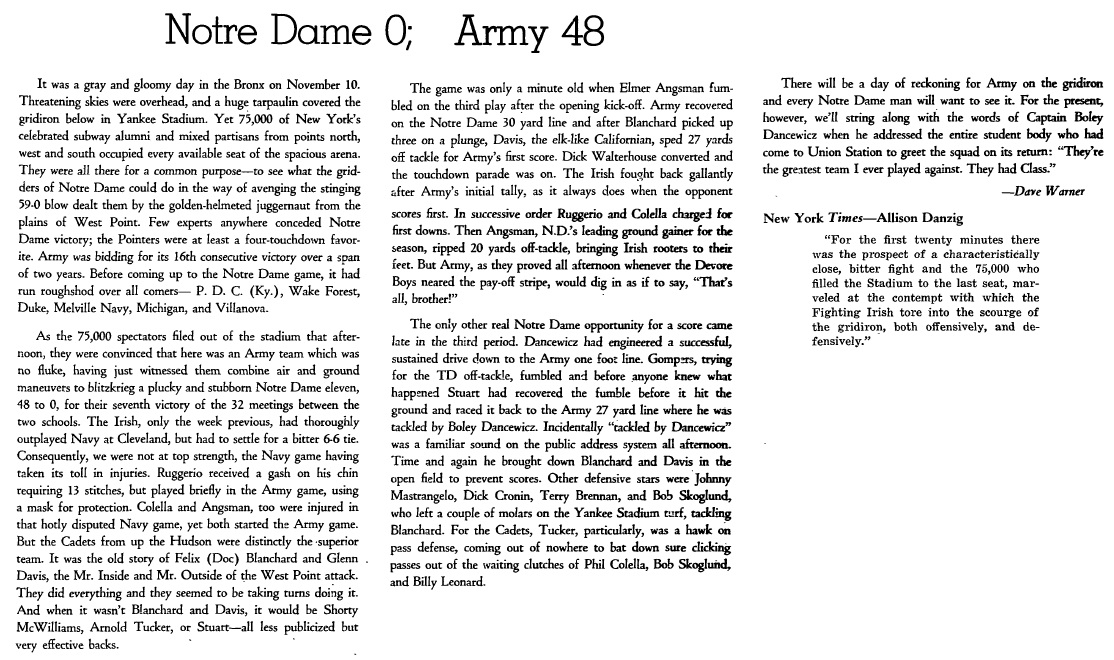
11/10 Army 48 – Notre Dame 0
11/17 Army 61 – Pennsylvania 0
12/01 Army 32 – Navy 13 W Philadelphia, PA

Unanimous choice for the nation’s number one team by the 116 voters in the Associated Press writers’ poll. The runner up was Navy.

Coach: Earl Henry “Red” Blaik (February 15, 1897 – May 6, 1989)
Dartmouth 1934-1940 – 45-15-4
Army: 1941-1958 – 121-33-10
Overall: 166-48-14
Awards:
All-American, 1919
AFCA Coach of the Year (1946)
College Football Hall of Fame, Inducted in 1964

Howitzer 1946 – not available online

http://digital-library.usma.edu/cdm/search/collection/howitzers/field/all/mode/all/conn/and/display/50/order/title/ad/asc

–


ArmyFB_1945_team-NationalChamps_AssemblyJan46
–


–

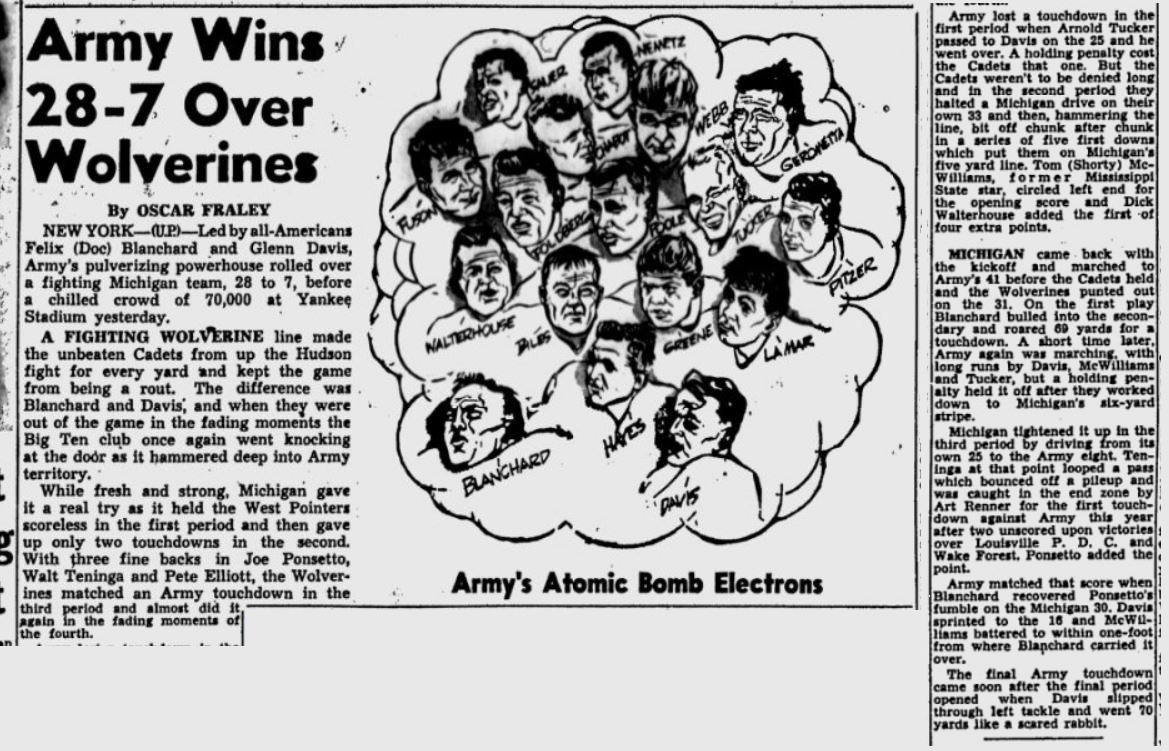
armyfb_1945_vsmichigan_stpetersburgtimes_oct141945

ArmyFB_1945_vsMichigan_StPetersburgTimes_Oct141945

–
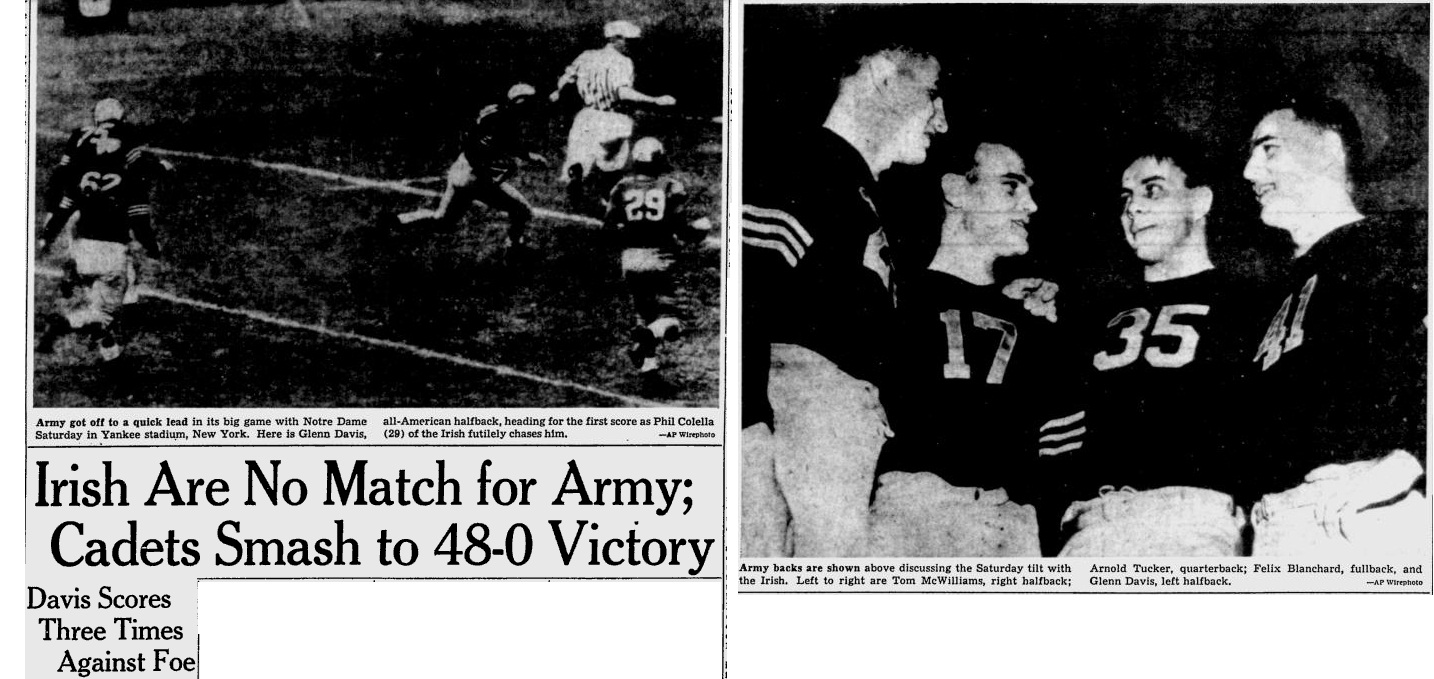
armyfb_1945_vsnotredame_milwaukeejournal_nov101945
ArmyFB_1945_vsNotreDame_MilwaukeeJournal_Nov101945

armyfb_1945_notredame_officialreview_recap

–

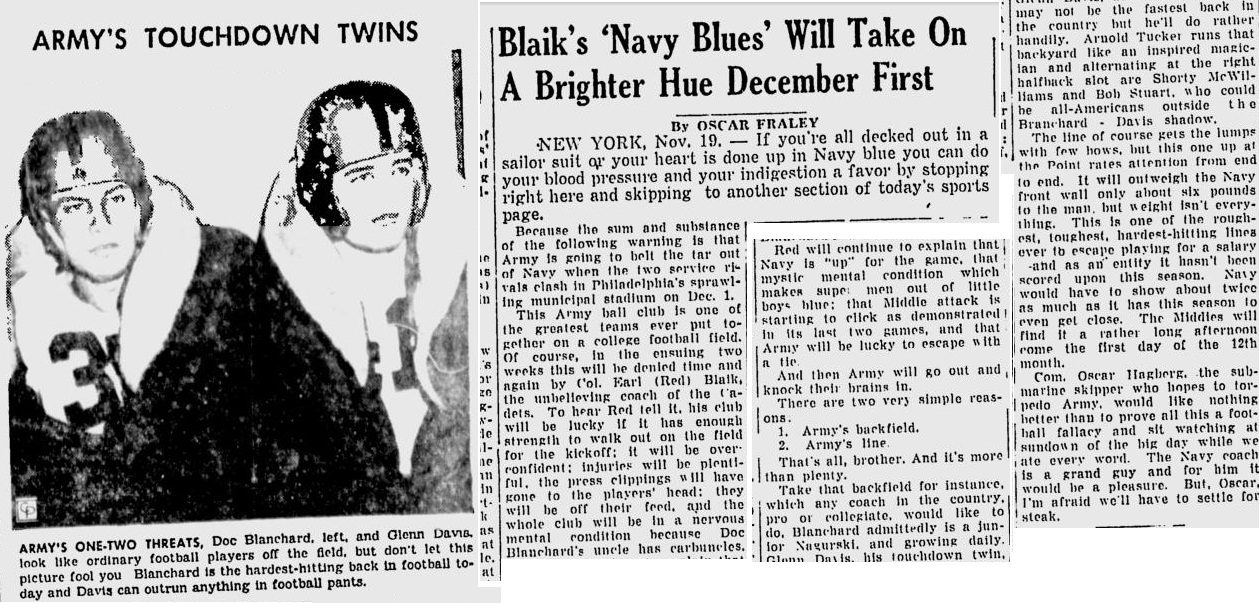
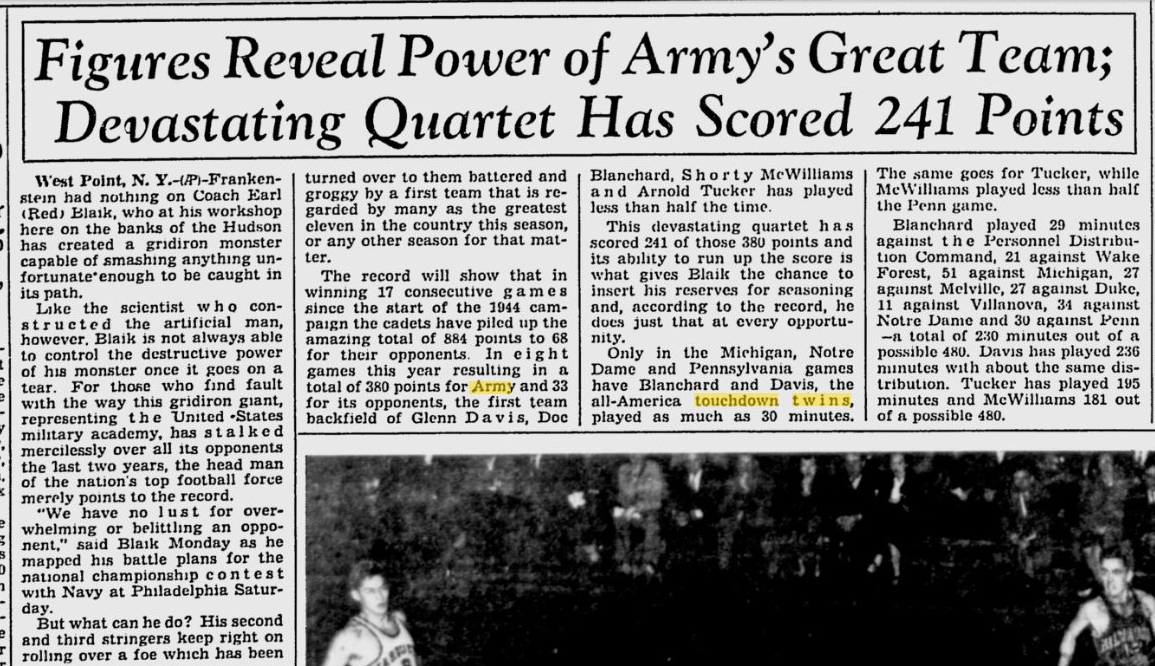
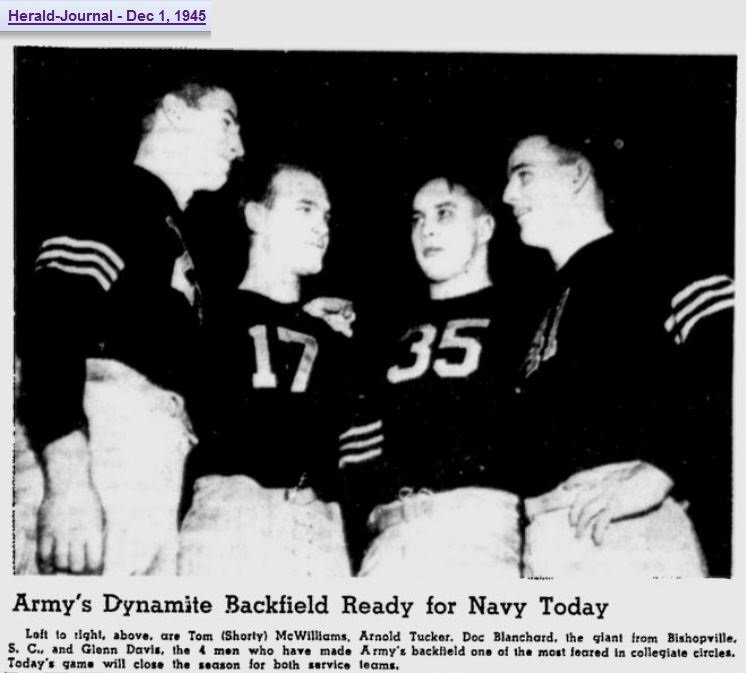
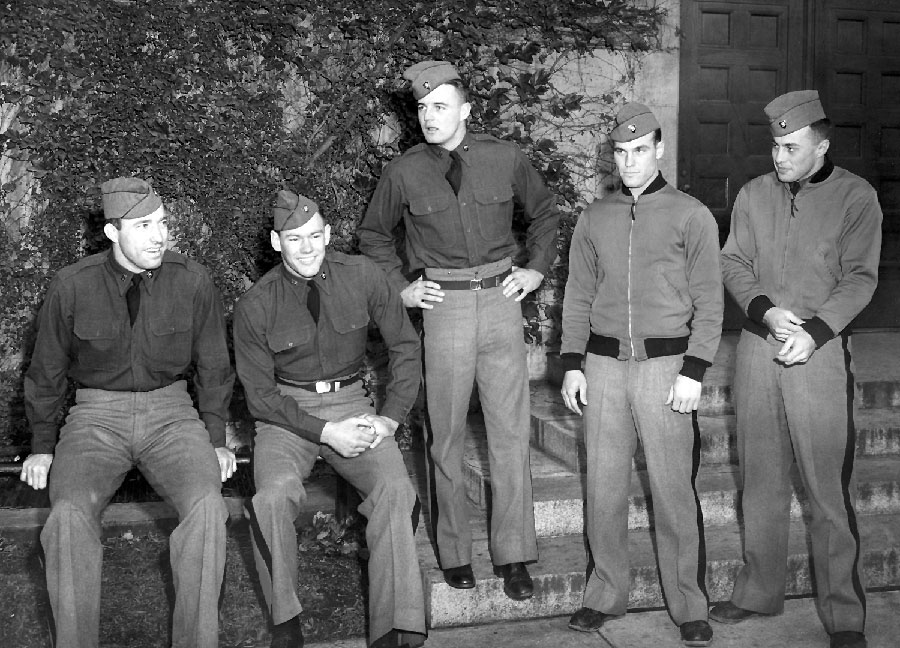
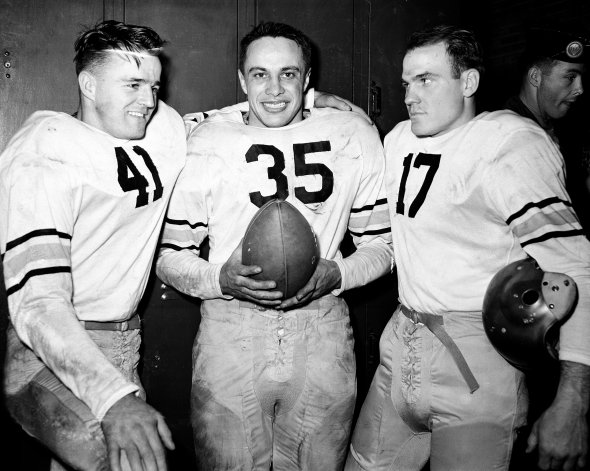
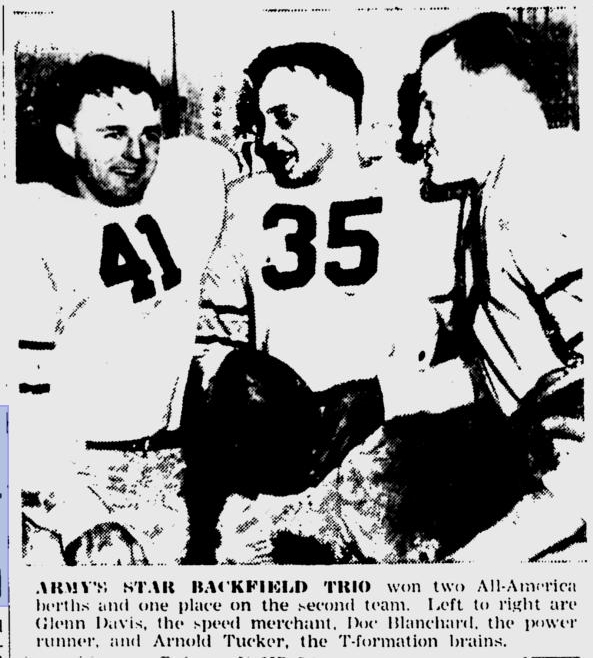
Tom McWilliams, Arnold Tucker, Doc Blanchard, and Glenn Davis

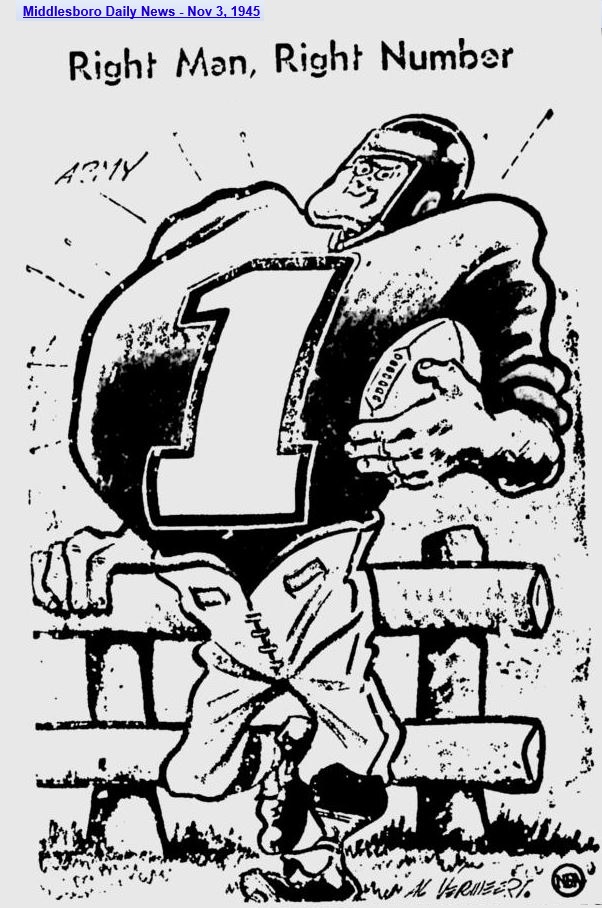
armyfb_1945_byalvermeer_middlesborodailynews_nov31945

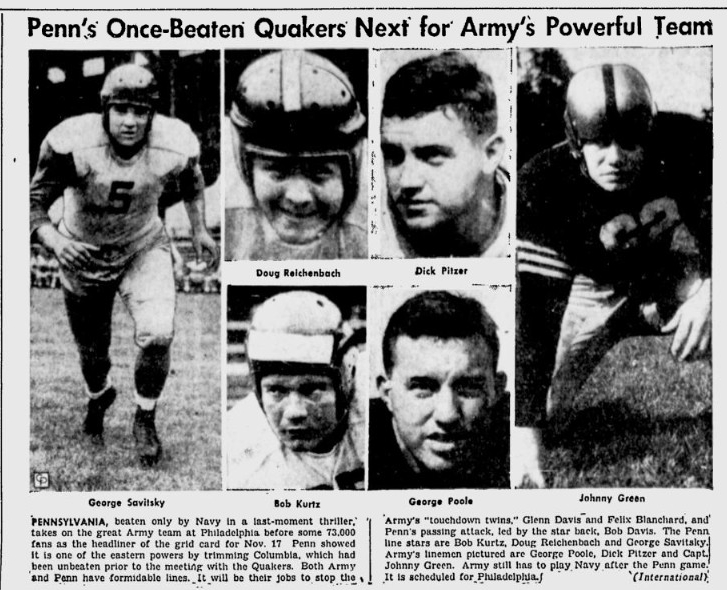
armyfb_1945_vspenn-linemen_dailytimespa_nov151945
ArmyFB_1945_vsPenn-Linemen_DailyTimesPa_Nov151945
–
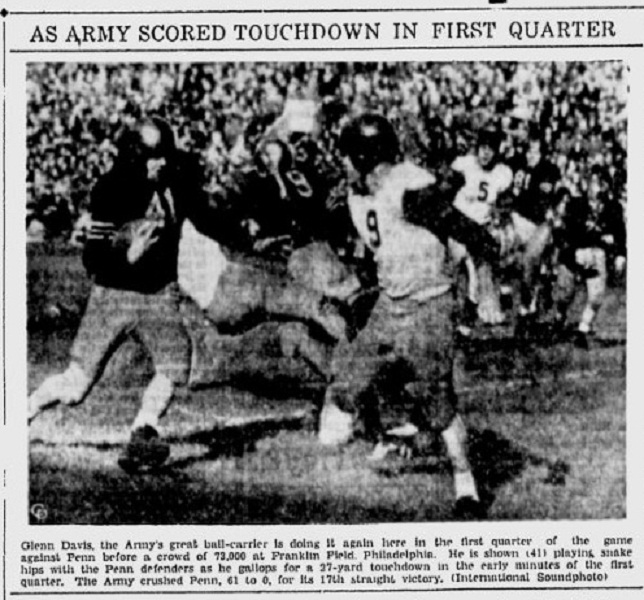
armyfb_1945_vspenn-glenndavis_dailytimes_nov171945
ArmyFB_1945_vsPenn-GlennDavis_DailyTimes_Nov171945
–
armyfb_1945_blanchard-davis_painesvilletelegraph_nov191945
ArmyFB_1945_Blanchard-Davis_PainesvilleTelegraph_Nov191945
–
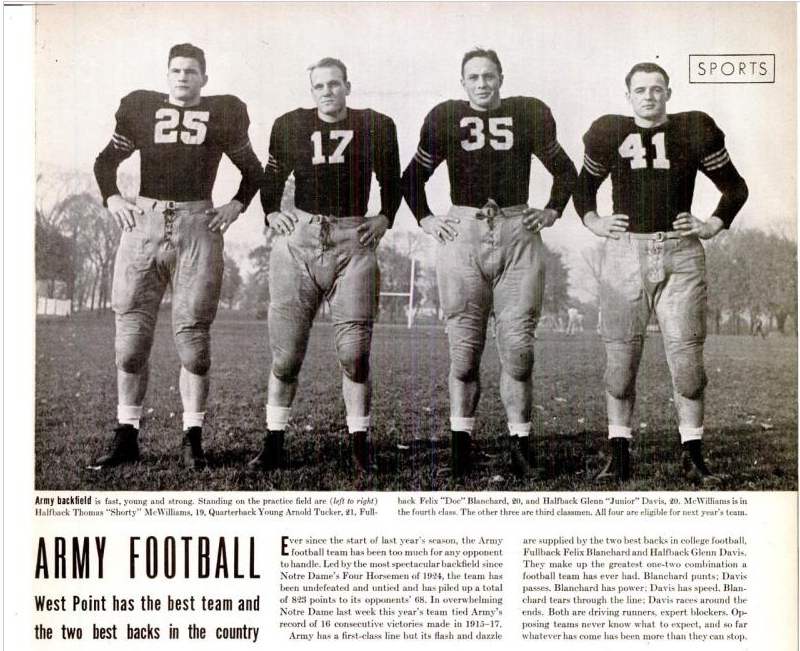
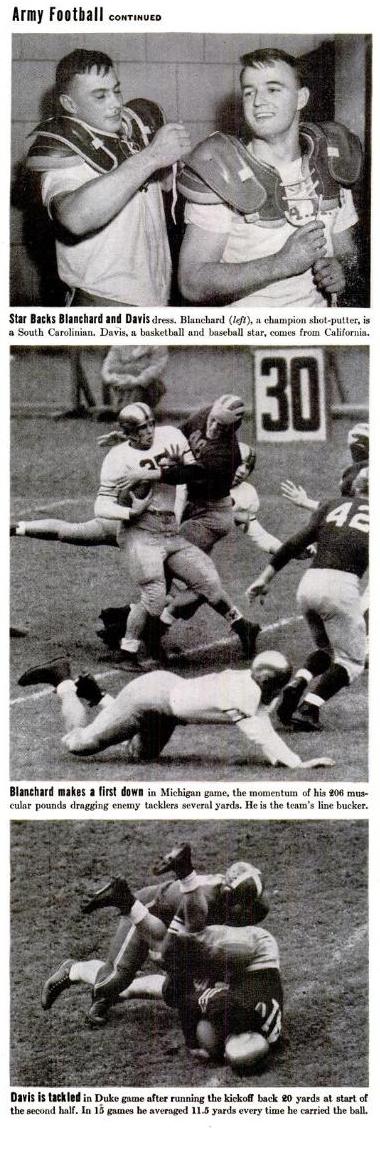
armyfb_1945_backs_life_nov191945
ArmyFB_1945_backs_LIFE_Nov191945
–
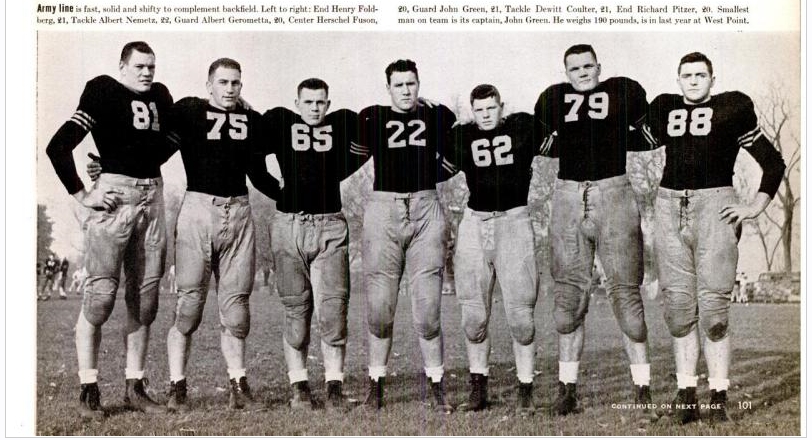
armyfb_1945_line_life_nov191945
ArmyFB_1945_line_LIFE_Nov191945
–
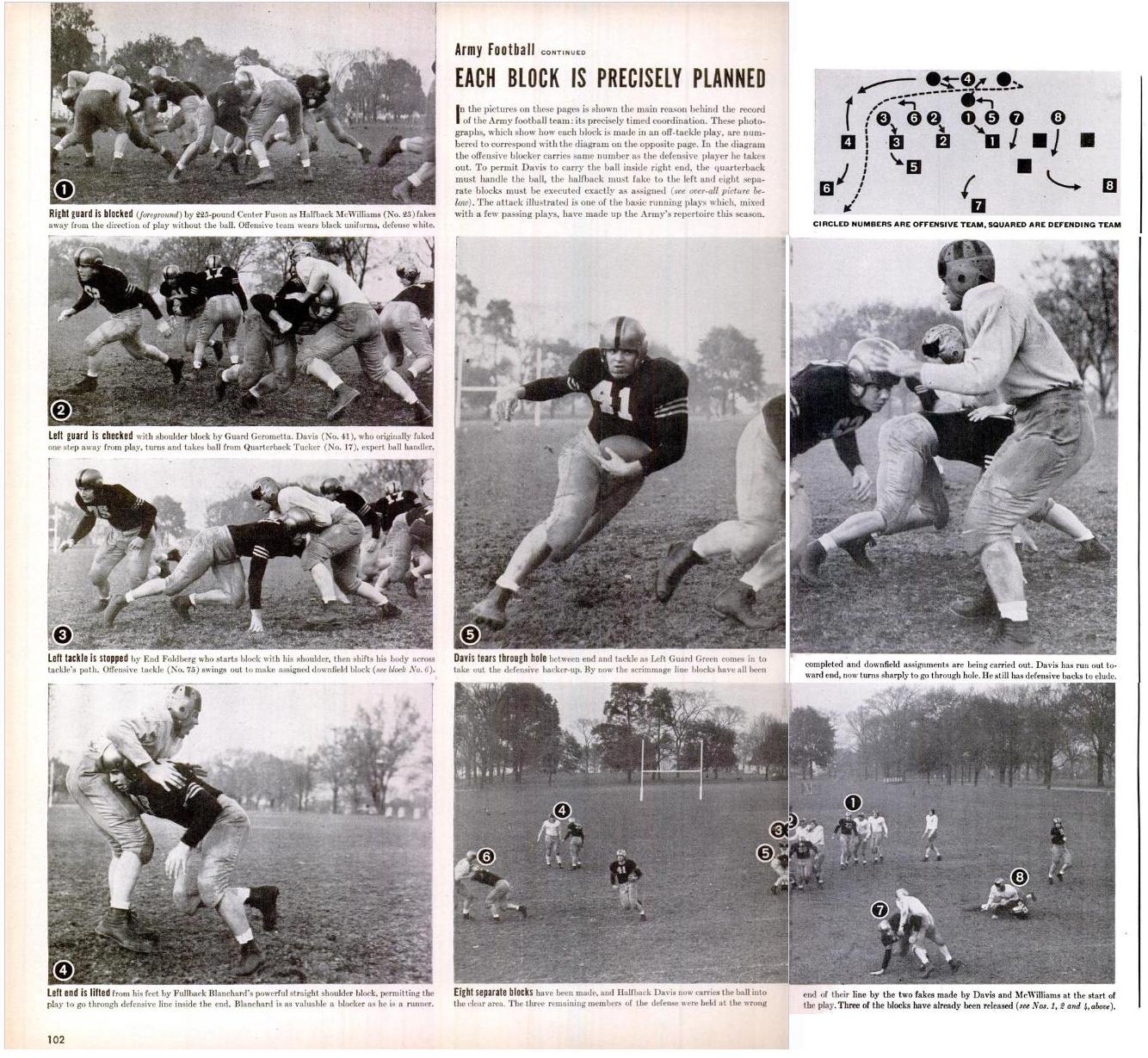
armyfb_1945_plays_life_nov191945
ArmyFB_1945_plays_LIFE_Nov191945
–
armyfb_1945_bandd_life_nov191945
ArmyFB_1945_BandD_LIFE_Nov191945
–
News Articles

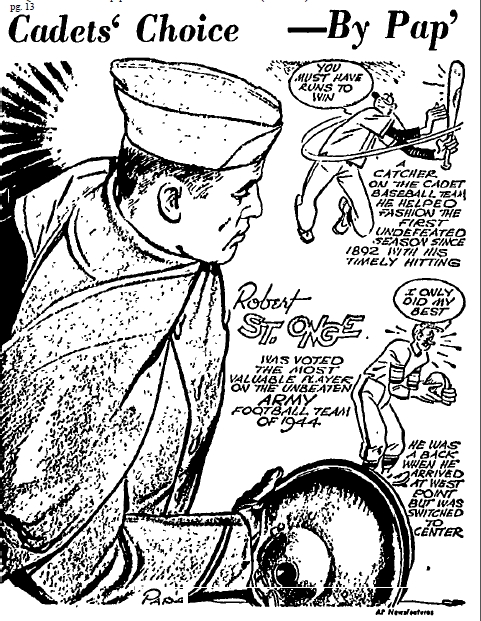
ArmyFB_1945_RobertStOnge_byPap_CSM_Jun111945

–

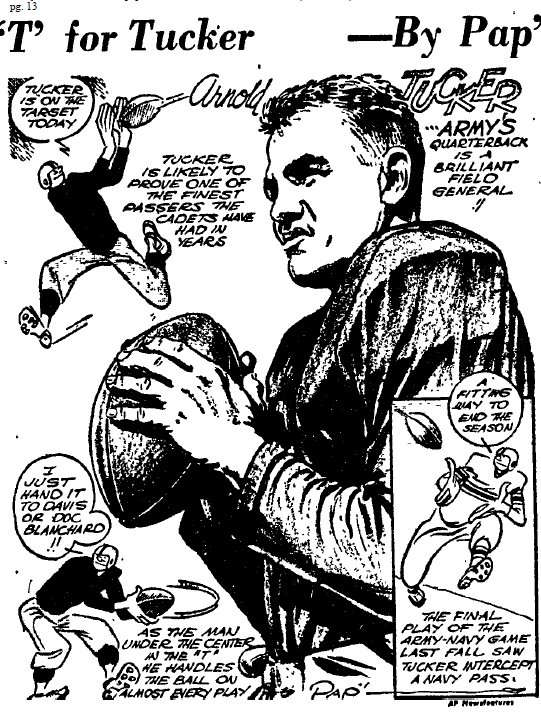
ArmyFB_1945_ArnoldTucker_byPap_CSM_Oct131945

ArmyFB_1945_ArnoldTucker_byPap_CSM_Oct131945

–

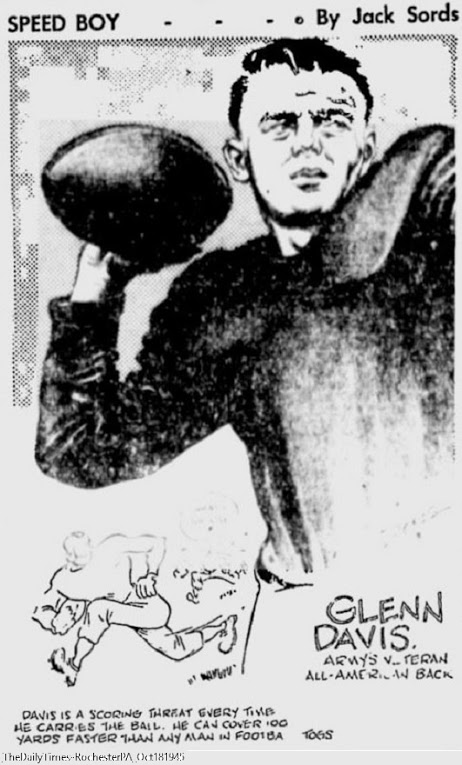
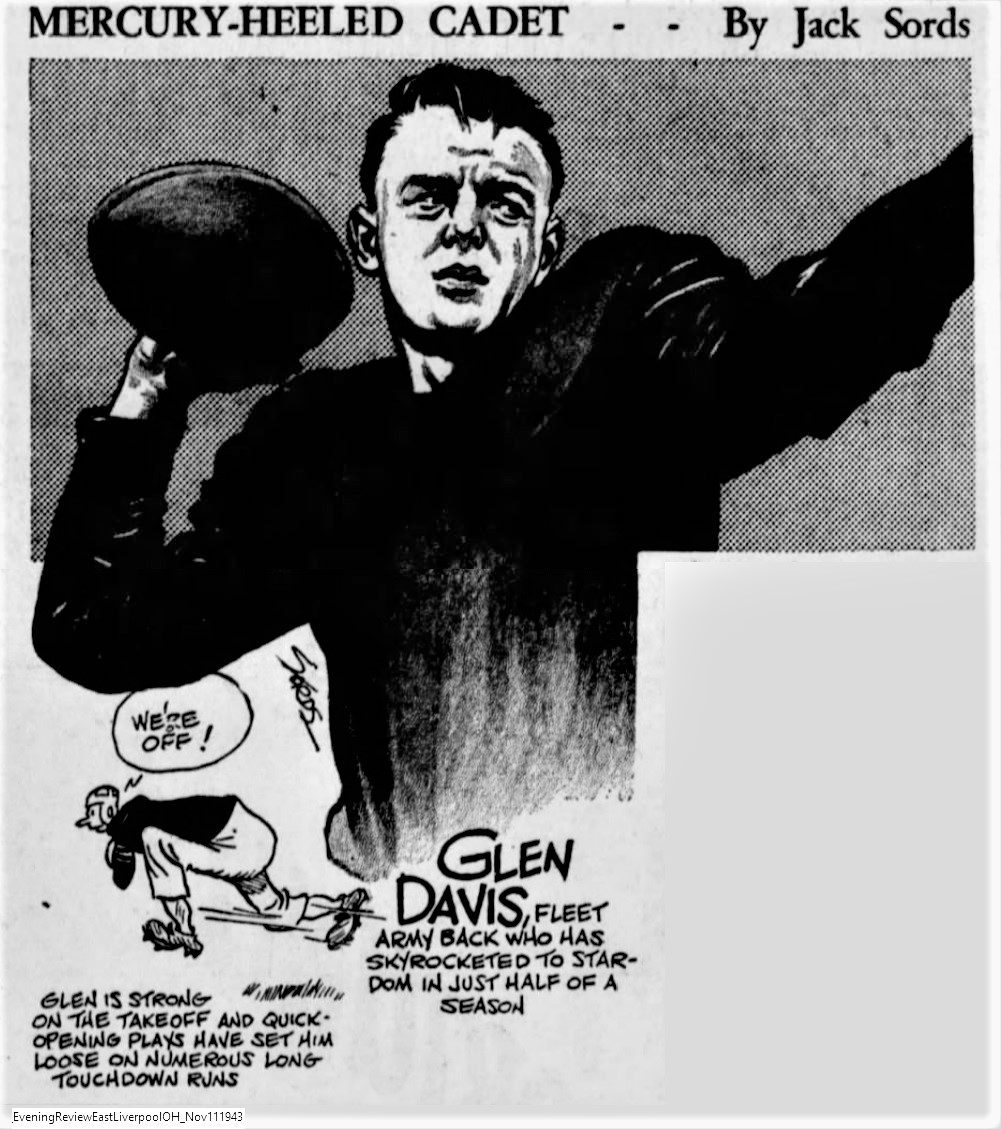
ArmyFB_1945_GlennDavis_byJackSords_TheDailyTimes-RochesterPA_Oct181945

–

ArmyFB_1945_DewittTEXCoulter_byPap_CSM_Nov61945

ArmyFB_1945_DewittTEXCoulter_byPap_CSM_Nov61945

–

ArmyFB_1945_DewittCoulter_byJackSords_PainesvilleTelegraph_DailyTimesPa_Nov17-23-241945

ArmyFB_1945_DewittCoulter_byJackSords_PainesvilleTelegraph_DailyTimesPa_Nov17-23-241945
–

armyfb_1945_texcoulter_prescotteveneingcourier_nov231945

ArmyFB_1945_TexCoulter_PrescottEveneingCourier_Nov231945

–

armyfb_1945_greatestteam_milwaukeejournal_nov271945
ArmyFB_1945_GreatestTeam_MilwaukeeJournal_Nov271945

–

armyfb_1945_vsnavy_painesvilletelegraph_nov291945
ArmyFB_1945_vsNavy_PainesvilleTelegraph_Nov291945
–
armyfb_1945_blanchard-davis_greensburgdailytribune_nov291945
ArmyFB_1945_Blanchard-Davis_GreensburgDailyTribune_Nov291945
–

armyfb_1945_backfield_deseretnews_nov301945

ArmyFB_1945_Backfield_DeseretNews_Nov301945

armyfb_1945_backfieldvsnavy_herald-tribune_dec11945

ArmyFB_1945_BackfieldvsNavy_Herald-Tribune_Dec11945

–

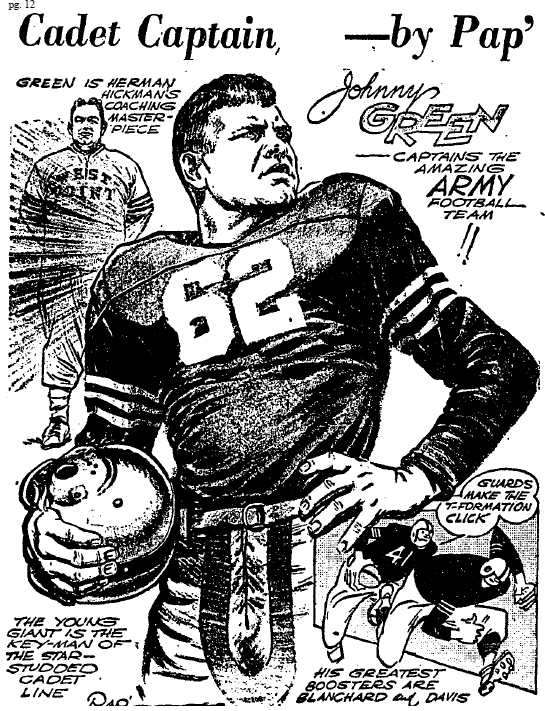
ArmyFB_1945_JohnGreen_byPap_CSM_Nov301945

ArmyFB_1945_JohnGreen_byPap_CSM_Nov301945

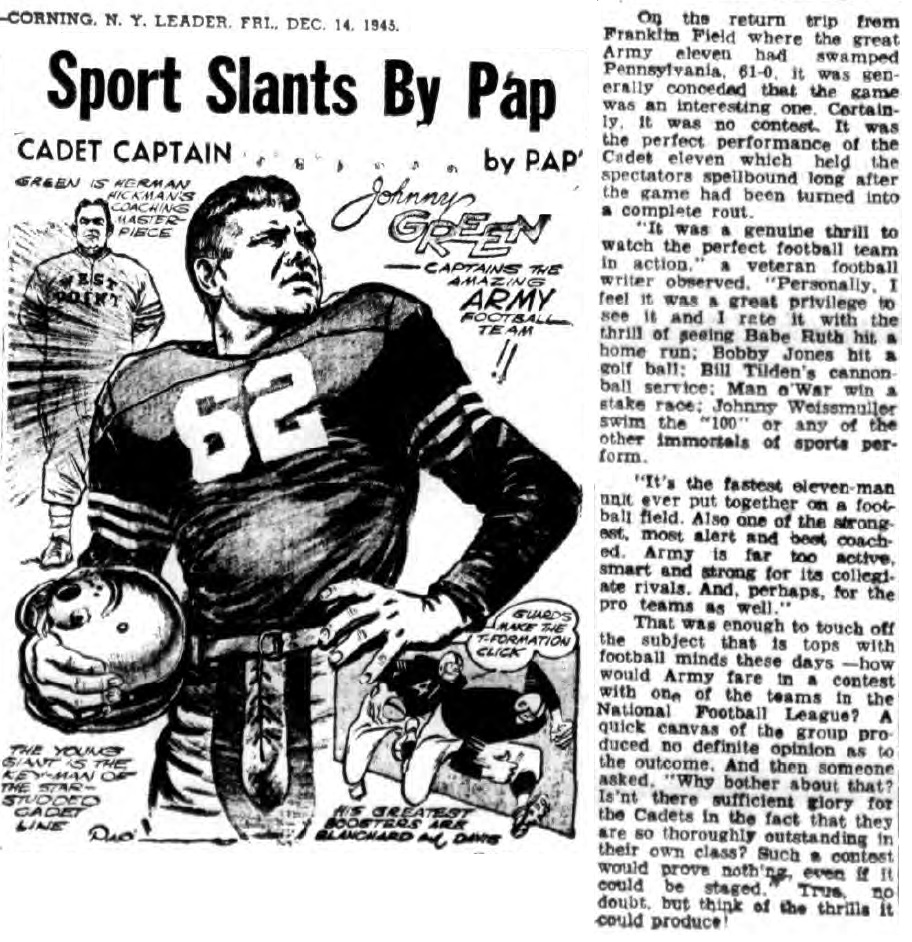
armyfb_1945_johngreen_bypap_corningnyleader_dec141945

ArmyFB_1945_JohnGreen_byPap_CorningNYLeader_Dec141945

–

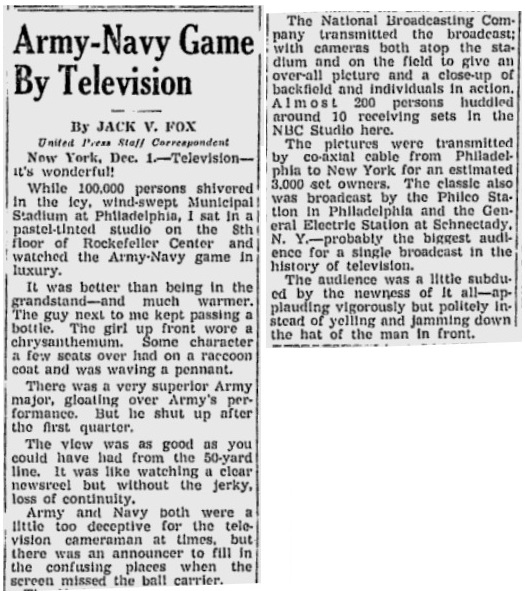
armyfb_1945_ontv_vsnavy_sundaymorningstar_dec21945

ArmyFB_1945_onTV_vsNavy_SundayMorningStar_Dec21945
–
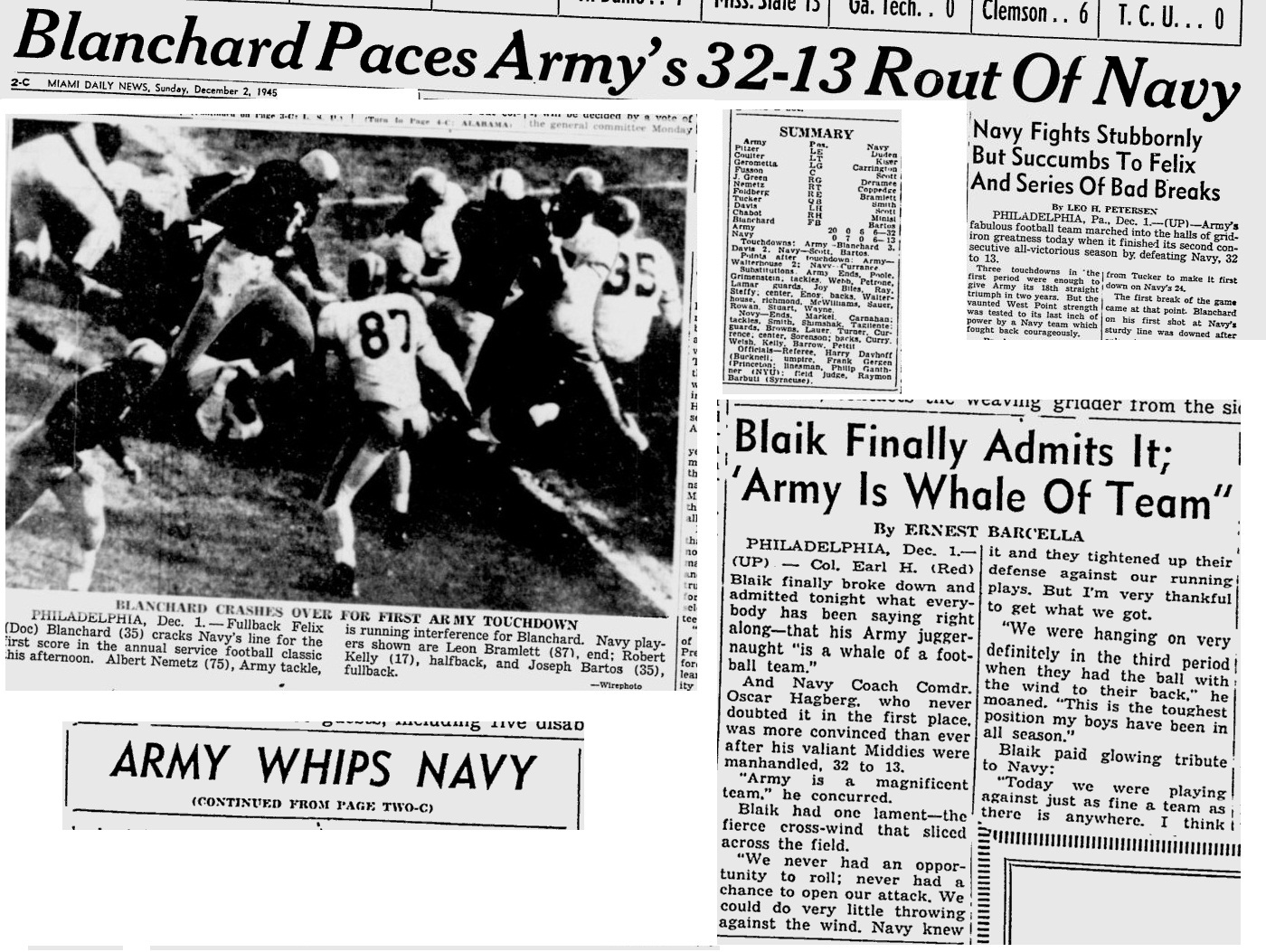
armyfb_1945_vsnavy_miaminews_dec21945
ArmyFB_1945_vsNavy_MiamiNews_Dec21945
–

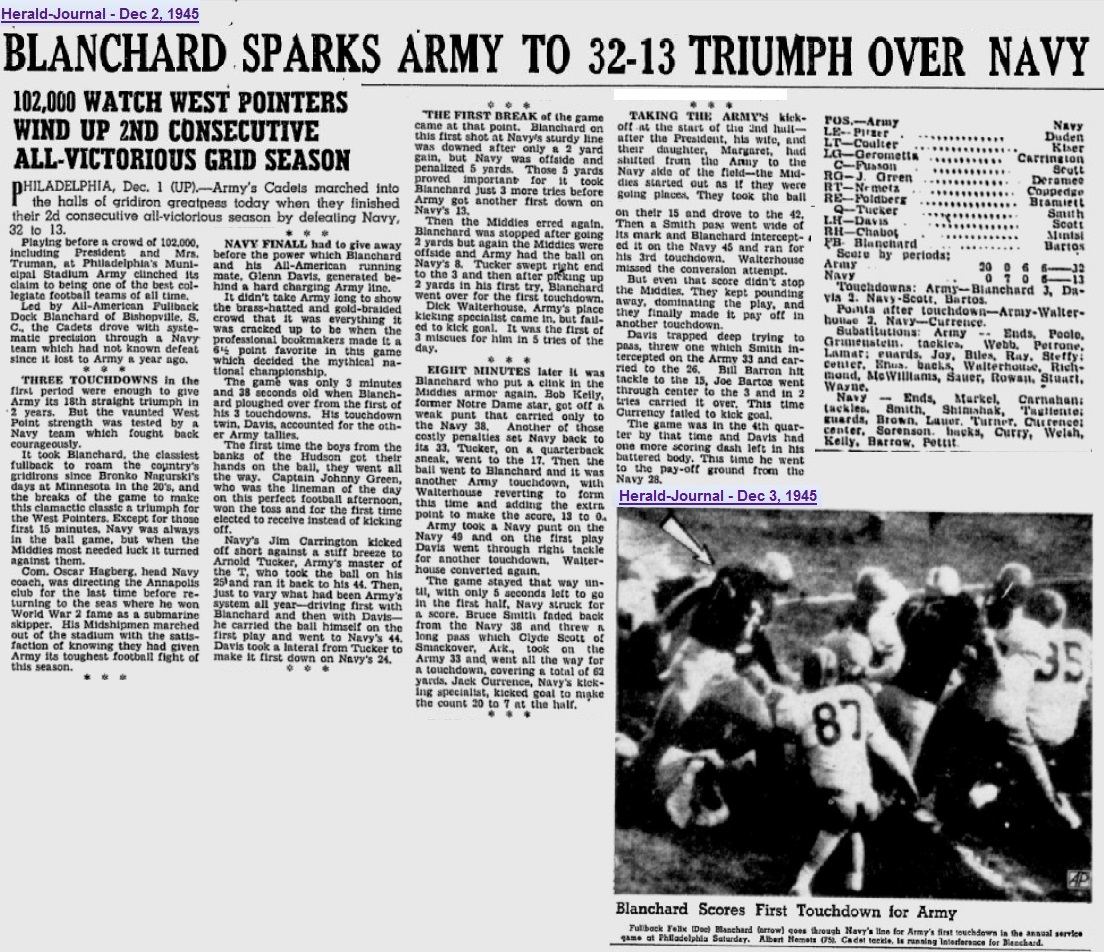
armyfb_1945_vsnavy_herald-tribune_dec21945

ArmyFB_1945_vsNavy_Herald-Tribune_Dec21945

–
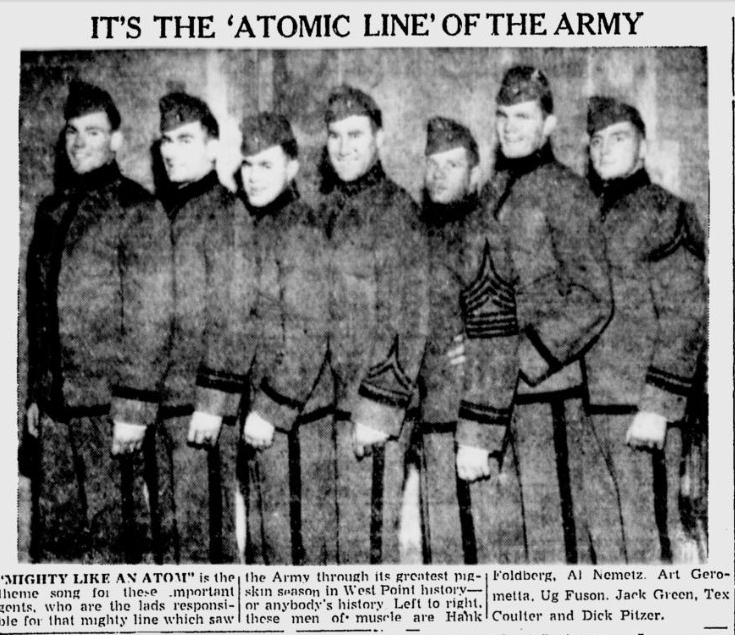
armyfb_1945_line_painesvilletelegraph_dec61945
ArmyFB_1945_Line_PainesvilleTelegraph_Dec61945

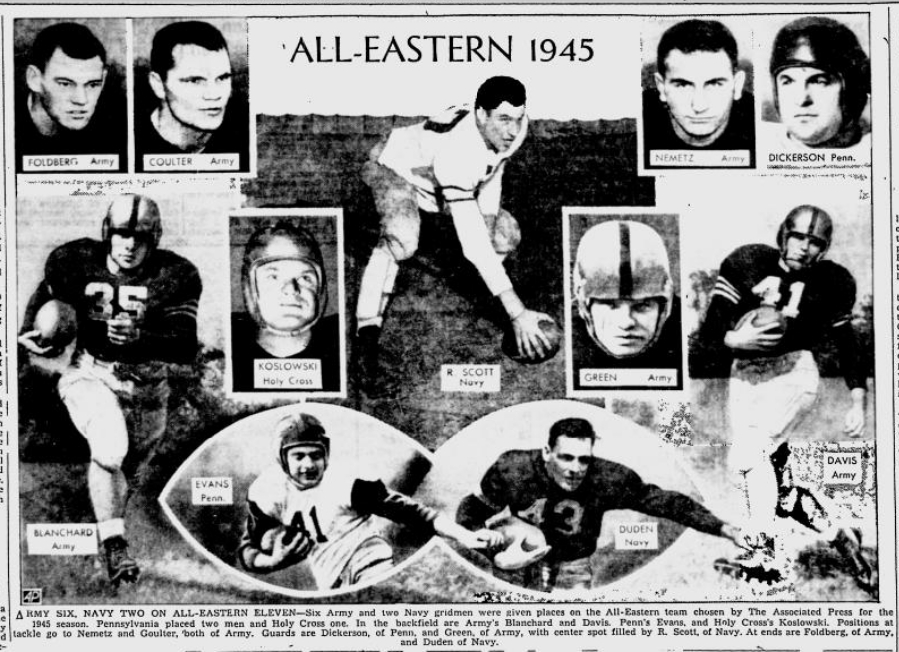
armyfb_1945_all-eastern_newsandcourier_dec51945

ArmyFB_1945_All-Eastern_NewsandCourier_Dec51945

armyfb_1945_all-american_1945_nea_entirearmyfirstteam_pittsburghpress_nov271945
NEA_1945_All-AmericanTeam_EntireArmyFirstTeam_PittsburghPress_Nov271945
–
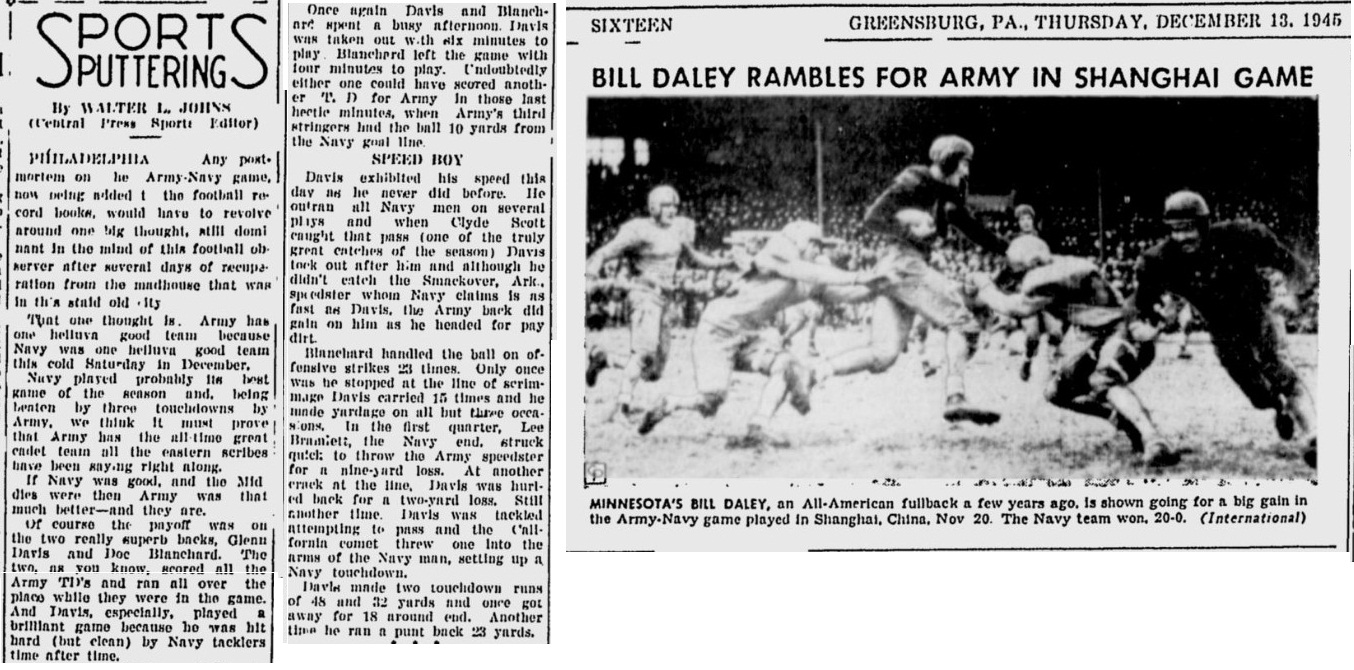
armyfb_1945_vsnavy-servicegameinshanghaichina_greensburgdailytribune_dec131945
ArmyFB_1945_vsNavy-ServiceGameinShanghaiChina_GreensburgDailyTribune_Dec131945

–

A closeup of the team in 1945 (misleading title) – awesome highlight film by legendary sportscaster Bill Stern

–

armyfb_1945_team-for-america_7-cadets

–

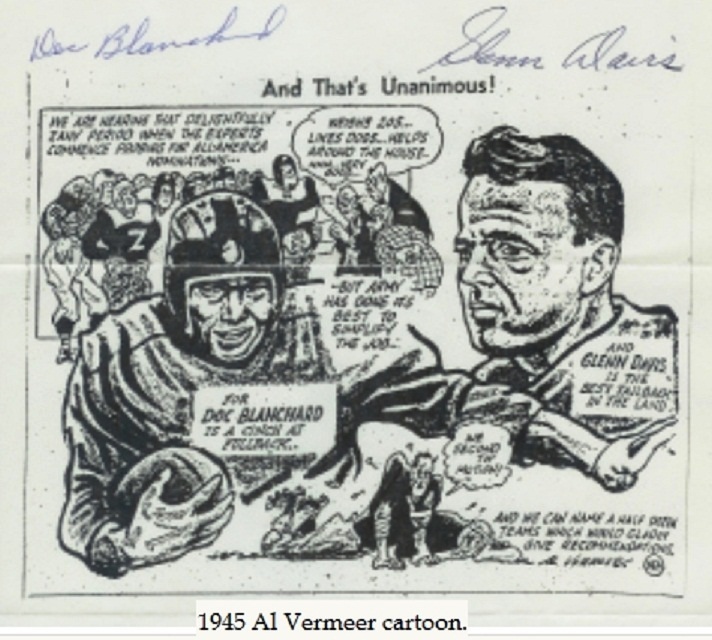
ArmyFB_1945_DocBlanchard-GlennDavis_byAlVermeer

ArmyFB_1945_DocBlanchard-GlennDavis_byAlVermeer

armyfb_1945_davis_photo

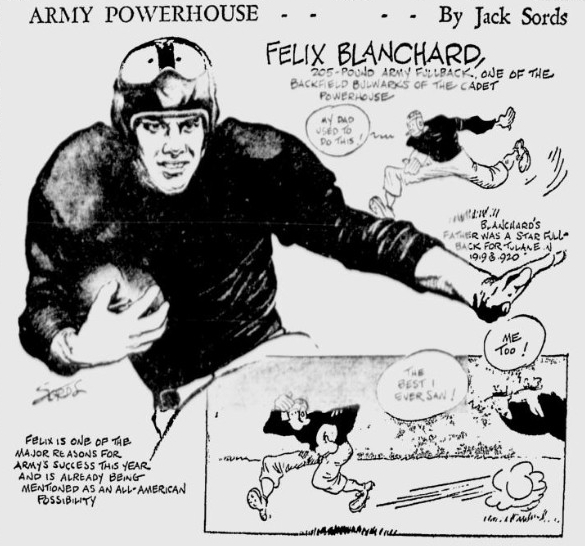
Felix Blanchard

–
________________________________________________________________
Football’s Greatest Decade by Bernie Mcarty

http://www.la84foundation.org/SportsLibrary/CFHSN/CFHSNv01/CFHSNv01n1b – see page 5

This writer (Bernie Mcarty) believes West Point 1945 is the greatest team of all time. The 1944 Army team may actually deserve that title, but it was never tested. Army was also undefeated in 1946, 1948 and 1949.
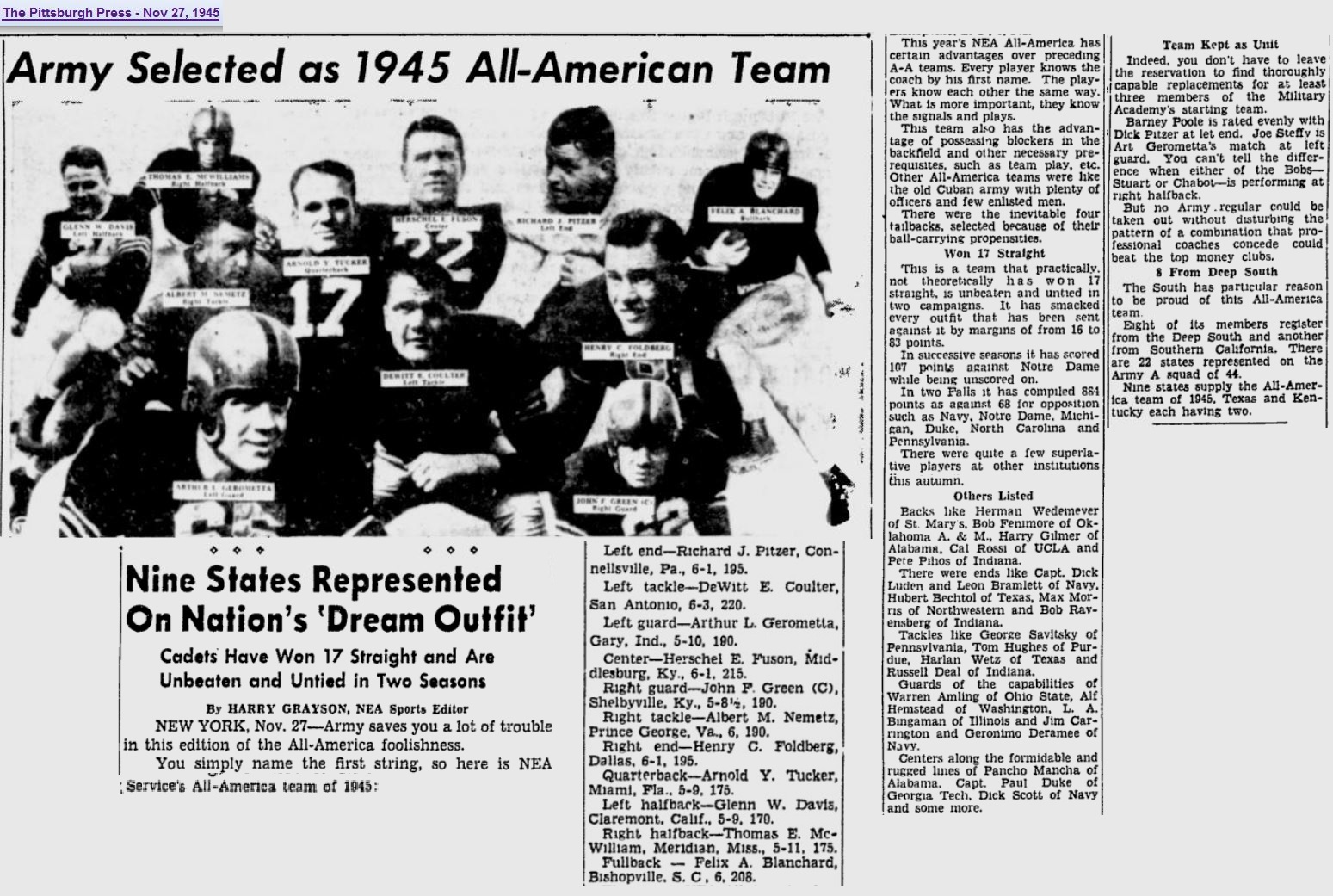
Army’s top stars during 1945-1949 were the effulgent “Touchdown Twins”, Glenn Davis and “Doc” Blanchard, Arnold Tucker, Arnold Galiffa, “Rip” Rowan, Bobby Jack Stuart and Gil Stephenson in the back-field, and up front Joe Steffy, Art Gerometta, Jack Green, Bill Yoemans, Joe Henry “Tex” Coulter, Al Nemetz, and the sterling end duo of Hank Foldberg and Barney Poole.
In 1945 the Newspaper Enterprise Assoc. simply picked the entire Army team as its All-American team, stating no group of All-Americans could beat the Cadets.
Only a world war could have brought together such a collection of players to one institution. But it took the coaching genius of Col. Earl Blaik to mold the players into a cohesive unit.
In truth, Navy personnel was equal to Army’s on an individual basis. The Middies never jelled as a team, however.
The 1951 Army outfit might have been as good as the 1945 Cadets, but the infamous cribbing scandal wiped out the team.

Sports articles provided by Russ “Skip” Grimm – Class of ’76

–

–

Herman Hickman

The Tennessee Terror

By Mike Gershman

Few men can recite Victorian poetry, wrestle professionally, and coach All-American linemen, but Herman Hickman managed it all with aplomb.

Once described as looking like “Friar Tuck in a high school production of Robin Hood,” Hickman pioneered special teams, was an All-America lineman, and turned out half a dozen more to pave the way for Doc Blanchard and Glenn Davis at West Point.

Born in Johnson City, Tennessee, Herman Michael Hickman played fullback at Chattanooga’s swanky Baylor School before entering the university. A small sophomore tackle (5’10”, 203), Hickman switched to guard as a junior and became a standout; however, he had impressed only Grantland Rice enough to be named to an All-America team his senior year.

Then Tennessee played New York University in a charity game at Yankee Stadium. Early in the game, NYU got to the Volunteers’ 5-yard line and ran four plays right at Hickman; they surrendered the ball at the 23, and football writers scrambled to change their All-America ballots. When one said Hickman was “the best guard the South ever produced,” Coach General Bob Neyland snarled, “Herman Hickman is the greatest guard football has ever known.”

After graduation, Hickman won All-League honors with the NFL’s Brooklyn Dodgers and wrestled professionally as “The Tennessee Terror.” He spent five years at North Carolina State as a line coach (and also lectured on Rudyard Kipling) before moving to West Point,

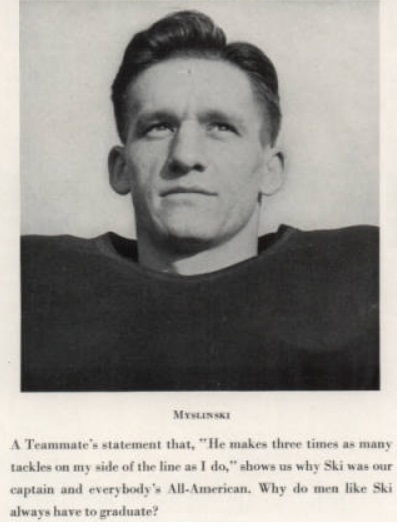
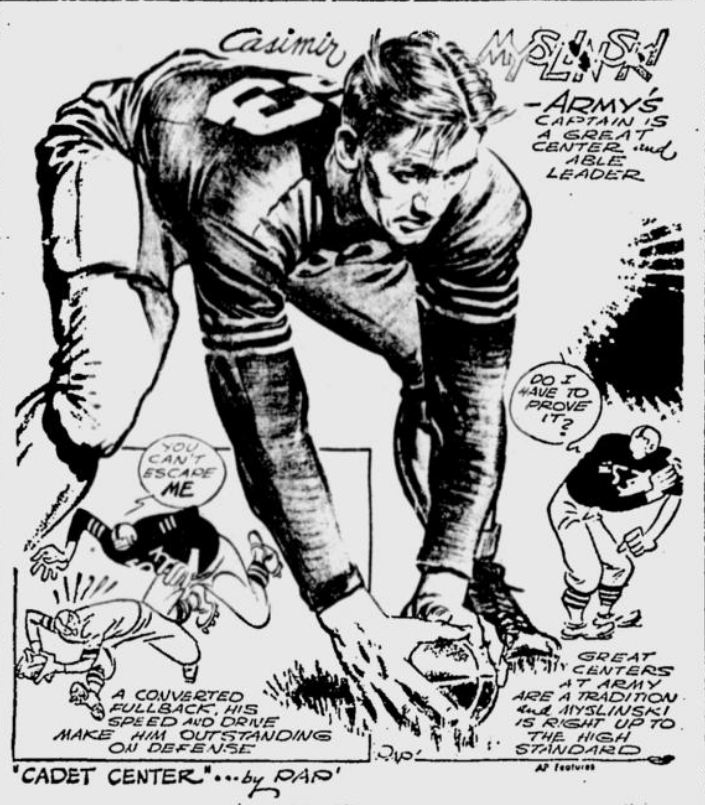
in five seasons at Army, he developed six All-Americas — center “Casimir Myslinski”, tackles “Tex Coulter” and Al Nemetz, and guards “Joe Stanowicz”, Jack Green, and Joe Steffy.

Hickman became Yale’s head coach in 1948 and, used to larger linemen, immediately dubbed his troops “The Seven Dwarfs.” The next morning, all seven wore strips of tape on their helmets, that read “Sleepy,” “Dopey,” “Bashful,” etc. Captain Levi Jackson, Yale’s first black player, went along with the gag; his strip read, “Snow White.”

Even though Hickman’s teams rarely finished above .500 he had a successful 1950 because Yale beat Harvard, 29-6, in The Game. He said, “We needed that one. It fits into my policy of keeping the alumni sullen but not mutinous.”

When mutiny began to stir, Hickman resigned and became a regular on the Celebrity Time TV game show and a football columnist for Sports Illustrated. A member of AP’s Mid-Century Team selected in 1950, he was named to the Knoxville Journal’s All-Time Tennessee team just before his death in 1958 from surgical complications.

Herman Michael Hickman, Jr.

Guard – Tennessee

HS: Johnson City (TN); Baylor Prep (Chattanooga, TN)

Born: 10/1/1911, Johnson City, TN

Died: 4/25/1958, Washington, DC

Bill Harold Kellum

Big Bill Kellum

Army A Football Yearling, Cow & Firstie Year

Korean War —

Big Bill Kellum led a platoon in the 21st Regiment of the 24th Infantry Division, earning the Silver Star. After his capture, Kellum organized resistance to Chinese indoctrination at Camp Five – Ponktong near the Chinese/North Korean border. His punishment was confinement to a special section of the camp hospital (no prisoner left alive), where he died in June 1951.

Grads would walk next to the wire whistling “On Brave Old Army Team” to encourage Bill.

USMA 1950
Memorial Articles

William Harold Kellum
NO. 17975 20 October 1926 15 June 1951
Died 15 June 1951 (Presumed date) at Pyoktong, North Korea. Aged 23 Years.

COURAGE AND DETERMINATION. These were the words by which 1st Lieutenant William H. Kellum lived, fought, and died. Bill Kellum’s dedication to these words constitutes a capsule explanation of his outstanding athletic achievements, his extraordinary gallantry on the field of battle, and his uncompromising attitude toward his Chinese captors which was directly responsible for his untimely, tragic, but highly courageous and exemplary death.

It is clear that Colonel Earl ‘Red’ Blaik, under whose tutelage Bill achieved AII- East honors at the position of end in addition to three football letters, two of them with Navv stars, was impressed by these characteristics of courage and determination, as he recently recalled that:

“Bill Kellum … in his quiet, rather self-effacing, but uncompromising way … had a depth of determination which would not allow him to play a secondary position even though to do otherwise he was forced to overcome a limited … (physique by college standards). Bill’s competitive urge had a ferocity of purpose which earned him the lasting respect of the troops both on the field and on the field of battle.”

Again, courage and determination are amply evident in Lieutenant Kellum’s combat record as illustrated by the following excerpts from his Silver Star citation:

“…He was assigned the mission of maintaining a combat outpost approximately 3,000 yards in front of the main line of resistance…. At the break of day, he could observe the enemy almost completely around his position. Realizing the threat to his security, he immediately began placing his men to meet the new threat… He ran from position to position, continually exposing himself to enemy fire, in order to encourage his men and direct the fire fight. When last seen, he was running toward the right flank of his platoon to direct that group of men who were then heavily engaged with the enemy …. “

But there was more to Bill Kellum than athletic and military achievements. More even than courage and determination. He was a man of many capabilities and interests, a man who is remembered for his ready grin as well as his courage, a man considerate of and deeply attached to his family, and a man of strong beliefs in God and dedication to country and career. An account which does justice to Bill’s achievements and character cannot be told hit and miss: it must have a chronological foundation.

So let us backtrack to Eastland, Texas, on 20 October 1926, Bill’s date of birth. He was a strong, healthy baby which gave him a good start towards being the outdoor, athletic type he turned out to be. Bill received his elementary education in Sulphur Springs, Texas, and El Dorado, Arkansas. His high school education was at Haynesville, Louisiana, where in recognition of good grades and citizenship he was elected a member of the National Honor Society.

In forecast of football exploits at West Point, Bill was a much respected terror on high school football fields. He made All-State two years and All-Southern one year playing the position of end. Let us look briefly at excerpts from newspaper accounts of games in which he played, for courage and determination were as evident then as thev were to be years later playing for higher stakes in Korea:

“…Kellum is a scrapper from whistle to gun…his fine competitive spirit is an inspiration to his teammates… in spite of the fact that opposing coaches have had their linemen double up on the lanky wingman. He has been a standout in every game with his jarring tackles, precision blocking, and fancy pass catching ……

Of course, football was not Bill’s onIy avocation. He was greatly interested in scouting, an interest which may have been given impetus by the action of a Boy Scout who saved him from death from gasoline fumes at the age of four by administering artificial respiration. Bill was also an active member of the First Baptist Church. Another sporting interest, swimming, he turned to profitable use as he served as manager and life guard of the Haynesville City Pool during high school days.

Bill was close to his family in growing up. He and his brother, Herman, now a doctor, were inseparable. In the one letter he was able to write home from prison camp, Bill’s primary concern was not for his own situation, but rather for news of Herman’s first child. In Bill’s words,

“…Have been thinking about (the family) a lot and have wondered greatly about the new addition to the family …. Let the kid know about his Uncle Bill.”

Bill’s favorite fishing partner was his father who continually encouraged him in his athletic and career ambitions. Bill was close to and always considerate of his mother, never failing in the years he was away from home to call her on special occasions. His only and younger sister, Beth, was the recipient of much advice as well as special concern and protection. An age difference of 12 years was no barrier between Bill and his younger brother, Joe, whose active approach to life was so similar to Bill’s.

Thus did William H. Kellum’s full boyhood prepare him for the responsibilities of manhood.

Upon finishing high school, Bill served five months in the US Navy in the closing months of World War II. While in the Navy, he won a “golden gloves” championship, evidence of his interest and competence in the “manly art of self-defense,” an interest which was to bring further laurels at West Point.

As a recipient of an appointment to the US Military Academy, Bill left the Navy to attend Louisiana State University where he found time amidst his West Point preparatory studies to be first-string end on the football team and to win a second place medal in the ROTC boxing matches.

Matriculating to West Point in July 1946, Bill, by graduation day, 6 June 1950, was able to leave an enviable record behind him. Bill’s football exploits have already been related. In boxing, he won many more bouts than he lost. Skinny for a heavyweight, Bill is still remembered at West Point and by classmates around the world for “cutting down to his size” ring opponents who outweighed him frequently by as much as 50 pounds. Herb Kroten, one of his boxing coaches, accounts for Bill’s success (he went to the finals of the Eastern intercollegiate Championships one year and was elected co-captain of the boxing team his First Class year) by recalling his willingness “to take on anything.”

Athletics were not Bill’s only interests at West Point. He was a member of the Fishing Club and Radio Club and ranked relatively high militarily. However. Bill is remembered by his classmates as much for his personality as for his more objective achievements. The Howitzer was indeed right in asserting that “Bill’s warm Southern personality and ready humor will be long remembered by the Class of ’50.”

Only a few short months after graduation, Bill, in company with so many of his classmates, was called upon to utilize his West Point training on the field of battle sooner than he or anyone else expected. His country and his Alma Mater did not find him wanting! As a platoon leader of Company G, 21st Inf., he distinguished himself on the field of battle being awarded the Bronze Star Medal for valor, the Silver Star, and the Purple Heart. He had every reason to write home proudly when he was promoted to 1st Lieutenant only five months after graduation. Excerpts have already been quoted from his Silver Star citation. Equally stirring and indicative of his courageous spirit and military leadership are the following excerpts from his Bronze Star citation:

“During his regiment’s advance his platoon was the leading element …. With complete disregard for his safety Lieutenant Kellum exposed himself to a hail of withering fire in order to place his men in positions affording the maximum fire power and control. Moving far forward, he directed the effective fire of friendly artillery and mortars …. He then led an assault – routing the enemy … and permitting the continued advance of the regiment ……

Captured during an action in which he was heroically leading his platoon in defending a combat outpost 3,000 yards in front of the main line of resistance, Lieutenant Kellum was taken to a prison camp in Pyoktong in North Korea. Here he faced his final and perhaps his most formidable test of courage. A classmate whom Bill assisted while he himself was weak and sick reports that:

“…under these difficult conditions Bill was a model soldier. He resisted his captors’ every effort to organize a mass indoctrination program in the officers’ compound, and did more than his share of the work in helping his fellow prisoners to survive….

In spite of a complete lack of care and only crackers and rice for food, Bill, by sheer determination. recovered from flu, only to incur the wrath of the Chinese for organizing the ambulatory soldiers at what was, in name only, the prison camp’s hospital. Thrown into detention in a part of the “hospital” from which no prisoners ever emerged alive, Bill died a hero’s death staunchly defending his convictions and the traditions of his Alma Mater and country. Fellow prisoners report that Bill’s death occurred approximately 15 June 1951, a date which is more accurate than the year end date, 31 December 1951, assumed in AG official records.

In their tremendous and irreplaceable loss, Bill’s surviving parents and brothers and sister have been strengthened by a justifiable pride shared bv friends, classmates, and fellow officers in a man who died as he lived: courageous and determined to be true to his own high ideals whatever the danger, whatever the personal sacrifice.

–R.P.L. ’50–

http://www.larchmontgazette.com/guide/history/1954/1954macdonnell2.html

http://www.kmike.com/oz/77/PyokTong.htm

http://www.cyberussr.com/hcunn/e-asia/korea-pow.html

http://koreanwar.defense.gov/factsheetpowkw.html

http://www.usma1950.com/1950/memorials/KellumWH.htm

http://militarytimes.com/citations-medals-awards/recipient.php?recipientid=107004

http://www.koreanwar.org/html/korean_war_project_remembrance_search_6.html?key=15625

http://www.homeofheroes.com/verify/recipients_k.html

http://www.koreanwar-educator.org/topics/silver_star/p_silver_star_recipients_k.htm

http://www.rootsweb.ancestry.com/~laalhn/korea.htm

http://www.fanbase.com/Army-Black-Knights-Football-1949/roster

http://www.archives.gov/research/military/korean-war/casualty-lists/la-alpha.pdf

http://books.google.com/books?id=J6-nkEfeZ0wC&pg=PA81&lpg=PA81&dq=William+Harold+Kellum&source=bl&ots=nkvKmRIEcl&sig=PNO-NPoXpZ9bNZqGSWhsKxU8-t4&hl=en&sa=X&ei=AmYUUL-TPIOC7AH-jIGACg&ved=0CEoQ6AEwAjgo#v=onepage&q=William%20Harold%20Kellum&f=false

http://www.kmike.com/POW_Olympics/pow/POW_Olympics_Names.htm

Joe Green

Korean War —- Joe Green Class of 50, another Army football player, was one of the pilots captured during this period. Although Green survived the war, he was held in solitary confinement for the duration of his captivity. Paul Roach remembers getting a glimpse of Green before the end of the war: “After that, a classmate and I always hummed –On, Brave Old Army Team — whenever we passed his compound”.

Football — Fullback Class Numerals and Monogram

Track — Monogram, Army A with Navy Gold Star

1958 Football Team and Undefeated Season

Continue reading →

Ron Henderson

awaiting data

Max Minor

2 Army A’s in Football — 1943 and 1944

1946 Football Team

1946 Army 9-0-1 AP#2

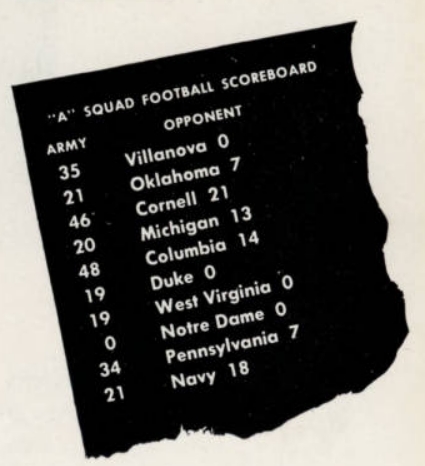
09/21 Army 35 – Villanova 0
09/28 Army 21 – Oklahoma 7
10/05 Army 46 – Cornell 21
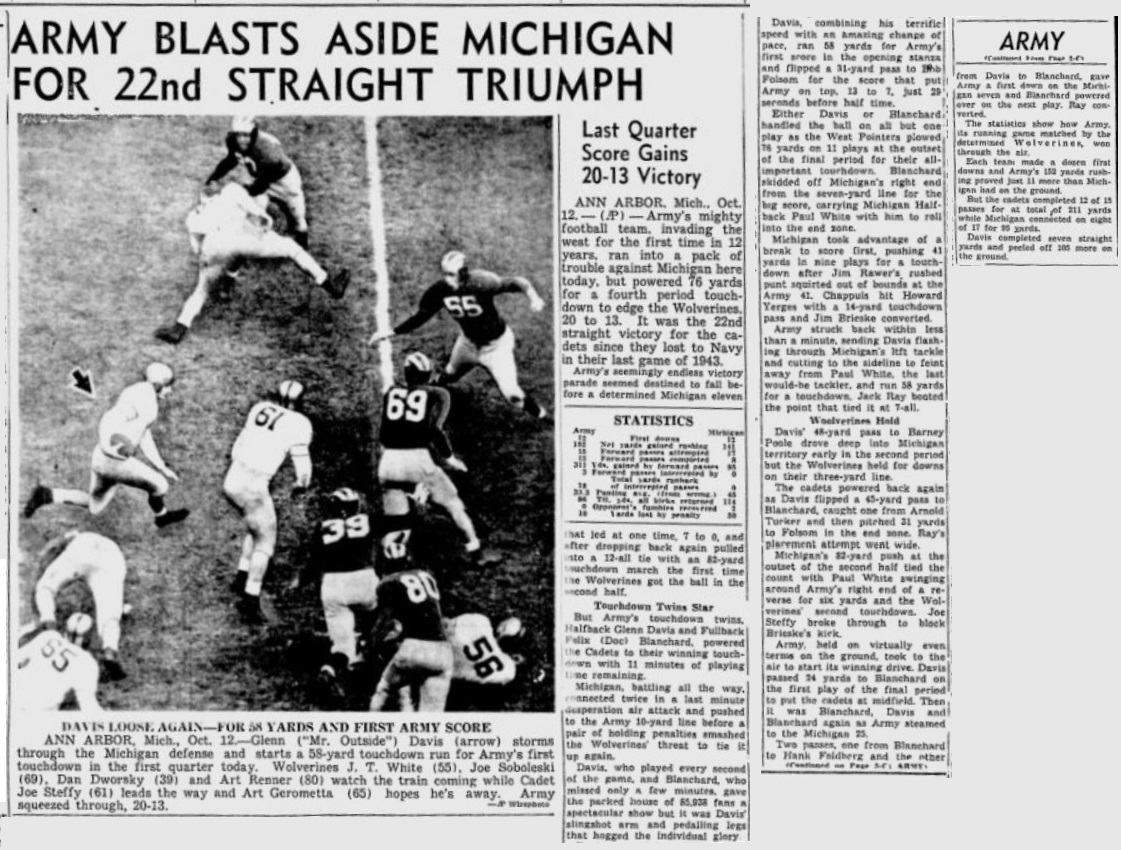
10/12 Army 20 – Michigan 13
10/19 Army 48 – Columbia 14
10/26 Army 19 – Duke 0 New York, NY
11/03 Army 19 – West Virginia 0
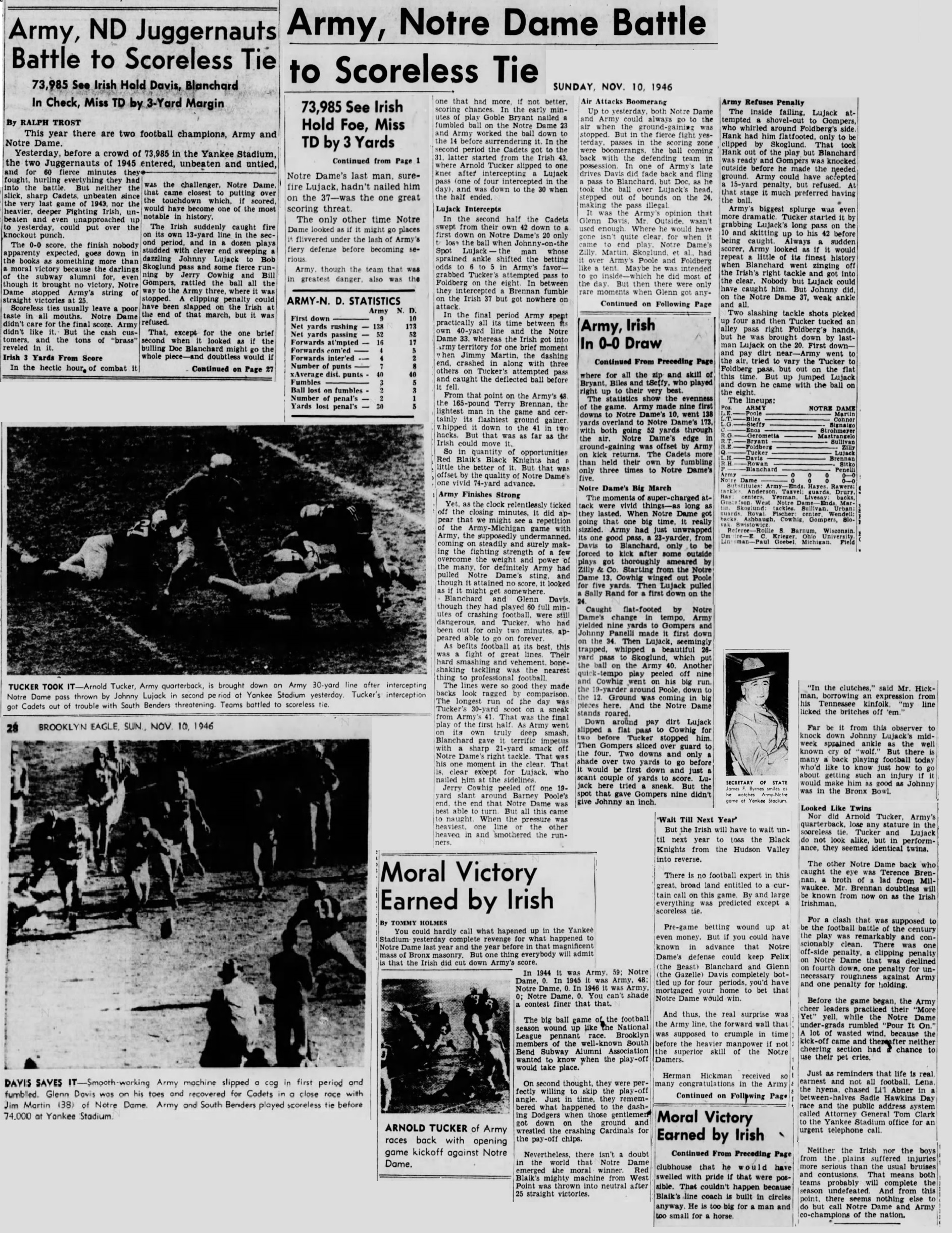
11/09 Army 0 – Notre Dame 0 Bronx, NY
11/16 Army 34 – Pennsylvania 7
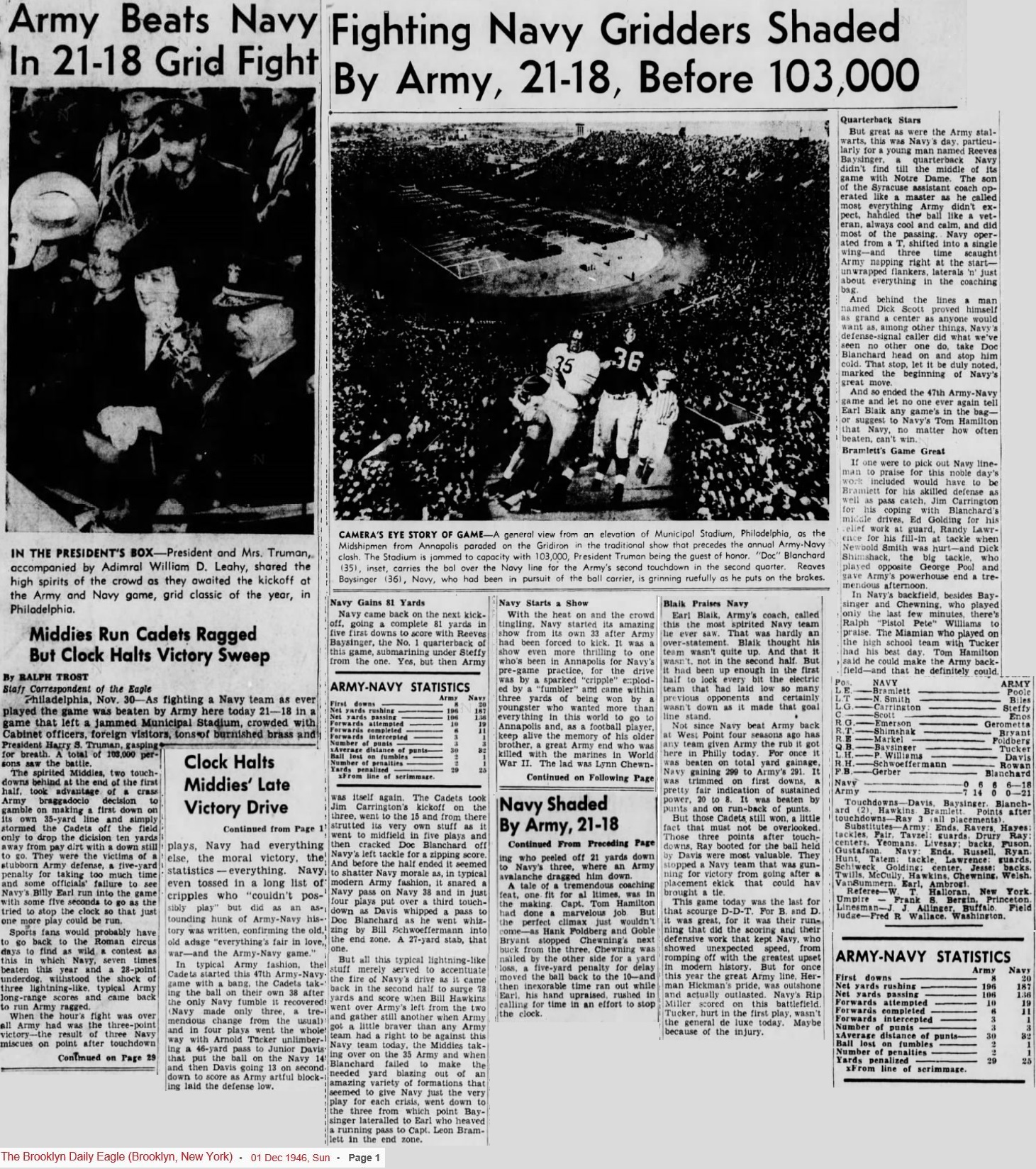
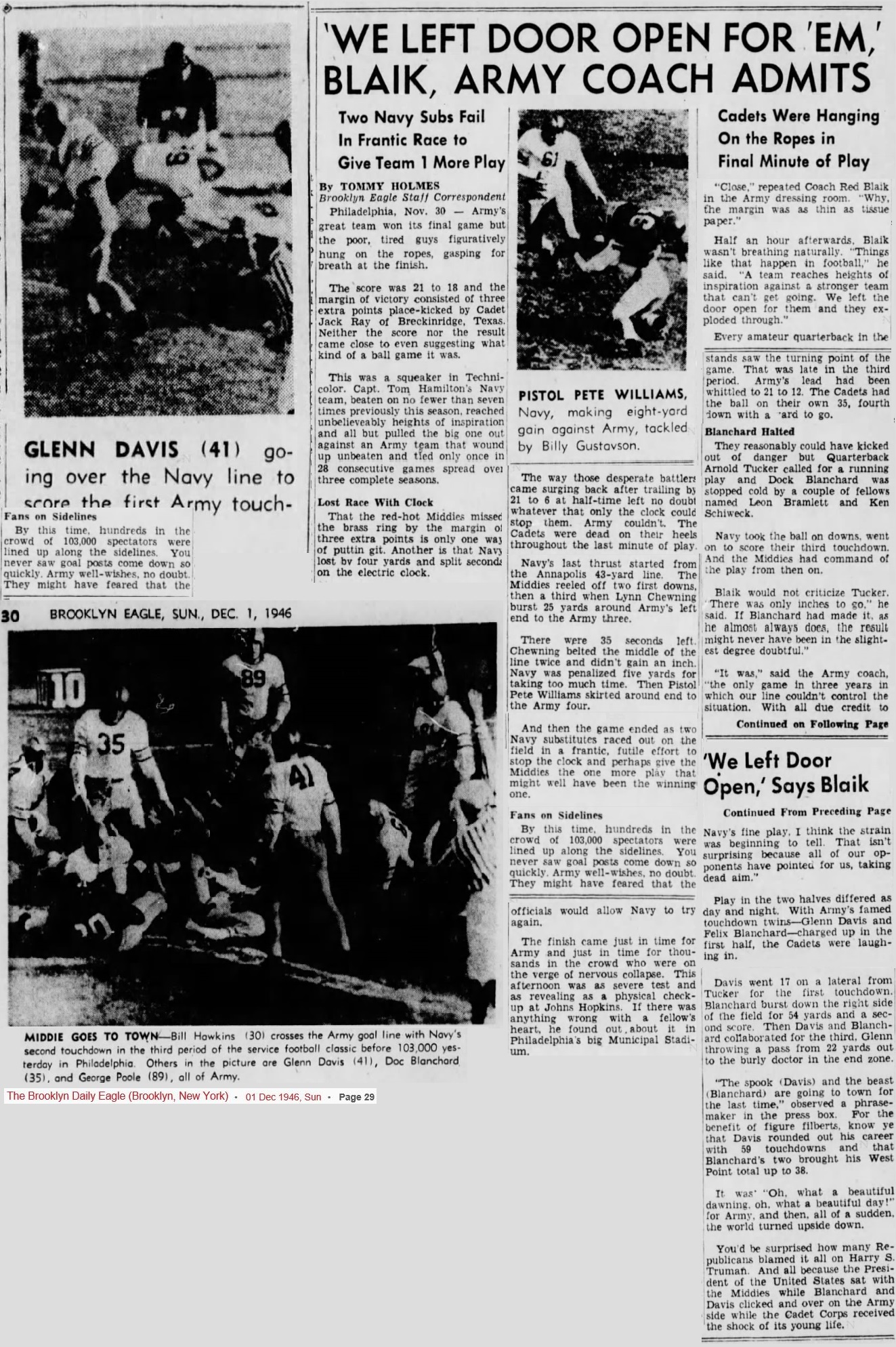
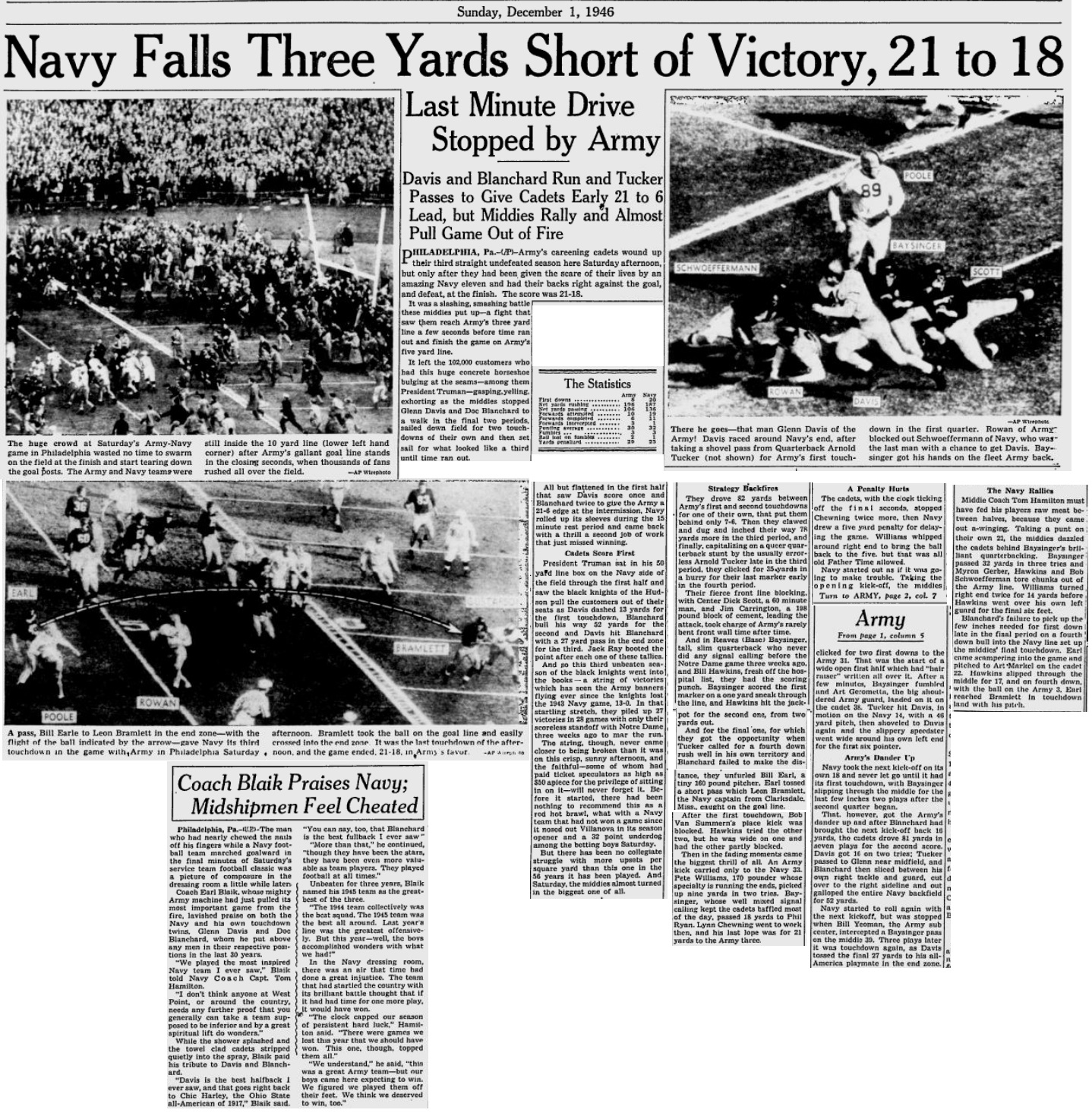
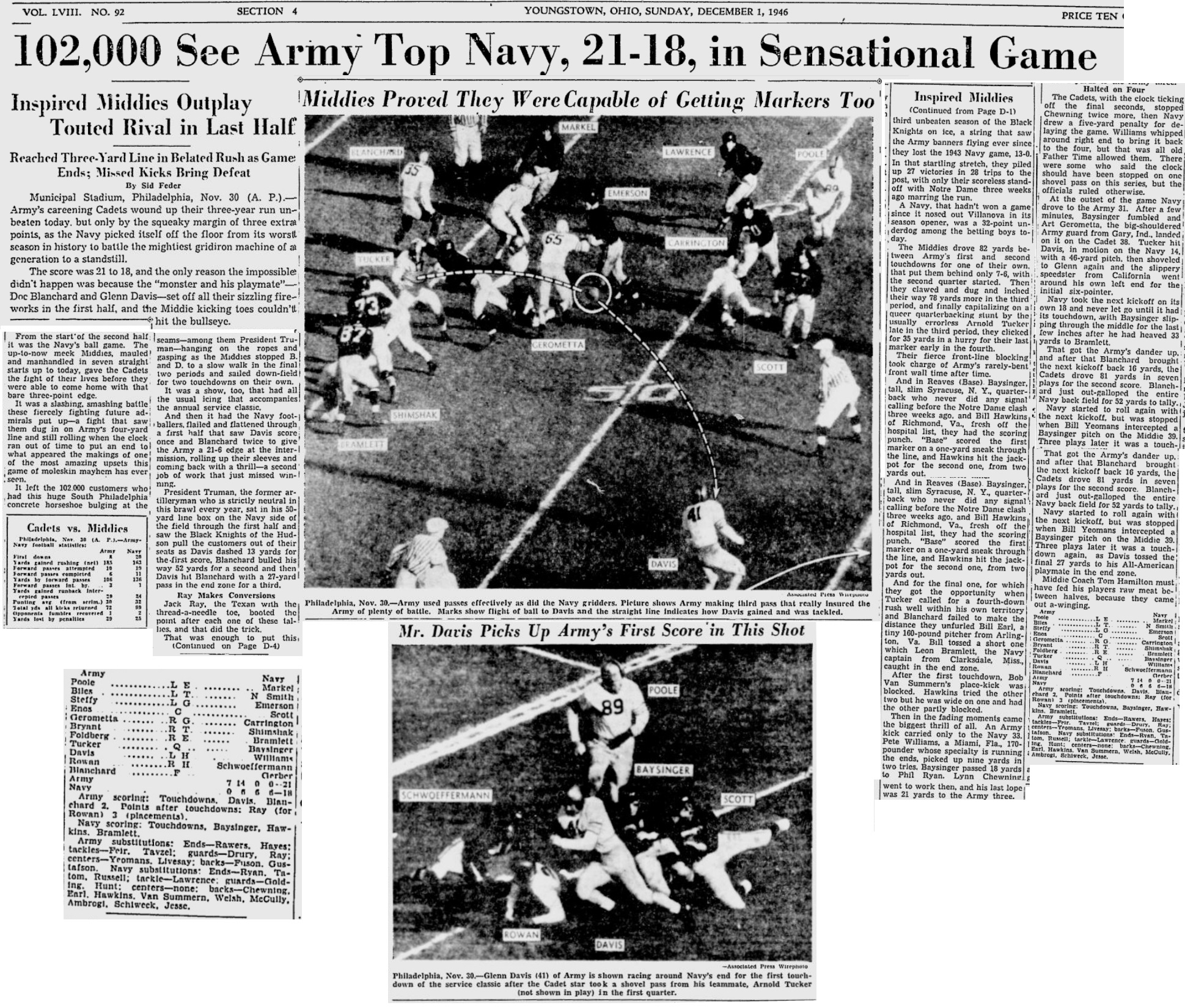
11/30 Army 21 – Navy 18 W Philadelphia, PA

Coach: Earl Henry “Red” Blaik (February 15, 1897 – May 6, 1989)
Dartmouth 1934-1940 – 45-15-4
Army: 1941-1958 – 121-33-10
Overall: 166-48-14
Awards:
All-American, 1919
AFCA Coach of the Year (1946)
College Football Hall of Fame, Inducted in 1964

Howitzer 1947

http://digital-library.usma.edu/cdm/compoundobject/collection/howitzers/id/3957/rec/40

–

ArmyFB_1946_team

1946 Team

–

ArmyFB_1946_Blanchard-Davis_Co-Captains

–

ArmyFB_1946_CoachBlaik

–

ArmyFB_1946_record

–

ArmyFB_1946_write-up

–

ArmyFB_1946_action-1_Blanchard-run_Foldberg-catch

–

ArmyFB_1946_action-2

–

ArmyFB_1946_action-3_Tucker-run

–

ArmyFB_1946_action-4_Blanchard-run_Foldberg-catch

–

ArmyFB_1946_action-5_Davis-run

–

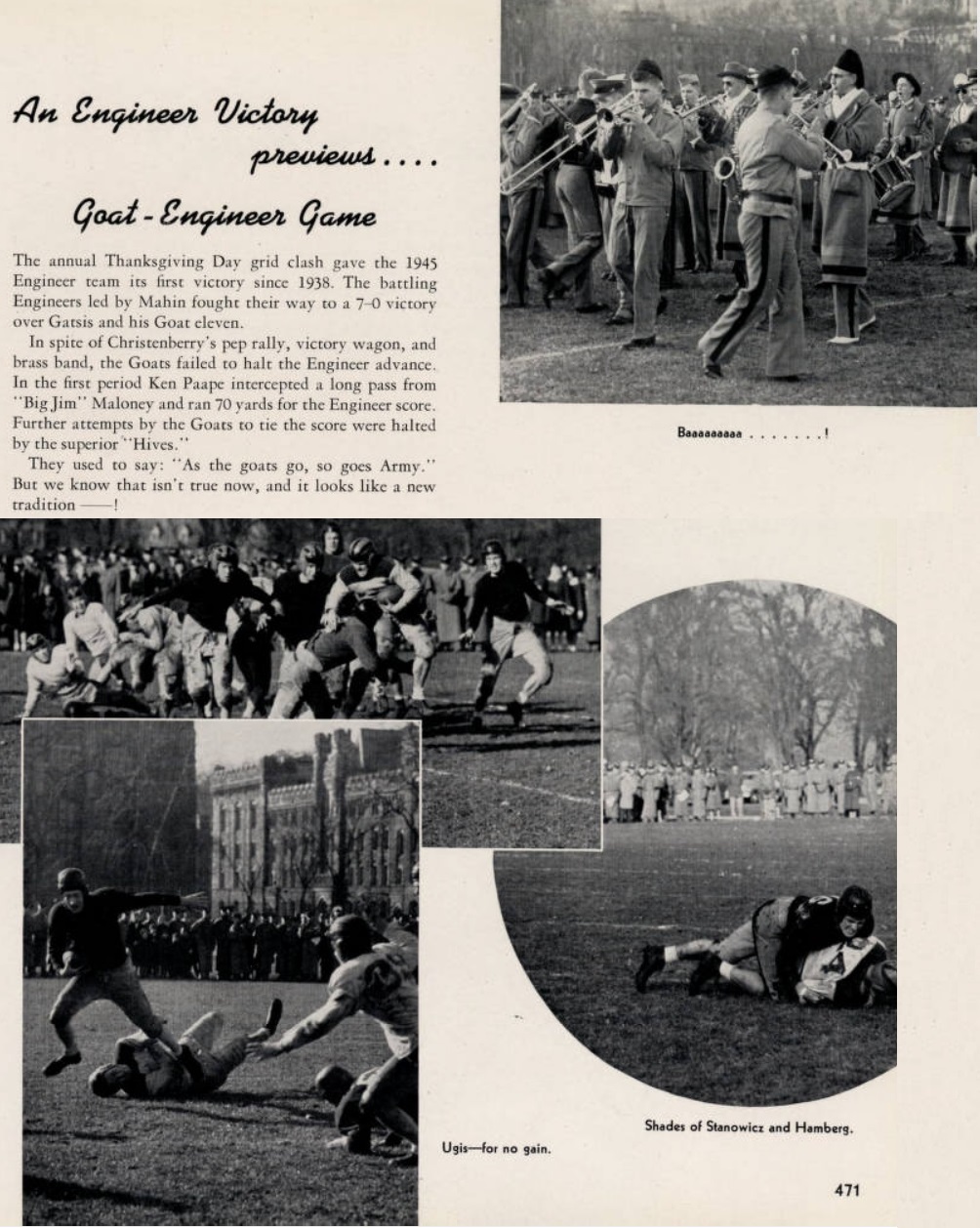
ArmyFB_1946_Goat-EngineerGame

–

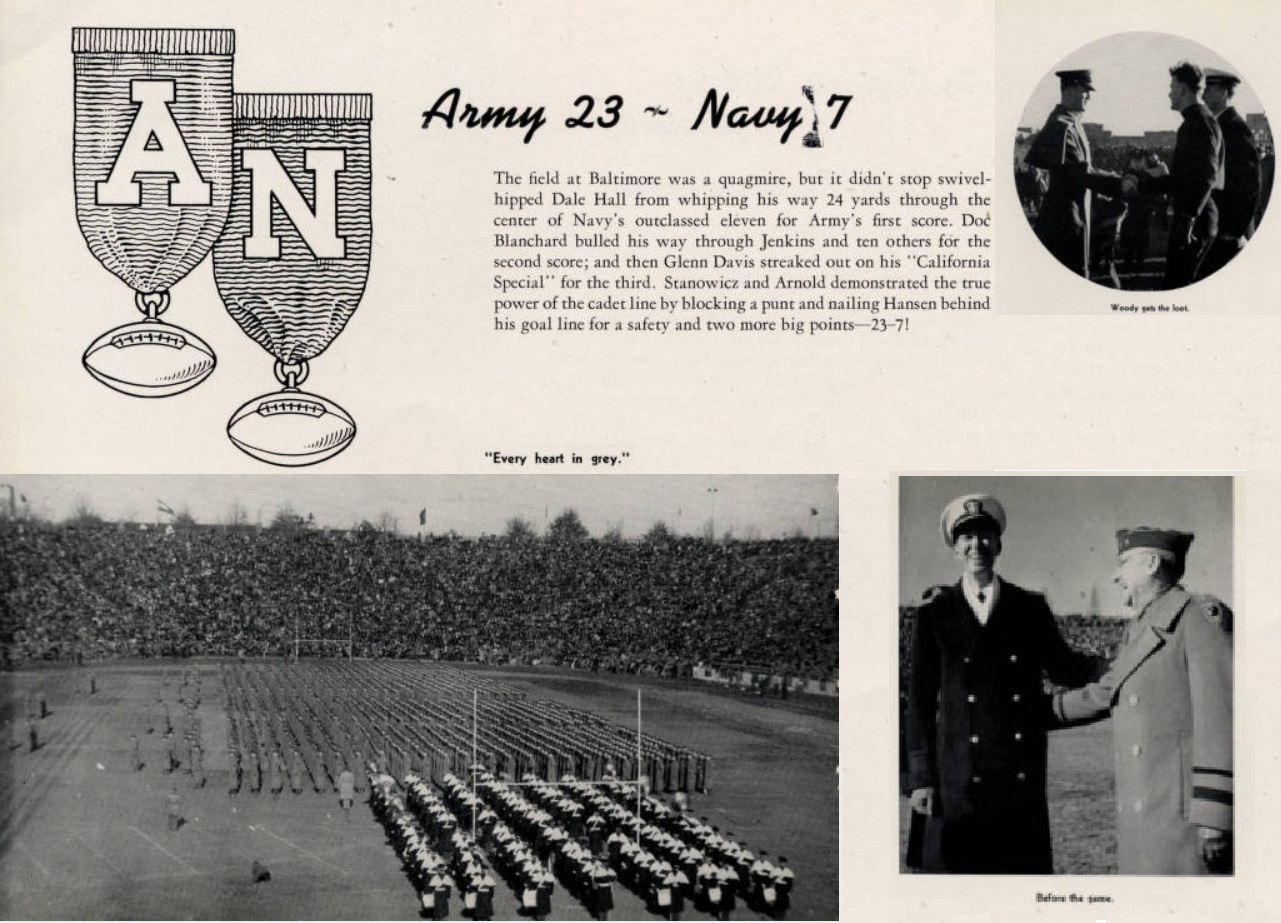
ArmyFB_1946_vsNavy-1

–

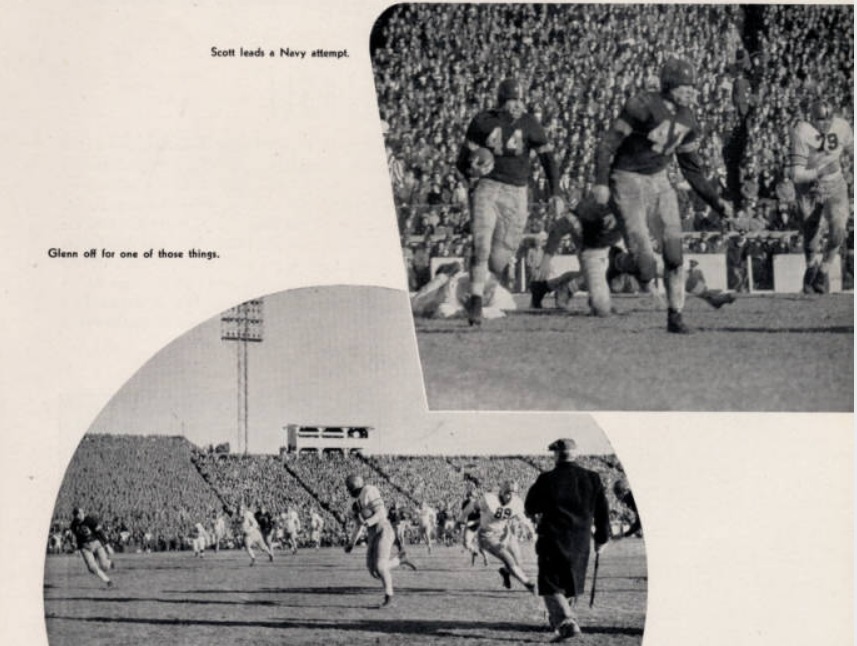
ArmyFB_1946_vsNavy-2

–

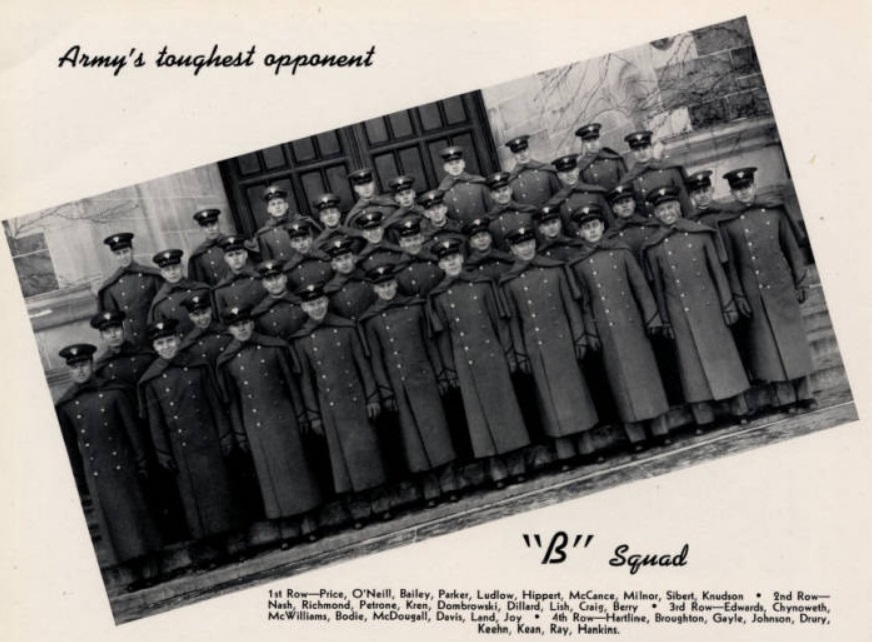
ArmyFB_1946_BSquad

–

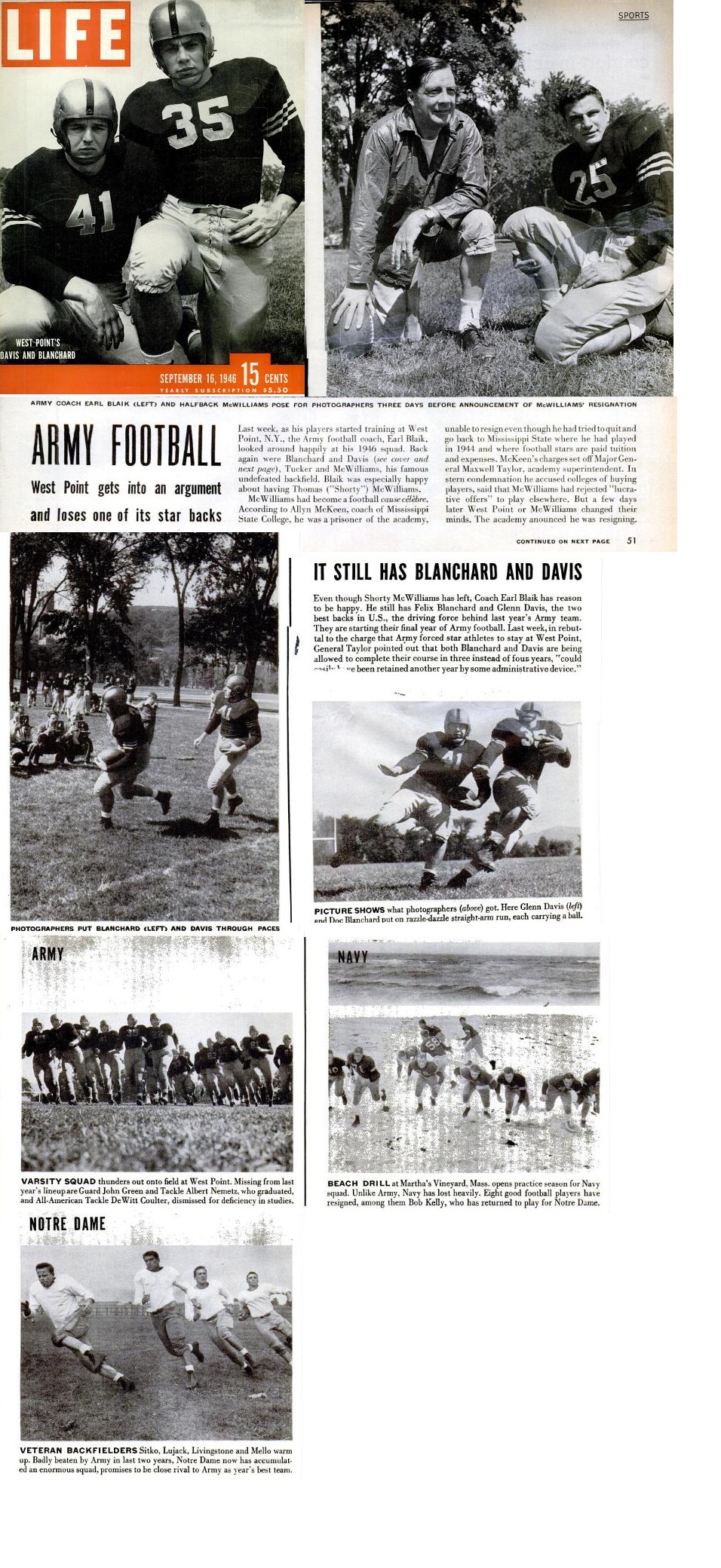
armyfb_1946_blanchard-davis_life-sep161946p51
ArmyFB_1946_Blanchard-Davis_Life-Sep161946p51

News Articles

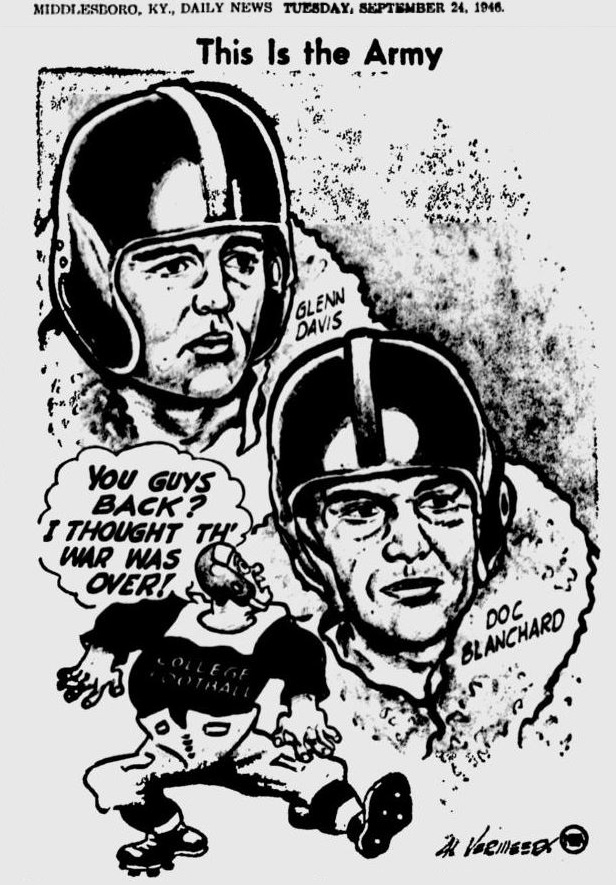
armyfb_1946_blanchard-davis_byalvermeer_middlesborodailynews_sep241946

ArmyFB_1946_Blanchard-Davis_byAlVermeer_MiddlesboroDailyNews_Sep241946

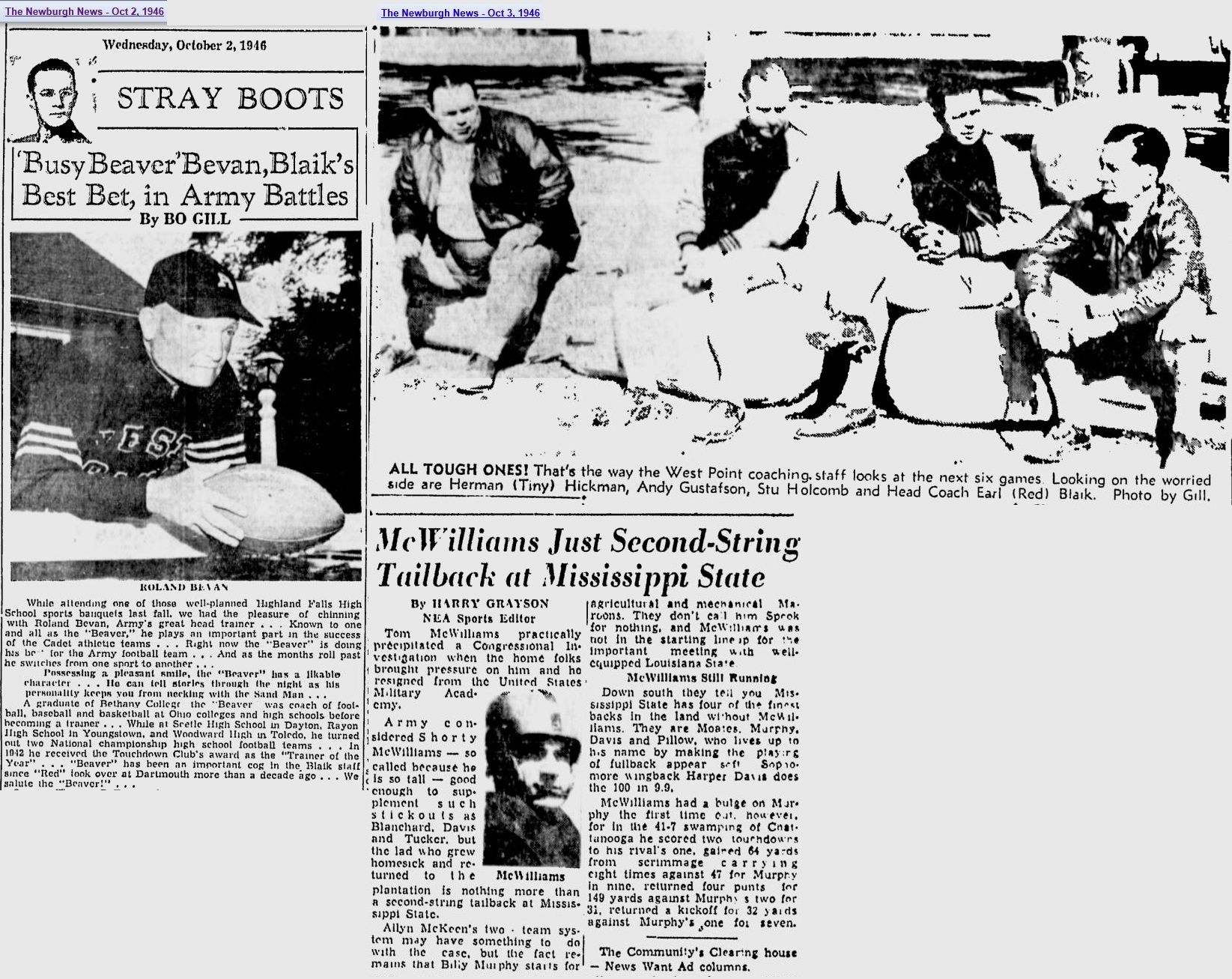
armyfb_1946_blaik-bevan-coaches_bogill_newburghnews_oct2-31946

ArmyFB_1946_Blaik-Bevan-Coaches_BoGill_NewburghNews_Oct2-31946

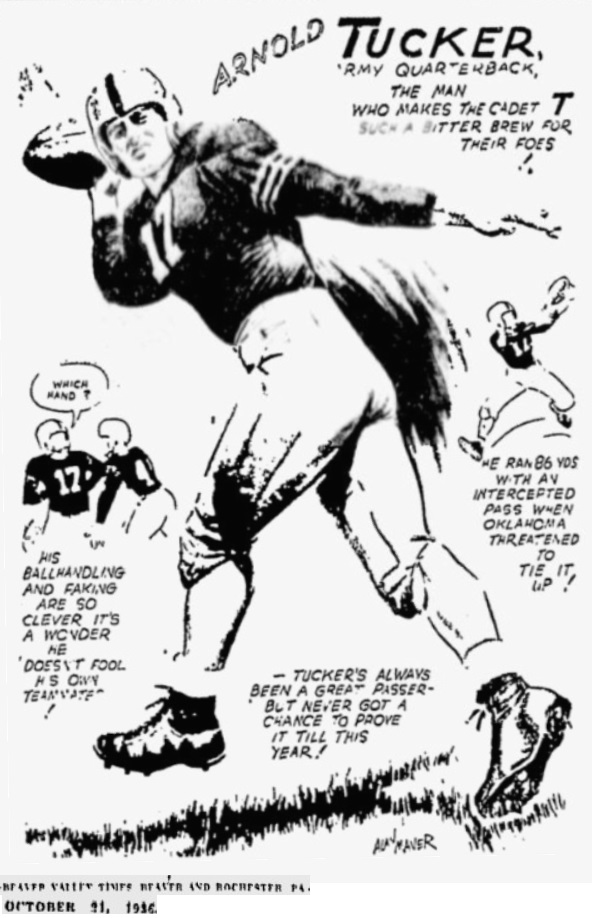
armyfb_1946_tucker_byalanmaver_thedailytimes_oct161946

ArmyFB_1946_Tucker_byAlanMaver_TheDailyTimes_Oct161946

ArmyFB_1946_vsMichigan_MiamiNews_Oct131946

ArmyFB_1946_vsMichigan_MiamiNews_Oct131946

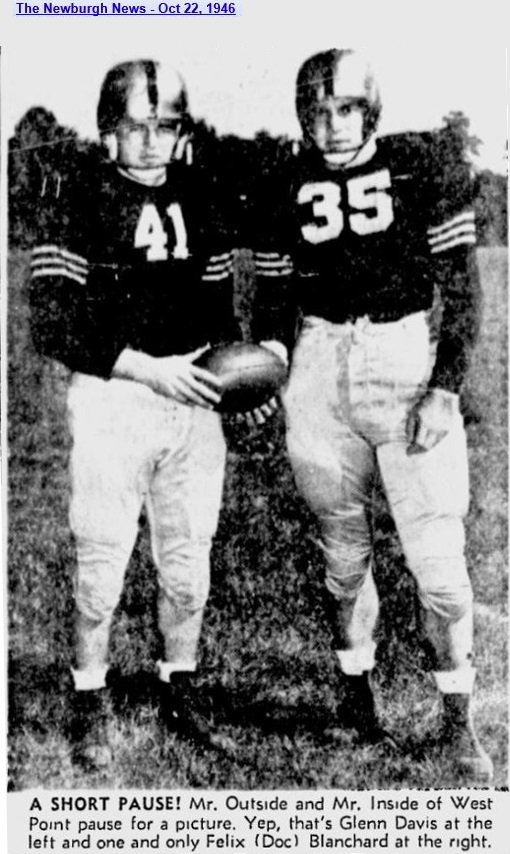
armyfb_1946_blanchard-davis_newburghnews_oct221946

ArmyFB_1946_Blanchard-Davis_NewburghNews_Oct221946

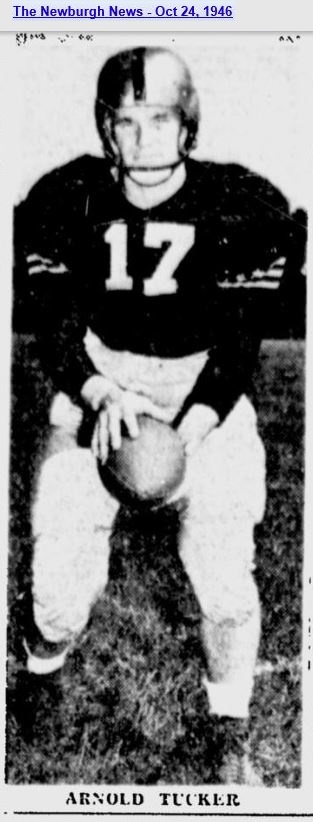
armyfb_1946_tucker_newburghnews_oct241946

ArmyFB_1946_Tucker_NewburghNews_Oct241946

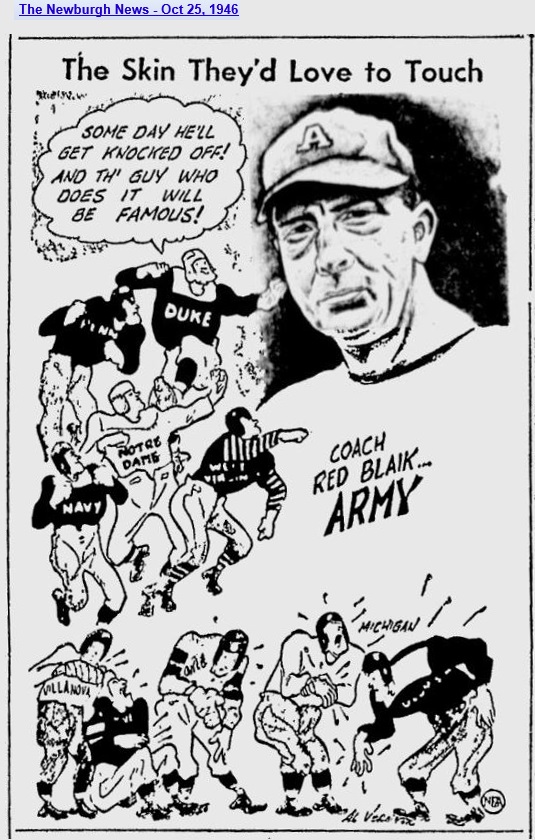
armyfb_1946_earlblaik_byalvemeer_newburghnews_oct251946

ArmyFB_1946_EarlBlaik_byAlVemeer_NewburghNews_Oct251946

ArmyFB_1946_vsDuke_ChanticleerYearbook1947

ArmyFB_1946_vsDuke_ChanticleerYearbook1947

armyfb_1946_vsnd_gameofthecentury_byalvemeer_newburghnews_nov51946

ArmyFB_1946_vsND_GameoftheCentury_byAlVemeer_NewburghNews_Nov51946

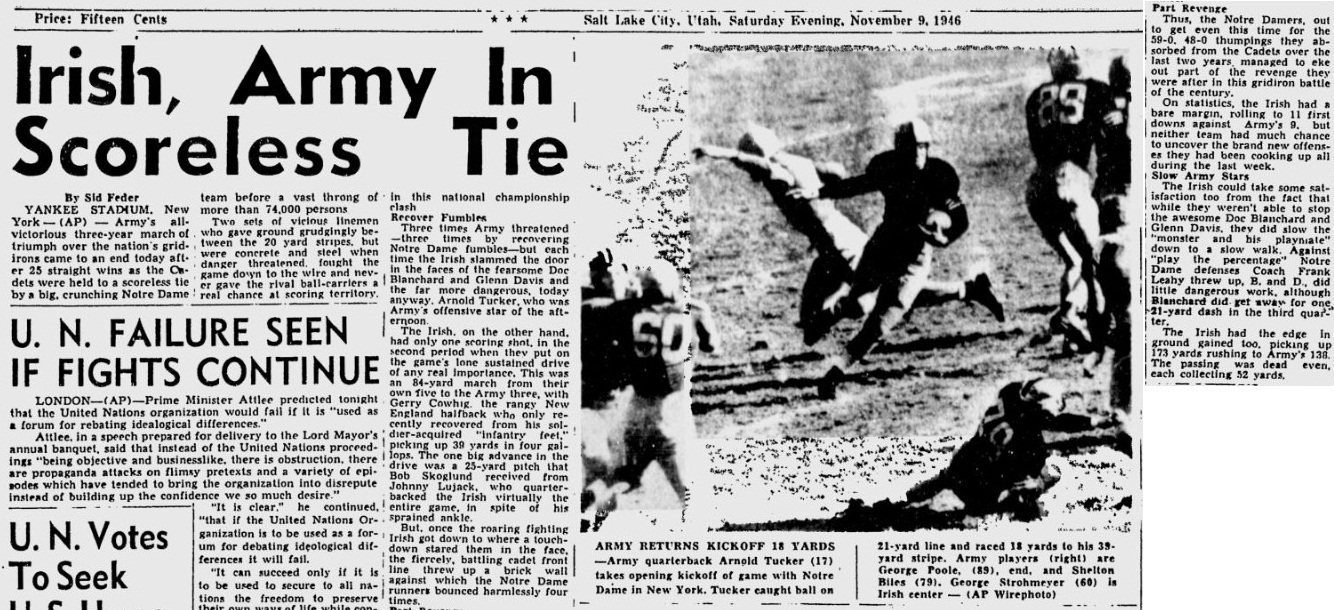
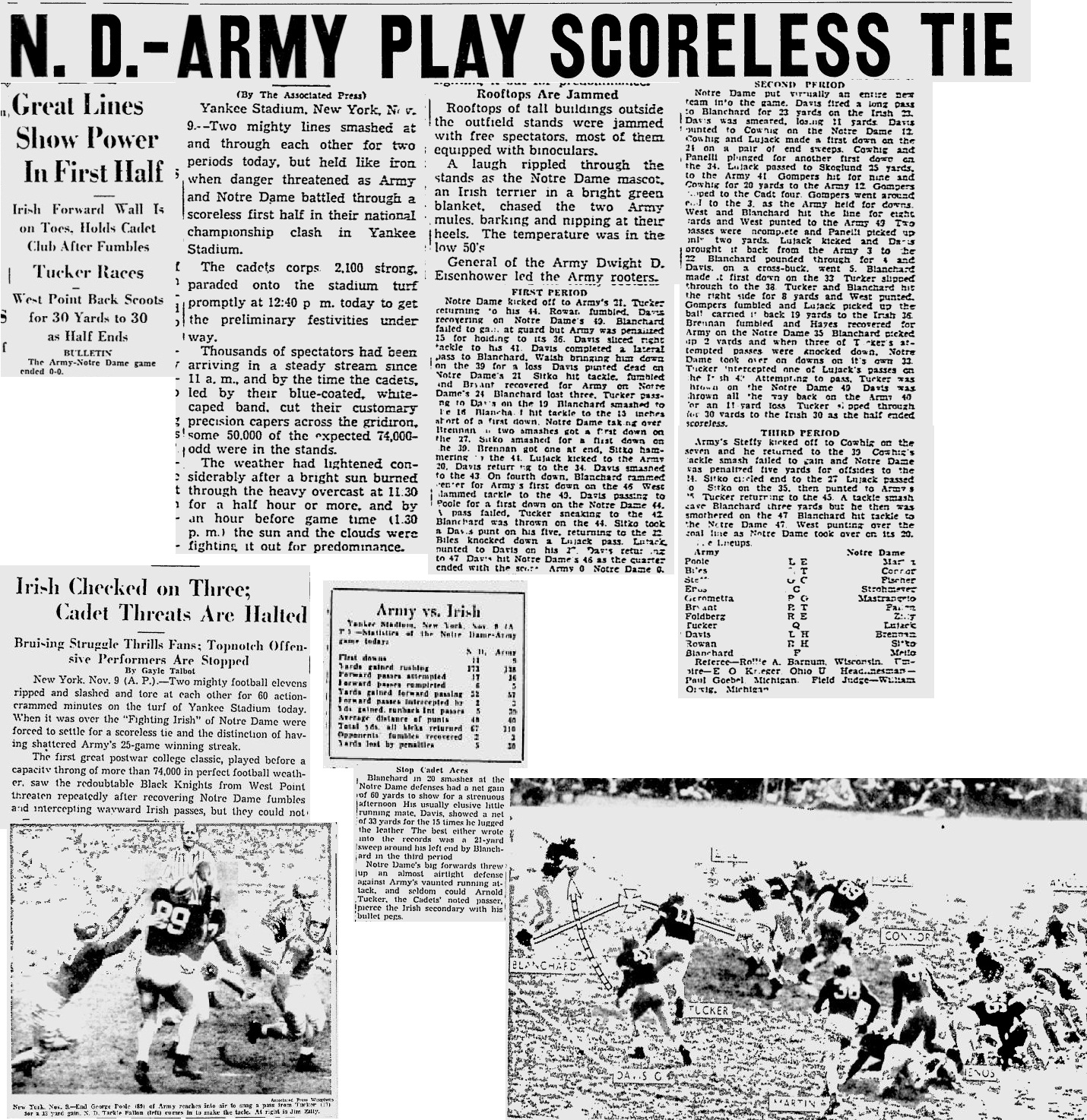
armyfb_1946_vsnotredame_deseretnews_nov81946
ArmyFB_1946_vsNotreDame_DeseretNews_Nov81946

ArmyFB_1946_vsNotreDame_pre-game_BostonGlobe_Nov91946

ArmyFB_1946_vsNotreDame_pre-game_BostonGlobe_Nov91946

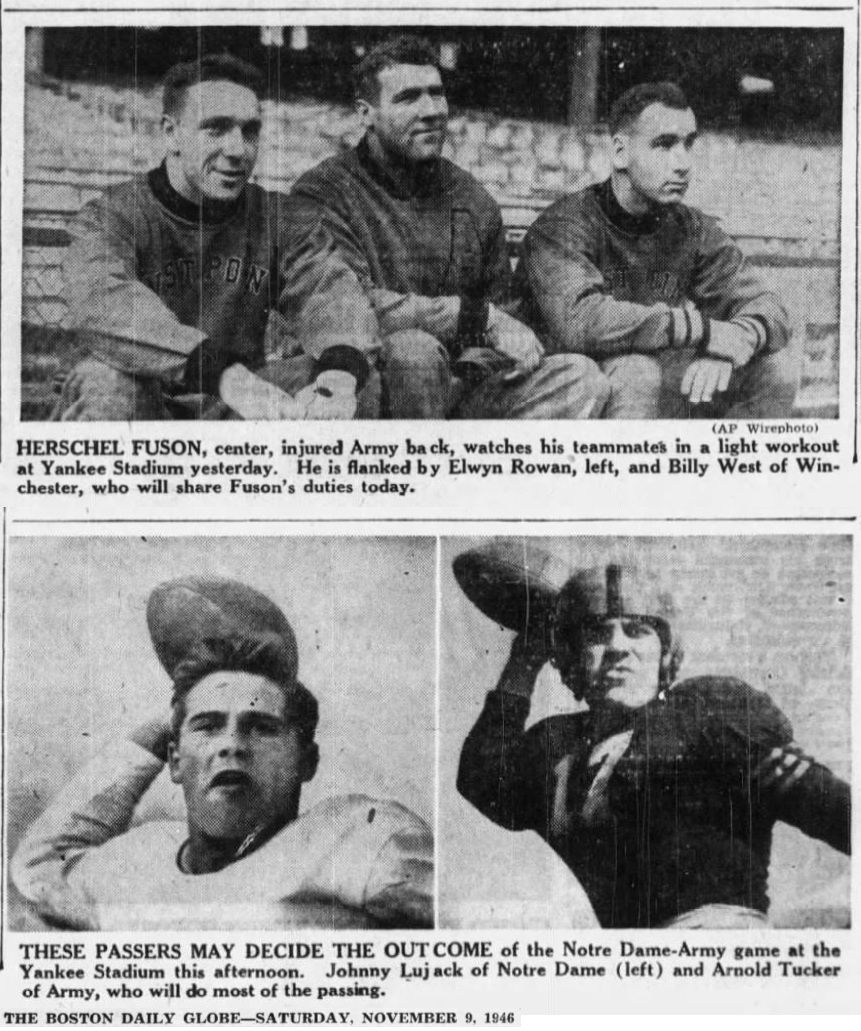
ArmyFB_1946_vsNotreDame_pics_BostonGlobe_Nov91946

ArmyFB_1946_vsNotreDame_pics_BostonGlobe_Nov91946

armyfb_1946_vsnotredame_deseretnews_nov91946

ArmyFB_1946_vsNotreDame_DeseretNews_Nov91946

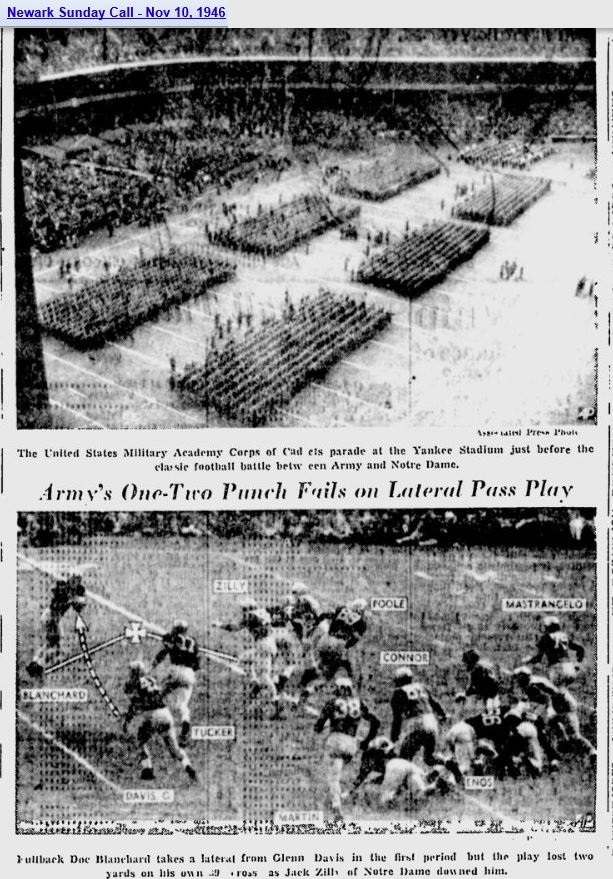
armyfb_1946_vsnd_corps-march-on_newarksundaycall_nov101946

ArmyFB_1946_vsND_Corps-March-on_NewarkSundayCall_Nov101946


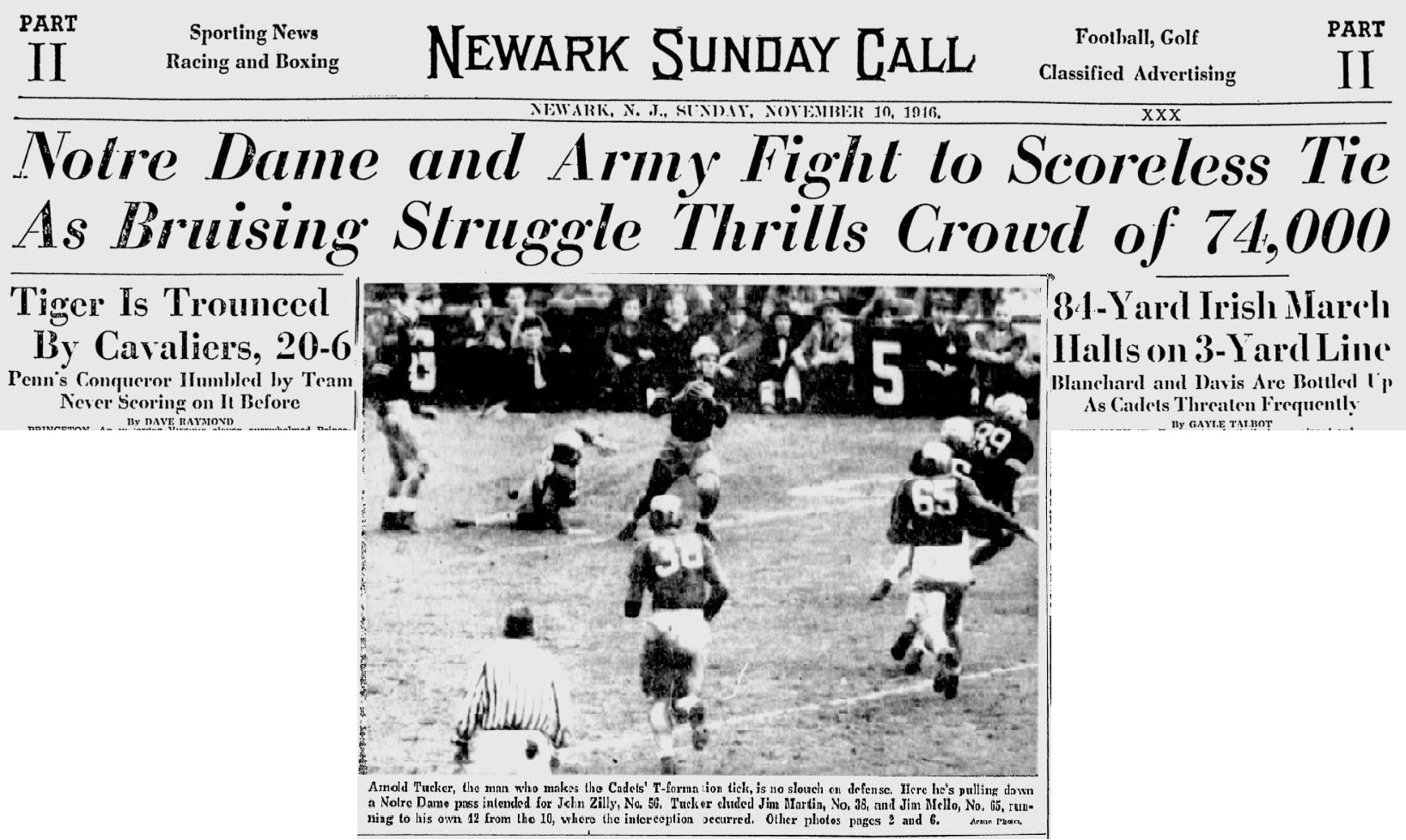
armyfb_1946_vsnd_newarksundaycall_nov101946

ArmyFB_1946_vsND_NewarkSundayCall_Nov101946

ArmyFB_1946_vsNotreDame_BrooklynDailyEagle_Nov101946

ArmyFB_1946_vsNotreDame_BrooklynDailyEagle_Nov101946

armyfb_1946_vsnotredame_youngstownvindicator_nov101946
ArmyFB_1946_Davis_vsNotreDame_YoungstownVindicator_Nov101946

–


–


–

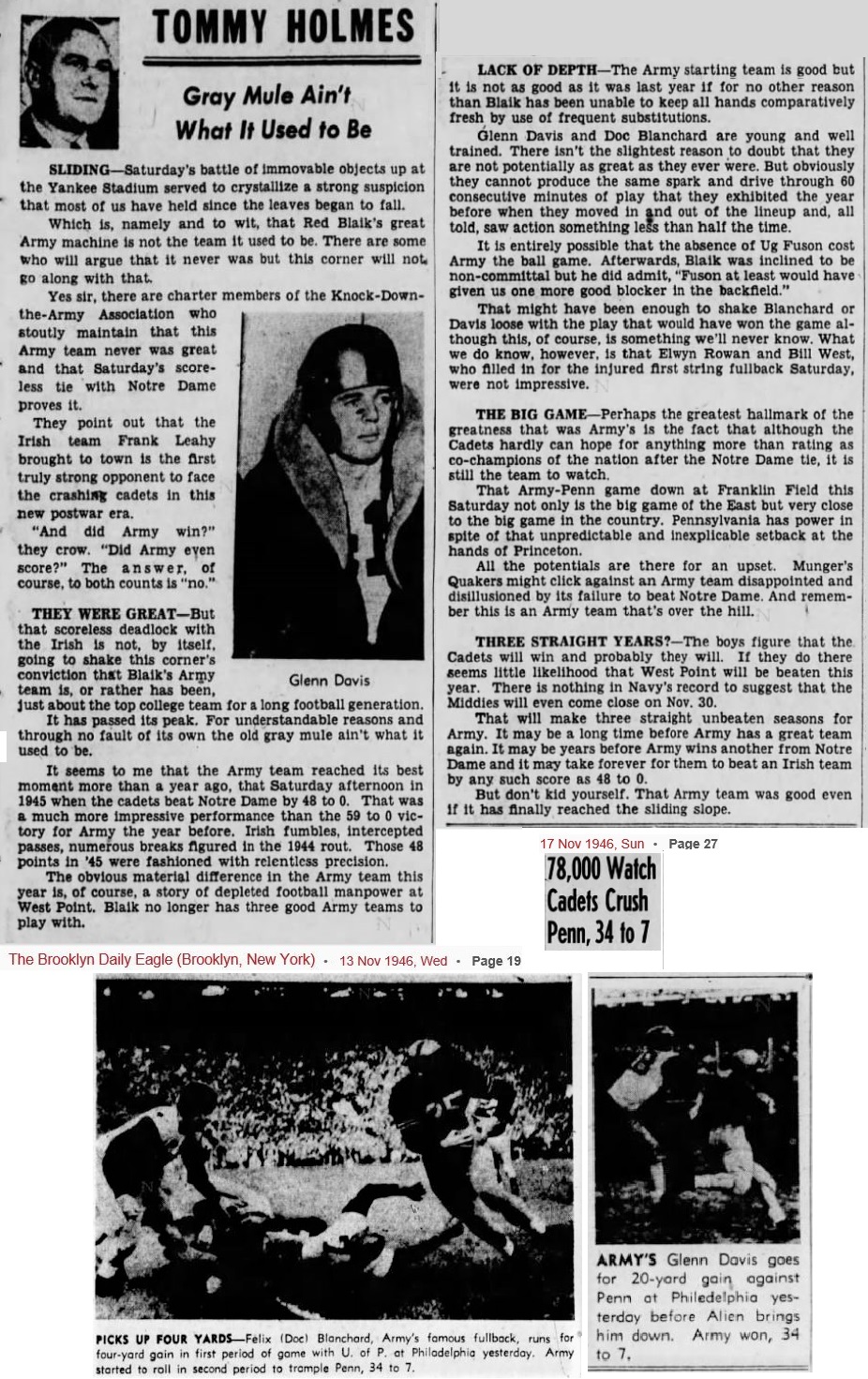
ArmyFB_1946_vsNotreDame-post-mortem_BrooklynDailyEagle_Nov131946

ArmyFB_1946_vsNotreDame-post-mortem_BrooklynDailyEagle_Nov131946

–

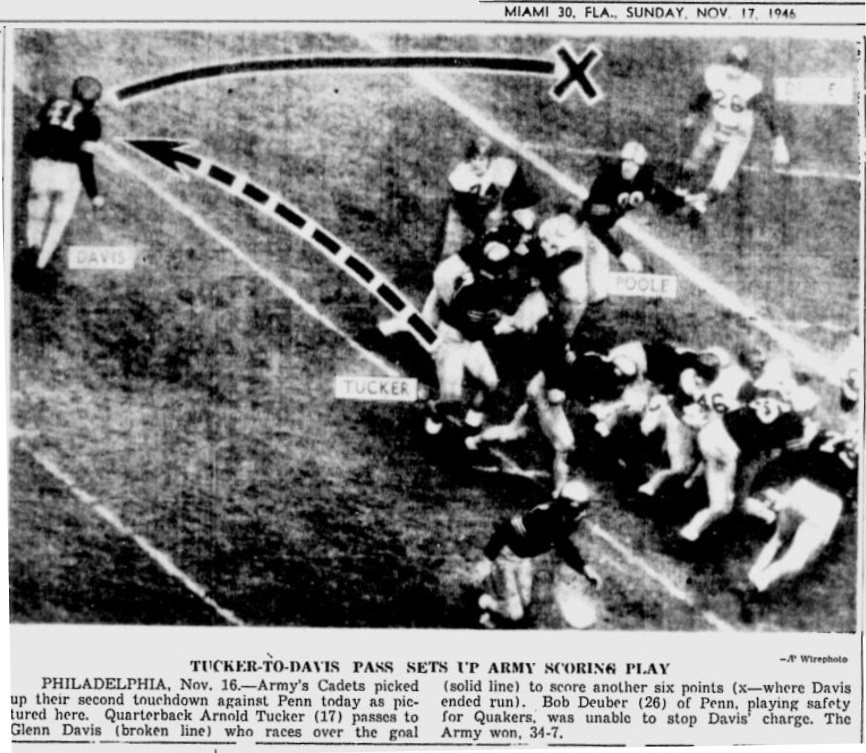
ArmyFB_1946_vsPenn_MiamiNews_17Nov1946.jpg
ArmyFB_1946_vsPenn_MiamiNews_17Nov1946
–
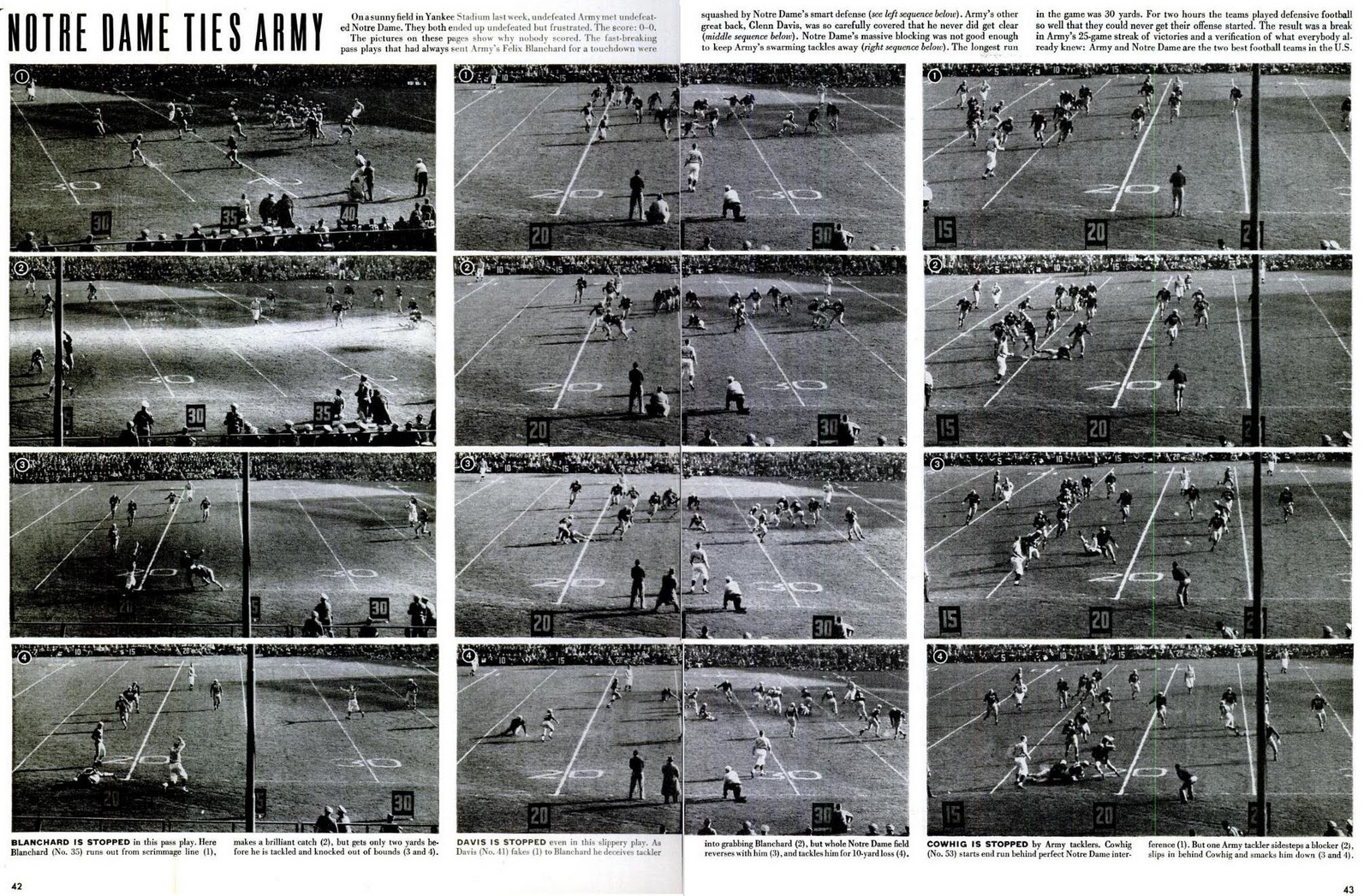
armyfb_1946_vsnotredame_life_nov181946
ArmyFB_1946_vsNotreDame_LIFE_Nov181946

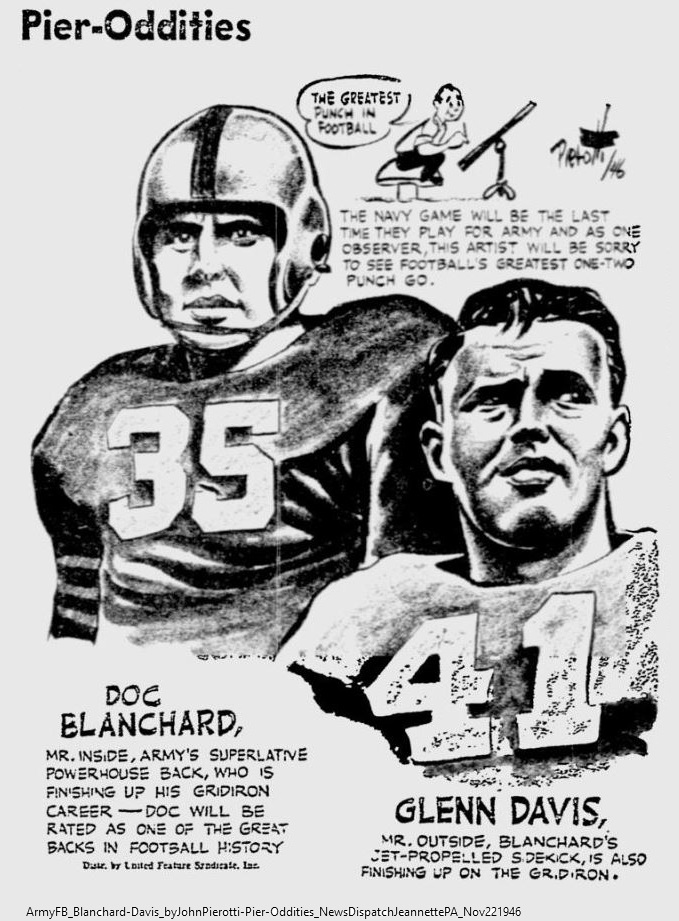
ArmyFB_1946_Blanchard-Davis_byJohnPierotti-Pier-Oddities_NewsDispatchJeannettePA_Nov221946 (1)
–

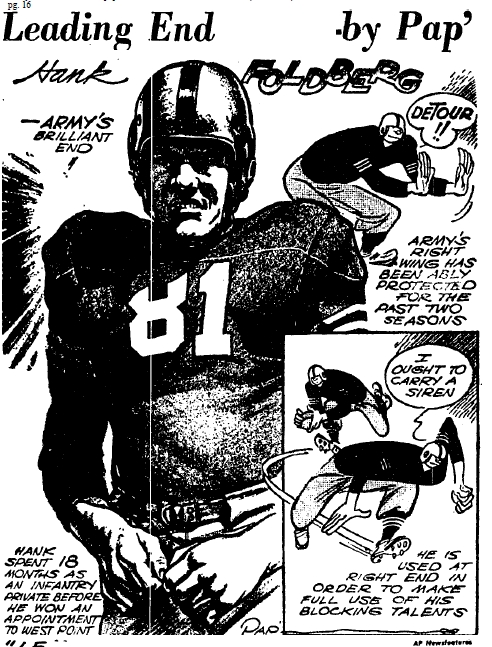
ArmyFB_1946_HankFoldberg_byPap_CSM_Nov261946

ArmyFB_1946_HankFoldberg_byPap_CSM_Nov261946

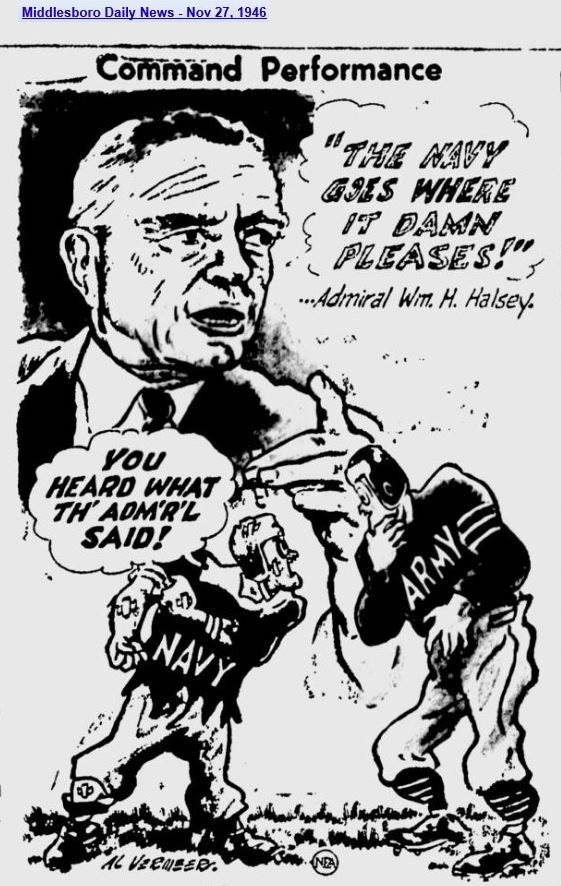
armyfb_1946_vsnavy_byalvermeer_middlesborodailynews_nov271946

ArmyFB_1946_vsNavy_byAlVermeer_MiddlesboroDailyNews_Nov271946

–

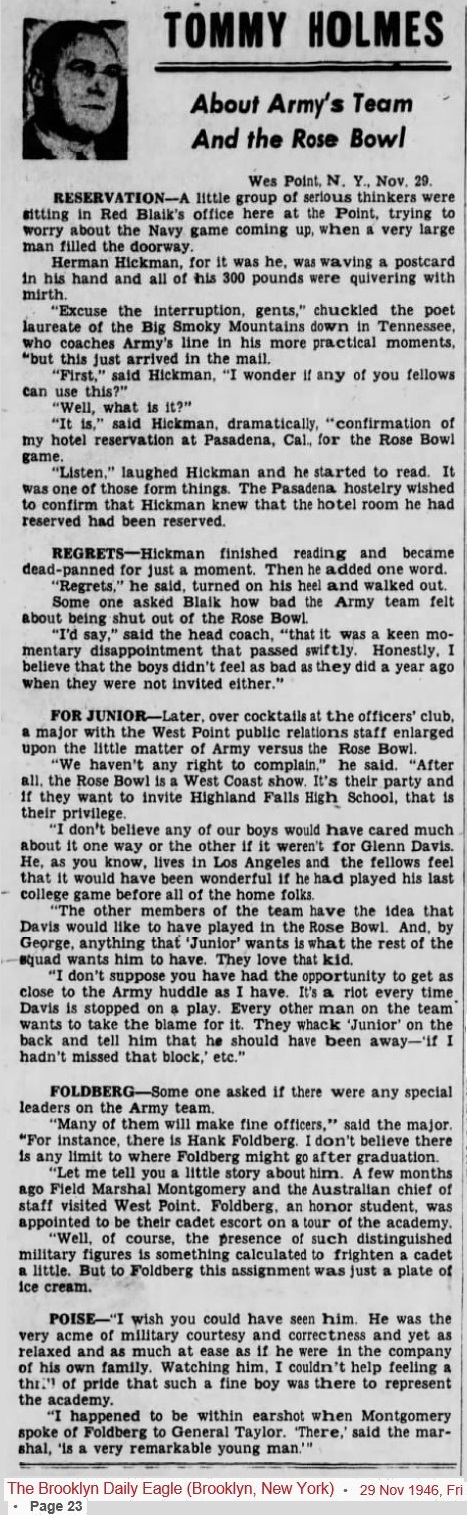
ArmyFB_1946_RoseBowl_BrooklynDailyEagle_Nov291946

ArmyFB_1946_RoseBowl_BrooklynDailyEagle_Nov291946

–

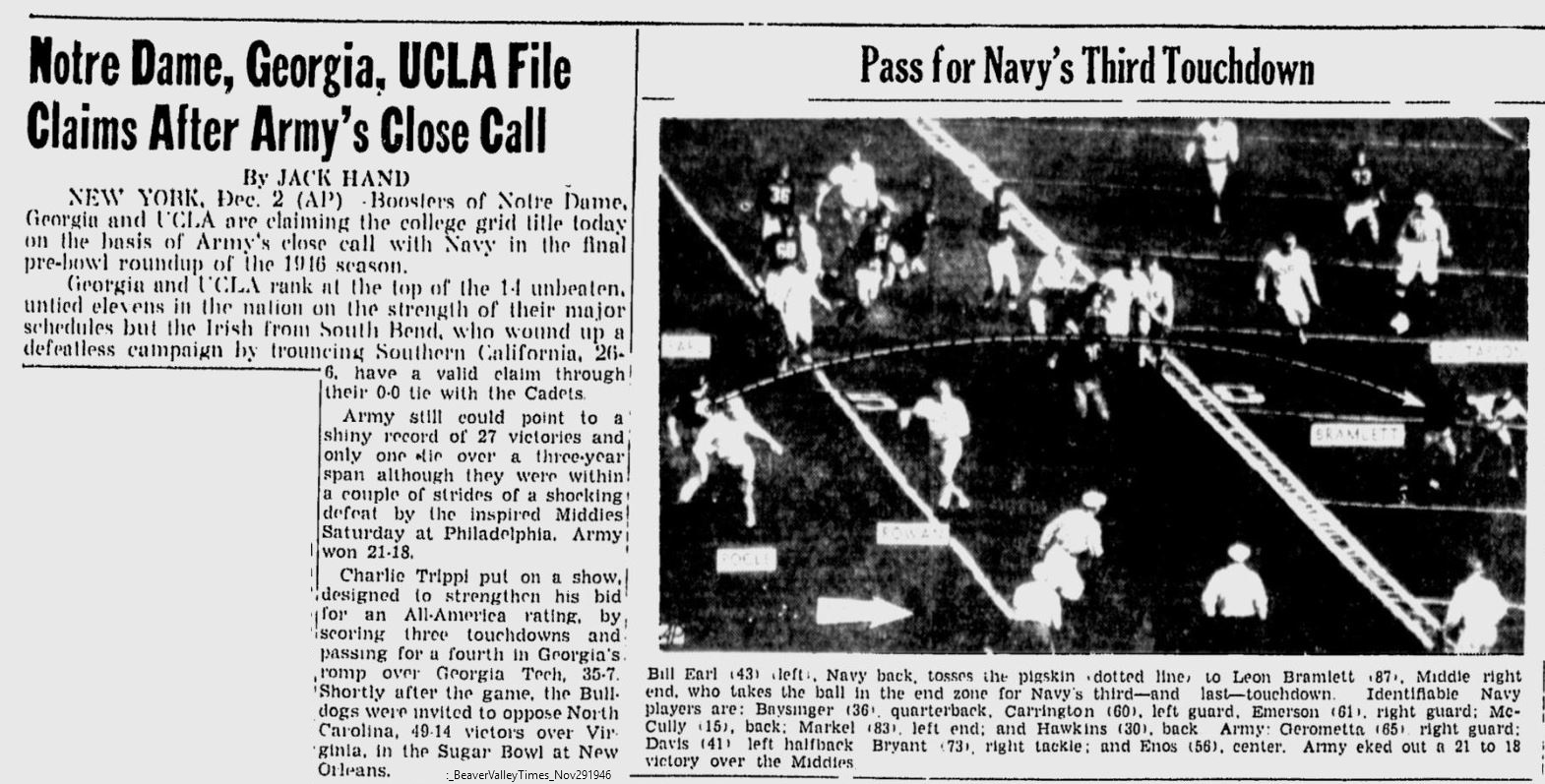
ArmyFB_1946_vsNavy-pic_BeaverValleyTimes_Nov291946

–

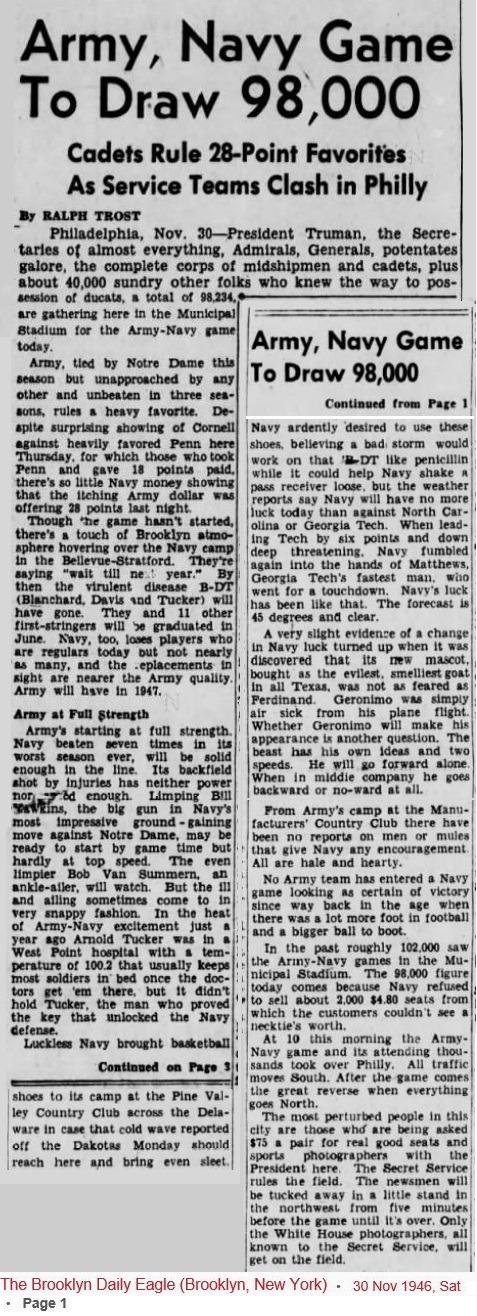
ArmyFB_1946_vsNavy-pre-game_BrooklynDailyEagle_Nov301946

ArmyFB_1946_vsNavy-pre-game_BrooklynDailyEagle_Nov301946

–

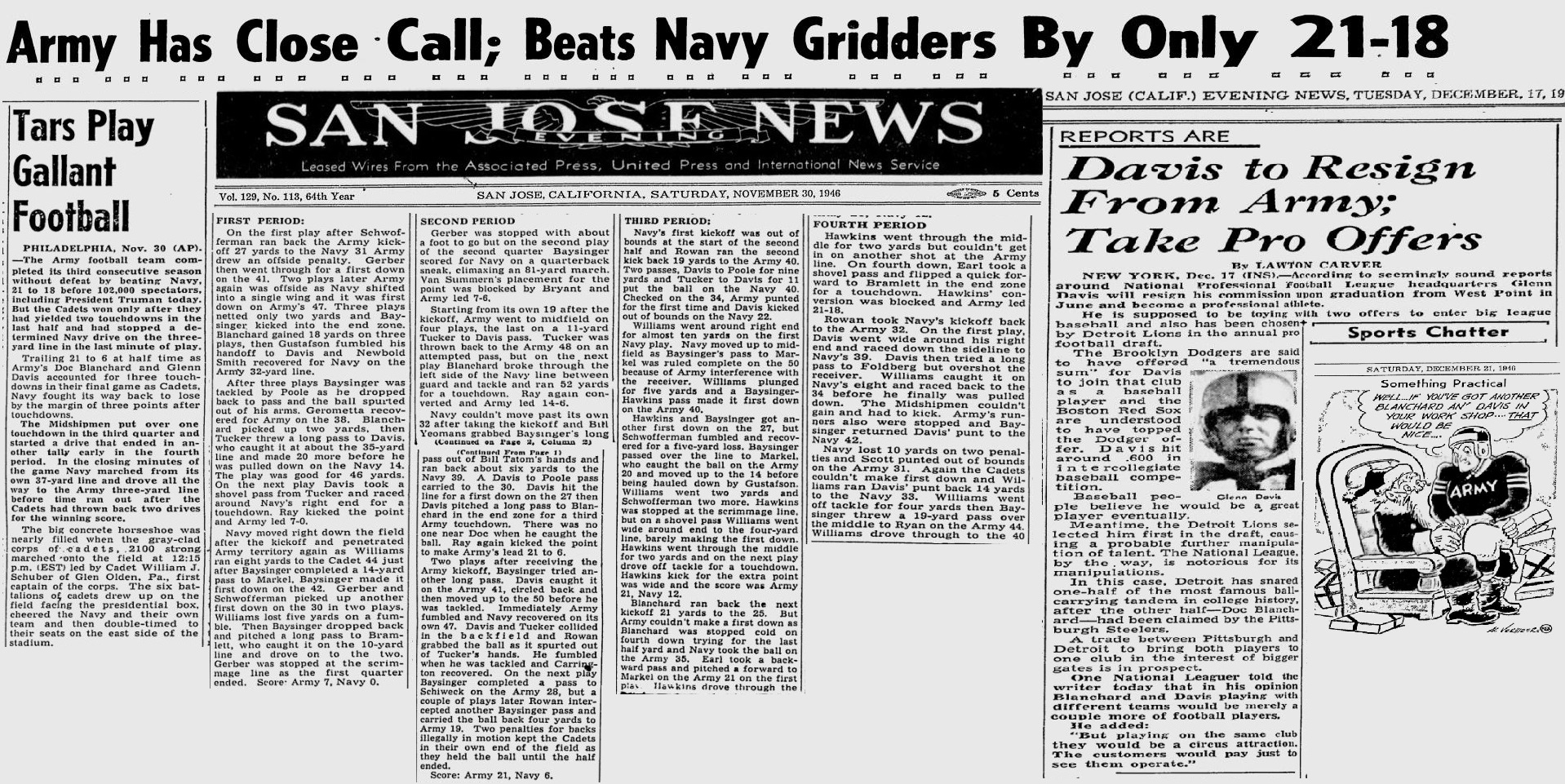
ArmyFB_1946_vsNavy_SanJoseEveningNews_Nov301946

–

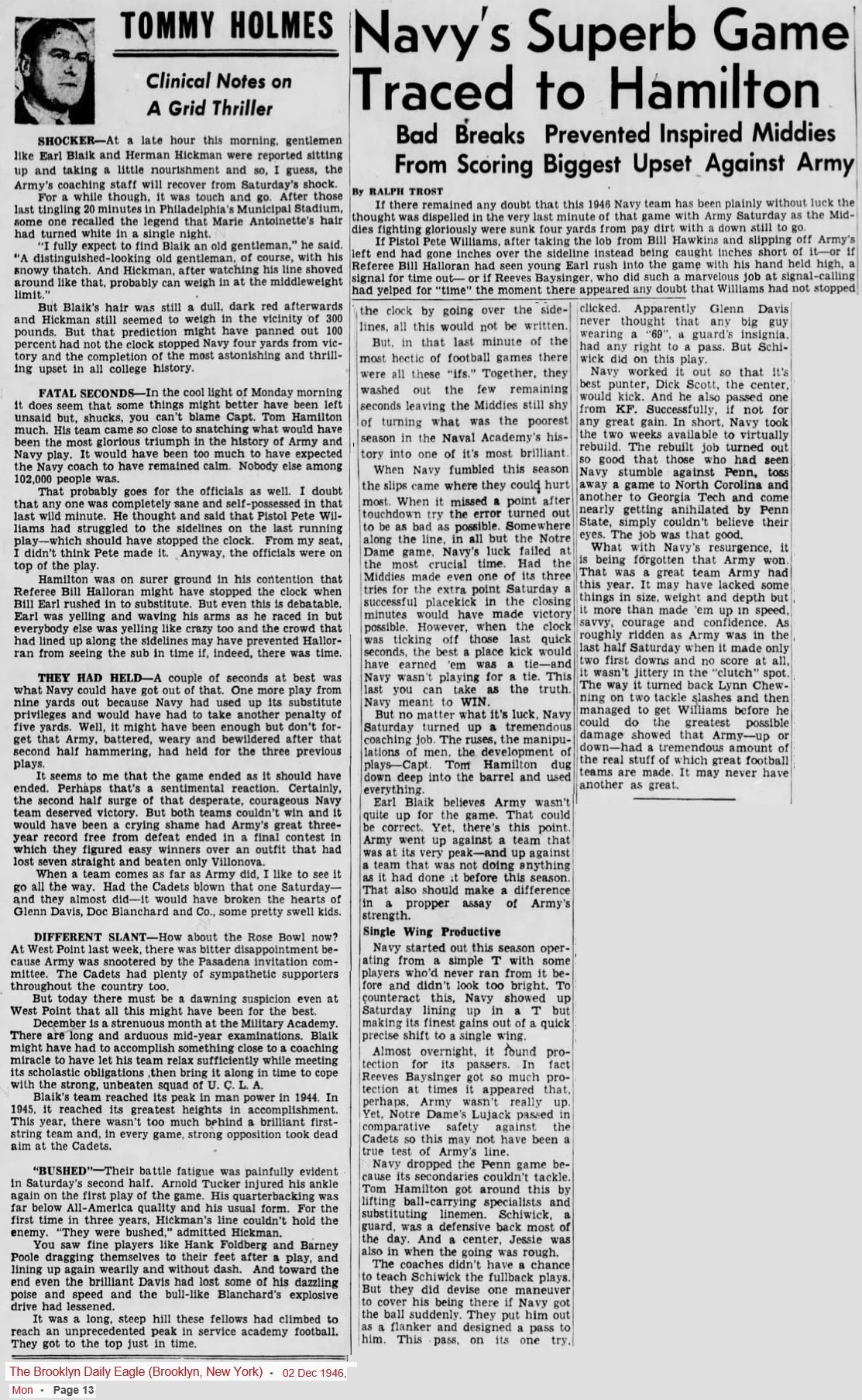
ArmyFB_1946_vsNavy_BrooklynDailyEagle_Dec11946

ArmyFB_1946_vsNavy_BrooklynDailyEagle_Dec11946

–

ArmyFB_1946_vsNavy_BrooklynDailyEagle_Dec11946cont

ArmyFB_1946_vsNavy_BrooklynDailyEagle_Dec11946cont

–

armyfb_1946_vsnavy_milwaukeejournal_dec11946
ArmyFB_1946_vsNavy_MilwaukeeJournal_Dec11946
–
armyfb_1946_vsnavy_youngstownvindicator_dec11946
ArmyFB_1946_vsNavy_YoungstownVindicator_Dec11946
–
armyfb_1946_vsnavy_sundaymorningstar-wilmington_dec11946
ArmyFB_1946_vsNavy_SundayMorningStar-Wilmington_Dec11946

–

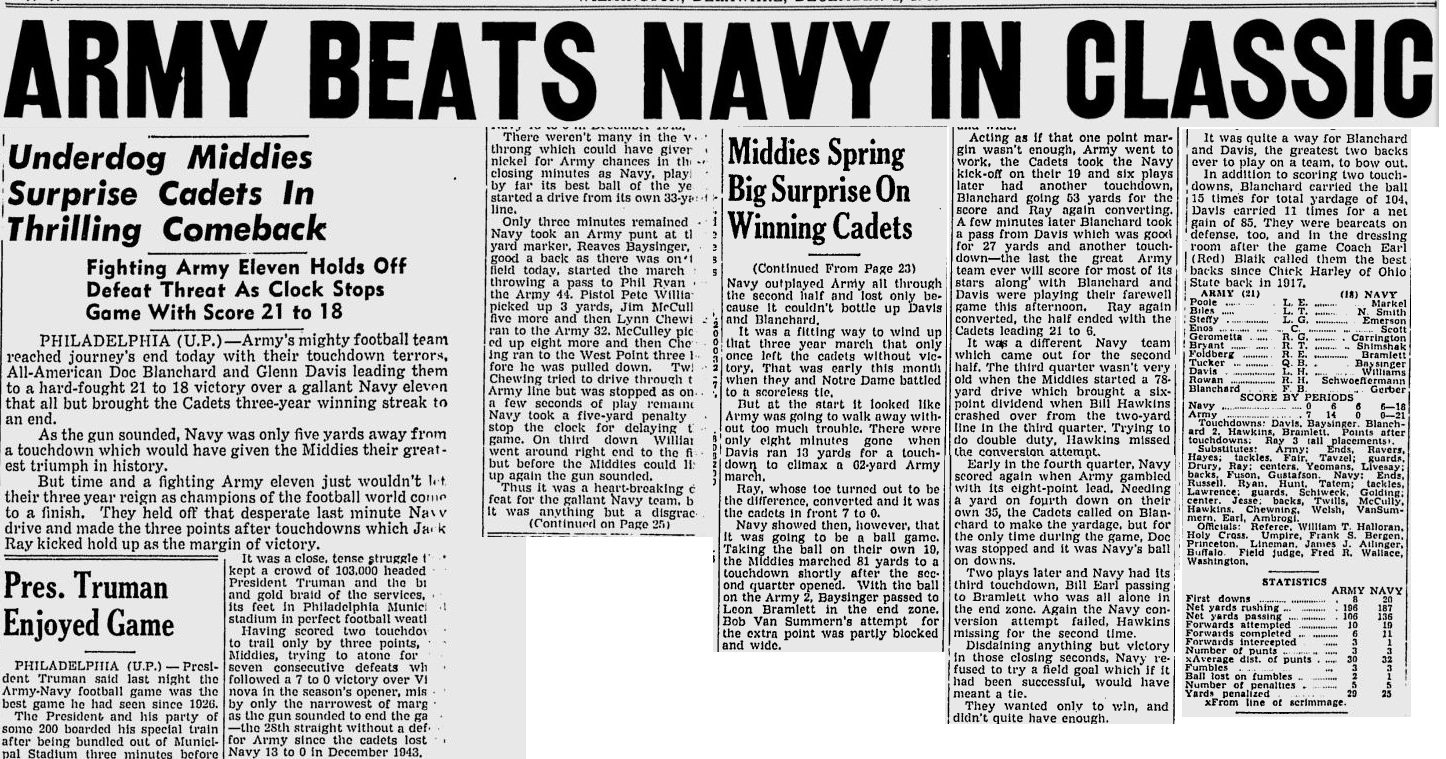
ArmyFB_1946_vsNavy-post-game_BrooklynDailyEagle_Dec21946

ArmyFB_1946_vsNavy-post-game_BrooklynDailyEagle_Dec21946

–

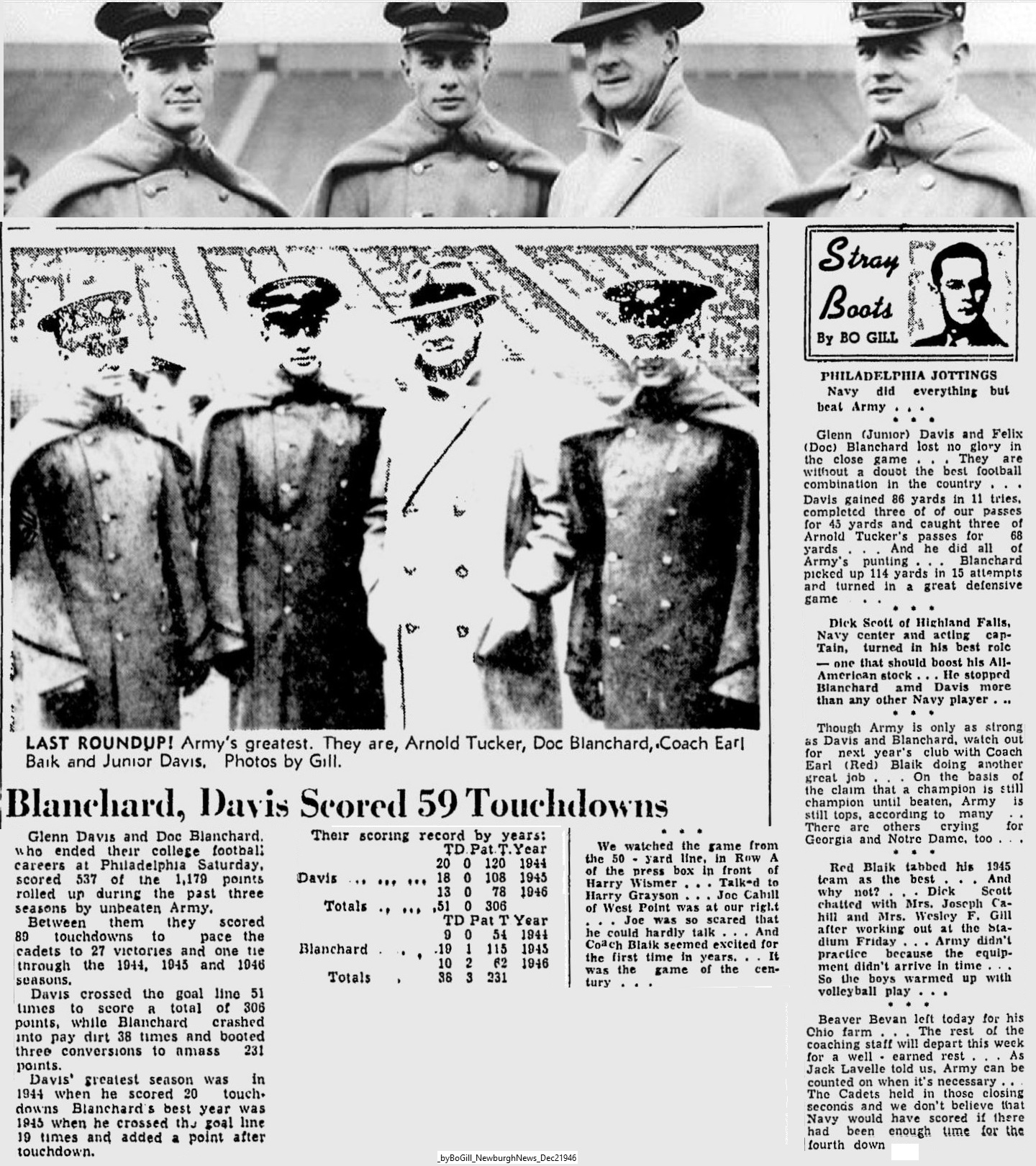
ArmyFB_1946_vsNavy_byBoGill_NewburghNews_Dec21946

–

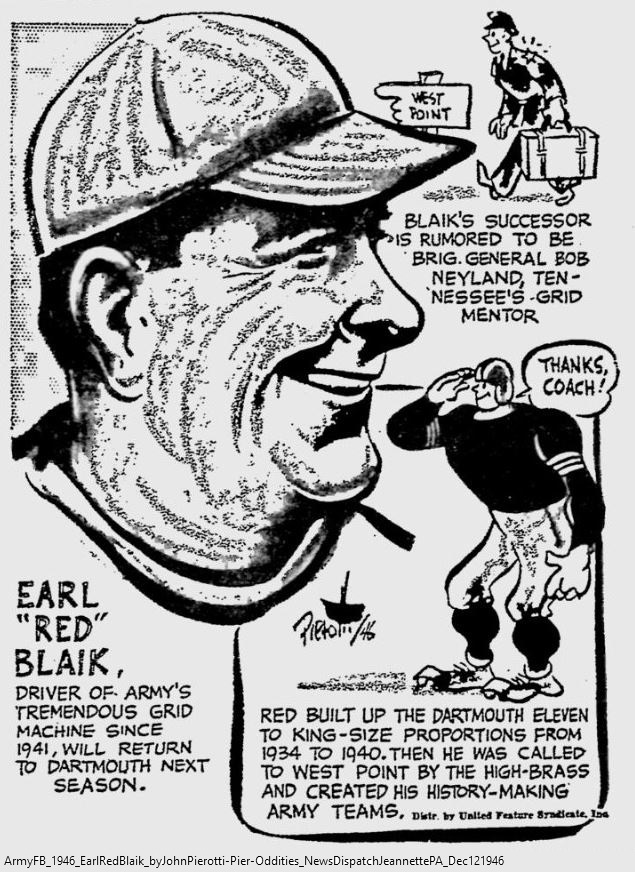
ArmyFB_1946_EarlRedBlaik_byJohnPierotti-Pier-Oddities_NewsDispatchJeannettePA_Dec121946

–

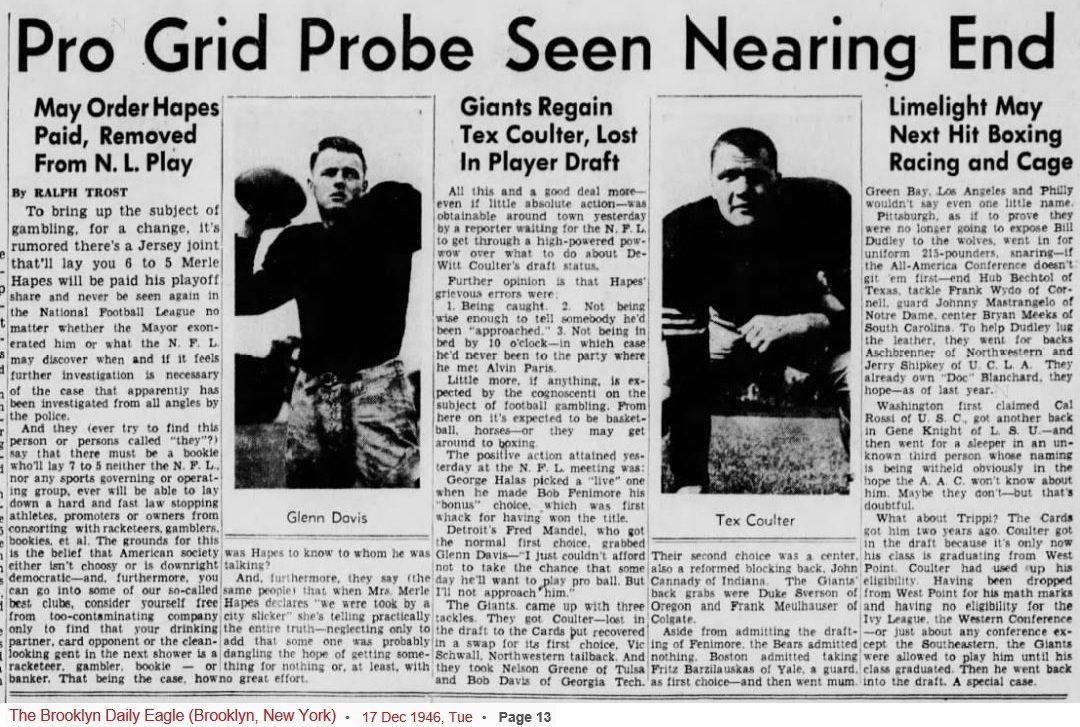
ArmyFB_1946_ProDraft_Davis-Coulter_BrooklynDailyEagle_Dec171946

ArmyFB_1946_ProDraft_Davis-Coulter_BrooklynDailyEagle_Dec171946

–

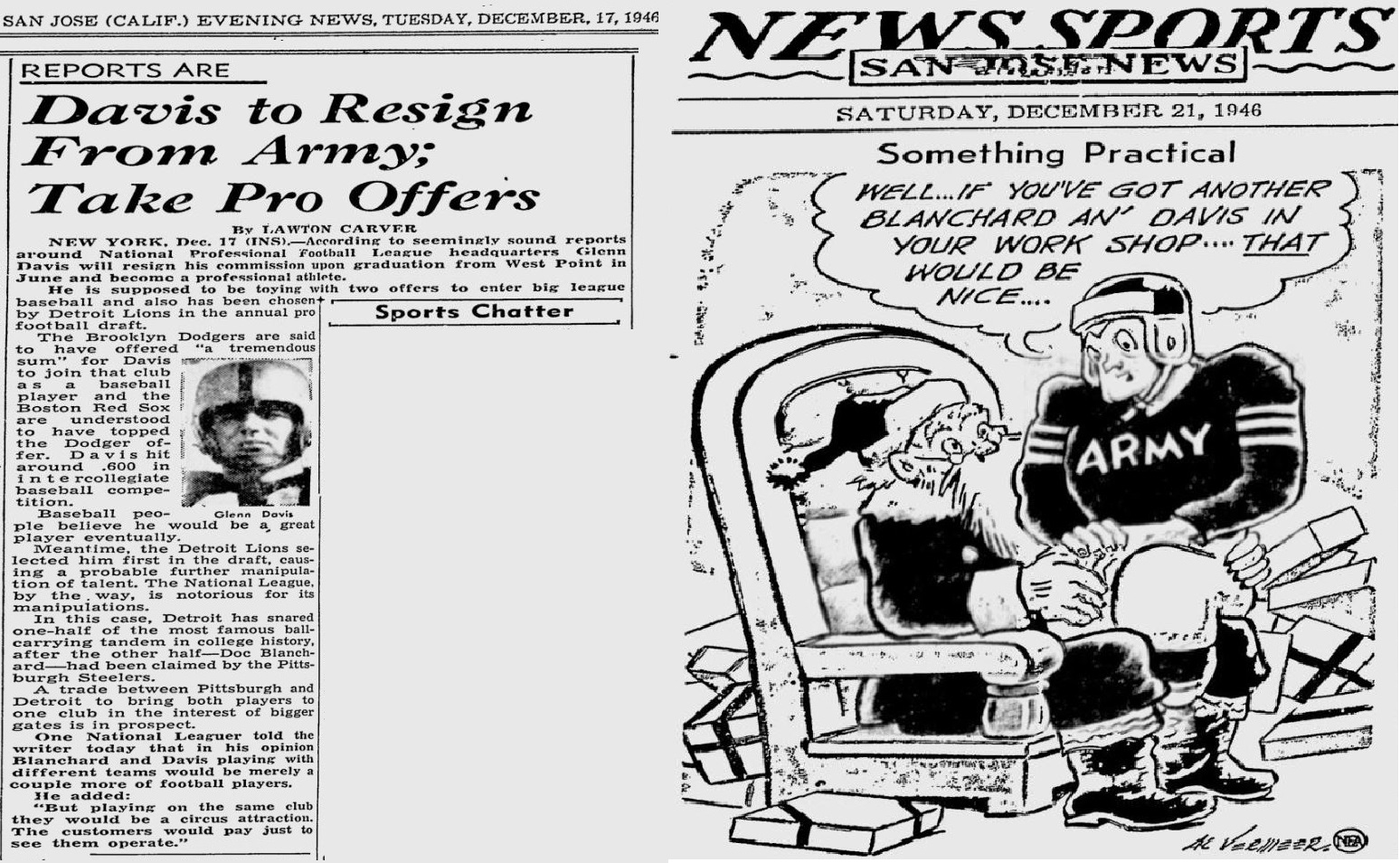
ArmyFB_1946_Davis-Pros_SanJoseEveningNews_Dec171946

–

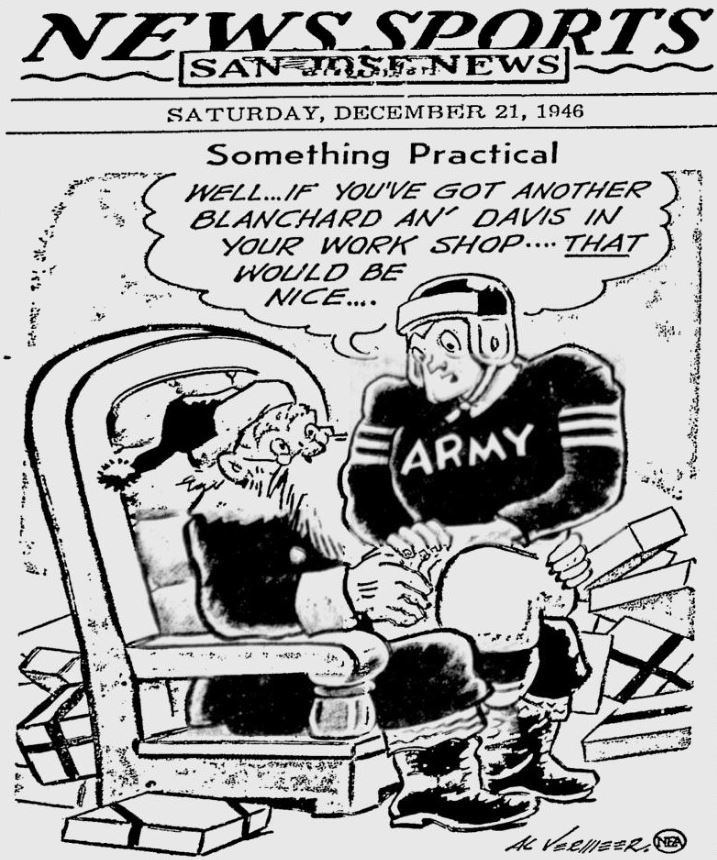
ArmyFB_1946_RequesttoSanta_byAlVermeer_SanJoseEveningNews_Dec211946

–

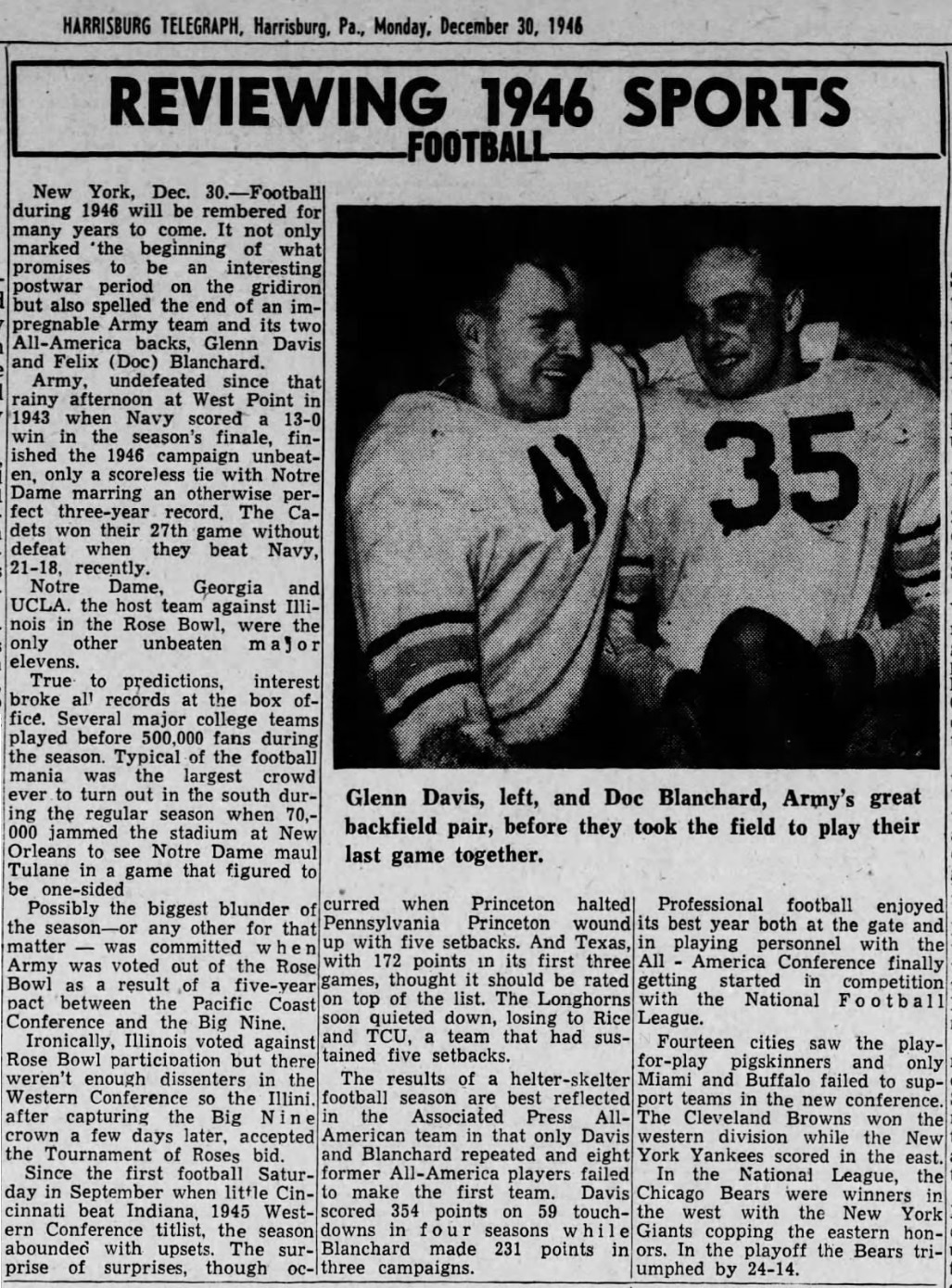
ArmyFB_1946_Review_Blanchard-Davis-pic_HarrisburgTelegraphPA_Dec301946

ArmyFB_1946_Review_Blanchard-Davis-pic_HarrisburgTelegraphPA_Dec301946
–
armyfb_1946_blanchard-davis-tucker_photo
ArmyFB_1946_Blanchard-Davis-Tucker_photo
–
armyfb_1946_blanchard-davis-tucker_oxnardpresscourier_dec51946
ArmyFB_1946_All-Americans_OxnardPressCourier_Dec51946

–

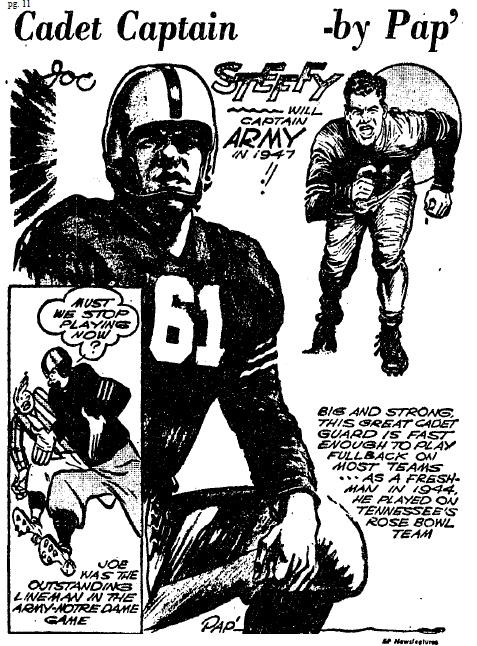
ArmyFB_1946_JoeSteffy_byPap_CSM_Dec171946

ArmyFB_1946_JoeSteffy_byPap_CSM_Dec171946

–

–

ArmyFB_1946_Athletics-intro

–

articles provided by Russ “Skip” Grimm – Class of ’76


By Rabble
Mar 13, 2003

Army-Navy 1946 – A look back at the 1946 Army-Navy game.

by Glenn Davis

14 Years after Glenn Davis played his last game for Army, he wrote an article exclusively for the Associated Press recalling one of the greatest Army-Navy football games in its long and storied history. The following is that story. Dateline—October, 1960.

GRID EXPERTS TALK

DAVIS CANT FORGET 1946 ARMY-NAVY GAME

By Glenn (Junior) Davis

3-Time All-America At West Point (1944-45-46) Heisman and Maxwell Trophy Winner ( 1946) College Football Hall of Fame)

This was the final football game of my college career and the one I shall always remember. It was the Army-Navy game, 1946.

The Army record for three years was 33 won, one tie and no defeats. If we could get by Navy it would be the most successful three years in modern college football. On the other hand, if we lost we might go down in the recod book as “just another team”.

Our team, was confident. Weren’t we playing a Navy team that had lost its last seven games? Hadn’t the newspaper so made us a solid 21-point favorite? Navy kicked oft, Army went right down the field and scored in fact, the first three times we got our hands on the ball we scored.

At half-time,the score was Army 21, Navy 0. In our dressing room you could hear such remarks as, “let’s make it 50-0,” and “they couldn’t break a paper bag the way they’re blocking today.” During the balf-time break, Col. Earl Blaik and the assistant coaches were trying to correct first half mistakes and make some new plays for the final two quarters. But no one was really paying much attention.

Running through our minds was a single thought, “how I will the papers play up a 50-0 game?” Army kicked off to Navy for the second half. The Middies marched right down the field and scored, but missed the extra point to make tht score 21-6.

Not much later a pass ihterception gave the Middies the ball deep in our territory and Navy went on to score, but missed the extra point again. It was now 21-12. Early in the fourth quarter on fourth down and one yard to go on our own 40 we elected to go to It. Doc Blanchard carried off-tackle.

There was no hole. Navy held. Eight plays later Navy scored its third touchdown. The score moved up to 21-18. Things were getting serious. Our three-year record was in jeopardy. Now Navy had the momentum and our chins were dragging on the ground. Navy was moving the ball easily and we couldn’t stop them.

With only five minutes to play Army fumbled and Navy recovered. Again the Middies started a drive. There wasnt much time remaining when Navy was on our 10- yard line. An off-tackle smash moved the ball to the 4 and only seconds remained. It was 2rd down and we stopped them for a gain of one. On the next play, Navy was stopped for no gain.

Time ran out before they could get off another play for the 4th down. The game was over. We had won 21-18. I shall never forget the game or the great lesson it is for all football players. Over-confidence can really ruin a great football team or individual star quicker than anything else.

Hadn’t we just seen what happens when you wake up to the fact that you are really in a dog fight out on the field only to find that you are playing a gang of supercharged Tigers? Sure, we won 21-18. But wernt we the 21-point favorites? Ill never forget it.


Sixty years later, it still bothers Joe Steffy. He and his former Army football teammates, now in their early-80s, still talk about the 1946 season. But this story starts in ’44.
Army went 9-0 that year, winning the national championship, repeating the feat in ’45. Then came 1946: Army vs. Notre Dame at Yankee Stadium. Army had beaten Notre Dame 48-0 and 59-0 the previous two years. The game featured four current or eventual Heisman Trophy winner, three current or eventual Outland Trophy winners and 23 current or eventual All-Americans. It ended in a 0-0 tie. In ’46, Army finished the year 9-0-1: Unbeaten, but not perfect. Even though Steffy begs to differ.

“They didn’t beat us, nobody did,” Steffy says. Still, the real disappointment came for Army at the end of the season. The Associated Press voters went with Notre Dame at No. 1. Back in those days, though, there was no official coaches’ poll and a host of national polls. Notre Dame was voted tops in five polls, Army in two and the teams were co-champs in three more. As you can see, even back then, the polls were far from perfect.

“We were still the national champs,” he says. “It’s like the heavyweight champ of the world, you have to beat him to take away the title. They didn’t beat us, I still can’t believe it””

By Justin Rodriguez Times Herald-Record December 23, 2007 Edited


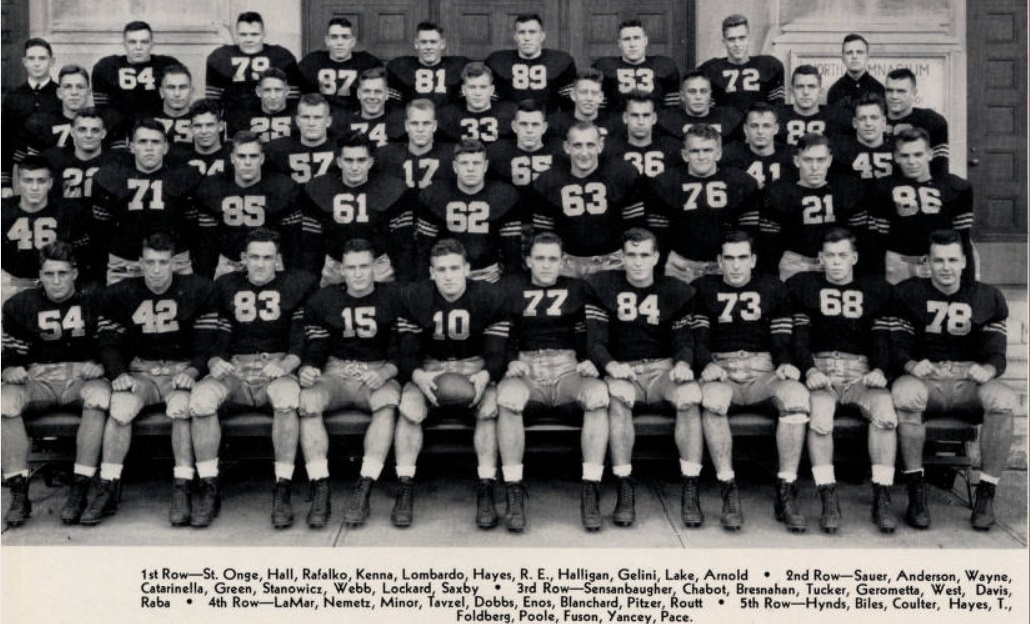
1944 Football Team


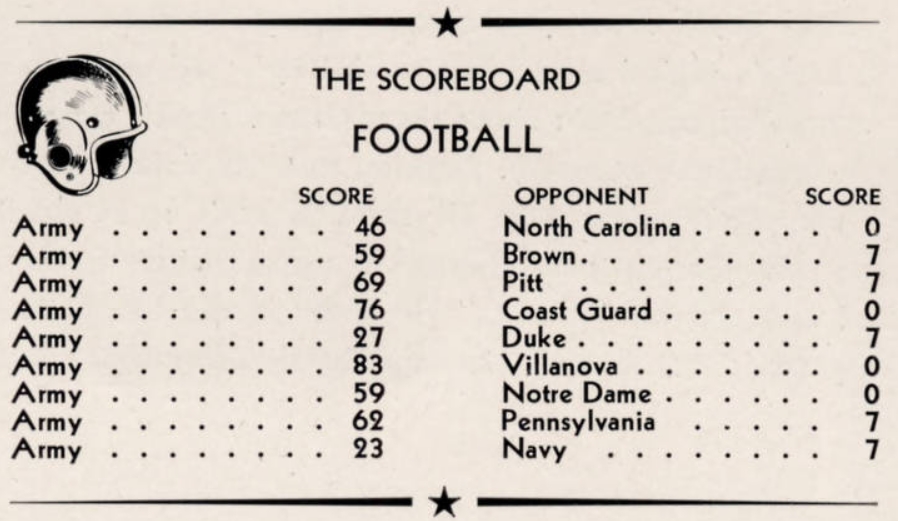
1944 Army 9-0 AP#1

09/30 Army 46 – North Carolina 0
10/07 Army 59 – Brown 0
10/14 Army 69 – Pittsburgh 7
10/21 Army 76 – Coast Guard 0
10/28 Army 27 – Duke 7
11/04 Army 83 – Villanova 0
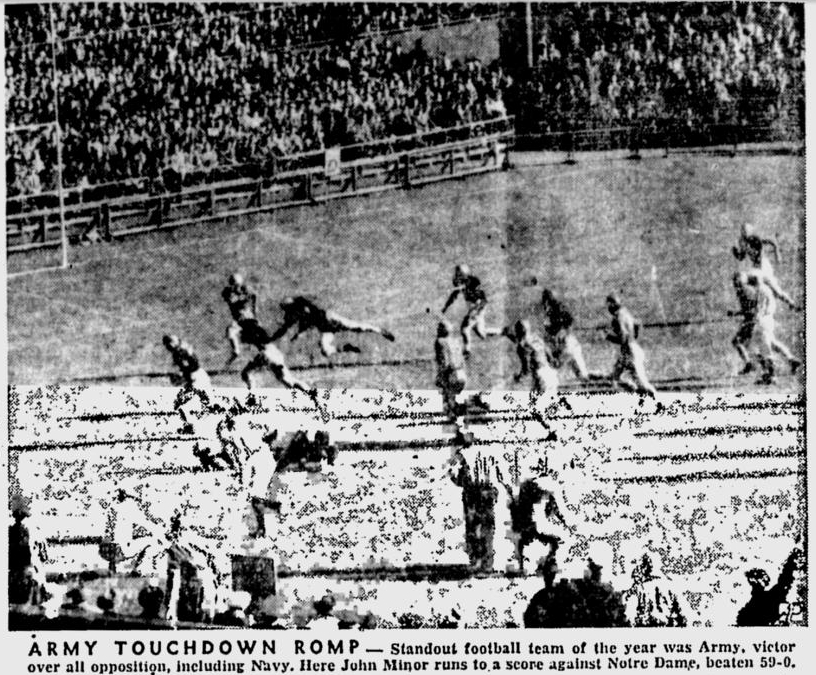
11/11 Army 59 – Notre Dame 0
11/18 Army 62 – Pennsylvania 7
12/02 Army 23 – Navy 7 W Baltimore, MD

Coach: Earl Henry “Red” Blaik (February 15, 1897 – May 6, 1989)
Dartmouth 1934-1940 – 45-15-4
Army: 1941-1958 – 121-33-10
Overall: 166-48-14
Awards:
All-American, 1919
AFCA Coach of the Year (1946)
College Football Hall of Fame, Inducted in 1964

Howitzer 1945
http://digital-library.usma.edu/cdm/compoundobject/collection/howitzers/id/2979/

–

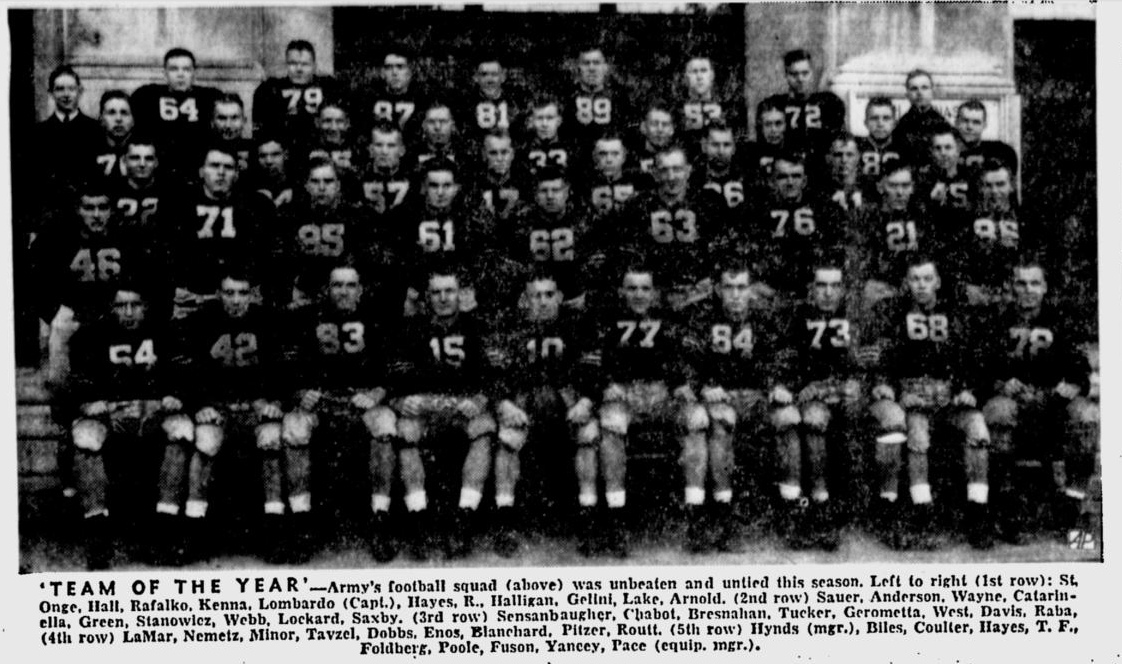
ArmyFB_1944_team_NationalChamps

–

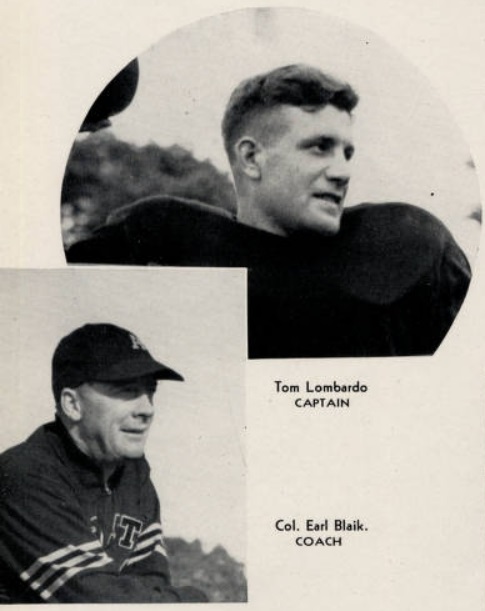
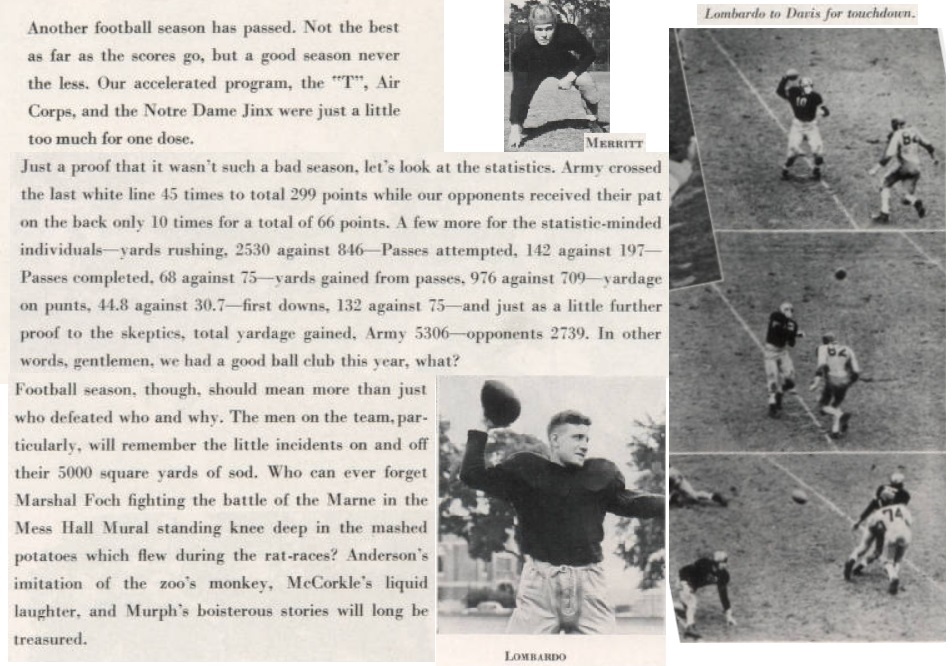
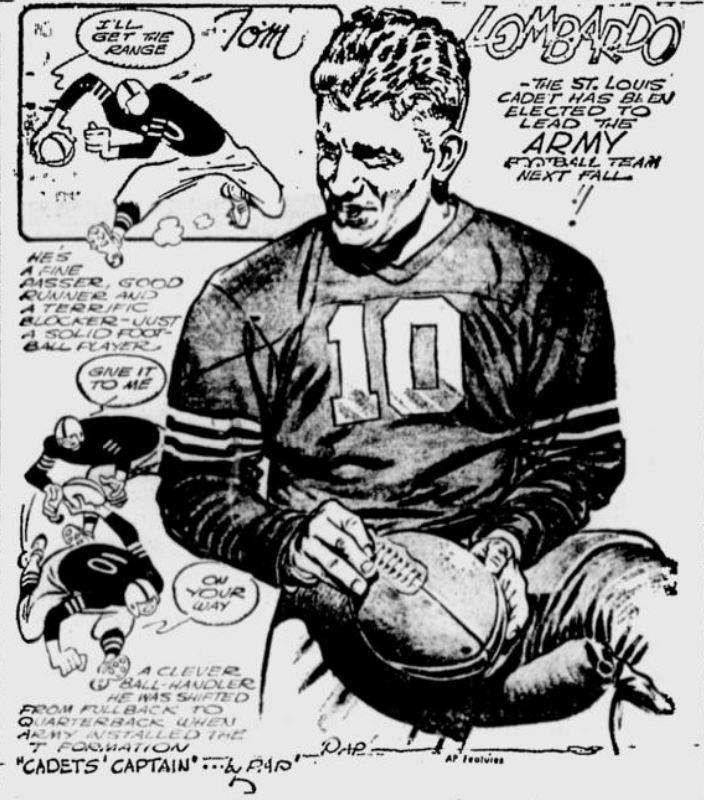
ArmyFB_1944_CoachBlaik_Lombardo-Captain

–

ArmyFB_1944_record

–

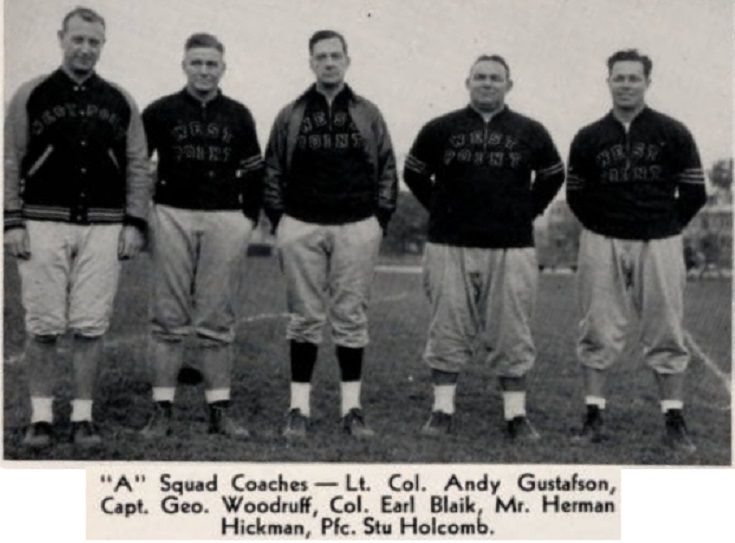
ArmyFB_1944_coaches

–
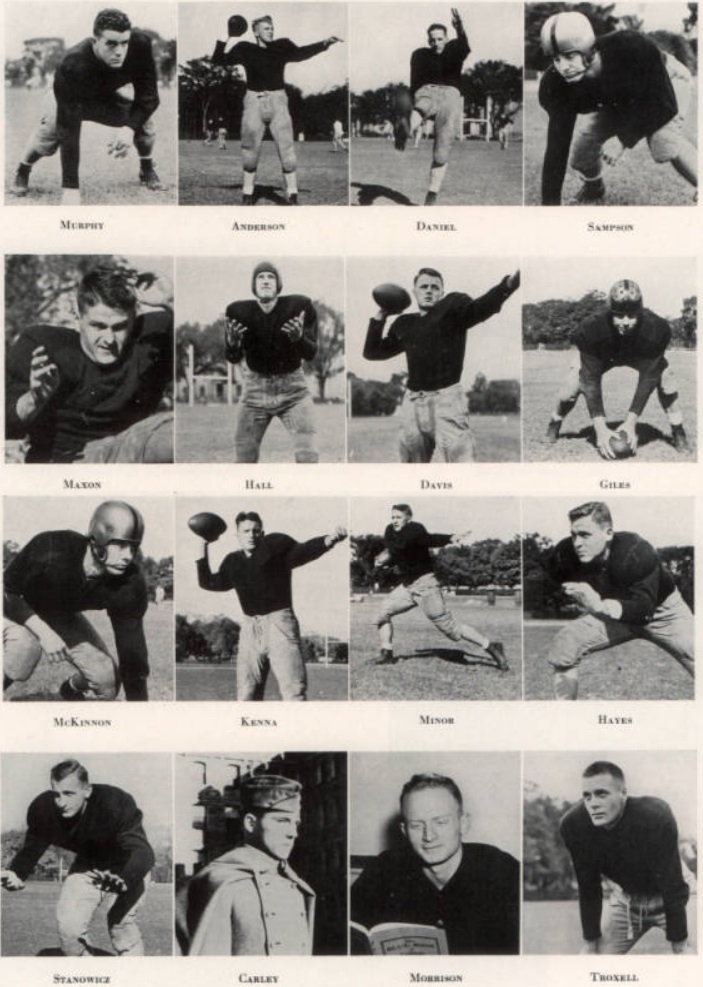
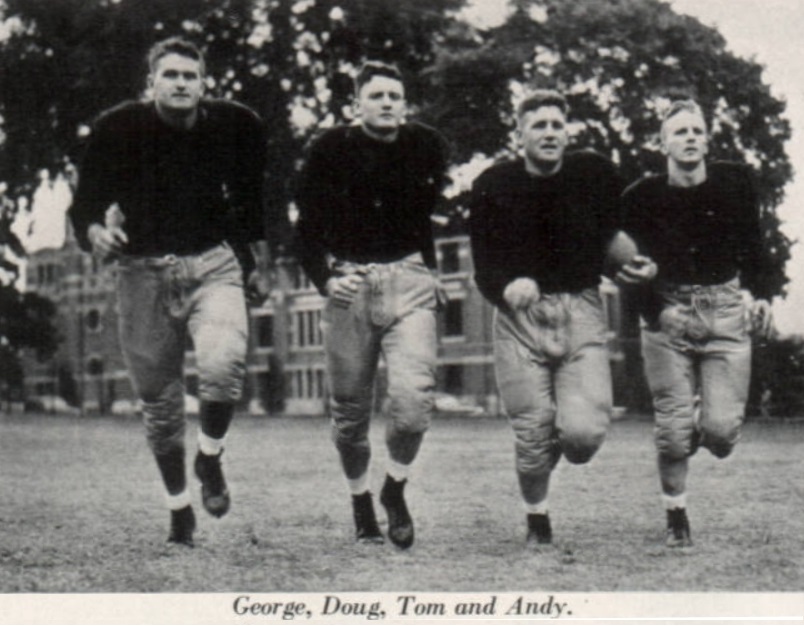
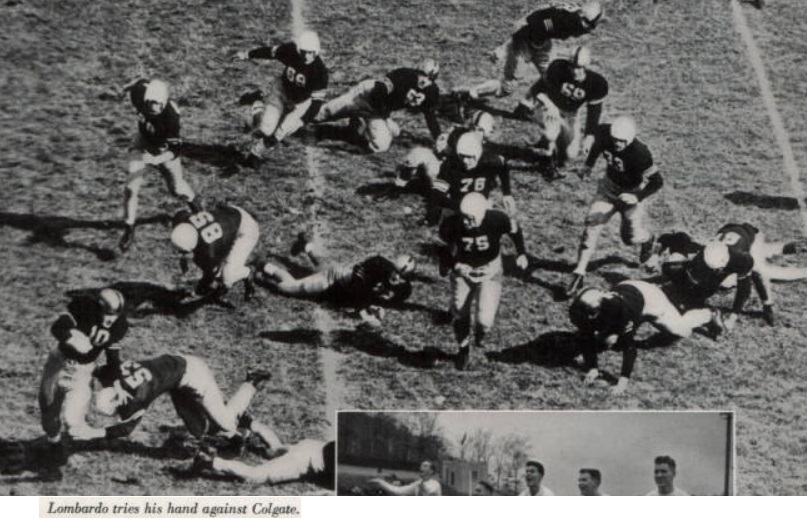
ArmyFB_1944_write-up

–

ArmyFB_1944_theT-at-work

–

ArmyFB_1944_Blanchard-run-1

–

ArmyFB_1944_Blanchard-run-2

–

ArmyFB_1944_Hall-run-1

–

ArmyFB_1944_Kenna-run-1

–

ArmyFB_1944_truck-wide

–

ArmyFB_1944_vsNotreDame

–

ArmyFB_1944_Goat-EngineerGame

–

ArmyFB_1944_Navy-1

–

ArmyFB_1944_Navy-2

–

ArmyFB_1944_BSquad

–

News Articles

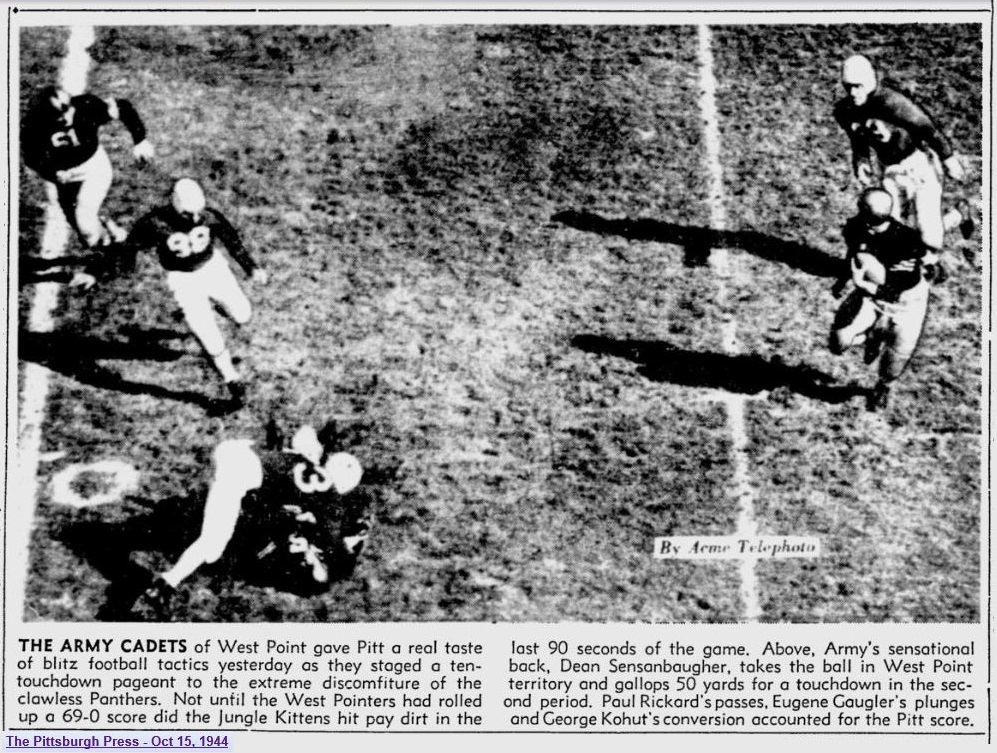
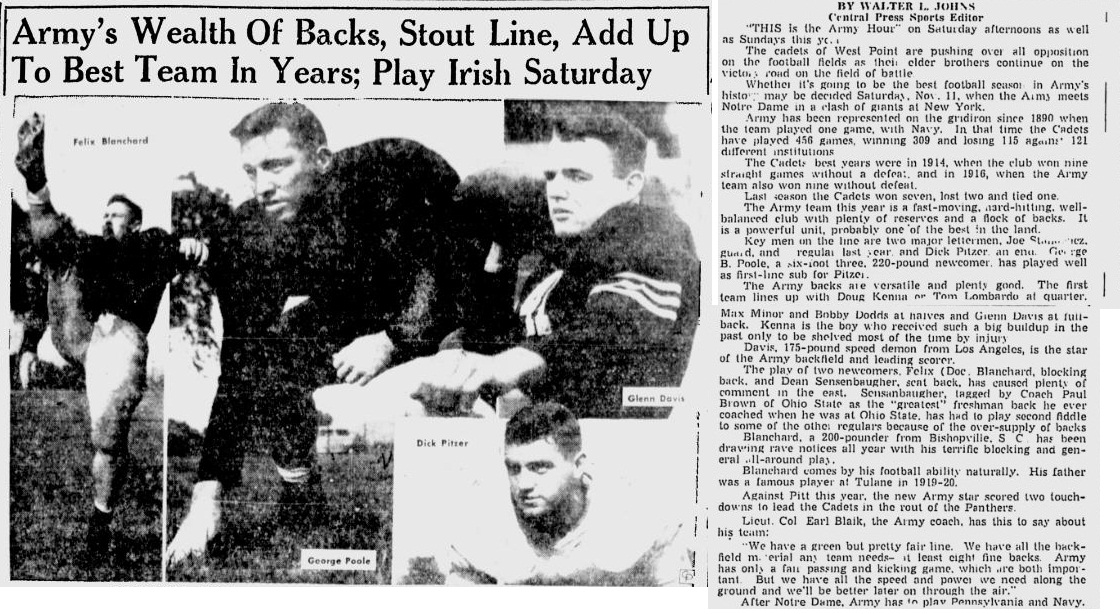
ArmyFB_1944_vsPitt_DeanSensanbaugher_PittsburghPress_Oct151944

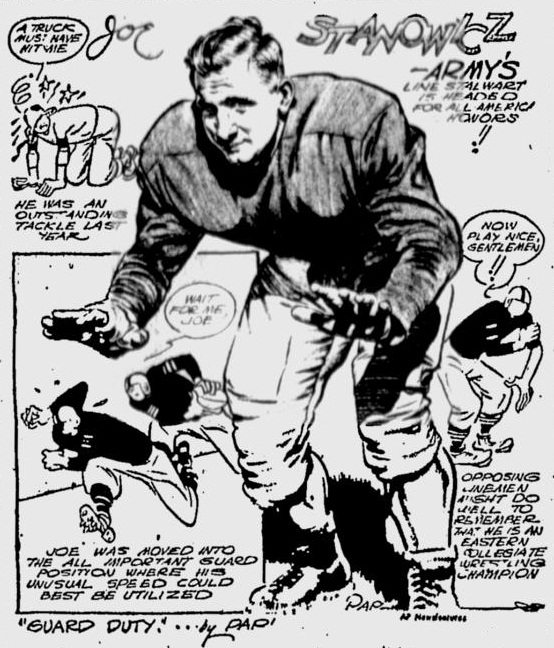
ArmyFB_1944_JoeStanowicz_byPap_PrescottEveningCourier_Oct281944
–

ArmyFB_1944_DocBlanchard_byJackSords_PainesvilleTelegraph_Nov61944

ArmyFB_1944_DocBlanchard_byJackSords_PainesvilleTelegraph_Nov61944
–
armyfb_1944_backs_painesvilletelegraph_nov91944
ArmyFB_1944_Backs_PainesvilleTelegraph_Nov91944
–

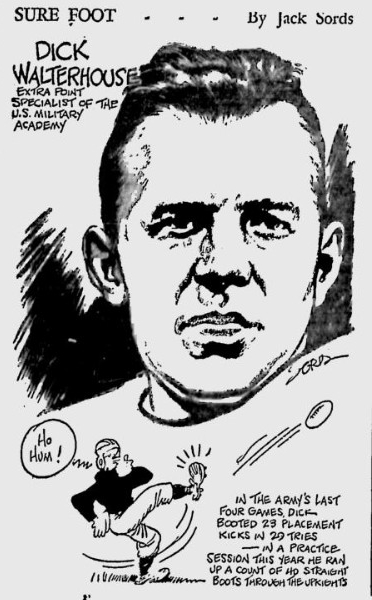
ArmyFB_1944_DickWalterhouse_byJackSords_GreensburgDailyTribune_Nov91944
–
armyfb_1944_backs-line_painesvilletelegraphandgreesburgdailytribune_nov7-91944
ArmyFB_1944_Backs-Line_PainesvilleTelegraphandGreesburgDailyTribune_Nov7-91944
–

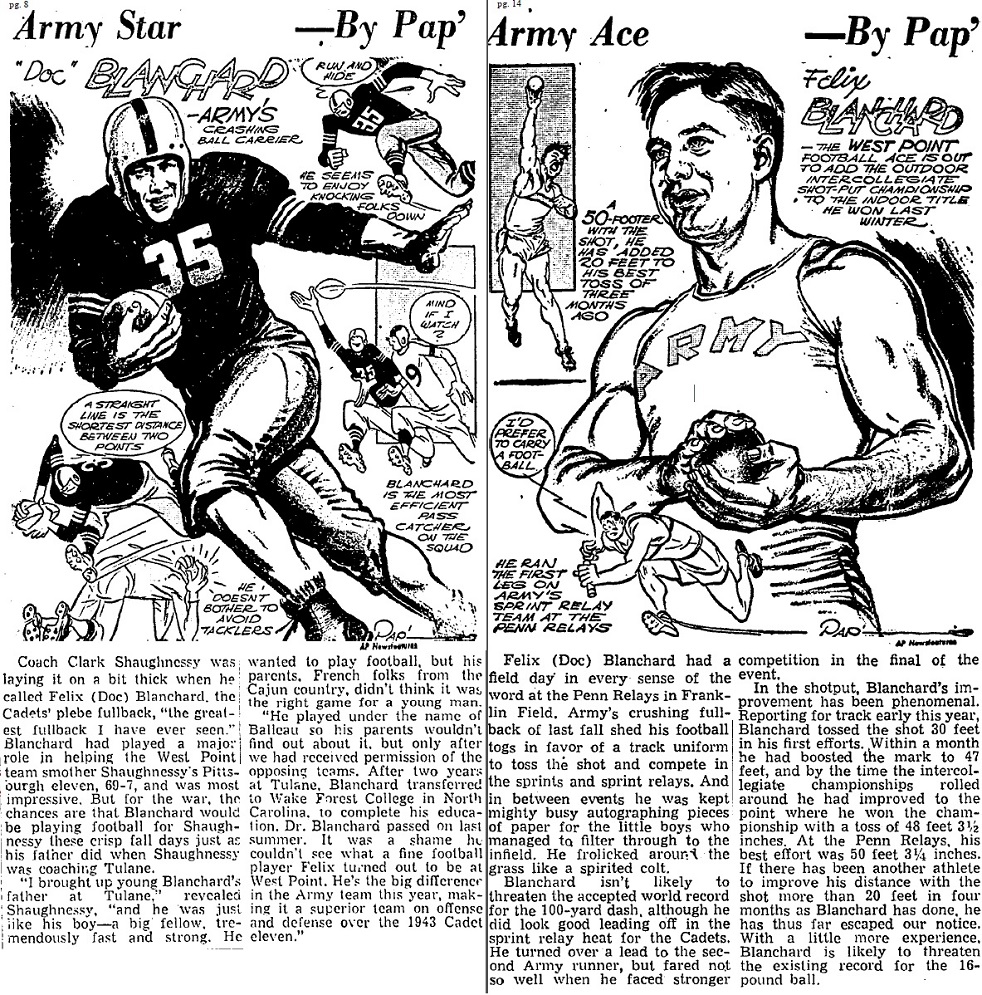
ArmyFB_1944_DocBlanchard_byPap_CSM_Nov151944-May101945
–

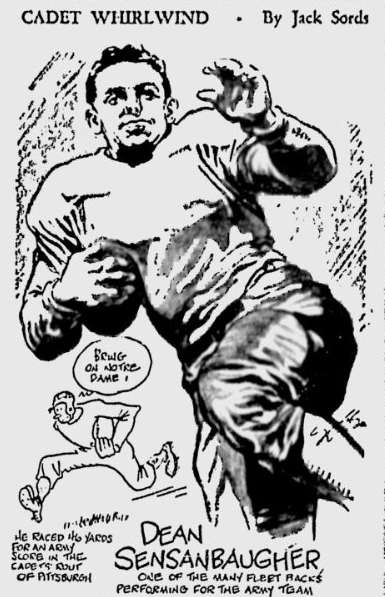
ArmyFB_1944_DeanSensanbaugher_byJackSords_GreensburgDailyTribune_Nov211944

–
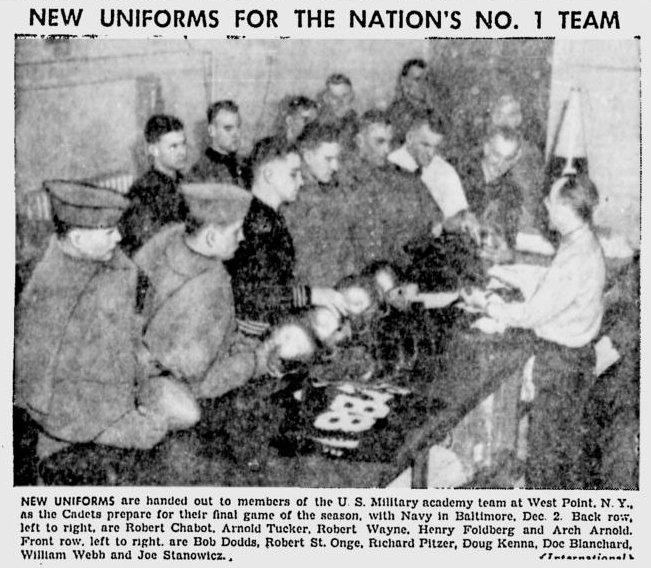
armyfb_1944_newuniforms_greensburgdailytribune_nov301944
ArmyFB_1944_NewUniforms_GreensburgDailyTribune_Nov301944

–

ArmyFB_1944_vsNavy_byJackSords_PainesvilleTelegraph_Nov301944
–
armyfb_1944_vsnavy_ottawacitizen_dec21944
ArmyFB_1944_vsNavy_OttawaCitizen_Dec21944
–

ArmyFB_1944_vsNavy_SundayMorningStar_Dec31944

ArmyFB_1944_vsNavy_SundayMorningStar_Dec31944

armyfb_1944_vsnavy_palmbeachpost_dec31944
ArmyFB_1944_vsNavy_PalmBeachPost_Dec31944
–
armyfb_1944_vsnavy_eveningindependent_dec41944
ArmyFB_1944_vsNavy_EveningIndependent_Dec41944
–

ArmyFB_1944_GlennDavis_byJackSords_PainesvilleTelegraph_Dec41944
–
armyfb_1944_vsnavy_prescotteveningcourier_dec71944
ArmyFB_1944_vsNavy_PrescottEveningCourier_Dec71944
–

ArmyFB_1944_ArmyTeam_PrescottEveningCourier_Dec91944

ArmyFB_1944_ArmyTeam_PrescottEveningCourier_Dec91944
–
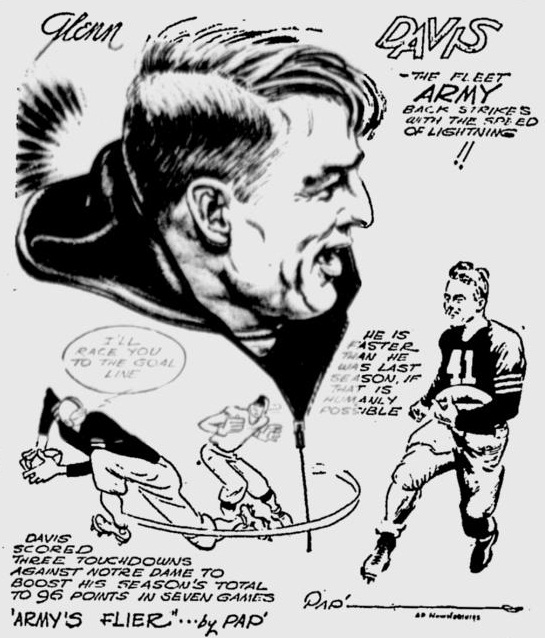
ArmyFB_1944_GlennDavis_byPap_PrescottEveningCourier_Dec111944
–

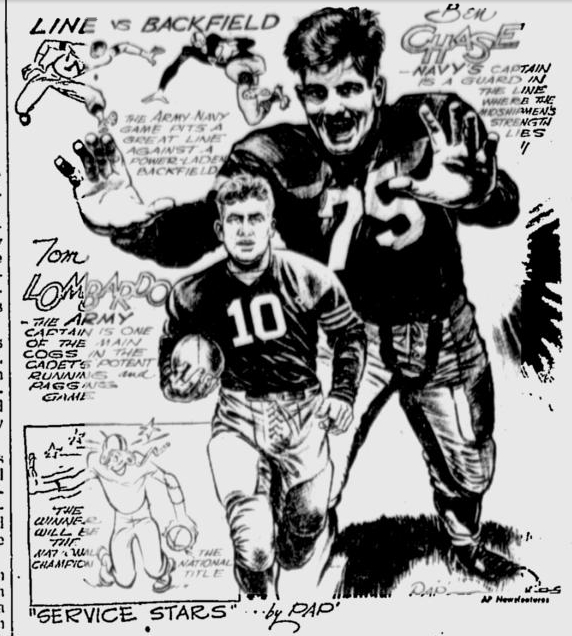
ArmyFB_1944_TomLombardo_byPap_PrescottEveningCourier_Dec151944

–

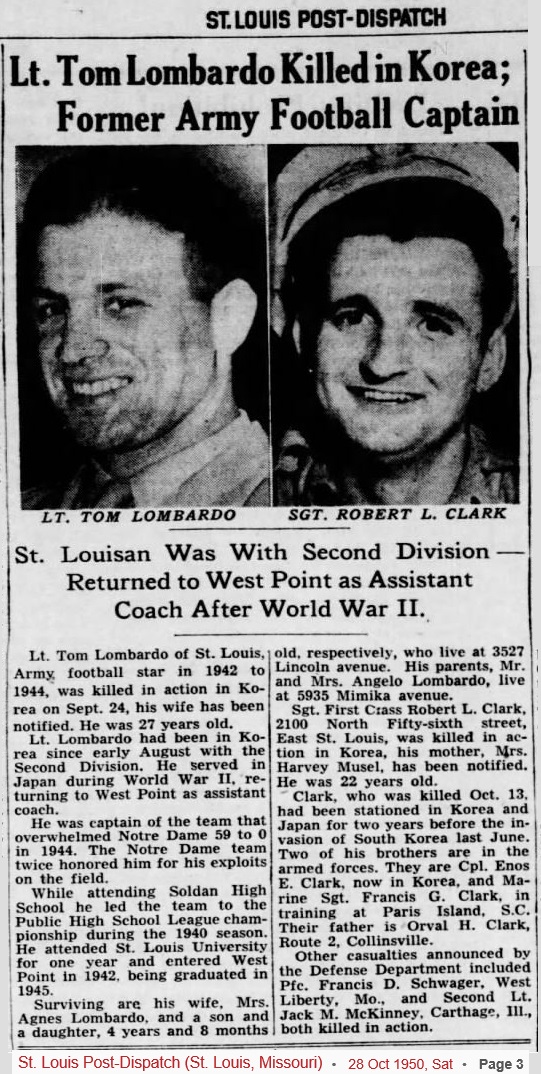
armyfb_1942-44_tomlombardo-kia-korea_stlouispostdispatch_oct281950
–

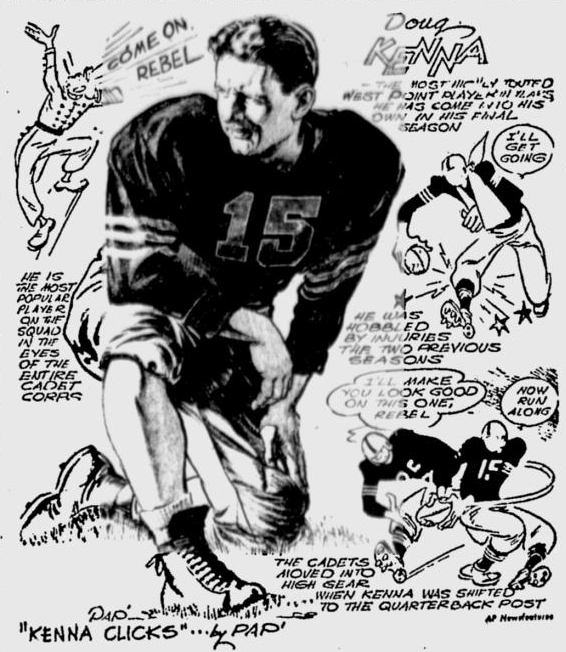
ArmyFB_1944_DougKenna_byPap_PrescottEveningCourier_Dec161944
–
armyfb_1944_vsnotredame_prescotteveningcourier_dec301944
ArmyFB_1944_vsNotreDame_PrescottEveningCourier_Dec301944
–

–
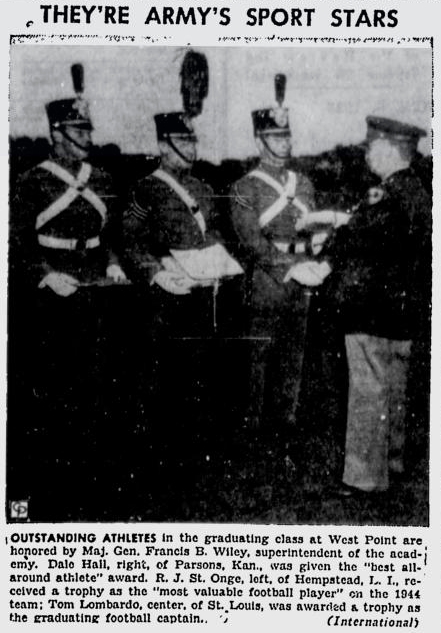
armyfb_1945_hall-lombardo-stonge_greensburgdailytribune_jun81945
ArmyFB_1945_Hall-Lombardo-StOnge_GreensburgDailyTribune_Jun81945

_________________________________________________________________________________________________________

Army was crowned as the nation’s #1 team by 95 of the 121 writers who participated in the AP poll.
As in 1943, the AP poll included service teams, drawn from flight schools and training centers which were preparing men for fighting in World War II, and the teams played against the colleges as part of their schedules.
Half of the final Top 20 teams were composed of service teams, in addition to the two service academies at West Point and Annapolis.
Most colleges that had suspended their programs in 1943 were back in 1944, including the entire Southeastern Conference.

___________________________________________________________________________________________________________

The Army-Navy Game Nobody Missed

In 1944, No. 1 Army Met No. 2 Navy in a Game for the Ages

Huddled Around Shortwave

MORE IN COLLEGE FOOTBALL

By RANDY ROBERTS

On the bitterly cold afternoon of Dec. 2, 1944, West Point’s Felix “Doc” Blanchard kicked the football to Annapolis’s Bobby Tom Jenkins to begin the biggest contest in the history of the Army-Navy series.

Sitting in the press box in Baltimore’s Municipal Stadium, reporter Al Laney wrote, “There never has been a sports event, perhaps never an event of any kind, that received the attention of so many Americans in so many places around the world.”

On that day the world was at war, but for a few hours, for the legions of American servicemen huddled around shortwave sets in Europe, the Mediterranean and the Pacific, the hostilities seemed to stop. This was a game played by boys training to be soldiers and sailors for the benefit of battle-hardened soldiers and sailors dreaming of being boys once again.

Clockwise from top left: U.S. Naval Academy (2), Time Life Pictures/Getty Images,

Clockwise from top left: The 1944 Army-Navy game; A program from the game; Future Heisman Trophy winners Glenn Davis (No. 41) and Doc Blanchard (No. 35) led Army to victory.

This year’s Army-Navy game, which takes place Saturday in Landover, Md., pits the 4-7 Midshipmen’s limping through their worst season in nearly a decade’s gainst a 3-8 Black Knights squad. Neither team can go to a bowl. The only intrigue is whether Navy has regressed enough to finally lose to Army for the first time since 2001.

But in 1944, this rivalry game was not only freighted with the unusual significance of the time, it was also one of the best and most hotly anticipated football games of all time. Army was 8-0 and ranked No. 1 in the country. Navy, at 6-2, was ranked No. 2.

At 2 p.m., with snow flurries in the air and servicemen around the world listening, the two teams finally met – both for college-football supremacy and for the greater honor of their schools and services.

The matchup almost didn’t happen. Slightly less than three years earlier, when the Japanese assault on Pearl Harbor plunged the U.S. into World War II, there were calls from politicians and journalists for Americans to set aside peacetime frivolities. Pro fessional baseball and college football had no place in a nation at war, some thought. “You can’t train a man to be a fighter by having him play football and baseball,” said Cmdr. James Joseph “Gene” Tunney, the Navy’s director of physical training and boxing’s former heavyweight champion. College football, he said, “has no place in war or preparing for war.”

Others disagreed. Cmdr. Thomas J. Hamilton, the head of the Navy’s Prefight and Physical Training program and a former head coach at Annapolis, thought football was an ideal way to train men for combat. And since Hamilton had the ear of the Navy brass, his position carried the day.

Football became an integral part of the Navy’s V-5 preflight initiative. This training program was installed at select college campuses including Iowa and Georgia. Other larger Navy V-programs followed the V-5’s lead. The mammoth V-12 program, instituted in over 130 colleges just before the 1943 football season to train naval and marine officers, also permitted – and even encouraged – these candidates to participate in varsity sports.

While the Navy was underwriting the continuation of college football, the Army moved in the opposite direction. The Army Specialized Training Program (ASTP), instituted in more than 240 colleges, prohibited cadets from participating in intercollegiate sports.

These decisions by leaders of the Army and Navy reshaped college football. Traditions were shed and the prewar pecking order was scrambled. Schools with Army Specialized Training Program were out of the running as serious football schools. Most could not field a team and discontinued the sport. Alabama, Auburn, Stanford and Syracuse didn’t field teams in 1943. Meanwhile, schools with V-12 programs, especially V-12 Marine programs, walked in tall cotton.

As some football programs declined or folded, V-12 schools like Notre Dame, Southern California and Purdue snapped up their best players. A player from Ohio State or Illinois, for instance, could enlist in a Marine V-12 program in July and find himself playing in the opener for Notre Dame in September (not surprisingly, the Irish won the 1943 national title).

The burst of football talent at these schools wouldn’t last. By late 1943, the Marines desperately needed junior officers to lead troops onto Pacific beaches. Football was no longer such a priority and V-12 programs were tapped for officers. No one was exempt. This point became clear on Nov. 1, 1943: Before the end of the season, the Marines called up Angelo Bertelli, Notre Dame’s All-American quarterback, and shipped him off to Paris Island to continue his training.

As transient as college football had become, there were two teams left largely intact: Army and Navy. Although both academies had shortened their courses of instruction and training to three years from four, Army’s cadets and Navy’s midshipmen were not subject to sudden call-ups or shipped preemptively overseas. They stayed on post until they graduated. And the leaders at both academies believed that excellence on the gridiron was important to the war effort. The Army and Navy football teams, thry believed, should stand as proxies for the two branches of service.

In late 1940, when Gen. Robert L. Eichelberger was appointed superintendent of the U.S. Military Academy, Army’s football team was in a sorry state. Certain that war was imminent, Eichelberger decided he wanted a team that would reflect the excellence of the academy and the Army.

As one of his first important acts as superintendent, he landed Earl “Red” Blaik as head football coach. Blaik had led Dartmouth to a 22-game unbeaten streak in the 1930s.

As wartime rules tilted college football’s balance of power toward the academies, Blaik had little trouble landing talent. Army quarterback Doug Kenna, who is now in the College Football Hall of Fame, began his career at Mississippi – but when his team was gutted by the war, he accepted an appointment at West Point. Barney Poole, a future Hall of Fame end, also moved from Ole Miss to West Point, with a pit stop during the 1943 season to play on North Carolina’s V-12 team.

Then there was Army’s famous backfield of Doc Blanchard and Glenn Davis – tandem that’s widely regarded as one of the best in the history of the sport. Blanchard, the fullback who was known as “Mr. Inside,” had played his freshman year at North Carolina and spent time in the Army before ending up on Blaik’s team. Davis, the halfback known as “Mr. Outside” was one of the few big-name players on the Army team who had gone directly to West Point from the gridirons of high school.

Davis, Blanchard, Kenna, and Poole weren’t so superior as athleted that they could have been considered ringers, but on this day in 1944, they would skirt close to the edge of being so.

The game was close for three quarters. Army led 9-7 going into the fourth. Then came a nine-play, 52-yard Army scoring drive in which Blanchard carried the ball seven times and accounted for all but four of the team’s yards. On the final play of the drive, he ran over three Navy defenders and bulled his way into the end zone.

A short time later, Davis put an exclamation point on the game. Finding a sliver of space, he broke through the Navy line, dodged past several defenders and outraced everyone else for a euphoric 50-yard touchdown run. The 23-7 Army victory was Blaik’s first in the series.

After the game, the coach received a telegram from the Pacific: “The greatest of all Army teams. – STOP – We have stopped the war to celebrate your magnificent success.”

It was signed MacArthur.

Excerpted from “A Team for America: The Army-Navy Game That Rallied a Nation” (Houghton Mifflin Harcourt)

1920 Football Team

1920 Army 7-2
1920/11/27 Army 0 – Navy 7 L

Coach Charles Dudley “Charlie” Daly (October 31, 1880 – February 12, 1959)
Army 1913-1916
Army 1919-1922

Overall: 58-13-3

Appeared in the film Daly, of West Point. 1902.

source http://en.wikipedia.org/wiki/Charles_Dudley_Daly

Howitzer 1921
http://digital-library.usma.edu/cdm/compoundobject/collection/howitzers/id/20132/

–

ArmyFB_1920_team_

–

ArmyFB_1920_team

–

ArmyFB_1920_team-roster-record

–

ArmyFB_1920_Wilhide-Captain

–

ArmyFB_1920_game

–

–

ArmyFB_1920_vsNotreDame_Howitzer1921

–

ArmyFB_1920_vsNavy_starters

–

ArmyFB_1920_vsNavy_stadium

–

ArmyFB_1920_vsNavy_action

–

1943 Football Team

1943 Army 7-2-1 AP#11
1943/11/27 Army 0 – Navy 13 L

Breakout Season under Blaik:
09/25 Army 27 – Villanova 0
10/02 Army 42 – Colgate 0
10/09 Army 51 – Temple 0
10/16 Army 52 – Columbia 0
In four games, the Cadets had outscored their opponents 172-0.
10/23 Army 39 – Yale 7
10/30 Army 13 – Pennsylvania 13
11/06 Army 0 – Notre Dame 26
11/13 Army 16 – Sampson Naval Training Station 7
11/20 Army 59 – Brown 0
11/27 Army 0 – Navy 13
–
Howitzer 1944
http://digital-library.usma.edu/cdm/compoundobject/collection/howitzers/id/4586/

–

ArmyFB_1943_team
–
ArmyFB_1943_team-roster

–

ArmyFB_1943_Myslinski-Captain

–

ArmyFB_1943_coaches

–

ArmyFB_1943_write-up

–

ArmyFB_1943_players

–

ArmyFB_1943_backs

–

ArmyFB_1943_action-1_Lombardo-run

–

ArmyFB_1943_action-2_Minor-run

–

ArmyFB_1943_action-3_Troxell-run

–

ArmyFB_1943_action-4_pitchtoMason

–

ArmyFB_1943_vsNotreDame_Yankee-stadium

–

ArmyFB_1943_vsNotreDame-1

–

ArmyFB_1943_vsNotreDame-2

–

ArmyFB_1943_vsNotreDame-action

–

ArmyFB_1943_vsNavy-1

–
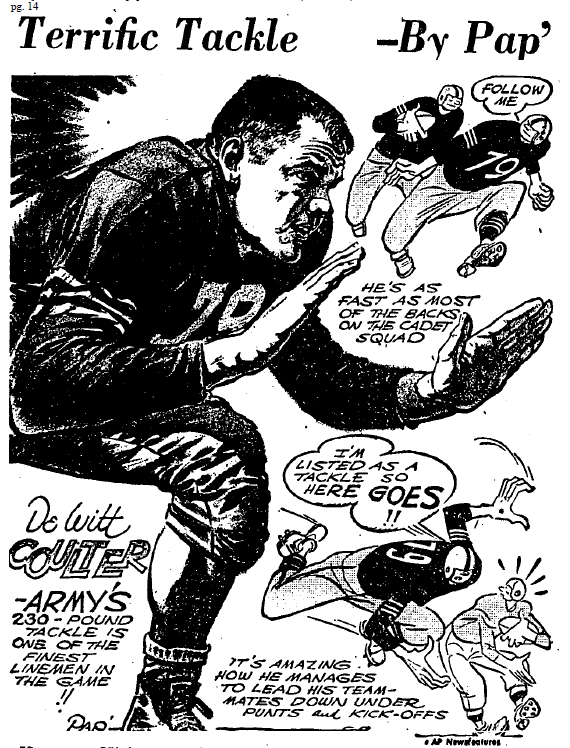
ArmyFB_1943_vsNavy-2

–
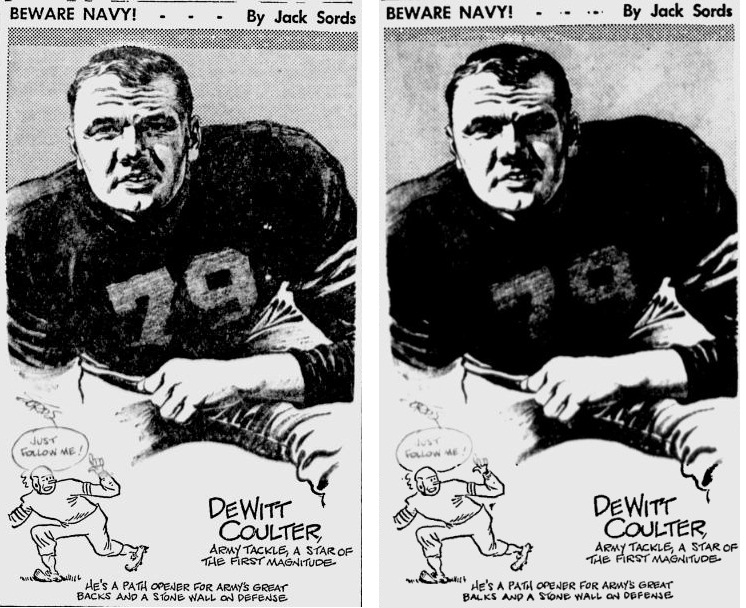
ArmyFB_1943_vsNavy-3

–
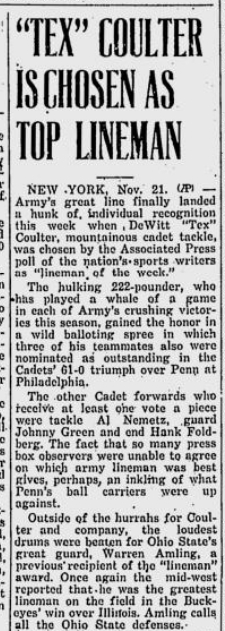
ArmyFB_1943_BSquad

News Articles

ArmyFB_1943_DougKenna_IllustratedFootballAnnual

–

ArmyFB_1943_EddieMurphy_byPap_PrescottEveningCourier_Oct181943
–

ArmyFB_1943_Tformation_PrescottEveningCourier_Oct281943

–

ArmyFB_1943_various_Oct-Nov1943

–

ArmyFB_1943_GlennDavis_various_Oct1943

–

ArmyFB_1943_GlennDavis_MiamiNews_Oct211943

–
–
–

ArmyFB_1943_OldArmyGame_LawrenceJournalWorld_Nov61943

–

ArmyFB_1943_vsND-pre_various_Nov4-51943

–

ArmyFB_1943_GlennDavis_byPap_Telegraph_Nov131943
–

–

ArmyFB_1943_vsNavy-pre_PittsburghPostGazette_Nov251943

–

ArmyFB_1943_vsNavy-Lombard-Myslinski_HeraldJournal_Nov281943

–

ArmyFB_1943_CasimirMyslinski-43Captain_byPap_EllensburgDailyRecord_Dec181943

ArmyFB_1943_CasimirMyslinski-43Captain_byPap_EllensburgDailyRecord_Dec181943

ArmyFB_1943_TomLombardo-44Captain_byPap_EllensburgDailyRecord_Dec201943

ArmyFB_1943_GlennDavis_byJackSords_EveningReviewEastLiverpoolOH_Nov111943

—————————

1937 Football Team

Army 1937 7-2
1937/11/27 Army 6 – Navy 0 W

Coach Garrison Holt Davidson (April 24, 1904 – December 25, 1992)
Army 1933-1937
1933 9-1
1934 7-3
1935 6-2-1
1936 6-3
1937 7-2
Overall: 35-11-1

source: http://en.wikipedia.org/wiki/Garrison_H._Davidson

Howitzer 1938
http://digital-library.usma.edu/cdm/compoundobject/collection/howitzers/id/5647/

–

ArmyFB_1937_team

–

ArmyFB_1937_record

–

ArmyFB_1937_CoachDavidson-Isbell-Captain

–

ArmyFB_1937_coaches

–

–

–

ArmyFB_1937_action-1

–

ArmyFB_1937_action-2

–

ArmyFB_1937_action-3

–

ArmyFB_1937_action-4

–

ArmyFB_1937_action-5

–

ArmyFB_1937_action-6

–

ArmyFB_1937_action-7

–

ArmyFB_1937_vsNotreDame

–

ArmyFB_1937_vsNotreDame_defense

–

ArmyFB_1937_vsNavy-1

–

ArmyFB_1937_vsNavy-2

–

ArmyFB_1937_vsNavy-gamesummary

–

ArmyFB_1937_vsNavy-offense

–

ArmyFB_1937_vsNavy-punt

News Articles

–

ArmyFB_1937_JimIsbell_byPap__SpokaneDailyChronicle_Dec71936

–

ArmyFB_1937_JackRyan_byJackSords_SchenectadyGazette_Nov111937

–

ArmyFB_1937_JimCraig_SpokanedailyChronicle_Nov161937

ArmyFB_1937_JimCraig_SpokanedailyChronicle_Nov161937


ArmyFB_1937_JimCraig_byPap_MoberlyMonitorMo_Nov111937

–


ArmyFB_1937_vsNavy_pre_ReadingEagle_Nov241937

–

armyfb_1937_vsnavy_pre_readingeagle_nov271937
ArmyFB_1937_vsNavy_pre_ReadingEagle_Nov271937

–

ArmyFB_1937_vsNavy_SundayMorningStar_Nov281937

ArmyFB_1937_vsNavy_SundayMorningStar_Nov281937

armyfb_1937_vsnavy_readingeagle_nov281937
ArmyFB_1937_vsNavy_ReadingEagle_Nov281937

armyfb_1937_vsnavy_thetelegraph_nov291937
ArmyFB_1937_vsNavy_TheTelegraph_Nov291937

armyfb_1937_vsnavy-gardavidson_readingeagle_nov281937
ArmyFB_1937_vsNavy-GARDavidson_ReadingEagle_Nov281937

Gar Davidson, a real story book hero.
library.la84.org/SportsLibrary/CFHSN/CFHSNv02/CFHSNv02n3g.pdf‎

ArmyFB_Coaches_byBurnley_OgdensburgAdvance_Oct271937

ArmyFB_Coaches_byBurnley_OgdensburgAdvance_Oct271937

–

1926 Football Team

1926 Army 7-1-1 #8*
1926/11/27 Army 21 – Navy 21 T (Soldier Field, Chicago Il)

Howitzer 1927
http://digital-library.usma.edu/cdm/compoundobject/collection/howitzers/id/17799

–

ArmyFB_1926_team

–

ArmyFB_1926_prospectus

–

ArmyFB_1926_CoachJones-TinyHewitt-Captain

–

ArmyFB_1926_coaches

–

ArmyFB_1926_B-Squad

–

ArmyFB_1926_C-Squad-PlebeTeam

–

ArmyFB_1926_vsNotreDame

–

ArmyFB_1926_vsNavy_MulemeetsGoat

–

ArmyFB_1926_vsNavy_starters

–

ArmyFB_1926_vsNavy_Cagle-runs

–

ArmyFB_1926_vsNavy_nogain

ArmyFB_1926_vsNavy_Chicago-SoldierField

–

read below – THE GREATEST ARMY–NAVY
By Ray Schmidt
“…No single game in college football history has ever so completely
combined the color, spectacle, national media coverage, public popularity,
and top-flight level of play as the Army-Navy battle of 1926 at Soldier Field.
Robert Kelley of the New York Times defined the game’s significance when he wrote
that day:
“Football had the greatest pageant, its high spot of color, and so did sport in the United States.”

http://www.la84.org/SportsLibrary/CFHSN/CFHSNv17/CFHSNv17n2e.pdf

*”The 1926 college football season was the first to attempt recognition of a national champion.
The Dickinson System was a mathematical point formula that awarded national championships in college football.
Devised by University of Illinois economics professor Frank G. Dickinson, the system crowned national champions from 1926 to 1940,
and included predated rankings for 1924 and 1925.”

Coach: Lawrence McCeney “Biff” Jones (October 8, 1895 – February 12, 1980)
Army 1926-1929 – 30-8-2
LSU 1932-1934 – 20-5-6
Oklahoma 1935-1936 – 9-6-3
Nebraska 1937-1941 – 28-14-4 (1940 Rose Bowl vs Stanford AP#7)

Total: 87-33-15

source: http://en.wikipedia.org/wiki/Biff_Jones


ArmyFB_1926_vsNavy_NewburghNews_Nov271926-1


ArmyFB_1926_vsNavy_EveningIndependent_Nov271926


ArmyFB_1926_vsNavy_SarasotaHeraldTribune_Nov281926

–

ArmyFB_1926_vsNavy_ChicagoTribune_Nov291926

–

ArmyFB_1926_vsNavy_panoramic_ChicagoTribune_Nov291926

–

ArmyFB_1926_vsNavy_ChicagoTribune_Nov291926_photos1

–

ArmyFB_1926_vsNavy_ChicagoTribune_Nov291926_photos2

–

ArmyFB_1926_vsNavy-Bennett-article_ChicagoTribune_Nov291926

–

–

ArmyFB_1926_LightHorseHarryWilson_byFegMurray_AmsterdamEveningRecorder_Nov171926

ArmyFB_1926_LightHorseHarryWilson_byFegMurray_AmsterdamEveningRecorder_Nov171926

ArmyFB_1926_vsNavyinChicago_byFegMurray_byJackSords_Utica_Nov301926

ArmyFB_1926_vsNavyinChicago_byFegMurray_byJackSords_Utica_Nov301926

–

1944_DonHutson_byPierotti_ArmyFB-BiffJones_NEState-LincolnJournal_Dec11944

–

THE GREATEST ARMY–NAVY

By Ray Schmidt
PAGE 9

There was a time — more difficult to remember with each passing season — when the results of the annual gridiron showdown between the teams of West Point and Annapolis (that’s Army and Navy) were followed by football fans across the country, and often carried significance in the race for mythical national honors. Yet even more so, the game and its surrounding pageantry represented the best moments of college football. No other rivalry in college football consistently created such anticipation at the host cities, and then actually came through with the color, the excitement, and the spectacle that was unmatched — with even a good football game on occasion.

From this long-running series there is one game that stands above the others as the greatest Army-Navy clash ever, and one of the best in the annals of all college football history. In the early 1940s, Esquire magazine conducted a poll and named the game “the greatest in history” to that time, while the long-time prominent coach, Clark Shaughnessy, selected it as one of the 12 greatest games of all-time. Shaughnessy described it as one game “seldom matched for brilliant and courageous individual play, and for daring and spectacular team strategy.” It was of course the legendary 1926 Army-Navy showdown.
In those times the service academies alternated years in selecting the site for their annual game,and during the 1920s bids were frequently received from several cities — usually always along the Eastern Seaboard. In late 1924, a group from Chicago — supported by U.S. Representatives Fred Britten and Martin Madden of Illinois — entered the bidding to host the 1925 Army-Navy game. The other cities seeking the game included Washington D.C., Philadelphia, Baltimore, and two different groups from New York (one representing the Polo Grounds and the other the relatively new Yankee Stadium). Chicago was under a handicap because of its distance from the two schools, and West Point officials (who would be selecting the 1925 site) were on record as opposing any site that would keep the Corps of Cadets away from the school overnight — a position endorsed by War Secretary John W. Weeks.

The 1925 game was ultimately awarded to the Polo Grounds — despite Yankee Stadium’s larger seating capacity — but Chicago businessmen were soon preparing another bid for the 1926 game which would be selected by Naval Academy officials. Again the Midwest city was challenged by New York, Baltimore, and Philadelphia, but this time it was better prepared The Chicago group announced its willingness to raise $100,000 for each academies’ athletic fund, in addition
to the approximately $600,000 which would be required to cover the expenses of bringing the teams and students to the game. Yet the Eastern cities continued in the role of the favorites.

Political pressure upon the academies intensified, as Midwest congressmen and service men’s organizations turned up the heat. No stone was left unturned — in December 1925 the Chicago Herald-Examiner ran an editorial stating that an Army-Navy game in Chicago would “arouse in youthful civilian minds a new understanding of love of country and eager appreciation of what education at West Point and Annapolis means” — this at a time when many leaders of America were urging the need for much better preparedness and training for the nation’s youth, given the recent experiences of World War I. In case patriotism didn’t strike the right chord, the editorial declared that, “Those great schools are not the exclusive property of the East.”

In the end, political pressure and big money carried the day — along with a stadium that could seat in excess of 100,000 ticket-buying fans — and so Annapolis officials awarded the 1926 game to Chicago. The Midwest city had built mammoth Grant Park Stadium on the banks of Lake Michigan just south of the downtown area in 1925. Some football games had been played there that first season — including Northwestern’s famous 3-2 win over Michigan in the mud — yet for 1926 the stadium was being renamed as “Soldier Field” in memory of World War I military personnel, and the Army-Navy game was selected as the formal dedication event.

Soldier Field was a U-shaped arena with a seating capacity of nearly 100,000, with many of the seats at the north end well beyond the gridiron itself. In anticipation of a large ticket demand for the Army-Navy clash, the Chicago Park Board was having temporary bleachers installed to close the open north end of the stadium — with no concern that these seats would be 30-40 yards beyond the goal posts. After holding out the seats for the two visiting student bodies and numerous dignitaries, there remained 40,000 decent seats which were priced at either $15 or $10 each, with the binocular-type seats priced lower. A full house scaled at these prices would produce gate receipts of approximately $800,000.

To say the least, the demand for tickets was overwhelming, as over 600,000 ticket requests were received for the 100,000 seats available on sale. Placed in charge of the ticket sales was Colonel H.C. Carbaugh — a 65-year old Army veteran who normally served as supervisor of the Civil Service Department for Chicago’s South Park Board Members of the public seeking tickets at times became so aggressive that it was necessary for Carbaugh to have body guards while at work, and police were assigned to protect the entrances to the Park’s Administration Building.

Of course it wouldn’t be Chicago without some hint of corruption, and it came to light when U.S. Representative John J. Gorman from Chicago charged that the South Park Board was violating an earlier agreement with the Chicago-area congressmen by only providing them with a hundred tickets each. Gorman added that rumors abounded that each of the park commissioners was receiving 1200 tickets. E. J. Kelly, president of the South Park commissioners, replied that everything possible was being done to distribute the tickets fairly and no attention was being given to the complaints of the congressmen.
Two days before the game Navy’s traveling party arrived aboard a special train via the Pennsylvania Railroad Coach Bill Ingram spurned a practice session at Soldier Field, and instead took his Middies to a workout on a secluded grassy island in the Sherman Park lagoon while guards protected all the bridgeways leading over the water. The Army team arrived soon afterward on the Michigan Central line, and Coach Biff Jones then drilled his charges at Soldier Field before the team headed for its accommodations at the South Shore Country Club.

The day before the game the visiting student bodies from the two academies were treated to a luncheon at Marshall Field’s giant department store in downtown Chicago, after which the cadets and midshipmen staged a big parade south on Michigan Avenue as they marched to Soldier Field for the formal dedication ceremony. Meanwhile, there was also a full slate of luncheons and parties planned to entertain the service personnel throughout the weekend.
Helping to fuel the already overheated college football fans of Chicago was the fact that the two teams were among the nation’s elite for 1926 — Navy coming in with a record of 9-0-0 and Army at 7-1-0, with only a narrow 7-0 defeat to Notre Dame marring the Cadets record. The Army team was slightly favored, and its powerhouse included such great players as Chris Cagle, “Lighthorse” Harry Wilson, Chuck Born, Gar Davidson, and Red Murrell; while Navy countered with standouts such as Tom Hamilton, Frank Wickhorst, Tom Eddy, and Whitey Lloyd.

When time for the kickoff finally arrived on November 27, 1926 — amidst concerns over the many counterfeit tickets which had been found in circulation — Soldier Field was jammed with approximately 110,000 fans, with thousands more standing atop every nearby building, water tower, and bridge that afforded any hopes of a glimpse of the action. A New York Times writer surveyed the scene from the rim of Soldier Field and reported that, “Looking off over the top of the stadium, there was nothing to see but people.” It was later stated that over 18,000 automobiles had been parked around the stadium, while Chicago taxi companies reported that they had made approximately 20,000 separate trips out to the arena. The massive crush of people and cars required the city to assign 1,350 police officers to direct traffic and maintain order. James Bennett of the Chicago Tribune described it as “a multitude that was worthy of the game.”

It was a cold day along the Chicago lakefront, and, except for the sun breaking through on one occasion, the game was played under a gray and heavily clouded sky. Snow banks surrounded the field from an earlier storm that had required 300 men to work the entire night before the game shoveling off the seats of the stadium. Around the rim of the stadium were large American flags which rippled in the wintry breezes off Lake Michigan.

Army kicked off to open the game, and surprisingly, Coach Jones of the Cadets had a half dozen of his first string players on the sideline. After the teams exchanged punts, the offensive fireworks began. Starting from its 45 yard line, Navy began to mix an array of short passes with its running attack. After several plays moved the ball to Army’s 34, Jim Schuber of Navy faked an end sweep but instead rifled a long pass that Hank Hardwick plucked out of the air at the eight yard line before being dragged down at the one. Two plays later Howard Caldwell blasted in for the touchdown, and Tom Hamilton’s drop-kick made it 7-0, Navy.

Again the teams returned to an exchange of possessions although Navy clearly held the upper hand, and writer Walter Eckersall later declared that “the Middies appeared unbeatable in the first quarter.” Late in the period Navy began a drive from its 43 yard line and, after a penalty set them back to the 32, Hamilton connected on a pass to Schuber that was good for 23 yards. After a couple more plays, Coach Jones rushed the rest of his Army first string into the game just before the quarter ended with the Middies at the Army 22. Several plays later Schuber blasted in from one yard out for the TD, and Hamilton’s PAT made it 14-0.

Later in the second quarter Army finally got its offense on track behind the hard running of Chris Cagle and Harry Wilson. Starting from their 37 yard line after a punt, the Cadets got rolling as Wilson broke off a dazzling change of pace run of 23 yards to the Navy 40. Two playslater Cagle swept around right end on a 21-yard gallop, and on the next snap Wilson slashed through the left side of the line and sailed 17 yards to Army’s first touchdown. Wilson’s placekick made it 14-7.

The next time Army had the ball it was unable to move, and so Red Murrell dropped back to his 20, from where he boomed a towering punt that came down to the Middies’ Howard Ransford on the Navy 25. Attempting a running catch, Ransford fumbled the ball and the bouncing pigskin caromed off the foot of Army’s Skip Harbold and toward the Navy goal line. Catching up with the ball near the 15, Harbold picked it up and rumbled toward paydirt, and despite falling down at the one, the weary cadet managed to squirm into the end zone for the touchdown. Wilson’s PAT made it 14-14, and the wild first half soon came to a close.

After the gigantic throng had been entertained by a mock battle between students of the two schools, the second half got underway as Army started from its 26 after Cagle’s 20-yard runback of the kickoff. Several plays later Wilson swept around left end for a gain of 15 yards to the Navy 44, and on the next snap Cagle broke up the middle and dashed all the way for the touchdown that put Army ahead 21-14 after Wilson’s PAT.

Despite the stunning comeback by the Cadets, the Middies returned to the attack. Both of the high-powered offenses fought back and forth until late in the third quarter when Navy started from its 43 yard line after a punt. Slowly the Middies headed up the field as the action moved into the fourth quarter. Hamilton completed two key passes to Alan Shapley on the drive, and Ransford chipped in a critical gain of eight yards for a first down at Army’s 15. The 12-play drive was capped off in sensational fashion when Shapley swept around right end on a fourth down and three play for an eight-yard touchdown run. With the entire stadium holding its breath, Hamilton calmly drop-kicked the extra point to tie it at 21-21.

With just over seven minutes left to play, the surrounding gloom and darkness had gathered to the point where it was increasingly difficult for fans and writers in the press box to distinguish the players on the field. Still, Army mounted one last attempt at the win, starting from its 27 yard line after the following kickoff. On the second play of the series Wilson broke through left tackle for a 28 yard dash into Navy territory, and then he and Murrell alternated in pounding the Middies’ line. Finally, checked just inside the 20, Wilson dropped back to attempt a place-kick from the 26. The ball was spotted directly in front of the goal posts, but incredibly Wilson’s kick sailed just wide.

The final couple minutes were played in “almost total darkness,” as the electric lights over the stadium’s entrance tunnels and on the Scoreboard twinkled in the gloom. On the last play of the game Hamilton attempted a desperate pass for Navy, but the aerial was intercepted by (and here’s where the darkness contributed to the confusion) either Wilson, Cagle, or Chuck Harding — depending on which game account you choose to accept. The runback was finally halted deep in Navy territory, and so the monumental battle ended in a 21-21 tie.

Combined with Notre Dame’s shocking 19-0 loss to Carnegie Tech that same day, undefeated Navy’s hard-earned tie gave its supporters plenty of ammunition to debate Stanford for the mythical national championship. Yet more significant was the 1926 game’s place in football history. Walter Eckersall described it as “one of the greatest football games ever played,” and it remains so to his day. No single game in college football history has ever so completely combined the color, spectacle, national media coverage, public popularity, and top-flight level of play as the Army-Navy battle of 1926 at Soldier Field. Robert Kelley of the New York Times defined the game’s significance when he wrote that day: “Football had the greatest pageant, its high spot of color, and so did sport in the United States.”

http://www.la84.org/SportsLibrary/CFHSN/CFHSNv17/CFHSNv17n2e.pdf

–

1905 Football Team

Record of 4-4-1, Tie was Navy, Coached by Robert Boyers ’03 and the Team Captain was Alexander Gillespie.

–

ArmyFB_1905_team

–

–ArmyFB_1905_team_

ArmyFB_1905_team-roster-record

–

ArmyFB_1905_vsNavy_roster-record

–

ArmyFB_1905_game

–

Howitzer 1906
http://digital-library.usma.edu/cdm/compoundobject/collection/howitzers/id/8195/rec/49
–

1960 Football Season


Army 1960 6-3-1
1960/11/26 Army 12 – Navy 17 L

Coach: Dale Stanley Hall (June 21, 1924 – August 23, 1996)
Army 1959-1961:
1959 Army 4-4-1
1960 Army 6-3-1
1961 Army 6-4
Army: 16-11-2
Total: 16-11-2

Schedule

Army 37 Buffalo 0
Army 20 Boston College 7
Army 28 California 10
Army 16 Penn State 28
Army 9 Nebraska 14
Army 54 Villanova 0
Army 30 Miami of Ohio 7
Army 9 Syracuse 6
Army 7 Pittsburg 7
Army 12 Navy 17

–

ArmyFB_1960_roster_NebraskaFootballProgram

–

ArmyFB_1960_players_NebraskaFootballProgram

–

Army – BC Game

–
ArmyFB_1960_vsBC-pre_TheHeights_Sep231960
–
ArmyFB_1960_vsBC_TheHeights_Sep301960
–

–

Army – California Game Oct 1

– – Blanda Passes for 2 Scores and Rushatz Runs Hard in 4-Touchdown 2d Half BERKELEY, Calif., Oct. 1 — Tom Blanda and Al Rushatz powered the Cadets of Army to a four-touchdown second-half rally and a 28-10 victory over California today. – – – NY Times Oct 2 1960
–

ArmyFB_1960_Psyops-fails_MiamiNews_Oct191960

Army – Nebraska Game Oct 14

ArmyFB_1960_vsNebraska-pre_DailyNebraskan_12Oct1960

–

ArmyFB_1960_vsNebraska_DailyNebraskan_14Oct1960

–

Army – Miami(OH) Game Oct 29

“Jim Sarn” 82, Barry Butzer 60, “Dick Eckert” 10

Bill Yost 75, “Bill Clark” 26, 84 “Bill Harkins”

“Glen Adams” 16, “Ed Pillings” AAA Trainer on left

Tom Blanda 18, Al Vanderbush 64, Al Rushatz 31 with ball, “Bob McCarthy” 77, #44 unknown, Bob Fuellhart 80

–

–

Army – Syracuse Game Nov 6

This was one of the finest games of the 4 years for the Class of 62. In the 4th quarter, Syracuse (defending National Champions) trying to come from behind, would attempt 3 passes, then hand off to Ernie Davis who would pickup 10 or 11 yards before Army closed on him. As Syracuse drove closer to the goal, Army stopped the drive with an interception and then drove to the Syracuse one-yard line, when time expired. It was a night on the town in New York City after that game.

One of our Fullbacks (probably Ray) is going to Bust Somebody – Al Rushatz & “Ray Paske” ran this play several times with success. There is a clear image in my mind of Al, right in front of the Corps, getting tripped up at the line of scrimmage, dropping his free hand as he is nearly horizontal, regaining his balance and rumbling for more yardage.

Tom Blanda gives us 3 More

John Ellerson puts him in the Dirt

Army has broken free, headed for a Score

–

–

ArmyFB_1960_vsSyracuse_ArthurDaley_NYT_Nov61960

–

ArmyFB_1960_MikeCasp_BeaverCountyTimes_Nov81960

–

ArmyFB_1960_DickEckert_MilwaukeeJournal_Nov81960

ArmyFB_1960_DickEckert_MilwaukeeJournal_Nov81960
–


‘on, Brave Old Army Team’
Backed by a legion of cheering cadets, the Army football team stormed into Yankee Stadium and beat favored Syracuse 9-6
Roger Williams, Sports Illustrated – November 14, 1960

For a disappointing, twice-beaten team, Army got a rousing send-off when it left West Point last week for its game with Syracuse. The corps of cadets disclosed and expended emotional reserves usually saved for the Navy game-signs, stunts, parades, a crackling determination all over the Point. Army, shouted 2,500 cadets, would beat Syracuse.

But Army was a 7-point underdog, and sportswriters noted that under Ben Schwartzwalder the Orange – in two varsity games, numerous freshman games and several preseason scrimmages – had never lost to Army in football. Still cadet spirit soared. At Yankee Stadium dedicated gray-coats plastered “Slash Syracuse” signs on sideline barriers and scattered oranges around a symbolic cross planted at midfield.

Army stole the on-field show as well. Playing their most inspired game in years, the Cadets forced Syracuse into costly mistakes. One penalty helped Army reach the Syracuse 12, where Tom Blanda kicked a field goal. A fumble on the Army 20 cost Syracuse its one real threat to score in the first half.

At half time, the Orange band marched and the “national champion” baton twirler performed. But the corps roared back with choruses of On, Brave Old Army Team. Then, in the third quarter, with Fullback Al Rushatz doing most of the carrying, Army moved swiftly and scored when sub Quarterback Dick Eckert faked two handoffs and cut inside end from the two. Army led 9-0.

Then Syracuse came to life. Ernie Davis ate up 37 yards on two runs and, when Army braced, Dick Easterly passed to Ken Ericson for a touchdown. Syracuse grabbed the ball again but Army stopped the Orange. With fourth and 10 on the Syracuse 39, Tom Gilburg dropped back in punt formation. Army scouts had seen the Orange fake a kick in similar situations and had alerted Coach Dale Hall. Hall played for the fake and, when Gilburg threw a pathetically wobbly pass, Army was ready. Roger Zailskas intercepted and that was all. The game ended 9-6 with Army on the Syracuse one and a mob of cadets jumping up and down on the sideline. They swept Hall and their team right off the field and on toward Annapolis.

_________________________________________________________________________________

Army vs Pittsburgh Nov 12

ArmyFB_1960_vsPittsburgh-guide


–

There were several reasons we lost to Navy that year.

–

ArmyFB_1960_GeorgeJoulwon_ReadingEagle_Nov201960

ArmyFB_1960_AlVanderbush_byPap_SarasotaHeraldTribune_Nov201960

–

ArmyFB_1960_AlVandebush-JoeBellino_byMurrayOlderman_PortsmouthTimes_Nov231960

ArmyFB_1960_AlVandebush-JoeBellino_byMurrayOlderman_PortsmouthTimes_Nov231960

ArmyFB_1960_Hall-Vanderbush-Gibson_SpokesmanReview_Nov261960

–

ArmyFB_1960_vsNavy_OcalaStarBanner_Nov251960

–

ArmyFB_1960_vsNavy_WashingtonPaObserver_Nov261960

–

ArmyFb_1960_vsNavyandJoeBellino_MiamiNews_Nov271960

–

–


By Rabble
Mar 11, 2003

1960: Army vs Navy – A look back at the 1960 Army-Navy game.  go to – https://forwhattheygave.wordpress.com/2007/11/02/1960-army-navy/

to see story with  pictures

The following article was written the day after the Army team took the Navy down to the wire in a most thrilling Army Navy games of that era. Navy prevailed that year, 17-12. Described by the Dean of New York sports writers, Red Smith (1905-1982), he aptly describes the exciting action in his exclusive column.

RED SMITH

The Slasher

Philadelphia, November, 26, 1960—–The first time they gave Joe Bellino the ball, Armys John Ellerson leaped upon his sternum and spread him out like apple butter 14pon the painted meadow of Philadelphias Municipal Stadium The second tim, he faked a quick-kick, spun to run to his left, and was hit from behind by a runaway beer truck named Bob McCarthy.

On his third try he did no better, and up in the press box aan said, “Army’ll beat this team.” Just then Bellino took the ball again. He shot through a gap near the middle of Army’s line, veered to the left on a long slant through the secondary, and raced 58 yards before George Kirschenbauer hauled him down on the Army 42-yard line. Navy was off and rolling in the 61st engagement of its Seventy Years’ War with the football paladins of West Point.

That first daring dash by the swift and stumpy marauder from the Severn didn’t lead directly to a score, but in one stroke it changed the complexion of the struggle from Gray to Navy Blue. Taking the opening kickoff, Navy was smashed flat by the same clamoring Cadets who had smeared the dangerous runners of Syracuse and Pitt earlier this season. Then a punt by Army’s Paul Stanley pinned the Sailors down a yard from their own goal line.

There was Navy staring glumly down the throat of a howitzer, and then Bellino busted loose. Before the first quarter was over, Navy was in front, 6-0. At intermission the score was 17-0, and 98,616 witnesses had a premonition that this might degenerate into another rabbit-hunt like Navy’s 43-12 gambol last year.

Early Errors Nobody could foresee the heroics which the second half would produce, the wild excursions and alarums, the mounting tension as Army came clawing back in a frantic struggle against the stubborn foe on the field and the coldly impartial clock hung up against a bright blue sky.

At halftime it seemed a shabby show, in spite of the mildest, loveliest weather this production had enjoyed in years, in spite of all the elegant trappings of traditional pageantry, in spite of the exciting presence of the admirable Bellino.

Army had messed it up early through mental and mechanical error. After the Cadets smothered Navy’s first action and forced a punt, Joe Blackgrove unwisely tried to field the bouncing kick with his back to an advancing horde. Smashed from behind, he fumbled away Army’s first chance to attack.

Stanley’s fine punt, repaired that damage, and after Bellino’s long run took the ball into Army territory, the military braced and Navy tried a fourth-down field goal which Greg Mather missed. So it was still a scoreless game, but on the very next play Al Rushatz, the West Point fullback, fumbled the ball back to Navy, Needing 23 yards for a touchdown, Navy got ’em fast, Bellino slanting over for the last four wearing Kirschenbauer like a stole across his shoulders.

Up off the Rug

THERE never was another one-piece play like Bellino’s big run, but in the second quarter he was a constant menace, butting the middle for short yardage and slipping outside the tackles to wriggle like a brook trout through congested traffic. With Joe running and Hal Spooner passing handsomely, Navy pushed down into scoring range again and Mather made the score 9-0 with a 26-yard field goal.

As the first half sifted away, the Midshipmen put on still another foray, once more with Spooner passing and Bellino carrying. With 17 seconds remaining, the quarterback threw to Jim Luper, who fell across the goal line with Bill Sipos hanging on. Trapped trying to pass for two extra points, Bellino flipped the ball back to Spooner, who ran for the 16th and 17th points.

Navy seemed In complete control. The Army attack, such as it had been, offered little to cheer the 2,400 Cadets in the stands. West Point backs couldn’t seem to get traction on tile dyed green grass, kept falling before they reached the line of scrimmage. Even the fire of the Army defense seemed damped after Navy’s first touchdown.

Something happened between halves, though. The third quarter opened, and it was a different game. With Tom Blanda’s passes complementing the rushes of Rushatz, Glen Adams and Kirschenbauer, Army drove for one touchdown and almost immediately set out after another. Again misfortune balked the Cadets; a penalty for having an inengible receiver downfield on a pass play slowed one drive, and the score was still 17-6 when the last period began.

Last Curtain

The jubilant Midshipmen on the stadium’s west slope had just about had it. Now and then they whooped and brandished white caps aloft, but mostly they sat transfixed, watching and praying, Dick Eckert, Army’s second quarterback, engineered a solid advance that Rushatz consummated with a dive into the end zone. Now it was 17-12 with nine minutes remaining for Army to chew at a five-point lead. Navy stopped a drive, then fumbled, Rushatz recovered for Army, 17 yards from victory. Yard by yard, cudgelling the line for short gains, Army ground ahead to the 6-yard line. There a hasty lateral got loose, rolled back to the Navy 20. Blanda passed and missed, passed and missed again. The clock showed 1:55 remaining when his last throw fell incomplete and Navy took the ball.

The contest was over, needing only a final theatrical flourish. There was a guy on hand to furnish just that. Guy named Bellino. Unable to run out the clock, Navy punted to midfield. Blanda wound up for the last prayerful shot, took aim on Blackgrove and fired. Bellino got in front of the receiver, picked off the ball on the goal line and went swirling 45 yards back to safety as the curtain came down.
_____________________________________________________________________________________________________________

ArmyFB_1960_TomBlanda-CoachDaleHall_TheMiamiNews_Dec221960


–
ArmyFB_1960_AlVandebush_HonoluluStarBulletin_Nov212003
–

–

ArmyFB_1961-64_Vietnam_ReadingEagle_Aug291965

ArmyFB_1961-64_Vietnam_ReadingEagle_Aug291965

–

1908 Football Team

1908 6-1-2
1908/11/28 Army 6 – Navy 4 W
Coach: Harry Nelly 1908-1910
15-5-2

–

ArmyFB_1908_team_

–

ArmyFB_1908_team

–

ArmyFB_1908_team-roster

–

ArmyFB_1908_game

–

ArmyFB_1908_Corps-cheers

–

ArmyFB_1908_vsNavy

–

Howitzer 1909
http://digital-library.usma.edu/cdm/compoundobject/collection/howitzers/id/10153/rec/7


Army Navy Game

Rivals Leave For Big Game – West Point Cadets and Annapolis Middies Depart for Battle Field.
Youngstown Vindicator – Nov 25, 1908
http://news.google.com/newspapers?id=DRFIAAAAIBAJ&sjid=1oAMAAAAIBAJ&dq=football%20philadelphia&pg=4851%2C4674625

ARMY AND NAVY IN FOOTBALL BATTLE; West Point and Annapolis Cadets Clash at Philadelphia To-day. TEAMS FIT AND CONFIDENT Battalions of Both Academies to See Conflict — Social and Official Throngs as Spectators.
New York Times – Nov 28, 1908
The football season for 1908 will close this afternoon when the rival … To-day is a general reunion day in :Philadelphia …
http://query.nytimes.com/mem/archive-free/pdf?res=F40716FA3C5517738DDDA10A94D9415B888CF1D3

30,000 PERSONS SEE ARMY TEAM DEFEAT NAVY ON FRANKLIN FIELD; Grizzled Veterans of Uncle Sam’s Service Mingle with Youth and Beauty, While Embryo Generals and Admirals Contest for Football Supremacy. ARMY VANQUISHES NAVY ON GRIDIRON – New York Times – November 29, 1908,
PHILADELPHIA, Penn., Nov 28 — The thirteen engagement in the perennial strife of football between West Point and Annapolis went into history this afternoon with a score of “Army, 6, and Navy, 4,” to be emblazoned in Army archives, and to be recorded on the other side of the ledger at Annapolis.
http://query.nytimes.com/mem/archive-free/pdf?res=F70D14F83A5A15738DDDA00A94D9415B888CF1D3

Army Vanquishes The Navy – Lewiston Morning Tribune – Nov 29, 1908
http://news.google.com/newspapers?id=D31fAAAAIBAJ&sjid=xy8MAAAAIBAJ&dq=football%20philadelphia&pg=1375%2C7001733

1959 Football Team

Army 1959 4-4-1 1959/11/28 Army 12 – Navy 43 L 1960 USMA Howitzer: no longer available at archive.org Coach: Dale Stanley Hall (June 21, 1924 – August 23, 1996) Army 1959-1961: 1959 Army 4-4-1 1960 Army 6-3-1 1961 Army 6-4 Army: 16-11-2 Total: 16-11-2 source: http://en.wikipedia.org/wiki/Dale_Hall Captain Bill Carpenter 87, Bob Anderson is 21, Ozzie Oswandel 56, Joe Caldwell 12, “Don Usry” 89, “Mike Jesor” 68, “Steve Waldrop”42, “Russ Walters” 83, “George Everbach” 82, “Scotty Brown”71, Coach Dale Hall is center.

The Class of 1960 had 2 Football All Americans – –

Bill Carpenter &Bob Anderson

– ArmyFB_1959_DaleHall_NewCoach_ChicagoTribune_Feb11959 ArmyFB_1959_DaleHall-newcoach_ChicagoTribune_Feb11959 – ArmyFB_1959_HallandLeaders_TheTelegraph_Sep141959 – ArmyFB_1959_CoachHall-stars_OcalaStarBanner_Sep201959ArmyFB_1959_vsBC-pre_TheHeights_Sep251959 ArmyFB_1959_vsBC-pre_TheHeights_Sep251959 ArmyFB_1959_vsDuke_various_Oct17-181959 ArmyFB_1959_Injuries-Anderson_OcalaStarBanner_Oct131959 –ArmyFB_1959_vsColoradoState_various_Oct251959 ArmyFB_1959_vsAirForce_TheVictoriaAdvocate_Nov11959 –ArmyFB_1959_vsVillanova_various_Nov81959– ArmyFB_1959_CoachDaleHall-WayneHardin-Navy_byMurrayOlderman_OcalaStarBanner_Nov261959 – ArmyFB_1959_EndforLonelyEnd_various_Nov251959 –
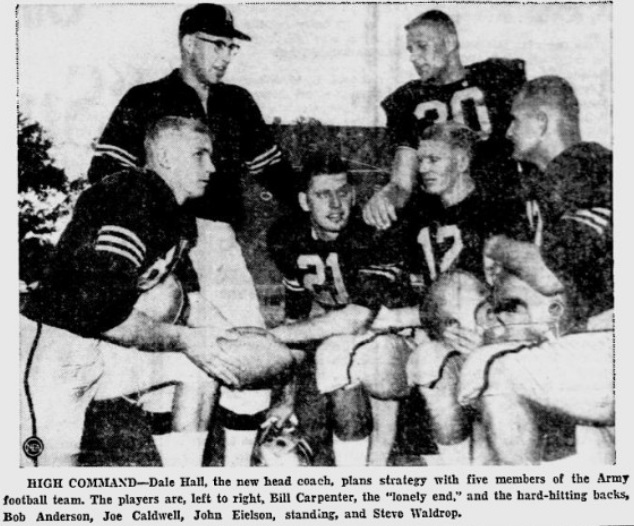
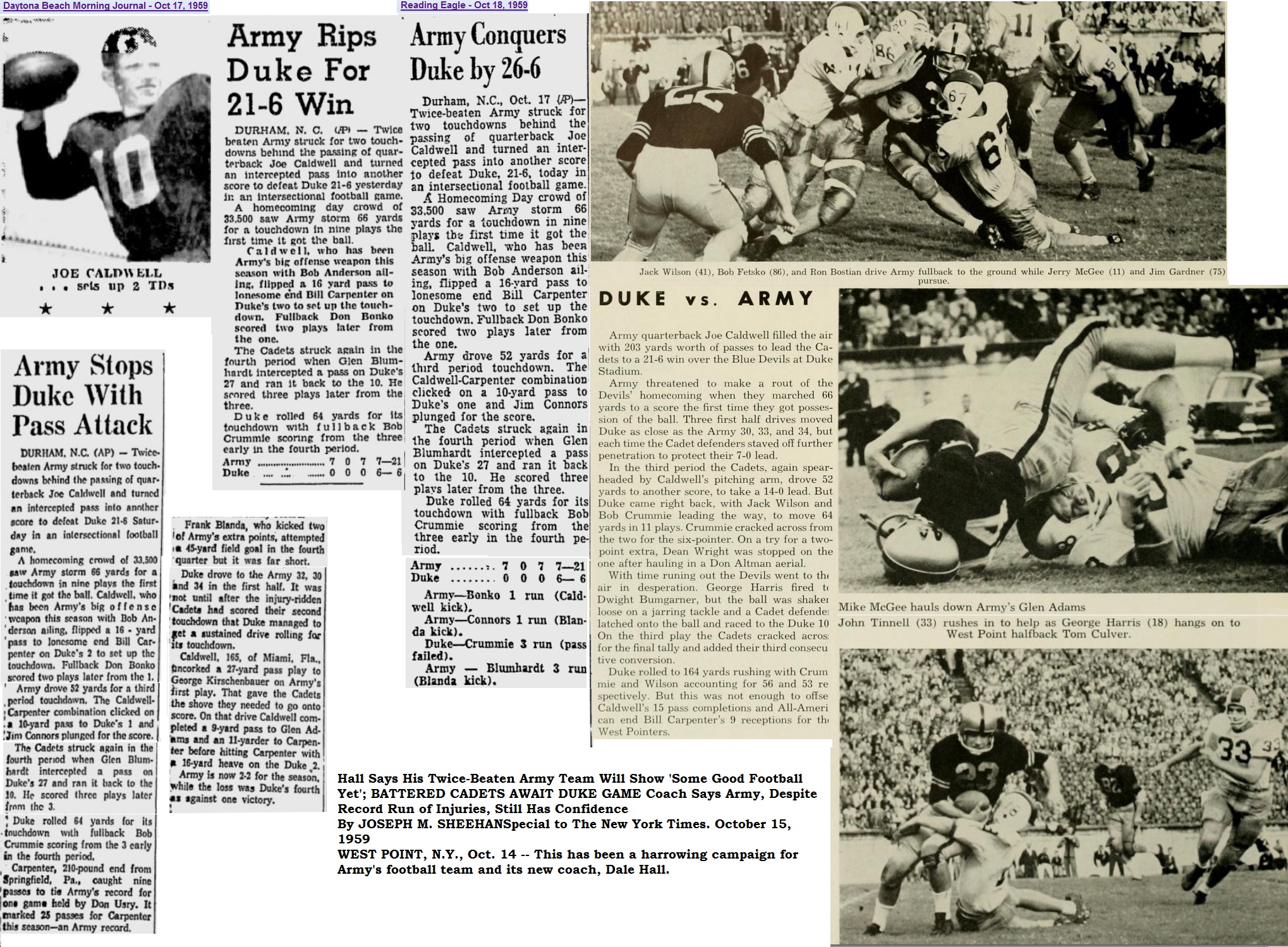
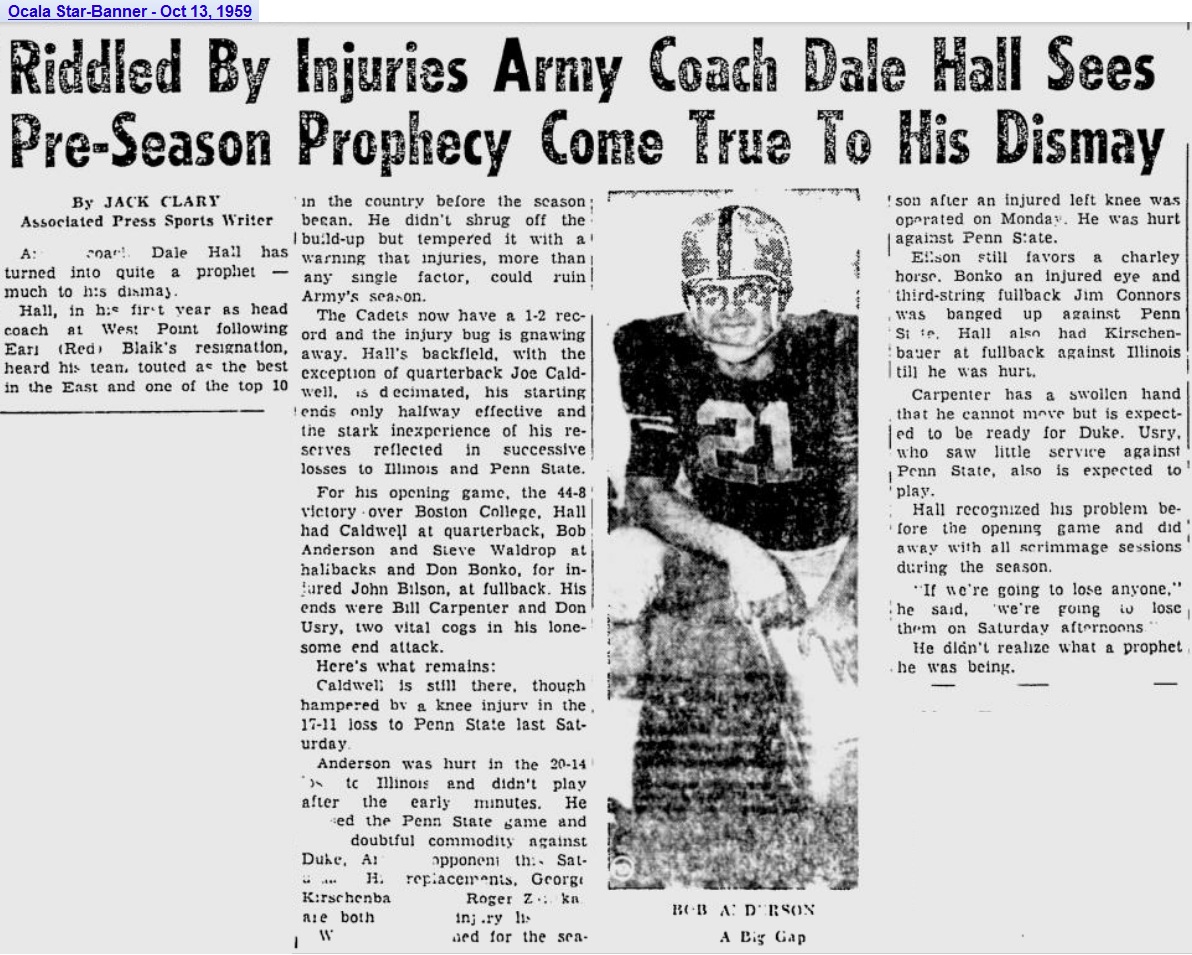
ArmyFB_1959_Caldwell-Carpenter_byMurrayOlderman_OcalaStarbanner_Nov271959

ArmyFB_1959_SpokesmanReview_Nov271960

ArmyFB_1959_vsNavy-pre_OcalaStarBanner_Nov271959

– –