
Tag Archives: Football

Jerry Clements

75 Bill Yost, 73 Bob Odd, 11 Pete King, 45 George Kirschenbauer, 58 Dick Buckner, 65 Harry Miller, 64 Al Vanderbush, 56 Ozzie Oswandel, 40 Russ DeVries, 94 Bob DeVries, 61 Jerry Clements

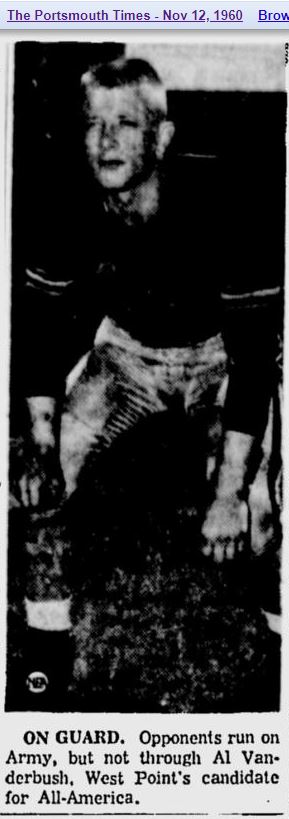
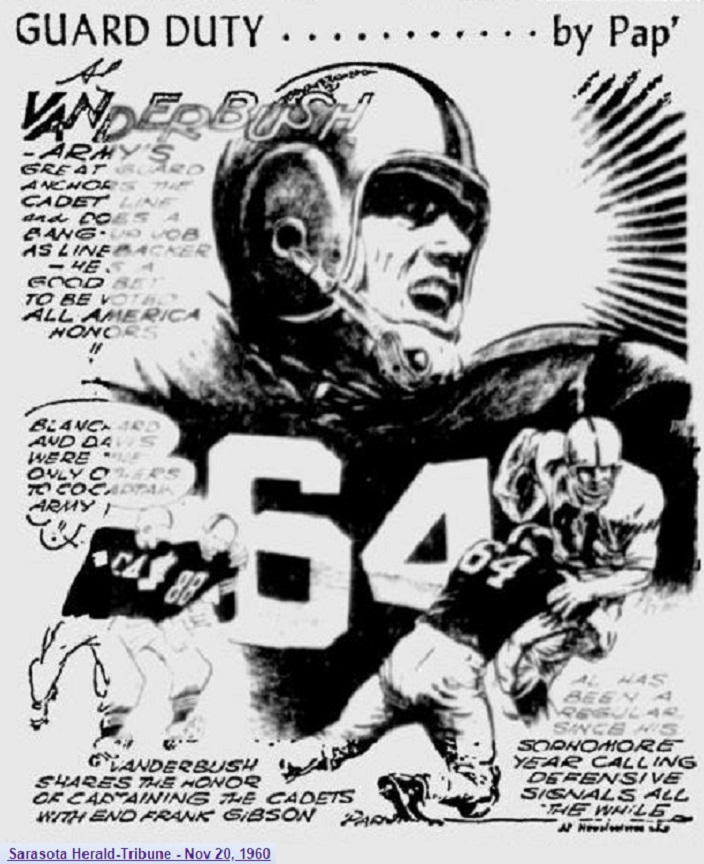
Al Vanderbush

75 Bill Yost, 73 Bob Odd, 11 Pete King, 45 George Kirschenbauer, 58 Dick Buckner, 65 Harry Miller, 64 Al Vanderbush, 56 Ozzie Oswandel, 40 Russ DeVries, 94 Bob DeVries, 61 Jerry Clements

ArmyFB_1960_AlVanderbush_PortsmouthTimes_Nov121960


ArmyFB_1960_AlVanderbush_byPap_SarasotaHeraldTribune_Nov201960

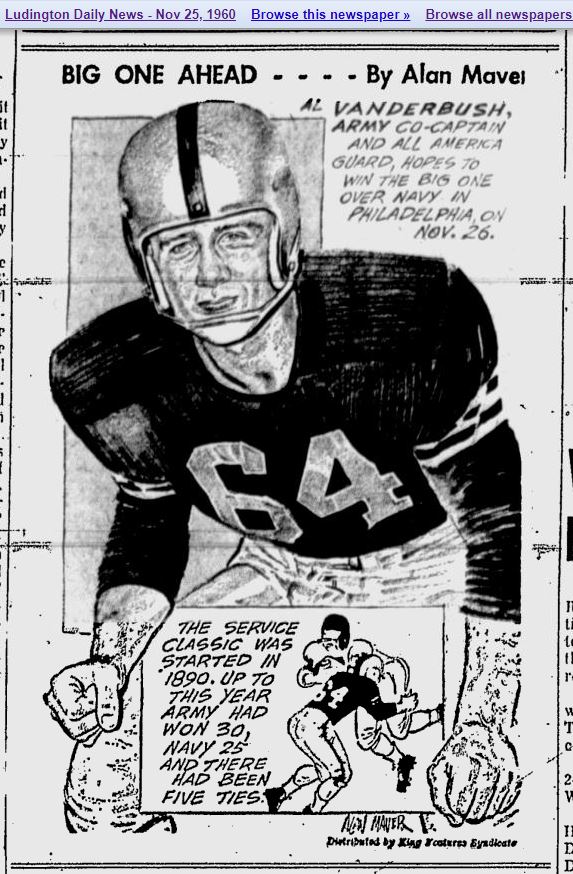
ArmyFB_1960_AlVanderbush_byAlanMaver_LudingtonDailyNews_Nov251960

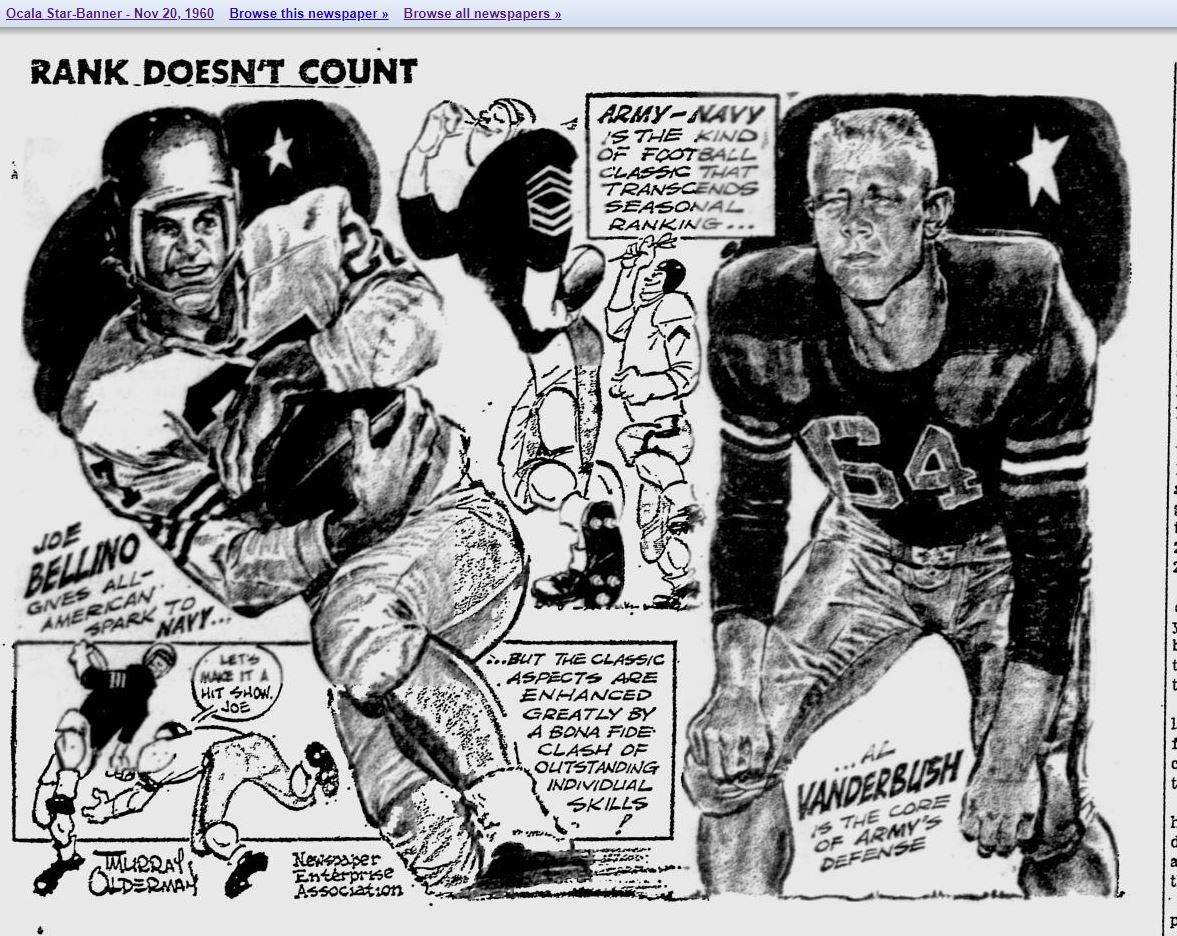
ArmyFB_1960_Vanderbush-Bellino_byMurrayOlderman_OcalaStarBanner_Nov201960

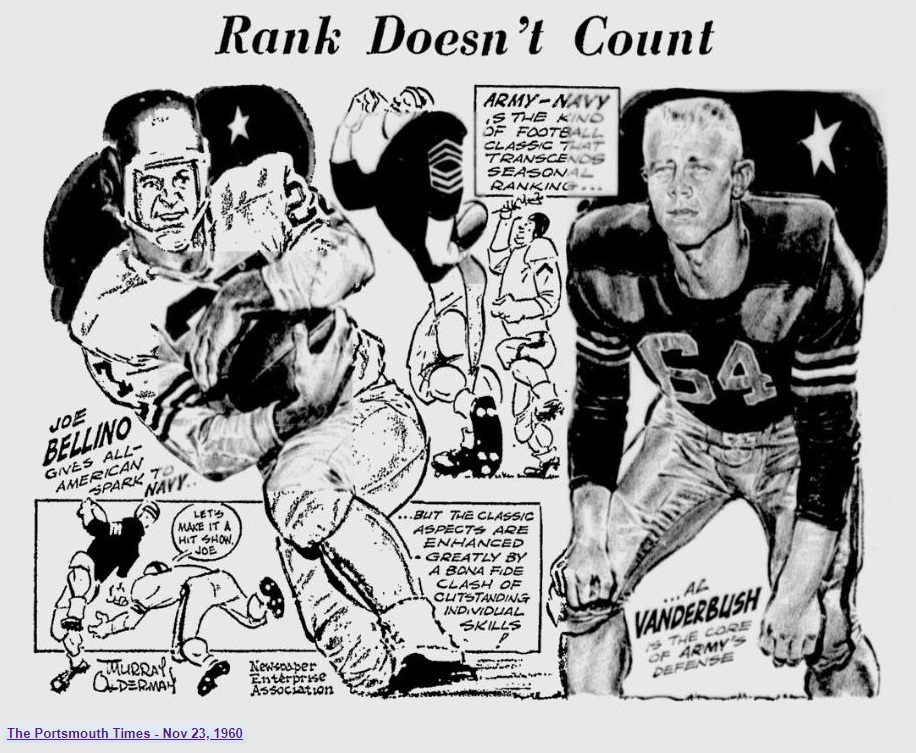
ArmyFB_1960_Vanderbush-Bellino_byMurrayOlderman_PortsmouthTimes_Nov231960

Harry Miller

75 Bill Yost, 73 Bob Odd, 11 Pete King, 45 George Kirschenbauer, 58 Dick Buckner, 65 Harry Miller, 64 Al Vanderbush, 56 Ozzie Oswandel, 40 Russ DeVries, 94 Bob DeVries, 61 Jerry Clements

Dick Buckner

75 Bill Yost, 73 Bob Odd, 11 Pete King, 45 George Kirschenbauer, 58 Dick Buckner, 65 Harry Miller, 64 Al Vanderbush, 56 Ozzie Oswandel, 40 Russ DeVries, 94 Bob DeVries, 61 Jerry Clements

Ozzie Oswandel

75 Bill Yost, 73 Bob Odd, 11 Pete King, 45 George Kirschenbauer, 58 Dick Buckner, 65 Harry Miller, 64 Al Vanderbush, 56 Ozzie Oswandel, 40 Russ DeVries, 94 Bob DeVries, 61 Jerry Clements

Bill Yost

75 Bill Yost, 73 Bob Odd, 11 Pete King, 45 George Kirschenbauer, 58 Dick Buckner, 65 Harry Miller, 64 Al Vanderbush, 56 Ozzie Oswandel, 40 Russ DeVries, 94 Bob DeVries, 61 Jerry Clements

Bob Ord

LTG.png  Bob & Gail Ord   120px-35th_Infantry_Regiment_DUI.jpg P116.jpg  100px-7th_Infantry_Division_SSI_(1973-2015).svg.png 25th Inf.jpeg
Football, Wrestling, Honor Committee. CoCO 35th Inf, 25th Div RVN, MACV, MILPERCEN, CO 1st Bde 7th Div, ODCSPER, CS CFA Korea, ADC 7th Div, CG PERSCOM, CG 25th Inf Div, CG USARPAC, Dean School of Intl Grad Studies.

Football, Wrestling, Track, injured Cow Year. Monogram in Football Yearling Year.

75 Bill Yost, 73 Bob Odd, 11 Pete King, 45 George Kirschenbauer, 58 Dick Buckner, 65 Harry Miller, 64 Al Vanderbush, 56 Ozzie Oswandel, 40 Russ DeVries, 94 Bob DeVries, 61 Jerry Clements

Larry Mengel

78 Tackle Fall of 59

Don Kauer

Don & Susan Kauer

67 Guard Fall of 59
Tom Blanda

18 Quarterback

59 Season Quarterbacks, Tom Blanda on the left, Pete King on the Right and Army’s Quarterback Joe Caldwell Class of 1960 whose name still appears in the record book after all these years.
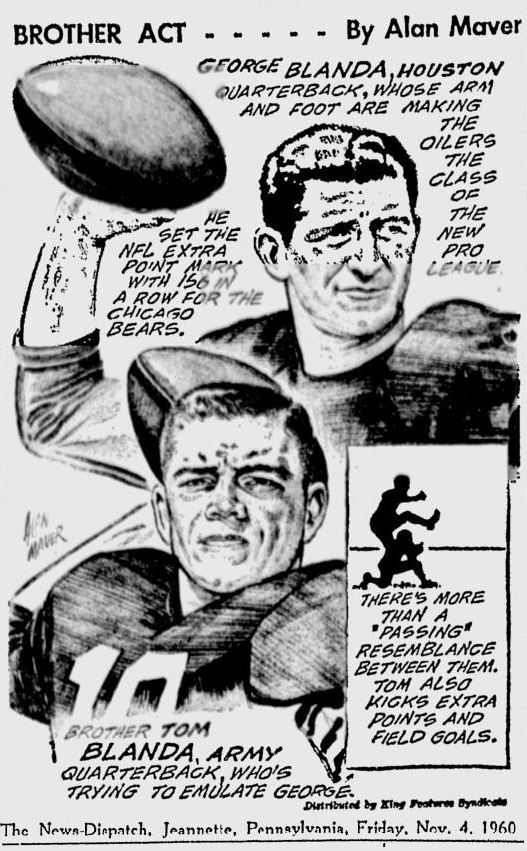
blandas_byalanmaver_newsdispatch_nov41960

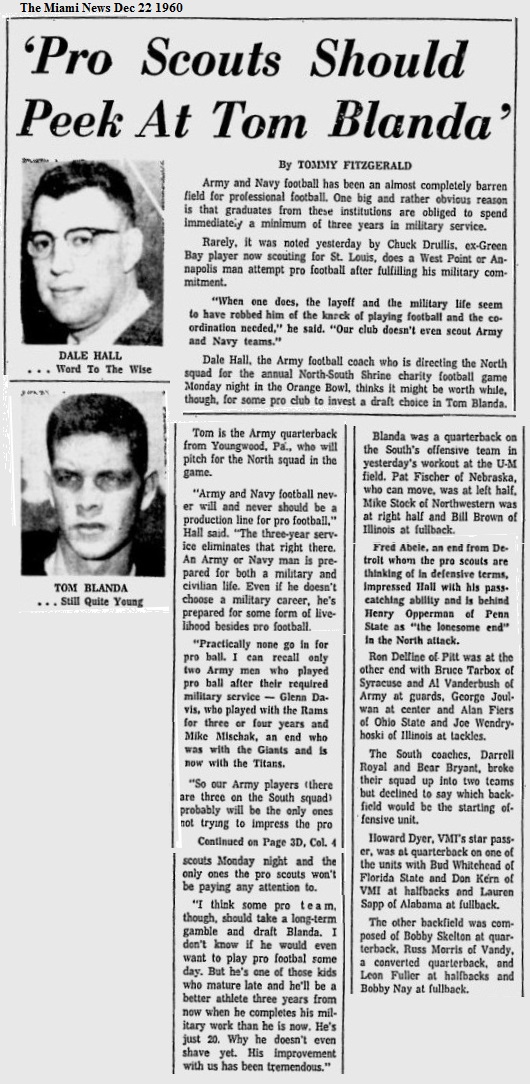
armyfb_1960_tomblanda-coachdalehall_themiaminews_dec221960

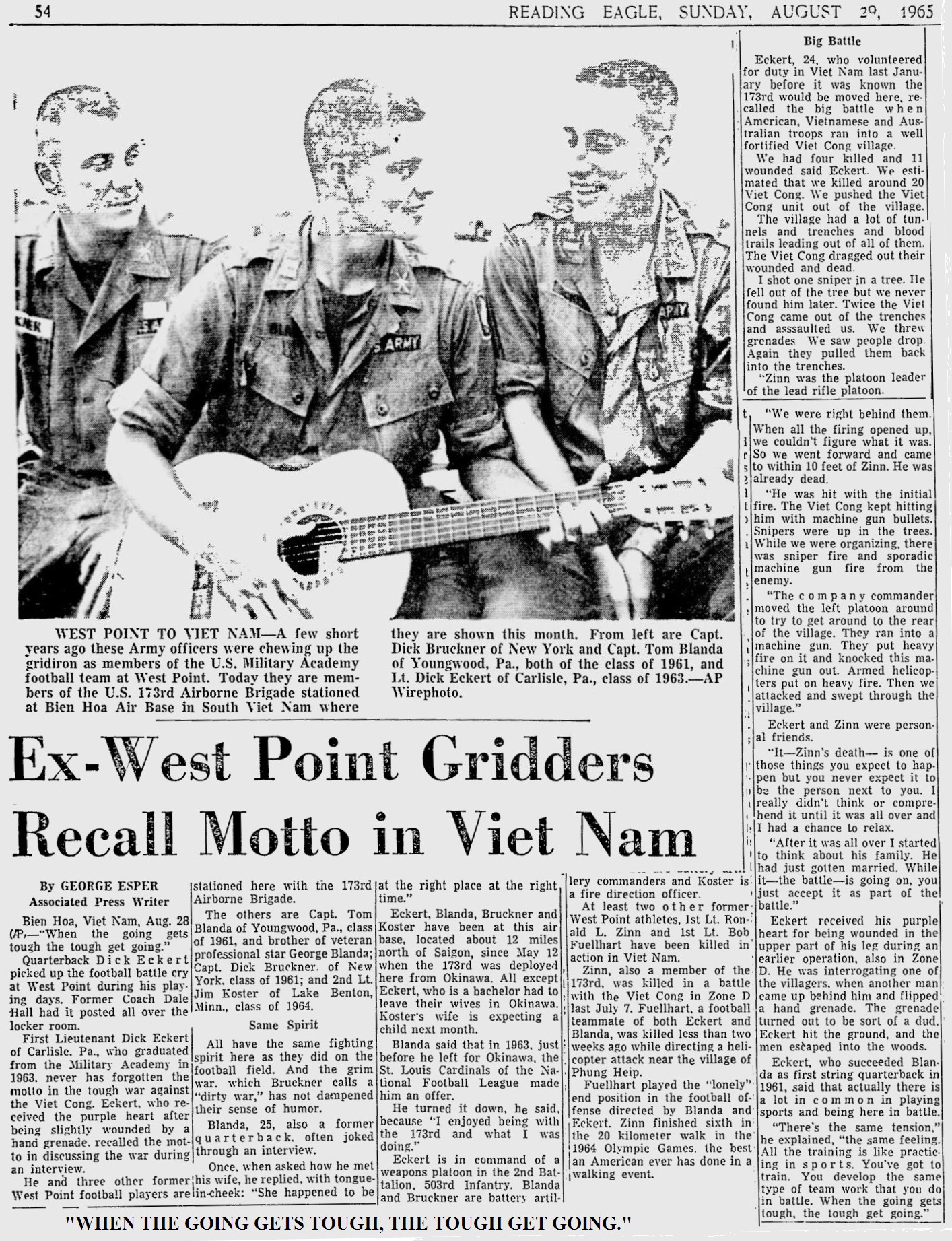
ArmyFB_1961-64_Vietnam_ReadingEagle_Aug291965

–

George Joulwan

54 Center Fall of 59

Tom Mailey

George Thomas Mailey

14 Quarterback Fall of 59

He learned early to utilize his BROWN BOY as an escape from Cadet Routine.  He is remembered as one who “stuck to his guns” – never hesitating to say what he believed.  He stood 92d in the Class and went Air Force at Graduation. 

GEORGE T. MAILEY  1962

 Cullum No. 23908-1962 | April 4, 1964 | Died in Columbus, OH

Interred in St. Mary’s Cemetery, Latrobe, PA


First Lieutenant George Thomas Mailey, a young man from Latrobe, Pennsylvania, who packed a brilliant list of accomplishments into 23 years of life, died Saturday, 4 April, three days before his 24th birthday. He never regained consciousness after suffering a severe head injury in an automobile accident on Good Friday in Columbus, Ohio. He died at 7:55 a.m. in the Riverside Hospital. 

Throughout his student days at Latrobe High School, Thomas was known for his athletic ability and for his scholastic achievements. He won eight letters in three sports: football, basketball, and golf. But it took more than athletic ability to gain admission to the Military Academy, and Thomas proved that he had it, for he was on every monthly dean’s list save one in his four years as a cadet.

After his graduation from West Point and with a commission in the Air Force, Thomas was sent to Columbus to study nuclear physics at Ohio State University. He had been a student there for a year and a half at the time of the accident and would have received his master’s degree in August 1964.

Thomas was born on 7 April 1940, the son of Mr. and Mrs. George II. Mailey in, Latrobe, Pennsylvania. He is survived by his parents; his two sisters, Anne and Jane; and one brother, Patrick.


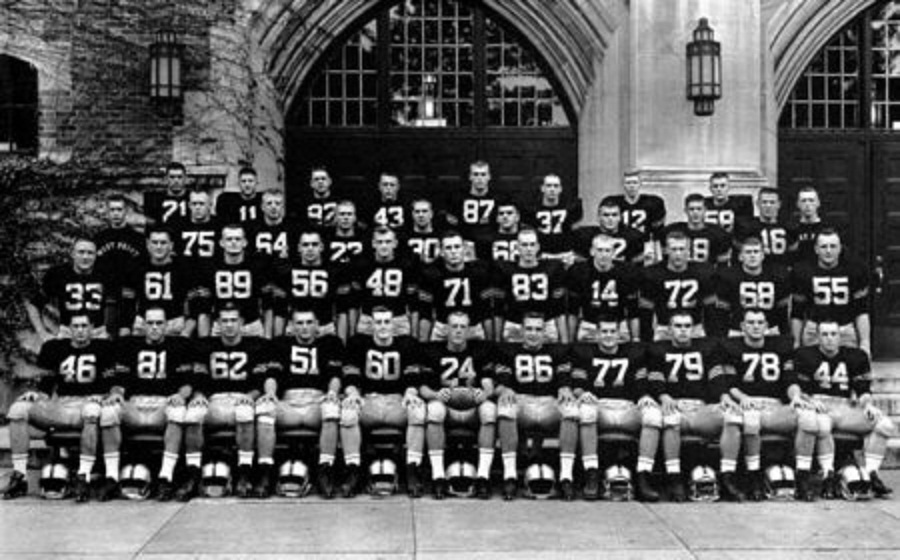
1958 Football Team


Time Nov 1958

Pete Dawkins (Army) is something more than a fine halfback. He is captain of the team, First Captain of the Cadet Corps, President and seventh-ranking scholar of his class, hockey defenseman and musician (he plays four instruments). In Army’s new wide-open offense, Dawkins specializes in slashing runs to the weak side, is the team’s top pass receiver and the nation’s leading scorer (74 points).

Bob Anderson (Army) teams with Dawkins to give Army the year’s most devastating halfback combination. An All-America last year and a better all-round player than Dawkins, Anderson shows powerful drive to the strong side, where the going is toughest, passes as well as most quarterbacks, blocks and tackles with fierce efficiency.

ASSEMBLY November / December 2003

Football Magic by Bill Mogan

The 1958 Army Football Team.
Some squad leaders took every occasion to bombard their plebes with verbal abuse or threats of long hours doing useless tasks, but Jules Weisler, my first regular-year squad leader, educated us on Army football. A solid man with slightly graying temples, he was intimidating that first night during Reorganization Week. I was a new plebe in Company M-2, and I braced in his room before supper formation.

Departing Minnesota had been a series of tradeoffs for me. My friends warned me that I’d never see good football away from the Big Ten. Braced up in Weisler’s room that first night, he asked me,

“What do you know about the Army football team, Mr. Mogan?”

“Not much, Sir,” was all I could manage.

Weisler looked me directly in the eyes and asked,

“Mr. Mogan, do you know who Mr. Bagdonas is?”

“No, Sir.” That was the truth.

He closed to inches in front of me and said,

“For your information, Smackhead, last year in the Colgate game, Mr. Bagdonas charged from his position as defensive tackle and took out two offensive linemen across from him. Then he knocked down the fullback, took the ball away from their quarterback, and ran 20 yards for a touchdown.”

At that point, a newspaper hovering over a desk on the far side of the room dropped, revealing the meanest human form I’d seen up to that moment in my life. The face fleetingly reminded me of a bestial comic book character, the Heap, but he was smiling and quickly demonstrated speech capability,

“Yeah, . . . and I didn’t even break my stride!”

“What do you think of that, Mr. Mogan?” asked Weisler.

I groped for a comment, but Weisler continued,

“That means Army is going to have a great season this year. You better be able to give me a personal, eyeball report on each and every game. Got that?”

“Yes, Sir!” It was crisp and final, but Weisler wasn’t finished.

“When you arrive for Monday morning calls, just start your football report. Don’t wait to be invited. Got it?”

Bagdonas was a great guy and the first member of the Army football team I’d met. I soon came into contact with more of Coach Red Blaik’s team. Bill Carpenter, “Leroy Green”, and others breezed past me as I braced against the halls of Company M-2’s barracks, the 48th, 49th, and 50th Divisions. In my 48th division, L-2 had some rooms, and I soon became familiar with Bob Anderson‘s usually smiling face. The role these men played in the 1958 Army football season shaped my whole attitude toward the Military Academy.

One day our intramural track team was running to Shea Stadium when we were stopped by the varsity football team, jogging to their practice field across the Plain from the Commandant’s house. Many of the cadets from my company were in that thundering herd. Bill Carpenter, Al Vanderbush, and “Leroy Green” stood out. I noticed Anderson, an All-American halfback with an unusual running style. He floated over the ground, only lightly planting his feet and never pushing his lower legs out in front of him, minimizing the time his knees might be extended. Brigade Commander and Football Captain Pete Dawkins, the King of the Beasts during our first months, was in the group. There were more I recognized from M-2 but lacked names to put with the faces.

Stern “Don Usry”, the tight end from L-2 who lived downstairs from us, nodded as he jogged past. The team’s cleats clattered away from us, but we remained in place as stone-faced Blaik and his coaching staff jogged past. On days when I had no intramurals, Weisler urged me to the practice field to see the Army team drill. Near the close of practice, Coach Blaik stood behind his quarterback, Joe Caldwell, and watched his offense snap through play after play. One day, canvas curtains were drawn fully around the practice field, and the MPs kept us out. The following Saturday, I took a seat in Michie Stadium, eager to see the final pre-season event, a full contact scrimmage with Syracuse.

The University of Minnesota games I knew had featured big linemen, but the Orangemen seemed to have some of the largest guys ever to walk onto a college football field. They towered over our guys, outweighing the Army line by 20 to 50 pounds per man. Even Ed Bagdonas seemed slight compared to his Syracuse counterpart. I sat directly behind the bench and observed Coach Earl Blaik‘s focus as the scrimmage unfolded. He was almost expressionless but active with his coaches and players as the white-clad Syracuse team pushed our team up and down the field all afternoon. As the sun set over Michie Stadium, I was concerned that our Army players were too small to play against the likes of Syracuse and the other teams listed on our schedule, but Blaik seemed strangely upbeat when he departed.

Designated as an usher for the opener, I wore a white belt and gloves with my dress gray uniform for the sometimes-wet South Carolina game. The play action was far different from what I had observed against Syracuse. Our linemen were still seriously outweighed, but they took off like greased lightening at the snap of the ball. Bagdonas and his compatriots in the trenches were popping the South Carolina line before the visitors were fully off of their stances. As an usher, I was free to roam up and down the aisles and tried to remain as close to the front railings as possible. Coach Blaik’s face was more animated than during the Syracuse scrimmage. He had a slight grin and seemed more excited. Army was passing, running, and moving the ball very well. Midway through the first quarter, it dawned on me that end Bill Carpenter stood alone on the field as the team huddled. His isolation continued, sometimes on the right, sometimes to the left, but he never joined the huddle. It was soon clear to all that day that Coach Blaik and the Army team were making football history. The lonely end formation, as it was later termed by sports writers, confused South Carolina’s defense. Carpenter dashed to precise spots to grab passes without any apparent guidance from the huddle. South Carolina had to react, so they committed their secondary to cover Carpenter on every play. That’s when the magic revealed itself.

Coach Blaik had perfected tactics and teamwork suited to the skills he found and nurtured in his individual players. Anderson, a great All-American runner, was passing the ball from fast, sweeping options. When Andy ran, he covered ground like the shadow of a fast bird flying over the stadium. Dawkins also ran and passed. Tight end “Don Usry” caught passes as much as the lonely end, while fullback Harry Walters chugged convincingly forward whenever he got the ball. Coach Earl Blaik‘s versatile offense caused total mystification on South Carolina’s side of the line of scrimmage. GEN MacArthur himself couldn’t have achieved greater offensive surprise. At the end of the day, Army stood victorious, 45 to 8, and the magical 1958 season was underway.

Cadets and visitors were effusive regarding the brilliance of Blaik’s genius and the team’s execution. One visitor walking nearby exclaimed, “Options work when you have smart players. Army may be the only team in the country with athletes smart enough to run that offense.”

Plebes were given an immediate fallout until Monday morning. I reported to Weisler’s room at 0545 hours Monday morning and began a loud, verbal report on the game: “Sir, the Football Report! On Saturday last, Army beat . . .” From a bed in the far alcove came the orders, “Stifle that noise, Mogan. If we want a football report in the future, we’ll ask you for it.”

That was my first and last football report, but as the season unfolded, the mastery of Red Blaik’s lonely end, and the execution by the smallest team to make the top five in college football, was inspiring. Each weekend the team demonstrated new heights of performance as Army beat bigger, stronger, faster teams. Rather than running up his own personal rushing numbers, Bob Anderson demonstrated his commitment every time he threw on the option plays and chose to do what was best for the team.

Results on the field were devastating. I was looking forward to each and every Saturday’s game. Clearly, Coach Blaik had studied the capabilities of each player and designed tactics built upon each one’s individual skills. The resulting field versatility completely surprised Army’s opponents.

58 Backfield — Pete Dawkins, Harry Walters, Joe Caldwell, Bob Anderson

Walters and Dawkins were injured in a convincing win over Virginia. The following week, Army came off the field in Pittsburgh with a 14-14 tie. Cadet chatter kept hope alive for an undefeated season by beating Rice in Texas. The 1958 season would then be the best season since the war years. Football enthusiasm pervaded every level of the Academy. The entire first class was tagged to take a train to Texas for the Rice game. Just before departure, it was announced from the mess hall poop deck that a telecast of the Rice game would be shown on the massive screen in South Auditorium. Response from the Corps was thunderous.

The cavernous room that was South Aud was filled with cadets, dates, faculty, officers’ wives, and a few teenaged dependents. I arrived early and found a seat near the left front of the beautiful, sloping auditorium. Army and Rice grappled to a 7-7 tie until the final minutes of the fourth quarter. With 54 seconds to go, Army got the ball at our own goal line. Quarterback Caldwell launched a long pass that arched beautifully over a sea of faces in the Rice stadium, toward my end of the TV screen. The camera panned left, blurring faces in the stadium as it followed the long, spiral pass through its trajectory. Dawkins came into view in the lower left corner of the giant screen, looking back over his left shoulder and sprinting toward the goal line. As he reached back for the falling ball, a determined Rice defender charged toward him. The ball fell toward Dawkins’ raised hands. I held my breath as the defender reached out for Dawkins . . . then the screen went blank and the sound died.

Screams and moans of frustration echoed throughout the auditorium that now was filled with standing fans. Those around me seemed resigned to the fact that we would not hear the outcome of the game for hours. But after seven confused minutes, a door at the rear of the auditorium burst open, and a captain ran into the auditorium. He began shouting, and the auditorium quieted. He’d telephoned a Texas friend who said that Dawkins caught the ball, knocked down the Rice defender, and dashed across the goal line. Army won, 14-7. A monolithic cheer erupted that sounded like a cannon firing in the auditorium. We plebes were immediately given another fallout.

The following week, rumor had it that Saint Peter (Dawkins) had fed the entire first class with a single box of crackers on the long train ride home from Texas.

Now it was time for the Corps trip to Philadelphia for the Army-Navy game.

The days leading up to the game were filled with academics, athletics, and watching football practice. Finally, team departure day arrived. An M48 tank escorted the team bus to Thayer Gate, and I joined a large melee of cadets who jogged beside the tank, cheering, and singing football songs. Cadet cheerleaders led a rousing pep rally as the buses stopped, with open windows, just across from the Hotel Thayer. “On, Brave Old Army Team” and “Sons of Slum and Gravy” echoed off the hotel walls and surrounding hills as we bid the team an emotional goodbye. Coach Blaik stepped to the bus door and waved for silence. He offered thanks from the team for the sendoff and for our great support throughout the season. The team looked forward to seeing us in Philadelphia and said, “We’ll beat Navy.” I followed the bus with my eyes as it passed through the gate and on through Highland Falls. My uniform suddenly chafed. The books under my arm felt heavy. I turned to jog back to my math class.

Our chartered train ride to Philadelphia was a late-night affair. Around midnight, we marched down the hill toward the train station. The prospect of the coming night in Philly after the game more than made up for the discomfort of sleeping on seats, floors, or luggage racks. The train jerked to a stop on a rail siding adjacent to Municipal Stadium at 0410 hours. We stirred but slept on until 0700. The morning of Saturday, 29 Nov 1958, was sunny, clear, and cool, and our train was just far enough away from the stadium that we could see little of the forming crowd. With long overcoat capes buttoned back over our shoulders, we gathered into massed company formations. Getting closer to the stadium, we discovered hoards of strangers cheering us outside a fence. Finally, we moved through a tunnel and emerged into the massive stadium to the cheers and applause of more than 100,000 fans. It was overwhelming. After months of living life as a plebe, the lowest form of human life, it was miraculous to just be part of something that big.

When the teams entered, I was a little surprised to see our team in white jerseys. An early Army fumble was run through the Army line for a fast Navy touchdown that quieted our side of the stadium. Somewhere Navy had found a 180-pound runt by the name of Joe Bellino, who enjoyed running along carrying defenders on his back. Fortunately, we started generating magic after Bellino’s early running demonstration.

During the second half of the game, I yelled myself hoarse. The Army line delivered magnificent violence on the Navy team. The element of surprise as well as Army teamwork wore Navy down. At the end of the day, Anderson, Dawkins, Carpenter, Usry, and company secured their just win, 22-6.

As the traditional Army post-game cheer boomed out from the Corps, I mulled over the individual players and their roles in what had played out that day and over the entire season. It occurred to me that while we had superb individual players, they had lived the vision of a team. Coach Blaik motivated each of them to support the other on that team with every fiber of their being. Each had a profile of skills, but no one was perfect. Every obstacle was overcome by selfless teamwork. Watching the buses and cars pass as I strode along the sidewalk, I knew I’d learned something from Coach Blaik. He had never spoken directly to me, but his knowledge of teamwork was a lesson I’d carry through life.

The floors of the Ben Franklin were jammed with hospitality suites that evening. Army organizations, clusters of grads, West Point societies, and parents of cadets had suites as gathering places for friends and their cadet sons. That night, I felt pride in just being a cadet. I recalled that first night in Weisler’s room when I met strongman “Ed Bagdonas”. The energy level generated that season carried me through the rest of my cadet career and through the decades since first seeing the Army team and their taciturn coach jogging to practice. The 1958 Army football team embodied the highest fulfillment of the word “teamwork.” As life pits my body and soul, I enjoy being in the company of classmates who shared the magical 1958 season. It’s always great to be among the best of men again.

armyfb_1958_team


Army Over Syracuse 9-6 Yankee Stadium

One of our Fullbacks (probably Ray) is going to Bust Somebody – Al Rushatz & Ray Paske ran this play several times with success. There is a clear image in my mind of Al, right in front of the Corps, getting tripped up at the line of scrimmage, dropping his free hand as he is nearly horizontal, regaining his balance and rumbling for more yardage.

Tom Blanda gives us 3 More

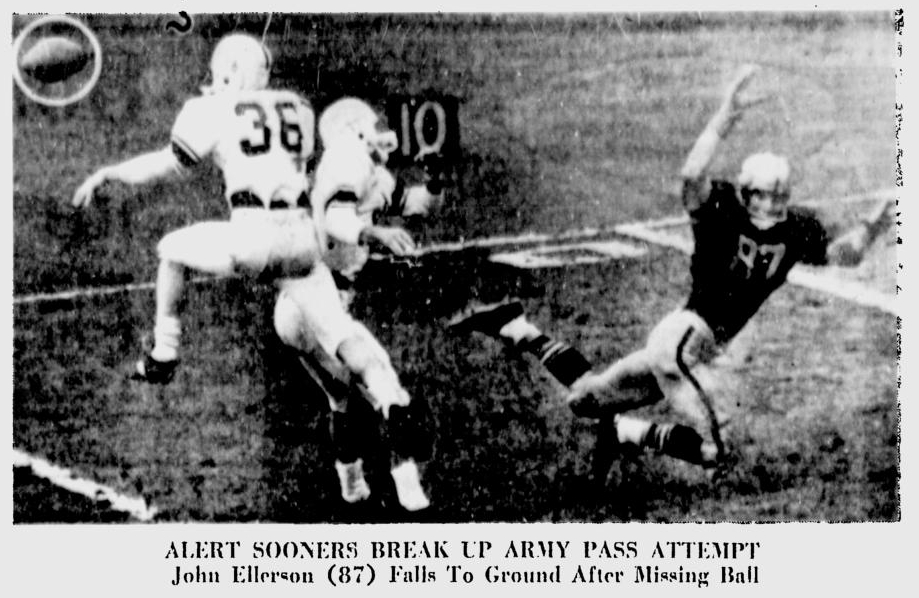
John Ellerson puts him in the Dirt

Army has broken Free, headed for a Score

Tom Culver

Renaissance Man

Tom Culver led the team in receptions in 1961 year with 20 catches for 305 yards, 15.3 yards per catch. (And we thought Tom spent his time in the dog house, at least some of us less-informed types did.) These ratings seem to be based on yards per catch. His 55-yard reception from Dick Eckert against Navy helped.

Tom briefly (a couple of years) held the single-game reception record, catching 11 passes in the Michigan game in 1960. A vast coaching/media conspiracy robbed him of this legacy as his number of catches were continually reduced (why, we do not know) until he dropped out of the top few, making way for more well-known and loved receivers.

He played on the basketball team but was dropped for a poor performance in a game in which he did not play.

Tom also earned a letter in lacrosse, scoring several goals against Mt. Washington and Navy.

Many know him for his musical group, the Hot Nuts, that played classical pieces in the Weapons Room while officers were present then went into rock and roll when they departed.

Bird watcher, author, golfer, raconteur: truly a renaissance man.

1959 Football Season

Class of 60

1960 Army Navy


1960: Army vs Navy

By RABBLE
Date: Mar 11, 2003

The following article was written the day after the Army team took the Navy down to the wire in a most thrilling Army-Navy games of that era. Navy prevailed that year, 17-12. Described by the Dean of New York sports writers, Red Smith (1905-1982), he aptly describes the exciting action in his exclusive column.

RED SMITH

The Slasher

Philadelphia, November, 26, 1960—–The first time they gave Joe Bellino the ball, Army’s John Ellerson leaped upon his sternum and spread him out like apple butter 14pon the painted meadow of Philadelphia’s Municipal Stadium The second time, he faked a quick-kick, spun to run to his left, and was hit from behind by a runaway beer truck named Bob McCarthy.

On his third try he did no better, and up in the press box and said, ” Army’ll beat this team.” Just then Bellino took the ball again. He shot through a gap near the middle of Army’s line, veered to the left on a long slant through the secondary, and raced 58 yards before George Kirschenbauer hauled him down on the Army 42-yard line. Navy was off and rolling in the 61st engagement of its Seventy Years’ War with the football paladins of West Point.

That first daring dash by the swift and stumpy marauder from the Severn didn’t lead directly to a score, but in one stroke it changed the complexion of the struggle from Gray to Navy Blue. Taking the opening kickoff, Navy was smashed flat by the same clamoring Cadets who had smeared the dangerous runners of Syracuse and Pitt earlier this season. Then a punt by Army’s Paul Stanley pinned the Sailors down a yard from their own goal line.

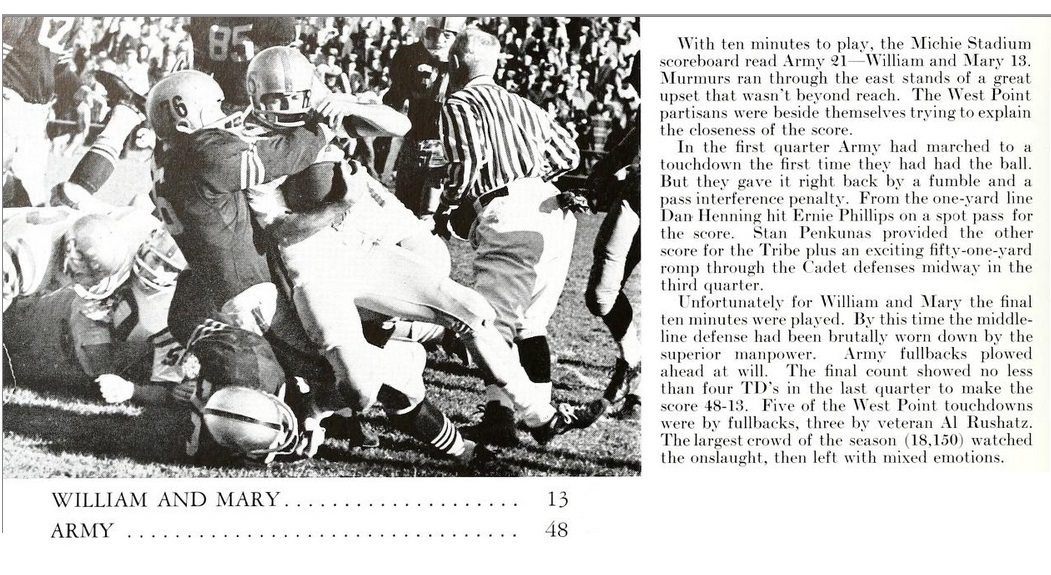
76,87,62,64,27,16 — Ball & Middie are on the ground to rear of 76

Kuhns, Ellerson, Vanderbush, Casp, Blumhardt, Adams

There was Navy staring glumly down the throat of a howitzer, and then Bellino busted loose. Before the first quarter was over, Navy was in front, 6-0. At intermission the score was 17-0, and 98,616 witnesses had a premonition that this might degenerate into another rabbit-hunt like Navy’s 43-12 gambol last year.

85 Zmuida, 27 Blumhardt, 62 Casp

Early Errors Nobody could foresee the heroics which the second half would produce, the wild excursions and alarums, the mounting tension as Army came clawing back in a frantic struggle against the stubborn foe on the field and the coldly impartial clock hung up against a bright blue sky.

At halftime it seemed a shabby show, in spite of the mildest, loveliest weather this production had enjoyed in years, in spite of all the elegant trappings of traditional pageantry, in spite of the exciting presence of the admirable Bellino.

Left to right 31,86, 62, 75, 55, 77, 40, 45, 50, 27, 64, 89, 44

Army had messed it up early through mental and mechanical error. After the Cadets smothered Navy’s first action and forced a punt, Joe Blackgrove unwisely tried to field the bouncing kick with his back to an advancing horde. Smashed from behind, he fumbled away Army’s first chance to attack.

Stanley’s fine punt, repaired that damage, and after Bellino’s long run took the ball into Army territory, the military braced and Navy tried a fourth-down field goal which Greg Mather missed. So it was still a scoreless game, but on the very next play Al Rushatz, the West Point fullback, fumbled the ball back to Navy, Needing 23 yards for a touchdown, Navy got ’em fast, Bellino slanting over for the last four wearing Kirschenbauer like a stole across his shoulders.

Up off the Rug

THERE never was another one-piece play like Bellino’s big run, but in the second quarter he was a constant menace, butting the middle for short yardage and slipping outside the tackles to wriggle like a brook trout through congested traffic. With Joe running and Hal Spooner passing handsomely, Navy pushed down into scoring range again and Mather made the score 9-0 with a 26-yard field goal.

As the first half sifted away, the Midshipmen put on still another foray, once more with Spooner passing and Bellino carrying. With 17 seconds remaining, the quarterback threw to Jim Luper, who fell across the goal line with Bill Sipos hanging on. Trapped trying to pass for two extra points, Bellino flipped the ball back to Spooner, who ran for the 16th and 17th points.

Navy seemed In complete control. The Army attack, such as it had been, offered little to cheer the 2,400 Cadets in the stands. West Point backs couldn’t seem to get traction on tile dyed green grass, kept falling before they reached the line of scrimmage. Even the fire of the Army defense seemed damped after Navy’s first touchdown.

Something happened between halves, though. The third quarter opened, and it was a different game. With Tom Blanda’s passes complementing the rushes of Rushatz, Glen Adams and Kirschenbauer, Army drove for one touchdown and almost immediately set out after another. Again misfortune balked the Cadets; a penalty for having an inengible receiver downfield on a pass play slowed one drive, and the score was still 17-6 when the last period began.

Last Curtain

The jubilant Midshipmen on the stadium’s west slope had just about had it. Now and then they whooped and brandished white caps aloft, but mostly they sat transfixed, watching and praying, Dick Eckert, Army’s second quarterback, engineered a solid advance that Rushatz consummated with a dive into the end zone. Now it was 17-12 with nine minutes remaining for Army to chew at a five-point lead. Navy stopped a drive, then fumbled, Rushatz recovered for Army, 17 yards from victory. Yard by yard, cuddling the line for short gains, Army ground ahead to the 6-yard line. There a hasty lateral got loose, rolled back to the Navy 20. Blanda passed and missed, passed and missed again. The clock showed 1:55 remaining when his last throw fell incomplete and Navy took the ball.

The contest was over, needing only a final theatrical flourish. There was a guy on hand to furnish just that. Guy named Bellino. Unable to run out the clock, Navy punted to midfield. Blanda wound up for the last prayerful shot, took aim on Blackgrove and fired. Bellino got in front of the receiver, picked off the ball on the goal line and went swirling 45 yards back to safety as the curtain came down.

1961 Football Team

Army 1961 6-4
1961/12/01 Army 7 – Navy 13 L

Coach: Dale Stanley Hall (June 21, 1924 – August 23, 1996)
Army 1959-1961:
1959 Army 4-4-1
1960 Army 6-3-1
1961 Army 6-4
Army: 16-11-2
Total: 16-11-2

source: http://en.wikipedia.org/wiki/Dale_Hall

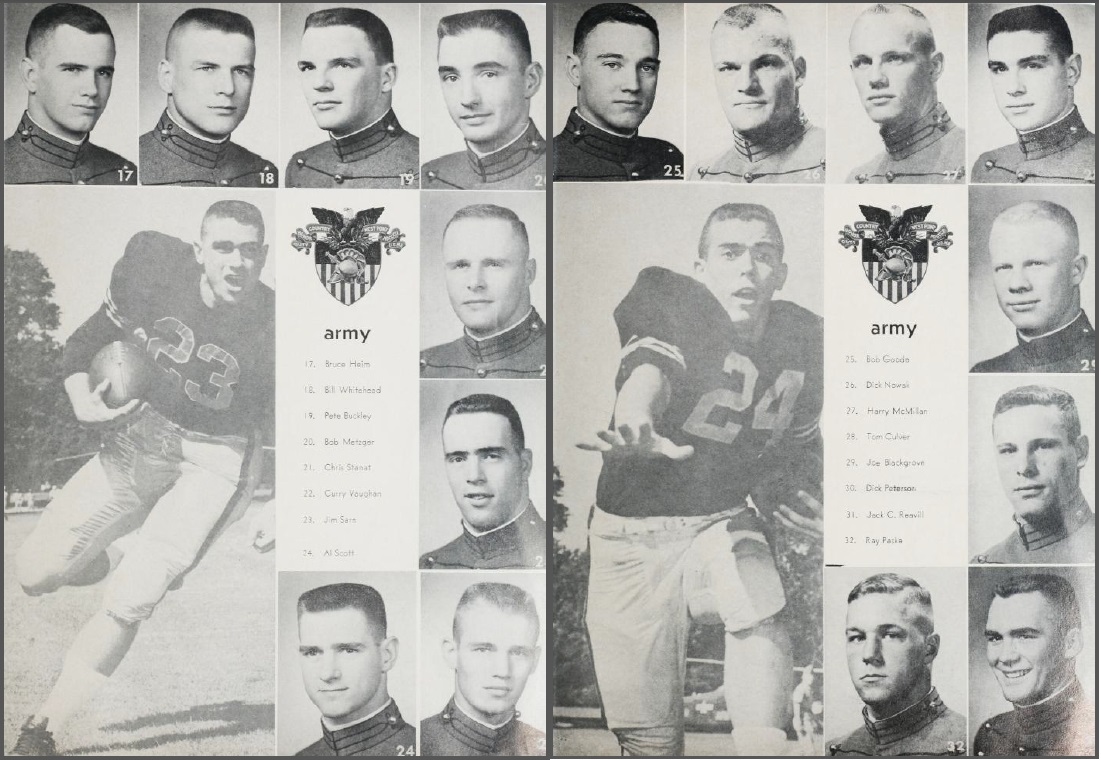
23 – Tom Culver, 24 – Pete King, 50 – Bottom of Pile – Bill Whitehead, 60 – Barry Butzer, 80 – Bobby Fuellhart, 85 – Paul Zmuida, There is one unknown Player

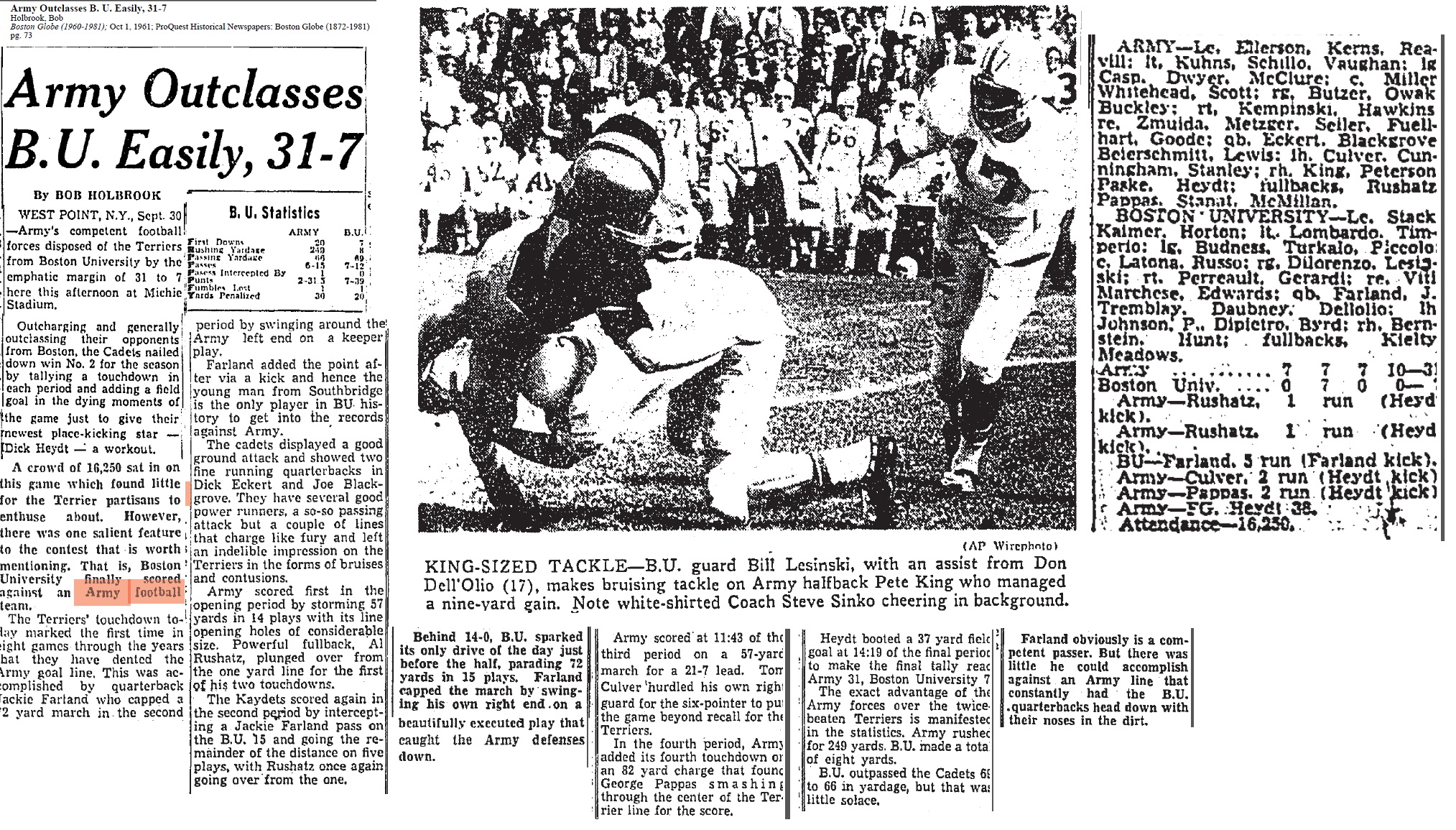
1961 Army 31- BU 7

’62 Football Team Members

1960 Army 30 – – Miami of Ohio 7

1960 Army 9 – Syracuse 6

1960 Army 16 – – Penn State 28

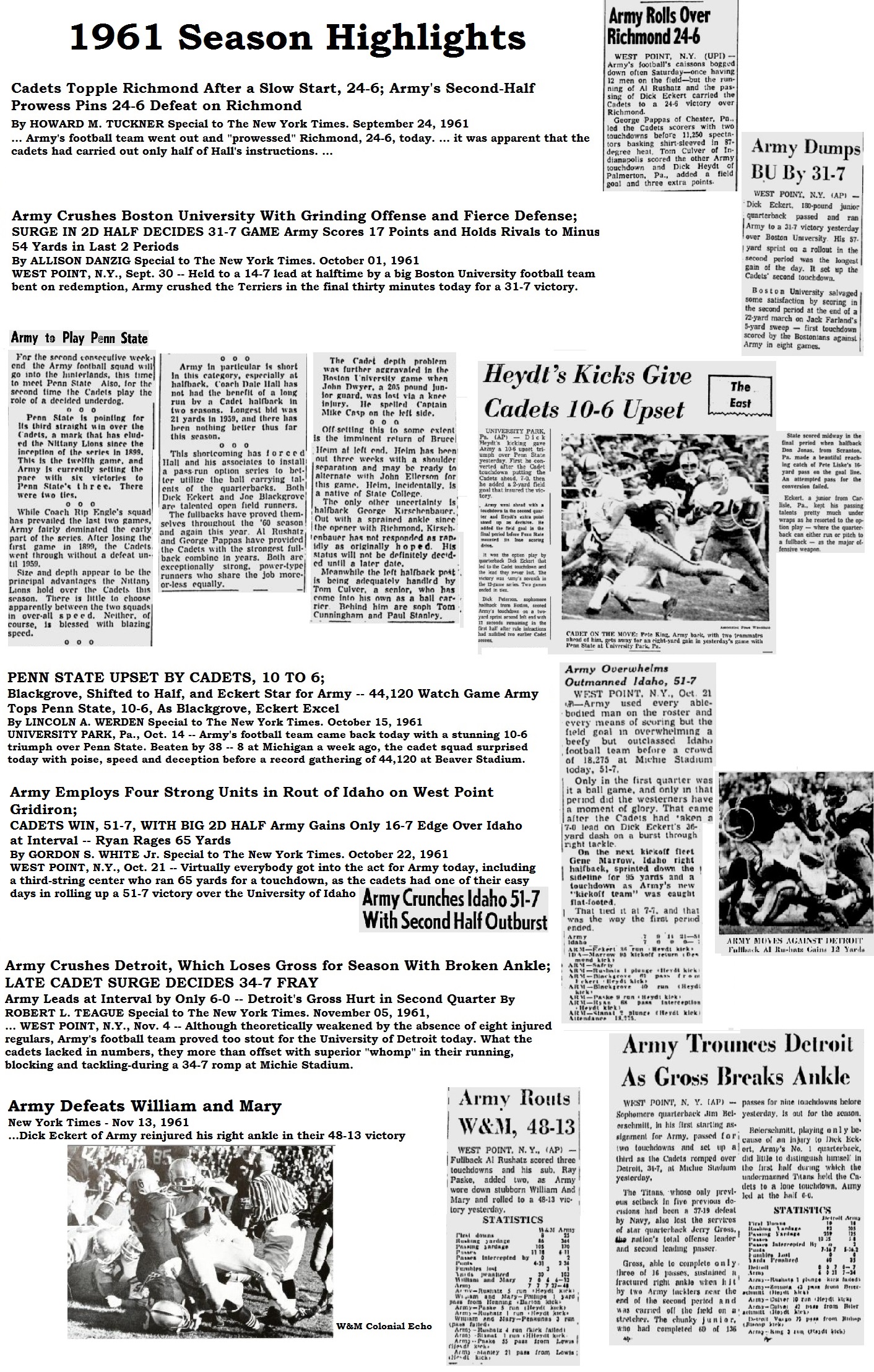
ArmyFB_1961_Season-Highlights_
ArmyFB_1961_Season-Highlights

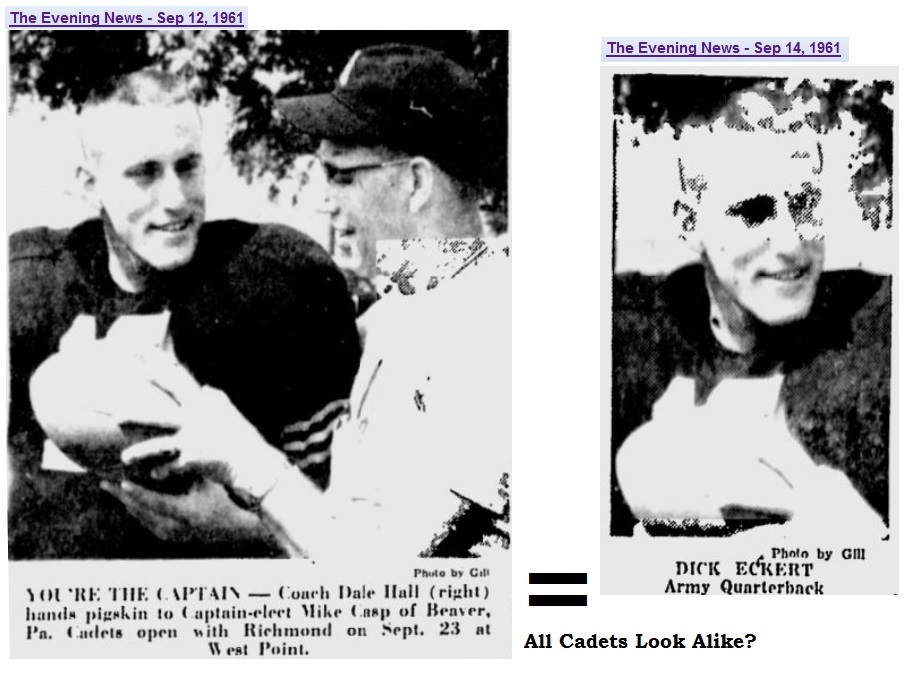
ArmyFB_1961_Hall and Who_EveningNews_Sep121961
ArmyFB_1961_Hall_and_Who_EveningNews_Sep121961

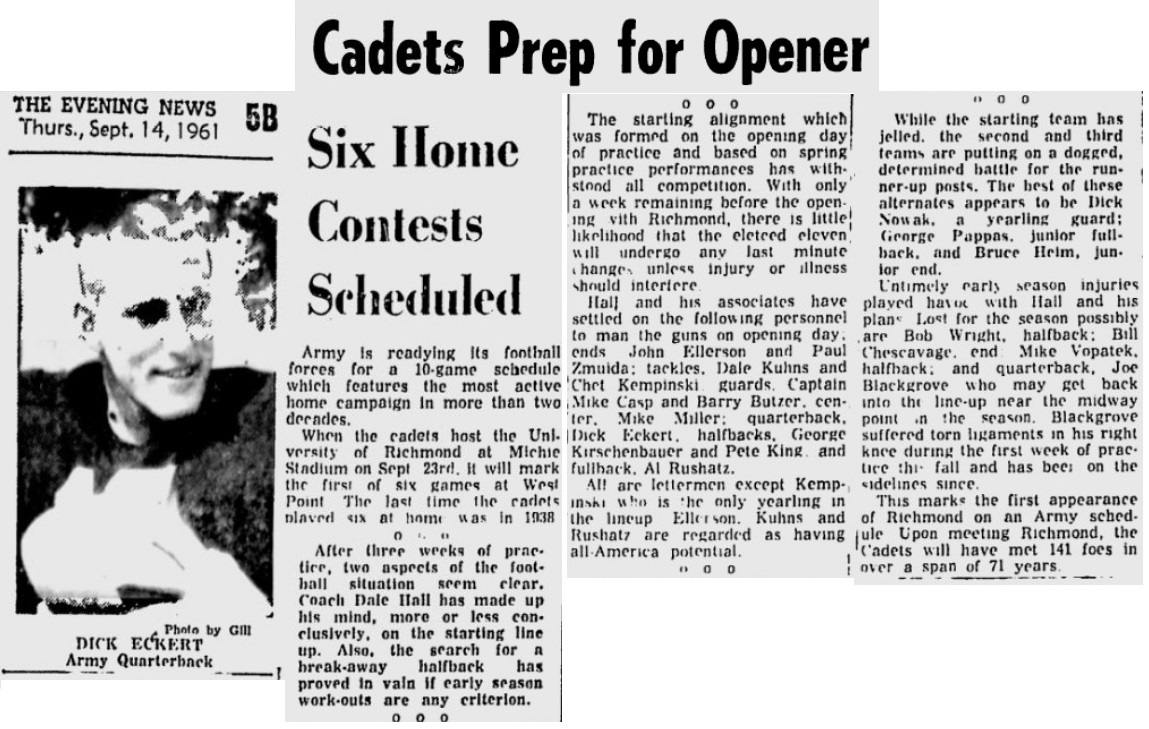
ArmyFB_1961_forecast_EveningNews_Sep141961

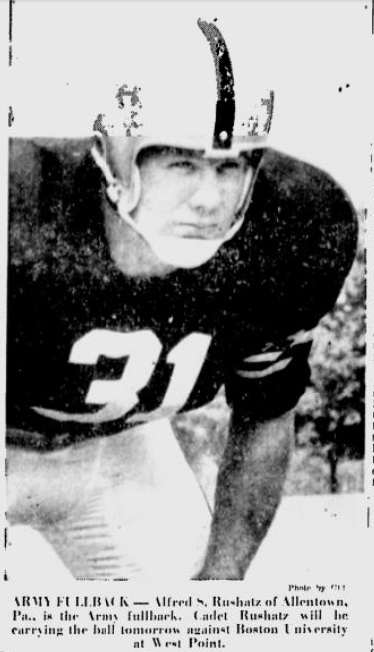
ArmyFB_1961_AlRushatz_EveningNews_Sep291961

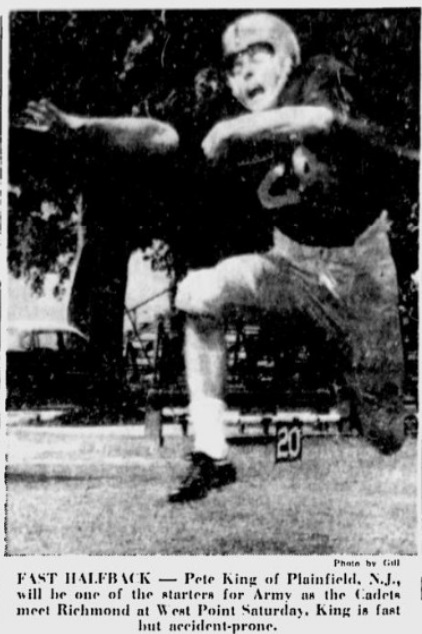
ArmyFB_1961_PeteKing_EveningNews_Sep211961

ArmyFB_1961_vsBU_BostonGlobe_Oct11961

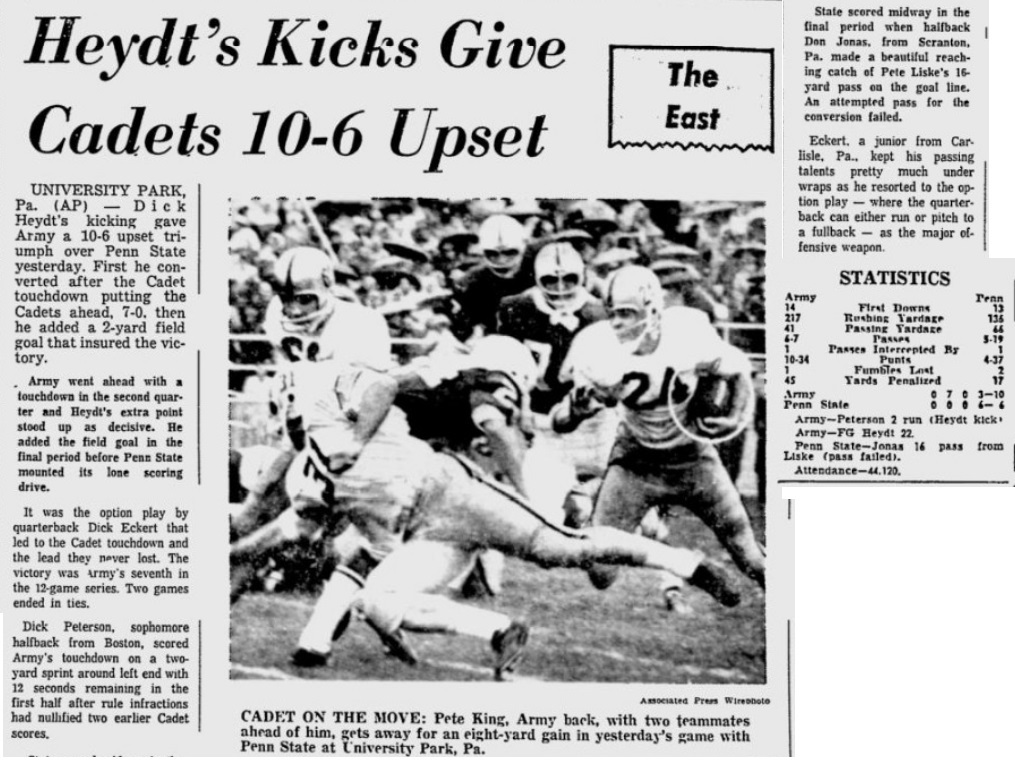
ArmyFB_1961_vsPennState_MiamiNews_Oct151961

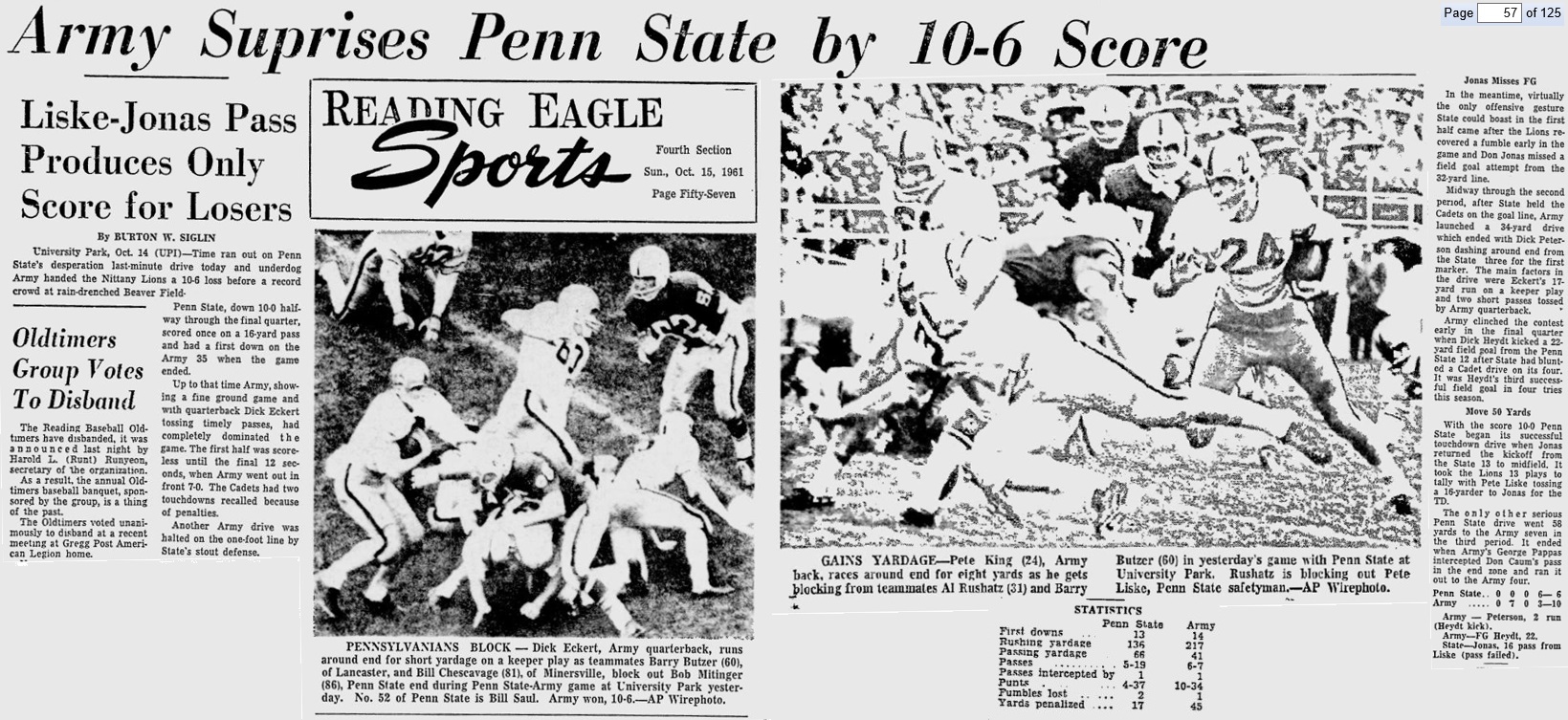
ArmyFB_1961_vsPennState_ReadingEagle_Oct151961

ArmyFB_1961_vsPennState_ReadingEagle_Oct151961

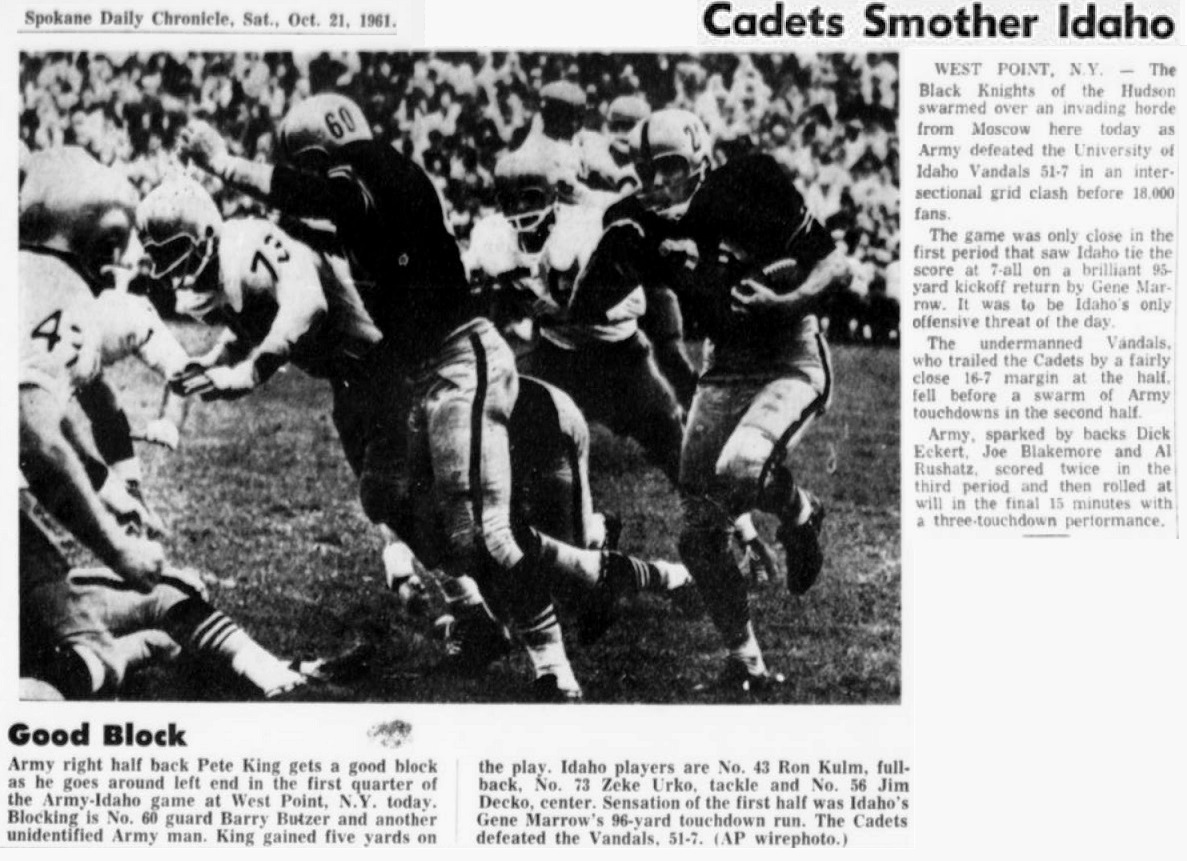
ArmyFB_1961_vsIdaho_SpokaneDailyChronicle_Oct211961

ArmyFB_1961_vsIdaho_SpokaneDailyChronicle_Oct211961

——————-
By Rabble
Mar 31, 2003

Army vs Penn State, 1961 –
A look back at the 1961 classic meeting between Army and Penn State through the eyes of the now defunct Newark Evening News. Army won 10-6. It was a huge upset win for the Cadets because the Army team had been crushed at Ann Arbor against Michigan the previous week by a score of 38-8.

By Len Elliott

Army’s Stutter~ Option to Short Side Bothers Penn State

ARMY detonated the big surprise of Eastern football Saturday, when it beat Penn State among the fog-topped mountains of central Pennsylvania, Army didn’t do it on a fluke either; the Cadets looked like the hotter team and they were.

Army won this one for several reasons. One was a piece of ingenuity by Coach Dale Hall, one which should strengthen our faith in the armed forces. A second was the high resolution of the team, which was smarting from its humiliation at Michigan the, week before; seven of the starting eleven were Pennsylvania boys too, and were playing before families and friends. A third factor was Penn State’s inability to-make its attack move consistently without its top quarterback, Galen Hall.

The first Hall, Army’s Dale, did two things last week which had a decisive bearing on the game. First he moved Joe Blackgrove, who had been alternating with Dick Eckert at quarterback, to left half. He put Blackgrove there to give Army some running speed to the outside.

Blackgrove, redheaded son of an Army sergeant, has speed, elusiveness and surprising drive, considering that he weighs only 168 pounds. He had been used last year almost solely as a specialist to run back kicks.

Turning the Short Side ALL’S other accomplishment was to ‘devise a way to get around the short side of Army’s unbalanced line without using the undersized Blackgrove as a blocker. He did it by coming up with what appears to be a new maneuver in offensive football. It was new to Penn State, anyway. the play could be called a delayed, or stutter, option. In this it differs from the belly option, the Faurot option and the rollout option, although it is closer to the Faurot than anything.

Army worked it this way. The team, for instance, would line up in right formation, with the lonely end far out and the line unbalanced. Blackgrove, the left half in the solid T, goes in extended motion to the right, or strong side. As he gets the ball from the center, Dick Eckert fakes to Al Rushatz, the fullback, who goes in as though on a fullback trap play, and a guard pulls. Eckert fakes to Rushatz, delays slightly with a couple of stutter steps, so the guard can get ahead of him, and then sets sail to the short side with the right halfback going with him as the pitch man.

Then the option develops. If the end, or the corner man if there is one, goes for Eckert, he pitches out to the right half and the latter turns the corner with the pulling guard in front of him. If the end softens to the outside for the pitch man, Eckert keeps the ball and goes inside him.

Fake Deceived Lions

ECKERT made the play beautifully against Penn State. He pitched out to Pete King once for 25 yards, to Ray Paske once for 30, to King again for nine. The long one by King almost went for a touchdown, only a last ditch tackle by Pete Liske averting it. King’s big gain put State in a bad hole, however, from which the Lions never recovered until Army had scored.

Apparently, as it was explained, the moves that make this option work are the fake to the fullback inside and the guard pulling. It looks like a trap and thus holds the linebacker and the tackle, and has the general effect of delaying pursuit. Anyway, it worked against Penn State and looked like a good way for the unbalanced T to get around the short side.

Going to the strong side Army uses the usual belly option and Blackgrove and Eckert ran this very well.

Eckert got the touchdown drive started with it and Blackgrove’s running got the Cadets into range for a field goal. With Blackgrove at halfback Army crossed up everybody by practically refusing to throw the ball. Out of 70 offensive plays, only seven were passes-and six of them complete. So the Cadets now appear to have the balance, when they want to use it that will make them even more dangerous.

Galen Hall Missed

PENN STATE apparently needs Galen Hall at quarterback, badly. Neither Liske, essentially a defensive player, nor Don Caurn could get the team moving for more than two drives. The first of these ended with an interception and so would the second, if offsetting penalties had not canceled the play.

The Lions had a big chance early, when King fumbled away a fair catch on the Army 29. But State tried to run the ball, then missed a pass on third and six and had to settle for a field goal try. Had they scored then the game might have been different. As it was, they never got into a threatening position again until late in the third period. Penn State must be given an accolade for one move. The ground crew was routed out of bed at midnight, soon after the rain began, and had the field covered before 1 a.m.

—————————

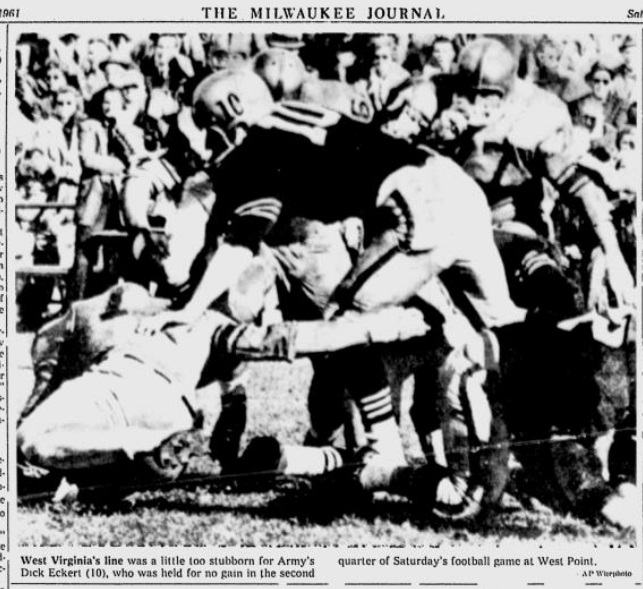
ArmyFB_1961_vsWVU-DickEckert_MilwaukeeJournal_Oct261961


“Pete King” with ball & “Bill Whitehead”

Click to access 1961detroitatarmy.pdf

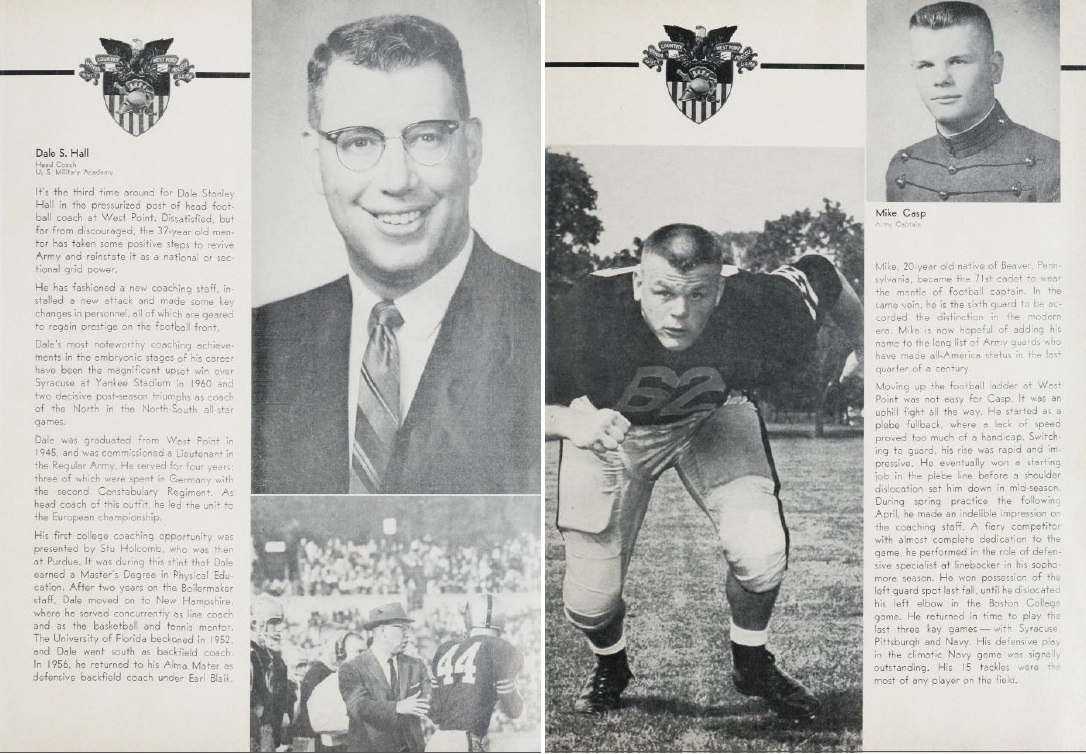
ArmyFB_1961_DaleHall-MikeCasp_DetroitvsArmy-program_11Nov1961
ArmyFB_1961_DaleHall-MikeCasp_DetroitvsArmy-program_04Nov1961

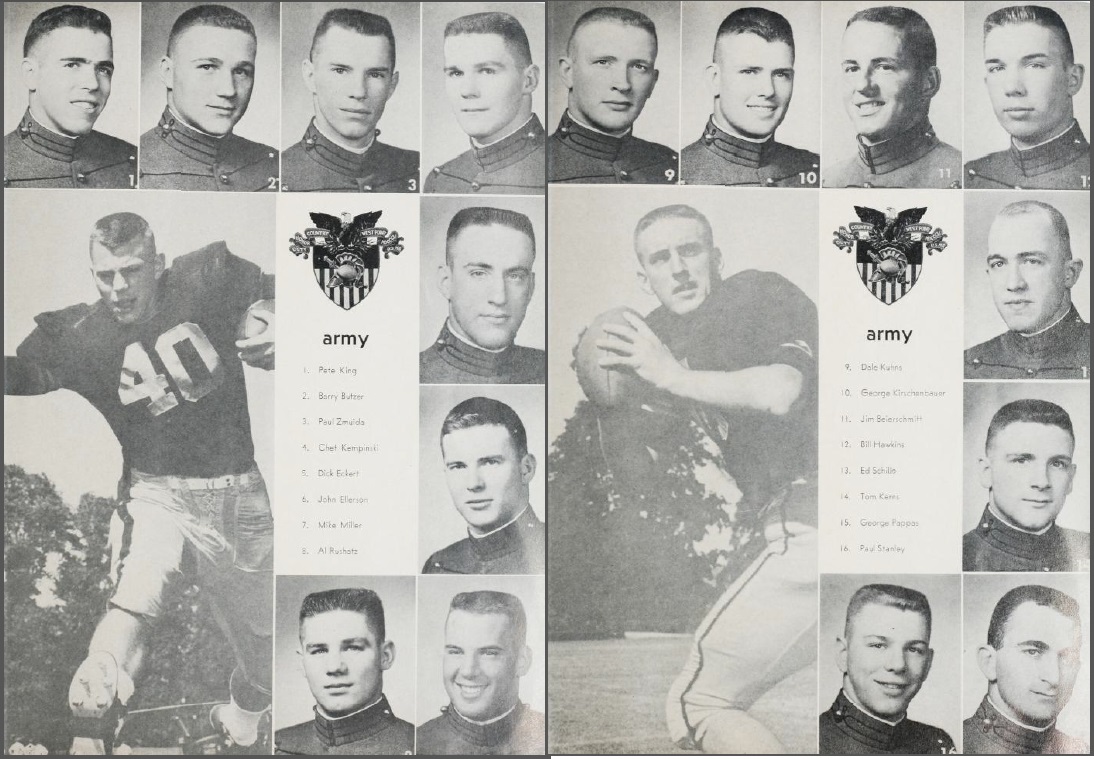
ArmyFB_1961_PlayerPhotos-1-2_DetroitvsArmyprogram_11Nov1961
ArmyFB_1961_PlayerPhotos-1-2_DetroitvsArmyprogram_04Nov1961-1

ArmyFB_1961_PlayerPhotos-3-4_DetroitvsArmyprogram_11Nov1961
ArmyFB_1961_PlayerPhotos-3-4_DetroitvsArmyprogram_04Nov1961

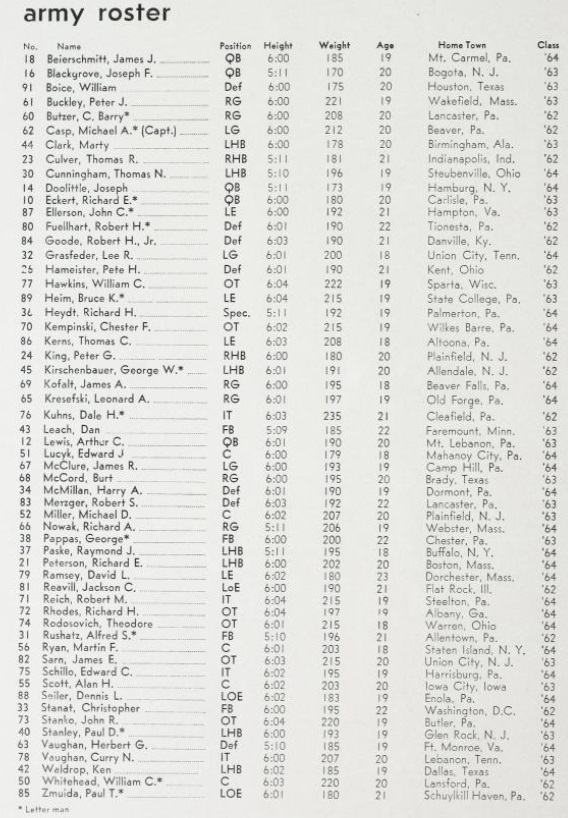
ArmyFB_1961_Army-roster_DetroitvsArmyprogram_11Nov1961
ArmyFB_1961_Army-roster_DetroitvsArmyprogram_04Nov1961

ArmyFB_1961_vsWM_Nov121961_ColonialEcho1962
ArmyFB_1961_vsWM_Nov111961_ColonialEcho1962

ArmyFB_1961_vsOU-JohnEllerson_MiamiNews_Nov191961

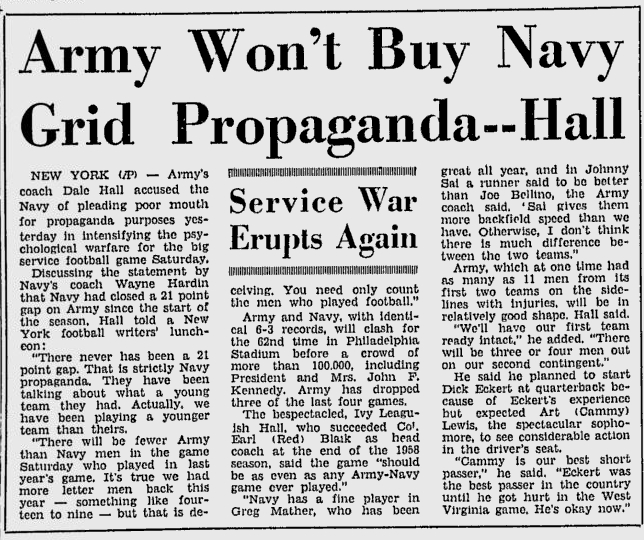
ArmyFB_1961_vsNavy-propaganda_DaytonaBeachMorningJournal_Nov281961

–

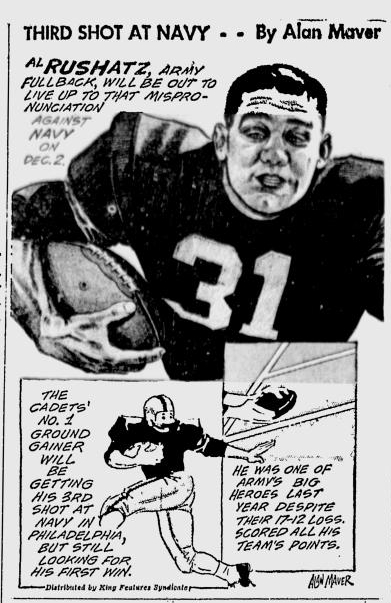
ArmyFB_1961_AlRushatz_byAlanMaver_RochesterInSentinel_Nov291961

–

ArmyFB_1961_startersvsNavy_SpokesmanReview_Dec21961 (file name should not be 62)
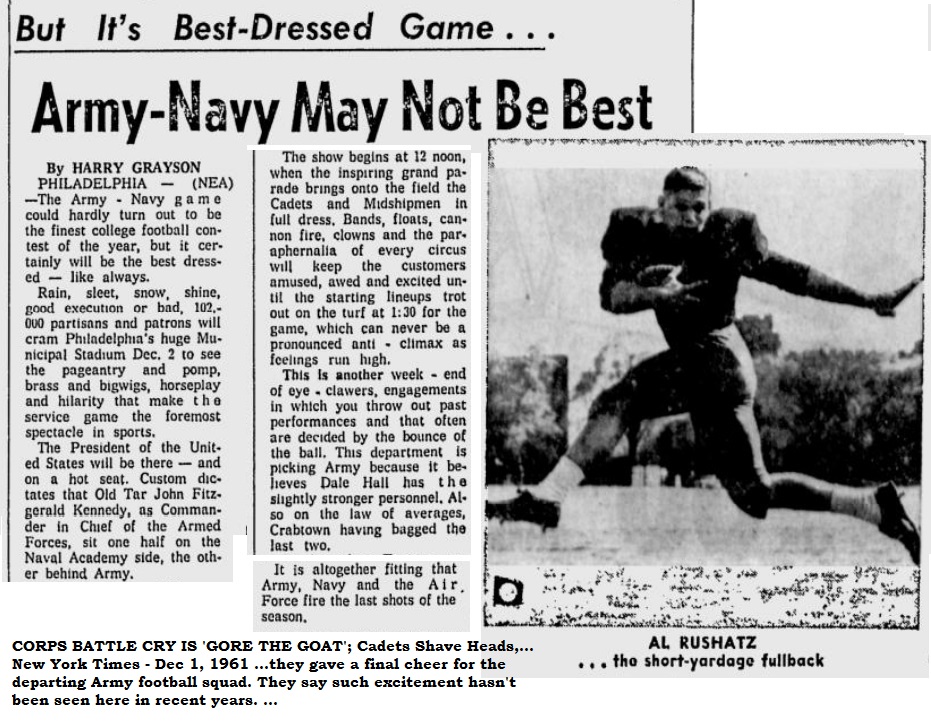
ArmyFB_1961_vsNavy_TheTelegraph_Nov291961
ArmyFB_1961_vsNavy_TheTelegraph_Nov291961-1

ArmyFB_1961_vsNavy-pre-Rushatz_MeridenJournal_Nov301961

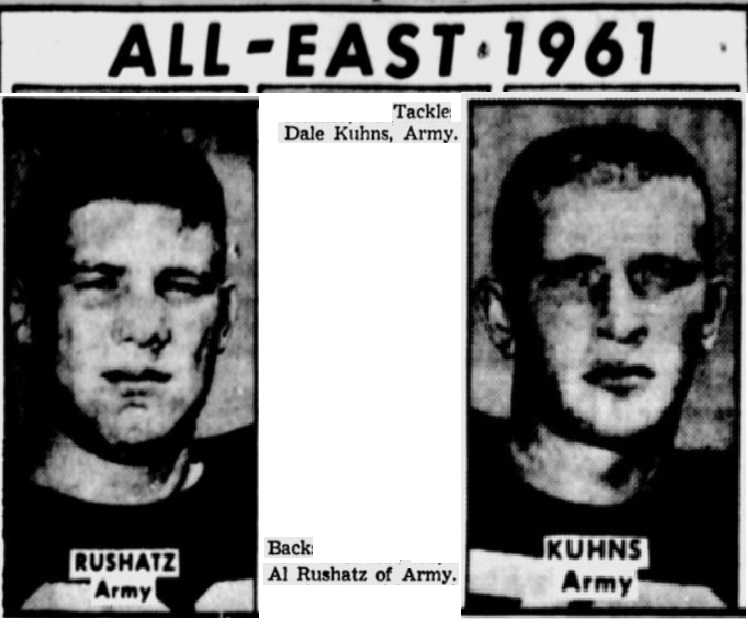
ArmyFB_1961_Rushatz-Kuhns-All-East_TheTelegraph_Dec11961

ArmyFB_1961_vsNavy_YoungstownVindicator_Dec31961

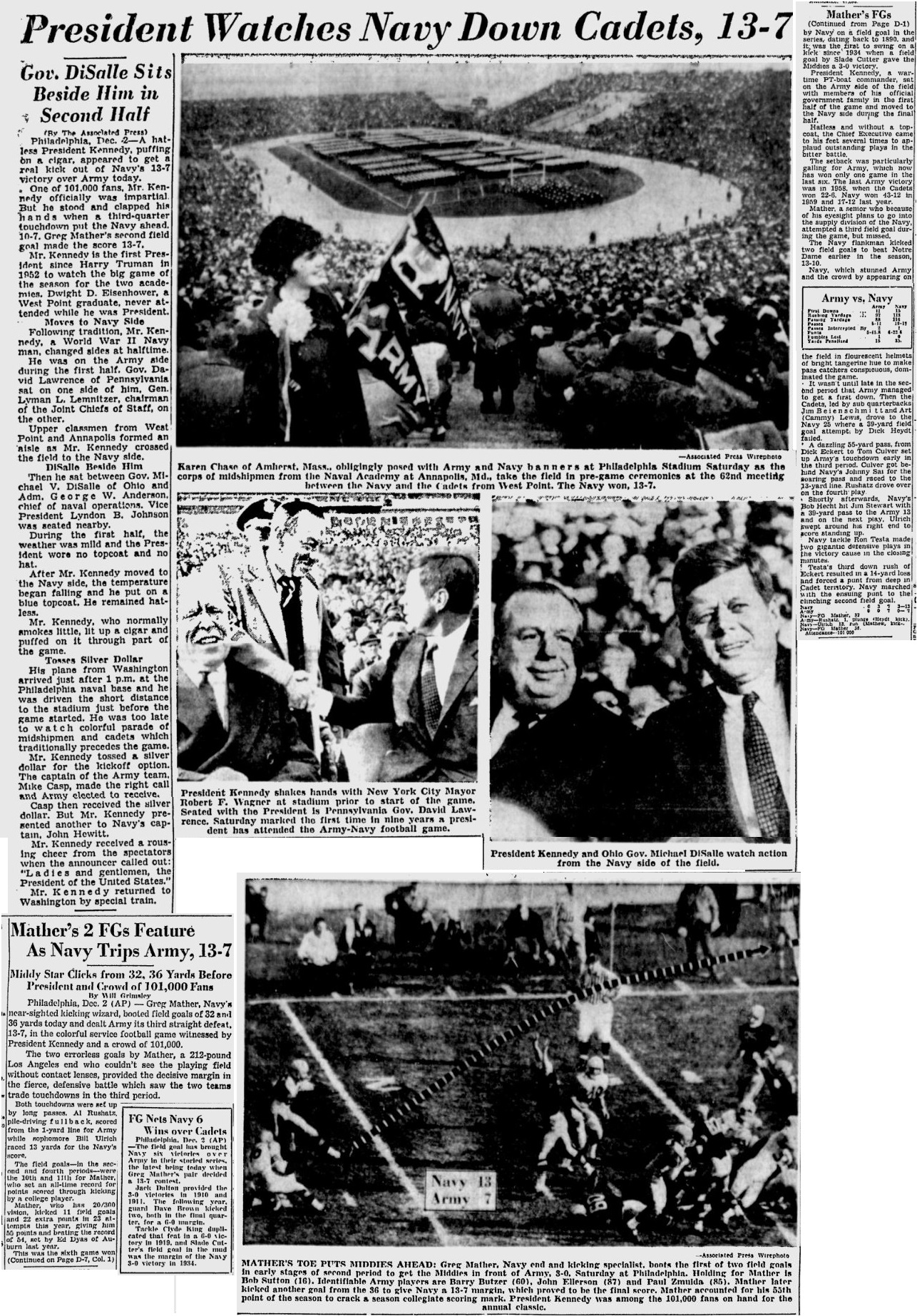
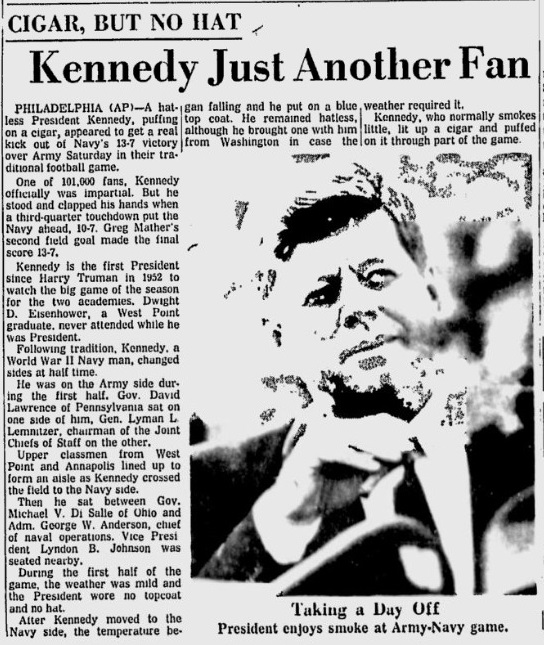
ArmyFB_1961_vsNavy-PresidentKennedyattends_EugeneRegisterGuard_Dec31961

ArmyFB_1961_vsNavy-PresidentKennedyattends_EugeneRegisterGuard_Dec31961

–

–

no sound

–

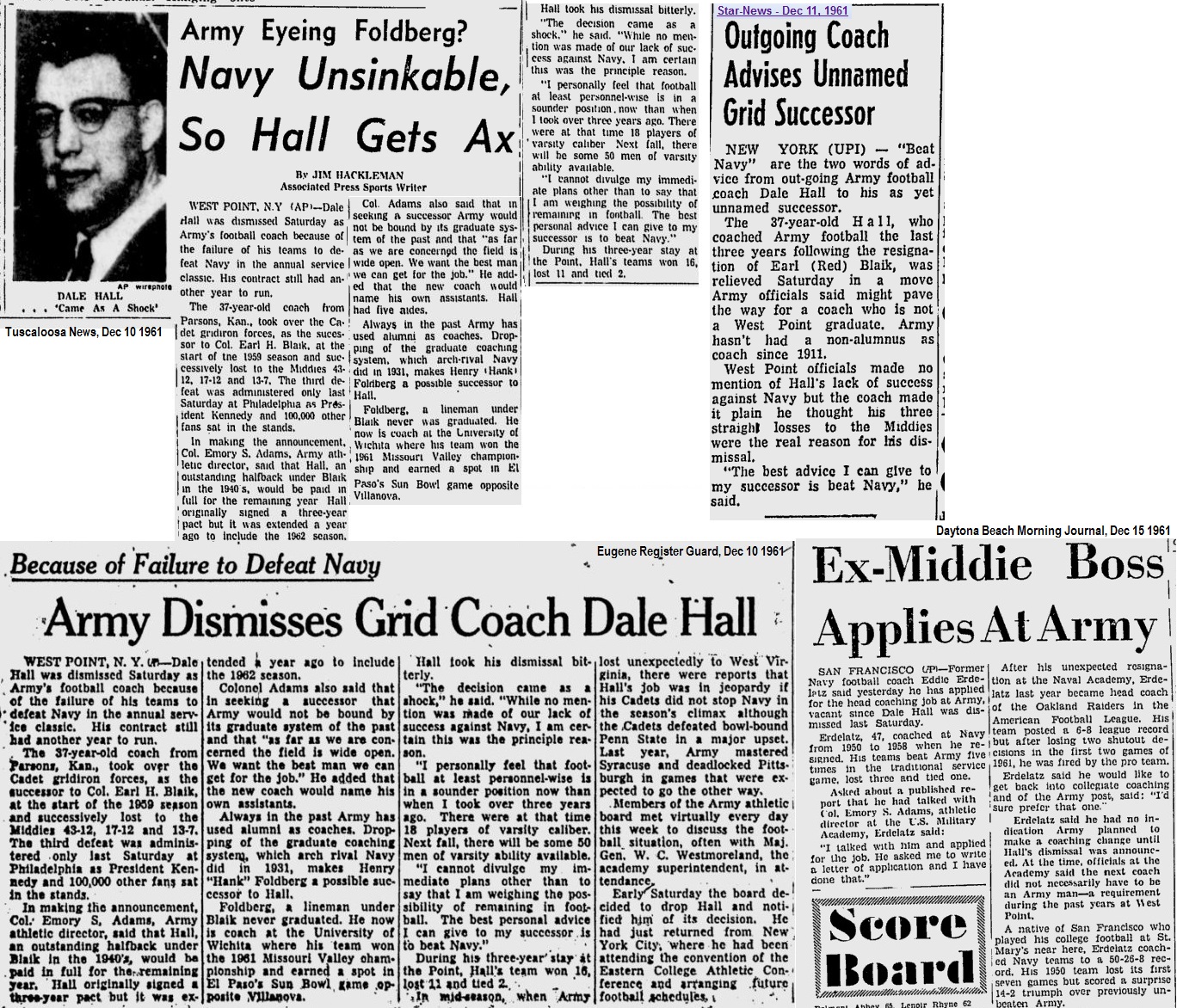
ArmyFB_1961_CoachDaleHall-firing_various_Dec1961

–

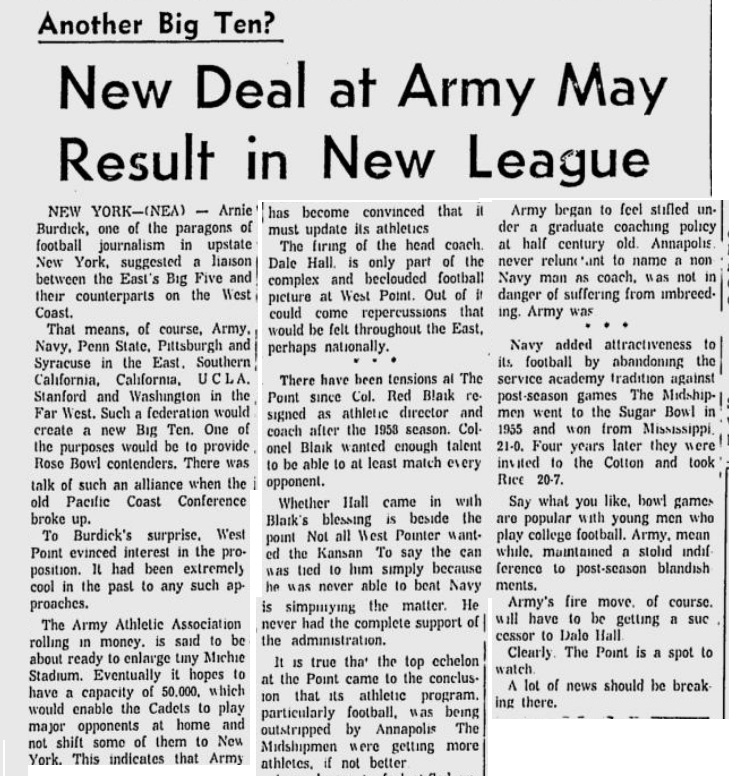
ArmyFB_1961_BigTen_AltusTimesDemocrat_Dec241961

–

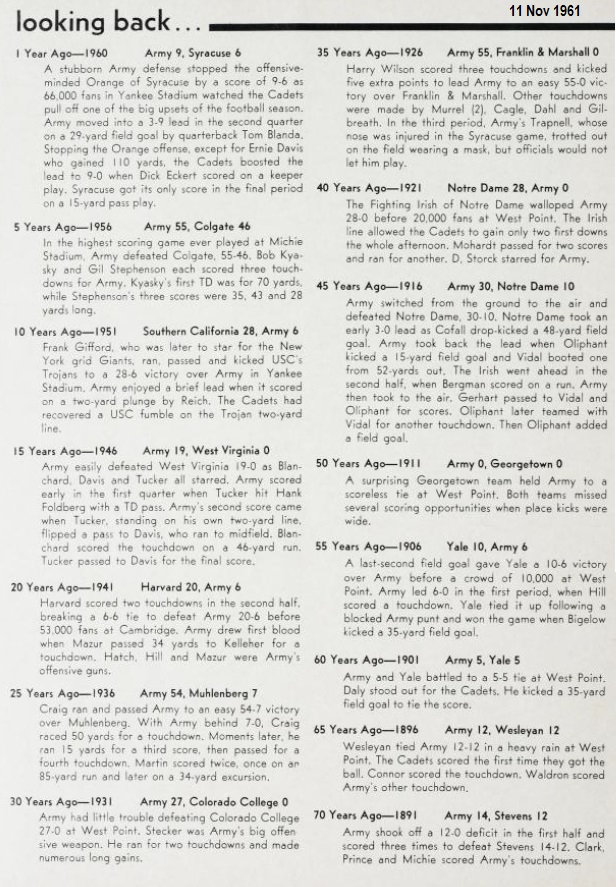
ArmyFB_1961_LookingBack-ArmyGames_11Nov1961

–
ArmyFB_1961-64_Vietnam_ReadingEagle_Aug291965
–

articles provided by Russ “Skip” Grimm – Class of ’76

Carl Morin

Carl Rolland Morin, JR

Nickname Curly

Class 1962

Company L-1

Home Town Eau Gallie, Fl.

High School Melbourne High

  • Played against “Bob Anderson” in High School and Beat Cocca Beach.

Date of Entry 1 July 1962

Date of Graduation 6 June 1962

Cadet Rank & Position

  • Lieutenant
  • Platoon Leader

Cullum Number 23899

Height 6′

Weight 185

Teams Football 4,3,2

  • Defensive Half Back, Full Back
  • Too many quailified Players Firstie Year

Coaches

  • “Col Blaik” Head Coach Plebe Year
  • “Dale Hall” Yearling & Cow

Team Captain

  • “Bill Carpenter” Yearling Year
  • “Al Vanderbush” & “Frank Gibson” Cow Year

Injuries Dislocated Right Elbow Wrestling

Athletic Awards

  • Numerals Plebe Year
  • Monogram Yearling & Cow Years

Few Demerits

Academic Star once as Firstie

Intramurals

  • Soccer, Wrestling and Volleyball

Recreation/Activities

  • Class Committee 3,2,1
  • Russian Club 4,3,2,1
  • Pistol Club 3,2,1
  • Ski Club 4,3,2

Vin Murphy

Vincent Edward Murphy

Class 1962

Company L-1

Home Town Winchester, Ma.

High School Winchester High

  • Attended with Joe Belinno, Navy’s Great Back
  • Designated the most underrated Football player in the state

Prep School Columbia Prep – Wash D.C.

  • Sent by Navy as was Joe Belinno the previous year
  • Missed the Navy cutoff score in English by 5 points
  • Recruited by Army which had a lower English score requirement than Navy but a 20 higher Math Score -(see Turnout Stars)

Date of Entry to Academy 1 July 1958

Date of Graduation 6 June 1962

Age at Graduation 23

Cullum Number 24400

Cadet Rank Sgt

Height

  • Entry 5′ 10″
  • Graduation 5′ 10″

Weight

  • Entry 185
  • Playing weight 170
  • Graduation 185

Teams

  • Plebe Football
  • Plebe Lacrosse

Coaches

  • Col Blaik Head Coach Football
  • It was either Academics or Football

Position Played End in Football

No significant amount of Demerits

3 Turnout Stars Earned- Math, Thermodynamics, the 3d is for some reason locked out of his mind.