Class of 1905 – Army Head Coach 1906 and 1912 – Assistant Coach in 1905, 1913 – 1916, 1919 – 1921
Earned 4 Army A’s in Football
The Lineman’s Bible
The Link – His Book
|
|
Class of 1905 – Army Head Coach 1906 and 1912 – Assistant Coach in 1905, 1913 – 1916, 1919 – 1921
The Link – His Book
|
|
 The Carlisle Backfield (top) and the 1912 Army team (bottom). Dwight Eisenhower, second from left. The Carlisle Backfield (top) and the 1912 Army team (bottom). Dwight Eisenhower, second from left. |
The Greastest Grudge Game Ever
By: John Hall in State College Magazine 12/12/2009
November 9, 1912 – Cullum Field, West Point, N.Y.
The sky was ugly. The temperature hovered around freezing all day, and black angry clouds were swirling over the Hudson River, threatening at any minute to drop a torrent of sleet on the crowd that had gathered to watch the greatest grudge game in football history.
On one side of the field, in black and gold uniforms, stood the mighty Cadets of Army. For years Harvard, Yale and Princeton had dominated the college gridiron, and they were called the Big Three. But over the past couple of seasons, through sheer guts and determination, Army had kicked down the door of that exclusive club and taken a seat at the table, and now people talked about the Big Four.
Across the field in red and white stood another upstart team determined to enter the ranks of the elite. But where Army had bludgeoned their way in, this team was determined to dance their way in. They were the Carlisle Indian Industrial School. Their official nickname was the Pirates, but everyone called them the Indians.
The Indian School at Carlisle, Pa., was the brainstorm of Richard Henry Pratt, an American Army officer who led the African-American “Buffalo Soldiers” in genocidal warfare against Native-American Indians. Most white Americans at the time were comfortable with the notion that the Indians either had to be exterminated or turned into a new type of slave. But Pratt felt that there had to be a better way. First he convinced the Federal government to give him the school. Then he convinced the Indians that their children would have a better chance of survival if they learned to read and write as well as the white man.
 Eisenhower in play action Eisenhower in play action |
Soon the Indians learned that they could also compete with the white man at his own game of football. The previous year Carlisle had beaten Pitt, Penn and Harvard. Going into the game at West Point they were 9-0-1. They were looking at nothing less than the national championship, and no one wanted it more than the Carlisle coach, Glenn Scobey “Pop” Warner. A brilliant strategist, he was also football’s first great innovator. In 1894 Warner was playing left guard for Cornell when their head coach, Marshall Newell, announced that he would be gone for a week to help his alma mater, Harvard, prepare for their annual showdown with Yale. Warner was named interim head coach and, seizing the opportunity to turn a game of brute force into a game of poetry and chess, he devised a trick play. Locked in a scoreless tie with Williams College late in the fourth quarter, Warner whispered “Number 39” in his quarterback’s ear. The quarterback took the ball and swung his arms toward the left halfback, and the whole team began sprinting left, except Warner. He took two steps back, pulled the ball out of the quarterback’s hands, and began running right into an open field. He was tackled from behind and fumbled the ball just short of the goal line. He failed to win the game, but had just invented the reverse.
When he took the coaching job at Carlisle, he found the Indians smaller than most college football players, but he also found them quick and athletic. He discovered ways to capitalize on this. He was the first coach to have backs start from a three-point stance and he invented what was called the Indian block, but today everyone calls it the cross body block. He also invented the wingback and single-wing formation. Then, in 1907, college football legalized the forward pass.
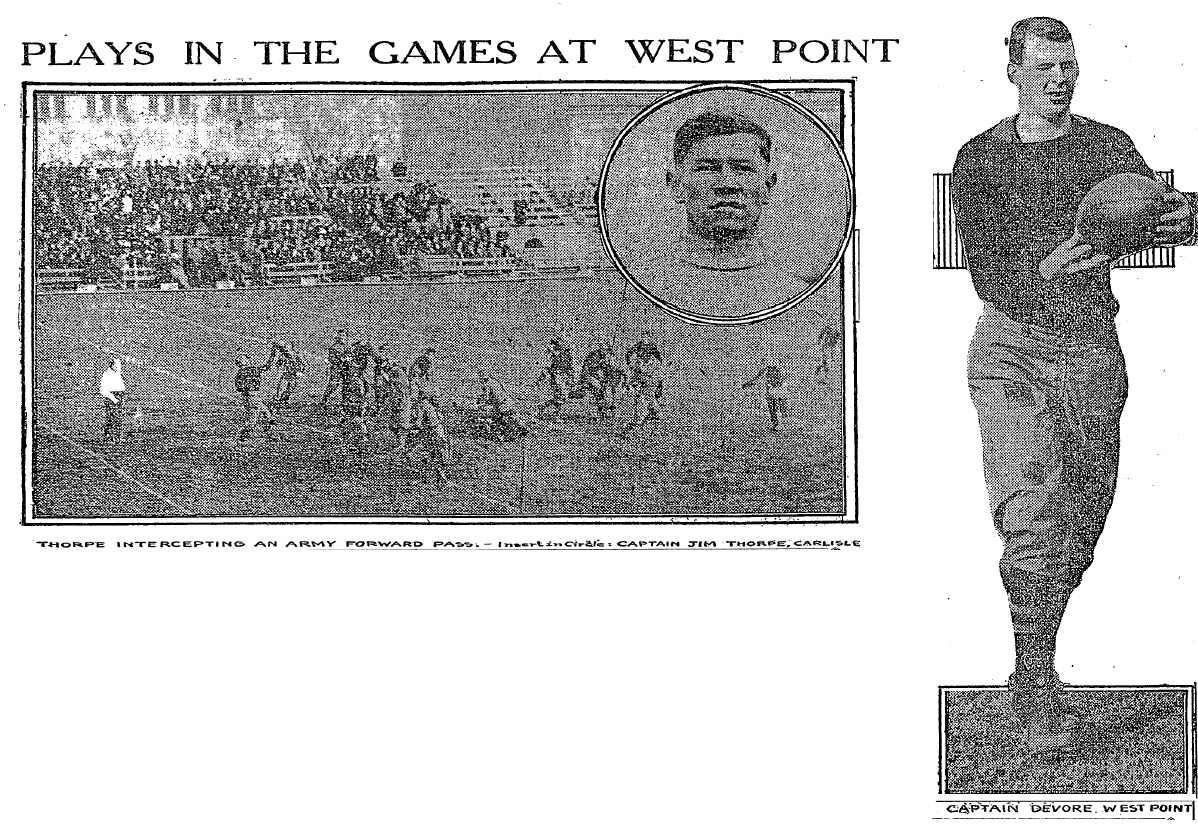
 Pennsylvania football icon, Jim Thorpe Pennsylvania football icon, Jim Thorpe |
At the time quarterbacks hurled the ball end-over-end, threw it like a shot put, or lobbed it underhand like a softball. Predictably, it lost all accuracy after about five yards. Warner played with the ball all summer, looking for a better way. Then when practice started in 1907 he called his backs aside. “I want you to practice this,” he said. He then spread his hand, placed the stitches along his fingers and wrapped his thumb around the other side of the ball. “Hold it like this, bring it up behind your head, and when you bring it forward put a spin on it, and then you will be able to throw it with pinpoint accuracy for 30 or 40 yards.” Warner had just invented the technique for the forward pass.
Now Warner, in his quest for the 1912 National Championship, had two things going for him. One was a new formation he had invented. The other was Jim Thorpe. Four months earlier, Thorpe was in Stockholm, Sweden, where he won the Olympic pentathlon and decathlon. When he was presented with the gold medals, Gustav, the King of Sweden, leaned forward and told him, “Sir, you are the greatest athlete in the world.” Thorpe simply replied, “Thanks, King.”
The American press agreed with the king. In the four months since then, Thorpe had received more coverage than Ty Cobb, Honus Wagner, and heavyweight boxing champion Jack Johnson. His reputation was not overrated. He could run, he could pass, he could kick. His high jumping and broad jumping ability enabled him to literally run over players, leaving bloody cleat marks on their thighs, torso and shoulders. During a game on September 28 against Dickinson, Thorpe had picked up a bungled snap in his own end zone and outran everyone for a 105-yard touchdown. The previous year at Forbes Field he had punted against Pittsburgh from deep in his own territory. Thorpe managed to race down the field, catch his own punt and run it in for a touchdown.
But on the other side of Collum Field this November day, there was a blue-eyed hardscrabble kid from Kansas who had plans of his own. It was only his first year as a starter, but he was already considered one of the hardest-running halfbacks and hardest-hitting linebackers in college football. He was determined to cement his reputation forever by using his bone-crushing tackles to put Jim Thorpe in the hospital. The kid’s name was Dwight Eisenhower.
Warner was taking no chances; he had been playing the race card for weeks. “These are the grandsons of the men who killed your grandfathers and raped your grandmothers at Wounded Knee,” he told his players in the pregame pep talk. “Today they will have their revenge. Today will be the day to make every Indian in America proud.” However, it is unlikely that Thorpe found much inspiration from such talk. In the first place, prodigies like Thorpe usually transcend petty prejudice. In the second place, Thorpe didn’t have any grandfathers at Wounded Knee. His one grandfather was Irish and his own father prided himself on a reputation as a hard-drinking, hard-fighting, quick-tempered “Irishman” His other grandfather was French and his mother Charlotte Vieux was a devout Roman Catholic, as was Thorpe his entire life. This made him a lightning rod for three of what were probably the top five prejudices in America at the time. Germans were securely in first place ahead of blacks, then, in no particular order, came Irish, Indians and Catholics.
 Carlisle Team Carlisle Team |
At 3 o’clock on that gray and windy afternoon, Thorpe took the opening kickoff and returned it for 13 yards. Then he walked over to the huddle where Carlisle quarterback Gus Welch told the team it was time to unleash Warner’s secret weapon. The Indians lined up in their standard power formation, two halfbacks and a fullback behind the quarterback. Thorpe then moved left and closer to the line, where he lined up in a three-point stance outside the left tackle. Alex Arcasa did the same thing on the right. Nobody had ever seen this before, but anyone today would recognize it for what Warner had already named it: the double wing formation.
During the first half, the Indians ran at Army out of this new formation, using a variety of reverses, double reverses and fake reverses. It seemed that at least three Indian backs had to touch the ball on every play. Years later, after he retired as president, Eisenhower recalled that one of the most awesome things he had ever seen in his life was Jim Thorpe running at him out of the double wing. But no one was more impressed by Warner’s innovative formation than a New York sportswriter named Walter Camp. In 1876 Camp had taken an English game called rugby and revised it – adding set downs, a line of scrimmage, and a few other changes. When he was done he had invented American football. Now he was the most respected sportswriter in America. He alone selected the National Champion and the All-America Team, and no one questioned his judgment. But in all his years as player, coach and writer, he had never seen anything like this: it didn’t look like football; it was more like a circus, or basketball on grass.
Carlisle was clearly outplaying Army, but the Cadets, through sheer tenacity and luck, entered the locker room at halftime with Carlisle leading by only a point, 7-6. However, with the new formation, the greatest athlete in the world, and the frenzy of revenge that Warner had instilled in his team, Eisenhower knew that the game was about to get out of hand, unless Thorpe was eliminated. Eisenhower called another linebacker, Leland Hobbs, over to a corner where he laid out his battle plan. Hobbs was to watch Eisenhower for a signal. Then Eisenhower, with all the force he could muster, would run directly into Thorpe’s chest, while Hobbs would blindside Thorpe’s knees as hard as he could.
The second half did not start well for Army. On Carlisle’s first possession of the half, Welch pitched the ball to Arcasa, who ran behind Thorpe and tackle Joe Guyon. Army captain “Leland Devore” had a bead on Arcasa, but he was knocked down by Thorpe and Guyon, while Arcasa ran around him for a touchdown. On the ensuing kickoff a humiliated and enraged Devore ignored the play and blindsided Guyon like a runaway freight train. Devore was immediately ejected for unsportsmanlike conduct. With the Army captain out, Eisenhower realized that he had to do something soon. He noticed that on first down Thorpe invariably ran the ball for Carlisle, so on the next series of downs he gave the signal to Hobbs. The two hit Thorpe as planned and spectators later said that the collision sounded like a pair of two-by-fours being slammed together. All three players went down. Hobbs got up first, then Eisenhower, but Thorpe stayed down. Eisenhower, thinking his plan had worked, began celebrating, but then the big Indian got up and walked to the huddle.
Eisenhower was now more determined than ever. A few plays later he and Hobbs tried it again. But like all great players, Thorpe had an instinct for the game, and at this point he demonstrated one of his less-known but highly impressive athletic skills: an ability to go from full speed to a standstill in a single step. So Thorpe, sprinting with the ball, stopped suddenly, watched as the two Army linebackers collided in front of him, and then ran around them for a few more yards. Eisenhower and Hobbs were barely conscious. Hobbs got to his feet first and staggered to the bench for medical assistance. Eisenhower got up but could hardly walk. He pleaded to stay in the game, but his coach, Ernest Graves, ordered him to the bench. Without Devore, without Hobbs, and without Eisenhower, the game turned into a rout and Carlisle won 27-6. In the locker room, Devore told reporters: “That Indian is the greatest player I have ever stacked up against. He is super-human. There is nothing he can’t do.”
That night as the Indians rode the train back to Manhattan, Walter Camp walked into their car. He told them that they might indeed be the best team in the nation, and he congratulated Thorpe, calling him the most brilliant player he had ever seen. Then the man who invented American football turned to Warner and told him that after today the game would never be played the same again.
The following week Eisenhower, still limping, suited up for a game against Tufts. As he carried the ball and tried to surge forward for an extra yard, a Tufts player grabbed his ankle and twisted his leg as hard as he could. Something popped and Eisenhower flopped around the field like a fish on dry land. He left the field on a stretcher and never played another down. He finished his football career at West Point as a cheerleader. Editor’s Note – Eisenhower Coached the Cullum or Plebe Team
 Pop Warner Pop Warner |
Pop Warner’s hopes for a national championship were shattered a week later in Philadelphia when Carlisle was defeated by Penn, 34-26. The following week they beat Springfield, and then went to Providence to play Brown on Thanksgiving Day. It was now Thorpe’s turn for his luck to run out. On the day before Thanksgiving, Thorpe participated in his last practice ever as a Carlisle player. A local sportswriter, Roy Johnson, came to the practice looking for an angle on a story. While watching the workout he recognized Charley Glancy, a former professional baseball coach who had also come to watch the practice. As the two were talking, Glancy suddenly interrupted Johnson: “I know that guy,” he said, pointing to Thorpe. “He played for me a couple of years ago.” Johnson, stunned, was on the story like a dog on a bone. Jim Thorpe had received a salary for playing baseball, making him retroactively ineligible for the Olympics. The International Olympic Committee stripped him of his championships and forced him to return his medals. In 1982, almost 30 years after Thorpe’s death, the committee completed the farce by reinstating him. It mattered little. Thorpe’s reputation had been earned on the playing field and nothing could tarnish it.
–
–
3 Army A’s, Team Captain as a Cow, and Assistant Coach under Earl Blaik in the Fall of 1950.
Eldon & Pam Perdew
Football all 4 Years, Class Numerals Plebe Year and Monogram Cow Year.
ELDON L. PERDEW 1962
Cullum No. 23943-1962 | January 24, 1985 | Died in Reno, NV
Interment not reported to WPAOG.
Eldon Lee “Don” Perdew was born in Hastings, NE, the youngest son of Charlotte and Lawrence Perdew, a heavy equipment operator. Don grew up in a closeknit, hardworking family with four older brothers: Bill, Jim, Charles “Chuck,” and Larry. Bill and Jim are now deceased, but Chuck and Larry are living in Lincoln, NE.
Don excelled in academics and sports. A natural leader, he captained the football team (and was an All State selectee), was on the Student Council, attended Boys State, received a Rotary Award and was his class vice president. Don was a perfect appointee: he had outstanding potential to be an Army officer and he could play football.
At West Point, Don was unflappable. His quick but kind sense of humor and his exceptional intellect seemed to make academics, athletics, and cadet life easy for him. Always cheerful, Don drew a wide circle of friends. Many F2 companymates and his classmates sought Don’s advice.
Don was eager to play football for Army, but Army had many top quarterbacks. Nevertheless, Don played on the “B” Squad for four years, earning his numerals and monogram. During First Class year, Don was a cadet captain and training officer for the 2nd Regiment. His F2 company mates selected him as their Honor Committee representative.
In 1961, Don was the cadet XO of Camp Buckner. Classmate Jim Kays, the camp commander, recalled Don’s ability to solve the tough problems, such as securing the speedboats that GEN and Mrs. Westmoreland especially enjoyed. The boats often were the target of late night pranks by the yearlings.
Don chose the Infantry, attending the Basic Course and Ranger School at Ft. Benning, GA, prior to his joining the 504th Airborne Infantry, 82nd Airborne Division, at Ft. Bragg, NC. He subsequently received Airborne and Jumpmaster wings and then, in 1964, assumed command of a company in the 504th.
Don then attended the Defense Language Institute at Monterey, CA, where he studied Czech and lived in an apartment on Casanova Street. Also living on that street were Scott McGurk, an F2 classmate and former roommate, as well as Pamela Hanscom, who would become Don’s soul mate and special love. The couple from Casanova Street had a wonderful and exciting courtship, leading to their marriage on 24 April 1965 in the beautiful Presidio of Monterey Chapel with Scott in attendance.
After leaving Monterey in 1965 and attending the Special Warfare School, Don joined A Company, 10th Special Forces Group (Airborne), in Bad Tolz, Germany. In 1966, he was sent to Viet Nam, serving in Headquarters Company, 5th Special Forces Group.
While Don was in Viet Nam, his first daughter, Laura Anne, was born on 11 Dec at Ft. Ord, CA. Laura is now a business owner living in Camas, WA, with her husband Leonard Hanna and children Nicholas (12), Jake (10), and Kaden (5). The children often peruse Don’s high school and military memorabilia, asking Pam with amazement and pride about all that Don had done in the Army.
Upon his return from Viet Nam, Don commanded A Company, 3rd Battalion, 1st Training Brigade, at Ft. Benning. In 1969, he attended the Infantry Officers Career Course there, and on 4 Apr 1969, Don’s second daughter, Kathleen Tracy, was born. Kathleen is now an Emergency Medical Technician living in Vancouver, WA.
Don was selected to return to West Point to teach in the Department of Earth, Space, and Graphic Sciences. To prepare, he attended the University of Southern California at Los Angeles, earning a master’s degree in geology.
Back at West Point, Don was an assistant professor and, later, an associate professor and director of the Planetary Science Program, as well as the director of Advanced Individual Study in Environment. He was an officer in charge of the cadet Geology Club, coach for West Point Youth Basketball, and coauthor of the 2nd edition of the Atlas of Landforms (Wiley, 1974). Additionally, he taught Physical Science at Orange County Community College.
In 1974, Don began two years in command of the 1st Battalion, 38th Infantry, 2nd Infantry Division in Korea. Upon his return, he was the recruiting division operations officer at the Army Southeastern Recruiting Command in Ft. Gillem, GA, before attending the Armed Forces Staff College later that year.
From 1977 to 1978, Don was the training officer at Headquarters, Sixth Army, at the Presidio of San Francisco. In 1978, he was assigned as the executive officer of the 3rd Brigade, 9th Infantry Division, Ft. Lewis, WA, commanded by Bill Carpenter ’60, Army’s “Lonely End” on the 1958 Army football team. At Ft. Lewis, Don and Pam also renewed their friendship with Scott McGurk, an Infantry brigade executive officer.
Pam remembers Ft. Lewis as especially wonderful. Don bought their daughters beautiful Arabian horses, the family joined the stables, and Don became president of the Riding Club. In 1980, when Don was assigned as the professor of military science at the University of Reno, the family took the horses with them and started breeding their own Arabians.
Don retired in Reno on 31 Oct 1984 as a lieutenant colonel, receiving the Meritorious Service Medal for more than 22 years of faithful service. He had previously received two Meritorious Service Medals, the Silver Star, Bronze Star, the Republic of Viet Nam Gallantry Cross Unit Citation Badge with palm, and the Army Commendation Medal.
Don died in Reno on 24 Jan 1985. At his memorial service, Pam reflected on their life, reminiscing about their many friends in the Army family. Pam indicated that Don was highly respected in the military, as he was in the civilian community, and that he had a way of drawing people to him. He will always be remembered as a wonderful husband and devoted father, brother, classmate, friend, and soldier, who lived the ideals of “Duty, Honor, Country.”
We love Don and will always miss him.


History: 1950 – 1951: Adversity strikes a heavy blow to the Army Football team. Numerous varsity players are released from West Point due to their violation of the school’s sacred honor code. The justified dismissals decimated the team. Many veteran, seasoned upper classmen, who would have provided the nucleus that could have incorporated and nurtured the green, younger players, were gone. As best they could, the former “B-squad” players of that era, attempted to rally the bewildered and inexperienced under classmen on the football team, but it seemed like a futile attempt for many reasons.
The community of grads and students empathized, and rightfully, with the administration for its action when the legendary honor code had been violated. Rumors of all sorts ran rampant on the Academy grounds and in the press. Statements were made and circulated about the demise of Army football. Predictions existed that the football program would take about 10 years to right itself, if at all.
At that time, mixed emotions permeated the Corps, faculty, grads, coaches, and the community of citizen on lookers. The shock of the event seemed too difficult to comprehend, however, optimism still kindled in the minds of those players who remained and the football loyalist who had faith in their team.
Surprisingly, within a short period of time, the untested players, seemed to coalesce, the coaching staff stabilized, and fundamental football schemes were utilized that allowed the innate ability of the individual players to develop. The trial and error period had started. A foundation for future development was established.
Each of the seasons and the spring practices provided, in a subtle way, the maturing of the 1953 team. Players were more comfortable with their skills and sensitive to each other’s strengths and weaknesses. This seemed to build a determination to overcome adversity and looking forward, optimistically, to playing and winning games.
As many reports have stated, the 1953 team “Returned to Glory” with the defeat of the nationally ranked Duke Blue Devils at the Polo Grounds in New York City. From a player’s stand point, that was the epitome of any game, team, and student body support that I’ve been associated with – bar none.
A major contribution was made by the 1953 team to resurrect the honor and glory of the United States Military Academy, its students and service personnel. Naming the 1953 Team to the Army Sports Hall of Fame, would be a reward that acknowledges that fact and could be considered as an Army “Unit Citation”.
Sincerely,
Bob Mischak
USMA 1954
1951-1953 Varsity letterman on the Army football team
1953 NBC-TV All American End
1954 College All Star Game player vs Detroit Lions
1954 Drafted by Cleveland Browns (NFL)
1954-1957 Military Service (Berlin, Fulda Germany)
1958 NY Giants (NFL) starting Offensive Guard — Head Coach: Jim Lee Howell,
Assts: Vince Lombardi (HoF), Tom Landry (HoF)
— Note: Starter in the famed “Greatest Game Ever Played”
which recently celebrated its 50th Anniversary. ESPN
produced a film which aired in Dec. 2008, now out on
DVD.
1960-1962 NY Titans (AFL) which became NY Jets (NFL) — Head Coaches: Sammy Baugh (HoF),
Clyde “Bulldog” Turner (HoF), Weeb Ewbank (HoF)
– – – Note: Team Captain, All-AFL offensive guard 60-62. First All Pro in the history of the NY Jets.
1963-1965 Oakland Raiders (AFL), starting offensive guard and TE — Head Coach: Al Davis (HoF)
1966-1973 USMA, Offensive Line Coach — Head Coach: Tom Cahill (NCAA Coach of the Year 1966)
Assts: Bill Parcells, John Mackovic, Ken Hatfield
1973-1987 Oakland/Los Angeles Raiders (NFL)* Owner: Al Davis (HoF), Head Coaches: John Madden (HoF),
Tom Flores, Player Personnel: Ron Wolf
1994 Los Angeles Raiders, TE Coach Head Coach: Art Shell (HoF)
– – – *Note: Member of 3 Super Bowl winning teams XI, XV, XVIII, 8 AFC Championship games and numerous playoff games. During tenure with Raiders served as TE Coach and Player Personnel Director.
– – – Coached notable TE’s such as Dave Casper (HoF), Todd Christensen (HoF nominee), Raymond Chester and Ted Kwalick
1988-1989 LA Cobras (Arena Football League), Asst. Coach Head Coach: Ray Willsey
1990 Munich Falcons (International League of American Football) Head Coach
1991 Ravenna Chiefs (Italian Football League), Head Coach
1991 Atlanta Falcons (NFL), Scout GM: Ken Herock
1992 London Monarchs (WLAF), DB Coach Head Coach: Ray Willsey
1993 Maryland Commandos (Arena Football League), Asst. Coach Head Coach: Ray Willsey
1997 London Monarchs (WLAF), OL Coach Head Coach: Lionel Taylor

History: 1950 – 1951: Adversity strikes a heavy blow to the Army Football team. Numerous varsity players are released from West Point due to their violation of the school’s sacred honor code. The justified dismissals decimated the team. Many veteran, seasoned upper classmen, who would have provided the nucleus that could have incorporated and nurtured the green, younger players, were gone. As best they could, the former “B-squad” players of that era, attempted to rally the bewildered and inexperienced under classmen on the football team, but it seemed like a futile attempt for many reasons.
The community of grads and students empathized, and rightfully, with the administration for its action when the legendary honor code had been violated. Rumors of all sorts ran rampant on the Academy grounds and in the press. Statements were made and circulated about the demise of Army football. Predictions existed that the football program would take about 10 years to right itself, if at all.
At that time, mixed emotions permeated the Corps, faculty, grads, coaches, and the community of citizen on lookers. The shock of the event seemed too difficult to comprehend, however, optimism still kindled in the minds of those players who remained and the football loyalist who had faith in their team.
Surprisingly, within a short period of time, the untested players, seemed to coalesce, the coaching staff stabilized, and fundamental football schemes were utilized that allowed the innate ability of the individual players to develop. The trial and error period had started. A foundation for future development was established.
Each of the seasons and the spring practices provided, in a subtle way, the maturing of the 1953 team. Players were more comfortable with their skills and sensitive to each other’s strengths and weaknesses. This seemed to build a determination to overcome adversity and looking forward, optimistically, to playing and winning games.
As many reports have stated, the 1953 team “Returned to Glory” with the defeat of the nationally ranked Duke Blue Devils at the Polo Grounds in New York City. From a player’s stand point, that was the epitome of any game, team, and student body support that I’ve been associated with – bar none.
A major contribution was made by the 1953 team to resurrect the honor and glory of the United States Military Academy, its students and service personnel. Naming the 1953 Team to the Army Sports Hall of Fame, would be a reward that acknowledges that fact and could be considered as an Army “Unit Citation”.
Sincerely,
Bob Mischak
USMA 1954
1951-1953 Varsity letterman on the Army football team
1953 NBC-TV All American End
1954 College All Star Game player vs Detroit Lions
1954 Drafted by Cleveland Browns (NFL)
1954-1957 Military Service (Berlin, Fulda Germany)
1958 NY Giants (NFL) starting Offensive Guard — Head Coach: Jim Lee Howell,
Assts: Vince Lombardi (HoF), Tom Landry (HoF)
— Note: Starter in the famed “Greatest Game Ever Played”
which recently celebrated its 50th Anniversary. ESPN
produced a film which aired in Dec. 2008, now out on
DVD.
1960-1962 NY Titans (AFL) which became NY Jets (NFL) — Head Coaches: Sammy Baugh (HoF),
Clyde “Bulldog” Turner (HoF), Weeb Ewbank (HoF)
– – – Note: Team Captain, All-AFL offensive guard 60-62. First All Pro in the history of the NY Jets.
1963-1965 Oakland Raiders (AFL), starting offensive guard and TE — Head Coach: Al Davis (HoF)
1966-1973 USMA, Offensive Line Coach — Head Coach: Tom Cahill (NCAA Coach of the Year 1966)
Assts: Bill Parcells, John Mackovic, Ken Hatfield
1973-1987 Oakland/Los Angeles Raiders (NFL)* Owner: Al Davis (HoF), Head Coaches: John Madden (HoF),
Tom Flores, Player Personnel: Ron Wolf
1994 Los Angeles Raiders, TE Coach Head Coach: Art Shell (HoF)
– – – *Note: Member of 3 Super Bowl winning teams XI, XV, XVIII, 8 AFC Championship games and numerous playoff games. During tenure with Raiders served as TE Coach and Player Personnel Director.
– – – Coached notable TE’s such as Dave Casper (HoF), Todd Christensen (HoF nominee), Raymond Chester and Ted Kwalick
1988-1989 LA Cobras (Arena Football League), Asst. Coach Head Coach: Ray Willsey
1990 Munich Falcons (International League of American Football) Head Coach
1991 Ravenna Chiefs (Italian Football League), Head Coach
1991 Atlanta Falcons (NFL), Scout GM: Ken Herock
1992 London Monarchs (WLAF), DB Coach Head Coach: Ray Willsey
1993 Maryland Commandos (Arena Football League), Asst. Coach Head Coach: Ray Willsey
1997 London Monarchs (WLAF), OL Coach Head Coach: Lionel Taylor
do not match up with their respected pages
He ordered the door secured and as he turned to speak his eyes were misty. “I have never coached a team that gave me more than you did. I never have coached a team that has given me as much satisfaction. Considering all the conditions since 1951, you have done more for football at West Point than any other team in the history of the Academy.”
Many Graduates in a number of Classes believe they did more for the Academy than any other Team in any Sport.
An article in the Nov ’53 Pointer published the day before the Navy Game concluded with —
“Tomorrow afternoon, radio sets will be tuned on Philadelphia all the way from Berlin to Panmunjom. Graduates will be listening for news of an Army victory. But they’ll be listening for something more – something none of them talk about. They’ll be listening for evidence that the Corps is on its way back. They want to know that the values which they stand for are still alive in the Corps.”
Prior to the Duke Game the Cheerleaders imposed a “Silence” upon the Corps of Cadets after the traditional pregame sendoff of the team. The Cheerleaders put a cork in the bottle of more than two years of pent up frustration. When the Corps completed its subdued, strangely silent, pregame march-on at the Polo Grounds, and the last man double-timed onto the first step of the stands, the Corps of Cadets exploded out. They shook that old stadium almost non-stop in the sunshine and shadows of that Indian summer afternoon. The Chanting – – Go! Go! Go! – – is remembered to this day by the players. ‘It was continuous, just deafening”.
Bob Mischak, ’54 as a player and a coach, participated in 3 Super Bowls, 8 AFC Championships and numerous playoff games. As the starting Offensive Tackle on the 1958 Giant Team he participated in “The Greatest Game Ever Played”. Bob had this to say of the 1953 Duke Game (perhaps Army’s Greatest Game) – “As many reports have stated, the 1953 team “Returned to Glory” with the defeat of the nationally ranked Duke Blue Devils at the Polo Grounds in New York City. From a player’s stand point, that was the epitome of any game, team, and student body support that I’ve been associated with – bar none.”
The ’53 Team’s success was marked with the most unusual Lambert Trophy presentation in the award’s 17 year history. For the first time, on a Sunday evening, 20 December 1953, in Washington Hall, the Lambert Trophy, emblematic of Eastern Football Supremacy, was presented outside of New York City to West Point’s Football Team and the Corps of Cadets.
Col. Blaik – –
“By the time the season got down to the Penn and Navy games, the starting eleven and about four substitutes carried the full load”.
The commitment to Team, to the Academy, to returning Army Football to respectability is illustrated in the fact that Bob Farris ’56, played the 2d half of the Navy Game blind in one eye. He was never to play another down of Football. Bob did not tell the Coaches or Team Doctor of his condition.
Years later Col. Blaik was to write – –
“For two years these boys had seen the roughest action. They had lived with the coaching lash, dirt, blood, and defeat”.
There is more to some teams than statistics can provide.
Page 1 of 13 Pages
Every Athlete, no Every Cadet should know what this Team did for the Academy, for our Motto

Jerry Lodge wore 67 and 32 is missing as is Norm Stephen 51- Army Center. 2d man 2d row next to Tommy Bell – is Zaborowski. Wynn #31 is in the 2d row not 3d.
Col Blaik “When I come to describe the team of 1953, what they meant to me and, far more important, what they meant to West Point, I cannot praise them enough.”
Page 2
Grantland Rice wrote “They came up the hard way and there probably has never been a squad with a finer spirit.”
|
Army Team Captain Leroy Lunn and Col Blaik |
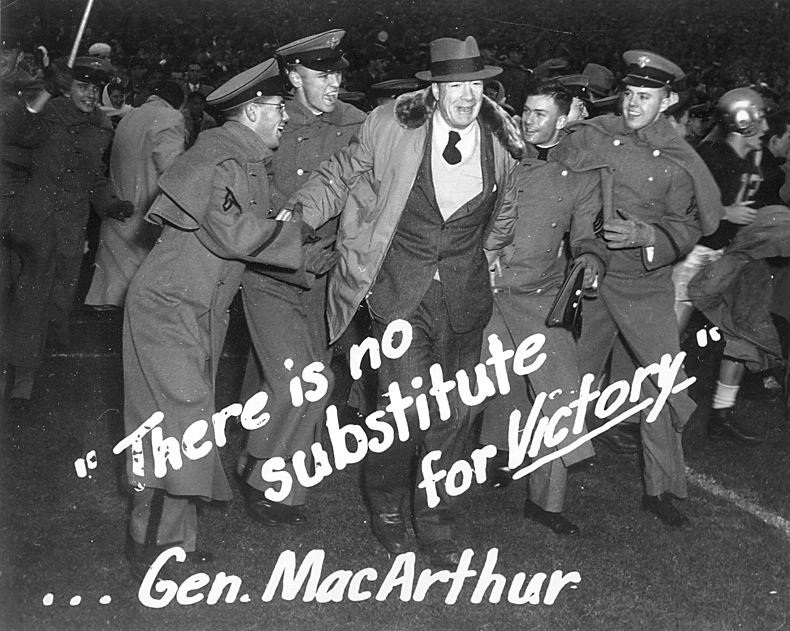
To understand the magnitude of the accomplishments of this team, recall that General McArthur gave his opinion in 1951 that it would take “at least 10 years” for Army to recover. In 1950, Army was 8-1 with a victory over Stanford, which finished the season ranked number seven in the nation; was tops in the nation in scoring defense, fourth in total defense, ninth in passing defense, and 10th in rushing offense; featured an All-American at end who finished eighth in the Heisman Trophy balloting, and two tackles who received votes for first team All-American; and would have been undefeated except for the stunning upset by Navy.
In 1951, Army went 2-7, defeating only Columbia and The Citadel and was trounced by Navy. Only one player received any national recognition, a name eventually to be etched in the hearts of all Army fans for decades to come: Mischak ’54 was number five in total kickoff return yards and first in average yards returned. The 1952 season was better, Army going 4-4, but again losing to Navy.
True, the Corps of Cadets did look for better things than in 1951 and “52”. Any prognostication that Army would win the Lambert Trophy, emblematic of the Eastern Championship, and be rated No. 14 nationally would have been tabbed fantastic. With Coach Blaik’s words as background, the team’s history echoes his witness.
|
Mischak leaping on Duke’s All American Red Smith after the 73 yard run down, Army held on four straight downs taking over inches from the goal line. |
They were one of the smallest Army football teams in years, at season’s end thirty-eight men, a team of heroes with no stars and with a different hero each Saturday, all playing for honor and love of the game. They were led by quiet, solid leaders from the class of 1954; augmented by a small number of players from the smallest Academy class in years, 1955, and a bevy of talented yearlings in the class of 1956 who set the gridiron on fire that fall. The NCAA changed the rules for the 1953 season to what is now called “one platoon” football, really “iron man” football.
Though the phrase wasn’t originated by Coach Earl Blaik, it was the incomparable football teacher, the thoroughly emotionally-controlled Blaik who, with tears in his eyes, handed the Army-Duke game ball to Bob Mischak, Army’s left end who made the incredible game-saving tackle. Blaik’s words to Bob were simple but powerful, and echo down through the years, “Don’t ever give up.”
The cheating incident had never-publicized, lingering effects on Army football players in the three following seasons, effects witnessed and painfully felt by the young, inexperienced B and C teams – the men who accomplished the “football miracle” of ’53.
Adding to the effects the players faced was the revelation that the much-admired Army varsity had been deeply involved in what became a national scandal.
In a number of cases the players left to pick up the pieces became subjects of totally unwarranted suspicions and stinging criticisms simply because they were Army football players. The season of 1953 changed all that — the team and the Corps of Cadets washed the effects away with stunning, inspirational teamwork and marvelous achievements.
|
Pat with the ball — Lodge Leading. |
As Blaik wrote years later in baring his bitterness and frustration over the cheating incident,
“For two years these boys had seen the roughest action. They had lived with the coaching lash, dirt, blood, and defeat.”
Following the 1952 season, changes in National Collegiate Athletic Association (NCAA) rules greatly restricted substitution and for several years virtually ended the offensive-defensive unit two-platoon system. The result was to lengthen playing time for varsity players, decrease the number of varsity letters awarded, increase injury potential, and cause a return to what in years past had been called “iron man football”. To compete under the more complicated substitution rules, Coach Blaik chose to return to the type of two-platoon system he inaugurated at Army during the World War II years, two or three units that went both ways, on offense and defense.
Page 3
|
Lodge shifted from Guard to Fullback – turning the corner, Mischak 87. |
While the rule changes impacted all collegiate teams, no team Army was to face in 1953 had suffered the total loss of its varsity lettermen and team leaders two years earlier.
The losses had forced virtually complete rebuilding from the ground up. Other colleges and universities would have been able to accelerate efforts to make up such losses with much larger student bodies and massive numbers of alumni on the lookout for talent, aggressive well-funded recruiting, junior college transfers, and the growing lure of expanding professional football immediately after graduation. Not so at Army.
The NCAA rule changes had other impacts not normally visible to cadets and Army sports fans — but were quite clear to team members vying for varsity status and the coveted Major A. The remaining 1953 team members, who, at the end of the 1952 season believed they had almost secured starting offensive or defensive platoon positions, suddenly found themselves being retested and moved from one position to another to determine who could play both offense and defense and had the conditioning, strength and stamina to play both ways.
Their extraordinary individual responses were inspirational, highlighting individual willingness to sacrifice for the team —
Bob Farris played the second half of the Navy game blind in one eye. Although he was captain of the ’54 team, he was never to play another down of football.
 Vann to Holleder Lombardi’s uncompromising demands on Vann, resulted in Peter becoming a superb drop back passer; with great ball-handling ability whose faking repeatedly confused defensive linemen. He was to set numerous Academy Records while the success Lumbardi achieved as an Assistant under Col Blaik propelled him into in the Pros. Vann to Holleder Lombardi’s uncompromising demands on Vann, resulted in Peter becoming a superb drop back passer; with great ball-handling ability whose faking repeatedly confused defensive linemen. He was to set numerous Academy Records while the success Lumbardi achieved as an Assistant under Col Blaik propelled him into in the Pros.
|
 Hagan’s handoff to Attaya initial scoring drive against Duke. Uebel #34 and probably #55 – Farris. NY Times Hagan’s handoff to Attaya initial scoring drive against Duke. Uebel #34 and probably #55 – Farris. NY Times
|
It’s important to note, that Peter Vann was a sterling offensive team leader his last two years at Army, became a classic drop-back passer and deft ball-handling and faking wizard who repeatedly confused defensive linemen, and was far more than Blaik’s description of him on defense as “dependable in a crisis”. Playing at defensive right halfback on the last play of the season’s crucial, turnaround game, he too made a game-saving play, batting away a pass thrown from Duke’s quarterback to their alternate quarterback — in the Army end zone – then went on to be ninth in Heisman Trophy voting and a second team All-American quarterback in 1954.
In the spring of 1952 Col Blaik said of Leroy Lunn – “as an offensive guard has excellent ability — and his presence sets a visual example of what constitues good preformance.
Because of the requirement to play both ways Lunn did not start in ’53. Years later Col Blaik was to say – – “I think it epitomized the character of this team and Lunn’s inspirational leadership that he was able to handle a difficult situation in a manner that increased his stature. It was not an easy thing to walk out there every Saturday for the toss of the coin and then to have to return to the bench and not be in for the kick-off.”
Page 4
|
Lunn for the coin toss – here he stayed on the field playing his greatest Game against Navy. |
Roy never let this bother his playing when he did get in. He improved so much that he clearly earned the right to start with his team against Navy. Then he went out and played the best game of his career.”
At quarterback, Peter Vann shared the job to some extent with Jerry Hagan early in the season, but improved gradually to indispensable level.
Vann, Pat Uebel, and Tommy Bell at halfbacks and Gerry Lodge at fullback played 60 minutes against Penn and almost all the way in the Navy game.
Right halfback Tommy Bell, scored one of the two touchdowns against Duke, became a first team All-American in 1954 and that same year one of the few four-year lettermen in Army football history. Yearling left halfback Pat Uebel, who scored one of the two touchdowns in the stunning upset of No. 7-ranked Duke and all three of Army’s touchdowns in the win over Navy — one of a small number of Army players to score three touchdowns against Navy, and to that time the only player to score all three touchdowns in a win over Navy – was another hero in the 1953 Army backfield. Of Army’s two lead halfbacks Coach Blaik would write, “In ’53 and ’54 both Uebel and Bell were among the top echelon of all-time West Point halfbacks.”
Rounding out the backfield after the loss to injury in the Tulane game of the swift, agile, hard-driving fullback, and punter, “Freddie Attaya”, was guard-converted-to-fullback Gerry Lodge, who stepped into Freddie’s shoes and performed magnificently at both fullback on offense and Linebacker
 Tommy Bell against Duke Tommy Bell against Duke
|
on defense. This backfield, 3 great ends and this Team that brought Vince Lombardi to the attention of the New York Giants at the end of the 1953 season, setting Vince on course to become a legendary professional coach.
Blaik said of the three ends on the 1953 team, “Our end play was handled by Bob Mischak, Lowell Sisson, and a yearling of unusual potential named Don Holleder. Sisson was another who kept improving and hit the top in the Navy game. After Attaya’s injury, Sisson did the punting.
Mischak developed into a fine pass receiver and on defense he delivered the play that was the pivot, in a real sense, of the entire season. Holleder was a naturally talented pass receiver with outstanding speed, hands, and competitive fire. By 1954 he became just about the most dangerous offensive end in college ranks. A first team All-American end in 1954, he voluntarily gave up the chance to become a two-time All-American, by acquiescing to Coach Blaik’s request that he switch to quarterback for the 1955 season, a position he had never played in either high school or college.
On 17 October 1967, his courage and heroism in Vietnam while attempting to rescue wounded soldiers in his unit cost him his life.
Don Holleder’s is life and service became the inspiration for the now-well-known Black Lion Award to football players at every level of football played in the nation, from youth leagues to intercollegiate Division IA.

|
|
 “Ski” Ordway “Ski” Ordway
|
 Franklin – double team tore up knee talking with 58 Zaborowski after Duke Game Franklin – double team tore up knee talking with 58 Zaborowski after Duke Game
|
 Attaya Army’s Fullback Attaya Army’s Fullback
|
Neil Chamberlain injured summer of ’53 – prior to the Navy Game. “Saturday Army will be represented by two different uniforms – – one black and gold, the other gray. I’ve found that I fight just as hard in one as I did in the other. We’ll all beat Navy this year.”
Coach Earl Blaik: “Injuries as the season advanced cost the team solid fullback and punter, three-year letterman Fred Attaya ’54; hard-nosed right halfback and three-year letterman Mike Zeigler ’56; and spirited end and three-year letterman “Ski” Godwin Ordway ’55. By the time the season got down to the Penn and Navy games, the starting eleven and about four substitutes carried the full load.”
Army linemen on the thinly-manned 1953 team included three guards, Captain Leroy Lunn, his classmate Dick Ziegler, and yearling Ralph Chesnauskas, whose talents included extra-point conversions. Ralph calmly kicked the two extra points against Duke to win the game, and became a first team All-American in 1954.
Page 5
|
Bell 46 and Uebel 34 showing 7th ranked Duke how Army played Football |
Center “Norman Stephen” was a steady, rock-solid team leader on offense, who on the first play from scrimmage in the second half of the second home game of the season, against Dartmouth, and in response to sting criticism from Col Blaik — lit a small but growing fire in the team and Corps of Cadets — when he broke from the huddle and ran, almost sprinting to the ball, prompting the team to follow his lead. The roar of approval and support from the Corps each time Norm broke and ran to the ball, from that point forward through the rest of the season, continued to unify a determined Corps of Cadets with their team. He was a standout linebacker who was the on-field captain who called defensive signals. Starting at tackle were two yearlings, “Ron Melnik” and Howard Glock, with first classman Joe Lapchick, Jr. doing most of the reserve playing.
Coach Blaik considered the heart of his defense to be yearling Bob Farris, a top man academically who in 1955 became the Corps’ First Captain, played tackle on offense and was a line backer on defense in 1953. “The linebacking of Farris against Navy was as fine as I have ever seen in that game,” he wrote. “Unfortunately, the abandon with which he played cost him a detached retina that ended his football. To have played him would have risked an aggravation that might have impaired his sight.”
None of the foregoing tells of the incredible will-to-win spirit and support of the 1953 team by the entire Corps of Cadets, all of it specifically intended to unify the team and Corps of Cadets in ways never before seen or heard at West Point.The Corps’ preparation for the game had been more than unusual, including a “silence” imposed by the cheerleaders at the meal following Blaik’s talk.
|
The 1953 cheerleaders, standing, for the Army team, with tumblers in the first row. Cheerleaders, left to right: Ed Moses, ’54; John Clayton ’55, Al Worden ’55, Billy McVeigh ’54, Jay Edwards ’54, Bill Robinson ’55; Tumblers: Peter Jones ’54, Dan Ludwig ’55, Jack Charles ’54, Charles Glenn ’56. Others – Jay Gould & Ben Schemmer ’54 and Alex Rupp ’55. |
1953 was a series of firsts: a helicopter flyover; the introduction of the cannon; a hugh Beat Navy Flag made by the Quartermater Corps; the weather ballon from Army Aviation at Stewart Field for the Duke Game releasing the Corps from the imposed Silence; Special Guideon Flags made by the Cadet Store posted in the Mess Hall listing every year Army Beat Navy.
Page 6

|
Front: Paul Deitzel, Line Coach; Vincent T. Lombardi, Backfield Coach; Roland Bevan, Trainer; Capt. R. J. St. Onge, Plebe Coach; Back: Capt. R. L. Dobbs, Ass’t Backfield Coach; Earl H. Blaik, Head Coach; Carney Laslie, Line Coach; Paul J. Amen, End Coach. Coach Earl Blaik’ who later labeled the resurgence of the Army team “a football miracle” saw his 1953 first assistant, backfield and end coach, Vince Lombardi, mold a dazzling backfield that became Vince’s springboard to professional football glory. Jim Lee Howell, the New York Giant’s head coach who hired Lombardi after the 1953 season, said, “If Lombardi can do that kind of job in three years at West Point – he could do a helluva job in the pros where he could have an experienced base to work with.” |

Attachments
1. Signed Nomination letters by the Classes of 1954, 1955, 1956, 1957, & 1962.
2. 1953 Army Football Highlights CD provided by Coach Hugh Wyatt, Founder of the Black Lion Award.
3. Bob Mischak’s Letter.
History: 1950 – 1951: Adversity strikes a heavy blow to the Army Football team. Numerous varsity players are released from West Point due to their violation of the school’s sacred honor code. The justified dismissals decimated the team. Many veteran, seasoned upper classmen, who would have provided the nucleus that could have incorporated and nurtured the green, younger players, were gone. As best they could, the former “B-squad” players of that era, attempted to rally the bewildered and inexperienced under classmen on the football team, but it seemed like a futile attempt for many reasons.
The community of grads and students empathized, and rightfully, with the administration for its action when the legendary honor code had been violated. Rumors of all sorts ran rampant on the Academy grounds and in the press. Statements were made and circulated about the demise of Army football. Predictions existed that the football program would take about 10 years to right itself, if at all.
At that time, mixed emotions permeated the Corps, faculty, grads, coaches, and the community of citizen on lookers. The shock of the event seemed too difficult to comprehend, however, optimism still kindled in the minds of those players who remained and the football loyalist who had faith in their team.
Surprisingly, within a short period of time, the untested players, seemed to coalesce, the coaching staff stabilized, and fundamental football schemes were utilized that allowed the innate ability of the individual players to develop. The trial and error period had started. A foundation for future development was established.
Each of the seasons and the spring practices provided, in a subtle way, the maturing of the 1953 team. Players were more comfortable with their skills and sensitive to each other’s strengths and weaknesses. This seemed to build a determination to overcome adversity and looking forward, optimistically, to playing and winning games.
As many reports have stated, the 1953 team “Returned to Glory” with the defeat of the nationally ranked Duke Blue Devils at the Polo Grounds in New York City. From a player’s stand point, that was the epitome of any game, team, and student body support that I’ve been associated with – bar none.
A major contribution was made by the 1953 team to resurrect the honor and glory of the United States Military Academy, its students and service personnel. Naming the 1953 Team to the Army Sports Hall of Fame, would be a reward that acknowledges that fact and could be considered as an Army “Unit Citation”.
Sincerely,
Bob Mischak
USMA 1954
1951-1953 Varsity letterman on the Army football team
1953 NBC-TV All American End
1954 College All Star Game player vs Detroit Lions
1954 Drafted by Cleveland Browns (NFL)
1954-1957 Military Service (Berlin, Fulda Germany)
1958 NY Giants (NFL) starting Offensive Guard — Head Coach: Jim Lee Howell,
Assts: Vince Lombardi (HoF), Tom Landry (HoF)
— Note: Starter in the famed “Greatest Game Ever Played”
which recently celebrated its 50th Anniversary. ESPN
produced a film which aired in Dec. 2008, now out on
DVD.
1960-1962 NY Titans (AFL) which became NY Jets (NFL) — Head Coaches: Sammy Baugh (HoF),
Clyde “Bulldog” Turner (HoF), Weeb Ewbank (HoF)
– – – Note: Team Captain, All-AFL offensive guard 60-62. First All Pro in the history of the NY Jets.
1963-1965 Oakland Raiders (AFL), starting offensive guard and TE — Head Coach: Al Davis (HoF)
1966-1973 USMA, Offensive Line Coach — Head Coach: Tom Cahill (NCAA Coach of the Year 1966)
Assts: Bill Parcells, John Mackovic, Ken Hatfield
1973-1987 Oakland/Los Angeles Raiders (NFL)* Owner: Al Davis (HoF), Head Coaches: John Madden (HoF),
Tom Flores, Player Personnel: Ron Wolf
1994 Los Angeles Raiders, TE Coach Head Coach: Art Shell (HoF)
– – – *Note: Member of 3 Super Bowl winning teams XI, XV, XVIII, 8 AFC Championship games and numerous playoff games. During tenure with Raiders served as TE Coach and Player Personnel Director.
– – – Coached notable TE’s such as Dave Casper (HoF), Todd Christensen (HoF nominee), Raymond Chester and Ted Kwalick
1988-1989 LA Cobras (Arena Football League), Asst. Coach Head Coach: Ray Willsey
1990 Munich Falcons (International League of American Football) Head Coach
1991 Ravenna Chiefs (Italian Football League), Head Coach
1991 Atlanta Falcons (NFL), Scout GM: Ken Herock
1992 London Monarchs (WLAF), DB Coach Head Coach: Ray Willsey
1993 Maryland Commandos (Arena Football League), Asst. Coach Head Coach: Ray Willsey
1997 London Monarchs (WLAF), OL Coach Head Coach: Lionel Taylor


They shook that old stadium almost non-stop in the sunshine and shadows of that Indian summer afternoon.


 Uebel scores 3 Times Against Navy

<img src=”http://forwhattheygaveonsaturdayafternoon.com/photos/coaches485.jpg” width=”480″

Peter takes to the Air

United States Corps of Cadets ready for Navy
It must be pointed out that Bob was the only player on the ’53 Team to be selected as an All American. Today the Academy does not recognze his All American status because of the organization which selected him.
B Squad

|
The 1953 cheerleaders, standing, for the Army team, with tumblers in the first row. Cheerleaders, left to right: Ed Moses, ’54; John Clayton ’55, Al Worden ’55, Billy McVeigh ’54, Jay Edwards ’54, Bill Robinson ’55; Tumblers: Peter Jones ’54, Dan Ludwig ’55, Jack Charles ’54, Charles Glenn ’56. Others – Jay Gould & Ben Schemmer ’54 and Alex Rupp ’55. |
one of the four cadets who went to Annapolis to steal the goat and bring it to West Point. They went in a convertible because they thought the goat’s horns would be too large for a sedan.
|
Front Row: Paul Deitzel, Line Coach; Vincent T. Lombardi, Backfield Coach; Roland Bevan, Trainer; Capt. R. J. St. Onge, Plebe Coach; Back Row:Capt. R. L. Dobbs, Ass’t Backfield Coach; Earl H. Blaik, Head Coach; Carney Laslie, Line Coach; Paul J. Amen, End Coach. The ’53 Season propelled Vince Lombardi into his legendary status in Pro Football; while Paul Dietzel took the 1958 LSU Team to a National Title – returning to West Point as Head Coach in 1963; Carney Laslie is believed to have been named Assistant Athletic Director at Alabama in 1957 and Paul J. Amen was named Coach of the Year at Wake Forest in both 1956 and 1959. |

Attachments
1. Signed Nomination letters by the Classes of 1954, 1955, 1956, 1957, & 1962.
2. 1953 Army Football Highlights CD provided by Coach Hugh Wyatt, Founder of the Black Lion Award.
3. Bob Mischak’s Letter.
History: 1950 – 1951: Adversity strikes a heavy blow to the Army Football team. Numerous varsity players are released from West Point due to their violation of the school’s sacred honor code. The justified dismissals decimated the team. Many veteran, seasoned upper classmen, who would have provided the nucleus that could have incorporated and nurtured the green, younger players, were gone. As best they could, the former “B-squad” players of that era, attempted to rally the bewildered and inexperienced under classmen on the football team, but it seemed like a futile attempt for many reasons.
The community of grads and students empathized, and rightfully, with the administration for its action when the legendary honor code had been violated. Rumors of all sorts ran rampant on the Academy grounds and in the press. Statements were made and circulated about the demise of Army football. Predictions existed that the football program would take about 10 years to right itself, if at all.
At that time, mixed emotions permeated the Corps, faculty, grads, coaches, and the community of citizen on lookers. The shock of the event seemed too difficult to comprehend, however, optimism still kindled in the minds of those players who remained and the football loyalist who had faith in their team.
Surprisingly, within a short period of time, the untested players, seemed to coalesce, the coaching staff stabilized, and fundamental football schemes were utilized that allowed the innate ability of the individual players to develop. The trial and error period had started. A foundation for future development was established.
Each of the seasons and the spring practices provided, in a subtle way, the maturing of the 1953 team. Players were more comfortable with their skills and sensitive to each other’s strengths and weaknesses. This seemed to build a determination to overcome adversity and looking forward, optimistically, to playing and winning games.
As many reports have stated, the 1953 team “Returned to Glory” with the defeat of the nationally ranked Duke Blue Devils at the Polo Grounds in New York City. From a player’s stand point, that was the epitome of any game, team, and student body support that I’ve been associated with – bar none.
A major contribution was made by the 1953 team to resurrect the honor and glory of the United States Military Academy, its students and service personnel. Naming the 1953 Team to the Army Sports Hall of Fame, would be a reward that acknowledges that fact and could be considered as an Army “Unit Citation”.
Sincerely,
Bob Mischak
USMA 1954
1951-1953 Varsity letterman on the Army football team
1953 NBC-TV All American End
1954 College All Star Game player vs Detroit Lions
1954 Drafted by Cleveland Browns (NFL)
1954-1957 Military Service (Berlin, Fulda Germany)
1958 NY Giants (NFL) starting Offensive Guard — Head Coach: Jim Lee Howell,
Assts: Vince Lombardi (HoF), Tom Landry (HoF)
— Note: Starter in the famed “Greatest Game Ever Played”
which recently celebrated its 50th Anniversary. ESPN
produced a film which aired in Dec. 2008, now out on
DVD.
1960-1962 NY Titans (AFL) which became NY Jets (NFL) — Head Coaches: Sammy Baugh (HoF),
Clyde “Bulldog” Turner (HoF), Weeb Ewbank (HoF)
– – – Note: Team Captain, All-AFL offensive guard 60-62. First All Pro in the history of the NY Jets.
1963-1965 Oakland Raiders (AFL), starting offensive guard and TE — Head Coach: Al Davis (HoF)
1966-1973 USMA, Offensive Line Coach — Head Coach: Tom Cahill (NCAA Coach of the Year 1966)
Assts: Bill Parcells, John Mackovic, Ken Hatfield
1973-1987 Oakland/Los Angeles Raiders (NFL)* Owner: Al Davis (HoF), Head Coaches: John Madden (HoF),
Tom Flores, Player Personnel: Ron Wolf
1994 Los Angeles Raiders, TE Coach Head Coach: Art Shell (HoF)
– – – *Note: Member of 3 Super Bowl winning teams XI, XV, XVIII, 8 AFC Championship games and numerous playoff games. During tenure with Raiders served as TE Coach and Player Personnel Director.
– – – Coached notable TE’s such as Dave Casper (HoF), Todd Christensen (HoF nominee), Raymond Chester and Ted Kwalick
1988-1989 LA Cobras (Arena Football League), Asst. Coach Head Coach: Ray Willsey
1990 Munich Falcons (International League of American Football) Head Coach
1991 Ravenna Chiefs (Italian Football League), Head Coach
1991 Atlanta Falcons (NFL), Scout GM: Ken Herock
1992 London Monarchs (WLAF), DB Coach Head Coach: Ray Willsey
1993 Maryland Commandos (Arena Football League), Asst. Coach Head Coach: Ray Willsey
1997 London Monarchs (WLAF), OL Coach Head Coach: Lionel Taylor
do not match up with their respected pages
Col. Blaik after the Navy Game
He ordered the door secured and as he turned to speak his eyes were misty. “I have never coached a team that gave me more than you did. I never have coached a team that has given me as much satisfaction. Considering all the conditions since 1951, you have done more for football at West Point than any other team in the history of the Academy.”
Many Graduates in a number of Classes believe they did more for the Academy than any other Team in any Sport.
An article in the Nov ’53 Pointer published the day before the Navy Game concluded with —
“Tomorrow afternoon, radio sets will be tuned on Philadelphia all the way from Berlin to Panmunjom. Graduates will be listening for news of an Army victory. But they’ll be listening for something more – something none of them talk about. They’ll be listening for evidence that the Corps is on its way back. They want to know that the values which they stand for are still alive in the Corps.”
Prior to the Duke Game the Cheerleaders imposed a “Silence” upon the Corps of Cadets after the traditional pregame sendoff of the team. The Cheerleaders put a cork in the bottle of more than two years of pent up frustration. When the Corps completed its subdued, strangely silent, pregame march-on at the Polo Grounds, and the last man double-timed onto the first step of the stands, the Corps of Cadets exploded out. They shook that old stadium almost non-stop in the sunshine and shadows of that Indian summer afternoon. The Chanting – – Go! Go! Go! – – is remembered to this day by the players. ‘It was continuous, just deafening”.
Bob Mischak, ’54 as a player and a coach, participated in 3 Super Bowls, 8 AFC Championships and numerous playoff games. As the starting Offensive Tackle on the 1958 Giant Team he participated in “The Greatest Game Ever Played”. Bob had this to say of the 1953 Duke Game (perhaps Army’s Greatest Game) – “As many reports have stated, the 1953 team “Returned to Glory” with the defeat of the nationally ranked Duke Blue Devils at the Polo Grounds in New York City. From a player’s stand point, that was the epitome of any game, team, and student body support that I’ve been associated with – bar none.”
The ’53 Team’s success was marked with the most unusual Lambert Trophy presentation in the award’s 17 year history. For the first time, on a Sunday evening, 20 December 1953, in Washington Hall, the Lambert Trophy, emblematic of Eastern Football Supremacy, was presented outside of New York City to West Point’s Football Team and the Corps of Cadets.
Col. Blaik – –
“By the time the season got down to the Penn and Navy games, the starting eleven and about four substitutes carried the full load”.
The commitment to Team, to the Academy, to returning Army Football to respectability is illustrated in the fact that Bob Farris ’56, played the 2d half of the Navy Game blind in one eye. He was never to play another down of Football. Bob did not tell the Coaches or Team Doctor of his condition.
Years later Col. Blaik was to write – –
“For two years these boys had seen the roughest action. They had lived with the coaching lash, dirt, blood, and defeat”.
There is more to some teams than statistics can provide.
Page 1 of ?? Pages
Every Athlete, no Every Cadet should know what this Team did for the Academy, for our Motto
Jerry Lodge wore 67 and 32 is missing as is Norm Stephen 51- Army Center. 2d man 2d row next to Tommy Bell – is Zaborowski. Wynn #31 is in the 2d row not 3d.
Col Blaik “When I come to describe the team of 1953, what they meant to me and, far more important, what they meant to West Point, I cannot praise them enough.”
Page 2
Grantland Rice wrote “They came up the hard way and there probably has never been a squad with a finer spirit.”
|
Army Team Captain Leroy Lunn and Col Blaik |
To understand the magnitude of the accomplishments of this team, recall that General McArthur gave his opinion in 1951 that it would take “at least 10 years” for Army to recover. In 1950, Army was 8-1 with a victory over Stanford, which finished the season ranked number seven in the nation; was tops in the nation in scoring defense, fourth in total defense, ninth in passing defense, and 10th in rushing offense; featured an All-American at end who finished eighth in the Heisman Trophy balloting, and two tackles who received votes for first team All-American; and would have been undefeated except for the stunning upset by Navy.
In 1951, Army went 2-7, defeating only Columbia and The Citadel and was trounced by Navy. Only one player received any national recognition, a name eventually to be etched in the hearts of all Army fans for decades to come: Mischak ’54 was number five in total kickoff return yards and first in average yards returned. The 1952 season was better, Army going 4-4, but again losing to Navy.
True, the Corps of Cadets did look for better things than in 1951 and “52”. Any prognostication that Army would win the Lambert Trophy, emblematic of the Eastern Championship, and be rated No. 14 nationally would have been tabbed fantastic. With Coach Blaik’s words as background, the team’s history echoes his witness.
|
Mischak leaping on Duke’s All American Red Smith after the 73 yard run down, Army held on four straight downs taking over inches from the goal line. |
They were one of the smallest Army football teams in years, at season’s end thirty-eight men, a team of heroes with no stars and with a different hero each Saturday, all playing for honor and love of the game. They were led by quiet, solid leaders from the class of 1954; augmented by a small number of players from the smallest Academy class in years, 1955, and a bevy of talented yearlings in the class of 1956 who set the gridiron on fire that fall. The NCAA changed the rules for the 1953 season to what is now called “one platoon” football, really “iron man” football.
Though the phrase wasn’t originated by Coach Earl Blaik, it was the incomparable football teacher, the thoroughly emotionally-controlled Blaik who, with tears in his eyes, handed the Army-Duke game ball to Bob Mischak, Army’s left end who made the incredible game-saving tackle. Blaik’s words to Bob were simple but powerful, and echo down through the years, “Don’t ever give up.”
The cheating incident had never-publicized, lingering effects on Army football players in the three following seasons, effects witnessed and painfully felt by the young, inexperienced B and C teams – the men who accomplished the “football miracle” of ’53.
Adding to the effects the players faced was the revelation that the much-admired Army varsity had been deeply involved in what became a national scandal.
In a number of cases the players left to pick up the pieces became subjects of totally unwarranted suspicions and stinging criticisms simply because they were Army football players. The season of 1953 changed all that — the team and the Corps of Cadets washed the effects away with stunning, inspirational teamwork and marvelous achievements.
|
Pat with the ball — Lodge Leading. |
As Blaik wrote years later in baring his bitterness and frustration over the cheating incident,
“For two years these boys had seen the roughest action. They had lived with the coaching lash, dirt, blood, and defeat.”
Following the 1952 season, changes in National Collegiate Athletic Association (NCAA) rules greatly restricted substitution and for several years virtually ended the offensive-defensive unit two-platoon system. The result was to lengthen playing time for varsity players, decrease the number of varsity letters awarded, increase injury potential, and cause a return to what in years past had been called “iron man football”. To compete under the more complicated substitution rules, Coach Blaik chose to return to the type of two-platoon system he inaugurated at Army during the World War II years, two or three units that went both ways, on offense and defense.
Page 3
|
Lodge shifted from Guard to Fullback – turning the corner, Mischak 87. |
While the rule changes impacted all collegiate teams, no team Army was to face in 1953 had suffered the total loss of its varsity lettermen and team leaders two years earlier.
The losses had forced virtually complete rebuilding from the ground up. Other colleges and universities would have been able to accelerate efforts to make up such losses with much larger student bodies and massive numbers of alumni on the lookout for talent, aggressive well-funded recruiting, junior college transfers, and the growing lure of expanding professional football immediately after graduation. Not so at Army.
The NCAA rule changes had other impacts not normally visible to cadets and Army sports fans — but were quite clear to team members vying for varsity status and the coveted Major A. The remaining 1953 team members, who, at the end of the 1952 season believed they had almost secured starting offensive or defensive platoon positions, suddenly found themselves being retested and moved from one position to another to determine who could play both offense and defense and had the conditioning, strength and stamina to play both ways.
Their extraordinary individual responses were inspirational, highlighting individual willingness to sacrifice for the team —
Bob Farris played the second half of the Navy game blind in one eye. Although he was captain of the ’54 team, he was never to play another down of football.
|
Vann to Holleder Lombardi’s uncompromising demands on Vann, resulted in Peter becoming a superb drop back passer; with great ball-handling ability whose faking repeatedly confused defensive linemen. He was to set numerous Academy Records while the success Lumbardi achieved as an Assistant under Col Blaik propelled him into in the Pros.
|
Hagan’s handoff to Attaya initial scoring drive against Duke. Uebel #34 and probably #55 – Farris. NY Times
|
It’s important to note, that Peter Vann was a sterling offensive team leader his last two years at Army, became a classic drop-back passer and deft ball-handling and faking wizard who repeatedly confused defensive linemen, and was far more than Blaik’s description of him on defense as “dependable in a crisis”. Playing at defensive right halfback on the last play of the season’s crucial, turnaround game, he too made a game-saving play, batting away a pass thrown from Duke’s quarterback to their alternate quarterback — in the Army end zone – then went on to be ninth in Heisman Trophy voting and a second team All-American quarterback in 1954.
In the spring of 1952 Col Blaik said of Leroy Lunn – “as an offensive guard has excellent ability — and his presence sets a visual example of what constitues good preformance.
Because of the requirement to play both ways Lunn did not start in ’53. Years later Col Blaik was to say – – “I think it epitomized the character of this team and Lunn’s inspirational leadership that he was able to handle a difficult situation in a manner that increased his stature. It was not an easy thing to walk out there every Saturday for the toss of the coin and then to have to return to the bench and not be in for the kick-off.”
Page 4
|
Lunn for the coin toss – here he stayed on the field playing his greatest Game against Navy. |
Roy never let this bother his playing when he did get in. He improved so much that he clearly earned the right to start with his team against Navy. Then he went out and played the best game of his career.”
At quarterback, Peter Vann shared the job to some extent with Jerry Hagan early in the season, but improved gradually to indispensable level.
Vann, Pat Uebel, and Tommy Bell at halfbacks and Gerry Lodge at fullback played 60 minutes against Penn and almost all the way in the Navy game.
Right halfback Tommy Bell, scored one of the two touchdowns against Duke, became a first team All-American in 1954 and that same year one of the few four-year lettermen in Army football history. Yearling left halfback Pat Uebel, who scored one of the two touchdowns in the stunning upset of No. 7-ranked Duke and all three of Army’s touchdowns in the win over Navy — one of a small number of Army players to score three touchdowns against Navy, and to that time the only player to score all three touchdowns in a win over Navy – was another hero in the 1953 Army backfield. Of Army’s two lead halfbacks Coach Blaik would write, “In ’53 and ’54 both Uebel and Bell were among the top echelon of all-time West Point halfbacks.”
Rounding out the backfield after the loss to injury in the Tulane game of the swift, agile, hard-driving fullback, and punter, “Freddie Attaya”, was guard-converted-to-fullback Gerry Lodge, who stepped into Freddie’s shoes and performed magnificently at both fullback on offense and Linebacker
|
Tommy Bell against Duke
|
on defense. This backfield, 3 great ends and this Team that brought Vince Lombardi to the attention of the New York Giants at the end of the 1953 season, setting Vince on course to become a legendary professional coach.
Blaik said of the three ends on the 1953 team, “Our end play was handled by Bob Mischak, Lowell Sisson, and a yearling of unusual potential named Don Holleder. Sisson was another who kept improving and hit the top in the Navy game. After Attaya’s injury, Sisson did the punting.
Mischak developed into a fine pass receiver and on defense he delivered the play that was the pivot, in a real sense, of the entire season. Holleder was a naturally talented pass receiver with outstanding speed, hands, and competitive fire. By 1954 he became just about the most dangerous offensive end in college ranks. A first team All-American end in 1954, he voluntarily gave up the chance to become a two-time All-American, by acquiescing to Coach Blaik’s request that he switch to quarterback for the 1955 season, a position he had never played in either high school or college.
On 17 October 1967, his courage and heroism in Vietnam while attempting to rescue wounded soldiers in his unit cost him his life.
Don Holleder’s is life and service became the inspiration for the now-well-known Black Lion Award to football players at every level of football played in the nation, from youth leagues to intercollegiate Division IA.
|
|
|
“Ski” Ordway
|
Franklin – double team tore up knee talking with 58 Zaborowski after Duke Game
|
Attaya Army’s Fullback
|
Neil Chamberlain injured summer of ’53 – prior to the Navy Game. “Saturday Army will be represented by two different uniforms – – one black and gold, the other gray. I’ve found that I fight just as hard in one as I did in the other. We’ll all beat Navy this year.”
Coach Earl Blaik: “Injuries as the season advanced cost the team solid fullback and punter, three-year letterman Fred Attaya ’54; hard-nosed right halfback and three-year letterman Mike Zeigler ’56; and spirited end and three-year letterman “Ski” Godwin Ordway ’55. By the time the season got down to the Penn and Navy games, the starting eleven and about four substitutes carried the full load.”
Army linemen on the thinly-manned 1953 team included three guards, Captain Leroy Lunn, his classmate Dick Ziegler, and yearling Ralph Chesnauskas, whose talents included extra-point conversions. Ralph calmly kicked the two extra points against Duke to win the game, and became a first team All-American in 1954.
Page 5
|
Bell 46 and Uebel 34 showing 7th ranked Duke how Army played Football |
Center “Norman Stephen” was a steady, rock-solid team leader on offense, who on the first play from scrimmage in the second half of the second home game of the season, against Dartmouth, and in response to sting criticism from Col Blaik — lit a small but growing fire in the team and Corps of Cadets — when he broke from the huddle and ran, almost sprinting to the ball, prompting the team to follow his lead. The roar of approval and support from the Corps each time Norm broke and ran to the ball, from that point forward through the rest of the season, continued to unify a determined Corps of Cadets with their team. He was a standout linebacker who was the on-field captain who called defensive signals. Starting at tackle were two yearlings, “Ron Melnik” and Howard Glock, with first classman Joe Lapchick, Jr. doing most of the reserve playing.
Coach Blaik considered the heart of his defense to be yearling Bob Farris, a top man academically who in 1955 became the Corps’ First Captain, played tackle on offense and was a line backer on defense in 1953. “The linebacking of Farris against Navy was as fine as I have ever seen in that game,” he wrote. “Unfortunately, the abandon with which he played cost him a detached retina that ended his football. To have played him would have risked an aggravation that might have impaired his sight.”
None of the foregoing tells of the incredible will-to-win spirit and support of the 1953 team by the entire Corps of Cadets, all of it specifically intended to unify the team and Corps of Cadets in ways never before seen or heard at West Point.The Corps’ preparation for the game had been more than unusual, including a “silence” imposed by the cheerleaders at the meal following Blaik’s talk.
|
The 1953 cheerleaders, standing, for the Army team, with tumblers in the first row. Cheerleaders, left to right: Ed Moses, ’54; John Clayton ’55, Al Worden ’55, Billy McVeigh ’54, Jay Edwards ’54, Bill Robinson ’55; Tumblers: Peter Jones ’54, Dan Ludwig ’55, Jack Charles ’54, Charles Glenn ’56. Others – Jay Gould & Ben Schemmer ’54 and Alex Rupp ’55. |
1953 was a series of firsts: a helicopter flyover; the introduction of the cannon; a hugh Beat Navy Flag made by the Quartermater Corps; the weather ballon from Army Aviation at Stewart Field for the Duke Game releasing the Corps from the imposed Silence; Special Guideon Flags made by the Cadet Store posted in the Mess Hall listing every year Army Beat Navy.
Page 6
They shook that old stadium almost non-stop in the sunshine and shadows of that Indian summer afternoon.
Uebel scores 3 Times Against Navy

Peter takes to the Air
United States Corps of Cadets ready for Navy
The Team’s marvelous success was marked with the most unusual Lambert Trophy presentation in the award’s history. First offered in 1936, and sponsored by New York City’s brothers, Victor A. and Henry L. Lambert, the trophy was symbolic of Eastern football supremacy, and had been won by Army in 1944, ’45, ’46, ’48 and ’49. For the first time, on a Sunday evening, 20 December 1953, in Washington Hall, the Lambert Trophy was presented outside of New York City to a football team and its student body.
In 1953, Army may not have won a national championship or produced a Heisman Trophy candidate but the seven victories, including Navy and Duke; a ranking of 14 in the nation in the season’s final pool; winning the Lambert Trophy; and earning Colonel Blaik “coach of the year” honors signaled the Academy’s “return to glory”.
To place the accomplishments of the 1953 Army Football Team prominently and in full view of the United States Corps of Cadets and the Long Gray Line, we, the members of the Classes of 1954, 1955, 1956, 1957 and ??? members of the Class of 1962, Nominate the 1953 Army Football Team for induction into the Army Sports Hall of Fame.
Attachments
1. Signed Nomination letters by the Classes of 1954, 1955, 1956, 1957, & 1962.
2. 1953 Army Football Highlights CD provided by Coach Hugh Wyatt, Founder of the Black Lion Award.
3. Bob Mischak’s Letter.
It must be pointed out that Bob was the only player on the ’53 Team to be selected as an All American. Today the Academy does not recognze his All American status because of the organization which selected him.
B Squad
B Squad
The Nomination is an attempt to give meaning to Col Blaik’s statement to the Team after the Navy Game on 28 November 1953
http://forwhattheygaveonsaturdayafternoon.com/wp-letters/bob-class
You must go to the bottom to allow the photos on the left to match the NominationNomination is Below
Nomination is Below
Nomination is Below
Nomination is Below
Nomination is Below
Nomination is Below
Nomination is Below
Nomination is Below
Nomination is Below
Nomination is Below
Nomination is Below
Nomination is Below
Nomination is Below
Nomination is Below
Nomination is Below
Nomination is Below
Nomination is Below
Nomination is Below
Nomination is Below
Nomination is Below
Nomination is Below
Nomination is Below
Nomination is Below
Nomination is Below
Nomination is Below
Nomination is Below
Nomination is Below
Nomination is Below
Nomination is Below
Nomination is Below
Nomination is Below
Nomination is Below
Nomination is Below
Nomination is Below
You must go to the bottom to allow the photos on the left to match the Nomination
Nomination is Below
Nomination is Below
Nomination is Below
Nomination is Below
Nomination is Below
Nomination is Below
Nomination is Below
Nomination is Below
Nomination is Below
Nomination is Below
Nomination is Below
Nomination is Below
Nomination is Below
Nomination is Below
Nomination is Below
Nomination is Below
Nomination is Below
Nomination is Below
Nomination is Below
Nomination is Below
Nomination is Below
You must go to the bottom to allow the photos on the left to match the Nomination
You must go to the bottom to allow the photos on the left to match the NominationNomination is Below
Nomination is Below
Nomination is Below
Nomination is Below
Nomination is Below
Nomination is Below
Nomination is Below
Nomination is Below
Nomination is Below
Nomination is Below
Nomination is Below
Nomination is Below
Nomination is Below
Nomination is Below
Nomination is Below
Nomination is Below
Nomination is Below
Nomination is Below
Nomination is Below
Nomination is Below
Nomination is Below
Nomination is Below
You must go to the bottom to allow the photos on the left to match the Nomination
Nomination is Below
Nomination is Below
Nomination is Below
Nomination is Below
Nomination is Below
Nomination is Below
Nomination is Below
Nomination is Below
Nomination is Below
Nomination is Below
Nomination is Below
Nomination is Below
Nomination is Below
Nomination is Below
Nomination is Below
Nomination is Below
Nomination is Below
Nomination is Below
Nomination is Below
Nomination is Below
Nomination is Below
Nomination is Below
Nomination is Below
You must go to the bottom to allow the photos on the left to match the Nomination
Nomination is Below
Nomination is Below
Nomination is Below
Nomination is Below
Nomination is Below
Nomination is Below
Nomination is Below
Nomination is Below
Nomination is Below
Nomination is Below
Nomination is Below
Nomination is Below
Nomination is Below
Nomination is Below
Nomination is Below
Nomination is Below
Nomination is Below
Nomination is Below
Nomination is Below
Nomination is Below
Nomination is Below
You must go to the bottom to allow the photos on the left to match the Nomination
You must go to the bottom to allow the photos on the left to match the NominationNomination is Below
Nomination is Below
Nomination is Below
Nomination is Below
Nomination is Below
Nomination is Below
Nomination is Below
Nomination is Below
Nomination is Below
Nomination is Below
Nomination is Below
Nomination is Below
Nomination is Below
Nomination is Below
Nomination is Below
Nomination is Below
Nomination is Below
Nomination is Below
Nomination is Below
Nomination is Below
Nomination is Below
Nomination is Below
You must go to the bottom to allow the photos on the left to match the Nomination
Nomination is Below
Nomination is Below
Nomination is Below
Nomination is Below
Nomination is Below
Nomination is Below
Nomination is Below
Nomination is Below
Nomination is Below
Nomination is Below
Nomination is Below
Nomination is Below
Nomination is Below
Nomination is Below
Nomination is Below
Nomination is Below
Nomination is Below
Nomination is Below
Nomination is Below
Nomination is Below
Nomination is Below
Nomination is Below
Nomination is Below
Nomination is Below
Nomination is Below
Nomination is Below
Nomination is Below
Nomination is Below
Nomination is Below
Nomination is Below
Nomination is Below
You must go to the bottom to allow the photos on the left to match the Nomination
Nomination is Below
Nomination is Below
Nomination is Below
Nomination is Below
Nomination is Below
Nomination is Below
Nomination is Below
Nomination is Below
Nomination is Below
Nomination is Below
Nomination is Below
Nomination is Below
Nomination is Below
Nomination is Below
Nomination is Below
Nomination is Below
Nomination is Below
Nomination is Below
Nomination is Below
Nomination is Below
Nomination is Below
You must go to the bottom to allow the photos on the left to match the Nomination
You must go to the bottom to allow the photos on the left to match the NominationNomination is Below
Nomination is Below
Nomination is Below
Nomination is Below
Nomination is Below
Nomination is Below
Nomination is Below
Nomination is Below
Nomination is Below
Nomination is Below
Nomination is Below
Nomination is Below
Nomination is Below
Nomination is Below
Nomination is Below
Nomination is Below
Nomination is Below
Nomination is Below
Nomination is Below
Nomination is Below
Nomination is Below
Nomination is Below
You must go to the bottom to allow the photos on the left to match the Nomination
Nomination is Below
Nomination is Below
Nomination is Below
Nomination is Below
Nomination is Below
Nomination is Below
Nomination is Below
Nomination is Below
Nomination is Below
Nomination is Below
Nomination is Below
Nomination is Below
Nomination is Below
Nomination is Below
Nomination is Below
Nomination is Below
Nomination is Below
Nomination is Below
Nomination is Below
Nomination is Below
Nomination is Below
Nomination is Below
Nomination is Below
Nomination is Below
Nomination is Below
Nomination is Below
Nomination is Below
Nomination is Below
Nomination is Below
Nomination is Below
Nomination is Below
Nomination is Below
Nomination is Below
Nomination is Below
Nomination is Below
Nomination is Below
Nomination is Below
Nomination is Below
Nomination is Below
Nomination is Below
Nomination is Below
Nomination is Below
Nomination is Below
Nomination is Below
Nomination is Below
Nomination is Below
Nomination is Below
Nomination is Below
Nomination is Below
Nomination is Below
Nomination is Below
Nomination is Below
Nomination is Below
You must go to the bottom to allow the photos on the left to match the Nomination
Nomination is Below
Nomination is Below
Nomination is Below
Nomination is Below
Nomination is Below
Nomination is Below
Nomination is Below
Nomination is Below
Nomination is Below
Nomination is Below
Nomination is Below
Nomination is Below
Nomination is Below
Nomination is Below
Nomination is Below
Nomination is Below
He ordered the door secured and as he turned to speak his eyes were misty. “I never coached a team that gave me more than you did. I never have coached a team that has given me as much satisfaction. Considering all the conditions since 1951, you have done more for football at West Point than any other team in the history of the Academy.”
Many Graduates in a number of Classes believe they did more for the Academy than any other Team in any Sport.
An article in the Nov ’53 Pointer published the day before the Navy Game concluded with —
“Tomorrow afternoon, radio sets will be tuned on Philadelphia all the way from Berlin to Panmunjom. Graduates will be listening for news of an Army victory. But they’ll be listening for something more – something none of them talk about. They’ll be listening for evidence that the Corps is on its way back. They want to know that the values which they stand for are still alive in the Corps.”
Prior to the Duke Game the Cheerleaders imposed a “Silence” upon the Corps of Cadets after the traditional pregame sendoff of the team. The Cheerleaders put a cork in the bottle of more than two years of pent up frustration. When the Corps completed its subdued, strangely silent, pregame march-on at the Polo Grounds, and the last man double-timed onto the first step of the stands, the Corps of Cadets exploded out. They shook that old stadium almost non-stop in the sunshine and shadows of that Indian summer afternoon. The Chanting – – Go! Go! Go! – – is remembered to this day by the players. ‘It was continuous, just deafening”.
Bob Mischak, ’54 as a player and a coach, participated in 3 Super Bowls, 8 AFC Championships and numerous playoff games. As the starting Offensive Tackle on the 1958 Giant Team he participated in “The Greatest Game Ever Played”. Bob had this to say of the 1953 Duke Game (perhaps Army’s Greatest Game) – “As many reports have stated, the 1953 team “Returned to Glory” with the defeat of the nationally ranked Duke Blue Devils at the Polo Grounds in New York City. From a player’s stand point, that was the epitome of any game, team, and student body support that I’ve been associated with – bar none.”
The ’53 Team’s success was marked with the most unusual Lambert Trophy presentation in the award’s 17 year history. For the first time, on a Sunday evening, 20 December 1953, in Washington Hall, the Lambert Trophy, emblematic of Eastern Football Supremacy, was presented outside of New York City to West Point’s Football Team and the Corps of Cadets.
Col. Blaik – –
“By the time the season got down to the Penn and Navy games, the starting eleven and about four substitutes carried the full load”.
The commitment to Team, to the Academy, to returning Army Football to respectability is illustrated in the fact that Bob Farris ’56, played the 2d half of the Navy Game blind in one eye. He was never to play another down of Football. Bob did not tell the Coaches or Team Doctor of his condition.
Years later Col. Blaik was to write – –
“For two years these boys had seen the roughest action. They had lived with the coaching lash, dirt, blood, and defeat”.
There is more to some teams than statistics can provide.
Page 1 of 13 Pages
Every Athlete, no Every Cadet should know what this Team did for the Academy, for our Motto
Jerry Lodge wore 67 and 32 is missing as is Norm Stephen 51- Army Center. 2d man 2d row next to Tommy Bell – is Zaborowski. Wynn #31 is in the 2d row not 3d.
Col Blaik “When I come to describe the team of 1953, what they meant to me and, far more important, what they meant to West Point, I cannot praise them enough.”
Page 2
Grantland Rice wrote “They came up the hard way and there probably has never been a squad with a finer spirit.”

Army Team Captain Leroy Lunn and Col Blaik
To understand the magnitude of the accomplishments of this team, recall that General McArthur gave his opinion in 1951 that it would take “at least 10 years” for Army to recover. In 1950, Army was 8-1 with a victory over Stanford, which finished the season ranked number seven in the nation; was tops in the nation in scoring defense, fourth in total defense, ninth in passing defense, and 10th in rushing offense; featured an All-American at end who finished eighth in the Heisman Trophy balloting, and two tackles who received votes for first team All-American; and would have been undefeated except for the stunning upset by Navy.
In 1951, Army went 2-7, defeating only Columbia and The Citadel and was trounced by Navy. Only one player received any national recognition, a name eventually to be etched in the hearts of all Army fans for decades to come: Mischak ’54 was number five in total kickoff return yards and first in average yards returned. The 1952 season was better, 4-4-1, but again losing to Navy.
True, the Corps of Cadets did look for better things than in 1951 and “52”. Any prognostication that Army would win the Lambert Trophy, emblematic of the Eastern Championship, and be rated No. 14 nationally would have been tabbed fantastic. With Coach Blaik’s words as background, the team’s history echoes his witness.

Mischak leaping on Duke’s All American Red Smith after the 73 yard run down, Army held on four straight downs taking over inches from the goal line.
They were one of the smallest Army football teams in years, at season’s end thirty-eight men, a team of heroes with no stars and with a different hero each Saturday, all playing for honor and love of the game. They were led by quiet, solid leaders from the class of 1954; augmented by a small number of players from the smallest Academy class in years, 1955, and a bevy of talented yearlings in the class of 1956 who set the gridiron on fire that fall. The NCAA changed the rules for the 1953 season to what is now called “one platoon” football, really “iron man” football.
Though the phrase wasn’t originated by Coach Earl Blaik, it was the incomparable football teacher, the thoroughly emotionally-controlled Blaik who, with tears in his eyes, handed the Army-Duke game ball to Bob Mischak, Army’s left end who made the incredible game-saving tackle. Blaik’s words to Bob were simple but powerful, “Don’t ever give up.”
The cheating incident had never-publicized, lingering effects on Army football players in the three following seasons, effects witnessed and painfully felt by the young, inexperienced B and C teams – the men who accomplished the “football miracle” of ’53.
Adding to the effects the players faced was the revelation that the much-admired Army varsity had been deeply involved in what became a national scandal.
In a number of cases the players left to pick up the pieces became subjects of totally unwarranted suspicions and stinging criticisms simply because they were Army football players. The season of 1953 changed all that — the team and the Corps of Cadets washed the effects away with stunning, inspirational teamwork and marvelous achievements.

Pat with the ball — Lodge Leading.
As Blaik wrote years later in baring his bitterness and frustration over the cheating incident, “For two years these boys had seen the roughest action. They had lived with the coaching lash, dirt, blood, and defeat.”
Following the 1952 season, changes in National Collegiate Athletic Association (NCAA) rules greatly restricted substitution and for several years virtually ended the offensive-defensive unit two-platoon system. The result was to lengthen playing time for varsity players, decrease the number of varsity letters awarded, increase injury potential, and cause a return to what in years past had been called “iron man football”. To compete under the more complicated substitution rules, Coach Blaik chose to return to the type of two-platoon system he inaugurated at Army during the World War II years, two or three units that went both ways, on offense and defense.
Page 3

Lodge shifted from Guard to Fullback – turning the corner, Mischak 87.
While the rule changes impacted all collegiate teams, no team Army was to face in 1953 had suffered the total loss of its varsity lettermen and team leaders two years earlier.
The losses had forced virtually complete rebuilding from the ground up. Other colleges and universities would have been able to accelerate efforts to make up such losses with much larger student bodies and massive numbers of alumni on the lookout for talent, aggressive well-funded recruiting, junior college transfers, and the growing lure of expanding professional football immediately after graduation. Not so at Army.
The NCAA rule changes had other impacts not normally visible to cadets and Army sports fans — but were quite clear to team members vying for varsity status and the coveted Major A. The remaining 1953 team members, who, at the end of the 1952 season believed they had almost secured starting offensive or defensive platoon positions, suddenly found themselves being retested and moved from one position to another to determine who could play both offense and defense and had the conditioning, strength and stamina to play both ways.
Their extraordinary individual responses were inspirational, highlighting individual willingness to sacrifice for the team —
Bob Farris played the second half of the Navy game blind in one eye. Although he was captain of the ’54 team, he was never to play another down of football.
Vann to Holleder Lombardi’s uncompromising demands on Vann, resulted in Peter becoming a superb drop back passer; with great ball-handling ability whose faking repeatedly confused defensive linemen. He was to set numerous Academy Records while the success Lumbardi achieved as an Assistant under Col Blaik propelled him into in the Pros.
Hagan’s handoff to Attaya initial scoring drive against Duke. Uebel #34 and probably #55 – Farris. NY Times
 Number #10’s faking holds the defensive line in place allowing dominance by the offensive lineman for the wide open end run by Pat.
It’s important to note, that Peter Vann was a sterling offensive team leader his last two years at Army, became a classic drop-back passer and deft ball-handling and faking wizard who repeatedly confused defensive linemen, and was far more than Blaik’s description of him on defense as “dependable in a crisis”. Playing at defensive right halfback on the last play of the season’s crucial, turnaround game, he too made a game-saving play, batting away a pass thrown from Duke’s quarterback to their alternate quarterback — in the Army end zone – then went on to be ninth in Heisman Trophy voting and a second team All-American quarterback in 1954.
In the spring of 1952 Col Blaik said of Leroy Lunn – “as an offensive guard has excellent ability — and his presence sets a visual example of what constitues good preformance.
Because of the requirement to play both ways Lunn did not start in ’53. Years later Col Blaik was to say – – “I think it epitomized the character of this team and Lunn’s inspirational leadership that he was able to handle a difficult situation in a manner that increased his stature. It was not an easy thing to walk out there every Saturday for the toss of the coin and then to have to return to the bench and not be in for the kick-off.”
Page 4

Lunn for the coin toss – here he stayed on the field playing his greatest Game against Navy.
Roy never let this bother his playing when he did get in. He improved so much that he clearly earned the right to start with his team against Navy. Then he went out and played the best game of his career.”
At quarterback, Peter Vann shared the job to some extent with Jerry Hagan early in the season, but improved gradually to indispensable level.
Vann, Pat Uebel, and Tommy Bell at halfbacks and Gerry Lodge at fullback played 60 minutes against Penn and almost all the way in the Navy game.
Right halfback Tommy Bell, scored one of the two touchdowns against Duke, became a first team All-American in 1954 and that same year one of the few four-year lettermen in Army football history. Yearling left halfback Pat Uebel, who scored one of the two touchdowns in the stunning upset of No. 7-ranked Duke and all three of Army’s touchdowns in the win over Navy — one of a small number of Army players to score three touchdowns against Navy, and to that time the only player to score all three touchdowns in a win over Navy – was another hero in the 1953 Army backfield. Of Army’s two lead halfbacks Coach Blaik would write, “In ’53 and ’54 both Uebel and Bell were among the top echelon of all-time West Point halfbacks.”
Rounding out the backfield after the loss to injury in the Tulane game of the swift, agile, hard-driving fullback, and punter, “Freddie Attaya”, was guard-converted-to-fullback Gerry Lodge, who stepped into Freddie’s shoes and performed magnificently at both fullback on offense and linebacker on defense. This backfield, 3 great ends and this Team that brought Vince Lombardi to the attention of the New York Giants at the end of the 1953 season.
Tommy Bell against Duke
Blaik said of the three ends on the 1953 team, “Our end play was handled by Bob Mischak, Lowell Sisson, and a yearling of unusual potential named Don Holleder. Sisson was another who kept improving and hit the top in the Navy game. After Attaya’s injury, Sisson did the punting.
Mischak developed into a fine pass receiver and on defense he delivered the play that was the pivot, in a real sense, of the entire season. Holleder was a naturally talented pass receiver with outstanding speed, hands, and competitive fire. By 1954 he became just about the most dangerous offensive end in college ranks. A first team All-American end in 1954, he voluntarily gave up the chance to become a two-time All-American, by acquiescing to Coach Blaik’s request that he switch to quarterback for the 1955 season, a position he had never played in either high school or college.
On 17 October 1967, his courage and heroism in Vietnam while attempting to rescue wounded soldiers in his unit cost him his life. Don Holleder’s life and service became the inspiration for the now-well-known Black Lion Award to football players at every level of football played in the nation, from youth leagues to intercollegiate Division IA.
<table> <tr>
<td>
Attaya Army’s Fullback
</td>
td>

“Ski” Ordway
</td>
<td>
Zeigler 22, Burd
coming across to block
</td>
<td>> </td>
<td> </td>
</tr>
</table>
<table> <tr>
Zeigler # 22, Burd coming across to Block
<td></td> <td> 

</td>
Zeigler # 22, Burd coming
across to Block </td> <td> “Ski” Ordway </td> Franklin – double team tore up knee talking with 58 Zaborowski after Duke Game
Attaya Army’s Fullback
Neil Chamberlain injured summer of ’53 – prior to the Navy Game. “Saturday Army will be represented by two different uniforms – – one black and gold, the other gray. I’ve found that I fight just as hard in one as I did in the other. We’ll all beat Navy this year.”
Coach Earl Blaik: “Injuries as the season advanced cost the team solid fullback and punter, three-year letterman Fred Attaya ’54; hard-nosed right halfback and three-year letterman Mike Zeigler ’56; and spirited end and three-year letterman “Ski” Godwin Ordway ’55. By the time the season got down to the Penn and Navy games, the starting eleven and about four substitutes carried the full load.”
Army linemen on the thinly-manned 1953 team included three guards, Captain Leroy Lunn, his classmate Dick Ziegler, and yearling Ralph Chesnauskas, whose talents included extra-point conversions. Ralph calmly kicked the two extra points against Duke to win the game, and became a first team All-American in 1954.
Page 5

Bell 46 and Uebel 34 showing 7th ranked Duke how Army played Football
Center “Norman Stephen” was a steady, rock-solid team leader on offense, who on the first play from scrimmage in the second half of the second home game of the season, against Dartmouth, and in response to stinging criticism from Col Blaik – lit a small but growing fire in the team and Corps of Cadets – when he broke from the huddle and ran, almost sprinting to the ball, prompting the team to follow his lead. The roar of approval and support from the Corps each time Norm broke and ran to the ball, from that point forward through the rest of the season, continued to unify a determined Corps of Cadets with their team. He was a standout linebacker who was the on-field captain who called defensive signals. Starting at tackle were two yearlings, “Ron Melnik” and Howard Glock, with first classman Joe Lapchick, Jr. doing most of the reserve playing.
Coach Blaik considered the heart of his defense to be yearling Bob Farris, a top man academically who in 1955 became the Corps’ First Captain, played tackle on offense and was a line backer on defense in 1953. “The linebacking of Farris against Navy was as fine as I have ever seen in that game,” he wrote. “Unfortunately, the abandon with which he played cost him a detached retina that ended his football. To have played him would have risked an aggravation that might have impaired his sight.”
None of the foregoing tells of the incredible will-to-win spirit and support of the 1953 team by the entire Corps of Cadets, all of it specifically intended to unify the team and Corps of Cadets in ways never before seen or heard at West Point.The Corps’ preparation for the game had been more than unusual, including a “silence” imposed by the cheerleaders at the meal following Blaik’s talk.

The 1953 cheerleaders, standing, for the Army team, with tumblers in the first row. Cheerleaders, left to right: Ed Moses, ’54; John Clayton ’55, Al Worden ’55, Billy McVeigh ’54, Jay Edwards ’54, Bill Robinson ’55; Tumblers: Peter Jones ’54, Dan Ludwig ’55, Jack Charles ’54, Charles Glenn ’56. Others – Jay Gould & Ben Schemmer ’54 and Alex Rupp ’55.
1953 was a series of firsts: a helicopter flyover; the introduction of the cannon; a huge Beat Navy Flag made by the Quartermater Corps; the weather ballon from Army Aviation at Stewart Field for the Duke Game releasing the Corps from the imposed Silence; Special Guidon Flags made by the Cadet Store posted in the Mess Hall listing every year Army Beat Navy.
Page 6
Corps March On, pre-game at the Polo Grounds, 17 October 1953. Jerry Hagan who engineered the 1st touchdown against Duke in recalling the game nearly 56 years later remembers the Chanting.

Front: Paul Deitzel, Line Coach; Vincent T. Lombardi, First Assistant & Backfield Coach; Roland Bevan, Trainer; Capt. R. J. St. Onge, Plebe Coach; Back: Capt. R. L. Dobbs, Ass’t Backfield Coach; Earl H. Blaik, Head Coach; Carney Laslie, Line Coach; Paul J. Amen, End Coach.
Page 7


Page 8
 Leroy Lunn
 Norm Stephen
 Bob Mischak
 Lowell Sisson
 Jerry Lodge
 Dick Ziegler
 Fred Attaya
 Jack Krause
In the Duke Game, Freddie Attaya remembers Vince Lombardi’s shouted advice to him as he ran onto the field in a third and seven situation. “Run the gauntlet” yelled Lombardi. Vince was reminding his fullback of a drill he put his backfield through in practice. Running backs, carrying the ball pressed against their gut, ran hard between two lines of eight players each. The ball carriers’ forearms protected the ball, and their hands tightly gripped opposite ends of the pigskin, every player in the gauntlet aggressively tried to “tackle the ball.” Freddie ripped the middle of Duke’s line for nine yards and a first down. When he came off the field, Lombardi rushed to hug him, telling him he had done a great job.
Jerry Lodge, played fullback on offense and guard on defense when Army was in a six-man line, and moved into linebacker when Army went to a five-man line. On defense, he played alongside the few linemen who were in the Duke Game nearly the entire 60 minutes and was in Army’s dramatic goal line stand following Bob Mischak’s game-saving tackle. With first and goal on Army’s 7-yard line, the Cadets held Duke on a fourth down quarterback sneak from the two, with 40 seconds to play. Throughout the final two minutes of play, especially during Duke’s four thrusts at the Army goal, it was almost impossible to hear or think because of the roar from the crowd. Cadets had come down out of the stands, were pressing around the Army bench and close to the sidelines, imploring their defense to hold. Army’s always thorough scouting reports helped exploit Duke’s weaknesses and patterns. Jerry remembered what Blaik had told the team. When the Blue Devils get inside an opponents’ 10-yard line, they run the ball between their own tackles on 95% of plays. And when they get close to the goal line, they run quarterback sneaks. Prior to the fourth down play, a Duke assistant threw a kicking tee onto the field, indicating a field goal attempt. Lutz picked up the tee and threw it back, disdaining the field goal.
Lodge had seen his teammate, left guard Dick Ziegler ’54, playing magnificently all afternoon, often absorbing the energy of three Duke blockers because of his hard charges in the middle of their line. As Duke huddled for Lutz to call the fourth down play, “Jerry said to Dick, “Remember, he’s going to try to sneak.” Lutz did, but he was met by a wall of white jerseys. Army took over on downs, inches from the goal line, while the Corps of Cadets shouted their frenzied approval. But the game wasn’t yet over. On first down, Freddie Attaya, on orders from Blaik, punted from deep in his end zone. Duke had 30 more seconds and four more plays from the Army 37-yard line – all passes – all knocked away. Peter Vann, Army’s quarterback, batted away the last pass in the end zone, a pass thrown by Gerry Barger, Duke’s quarterback, to starting quarterback Worth Lutz.
Page 9
Page 10
Page 11


Page 12
Page 13
http://forwhattheygaveonsaturdayafternoon.com/wp-letters/bob-class
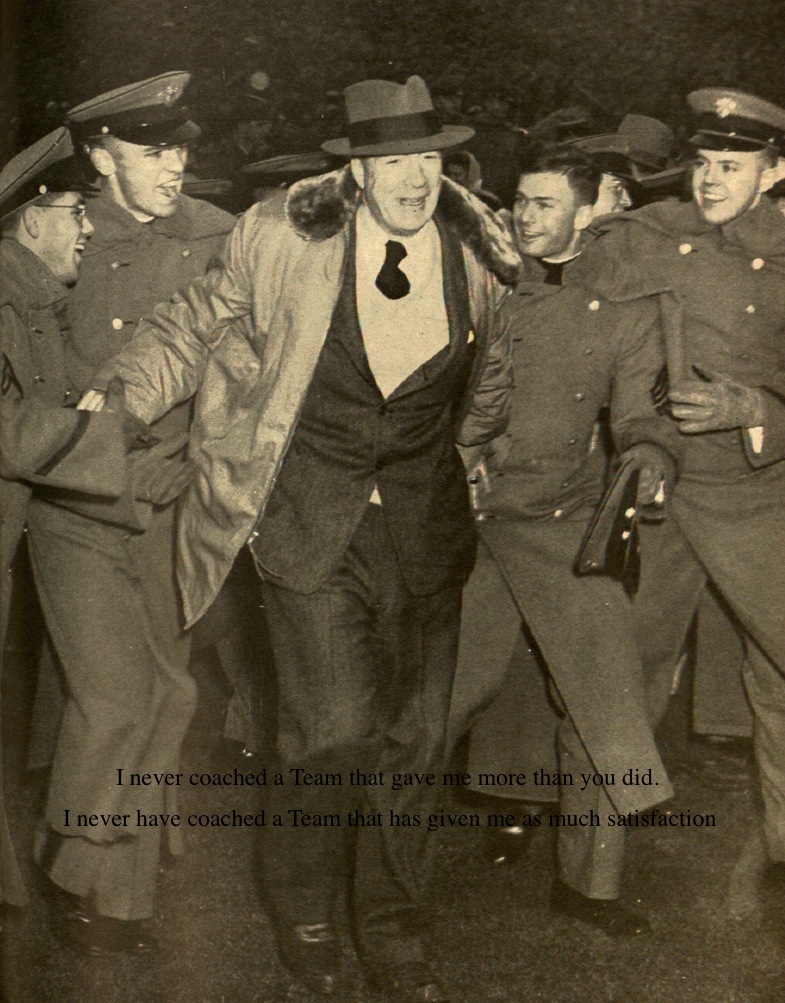
Jerry Lodge wore 67 and 32 is missing as is Norm Stephen 51- Army Center. 2d man 2d row next to Tommy Bell – is Zaborowski. Wynn #31 is in the 2d row not the 3d
Col Blaik “When I come to describe the team of 1953, what they meant to me and, far more important, what they meant to West Point, I cannot praise them enough.”
Of them, Grantland Rice wrote with eloquent simplicity, “They came up the hard way and there probably has never been a squad with a finer spirit.”
To understand the magnitude of the accomplishments of this team, recall that General McArthur gave his opinion in 1951 that it would take 10 years for Army to recover and field a top tier team. It took two years.
Coach Earl Blaik: “Injuries as the season advanced cost the team solid fullback and punter, three-year letterman Fred Attaya ’54; hard-nosed right halfback and three-year letterman Mike Zeigler ’56; and spirited end and three-year letterman “Ski” Godwin Ordway ’55. By the time the season got down to the Penn and Navy games, the starting eleven and about four substitutes carried the full load.”
In 1950, Army was 8-1 with a victory over Stanford, which finished the season ranked number seven in the nation; was tops in the nation in scoring defense, fourth in total defense, ninth in passing defense, and 10th in rushing offense; featured an All-American at end who finished eighth in the Heisman Trophy balloting, and two tackles who received votes for first team All-American; and would have been undefeated except for the stunning upset at the hands of Navy.
In 1951, Army went 2-7, defeating only Columbia and The Citadel and was trounced by Navy. Only one player received any national recognition, a name eventually to be etched in the hearts of all Army fans for decades to come: Mischak ’54 was number five in total kickoff return yards and first in average yards returned. The 1952 season was better, Army going 4-4, defeating South Carolina, but losing to Navy.
True, the Corps of Cadets did look for better things than in 1951 and “52”. Any prognostication that Army would win the Lambert Trophy, emblematic of the Eastern Championship, and be rated No. 14 nationally would have been tabbed fantastic. With Coach Blaik’s words as background, the team’s history echoes his witness.
|
Army Team Captain Leroy Lunn and Col Blaik |
They were one of the smallest Army football teams in years, at season’s end thirty-eight men, a team of heroes with no stars and with a different hero each Saturday, all playing for honor and love of the game. They were led by quiet, solid leaders from the class of 1954; augmented by a small number of players from the smallest Academy class in years, 1955, and a bevy of talented yearlings in the class of 1956 who set the gridiron on fire that fall. The NCAA changed the rules for the 1953 season to what is now called “one platoon” football, really “iron man” football.
Though the phrase wasn’t originated by Coach Earl Blaik, it was the incomparable football teacher, the thoroughly emotionally-controlled Blaik who, with tears in his eyes, handed the Army-Duke game ball to Bob Mischak, Army’s left end who made the incredible game-saving tackle. Blaik’s words to Bob were simple but powerful, and echo down through the years,
– – – – – – – – – – – – – – – “Don’t ever give up.” – – – – – – – – – – – – – – –
|
Mischak leaping on Duke’s All American Red Smith after the 73 yard run down, Army held taking over inches from the goal line. Col Blaik ordered an immediate punt and Army again held Duke at bay. It must be pointed out that Bob was the only player on the ’53 Team to be selected as an All American. Today the Academy does not recognze his All American status because of the organization which selected him. Army Football Classics – 1953 Football Film http://forwhattheygaveonsaturdayafternoon.com/wp-1954/army-duke-1953 |
The cheating incident had never-publicized, lingering effects on Army football players in the three following seasons, effects witnessed and painfully felt by the young, inexperienced B and C teams – the men who accomplished the “football miracle” of 1953.
As Blaik wrote years later in baring his bitterness and frustration over the cheating incident,
“For two years these boys had seen the roughest action. They had lived with the coaching lash, dirt, blood, and defeat.”
Adding to the effects the players faced was the revelation that the much-admired Army varsity had been deeply involved in what became a national scandal.
In a number of cases the players left to pick up the pieces became subjects of totally unwarranted suspicions and stinging criticisms simply because they were Army football players. The season of 1953 changed all that —
the team and the Corps of Cadets washed the effects away with stunning, inspirational teamwork and marvelous achievements. Yet, there were more hurdles to cross before they could accomplish their football miracle.
Following the 1952 season, changes in National Collegiate Athletic Association (NCAA) rules greatly restricted substitution and for several years virtually ended the offensive-defensive unit two-platoon system. The result was to lengthen playing
|
Lodge shifted to Fullback – turning the corner, Mischak 87. |
time for varsity players, decrease the number of varsity letters awarded, increase injury potential, and cause a return to what in years past had been called “iron man football”. To compete under the more complicated substitution rules, Coach Blaik chose to return to the type of two-platoon system he inaugurated at Army during the World War II years, two or three units that went both ways, on offense and defense.
While the rule changes impacted all collegiate teams, no team Army was to face in 1953 had suffered the total loss of its varsity lettermen and team leaders two years earlier. The losses had forced virtually complete rebuilding from the ground up. Other colleges and universities would have been able to accelerate efforts to make up such losses with much larger student bodies and massive numbers of alumni on the lookout for talent, aggressive well-funded recruiting, junior college transfers, and the growing lure of expanding professional football immediately after graduation. Not so at Army.
|
Pat with the ball — There appears to be a guard on the other side of Lodge blocking 88 — is this play later to become known as the Green Bay Power Sweep? |
The NCAA rule changes had other impacts not normally visible to cadets and Army sports fans — but were quite clear to team members vying for varsity status and the coveted Major A. The remaining 1953 team members, who, at the end of the 1952 season believed they had almost secured starting offensive or defensive platoon positions, suddenly found themselves being retested and moved from one position to another to determine who could play both offense and defense and had the conditioning, strength and stamina to play both ways.
Their extraordinary individual responses were inspirational, highlighting individual willingness to sacrifice for the team.
Bob Farris played the entire second half of the Navy game totally blind in one eye. Although he was captain of the ’54 team, he was never to play another down of football.
Again, from Col Blaik’s ’74 book.
“A normal amount of injuries as the season advanced cost us solid fullback and punter “Fred Attaya”, hard-nosed right halfback “Mike Zeigler”, spirited end “Ski” “Godwin Ordway”, and a few others.”
“By the time we got down to the Penn and Navy games, the starting eleven and about four substitutes carried the full load.”
|
|
|
“Ski” Ordway
|
Franklin – season over – double team tore up knee but a smile talking with 58 Zaborowski after Duke Game
|
Attaya Army’s Fullback
|
Neil Chamberlain injured summer of ’53 said this prior to the Navy Game. “Saturday Army will be represented by two different uniforms – – one black and gold, the other gray. I’ve found that I fight just as hard in one as I did in the other. We’ll all beat Navy this year.”
|
Vann to Holleder Vince Lombardi’s uncompromising demands on Vann, resulted in Peter becoming a superb drop back passer; with great ball-handling ability whose faking repeatedly confused defensive linemen. He was to set numerous Academy Records while the success Vince Lumbardi achieved as an Assistant Coach under Col Blaik propelled him to success in the Pros.
|
Hagan’s handoff to Attaya initial scoring drive against Duke. Uebel #34 and probably #55 – Farris. NY Times
|
At quarterback, Peter Vann shared the job to some extent with Jerry Hagan early in the season, but improved gradually to indispensable level.
Vann, Pat Uebel, and Tommy Bell at halfbacks and Gerry Lodge at fullback played 60 minutes against Penn and almost all the way in the Navy game.
It’s important to note, that Peter Vann was a sterling offensive team leader his last two years at Army, became a classic drop-back passer and deft ball-handling and faking wizard who repeatedly confused defensive linemen, and was far more than Blaik’s description of him on defense as “dependable in a crisis”. Playing at defensive right halfback on the last play of the season’s crucial, turnaround game, he too made a game-saving play, batting away a pass thrown from Duke’s quarterback to their alternate quarterback — in the Army end zone – then went on to be ninth in Heisman Trophy voting and a second team All-American quarterback in 1954.
|
Tommy Bell against Duke
|
Vann to Mischak. The only way to stop the catch is to climb on top prior to the arrival of the ball. |
Right halfback Tommy Bell, scored one of the two touchdowns against Duke, became a first team All-American in 1954 and that same year one of the few four-year lettermen in Army football history. Yearling left halfback Pat Uebel, who scored one of the two touchdowns in the stunning upset of No. 7-ranked Duke and all three of Army’s touchdowns in the win over Navy — one of a small number of Army players to score three touchdowns against Navy, and to that time the only player to score all three touchdowns in a win over Navy – was another hero in the 1953 Army backfield. Of Army’s two lead halfbacks Coach Blaik would write,
“In ’53 and ’54 both Uebel and Bell were among the top echelon of all-time West Point halfbacks.”
Rounding out the backfield after the loss to injury in the Tulane game of the swift, agile, hard-driving fullback, and punter, “Freddie Attaya”, was guard-converted-to-fullback Gerry Lodge, who stepped into Freddie’s shoes and performed
|
Attaya 46 and Uebel 34 showing 7th ranked Duke how Army played Football |
magnificently at both fullback on offense and linebacker on defense. It was this backfield, plus three great Army ends, and this team that brought Vince Lombardi to the attention of the New York Giants at the end of the 1953 season, setting Vince on course to become a legendary professional coach.
Blaik said of the three ends on the 1953 team, “Our end play was handled by Bob Mischak, Lowell Sisson, and a yearling of unusual potential named Don Holleder. Sisson was another who kept improving and hit the top in the Navy game. After Attaya’s injury, Sisson did the punting.
Mischak developed into a fine pass receiver and on defense he delivered the play that was the pivot, in a real sense, of the entire season. Holleder was a naturally talented pass receiver with outstanding speed, hands, and competitive fire. By 1954 he became just about the most dangerous offensive end in college ranks. Don later became an Army legend in his own right. A first team All-American end in 1954, he voluntarily gave up the chance to become a two-time All-American, by acquiescing to Coach Blaik’s request that he switch to quarterback for the 1955 season, a position he had never played in either high school or college. On 17 October 1967, his courage and heroism in Vietnam while attempting to rescue wounded soldiers in his unit cost him his life.
Don Holleder’s is life and service became the inspiration for the now-well-known Black Lion Award to football players at every level of football played in the nation, from youth leagues to intercollegiate Division IA.
Army linemen on the thinly-manned 1953 team included three guards, captain Leroy Lunn, his classmate Dick Ziegler, and yearling Ralph Chesnauskas, whose talents included extra-point conversions. Ralph calmly kicked the two extra points against Duke to win the game, and became a first team All-American in 1954.
|
Lunn for the coin toss – here he stayed on the field playing his greatest Game against Navy. |
Blaik, writing of “Leroy Lunn”, said,
“I think it epitomized the character of this team and Lunn’s inspirational leadership that he was able to handle a difficult situation in a manner that increased his stature. It was not an easy thing to walk out there every Saturday for the toss of the coin and then to have to return to the bench and not be in for the kick-off.
Roy never let this bother his playing when he did get in. He improved so much that he clearly earned the right to start with his team against Navy. Then he went out and played the best game of his career.”
Center “Norman Stephen” was a steady, rock-solid team leader on offense, who on the first play from scrimmage in the second half of the second home game of the season, against Dartmouth, — lit a small but growing fire in the team and Corps of Cadets — when he broke from the huddle and ran, almost sprinting to the ball, prompting the team to follow his lead. The roar of approval and support from the Corps each time Norm broke and ran to the ball, from that point forward through the rest of the season, continued to unify a determined Corps of Cadets with their team. He was a standout linebacker who was the on-field captain who called defensive signals. Starting at tackle were two yearlings, “Ron Melnik” and Howard Glock, with first classman Joe Lapchick, Jr. doing most of the reserve playing.
Coach Blaik considered the heart of his defense to be yearling Bob Farris, a top man academically who in 1955 became the Corps’ First Captain, played tackle on offense and was a line backer on defense in 1953. “The linebacking of Farris against Navy was as fine as I have ever seen in that game,” he wrote. “Unfortunately, the abandon with which he played cost him a detached retina that ended his football. To have played him would have risked an aggravation that might have impaired his sight. Nevertheless, Bob captained the 54 team and helped out with coaching.”
None of the foregoing tells of the incredible will-to-win spirit and support of the 1953 team by the entire Corps of Cadets, all of it specifically intended to unify the team and Corps of Cadets in ways never before seen or heard at West Point.The Corps’ preparation for the game had been more than unusual, including a “silence” imposed by the cheerleaders at the meal following Blaik’s talk.
They shook that old stadium almost non-stop in the sunshine and shadows of that Indian summer afternoon.

This was also the game in which a band of enterprising 1954 and 1955 cheerleaders first rolled out and fired the now-traditional Army victory cannon. The first blast of the cannon culminated months of planning and scheming, in which the cheerleaders prevailed upon COL “Red” Reeder, the Graduate Manager of Athletics, to grant them Corps Squad status to obtain financial support for their spirit-inducing initiatives.
Uebel scores 3 Times Against Navy
The Team’s marvelous success was marked with the most unusual Lambert Trophy presentation in the award’s history. First offered in 1936, and sponsored by New York City’s brothers, Victor A. and Henry L. Lambert, the trophy was symbolic of Eastern football supremacy, and had been won by Army in 1944, ’45, ’46, ’48 and ’49. For the first time, on a Sunday evening, 20 December 1953, in Washington Hall, the Lambert Trophy was presented outside of New York City to a football team and its student body.
In 1953, Army may not have won a national championship or produced a Heisman Trophy candidate but the seven victories, including Navy and Duke; a ranking of 14 in the nation in the season’s final pool; winning the Lambert Trophy; and earning Colonel Blaik “Coach of the Year” honors signaled the Academy’s “Return to Glory”.

|

|

|

|

|

|
Bob Mischak participated in 3 Super Bowls, 8 AFC Championships and many playoff games. As the starting Offensive Tackle on the 1958 Giant Team he participated in “The Greatest Game Ever Played” – – yet he considers the ’53 Duke Game the eptiome of any Game.
|
 Lodge going down tosses to Schweikert for score. Lodge going down tosses to Schweikert for score.
|
 Freddie Attaya Freddie Attaya Mike Zeigler Mike Zeigler
|

|
 Tommy Bell Tommy Bell
|
 Pat Uebel Pat Uebel
|
 Bob FarrisPlayed the entire 2d half of the Navy Game totally blind in one eye. Bob FarrisPlayed the entire 2d half of the Navy Game totally blind in one eye.
|
 Ralph Chesnauskas Ralph Chesnauskas
|
 Ron Melnick Ron Melnick
|
 Meador Mgr Meador Mgr
|

|
 Burd Burd
|

|
 Lasley Lasley
|
 Unknown Unknown
|

|
 Don Holleder – 84 Don Holleder – 84
|
 Unknown Unknown
|
 Cody Cody
|
B Squad
 Vann to Sisson Vann to Sisson
|
 B Squad |
 Uebel Intercepts Uebel Intercepts
|
 Krause driving his man to the ground |
Peter takes to the Air
United States Corps of Cadets ready for Navy
 Sisson headed for another score Sisson headed for another score
|
|
 Peter stuffs the ball in Jerry’s gut Peter stuffs the ball in Jerry’s gut
|
 Wynn |
|
 Mischak Mischak
|
 Jerry Lodge Jerry Lodge
|
|
Lunn
|
Norm Stephen
|
 Jerry Lodge Jerry Lodge
|
The Firsties Last game
To place the accomplishments of the 1953 Army football team prominently and in full view of the United States Corps of Cadets and the Long Gray Line, we, the members of the 1953 – 1954 Cadet Corps, Coach Hugh Wyatt, (Founder of the Black Lion Award) and ??? members of the Class of 1962, nominate the 1953 Army football team for induction into the Army Sports Hall of Fame.
Please note – – credit must be given to Bill McWilliams ’55 and Dave Phillips ’62 for their efforts in preparation of the material for this Nomination.
Attachments
1. Signed Nomination letters by the Classes of 1954, 1955, 1956, 1957, & 1962.
2. Bob Mischak’s Letter and Resume.
3. Coach Hugh Wyatt’s (Founder of the Black Lion Award) support of the Nomination and contribution of the 1953 Army Football Highlights CD.

Hannibal, NY’s Chris Swain making one of 4 Solo Tackles against Rutgers 23 October 2009.
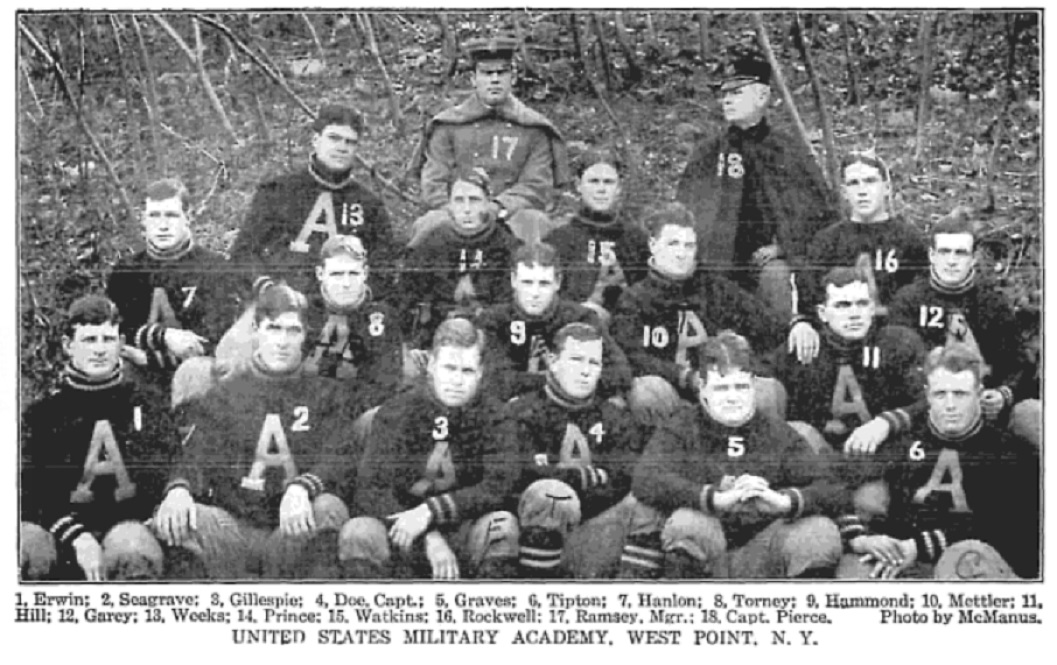
–
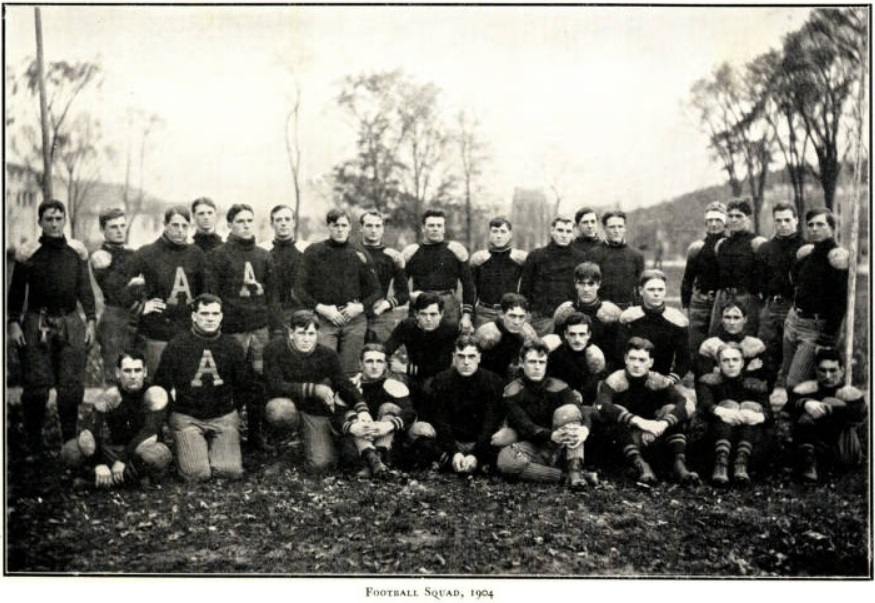
–
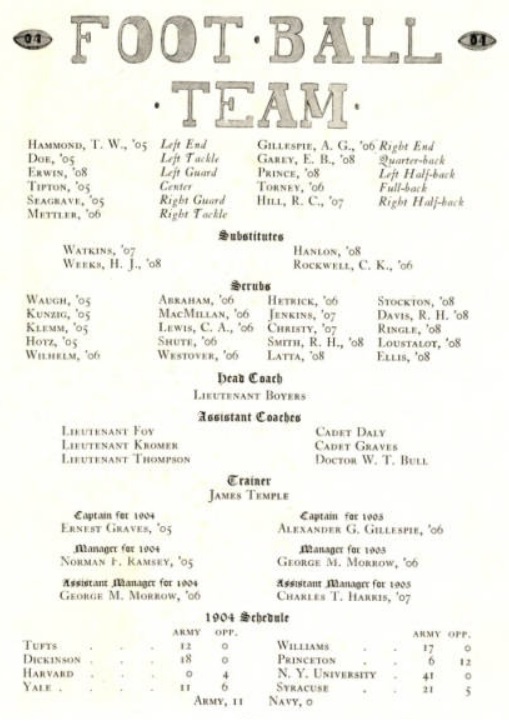
–
Howitzer 1905
http://digital-library.usma.edu/cdm/compoundobject/collection/howitzers/id/9296/rec/52
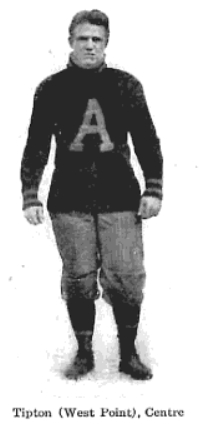
Tipton – All-American Center
–
Ready to do or die, the navy football players left Annapolis yesterday for Philadelphia. The players wero given a rousing send-off when they left the acdemy grounds…
ARMY 11, NAVY 0 – Boston Daily Globe
Tipton’s Kicking Great Football – Meriden Daily Journal – Nov 27, 1904
Army Beats Navy – Sunday Morning Star – Nov 27, 1904
In Hard Fought Game Won Annual Football Match
http://news.google.com/newspapers?id=FOsmAAAAIBAJ&sjid=6AIGAAAAIBAJ&dq=football%20philadelphia&pg=3932%2C2627061
–
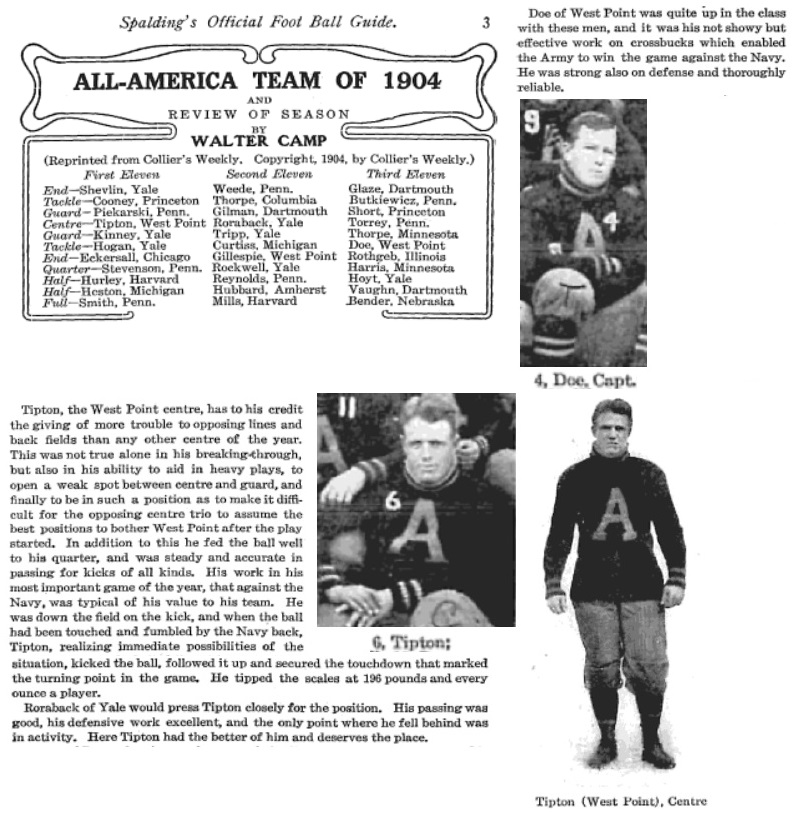
–
Army Guard, Army Fullback, Army Wrestler
See 1953 Football Team

Cadet will not Lie, Cheat, Steal, or Tolerate Those Who Do

USMA at West Point

We have changed the wording of our Alma Mater to reflect the fact that our Women Graduates have also given their lives serving this Nation.
Our Flag in 1812

----- Class of 2012 Motto ------
"For More Than Ourselves"
Thank you Class of 2012 for the Honor of Marching with you The Class of 62 - Can Do

Remember - The Soldiers you will lead Always Come First

Motto -- Duty Honor Country

The Cadets of West Point

They played perhaps Army's Greatest Game. They were the Team that Gave The Most

Washington's Letter recommending the establishment of the Academy and the History of West Point

The Oaths We Take

West Point's Medal of Honor Recipients

Jefferson Hall - the Academy's new Library.

Douglas MacArthur

Vinegar Joe Stilwell cleaning his Thompson -The Walkout -Burma 1942

George Patton

The Monuments of West Point

Kosciuszko Monument - Guarding the Hudson ensuring there is no passage of British Man of War

Forts of the Hudson

So we'll sing our reminiscences of Benny Havens, Oh!

Academic Excellence

Colonel Thayer

West Point

Trophy Point

"L'Ecole Polytechnique Monument", or The French Monument by Cadets

Superintendent's Quarters viewed from Thayer Road

Superintendant was not Happy Black '57

Home of the Dean

Quarters 104

Cadet Chapel

Michie Stadium

Arvin Gym

Kimsey Athletic Center

Holleder Center

Washington Monument

United States Military Academy Band

Cadet Barracks

Rugby Complex

Great Chain

Plain looking toward Washington Hall

Battle Monument

Washington Hall with Cadet Chapel on rocks above

Hudson River

Captured Trophies

Battle Monument

West Point Cemetery

Plain

Cost to this Nation of Differing Views

Trophy Point -- Our Flag

Corps of Cadets Formed in Companies early 1960s

Sending the Army Team off to Beat Navy

Army Mule

Color Guard

Band Box Review Early 1950's in Central Area

Battalion Mass Early 50's

Flirtation Walk

Class of 2008 Class Crest & Motto "No Mission Too Great" Their Commencement "Here am I; Send me."
Thank you Class of 2008 and Please Thank the Men & Women --- the Soldiers you will lead --- The Class of 62.
Duty Honor Country
The '54 Crest

28th Infantry Regiment Black Lion Award is intended to go to the person on his team "who best exemplifies the character of Don Holleder: leadership, courage, devotion to duty, self-sacrifice, and - above all -
an unselfish concern for the team ahead of himself."
"The Army moves as a team, eats as a team, and fights as a team."

The '55 Crest

Don Holleder Remember - The Soldiers you will lead Always Come First

Vann and Holleder

9 Army A's

The '56 Crest

The '57 Crest

Can Do

Gen Van Fleet addressing the Corps prior to the Navy Game

Constructed under supervision of Jay Gould "54 and the Ord Dept from a German Rocket Gun captured at Kasserine Pass. First used in the Duke Game.

COL "Red" Reeder granted the Cheerleaders Corps Squad status to obtain financial support for their spirit-inducing initiatives.
Bob Mischak - - It should be pointed out that Bob was an All American selection, but is not recognized by the Academy as such because of the organization which selected him.

Ubel scores 3 Times against Navy - Vann's facking results in Peter getting tackled - #10 on the ground behind Ubel

Vann to Sisson

Army's B Squad

Vann to Mischak.
Uebel Intercepts
Cody to Don Holleder
Lasley

Frank Hicks
Burd

Bill Purdue
Cody
Meador Mgr
Ron Melnick
Ralph Chesnauskas
Pat Uebel
Tommy Bell
Sisson headed for another score
Peter Vann stuffs the ball in Jerry's gut

Leroy Lunn & Jerry Lodge

Uebel after taking the handoff from Hagan
Attaya - Army's Fullback

Sisson - one of 3 Great Ends
Bob Mischak
Ralph Chesnauskas
Bob Farris

Vann moving out of the pocket

Peter Vann 10, Billy Chance 38, Herdman 68

Ken Kramer

Joe Lapchick

Kirk Cockrell
Lodge going down tosses to Paul Schweikert for score.
Dick Zeigler
Bob FarrisPlayed the 2d half of the Navy Game blind in one eye.
Pat Uebel
Tommy Bell

Peter Vann
Freddie Attaya
Mike Zeigler

Jerry Lodge wearing #67, playing fullback.

Johnny Wing

Lowell Sisson

Norm Stephen

Jack Krause

Dick Ziegler
Jerry Lodge
Leroy Lunn
Norm Stephen
Jerry Lodge

Corps of Cadets for Navy Game
Can Do
"The Army moves as a team, eats as a team, and fights as a team."
The '54 Crest
The '55 Crest
28th Infantry Regiment Black Lion Award is intended to go to the person on his team "who best exemplifies the character of Don Holleder: leadership, courage, devotion to duty, self-sacrifice, and - above all - an unselfish concern for the team ahead of himself."
 Ernest Graves


