Amy Meets 7th Ranked Duke in the Polo Grounds – NYC
When he picked up his shirt and sock roll, Roy Cooper handed him an orange and white jersey with number 32 on it. As a Plebe he was not eligible to play varsity ball so he was surprised to be told to report to the A Squad. He was going to be Jim Brown of Syracuse. On his first play from scrimmage, behind B Squad blocking he took the handoff and ripped off 8 yards. Returning to the huddle, he was feeling good, until Colonel Blaik uttered those words dreaded by every Army B Squad Player– Run it again. This time he barely took the handoff when he was smashed to the ground by Dick Stephenson. Years later as an All American and member of the NCAA Hall of Fame he would still remember that hit. (Page 5 of Army Lore)
The only soldier ever to be awarded the Combat Infantryman Badge as a General Officer. http://en.wikipedia.org/wiki/Combat_Infantryman_Badge
Consulate – Chengdu China
http://chengdu.usembassy-china.org.cn/galleries/wwii-on-the-ground/gallery-on-the-ground-general-joseph-stilwell.html Continue reading
After the Navy Game —- He ordered the door secured and as he turned to speak his eyes were misty.
“I have never coached a team that give me more than you did. I never have coached a team that has given me as much satisfaction. Considering all the conditions since 1951, you have done more for football at West Point than any other team in the history of the Academy.”
1. Bob Farris ’55 played the entire 2d half of the Navy Game totally blind in one eye. Although he was Captain of the ’54 Team he was never to play another down of Football.
2. Bob Mischak ’54 as a player and a coach, Bob participated in 3 Super Bowls, 8 AFC Championships and numerous playoff games. As the starting Offensive Tackle on the 1958 Giant Team he participated in “The Greatest Game Ever Played” – – yet he had this to say of the 1953 Duke Game:
“As many reports have stated, the 1953 team “Returned to Glory” with the defeat of the nationally ranked Duke Blue Devils at the Polo Grounds in New York City. From a player’s stand point, that was the epitome of any game, team, and student body support that I’ve been associated with – bar none.”
1950 Graduates stationed at Fort Bliss listening to every word on the radio heard Ted Husing say “- – – And, Smith is in the clear, he’s away for a touchdown.” there was a pause of 5 second or so of silence, and Husing then said, “No, no…he’s going to get caught from behind!”
For over 10 years the Academy’s Military Psychology and Leadership Department referred to Bob Mischak’s run down of Red Smith, and the team’s effort that day as an example of the power of motivation.
3. Coach Hugh Wyatt founder of the Black Lion Award provided the August 14, 2009 Bradenton Herald article by Roger Mooney. Excerpts of the interview with Jerry Hagan ’55 who quarterbacked the 1st Army drive in the Duke Game are below
It is the chanting that Jerry Hagan remembers most about that October afternoon in the fall of 1953.
Sure, Hagan remembers the touchdowns and the game-saving tackle by Bob Mischak in the game’s waning minutes. He remembers Earl Blaik, Army’s larger-than-life coach, calmly pacing the sidelines at the old Polo Grounds. Hagan remembers heading to the locker room at halftime holding a 7-0 lead. He remembers thinking during the days leading up to the game that he and his Army teammates were going to be trounced by Duke, at the time ranked seventh in the country.
Those memories are as clear as the brilliant blue October sky that Saturday afternoon nearly 56 years ago.
“Go! Go! Go! Go!”
“It was continuous,” said the 75-year-old Hagan, who played that afternoon. “Just deafening”
Army didn’t win a national championship that afternoon. No one clinched a Heisman Trophy. But Army won something more important. The Black Knights knocked off a top-10 team and began lifting the stain caused by the Honor Code scandal that had rocked the academy two years earlier.
Because of one game. Because of one win.
“Army was back,” Hagan said.
Go! Go! Go! Go!
Hagan Class of ’55 entered the Academy that summer of 1951 when the scandal broke. “The atmosphere was just so depressing for a while because nobody could believe this could happen,” Hagan said.”It kind of crushes you.”
The football team was devastated. Blaik’s teams had won three national titles and produced two Heisman Trophy winners in the six seasons prior to 1951. In 1951, Army went 2-7, including a season-ending loss to Navy. Hagan was a member of the varsity in 1952, playing defensive back.
The following year Hagan was moved to linebacker and quarterback since the NCAA imposed a rule returning the game to “Iron Man” football.
The ’53 Team opened the season with a win at Furman, but lost the following week to Northwestern. It was a loss, Hagan said, that shook the team’s confidence. But the Black Knights had an assistant coach who would not let his unit suffer a mental breakdown. His name was Vince Lombardi.
“He was a very cerebral coach,” Hagan said. “He was so intense, so intolerant of mental mistakes. We didn’t have many athletes, but we were probably the most mentally prepared team because of Coach Lombardi and Coach Blaik.”
Army football wasn’t much to rally around during the 1951 and ’52 seasons. The Corps of Cadets were use to us getting beat.
Then came Oct. 17, 1953, and the seventh-ranked Duke Blue Devils.
The cadets filed into the Polo Grounds silent as ever, but started screaming. Go! Go! Go! Go!
And go Army did.
It was 14-13 late in the fourth quarter when Duke’s Red Smith broke free headed for the winning touchdown. Mischak caught Smith at the 10 and brought him down at the 7.
It is the most famous tackle in Army history.
Army stopped Duke less than a foot from the goal line on fourth down.
Seconds later, players were riding on the shoulders of the cadets, who stormed the field. Army went 7-1-1 that year, beating Navy in the season finale. They were awarded the Lambert Trophy for being the best team in the East.
They restored the Academy’s pride. The glory was back.
Now there is a push to have the ’53 immortalized in the Academy’s Hall of Fame.
4. Lodge from guard to fullback, Sisson switched from end to back and then switched back to end; Lunn as Team Captain on the sidelines, as another was better able to meet the new requirements of playing both ways; the injuries to Chamberlin, Attaya, Zeigler, Ordway and Franklin; and the unrelenting demands and hours spent ensuring Vann mastered the details of the Royal 3 F’s -(Faking, Feeding and Fleeing) that Vann met Lombardi’s expectations, resulted in Jim Lee Howell, the New York Giants’ head coach who hired Lombardi after the 1953 season at Army to say – –
“If Lombardi can do that kind of job in three years at West Point – he could do a helluva job in the pros where he would have an experienced base to work with.”
The 3 years were the 2 difficult seasons of 1951 and 1952 followed by the success of the 1953 Season.
Years later after Vince Lombardi’s death his son was to write – “My personal interest lies in Peter Vann’s contribution to the success of the 1953 Army team which I consider a major factor in my father’s success.”
5. Ted Husing the CBS Sports announcer for the Duke Game — “These Boys have got me so excited I can’t even finish the Broadcast. Take over Walter”
If you do not know who Ted Husing was – – wikipedia provides this “Husing’s personally could be arrogant, coarse and opinionated. He was the first to bring a candid, editorial style to sports play- by- play. He was barred for two years by Harvard University for covering its home football games after he called All American quarterback Barry Wood’s performance “putrid”. After criticzing World Series umpires in 1934, Husing was banned from doing play-by-play of the Fall Classic by Commissioner Kenesaw Mountain Landis”
6.Col Blaik “When I come to describe the team of 1953, what they meant to me and, far more important, what they meant to West Point, I cannot praise them enough.”
7. Grantland Rice wrote with eloquent simplicity, “They came up the hard way and there probably has never been a squad with a finer spirit.”
8. Winners of the Lambert Trophy.
9. Rated No. 14 Nationally.
10. Col Blaik was named Coach of the Year by the Washington Touchdown Club.
11. Col Blaik After the Duke Game — The emotionally-controlled Blaik who, with tears in his eyes, handing the Army-Duke game ball to Bob Mischak with the words – “Don’t ever give up.” He was later to refer to the it as “The Game never to be forgotten.”
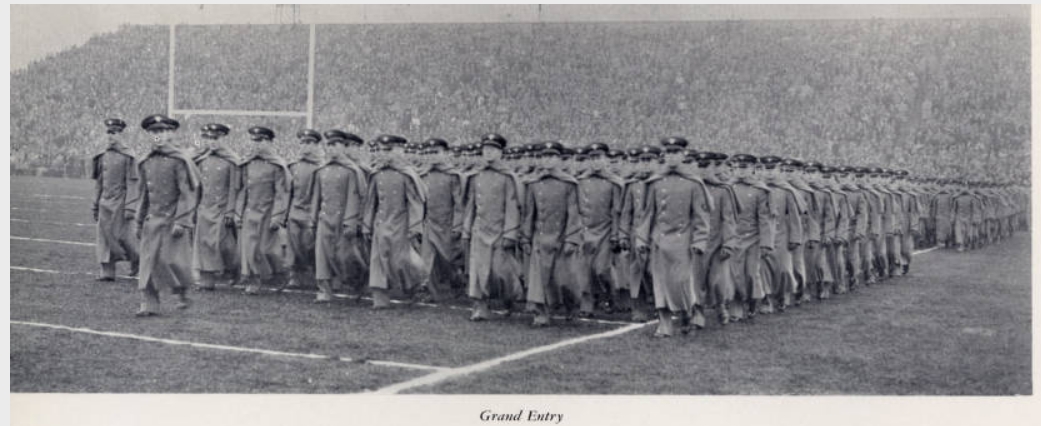
12. The Silence imposed upon the Corps The Corps’ preparation for the game had been more than unusual, including a “silence” imposed by the cheerleaders at the meal following Blaik’s talk. The “silence” which began after the traditional pregame sendoff of the team – proved potent. The cheerleaders had put a cork in the bottle of more than two years of pent up frustration. When the Corps completed its subdued, strangely silent, pregame march-on at the Polo Grounds, and the last man double-timed onto the first step of the stands, the men in gray exploded. They shook that old stadium almost non-stop in the sunshine and shadows of that Indian summer afternoon.
13.Duke ball players reaction — Worth Lutz, Dukes quarterback said after the Game, “The savage cheering of Go!GO!GO! from the West Point stands placed our team in a nervous fright of tension and jitters.”
14. New York Times the day after Army’s 14 – 13 win over 7th ranked Duke summed up what that Team did with – – –
“The fire and viciousness with which this Army team ran, hit, blocked and tackled made it the winner it was today against a team whose line was thought to be too powerful for the cadets and whose backs were expected to show the speed and driving force.”
And anothe quote — “But from well back an Army figure set out in pursuit. With the place in an uproar, Bob Mischak cut down the gap between them, and finally leaped upon Smith and dragged him down on the 7 yard mark, 73 yards from the line of scrimmage.”
Bob had run down Duke’s All American Red Smith. For nearly 15 years afterward the story of Army’s win and Bob’s tackle was part of West Point’s Military Psychology and Leadership Course – as an example of the power of motivation.
15. NY Times again
“He (Attaya) also took a 17-yard pass, amazingly thrown left-handed by Vann, immediately preceding the 43-yard scoring aerial.”
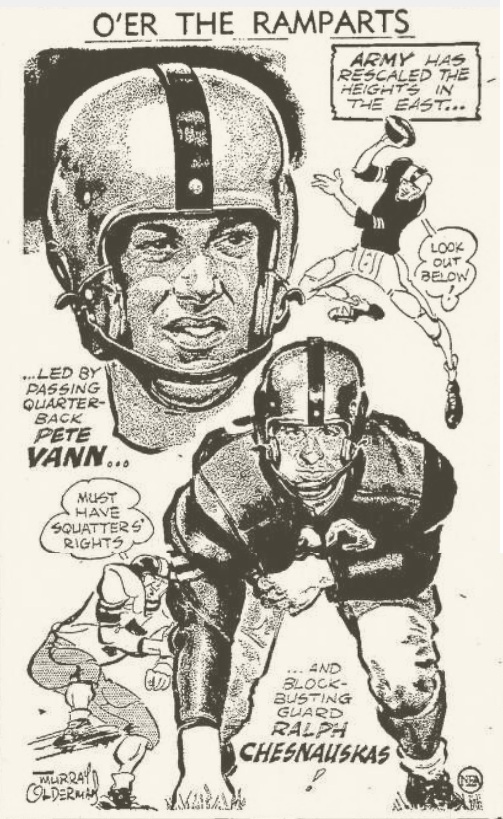
Third was Ralph Chesnauskas, Yearling right guard who played the entire sixty minutes”
16. Even today Lowell Sisson ’54 accepts responsibility for the ’53 Team’s only loss. How many Athletes are willing to admit their contribution to a loss 56 years past, especially when that Team had such an outstanding Season – such was and is the makeup of the ’53 Team.
The NCAA changed the rules for the 1953 Season what was in effect a return to Iron Man Football. Lowell played Offensive End during the ’52 Season but in trying to come up with the best fit, Lowell was switched to the backfield in the spring of ’53.
“About 10 days before the season was to start I was called in to Col Blaik’s office. Fearful regarding what the reason was, I reported in to find “Col Blaik” and “Vince Lombardi” there and they proceeded to ask me what my reaction would be if they were to switch me back to end. I said I did not care where they wanted me to play as long as I could be of value to the team.
Because of the switch back to end I did not get totally grooved into playing defensive end and this contributed to a large degree why we lost our only game that season. I felt I played a terrible game against Northwestern and contributed mightily to our defeat.”
17. Col Blaik wasn’t a coach who gave emotional, fire and brimstone speeches at halftime. Rather, he was analytical. He identified mistakes and taught his team how to correct them. Not so against Dartmouth. He was frustrated by a flat, lackluster first half and gave his team a tongue lashing.
Ralph Chesnauskas remembers they were the harshest he ever heard the Colonel speak — words to the effect – – –
“I do not care if it is your Mother across the line from you, I want her on the ground.”
18. Col Blaik’s offensive play routine required the Army center to be the first man out of the huddle after the quarterback called the play. As the center trotted up over the ball, the rest of the team would pause, then break from the huddle, and jog to the line of scrimmage. Not so the second half against Dartmouth, or against any other team the remainder of the 1953 season.
Center Norm Stephen ’54 was so energized by Blaik’s blistering half time remarks, that on the first offensive play of the second half he bolted from the huddle and raced to the ball – and the other ten players pausing for a moment to understand, followed his lead. The Corps roared their approval, and that pattern continued the rest of the afternoon. A new method for calling up “the twelfth man” had been established.
19. Colonel Red Reeder who served West Point as Assistant Athletic Director in the Army Athletic Association, (The Triple A) from 1948 to 1967 had this to say –
“In all my association with the Corps, I have never seen a better display of Sprit. ”
20. The Cheer Leaders were told a Pack Howitzer was too expensive to be given to the Cadet Corps. With the help of the Ordinance Department Jay Gould ’54 constructed a Cannon from a German Rocket Gun captured at Kasserine Pass. It was first used in the Duke Game.
The Cadets were nearly paranoid with concern that the Middies were going to interfere with the Cheer Leaders plans for the Navy Game 6 weeks away. Bill Robinson took the step to hide the Victory Cannon at Ft. Hamilton in NYC after the Duke Game. It is another indicator of how intent the Cadets were on keeping things going, supporting the team the entire season without a hitch.
21. Billy the Navy Goat was taken by Cadets and paraded through Washington Hall. President Eisenhower ordered the Cadets to immediately return the Goat.
22. They were one of the smallest Army football teams in years, at season’s end thirty-eight men, a team of heroes with no stars and with a different hero each Saturday.
23. Neil Chamberlin a standout at tackle during the ’52 Season was lost during the summer of 1953. Col Blaik said of the season “Injuries as the season advanced cost the Team solid fullback and punter Fred Attaya ’54, hard-nosed right halfback Mike Zeigler ’56, and spirited end “Ski” Godwin Ordway ’55. By the time season got down to the Penn and Navy games, the starting eleven and about four substitutes carried the full load.”
The 1953 Team was a Team of Iron Men committed to the ideals of West Point. They played Iron Man Football.
23. Army Defense – In the Duke Game 23 passes were thrown by Duke compared to the 28 passes which were throw in their first 4 games. Chesnauskas, Zeigler at guard, Farris and Melnik at the tackles, Mischak, Sisson and Holleder controlling the sweeps, bottled up Duke’s running game all afternoon except for the one reverse and 73 yard sprint by Red Smith which Mischak hauled down.
24. Bob Brogi ’62 when asked if he supported the Nomination replied –
“Absolutely and unquestionably YES, YES and YES. Unlike most members of our Class, being from Highland Falls and a 15 year old in 1953, I saw all of the Army home football games in 1953 as well as most of 1949-1957. In the early years to include 1953, I had to watch not from the inside stadium, but from a high oak tree which I would climb so that I had a commanding view above what was then the somewhat temporary stands at the North end of the field. About that year, I became much more savvy as to ways that I could get or con tickets from those who were not going to use and always sat as a real participant. So I vividly recall seeing Sisson, Stephen, Tommy Bell, Pat Uebel, Fred Attaya, Peter Vann, Bob Mischak, Ralph C., Don Hollander , and many, many others through the years.”
25. Jim Morgan ’57x remembers General James Van Fleet, before the Navy Game, standing on the Poop Deck, stripping off his uniform down to a Beat Navy T-shirt, then putting on his Army sweater with his Football Army A, bring from the Corps of Cadets thunderous shouts, demanding Victory over Navy.
26. Dick Stephenson ’57 who earned 3 Army A’s as a lineman; (who is remembered even today by Bob Anderson ’60 for the hit Dick put on Bob in Bob’s introduction to Army Football in the fall of 1956) remembers – –
One of Army football’s most effective passers, Peter Vann, the Army QB (with a truly great right handed passing arm), managed a left handed forward shovel pass to Freddie Attaya, from the grasp of the Duke’s All American tackle Eddie Meadows who had pinned Petes’s passing, right arm to his torso, which Freddie caught to keep an Army drive going on into a score…simply unbelieveable momentum, continuity, and a bit of luck.
Who remembers the incredible diagonal, quickly one-on-one, pursuit of the Duke halfback, Red Smith, in an open field chased by Army’s end, Bob Mischak, catching and covering somehow, from some 73 long, long yards, with Mischak tackling him from behind, at Army’s 7-yard line. The Duke halfback never ran so fast and free, and Bob Mischak literally found another gear. The score was already 14-13, Army, at this time in the game, as I recall.
Who remembers following this incredible pursuit/catch by Bob Mischak, the Army team put on a goalline stand that defied all sense, reason, or logic, holding Duke off on all four downs, with Duke so arrogantly confident that they refused a field goal attempt!
27. Freddie Attaya remembers Vince Lombardi’s shouted advice to him as he ran onto the field in a third and seven situation. “Run the gauntlet” yelled Lombardi.
Vince was reminding his fullback of a drill he put his backfield through in practice. Running backs, carrying the ball pressed against their gut, ran hard between two lines of eight players each. The ball carriers’ forearms protected the ball, and their hands tightly gripped opposite ends of the pigskin, every player in the gauntlet aggressively tried to “tackle the ball.” Freddie ripped the middle of Duke’s line for nine yards and a first down. When he came off the field, Lombardi rushed to hug him, telling him he had done a great job.
28. Jerry Lodge, converted from guard to fullback during spring practice, remembered the Duke game for a different reason. He played fullback on offense and guard on defense when Army was in a six-man line, and moved into linebacker when Army went to a five-man line. On defense, he played alongside the few linemen who were in the game nearly the entire 60 minutes and was in Army’s dramatic goal line stand following Bob Mischak’s game-saving tackle. With first and goal on Army’s 7-yard line, the cadets held Duke on a fourth down quarterback sneak from the two, with 40 seconds to play.
Throughout the final two minutes of play, especially during Duke’s four thrusts at the Army goal, it was almost impossible to hear or think because of the roar from the crowd. Cadets had come down out of the stands, were pressing around the Army bench and close to the sidelines, imploring their defense to hold.
Army’s always thorough scouting reports helped exploit Duke’s weaknesses and patterns.
Jerry Lodge remembered what Blaik had told the team. When the Blue Devils get inside an opponents’ 10-yard line, they run the ball between their own tackles on 95% of plays. And when they get close to the goal line, they run quarterback sneaks. Prior to the fourth down play, a Duke assistant threw a kicking tee onto the field, indicating a field goal attempt.
Lutz picked up the tee and threw it back, disdaining the field goal.
Gerry Lodge had seen his teammate, left guard Dick Ziegler ’54, playing magnificently all afternoon, often absorbing the energy of three Duke blockers because of his hard charges in the middle of their line. As Duke huddled for Lutz to call the fourth down play, Lodge said to Ziegler “Remember, he’s going to try to sneak.”
Duke’s Lutz did, but he was met by a wall of white jerseys. Army took over on downs, inches from the goal line, while the Corps of Cadets shouted their frenzied approval. But the game wasn’t yet over. On first down, Freddie Attaya, on orders from Blaik, punted from deep in his end zone. Duke had 30 more seconds and four more plays from the Army 37-yard line – all passes – all knocked away. Peter Vann, Army’s quarterback, batted away the last pass in the end zone, a pass thrown by Gerry Barger, Duke’s quarterback, to starting quarterback Worth Lutz.
29. To back up — With two and one half minutes left in a game that was already emotionally and physically exhausting, Duke took the ball on downs just inside their own 20-yard line with Army leading 14-13. Worth Lutz knew he needed a long gain. His team didn’t have the energy for a long, grinding drive, so he called a double reverse. Lutz handed the ball to halfback Bob Pascal, indicating a sweep around Army’s left side. Pascal then slipped the ball to “Red” Smith, Duke’s speedy All-American candidate, heading in the opposite direction. Army’s defense over commited, and Smith broke into the secondary. After sidestepping a linebacker, he was in the clear, ten yards beyond pursuing Army defenders, sprinting toward the southeast corner of the field.
Earl Blaik years later described reactions on the Army sidelines.
“We on the bench and the Corps of gray in the lower stands behind us shot to our feet in sudden silent, stunned consternation. Smith looked home free. I felt our heads were being pushed down once more into the ashes of 1951.”
Then, from out of the pack of pursuers, came left end Bob Mischak. He had an angle on Smith and rapidly began closing the gap at the 50-yard line. By the time Smith crossed the Army 20, Mischak had closed to 3 yards. The Army stands were coming alive, shouting encouragement to him, but it was important that he not commit too soon. Blaik held his breath, muttering to himself, – “Not yet! Not yet!” As Smith crossed the 12-yard line, Earl Blaik was saying “Now! Now!” Bob Mischak leaped far and high, caught Smith around the shoulders at the 10, and downed him on the 7-yard line.
Earl Blaik remembered Bob Mischak’s game-saving tackle for the rest of his life.
“In somehow catching and collaring [Smith], Mischak displayed heart and a pursuit that for one single play I have never seen matched. Yet his feat, one of the great defensive plays of football, would have soon been forgotten, had it not been for the [goal line stand that] followed.”
30. They were only scored on 12 times in ’53. One by Navy, 5 times by Northwestern with 6 spread out over the other 7 Teams.
General MacArthur said it would take 10 years.
The Leadership of the Class of 1954, the commitment, the self sacrifice of the Classes of 1955 and 1956 — of every member of that Team, supported by the Thunderous Chant of Go, Go, Go from the Class of 1957 insured that it only took 3 years.
Cadets left to right, Clyde W. La Grone, Roman J. Peisinger, Ira Coron, and Leonard Griggs. In the background is Rox Shain, the Army player whose game-opening diagonal kickoff preceded Navy’s fumble. (Photo courtesy of Willis C. Tomsen, ’54.)

signed by ’54, ’55, ’56, ’57, ’62
Attachments
1. The ’53 Season
http://forwhattheygaveonsaturdayafternoon.com/wp-53/season
2. Bob Mischak’s Letter to Last year’s Selection Committee
http://forwhattheygaveonsaturdayafternoon.com/wp-1954/mischak-letter
3. Army Football Classsics -1953 Football Film
http://forwhattheygaveonsaturdayafternoon.com/wp-1954/53season-blaik-faces
http://forwhattheygaveonsaturdayafternoon.com/wp-1954/army-duke-1953
http://forwhattheygaveonsaturdayafternoon.com/wp-1954/army-navy53
Requirements
1. Complete Review by the Members of the 1953 – 1954 Corps of Cadets to insure correctness of material. (In the Chant were there 3 Go Go Gos or 4? Is it Jerry or Gerry Lodge – Academy Publications-Howitzer and The Pointer have it both ways – just informed it is Jerry)? A misspelled name and incorrect location of a player in the Team photo have been corrected – are there any other corrections? Need better picture of Ordway.
2. Rework of the draft Nomination and The ’53 Season by ’62.
3. Continue the count of the Class of ’62 to determine an exact number supporting the Nomination.
4. Add any additional comments from the 1953 – 1954 Corps of Cadets which support the Nomination.
5. Determine if each of the 4 Class Presidents (’54 – ’57) or an approprite representative from each Class are willing to sign the Nomination. Failing that, if available would the 1953 – 1954 Cadet Brigade Commander be willing to sign the Nomination?
The 1953 – 1954 Corps of Cadets and ??? members of the Class of 1962 Nominate the 1953 Football Team for the Army Sports Hall of Fame.
We the Graduates of the Classes of 1954, 1955, 1956, 1957, and 1962 believe the 1953 Football Team must be recognized for what they gave back to the Corps of Cadets, for what they gave for our Honor Code, for what they gave back to our Academy Motto — for what they gave back to the United States Military Academy.
3 Army A’s in Football
Football’s Greatest Decade – – by Bernie Mcarty – http://www.la84foundation.org/SportsLibrary/CFHSN/CFHSNv01/CFHSNv01n1b – – see page 5
This writer believes West Point 1945 is the greatest team of all time. The 1944 Army team may actually deserve that title, but it was never tested. Army was also undefeated in 1946, 1948 and 1949.
Army’s top stars during 1945-1949 were the effulgent “Touchdown Twins”, Glenn Davis and Doc Blanchard, Arnold Tucker, Arnold Galiffa, Rip Rowan, Bobby Jack Stuart and Gil Stephenson in the back-field, and up front Joe Steffy, Art Gerometta, Jack Green, Bill Yeoman,”Joe Henry”, Tex Coulter, Al Nemetz, and the sterling end duo of Hank Foldberg and Barney Poole.
In 1945 the Newspaper Enterprise Assoc. simply picked the entire Army team as its All-American team, stating no group of All-Americans could beat the Cadets. Only a world war could have brought together such a collection of players to one institution. But it took the coaching genius of Col. Earl Blaik to mold the players into a cohesive unit. In truth, Navy personnel was equal to Army’s on an individual basis. The Middies never jelled as a team, however.
The 1951 Army outfit might have been as good as the 1945 Cadets, but the infamous cribbing scandal wiped out the team.
3 Army A’s in Football.
Football’s Greatest Decade – – by Bernie Mcarty –
http://www.la84foundation.org/SportsLibrary/CFHSN/CFHSNv01/CFHSNv01n1b – – see page 5
This writer believes West Point 1945 is the greatest team of all time. The 1944 Army team may actually deserve that title, but it was never tested. Army was also undefeated in 1946, 1948 and 1949.
Army’s top stars during 1945-1949 were the effulgent “Touchdown Twins”, Glenn Davis and Doc Blanchard, Arnold Tucker, Arnold Galiffa, Rip Rowan, Bobby Jack Stuart and Gil Stephenson in the back-field, and up front Joe Steffy, Art Gerometta, Jack Green, “Bill Yoemans”, Joe Henry “Tex” Coulter, Al Nemetz, and the sterling end duo of Hank Foldberg and Barney Poole.
In 1945 the Newspaper Enterprise Assoc. simply picked the entire Army team as its All-American team, stating no group of All-Americans could beat the Cadets.
Only a world war could have brought together such a collection of players to one institution. But it took the coaching genius of Col. Earl Blaik to mold the players into a cohesive unit.
In truth, Navy personnel was equal to Army’s on an individual basis. The Middies never jelled as a team, however.
The 1951 Army outfit might have been as good as the 1945 Cadets, but the
infamous cribbing scandal wiped out the team.
An Army A each of his 3 years of Football eligibility. Class of 64. Awaiting data


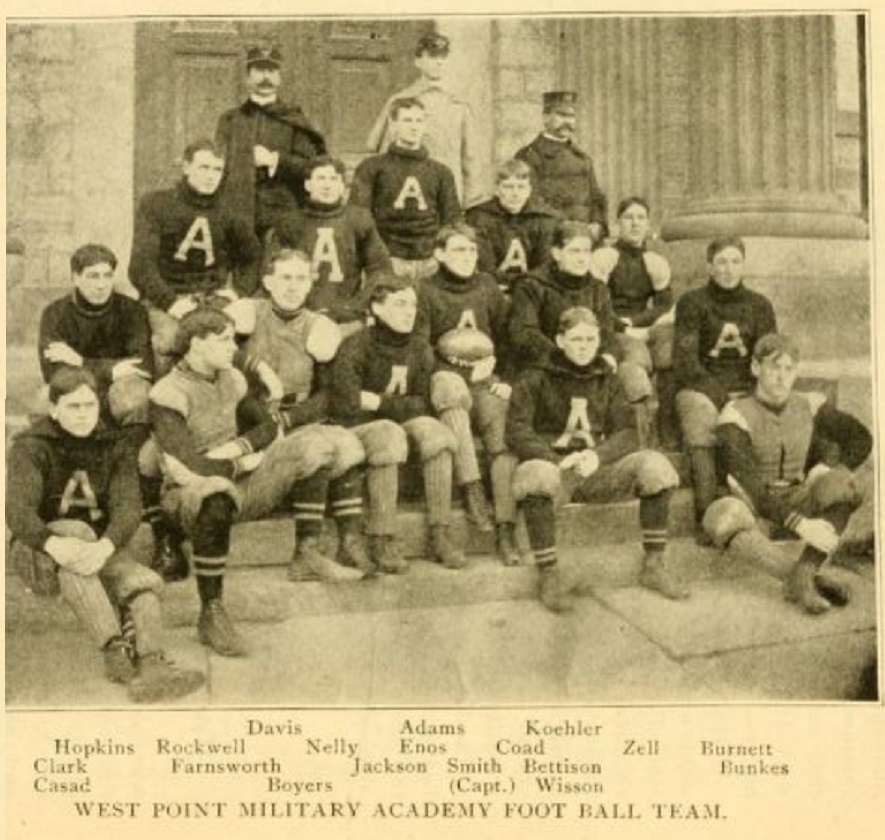
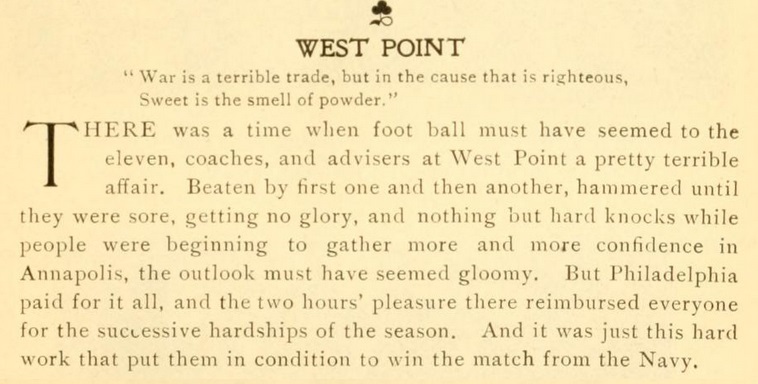
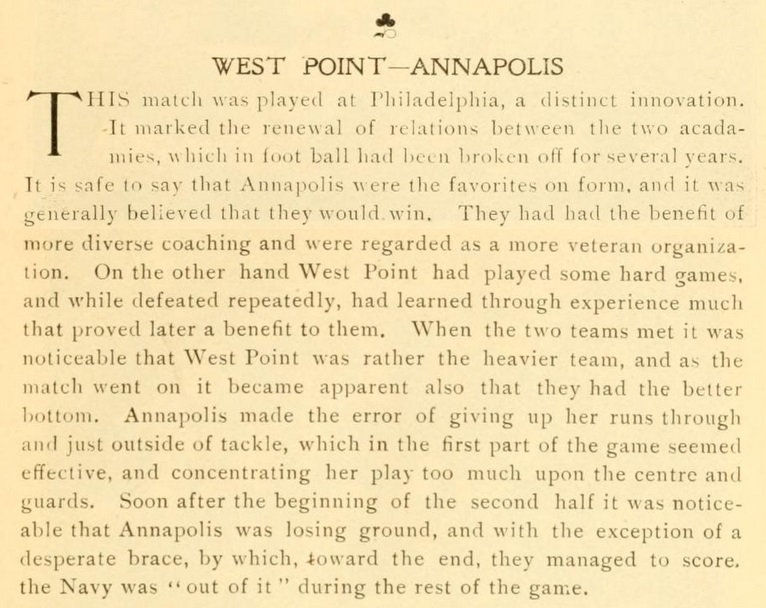
1899 team
–
–
–
Cadets Against Middies
Army and Navy Meet Today My And Navy Meet Today Philadelphia…
– Boston Evening Transcript – Dec 2, 1899
The State, War and Navy departments were almost deserted today as a result of the West Point – Annapolis football game in Philadelphia…
http://news.google.com/newspapers?id=tbg-AAAAIBAJ&sjid=xVkMAAAAIBAJ&dq=football%20philadelphia&pg=5659%2C3775721
CADETS AT FOOTBALL TO-DAY – Rival Teams.- New York Times
West Point Defeats Annapolis
Boston Evening Transcript – Dec 4, 1899
http://news.google.com/newspapers?id=trg-AAAAIBAJ&sjid=xVkMAAAAIBAJ&dq=football%20philadelphia&pg=6448%2C4062363
ARMY WHIPS NAVY.- Boston Daily Globe
Navy’s Battered Team.
Baltimore American – Dec 4, 1899
It could not lose this game and, have any reputation at football. They had been preparing for it for sis … Philadelphia – Naval Academy, 5; West Point, 17
http://news.google.com/newspapers?id=VfVBAAAAIBAJ&sjid=1LgMAAAAIBAJ&dq=football%20philadelphia&pg=5339%2C3659220
–
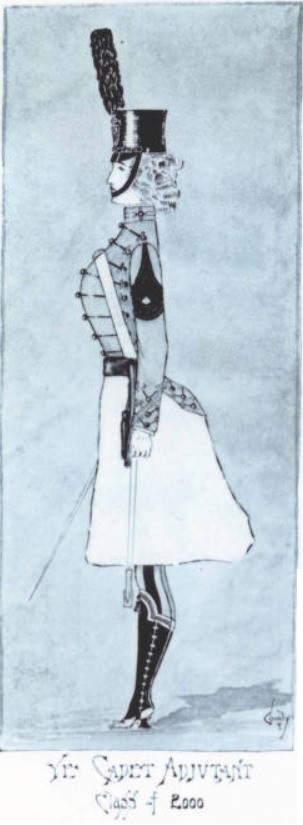
from the 1900 Howitzer
1957 Army 7-2
Coaches#13 AP#18
1957/10/12 Army 21 – Notre Dame 23
1957/11/30 Army 0 – Navy 14 L
SI- December 02, 1957 Army
http://sportsillustrated.cnn.com/vault/edb/reader.html?magID=SI&issueDate=19571202&mode=reader_vault – 


– 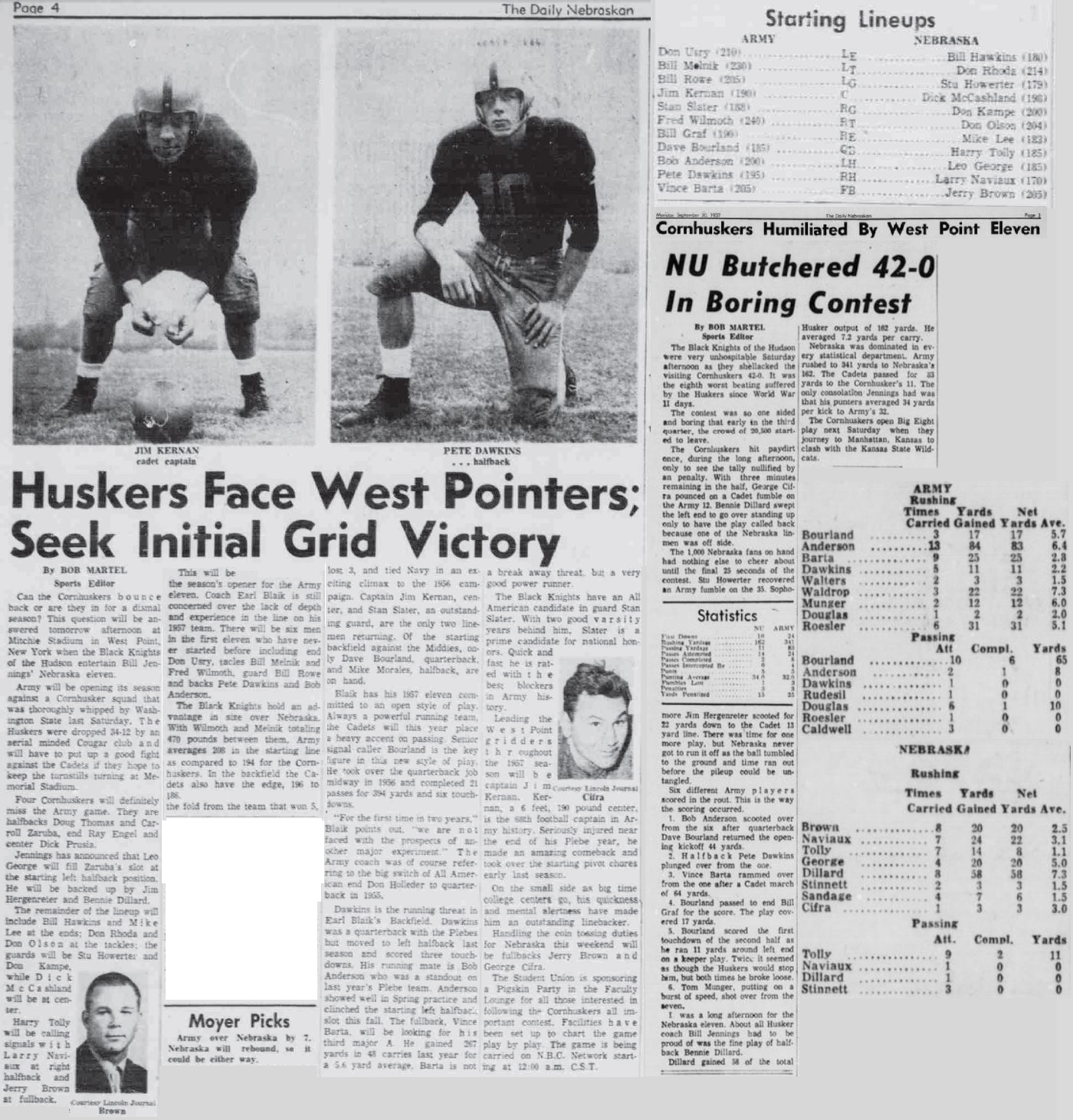
ArmyFB_1957_vsNebraska_MiamiNews_Sep291957
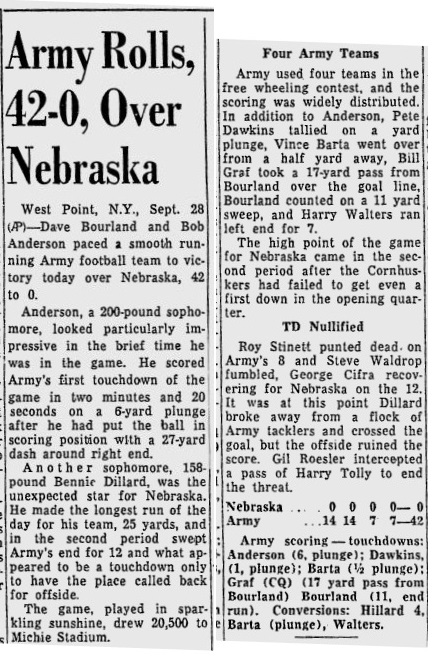
ArmyFB_1957_vsNebraska_ReadingEagle_Sep291957
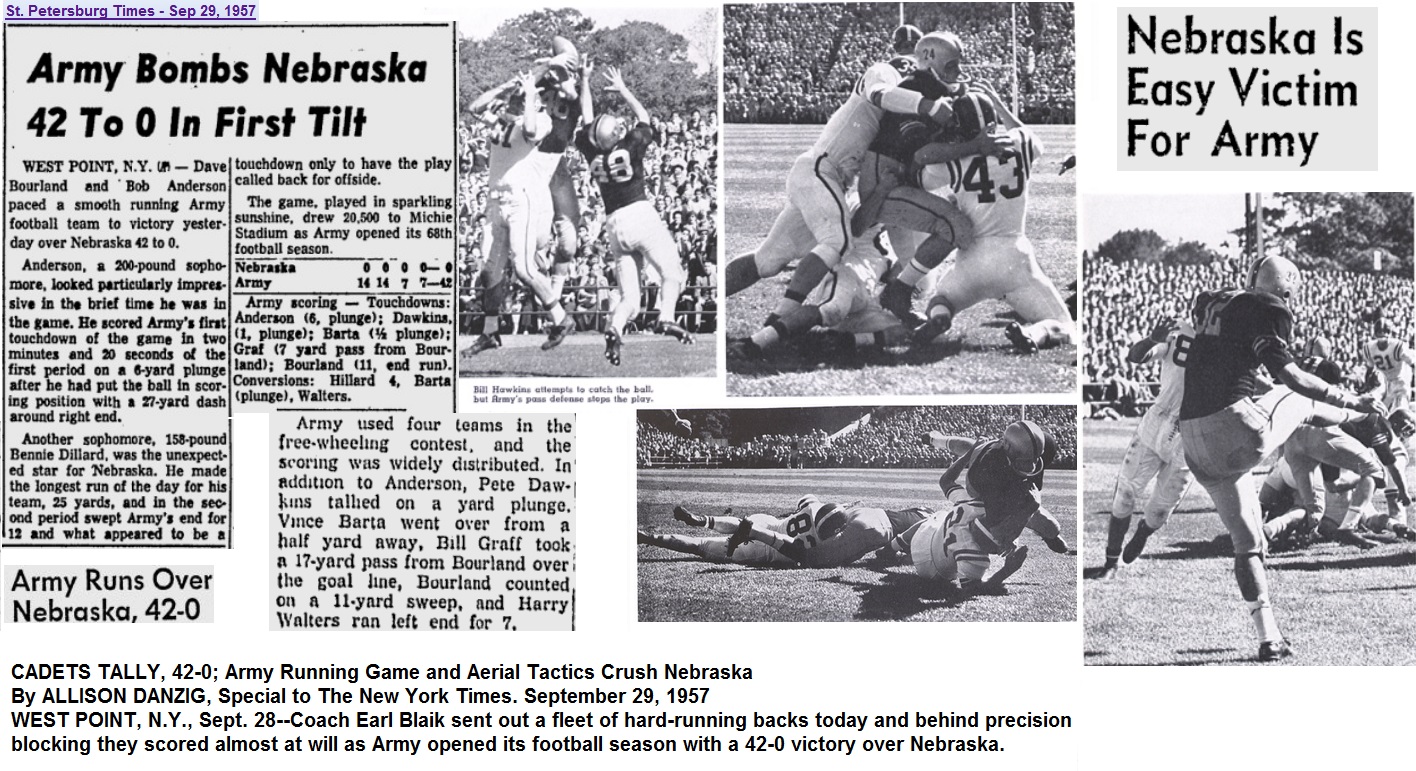
ArmyFB_1957_vsNebraska_StPetersburgTimes_Sep291957
–
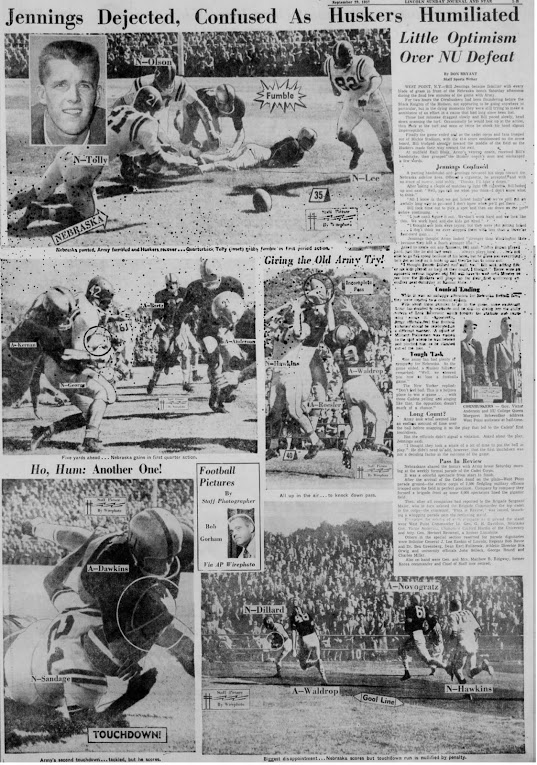
ArmyFB_1957_vsNebraska_LincolnSundayJournalandStar_Sep291957
–
–
October 5 at Penn State No. 8 New Beaver Field University Park, PA – Won 27–13
–
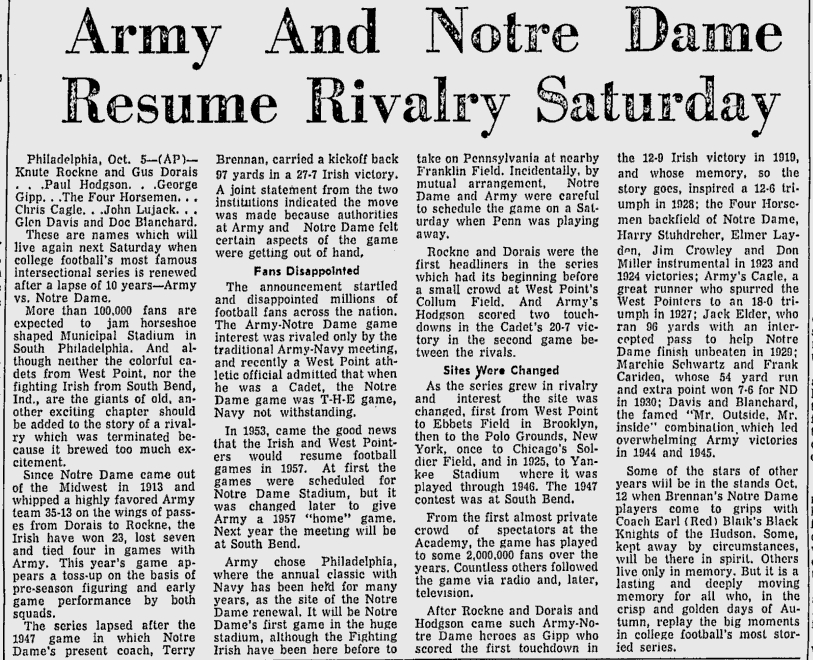
ArmyFB_1957_vsNotreDame_MiamiNews_Oct61957
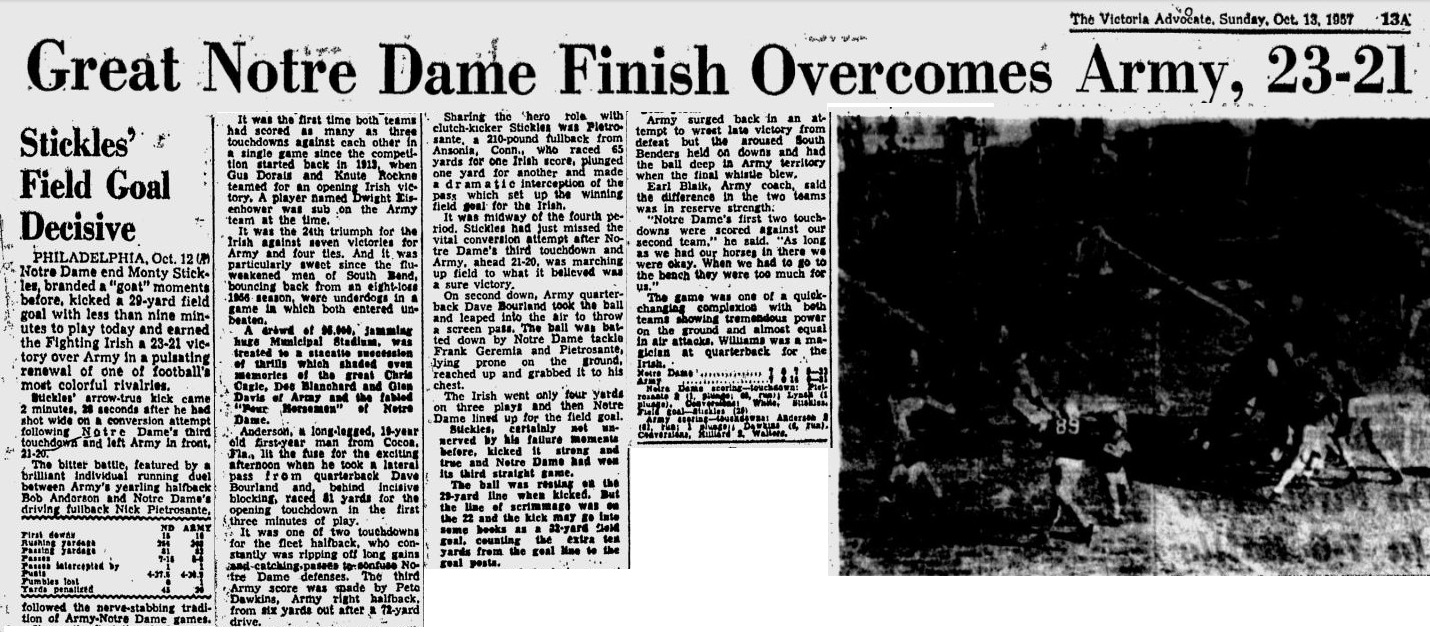 ArmyFB_1957_VictoriaAdvocate_Oct91957
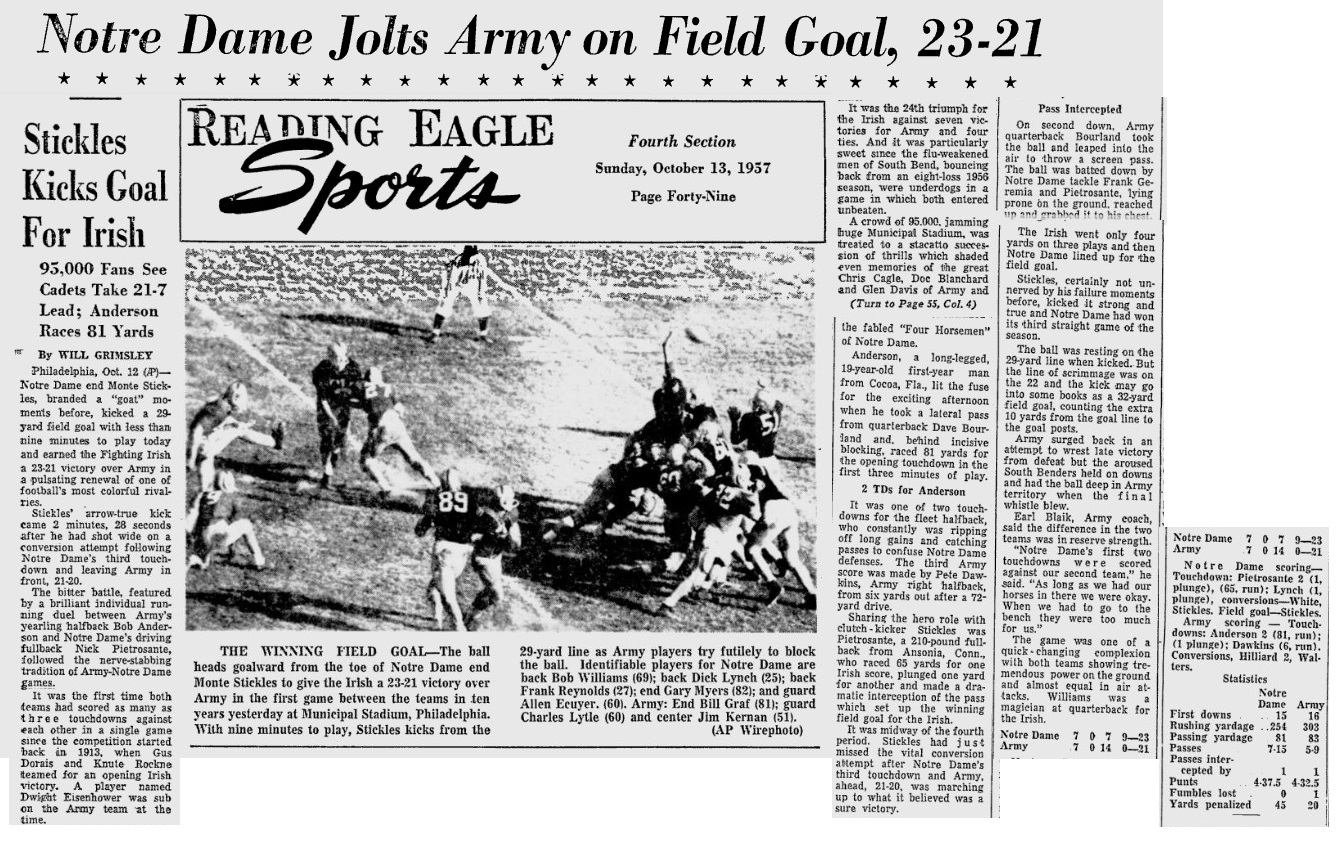
ArmyFB_1957_vsNotreDame_ReadingEagle_Oct131957 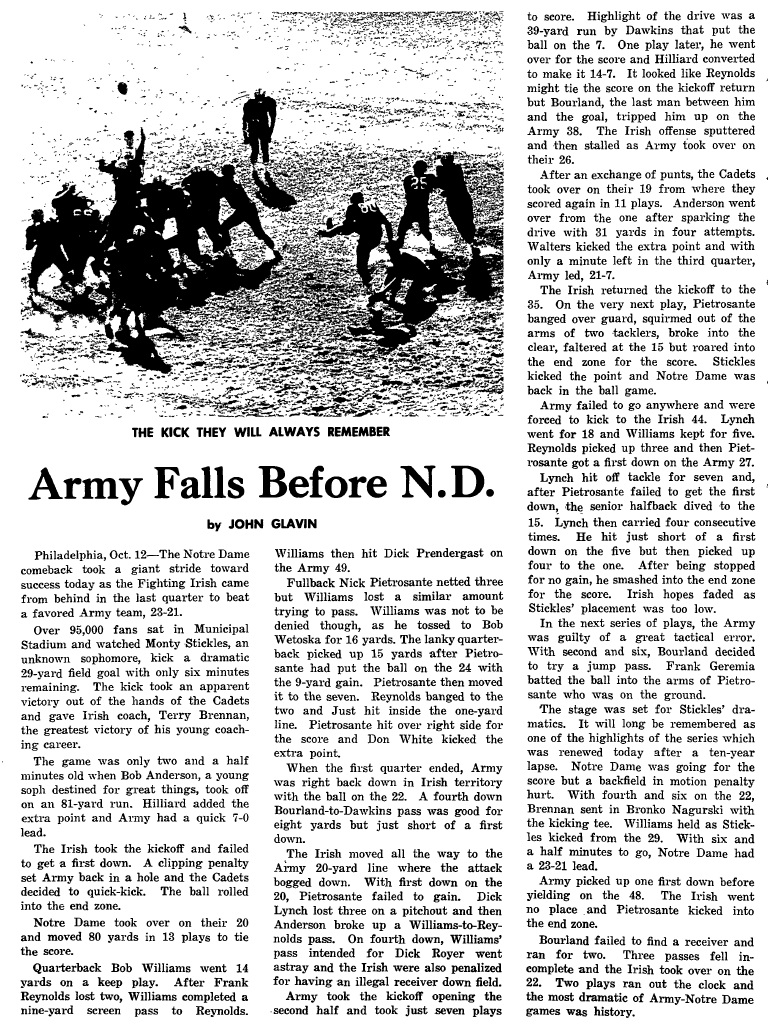 ArmyFB_1957_NotreDameOfficialReview_recap –
 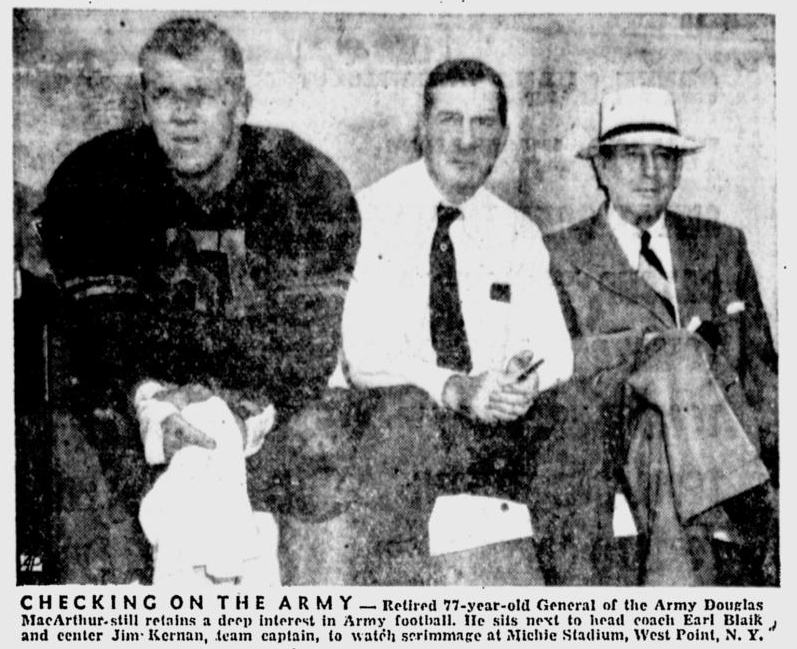 ArmyFB_1957_MacArthur_NewsDispatch_Oct101957
–
–
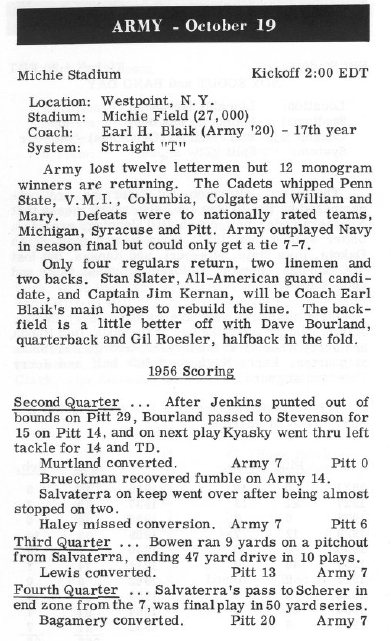
– October 19 at Michie Stadium Won 29 -13
–
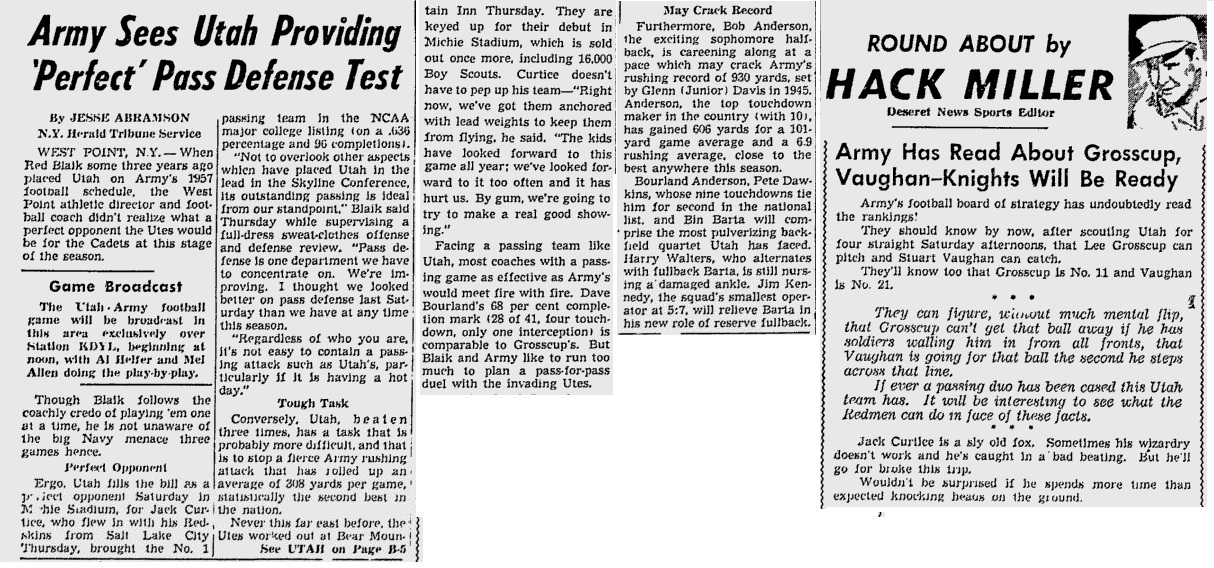
ArmyFB_1957_vsUtah_DeseretNews_Nov81957
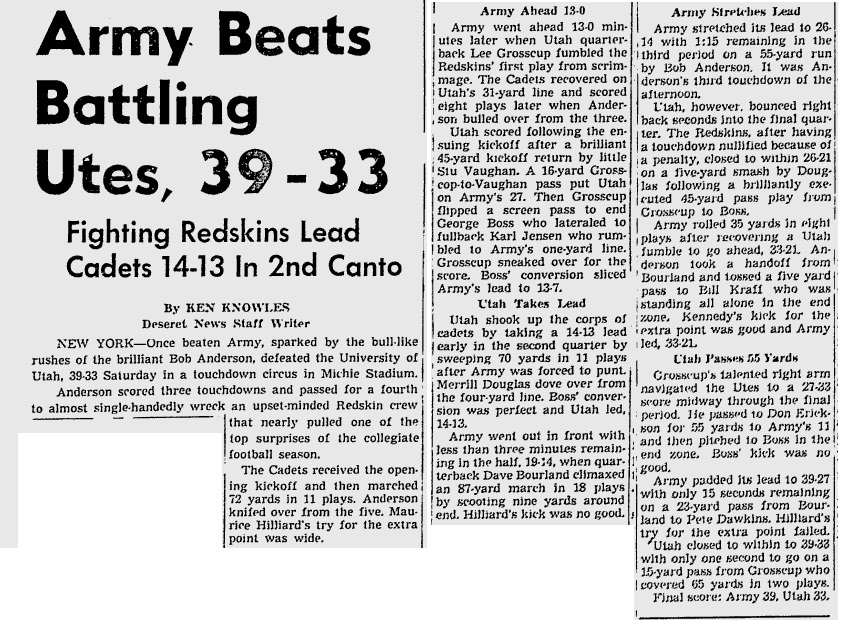 ArmyFB_1957_vsUtah_DeseretNews_Nov91957
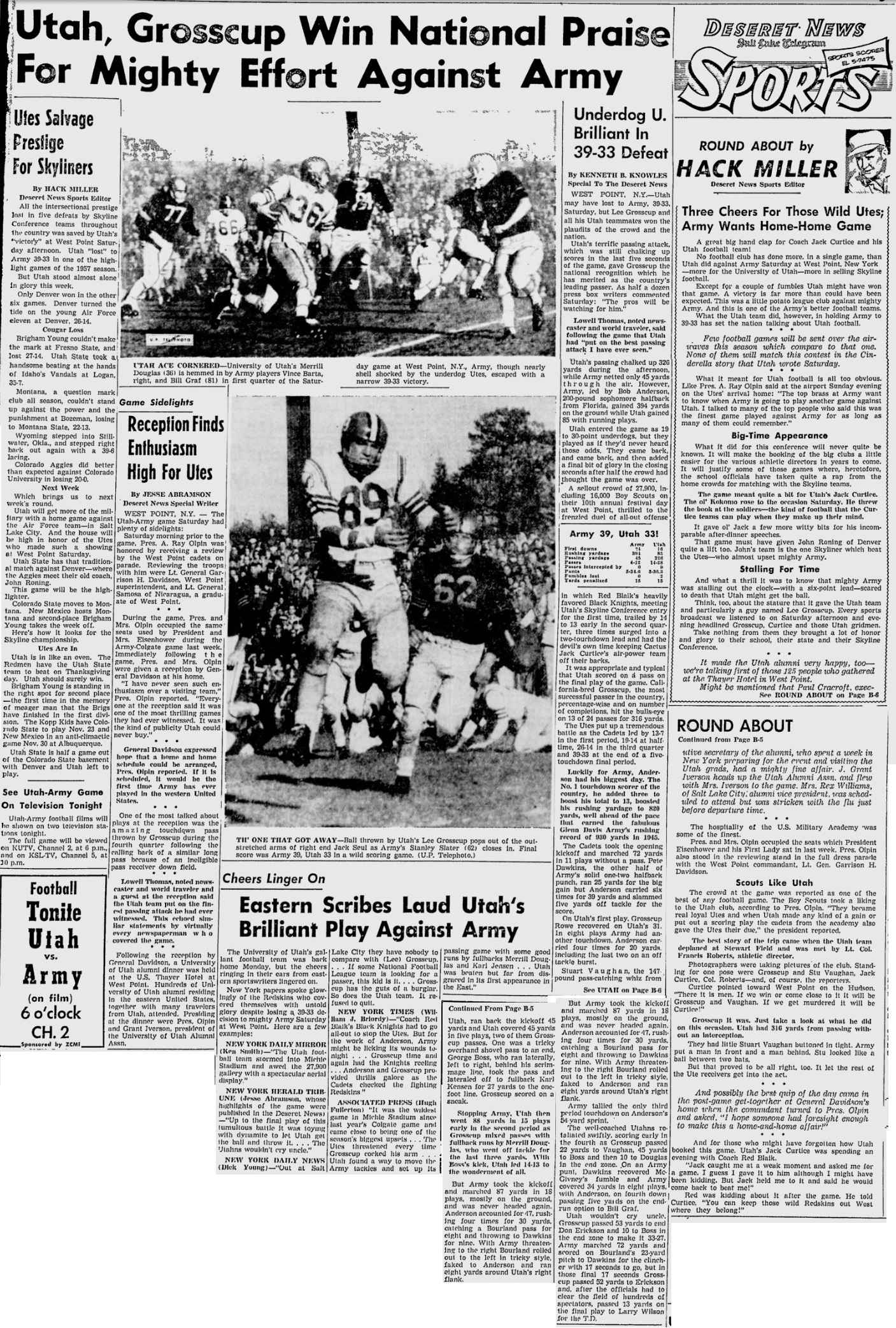
ArmyFB_1957_vsUtah_DeseretNews_Nov111957 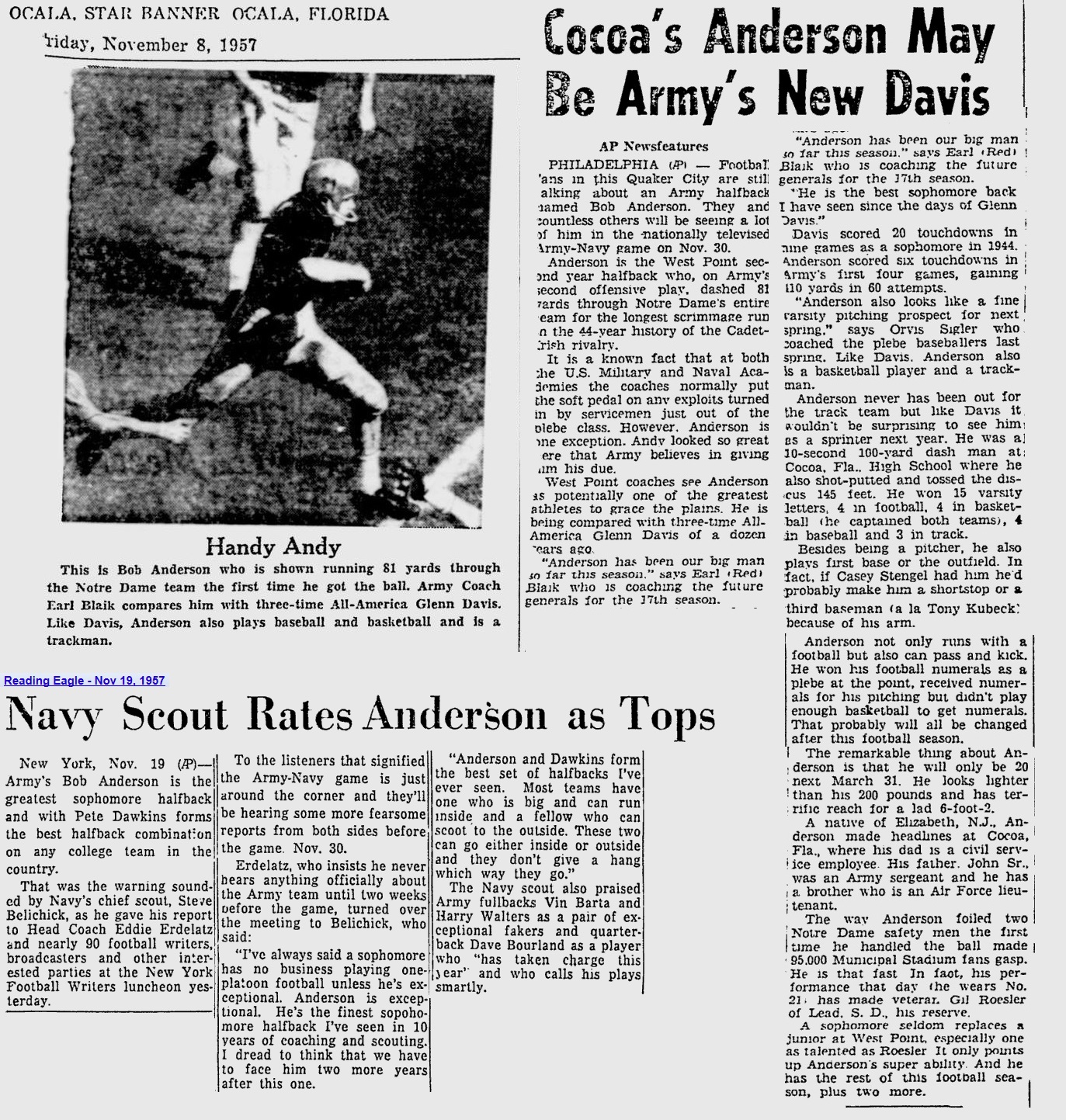 ArmyFB_1957_BobAnderson_ReadingEagle_Nov111957
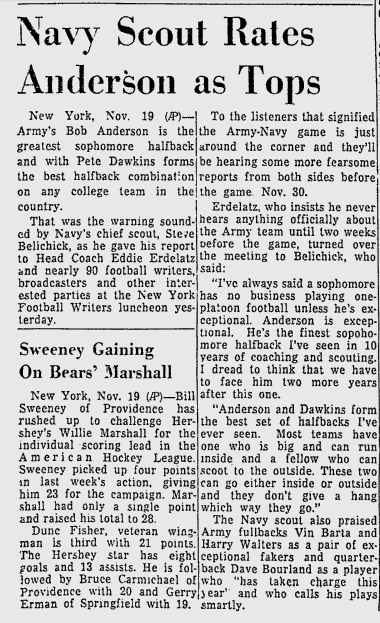
ArmyFB_1957_Anderson-Belichick_MiamiNews_Nov191957 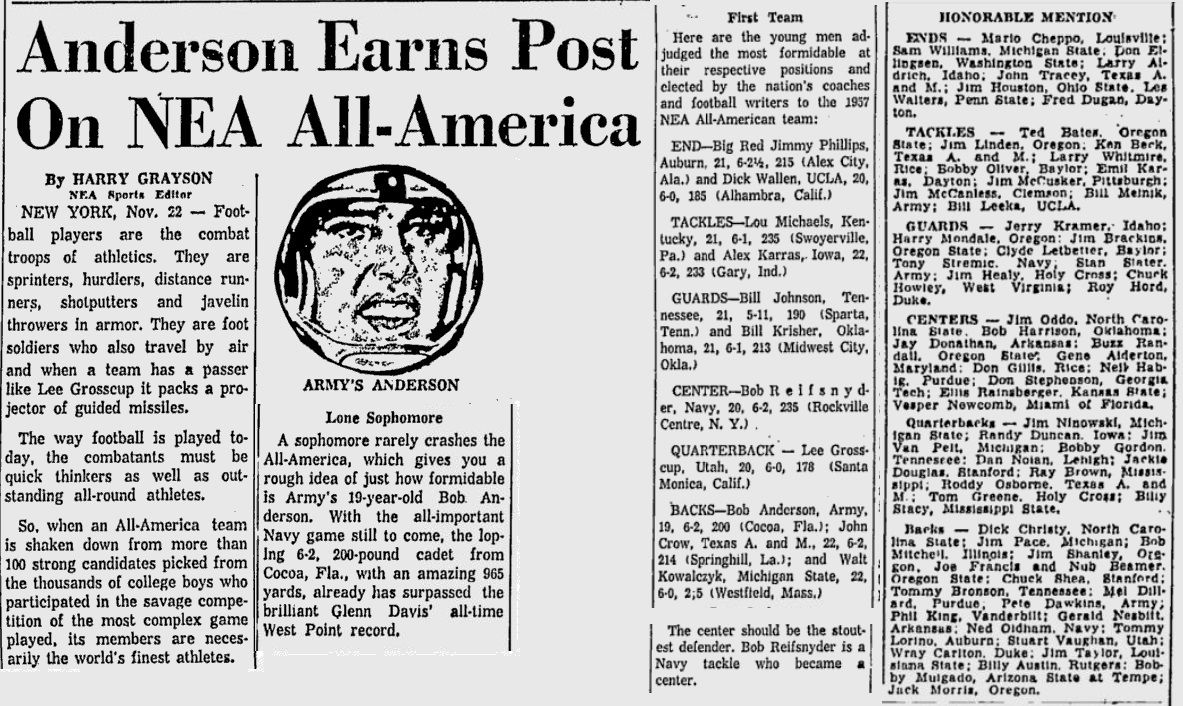 ArmyFB_1957_NEA-All-Americans_MiamiNews_Nov221957 –
 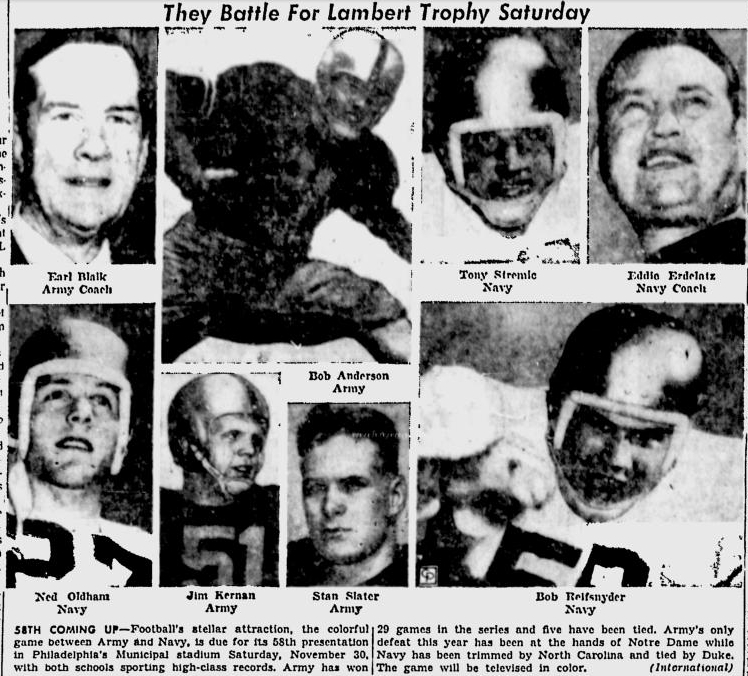 ArmyFB_1957_vsNavy_WashingtonObserver_Nov261957
 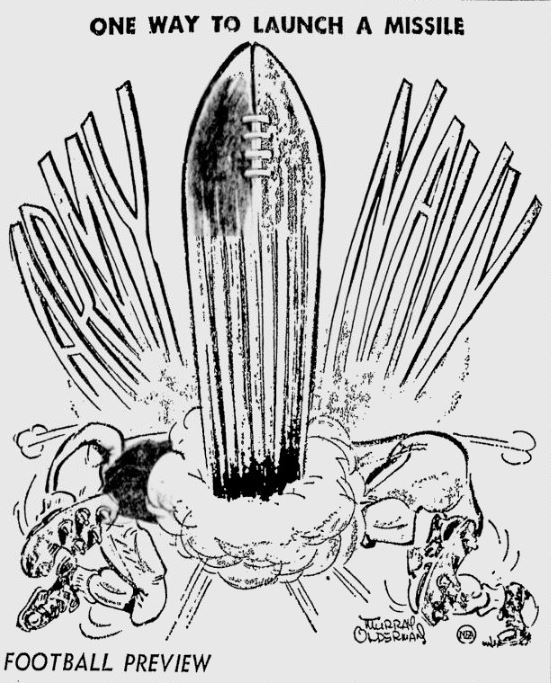 ArmyFB_1957_vsNavy-pre_byMurrayOlderman_TimesDaily-FlorenceAl_Nov271957
–
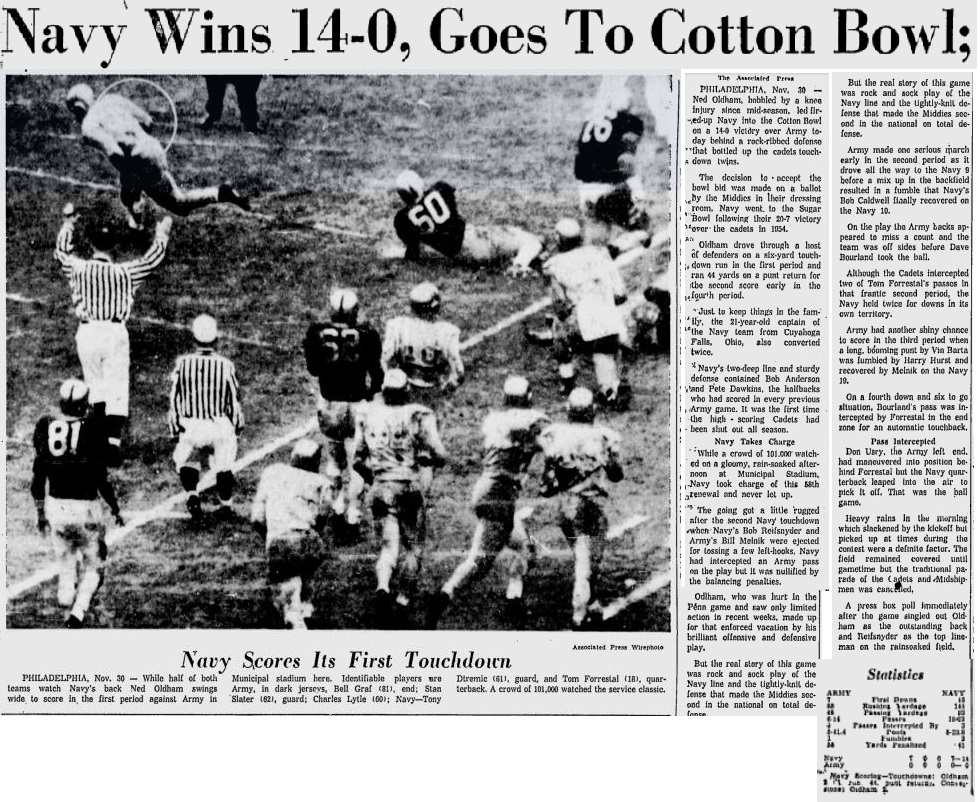
–
–
– 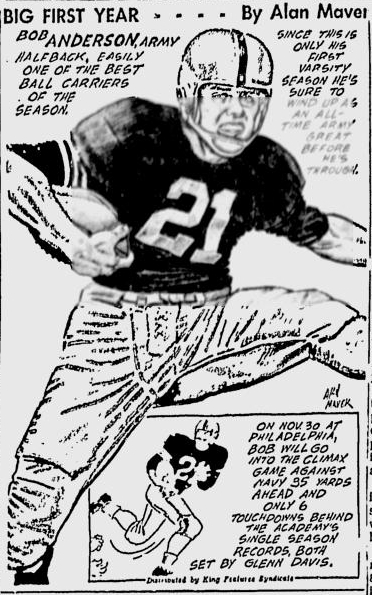
ArmyFB_1957_BobAnderson_byAlanMaver_WashingtonObserver_Nov301957
– 
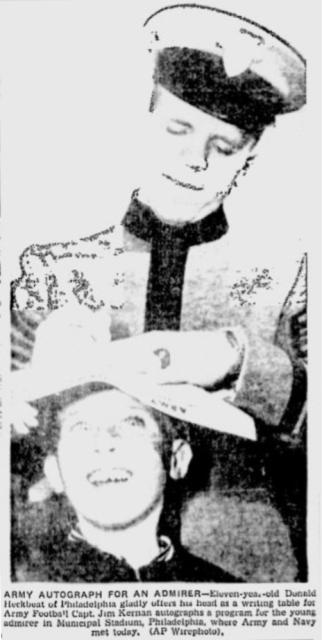
ArmyFB_1957_JimKernan_TimesDaily_Nov301957
–
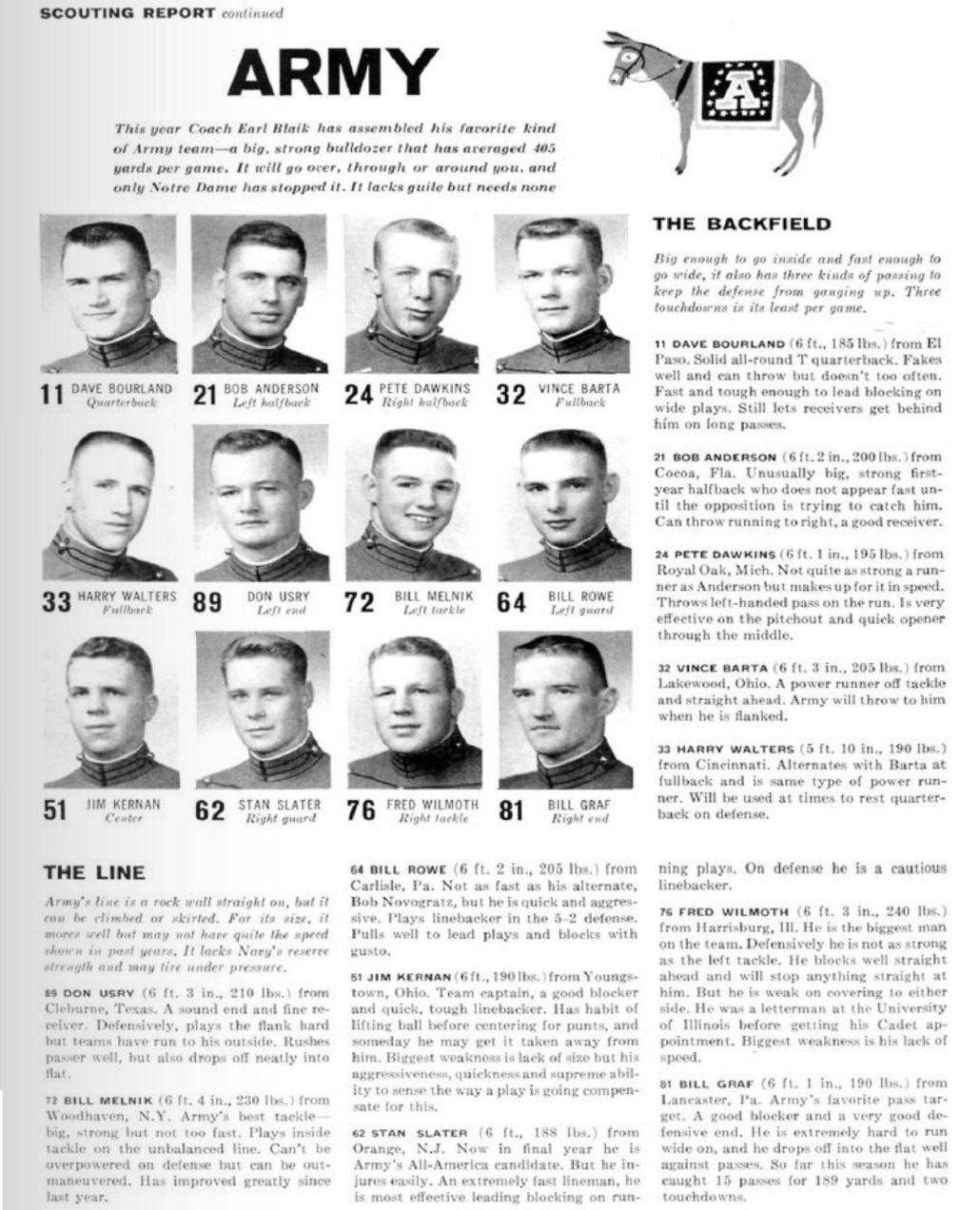
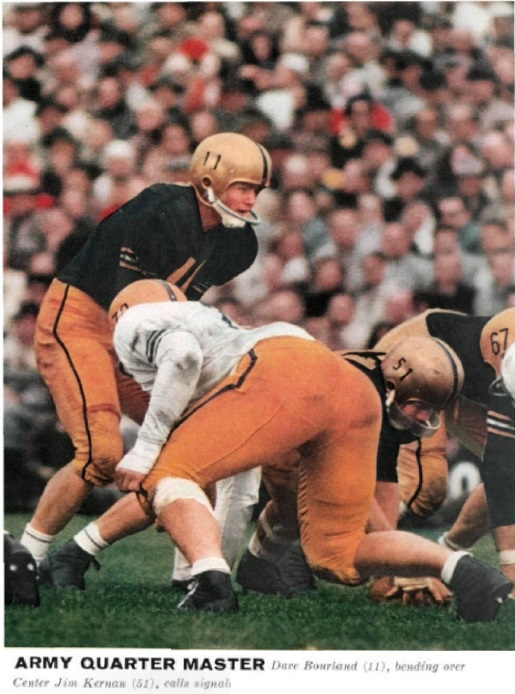
–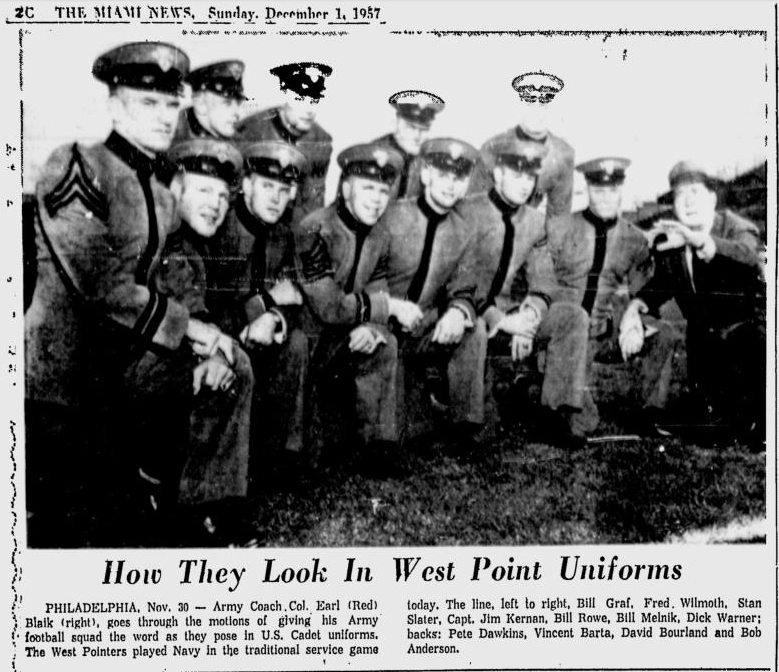 ArmyFB_1957_Army-starters_MiamiNews_Dec11957 – December 02, 1957 Army This year Coach Earl Blaik has assembled his favorite kind of Army team—a big, strong bulldozer that has averaged 405 yards per game. It will go over, through or around you, and only Notre Dame has stopped it. It lacks guile but needs none…. http://sportsillustrated.cnn.com/vault/edb/reader.html?magID=SI&issueDate=19571202&mode=reader_vault –
  –
– 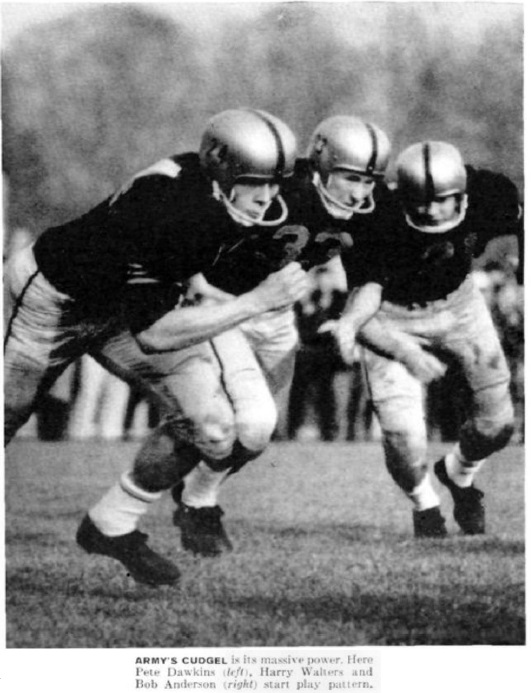 –
–  –
–  – news articles etc., provided by Russ “Skip” Grimm – Class of ’76
By Rabble Jan 16, 2003 Army vs Navy, 1957* – Rabble takes a look back on the 1957 Army-Navy game. (* title corrected from 1953 to 1957) In 1957, the Army football program was again on the rise as the Black Knights swept to an impressive 7-2 record but the two losses came against Armys two biggest rivals, Notre Dame and Navy. The team was 16 points away from going undefeated that season. A 23-21 loss to the Irish in Philadelphias Municipal Stadium and a 14-0 loss to the Mids . . . . . .to close the season in that same stadium prevented the team from going all the way that year in Blaiks next to last season before his retirement the following year when he produced his last undefeated season at West Point. Only a tie with Pitt that year marked a spectacular 8-0-1 log. Jimmy Powers was a respected columnist of the NY Daily News in the 1950s. The following column was written by him after the loss to Navy that season of 1957. His column was appropriately called THE POWERHOUSE by Jimmy Powers-
THE POWERHOUSE By Jimmy Powers Philadelphia, Nov. 30, 1957 -Ned Oldham was the hero, of course. He scored all the points. But there was more to it than that. Navy was faster, more alert and had more deception in its attack. Navy ran its play crisply and there was no question, as the game wore on, that its diversified attack was just too much for the gallant Cadets to cope with. There were a few penalties for elbowing and piling on but flareups quickly subsided as the lads settled down to their assignments. Navy used a variety of screened pass plays most effectively. Navy’s line switching constantly piled up ball carriers with almost ridiculous ease. The highly publicized Bob Anderson appeared sluggish in contrast to the speedy ends and defensive backs who hauled him down. Tom Forrestal kept the opposition off balance and Bob Reifsnyder played such an outstanding game he provoked a near riot in the final quarter when frustrated Cadets went after him with bare fists. It was an exciting contest despite the drab, spongy, gray skies and cutting wind. And it was a delightfully colorful show to watch “live” as well as on TV. TOUCHDOWN PUNCTUATES PERIOD When Navy appeared in pastel jersey and pale gold numerals, half-drowned viewers amused themselves by trying to identify the exact shade of blue. It definitely was not the familiar rich dark navy blue. It was more of a Mediterranean blue bleached to a robin’s egg hue. It brought on quite a few whistles. I had never seen a touchdown scored in the exact second that ended a quarter, but that’s exactly what happened when Navy marched 72 yards in 19 plays. The play was a peculiar one. Ned Oldham lunged off right tackle as the clock registered 15:00. He appeared to be smothered by several dark shirts scrambling to snatch at him. Oldham kept his feet, pivoted like a man going beserk in a revolving door, and next we knew he was dashing upright across the goal, running well into the end zone with a powerful leg drive. The Middies immediately broke out a gaudily painted banner… “We’ll beat Army black and blue in color.” How right they were. Army came blazing back with Dawkins running wild, but just inside the 10 Navy’s Caldwell leaped upon a loose ball and drew it fiercely to his bosom, a timely recovery. A series of consecutive penalties caused a succession of huddles by the men in the candy-striped shirts and brought down upon their unheeding ears innumerable witticisms from the crowd. Forrestal grew a bit reckless as halftime approached. A long pass was intercepted, but Navy’s line held on the 36 and took over. Army just was riot shaking any man loose for the long gainers that had distinguished its play on this same turf against Notre Dame. As the second quarter wore on, the sky grew darker and, off to our right, the buildings of downtown Philadelphia faded from sight. Beneath us, the gray block of Cadets sat huddled morosely in ponchos. They stirred expectantly as, with 20 seconds on the clock, Army’s golden helmets conferred in a huddle resembling satellites. They whirled back to positions. A long pass was com- pleted. Then came the letdown . . . “Illegal receiver downfield.” EVEN MULES FOUND GOING TOUGH As the soggy athletes trotted off, Navy’s cheering section unfurled another alliterative command . . . “Mash the Mule.” One poor mule started across the green swamp. Following the urgings of its rider, it walked slowly downfield to join its assistant, another equally damp mascot. There was a rather elaborate balf time parade of floats, faintly reminiscent of the early Pasadena or California collegiate school, then the third quarter opened. Army intercepted. a deflected pass, but again its attack fizzled. There was a rhubarb on the 4 when Anderson fumbled and had the ball stolen from him, apparently a fraction of a second after the whistle. The ball was as tenderly cared for as a baby, nursed and covered with a turkish towel. Actually, more than a dozen balls were used, coming out of an assembly line dryer. Once, the wet ball squirted out of Harry Hurst’s hands, but the Navy got it back on an interception, thereby surgically removing goat’s horns from Mister Hurst’s noodle. Then came the cruncher. Ned Oldham took Barta’s punt and made one of the prettiest broken field runbacks in the history of the series. He skidded to his right, reversed, used some tricky toe dancing and change of pace. After 44 thrilling yards, he crossed standing up, kicked the point and thus accounted for all of Navy’s 14. Oldham figured in another interception. Army made a great goal-line stand, but when the lights came on and the rain shrank away to a few drops, you could see the silhouettes of Navy’s third team mirrored in the great lake of water that surrounded the gridiron. When they were whistled in, in clean dry uniforms, to share in the final glory, you knew it was all over.
–
–
1939 Army 3-4-2
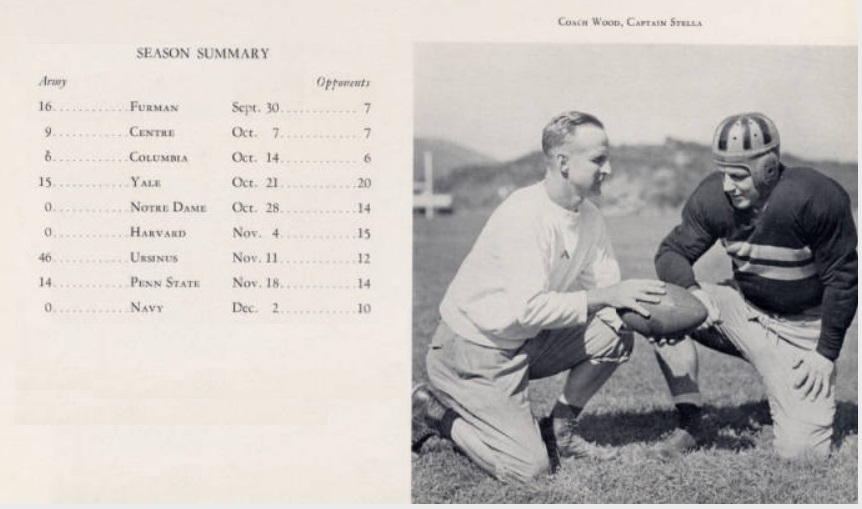
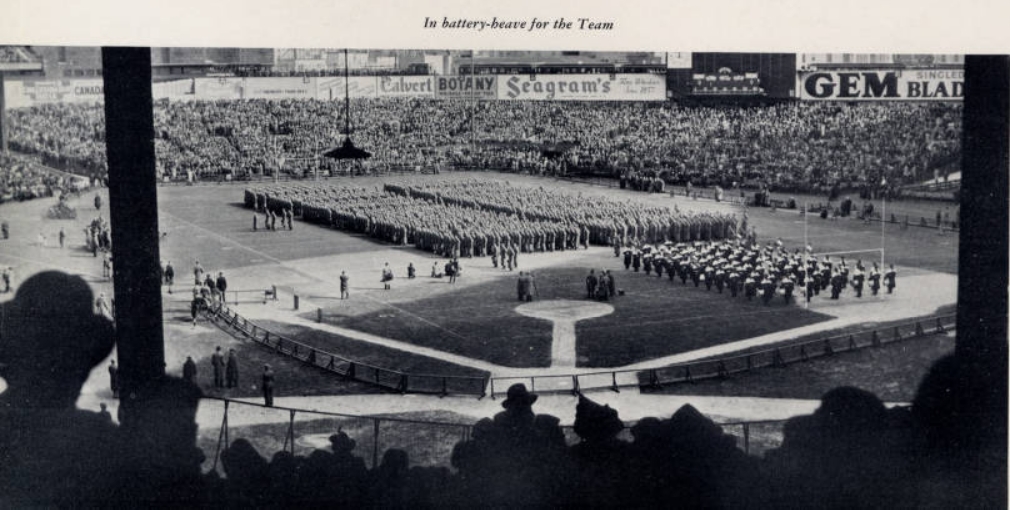
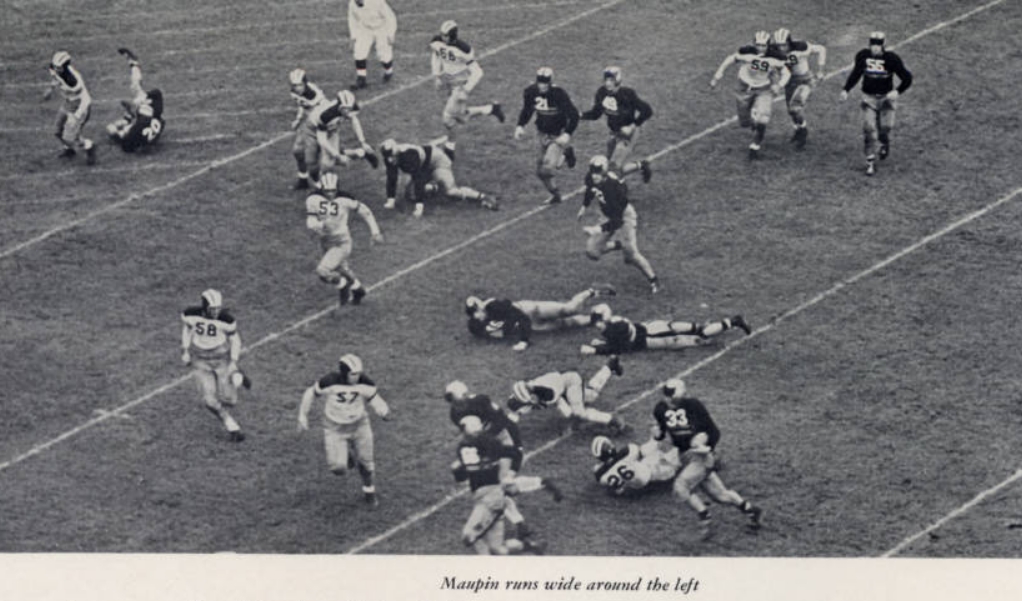
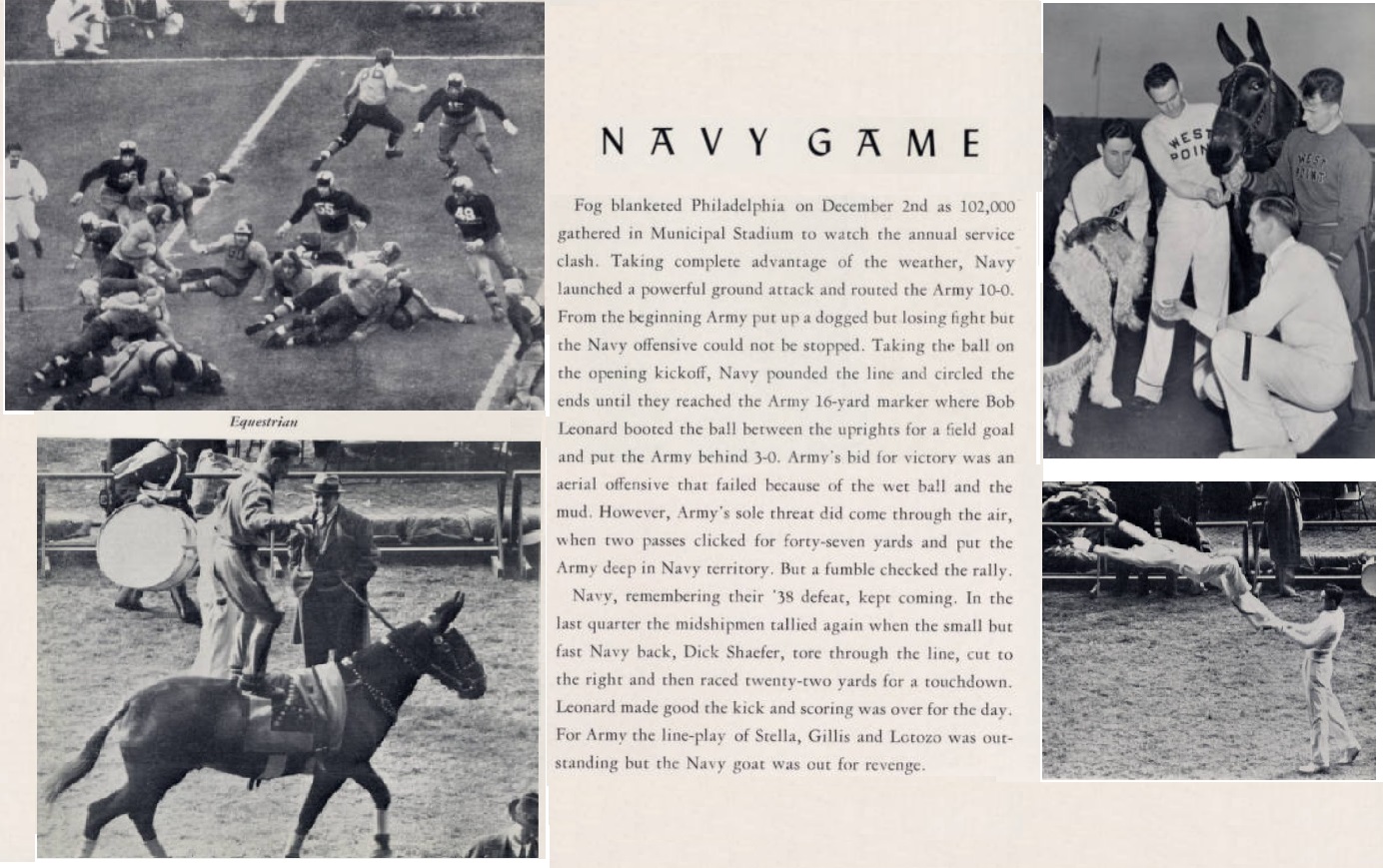
1939/12/02 Army 0 – Navy 10 L
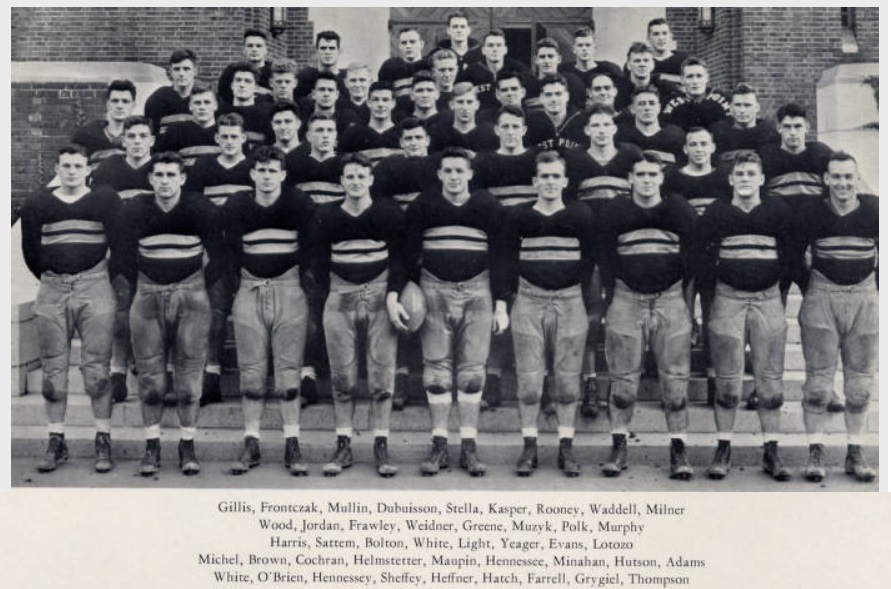
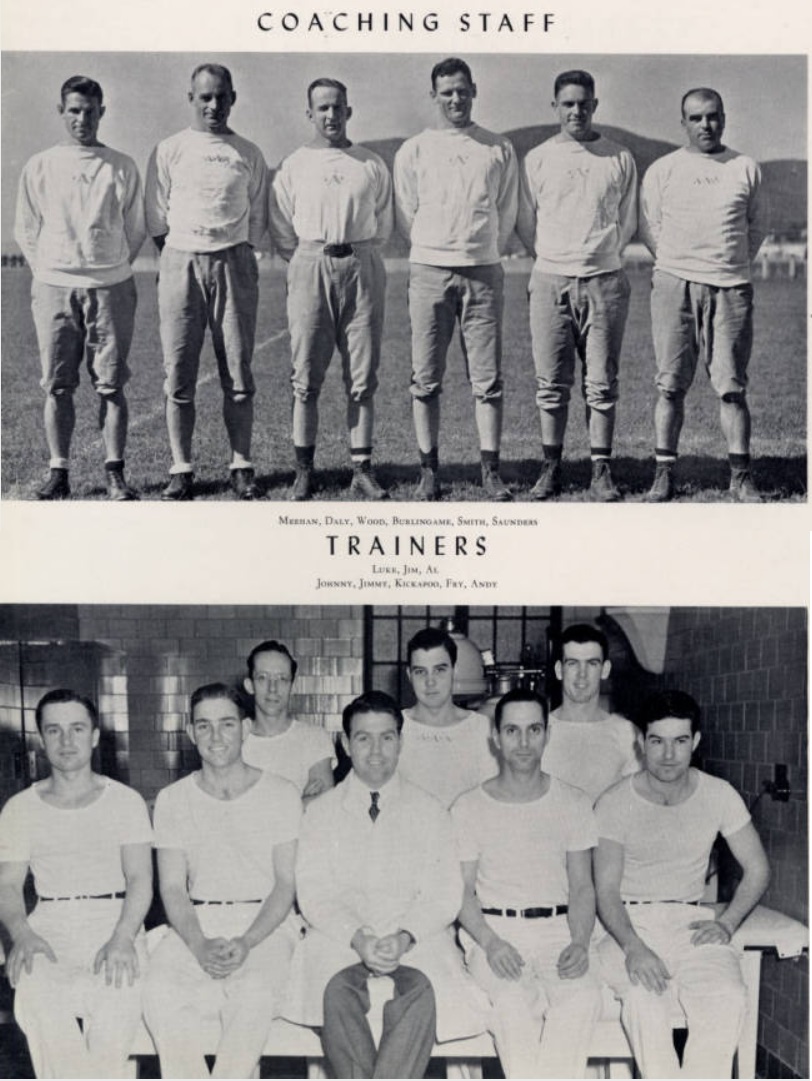
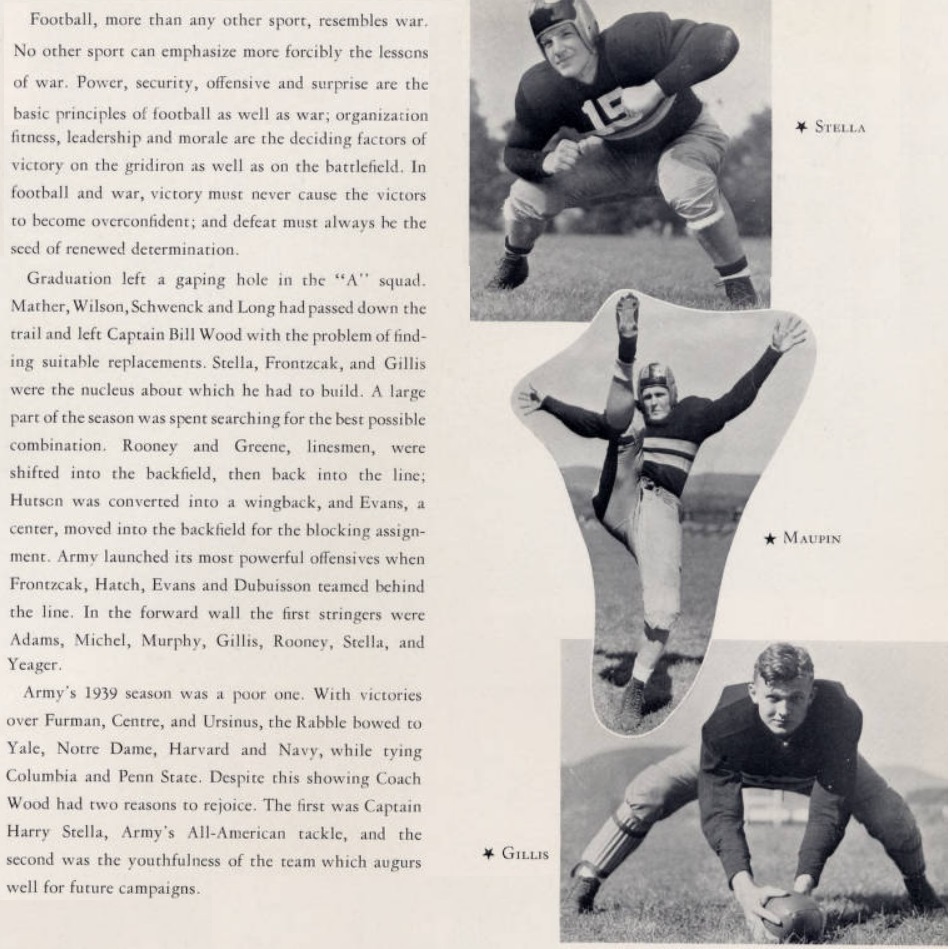
Coach: William H. “Bill” Wood (c. 1900 – June 7, 1988)
1938-1940
1938 Army 8-2
1939 Army 3-4-2
1940 Army 1-7-1
Overall: 12-13
http://en.wikipedia.org/wiki/William_H._Wood
Howitzer 1940
http://digital-library.usma.edu/cdm/compoundobject/collection/howitzers/id/2357/
–
–
–
–
–
–
–
–
–
–
–
–
–
–
News Articles
–
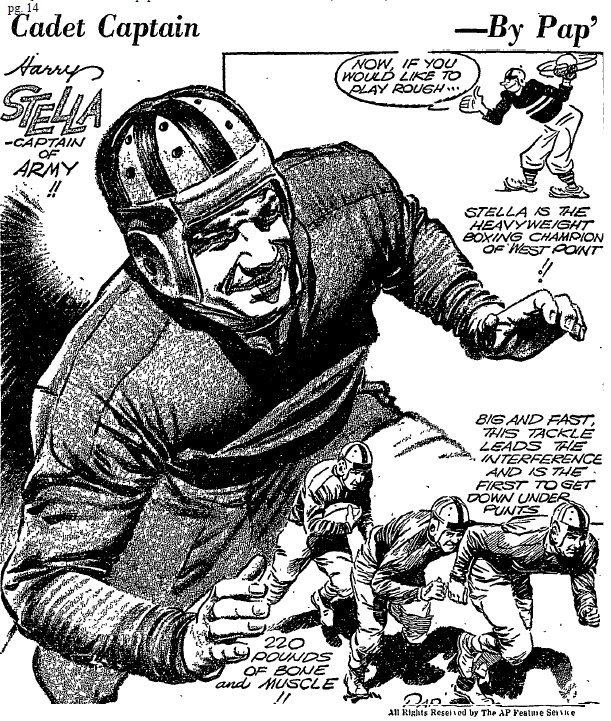
ArmyFB_1939_HarryStella_byPap_CSM_Oct181939
–
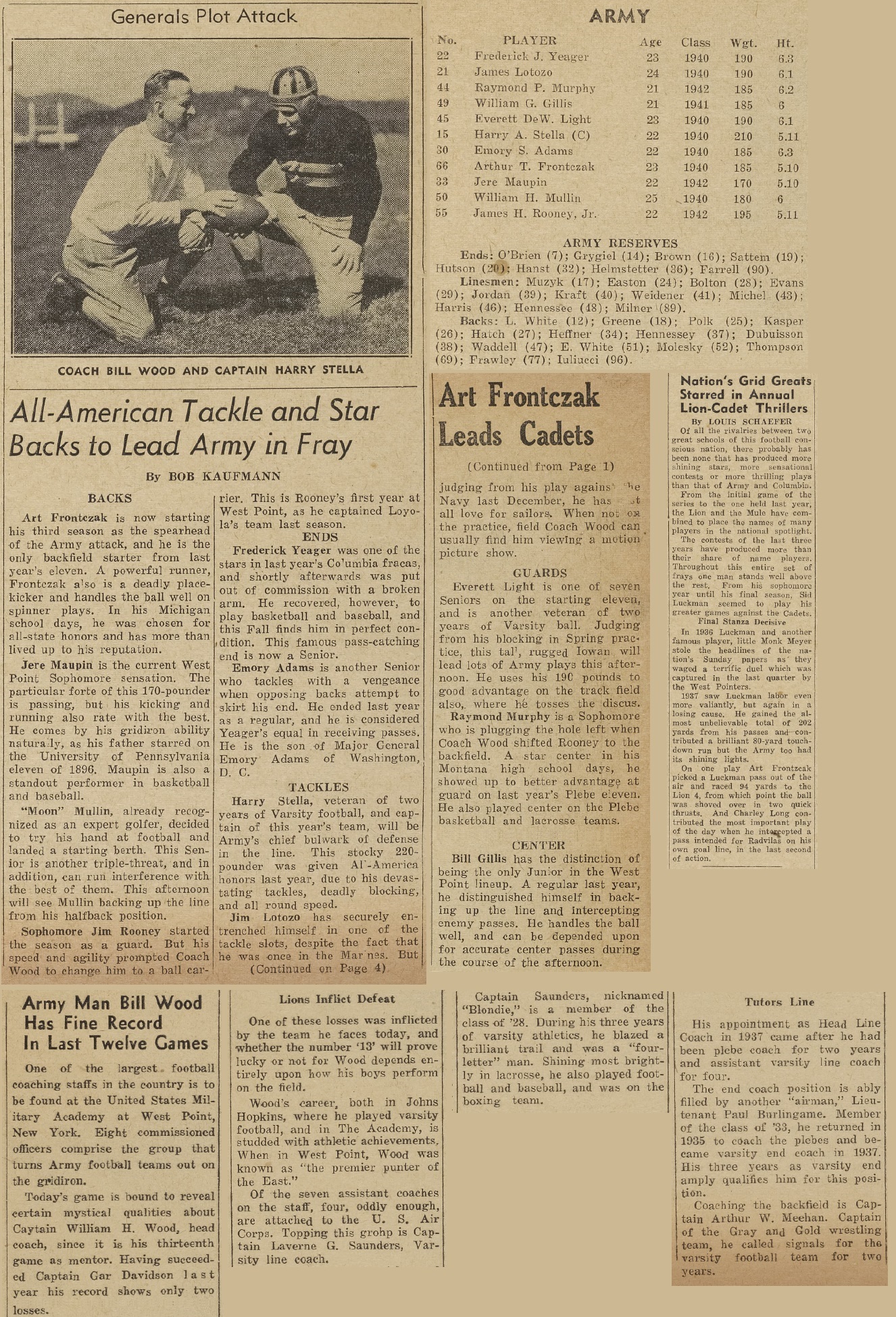
ArmyFB_1939_vsColumbia_ColumbiaSpectator_Oct141939
–
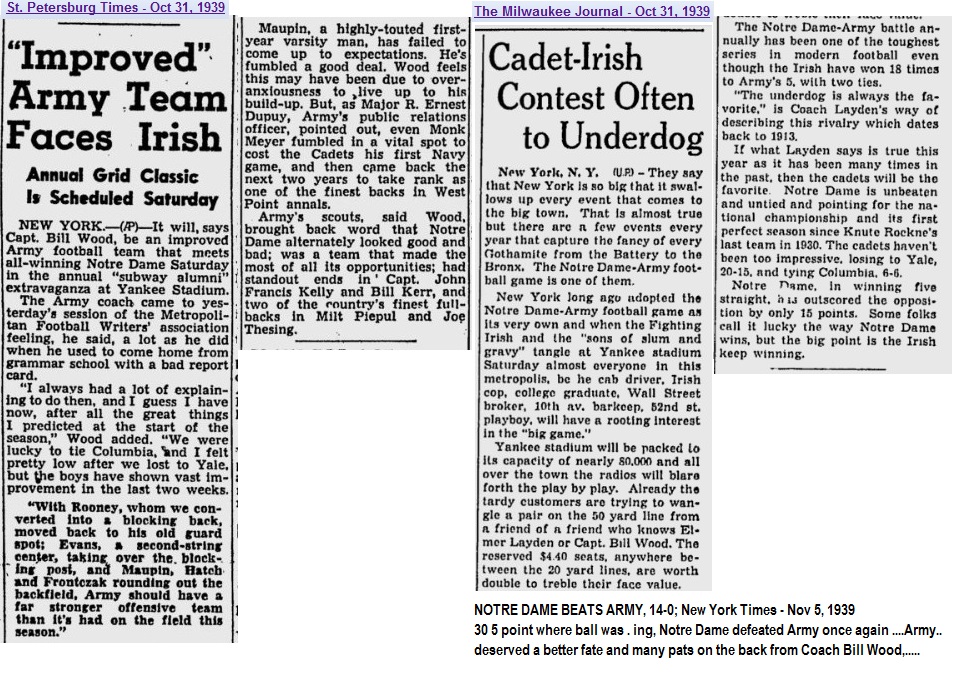
ArmyFB_1939_vsNotreDame_StPetersburgTimes_Oct311939
–
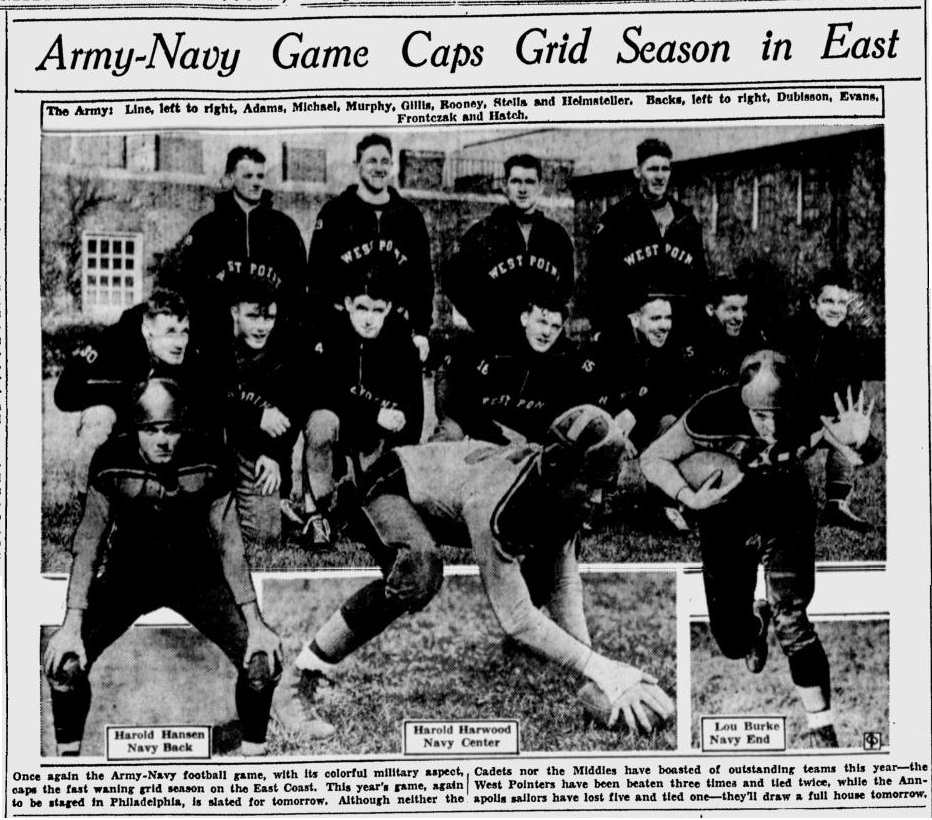
ArmyFB_1939_vsNavy_BerkeleyDailyGazette_Nov301939
–
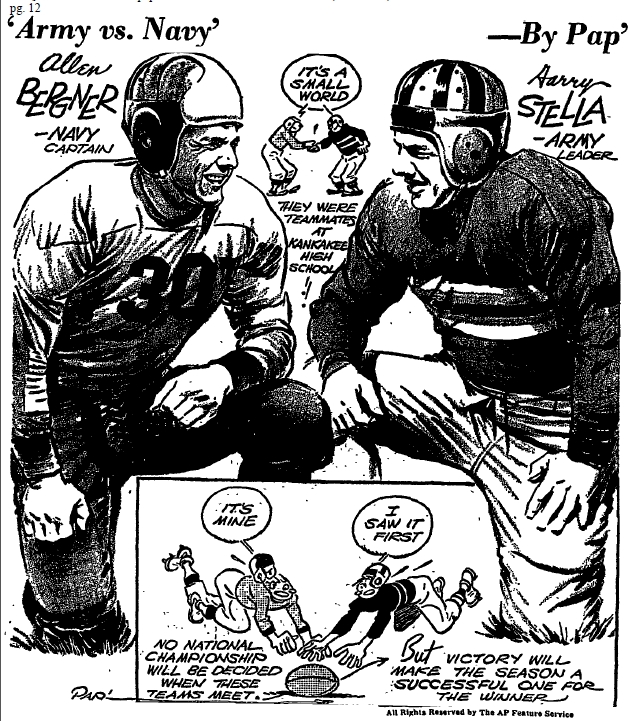
ArmyFB_1939_HarryStella-AllenBergner-Navy_byPap_CSM_Dec21939
–

ArmyFB_1939_vsNavy_PrescottEveningCourier_Dec21939-1
–
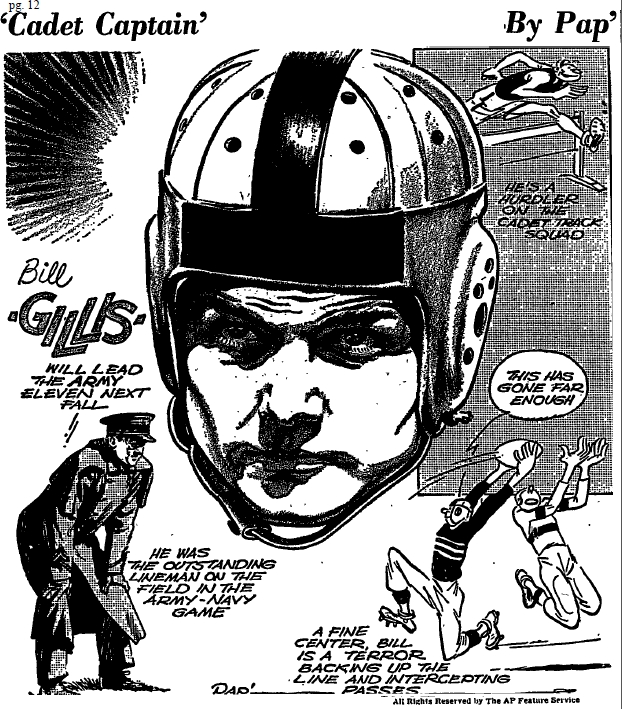
ArmyFB__1939_HarryStella-AllenBergner-Navy_byPap_CSM_Dec21939
–
1965 Army 4-5-1
1965/11/27 Army 7 – Navy 7 T
Coach Paul Dietzel 1962-1965
LSU 46-24-3 National Champs 1958
Army 21-18-1
South Carolina 42-53-1
Total: 109-95-5
Army:
1962 Army 6-4
1963 Army 7-3
1964 Army 4-6
1965 Army 4-5-1
Army Totals: 21-18-1
http://en.wikipedia.org/wiki/Paul_Dietzel
–
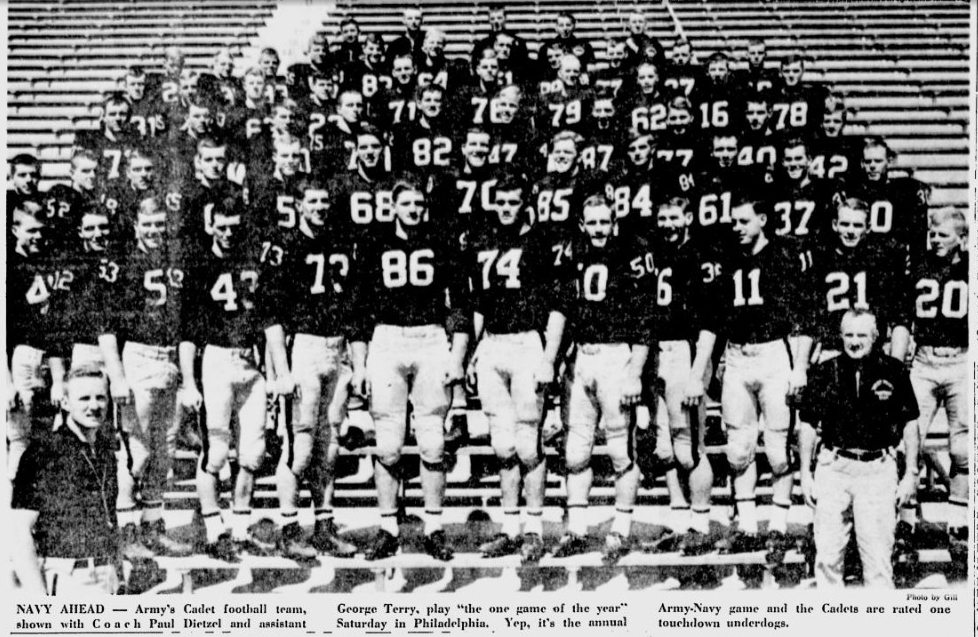
–

ArmyFB_1965_vsVMI_NewsandCourier_Sep261965
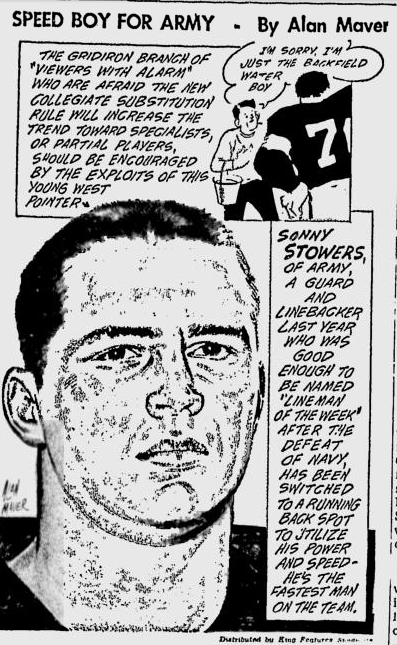
ArmyFB_1965_SonnyStowers_byAlanMaver_NewsDispatch_Sep301965
–

ArmyFB_1965_vsBC-pre_TheHeights_Oct11965

ArmyFB_1965_vsBC__Oct31965

ArmyFB_1965_vsBC_TheHeights_Oct81965

ArmyFB_1965_vsRutgers_MiamiNews_Oct171965

ArmyFB_1965_vsAirForce_SarasotaHeraldTribune_Nov71965-2

ArmyFB_1965_vsWyoming_EveningNews_Nov151965


ArmyFB_1965_vsNavy_StPetersburg_Nov261965

ArmyFB_1965_Dietzel-Stowers_Cook_ToledoBlade_Nov291965-1

ArmyFB_1965_vsNavy_WashingtonObserver_Nov271965

ArmyFB_1965_SonnyStowers_NewsandCourier_Nov291965

ArmyFB_1965_vsNavy_TheMiamiNews_Nov281965
9 Army A’s — Football, Baseball and Hockey — earning one in every season of the 3 years he was eligible to play. Ralph was an All American Guard in 1954. He was also the Captain of the 1955 – 1956 Hockey Team.
He played in the 1955 North – South Game.
At Graduation he received the AAA (The Triple A) Award for rendering the most valuable service to athletics during his Cadet Years.

Chesnauskas, a 1956 graduate, won the prestigious AAA Award following a stellar career that included nine letters, three each in football, hockey and baseball.
On the gridiron, Chesnauskas was a guard who earned first-team All-American honors in 1954, was selected to participate in the 1955 North-South Shrine Game and was a part of 18 victories.
Chesnauskas, who served as hockey team captain as a senior, netted seven points off of four goals and three assists and was part of 29 wins as a standout defenseman for Hall of Fame coach Jack Riley.

<img src=”http://forwhattheygaveonsaturdayafternoon.com/photos/ralph-colblaik.jpg”


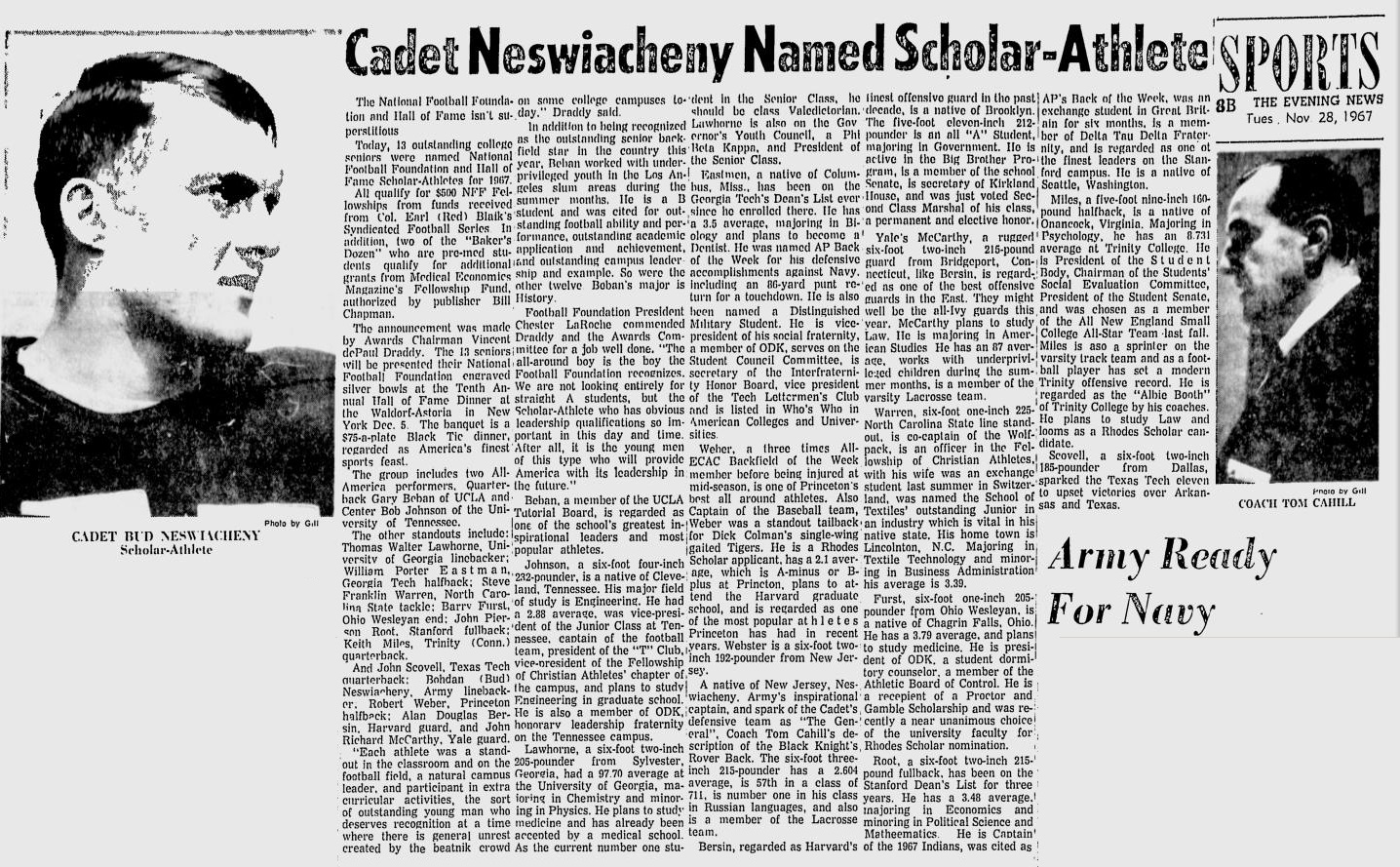
January 18, 1981 North Shore News Paper page 25 (Note there is an error – Pete Dawkins did not earn 9 Army A’s)


–
–
By JOHN GARNER, Jr.
CONTRIBUTING WRITER
September 11, 2009
When former three-sport standout Ralph Chesnauskas proudly walks to the podium tonight for his induction into the U.S. Military Academy Sports Hall of Fame, it will open a vault full of cherished memories.
Chesnauskas, a 1956 West Point graduate, enjoyed a star-studded collegiate experience that included nine letters — three each in football, hockey and baseball. He will put an exclamation point on a playing career that occurred over 50 years ago.
“I was honored to get the call from Army AD Kevin Anderson that I’ve been selected to the Army Hall of Fame,” said Chesnauskas, a full-time resident of Cummaquid. “During my time at West Point, there were many lessons to be learned that came in useful later on in life.”
In the fall, Chesnauskas was a two-way player at guard and defensive tackle, earned first-team All-American honors in 1954, was selected to the 1955 North-South Shrine Game and was an integral part of 18 victories and three national Top 20 rankings.
The rugged 6-0, 207-pound Brockton native played for legendary Col. Earl “Red” Blaik, head coach at Army from 1941-58, who posted a 121-32-10 record and won national championships in 1944-45, led by Heisman Trophy winners Glenn Davis and Doc Blanchard.
Blanchard, nicknamed “Mr. Inside” during his playing days, was one of Army’s assistant coaches in the early and mid-1950’s, along with future LSU coach Paul Dietzel, 1947 Outland Trophy winner Joe Steffy and Vince Lombardi, who captured five NFL titles and the Super Bowls I and II as head coach of the Green Bay Packers.
“Coach Blaik was a great strategist, but was aloof and very low key — he almost never hollered at his players,” Chesnauskas said. “But Coach Lombardi was just the opposite — he was always yelling and screaming and was a gregarious person.”
Army recovered from an honor code scandal in 1951 that saw many frontline players dismissed from the squad and the Academy. But after records of 2-7 and 4-4-1, the Cadets posted winning seasons of 7-1-1, 7-2 and 6-3 against the likes of Michigan, Syracuse, Penn State, Tulane, Yale, Dartmouth, Navy and previously undefeated Duke during Chesnauskas’ tenure.
After playing on the interior his first three seasons, Chesnauskas moved to tackle and end in 1955 after talented southpaw Don Holleder switched from end to quarterback. Holleder was later killed in 1967 during the Vietnam War.
A classmate of General Norman Schwarzkopf, Chesnauskas served as hockey team captain as a senior, scored four goals and three assists and was part of 29 wins as a standout defenseman for Hall of Fame and 1960 Olympic Gold Medal coach Jack Riley, who lives in Marstons Mills.
“When he arrived at West Point, he couldn’t even skate,” said the charismatic Riley, who will be on hand to see his former player inducted. “By his senior year he became captain and a pretty good defenseman who would hit anything that moved on the ice.”
During his three-year baseball career as an outfielder, the Cadets won 30 games, including a victory against Navy.
After a rough start academically, Ralph became a Dean’s List student and Academic All-American his senior year and became friends with Army halfback Pete Dawkins, who would capture the 1958 Heisman Trophy,
Upon graduation from West Point, Chesnauskas went to tank training at Fort Knox and jump school at Fort Benning, before being stationed in West Germany until his honorable discharge from the Army in 1959.
He worked at Gillette for 38 years, where he became vice president of engineering. After living in Peabody for 35 years and summering in Marstons Mills since 1980, he moved to Cummaquid full-time with his wife seven years ago. He works outside in their garden, splits and cuts wood and is just seven pounds over his playing weight a half-century ago at West Point.
In addition to Chesnauskas, the Army Hall of Fame Class of 2009 includes current Duke men’s basketball coach Mike Krzyzewski, Bill Carpenter, Tracy Hanlon, Ray Murphy, Nicki Robbins, Jack Rust and Thomas Truxtun.
They will all be recognized during Army’s football game against Duke tomorrow at Michie Stadium — right on the field not surprisingly named after Coach Blaik.
John Garner Jr. can be contacted at jgarner@capecodonline.com.
1972 Army 6-4
1972/12/02 Army 23 – Navy 15 W
Coach – Thomas B. Cahill (October 11, 1919 – October 29, 1992)
Army 1966-1973:
1966 Army 8-2 Coach of the Year
1967 Army 8-2
1968 Army 7-3
1969 Army 4-5-1
1970 Army 1-9-1
1971 Army 6-4
1972 Army 6-4
1973 Army 0-10
Overall Army: 40-39-2
Union NY 1976-79
source: http://en.wikipedia.org/wiki/Tom_Cahill_(American_football)
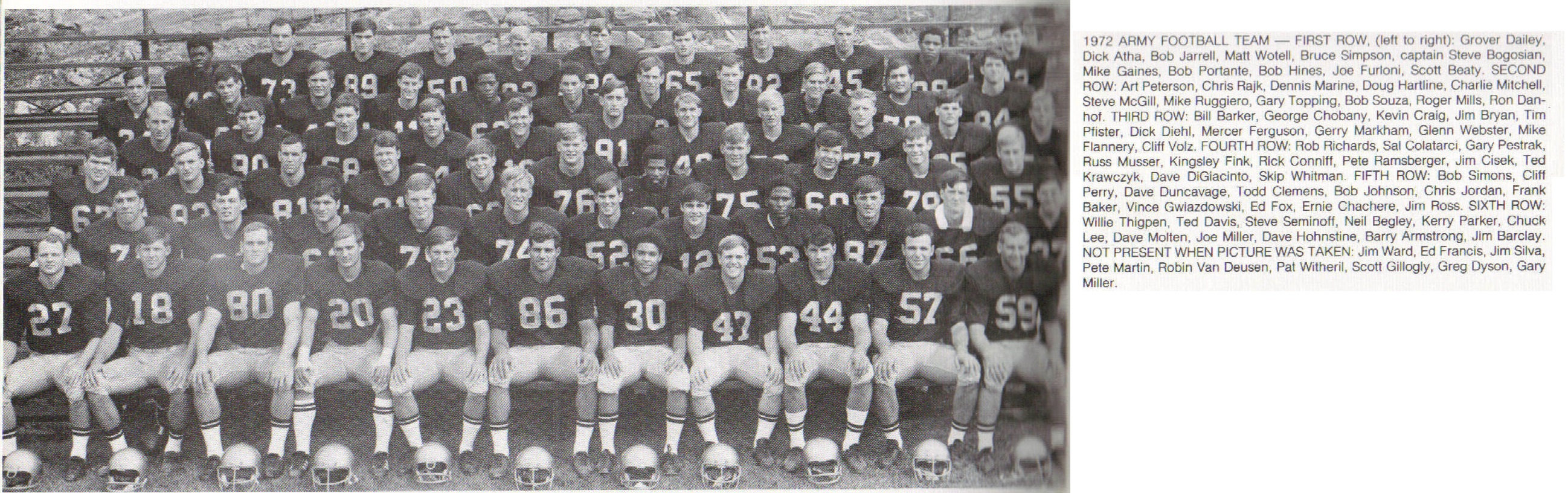
ArmyFB_1972_team
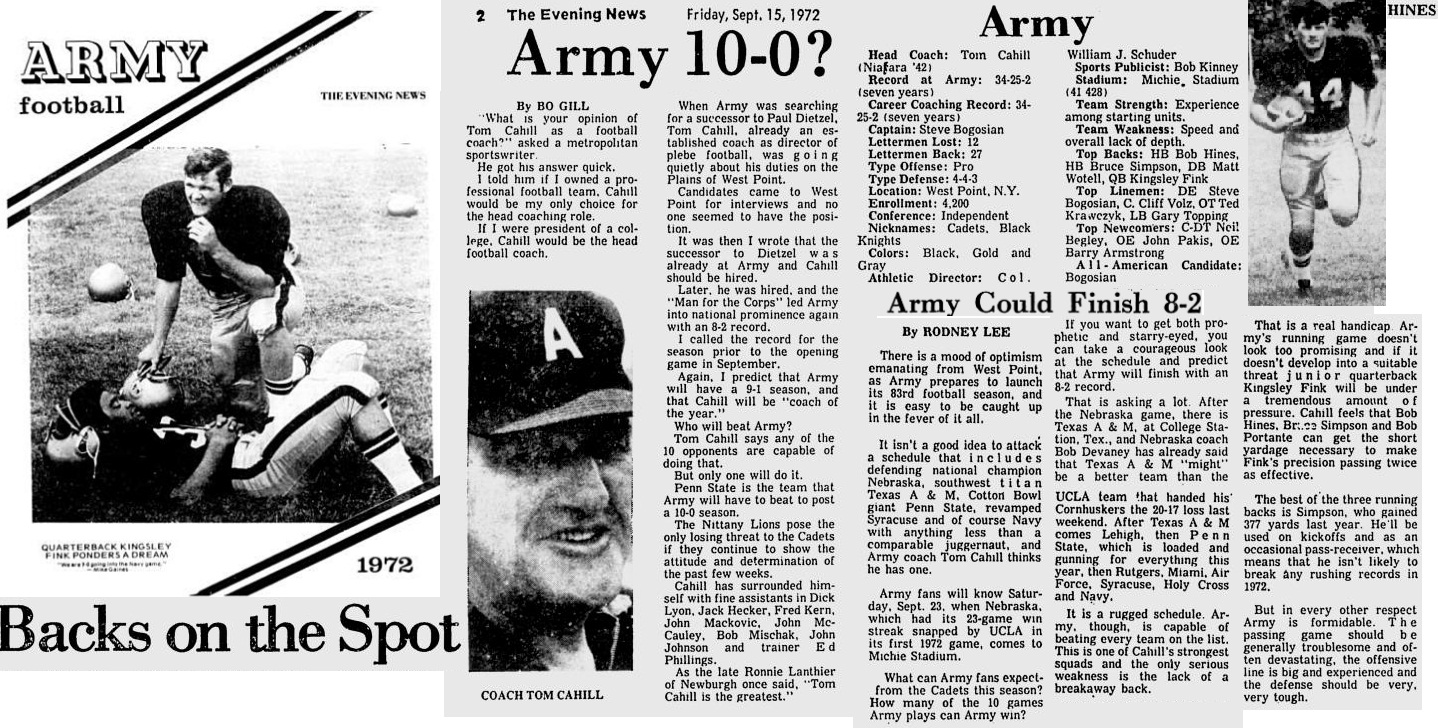
ArmyFB_1972_ArmyCoaches-team-roster_EN-Sep151972
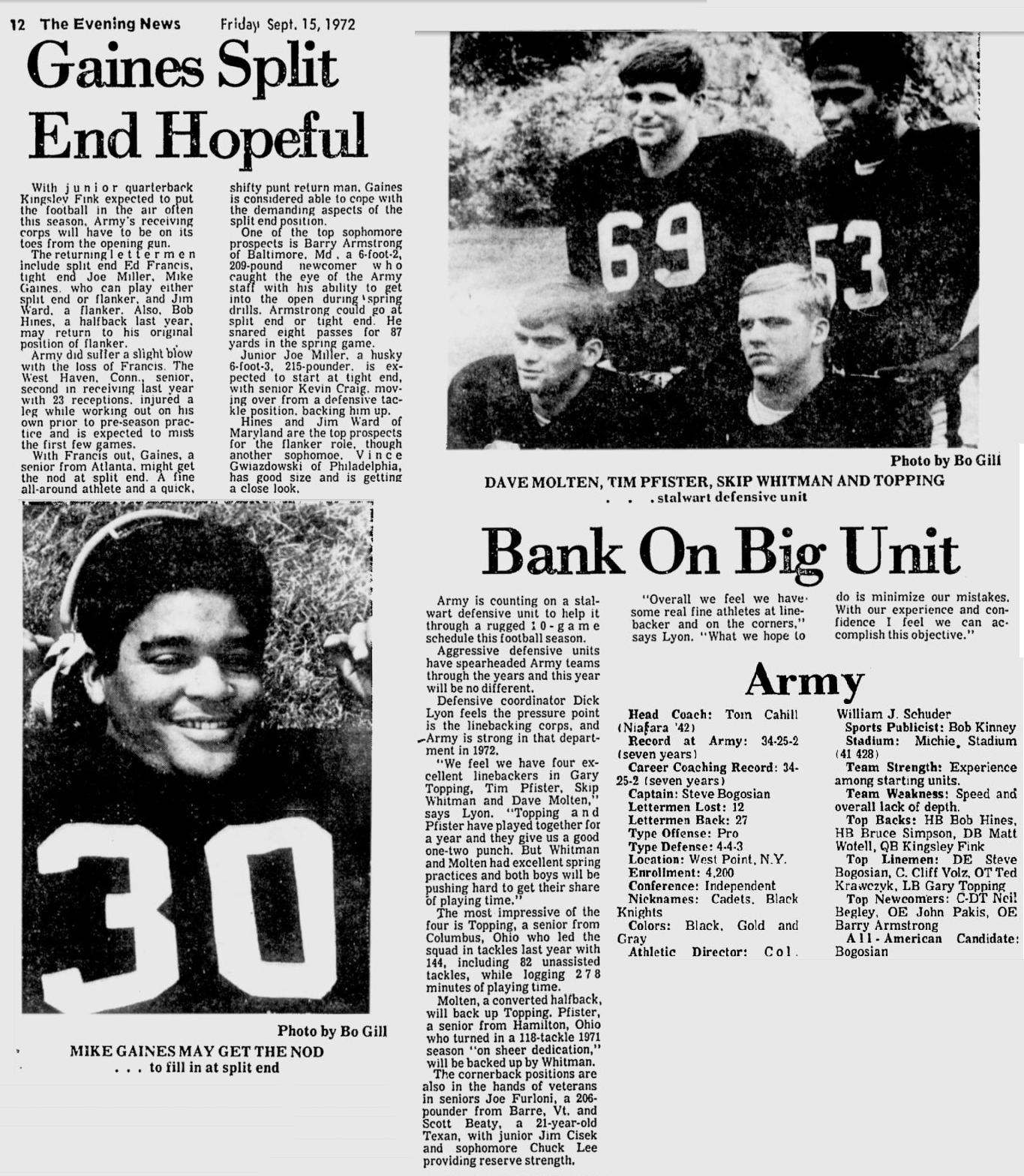
ArmyFB_1972_ArmyDefense_Gaines_EN-Sep151972
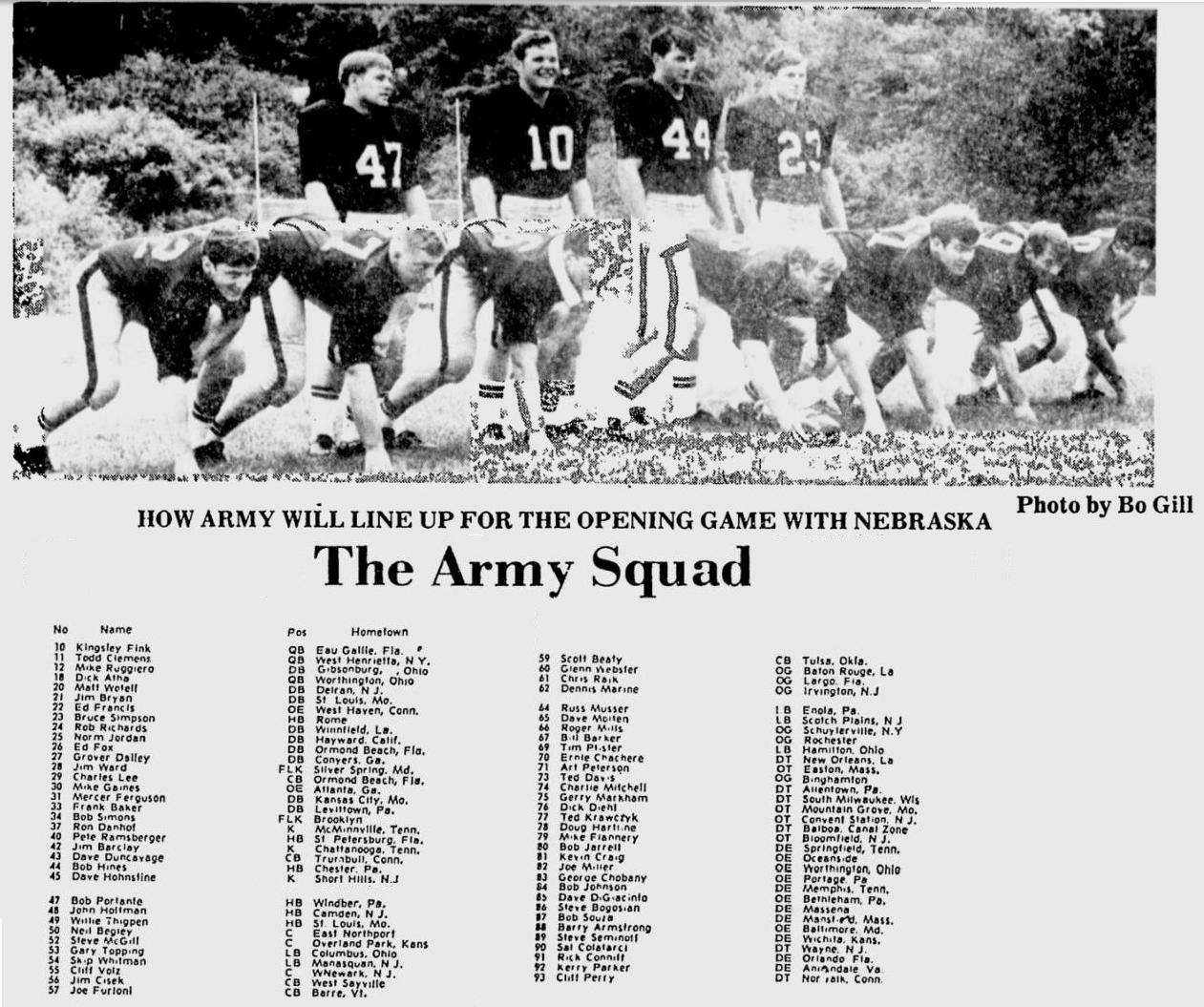
ArmyFB_1972_ArmyOffense_TeamRoster_EN-Sep151972
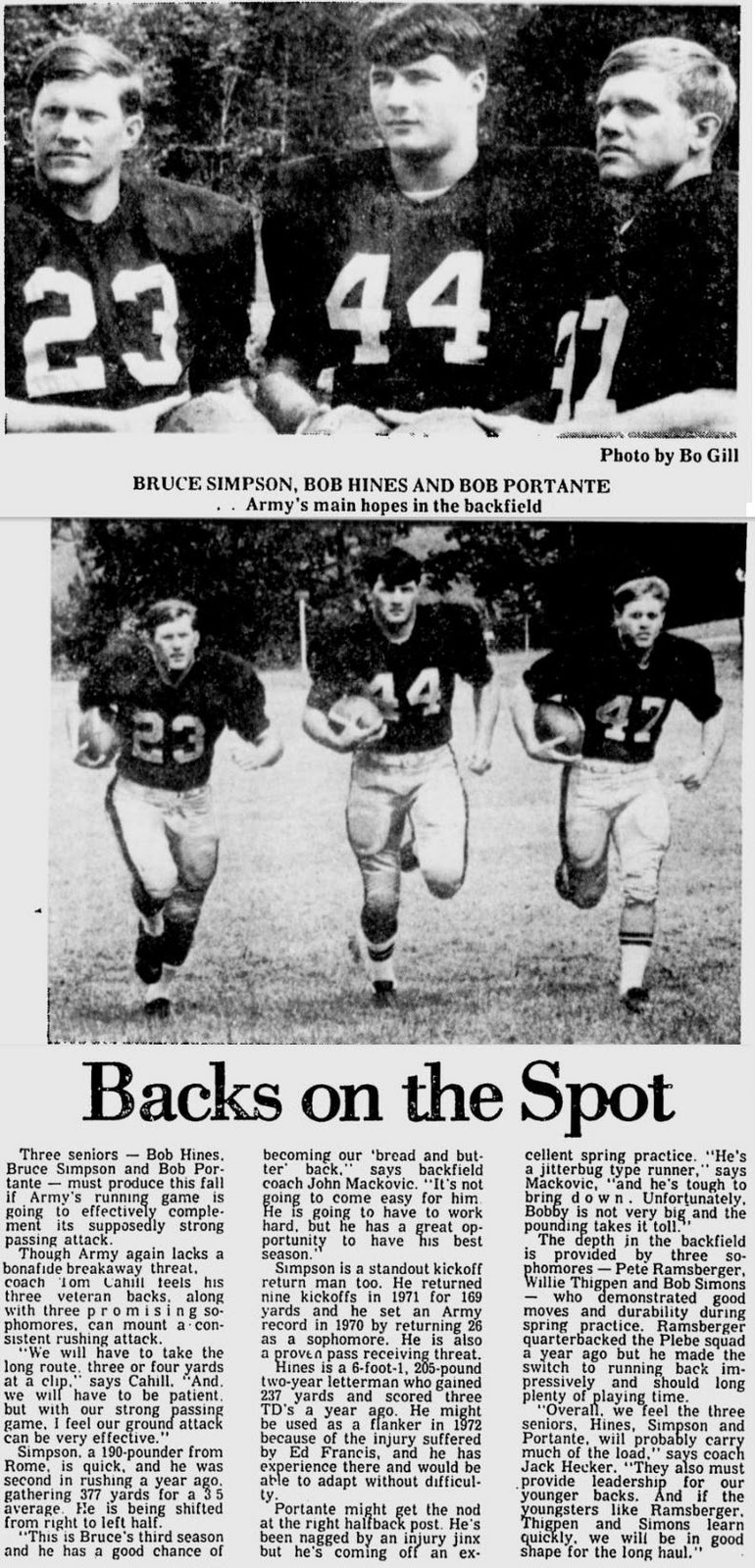
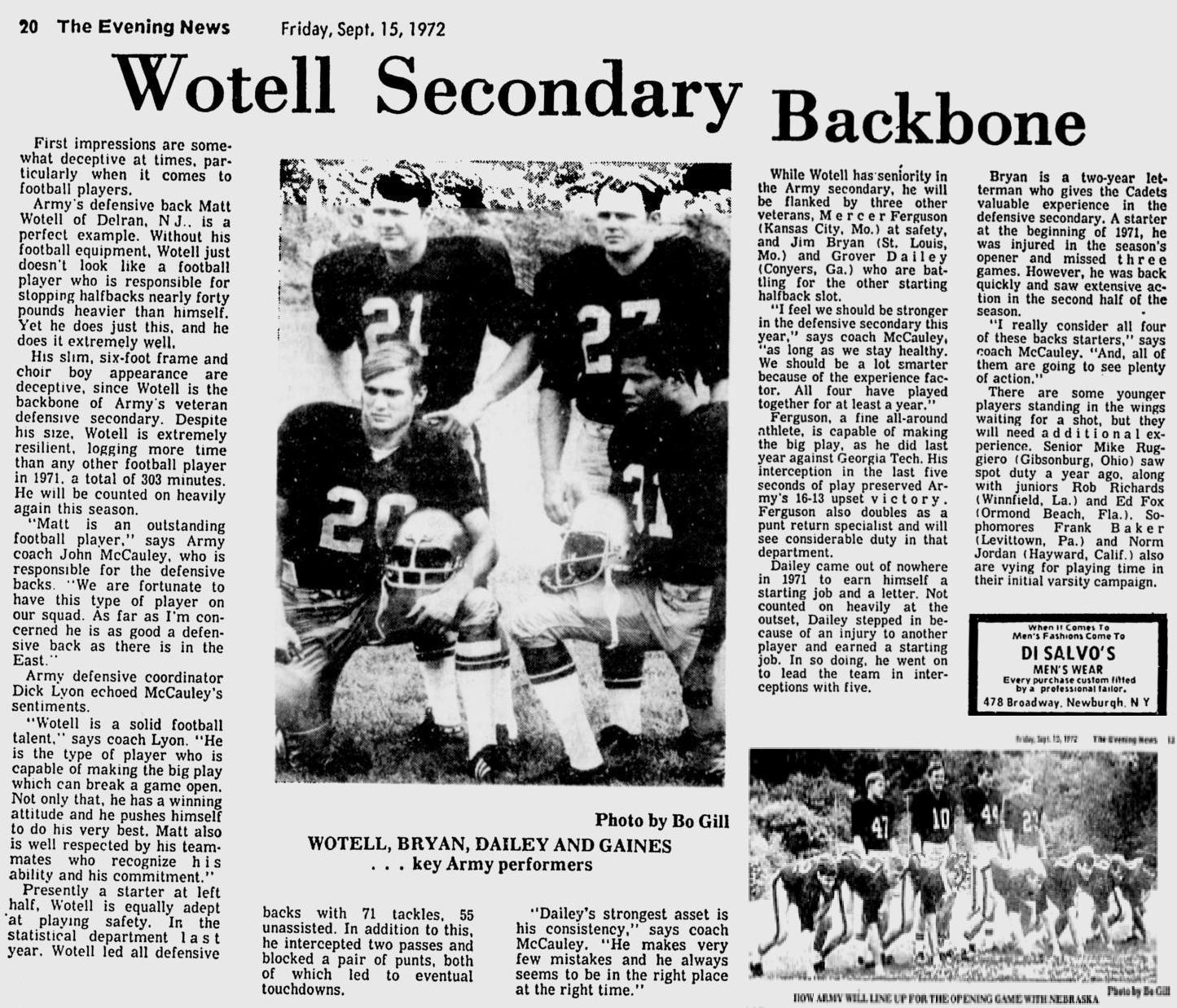
ArmyFB_1972_Wotell-The-Evening-News-15 Sept-1972
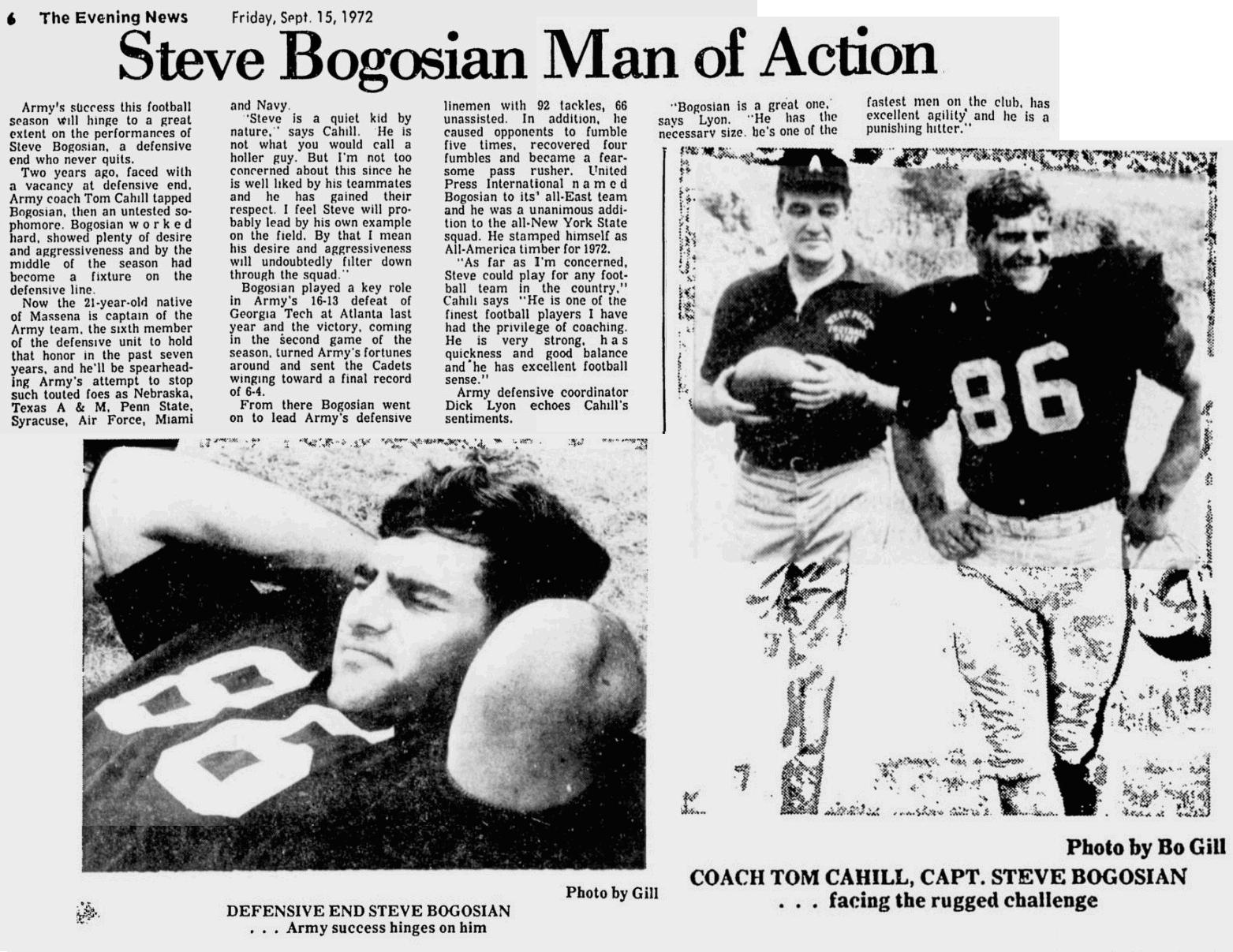
ArmyFB_1972_Cahill-CaptainBogosian_EN-Sep151972
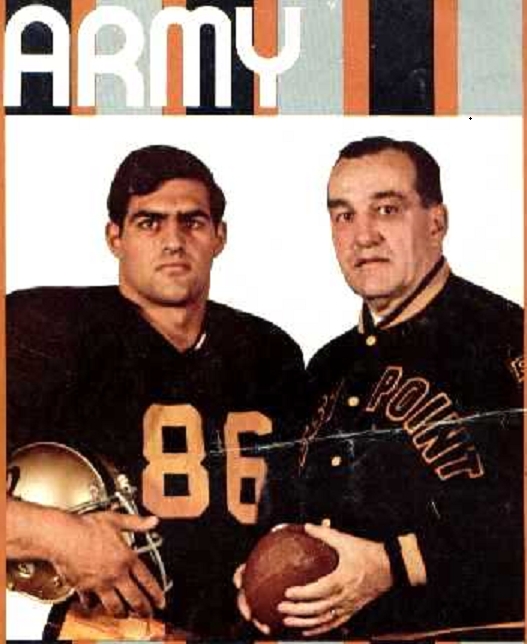
ArmyFB_1972_Bogosian-Cahill_program-pic
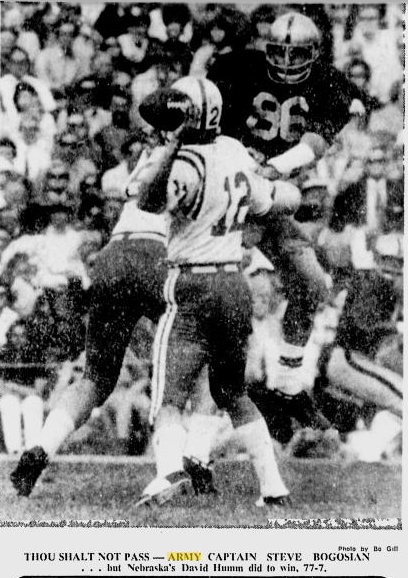
ArmyFB_1972_Bogosian-HummNU
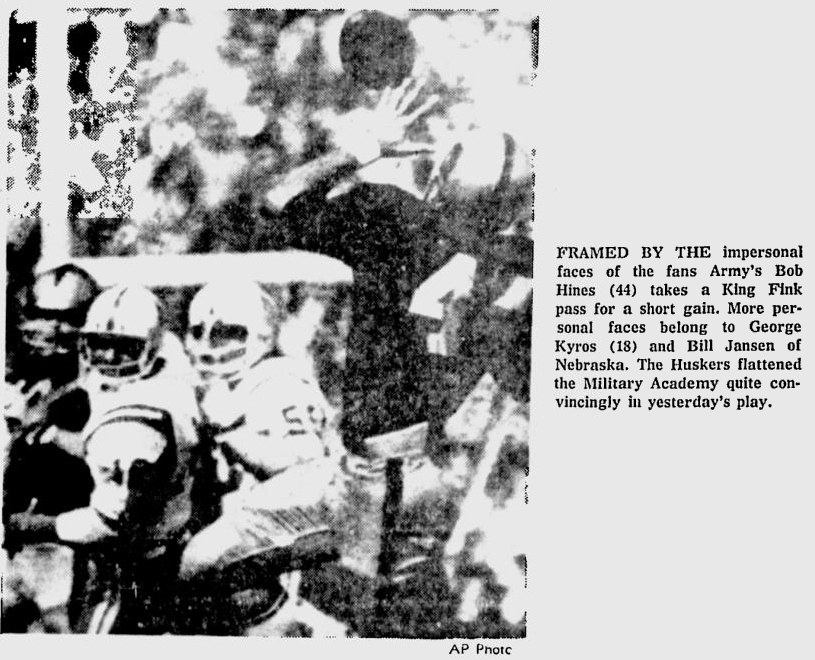
ArmyFB_1972_vsNebraska_BobHines_MichiganDaily_Sep241972
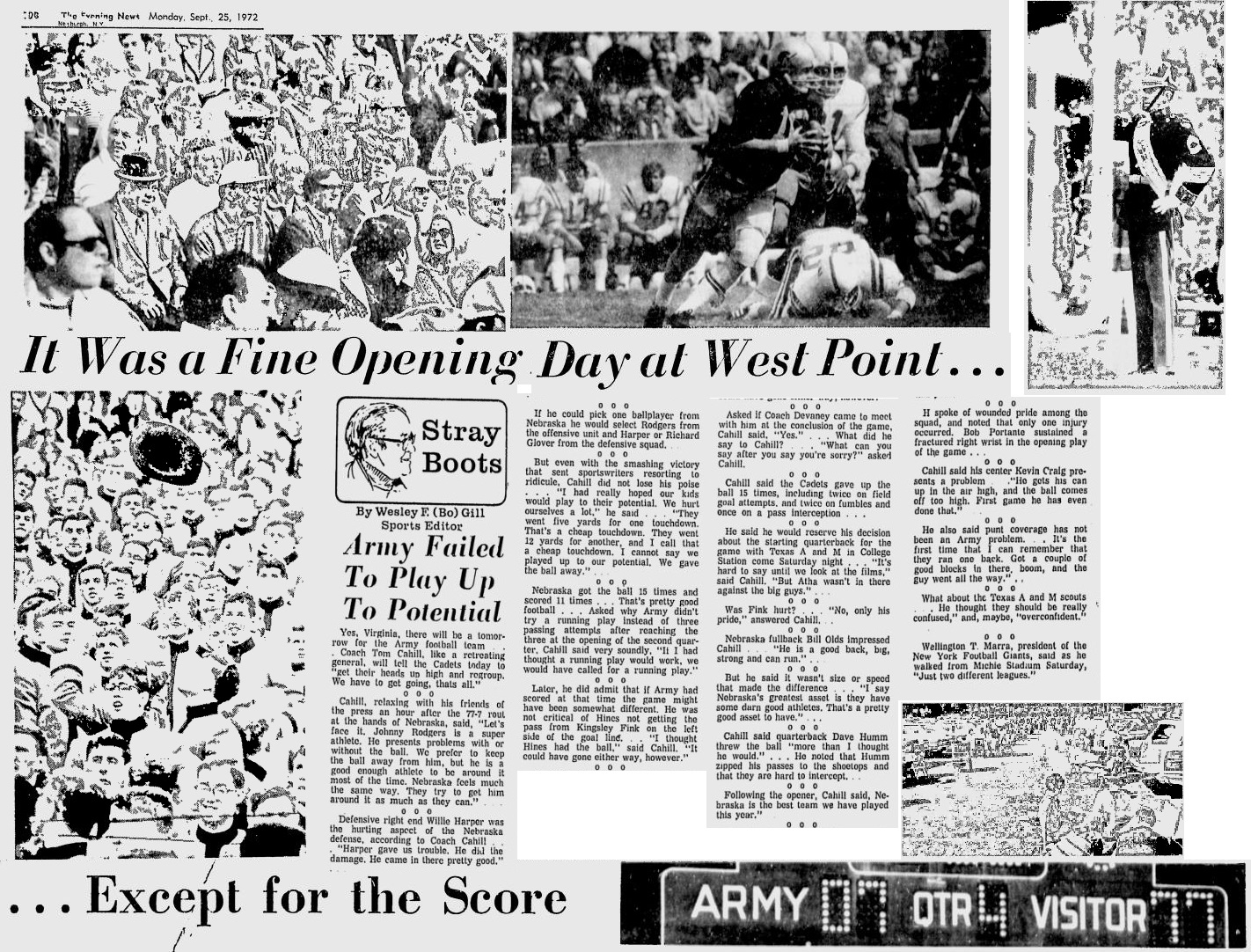
ArmyFB_1972_vsNebraska_EveningNews_Sep251972
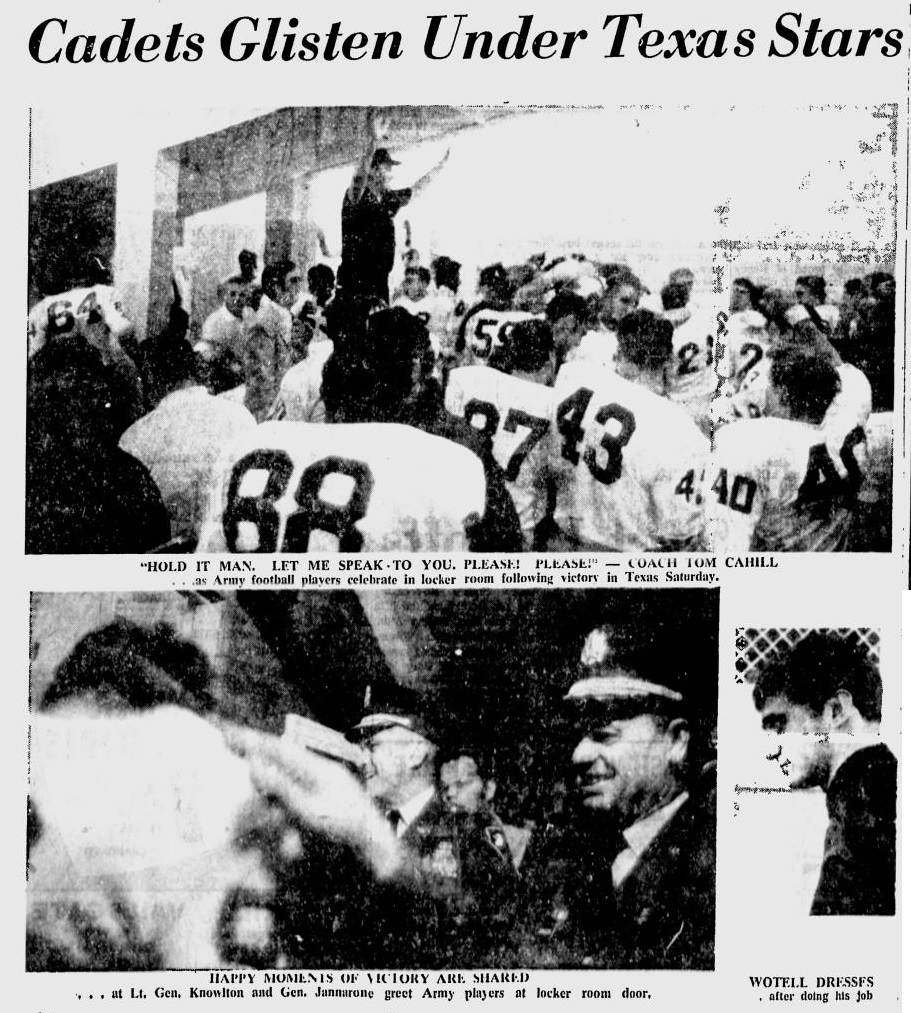
ArmyFB_1972_vsTAM-team_EveningNews_Oct21972
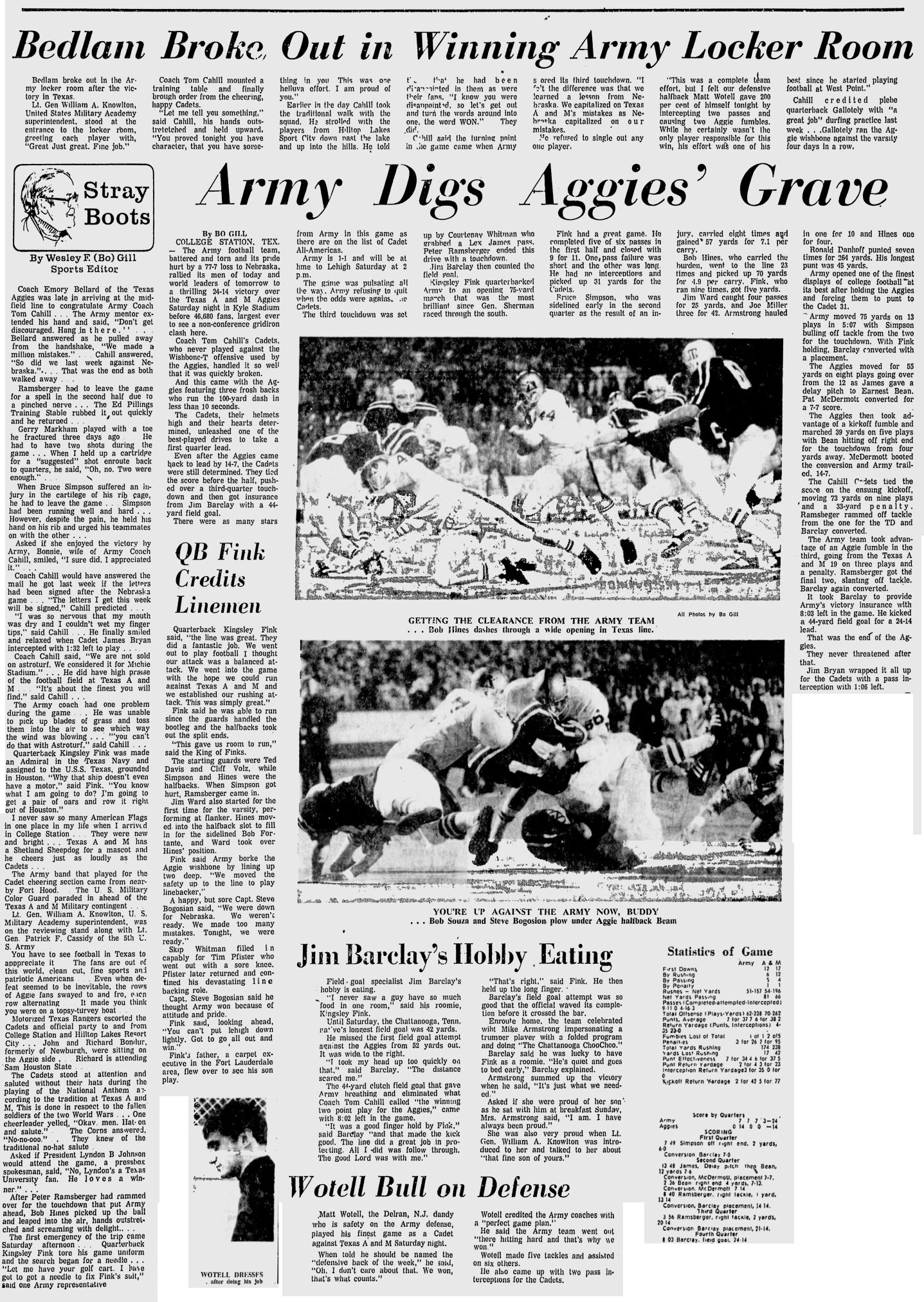
ArmyFB_1972_vsTAM_EveningNews_Oct21972
ArmyFB_1972_vsTAM-Wottel_EveningNews_Oct21972
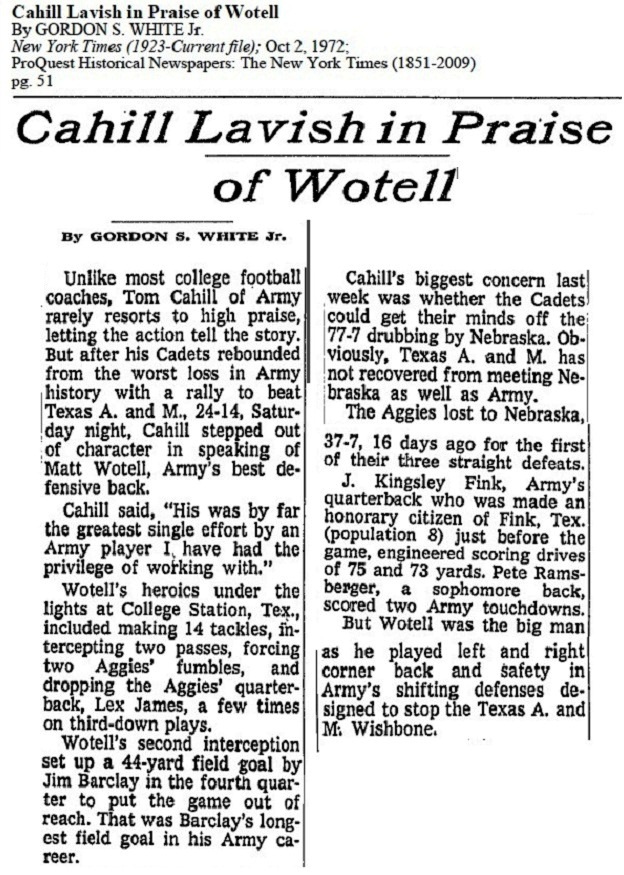
ArmyFB_1972_Wotell_NYT_Oct21972
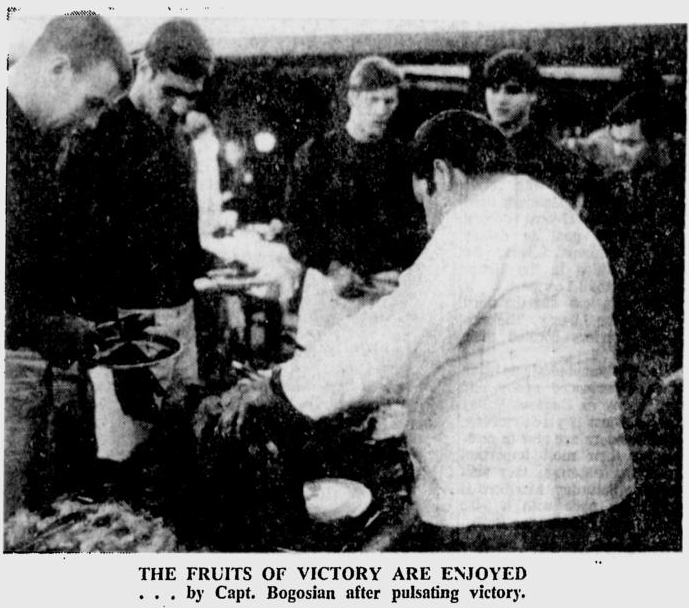
ArmyFB_1972_vsTAM-Bogosian_EveningNews_Oct21972
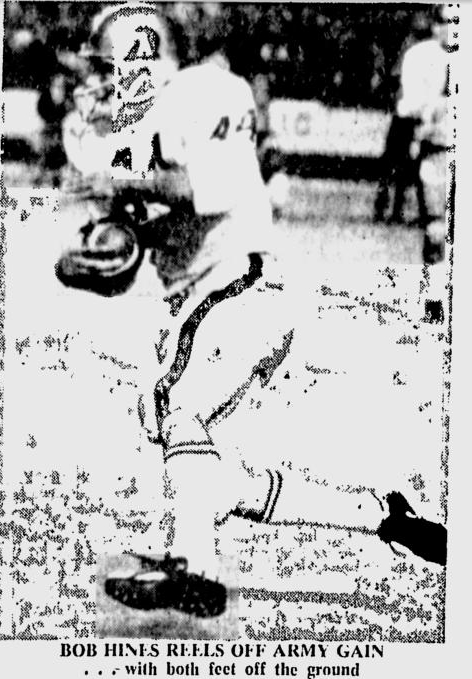
ArmyFB_1972_vsTAM-BobHines_EveningNews_Oct21972
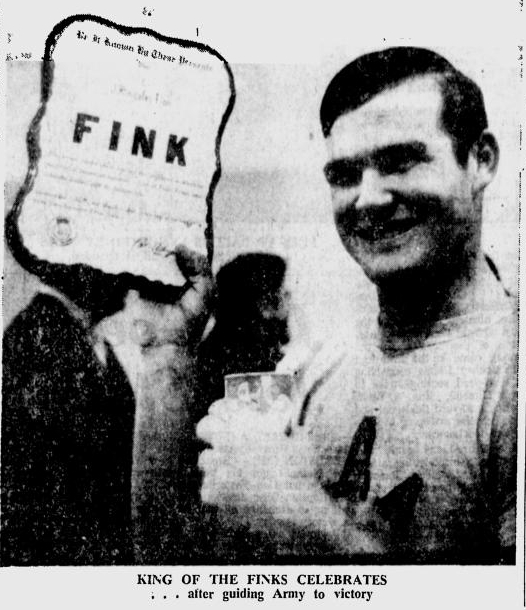
ArmyFB_1972_vsTAM-Fink_EveningNews_Oct21972
–
–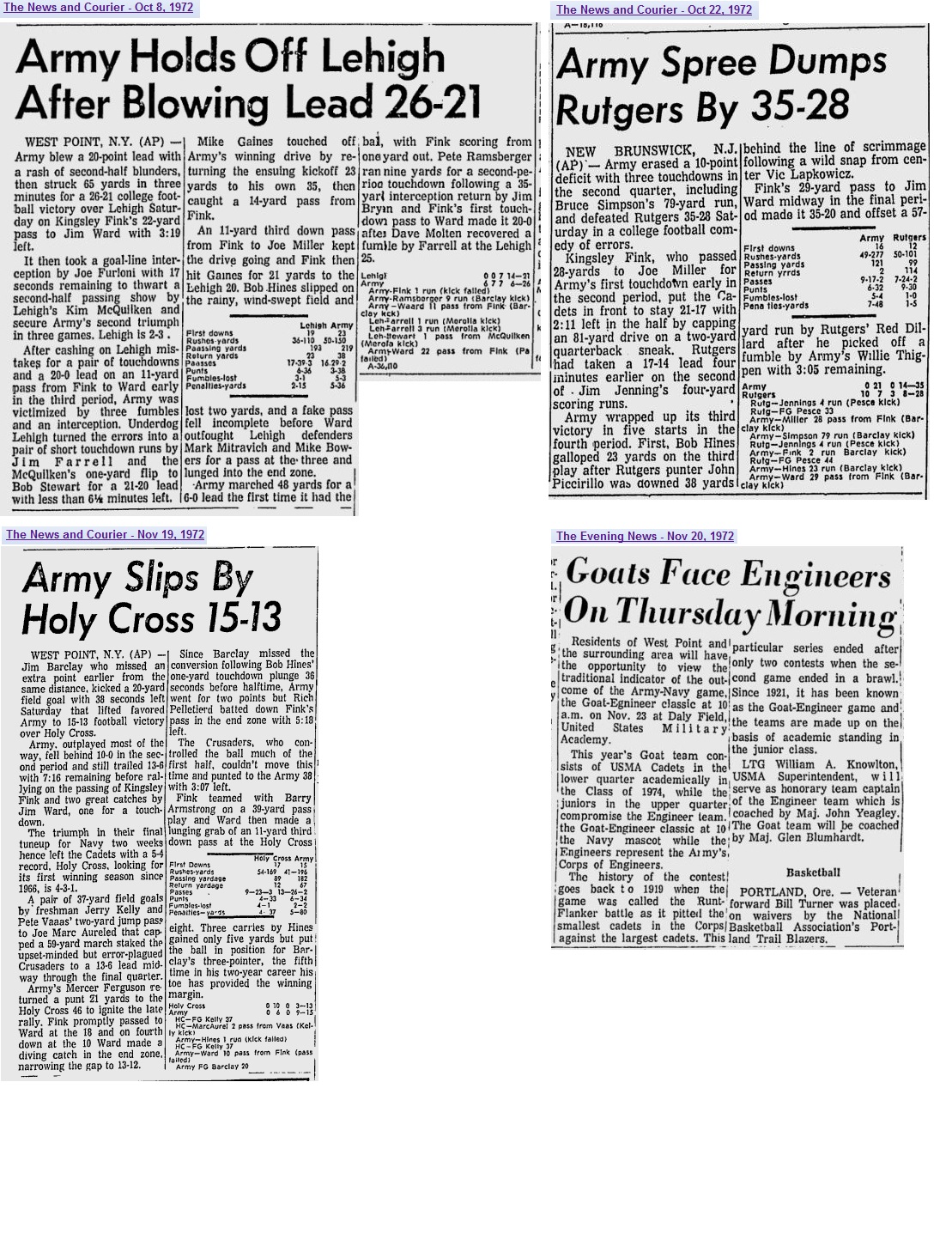
ArmyFB_1972_various_Oct-Nov1972
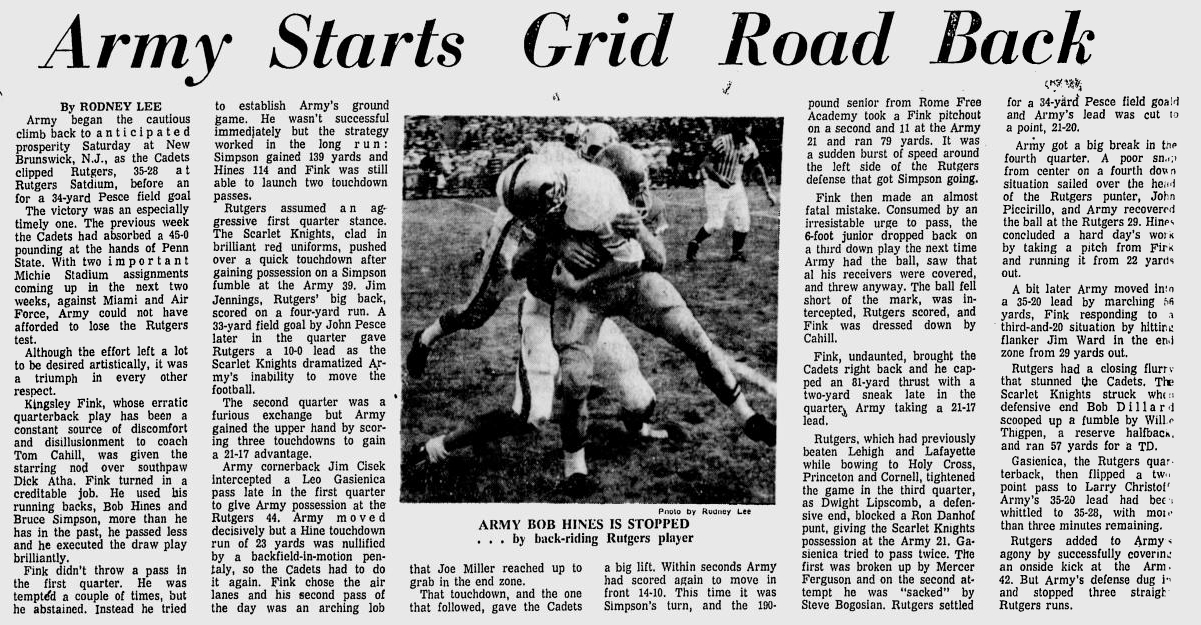
ArmyFB_1972_vsRutgers_EveningNews_Oct231972
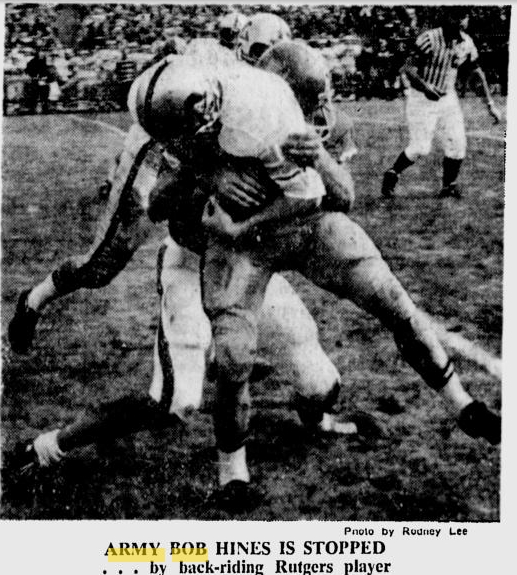
ArmyFB_1972_vsRutgers_EveningNews_Oct231972
–
–
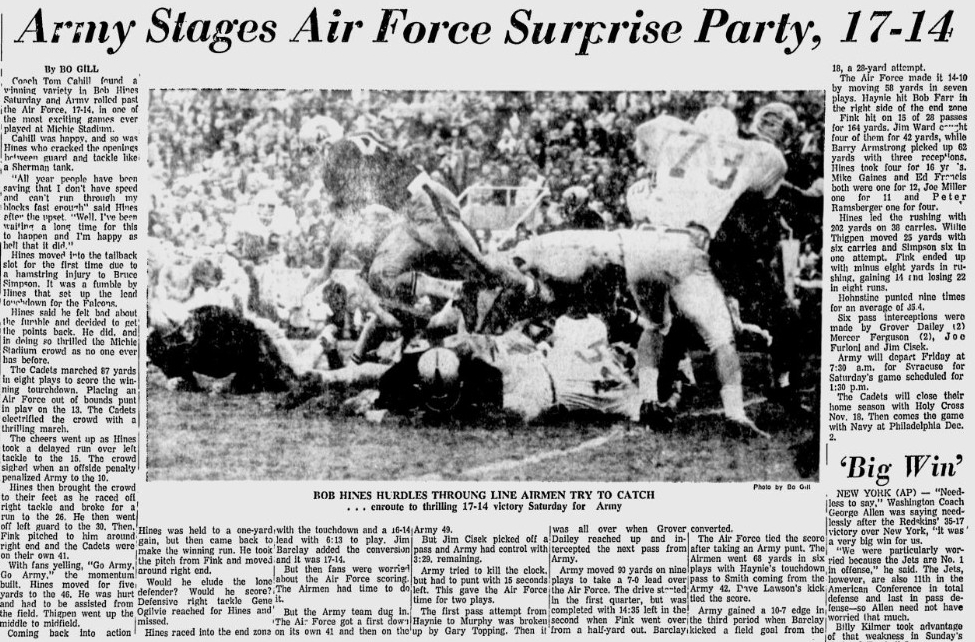
ArmyFB_1972_vsAirForce_EveningNews_Nov61972
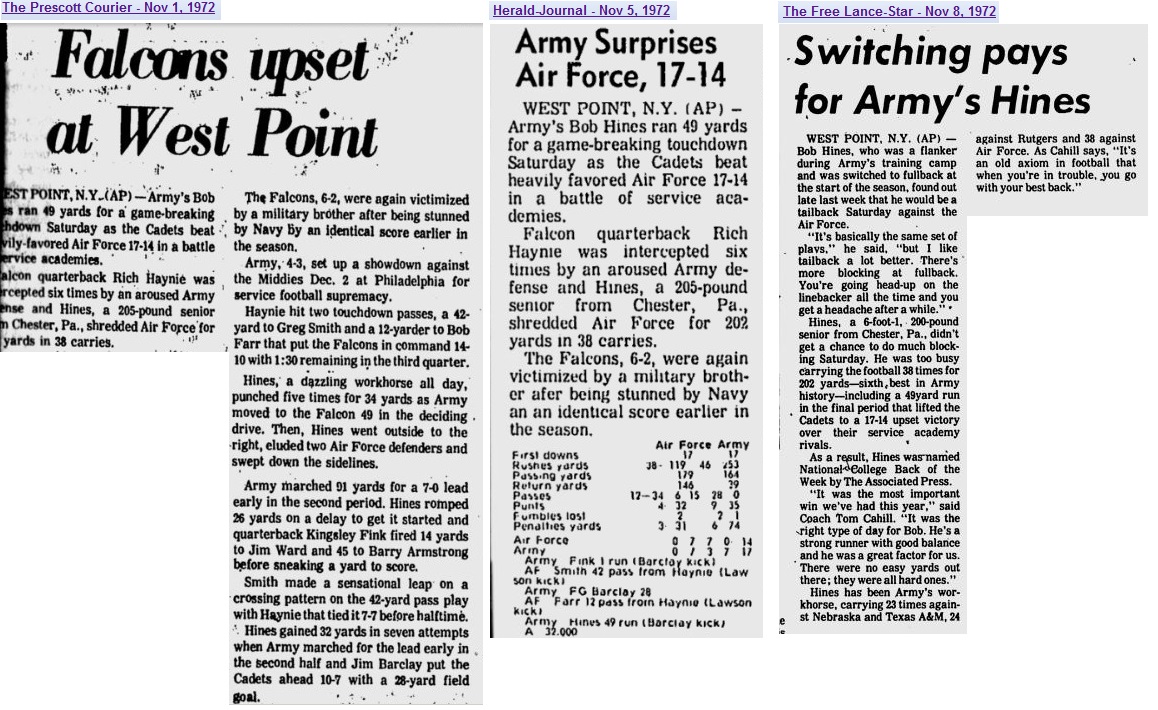
ArmyFB_1972_vsAF_various_Nov1972
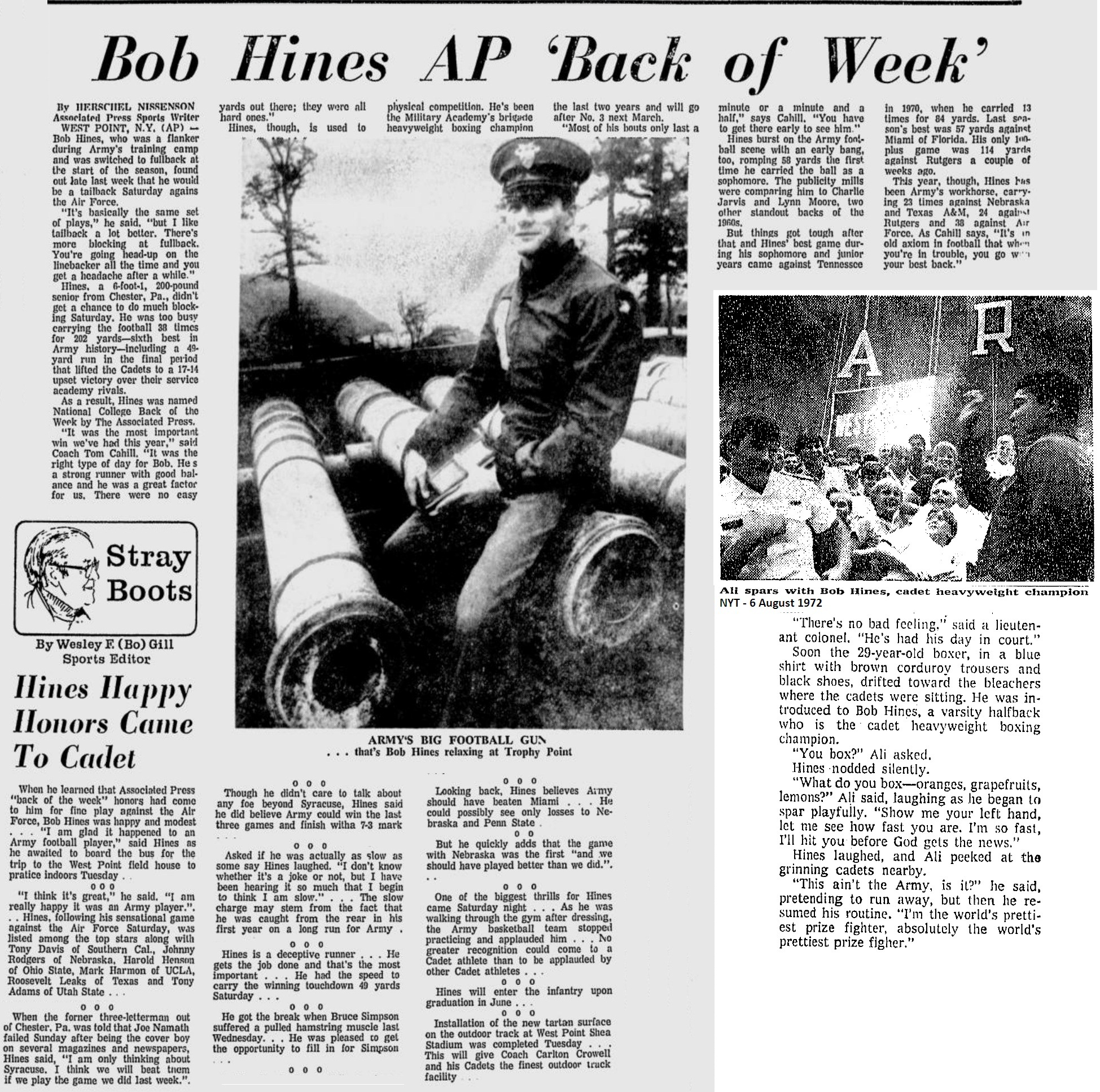
ArmyFB_1972_vaAF-BobHines-BackofWeek_EveningNews_Nov81972
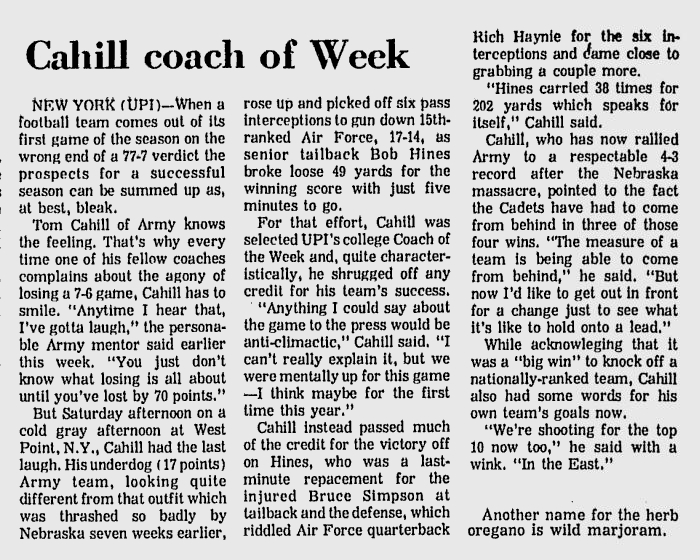 ArmyFB_1972_vsAF_Cahill-CoachoftheWeek_SundayTimesSentinel_Nov81972
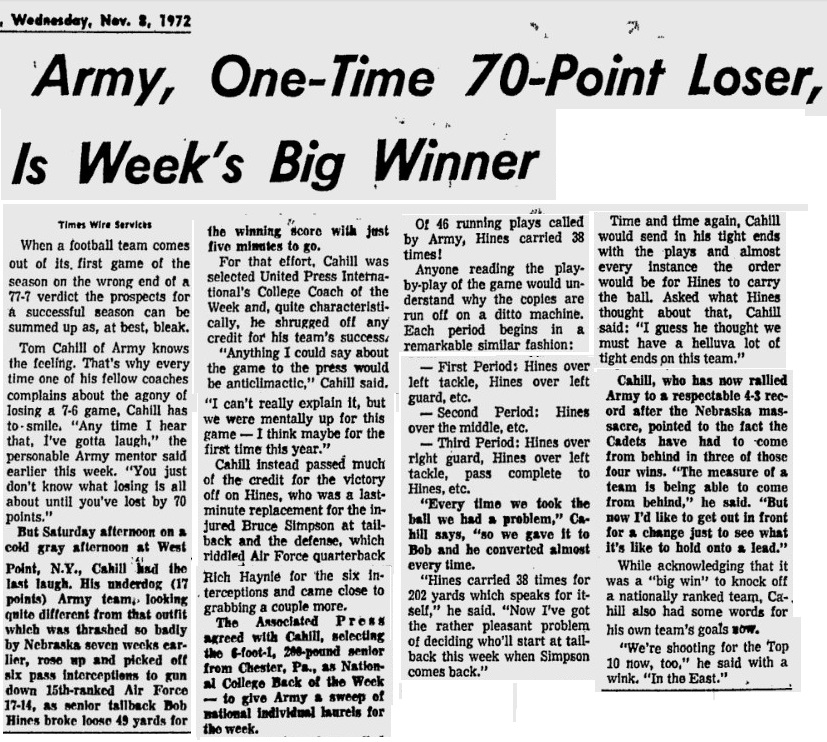
ArmyFB_1972_vsAF_StPetersburgTimes_Nov81972
–
–
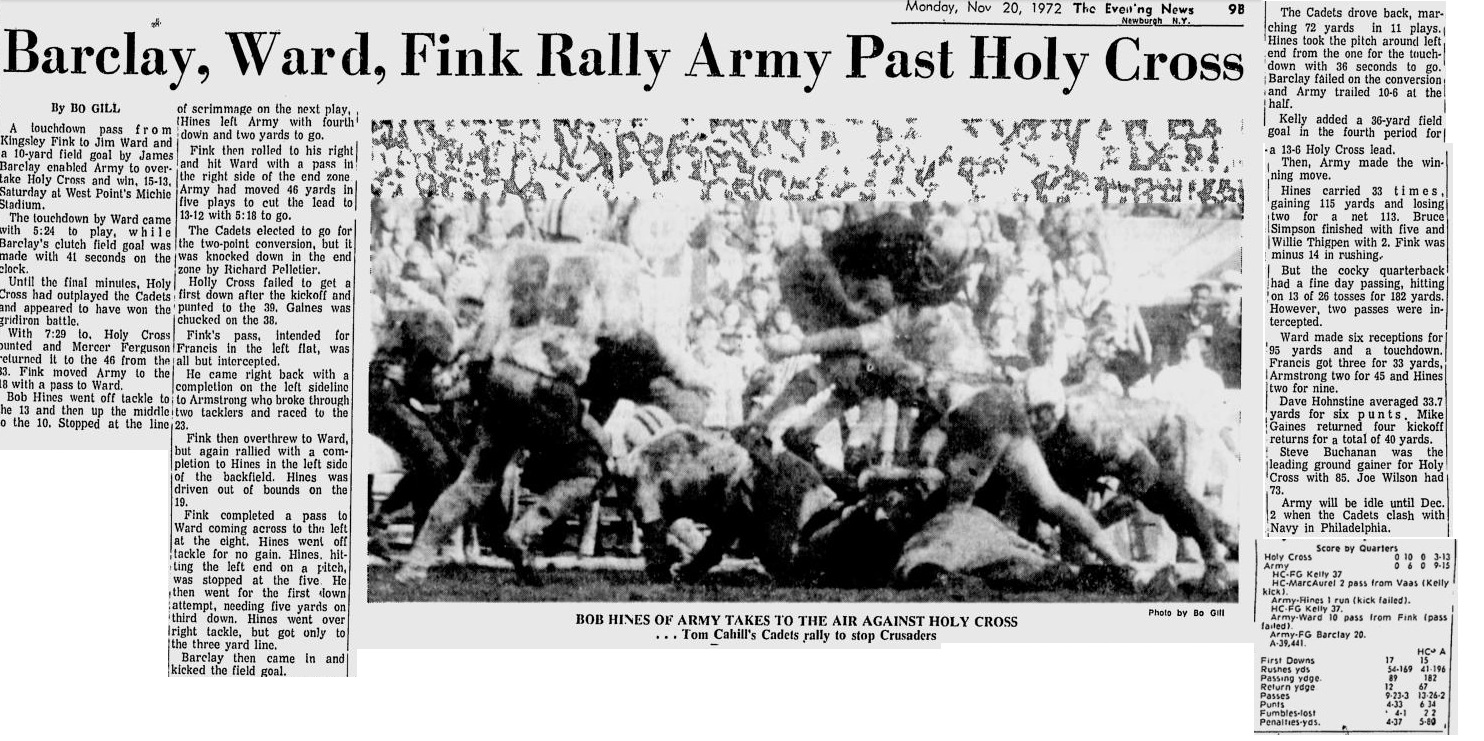
ArmyFB_1972_vsHolyCross_EveningNews_Nov201972
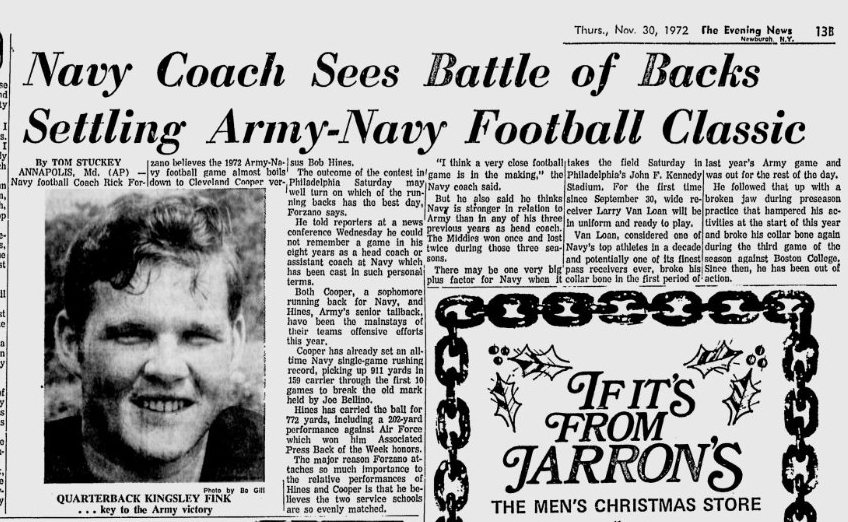
ArmyFB_1972_ArmyNavy-preview_EN-Nov301972
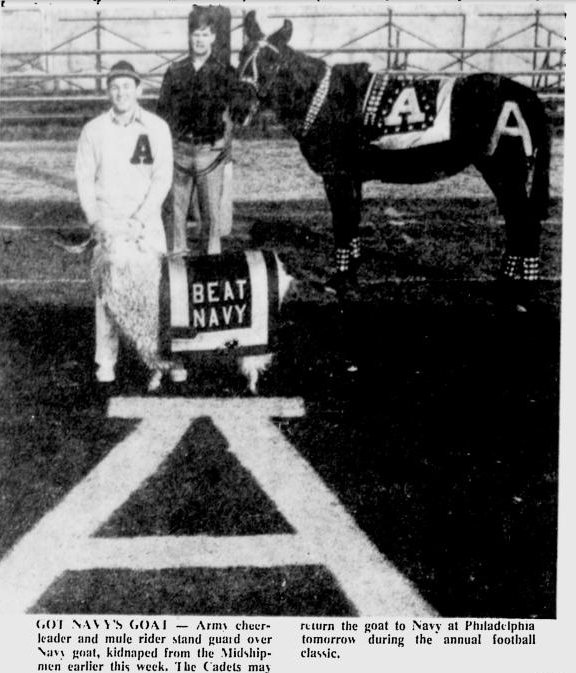
ArmyFB_1972_WeGotNavysGoat_EN-Dec11972
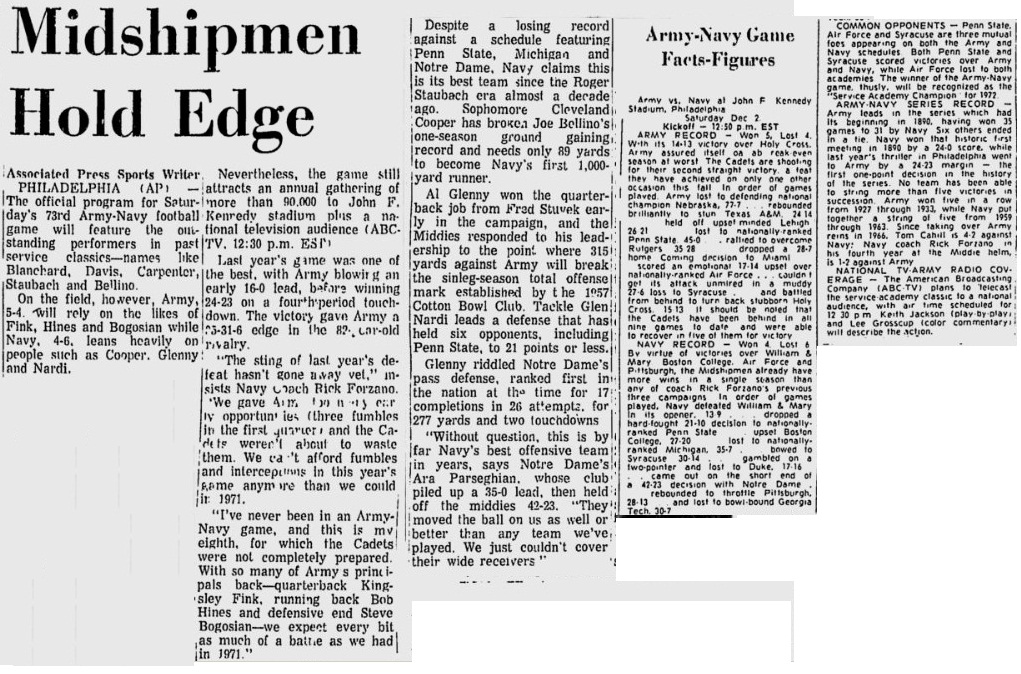
ArmyFB_1972_Army-Navy-preview_EN-Dec11972
–
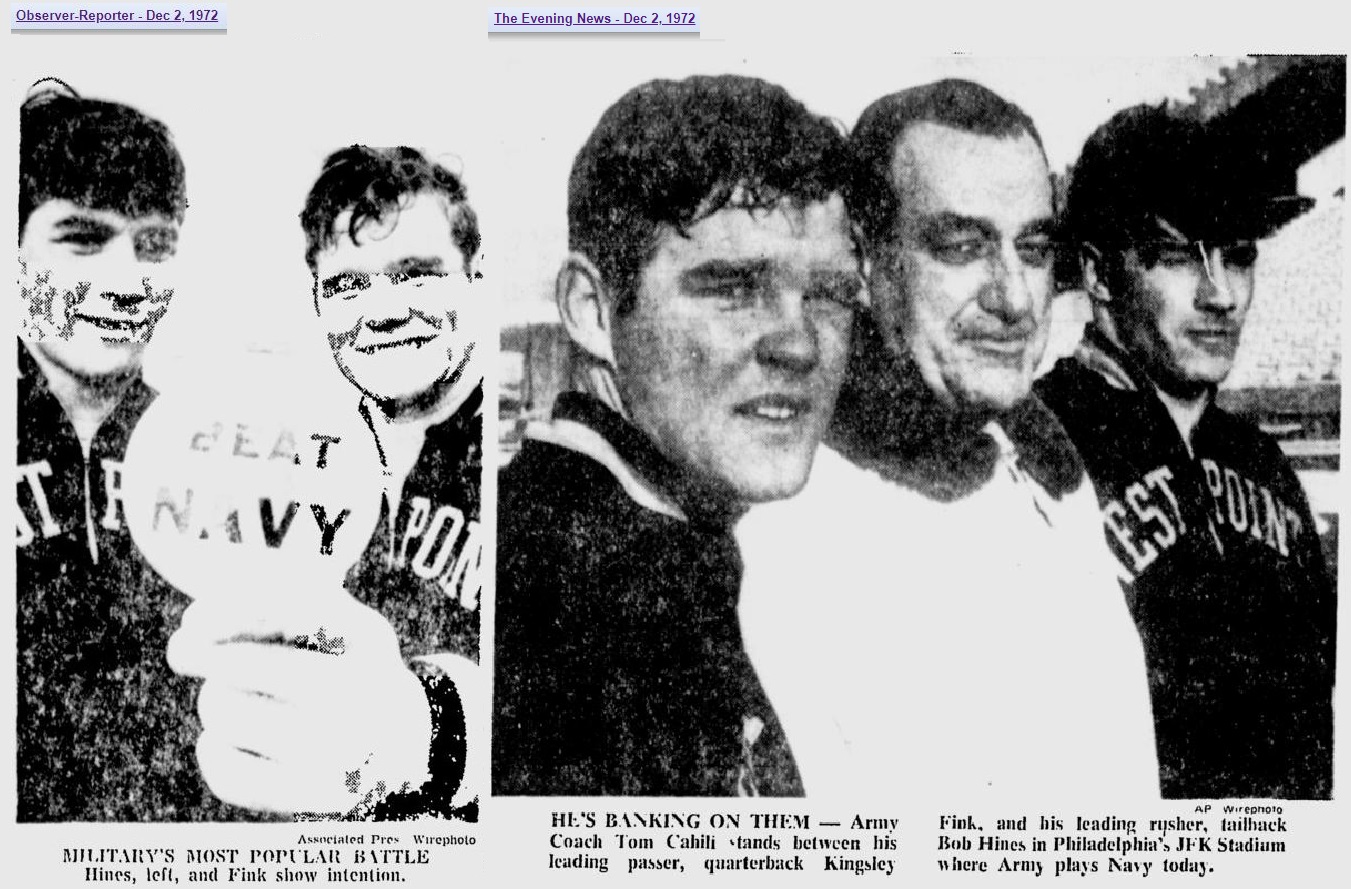
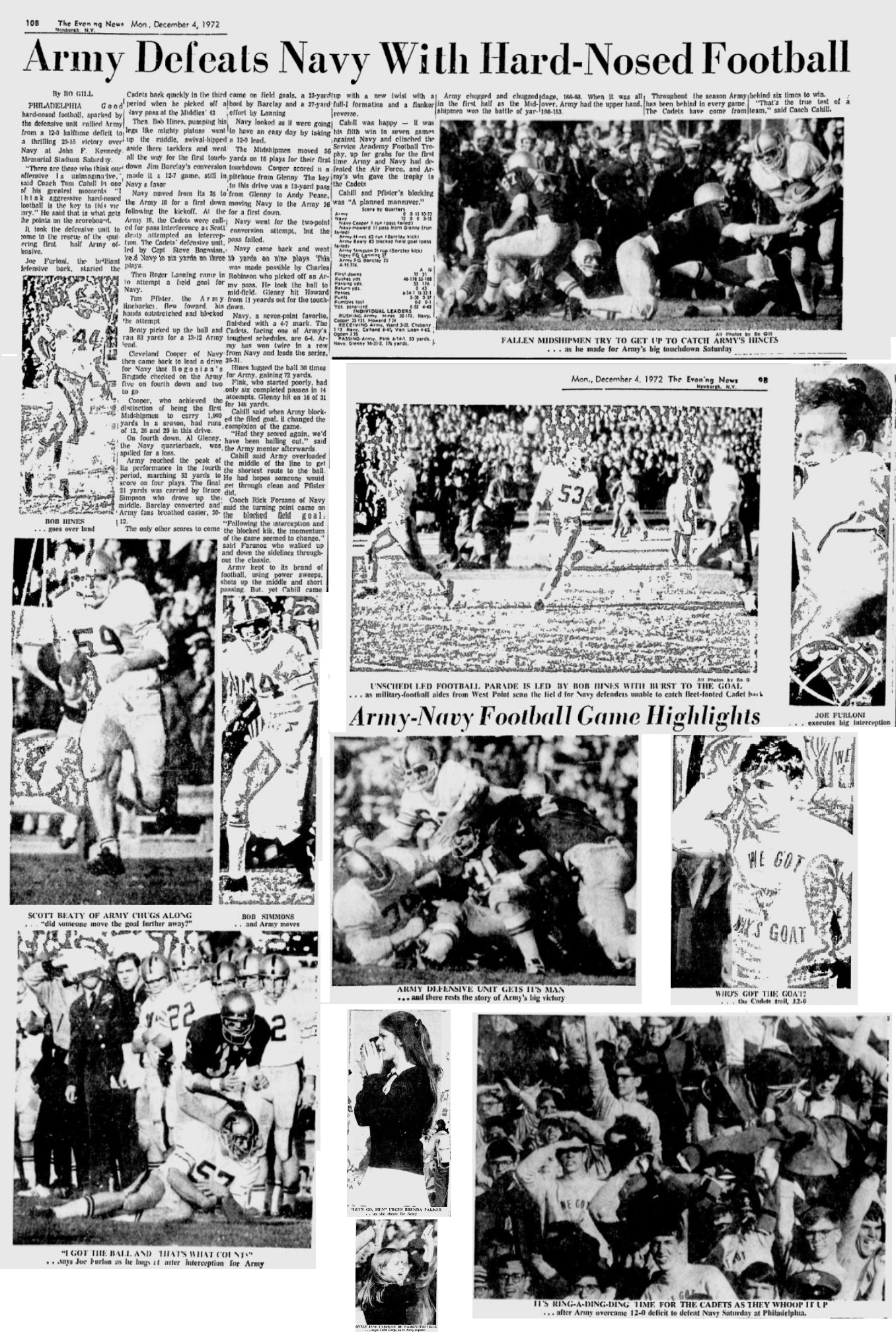
ArmyFB_1972_vsNavy_Hines_EN-Dec41972
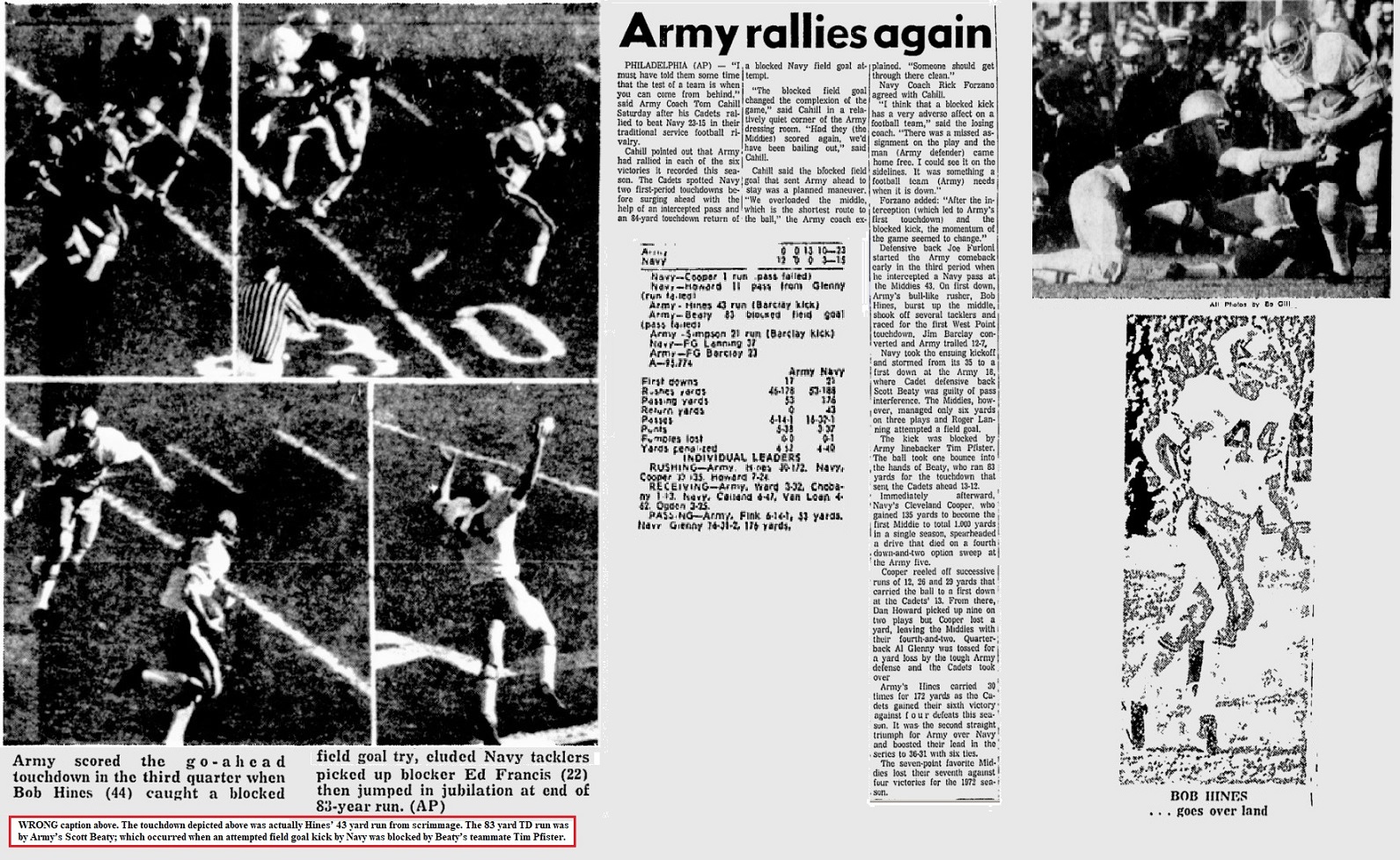
ArmyFB_1972_BobHines_vsNavy
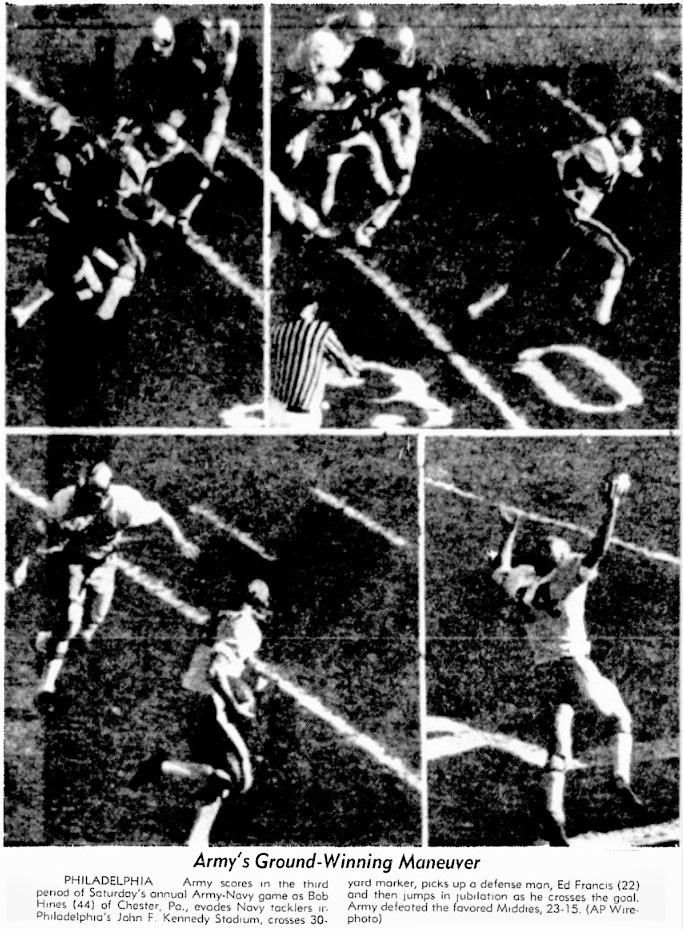
WRONG caption. The touchdown depicted above was actually Hines’ 43 yard run from scrimmage. The 83 yard TD run was by Army’s Scott Beaty; which occurred when an attempted field goal kick by Navy was blocked by Beaty’s teammate Tim Pfister.
–
–
–
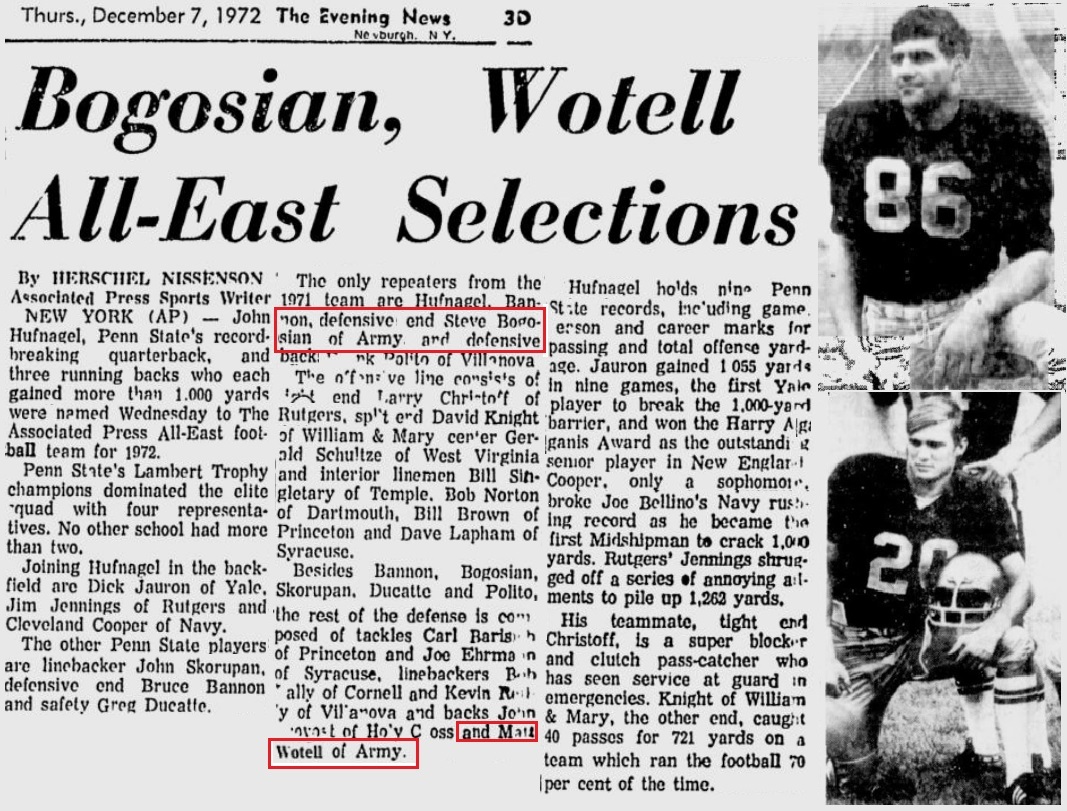
ArmyFB_1972_story1
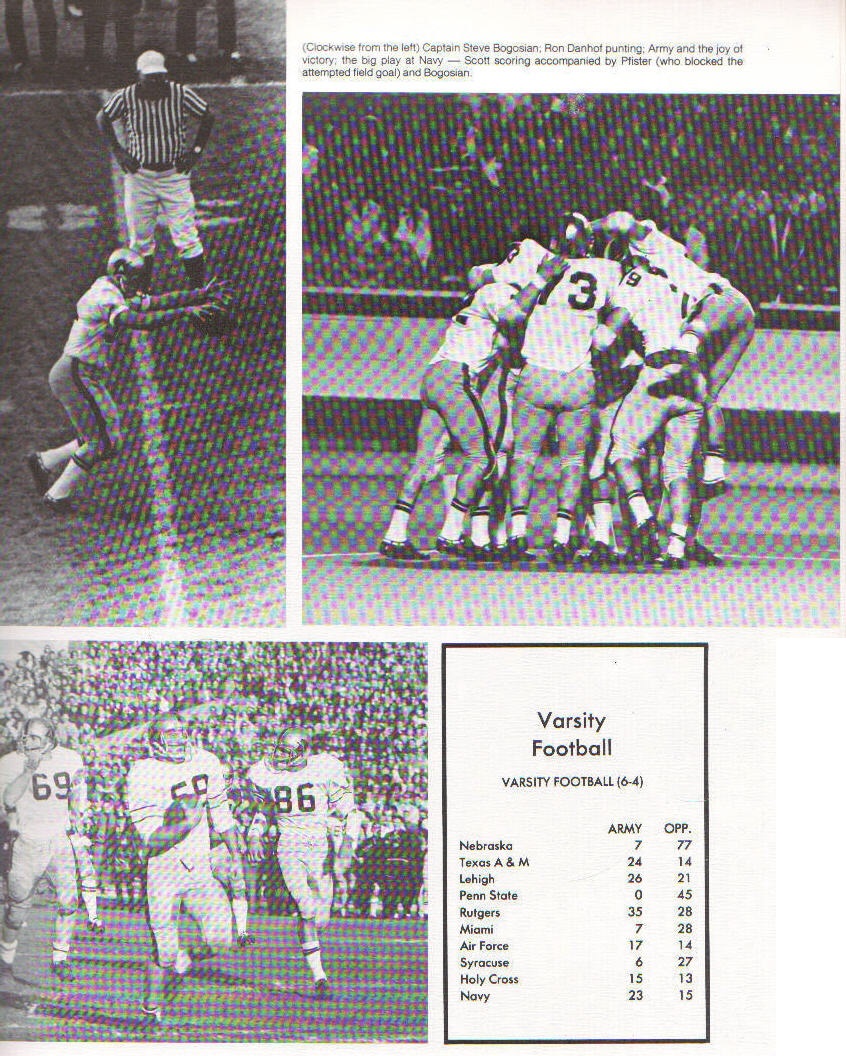
ArmyFB_1972_story2
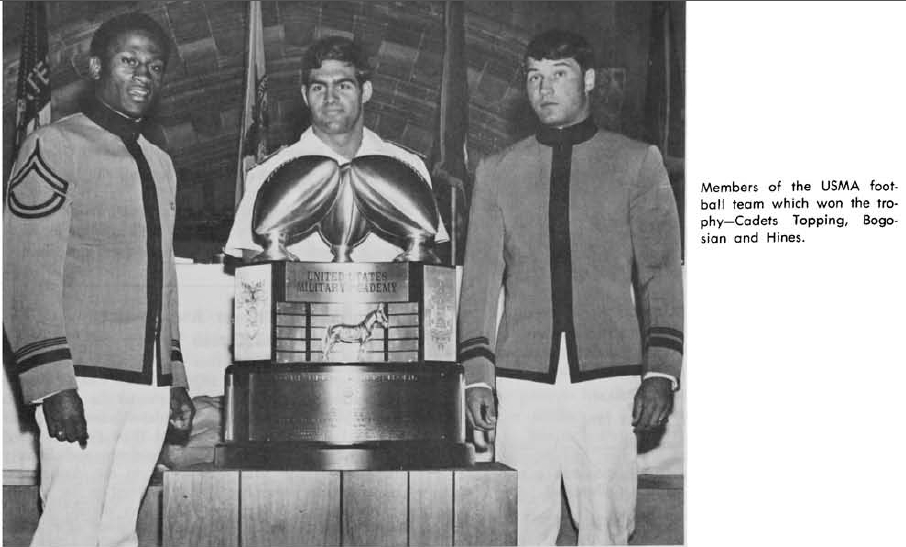
ArmyFB_1972_Topping_Bogosian_Hines_Assembly32n21973
–
–
January 29, 2009
Mr. Bob Beretta
Senior Associate Athletic Director for Athletic Communication
U.S. Military Academy
639 Howard Road
West Point, NY 10996
Dear Mr. Baretta;
I am honored to have the privilege of supporting, and in the strongest possible terms urging the selection of the 1953 Army football team for the Academy’s Sports Hall of Fame.
Enclosed please find the book, A Return to Glory, and two articles, one on Vince Lombardi, the other on the 1953 Army-Duke football game, both published some years ago in Assembly magazine. Together, these three items chronicle the history of Army football’s astonishing turnaround following the devastating 1951 cheating incident, a turnaround crowned by the 1953 team’s glowing achievements. The succeeding paragraphs will highlight a few of the team’s additional, unforgettable accomplishments and effects, some comments resulting from their play and at the same time, through the enclosed writings offer those considering the nomination a far deeper understanding of its remarkable history. With respect to the book, I will identify the most pertinent chapters and pages to ease learning about the players and their season, a season never to be forgotten by the Corps of Cadets of that era – and a season that inspired the Bicentennial book’s title.
Before proceeding, it is important to put the subject in perspective with Coach Earl Blaik‘s words about the 1953 Army football team. In his 1974 autobiography, The Red Blaik Story, he wrote, “When I come to describe the team of 1953, what they meant to me and, far more important, what they meant to West Point, I cannot praise them enough.” Of them, Grantland Rice wrote with eloquent simplicity, “They came up the hard way and there probably has never been a squad with a finer spirit.” True, we did look for better things than in 1951 and “52”. We did not harbor, however, the faintest dream of even localized empire. Any prognostication that we would win the Lambert Trophy, emblematic of the Eastern Championship, and be rated No. 14 nationally would have been tabbed fantastic. With Coach Blaik’s words as background, the team’s history echoes his witness.
They were one of the smallest Army football teams in years, at season’s end thirty-eight men, a team of heroes with no stars and with a different hero each Saturday, all playing for honor and love of the game, undeniable facts laid out in chapters 17-19 (pages 787-916) in A Return to Glory. They were led by quiet, solid leaders from the class of 1954; augmented by a small number of players from the smallest Academy class in years, 1955, and a bevy of talented yearlings in the class of 1956 who set the gridiron on fire that fall. All, together, became inspired. Though the phrase wasn’t originated by Coach Earl Blaik, it was the incomparable football teacher, the thoroughly emotionally-controlled Blaik who, with tears in his eyes, handed the Army-Duke game ball to Bob Mischak, Army’s left end who made the incredible game-saving tackle. Blaik’s words to Bob were simple but powerful, and echo down through the years, “Don’t ever give up.”
The cheating incident had never-publicized, lingering effects on Army football players in the three following seasons, effects witnessed and painfully felt by the young, inexperienced B and C teams – the men who accomplished the “football miracle” of 1953. As Blaik wrote years later in baring his bitterness and frustration over the cheating incident, “For two years these boys had seen the roughest action. They had lived with the coaching lash, dirt, blood, and defeat.” Adding to the effects the players faced was the revelation that the much-admired Army varsity had been deeply involved in what became a national scandal. In a number of cases the players left to pick up the pieces became subjects of totally unwarranted suspicions and stinging criticisms simply because they were Army football players. Army football, indeed, service academy football came under sharp attack in Congress as well as in the media. It seemed to some players that men they had looked up to as champions and team leaders had disgraced not only themselves, the Academy, the Army and Air Force, they had embarrassed and disgraced the game of football. The season of 1953 changed all that — the team and the Corps of Cadets washed the effects away with stunning, inspirational teamwork and marvelous achievements. Yet, there were more hurdles to cross before they could accomplish their football miracle.
Following the 1952 season, changes in National Collegiate Athletic Association (NCAA) rules greatly restricted substitution and for several years virtually ended the offensive-defensive unit two-platoon system. The result was to lengthen playing time for varsity players, decrease the number of varsity letters awarded, increase injury potential, and cause a return to what in years past had been called “iron man football”.
To compete under the more complicated substitution rules, Coach Blaik chose to return to the type of two-platoon system he inaugurated at Army during the World War II years, two or three units that went both ways, on offense and defense. While the rule changes impacted all collegiate teams, no team Army was to face in 1953 had suffered the total loss of its varsity lettermen and team leaders two years earlier. The losses had forced virtually complete rebuilding from the ground up. Other colleges and universities would have been able to accelerate efforts to make up such losses with much larger student bodies and massive numbers of alumni on the lookout for talent, aggressive well-funded recruiting, junior college transfers, and the growing lure of expanding professional football immediately after graduation. Not so at Army.
The NCAA rule changes had other impacts not normally visible to cadets and Army sports fans — but were quite clear to team members vying for varsity status and the coveted Major A. The remaining 1953 team members, who, at the end of the 1952 season believed they had almost secured starting offensive or defensive platoon positions, suddenly found themselves being retested and moved from one position to another to determine who could play both offense and defense and had the conditioning, strength and stamina to play both ways. Their extraordinary individual responses were inspirational, highlighting individual willingness to sacrifice for the team. Again, from Coach Blaik’s 1974 book.
“A normal amount of injuries as the season advanced cost us solid fullback and punter “Fred Attaya”, hard-nosed right halfback “Mike Zeigler”, spirited end “Ski” “Godwin Ordway”, and a few others. By the time we got down to the Penn and Navy games, the starting eleven and about four substitutes carried the full load” At quarterback, “Peter Vann” shared the job to some extent with “Jerry Hagan” early in the season, but improved gradually to indispensable level. Vann, Pat Uebel, and “Tommy Bell” at halfbacks and “Gerry Lodge” at fullback played 60 minutes against Penn and almost all the way in the Navy game.”
It’s important to note, that Peter Vann was a sterling offensive team leader his last two years at Army, became a classic drop-back passer and deft ball-handling and faking wizard who repeatedly confused defensive linemen, and was far more than Blaik’s description of him on defense as “dependable in a crisis”. Playing at defensive right halfback on the last play of the season’s crucial, turnaround game, he too made a game-saving play, batting away a pass thrown from Duke’s quarterback to their alternate quarterback — in the Army end zone – then went on to be ninth in Heisman Trophy voting and a second team All-American quarterback in 1954. Right halfback Tommy Bell, scored one of the two touchdowns against Duke, became a first team All-American in 1954 and that same year one of the few four-year lettermen in Army football history. Yearling left halfback Pat Uebel, who scored one of the two touchdowns in the stunning upset of No. 7-ranked Duke and all three of Army’s touchdowns in the win over Navy — one of a small number of Army players to score three touchdowns against Navy, and to that time the only player to score all three touchdowns in a win over Navy – was another hero in the 1953 Army backfield. Of Army’s two lead halfbacks Coach Blaik would write, “In ’53 and ’54 both Uebel and Bell were among the top echelon of all-time West Point halfbacks.” (See pages 202-206 of A Return to Glory, for added information on Thomas J. Bell and Robert M. Mischak.)
Rounding out the backfield after the loss to injury in the Tulane game of the swift, agile, hard-driving fullback, and punter, “Freddie Attaya”, was guard-converted-to-fullback “Gerry Lodge”, who stepped into Freddie’s shoes and performed magnificently at both fullback on offense and linebacker on defense. It was this backfield, plus three great Army ends, and this team that brought Vince Lombardi to the attention of the New York Giants at the end of the 1953 season, setting Vince on course to become a legendary professional coach. (See pages 208-216 for added information on Lowell Sisson, “Gerald Lodge”, “Leroy Lunn”, “Freddie Attaya”, and Peter Vann.)
Blaik said of the three ends on the 1953 team, “Our end play was handled by Bob Mischak, Lowell Sisson, and a yearling of unusual potential named Don Holleder. Sisson was another who kept improving and hit the top in the Navy game. After Attaya’s injury, Sisson did the punting. Mischak developed into a fine pass receiver and on defense he delivered the play that was the pivot, in a real sense, of the entire season. Holleder was a naturally talented pass receiver with outstanding speed, hands, and competitive fire. By 1954
he became just about the most dangerous offensive end in college ranks. Don later became an Army legend in his own right. A first team All-American end in 1954, he voluntarily gave up the chance to become a two-time All-American, by acquiescing to Coach Blaik’s request that he switch to quarterback for the 1955 season, a position he had never played in either high school or college. On 17 October 1967, his courage and heroism in Vietnam while attempting to rescue wounded soldiers in his unit cost him his life. His life and service became the inspiration for the now-well-known Black Lion Award to football players at every level of football played in the nation, from youth leagues to intercollegiate Division IA.
Army linemen on the thinly-manned 1953 team included three guards, captain “Leroy Lunn”, his classmate “Dick Ziegler”, and yearling “Ralph Chesnauskas”, whose talents included extra-point conversions. Ralph calmly kicked the two extra points against Duke to win the game, and became a first team All-American in 1954. Blaik, writing of “Leroy Lunn”, said, “I think it epitomized the character of this team and Lunn’s inspirational leadership that he was able to handle a difficult situation in a manner that increased his stature. It was not an easy thing to walk out there every Saturday for the toss of the coin and then to have to return to the bench and not be in for the kick-off. Roy
never let this bother his playing when he did get in. He improved so much that he clearly earned the right to start with his team against Navy. Then he went out and played the best game of his career.”
Center “Norman Stephen” was a steady, rock-solid team leader on offense, who on the first play from scrimmage in the second half of the second home game of the season, against Dartmouth, — lit a small but growing fire in the team and Corps of Cadets — when he broke from the huddle and ran, almost sprinting to the ball, prompting the team to follow his lead. The roar of approval and support from the Corps each time Norm broke and ran to the ball, from that point forward through the rest of the season, continued to unify a determined Corps of Cadets with their team. He was a standout linebacker who was the on-field captain who called defensive signals. Starting at tackle were two yearlings, “Ron Melnik” and “Howard Glock”, with first classman “Joe Lapchick”, Jr. doing most of the reserve playing.
Coach Blaik considered the heart of his defense to be yearling Bob Farris, a top man academically who in 1955 became the Corps’ First Captain, played tackle on offense and was a line backer on defense in 1953. “The linebacking of Farris against Navy was as fine as I have ever seen in that game,” he wrote. “Unfortunately, the abandon with which he played cost him a detached retina that ended his football. To have played him would have risked an aggravation that might have impaired his sight. Nevertheless, Bob captained our 54 team and helped out with coaching.”
None of the foregoing tells of the incredible will-to-win spirit and support of the 1953 team by the entire Corps of Cadets, all of it specifically intended to unify the team and Corps of Cadets in ways never before seen or heard at West Point. It’s marvelous success was marked with the most unusual Lambert Trophy presentation in the award’s history. (Detailed in A Return to Glory, pages 912-916). First offered in 1936, and sponsored by New York City’s brothers, Victor A. and Henry L. Lambert, the trophy was symbolic of Eastern football supremacy, and had been won by Army in 1944, ’45, ’46, ’48 and ’49. For the first time, on a Sunday evening, 20 December 1953, in Washington Hall, the Lambert Trophy was presented outside of New York City to a football team and its student body. (Photograph, page 914)
Respectfully, for your consideration,
Bill McWilliams, USMA 1955
NHF Books, Inc.
2229 Fiero Drive
Las Vegas, NV 89134-6042
702-363-6968; E-mail: brmcw@cox.net

Cadet will not Lie, Cheat, Steal, or Tolerate Those Who Do

USMA at West Point

We have changed the wording of our Alma Mater to reflect the fact that our Women Graduates have also given their lives serving this Nation.
Our Flag in 1812

----- Class of 2012 Motto ------
"For More Than Ourselves"
Thank you Class of 2012 for the Honor of Marching with you The Class of 62 - Can Do

Remember - The Soldiers you will lead Always Come First

Motto -- Duty Honor Country

The Cadets of West Point

They played perhaps Army's Greatest Game. They were the Team that Gave The Most

Washington's Letter recommending the establishment of the Academy and the History of West Point

The Oaths We Take

West Point's Medal of Honor Recipients

Jefferson Hall - the Academy's new Library.

Douglas MacArthur

Vinegar Joe Stilwell cleaning his Thompson -The Walkout -Burma 1942

George Patton

The Monuments of West Point

Kosciuszko Monument - Guarding the Hudson ensuring there is no passage of British Man of War

Forts of the Hudson

So we'll sing our reminiscences of Benny Havens, Oh!

Academic Excellence

Colonel Thayer

West Point

Trophy Point

"L'Ecole Polytechnique Monument", or The French Monument by Cadets

Superintendent's Quarters viewed from Thayer Road

Superintendant was not Happy Black '57

Home of the Dean

Quarters 104

Cadet Chapel

Michie Stadium

Arvin Gym

Kimsey Athletic Center

Holleder Center

Washington Monument

United States Military Academy Band

Cadet Barracks

Rugby Complex

Great Chain

Plain looking toward Washington Hall

Battle Monument

Washington Hall with Cadet Chapel on rocks above

Hudson River

Captured Trophies

Battle Monument

West Point Cemetery

Plain

Cost to this Nation of Differing Views

Trophy Point -- Our Flag

Corps of Cadets Formed in Companies early 1960s

Sending the Army Team off to Beat Navy

Army Mule

Color Guard

Band Box Review Early 1950's in Central Area

Battalion Mass Early 50's

Flirtation Walk

Class of 2008 Class Crest & Motto "No Mission Too Great" Their Commencement "Here am I; Send me."
Thank you Class of 2008 and Please Thank the Men & Women --- the Soldiers you will lead --- The Class of 62.
Duty Honor Country
The '54 Crest

28th Infantry Regiment Black Lion Award is intended to go to the person on his team "who best exemplifies the character of Don Holleder: leadership, courage, devotion to duty, self-sacrifice, and - above all -
an unselfish concern for the team ahead of himself."
"The Army moves as a team, eats as a team, and fights as a team."

The '55 Crest

Don Holleder Remember - The Soldiers you will lead Always Come First

Vann and Holleder

9 Army A's

The '56 Crest

The '57 Crest

Can Do

Gen Van Fleet addressing the Corps prior to the Navy Game

Constructed under supervision of Jay Gould "54 and the Ord Dept from a German Rocket Gun captured at Kasserine Pass. First used in the Duke Game.

COL "Red" Reeder granted the Cheerleaders Corps Squad status to obtain financial support for their spirit-inducing initiatives.

Bob Mischak - - It should be pointed out that Bob was an All American selection, but is not recognized by the Academy as such because of the organization which selected him.

Ubel scores 3 Times against Navy - Vann's facking results in Peter getting tackled - #10 on the ground behind Ubel

Vann to Sisson

Army's B Squad

Vann to Mischak.

Uebel Intercepts

Cody to Don Holleder

Lasley

Frank Hicks

Burd

Bill Purdue

Cody

Meador Mgr

Ron Melnick

Ralph Chesnauskas

Pat Uebel

Tommy Bell

Sisson headed for another score

Peter Vann stuffs the ball in Jerry's gut

Leroy Lunn & Jerry Lodge

Uebel after taking the handoff from Hagan

Attaya - Army's Fullback

Sisson - one of 3 Great Ends
Bob Mischak

Ralph Chesnauskas

Bob Farris

Vann moving out of the pocket

Peter Vann 10, Billy Chance 38, Herdman 68

Ken Kramer

Joe Lapchick

Kirk Cockrell

Lodge going down tosses to Paul Schweikert for score.

Dick Zeigler

Bob FarrisPlayed the 2d half of the Navy Game blind in one eye.
Pat Uebel
Tommy Bell

Peter Vann

Freddie Attaya

Mike Zeigler

Jerry Lodge wearing #67, playing fullback.

Johnny Wing

Lowell Sisson

Norm Stephen

Jack Krause

Dick Ziegler

Jerry Lodge

Leroy Lunn

Norm Stephen

Jerry Lodge

Corps of Cadets for Navy Game
Can Do
"The Army moves as a team, eats as a team, and fights as a team."
The '54 Crest
The '55 Crest
28th Infantry Regiment Black Lion Award is intended to go to the person on his team "who best exemplifies the character of Don Holleder: leadership, courage, devotion to duty, self-sacrifice, and - above all - an unselfish concern for the team ahead of himself."