Author Archives: forwhattheygave.com

My site was placed on WordPress in 2013. Since then I have added a significant amount of material. Approximately 9 months ago my yearly bill was due. I was suddenly unable to access Forwhattheygave.com. A Wordpress Tech contacted me offering assistance. He simply tried to copy my material and assumed control of Forwhattheygave.com. My site still exists as the Tech recently copied material and created ForWhatTheyGaveOnSaturdayAfternoon.com which was my web site prior to setting umps site on Wordpresss. You can find the site as couple of Months ago a WordPress Tech found the site. Thank You. Phil

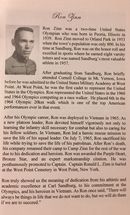
Ron Zinn

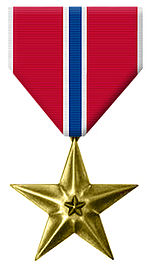
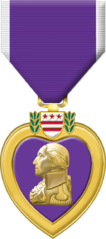
Purple_Heart_Medal.png 7/7/1965  Ronald L. Zinn
Two Army As, 1 each in Track & Cross Country.

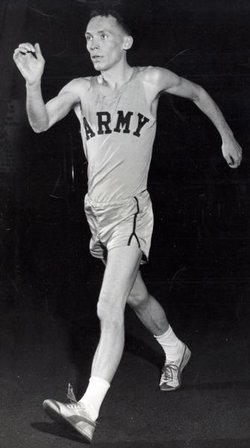
First Cadet to be selected to a USA Olympic team; competed in race-walking at the 1960 Olympics and was top American finisher in the 20K race. Also a key contributor on the Academy cross-country and track teams. Ron was Killed in Action Vietnam 7/7/65 – –  John Easterbrook
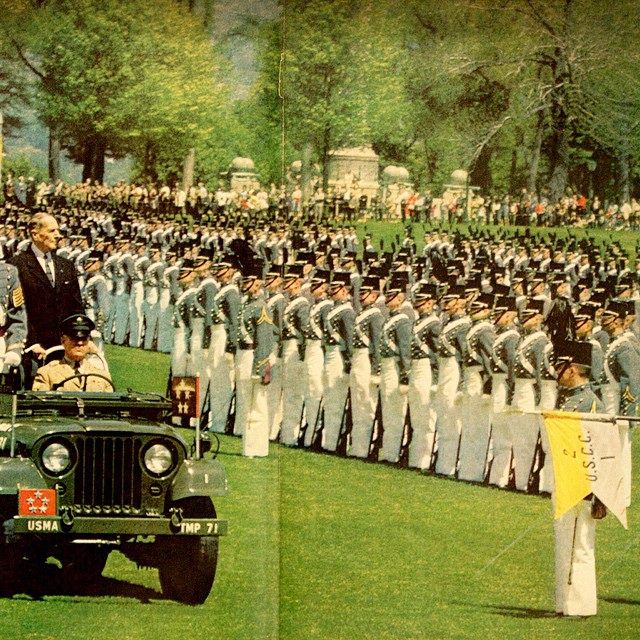
Ron was honored with a Brigade Parade

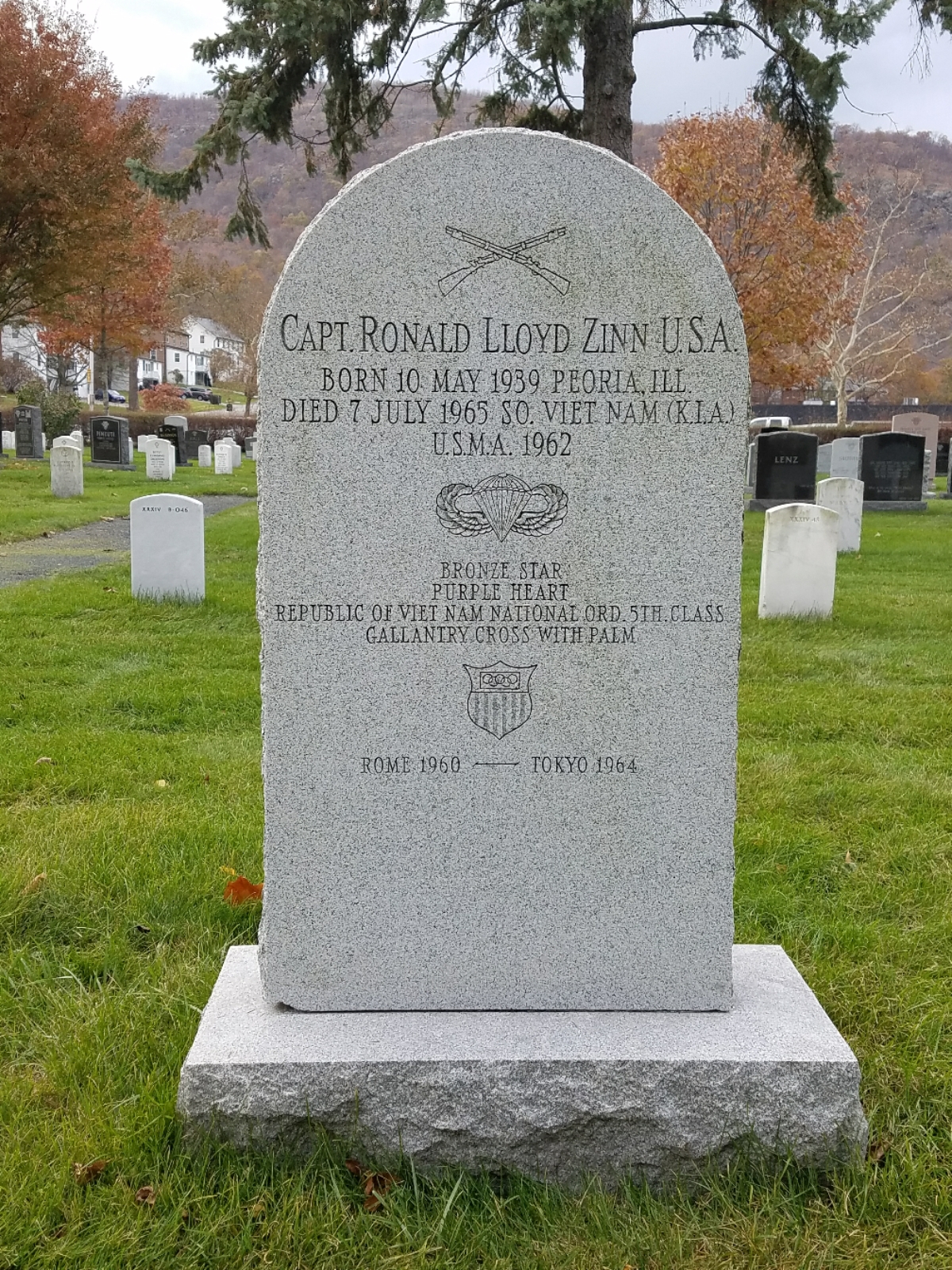
RONALD L. ZINN  1962

Cullum No. 24143-1962 | July 7, 1965 | Died in Vietnam

Interred in West Point Cemetery, West Point, NY

Ronald Lloyd Zinn was a cadet who possessed several outstanding virtues, but it was his determination to succeed that allowed him to overcome any difficulty. Although marching, and even running, were sometimes difficult for Ron, he went on to become an Olympic class race walker. He represented the U.S.A. in Rome and again in Tokyo.

He was relentless in his efforts to succeed as a cadet and as an Olympian. His loving parents and family saw how his efforts bore fruit time and time again. They were extremely proud of Ron. The Zinns knew he was one of “America’s finest.” COL Richard “Dick” Kent remembers his former roommate: “Even after 41 years, I remember Ron as a truly modest, honest, and straightforward person with a dry sense of humor. He made lots of Corps Squad trips but usually managed to bring something back for his roommates. He spent more than a few weekends at our home in Manhattan Beach and was well liked by everyone there. I guess the thing that sticks with me the most after all this time is my recollection of Ron’s levelheadedness and his fundamental decency.”

That’s the way I remember Ron, too, as we shared the rigors of cadet life in Company C1. Ron and I also ended up in the same company Yearling year at Camp Buckner. This was fortunate for both of us, since our company won the Buckner Stakes training competition. As a result, Ron and I both celebrated Labor Day weekend with a three day pass in NYC. I still have a picture of us standing around the piano at Joe King’s Ratskeller, our glasses raised in unison to the beat of our favorite drinking song. Another fond memory of Ron occurred during our First Class year when I was on holiday leave. Sitting in the basement of my girlfriend’s house, I turned on the television and tuned in to a track meet being held at Madison Square Garden. Ron was clearly visible on the screen as he power walked his way to the front of the pack. My immediate reaction was to proudly exclaim, “That’s my classmate, Ron, and he’s on his way to another victory!”

Dick Kent also recalls memories from First Class year, after Ron had been in the Olympics: “Lots of other cadets, myself included, would challenge Ron to informal walking races. After all, how hard could it be? We all probably harbored secret hopes of beating the champ. At first, Ron would sort of humor us and let us win. If we became too obnoxious or insistent, he would reluctantly, and with a degree of resignation, show us the basic points of Olympic walking and how sorry we really were. It was done without malice and in genuinely good humor, but it left me in total awe of Ron’s capabilities and self discipline. If you pressed him for stories of what the Olympics were like, he would never talk about himself but would make an observation about his fellow athletes and his respect for them, even those from Warsaw Pact countries.”

Ron is not only remembered by family and classmates, but also by the comrades in arms with whom he served. On 21 Apr 2000, Ron’s company commander in Viet Nam, Infantry LTC Roy Lombardo, placed a wreath on Ron’s grave at the West Point cemetery and addressed the assembly of “Bravo Bulls.” He said: “We, veterans of Co. B, 2/503d Parachute Infantry Regiment, assemble today in memory of LT Ron Zinn, not to praise you, but to remember you. There are 64 veterans of Company B, in contact by letters and email, and all who served with you remember you with camaraderie and respect.”

In his eulogy, LTC Lombardo observed: “We remember a young officer, described by his Military Academy classmates as fun loving yet ascetic in his physical training regimen; a tough wrestler with a unique ability to absorb pain while outlasting his opponents; a world class track Olympian, participating in the 1960 Olympics while still a cadet, and in the 1964 Olympics after commissioning; as a lean, muscular lieutenant who joined us on Okinawa and led the company track team to the battalion championship. We remember a newly married officer, anxious to become proficient at his Infantry assignment but equally anxious to have his bride, Barbara, join him on Okinawa.

“We remember a dedicated soldier who worked night and day to master his trade in the jungles of War Zone D and to win the trust of his men, for whom he cared deeply. We remember a determined leader, who, on 7 July 1965, rushed to the aid of his wounded squad leader, only to succumb to enemy fire. In so doing, you became the first officer KIA in the 173rd Airborne Brigade and one of the first in Viet Nam.”

Inspired by Ron’s selfless example, Bravo’s battered heroes turned the tide of battle. In the process, they garnered a Medal of Honor, two Distinguished Service Crosses, four Silver Stars, 14 Commendation Medals, and more than 100 Purple Hearts. Ron’s valor was emulated over and over again.

In addition to the military, the athletic community also commemorates Ron. Each year in Asbury Park, NJ, an event is held for all wouldbe champion walkers, and I even participated in the CPT Ronald Zinn Memorial Races one year. I didn’t win any prizes, but I still treasure the Tshirt I received bearing his name.

There are many of us still left on this earth who never will forget Ron as a brave soldier, a worldclass athlete, and a real class guy. His name is not only engraved on the Viet Nam Memorial Wall in Washington, DC, and his tombstone in the West Point Cemetery, it is also etched in the hearts of all of us who were fortunate enough to have known him.

Sleep well, old friend, you are not forgotten. Pax vobiscum.

“At the 1964 Olympic Trials for 50 kilometers, Chris McCarthy was walking in a pack that included Army Lieutenant Ron Zinn (later killed in Vietnam) and Don DeNoon of the Southern California Striders, who holds the national indoor mile record. At one point McCarthy attempted a burst, and an official following on a bicycle shouted, “McCarthy, that’s one warning on you!” Zinn and the others complained to the official that according to the rules he couldn’t judge from a moving vehicle. The judge pedaled ahead, sulking, and descended from his bicycle. When the group passed him, McCarthy was back walking cautiously in the middle of the pack. “DeNoon,” shouted the judge, “that’s one warning on you!” DeNoon eventually received a second caution and had to leave the race. McCarthy went on to win…Many race walkers are former distance runners who started walking either out of curiosity or necessity. Ron Zinn switched from cross-country to walking following an arch injury….At the National AAU championships in St. Louis in 1963 no walking judges appeared. Ron Zinn covered two miles in 14:03.6, erasing Henry Laskau’s championship record by almost 20 seconds. Chris McCarthy, who was then putting out a magazine for race walkers, published a picture of Zinn finishing with both feet off the ground. “Ron Zinn soars to victory,” said the caption.”

Ronald Zinn of Orland Park, III., a West Point first classman, set course record of 1:4I:5 1 in winning National AAU 20-kilometer championship walk at Buffalo, finished 26 seconds ahead of Jack Mort-land of Ohio Track Club of Columbus.


September 21, 1964
A Roundup Of The Sports Information Of The Week
Chris McCarthy of Chicago, Bruce MacDonald of New York and Mike Brodie of Pleasant Hill, Calif. heeled-and-toed their way on to the U.S. Olympic Walking Team in the 50-kilometer trials in Seattle and joined Ron Zinn of West Point, N.Y.. Lieut. Ron Laird of Pomona. Calif. and Jack Mortland of Columbus. Ohio, who had earlier qualified for the squad in the 20-kilometer walk.

I have just learned of the death in action in Vietnam of a fine friend, Lieut. Ron Zinn. I am sure those who were with the U.S. Olympic team in Tokyo, where Ron finished sixth in the 20-kilo walk, must be saddened by this news.
In its way, Ron’s performance in this race was as important to American race walking as was Billy Mills’s brilliant 10,000-meter victory to distance running.
I roomed with Ron both in Tokyo and on a trip to Moscow in 1961. He was a fine athlete and sportsman, a gentleman and as fierce a competitor as I have ever met.
JACK MORTLAND

Located at Wall Municipal Complex, the 2010 Captain Ronald Zinn 5K Run and 10K Walk was directed by Shore AC’s 1956 Olympic Racewalker Elliott Denman.
The event is meant to celebrate the life of the late great Olympian Ronald Zinn, an Olympic racewalker, West Point Alum, and a Captain in Vietnam, Ronald Zinn was killed in war leaving behind a true legacy. Before the race began, Elliott spoke to the runners at the start of the race about the life of Captain Ronald Zinn. 

Soldier, Olympian

by Dave Phillips 62 Sports Historian

How could the remarkable race walker Ron Zinn not be included in the Army track and field media guide? He was a member of two US Olympic teams and I remember well watching the beginning of one of his Olympic races on television (black and white). He was in the lead as the walkers left the stadium. I was so proud of him and West Point I practically levitated. Tom Feeley ’62

He earned Class Numerials in Track & Field, Cross Country and Wrestling, while earing Army A’s in Track & Field and Cross Country

He was a fine young officer, revered by his men, and was killed in RVN. Link to site dedicated to Ron —

http://www.virtualwall.org/dz/ZinnRL01a.htm

Captain Ron Zinn Memorial Award

Given to the outstanding U.S. race walker to commemorate the achievements of Capt. Ron Zinn, who lost his life in combat during the Vietnam War. A race walker, he was a member of the U.S. Olympic Team in the 1964 Summer Games at Tokyo and his sixth place finish in the 20 km event was considered outstanding for American walkers at that time.


Web page for West Point Grave Site

http://www.findagrave.com/cgi-bin/fg.cgi?page=gr&GRid=6791979

BENNING 1962; ONE MILE RUN. “Gun goes off and everyone bolts from the starting line. Wait! Ron is WALKING! As the runners quickly leave him in the dust, the Cadre goes NUTS! SCREAMING, “RUN! RUN!” and a few other choice remarks. But NO; Ron keeps walking, pumping his elbows. At the 3/4 mile mark, Ron starts passing stragglers by the dozens. It’s now obvious Ron will be well under the “TIME TO BEAT” 6 MINUTE MILE and everyone on the sidelines [the next group of runners AND the Cadre] starts clapping and cheering for Ron as he walks across the finish line. Glad I was there – thanks, guys. Way to go, Ron. Tom Feeley ’62

May 2013 VFW Article provided by Steve Sperman

–
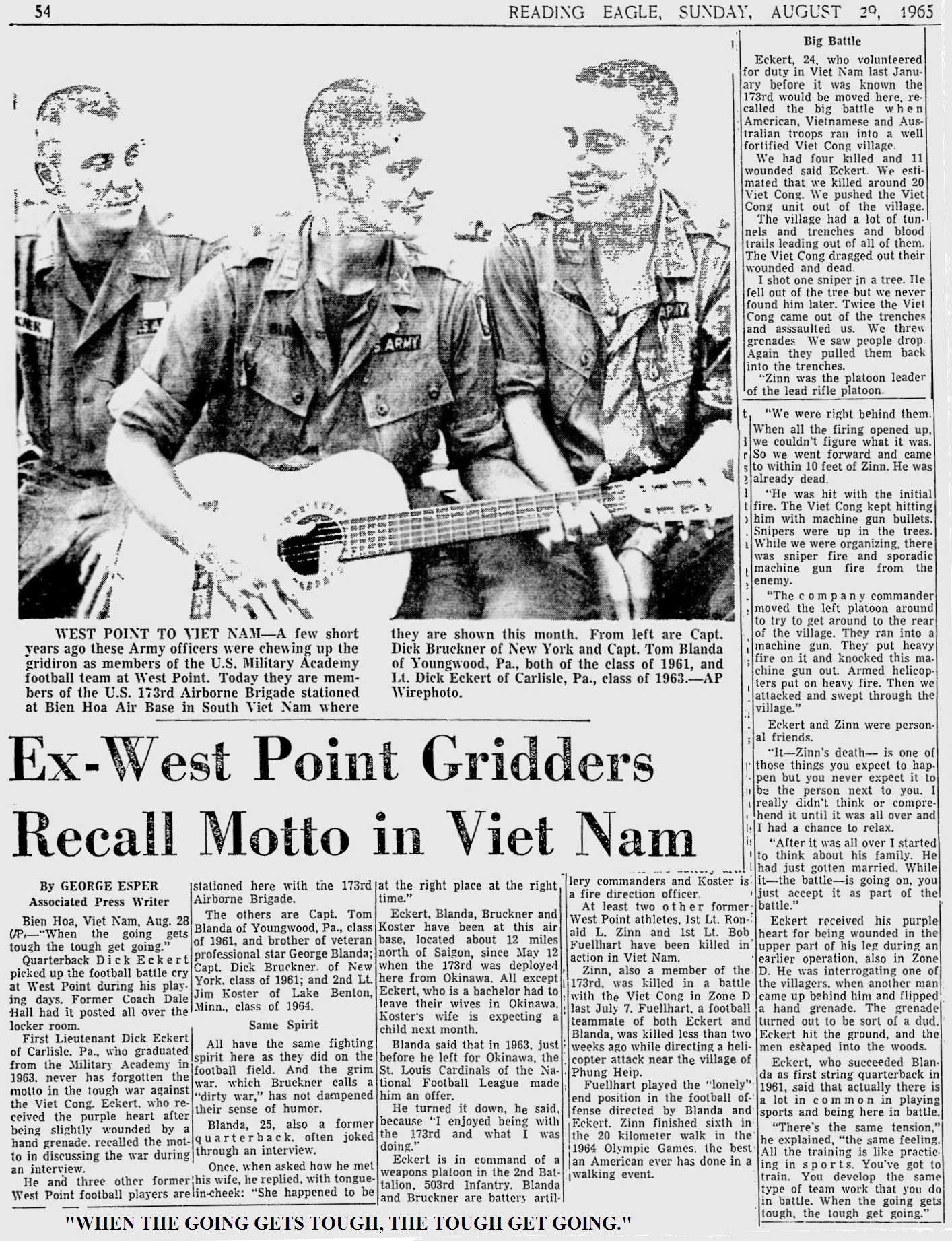
ArmyFB_1961-64_Vietnam_ReadingEagle_Aug291965

BIRTH


Peoria, Peoria County, Illinois, USA
DEATH 7 Jul 1965 (aged 26)


Ho Chi Minh (Saigon), Hồ Chí Minh Municipality, Vietnam
BURIAL

West Point, Orange County, New York, USA

PLOT Section XXXIV, Row D, Grave 141


Ronald Lloyd Zinn
Captain
B CO, 2ND BN, 503RD INFANTRY, 173RD ABN BDE, US ARMY SPT CMD VIETNAM, MACV
Army of the United States
Orland Park, Illinois
May 10, 1939 to July 07, 1965
RONALD L ZINN is on the Wall at Panel 2E, Line 30
See the full profile or name rubbing for Ronald Zinn
cib.gif


phndvsvc.gif

armyjump.gif 

Ronald L Zinn
usarv.gif 173abn2.gif 503infrgt.gif
Ronald L Zinn


CPT RONALD LLOYD ZINN
07 Jul 2001


From a West Point comrade and fellow member of the track team who remembers Ron as a competitive walker who represented our country on the 1960 Olympic Team. With deep gratitude we are remembering you and all the others who served and died in times of war so that we may enjoy the Freedom and Liberties that make the United States of America great.

Clark T. Ballard, Jr., M.D.
Colonel, U S Army (Ret)
66 Leschi Drive, Steilacoom, WA 98388-1514
n6qg@yahoo.com

10 Apr 2002


Dear Family and Friends of Captain Ronald Lloyd Zinn,

I am very sorry about your loss. It must have been a terrible experience that he went through, and I am sorry. I recently visited the Vietnam Memorial on my class trip to Washington D.C. He must have been a very brave man. It was very honorable of him to step up and be part of the war. He showed great nationalism, and I want to thank him for fighting the war for us. I am deeply sorry for your loss.

Christina
CMKaiser@aol.com

01 Apr 2003


It was my honor to serve in the U.S. Army with Lt. Ron Zinn in 1963-1964 in Ft Devens, Mass. As a secretary to the unit commander, I often was able to talk with him about his fantastic ability to walk fast. He often would walk faster than I was able to run during daily workouts. He often walked from Ft Devens to Boston and back just for practice. He was a very professional and dedicated person.

Spc. William Weigand
mz95bd@tir.com

23 May 2007


Thank you to the creators of this memorial. Ron Zinn was and forever will be my brother. It is nearing 42 years since his death. His parents are both gone, but his sister and I remember him often with love, affection, and admiration. He was very special, as are all those names on the Wall. In 2006, there was a nice ceremony in Orland Park. It was to recognize her fallen heroes, of which Ron was one.

From his brother,
Jerry Zinn
Davenport, Iowa
jerryzinn@mchsi.com

A Note from The Virtual Wall

On 07-08 July 1965 ten US soldiers from the 173rd Abn Bde were killed during a sweep in the area known as War Zone D, north of the Dong Nai River and northwest of Bien Hoa. They were

  • E Troop, 17th Cavalry
    • PFC Johnie E. Rice, Freeburn, KY
  • B Co, 1st Bn, 503rd Infantry
    • SGT McArthur Johnson, Wilmington, NC
    • SGT Durward F. Ray, Columbus, GA
    • PVT Edward J. Almeida, New Bedford, MA
  • C Co, 1st Bn, 503rd Infantry
    • PVT John D. Shaw, Summit, MS
  • B Co, 2nd Bn, 503rd Infantry
    • CPT Ronald L. Zinn, Orland Park, IL
    • SSG David L. Howard, Fountain Inn, SC
    • PVT Rudolph V. Hernandez, San Antonio, TX (Bronze Star “V”)
    • PVT Allen I. Johnson, Cloquet, MN
  • HHC, 2nd Bn, 503rd Infantry

6791979_1510887518

6791979_1489147774 

This Photo depicts what it takes to achieve the Impossible.  I would have liked him to continue Wrestling.  He earned a 62 for his Gray Jacket.  A Teammate
“Ron was one of the most determined individuals you could ever meet,” Jerry Zinn said of his older brother. “If there was a challenge, he was up to it.”
image


15045 West Ave Orland Park Il 60462

Eagle Scout Tim Klotz, of Orland Park Boy Scout Troop 383, created the memorial garden to forever remember Captain Ronald L. Zinn.
45319894_2177767229177259_5607395472139354112_n     


Biography prepared for the sign at the Ronald L. Zinn Memorial Garden and Captain Zinn’s induction into the Carl Sandburg High School Athletic Hall of Fame.

At Sandburg, Zinn was on the honor roll and excelled in sports. In 1957, he was named the school’s most valuable athlete. He would eventually become the first US Olympian to graduate from Carl Sandburg High School.
 
Ron married his wife, Barbara, shortly before being deployed to Vietnam in May, 1965.
 
“As a new platoon leader, Ron devoted himself vigorously to learn the infantry skills necessary for success in combat. He deeply cared for his subordinate which was the basis for his heroic rescue efforts to aid his wounded squad leader and led to his being killed in action.”
Lieutenant Colonel Roy S. Lombardo, Jr.
 
After his death, the company named their camp after their beloved friend calling it Camp Zinn for the duration of the war. Zinn was posthumously promoted to the rank of captain.
 
“There will always be things in life that we do not want to do; but we will do them, if we are to succeed.” US Army Captain Ronald L. Zinn 


Elexa Willis

awaiting data

Holly Pedley

awaiting data

Pamela Pearson

awaiting data

Jim Irons

Class of 1950. Played right guard.  Played with “Doc Blanchard” & “Glenn Davis”. He was captain of the baseball team.

Morris Herbert

awaiting data

Gary Winton

awaiting data

This page has been removed

Use the search button on the left – type in STU SHERARD


Mike Viti

Mike is Class of 2008

Army Firstie fullback Mike Viti gave everything against Navy despite having a high right ankle sprain. (Editors note – see Army Lore Home Page

“The trainers and the doctors looked at it,” Viti said. “Realistically, it was bad, even if I hurt it that much more it wasn’t going to hurt that much more. It probably would have hurt more to stay out. There’s time to let it heal. There’s an off-season, end of a career. If it’s not your senior season and the last game of your career, you don’t go”

http://www.dallasnews.com/sharedcontent/dws/spt/football/nfl/stories/033008dnsponfldraft.32e0e48.html

Scott Wesley

awaiting data

William Sullivan

awaiting data

Justin Koenig

awaiting data

Norman Schwarzkopf

awaiting data

Austin Miller

awaiting data 2007

Mike Castelli

awaiting data 2007

Peter Bier

awaiting 2007

Glenn Davis


Glenn Davis in 1944 — He played Fullback until Doc Blanchard arrived

The Webster’s dictionary definition of a gentleman barely does justice to Glenn Davis. Ask Joe Shelton ’44, a Firstie in Glenn’s company when Glenn was a Plebe. Ask — —, ’50, a Plebe who went on calls to Glenn’s room when Glenn was a Firstie and was perhaps the most celebrated athlete in America. Ask Joe Steffy ’49, Glenn’s Classmate and Outland Trophy Winner. Each gives the same response when asked about Glenn: a very fine person, a gentleman.
Glenn Davis: a gentleman in the tradition of the 19th century. A genleman as Robert E Lee was a gentleman.

Glenn Davis: “The Real Touchdown Twin”

by David Pietrusza

Despite being dubbed the “Touchdown Twins,” Army’s Glenn Davis and Doc Blanchard were not identical physical specimens. Doc Blanchard, at 6’0″ and 205 pounds, was by far the bigger of the two football legends. The 5’9″, 170 pound Davis, however, may have been the better natural athlete.

At the Point Davis lettered not only in football but in baseball, basketball and track. And he did not just letter. On the diamond the center fielder’s arm was described as “whiplike,” and he was good enough to earn Branch Rickey’s comment that he could fetch a $75,000 bonus. Coming from a man with a reputation for tossing dollars around like man-hole covers, that was high praise indeed.

Even in his full football uniform Glenn Davis could flat out run, covering 100 yards in less than ten seconds Perhaps most impressive though was his performance on the “Master of the Sword” test the Military Academy devised to test the athletic prowess of future officers. Out of a possible 1,000 points on such diverse events as a 300-yard-run, dodge run, vertical jump, parallel bar dips, softball throw, sit-ups, chin-ups, and the standing broad jump, the average cadet scored 540. Davis posted a 926.5 mark, the all-time record.

While Davis was not, however, Doc Blanchard’s physical twin, he was his brother Ralph’s twin. Ralph was named for their father, a southern California bank manager, but it was Glenn who was always known as “Junior.” Why? He was born ninety minutes after his “older” brother.

The Davis twins were nearly inseparable. They double-dated together, played harmless juvenile pranks together, and planned on attending USC together. But instead Congressman Jerry Voorhis (later defeated for re-election by a young war veteran named Richard Nixon) offered Glenn a berth at West Point. Glenn said yes but only if brother Ralph could come along.

No problem, said the Army, bring him along.

Glenn Davis had already distinguished himself as an athlete, being a four-letter man in high school and winning the Knute Rockne trophy as Southern California’s outstanding schoolboy track star. In football he scored 263 points his senior year.

Davis debuted for Army during the 1943 season, running for eight TDs and passed for four more. West Point, which recently had been a football laughingstock, finished with a respectable 7-2-1 mark. It was a decent start for both Davis and his team, but it hardly gave any hint of the true greatness to come.

Football, however, was not the only thing on Davis’ mind in 1943 – or maybe it was. Even though he rose at four each morning to cram in his studies, he still failed math and was in the parlance of the Academy “found” deficient. That meant he was kindly asked to leave the Academy that December to study even harder for re-admission.

Davis succeeded, returning to West Point the next fall but having to repeat his plebe year. That had its benefits. During World War II West Point was graduating classes in three years rather than four. Davis’ lack of numerical expertise gave him another year on the gridiron – and ultimately the Heisman Trophy.

In 1944 Davis came into his own, leading the nation with an average of 11.5 yards per carry and in total scoring with 120 total points. Blanchard and Davis, “Mr. Inside and Mr. Outside,” paced Army to an undefeated and untied season–it’s first since 1916. The Black Knights scored a fearsome 504 points, 56 per game, second only to 1904 Michigan’s 58.9. Army rightfully earned the Lambert Trophy, the Williams Trophy, and the Williamson Plaque.

Davis secured the Maxwell Trophy, the Walter Camp Trophy, and the Helm Foundation Award, but finished second to Ohio State’s Les Horvath for the Heisman.

Speed was his forte, but it was hardly the only weapon in his arsenal. “He also possessed,” Bob Carroll, the founder of the Professional Football Researcher’s Association (PFRA), noted, “a devastating change of pace, a powerful leg drive, and a strong stiff arm.”

Despite his natural ability the grind occasionally wore on Davis. Football required an hour and a half of grueling practice each day -in addition to the three hours of physical education required weekly of each cadet. And, of course, there was the obligation of academics and the specter of another failed math course. “I never used to think about taking a daytime nap,” Davis admitted, “Now I get sleepy every time I see a sofa.”

Army went on to another perfect season in 1945 and at Yankee Stadium defeated Navy for the national championship. Davis’s 49-yard touchdown helped.

For the year Davis scored 108 points and led the nation with 11.5 yards per carry. Such a performance inspired the great Grantland Rice to write in November 1945: “Davis is not only one of the fastest backs that ever lugged a football on any field at any time, but he is also a strong running back who isn’t easy to bring down.”

And those who actually had to face him were even more impressed. “Every time Davis touched the ball,” said Columbia’s Gene Rossides, “it would be like an electric current going through the defending team.”

Yet, it was Doc Blanchard, who led the nation in total scoring and captured the 1945 Heisman. Still when Blanchard accepted his trophy in January 1946, he told the audience: “I’d have voted for Glenn Davis.”

All eyes were on Army’s squad as it began its 1946 season. Both Blanchard and Davis returned for another season. Their teammates elected the “Touchdown Twins” as the first co-captains in Army football history, and they graced the cover of Life magazine.

That was the good news. Just about every other indicator was bad. First and foremost, the nation’s civilian schools now benefitted from demobilization. West Point and Annapolis would no longer have their pick of athletic talent. the competition was getting equalized.

Secondly, after the some acrimonious public wrangling team lost one of its stars, Thomas “Shorty” McWilliams, who was allowed to resign from the Academy.

And against Villanova in the season’s first game, Doc Blanchard hurt his knee and was never again at peak form. Davis had to pick up the slack. Perhaps his greatest moment came against Michigan when he rushed for 105 yards and caught seven passes for an additional 159 yards. Beyond that, he intercepted two passes and even threw a pass for a another touchdown.

Legendary Army coach Earl “Red” Blaik praised him as “the best player I have seen, anywhere, any time.”

Despite increased competition and Blanchard’s ills, 1946 Army squad still remained undefeated; the only blot on its record being a scoreless tie against Notre Dame, which dethroned the Black Knights as national champions.

Red Blaik had no apologies and ranked his 1946 Black Knights as superior than either the 1944 or the 1945 teams. “I reserve the warmest affection and the greatest respect for the 1946 team,” he once wrote, ” which, in the face of adversities, playing the best of college opposition, completely and thoroughly demonstrated its right to be classed as great.” Much as Davis had placed second in 1944 and 1945 for the Heisman, Blaik had come in second for Coach of the Year honors both seasons. In 1946 he captured the award.

And Glenn Davis finally won his Heisman. The glory was now his. Also bestowed on him were the Maxwell Trophy, the Walter Camp Trophy, and the Associated Press designation of Male Athlete of the Year. He might have also garnered the Sullivan Trophy — but in an administrative snafu his name had been left off the ballot

The Heisman vote:

Player                    School           Total

1 Glenn Davis Army 792

2 Charles Trippi Georgia 435

3 Johnny Lujack Notre Dame 379

4 Doc Blanchard Army 267

5 Arnold Tucker Army 257

6 Herman Wedemeyer St. Mary’s 101

7 Burr Baldwin UCLA 49

8 Bobby Layne Texas 45


By the time Davis had hung up his Army spikes he has posted some prodigious numbers:

                   RUSHING            PASS RECEIVING         SCORE

YEAR ATT YDS AVG NO YDS AVG TD TOTAL

1943 95 634 6.7 7 68 9.7 1 48

1944 58 667 *11.5 13 221 17 4 *120

1945 82 944 *11.5 5 213 42.6 0 108

1946 123 712 5.8 20 348 17.4 5 78

Totals 358 2957 8.3 45 850 18.9 10 354


* – Led the nation

In his 38 games for Army Davis had scored 59 touchdowns. Twenty-seven were over 37 yards, with his longest being 87.

The NFL’s Detroit Lions drafted Davis, and both he and Blanchard had wanted to pursue pro football careers after graduating. But the Secretary of the Army refused to allow such activity, and the only football action the duo saw in 1947 was on the set of a low-budget film called The Spirit of West Point. The picture was hardly memorable, but it had its place in football history. During filming, Davis tore cartilage and ligaments in his right knee. They never healed properly.

Red Blaik had once commented about Davis that he was “as bashful as a girl on her first date, even though he is an All-America.” That may have been true, but it did not stop the very eligible bachelor from being seen with a number of Hollywood’s most attractive young starlets. Still in the Army, he dated Ann Blyth and after meeting Elizabeth Taylor at a touch football game on the beach (where else?), they became an item. Just before Davis shipped off for Korea, the couple became engaged (“When I saw that frank, wonderful face, I thought, ‘This is the boy'”), but Taylor proved less reliable than Doc Blanchard and the engagement was off. He was later married briefly to actress Terry Moore before marrying the beautiful Ellen Harriet Lancaster Slack.

After completing his obligatory three-year Army hitch, Davis returned to football, signing with the Los Angeles Rams in 1950 and powering them to 9-3-0 record, good enough for a tie with George Halas’s Chicago Bears. They defeated the Bears 24-14 but fell to the Browns in that year’s Championship Game 30-28.

Davis had lead the Rams in rushing, scoring seven touchdowns, but thought the injury he had suffered during The Spirit of West Point’s filming and the four-year layoff had taken their toll on his skills. “I was as good a player as a senior in high school,” he once modestly said, “as I was with the Rams.” After just one more season in the NFL he called it quits.

For three decades he worked as special events director for the Los Angeles Times, earning the respect of those around him. “West Point,” said one sports writer a half-century ago, “might make an officer out of Glenn Davis, but he’s already a gentleman.”

Here is what was said at his passing

As most of you know, Glenn Davis – Army’s fabled “Mr. Outside” — recently passed away, and was buried adjacent to his revered coach, Red Blaik, at the West Point cemetery on March 18th. It was a bright day, with Glenn’s widow, Yvonne, there as well as a number of the Davis family. Many of Glenn’s teammates were there to bear witness, along with other friends and sports luminaries. Interestingly, Bobby Ross, and the entire West Point football coaching staff — Every one of them — were there, along with Joe Bellino, Navy’s first Heisman award winner.

Pete Dawkins was asked to speak on behalf of the heritage of generations of the Army team.

Glenn Davis’ Funeral
March 18, 2005

It goes without saying that Glenn was a remarkably gifted athlete, whose achievements stand tall in the annals of West Point, and in the history of sport in America. For that, he earned our undying respect, and deep admiration.

But, to me, Glenn was so much more, besides.

Over the past week, his passing caused me to think a lot about, “What makes a life?” – and, “Just what is it that made Glenn’s life so memorable, and so special?”

I’m not at all sure that I’ve found the answer but, in my musings, three remembrances came to stand out, that I thought would be appropriate to share with you today.

First, it’s important to remember that Glenn was not just a great star, he was also a great teammate. Even in the face of the torrent of notoriety – that, weekly, blustered with headlines bulging the wonder of his personal exploits (and often those of Doc Blanchard, “Mr. Inside”, as well) Glenn thought of Steffy and Tucker and Poole and Foldberg .. and all the others, too. And he understood, without any question in his mind, that it was the team – not just the marvel of his personal performance – that brought victory, and truly deserved the accolade of success.

It wasn’t forced, or false, or pretend, or clever, or calculated, or conscious, or contrived. It was Glenn. Given West Point, and the times, it seemed natural, and the right way to think – and behave. But in contrast with so many of our “sports-idols” of today, we can truly relish Glenn’s dignity and quiet humility.

My second reflection is related, in that it was Glenn’s humility that made his prodigious talent “human” – and accessible. During the season of 1946, I was 8 years old. Yet Glenn’s impact on my life was very personal – and powerful. It wasn’t just that he was a star. It wasn’t just that he had “explosive” speed and uncanny balance. It was something more. Glenn had about him a grace… a kind of majesty. A personal aura that touched the spirit of a young 8-year old in Michigan. In a way that I can’t fully explain, it was beguiling. Looking back, I realize that it kindled my youthful imagination, and sparked – for me – the allure of West Point, and the dream of the Army team.

Now, it occurs to me that there was a third distinctive attribute that Glenn shared with all of us who came to know him well: his friendship. I knew him for a little more than 40 years. Many of you here knew him quite a bit longer. The truth is, Glenn and I didn’t see one another all that frequently. Most often, it was in conjunction with some sort of Heisman affair. But it was the kind of friendship where we picked up exactly where we had left off the last time, without missing a single beat.

In more recent times, after he and Yvonne were married, Judi and I — and the two of them — seemed to often find ourselves together at the end of the evening. I look back on those as treasured times. We talked, and laughed, and reminisced, and speculated on times ahead.

I always came away feeling refreshed. Glenn had a disarming directness, and selflessness about him that was very special. He never complained; instinctively dwelled on the positive half of everything; and came up with some of the most unexpected, and insightful, perspectives anyone could ever imagine.

It seems to me that there’s little more you could ask for in a friendship than this.

Last fall, during half-time at the TCU game, a group of us were asked to assemble in Michie stadium, at the 50 yard line of Blaik field. As Glenn was feeling the difficulties of his therapy at that time, he slipped his arm into mine, and asked if I would escort him onto the field. On our way out, he began to apologize for needing my help. I interrupted him in mid-sentence and told him, “Listen to me: Glenn Davis never, ever needs to apologize to me.” In fact, I told him that in all the years I had known him, and been with him – and, in fact, at that very moment – all my eyes ever saw was the strong, fresh, sculptured form of my boyhood idol.

What I said was the absolute truth. And I believe I saw him rise up a little more erect. And stride forward with strength and confidence.

“What is it that makes a good life?” He knew. And, in truth, that was the way he lived.

We miss you, Glenn. All of us do. But, more importantly, we will remember you — long, and well.

Godspeed, good friend.

http://apse.dallasnews.com/contest/2004/writing/over250/over250_columns_first1.html

http://www.heisman.com/sports/m-footbl/spec-rel/031005aaa.html

http://archive.recordonline.com/archive/2004/11/19/losportm.htm

Football’s Greatest Decade – – by Bernie Mcarty –
http://www.la84foundation.org/SportsLibrary/CFHSN/CFHSNv01/CFHSNv01n1b – – see page 5

This writer believes West Point 1945 is the greatest team of all time. The 1944 Army team may actually deserve that title, but it was never tested. Army was also undefeated in 1946, 1948 and 1949.

Army’s top stars during 1945-1949 were the effulgent “Touchdown Twins”, Glenn Davis and “Doc” Blanchard, Arnold Tucker, Arnold Galiffa, “Rip” Rowan, Bobby Jack Stuart and Gil Stephenson in the back-field, and up front Joe Steffy, Art Gerometta, Jack Green, Bill Yoemans, Joe Henry “Tex” Coulter, Al Nemetz, and the sterling end duo of Hank Foldberg and Barney Poole.

In 1945 the Newspaper Enterprise Assoc. simply picked the entire Army team as its All-American team, stating no group of All-Americans could beat the Cadets.

Only a world war could have brought together such a collection of players to one institution. But it took the coaching genius of Col. Earl Blaik to mold the players into a cohesive unit.

In truth, Navy personnel was equal to Army’s on an individual basis. The Middies never jelled as a team, however.

The 1951 Army outfit might have been as good as the 1945 Cadets, but the
infamous cribbing scandal wiped out the team.

–

–

no sound


–


–


–

–

Elmer Oliphant

–

ArmyFB_1918_ElmerOliphant_Assembly_1

–

ElmerOliphant_USMA1918

–

ArmyFB_1914_ElmerOliphant_Assembly_2

–

ArmyFB_1914_ElmerOliphant_Assembly_3

–

ArmyFB_1914_ElmerOliphant_Assembly_4

–

ArmyFB_1914_ElmerOliphant_Assembly_5

–

ArmyFB_1914_ElmerOliphant_MilwaukeeJournal_Aug281914

–

ArmyFB_1914-1918_ElmerOliphant_photo1

–

ArmyFB_1914-1918_ElmerOliphant_photo2

–

ArmyFB_1914-1918_ElmerOliphant_photo3

–

ArmyFB_1914-1918_ElmerOliphant_photo4

–

ArmyFB_1914-1918_ElmerOliphant_MilwaukeeJournal_Nov291936

–

Charles Meyer

Charles R Monk Meyers

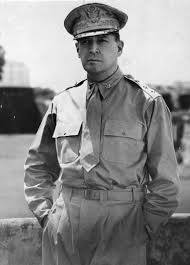
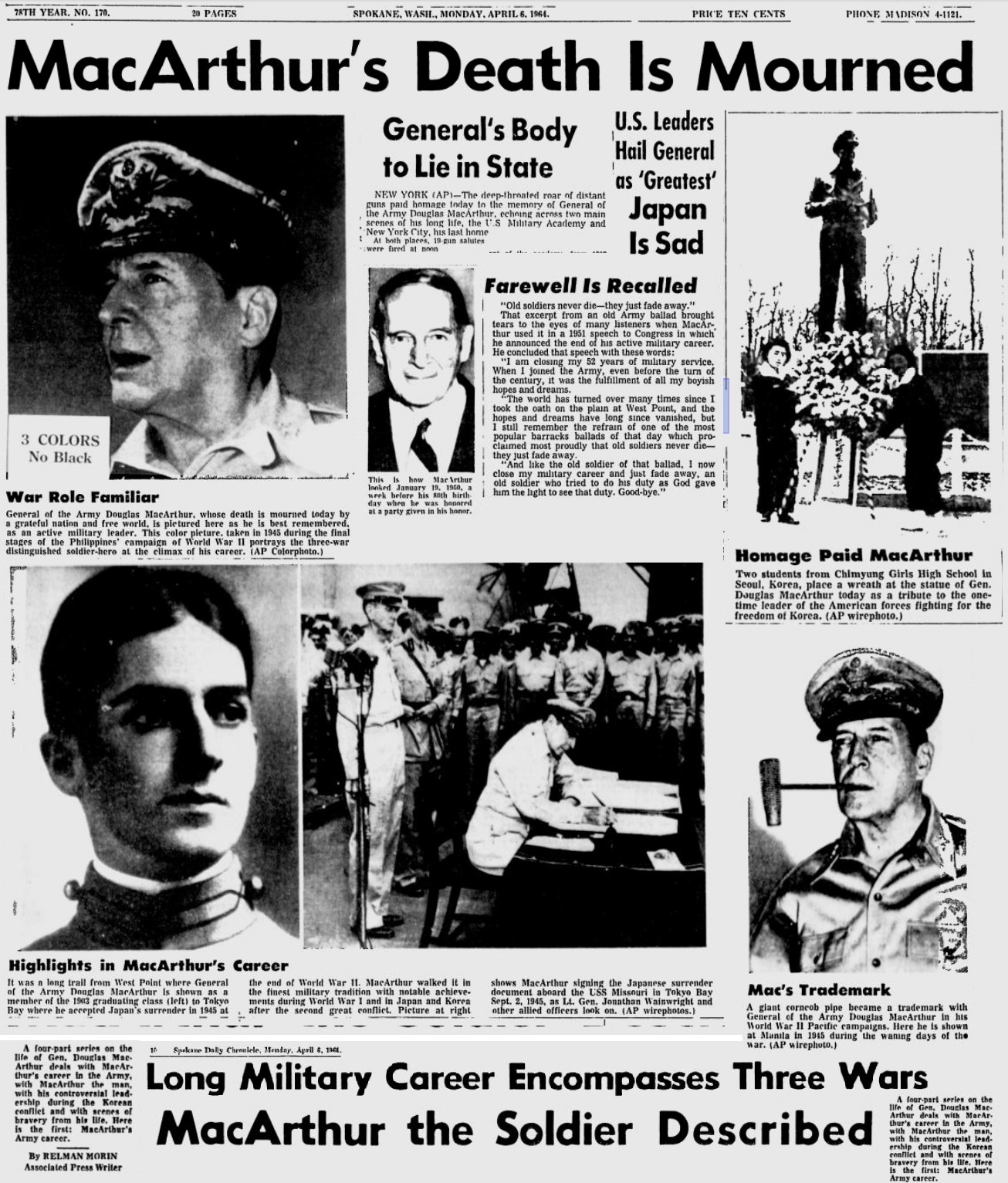
Douglas MacArthur

Awarded the Medal of Honor – Bataan Peninsula 1 April 1942.

It should be noted that General MacArthur’s Father was also awarded the Medal of Honor for Gallantry at Missionary Ridge. See bottom of page

Go to to below link for information on The May 1962 Speech by General MacArthur

http://forwhattheygaveonsaturdayafternoon.com/wp-1962/macarthur-dhc

The Japanese Surrender 1945
http://www.youtube.com/watch_popup?v=vcnH_kF1zXc&feature=player_embedded

MacArthur played Football till injured

General MacArthur’s Duty, Honor, Country speech was recorded for us because Jim Ellis ’62 First Captain and Pete Wuerpel Bde Adjutant ’62 had the foresight to realize perhaps we would want to remember what the General said to us. He spoke to us without notes

What we remember of that day is at the bottom of this page

http://americanrhetoric.com/speeches/douglasmacarthurthayeraward.html

Jim Ellis' arm is to General MacArthur's right.

Jim Ellis’ arm is to General MacArthur’s right.

MacArthur

What we remember of that day in May when he talked to us

This Saturday, 12 May 2007, marks the 45th Anniversary of the presentation of the Thayer Award to General of the Army Douglas MacArthur ’03 and his legendary Duty, Honor, Country acceptance speech, and several graduates have shared their memories of that day. Perhaps the most significant recollection is of the absolute silence of the Corps and other attendees during the speech.

Larry Waters ’62 added that he had never seen the Corps standing so tall on The Plain as when the general trooped the line during the review that preceded the speech.

Denny Benchoff ’62 noted that “you could hear a pin drop” until a man began taking photographs using a camera with a noisy shutter. A general officer sitting nearby reached over to the man, gently touched his hand, and put a finger up to his lips to indicate silence was requested. All this was done without taking his eyes off GEN MacArthur for more than a few seconds.

Duke Meceda ’62 also recalled the silence during the speech but added that the mess hall was silent for at least 15-20 seconds afterwards as well, the effect of the speech was that dramatic. Then the attendees began to applaud.

Pat Canary notes that when Jim Ellis ’62 dismissed the Corps, the silence resumed as the cadets left the mess hall and returned to the barracks. Many seemed to appreciate the fact that the speech was GEN MacArthur’s farewell to West Point.

Perhaps the most comprehensive recollection was provided by Dick Chegar ’62, who served as escort for GEN Anthony McAuliffe ’19 of Bastogne fame. He recalls that Mrs. MacArthur, Mrs. Westmoreland, and their escorts were seated on the poop deck while a number of famous general officers were seated at ten-man tables near the podium on the ground floor. GEN MacArthur was 82 at the time, and this alone caused a sense of drama in the air, almost symbolic of the passing of an era. His opening joke about the doorman at his hotel asking if he had ever been to West Point before caused the mess hall to erupt in laughter, but the mood soon grew serious as MacArthur spoke of distant battlefields and the American soldier’s “patience under adversity, courage under fire, and modesty in victory.” He delivered his speech without notes, and most attendees were acutely aware of his exemplary oratory. About two-thirds of the way through the speech, however, MacArthur hesitated for a moment, turned to his right, and looked directly at his wife Jean. It was as if a ray of light passed between them in that moment. GEN MacArthur then flawlessly continued his speech to completion. Several weeks later, the Cadet First Captain visited GEN MacArthur in New York City and was told that the speech had been written in advance, committed to memory and rehearsed several times. Dick felt that the pause occurred because the next line may have been forgotten for a moment. Many years later, when one of Dick’s captains won the annual General Douglas MacArthur Leadership Award, Dick told him the story about the momentary pause. When the captain later met Mrs. MacArthur at the ceremony, she confirmed her recollection of the glance that passed between them on that day.

Johnny Godwin ’62 was a member of the cadet officer honor guard arrayed on the steps of Washington Hall. He recalls that GEN MacArthur was extremely gracious, stopping to talk and shaking hands with a strong grip.

There was an air of excitement because MacArthur was already a legend at West Point. At the top of the steps, the general turned and said, “I thank you all.”

Neil Nydegger ’62 was impressed by the General’s “sincerity and genuine commitment to the Army and to West Point” and how he had “captured the simple essence of being a soldier.”

Gary Sharp ’62 recalled: — “MacArthur’s well-chosen words and deliberate delivery made an emotional impression on me that I will never forget … being the first in war and possibly the first to die, the loneliness of remote duty, the hardships on a soldier’s family, the fears that all soldiers face in battle, the camaraderie soldiers experience, the pride and honor felt when a soldier’s job has been done well, and the deeply emotional sound of Taps at a soldier’s burial … were all in his speech. If they were not in his exact words, they were in the silences between them. If any soldier ever needs encouragement before or in battle, he only needs to hear or read MacArthur’s words.”

Fred Bothwell ’62, first in his class in English, was impressed with the general’s choice of words like “tocsin” and “mournful murmur of the battlefield,” calling his speech “the most brilliant piece of oratory that I have ever heard.”

Stu Sherard ’62 was moved by the reaction of his roommate, Frank Reasoner, a former Marine sergeant who returned to the Marine Corps after graduation and was killed in action on 12 July 1965 in Viet Nam, receiving the Medal of Honor posthumously. Hard core Marine Reasoner had tears in his eyes several times during the speech.

John Dilley ’62 also recalls that “there was not a dry eye in the house,” but his strongest recollection is of MacArthur’s intoning, “… the Corps, and the Corps, and the Corps.”

Bob Reid ’62 had a similar recollection of being touched deeply and moved to tears, especially by MacArthur’s final allusion to “the Corps.”

Forty-five years later, Bob Cooper ’62 still finds himself quoting MacArthur’s speech to those he meets who are opposed to the war in Iraq: “This does not mean that you are warmongers. On the contrary, the soldier, above all other people, prays for peace, for he must suffer and bear the deepest wounds and scars of war.”

Bill Ross ’62 recalled MacArthur’s sonorous delivery and a more pragmatic aspect: GEN MacArthur, as a former Superintendent, exercised the prerogative normally reserved to heads of state and granted amnesty, permitting Bill to enjoy the beautiful Saturday afternoon without sitting confinement.

John Taylor ’62 recalls that Army’s newly-established Rugby Team, of which he was one of the co-founders, went on that afternoon to beat the leading rugby club in the nation, the New York Rugby Club.

Mike Moore ’62 recalls being photographed presenting a 1962 Howitzer to the general (Mike was the editor) and then flying off to Syracuse to play lacrosse, Army winning by about ten points.

Gus Fishburne ’62 recalls that the baseball and lacrosse teams attended in uniform, standing along the walls of the north wing during the speech.

Tom Eccleston ’62 recalls a very personal and pragmatic result of having heard the speech. After several years of active duty and a tour in Viet Nam, Tom embarked upon a civilian career selling high voltage equipment and was given The Boston Edison Company as a challenge. While attempting to sell some old timers at Boston Edison his company’s equipment, he happened to mention that he had heard MacArthur’s speech. He was then seen as a minor celebrity and received a large contract within the year.

Like many of his classmates, Dave Francis’62 initially was waiting impatiently for lunch to be over so that he could hop into his Austin Healey sports car and drive down to Philadelphia for the weekend: “in the subsequent years, the memory of that weekend in Philadelphia has faded, but the memory of MacArthur’s speech has remained with me.”

Denny Coll ’65, however, was just a Plebe at the time and a member of the football team brought back in uniform and pads from spring practice to hear the speech. He also was a sleep-deprived Plebe who had just had a hearty football training table meal in a very warm, un-air conditioned mess hall. He and some classmates dozed off after the opening minutes of the speech, only to be awakened by the sound of MacArthur’s West Point ring inadvertently striking the podium near the microphone. His recollection of the speech is limited to its moving conclusion: “Today marks my final roll call with you, but I want you to know that when I cross the river my last conscious thoughts will be of The Corps, and The Corps, and The Corps. I bid you farewell.” He then realized that he was a part of history but had missed most of a historic speech.

Others also missed the speech, but for official reasons. Ernest Gus Zenker ’62 had branched Air Defense Artillery and was visiting a Nike missile site in New Jersey that Saturday, along with several Air Defense classmates.

Many more would have missed hearing the speech, however, had it not been for the presence of mind of the First Captain, Jim Ellis. The previous evening he had contacted the Public Information Officer at the time and asked if the speech would be recorded. The PIO office had no plans to do so. Jim then asked his roommate, Pete Wuerpel, the Adjutant, to set up a recorder on the poop deck. All other recordings of the speech owe their genesis to Pete’s reel-to-reel tape .. which he still has. And now you know the rest of the story.

—–

–

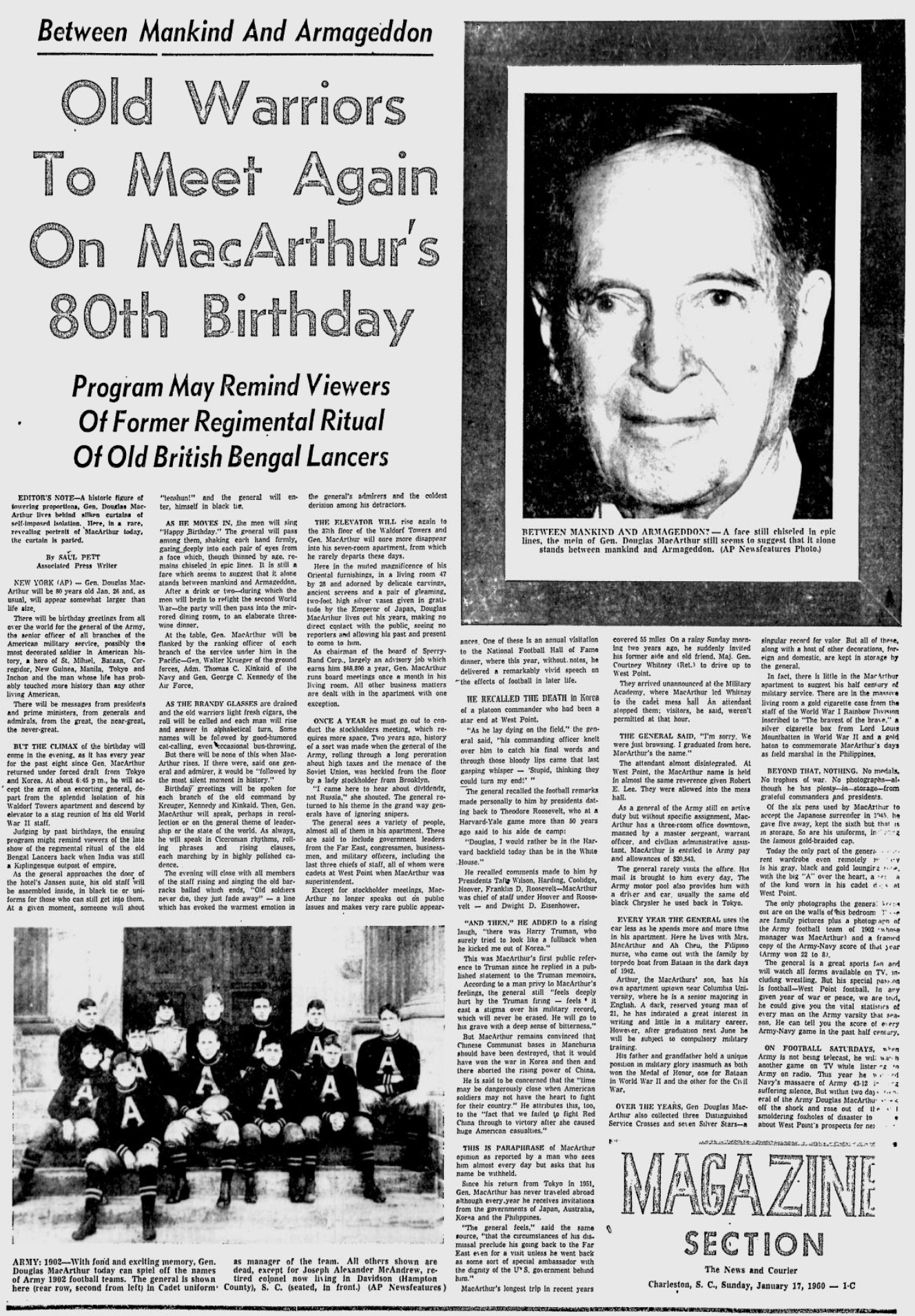
DouglasMacArthur_80thBirthday_NewsandCourier_Jan171960

–

DouglasMacArthur_Death_SpokaneDailyChronicle_Apr61964

The man who won 24 Olympic gold medals for the United States isn’t Michael Phelps or Mark Spitz or even Jesse Owens. In fact, he didn’t compete in any Olympic sport. Yet he swung America’s attention to the importance of the Olympic Games as no other American had ever done — and turned Olympic gold into a rebirth of the American spirit.

He was General Douglas MacArthur.

We usually think of MacArthur as one of the supreme commanders of World War II, liberator of the Philippines and rebuilder of a shattered postwar Japan — and the genius behind one of the greatest military master strokes in history: the landing at Inchon during the Korean War.

But in 1928 MacArthur was president of the U.S. Olympic Committee, and led his country’s team to some of its most glorious moments — and laid the foundations for America’s love affair with the Olympics ever since.

At the time the modern games had only been held seven times since their founding in 1896. Many Americans wondered how much time and money the United States should spend — or waste — on the Olympic effort. So when the president of the U.S. Olympic Committee died suddenly, the other members turned desperately to the former superintendent of West Point and World War I hero, Major General Douglas MacArthur.

He was already famous for his advocacy of sports at West Point; his message to cadets about athletics, “On the field of friendly strife are sown the seeds that . . . bring forth victory,” stands near the West Point football stadium to this day.

MacArthur accepted the job with enthusiasm, and threw himself into the work as if he had been planning a military campaign. He met with coaches, gave inspiring speeches to sponsoring committees, harangued his coaches and his athletes — even supervised their training and workout schedules.

When the team arrived in Holland for the games, the outlook was not bright for our entrants, MacArthur wrote later, but he was determined that the United States should win. He became in effect Coach-in-Chief, attending every practice he could and meeting with athletes to evaluate their performance and motivate them to a higher level. MacArthur admitted he rode them hard: “I stormed and pleaded and cajoled.” He told them that America was the greatest nation in the world and therefore it deserved to have the greatest Olympic team.

We have not come 3,000 miles just to lose gracefully, he thundered, we are here to win, and win decisively.

When the U.S. boxing team’s coach threatened to withdraw from further competition after a blatantly unfair decision, MacArthur stopped him cold. Americans never quit, MacArthur barked. It became the motto for the entire team.

MacArthur’s fierce effort paid off. The United States had won 24 gold medals, more than the next two most-decorated countries, Finland and Germany, put together. The U.S. team had set 17 Olympic records and seven world records. When they returned to the United States, MacArthur wrote up a stirring report for President Coolidge on his team’s performance, and urged that support for the Olympic Committee be put on a more regular basis with a $2 million endowment fund.

Nothing has been more characteristic of the genius of the American people than their genius for athletics. MacArthur told the president. The experience, he said, “has made me proud to be an American.”

One of his old field commanders, General Charles Summerall, wrote to MacArthur: “You have not only maintained the reputation that Americans do not quit, but that Americans know how to win.

MacArthur had turned the Olympic Games into a source of national pride, as well as a national priority. Victory there has remained a symbol of the American spirit — one we need this year, perhaps, more than ever.
Historian Arthur Herman is a senior fellow at the Hudson Institutein

–