Author Archives: forwhattheygave.com

My site was placed on WordPress in 2013. Since then I have added a significant amount of material. Approximately 9 months ago my yearly bill was due. I was suddenly unable to access Forwhattheygave.com. A Wordpress Tech contacted me offering assistance. He simply tried to copy my material and assumed control of Forwhattheygave.com. My site still exists as the Tech recently copied material and created ForWhatTheyGaveOnSaturdayAfternoon.com which was my web site prior to setting umps site on Wordpresss. You can find the site as couple of Months ago a WordPress Tech found the site. Thank You. Phil

Swimming & Diving Women

Women’s Swimming & Diving pages

Swimming & Diving Men

Mens Swimming & Diving pages

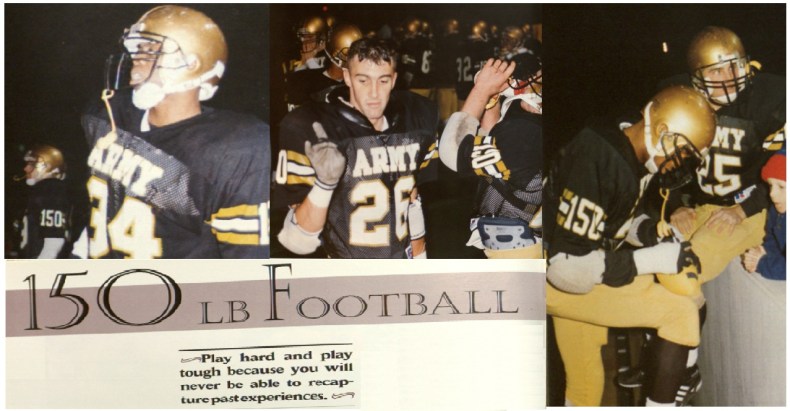
150, Lightweight, Sprint Football


Click on the Team Photos and the highlighted player’s names for additional material

The First Year of 150s is below.

Army 150 lb. Football 1st season – Spring-Fall 1957

Many Cadets had been outstanding high school football players, but because they were small, had no chance of playing football at West Point.

Meanwhile, there was an Eastern Intercollegiate Athletic Association 150 pound Football League. Army was not in the League because Army Coach Earl “Red” Blaik didn’t want Army to have but one team – his. Navy, however, had been in the League since the start, and had won 9 of 11 championships.

Suddenly, in the Spring of 1957, at the end of our 2nd Class year, it was announced that Army would join the League, and field a team in the fall. Try-outs would take place over a 3-day period at the field next to Michie Stadium.

600 Cadets in the Classes of 1958, 1959, and 1960 signed up for the tryouts. 600! Soon, the big day arrived and we learned that the screeners would include Red Blaik, Doc Blanchard, Glenn Davis, and Arnold Tucker – Army Greats, all of them. We thought, “looks like they’re serious about this.”

Doc Blanchard, Glenn Davis and Arnold Tucker returning to the Academy for the first time since Graduation. (Note probably not in 1957) Photo

After 3 days of every imaginable football test, 200 of us were selected to report for final tryouts 3 months later in September 1957. The summer flew by – summer trip, summer duty, and every day 200 Cadets looked forward to 150 pound football.

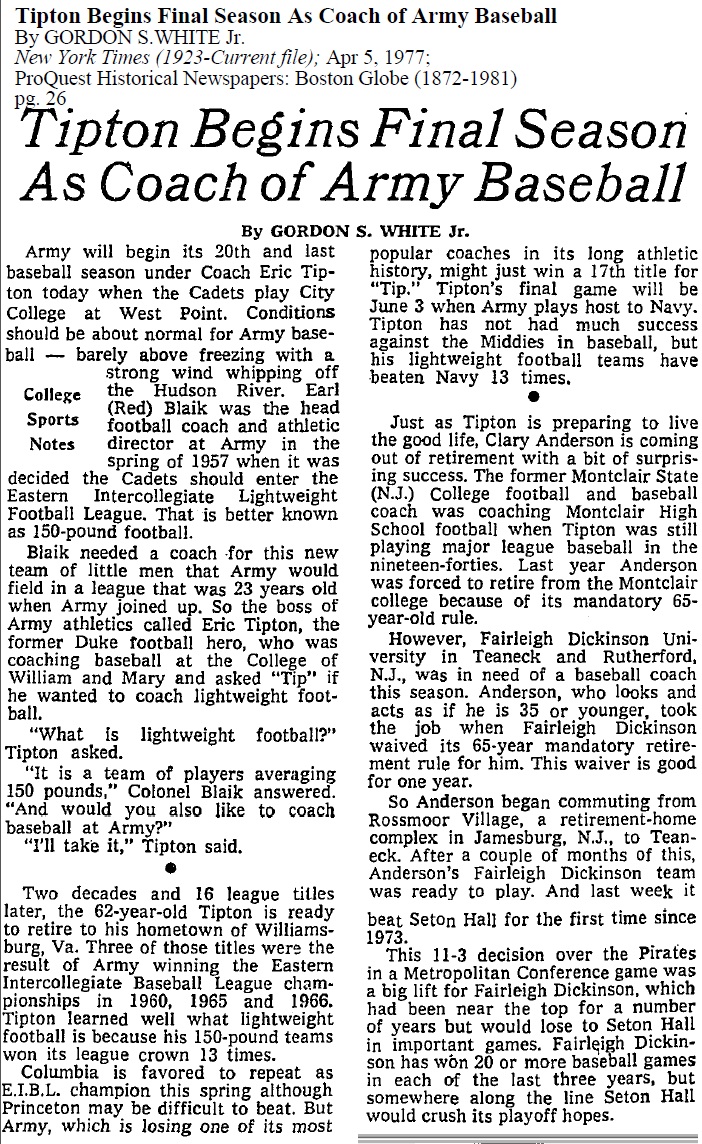
Finally, the big day arrived, and two hundred 150lb. hopefuls turned out to meet our new coach and try to make the team. Our new coach was Eric Tipton, an All-American Football player at Duke in the late thirties, a professional baseball player and coach, and a great leader. Coach Tipton had 2 weeks to cut the squad from 200 players to 48 men who could play both offense and defense, could make weigh-in at 154 pounds, learn plays, and play our first game. Tall order – the pressure was on.

At the end of the week, several – 58ers had made the cut. The starting team included Quarterback Ralph Wensinger (a ’58 classmate just turned back to ’59), Running Back Jude Thiebert (a track sprinter who was on the “big” Army team, but dropped “down” to play 150lbs), Center Brad Johnson (who was to be our team Captain), Left Guard Bill Shely, Left Tackle John Brinson, and Left End Dick Schonberger. So 1958 had 6 of 11 starters, and a large number of other ’58ers made the roster, as well.

Within a week, Coach Tipton had us ready. We played and won our first two games, against Columbia and Cornell, by big margins, and then went down to Annapolis to play our biggest challenge – the U S Naval Academy, the undisputed rulers of 150 lb. Football. We went down 3 days early, so we could get over the jitters before the game. The Middies gave us the treatment in their Mess Hall, but we laughed them off.

Finally, the game came. President Eisenhower in the stands. We fought it out with Navy for 3-1/2 quarters. We could move the ball, but just couldn’t score from inside their 20. They couldn’t move the ball, but had a good punter. Neither side risked a passing attack. Finally, with 4 minutes left in the game, Navy fumbled on their own 43-yard line. Our second team, our best defensive team, was on the field and RG Dick Welch recovered the fumble. There was a lengthy time-out as one of our teammates was carried off the field with torn knee ligaments. We promised him we’d score. Coach Tipton sent in the first team, including 6 1958ers – Ralph Wensinger at QB, Jude Theibert at RB, Brad Johnson at Center, Bill Shely at LG, John Brinson at LT, and Dick Schonberger at LE.

1957 Team

5-0-1 Beat Navy
League Champions

formerly at http://forwhattheygaveonsaturdayafternoon.com/wp-1958/150team

Additional page –

https://forwhattheygave.wordpress.com/2008/07/07/1957-150-pound-football-team/

As we went onto the field, we told Ralph, “Run it straight at ’em – no passes – we can beat ’em – they can’t stop us” – echoed by our whole team. And we ran it at them, knocking them back on their heels. Four yards, 5 yards, 4 yards – in 7 plays we were on the goal line with about a minute left. Ralph called a sneak – wedge blocking – and we pushed the very tough Navy line back over the goal line and Ralph plunged over.

Army 7 – Navy 0. On their last possession, Navy couldn’t move the ball. Time ran out. The game was over. It was a great night for us in Bancroft Hall coupled with a visit to the hospital to visit our wounded.

After we beat Penn handily, our over-confident team faced an excellent Princeton team who tied us 21 – 21. It was a huge disappointment. They had a great passing attack, and it was all we could do to hang on for a tie. Because of that tie, and because Rutgers was undefeated, we had to beat them to win the Championship. We went to New Bruswick and won 34-14.

Columbia, Cornell, Navy, Penn, Princeton, and Rutgers. The season was a great success. We not only were undefeated, and won the Eastern Intercollegiate Championship, but we beat NAVY! Through it all, our Classmate, Quarterback Ralph Wensinger was a rock. He was a super athlete, very competitive, never gave up, and loved football. We loved Ralph. Coach Tipton would go on to become the winningest coach in any sport at West Point.

Sadly, our great Quarterback, Ralph Wensinger, would be killed in Vietnam. None of us will ever forget him.

User Info

Dearest Daddy,

It is Memorial Day May 31, 2021.

I turned 60 two and a half weeks ago and sadly realized it has been 53 years my heart as a 7 year old child was broken.

I will always honor your bravery, courage and sacrifice to our country but it will never assuage the pain of losing you, no matter how many years pass.

I can still feel that last hug you gave me on June 5, 1968 before you boarded the plane for Vietnam. I can still see you in your khaki uniform as you carry your duffel bag and board the plane – waving one last time to Me (your oldest daughter) and Cynthia (your middle daughter).

The past recedes, but my memories don’t fade and my pain will never diminish.

I love you Daddy and I always will.

Be Thou At Peace,

Your eldest daughter Elaine

Ralph Robert Wensinger (Daddy) October 28, 1935 – October 21, 1968
Patricia Ann Wensinger (Mom) 1941 –
Elaine Ann (Wensinger) Knowles 1961- Daughter of Ralph Robert Wensinger
Cynthia Ann Wensinger 1964 – Daughter of Ralph Robert Wensinger
Kathleen Ann (Wensinger) LoFreddo 1965 – Daughter of Ralph Robert Wensinger

John Brinson, C-2, 1958

1958 Team

6-0 Beat Navy
League Champions

1959 Team

5-1 Lost to Navy

1960 Team

5-1 Lost to Navy

1961 Team

5-1 Lost to Navy

A Member of the Class of 62 Gave 26 Years to the 150s

1962 Team

6-0 Beat Navy
League Champions

1963 Team

2-3 Lost to Navy

1964 Team

6-0 Beat Navy
League Champions

1965 Team

5-1 Lost to Navy

1966 Team

6-0 Beat Navy
League Champions

1967 Team

4-2 Lost to Navy

1968 Team

6-0 Beat Navy
League Champions

1969 Team

4-2 Lost to Navy

1970 Team

6-0 Beat Navy
League Champions

1971 Team

5-1 Beat Navy
Co-Champions with Navy

1972 Team

6-0 Beat Navy
League Champions

1973 Team

6-0 Beat Navy
League Champions

1974 Team

6-0 Beat Navy
League Champions

1975 Team

4-2 Beat Navy

1976 Team

6-0 Beat Navy

League Champions

1977 Team

3-2 Lost to Navy

1978 Team

3-2 Lost to Navy

1979 Team

4-1 Beat Navy
Co-Champions with Navy

1980 Team

6-0 Beat Navy
League Champions

1981 Team

4-1 Lost to Navy

1982 Team

3-2 Lost to Navy

1983 Team

8-0 Beat Navy
League Champions

1984 Team

5-2 Lost to Navy but then Beat Navy 52-0 in the Antracite Bowl
Co-Champion Navy & Cornell

1985 Team

5-2 Lost to Navy

1986 Team

5-2 Beat Navy
Co-Champion with Navy & Cornell

1987 Team

5-2 Beat Navy
Co-Champion with Navy

1988 Team

6-1 Lost to Navy
League Champions

1989 Team

5-0-1 Beat Navy
Co-Champion with Princeton

1990 Team

6-0 Beat Navy
League Champions

1991 Team

5-0-1 Tied Navy

1992 Team

4-3 Lost to Navy

1993 Team

5-2 Beat Navy

1994 Team

6-0 Beat Navy
League Champions

1995 Team

6-1 Lost to Navy

1996 Team

6-1 Beat Navy
Co-Champions with Navy & Penn

1997 Team

5-2 Lost to Navy

1998 Team

5-1 Beat Navy
Co-Champions with Penn

1999 Team

5-1 Beat Navy

2000 Team

6-1 Beat Navy Twice

2001 Team

5-1 Lost to Navy

2002 Team

4-2 Lost to Navy

2003 Team

5-1 Beat Navy

2004 Team

4-3 Lost to Navy

2005 Team

4-3 Lost to Navy

2006 Team

3-3 Lost to Navy

2007 Team

2-5 Lost to Navy

Need Photo

src=”” width=”790″ />

2008 Team

2-5 Lost to Navy

Need Photo

src=”” width=”790″ />

2009 Team

6-1 Lost to Navy

Need Photo

src=”” width=”790″ />

2010 Team

5-1 Beat Navy
Co-Champions with Penn

Need Photo

src=”” width=”790″ />

2011 Team

5-2 Lost to Navy

Need Photo

src=”” width=”790″ />

2012 Team

7-0 Beat Navy
League Champions

Need Photo

src=”” width=”790″ />

2013 Team

7-0 Beat Navy
League Champions

Need Photo

src=”” width=”790″ />


October 2008 – – 150, Lightweight, Sprint 51st Reunion

old – http://forwhattheygaveonsaturdayafternoon.com/wp-2008/reunion

— Kevin Anderson – Director of Athletics

— Pete Dawkins, ’59 – too big to play 150

— “Jude Thiebert”, ’58 – #43 Halfback

— “Bill Shely”, ’58 – #67 Left Guard

— Dick Schonberger, ’58 – #87 Left End

— Brad Johnson, ’58 – #53 Center and Team Captain

— John Brinson, ’58 – #73 Left Tackle

— Jim Kays, ’62 150 player, Asst. Coach 3 years and 150 OIC for 19 years

— “Buster Hagenbeck”, 150 player and current USMA Superintendent

— Not shown: Ralph Wensinger, ’59 (turned back form ’58) – #10 Quarterback in ’57 and ’58, KIA Vietnam

—————————————————————-

Old site 150 pages

old – http://forwhattheygaveonsaturdayafternoon.com/wp-1959/150

old – http://forwhattheygaveonsaturdayafternoon.com/wp-1960/150

old- http://forwhattheygaveonsaturdayafternoon.com/wp-1961/150

old – http://forwhattheygaveonsaturdayafternoon.com/wp-1963/150

old- http://forwhattheygaveonsaturdayafternoon.com/wp-1964/150

old – http://forwhattheygaveonsaturdayafternoon.com/wp-1965/150

old – http://forwhattheygaveonsaturdayafternoon.com/wp-1966/150

old – http://forwhattheygaveonsaturdayafternoon.com/wp-1967/150

old – http://forwhattheygaveonsaturdayafternoon.com/wp-1968/150

old – http://forwhattheygaveonsaturdayafternoon.com/wp-1969/150

old – http://forwhattheygaveonsaturdayafternoon.com/wp-1970/150

old- http://forwhattheygaveonsaturdayafternoon.com/wp-1971/150

old – http://forwhattheygaveonsaturdayafternoon.com/wp-1972/150

old – http://forwhattheygaveonsaturdayafternoon.com/wp-1973/150

old – http://forwhattheygaveonsaturdayafternoon.com/wp-1974/150

old – http://forwhattheygaveonsaturdayafternoon.com/wp-1975/150

old – http://forwhattheygaveonsaturdayafternoon.com/wp-1976/150

old- http://forwhattheygaveonsaturdayafternoon.com/wp-1977/150

old – http://forwhattheygaveonsaturdayafternoon.com/wp-1978/150

old- http://forwhattheygaveonsaturdayafternoon.com/wp-1979/150

old – http://forwhattheygaveonsaturdayafternoon.com/wp-1980/150

old – http://forwhattheygaveonsaturdayafternoon.com/wp-1981/150

old – http://forwhattheygaveonsaturdayafternoon.com/wp-1982/150

old – http://forwhattheygaveonsaturdayafternoon.com/wp-1983/150

old – http://forwhattheygaveonsaturdayafternoon.com/wp-1984/150

old – http://forwhattheygaveonsaturdayafternoon.com/wp-1985/150

old – http://forwhattheygaveonsaturdayafternoon.com/wp-1986/150

old – http://forwhattheygaveonsaturdayafternoon.com/wp-1987/150

old- http://forwhattheygaveonsaturdayafternoon.com/wp-1988/150

old- http://forwhattheygaveonsaturdayafternoon.com/wp-1989/150

old- http://forwhattheygaveonsaturdayafternoon.com/wp-1990/150

old- http://forwhattheygaveonsaturdayafternoon.com/wp-1991/150

old – http://forwhattheygaveonsaturdayafternoon.com/wp-1992/150

old – http://forwhattheygaveonsaturdayafternoon.com/wp-1993/150

old – http://forwhattheygaveonsaturdayafternoon.com/wp-1994/150

old – http://forwhattheygaveonsaturdayafternoon.com/wp-1995/150

old – http://forwhattheygaveonsaturdayafternoon.com/wp-1996/150

old – http://forwhattheygaveonsaturdayafternoon.com/wp-1997/150

old- http://forwhattheygaveonsaturdayafternoon.com/wp-1998/150

old – http://forwhattheygaveonsaturdayafternoon.com/wp-1999/150

old- http://forwhattheygaveonsaturdayafternoon.com/wp-2000/150

old- http://forwhattheygaveonsaturdayafternoon.com/wp-2001/150

old – http://forwhattheygaveonsaturdayafternoon.com/wp-2002/150

old – http://forwhattheygaveonsaturdayafternoon.com/wp-2003/150

old- http://forwhattheygaveonsaturdayafternoon.com/wp-2004/150

old – http://forwhattheygaveonsaturdayafternoon.com/wp-2005/150

old – http://forwhattheygaveonsaturdayafternoon.com/wp-2006/150

old – http://forwhattheygaveonsaturdayafternoon.com/wp-2007/150

Soccer Women

Womens soccer pages

Soccer Men

Future soccer pages

Gymnastics

Future gymnastics pages

Golf

Future Golf pages

Cross Country Women

Future women’s cross country pages

Basketball Mens

Future basketball pages

Baseball

Future baseball pages

Rifle

See

http://forwhattheygaveonsaturdayafternoon.com/wp-coaches/oscar-gallman

Lacrosse


Sports Illustrated — June 12, 1961

JOYS OF A JUNE WEEK —
By Ray Cave

Army and Navy, those classic rivals, celebrate graduation time with fun and games at West Point and Annapolis, and both win approval from several thousand pretty guests

Whether you were the type who loves a parade, the sort who goes where the girls are or simply a connoisseur of athletic Donnybrooks — the place to be last Saturday (June 3d) was either West Point or Annapolis.

On the stern high bluffs above the Hudson were the pomp and pageantry of an Army graduation week, hundreds of pretty young ladies who had come from every state in the union and an Army-Navy baseball game that starred a very famous athlete. And on the gentle slopes of the Severn, the Navy offered more gold braid and brass bands, more beauties and a lacrosse game with a national championship at stake.

When Navy held its pep rally on Thursday evening, two days before the game, it had no inkling that the Army lacrosse team was nursing a year-long grudge. The likelihood of athletic successes was adding to the normal joys of the Annapolis June Week. An electric “Beat Army!” sign flashed from Bancroft Hall, the world’s biggest dormitory, which houses all 3,665 of the midshipmen.

Rear Admiral John F. Davidson, the academy superintendent, was introduced at the rally by a glib midshipman as “Big Daddy,” and he took it gamely while the exuberant middies cheered. Already the first dates were arriving for their week-long stay, a social assembly that would include three dances, three parades, a concert by Duke Ellington and an address by President Kennedy at graduation. Tough old Navy captains with houses on the academy grounds were helplessly watching their wives take in girl boarders by the score, while the graceful but small colonial town of Annapolis (23,385) was preparing its boarding houses for 50,000 visitors. (Also ready: the town’s 200 legal Slot machines, the biggest concentration of one-armed bandits east of Las Vegas.)

The town’s narrow streets, meanwhile, looked like a scene from a Monte Carlo road rally. Four hundred graduating first classmen had bought cars. On May 27 regulations preventing them from using automobiles had been lifted, and convertible sport models in flaming red were obviously this year’s choice.

“I know we’ll do well,” summed up the admiral as he spoke at the Thursday pep rally. “Army, Army, call the doctor,” sang the midshipmen while they waved their bright white hats and stood impressively tall in the short-sleeved, tropical uniforms that Navy wears in such hot spots as Guam, Panama and Annapolis.

The next morning the Navy lacrosse team was practicing on an athletic field so close to the Severn River (which is actually a tidal backwater, not a river at all) that when Coach Bill Bilderback arrived his first words were, “Don’t throw the balls in the water.”

The Navy squad should be able to throw well enough to miss a river. Last year it was unbeaten in college play, ending the season by defeating a favored Army team at West Point. (That was the game which Army was remembering so well this week.) This season Navy won nine more consecutive college games, but frequently in such hairbreadth fashion that John Paul Jones would have given up the ship as lost. Navy was badly behind against every major opponent. It trailed Maryland 5-1 in the second half and fought back to win in overtime. It was behind 8-4 to Baltimore University in the last period, and scored in the last minute to beat Virginia.

Speed and stamina, not lacrosse finesse, seemed to be winning for Navy. At the beginning of the season the Middies were actually given little chance of another title. “But we kept improving every game,” said Coach Bilderback, sounding a little surprised himself. Navy was getting excellent play from a big (6 feet 2 inches) attack man, Tom Mitchell, had an outstanding defenseman in Team Captain Neil Reich and six football players who provided some brute force. The most noticeable of these was John Hewitt, captain of next year’s football team. Navy’s 1961 lacrosse philosophy was simple: run, run, run, and eventually the other fellow won’t be able to get up and down the 110-yard field. This worked all year.

But if Navy was a surprise, Army was more so. In the state of Maryland there is a tendency to feel that a man cannot play lacrosse unless he is raised within 40 miles of Baltimore. Army was pooh-poohed for playing a weak schedule, and accused of using more muscle than talent. “Animals,” a Baltimore newspaper said of the Army team, after carefully making an exception of the Marylanders on it.

One little non-Marylander, however, was a 5-foot 8-inch, 154-pound twirling nuisance named Pat Hillier, who was from Long Island. His 20 goals led Army’s scorers. “Best we’ve seen,” said the Navy scouting report bluntly, after listing six things he did well. Another was 155-pound Rusty Broshous, from the town of West Point, N.Y.

In the midfield Army had Ron Hannon, a 1961 version of Pete Dawkins. Hannon was first captain of cadets, star of the basketball team and, as Navy put it, “a rough, tough midfielder.” The Army defense was composed of three football players, none of whom had handled a lacrosse stick before their second year at West Point. “Our stick work isn’t the best, but we hit people,” said one of them, Glenn Adams, a big, fast football halfback with a knack for understatement.

Army Coach Jim Adams — tall as a Texan, laconic as a down-Easter and actually (of course) from Baltimore — felt that his team, like Navy, also had developed late in the season. And it had two other striking similarities to Navy: a tough defense and the run, run, run philosophy. “We’ll just try and keep up with them,” Coach Adams said. He made it sound wistful. Bilderback was also sounding wistful. Looking at the national lacrosse trophy which Navy has kept since last year’s victory, he said, “I hope I won’t be wrapping it up soon.”

Despite occasional showers, more than 6,000 paid their way into the Navy stadium on Saturday. CBS-TV was also there, taping the game for a sports spectacular to be shown five days later. What they got was a spectacular game. The Navy defense gave Army only 10 shots in the first half (20 is average). But Army, body-checking, battering and, most of all, running, as it substituted four different sets of midfielders, kept its poise. Poor Navy shooting resulted in a 2-2 tie at half time. Then, in the space of 51 frantic seconds shortly after the start of the third period, Navy poured in three goals. Against any less resolute opponent this would have ended the game. At the same time the crowd was cheering the news (announced on loudspeakers) that Navy had won in Army-Navy track, tennis, golf and baseball.

But Army coolly tightened its defense, began putting two men to chasing the Navy player with the ball, and got away with it when “untirable” Navy started slowing down. Army scored while a Navy player was off the field with a penalty, scored again when a midfielder broke through all alone at the goal, and finally tied the game at 5-5 when a beautiful bounce shot by Hannon skidded in.

The blitz continued when a daring pass the full length of the field set up a goal by Broshous. A minute later Broshous brazenly stole the ball from the Navy goalie and flipped it in for a score. In the last moments of the third period Army Captain Sam Wilder almost casually held the ball behind the Navy goal, then came out to his left and scored with exactly one second left. This, the last of six straight Army goals, was doubly discouraging to Navy and proved decisive, because the Middies fought back to 9-8 before finally losing 10-8. So determined was Army’s defense that not a single Navy goal was made by a first-string attack man. Army’s Broshous and Hillier each scored twice.

At the final gun the air was filled with sticks, gloves and helmets thrown high by the Army players. The Army substitutes, who had stood up the entire game as if to show the team’s determination, joined the melee. Happy Jim Adams was carried to the dressing room and congratulated by an Army general wearing a “Beat Navy!” button just below six impressive rows of service decorations on his uniform.

“Your boys wanted it real bad,” said Navy’s beaten Bilderback to Adams. “Lots of guts.” And it must be said that Navy gave nothing away; Army simply took it.

The victory left it up to the Intercollegiate Lacrosse Association to either name Army national champion, or make both Army and Navy co-champions because each lost one game, Army to Virginia. But whatever they do, Army has what every Army team wants most, the win over Navy. Minutes later the Army team was roaring and shouting as its bus crawled through the traffic back to the Navy field house. There it grabbed Jim Adams, starched shirt and all, and threw him over a sea wall into the Severn. As his players were about to let him fly, a frantic Navy voice of authority was heard shouting, “Don’t! Don’t! The tide’s out!” But Navy was just a little too slow again. There was, it turned out, enough water to float Jim Adams, the happiest man at June Week.

James Adams – Army Lacrosse Coach 1958 – 1969

Hall of Fame – – – http://www.uslacrosse.org/museum/halloffame/view_profile.php?prof_id=10

Coach Ace Adams being chunked into the Severn River after the 1961 Army-Navy Lacrosse game, won by Army 10-8.

photo provided by Butch Darrell – 1962 Lacrosse Captain

Sports Illustrated — June 09, 1969

INTO COMBAT WITH STICKS, FOR MORE THAN A TITLE — Patrick F. Putnam

Every Army-Navy match is a miniwar, but the Cadet lacrossemen had never forgotten the ultimate humiliation they were forced to endure following The Great Drubbing of 1965

For Jim Adams, Army’s laconic and long-suffering lacrosse coach, it would be his last chance for some time, perhaps forever, to smack the smugness out of Navy. The Middies do not cross sticks with Penn, and that’s where Adams, because he has five daughters, will be employed next year. At Penn, the daughters of coaches go to school tuition-free; at West Point, where they are stuffy about the sex of their students, they do not. And so – the last trip to Annapolis, with the national championship, or at least an equal share of it with Johns Hopkins, to the winner, and, well, no quarter to the loser. Army hadn’t won this game since 1963, and no one at the Point has been able to forget or forgive The Great 18-7 Drubbing of 1965, when the Middies’ first string poured it on for almost the full 60 minutes, then walked away laughing.

“They never put in any of their reserves,” Adams grimly told his heavily favored Cadets in the locker room just before last Saturday’s game. “They just kept running up the score. And when it was over, they picked up Bill Bilderback [the Navy coach] and carried him over to our bench. It was the most humiliating moment of my life.”

In lacrosse, the teams sit on the same side of the field and are separated by no more than the width of the official scorer’s table. Carrying a winning coach over to greet the loser is akin to sinking an enemy and then shooting holes in his lifeboats. The Army, led by its scoring ace, Pete Cramblet, voted to ignore all white flags.
“It’s nothing personal,” said Cramblet. “Take the Navy guys one at a time and you’ll like them all. Nice guys. But get them all together and you don’t want to know them. We don’t just want to beat them, we want to beat them badly.”

The Cadets went into Saturday’s game with only a 14-11 loss to Johns Hopkins against them. No team had held them to fewer than 10 goals, and in seven of their nine victories they had won by eight goals or more. “The only way to beat Army,” the ancients of the game were saying, “is to score 20 and hold them to 19.”

“The way we got to try and beat them,” said John Padgett, Navy’s premier defenseman, “is to knock them down, intimidate them. We’ve got some good tough boys and there’re going to be some people on the ground.”

When Bilderback scouted an Army game recently, he took Padgett with him. In Saturday’s game the 5’11”, 187-pound senior was given the task of stopping Cramblet. When Navy had played Hopkins, Padgett had been sent to do the same job against All-America Joe Cowan, had shut him out and Navy had shocked everyone by winning 9-6. It was Hopkins’ only loss this year. The Middies had been less fortunate against Princeton and the Carling Club, losing to both by 10-8 scores. And Princeton lost six games, which made a lot of people wonder how the Navy managed to win 10.

“We won because the kids wanted to win,” said Bilderback, an unassuming little man in baggy pants who has won six national titles and shared two others in 11 years as Navy coach. “We don’t have any superstars, just a bunch of fighters. Lacrosse is just like combat, and our kids wouldn’t be at the Academy if they didn’t want to be in combat.” Then he grinned. “But I guess that’s why they are at West Point, too.”

Saturday’s combat had hardly begun when Army’s John Connors took a pass from Marty Knorr, slipped past a Navy defender and drilled home a goal. And few in the crowd of 16,056, the largest in collegiate lacrosse history, noticed that Army, disdainfully, had not even started Cramblet. Now he trotted in. An All-America as a sophomore last year, he had 35 goals and nine assists going into the Navy game. Rivals would love to double-team him, but they can’t because there’s sophomore Tom Cafaro, who is almost as good, with 16 goals and 23 assists. And Knorr (17-18). And Darby Boyle (11-17).

“We like to mix them up, use them in different three-man combinations,” said Adams happily. “It keeps the other team confused.”
Adams shook his head. “That Cramblet is something else. You almost have to not coach him. You hate to tamper with his style, which may not be classic but is natural to him. You tell him what to do and he does it a different way, yet he winds up scoring. It’s not that he’s a rebel; it’s just that he has to play his way to play well.” He smiled. “I guess you can say his performance has overcome my coaching frustrations.”

Out on the field Cramblet was playing lacrosse his way, left-handed. He took a pass from Charlie Jarvis, a footballer who plays lacrosse defense as though armed with an ax, took two steps to the right – and passed to Boyle, who scored.

“But they said he doesn’t pass off,” said the bewildered Middies. “No matter. We’ll get our share. That Army goalie isn’t too much.”
The goalie was Rob Stewart, a small fireplug who had moved into the job six games after the season started. The Navy scouting report on him said: “Shoot and ye shall score.” And Navy, which shoots often if not very well, unloaded 46 shots at him, most of them wildly. One shot, fired in desperation, sailed high over the goal and passed through the football goalposts 20 feet beyond, which left the crowd demanding three points for a field goal.

On Navy’s shots against Stewart, only 17 came near the goal and only three went in. The Middies scored their fourth goal against the reserves, while Army was voting to give Stewart the game ball (final score: Army 14, Navy 4). There is no record of what Navy voted to give its scout.

If Navy’s attack was having its problems, Army’s, led by Cramblet, who scored four goals and had two assists, was not. The Cadets took 10 fewer shots than Navy, scored with 10 more. “No sense throwing the ball,” needled an Army player later, “unless it goes in the net.”
Cramblet didn’t get his first until early in the second period, and it was a beauty. He came in behind the Navy goal from the left – chased by Padgett – turned away, went into the air and let go over his right shoulder.

“Actually, it was pretty lucky,” he said later. “All I was trying to do was avoid getting hit. I saw Padgett coming and I went up to get away from him. I was just trying to get rid of the ball.” He scored twice more in the quarter, and Army took an 8-3 lead into halftime.

But Navy wasn’t done. For 14 minutes and 59 seconds of the third period the Middies held Army in check, until Knorr found Navy’s goal unattended with one second left in the period and scored, to make it 9-3. “Until then, it was tug-of-war,” said Adams. “Navy had to do its thing to get back in it, and we had to do ours to hold our lead. Just two forces struggling to see who could get some momentum going. That fast goal at the end just took it out of them.”

With six minutes to play, Adams relented: he pulled his starters. But when it was over, the Cadets were relentless —- they piled Adams on their shoulders and carried him the six feet to the Navy bench. Rat-a-tat-tat. Under went the Navy lifeboats.

//////

for excellent Army Lacrosse History coverage – go to goarmysports and download the current team media guide

http://www.goarmysports.com/sports/m-lacros/

see also

http://en.wikipedia.org/wiki/Army_Black_Knights_men%27s_lacrosse


//////

Hockey: Coach Riley Retires


Riley_Retires_SchectadyGazette_Mar31986

Cross Country Men


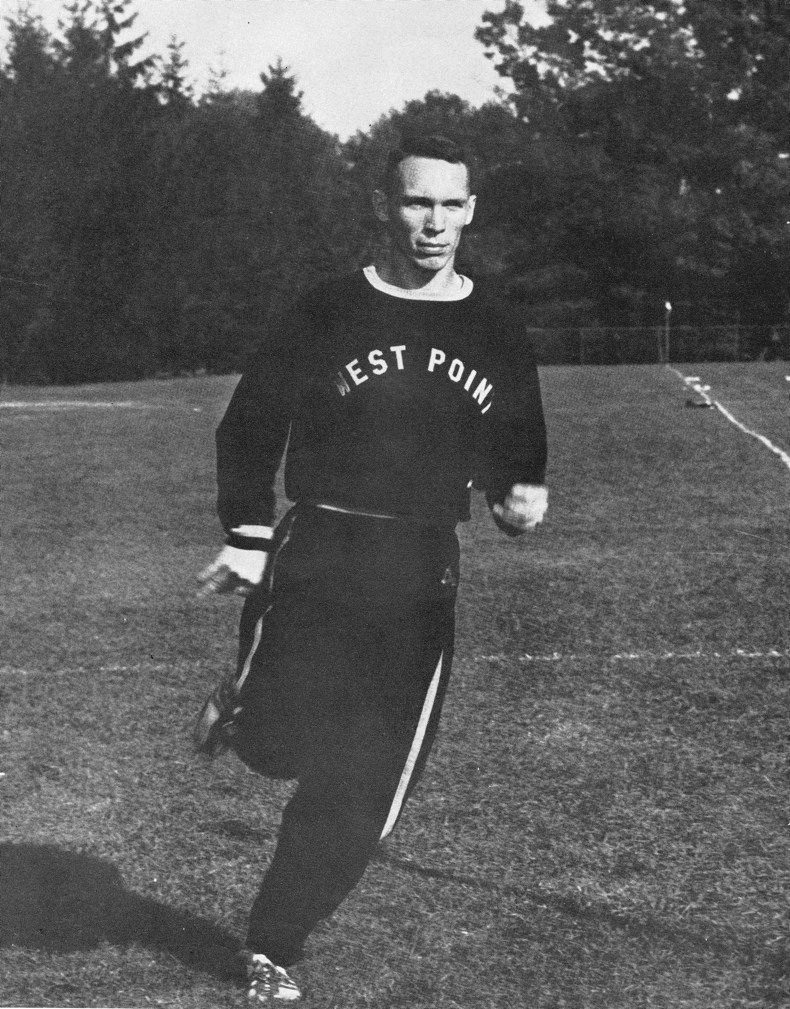
Ron Zinn Class of 62 — Member of two US Olympic teams

How could the remarkable Ron Zinn not be included in the Army track and field media guide? He was a member of two US Olympic teams and I remember well watching the beginning of one of his Olympic races on television (black and white). He was in the lead as the walkers left the stadium.


ZinnRon_ArmyTrack_1962


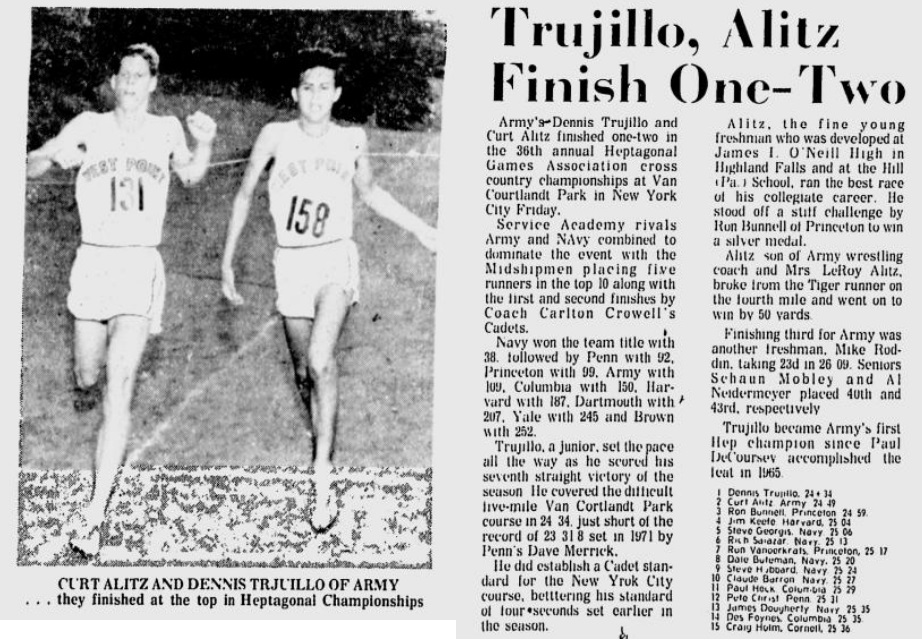
ArmyCxCtry_1974_CurtAlitz-DennisTrujillo_1-2Heps_EveningNews_Nov91974

ArmyCxCtry_1974_CurtAlitz-DennisTrujillo_1-2Heps_EveningNews_Nov91974

Basketball Womens

click on photo

  • 1995 Womens Basketball Team
  • 1996 Womens Basketball Team
  • 1997 Womens Basketball Team
  • Jim Young

    Jim Young became a hero at West Point when he built Army back into a winner after more than a decade of despair. When Young arrived as head coach in 1983, Army had won more than four games only once in the previous 11 years. Young didn’t fare any better his first season (2-9). But after installing a ground-oriented attack in 1984, Army football took off.
    Young had only one more losing season before retiring after a 30-20 victory over Navy in 1990, his 51st win at West Point, third-most in academy history.

    http://www.collegefootball.org/famersearch.php?page=1&submitted=1&school=Army&sortby=school


    ArmyFB_1984_ArmyWinning_PittsburghPostGazette_Nov101984


    ArmyFB_1984_Resurgence_NewburghEveningNews_Nov281984


    ArmyFB_1985_WinningunderYoung_Robesonian_Nov81985


    ArmyFB_1988_BlaikonArmy_KentuckyNewEra_Nov151988-1


    ArmyFB_1990_JimYoung_vsNavy_FreeLanceStar_Dec101990

    Sports articles provided by Russ “Skip” Grimm – Class of ’76

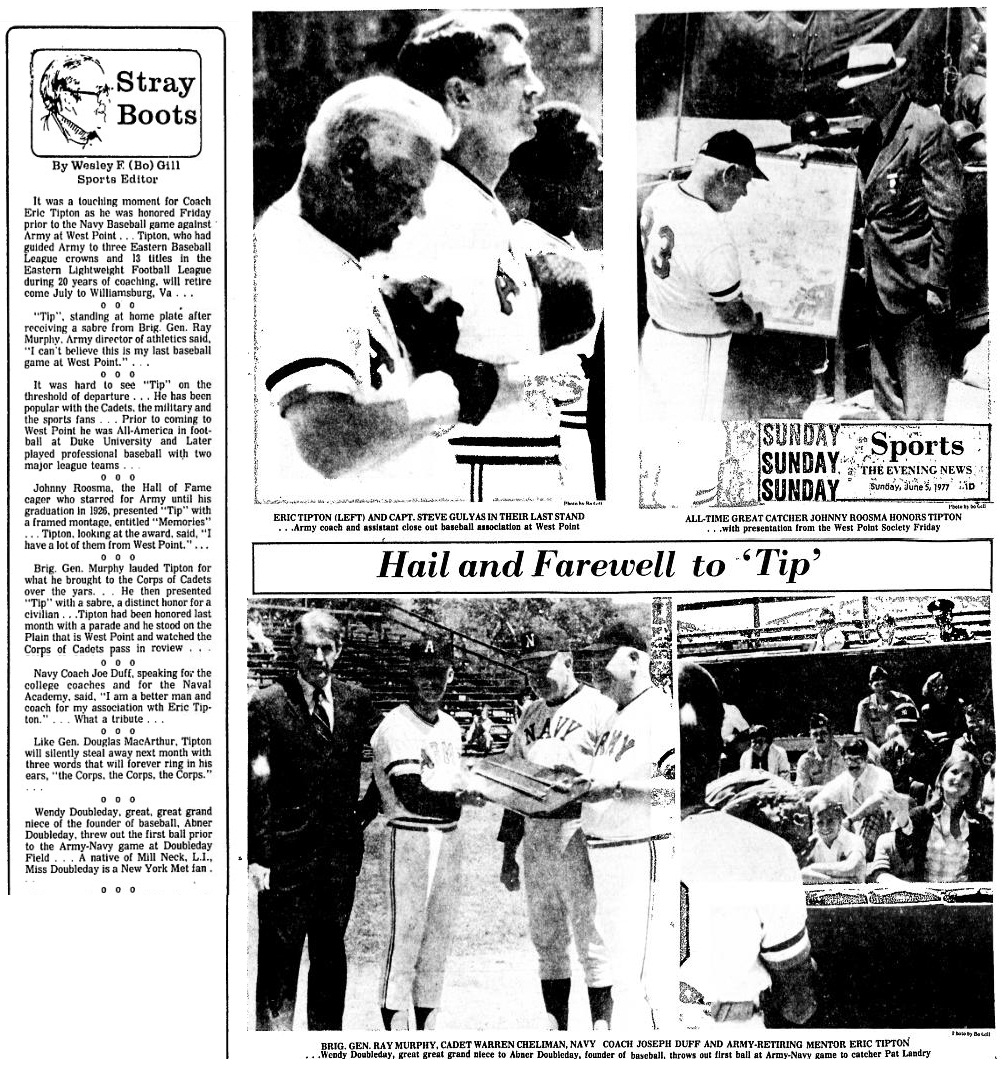
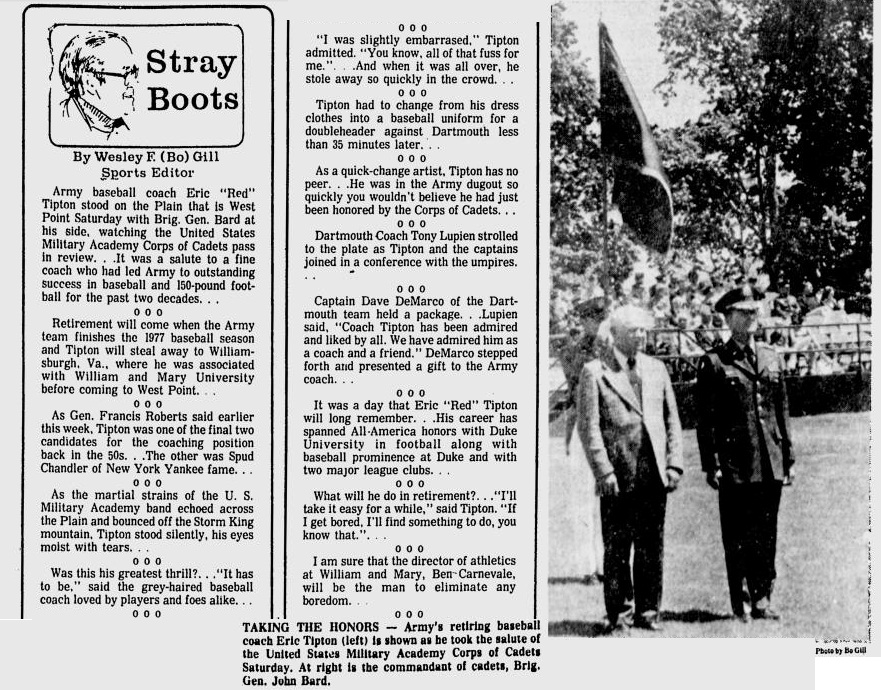
    Eric Tipton

    Baseball & Lightweight Football Coach

    A Moment Please

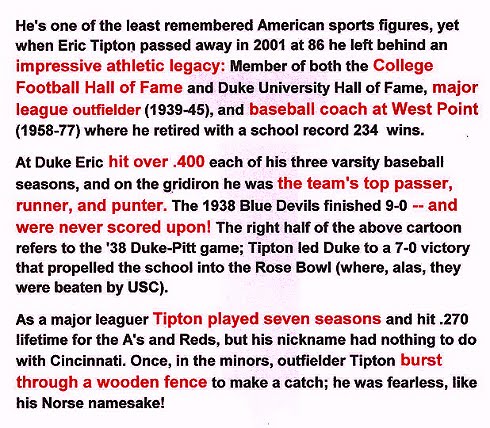
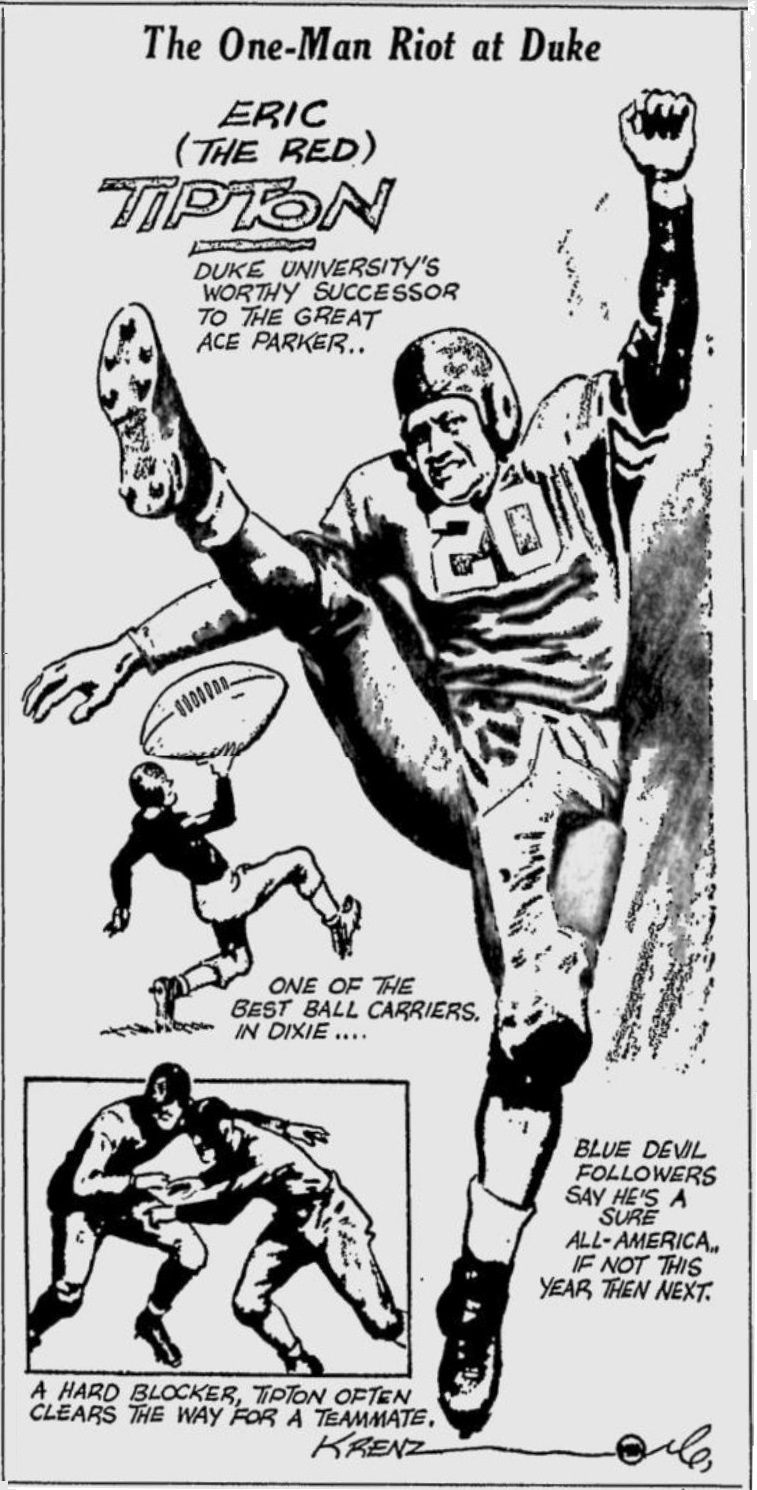
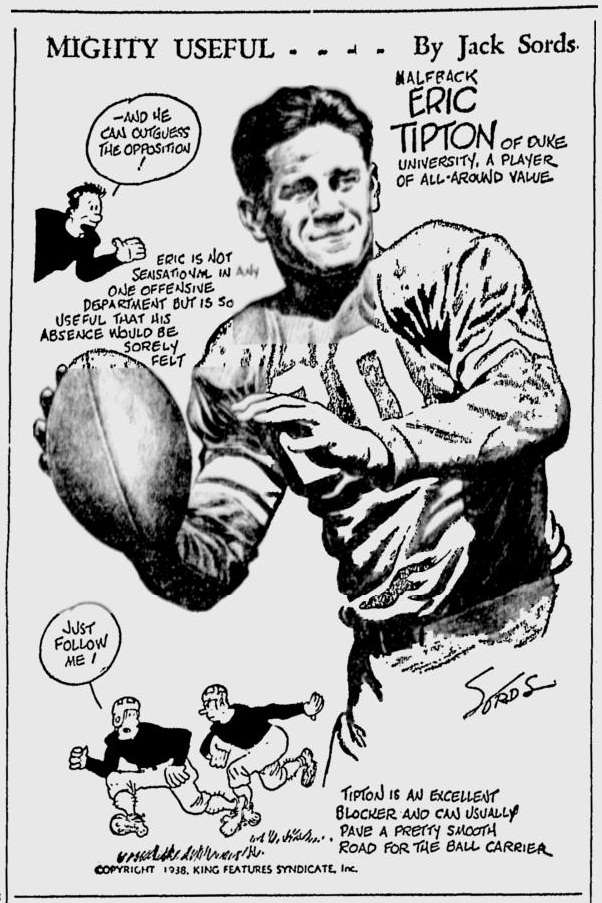
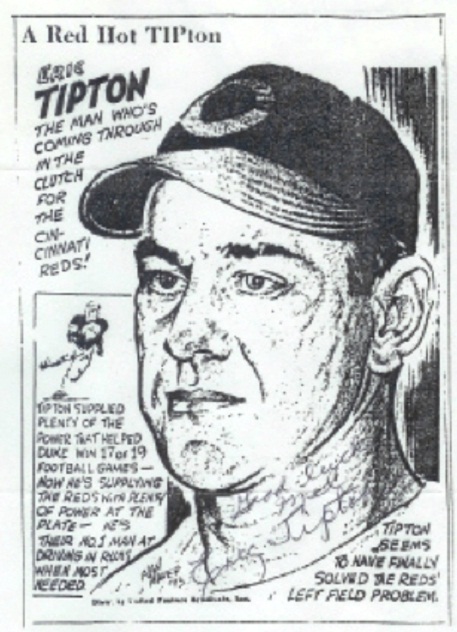
    Star Athlete and Coach Eric “Red” Tipton 1915-2001: National College Football Hall of Fame also honored at Duke, William and Mary, and Army. One of fifteen College FB Hall of Fame men who also played ML Baseball – in the top half in seasons (7) and games played (501). A star running back and punter at Duke 1936-1938: 25-4-1 team record, two Southern Conference titles..rushed for 1,633 yards and scored 17 touchdowns. Named a First Team or second team All-America
    halfback in 1938.

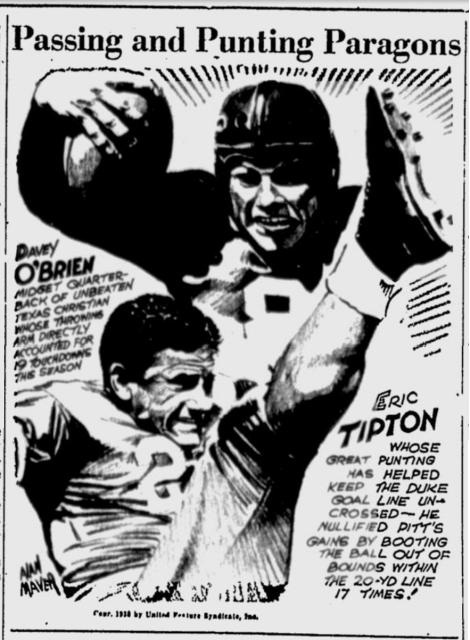
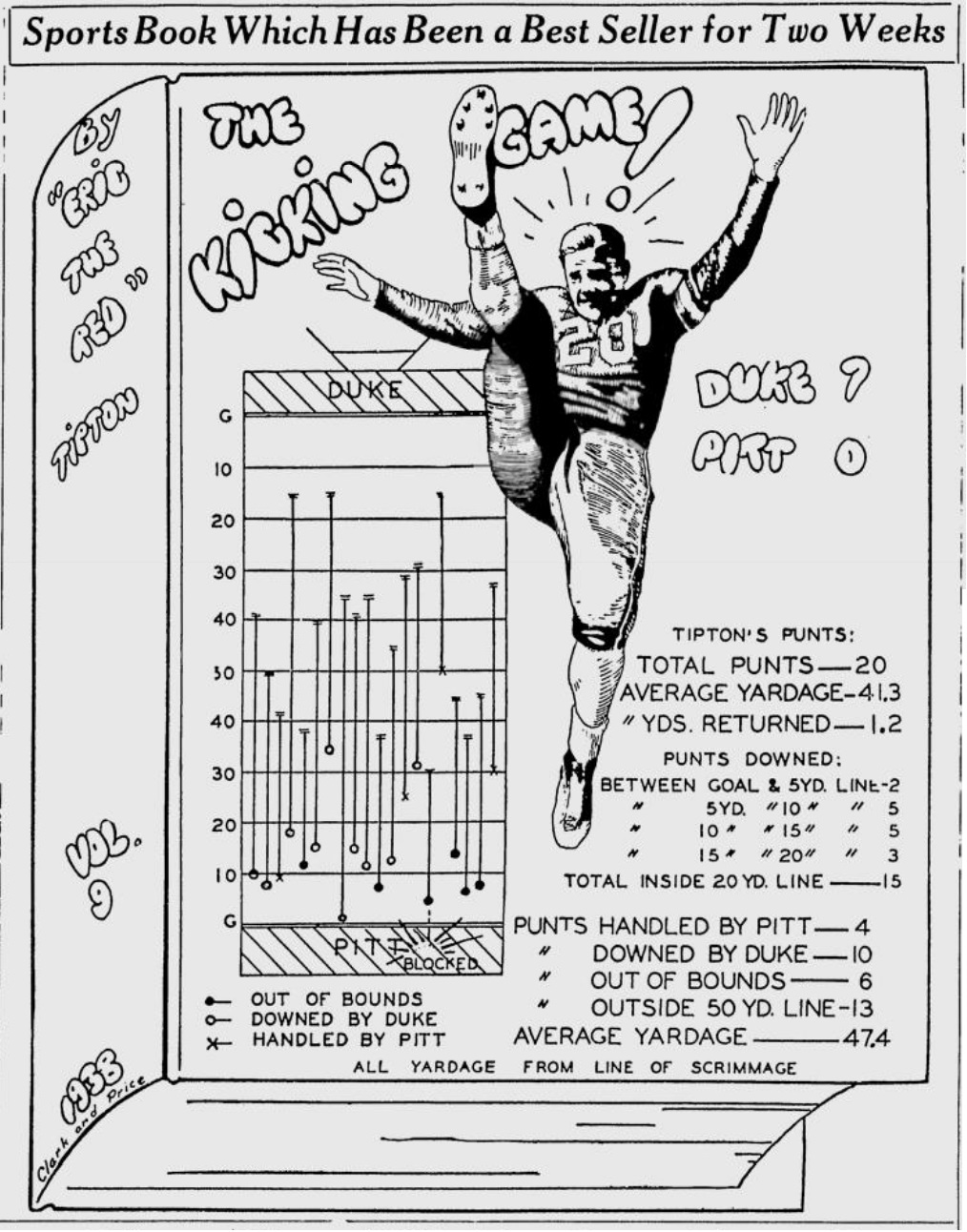
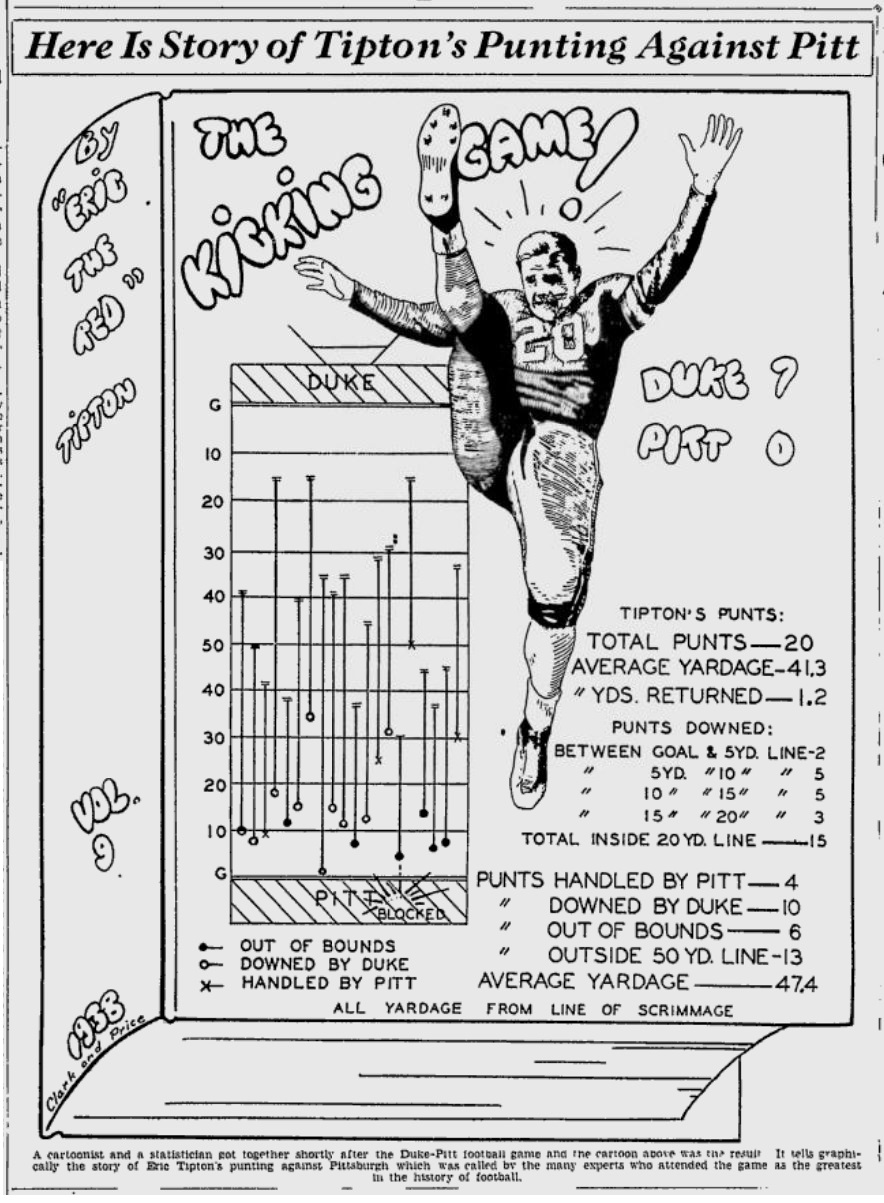
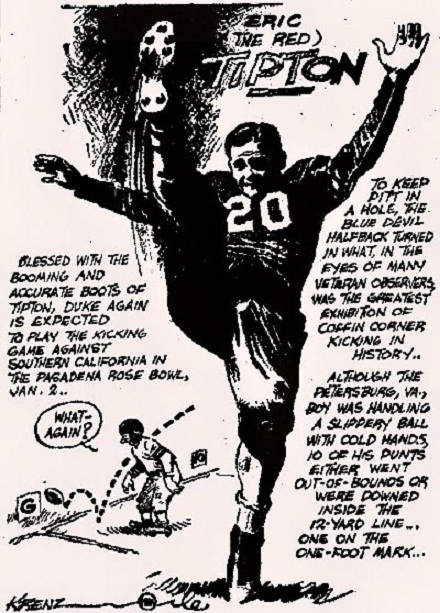
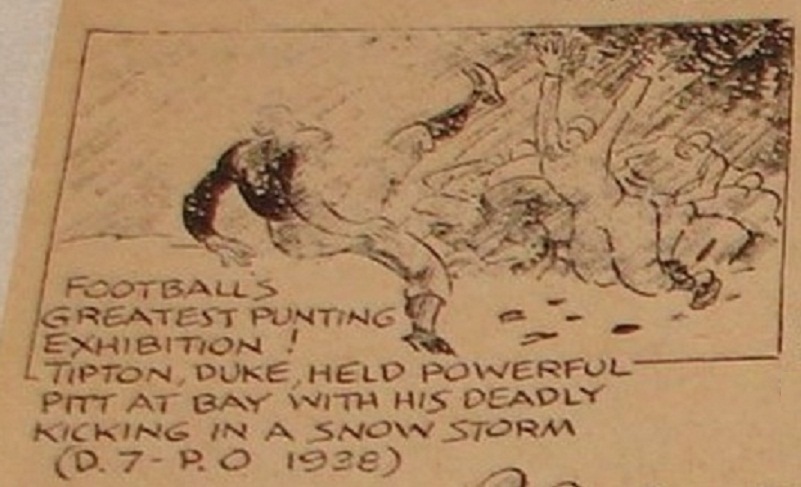
    Duke’s 1938 team went undefeated 9-0-0, and remarkably, did not allow a single point during the season! Lost 7-3 to USC in the 1939 Rose Bowl game one of college footballs most historic games. The most memorable performance of Tiptons football career was the final game of the 1938 season – Duke took on #4 Pittsburgh in freezing, snowy conditions. In the 7-0 win, Tipton kept the powerhouse Pitt offense bottled up with 14 punts inside the 20, including seven of them inside the 10.

    Chose a career in pro baseball – 7 seasons in the major leagues with the Philadelphia Athletics and Cincinnati Reds- hit .270 with 22 homers and 151 RBIs in 501 career games. “In 1626 career at-bats in the Major Leagues, he struck out only 127 times (about 7.8%). He finished his career with a .270 batting average (the league average during his career was .265), a .360 on-base percentage, 22 home runs, 151 runs batted in, 20 steals (he was never caught stealing), and a .977 fielding percentage.”

    Was an assistant football coach at William and Mary and then hired by Army’s Earl ‘Red” Blaik in 1957 as varsity baseball coach and head coach of the new 150-pound Lightweight Football team. In 20 seasons his baseball teams were 234-201-5 with 3 league titles. In Lightweight FB he was 104-14-1 – a .878 winning percentage with 13 league titles – still unmatched or surpassed!

    Tipton_2001_career-summary

    Tipton_2001_career-summary

    Tipton_1937_byArtKrenz_SpokaneDailyChronicle_Nov21937

    Tipton_1937_byArtKrenz_SpokaneDailyChronicle_Nov21937

    Tipton_1938_byJackSords_MeridenRecord_Oct41938_
    Tipton_1938_byJackSords_MeridenRecord_Oct41938

    Tipton_1938_Tipton-OBrien_byAlanMaver_LodiNewsSentinel_Dec61938
    Tipton_1938_Tipton-OBrien_byAlanMaver_LodiNewsSentinel_Dec61938


    tipton_1938_puntingversuspitt_byclarkandprice_newsandcourier_dec111938
    Tipton_1938_puntingversusPitt_byClarkandPrice_NewsandCourier_Dec111938

    tipton_1938_puntingversuspitt_byclarkandprice_heraldjournal_dec121938

    Tipton_1938_puntingversusPitt_byClarkandPrice_HeraldJournal_Dec121938

    Tipton_1938_byArtKrenz_Dec1938
    Tipton_1938_byArtKrenz_Dec1938

    Tipton_1938_byGeneMack_GreatestPuntingExhibition
    Tipton_1938_byGeneMack_GreatestPuntingExhibition
    Tipton_1943_byAlanMaver_cartoon

    Tipton_1943_byAlanMaver_cartoon

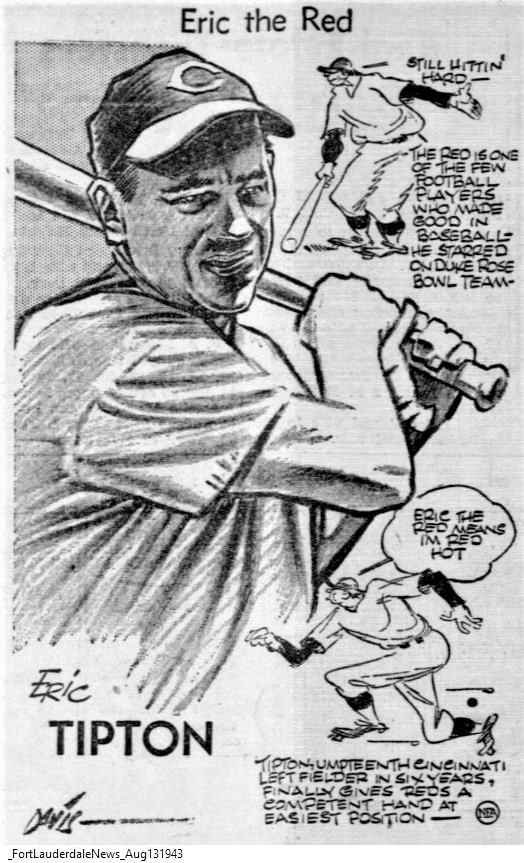
    EricTipton_byDavis_FortLauderdaleNews_Aug131943

    EricTipton_byDavis_FortLauderdaleNews_Aug131943

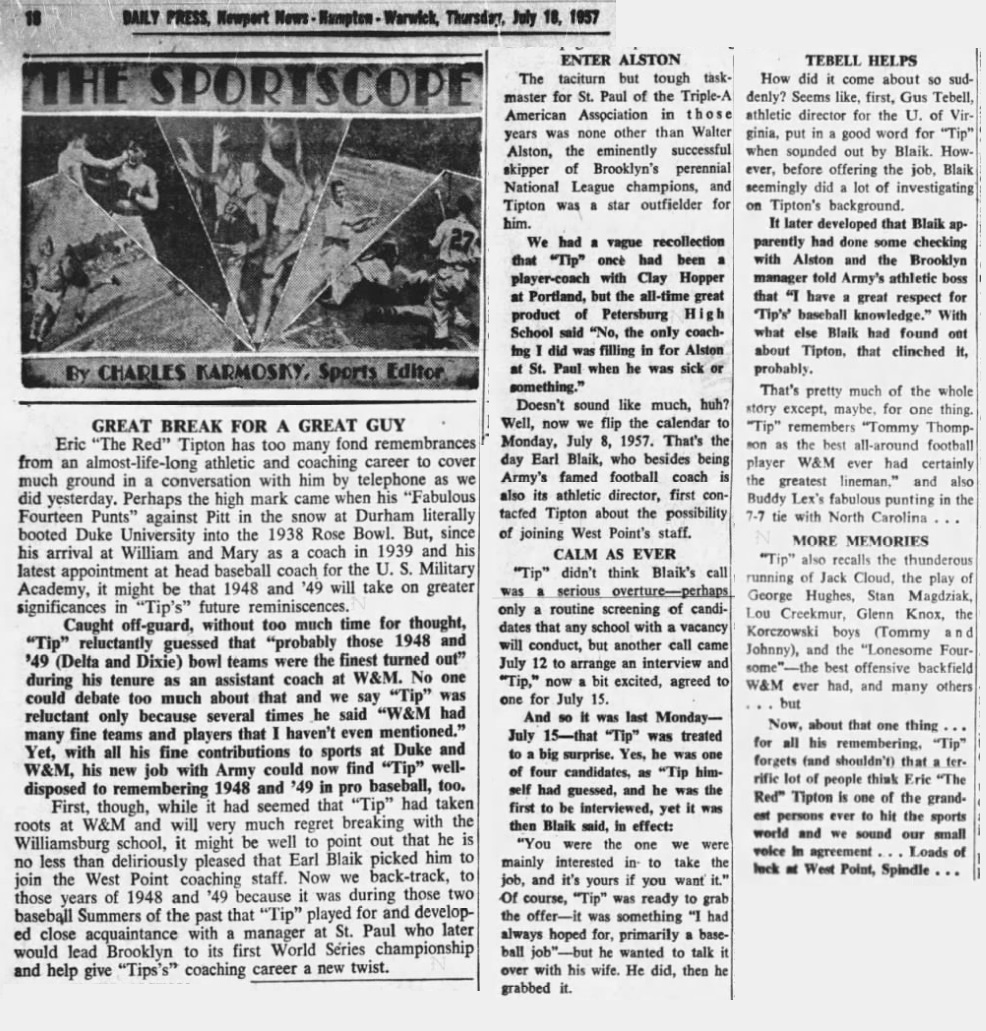
    Tipton_DP_Jul181957

    Tipton-MiddletonTimesHeraldRecord_Oct311976


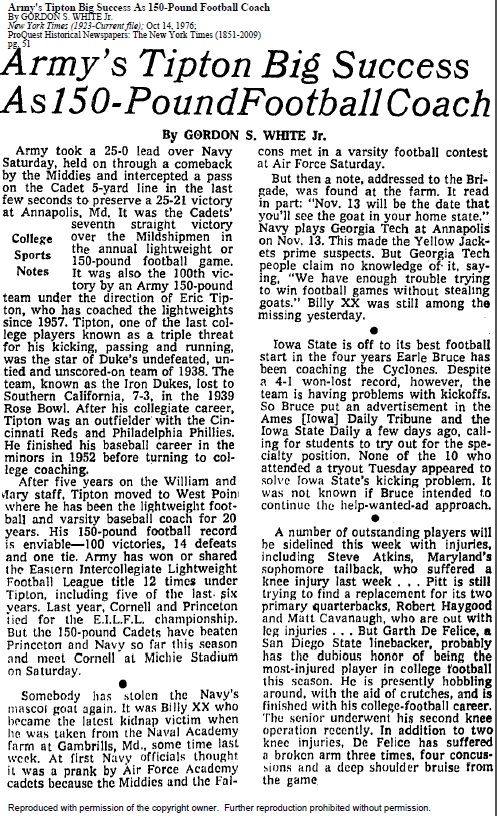
    1976_tiptons-100th_101476_newyorktimes
    1976_ Eric Tipton -100th_101476_NewYorkTimes-1

    tipton_1977_armybaseball_1977_nyt_apr51977
    Tipton_ArmyBaseball_1977_NYT_Apr51977

    tipton_1977_finalbaseballgame-chellman_newburgeveningnews_jun51977
    Tipton_1977_FinalBaseballGame-Chellman_NewburgEveningNews_Jun51977

    tipton_1977_finalparade_newburgeveningnews_may151977
    Tipton_1977_FinalParade-pic_NewburgEveningNews_May151977


    Excellent bio at

    http://sabr.org/bioproj/person/803d7037

    Text and sports articles from Russ Grimm known better as Skip – Class of 1976

    Leading 14 to zero it was 4th Down, on their own 38. The play had been sent in. They were operating out of the Texas Wishbone and the 150 quarterback saw that the middle was clogged with defenders. He checked off to a slant pass to his wide open split end. Ten men momentarily stiffened, for if the play failed, each knew they would all be in for punishing comments. Number 51 snapped him the ball, as he raised up to pass Coach Tipton nearly swallowed his cigar; but then was to never say a word as Donnie took the pass for 61 yards to the 1 yard line. The Army defense led by numbers 83 & 67 dominated the field. Number 40 piled up yards resulting in a 41 to 0 score. Glynn Mallory a 150 player, Class of 61 enjoyed the humor when Mrs. Tipton ordered Crab Cakes that evening in Annapolis.

    The 1973 Team is at http://forwhattheygaveonsaturdayafternoon.com/wp-1974/150

    Charles R Monk Meyer

    Heisman Trophy runner-up 1935, College Football Hall Of Fame 1987

    MonkMeyer_USMA_1937

    1935

    ArmyFB_1935_MonkMeyer

    –

    ArmyFB_1935_BillShuler-MonkMeyer_byPap_Nov21935

    –

    ArmyFB_1935_MonkMeyer_byAlanMaver_SundayMorningStar_Nov31935

    ArmyFB_1935_MonkMeyer_byAlanMaver_SundayMorningStar_Nov31935

    ArmyFB_1935_All-East_Telegraph_Dec31935

    –

    All-Americans_1935_UPI_PittsburghPress_Nov291935

    –

    MonkMeyer-runnerupto-JayBerwanger_Heisman_1935_TelegraphHerald_Dec511935

    –

    1936

    ArmyFB_1936_MonkMeyer_TelegraphHerald_Oct151936

    –

    ArmyFB_1936_Meyer-run1

    –

    ArmyFB_1936_MonkMeyer_byPap_CSM_Oct141936

    –

    ArmyFB_1936_vsNavy_YoungstownVindicator_Nov241936

    –

    ArmyFB_1936_vsNavy_YoungstownVindicator_Nov251936

    –

    ArmyFB_1936_vsNavy-pre_TheDay_Nov281936

    “Pound for pound, there were few backs more threatening in a broken field than Army’s Monk Meyer.”

    –

    MonkMeyer-Luzon_1945_DailyTimes_Jun111945

    –

    CharlesRMonkMeyer_1937_CollegeFootballHoF_GadsdenTimes_Dec81987

    –

    From Go Army Sports:

    Class of 1937
    Football/Basketball/Lacrosse

    Charles “Monk” Meyer earned a pair of varsity letters in football, three in basketball and one in lacrosse during a stellar athletic career at West Point. He finished second in the initial Heisman Trophy voting to Jay Berwanger of the University of Chicago and retired from the U.S. Army with the rank of Brigadier General.

    Meyer received the Silver Anniversary Award from Sports Illustrated in 1961 and collected the Gold Medal Award from the National Football Foundation 1987.

    As a standout quarterback, Meyer helped Army to a 28-6 victory over Navy in 1935 at Philadelphia’s Franklin Field and played in the 1937 College All-Star Game. Among Meyer’s single-game highlights was a 172-yard passing performance during a 27-16 victory opposite Columbia and future National Football League Hall of Fame quarterback Sid Luckman in 1936.

    Meyer helped Army to six wins in each of his two seasons.

    On the hardwood, Meyer earned three varsity letters. He served as team captain in 1937 and contributed to squads that posted a combined 24-18 record, including a pair of wins opposite service academy rival Navy.

    Meyer was also a member of Army’s lacrosse team and earned a varsity letter in 1937. The Black Knights finished 9-1 that season and ended the year with a 6-5 victory at Navy. Wins against Hobart, Yale, Syracuse, Penn State and Johns Hopkins also highlighted the campaign.

    –

    ‘Monk’ Meyer: From Allentown and West Point gridiron to heroism on the battlefield
    Allentown High alumnus led Army against Notre Dame 75 years ago this week.
    November 16, 2010|By Evan Burian
    Allentown Morning Call – Nov 16, 2010

    When Army and Notre Dame meet for the 50th time on Saturday in the new Yankee Stadium in New York, all the history and lore that surround this colorful collegiate rivalry will spring to life.

    “Cheer, cheer for old Notre Dame” with the legendary George Gipp in 1919 and 1920. Notre Dame’s Four Horsemen of 1924 and Grantland Rice’s classic lead to his story on the game, “Outlined against a blue, gray, October sky the Four Horsemen rode again.” And Notre Dame coach Knute Rockne’s inspirational halftime “Win one for the Gipper” pep talk in 1928 that resulted in an upset Irish victory.

    “On, Brave Old Army Team” with coach Earl “Red” Blaik’s powerful and undefeated war-time machine led by Doc Blanchard “Mr. Inside” and Glenn Davis “Mr. Outside” of 1944-46. It was when three All-Americans — halfbacks Pete Dawkins, Bob Anderson and Northampton’s Bob Novogratz at guard — led a Black Knight conquest in 1958.

    And 75 years ago this year in the 1935 contest, it was Allentown’s Charles “Monk” Meyer of Army whose name was added to this golden honor roll.

    Although small in stature at 5-9 and 150 pounds, and looking more like the team’s student manager, “Monk” Meyer was indeed a West Point football star. And like many other Army graduates, he went on to display heroism on the battlefield for his country.

    Charles Robert “Monk” Meyer played football, basketball and baseball at Allentown High School for the nationally recognized coach, J. Birney Crum. As a single-wing halfback in 1930, Meyer was the club’s top scorer with 12 touchdowns as he helped the Canaries to a perfect 11-0 season.

    The Canary and Blue juggernaut rolled up 338 points that season while giving up only 18. The Morning Call headlined Meyer’s exploits after the Thanksgiving Day triumph over Bethlehem as “Little, But Oh My!”

    As the son of Lt. Col. Hermie Meyer and born at West Point, N.Y., on May 1, 1911, “Monk” was tagged by birth and tradition to serve his country with a career in the military.

    Monk grew up at various Army bases throughout the nation and even in the Philippines as his father received assignments during his military career. The Meyer family relocated to the Lehigh Valley area in time for Monk to play football, basketball and baseball at Allentown High.

    After leaving Allentown High, Meyer prepped at Philadelphia’s Chestnut Hill Academy and entered West Point in 1933 as a player who could run, pass, kick and play defense. For two seasons, 1935 and 1936, the “150-pound Mighty Mite” was the big gun of the Army attack for coach Gar Davidson.

    Touchdown pass

    In 1935 against Notre Dame before a capacity crowd of 78,114 in Yankee Stadium, it was Meyer’s 41-yard first-quarter TD pass and stellar performance in a 6-6 tie that brought him into the limelight. The press recognition eventually led to his All-American mention and then to his being named runner-up to the University of Chicago’s Jay Berwanger in the first-ever Heisman Trophy vote that year.

    However, Meyer’s fondest memory of the season was the stalemate with the Fighting Irish and what happened after the game. Meyer said he was resting by the locker-room door when someone started knocking on it. Opening the door, Meyer was startled to see Notre Dame head coach Elmer Layden, one of the immortal Four Horsemen, along with Irish players.

    Layden said, “Hey kid, go get Monk Meyer, we want to congratulate him on the great game he played against us.”

    When the stunned Meyer replied that he was Monk Meyer, Layden continued, “Look kid, we’re not fooling around, we want to talk to Monk Meyer.’ “

    Meyer then called over some of his teammates to verify to Layden that he indeed was Monk Meyer.

    All the astonished Layden could mutter while looking at the smallish Meyer was, “Gee whiz.”

    In 1936, Monk had another big day in Yankee Stadium. This time the Army ace outdueled famed Columbia passer and future Chicago Bear Hall of Fame quarterback Sid Luckman as the Black Knights prevailed, 27-16, over the Lions.

    A pair of football shoes

    In the book, “Coach Birney Crum and Allentown High,” attorney Ray Brennen, Meyer’s Allentown High classmate and lifelong friend, said of him: “He almost didn’t have a football career at Army let alone the resulting fame and honors because he was just one of over a hundred players trying out for the team when he got to West Point and a little guy to boot.

    “It was Birney who got Monk a pair of football shoes that fit him properly so he could show his running skills, and it was Birney, while watching practice, who told the Army coaches to take Monk off the fifth team and put him in with the first unit to show them that he could get the job done.”

    Meyer graduated from West Point in 1937 and led troops in the Pacific Theater under the overall command of Gen. Douglas MacArthur during World War II and again in Korea, and was wounded twice.

    Among the numerous decorations he received were two Silver Stars and, for “extraordinary heroism,” the Distinguished Service Cross. It is the second-highest decoration in the United States, just below the Medal of Honor.

    –

    Doug Blubaugh

    Assistant Army Wrestling Coach Late 50s – Early 60s

    Doug was to say later “If it were not for Al Rushatz I would never have won my Olypmic Gold Medal”. Al was a Plebe & Yearling who Doug practiced against.

    In the shadowed ruins of Rome’s ancient Basilica, Doug Blubaugh battled the world champion from Iran for the Olympic gold medal. Emamali Habibi had never known defeat.
    Three times the Persian attacked, each time throwing the young American into danger. Then a swift counterattack from Blubaugh hurled his opponent to his back … suddenly the struggle was ended.
    Thus did an Oklahoma farm boy reach the apex of a brilliant athletic career, earning the 1960 Olympic gold medal at 160.5 pounds, and with it recognition as the outstanding wrestler in the world.

    http://www.wrestlinghalloffame.org/awards/?dm&honoree=32

    http://en.wikipedia.org/wiki/Wrestling_at_the_1960_Summer_Olympics

    http://www.wrestlingsbest.com/collectibles/wrestuffcards008.html

    http://video.aol.com/video-detail/doug-blubaugh-vs-habbibi/1206184370

    http://www.ncaasports.com/wrestling/mens/story/arc_story/16738

    http://www.okstate.com/SportSelect.dbml?SPSID=2371&SPID=162&DB_OEM_ID=200&ATCLID=5902

    Phil Costain

    awaiting data