
-
-
Navigation
-
- #12358 (no title)
- 2D Page
- 62 Track
- American civil-military relations: The soldier and the state in a new era
- American Women Serving in Foxholes
- Army Teams
- Backup Worth of a Class
- Broke
- CAN DO AND WE DID
- Civil War Photos
- Civil War Stamps
- Class of 1962 A & B Individual Posts
- Classes
- Cliff McKeithan
- Current Listing
- Data for letter
- Dave Armstrong
- Dick Wylie
- Dissent and Strategic Leadership of The Military Professions
- Firepower, Attrition, Maneuver
- Firepower, Attrition, Maneuver
- franklin / burns
- Gary Brown
- George Telenko
- Intrepidity and Character Development Within the Army Profession
- Jim Kays
- John Wagner
- Larry Mengel
- President Kennedy & General Westmoreland
- SNIKRAH6772
- U.S. Civil-Military Relations: Transition or Crisis
- West Point Class of 1962
- What ’62 Gave
- What ’62 Gave Support # 1
- What ’62 Gave Support # 2
- Women in the Front Line
- Work Page
- Worth of A West Point Class
- Worth of a West Point Class
- Your Body
- Army Navy Football
- Recent Posts
- About
- Newsletter
- Contact Information
- Submissions
- Credits
-
Categories
Category Archives: Army Greats
Holly Fishburne
October 15, 2008 – 8:58 pm
Captain of the Soccer Team
Married Mark West (Captain of the 150 Team Football) Class of 1991


Colin Kelly
July 10, 2008 – 5:43 pm

America’s First Hero in World War II Colin Kelly – – – – – – – – Class of 1937


http://en.wikipedia.org/wiki/Colin_Kelly
http://www.airartnw.com/colinkellylegend.htm
Nominated for the Medal of Honor Colin Kelly received the Distingushed Service Cross

There’s a Star Spangled Banner Waving Somewhere
Words and Music by Paul Roberts and Shelby Darnell.
©1942 by MCA Music, A division of MCA, Inc.
There’s a Star-Spangled Banner waving somewhere
In a distant land so many miles away.
Only Uncle Sam’s great heroes get to go there
Where I wish that I could also live some day.
I’d see Lincoln, Custer, Washington and Perry,
And Nathan Hale and Colin Kelly, too.
There’s a Star-Spangled Banner waving somewhere,
Waving o’er the land of heroes brave and true.
In this war with its mad schemes of destruction
Of our country fair and our sweet liberty,
By the mad dictators, leaders of corruption,
Can’t the U. S. use a mountain boy like me?
God gave me the right to be a free American,
And for that precious right I’d gladly die.
There’s a Star-Spangled Banner waving somewhere,
That is where I want to live when I die.
Though I realize I’m crippled, that is true, sir,
Please don’t judge my courage by my twisted leg.
Let me show my Uncle Sam what I can do, sir,
Let me help to bring the Axis down a peg.
If I do some great deed I will be a hero,
And a hero brave is what I want to be.
There’s a Star-Spangled Banner waving somewhere,
In that heaven there should be a place for me.
Read more: https://www.scoutsongs.com/lyrics/theres-a-star-spangled-banner-waving-somewhere.html#ixzz5aQwTXpmJ
Follow us: @yugiohcardguide on Twitter | YuGiOhCardGuide on Facebook
Editor’s Note Kelly’s Son – also Colin Graduated in the mid 60’s. He like his Father was an athlete and at some point a page will be prepared for him. For now he is 3rd from right, 1st row


Ross Gagliano
June 3, 2008 – 5:00 pm
Scholar, Rebounder, Scorer
He paid his dues, waiting patiently for his chance. When he got it, he made the best of it, becoming part of one of Army’s finest teams and half of a record-setting rebounding duo.
Posted by a friend.


Whitey Grove
April 24, 2008 – 4:59 pm
Edward A. Grove
Lettered in Football 1934 & 1935
An 80 yard touchdown run on a reverse against Navy in 1935
http://forwhattheygaveonsaturdayafternoon.com/wp-teams/football/army-navy-football
Art Brown
March 25, 2008 – 4:42 pm
Art & Karen Brown
Soccer — Team Captain Fall of 1961



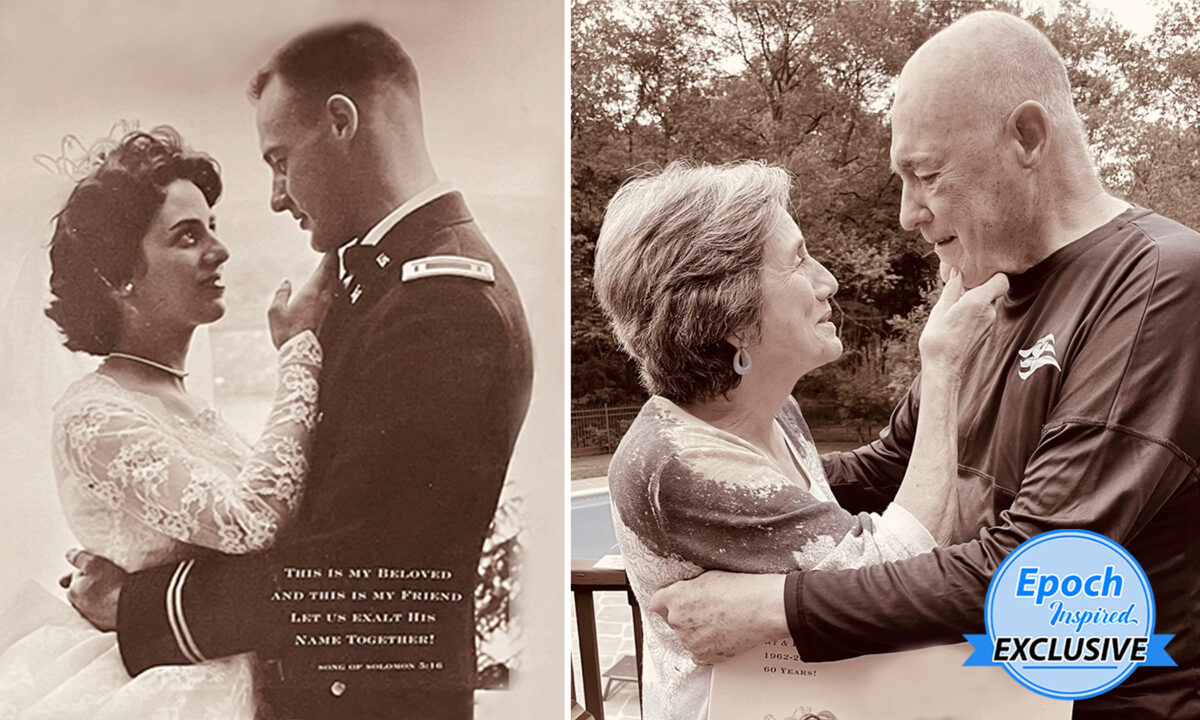
(Courtesy of Sydney Brown)
‘You Need to Put God First’: After 60 Years of Marriage,
Elderly Couple Is Still as in Love as Ever
0:006:03
1
A Florida couple who met in 7th grade and have always put God first have just celebrated their 60th wedding anniversary—and they are still as smitten as ever. Their love story is a testament to a happy marriage rooted in faith, togetherness, and forgiveness.
Arthur Brown, 82, a veteran of the U.S. Army Corps of Engineers, and his wife Karen Brown, 80, a retired administrative assistant, are both cancer survivors and true patriots who are grateful for their blessed family life. Originally from Teaneck, New Jersey, they now live in Orlando, Florida—their home of 35 years.
“We got married at West Point three days after graduation, on June 9, 1962. I didn’t want to rush into it, so we waited three days,” Arthur told The Epoch Times, jokingly.

The couple celebrated 60 years together on Karen’s 80th birthday in February, turning the special day into a family reunion at a holiday home in Holland, Michigan.
Their 21-year-old granddaughter, Sydney, who lives in New York City, shared footage of the lovebirds blowing out their candles on TikTok, captioned, “They’re still as in love as ever.” The clip went viral.
“Poppy still flirts with Gammy!” Sydney told The Epoch Times. “While they’re blowing out their candles to make a wish, Poppy says he wishes for another 100 years and then kisses her; everyone says that every couple should be doing that, even 60 years later.
“People love that their love is still so alive, and they’re such an inspiration to me. It was actually crazy; someone from their church saw the video and commented on it, then a bunch of people replied … it’s such a testament to their love, how they serve everyone in their community, which [is] so great.”


Be it people who have lost their grandparents or others, many are inspired by Arthur and Karen’s love. Some are even motivated to be “more self-sacrificial” in their own relationships.
Karen was just 14 years old when she saw Arthur for the first time. Arthur’s brother was her classmate and, after 12 months, introduced the couple on Memorial Day 1957. Arthur was 17.
It wasn’t customary for girls to ask boys on a date in the ’50s, Karen said, but she summoned the courage to invite Arthur to her New Jersey sorority’s annual dance and cookout. Arthur suggested they meet sooner.
“We went to a drive-in movie,” recalled Karen. “I probably fell asleep the minute the movie started … I was just over the flu. The car started and I said, ‘I’m so sorry!’ He said, ‘I know you’ve been sick.’ I thought, what a nice guy.”

Karen enrolled at Katharine Gibbs College in New York, close to home, and got a job as an admin assistant for Time Magazine’s travel department. Arthur proposed with a “beautiful diamond” in front of her parents, sisters, and grandmother.
“He actually proposed in my parents’ home which was the most wonderful, memorable place,” Karen said. “We both came from wonderful examples of parents. We are blessed.”
The couple tied the knot and, after Arthur completed Airborne Ranger Training, they moved to Fort Campbell, Kentucky, where they welcomed a daughter. Two sons were born in Ohio. Arthur served in Thailand and Vietnam before returning to West Point for an advanced engineering course, and eventually a teaching post. Karen was president of the Wives’ Club for two years.
The couple’s love deepened as time passed, and they never stopped surprising one another.
Arthur tells a story: “[Karen] wrote a poem about me before I ever met her. Her best friend showed me, but wouldn’t show me who wrote it, so I promptly forgot about it. Ten years later, five years after we were married, I heard [Karen] telling somebody about this poem that she wrote about me and I said, ‘You wrote that poem? So how’s that!’”

Arthur spent 24 years in the Army, during which his family moved 23 times. In 1986, he left the Army for a unique opportunity with the Walt Disney Company.
Arthur said: “This guy came along, he had just fired his project manager for Pleasure Island. He called and said, ‘I’ve got an offer for you. Think about it, pray about it. I’ll call you back in two weeks.’ I crunched numbers and I decided, go for it. That’s how I got 23 years at Disney.”
Over two decades, Arthur was involved in design and building at every single Disney theme park, backstage area, and resort property. He retired after a prostate cancer diagnosis and sickness owing to Agent Orange exposure. Karen is also a cancer survivor; she battled colon cancer and is now seven years in remission.
With six decades of happy marriage under their belts, Arthur and Karen claim the key to harmony is quite simple: be best friends, put God first, trust, forgive, and never go to bed angry.
Arthur said: “The two most important words are, ‘Yes dear!’ We just serve each other, we truly do care about each other, and we do anything that we can to make the other one more comfortable, more happy.”
Dick Irwin
March 23, 2008 – 4:36 pm

Richard William Irwin
Nickname : Dick
Class : 1962
Company : L-1
Home Town: Lutherville, Maryland
High School : Milford Mill
Prior College Attendance : Georgia Tech, 1957-58
Date of Entry to Academy : July 1, 1958
Date of Graduation : June 6, 1962
Age at Graduation : 22
Cullum Number : 23912
Cadet Rank & Military Position
Rank : Lieutenant
Position : Platoon Leader
Height
Entry : 5’11”
Graduation : 5″11″
Weight
Entry : 178
Playing weight : 185
Graduation : 185
Teams :
o 1958: C Squad (Plebe) Soccer Team
o 1958-59: Off-season Lacrosse Team
o 1959: Off-season Soccer Team
o 1959: B Squad (JV) Soccer Team
o 1960: Off-season Soccer Team
o 1960: A Squad (Varsity) Soccer Team
o 1961: Off-season Soccer Team
o 1961: A Squad (Varsity) Soccer Team
Soccer Coaches
o Head Coach: “Joe Palone”
o Assistant: “Scotty Adams”
Team Captain :
o 1960 “Kaiser Bazan”
o 1961 Art Brown
Positions Played
o Plebe: Inside Left
o B-Squad: Left Halfback
o A-Squad: Center Halfback & Left Fullback
Award of Army A
o Plebe : 62 numerals
o Yearling: None
o Cow : Major A
o Firstie : Major A
As you can see from the lack of entries directly above, I was a “journeyman” soccer player (usually a starter) on teams that did not compete in any NCAA tournaments. In those days, soccer did not compete in any league, but we did play a lot of the best teams in the northeast and middle-Atlantic states.
Relationship with Tactical Department :
I managed to keep a “healthy distance” between myself and the tactical department for most of my Cadet years except for one month during plebe year when I was room orderly for two weeks during a single month. I went over in demerits and only my soccer team status saved me from walking the area. I recall that I had to serve one weekend of confinement.
The only other “brush” with the tactical department was several weeks before graduation. The Board of Visitors, headed by General of the Army Omar Bradley, were at West Point for their annual visit. On Friday afternoon (two days after we firsties had taken delivery on our new cars) we marched in a Brigade Review for the Board. I was platoon leader of 2nd platoon, L-1, for the parade.
As we passed in review, all went well until “ready front” after passing the reviewing party. Disaster occurred as I brought my saber back up and snapped my head back around. My saber slipped out of my grip and went twirling up in the air out in front of the platoon and fortunately landed pointy end in the turf, and my “tarbucket” (Editor’s note – hat with plume of feathers for Officer Cadets) spun off my head and fell to the ground. I managed to kick the hat out in front of me, removed my saber from its temporary roost in the grass as I marched by, and finally scooped-up my tarbucket which was lying in our direction of march.(Editor’s note – Tarbuckets, especially ones with feathers are deliberately kicked along the field of march by succeeding ranks of Cadets. Tarbuckets with feather are expensive)
As soon as we broke ranks in South Area, I raced up to my room, changed into civilian clothes and ran all the way down to the parking lot across from the Thayer Hotel where my new TR-4 was parked. I was determined not to miss out on a planned weekend leave trip down to Maryland to visit my soon-to-be fiance’, Sharon Lenz. Somehow, although my ineptness had been seen by all, I did not suffer any tangible consequences. ((Editor’s note – If he had not cleared the area, he would have as a minumin been required to report to his Tactical Officier – so the urgency of getting in the car and off Post)
However, the following weekend, when General of the Army Douglas MacArthur received the Thayer Award, I did have a “one-sided” conversation with the Tactical Department. As we were forming up for parade, Major “Dutch” Shultz, our L-1 Tac officer came over to me. After we saluted, he said only the following few words: “Mr. Irwin, you owe me one!” I said: “Yes sir.”
Recreation
Clubs:
o KDET
o Rocket Society
o Yearbook
o Skeet
Intramurals :
o Handball
o Squash
Class Standing : 97 out of 602
Officer Assignment to the Academy
Department : Earth, Space & Graphic Sciences, 1969-72
Coaching Duties
o Head coach, B-Squad Soccer, 1970
o Assistant coach (for Joe Palone), A-Squad Soccer, 1971
Pete Lash
March 10, 2008 – 4:20 pm
Joe Steffy comments about Col Earl Blaik‘s greatest thrill in Army Football.
COL Blaik said there were two: One was the 93 yard touchdown by Rip Rowan in the Army Navy Game.
The other was a touchdown run to win the game against Navy in 1955. RB Pete Lash ran for 30-40 yards to paydirt during which every Navy player had a shot at him, but he run through them all. Joe said that Lash was a walk-on. Small and played high school FB; Joe said he really did not have the attributes of a great player. BUT, he was tenacious and worked harder than anyone on the team. He succeeded in making the starting team his senior year. Went on to become a three star general.
Jim Kimsey
February 16, 2008 – 5:21 pm
Founded AOL. Donated Kimsey Athletic Center – South end of Blaik Field, Home of Army Football, major contributor to establishing The ’62 Room, our Class Fitness Center. Served 3 Combat Tours.
Distinguished Graduate 2008

Jim Kimsey, a dot-com entrepreneur who helped turn a failed video game company into America Online, the giant dial-up service that helped bring the Internet to the masses, died on Tuesday at his home in McLean, Va. He was 76.
The cause was cancer, his son Mark said.
Long before Facebook or Twitter, Mr. Kimsey was a co-founder of AOL, connecting a nascent online audience with news and information as never before. Through its online chat rooms and email service, the company influenced a generation of Internet providers and left an imprint on popular American culture, the sound of a buzzing modem and its trademark “You’ve got mail!” entering the national lexicon. (It was the title of a 1998 Nora Ephron film with Tom Hanks and Meg Ryan.)
Mr. Kimsey steered AOL through its early days as its founding chairman and chief executive, but he largely avoided the spotlight. In 1995, the year Mr. Kimsey stepped down as chairman, The Washington Post called him a “behind-the-scenes power broker” whose name might lead the average person to “draw a blank.”
Indeed, one of his best known acts at AOL was handing power to someone else. Mr. Kimsey, a sort of elder statesman for the company, groomed another co-founder, Steve Case, at the time a young Internet marketing expert, to take over.
Mr. Case oversaw AOL’s expansion into a media conglomerate with a $220 billion market capitalization.
“I think one of the best things I ever did was let Steve run the company,” Mr. Kimsey told The Washington Post in 1995. “Today that one decision to get out of the way makes me look like a genius.”
Mike Sullivan
January 28, 2008 – 2:43 pm
Army A’s in Football Cow & Firstie Years with 2 Navy Gold Stars
Paul Kirkegaard
January 27, 2008 – 11:45 pm
Soccer Yearling Cow & Firstie Year, Army A Cow & Firstie Year.
Awaiting data for input.
Greg Gadson
January 24, 2008 – 11:44 pm
Battleship
http://www.battleshipmovie.com/?__source=ggl|battleship|Brand|G_Battleship&sky=ggl|battleship|Brand|G_Battleship#
Fox News Interview
http://www.goarmysports.com/ViewArticle.dbml?DB_OEM_ID=11100&ATCLID=1370702
New York Daily News
January 22, 2008
Lieutenant Colonel Greg Gadson Is Giants’ Inspirational Co-Captain
By Mike Lupica
As edited
His name is Lt. Col. Greg Gadson and he used to wear No. 98 for Army
He earned 4 Army A’s along with 3 Navy Stars
Ltc Gadson was with the Second Battalion and 32nd Field Artillery, on his way back from a memorial service for two soldiers from his brigade when he lost both his legs to a roadside bomb in Bahgdad. It was the night of May 7, 2007, and Lt. Col. Gadson didn’t know it at the time because he couldn’t possibly have known, but it was the beginning of a journey that brought him to Lambeau Field Sunday night.
He was there as an honorary co-captain of the Giants, there on the sideline at Lambeau because this Giants’ season has become his season now and he wasn’t going to watch from some box. This is a Giant at the Super Bowl worth knowing about, as much as any of them.
“Me being a part of this team,” Gadson was saying Monday night from his home in Virginia, having made it back there from Green Bay, “really starts with the team I played on at West Point.”
He played at West Point between 1985 and 1988, and one of his teammates was Mike Sullivan, who played cornerback and some safety and is now one of Tom Coughlin’s assistants with the Giants. When Sullivan and so many other of Gadson’s teammates found out what had happened on the night of May 7, found that Gadson had first lost his left leg to arterial infections and then his right, it brought that old Army team back together.

“My injury turned out to be a catalyst event,” Gadson said. “These were guys who hadn’t talked in years, but now were rallying around me, and my family. Some of us had stayed in contact, but not to any great degree. But now an incident in a war reminded us that we were still brothers.”
Sullivan visited Gadson at Walter Reed, came back in June, this time with a No. 98 Giants jersey, Gadson’s own name on the back, signed by several Giants players. When Sullivan left that day in June, he said to Gadson, “What else can we do?”
Greg Gadson said he’d love to take his family to a Giants game.
It was the Giants-Redskins game, in Washington, third Sunday of the season, Giants 0-2 by then. The tickets were arranged and then the Friday before the game Mike Sullivan called and asked if Gadson would be interested in addressing the team on Saturday night.
Gadson’s wife Kim drove him to the Giants’ hotel. Lt. Col. Greg Gadson, Second Battalion, 32nd Field Artillery, old outside linebacker from Army, spoke to the Giants. And just as no one knew that the Giants would begin a 10-game road winning streak the next day, just as no one knew this could ever become a Super Bowl season, no one in that room including Gadson himself knew that the soldier in the wheelchair was joining the season that night.
“I just spoke from the heart, as a soldier and as a former football player,” he said, “for about 10 or 15 minutes. I talked to them about appreciating the opportunities in their lives, how special and privileged they were, how everybody needs to understand what they truly have. And I talked to them about the power of sports in people’s lives, especially soldiers’ lives, how many times I’d watched soldiers get up in the middle of the night after a 12-hour shift if there is a chance to watch a game, or how soldiers would do anything to watch a game before they went on that kind of shift.
“I told them that of course after all the exteriors had been stripped away, they played the game for themselves. But that they had to play the game for each other. Then I talked about myself, how my old teammates came to my need, and how I was reminded again the power of a team, the emotional commitment teammates have for each other, that when a team finds a way to do things greater than they thought they could do, that they couldn’t have done individually, that a bond is formed that can live forever.
“I told them that truly great teams usually form that bond by going through something together, and how whatever they were going through at that point in the season that no success ever came easy. And finally I reminded them that nothing is promised to anybody in this life, starting with tomorrow.”

Greg Gadson
The Giants won the next day against the Redskins, and began a six-game winning streak, and began that road winning streak that now takes them on the road to Super Bowl XLII. It began Greg Gadson’s road to Lambeau, and being wheeled out by his 13-year old son Jaelen as an honorary co-captain of the Giants along with the great Harry Carson.
“I can’t even remember the last time I was actually out on the field,” he said. “Maybe when I played.”
Gadson had been on the sidelines when the Giants won their first playoff game against the Bucs. The team wanted him in Dallas, but he was having more surgery, on what is left of his right leg, and his right arm, which had also been damaged by the IED. But he was well enough to travel to Green Bay, and strong enough to spend the whole game on the sideline with his son, the players calling him what they have all along: “Sir”
“I wouldn’t say I was warm,” he said. “But I was comfortable enough not to be hugging one of those heaters all day.”
He watched from the sidelines at Lambeau as the team he met at 0-2 played the way it played against the Packers and played itself to the Super Bowl watched as the Giants came back from that missed field goal at the end of regulation, finally saw Lawrence Tynes kick it through from 47 yards out.
“When the ball went through, you could feel the elation on our sidelines, and hear the stadium go quiet at the same time,” Gadson said. “It was like the air being let out of a whole state’s soul. And then the next thing I saw was my son jumping in the air and running on that field.”
The boy ran for both of them.
Bill Harold Kellum
January 11, 2008 – 10:10 pm
Big Bill Kellum
Army A Football Yearling, Cow & Firstie Year
Korean War —
Big Bill Kellum led a platoon in the 21st Regiment of the 24th Infantry Division, earning the Silver Star. After his capture, Kellum organized resistance to Chinese indoctrination at Camp Five – Ponktong near the Chinese/North Korean border. His punishment was confinement to a special section of the camp hospital (no prisoner left alive), where he died in June 1951.
Grads would walk next to the wire whistling “On Brave Old Army Team” to encourage Bill.
USMA 1950
Memorial Articles
William Harold Kellum
NO. 17975 20 October 1926 15 June 1951
Died 15 June 1951 (Presumed date) at Pyoktong, North Korea. Aged 23 Years.
COURAGE AND DETERMINATION. These were the words by which 1st Lieutenant William H. Kellum lived, fought, and died. Bill Kellum’s dedication to these words constitutes a capsule explanation of his outstanding athletic achievements, his extraordinary gallantry on the field of battle, and his uncompromising attitude toward his Chinese captors which was directly responsible for his untimely, tragic, but highly courageous and exemplary death.
It is clear that Colonel Earl ‘Red’ Blaik, under whose tutelage Bill achieved AII- East honors at the position of end in addition to three football letters, two of them with Navv stars, was impressed by these characteristics of courage and determination, as he recently recalled that:
“Bill Kellum … in his quiet, rather self-effacing, but uncompromising way … had a depth of determination which would not allow him to play a secondary position even though to do otherwise he was forced to overcome a limited … (physique by college standards). Bill’s competitive urge had a ferocity of purpose which earned him the lasting respect of the troops both on the field and on the field of battle.”
Again, courage and determination are amply evident in Lieutenant Kellum’s combat record as illustrated by the following excerpts from his Silver Star citation:
“…He was assigned the mission of maintaining a combat outpost approximately 3,000 yards in front of the main line of resistance…. At the break of day, he could observe the enemy almost completely around his position. Realizing the threat to his security, he immediately began placing his men to meet the new threat… He ran from position to position, continually exposing himself to enemy fire, in order to encourage his men and direct the fire fight. When last seen, he was running toward the right flank of his platoon to direct that group of men who were then heavily engaged with the enemy …. “
But there was more to Bill Kellum than athletic and military achievements. More even than courage and determination. He was a man of many capabilities and interests, a man who is remembered for his ready grin as well as his courage, a man considerate of and deeply attached to his family, and a man of strong beliefs in God and dedication to country and career. An account which does justice to Bill’s achievements and character cannot be told hit and miss: it must have a chronological foundation.
So let us backtrack to Eastland, Texas, on 20 October 1926, Bill’s date of birth. He was a strong, healthy baby which gave him a good start towards being the outdoor, athletic type he turned out to be. Bill received his elementary education in Sulphur Springs, Texas, and El Dorado, Arkansas. His high school education was at Haynesville, Louisiana, where in recognition of good grades and citizenship he was elected a member of the National Honor Society.
In forecast of football exploits at West Point, Bill was a much respected terror on high school football fields. He made All-State two years and All-Southern one year playing the position of end. Let us look briefly at excerpts from newspaper accounts of games in which he played, for courage and determination were as evident then as thev were to be years later playing for higher stakes in Korea:
“…Kellum is a scrapper from whistle to gun…his fine competitive spirit is an inspiration to his teammates… in spite of the fact that opposing coaches have had their linemen double up on the lanky wingman. He has been a standout in every game with his jarring tackles, precision blocking, and fancy pass catching ……
Of course, football was not Bill’s onIy avocation. He was greatly interested in scouting, an interest which may have been given impetus by the action of a Boy Scout who saved him from death from gasoline fumes at the age of four by administering artificial respiration. Bill was also an active member of the First Baptist Church. Another sporting interest, swimming, he turned to profitable use as he served as manager and life guard of the Haynesville City Pool during high school days.
Bill was close to his family in growing up. He and his brother, Herman, now a doctor, were inseparable. In the one letter he was able to write home from prison camp, Bill’s primary concern was not for his own situation, but rather for news of Herman’s first child. In Bill’s words,
“…Have been thinking about (the family) a lot and have wondered greatly about the new addition to the family …. Let the kid know about his Uncle Bill.”
Bill’s favorite fishing partner was his father who continually encouraged him in his athletic and career ambitions. Bill was close to and always considerate of his mother, never failing in the years he was away from home to call her on special occasions. His only and younger sister, Beth, was the recipient of much advice as well as special concern and protection. An age difference of 12 years was no barrier between Bill and his younger brother, Joe, whose active approach to life was so similar to Bill’s.
Thus did William H. Kellum’s full boyhood prepare him for the responsibilities of manhood.
Upon finishing high school, Bill served five months in the US Navy in the closing months of World War II. While in the Navy, he won a “golden gloves” championship, evidence of his interest and competence in the “manly art of self-defense,” an interest which was to bring further laurels at West Point.
As a recipient of an appointment to the US Military Academy, Bill left the Navy to attend Louisiana State University where he found time amidst his West Point preparatory studies to be first-string end on the football team and to win a second place medal in the ROTC boxing matches.
Matriculating to West Point in July 1946, Bill, by graduation day, 6 June 1950, was able to leave an enviable record behind him. Bill’s football exploits have already been related. In boxing, he won many more bouts than he lost. Skinny for a heavyweight, Bill is still remembered at West Point and by classmates around the world for “cutting down to his size” ring opponents who outweighed him frequently by as much as 50 pounds. Herb Kroten, one of his boxing coaches, accounts for Bill’s success (he went to the finals of the Eastern intercollegiate Championships one year and was elected co-captain of the boxing team his First Class year) by recalling his willingness “to take on anything.”
Athletics were not Bill’s only interests at West Point. He was a member of the Fishing Club and Radio Club and ranked relatively high militarily. However. Bill is remembered by his classmates as much for his personality as for his more objective achievements. The Howitzer was indeed right in asserting that “Bill’s warm Southern personality and ready humor will be long remembered by the Class of ’50.”
Only a few short months after graduation, Bill, in company with so many of his classmates, was called upon to utilize his West Point training on the field of battle sooner than he or anyone else expected. His country and his Alma Mater did not find him wanting! As a platoon leader of Company G, 21st Inf., he distinguished himself on the field of battle being awarded the Bronze Star Medal for valor, the Silver Star, and the Purple Heart. He had every reason to write home proudly when he was promoted to 1st Lieutenant only five months after graduation. Excerpts have already been quoted from his Silver Star citation. Equally stirring and indicative of his courageous spirit and military leadership are the following excerpts from his Bronze Star citation:
“During his regiment’s advance his platoon was the leading element …. With complete disregard for his safety Lieutenant Kellum exposed himself to a hail of withering fire in order to place his men in positions affording the maximum fire power and control. Moving far forward, he directed the effective fire of friendly artillery and mortars …. He then led an assault – routing the enemy … and permitting the continued advance of the regiment ……
Captured during an action in which he was heroically leading his platoon in defending a combat outpost 3,000 yards in front of the main line of resistance, Lieutenant Kellum was taken to a prison camp in Pyoktong in North Korea. Here he faced his final and perhaps his most formidable test of courage. A classmate whom Bill assisted while he himself was weak and sick reports that:
“…under these difficult conditions Bill was a model soldier. He resisted his captors’ every effort to organize a mass indoctrination program in the officers’ compound, and did more than his share of the work in helping his fellow prisoners to survive….
In spite of a complete lack of care and only crackers and rice for food, Bill, by sheer determination. recovered from flu, only to incur the wrath of the Chinese for organizing the ambulatory soldiers at what was, in name only, the prison camp’s hospital. Thrown into detention in a part of the “hospital” from which no prisoners ever emerged alive, Bill died a hero’s death staunchly defending his convictions and the traditions of his Alma Mater and country. Fellow prisoners report that Bill’s death occurred approximately 15 June 1951, a date which is more accurate than the year end date, 31 December 1951, assumed in AG official records.
In their tremendous and irreplaceable loss, Bill’s surviving parents and brothers and sister have been strengthened by a justifiable pride shared bv friends, classmates, and fellow officers in a man who died as he lived: courageous and determined to be true to his own high ideals whatever the danger, whatever the personal sacrifice.
–R.P.L. ’50–
http://www.larchmontgazette.com/guide/history/1954/1954macdonnell2.html
http://www.kmike.com/oz/77/PyokTong.htm
http://www.cyberussr.com/hcunn/e-asia/korea-pow.html
http://koreanwar.defense.gov/factsheetpowkw.html
http://www.usma1950.com/1950/memorials/KellumWH.htm
http://militarytimes.com/citations-medals-awards/recipient.php?recipientid=107004
http://www.koreanwar.org/html/korean_war_project_remembrance_search_6.html?key=15625
http://www.homeofheroes.com/verify/recipients_k.html
http://www.koreanwar-educator.org/topics/silver_star/p_silver_star_recipients_k.htm
http://www.rootsweb.ancestry.com/~laalhn/korea.htm
http://www.fanbase.com/Army-Black-Knights-Football-1949/roster
http://www.archives.gov/research/military/korean-war/casualty-lists/la-alpha.pdf
http://www.kmike.com/POW_Olympics/pow/POW_Olympics_Names.htm
Joe Green
January 10, 2008 – 11:08 pm
Korean War —- Joe Green Class of 50, another Army football player, was one of the pilots captured during this period. Although Green survived the war, he was held in solitary confinement for the duration of his captivity. Paul Roach remembers getting a glimpse of Green before the end of the war: “After that, a classmate and I always hummed –On, Brave Old Army Team — whenever we passed his compound”.
Football — Fullback Class Numerals and Monogram
Track — Monogram, Army A with Navy Gold Star