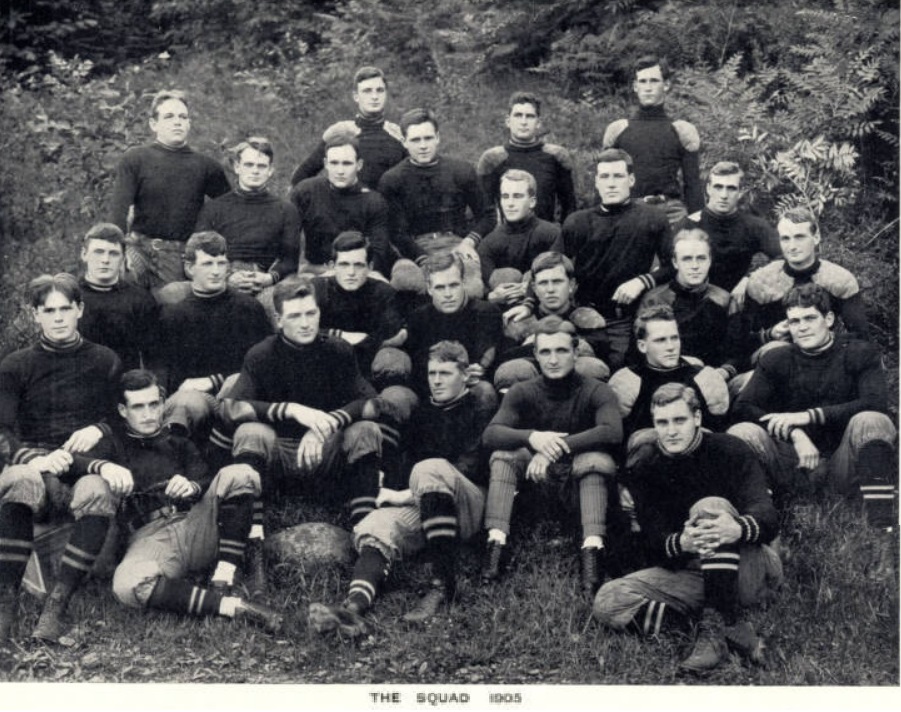
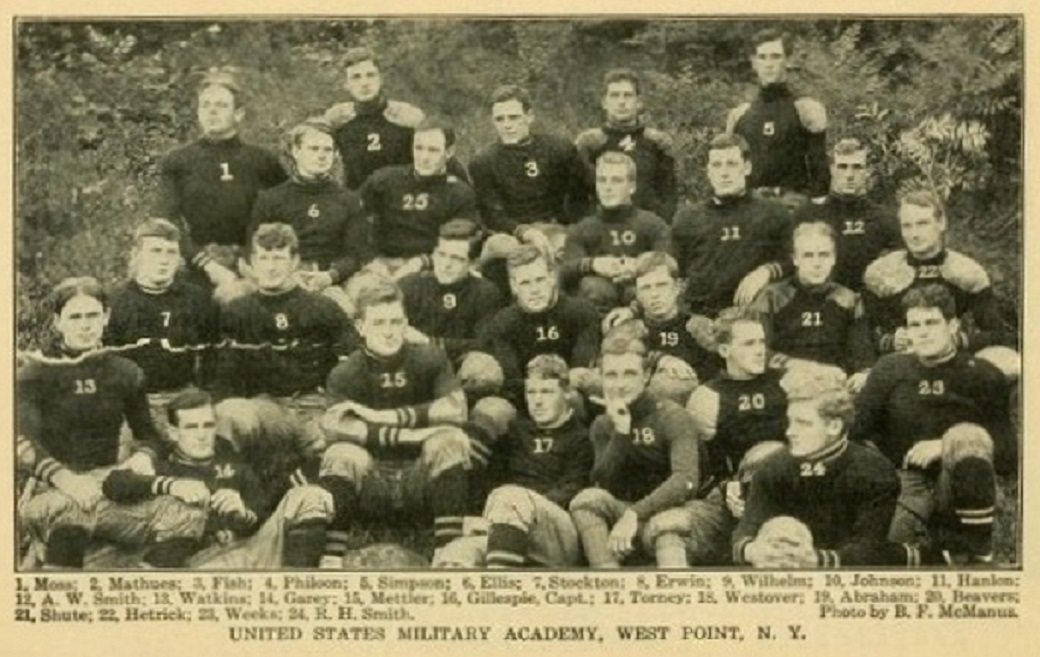
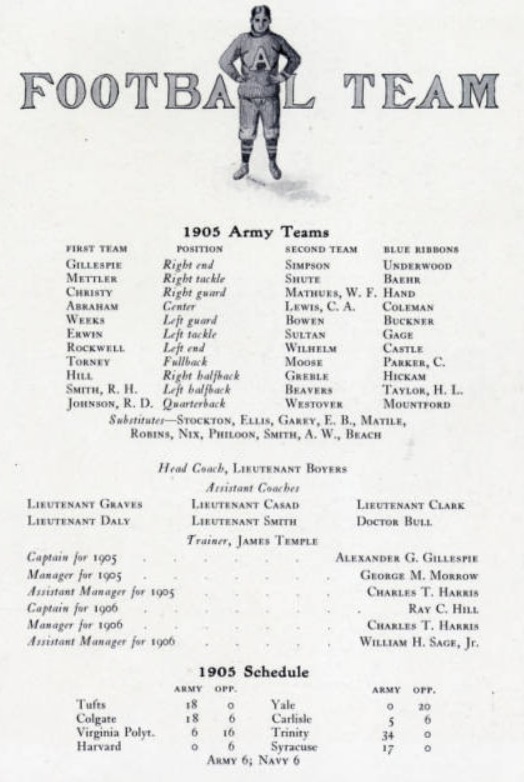
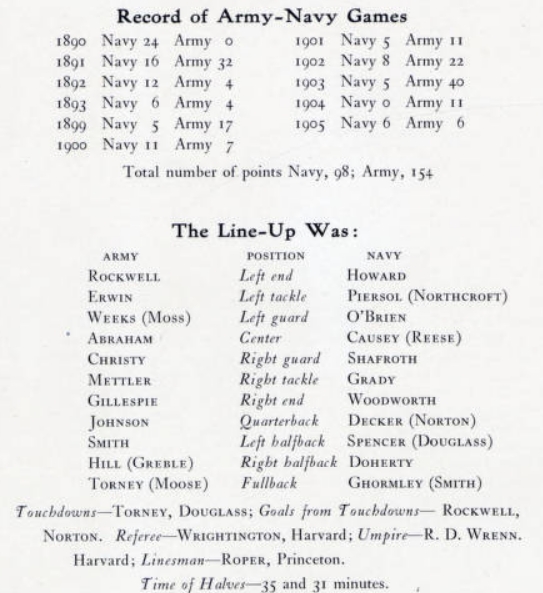
Record of 4-4-1, Tie was Navy, Coached by Robert Boyers ’03 and the Team Captain was Alexander Gillespie.

–
–
–
–
–
–
Howitzer 1906
http://digital-library.usma.edu/cdm/compoundobject/collection/howitzers/id/8195/rec/49
–
–
–
–
–
–
–
Howitzer 1906
http://digital-library.usma.edu/cdm/compoundobject/collection/howitzers/id/8195/rec/49
–
Army 1960 6-3-1
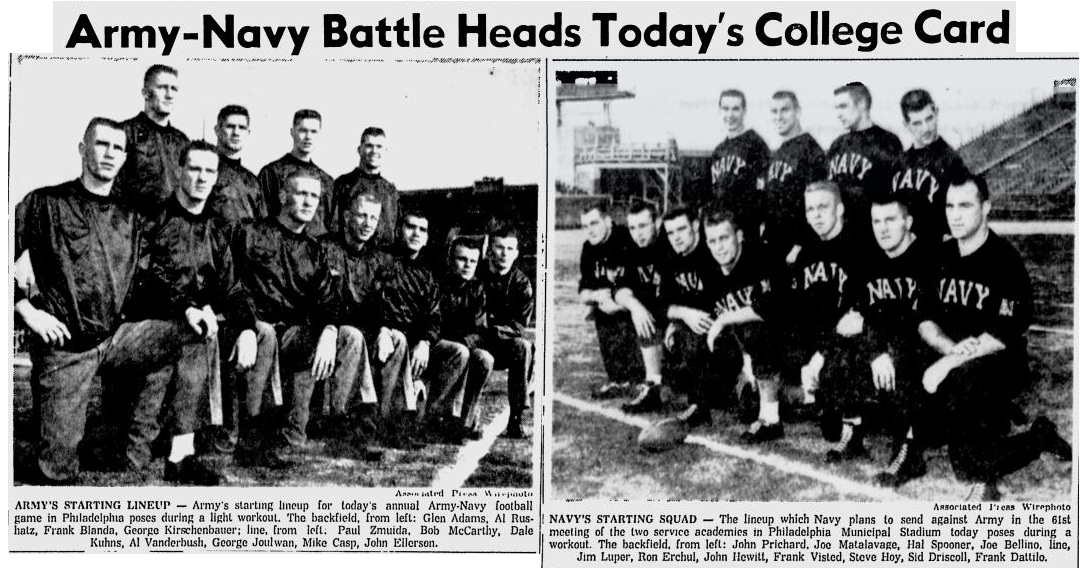
1960/11/26 Army 12 – Navy 17 L
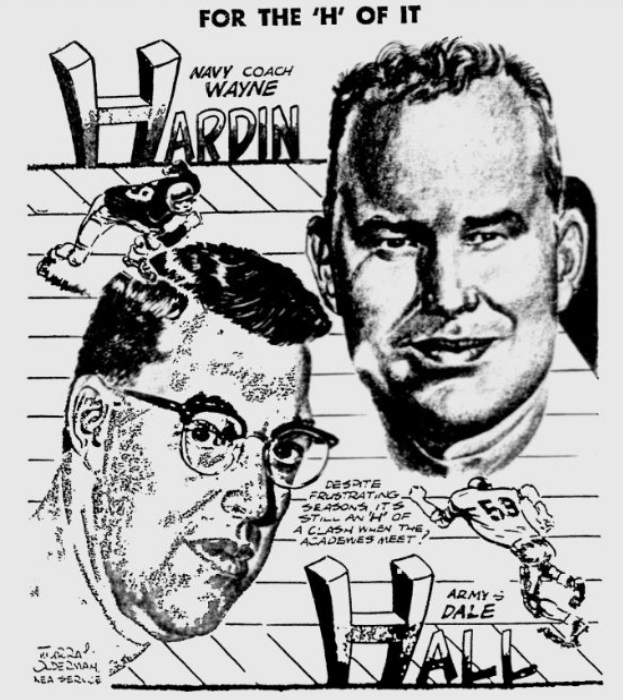
Coach: Dale Stanley Hall (June 21, 1924 – August 23, 1996)
Army 1959-1961:
1959 Army 4-4-1
1960 Army 6-3-1
1961 Army 6-4
Army: 16-11-2
Total: 16-11-2
Army 37 Buffalo 0
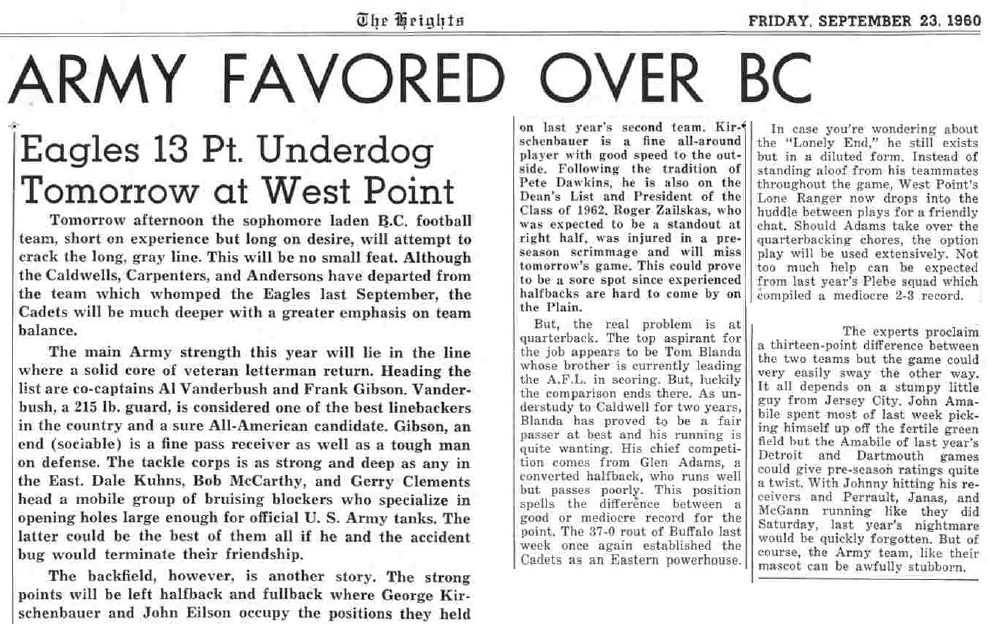
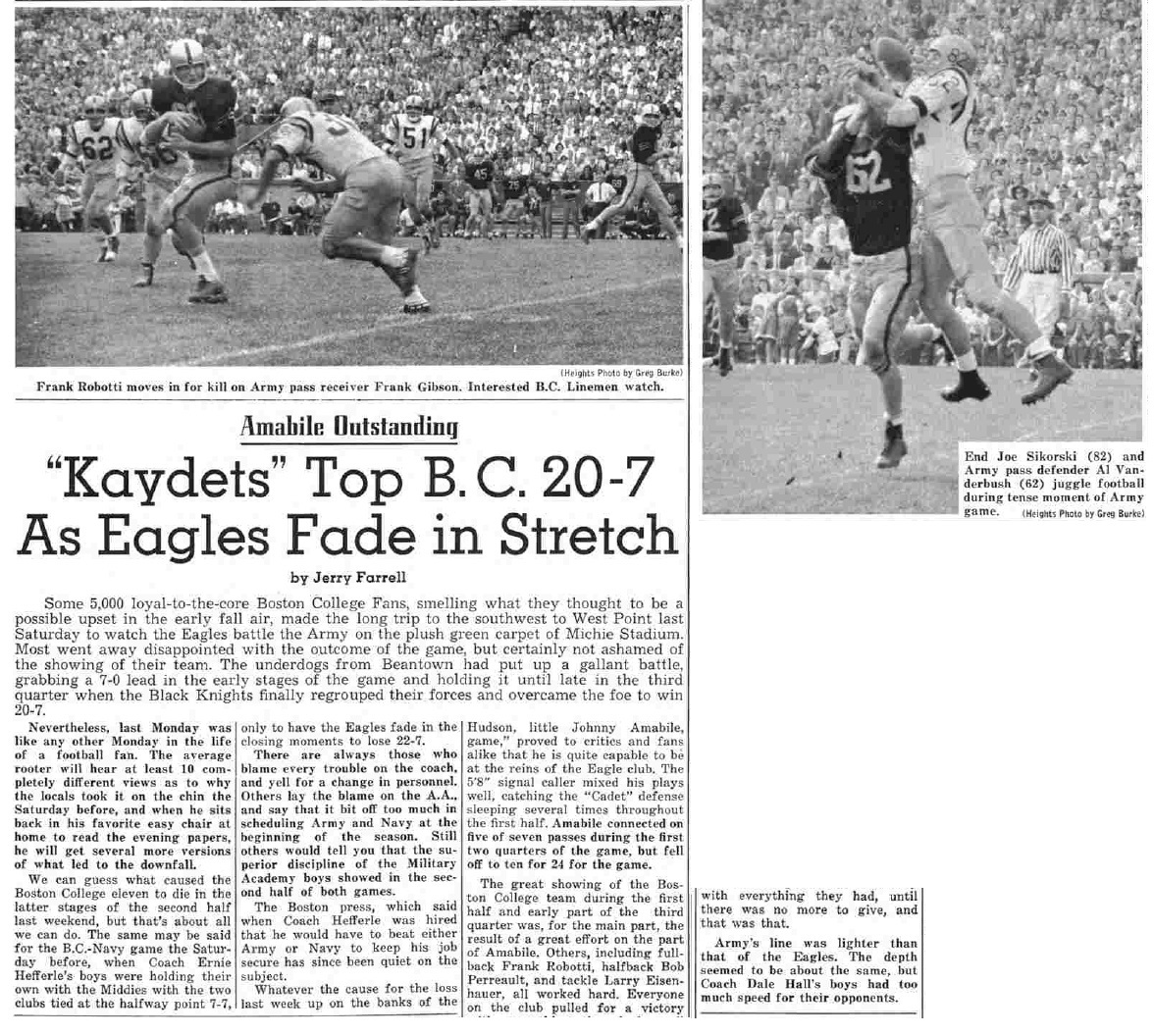
Army 20 Boston College 7
Army 28 California 10
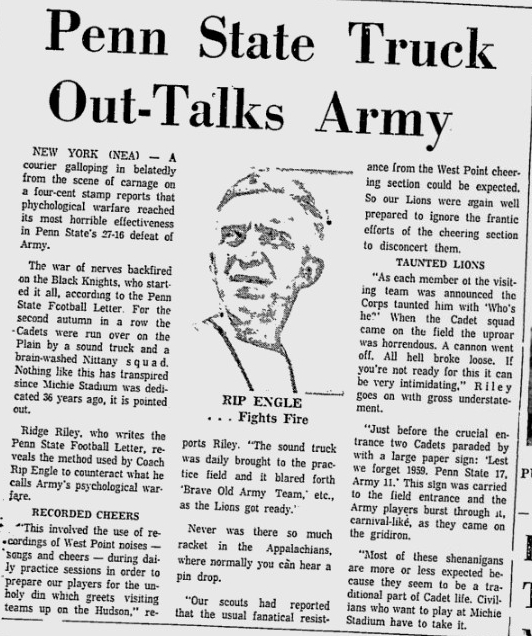
Army 16 Penn State 28
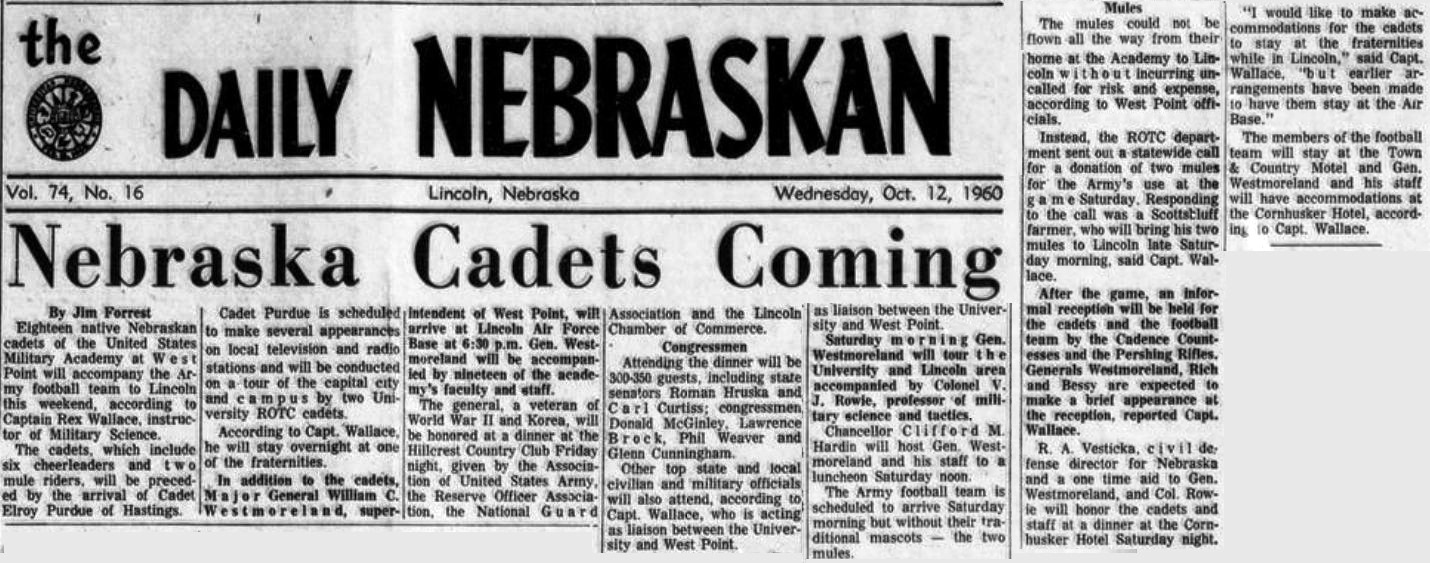
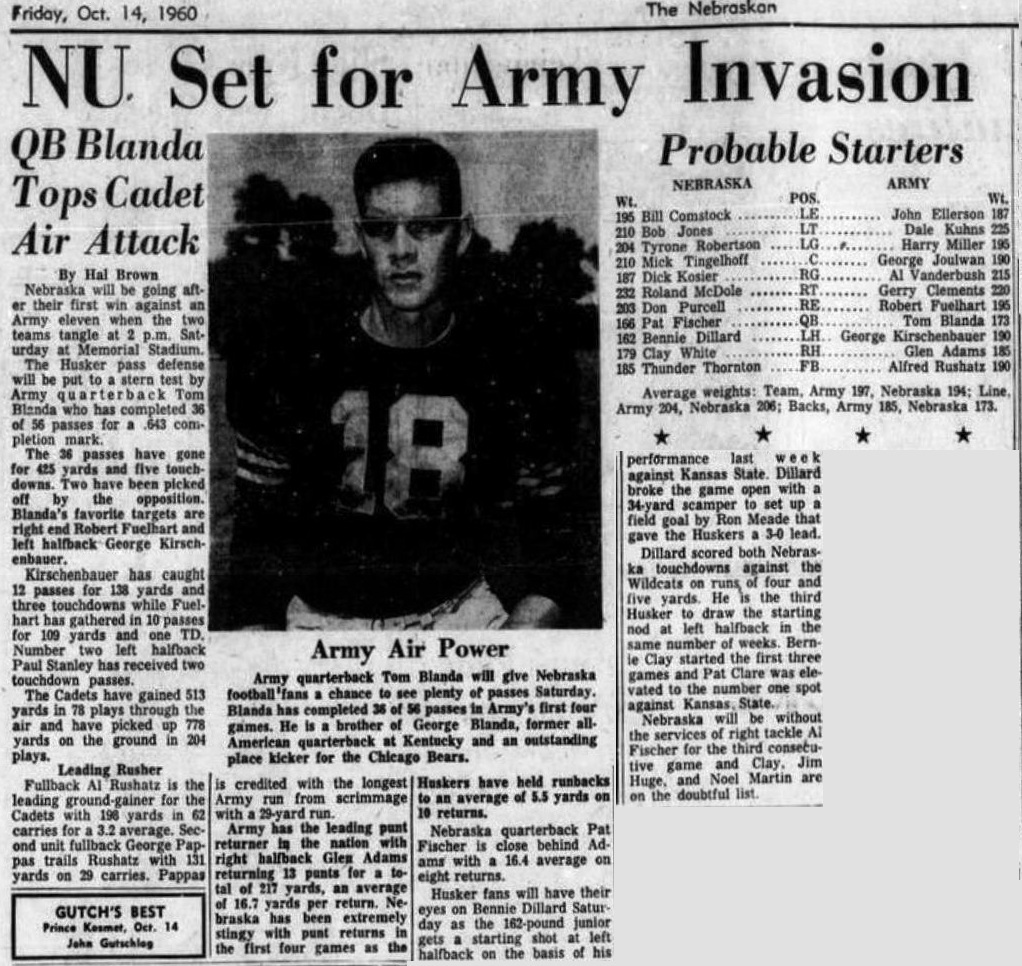
Army 9 Nebraska 14
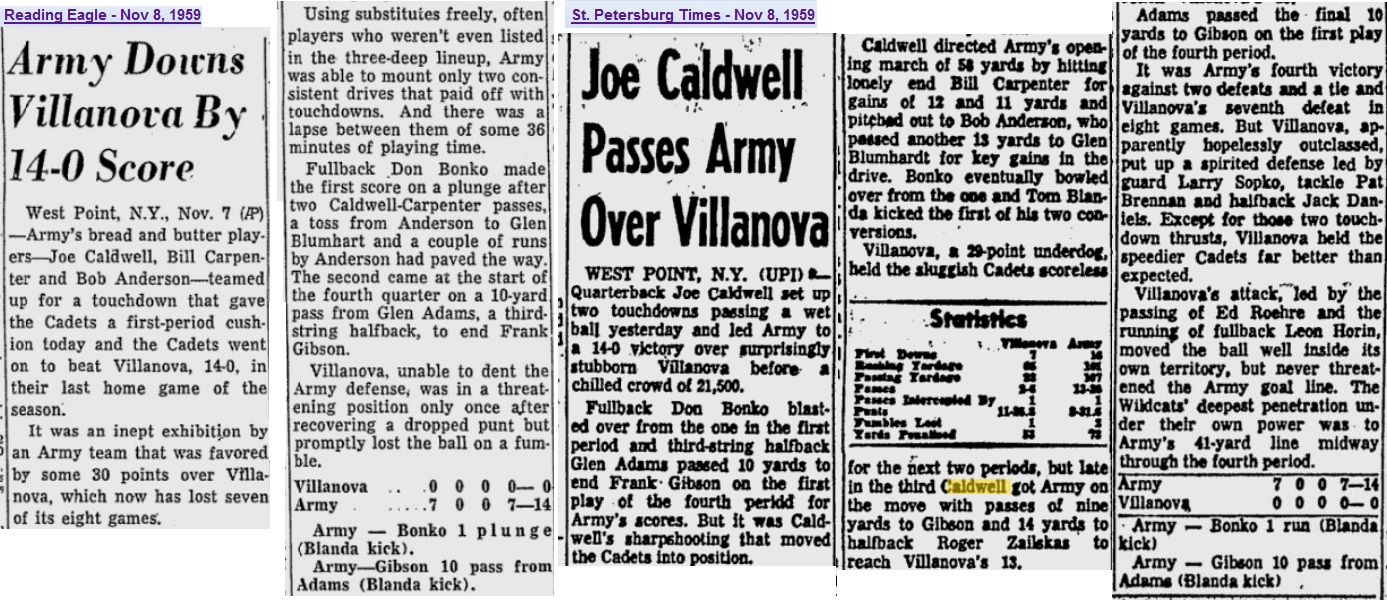
Army 54 Villanova 0
Army 30 Miami of Ohio 7
Army 9 Syracuse 6
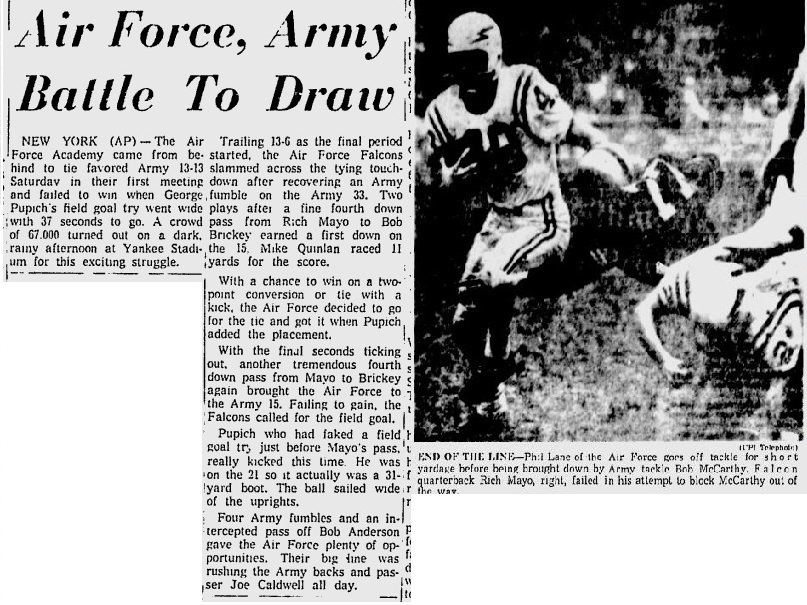
Army 7 Pittsburg 7
Army 12 Navy 17
–
–
–
–
–
–
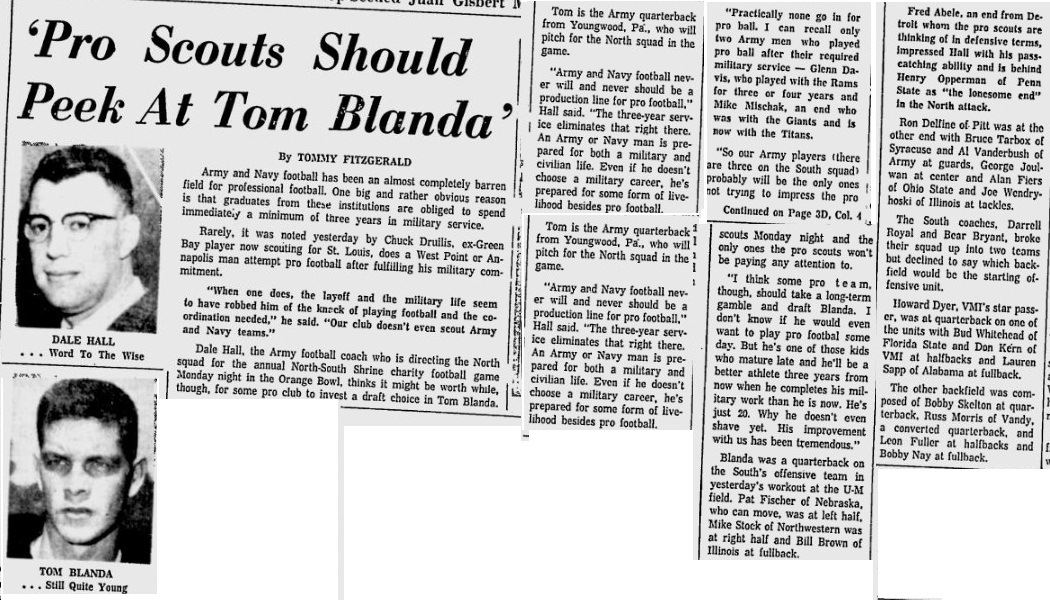
– – Blanda Passes for 2 Scores and Rushatz Runs Hard in 4-Touchdown 2d Half BERKELEY, Calif., Oct. 1 — Tom Blanda and Al Rushatz powered the Cadets of Army to a four-touchdown second-half rally and a 28-10 victory over California today. – – – NY Times Oct 2 1960
–
–
–


–
–

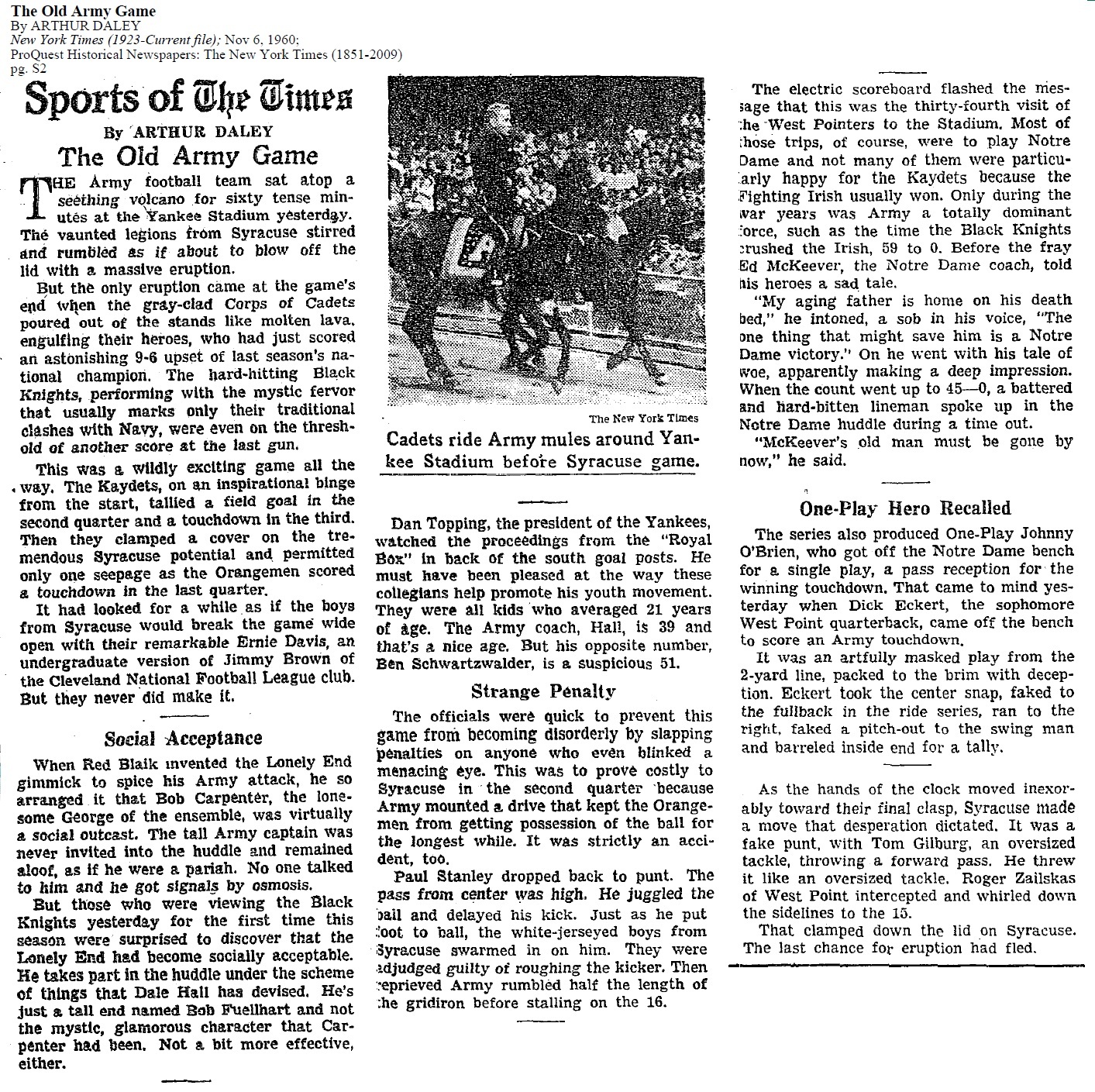
This was one of the finest games of the 4 years for the Class of 62. In the 4th quarter, Syracuse (defending National Champions) trying to come from behind, would attempt 3 passes, then hand off to Ernie Davis who would pickup 10 or 11 yards before Army closed on him. As Syracuse drove closer to the goal, Army stopped the drive with an interception and then drove to the Syracuse one-yard line, when time expired. It was a night on the town in New York City after that game.


–
–
–
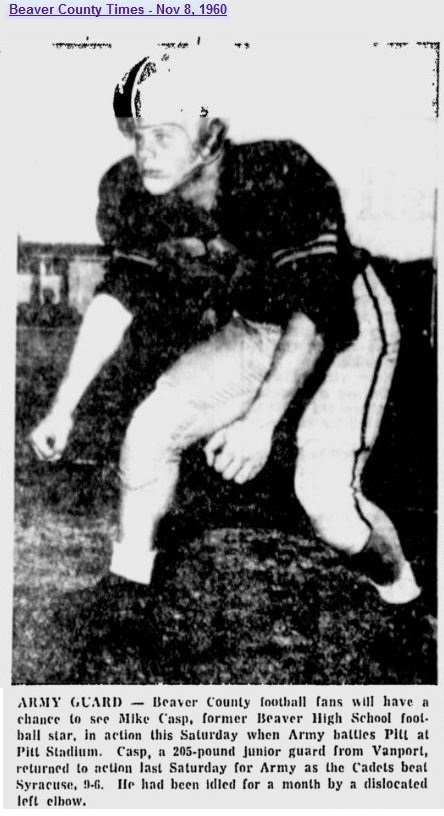
–
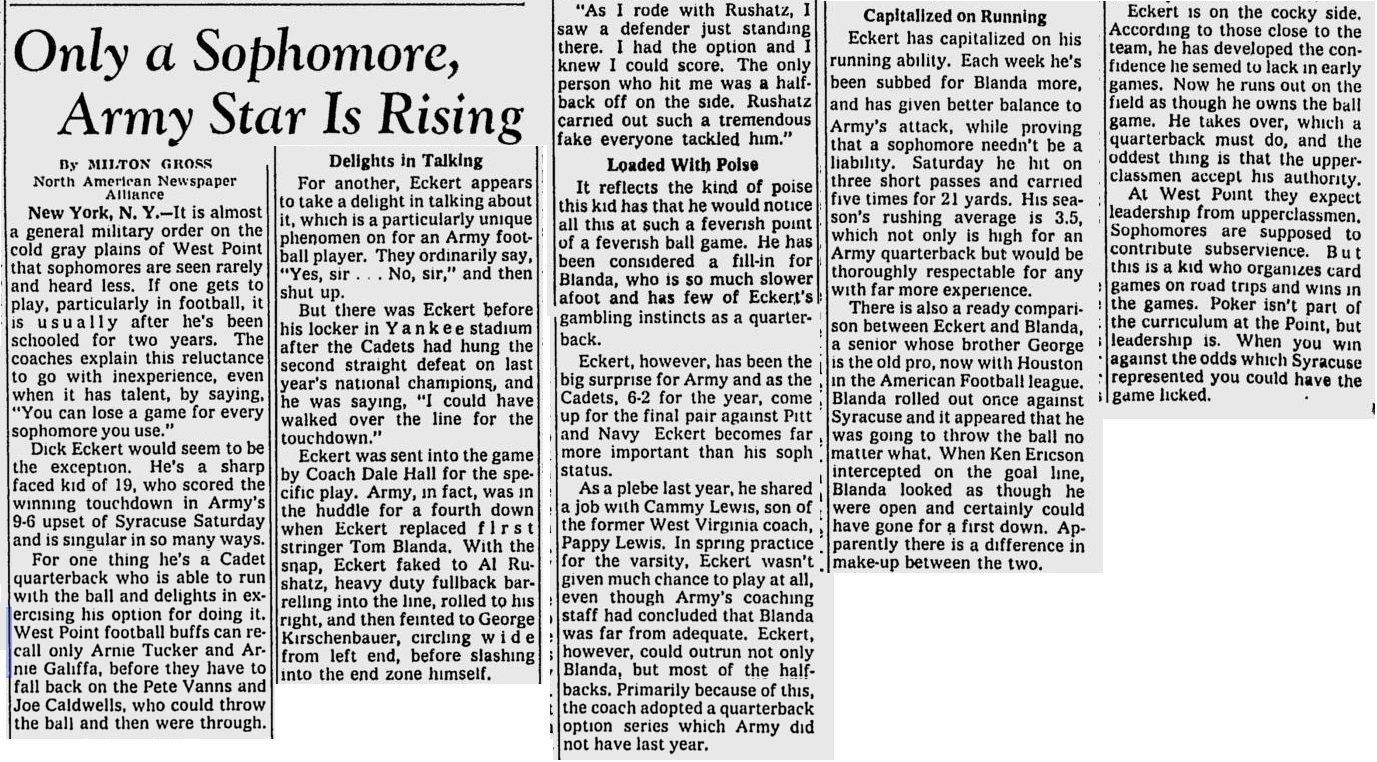
ArmyFB_1960_DickEckert_MilwaukeeJournal_Nov81960
–
‘on, Brave Old Army Team’
Backed by a legion of cheering cadets, the Army football team stormed into Yankee Stadium and beat favored Syracuse 9-6
Roger Williams, Sports Illustrated – November 14, 1960
For a disappointing, twice-beaten team, Army got a rousing send-off when it left West Point last week for its game with Syracuse. The corps of cadets disclosed and expended emotional reserves usually saved for the Navy game-signs, stunts, parades, a crackling determination all over the Point. Army, shouted 2,500 cadets, would beat Syracuse.
But Army was a 7-point underdog, and sportswriters noted that under Ben Schwartzwalder the Orange – in two varsity games, numerous freshman games and several preseason scrimmages – had never lost to Army in football. Still cadet spirit soared. At Yankee Stadium dedicated gray-coats plastered “Slash Syracuse” signs on sideline barriers and scattered oranges around a symbolic cross planted at midfield.
Army stole the on-field show as well. Playing their most inspired game in years, the Cadets forced Syracuse into costly mistakes. One penalty helped Army reach the Syracuse 12, where Tom Blanda kicked a field goal. A fumble on the Army 20 cost Syracuse its one real threat to score in the first half.
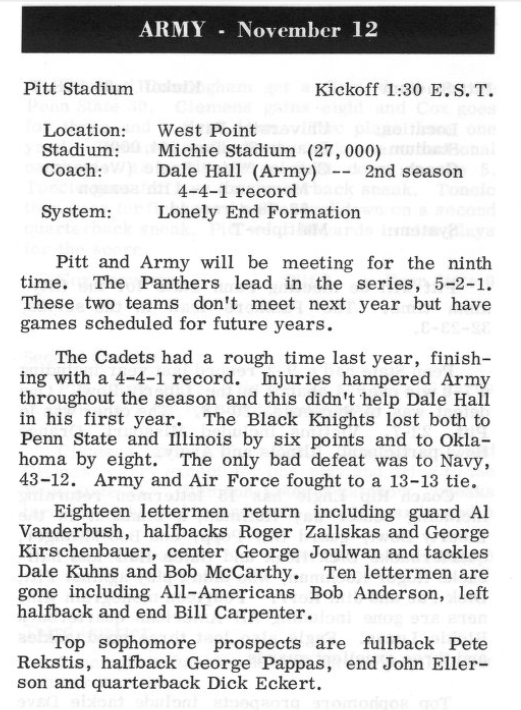
At half time, the Orange band marched and the “national champion” baton twirler performed. But the corps roared back with choruses of On, Brave Old Army Team. Then, in the third quarter, with Fullback Al Rushatz doing most of the carrying, Army moved swiftly and scored when sub Quarterback Dick Eckert faked two handoffs and cut inside end from the two. Army led 9-0.
Then Syracuse came to life. Ernie Davis ate up 37 yards on two runs and, when Army braced, Dick Easterly passed to Ken Ericson for a touchdown. Syracuse grabbed the ball again but Army stopped the Orange. With fourth and 10 on the Syracuse 39, Tom Gilburg dropped back in punt formation. Army scouts had seen the Orange fake a kick in similar situations and had alerted Coach Dale Hall. Hall played for the fake and, when Gilburg threw a pathetically wobbly pass, Army was ready. Roger Zailskas intercepted and that was all. The game ended 9-6 with Army on the Syracuse one and a mob of cadets jumping up and down on the sideline. They swept Hall and their team right off the field and on toward Annapolis.
_________________________________________________________________________________
–
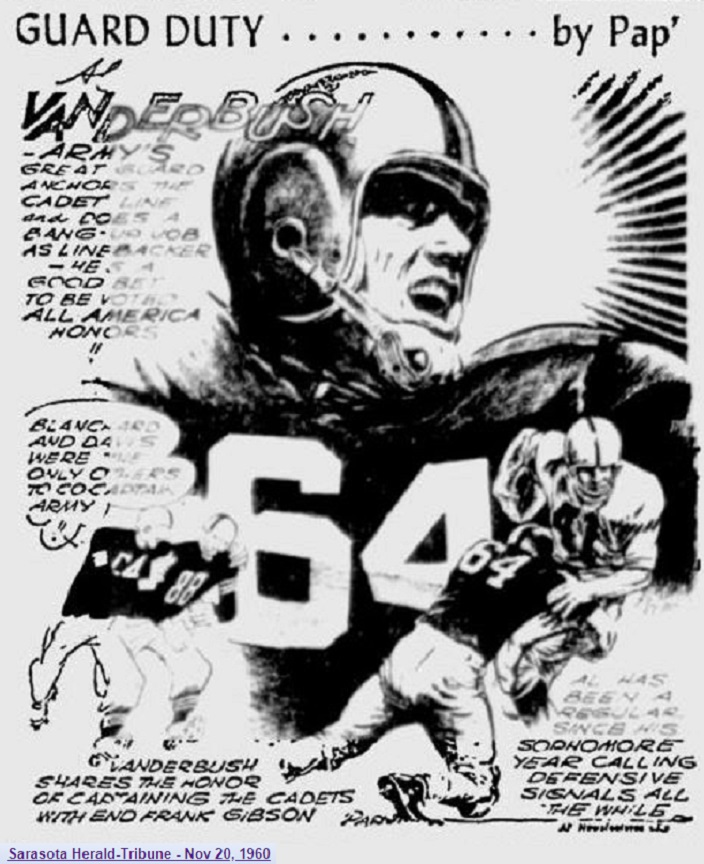
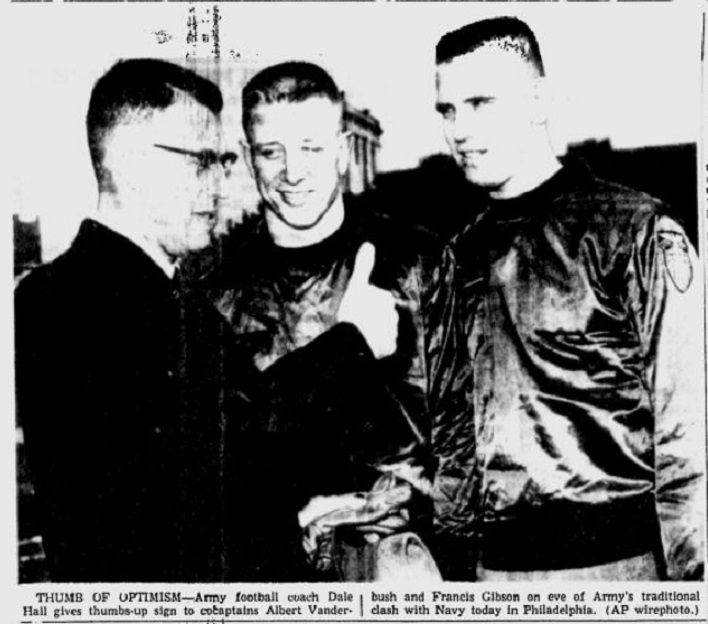
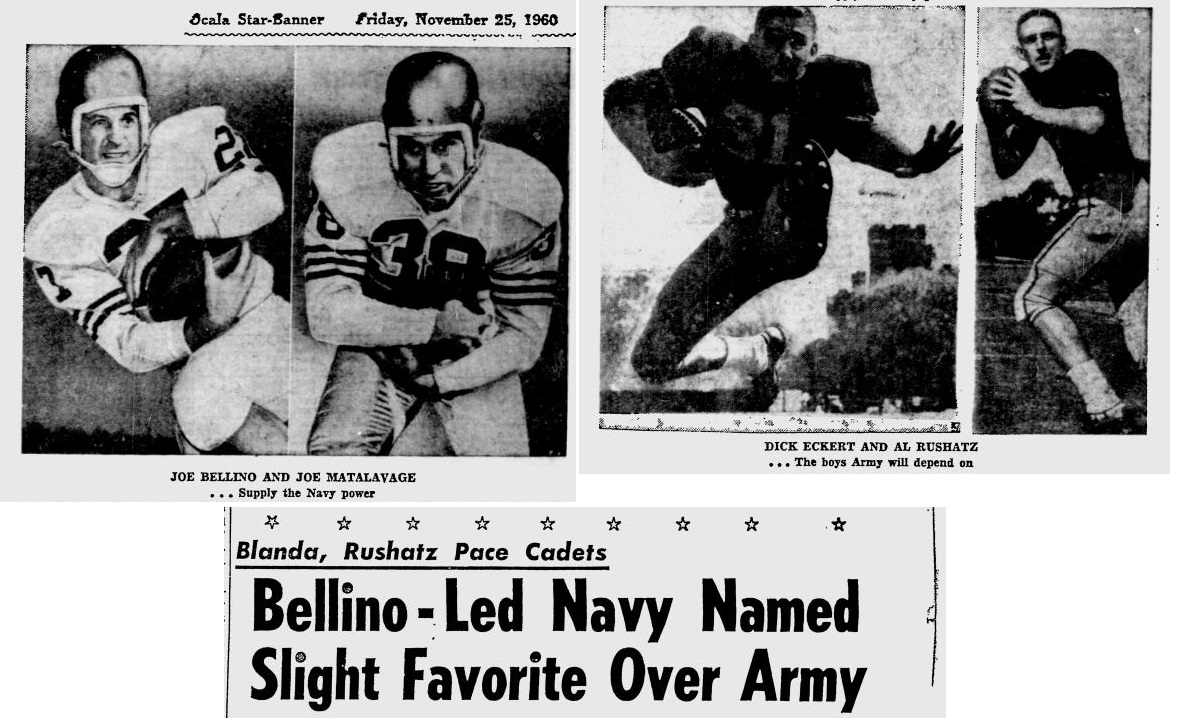
There were several reasons we lost to Navy that year.
–
–
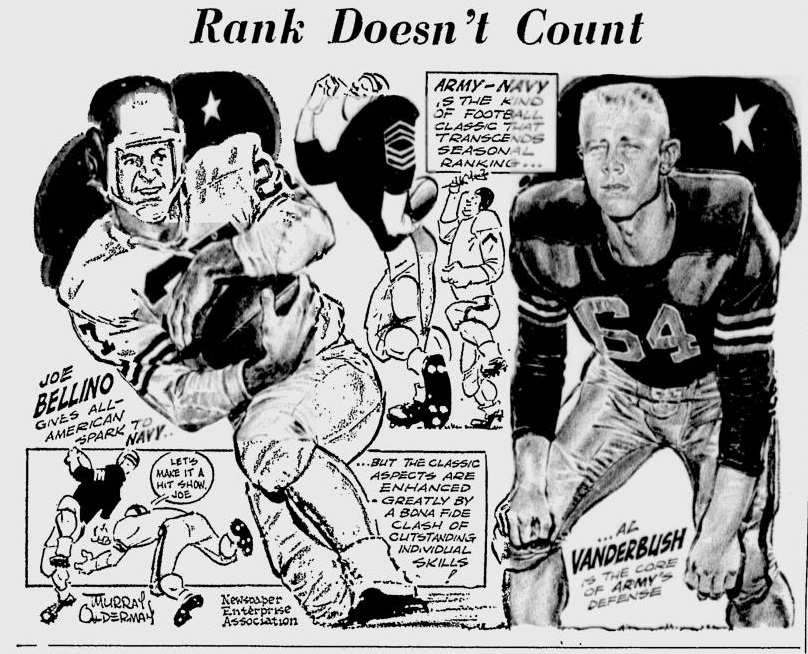
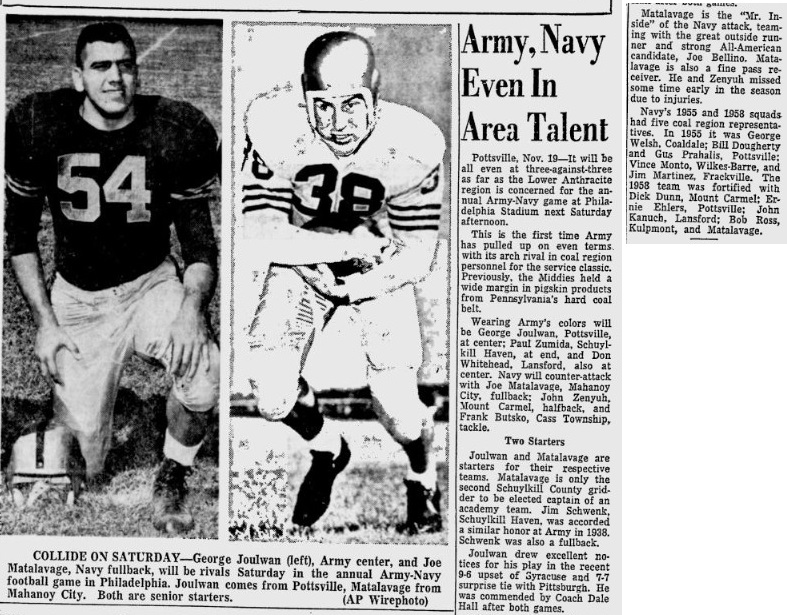
ArmyFB_1960_AlVandebush-JoeBellino_byMurrayOlderman_PortsmouthTimes_Nov231960
–
–
–
–
–
By Rabble
Mar 11, 2003
1960: Army vs Navy – A look back at the 1960 Army-Navy game. go to – https://forwhattheygave.wordpress.com/2007/11/02/1960-army-navy/
to see story with pictures
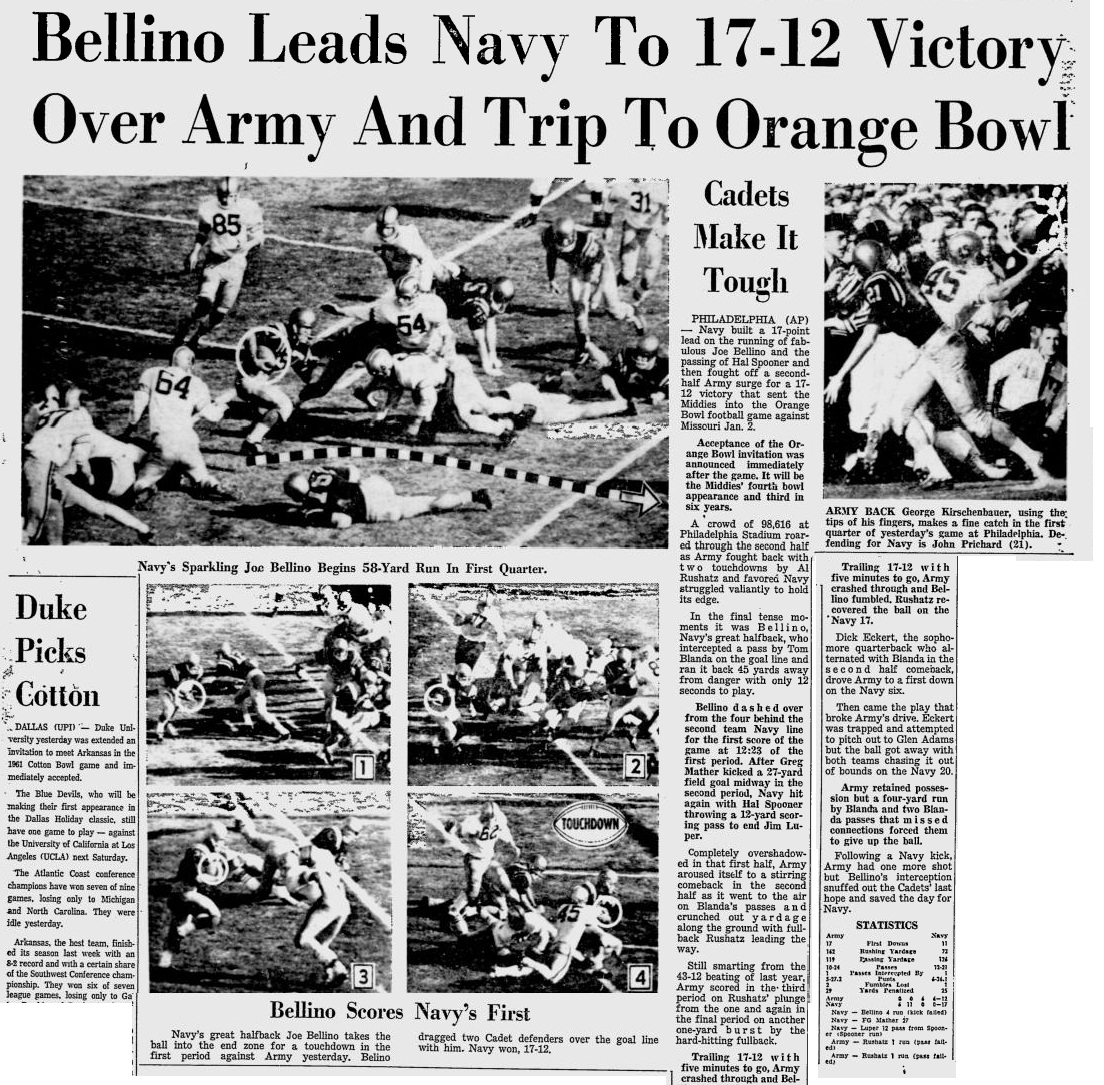
The following article was written the day after the Army team took the Navy down to the wire in a most thrilling Army Navy games of that era. Navy prevailed that year, 17-12. Described by the Dean of New York sports writers, Red Smith (1905-1982), he aptly describes the exciting action in his exclusive column.
RED SMITH
The Slasher
Philadelphia, November, 26, 1960—–The first time they gave Joe Bellino the ball, Armys John Ellerson leaped upon his sternum and spread him out like apple butter 14pon the painted meadow of Philadelphias Municipal Stadium The second tim, he faked a quick-kick, spun to run to his left, and was hit from behind by a runaway beer truck named Bob McCarthy.
On his third try he did no better, and up in the press box aan said, “Army’ll beat this team.” Just then Bellino took the ball again. He shot through a gap near the middle of Army’s line, veered to the left on a long slant through the secondary, and raced 58 yards before George Kirschenbauer hauled him down on the Army 42-yard line. Navy was off and rolling in the 61st engagement of its Seventy Years’ War with the football paladins of West Point.
That first daring dash by the swift and stumpy marauder from the Severn didn’t lead directly to a score, but in one stroke it changed the complexion of the struggle from Gray to Navy Blue. Taking the opening kickoff, Navy was smashed flat by the same clamoring Cadets who had smeared the dangerous runners of Syracuse and Pitt earlier this season. Then a punt by Army’s Paul Stanley pinned the Sailors down a yard from their own goal line.
There was Navy staring glumly down the throat of a howitzer, and then Bellino busted loose. Before the first quarter was over, Navy was in front, 6-0. At intermission the score was 17-0, and 98,616 witnesses had a premonition that this might degenerate into another rabbit-hunt like Navy’s 43-12 gambol last year.
Early Errors Nobody could foresee the heroics which the second half would produce, the wild excursions and alarums, the mounting tension as Army came clawing back in a frantic struggle against the stubborn foe on the field and the coldly impartial clock hung up against a bright blue sky.
At halftime it seemed a shabby show, in spite of the mildest, loveliest weather this production had enjoyed in years, in spite of all the elegant trappings of traditional pageantry, in spite of the exciting presence of the admirable Bellino.
Army had messed it up early through mental and mechanical error. After the Cadets smothered Navy’s first action and forced a punt, Joe Blackgrove unwisely tried to field the bouncing kick with his back to an advancing horde. Smashed from behind, he fumbled away Army’s first chance to attack.
Stanley’s fine punt, repaired that damage, and after Bellino’s long run took the ball into Army territory, the military braced and Navy tried a fourth-down field goal which Greg Mather missed. So it was still a scoreless game, but on the very next play Al Rushatz, the West Point fullback, fumbled the ball back to Navy, Needing 23 yards for a touchdown, Navy got ’em fast, Bellino slanting over for the last four wearing Kirschenbauer like a stole across his shoulders.
Up off the Rug
THERE never was another one-piece play like Bellino’s big run, but in the second quarter he was a constant menace, butting the middle for short yardage and slipping outside the tackles to wriggle like a brook trout through congested traffic. With Joe running and Hal Spooner passing handsomely, Navy pushed down into scoring range again and Mather made the score 9-0 with a 26-yard field goal.
As the first half sifted away, the Midshipmen put on still another foray, once more with Spooner passing and Bellino carrying. With 17 seconds remaining, the quarterback threw to Jim Luper, who fell across the goal line with Bill Sipos hanging on. Trapped trying to pass for two extra points, Bellino flipped the ball back to Spooner, who ran for the 16th and 17th points.
Navy seemed In complete control. The Army attack, such as it had been, offered little to cheer the 2,400 Cadets in the stands. West Point backs couldn’t seem to get traction on tile dyed green grass, kept falling before they reached the line of scrimmage. Even the fire of the Army defense seemed damped after Navy’s first touchdown.
Something happened between halves, though. The third quarter opened, and it was a different game. With Tom Blanda’s passes complementing the rushes of Rushatz, Glen Adams and Kirschenbauer, Army drove for one touchdown and almost immediately set out after another. Again misfortune balked the Cadets; a penalty for having an inengible receiver downfield on a pass play slowed one drive, and the score was still 17-6 when the last period began.
Last Curtain
The jubilant Midshipmen on the stadium’s west slope had just about had it. Now and then they whooped and brandished white caps aloft, but mostly they sat transfixed, watching and praying, Dick Eckert, Army’s second quarterback, engineered a solid advance that Rushatz consummated with a dive into the end zone. Now it was 17-12 with nine minutes remaining for Army to chew at a five-point lead. Navy stopped a drive, then fumbled, Rushatz recovered for Army, 17 yards from victory. Yard by yard, cudgelling the line for short gains, Army ground ahead to the 6-yard line. There a hasty lateral got loose, rolled back to the Navy 20. Blanda passed and missed, passed and missed again. The clock showed 1:55 remaining when his last throw fell incomplete and Navy took the ball.
The contest was over, needing only a final theatrical flourish. There was a guy on hand to furnish just that. Guy named Bellino. Unable to run out the clock, Navy punted to midfield. Blanda wound up for the last prayerful shot, took aim on Blackgrove and fired. Bellino got in front of the receiver, picked off the ball on the goal line and went swirling 45 yards back to safety as the curtain came down.
_____________________________________________________________________________________________________________

–
–
–
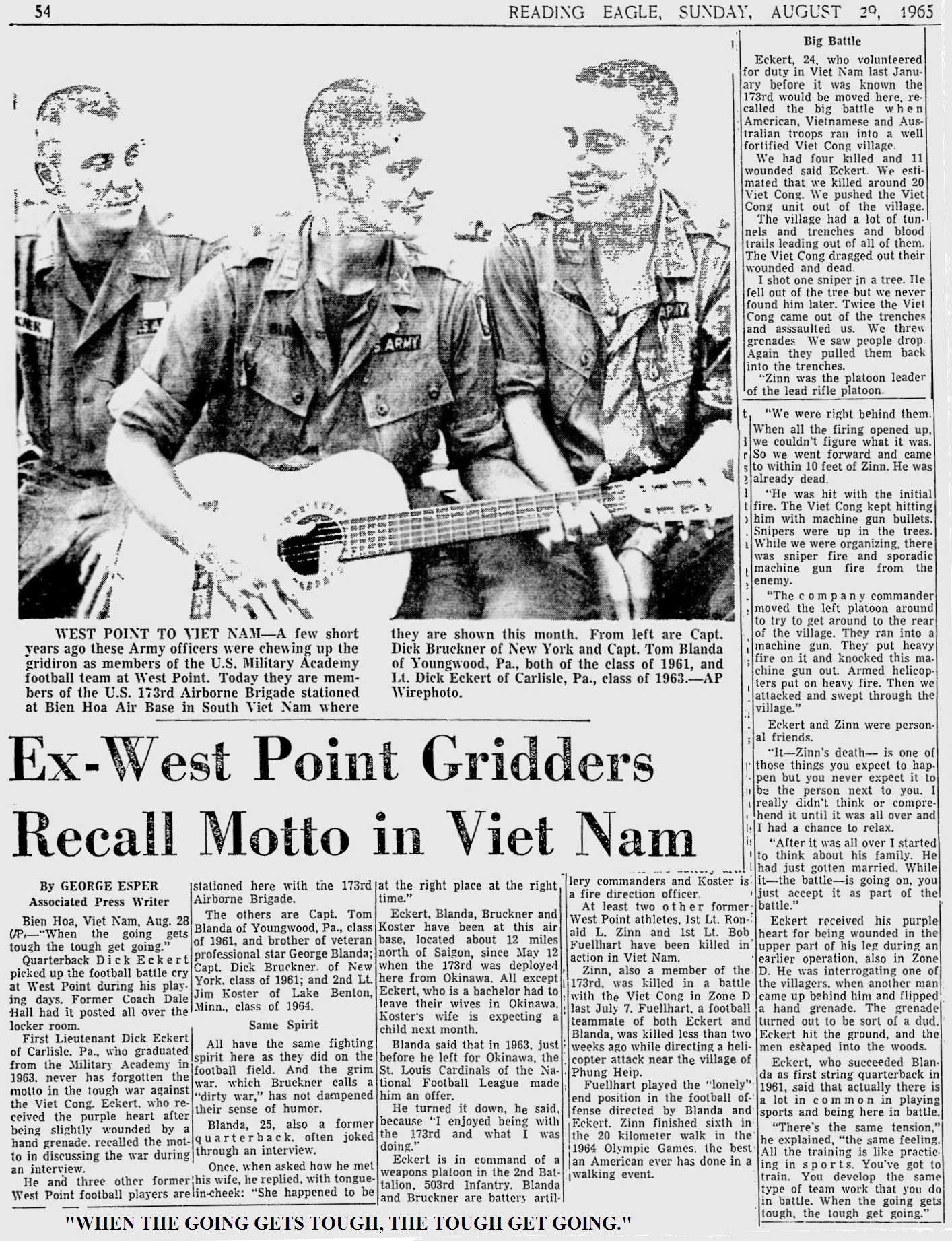
ArmyFB_1961-64_Vietnam_ReadingEagle_Aug291965
–
–
–
–
–
–
–
–
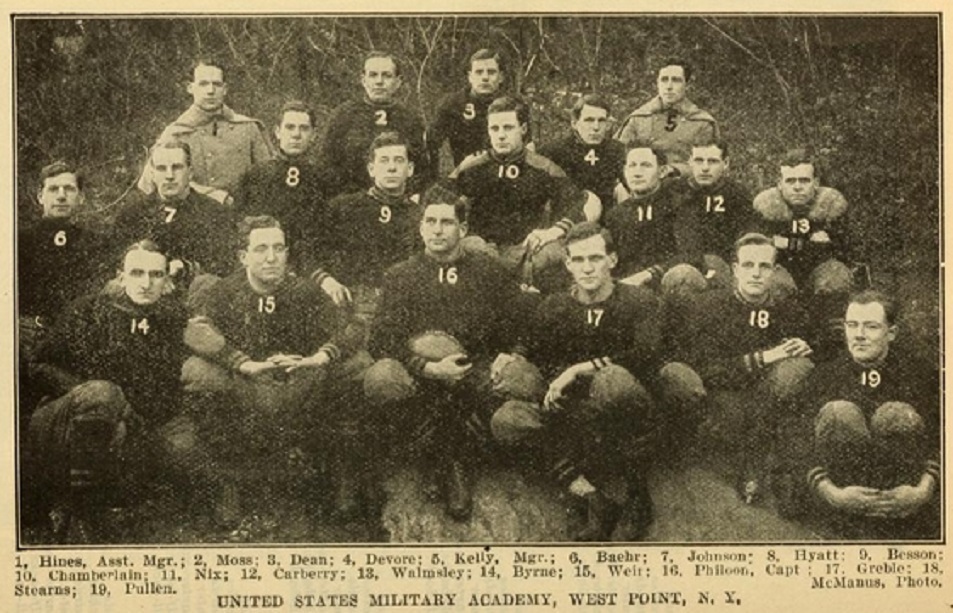
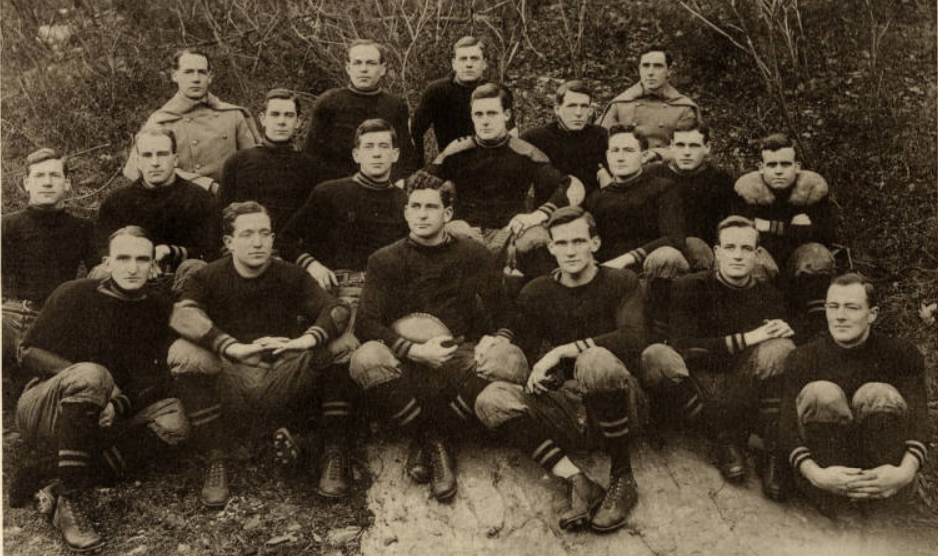
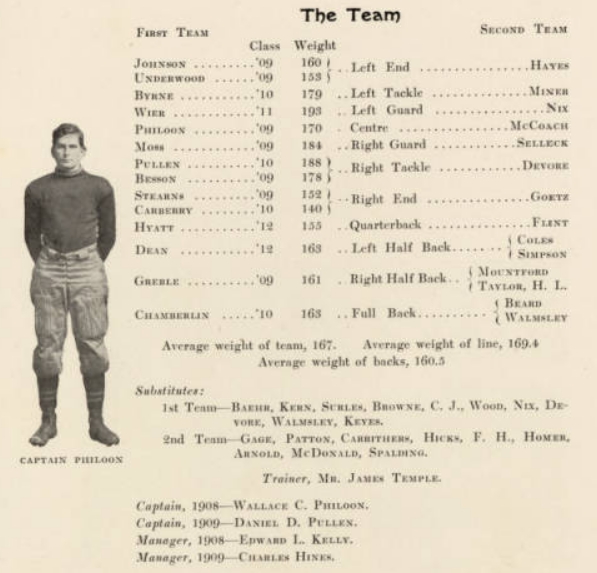
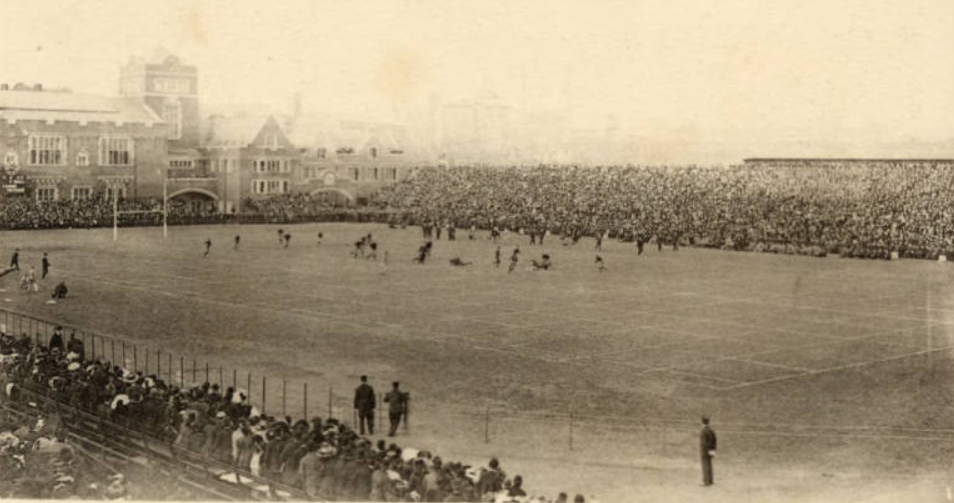
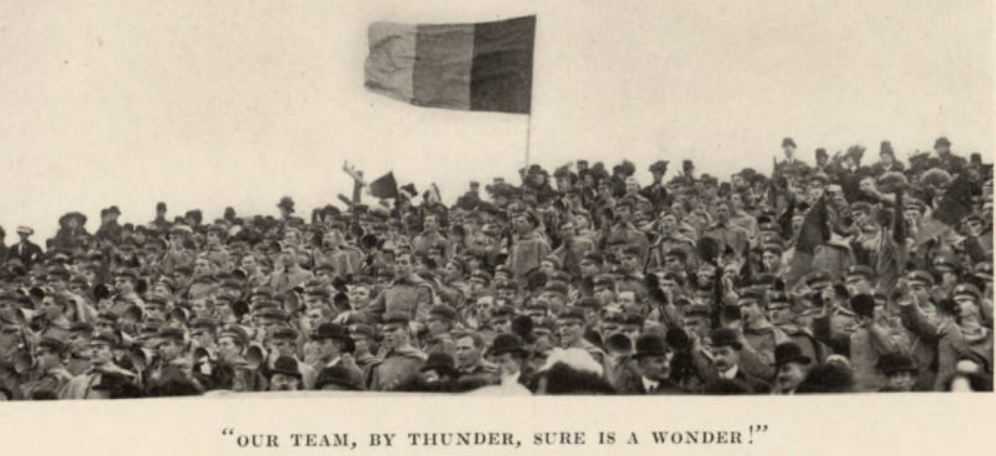
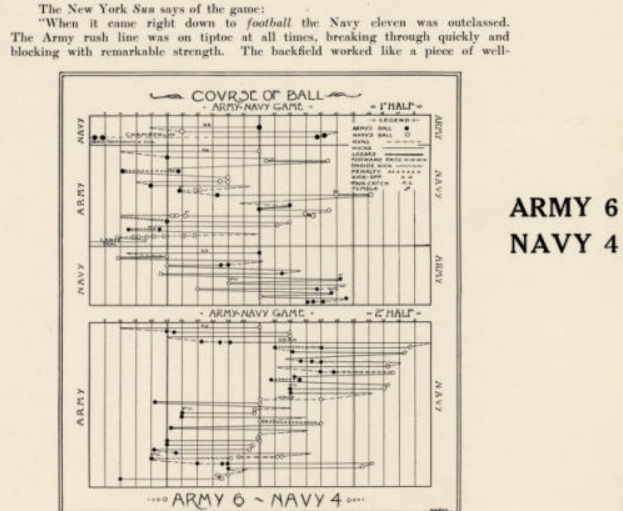
Howitzer 1909
http://digital-library.usma.edu/cdm/compoundobject/collection/howitzers/id/10153/rec/7

Army Navy Game
Rivals Leave For Big Game – West Point Cadets and Annapolis Middies Depart for Battle Field.
Youngstown Vindicator – Nov 25, 1908
http://news.google.com/newspapers?id=DRFIAAAAIBAJ&sjid=1oAMAAAAIBAJ&dq=football%20philadelphia&pg=4851%2C4674625
ARMY AND NAVY IN FOOTBALL BATTLE; West Point and Annapolis Cadets Clash at Philadelphia To-day. TEAMS FIT AND CONFIDENT Battalions of Both Academies to See Conflict — Social and Official Throngs as Spectators.
New York Times – Nov 28, 1908
The football season for 1908 will close this afternoon when the rival … To-day is a general reunion day in :Philadelphia …
http://query.nytimes.com/mem/archive-free/pdf?res=F40716FA3C5517738DDDA10A94D9415B888CF1D3
30,000 PERSONS SEE ARMY TEAM DEFEAT NAVY ON FRANKLIN FIELD; Grizzled Veterans of Uncle Sam’s Service Mingle with Youth and Beauty, While Embryo Generals and Admirals Contest for Football Supremacy. ARMY VANQUISHES NAVY ON GRIDIRON – New York Times – November 29, 1908,
PHILADELPHIA, Penn., Nov 28 — The thirteen engagement in the perennial strife of football between West Point and Annapolis went into history this afternoon with a score of “Army, 6, and Navy, 4,” to be emblazoned in Army archives, and to be recorded on the other side of the ledger at Annapolis.
http://query.nytimes.com/mem/archive-free/pdf?res=F70D14F83A5A15738DDDA00A94D9415B888CF1D3
Army Vanquishes The Navy – Lewiston Morning Tribune – Nov 29, 1908
http://news.google.com/newspapers?id=D31fAAAAIBAJ&sjid=xy8MAAAAIBAJ&dq=football%20philadelphia&pg=1375%2C7001733
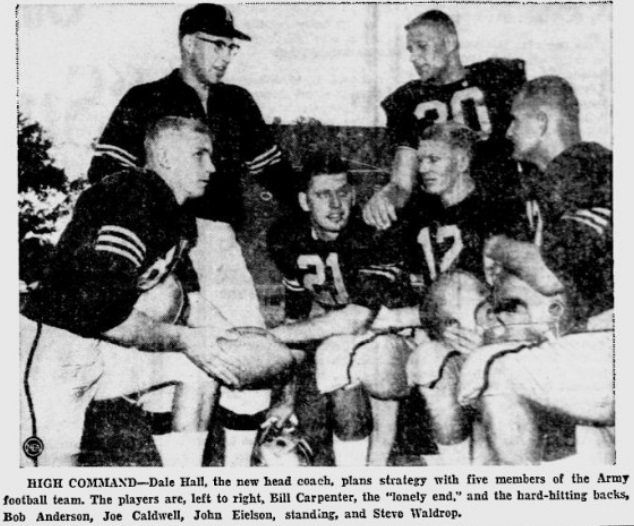
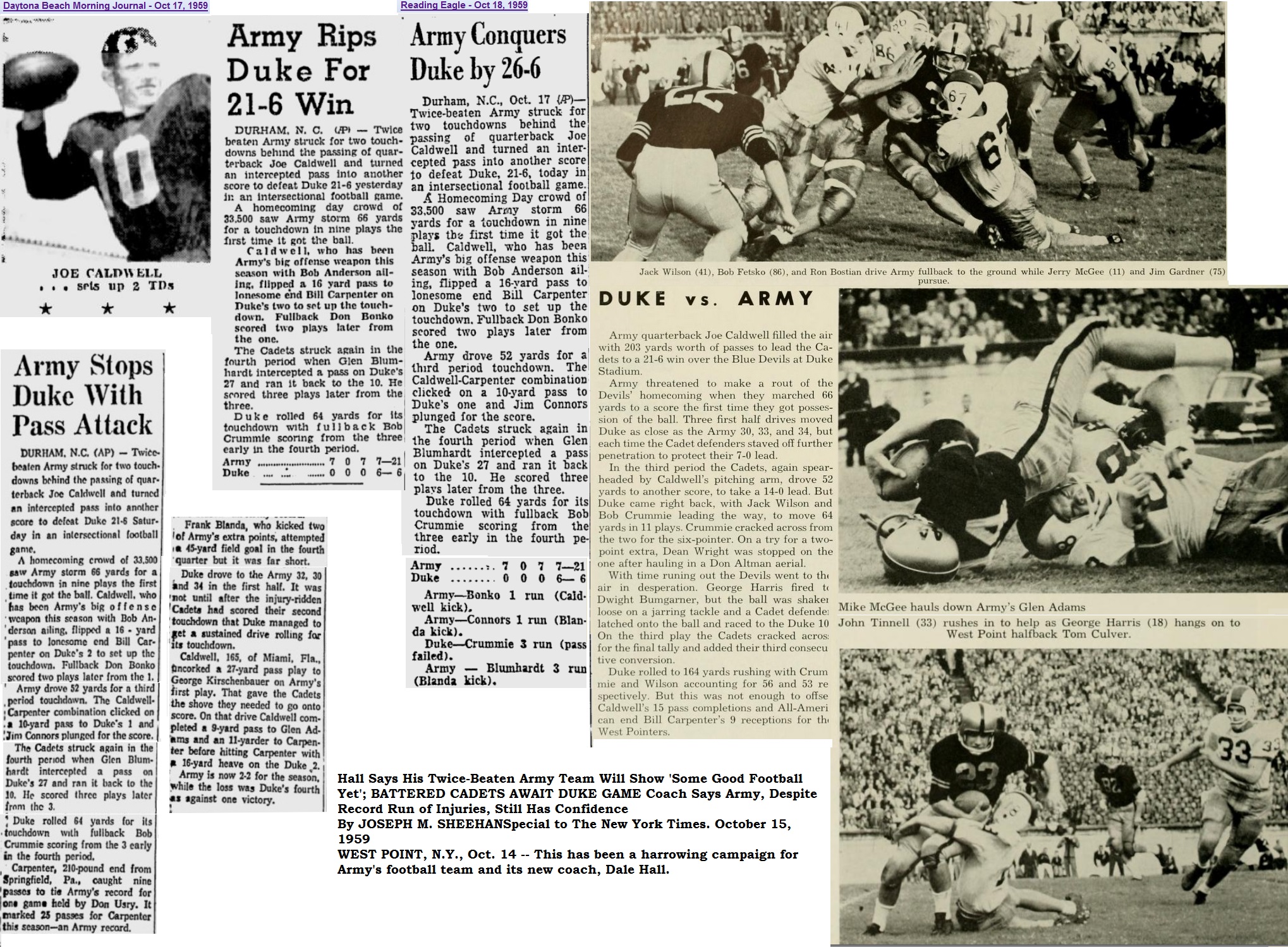
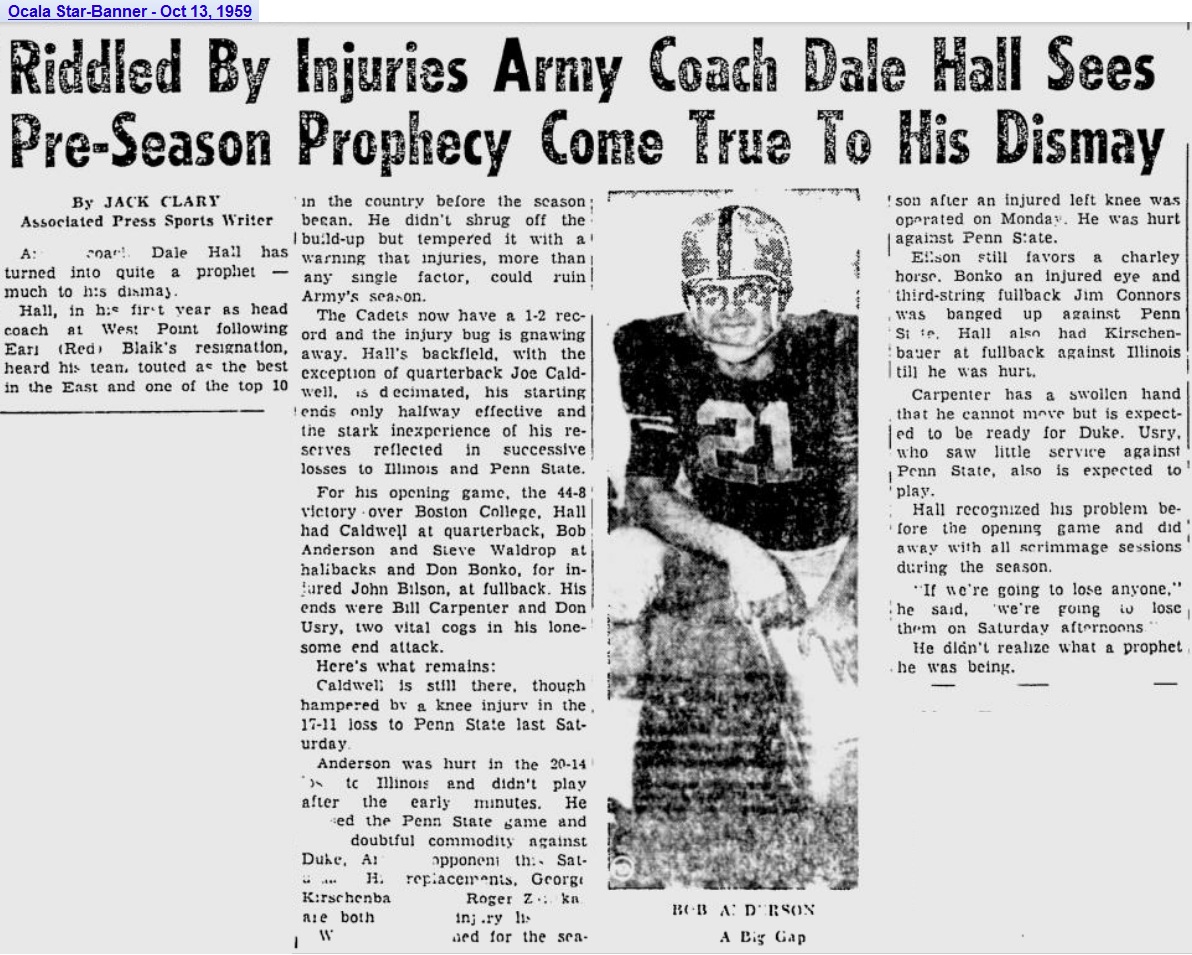
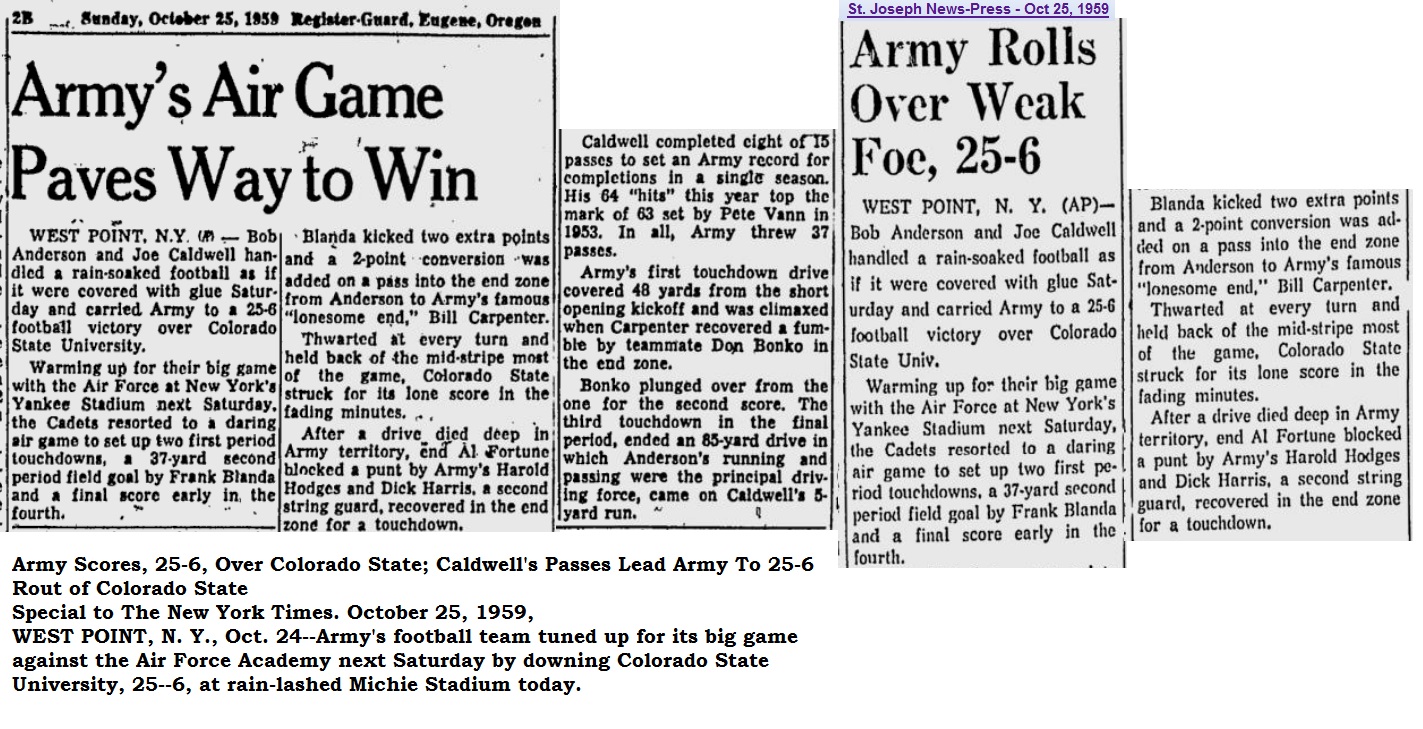
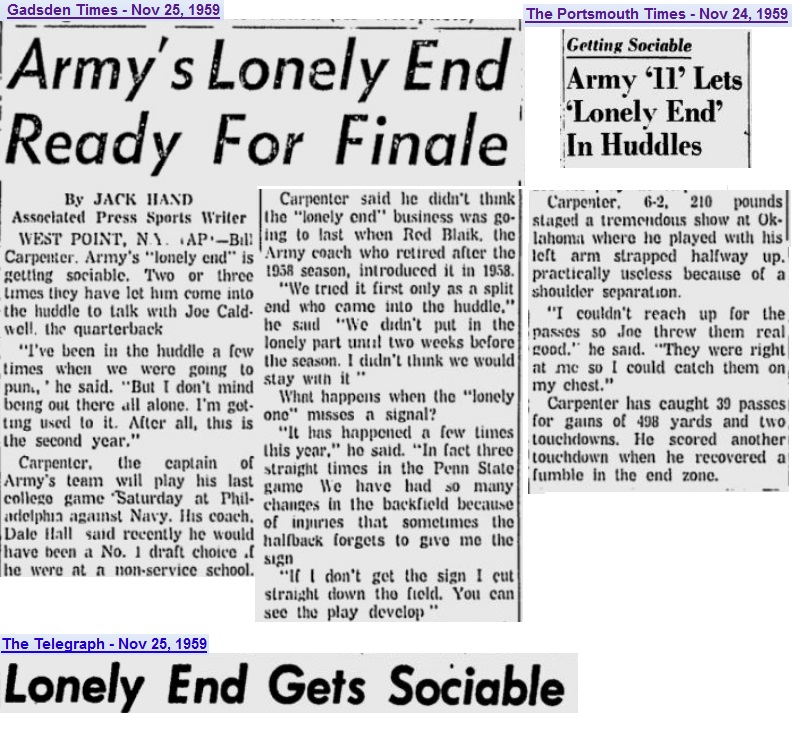
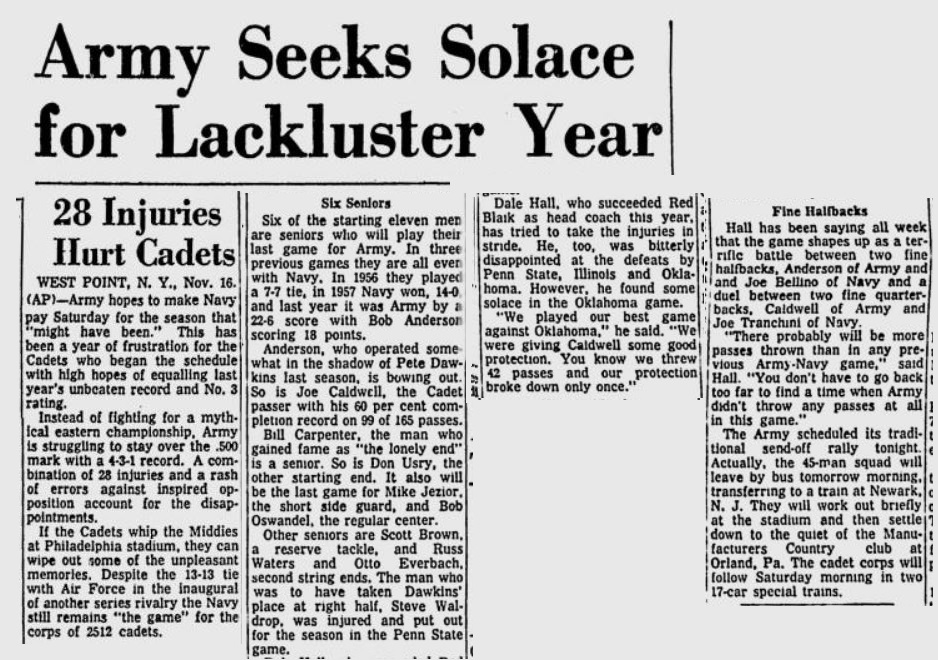
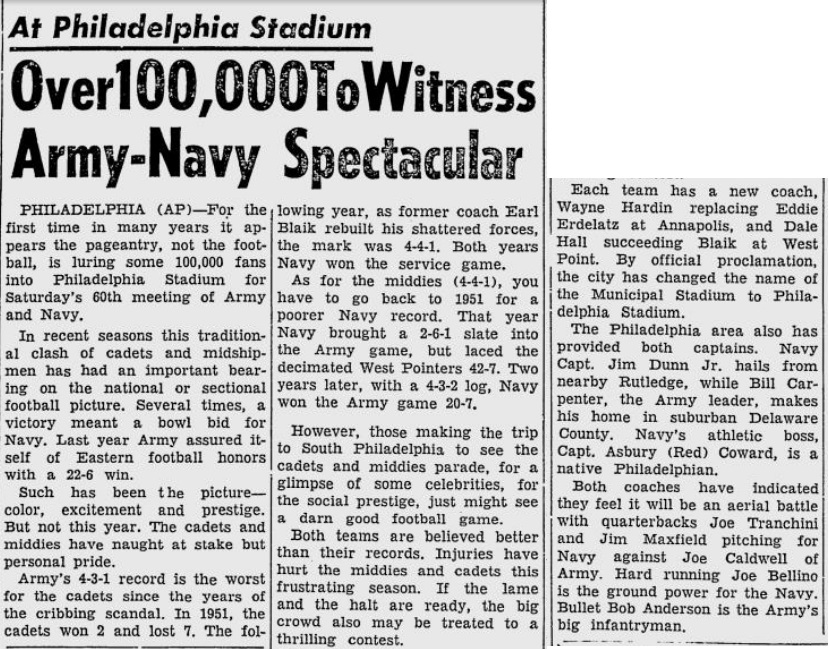
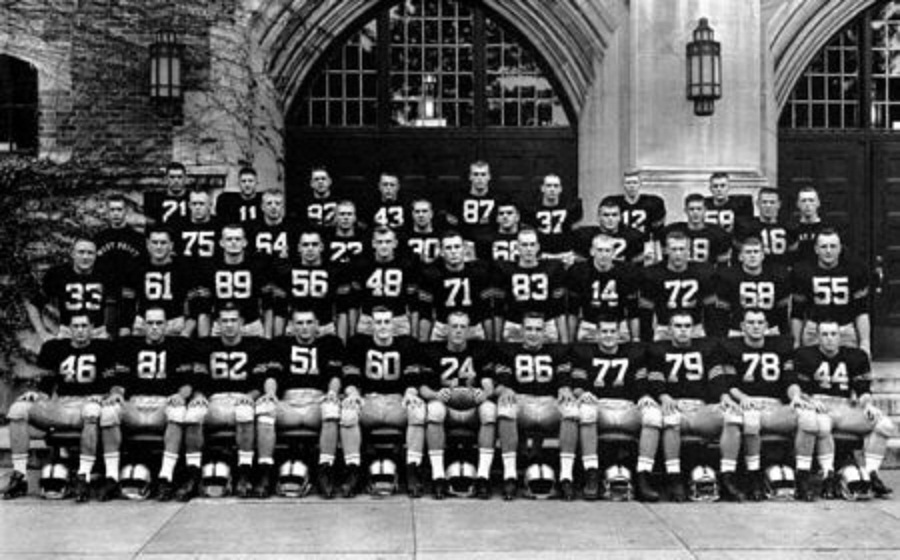
Army 1959 4-4-1 1959/11/28 Army 12 – Navy 43 L 1960 USMA Howitzer: no longer available at archive.org Coach: Dale Stanley Hall (June 21, 1924 – August 23, 1996) Army 1959-1961: 1959 Army 4-4-1 1960 Army 6-3-1 1961 Army 6-4 Army: 16-11-2 Total: 16-11-2 source: http://en.wikipedia.org/wiki/Dale_Hall  Captain Bill Carpenter 87, Bob Anderson is 21, Ozzie Oswandel 56, Joe Caldwell 12, “Don Usry” 89, “Mike Jesor” 68, “Steve Waldrop”42, “Russ Walters” 83, “George Everbach” 82, “Scotty Brown”71, Coach Dale Hall is center.
– 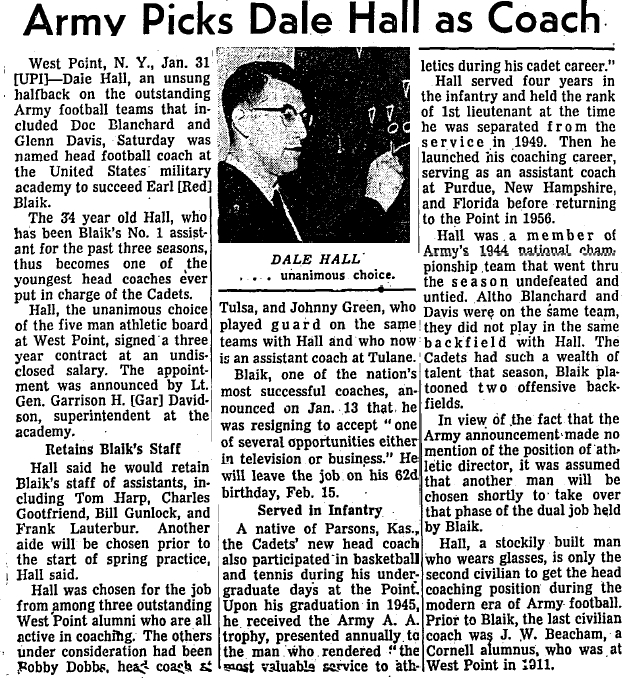 ArmyFB_1959_DaleHall-newcoach_ChicagoTribune_Feb11959 –
 ArmyFB_1959_HallandLeaders_TheTelegraph_Sep141959 –
 ArmyFB_1959_vsBC-pre_TheHeights_Sep251959
 ArmyFB_1959_vsBC-pre_TheHeights_Sep251959
 –
 –
 –
 –
 –
–  –
Pete Dawkins (Army) is something more than a fine halfback. He is captain of the team, First Captain of the Cadet Corps, President and seventh-ranking scholar of his class, hockey defenseman and musician (he plays four instruments). In Army’s new wide-open offense, Dawkins specializes in slashing runs to the weak side, is the team’s top pass receiver and the nation’s leading scorer (74 points).
Bob Anderson (Army) teams with Dawkins to give Army the year’s most devastating halfback combination. An All-America last year and a better all-round player than Dawkins, Anderson shows powerful drive to the strong side, where the going is toughest, passes as well as most quarterbacks, blocks and tackles with fierce efficiency.
Football Magic by Bill Mogan
The 1958 Army Football Team.
Some squad leaders took every occasion to bombard their plebes with verbal abuse or threats of long hours doing useless tasks, but Jules Weisler, my first regular-year squad leader, educated us on Army football. A solid man with slightly graying temples, he was intimidating that first night during Reorganization Week. I was a new plebe in Company M-2, and I braced in his room before supper formation.
Departing Minnesota had been a series of tradeoffs for me. My friends warned me that I’d never see good football away from the Big Ten. Braced up in Weisler’s room that first night, he asked me,
“What do you know about the Army football team, Mr. Mogan?”
“Not much, Sir,” was all I could manage.
Weisler looked me directly in the eyes and asked,
“Mr. Mogan, do you know who Mr. Bagdonas is?”
“No, Sir.” That was the truth.
He closed to inches in front of me and said,
“For your information, Smackhead, last year in the Colgate game, Mr. Bagdonas charged from his position as defensive tackle and took out two offensive linemen across from him. Then he knocked down the fullback, took the ball away from their quarterback, and ran 20 yards for a touchdown.”
At that point, a newspaper hovering over a desk on the far side of the room dropped, revealing the meanest human form I’d seen up to that moment in my life. The face fleetingly reminded me of a bestial comic book character, the Heap, but he was smiling and quickly demonstrated speech capability,
“Yeah, . . . and I didn’t even break my stride!”
“What do you think of that, Mr. Mogan?” asked Weisler.
I groped for a comment, but Weisler continued,
“That means Army is going to have a great season this year. You better be able to give me a personal, eyeball report on each and every game. Got that?”
“Yes, Sir!” It was crisp and final, but Weisler wasn’t finished.
“When you arrive for Monday morning calls, just start your football report. Don’t wait to be invited. Got it?”
Bagdonas was a great guy and the first member of the Army football team I’d met. I soon came into contact with more of Coach Red Blaik’s team. Bill Carpenter, “Leroy Green”, and others breezed past me as I braced against the halls of Company M-2’s barracks, the 48th, 49th, and 50th Divisions. In my 48th division, L-2 had some rooms, and I soon became familiar with Bob Anderson‘s usually smiling face. The role these men played in the 1958 Army football season shaped my whole attitude toward the Military Academy.
One day our intramural track team was running to Shea Stadium when we were stopped by the varsity football team, jogging to their practice field across the Plain from the Commandant’s house. Many of the cadets from my company were in that thundering herd. Bill Carpenter, Al Vanderbush, and “Leroy Green” stood out. I noticed Anderson, an All-American halfback with an unusual running style. He floated over the ground, only lightly planting his feet and never pushing his lower legs out in front of him, minimizing the time his knees might be extended. Brigade Commander and Football Captain Pete Dawkins, the King of the Beasts during our first months, was in the group. There were more I recognized from M-2 but lacked names to put with the faces.
Stern “Don Usry”, the tight end from L-2 who lived downstairs from us, nodded as he jogged past. The team’s cleats clattered away from us, but we remained in place as stone-faced Blaik and his coaching staff jogged past. On days when I had no intramurals, Weisler urged me to the practice field to see the Army team drill. Near the close of practice, Coach Blaik stood behind his quarterback, Joe Caldwell, and watched his offense snap through play after play. One day, canvas curtains were drawn fully around the practice field, and the MPs kept us out. The following Saturday, I took a seat in Michie Stadium, eager to see the final pre-season event, a full contact scrimmage with Syracuse.
The University of Minnesota games I knew had featured big linemen, but the Orangemen seemed to have some of the largest guys ever to walk onto a college football field. They towered over our guys, outweighing the Army line by 20 to 50 pounds per man. Even Ed Bagdonas seemed slight compared to his Syracuse counterpart. I sat directly behind the bench and observed Coach Earl Blaik‘s focus as the scrimmage unfolded. He was almost expressionless but active with his coaches and players as the white-clad Syracuse team pushed our team up and down the field all afternoon. As the sun set over Michie Stadium, I was concerned that our Army players were too small to play against the likes of Syracuse and the other teams listed on our schedule, but Blaik seemed strangely upbeat when he departed.
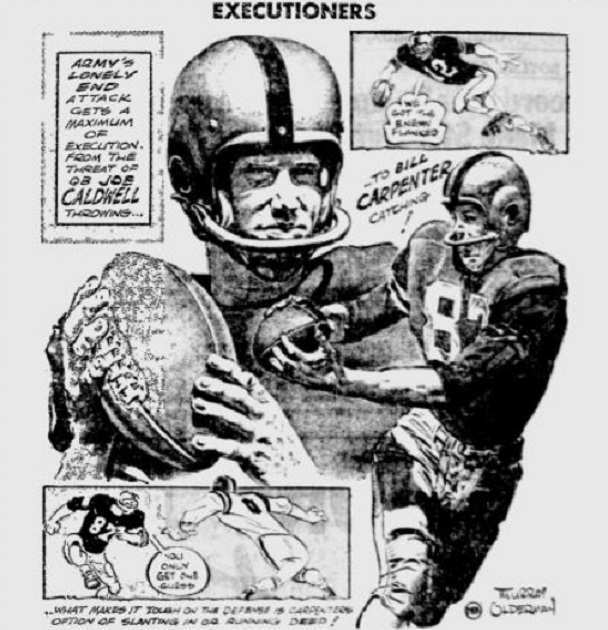
Designated as an usher for the opener, I wore a white belt and gloves with my dress gray uniform for the sometimes-wet South Carolina game. The play action was far different from what I had observed against Syracuse. Our linemen were still seriously outweighed, but they took off like greased lightening at the snap of the ball. Bagdonas and his compatriots in the trenches were popping the South Carolina line before the visitors were fully off of their stances. As an usher, I was free to roam up and down the aisles and tried to remain as close to the front railings as possible. Coach Blaik’s face was more animated than during the Syracuse scrimmage. He had a slight grin and seemed more excited. Army was passing, running, and moving the ball very well. Midway through the first quarter, it dawned on me that end Bill Carpenter stood alone on the field as the team huddled. His isolation continued, sometimes on the right, sometimes to the left, but he never joined the huddle. It was soon clear to all that day that Coach Blaik and the Army team were making football history. The lonely end formation, as it was later termed by sports writers, confused South Carolina’s defense. Carpenter dashed to precise spots to grab passes without any apparent guidance from the huddle. South Carolina had to react, so they committed their secondary to cover Carpenter on every play. That’s when the magic revealed itself.
Coach Blaik had perfected tactics and teamwork suited to the skills he found and nurtured in his individual players. Anderson, a great All-American runner, was passing the ball from fast, sweeping options. When Andy ran, he covered ground like the shadow of a fast bird flying over the stadium. Dawkins also ran and passed. Tight end “Don Usry” caught passes as much as the lonely end, while fullback Harry Walters chugged convincingly forward whenever he got the ball. Coach Earl Blaik‘s versatile offense caused total mystification on South Carolina’s side of the line of scrimmage. GEN MacArthur himself couldn’t have achieved greater offensive surprise. At the end of the day, Army stood victorious, 45 to 8, and the magical 1958 season was underway.
Cadets and visitors were effusive regarding the brilliance of Blaik’s genius and the team’s execution. One visitor walking nearby exclaimed, “Options work when you have smart players. Army may be the only team in the country with athletes smart enough to run that offense.”
Plebes were given an immediate fallout until Monday morning. I reported to Weisler’s room at 0545 hours Monday morning and began a loud, verbal report on the game: “Sir, the Football Report! On Saturday last, Army beat . . .” From a bed in the far alcove came the orders, “Stifle that noise, Mogan. If we want a football report in the future, we’ll ask you for it.”
That was my first and last football report, but as the season unfolded, the mastery of Red Blaik’s lonely end, and the execution by the smallest team to make the top five in college football, was inspiring. Each weekend the team demonstrated new heights of performance as Army beat bigger, stronger, faster teams. Rather than running up his own personal rushing numbers, Bob Anderson demonstrated his commitment every time he threw on the option plays and chose to do what was best for the team.
Results on the field were devastating. I was looking forward to each and every Saturday’s game. Clearly, Coach Blaik had studied the capabilities of each player and designed tactics built upon each one’s individual skills. The resulting field versatility completely surprised Army’s opponents.

Walters and Dawkins were injured in a convincing win over Virginia. The following week, Army came off the field in Pittsburgh with a 14-14 tie. Cadet chatter kept hope alive for an undefeated season by beating Rice in Texas. The 1958 season would then be the best season since the war years. Football enthusiasm pervaded every level of the Academy. The entire first class was tagged to take a train to Texas for the Rice game. Just before departure, it was announced from the mess hall poop deck that a telecast of the Rice game would be shown on the massive screen in South Auditorium. Response from the Corps was thunderous.
The cavernous room that was South Aud was filled with cadets, dates, faculty, officers’ wives, and a few teenaged dependents. I arrived early and found a seat near the left front of the beautiful, sloping auditorium. Army and Rice grappled to a 7-7 tie until the final minutes of the fourth quarter. With 54 seconds to go, Army got the ball at our own goal line. Quarterback Caldwell launched a long pass that arched beautifully over a sea of faces in the Rice stadium, toward my end of the TV screen. The camera panned left, blurring faces in the stadium as it followed the long, spiral pass through its trajectory. Dawkins came into view in the lower left corner of the giant screen, looking back over his left shoulder and sprinting toward the goal line. As he reached back for the falling ball, a determined Rice defender charged toward him. The ball fell toward Dawkins’ raised hands. I held my breath as the defender reached out for Dawkins . . . then the screen went blank and the sound died.
Screams and moans of frustration echoed throughout the auditorium that now was filled with standing fans. Those around me seemed resigned to the fact that we would not hear the outcome of the game for hours. But after seven confused minutes, a door at the rear of the auditorium burst open, and a captain ran into the auditorium. He began shouting, and the auditorium quieted. He’d telephoned a Texas friend who said that Dawkins caught the ball, knocked down the Rice defender, and dashed across the goal line. Army won, 14-7. A monolithic cheer erupted that sounded like a cannon firing in the auditorium. We plebes were immediately given another fallout.
The following week, rumor had it that Saint Peter (Dawkins) had fed the entire first class with a single box of crackers on the long train ride home from Texas.
Now it was time for the Corps trip to Philadelphia for the Army-Navy game.
The days leading up to the game were filled with academics, athletics, and watching football practice. Finally, team departure day arrived. An M48 tank escorted the team bus to Thayer Gate, and I joined a large melee of cadets who jogged beside the tank, cheering, and singing football songs. Cadet cheerleaders led a rousing pep rally as the buses stopped, with open windows, just across from the Hotel Thayer. “On, Brave Old Army Team” and “Sons of Slum and Gravy” echoed off the hotel walls and surrounding hills as we bid the team an emotional goodbye. Coach Blaik stepped to the bus door and waved for silence. He offered thanks from the team for the sendoff and for our great support throughout the season. The team looked forward to seeing us in Philadelphia and said, “We’ll beat Navy.” I followed the bus with my eyes as it passed through the gate and on through Highland Falls. My uniform suddenly chafed. The books under my arm felt heavy. I turned to jog back to my math class.
Our chartered train ride to Philadelphia was a late-night affair. Around midnight, we marched down the hill toward the train station. The prospect of the coming night in Philly after the game more than made up for the discomfort of sleeping on seats, floors, or luggage racks. The train jerked to a stop on a rail siding adjacent to Municipal Stadium at 0410 hours. We stirred but slept on until 0700. The morning of Saturday, 29 Nov 1958, was sunny, clear, and cool, and our train was just far enough away from the stadium that we could see little of the forming crowd. With long overcoat capes buttoned back over our shoulders, we gathered into massed company formations. Getting closer to the stadium, we discovered hoards of strangers cheering us outside a fence. Finally, we moved through a tunnel and emerged into the massive stadium to the cheers and applause of more than 100,000 fans. It was overwhelming. After months of living life as a plebe, the lowest form of human life, it was miraculous to just be part of something that big.
When the teams entered, I was a little surprised to see our team in white jerseys. An early Army fumble was run through the Army line for a fast Navy touchdown that quieted our side of the stadium. Somewhere Navy had found a 180-pound runt by the name of Joe Bellino, who enjoyed running along carrying defenders on his back. Fortunately, we started generating magic after Bellino’s early running demonstration.
During the second half of the game, I yelled myself hoarse. The Army line delivered magnificent violence on the Navy team. The element of surprise as well as Army teamwork wore Navy down. At the end of the day, Anderson, Dawkins, Carpenter, Usry, and company secured their just win, 22-6.
As the traditional Army post-game cheer boomed out from the Corps, I mulled over the individual players and their roles in what had played out that day and over the entire season. It occurred to me that while we had superb individual players, they had lived the vision of a team. Coach Blaik motivated each of them to support the other on that team with every fiber of their being. Each had a profile of skills, but no one was perfect. Every obstacle was overcome by selfless teamwork. Watching the buses and cars pass as I strode along the sidewalk, I knew I’d learned something from Coach Blaik. He had never spoken directly to me, but his knowledge of teamwork was a lesson I’d carry through life.
The floors of the Ben Franklin were jammed with hospitality suites that evening. Army organizations, clusters of grads, West Point societies, and parents of cadets had suites as gathering places for friends and their cadet sons. That night, I felt pride in just being a cadet. I recalled that first night in Weisler’s room when I met strongman “Ed Bagdonas”. The energy level generated that season carried me through the rest of my cadet career and through the decades since first seeing the Army team and their taciturn coach jogging to practice. The 1958 Army football team embodied the highest fulfillment of the word “teamwork.” As life pits my body and soul, I enjoy being in the company of classmates who shared the magical 1958 season. It’s always great to be among the best of men again.


Captain
(no photo at present)

177 Pounds


191 Pounds


167 Pounds


123 pounds


Tom on the Mound against Navy 1961. “Gordon Dopsloff” Class of “1963” is probably on First> (Sports Illustrated photo by A Triolo)


(Photo from Col Red Reeder’s Book – Pointers on Athletes)


Army 1961 6-4
1961/12/01 Army 7 – Navy 13 L
Coach: Dale Stanley Hall (June 21, 1924 – August 23, 1996)
Army 1959-1961:
1959 Army 4-4-1
1960 Army 6-3-1
1961 Army 6-4
Army: 16-11-2
Total: 16-11-2
source: http://en.wikipedia.org/wiki/Dale_Hall


23 – Tom Culver, 24 – Pete King, 50 – Bottom of Pile – Bill Whitehead, 60 – Barry Butzer, 80 – Bobby Fuellhart, 85 – Paul Zmuida, There is one unknown Player

1961 Army 31- BU 7 |

’62 Football Team Members |

1960 Army 30 – – Miami of Ohio 7 |

1960 Army 9 – Syracuse 6 |

1960 Army 16 – – Penn State 28 |

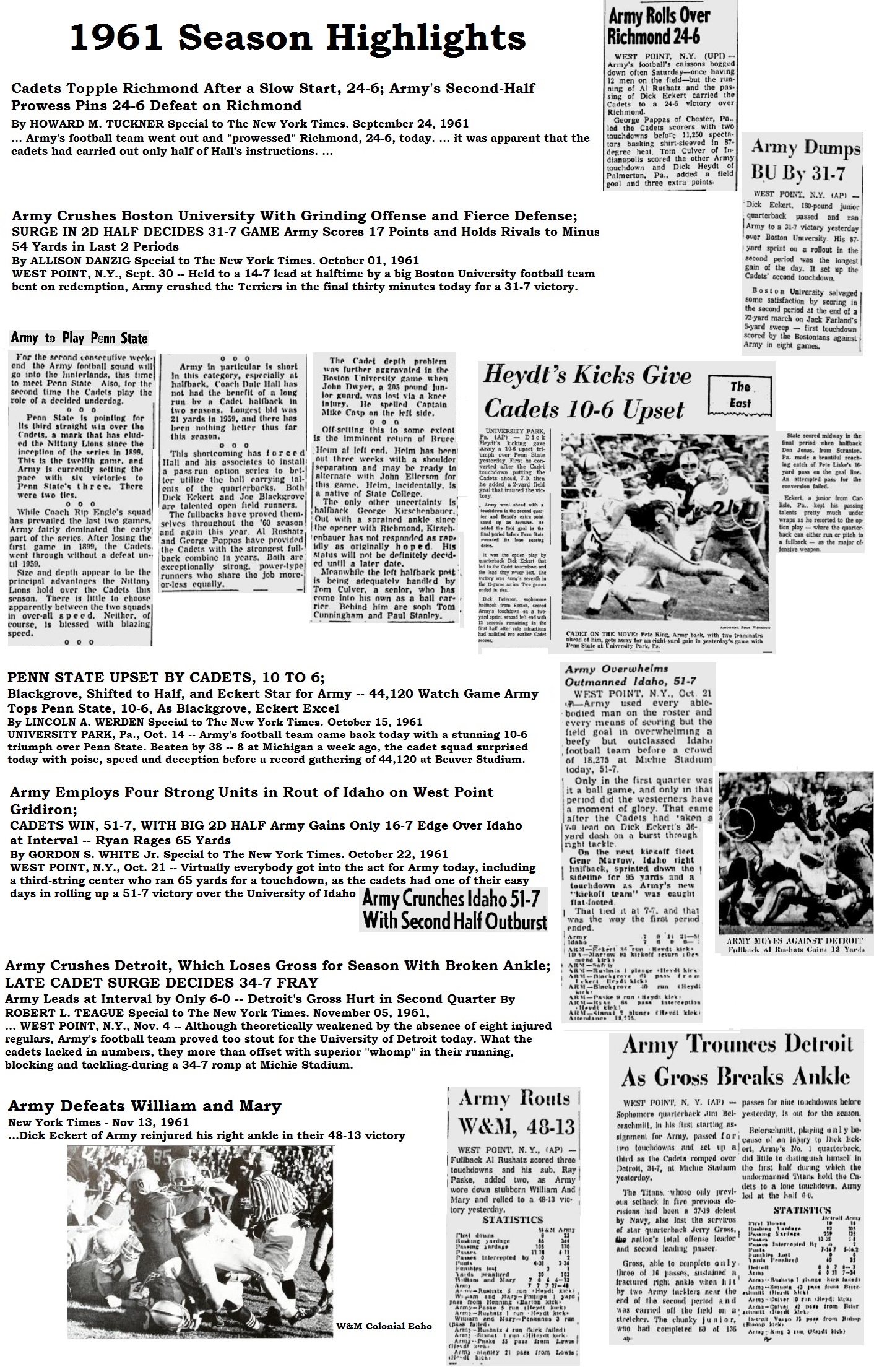
ArmyFB_1961_Season-Highlights
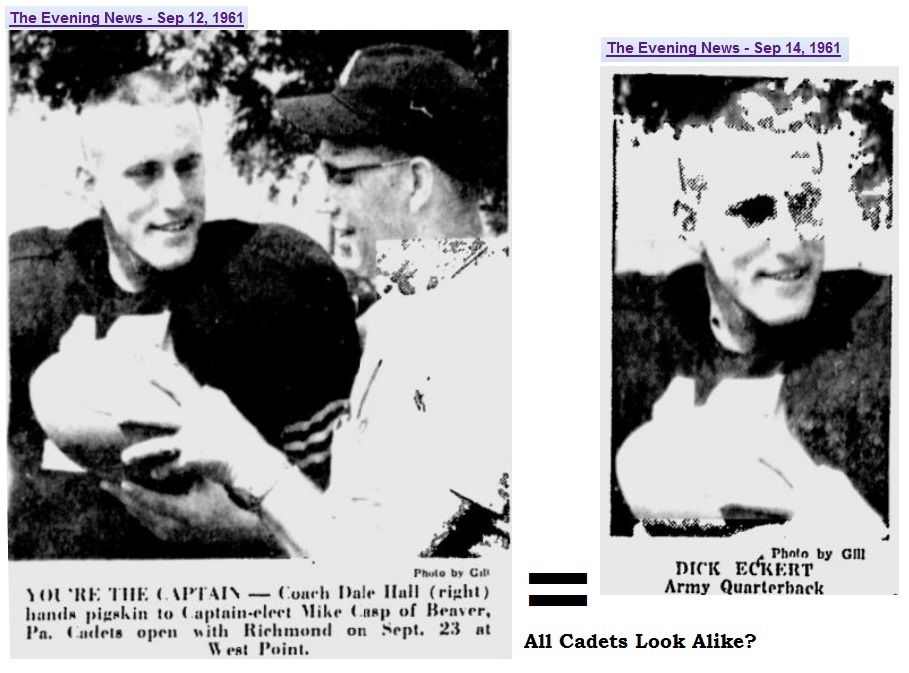
ArmyFB_1961_Hall_and_Who_EveningNews_Sep121961
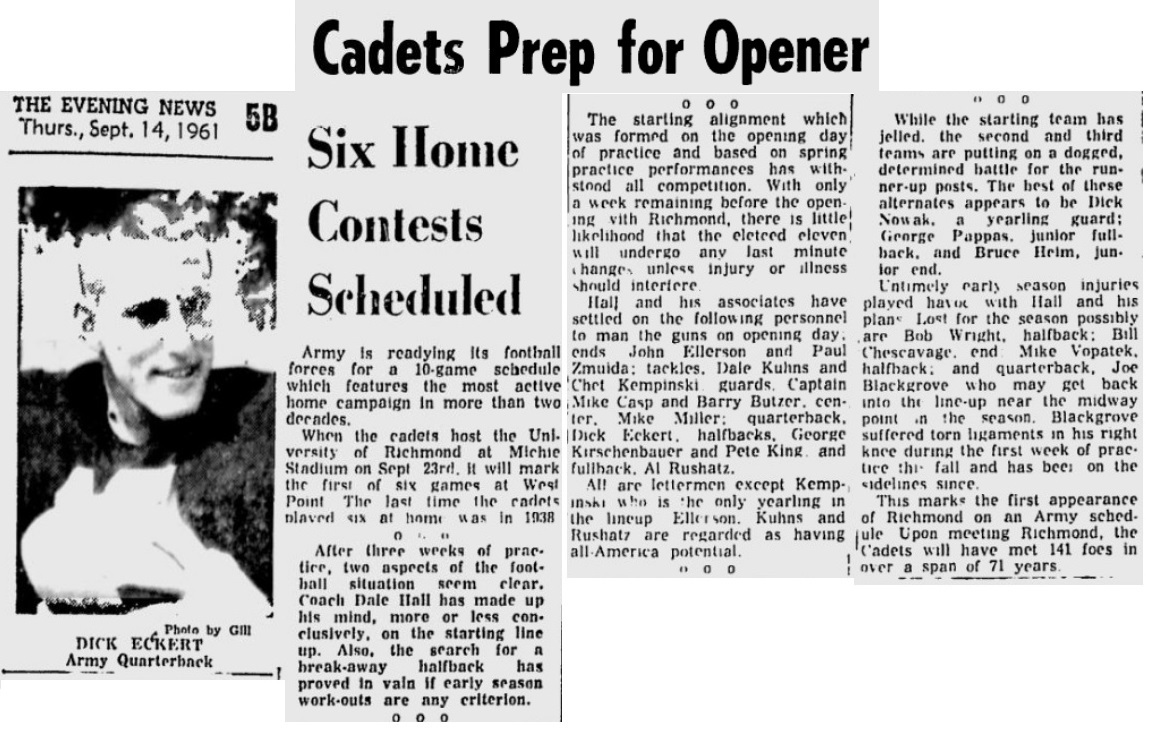
ArmyFB_1961_forecast_EveningNews_Sep141961
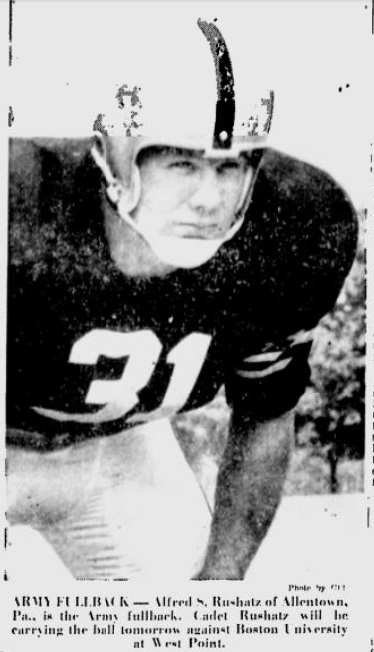
ArmyFB_1961_AlRushatz_EveningNews_Sep291961
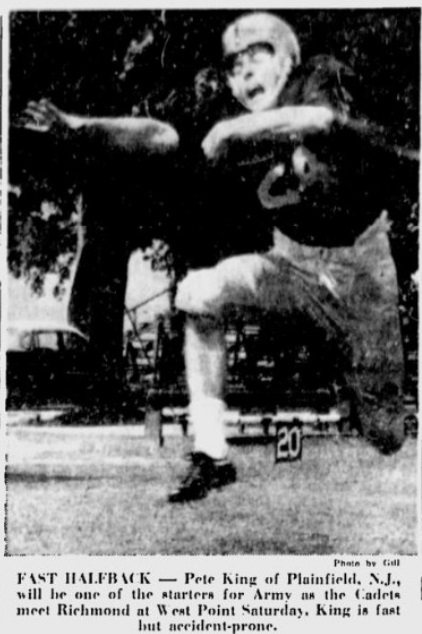
ArmyFB_1961_PeteKing_EveningNews_Sep211961
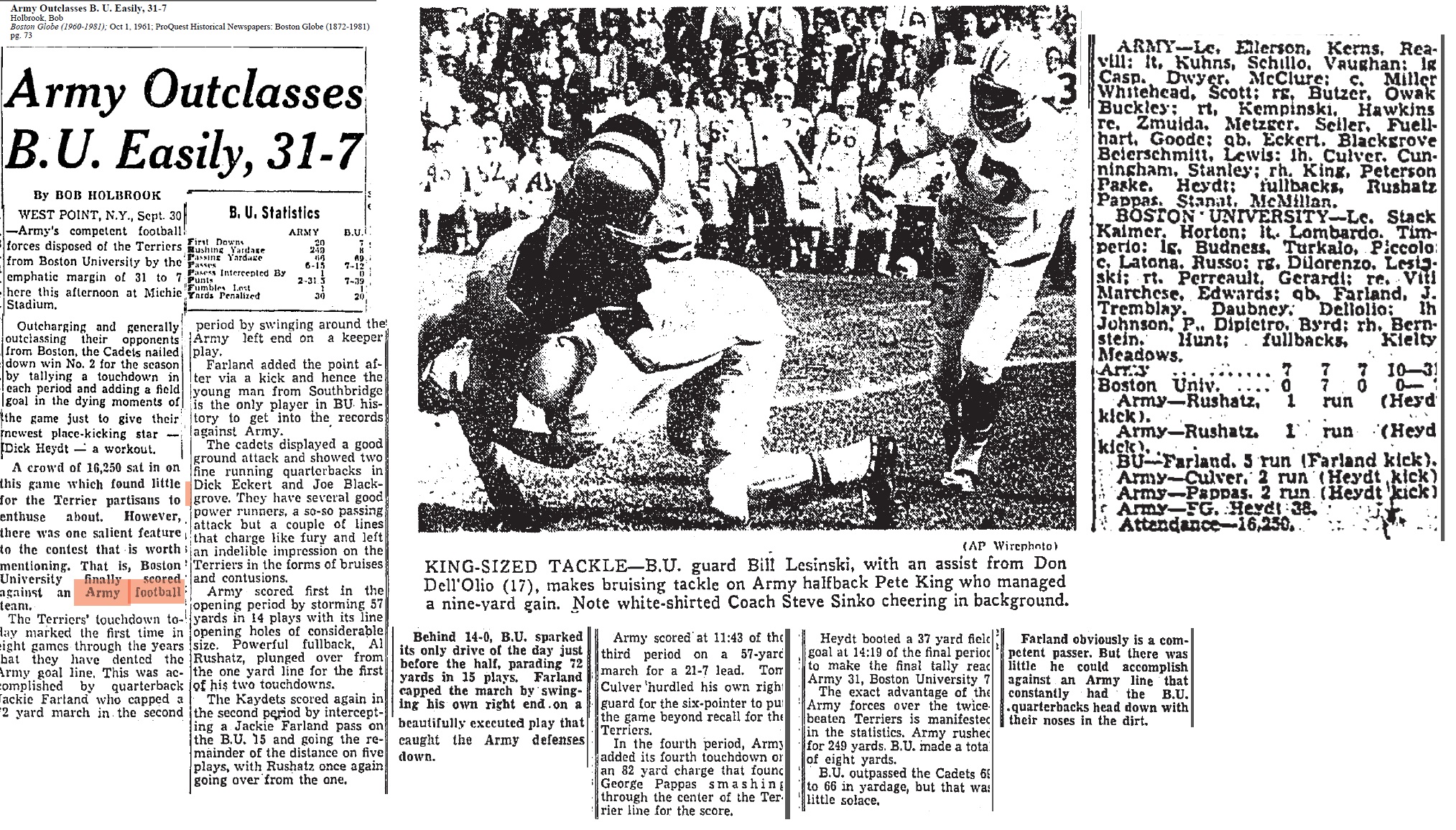
ArmyFB_1961_vsBU_BostonGlobe_Oct11961
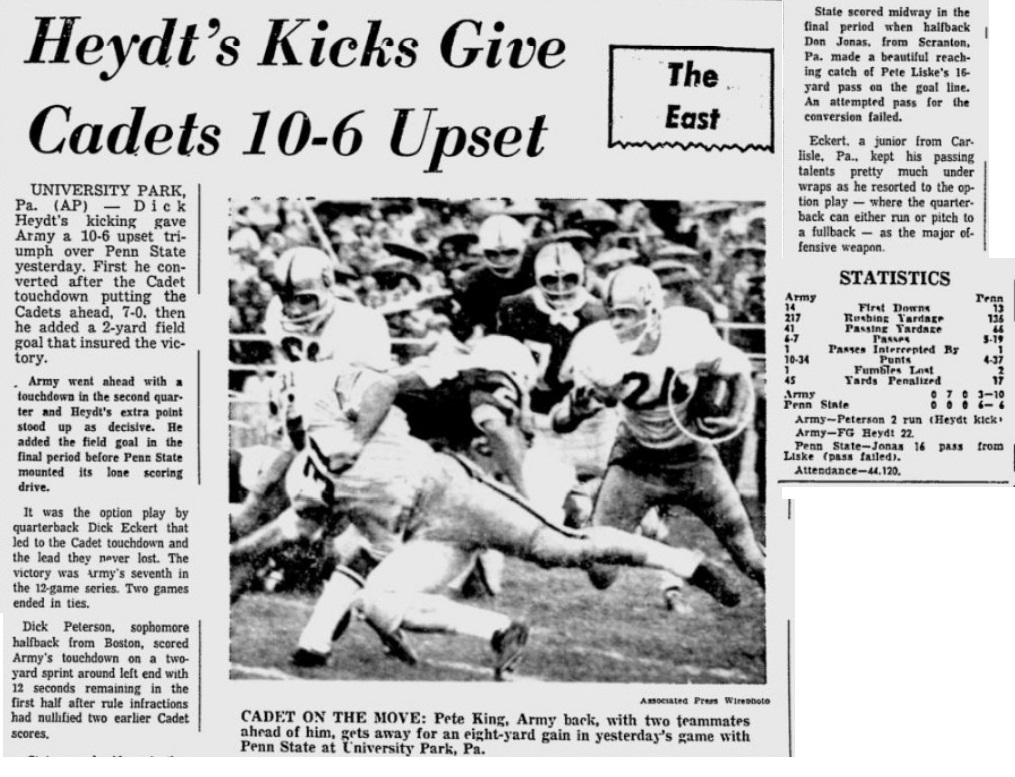
ArmyFB_1961_vsPennState_MiamiNews_Oct151961
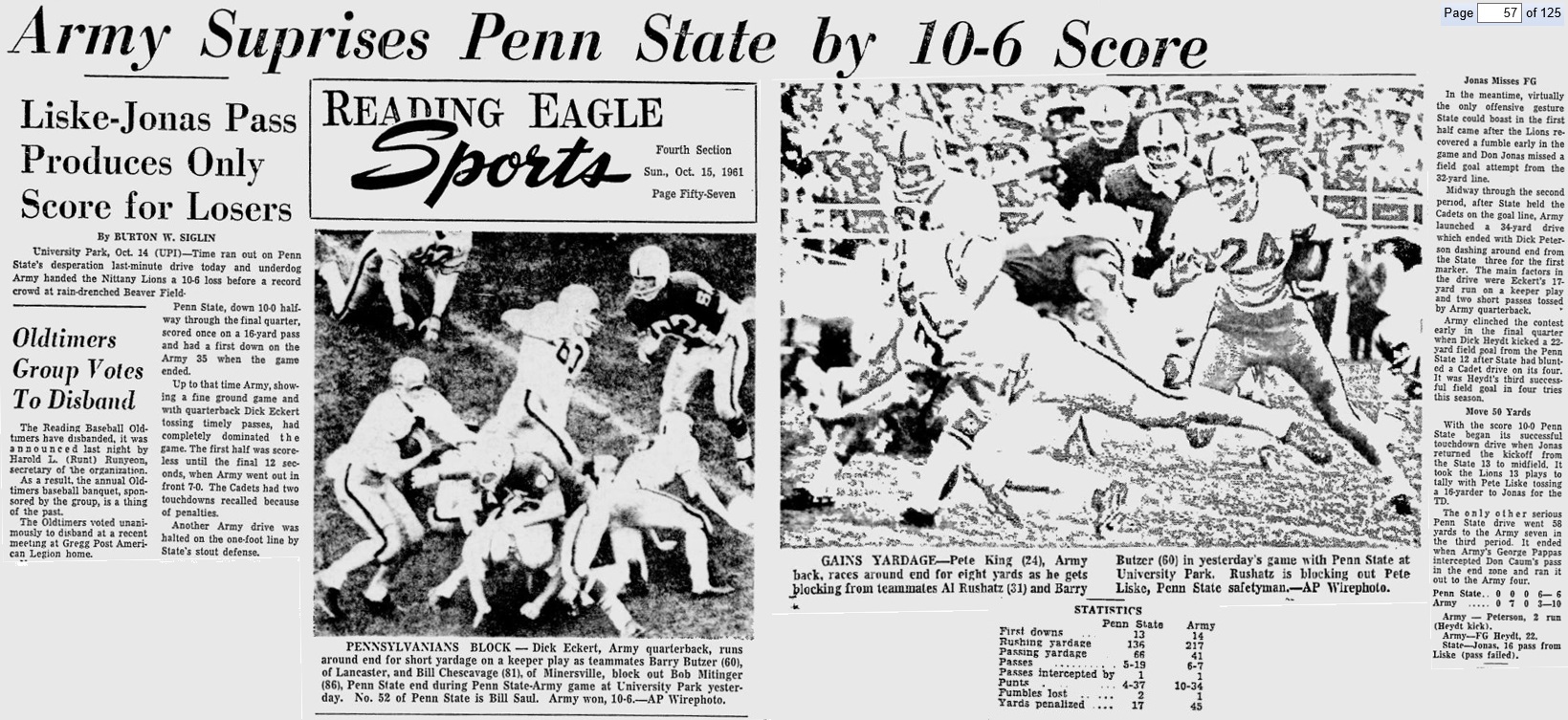
ArmyFB_1961_vsPennState_ReadingEagle_Oct151961
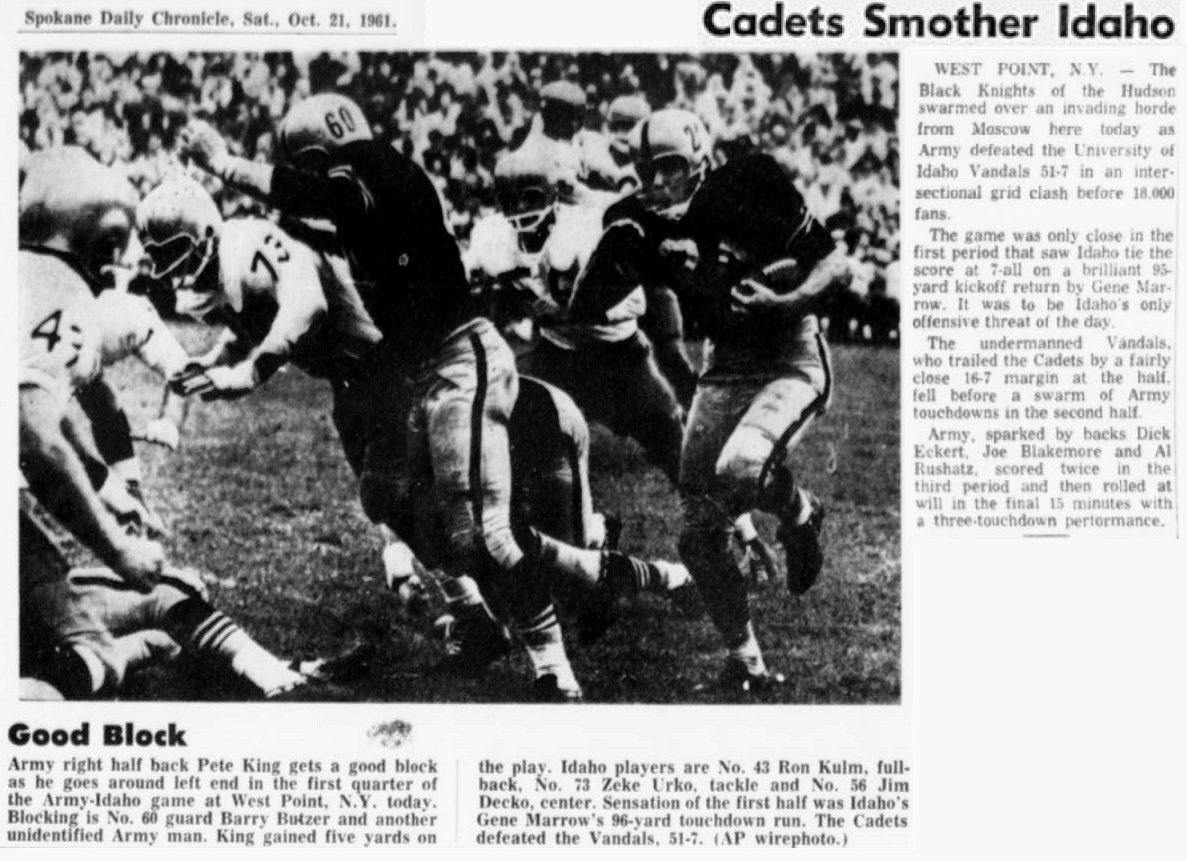
ArmyFB_1961_vsIdaho_SpokaneDailyChronicle_Oct211961
——————-
By Rabble
Mar 31, 2003
Army vs Penn State, 1961 –
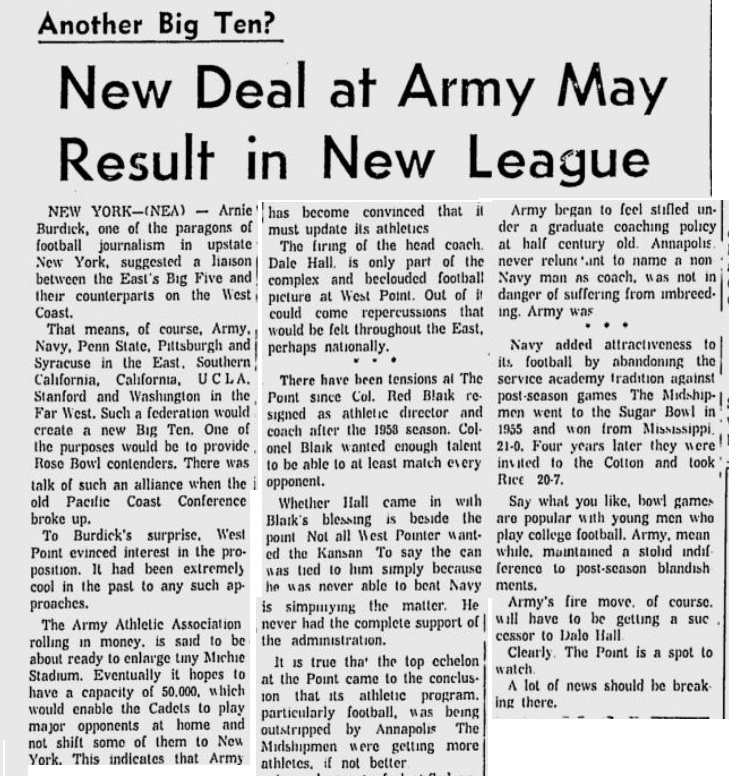
A look back at the 1961 classic meeting between Army and Penn State through the eyes of the now defunct Newark Evening News. Army won 10-6. It was a huge upset win for the Cadets because the Army team had been crushed at Ann Arbor against Michigan the previous week by a score of 38-8.
By Len Elliott
Army’s Stutter~ Option to Short Side Bothers Penn State
ARMY detonated the big surprise of Eastern football Saturday, when it beat Penn State among the fog-topped mountains of central Pennsylvania, Army didn’t do it on a fluke either; the Cadets looked like the hotter team and they were.
Army won this one for several reasons. One was a piece of ingenuity by Coach Dale Hall, one which should strengthen our faith in the armed forces. A second was the high resolution of the team, which was smarting from its humiliation at Michigan the, week before; seven of the starting eleven were Pennsylvania boys too, and were playing before families and friends. A third factor was Penn State’s inability to-make its attack move consistently without its top quarterback, Galen Hall.
The first Hall, Army’s Dale, did two things last week which had a decisive bearing on the game. First he moved Joe Blackgrove, who had been alternating with Dick Eckert at quarterback, to left half. He put Blackgrove there to give Army some running speed to the outside.
Blackgrove, redheaded son of an Army sergeant, has speed, elusiveness and surprising drive, considering that he weighs only 168 pounds. He had been used last year almost solely as a specialist to run back kicks.
Turning the Short Side ALL’S other accomplishment was to ‘devise a way to get around the short side of Army’s unbalanced line without using the undersized Blackgrove as a blocker. He did it by coming up with what appears to be a new maneuver in offensive football. It was new to Penn State, anyway. the play could be called a delayed, or stutter, option. In this it differs from the belly option, the Faurot option and the rollout option, although it is closer to the Faurot than anything.
Army worked it this way. The team, for instance, would line up in right formation, with the lonely end far out and the line unbalanced. Blackgrove, the left half in the solid T, goes in extended motion to the right, or strong side. As he gets the ball from the center, Dick Eckert fakes to Al Rushatz, the fullback, who goes in as though on a fullback trap play, and a guard pulls. Eckert fakes to Rushatz, delays slightly with a couple of stutter steps, so the guard can get ahead of him, and then sets sail to the short side with the right halfback going with him as the pitch man.
Then the option develops. If the end, or the corner man if there is one, goes for Eckert, he pitches out to the right half and the latter turns the corner with the pulling guard in front of him. If the end softens to the outside for the pitch man, Eckert keeps the ball and goes inside him.
Fake Deceived Lions
ECKERT made the play beautifully against Penn State. He pitched out to Pete King once for 25 yards, to Ray Paske once for 30, to King again for nine. The long one by King almost went for a touchdown, only a last ditch tackle by Pete Liske averting it. King’s big gain put State in a bad hole, however, from which the Lions never recovered until Army had scored.
Apparently, as it was explained, the moves that make this option work are the fake to the fullback inside and the guard pulling. It looks like a trap and thus holds the linebacker and the tackle, and has the general effect of delaying pursuit. Anyway, it worked against Penn State and looked like a good way for the unbalanced T to get around the short side.
Going to the strong side Army uses the usual belly option and Blackgrove and Eckert ran this very well.
Eckert got the touchdown drive started with it and Blackgrove’s running got the Cadets into range for a field goal. With Blackgrove at halfback Army crossed up everybody by practically refusing to throw the ball. Out of 70 offensive plays, only seven were passes-and six of them complete. So the Cadets now appear to have the balance, when they want to use it that will make them even more dangerous.
Galen Hall Missed
PENN STATE apparently needs Galen Hall at quarterback, badly. Neither Liske, essentially a defensive player, nor Don Caurn could get the team moving for more than two drives. The first of these ended with an interception and so would the second, if offsetting penalties had not canceled the play.
The Lions had a big chance early, when King fumbled away a fair catch on the Army 29. But State tried to run the ball, then missed a pass on third and six and had to settle for a field goal try. Had they scored then the game might have been different. As it was, they never got into a threatening position again until late in the third period. Penn State must be given an accolade for one move. The ground crew was routed out of bed at midnight, soon after the rain began, and had the field covered before 1 a.m.
—————————
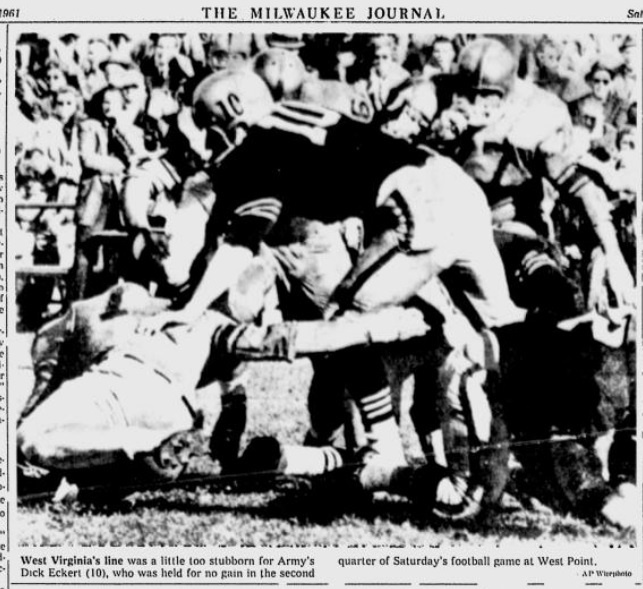
ArmyFB_1961_vsWVU-DickEckert_MilwaukeeJournal_Oct261961

“Pete King” with ball & “Bill Whitehead”
Click to access 1961detroitatarmy.pdf
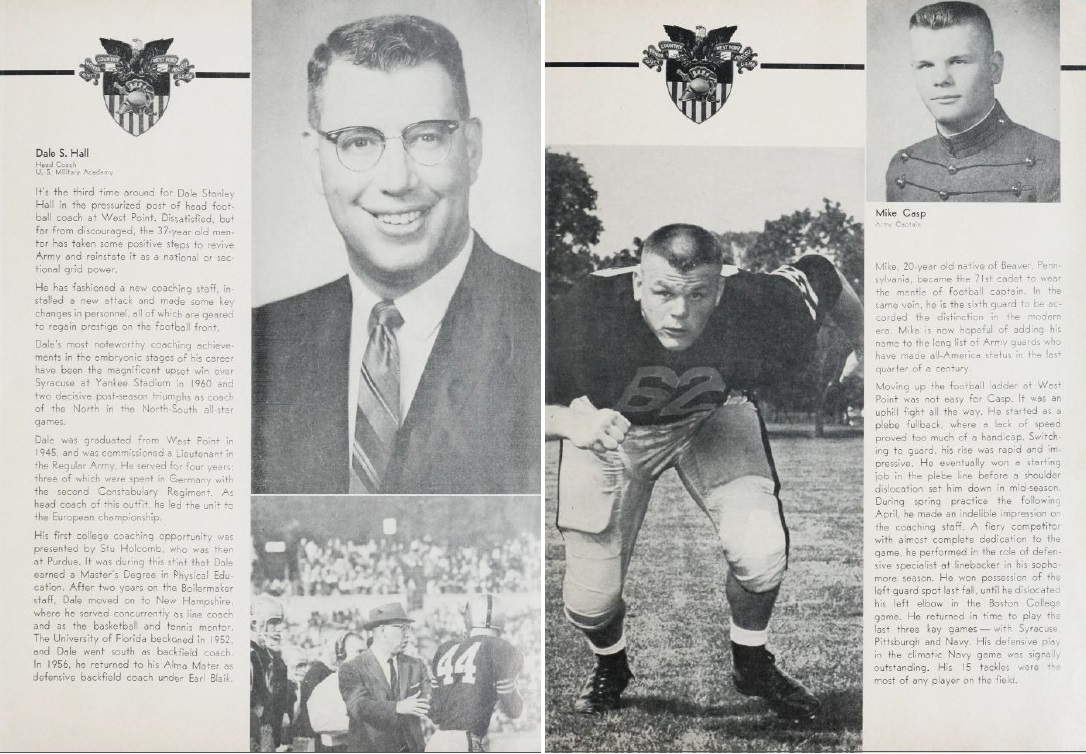
ArmyFB_1961_DaleHall-MikeCasp_DetroitvsArmy-program_04Nov1961
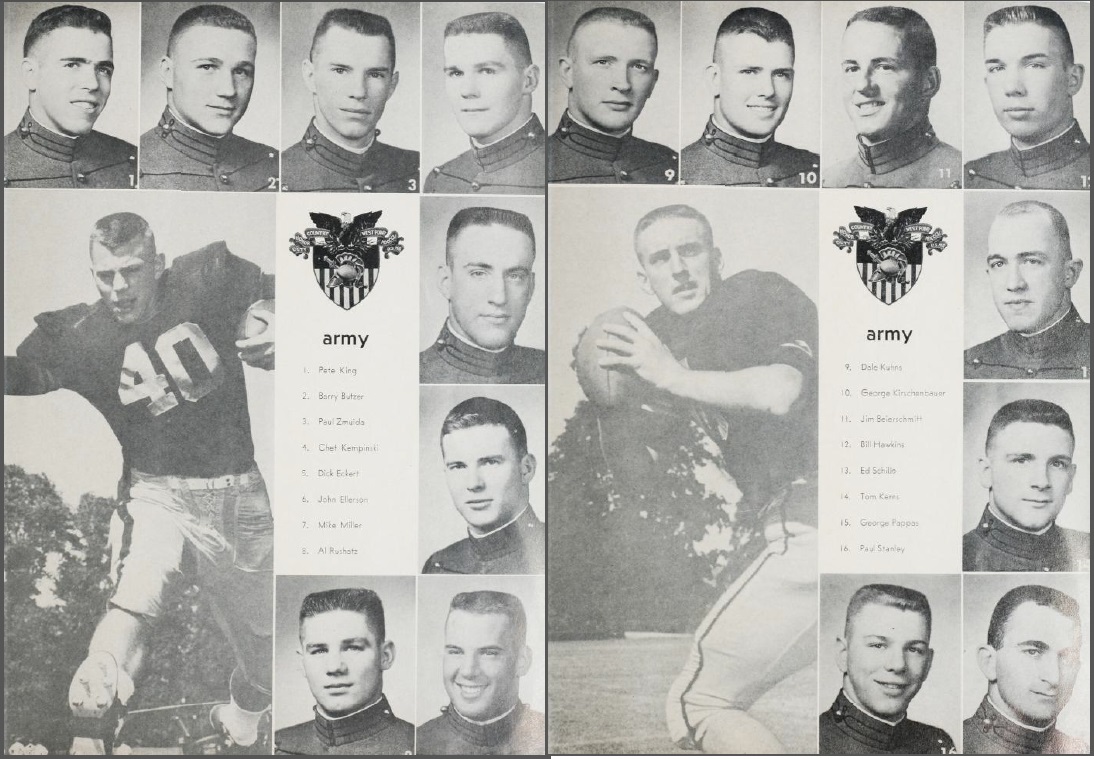
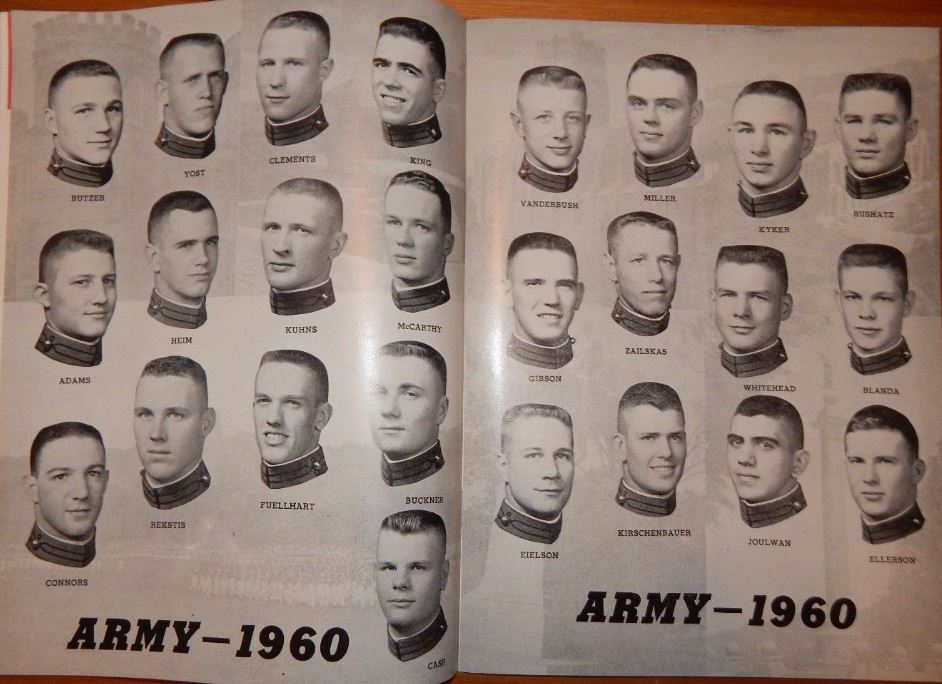
ArmyFB_1961_PlayerPhotos-1-2_DetroitvsArmyprogram_04Nov1961-1
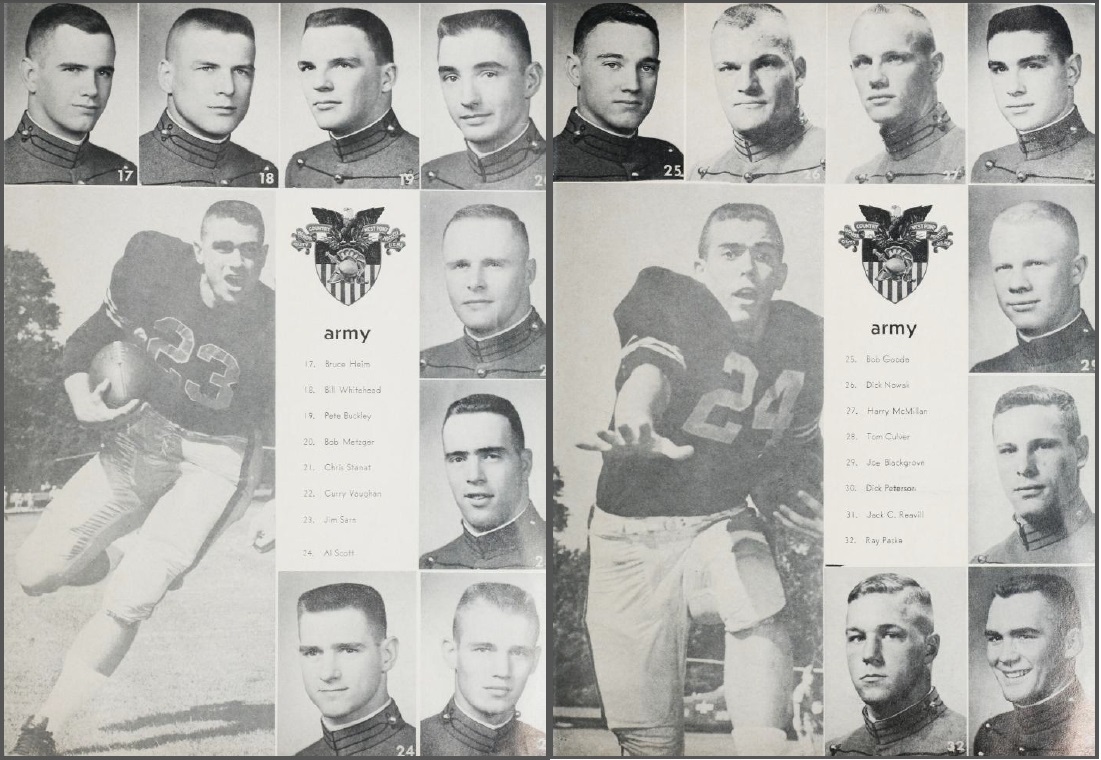
ArmyFB_1961_PlayerPhotos-3-4_DetroitvsArmyprogram_04Nov1961
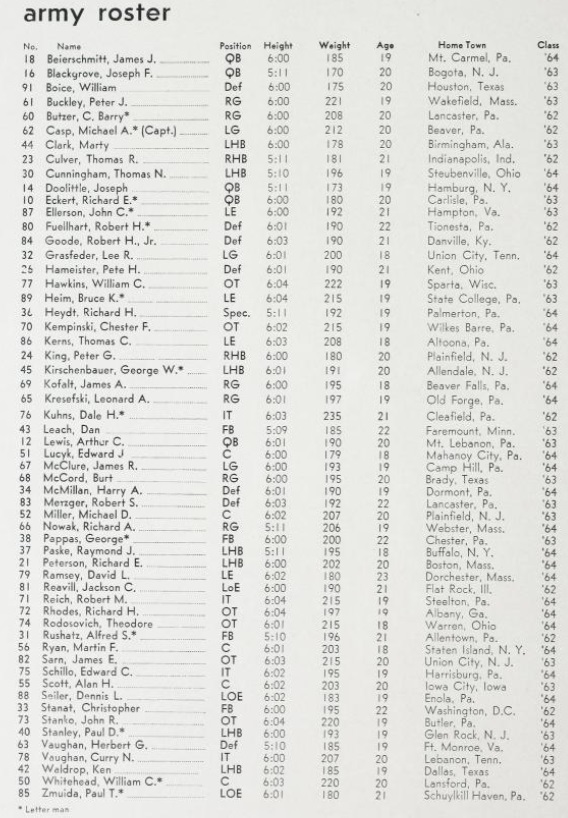
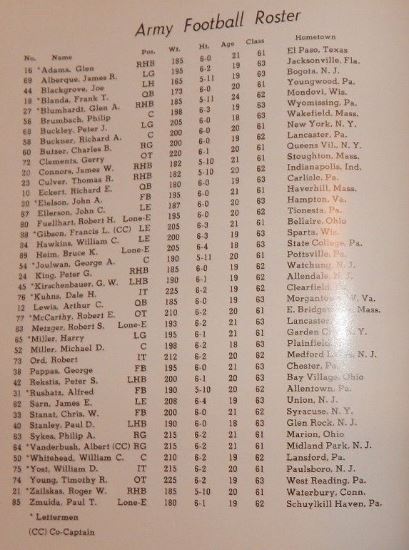
ArmyFB_1961_Army-roster_DetroitvsArmyprogram_04Nov1961
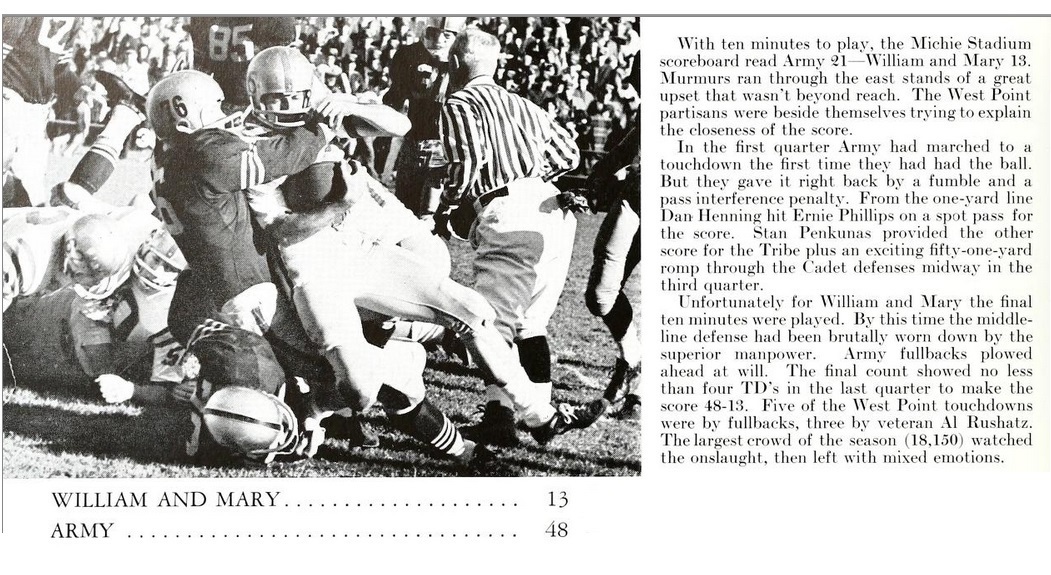
ArmyFB_1961_vsWM_Nov111961_ColonialEcho1962
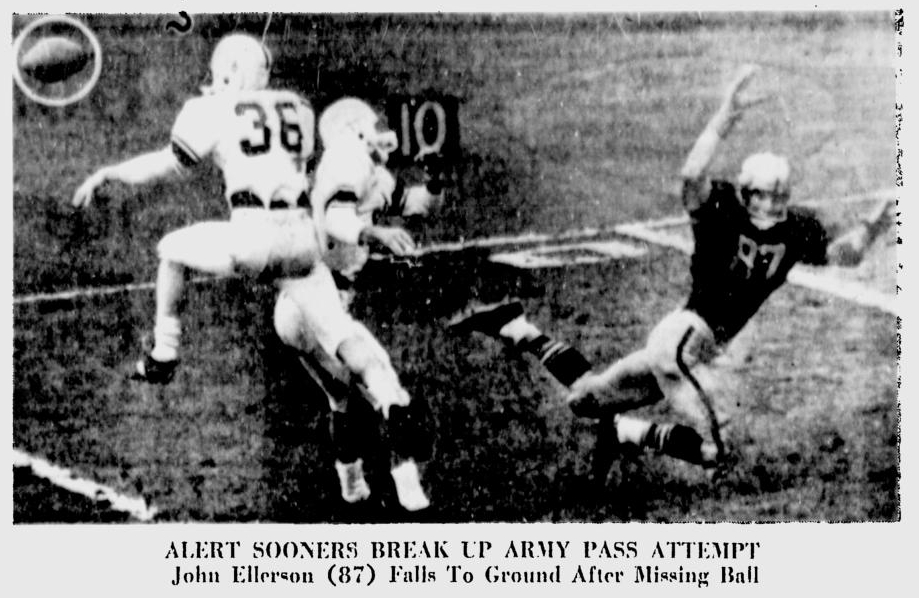
ArmyFB_1961_vsOU-JohnEllerson_MiamiNews_Nov191961
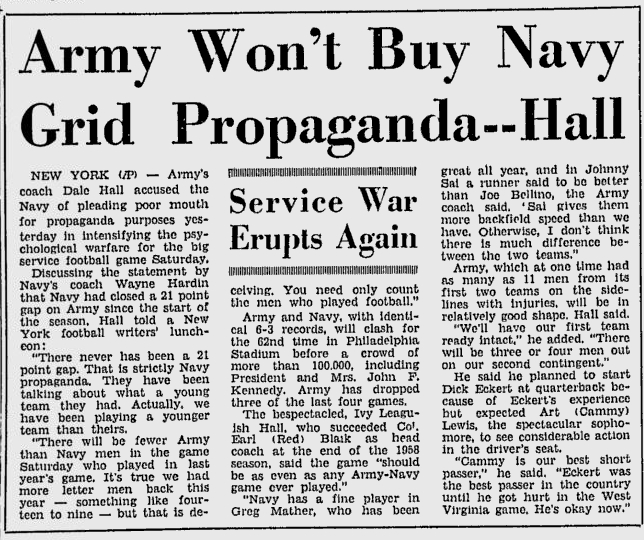
ArmyFB_1961_vsNavy-propaganda_DaytonaBeachMorningJournal_Nov281961
–
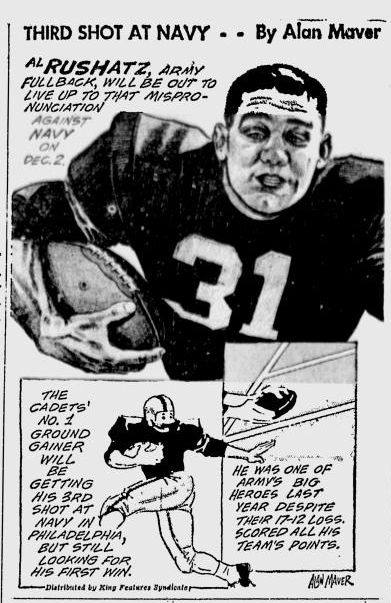
ArmyFB_1961_AlRushatz_byAlanMaver_RochesterInSentinel_Nov291961
–
 ArmyFB_1961_startersvsNavy_SpokesmanReview_Dec21961 (file name should not be 62)
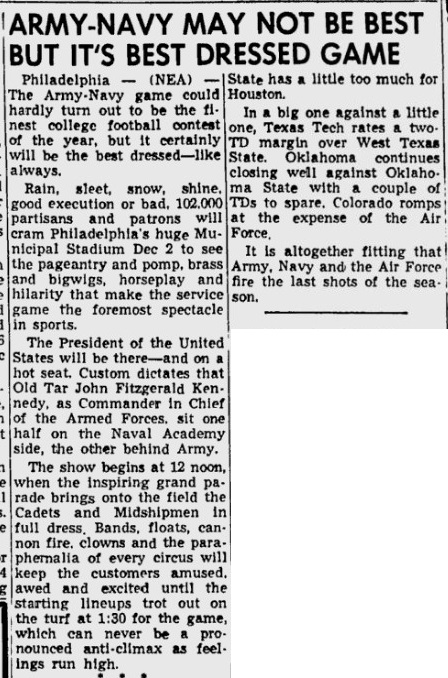
ArmyFB_1961_vsNavy_TheTelegraph_Nov291961-1
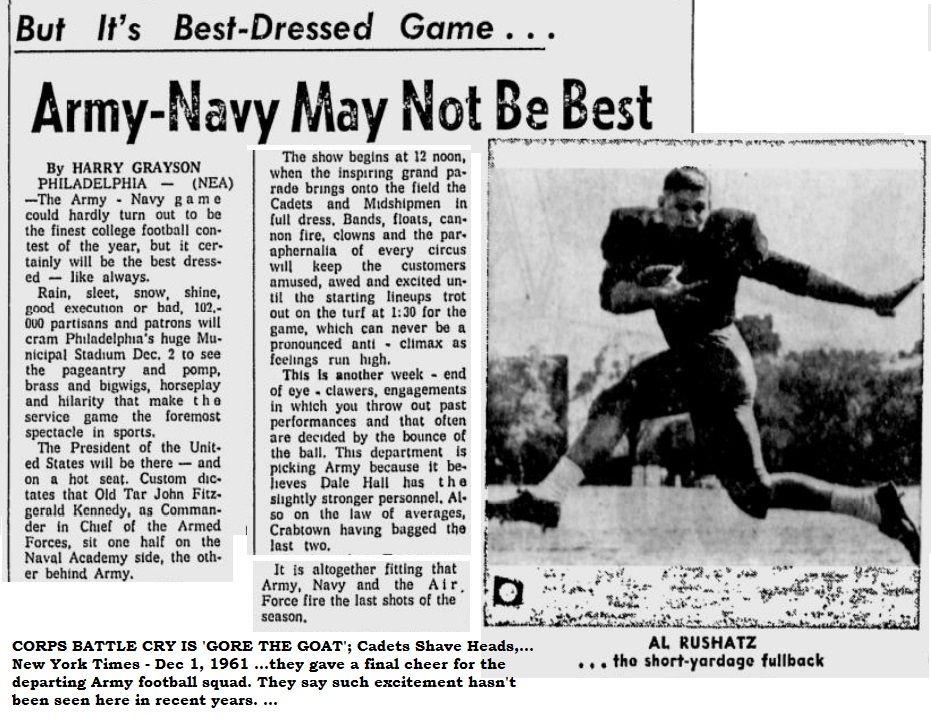
ArmyFB_1961_vsNavy-pre-Rushatz_MeridenJournal_Nov301961
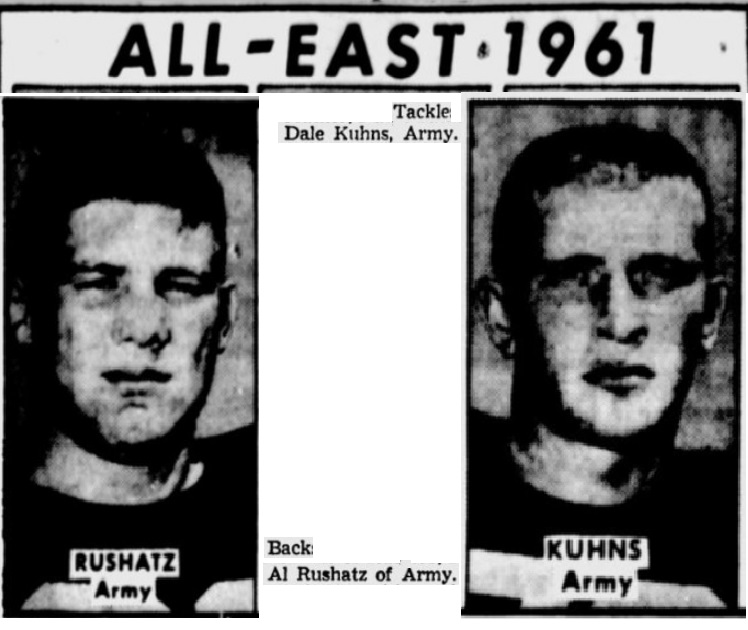
ArmyFB_1961_Rushatz-Kuhns-All-East_TheTelegraph_Dec11961
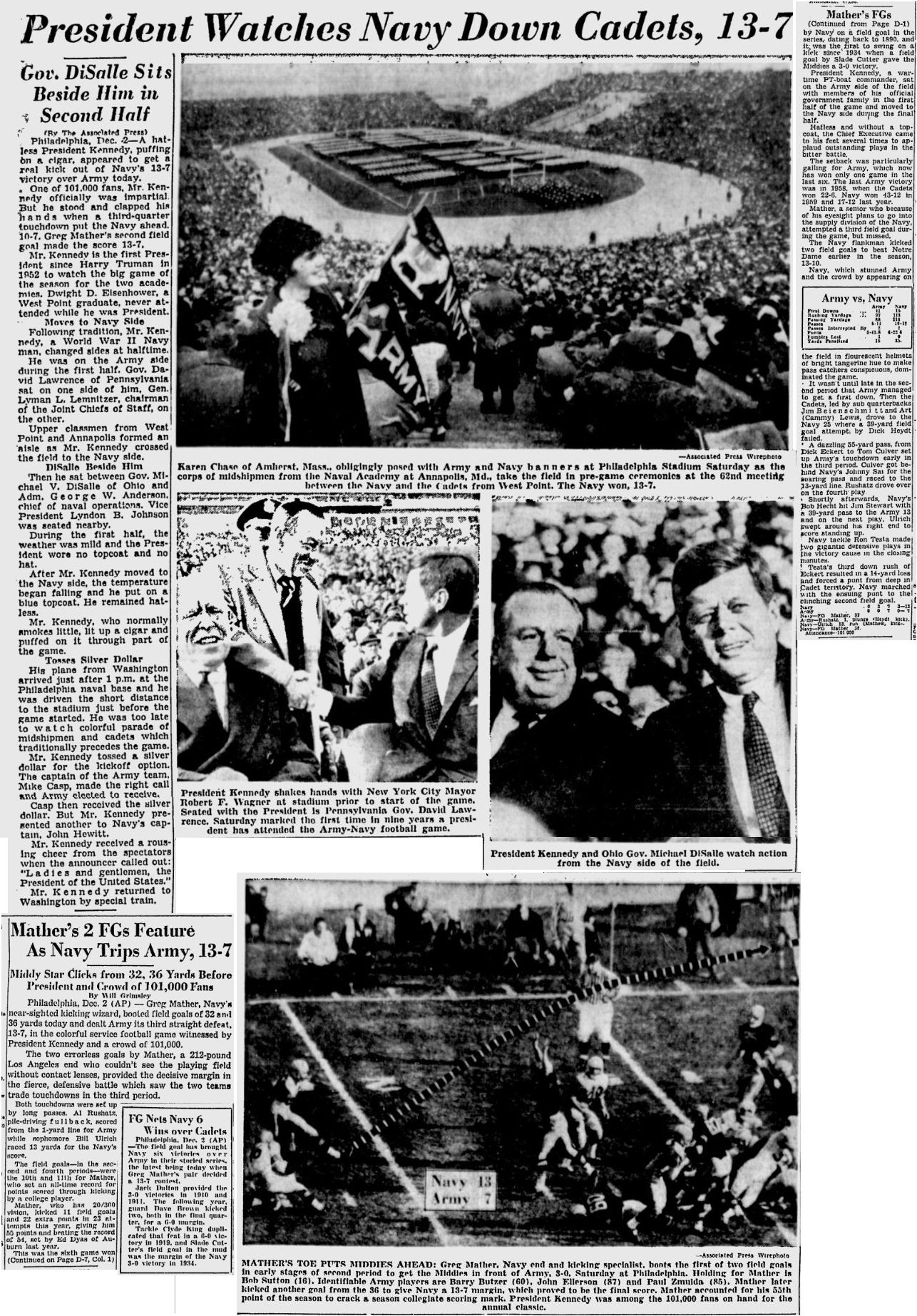
ArmyFB_1961_vsNavy_YoungstownVindicator_Dec31961
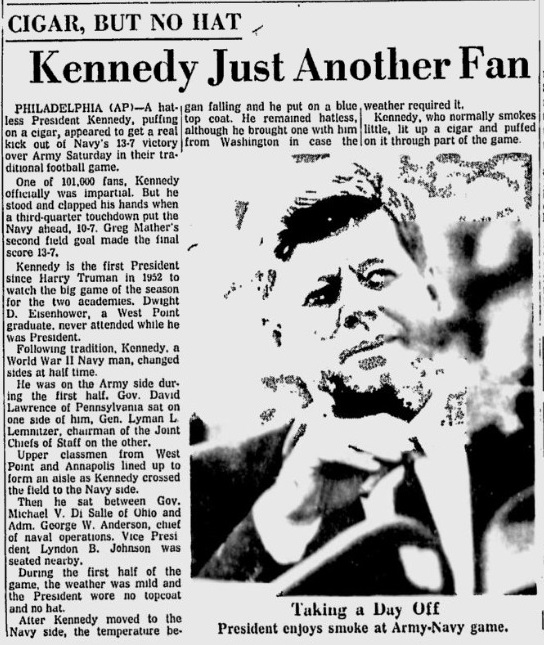
ArmyFB_1961_vsNavy-PresidentKennedyattends_EugeneRegisterGuard_Dec31961
–
–
no sound
–
–
–
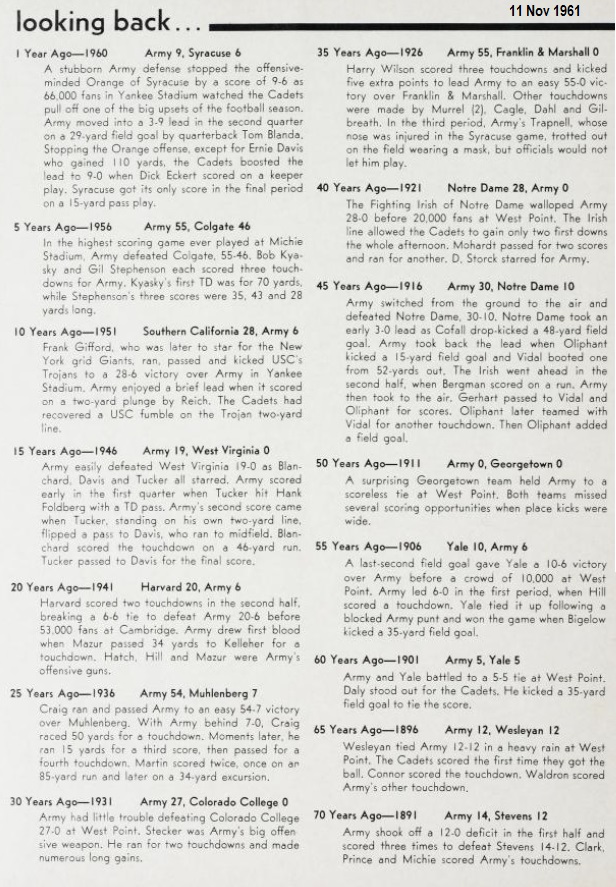
ArmyFB_1961_LookingBack-ArmyGames_11Nov1961
articles provided by Russ “Skip” Grimm – Class of ’76
From: Chuck Profilet <profilet@mediaone.net>
Date: Tuesday, June 15, 1999
Subject: Memorial Day – 1999
MEMORIAL DAY FT. LAUDERDALE, FLORIDA MAY 31, 1999 By Charles W. Profilet, E-1, 58
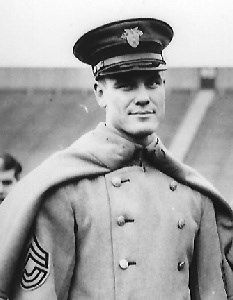
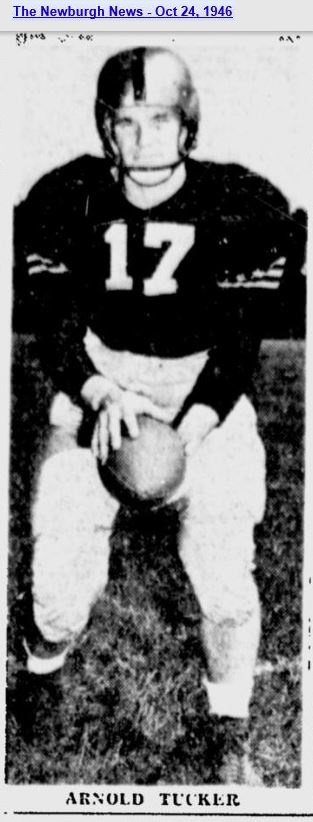
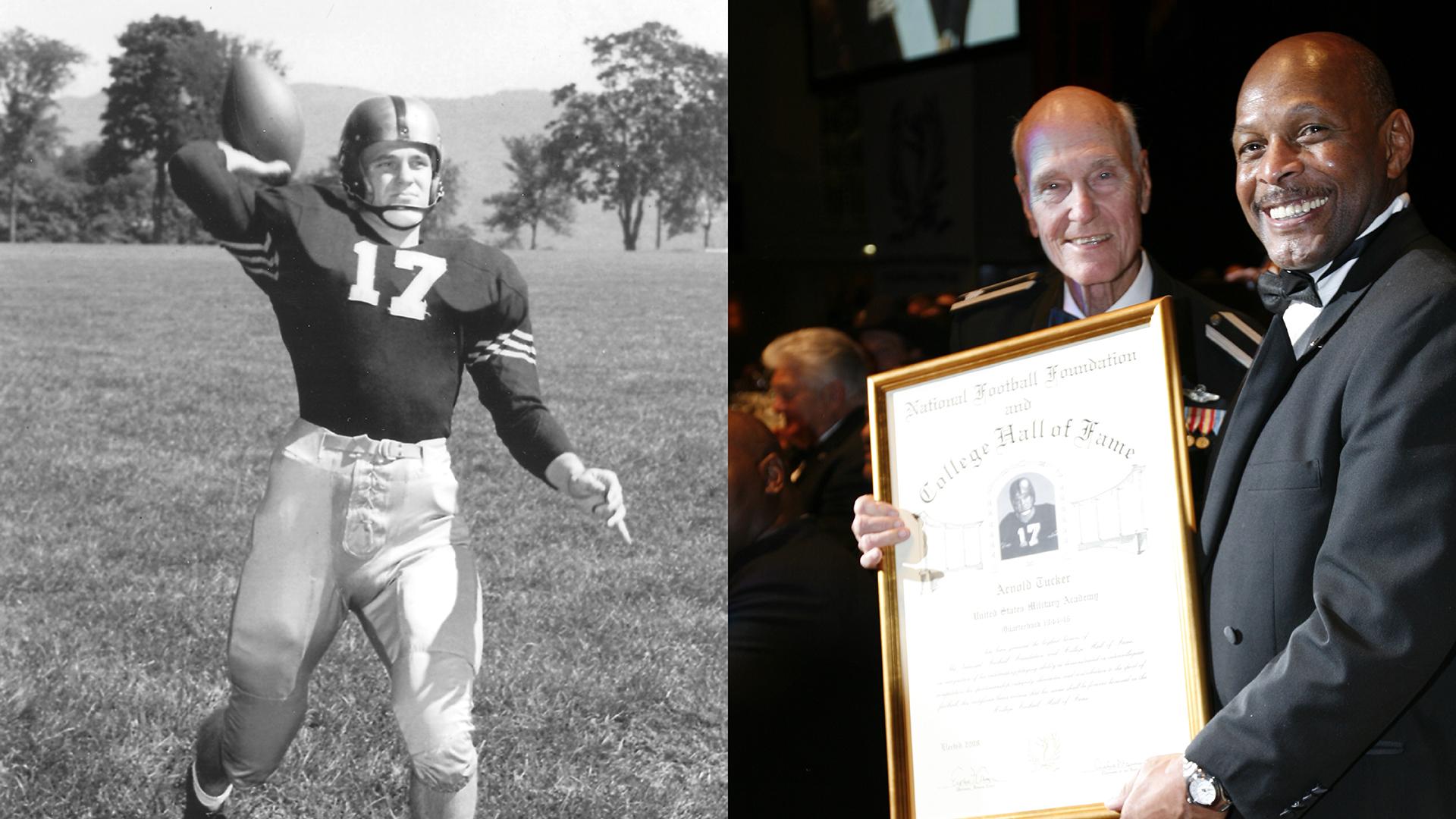
Of particular interest to 58 is the guest speaker at the luncheon. Lt. Col. Arnold Tucker, USAF Retired, USMA 47, was the speaker. Dedicated fans of Army football recognize the name of “Young Arnold Tucker” as the All-American quarterback of the 44, 45, and 46 undefeated Army football teams with Blanchard and Davis as running backs. Some of the class in 1st Regiment remembers him as Company Tactical Officer for Co. F-1 during our plebe and yearling years. Col. Tucker spoke from the heart with stories from his cadet days, his Air Force career, and duty at West Point. Four short stories among many are worthy of sharing with you.
Col. Tucker’s high school classmate went on to attend the Naval Academy and ended up as Captain of the Navy Team for the 1946 Army-Navy game. At some point in the game he and his friend, Bruce Smith, collided. Tucker helped his friend up, spoke to him and proceeded back to the huddle. During film review, Col. Blaik made note of Tucker assisting the Navy. They remain today life long friends.

After graduation and flying training Tucker was assigned to a transport squadron in Japan. Soon selected as aide-de-camp for the commanding general, MG Edward H. White, USMA 24, he was notified that the Air Force had agreed with an Army request, unknown to Tucker, to return him to West Point for the football season as an assistant backfield coach. He objected and asked to stay in Japan with his wife and mother-in-law. Finally the Army Athletic Association informed him that the Association would pay all expenses for his family, if he would return to help the Army team. He finally accepted the assignment with the agreement of General White to return to Japan after the season. With a smile he noted that the assignment as assistant backfield coach was a “piece of cake”. Why? The backfield coach was Vince Lombardi.
Following two years as a Company Tactical Officer, he was assigned to the Commandant’s staff and given an assignment to oversee updating the Blue Book. One of many changes he made was to place Flirtation Walk on limits at night. He asked the cadets present if Flirty was still on limits. A weak “yes sir” suggested that today’s cadets might not see Flirtation Walk in the same light as those classes who were restricted to West Point most of the four years.
Col. Tucker ended on a sad but proud note. In 1967 he was stationed at Cape Kennedy, when a fire aboard the Apollo capsule killed three NASA Astronauts. LTC Edward H. White, II, USMA 52, son of COL Tucker’s commander in Japan, and the first man to walk in space perished in the fire. At the request of the family, Col. Tucker accompanied Ed White’s remains to West Point for burial.
2 Army A’s in Football
Football’s Greatest Decade – – by Bernie Mcarty – http://www.la84foundation.org/SportsLibrary/CFHSN/CFHSNv01/CFHSNv01n1b – – see page 5
This writer believes West Point 1945 is the greatest team of all time. The 1944 Army team may actually deserve that title, but it was never tested. Army was also undefeated in 1946, 1948 and 1949.
Army’s top stars during 1945-1949 were the effulgent “Touchdown Twins”, Glenn Davis and Doc Blanchard, Arnold Tucker, Arnold Galiffa, Rip Rowan, Bobby Jack Stuart and Gil Stephenson in the back-field, and up front” Joe Steffy”, Art Gerometta, Jack Green, “Bill Yoemans”, Joe Henry “Tex” Coulter,Al Nemetz, and the sterling end duo of Hank Foldberg and Barney Poole.
In 1945 the Newspaper Enterprise Assoc. simply picked the entire Army team as its All-American team, stating no group of All-Americans could beat the Cadets. Only a world war could have brought together such a collection of players to one institution. But it took the coaching genius of Col. Earl Blaik to mold the players into a cohesive unit. In truth, Navy personnel was equal to Army’s on an individual basis. The Middies never jelled as a team, however.
The 1951 Army outfit might have been as good as the 1945 Cadets, but the infamous cribbing scandal wiped out the team.
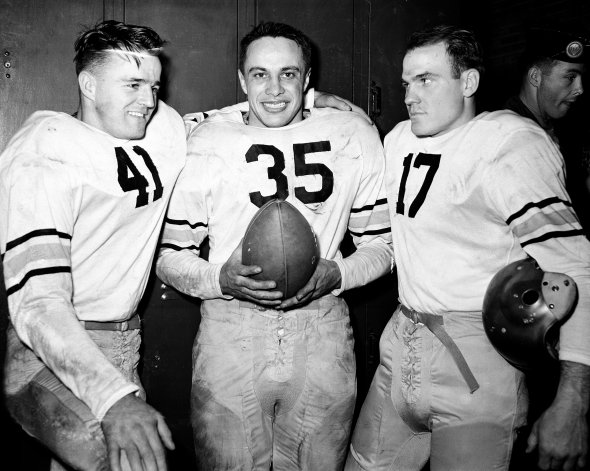
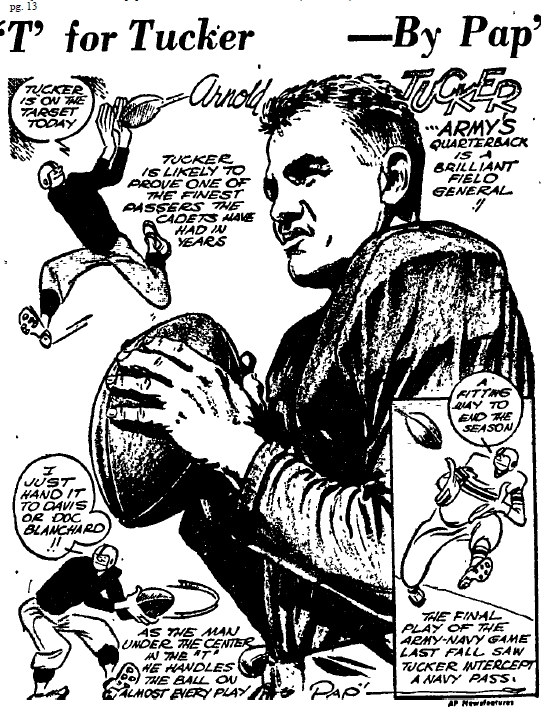
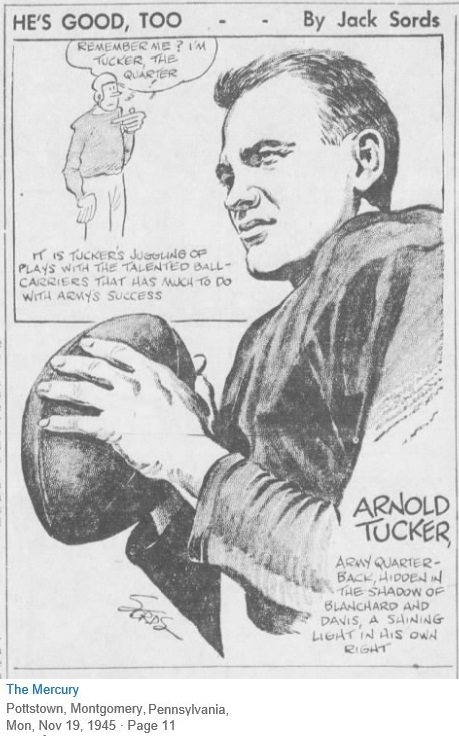
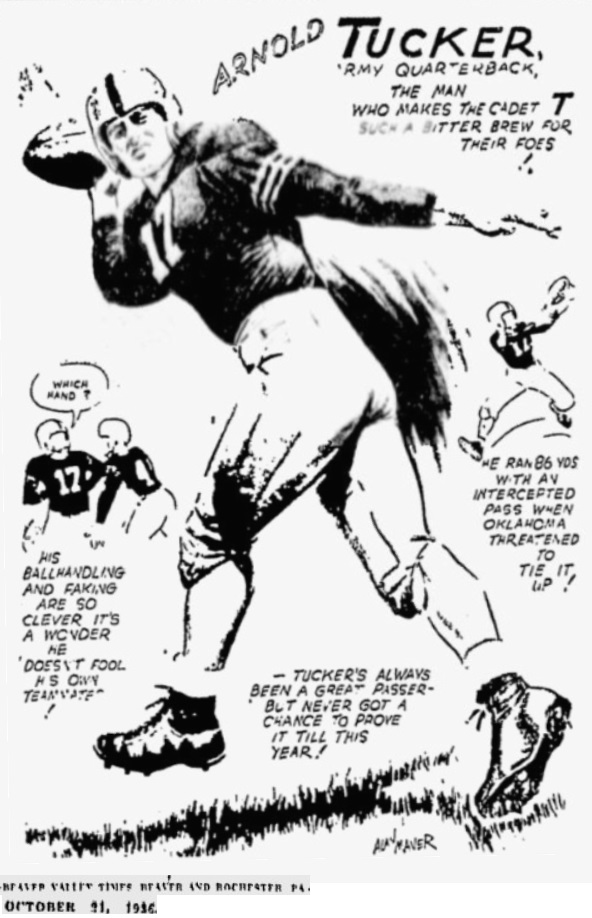
—
Lt Colonel Retired Young Arnold Tucker of Palmetto Bay, Florida, passed away on January 10, 2019 in Miami, Florida. Born January 05, 1924 in Calhoun Falls, South Carolina, Arnold or “Tuck” as he was known, was a loving and dedicated husband to his wife of 51 years, Patricia (Small) Tucker, and father to his two children, Tom and Patty. He was well known in Miami in the 1940’s for his academic and athletic excellence. He attended Citrus Grove Junior High School where he was an Honour student and a recipient of the American Legion Award for athletic leadership and good citizenship.
At Miami Senior High School, he was a member of the National Honour Society and the Key Club, Captain of the basketball team, and selected “All State” basketball player for two years. In football he was the “Running Tailback” on the team which won the Southern High School Championship, was selected as a member of the “All State” and “All Southern” football teams and received the Miami High Sigma Nu Trophy as outstanding athlete for the years 42-43. He was later inducted into the Miami High School Hall of Fame.
Tuck enlisted in the US Navy V-12 Program in June of 1943. As a Naval Assignee he attended the University of Florida and transferred to the University of Miami. As a freshman, he was a member of the varsity basketball and football teams and was awarded the “Iron Man Trophy” for exceptional football participation.
He was discharged from the Navy in July of 1944 in order to attend The United States Military Academy at West Point, New York. He graduated from the USMA and was commissioned a second lieutenant in June of 1947. While a Cadet at West Point, he was Captain of the basketball team and Quarterback on the undefeated National Championship football team for three years. He was designated an “All-American” football player in 1946. He was awarded the James E. Sullivan trophy by the National Amateur Athletic Union as the United States Amateur Athlete for 1946. He was known as “Mr. Topside” in the same backfield with “Mr. Inside” and “Mr. Outside,” Doc Blanchard and Glen Davis.
After graduating from Army Air Corps pilot training, he served as a Bomber Pilot of the B29 with the 307th Bomb Wing at Mac Dill AFB Tampa, Florida as well as a Line Pilot with Military Airlift Command Tokyo, Japan. He also had assignments as Aide De Camp to the Commanding General and was Commanding Officer of the Headquarters Squadron and served as an Operations Officer.
Tuck was assigned as an assistant football coach to Coach Vince Lombardi at West Point while also serving a 4-year tour from 1953-1957 as a tactical officer in the Commandant of Cadets Office.
He graduated from the Air Force Command and Staff College and served a four-year tour of duty at Headquarters US Air Forces, Pentagon Building, Washington D.C. He received an MBA degree from George Washington University in 1963 and then served a four-year tour of duty as Chief of the Telemetry Division of the Airforce Eastern Test Range, Cocoa Beach, Florida from 1963 to 1967. In 1967 he was stationed at Cape Kennedy, when a fire aboard the Apollo capsule killed three NASA Astronauts. LTC Edward H. White, II, USMA 52, son of COL Tucker’s commander in Japan, and the first man to walk in space perished in the fire. At the request of the family, Col. Tucker accompanied Ed White’s remains to West Point for burial.
Tuck served four years in direct support of the Vietnamese War as Director of Airlift, 5th Air Force Headquarters, Tokyo, Japan, as Commander of the C130 Gunship Squadron, Ubon, Thailand and as Chief Special Operations Division, 7th Air Force, Saigon Vietnam.
His last active duty military assignment was from 1971-1974 as the Professor of Aerospace Studies (AFROTC), University of Miami, Coral Gables, Florida. He retired after 31 years of continuous active duty at Homestead AFB, Florida in June 1974.
After Military Retirement he was employed by the University of Miami for two years as the Assistant Director of Athletics for Sales and Promotions.
He received many medals and accommodations, just to name a few: The Distinguished Flying Cross, The Bronze Star Medal, The Meritorious Service Medal, NCAAF College Football Hall of Fame, United States Military Academy Athletic Hall of Fame, and North Carolina Athletic Hall of Fame.
Tuck was predeceased by his wife Patricia (Small) Tucker, one brother Dick Allen Tucker (1920-1943) who was shot down in Europe while serving as a fighter pilot in WW2. 1st Lt. Dick Allen Tucker is buried at Cambridge American Cemetery and Memorial Coton, South Cambridgeshire District, Cambridgeshire, England.
Also preceded by his mother, Sara Victoria (Callahan) Tucker, his father, Floyd Allen Tucker (1893-1970), one sister, Sylvia Victoria Tucker, and his son, Thomas Tucker. He is survived by one daughter, Patricia Nugent, son-in-law, Patrick Nugent, two grandsons, Zachary Cooke and Patrick Nugent II, all of Miami, Florida, and one daughter-in-law, Tina Tucker of Holiday, Florida.
—-

Cadet will not Lie, Cheat, Steal, or Tolerate Those Who Do

USMA at West Point

We have changed the wording of our Alma Mater to reflect the fact that our Women Graduates have also given their lives serving this Nation.
Our Flag in 1812

----- Class of 2012 Motto ------
"For More Than Ourselves"
Thank you Class of 2012 for the Honor of Marching with you The Class of 62 - Can Do

Remember - The Soldiers you will lead Always Come First

Motto -- Duty Honor Country

The Cadets of West Point

They played perhaps Army's Greatest Game. They were the Team that Gave The Most

Washington's Letter recommending the establishment of the Academy and the History of West Point

The Oaths We Take

West Point's Medal of Honor Recipients

Jefferson Hall - the Academy's new Library.

Douglas MacArthur

Vinegar Joe Stilwell cleaning his Thompson -The Walkout -Burma 1942

George Patton

The Monuments of West Point

Kosciuszko Monument - Guarding the Hudson ensuring there is no passage of British Man of War

Forts of the Hudson

So we'll sing our reminiscences of Benny Havens, Oh!

Academic Excellence

Colonel Thayer

West Point

Trophy Point

"L'Ecole Polytechnique Monument", or The French Monument by Cadets

Superintendent's Quarters viewed from Thayer Road

Superintendant was not Happy Black '57

Home of the Dean

Quarters 104

Cadet Chapel

Michie Stadium

Arvin Gym

Kimsey Athletic Center

Holleder Center

Washington Monument

United States Military Academy Band

Cadet Barracks

Rugby Complex

Great Chain

Plain looking toward Washington Hall

Battle Monument

Washington Hall with Cadet Chapel on rocks above

Hudson River

Captured Trophies

Battle Monument

West Point Cemetery

Plain

Cost to this Nation of Differing Views

Trophy Point -- Our Flag

Corps of Cadets Formed in Companies early 1960s

Sending the Army Team off to Beat Navy

Army Mule

Color Guard

Band Box Review Early 1950's in Central Area

Battalion Mass Early 50's

Flirtation Walk

Class of 2008 Class Crest & Motto "No Mission Too Great" Their Commencement "Here am I; Send me."
Thank you Class of 2008 and Please Thank the Men & Women --- the Soldiers you will lead --- The Class of 62.
Duty Honor Country
The '54 Crest

28th Infantry Regiment Black Lion Award is intended to go to the person on his team "who best exemplifies the character of Don Holleder: leadership, courage, devotion to duty, self-sacrifice, and - above all -
an unselfish concern for the team ahead of himself."
"The Army moves as a team, eats as a team, and fights as a team."

The '55 Crest

Don Holleder Remember - The Soldiers you will lead Always Come First

Vann and Holleder

9 Army A's

The '56 Crest

The '57 Crest

Can Do

Gen Van Fleet addressing the Corps prior to the Navy Game

Constructed under supervision of Jay Gould "54 and the Ord Dept from a German Rocket Gun captured at Kasserine Pass. First used in the Duke Game.

COL "Red" Reeder granted the Cheerleaders Corps Squad status to obtain financial support for their spirit-inducing initiatives.

Bob Mischak - - It should be pointed out that Bob was an All American selection, but is not recognized by the Academy as such because of the organization which selected him.

Ubel scores 3 Times against Navy - Vann's facking results in Peter getting tackled - #10 on the ground behind Ubel

Vann to Sisson

Army's B Squad

Vann to Mischak.

Uebel Intercepts

Cody to Don Holleder

Lasley

Frank Hicks

Burd

Bill Purdue

Cody

Meador Mgr

Ron Melnick

Ralph Chesnauskas

Pat Uebel

Tommy Bell

Sisson headed for another score

Peter Vann stuffs the ball in Jerry's gut

Leroy Lunn & Jerry Lodge

Uebel after taking the handoff from Hagan

Attaya - Army's Fullback

Sisson - one of 3 Great Ends
Bob Mischak

Ralph Chesnauskas

Bob Farris

Vann moving out of the pocket

Peter Vann 10, Billy Chance 38, Herdman 68

Ken Kramer

Joe Lapchick

Kirk Cockrell

Lodge going down tosses to Paul Schweikert for score.

Dick Zeigler

Bob FarrisPlayed the 2d half of the Navy Game blind in one eye.
Pat Uebel
Tommy Bell

Peter Vann

Freddie Attaya

Mike Zeigler

Jerry Lodge wearing #67, playing fullback.

Johnny Wing

Lowell Sisson

Norm Stephen

Jack Krause

Dick Ziegler

Jerry Lodge

Leroy Lunn

Norm Stephen

Jerry Lodge

Corps of Cadets for Navy Game
Can Do
"The Army moves as a team, eats as a team, and fights as a team."
The '54 Crest
The '55 Crest
28th Infantry Regiment Black Lion Award is intended to go to the person on his team "who best exemplifies the character of Don Holleder: leadership, courage, devotion to duty, self-sacrifice, and - above all - an unselfish concern for the team ahead of himself."