Tag Archives: Football

Jack Reavill

Jack & Susie Reavill                                 
Football and Lacrosse; 1/20 Arty 63, AdC 65, 6/12 Arty Korea 65, 1/19 Arty 67, 52d Arty Gp RVN 68, HQ CONARC 70, V Corps Arty 77, Co 1/333 FA  79, DC 83, OASOD 84,  OASOPS 84, Ret 88.

Jack with 2d Place Trophy – 6th Grade – he had that knee replaced in 2009

Jack elected Captain of the 1957 RHS Team

Jackson Custer Reavill – Class of 1962

Cadet Company L-2

Home Town: Flat Rock, Illinois

Flat Rock, a town of approximately 450 people, had a grade school but no high school. Jack lettered in both basketball and track during grades 6-8. As a 6th grader, he was a starter on the Flat Rock basketball team that won second place in the Illinois Grade School State-Wide Tournament

High School: Robinson High School (RHS), Robinson, Illinois
Flat Rock students were bussed 15 miles to Robinson High School. Since no transportation was provided by the school system for extra curricular activities, Jack and others hitch hiked their way to Flat Rock after practices.

At RHS, Jack lettered 3 years in both football and basketball and 2 years in track. He was both captain and most valuable player of the football and basketball teams in his senior year. He was All-County, All Conference, and honorable mention All State in both football and basketball his junior and senior years. At the time, Illinois had not divided the schools into classes by size.

Though baseball was not a high school sponsored sport, Jack played Babe Ruth and American Legion baseball and was selected for the league All Star Teams each year.

Jack had previously committed to play football and basketball at DePauw University in Greencastle, Indiana. He also had been designated a 3rd alternate to West Point. During a high school civics trip to Washington, DC in early June of 1958, Jack learned that he had been advanced from 3rd alternate to principle. He entered USMA three weeks later.

Date of Entry to Academy: 2 July 1958

Date of Graduation: 6 June 1962

Age at Graduation: 22

Cullum Number 24,000

Cadet Rank Rank: SGTHeight at Entry: 6′ 1″ and 6′ 2″ at Graduation

Weight at Entry: 205

Playing Weight: Basketball 195; Football 205; Lacrosse 195

Graduation Weight: 205

Teams: Jack was not brought in to USMA to play any sport. After tryouts during Beast Barracks, he was invited to play football, basketball, baseball and track. He later became a “walk on” in football, basketball, and lacrosse.

Basketball (Plebe Year)
Though not a starter on the plebe team, Jack was a role player because of his long range jump shooting accuracy. As a result, he was selected by the varsity coaching staff to act as Navy’s leading scorer during preparations for the Navy basketball game.

B Squad Football (Yearling & Cow Years) and Varsity Football Firstie Year.

Jack Reavill #81 is front row, 4th player from left

Lacrosse Photo Here

1962 Lacrosse Team (Jack Reavill is #34, right most player in 1st row)

North-South Team Picture Here

Reavill is 5th player from left in 2nd row.

Coaches/Assistant Coaches

Basketball – Major Bell

B Squad Football – Tony Bulotta

VarsityFootball – Dale Hall and “Chuck Gottfried”

Lacrosse – Jim Ace Adams

Coach Ace Adams being chunked into the Severn River after the 1961 Army-Navy Lacrosse game, won by Army 10-8.

Team Captains
Football – Mike Casp

Lacrosse – Charles Butch Darrell

Positions Played

Basketball – Guard/Forward

Football – Tight End/Defensive End/Special Teams

Lacrosse – Defense

Athletic Awards

Plebe Year Basketball – Class Numerals

Yearling Year – Football and Lacrosse Monograms

Cow Year – Football and Lacrosse Monograms

Firstie Year – Football Monogram and Lacrosse Army “A”

Team Recognition

National – 1961 Lacrosse Team below and Navy shared National Championship

Lacrosse Team Photo Here

Individual Recognition

1962 Honorable Mention All America Lacrosse Defense Player Firstie Year and defensive starter for the North in the 1962 North-South Lacrosse Game.

West Point Lacrosse Loose Balls Award below was normally won by midfielders or attackers, not members of the defense.
Post Season Play

Started for the North Team in the 1962 North-South Lacrosse Game held at Rutgers University – North Team Lost

While a graduate student at Tulane University in New Orleans, LA, Jack Reavill assisted Dr. Rix Yard, Tulane’s Athletic Director, in establishing the Tulane Lacrosse Club. During 1971-1973 Jack coached-and played on the Tulane club against other university club teams in the Southeast. The Tulane club dominated the Southeast clubs during Jack’s tenure. After Jack’s departure, Tulane joined the Texas Lacrosse League in 1974 and also dominated that league during the years of Tulane’s membership. Jack received commendations from Dr. Yard and the CG, 5th Army for creating an environment that enabled free and open discussions of the Vietnam War and other topics resulting in a better understanding of and appreciation for the respective views of the team members.

Bob Anderson as an Army Back

Army’s Guided Missile

Coach Earl BlaikBy Kevin Hynes

“Tim Cohane, LOOK Magazines Sports Editor, says Army’s Bob Anderson is the finest sophomore to hit the collegiate football horizon since Red Grange ran wild in his first year at Illinois”. — Los Angeles Times, Sports Editor Paul Zimmerman’s column, November 20, 1957.

“Bob Anderson is the greatest player West Point has had since Glenn Davis.” –Earl Blaik to Stanley Woodward, Editor, Dell Magazine Football Preview, August, 1959

Continue reading →

Bill Whitehead

3 Army A’s in Football, played B Squad Lacrosse Yearling Year

Why ’62 Nominated the ’53 Football Team for West Point’s Hall of Fame

The Reasons for 62’s Nomination

After the Navy Game —- He ordered the door secured and as he turned to speak his eyes were misty. “I have never coached a team that give me more than you did. I never have coached a team that has given me as much satisfaction. Considering all the conditions since 1951, you have done more for football at West Point than any other team in the history of the Academy”.

Continue reading →

Lowell Sisson

Lowell Remembers

Continue reading →

Bob Mischak – Letter to West Point’s Hall of Fame Selection Committee


Continue reading →

Bob Farris

Bob, as a Cow was Captain of the 1954 Team. In 1953 he played the entire 60 minutes against Navy and Pennsylvania and was in for all but three minutes in the Duke and Tulane Games. He played tackle on offense and linebacker on defense.

General MacArthur lauded his play and academic standing. Col Blaik credited Bob as one of the leaders who instilled the “Will to Win” in the “53 Team. On 3 successive Saturdays he was voted lineman of the week in the Sports Writers Poll.

He was blinded in one eye the entire 2d half of the Navy Game, yet never came out. How did America make such men? Or was it simply that Teams “Will to Win” that drove each player?


The Team he Captained but was unable to play for


This photo of Bob and Col Blaik appeared in the Feb 22, 1981 New York Times

November 9, 1988

General James Van Fleet

5210 Van Fleet Road

Polk City, FL 33868

Subject: Army-Navy 1953

Dear General Van Fleet,

The Army-Navy 1988 game is coming up. Let me go back 35 years to Army-Navy 1953 and recall an evening we shared.

It was the night before the big game, at the West Point Mess Hall. A young plebe sat, stood, and shouted with 2400 other cadets as a great general stood in the poop deck to exhort and rally us to victory. I was the plebe; you were the general. It was one of those nights you never forget.

Here was a lowly plebe, — coming off the rigors of Summer’s Beast Barracks and Autumn’s academics and sports, — all of a sudden, in one night, joining into one with the whole Corps and a general.

Let’s look at the special circumstances fueling the night. Army had lost three years straight, and were in a re-building phase. A fantastic crop of sophomores shored up some fine juniors and seniors to produce a successful season, and cause the Corps to feel we could take the big one, — Navy. Our sophomores included future All-Americans like Bob Farris, Pat Uebel and Ralph Chesnauskas, who joined All-Americans like Don Holleder and Tommy Bell. A solid Army team had again come together under Coach Red Blaik.

Circumstance #2 was the week-before activities. These included a special, creative display by each of the 24 companies. My Company L-2 proudly extolled the gridiron prowess of a company member, with a large, well-engineered device depicting our Big 55, Bob Farris, scrubbing the Navy goat. The device, about 8′ tall, was powered by L-2 plebes lying on their backs driving a bicycle-like mechanism. For seven days before, for an hour before supper, L-2 plebes taking turns had #55 going up and down, dunking an scrubbing Billy. This was a distinct privilege, where a plebe could do his part.

Circumstance #3 was the possession of Billy, the Navy goat. The capture was engineered by Firstie Ben Schemmer, my Co. L-2 platoon leader. Ben earlier that night had called his plebes into his room to tell the story. When asked how he found the goat, Ben said, “I followed my nose.” On the return to West Point the goat had poked its horns through the convertible car’s roof to stare at a startled gas station attendant in Maryland pumping gas. Ben paraded Billy through the Mess Hall to the delight and wild cheers of the Corps.

The fourth, and crowning Circumstance was the appearance Friday night right after supper of WW II and Korean War General James Van Fleet. A real live hero general in the same room. Wow. And never could I have anticipated how in the next hour one person, namely you, could fire up the team and the Corps into such a frenzy. I anticipated a solid, driving speech, — somewhat “proper.” To my surprise we instead got a cheerleader just perfect for that special occasion. In just one hour, you took a team and Corps that dared to think they had a chance against favored Navy and molded them into a tightly knit unit that KNEW they would beat Navy.

I remember vividly how you started out at T=0 in full uniform. Then you dared take your jacket off. Out of uniform, I thought. This daring, bold move triggered off a receptive Corps. “He means business.” Next came rolled up sleeves. The Corps decibel level further increased and more cadet stored energy was converted to heat energy. The poop deck got hotter. You loosened your tie. More cheers. Off came the tie, and with each such action you yelled out fighting words. The noise and activity level from T=0 to T=1 hour followed mathematically a straight line having a steep, positive slope. Graphics 101. You provided the ultimate at T=59 minutes when right before our eyes you took off your shirt and uncovered a white tee shirt with a big Army A! You thereby caused the Corps to reach its’ absolute, upper physical limits. The noise, jumpings, arm flailings, jaw openings, stompings, and adrenaline flows were at max max.

A great general had once again done his job. He took a corps of men, who had potential but were somewhat tentative, and molded them into a winning, fighting team.

I don’t have to remind you of the big 20-7 Army victory the next day in Philadelphia, a major upset, against a tough, great Navy team.

My immediate reward was falling out in the Mess Hall for a full week. Big stuff to a plebe. My long-term reward, as you can see here, is a wonderful remembrance. A remembrance of a great general coming together with an impressionable plebe. I thank you for that remembrance.

As you live your Florida retirement, know that we are thinking of you. Know that the many positive experiences you produced throughout your career are re-lived. Know that each year, on the Friday evening before the big game, 2400 cadets will be seeing the big “A” on the big man.

Go Army !!!

Sincerely,
James H. Morgan
Co. L-2, Class ’57x

1953 Football Team Nomination

The Class of 1962 believes the 1953 Football Team belongs in West Point’s Sports Hall of Fame.

If you play for Army, always remember what these Cadets did.

This is that Team – Winners of the Lambert Trophy

*Please note – Gerry Lodge – 67 and possibly #32 is missing from Photo and 2d man 2d row next to Tommy Bell – Name is Zaborowski number 58, and Wynn number 31 is in 2d row not 3d.

The Nomination

There is more to some teams than just the statistics, than just the win loss record. Sometimes there are teams which are able to overcome adversity, who just have the will to win.

General MacArthur said it would take 10 years. Grantland Rice wrote “They came up the hard way, and there probably has never been a team with greater spirit.” The team had only one All American and because of the organization which selected him, West Point does not even recognize him today as such. Still, just as with the ’44, ’45, ’46, ’48, ’49 and ’58 Teams, the 1953 Team won the Lambert Trophy.

The day after their memorable game against the 7th ranked team in the nation, the New York Times wrote —

“He also took a 17-yard pass, amazingly thrown left-handed by Vann, immediately preceding the 43-yard scoring aerial”

Peter Vann rolling to his right to throw, had been confronted by Duke’s All-American left tackle Ed Meadows. Peter had to slow and reverse direction, slanting to his left toward the line of scrimmage, to evade Meadows’ charge. As he lunged past, Meadows grabbed for Vann’s right arm, and Peter instinctively switched the ball to his left hand. Meadows then caught hold of Vann’s right arm, but Peter, still moving to his left, pulled free and threw a short, wobbly, but accurate left-handed strike to Fred Attaya.

1950 Graduates stationed at Fort Bliss listening to every word on the radio heard Bill Stern “- – – And, Smith is in the clear, he’s away for a touchdown.” there was a pause of 5 second or so of silence, and Stern then said, “No, no…he’s going to get caught from behind!”

The next day in the Times– “But from well back an Army figure set out in pursuit. With the place in an uproar, Bob Mischak cut down the gap between them, and finally leaped upon Smith and dragged him down on the 7 yard mark, 73 yards from the line of scrimmage.”

An Army end had run down Duke’s speedy All American Candidate – Red Smith. Army held, taking over inches from the goal line.

Again from the Times “A third was Ralph Chesnauskas, yearling right guard who played the entire sixty minutes.”

It should be noted here that in the locker room after the game, the Triple A T-shirts worn by the Cadets who had played nearly the entire game had to be cut off with scissors as the shirts had adhered to their skin.

The Times summed up what that Team did that day with —

“The fire and viciousness with which this Army team ran, hit, blocked and tackled made it the winner it was today against a team whose line was thought to be too powerful for the cadets and whose backs were expected to show the speed and driving force.”

Perhaps the Army Duke Game at the Polo Grounds was West Point’s greatest game. Army went undefeated (tie — Tulane) the rest of the season beating Navy 20 to 7. After the Navy game, Col Blaik said to the Team

“I have never coached a team that give me more than you did. I never have coached a team that has given me as much satisfaction. Considering all the conditions since 1951, you have done more for football at West Point than any other team in the history of the Academy.”

Prior to the Duke Game is perhaps for the first and only time that the Corps of Cadets ever imposed a silence upon itself. The pent up frustration of continued losing the past two seasons was only released when the last Cadet left the field for the stands after the march on. Worth Lutz, Duke’s quarterback said after the Game, “The savage cheering of Go!GO!GO! from the West Point stands placed our team in a nervous fright of tension and jitters”.

For over 10 years the Academy’s Military Psychology and Leadership Department referred to Bob Mischak’s run down of Red Smith, and the team’s effort that day as an example of the power of motivation.

Much, much more could be said about this Team — for perhaps at no time before or since has the United States Army, the Corps of Cadets, the Coaching Staff and the Team itself been so in sync. The Washington D.C. Touchdown Club named Col Blaik Coach of the Year following the 1953 Season. It was the first time a cannon was used (a German rocket gun captured at Kasserine Pass); a Cadet bath robe was floated up by weather balloons — an offering to the gods of the game; an Army Cheerleader cheered so loud and jumped so high, he tore neck muscles, causing him to lose consciousness; the Navy Goat was brought to West Point and taken into Washington Hall to the cheers of the Cadet Corps; Red Reeder made the Cheering Squad a team sport that year; the flag depot in Philly made a huge Beat Navy flag; there was the fly over by an Army Helicopter painted with Beat Navy — it goes on.

The importance of that season might be summed up from an article in The Pointer published the night before the Navy Game which tied the Team and its accomplishments to the events of 1951.

“Tomorrow afternoon, radio sets will be tuned on Philadelphia all the way from Berlin to Panmunjom. Graduates will be listening for news of an Army victory. But they’ll be listening for something more – something none of them talk about. They’ll be listening for evidence that the Corps is on its way back. They want to know that the values which they stand for are still alive in the Corps.”

Sources

Morris Herbert – Class of 1950

Jay Gould – Class of 1954 Army Cheer Leader

Peter Vann – Class of 1956 Army Quarterback

The New York Times

A Return to Glory

You Have to Pay the Price

1954 Howitzer

The Pointer – Fall of 1953

Reviewed by

BG (Ret) Jim Kays – Class of 1962 Dean E&AS Naval Postgraduate School

Col Lance Betros – Class of 1977 Department Head Department of History USMA

Army 30 – Miami of Ohio 7

Col Blaik returned for this Game

Al – Right up the Middle

Good shot of Barry “60” – usually shirt covered with mud

Paul in for the Score

Class of ’62 Football Players

Mike Casp – Captain

We lost Mike in Vietnam

George Kirschenbaur

Al Rushatz

Glen Blumhardt

Dale Kuhns

Tom Culver

Barry Butzer

Bobby Fuellhart

We lost Bobby in Vietnam

Bill Whitehead

Pete King

Bob Ord

Chris Stanat

Paul Zmuida

Army 31 – Boston University 7

Unfortunately the only negatives available of the ’61 Season are of the Boston University Game (31-7). The 4 negatives are of plays which occurred long after ’62 had put the game away and were sitting on the sideline.

Joe Caldwell

Continue reading →

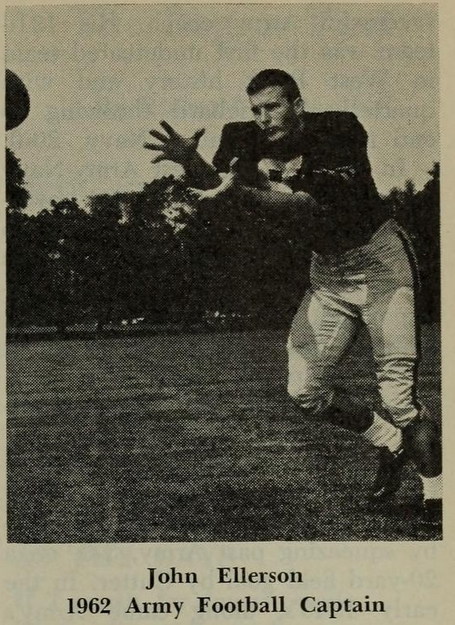
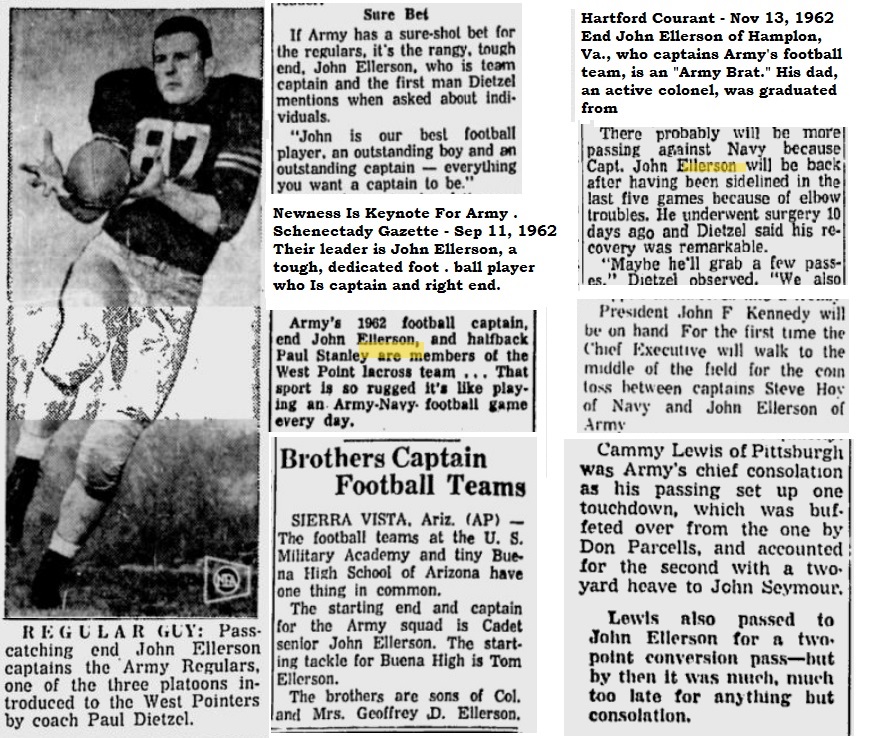
John Ellerson

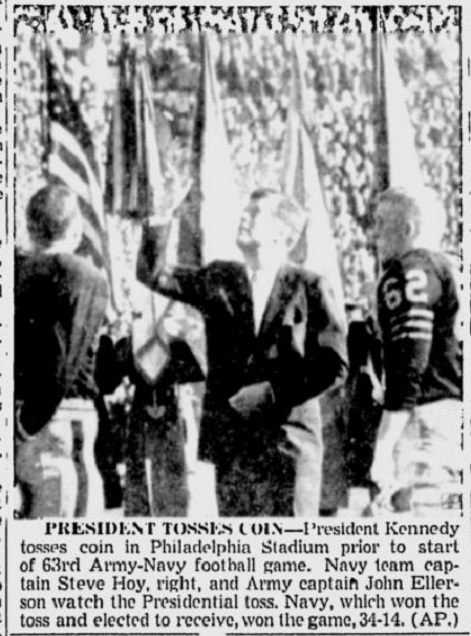
Class of 1963 – Captain of the 1962 Army Football Team
Also see Red Smith’s article of the 1960 Army Navy Game
http://forwhattheygaveonsaturdayafternoon.com/wp-teams/football/army-navy-football

John #87 brings him down. (Note – that is 87 on his helmet)

Army 9 Syracuse 6 – Yankee Stadium 1961, against Syracuse and Ernie Davis their All American Back.


–

Army Navy 1961 – Setting up his Block for Al Rushatz Army’s Fullback

–

1962

ArmyFB_1962_JohnEllerson-Captain_TheLink

https://archive.org/stream/link2011unse#page/7/mode/1up

ArmyFB_1962_JohnEllerson-Captain_LeaderPost_Oct21962

–

ArmyFB_1962_JohnEllerson-JFK_Hoy-Navy_TheDay_Dec31962

–

Rich Ellerson

West Point’s 36th Head Football Coach

Continue reading →

Football & Swimming

Pete Lash

Joe Steffy said COL Blaik had 2 great moments in football. one was the 93 yard touchdown by Rip Rowan in the A-N game.

The other was a touchdown run to win the game against Navy in 1955. RB Pete Lash ran for 30-40 yards to paydirt during which every Navy player had a shot at him, but he run through them all. Joe said that Lash was a walk-on. Small and played high school FB; Joe said he really did not have the attributes of a great player. BUT, he was tenacious and worked harder than anyone on the team. He succeeded in making the starting team his senior year. Went on to become a three star general.

It was the Fall of 1953. Years later Earl Blaik was to write of that Season – – “For two years these boys had seen the roughest action. They had lived with the coaching lash, dirt, blood, and defeat.”

Pete started the season on the B squad. One day at practice they were running the next week’s opponents plays against the Second Team – A Squad Defense — and doing quite well. Col Blaik came over, watched for a few minutes, blew his whistle and had two B Squaders change jerseys with A Squad players. From that day on Pete was on the A Squad.

After the jersey exchange Pete was sent over to where the backs were working with Vince Lombardi, who asked Pete if he knew the plays — which of course he didn’t but faked it — and managed to get by with only a little of Coach Lombardi’s sarcasm.

It was Col Blaik’s message that day to every player and it got their attention and made practices more competitive.

A little over 5 years later Col Blaik retired. Joe Steffy, Class of ’49, Army’s only Outland Trophy Winner asked his Coach what were his best memories of the 18 Army Navy Games. He mentioned two, one of which was Pete running through, around or over every Navy Player on the Field in the Fall of 1955.

Army 20 – Navy 7

Col Blaik

Peter Vann ‘s explanation of Lombardi’s Royal “3Fs”; comments about schooling by Vince Lombardi and a letter by Vince’s Son indicating that because of Peter’s success his Dad was able to climb the professional ranks – – is at Peter Vann.

Continue reading →

More Than a Ball Game

Army Navy Series 1890 – 1952

1953 Records