Author Archives: forwhattheygave.com

My site was placed on WordPress in 2013. Since then I have added a significant amount of material. Approximately 9 months ago my yearly bill was due. I was suddenly unable to access Forwhattheygave.com. A Wordpress Tech contacted me offering assistance. He simply tried to copy my material and assumed control of Forwhattheygave.com. My site still exists as the Tech recently copied material and created ForWhatTheyGaveOnSaturdayAfternoon.com which was my web site prior to setting umps site on Wordpresss. You can find the site as couple of Months ago a WordPress Tech found the site. Thank You. Phil

Ted Stroup

Ted & Harriet Stroup  

Swimming, 4 years, along with 7 additional Clubs to include Senior Editor of the Howitzer
Masters @ Texas A & M, HEADSUPACTVN, MACV/USARV, US. Assistant Coach Firstie Year. Was to end his Military Career wearing 3 Stars.


Chair of Board of Directors

West Point Association of GraduatesJan 2007 – Dec 2011 · 5 yrsUnited States Military Academy, West Point , New York

Chair of the Board of Directors of a large alumni association for the United States Military Academy with fiscal, governance, fund raising, communications and leadership duties

Ted was assigned to the Office of Military Instruction, Department of Tactics during the 1968- 1971 Academic years.  He was asked by Coach Jack Ryan to Coach the Plebe Swimming Team during this period.


Association of United States ArmyDec 1996 – Dec 2012 · 16 yrs 1 mo


Provided direction and guidance on stratgice communication issues for the organization, to include media, international developement, congressional affairs, academic interface and public outreach.Also served as Executive Director, Institute for Land Warfare, ILW, quasi think tank for AUSA.

LTG, US Army retired


Self Employed Consultant- DefenseJan 2013 – Present · 9 yrs 5 mosFalls Church, Va


Provide advice and insight on national/international defense – ranging from strategic to operational venues, to include personnel, budget/program insights, military engineering, project management and acqusition matters. Plus well versed in non profit management and operation

1953 Football Team Draft Nomination

After the Navy Game —- He ordered the door secured and as he turned to speak his eyes were misty.

“I have never coached a team that give me more than you did. I never have coached a team that has given me as much satisfaction. Considering all the conditions since 1951, you have done more for football at West Point than any other team in the history of the Academy.”

1. Bob Farris ’55 played the entire 2d half of the Navy Game totally blind in one eye. Although he was Captain of the ’54 Team he was never to play another down of Football.

2. Bob Mischak ’54 as a player and a coach, Bob participated in 3 Super Bowls, 8 AFC Championships and numerous playoff games. As the starting Offensive Tackle on the 1958 Giant Team he participated in “The Greatest Game Ever Played” – – yet he had this to say of the 1953 Duke Game:

“As many reports have stated, the 1953 team “Returned to Glory” with the defeat of the nationally ranked Duke Blue Devils at the Polo Grounds in New York City. From a player’s stand point, that was the epitome of any game, team, and student body support that I’ve been associated with – bar none.”

1950 Graduates stationed at Fort Bliss listening to every word on the radio heard Ted Husing say “- – – And, Smith is in the clear, he’s away for a touchdown.” there was a pause of 5 second or so of silence, and Husing then said, “No, no…he’s going to get caught from behind!”

For over 10 years the Academy’s Military Psychology and Leadership Department referred to Bob Mischak’s run down of Red Smith, and the team’s effort that day as an example of the power of motivation.

3. Coach Hugh Wyatt founder of the Black Lion Award provided the August 14, 2009 Bradenton Herald article by Roger Mooney. Excerpts of the interview with Jerry Hagan ’55 who quarterbacked the 1st Army drive in the Duke Game are below

It is the chanting that Jerry Hagan remembers most about that October afternoon in the fall of 1953.

Sure, Hagan remembers the touchdowns and the game-saving tackle by Bob Mischak in the game’s waning minutes. He remembers Earl Blaik, Army’s larger-than-life coach, calmly pacing the sidelines at the old Polo Grounds. Hagan remembers heading to the locker room at halftime holding a 7-0 lead. He remembers thinking during the days leading up to the game that he and his Army teammates were going to be trounced by Duke, at the time ranked seventh in the country.

Those memories are as clear as the brilliant blue October sky that Saturday afternoon nearly 56 years ago.

“Go! Go! Go! Go!”

“It was continuous,” said the 75-year-old Hagan, who played that afternoon. “Just deafening”

Army didn’t win a national championship that afternoon. No one clinched a Heisman Trophy. But Army won something more important. The Black Knights knocked off a top-10 team and began lifting the stain caused by the Honor Code scandal that had rocked the academy two years earlier.

Because of one game. Because of one win.
“Army was back,” Hagan said.

Go! Go! Go! Go!

Hagan Class of ’55 entered the Academy that summer of 1951 when the scandal broke. “The atmosphere was just so depressing for a while because nobody could believe this could happen,” Hagan said.”It kind of crushes you.”

The football team was devastated. Blaik’s teams had won three national titles and produced two Heisman Trophy winners in the six seasons prior to 1951. In 1951, Army went 2-7, including a season-ending loss to Navy. Hagan was a member of the varsity in 1952, playing defensive back.

The following year Hagan was moved to linebacker and quarterback since the NCAA imposed a rule returning the game to “Iron Man” football.

The ’53 Team opened the season with a win at Furman, but lost the following week to Northwestern. It was a loss, Hagan said, that shook the team’s confidence. But the Black Knights had an assistant coach who would not let his unit suffer a mental breakdown. His name was Vince Lombardi.

“He was a very cerebral coach,” Hagan said. “He was so intense, so intolerant of mental mistakes. We didn’t have many athletes, but we were probably the most mentally prepared team because of Coach Lombardi and Coach Blaik.”
Army football wasn’t much to rally around during the 1951 and ’52 seasons. The Corps of Cadets were use to us getting beat.

Then came Oct. 17, 1953, and the seventh-ranked Duke Blue Devils.
The cadets filed into the Polo Grounds silent as ever, but started screaming. Go! Go! Go! Go!

And go Army did.

It was 14-13 late in the fourth quarter when Duke’s Red Smith broke free headed for the winning touchdown. Mischak caught Smith at the 10 and brought him down at the 7.

It is the most famous tackle in Army history.

Army stopped Duke less than a foot from the goal line on fourth down.
Seconds later, players were riding on the shoulders of the cadets, who stormed the field. Army went 7-1-1 that year, beating Navy in the season finale. They were awarded the Lambert Trophy for being the best team in the East.

They restored the Academy’s pride. The glory was back.

Now there is a push to have the ’53 immortalized in the Academy’s Hall of Fame.

4. Lodge from guard to fullback, Sisson switched from end to back and then switched back to end; Lunn as Team Captain on the sidelines, as another was better able to meet the new requirements of playing both ways; the injuries to Chamberlin, Attaya, Zeigler, Ordway and Franklin; and the unrelenting demands and hours spent ensuring Vann mastered the details of the Royal 3 F’s -(Faking, Feeding and Fleeing) that Vann met Lombardi’s expectations, resulted in Jim Lee Howell, the New York Giants’ head coach who hired Lombardi after the 1953 season at Army to say – –

“If Lombardi can do that kind of job in three years at West Point – he could do a helluva job in the pros where he would have an experienced base to work with.”

The 3 years were the 2 difficult seasons of 1951 and 1952 followed by the success of the 1953 Season.

Years later after Vince Lombardi’s death his son was to write – “My personal interest lies in Peter Vann’s contribution to the success of the 1953 Army team which I consider a major factor in my father’s success.”

5. Ted Husing the CBS Sports announcer for the Duke Game — “These Boys have got me so excited I can’t even finish the Broadcast. Take over Walter”

If you do not know who Ted Husing was – – wikipedia provides this “Husing’s personally could be arrogant, coarse and opinionated. He was the first to bring a candid, editorial style to sports play- by- play. He was barred for two years by Harvard University for covering its home football games after he called All American quarterback Barry Wood’s performance “putrid”. After criticzing World Series umpires in 1934, Husing was banned from doing play-by-play of the Fall Classic by Commissioner Kenesaw Mountain Landis”

6.Col Blaik “When I come to describe the team of 1953, what they meant to me and, far more important, what they meant to West Point, I cannot praise them enough.”

7. Grantland Rice wrote with eloquent simplicity, “They came up the hard way and there probably has never been a squad with a finer spirit.”

8. Winners of the Lambert Trophy.

9. Rated No. 14 Nationally.

10. Col Blaik was named Coach of the Year by the Washington Touchdown Club.

11. Col Blaik After the Duke Game — The emotionally-controlled Blaik who, with tears in his eyes, handing the Army-Duke game ball to Bob Mischak with the words – “Don’t ever give up.” He was later to refer to the it as “The Game never to be forgotten.”

12. The Silence imposed upon the Corps The Corps’ preparation for the game had been more than unusual, including a “silence” imposed by the cheerleaders at the meal following Blaik’s talk. The “silence” which began after the traditional pregame sendoff of the team – proved potent. The cheerleaders had put a cork in the bottle of more than two years of pent up frustration. When the Corps completed its subdued, strangely silent, pregame march-on at the Polo Grounds, and the last man double-timed onto the first step of the stands, the men in gray exploded. They shook that old stadium almost non-stop in the sunshine and shadows of that Indian summer afternoon.

13.Duke ball players reaction — Worth Lutz, Dukes quarterback said after the Game, “The savage cheering of Go!GO!GO! from the West Point stands placed our team in a nervous fright of tension and jitters.”

14. New York Times the day after Army’s 14 – 13 win over 7th ranked Duke summed up what that Team did with – – –

“The fire and viciousness with which this Army team ran, hit, blocked and tackled made it the winner it was today against a team whose line was thought to be too powerful for the cadets and whose backs were expected to show the speed and driving force.”

And anothe quote — “But from well back an Army figure set out in pursuit. With the place in an uproar, Bob Mischak cut down the gap between them, and finally leaped upon Smith and dragged him down on the 7 yard mark, 73 yards from the line of scrimmage.”

Bob had run down Duke’s All American Red Smith. For nearly 15 years afterward the story of Army’s win and Bob’s tackle was part of West Point’s Military Psychology and Leadership Course – as an example of the power of motivation.

15. NY Times again

“He (Attaya) also took a 17-yard pass, amazingly thrown left-handed by Vann, immediately preceding the 43-yard scoring aerial.”

Third was Ralph Chesnauskas, Yearling right guard who played the entire sixty minutes”

16. Even today Lowell Sisson ’54 accepts responsibility for the ’53 Team’s only loss. How many Athletes are willing to admit their contribution to a loss 56 years past, especially when that Team had such an outstanding Season – such was and is the makeup of the ’53 Team.

The NCAA changed the rules for the 1953 Season what was in effect a return to Iron Man Football. Lowell played Offensive End during the ’52 Season but in trying to come up with the best fit, Lowell was switched to the backfield in the spring of ’53.

“About 10 days before the season was to start I was called in to Col Blaik’s office. Fearful regarding what the reason was, I reported in to find “Col Blaik” and “Vince Lombardi” there and they proceeded to ask me what my reaction would be if they were to switch me back to end. I said I did not care where they wanted me to play as long as I could be of value to the team.

Because of the switch back to end I did not get totally grooved into playing defensive end and this contributed to a large degree why we lost our only game that season. I felt I played a terrible game against Northwestern and contributed mightily to our defeat.”

17. Col Blaik wasn’t a coach who gave emotional, fire and brimstone speeches at halftime. Rather, he was analytical. He identified mistakes and taught his team how to correct them. Not so against Dartmouth. He was frustrated by a flat, lackluster first half and gave his team a tongue lashing.

Ralph Chesnauskas remembers they were the harshest he ever heard the Colonel speak — words to the effect – – –

“I do not care if it is your Mother across the line from you, I want her on the ground.”

18. Col Blaik’s offensive play routine required the Army center to be the first man out of the huddle after the quarterback called the play. As the center trotted up over the ball, the rest of the team would pause, then break from the huddle, and jog to the line of scrimmage. Not so the second half against Dartmouth, or against any other team the remainder of the 1953 season.

Center Norm Stephen ’54 was so energized by Blaik’s blistering half time remarks, that on the first offensive play of the second half he bolted from the huddle and raced to the ball – and the other ten players pausing for a moment to understand, followed his lead. The Corps roared their approval, and that pattern continued the rest of the afternoon. A new method for calling up “the twelfth man” had been established.

19. Colonel Red Reeder who served West Point as Assistant Athletic Director in the Army Athletic Association, (The Triple A) from 1948 to 1967 had this to say –

“In all my association with the Corps, I have never seen a better display of Sprit. ”

20. The Cheer Leaders were told a Pack Howitzer was too expensive to be given to the Cadet Corps. With the help of the Ordinance Department Jay Gould ’54 constructed a Cannon from a German Rocket Gun captured at Kasserine Pass. It was first used in the Duke Game.

The Cadets were nearly paranoid with concern that the Middies were going to interfere with the Cheer Leaders plans for the Navy Game 6 weeks away. Bill Robinson took the step to hide the Victory Cannon at Ft. Hamilton in NYC after the Duke Game. It is another indicator of how intent the Cadets were on keeping things going, supporting the team the entire season without a hitch.

21. Billy the Navy Goat was taken by Cadets and paraded through Washington Hall. President Eisenhower ordered the Cadets to immediately return the Goat.

22. They were one of the smallest Army football teams in years, at season’s end thirty-eight men, a team of heroes with no stars and with a different hero each Saturday.

23. Neil Chamberlin a standout at tackle during the ’52 Season was lost during the summer of 1953. Col Blaik said of the season “Injuries as the season advanced cost the Team solid fullback and punter Fred Attaya ’54, hard-nosed right halfback Mike Zeigler ’56, and spirited end “Ski” Godwin Ordway ’55. By the time season got down to the Penn and Navy games, the starting eleven and about four substitutes carried the full load.”

The 1953 Team was a Team of Iron Men committed to the ideals of West Point. They played Iron Man Football.

23. Army Defense – In the Duke Game 23 passes were thrown by Duke compared to the 28 passes which were throw in their first 4 games. Chesnauskas, Zeigler at guard, Farris and Melnik at the tackles, Mischak, Sisson and Holleder controlling the sweeps, bottled up Duke’s running game all afternoon except for the one reverse and 73 yard sprint by Red Smith which Mischak hauled down.

24. Bob Brogi ’62 when asked if he supported the Nomination replied –

“Absolutely and unquestionably YES, YES and YES. Unlike most members of our Class, being from Highland Falls and a 15 year old in 1953, I saw all of the Army home football games in 1953 as well as most of 1949-1957. In the early years to include 1953, I had to watch not from the inside stadium, but from a high oak tree which I would climb so that I had a commanding view above what was then the somewhat temporary stands at the North end of the field. About that year, I became much more savvy as to ways that I could get or con tickets from those who were not going to use and always sat as a real participant. So I vividly recall seeing Sisson, Stephen, Tommy Bell, Pat Uebel, Fred Attaya, Peter Vann, Bob Mischak, Ralph C., Don Hollander , and many, many others through the years.”

25. Jim Morgan ’57x remembers General James Van Fleet, before the Navy Game, standing on the Poop Deck, stripping off his uniform down to a Beat Navy T-shirt, then putting on his Army sweater with his Football Army A, bring from the Corps of Cadets thunderous shouts, demanding Victory over Navy.

26. Dick Stephenson ’57 who earned 3 Army A’s as a lineman; (who is remembered even today by Bob Anderson ’60 for the hit Dick put on Bob in Bob’s introduction to Army Football in the fall of 1956) remembers – –

One of Army football’s most effective passers, Peter Vann, the Army QB (with a truly great right handed passing arm), managed a left handed forward shovel pass to Freddie Attaya, from the grasp of the Duke’s All American tackle Eddie Meadows who had pinned Petes’s passing, right arm to his torso, which Freddie caught to keep an Army drive going on into a score…simply unbelieveable momentum, continuity, and a bit of luck.

Who remembers the incredible diagonal, quickly one-on-one, pursuit of the Duke halfback, Red Smith, in an open field chased by Army’s end, Bob Mischak, catching and covering somehow, from some 73 long, long yards, with Mischak tackling him from behind, at Army’s 7-yard line. The Duke halfback never ran so fast and free, and Bob Mischak literally found another gear. The score was already 14-13, Army, at this time in the game, as I recall.

Who remembers following this incredible pursuit/catch by Bob Mischak, the Army team put on a goalline stand that defied all sense, reason, or logic, holding Duke off on all four downs, with Duke so arrogantly confident that they refused a field goal attempt!

27. Freddie Attaya remembers Vince Lombardi’s shouted advice to him as he ran onto the field in a third and seven situation. “Run the gauntlet” yelled Lombardi.

Vince was reminding his fullback of a drill he put his backfield through in practice. Running backs, carrying the ball pressed against their gut, ran hard between two lines of eight players each. The ball carriers’ forearms protected the ball, and their hands tightly gripped opposite ends of the pigskin, every player in the gauntlet aggressively tried to “tackle the ball.” Freddie ripped the middle of Duke’s line for nine yards and a first down. When he came off the field, Lombardi rushed to hug him, telling him he had done a great job.

28. Jerry Lodge, converted from guard to fullback during spring practice, remembered the Duke game for a different reason. He played fullback on offense and guard on defense when Army was in a six-man line, and moved into linebacker when Army went to a five-man line. On defense, he played alongside the few linemen who were in the game nearly the entire 60 minutes and was in Army’s dramatic goal line stand following Bob Mischak’s game-saving tackle. With first and goal on Army’s 7-yard line, the cadets held Duke on a fourth down quarterback sneak from the two, with 40 seconds to play.

Throughout the final two minutes of play, especially during Duke’s four thrusts at the Army goal, it was almost impossible to hear or think because of the roar from the crowd. Cadets had come down out of the stands, were pressing around the Army bench and close to the sidelines, imploring their defense to hold.

Army’s always thorough scouting reports helped exploit Duke’s weaknesses and patterns.

Jerry Lodge remembered what Blaik had told the team. When the Blue Devils get inside an opponents’ 10-yard line, they run the ball between their own tackles on 95% of plays. And when they get close to the goal line, they run quarterback sneaks. Prior to the fourth down play, a Duke assistant threw a kicking tee onto the field, indicating a field goal attempt.

Lutz picked up the tee and threw it back, disdaining the field goal.

Gerry Lodge had seen his teammate, left guard Dick Ziegler ’54, playing magnificently all afternoon, often absorbing the energy of three Duke blockers because of his hard charges in the middle of their line. As Duke huddled for Lutz to call the fourth down play, Lodge said to Ziegler “Remember, he’s going to try to sneak.”

Duke’s Lutz did, but he was met by a wall of white jerseys. Army took over on downs, inches from the goal line, while the Corps of Cadets shouted their frenzied approval. But the game wasn’t yet over. On first down, Freddie Attaya, on orders from Blaik, punted from deep in his end zone. Duke had 30 more seconds and four more plays from the Army 37-yard line – all passes – all knocked away. Peter Vann, Army’s quarterback, batted away the last pass in the end zone, a pass thrown by Gerry Barger, Duke’s quarterback, to starting quarterback Worth Lutz.

29. To back up — With two and one half minutes left in a game that was already emotionally and physically exhausting, Duke took the ball on downs just inside their own 20-yard line with Army leading 14-13. Worth Lutz knew he needed a long gain. His team didn’t have the energy for a long, grinding drive, so he called a double reverse. Lutz handed the ball to halfback Bob Pascal, indicating a sweep around Army’s left side. Pascal then slipped the ball to “Red” Smith, Duke’s speedy All-American candidate, heading in the opposite direction. Army’s defense over commited, and Smith broke into the secondary. After sidestepping a linebacker, he was in the clear, ten yards beyond pursuing Army defenders, sprinting toward the southeast corner of the field.

Earl Blaik years later described reactions on the Army sidelines.

“We on the bench and the Corps of gray in the lower stands behind us shot to our feet in sudden silent, stunned consternation. Smith looked home free. I felt our heads were being pushed down once more into the ashes of 1951.”

Then, from out of the pack of pursuers, came left end Bob Mischak. He had an angle on Smith and rapidly began closing the gap at the 50-yard line. By the time Smith crossed the Army 20, Mischak had closed to 3 yards. The Army stands were coming alive, shouting encouragement to him, but it was important that he not commit too soon. Blaik held his breath, muttering to himself, – “Not yet! Not yet!” As Smith crossed the 12-yard line, Earl Blaik was saying “Now! Now!” Bob Mischak leaped far and high, caught Smith around the shoulders at the 10, and downed him on the 7-yard line.

Earl Blaik remembered Bob Mischak’s game-saving tackle for the rest of his life.

“In somehow catching and collaring [Smith], Mischak displayed heart and a pursuit that for one single play I have never seen matched. Yet his feat, one of the great defensive plays of football, would have soon been forgotten, had it not been for the [goal line stand that] followed.”

30. They were only scored on 12 times in ’53. One by Navy, 5 times by Northwestern with 6 spread out over the other 7 Teams.

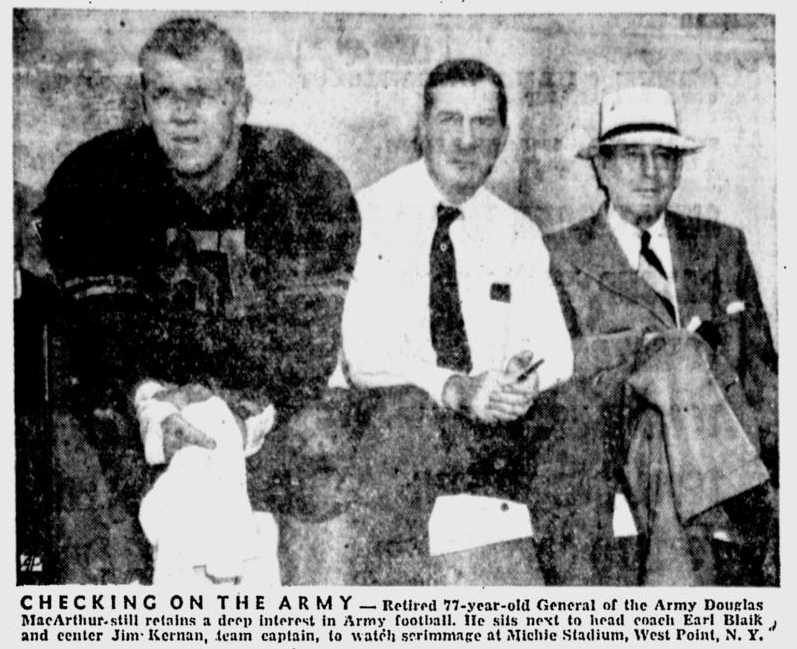
General MacArthur said it would take 10 years.

The Leadership of the Class of 1954, the commitment, the self sacrifice of the Classes of 1955 and 1956 — of every member of that Team, supported by the Thunderous Chant of Go, Go, Go from the Class of 1957 insured that it only took 3 years.

Cadets left to right, Clyde W. La Grone, Roman J. Peisinger, Ira Coron, and Leonard Griggs. In the background is Rox Shain, the Army player whose game-opening diagonal kickoff preceded Navy’s fumble. (Photo courtesy of Willis C. Tomsen, ’54.)

It was the Season Army Returned to Glory

Col. Earl Blaik leaving the field late afternoon Nov. 28th 1953 after the Army Team beat Navy 20 to 7.

“I have never coached a team that give me more than you did. I never have coached a team that has given me as much satisfaction. Considering all the conditions since 1951, you have done more for football at West Point than any other team in the history of the Academy.”

We five Classes believe the 1953 Football Team did more for West Point than any other Team in any Sport.

signed by ’54, ’55, ’56, ’57, ’62

Attachments

1. The ’53 Season
http://forwhattheygaveonsaturdayafternoon.com/wp-53/season

2. Bob Mischak’s Letter to Last year’s Selection Committee

http://forwhattheygaveonsaturdayafternoon.com/wp-1954/mischak-letter

3. Army Football Classsics -1953 Football Film

http://forwhattheygaveonsaturdayafternoon.com/wp-1954/53season-blaik-faces

http://forwhattheygaveonsaturdayafternoon.com/wp-1954/army-duke-1953

http://forwhattheygaveonsaturdayafternoon.com/wp-1954/army-navy53

Requirements

1. Complete Review by the Members of the 1953 – 1954 Corps of Cadets to insure correctness of material. (In the Chant were there 3 Go Go Gos or 4? Is it Jerry or Gerry Lodge – Academy Publications-Howitzer and The Pointer have it both ways – just informed it is Jerry)? A misspelled name and incorrect location of a player in the Team photo have been corrected – are there any other corrections? Need better picture of Ordway.

2. Rework of the draft Nomination and The ’53 Season by ’62.

3. Continue the count of the Class of ’62 to determine an exact number supporting the Nomination.

4. Add any additional comments from the 1953 – 1954 Corps of Cadets which support the Nomination.

5. Determine if each of the 4 Class Presidents (’54 – ’57) or an approprite representative from each Class are willing to sign the Nomination. Failing that, if available would the 1953 – 1954 Cadet Brigade Commander be willing to sign the Nomination?

Work Area

The 1953 – 1954 Corps of Cadets and ??? members of the Class of 1962 Nominate the 1953 Football Team for the Army Sports Hall of Fame.

We the Graduates of the Classes of 1954, 1955, 1956, 1957, and 1962 believe the 1953 Football Team must be recognized for what they gave back to the Corps of Cadets, for what they gave for our Honor Code, for what they gave back to our Academy Motto — for what they gave back to the United States Military Academy.

Don Voss

1961 Lacrosse Team

James Adams – Army Lacrosse Coach 1958 – 1969

Hall of Fame – – – http://www.uslacrosse.org/museum/halloffame/view_profile.php?prof_id=10

Coach Ace Adams being chunked into the Severn River after the 1961 Army-Navy Lacrosse game, won by Army 10-8.

This game, played in the Navy-Marine Corps Memorial Stadium, was the first lacrosse game ever to be televised nationally. Ron Hannon ’61 seemed to come up with every ground ball and Dick Buckner ’61 hit a Navy defenseman so hard I felt the ground shake.

One of the best lacrosse pictures I’ve ever seen is in our 62 Howitzer of Mac Howard taking a shot in that game. Rusty Broshous scored two goals when we needed them most. Our victory enabled Army to share the National Championship with Navy- we had dropped a game to Virginia earlier.

As you can guess, we were jubilant. As soon as coach hit the water, we all jumped in after him still in uniform. “Holy Cow! (or perhaps words a little stronger) The tide’s out!” shouted Dave Harkins. We were facing a six foot high sea-wall. Fortunately, our ever-faithful bus driver Jake knew what to do. He retrieved a rope and life-saving ring from Halsey Field House and fished us out one by one. by Butch Darrell – 1962 Lacrosse Captain

Sports Illustrated — June 12, 1961

JOYS OF A JUNE WEEK —
By Ray Cave

Army and Navy, those classic rivals, celebrate graduation time with fun and games at West Point and Annapolis, and both win approval from several thousand pretty guests

Whether you were the type who loves a parade, the sort who goes where the girls are or simply a connoisseur of athletic Donnybrooks — the place to be last Saturday (June 3d) was either West Point or Annapolis.

On the stern high bluffs above the Hudson were the pomp and pageantry of an Army graduation week, hundreds of pretty young ladies who had come from every state in the union and an Army-Navy baseball game that starred a very famous athlete. And on the gentle slopes of the Severn, the Navy offered more gold braid and brass bands, more beauties and a lacrosse game with a national championship at stake.

When Navy held its pep rally on Thursday evening, two days before the game, it had no inkling that the Army lacrosse team was nursing a year-long grudge. The likelihood of athletic successes was adding to the normal joys of the Annapolis June Week. An electric “Beat Army!” sign flashed from Bancroft Hall, the world’s biggest dormitory, which houses all 3,665 of the midshipmen.

Rear Admiral John F. Davidson, the academy superintendent, was introduced at the rally by a glib midshipman as “Big Daddy,” and he took it gamely while the exuberant middies cheered. Already the first dates were arriving for their week-long stay, a social assembly that would include three dances, three parades, a concert by Duke Ellington and an address by President Kennedy at graduation. Tough old Navy captains with houses on the academy grounds were helplessly watching their wives take in girl boarders by the score, while the graceful but small colonial town of Annapolis (23,385) was preparing its boarding houses for 50,000 visitors. (Also ready: the town’s 200 legal Slot machines, the biggest concentration of one-armed bandits east of Las Vegas.)

The town’s narrow streets, meanwhile, looked like a scene from a Monte Carlo road rally. Four hundred graduating first classmen had bought cars. On May 27 regulations preventing them from using automobiles had been lifted, and convertible sport models in flaming red were obviously this year’s choice.

“I know we’ll do well,” summed up the admiral as he spoke at the Thursday pep rally. “Army, Army, call the doctor,” sang the midshipmen while they waved their bright white hats and stood impressively tall in the short-sleeved, tropical uniforms that Navy wears in such hot spots as Guam, Panama and Annapolis.

The next morning the Navy lacrosse team was practicing on an athletic field so close to the Severn River (which is actually a tidal backwater, not a river at all) that when Coach Bill Bilderback arrived his first words were, “Don’t throw the balls in the water.”

The Navy squad should be able to throw well enough to miss a river. Last year it was unbeaten in college play, ending the season by defeating a favored Army team at West Point. (That was the game which Army was remembering so well this week.) This season Navy won nine more consecutive college games, but frequently in such hairbreadth fashion that John Paul Jones would have given up the ship as lost. Navy was badly behind against every major opponent. It trailed Maryland 5-1 in the second half and fought back to win in overtime. It was behind 8-4 to Baltimore University in the last period, and scored in the last minute to beat Virginia.

Speed and stamina, not lacrosse finesse, seemed to be winning for Navy. At the beginning of the season the Middies were actually given little chance of another title. “But we kept improving every game,” said Coach Bilderback, sounding a little surprised himself. Navy was getting excellent play from a big (6 feet 2 inches) attack man, Tom Mitchell, had an outstanding defenseman in Team Captain Neil Reich and six football players who provided some brute force. The most noticeable of these was John Hewitt, captain of next year’s football team. Navy’s 1961 lacrosse philosophy was simple: run, run, run, and eventually the other fellow won’t be able to get up and down the 110-yard field. This worked all year.

But if Navy was a surprise, Army was more so. In the state of Maryland there is a tendency to feel that a man cannot play lacrosse unless he is raised within 40 miles of Baltimore. Army was pooh-poohed for playing a weak schedule, and accused of using more muscle than talent. “Animals,” a Baltimore newspaper said of the Army team, after carefully making an exception of the Marylanders on it.

One little non-Marylander, however, was a 5-foot 8-inch, 154-pound twirling nuisance named Pat Hillier, who was from Long Island. His 20 goals led Army’s scorers. “Best we’ve seen,” said the Navy scouting report bluntly, after listing six things he did well. Another was 155-pound Rusty Broshous, from the town of West Point, N.Y.

In the midfield Army had Ron Hannon, a 1961 version of Pete Dawkins. Hannon was first captain of cadets, star of the basketball team and, as Navy put it, “a rough, tough midfielder.” The Army defense was composed of three football players, none of whom had handled a lacrosse stick before their second year at West Point. “Our stick work isn’t the best, but we hit people,” said one of them, Glenn Adams, a big, fast football halfback with a knack for understatement.

Army Coach Jim Adams — tall as a Texan, laconic as a down-Easter and actually (of course) from Baltimore — felt that his team, like Navy, also had developed late in the season. And it had two other striking similarities to Navy: a tough defense and the run, run, run philosophy. “We’ll just try and keep up with them,” Coach Adams said. He made it sound wistful. Bilderback was also sounding wistful. Looking at the national lacrosse trophy which Navy has kept since last year’s victory, he said, “I hope I won’t be wrapping it up soon.”

Despite occasional showers, more than 6,000 paid their way into the Navy stadium on Saturday. CBS-TV was also there, taping the game for a sports spectacular to be shown five days later. What they got was a spectacular game. The Navy defense gave Army only 10 shots in the first half (20 is average). But Army, body-checking, battering and, most of all, running, as it substituted four different sets of midfielders, kept its poise. Poor Navy shooting resulted in a 2-2 tie at half time. Then, in the space of 51 frantic seconds shortly after the start of the third period, Navy poured in three goals. Against any less resolute opponent this would have ended the game. At the same time the crowd was cheering the news (announced on loudspeakers) that Navy had won in Army-Navy track, tennis, golf and baseball.

But Army coolly tightened its defense, began putting two men to chasing the Navy player with the ball, and got away with it when “untirable” Navy started slowing down. Army scored while a Navy player was off the field with a penalty, scored again when a midfielder broke through all alone at the goal, and finally tied the game at 5-5 when a beautiful bounce shot by Hannon skidded in.

The blitz continued when a daring pass the full length of the field set up a goal by Broshous. A minute later Broshous brazenly stole the ball from the Navy goalie and flipped it in for a score. In the last moments of the third period Army Captain Sam Wilder almost casually held the ball behind the Navy goal, then came out to his left and scored with exactly one second left. This, the last of six straight Army goals, was doubly discouraging to Navy and proved decisive, because the Middies fought back to 9-8 before finally losing 10-8. So determined was Army’s defense that not a single Navy goal was made by a first-string attack man. Army’s Broshous and Hillier each scored twice.

At the final gun the air was filled with sticks, gloves and helmets thrown high by the Army players. The Army substitutes, who had stood up the entire game as if to show the team’s determination, joined the melee. Happy Jim Adams was carried to the dressing room and congratulated by an Army general wearing a “Beat Navy!” button just below six impressive rows of service decorations on his uniform.

“Your boys wanted it real bad,” said Navy’s beaten Bilderback to Adams. “Lots of guts.” And it must be said that Navy gave nothing away; Army simply took it.

The victory left it up to the Intercollegiate Lacrosse Association to either name Army national champion, or make both Army and Navy co-champions because each lost one game, Army to Virginia. But whatever they do, Army has what every Army team wants most, the win over Navy. Minutes later the Army team was roaring and shouting as its bus crawled through the traffic back to the Navy field house. There it grabbed Jim Adams, starched shirt and all, and threw him over a sea wall into the Severn. As his players were about to let him fly, a frantic Navy voice of authority was heard shouting, “Don’t! Don’t! The tide’s out!” But Navy was just a little too slow again. There was, it turned out, enough water to float Jim Adams, the happiest man at June Week.

Ace Adams

James Adams – Army Lacrosse Coach 1958 – 1969

Continue reading →

1994-1995 Women’s Basketball

Gil Stephenson


Continue reading →

Bobby Jack Stuart

Please go to the Class of 49

Jack Green

3 Army A’s in Football

Football’s Greatest Decade – – by Bernie Mcarty – http://www.la84foundation.org/SportsLibrary/CFHSN/CFHSNv01/CFHSNv01n1b – – see page 5

This writer believes West Point 1945 is the greatest team of all time. The 1944 Army team may actually deserve that title, but it was never tested. Army was also undefeated in 1946, 1948 and 1949.

Army’s top stars during 1945-1949 were the effulgent “Touchdown Twins”, Glenn Davis and Doc Blanchard, Arnold Tucker, Arnold Galiffa, Rip Rowan, Bobby Jack Stuart and Gil Stephenson in the back-field, and up front Joe Steffy, Art Gerometta, Jack Green, Bill Yeoman,”Joe Henry”, Tex Coulter, Al Nemetz, and the sterling end duo of Hank Foldberg and Barney Poole.

In 1945 the Newspaper Enterprise Assoc. simply picked the entire Army team as its All-American team, stating no group of All-Americans could beat the Cadets. Only a world war could have brought together such a collection of players to one institution. But it took the coaching genius of Col. Earl Blaik to mold the players into a cohesive unit. In truth, Navy personnel was equal to Army’s on an individual basis. The Middies never jelled as a team, however.

The 1951 Army outfit might have been as good as the 1945 Cadets, but the infamous cribbing scandal wiped out the team.

Al Nemetz

3 Army A’s in Football.

Football’s Greatest Decade – – by Bernie Mcarty –
http://www.la84foundation.org/SportsLibrary/CFHSN/CFHSNv01/CFHSNv01n1b – – see page 5

This writer believes West Point 1945 is the greatest team of all time. The 1944 Army team may actually deserve that title, but it was never tested. Army was also undefeated in 1946, 1948 and 1949.

Army’s top stars during 1945-1949 were the effulgent “Touchdown Twins”, Glenn Davis and Doc Blanchard, Arnold Tucker, Arnold Galiffa, Rip Rowan, Bobby Jack Stuart and Gil Stephenson in the back-field, and up front Joe Steffy, Art Gerometta, Jack Green, “Bill Yoemans”, Joe Henry “Tex” Coulter, Al Nemetz, and the sterling end duo of Hank Foldberg and Barney Poole.

In 1945 the Newspaper Enterprise Assoc. simply picked the entire Army team as its All-American team, stating no group of All-Americans could beat the Cadets.

Only a world war could have brought together such a collection of players to one institution. But it took the coaching genius of Col. Earl Blaik to mold the players into a cohesive unit.

In truth, Navy personnel was equal to Army’s on an individual basis. The Middies never jelled as a team, however.

The 1951 Army outfit might have been as good as the 1945 Cadets, but the
infamous cribbing scandal wiped out the team.

Dick Nowack

An Army A each of his 3 years of Football eligibility. Class of 64. Awaiting data

Herman J. Koehler

Master of the Sword

Continue reading →

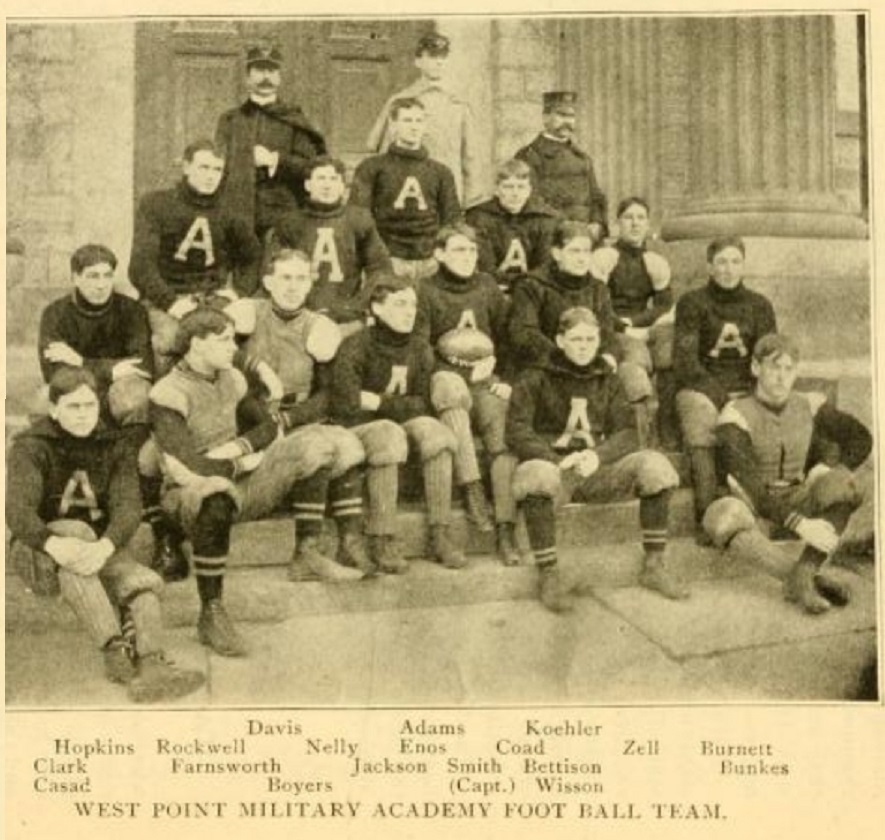
1899 Football Team

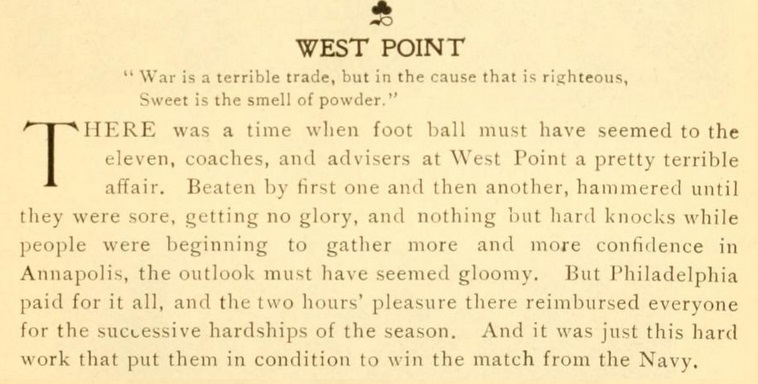
The Army Navy Game

1899 team

ArmyFB_1899_team_

–

ArmyFB_1899_summary

–

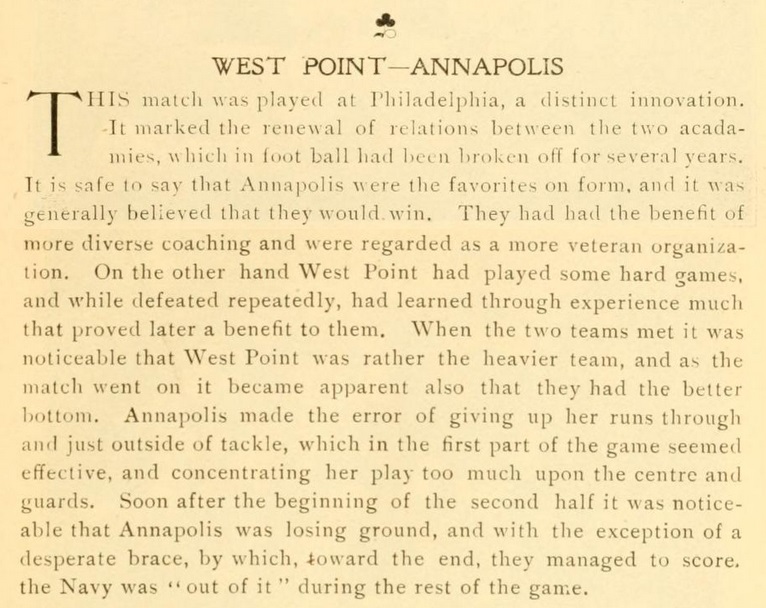
ArmyFB_1899_vsNavy

–

Cadets Against Middies
Army and Navy Meet Today My And Navy Meet Today Philadelphia…
– Boston Evening Transcript – Dec 2, 1899
The State, War and Navy departments were almost deserted today as a result of the West Point – Annapolis football game in Philadelphia…
http://news.google.com/newspapers?id=tbg-AAAAIBAJ&sjid=xVkMAAAAIBAJ&dq=football%20philadelphia&pg=5659%2C3775721

CADETS AT FOOTBALL TO-DAY – Rival Teams.- New York Times

West Point Defeats Annapolis
Boston Evening Transcript – Dec 4, 1899
http://news.google.com/newspapers?id=trg-AAAAIBAJ&sjid=xVkMAAAAIBAJ&dq=football%20philadelphia&pg=6448%2C4062363

ARMY WHIPS NAVY.- Boston Daily Globe

Navy’s Battered Team.
Baltimore American – Dec 4, 1899
It could not lose this game and, have any reputation at football. They had been preparing for it for sis … Philadelphia – Naval Academy, 5; West Point, 17
http://news.google.com/newspapers?id=VfVBAAAAIBAJ&sjid=1LgMAAAAIBAJ&dq=football%20philadelphia&pg=5339%2C3659220

–

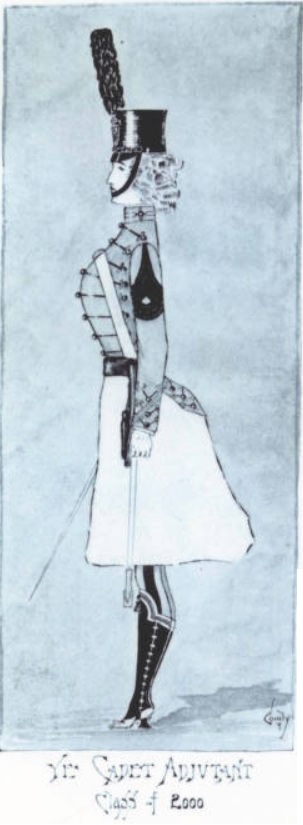
CadetAdjutant2000_fromtheHowitzer1900

from the 1900 Howitzer

1966 Basketball, Golf and Track

1964-1965 Basketball Team

1957 Team


1957 Army 7-2

Coaches#13 AP#18

1957/10/12  Army 21  –  Notre Dame  23

1957/11/30  Army    0  –  Navy   14 L

SI- December 02, 1957 Army

http://sportsillustrated.cnn.com/vault/edb/reader.html?magID=SI&issueDate=19571202&mode=reader_vault –

Army goes 7-2 in 1957

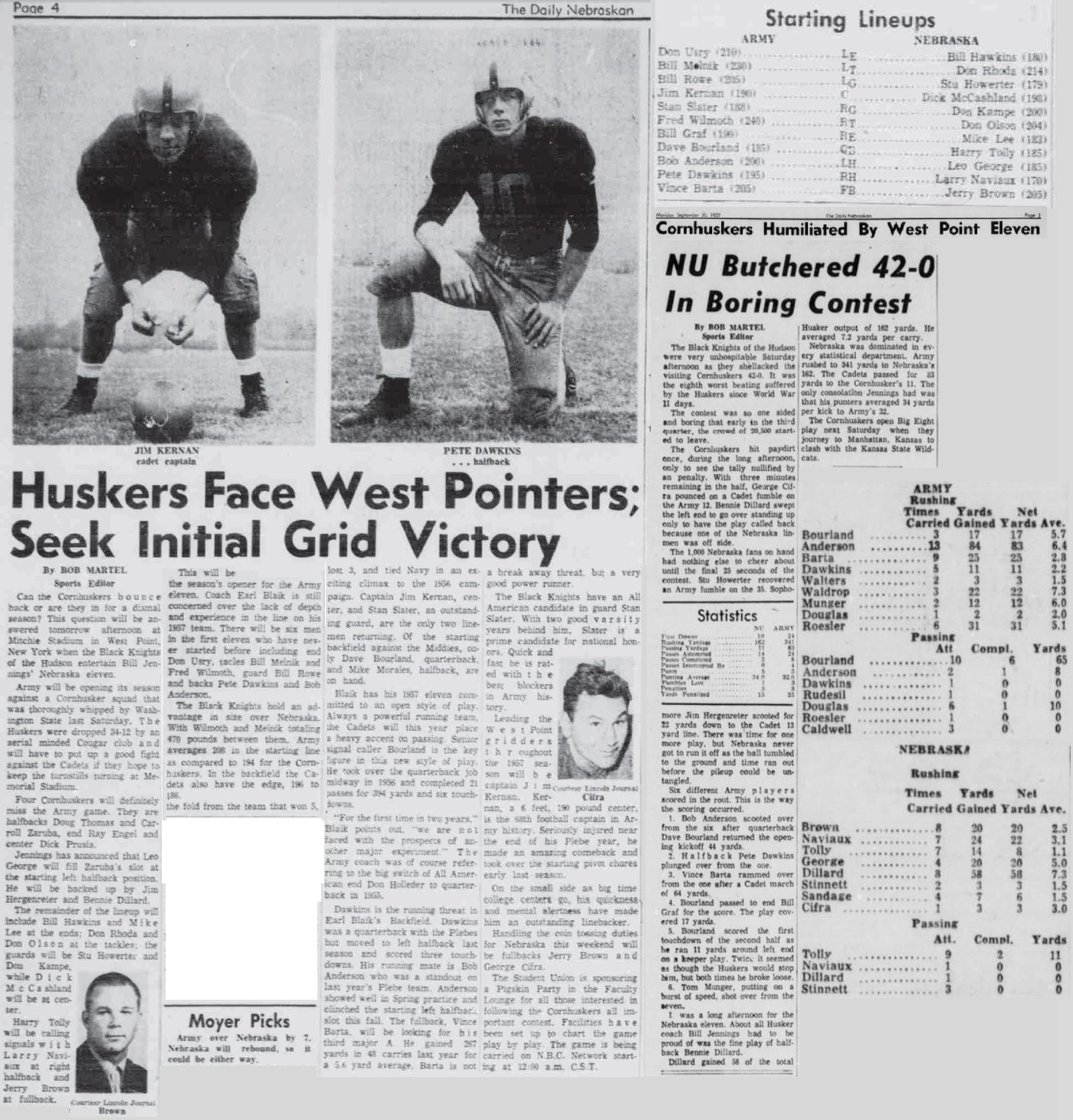
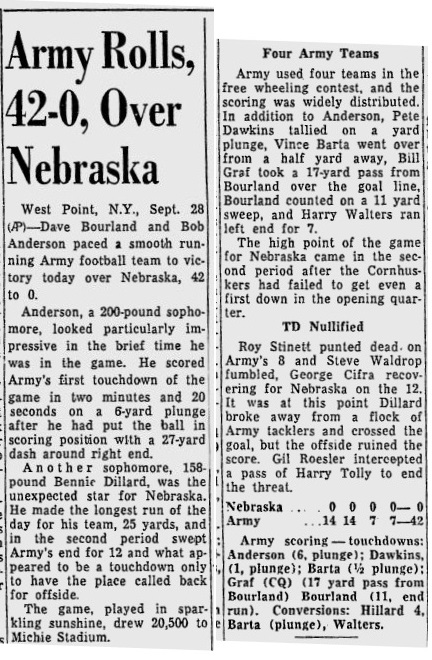
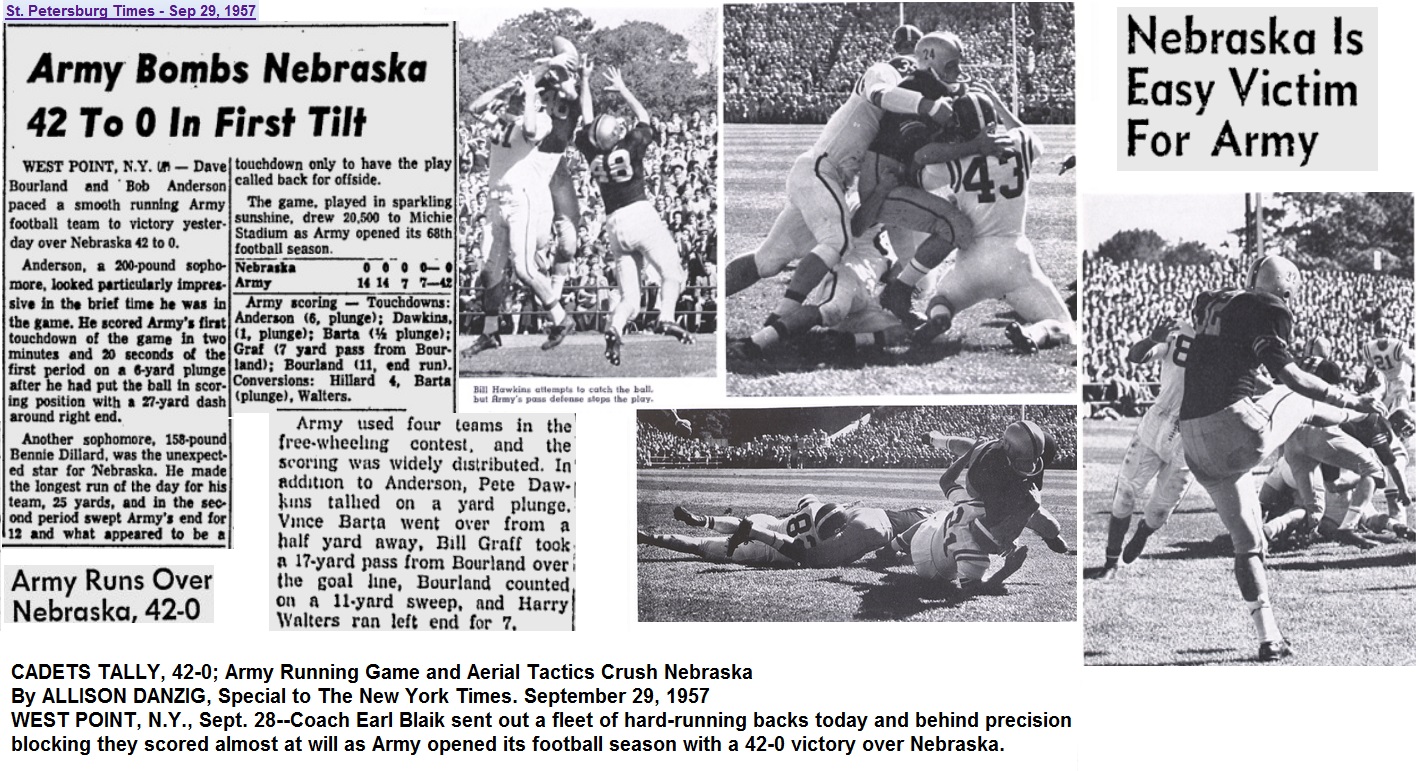
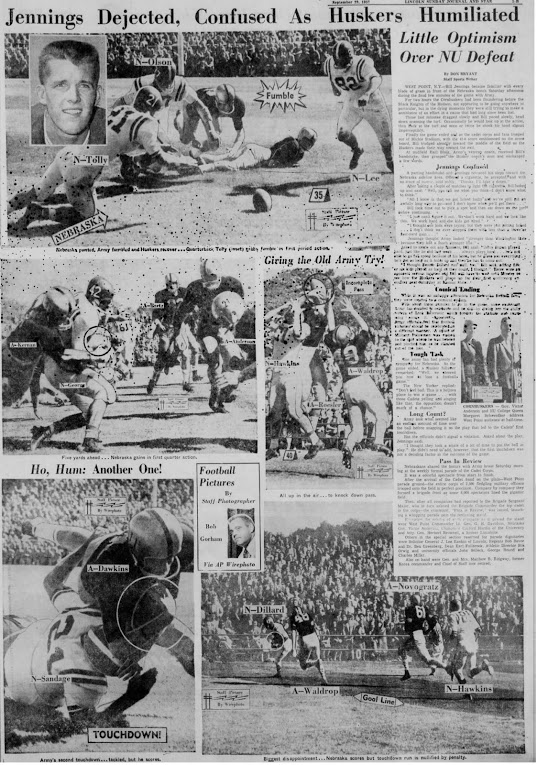
September 28, 1957 – Army 42 Nebraska 0

– ArmyFB_1957_vsNebraska_DailyNebraskan_Sep281957

ArmyFB_1957_vsNebraska_MiamiNews_Sep291957

armyfb_1957_vsnebraska_readingeagle_sep291957

ArmyFB_1957_vsNebraska_ReadingEagle_Sep291957

armyfb_1957_vsnebraska_42-0_nuyearbook58

ArmyFB_1957_vsNebraska_StPetersburgTimes_Sep291957

–

ArmyFB_1957_vsNebraska_LincolnSundayJournalandStar_Sep291957

ArmyFB_1957_vsNebraska_LincolnSundayJournalandStar_Sep291957

–


–

October 5 at Penn State No. 8 New Beaver Field University Park, PA – Won 27–13

–

armyfb_1957_vsnotredame_miaminews_oct61957

ArmyFB_1957_vsNotreDame_MiamiNews_Oct61957

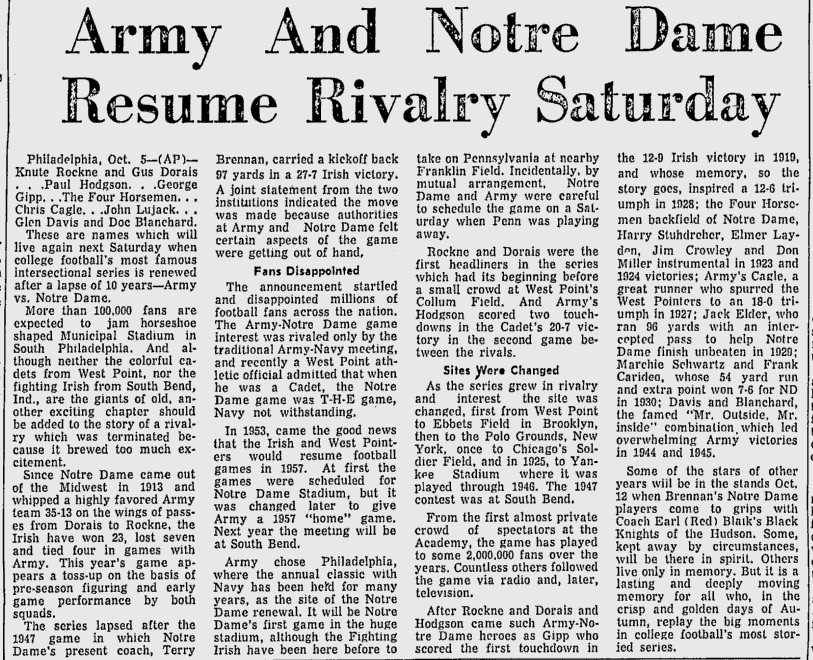
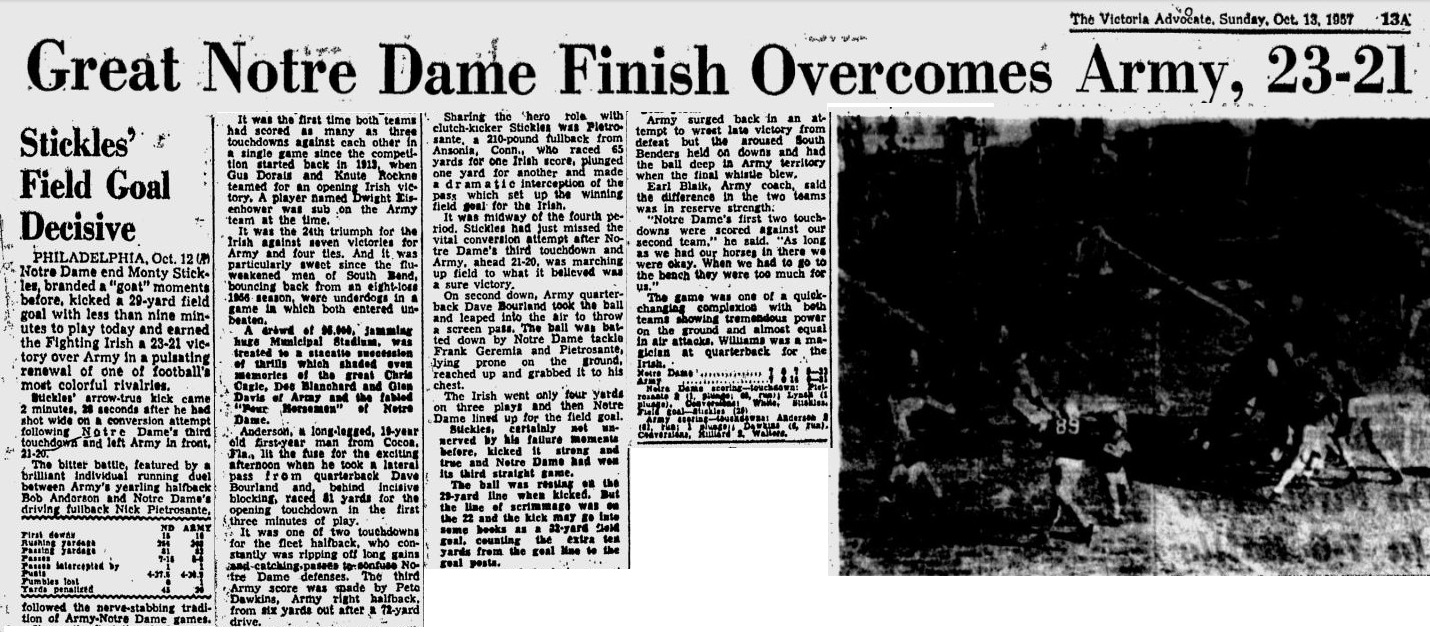
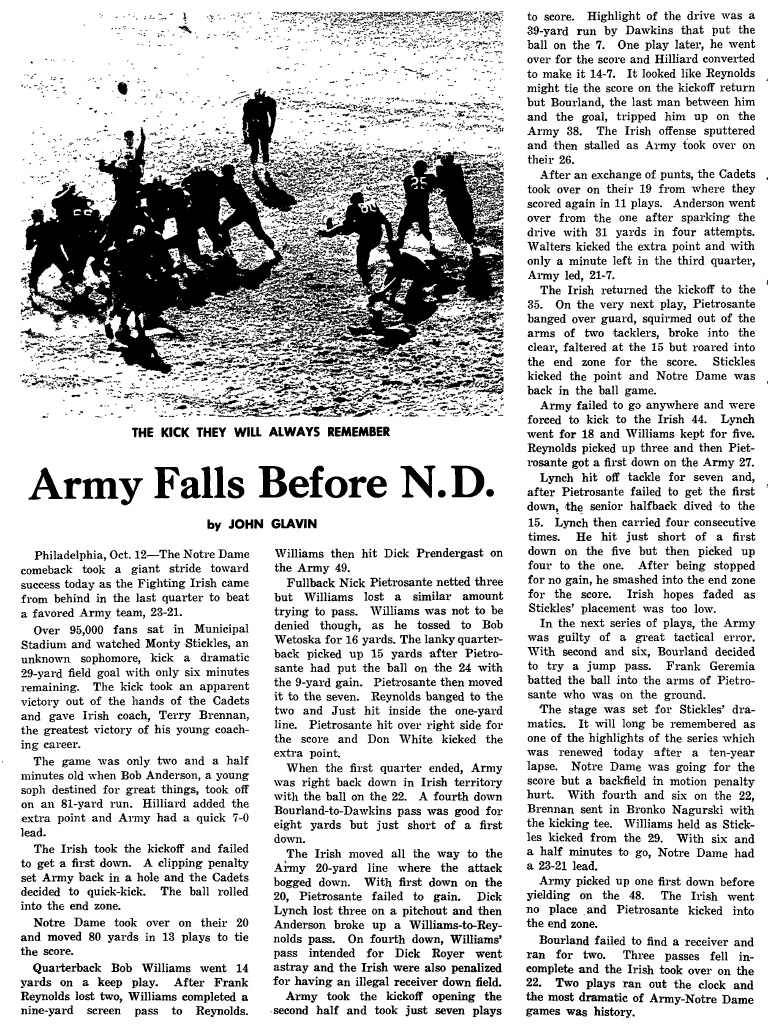
armyfb_1957_vsnotredame_victoriaadvocate_oct131957 ArmyFB_1957_VictoriaAdvocate_Oct91957
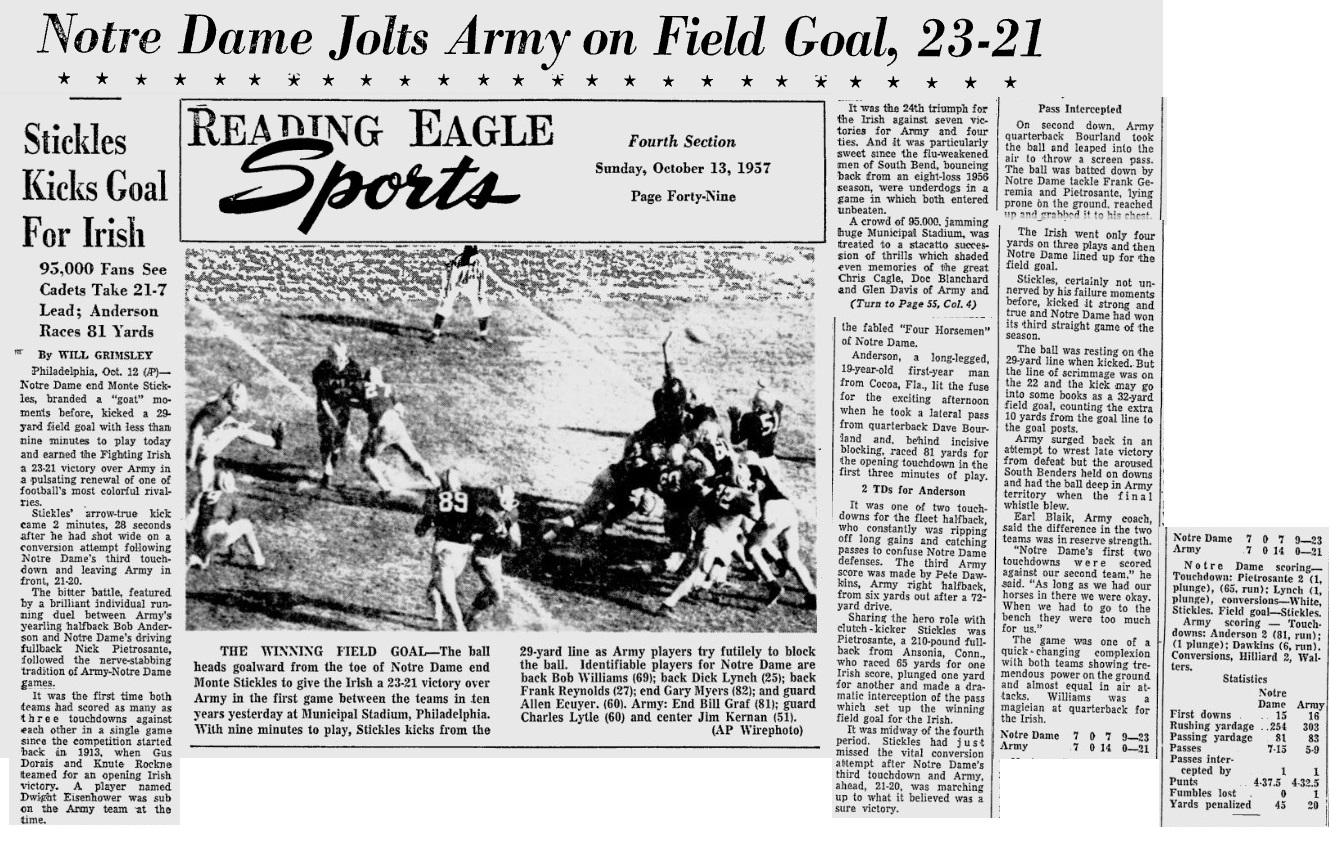
armyfb_1957_vsnotredame_readingeagle_oct131957

ArmyFB_1957_vsNotreDame_ReadingEagle_Oct131957 ArmyFB_1957_NotreDame_OfficialReview_recap ArmyFB_1957_NotreDameOfficialReview_recap – ArmyFB_1957_MacArthur_NewsDispatch_Oct101957 ArmyFB_1957_MacArthur_NewsDispatch_Oct101957

–

–

ArmyFB_1957_vsPittsburgh-guide.jpg

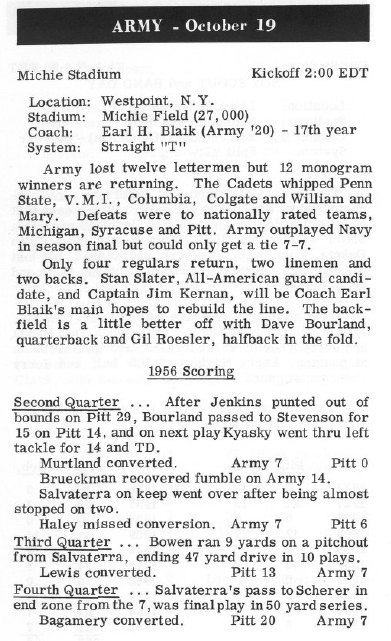
– October 19 at Michie Stadium Won 29 -13

–

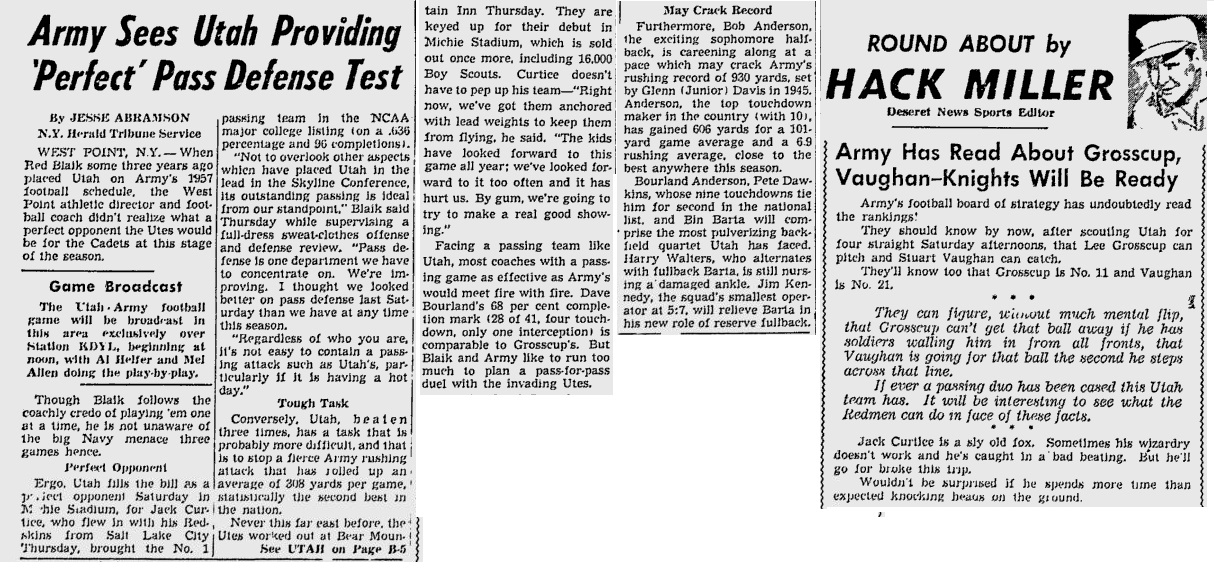
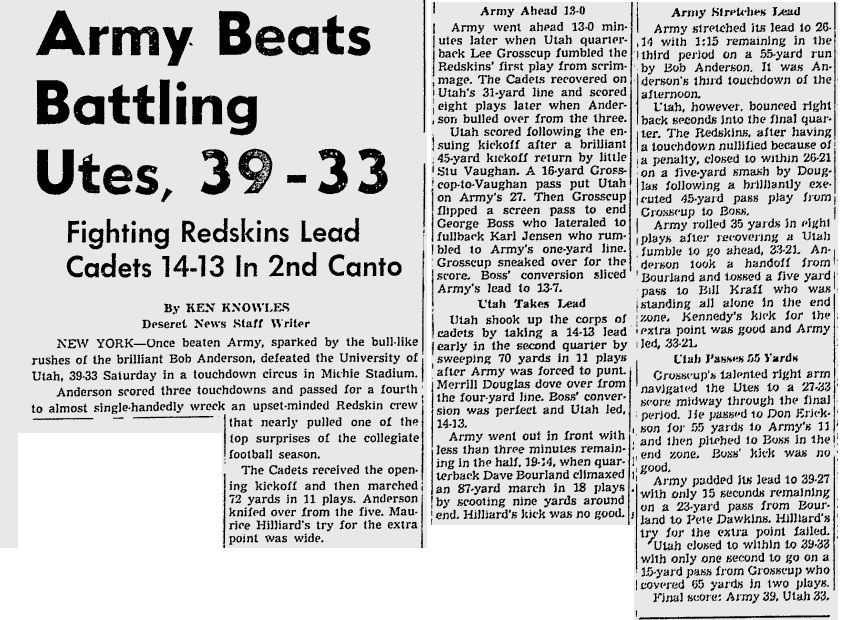
armyfb_1957_vsutah_deseretnews_nov81957

ArmyFB_1957_vsUtah_DeseretNews_Nov81957

armyfb_1957_vsutah_deseretnews_nov91957 ArmyFB_1957_vsUtah_DeseretNews_Nov91957
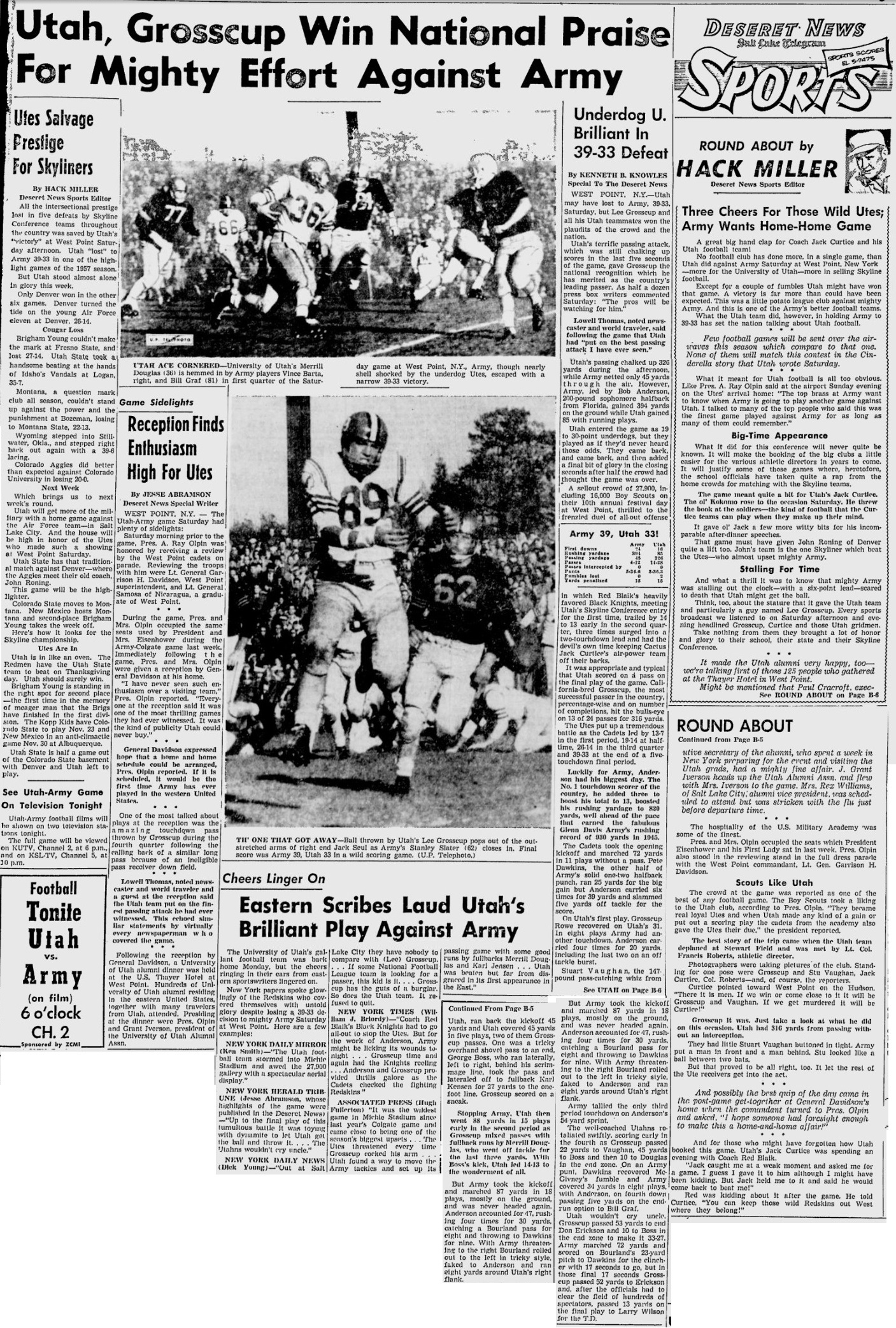
armyfb_1957_vsutah_deseretnews_nov111957

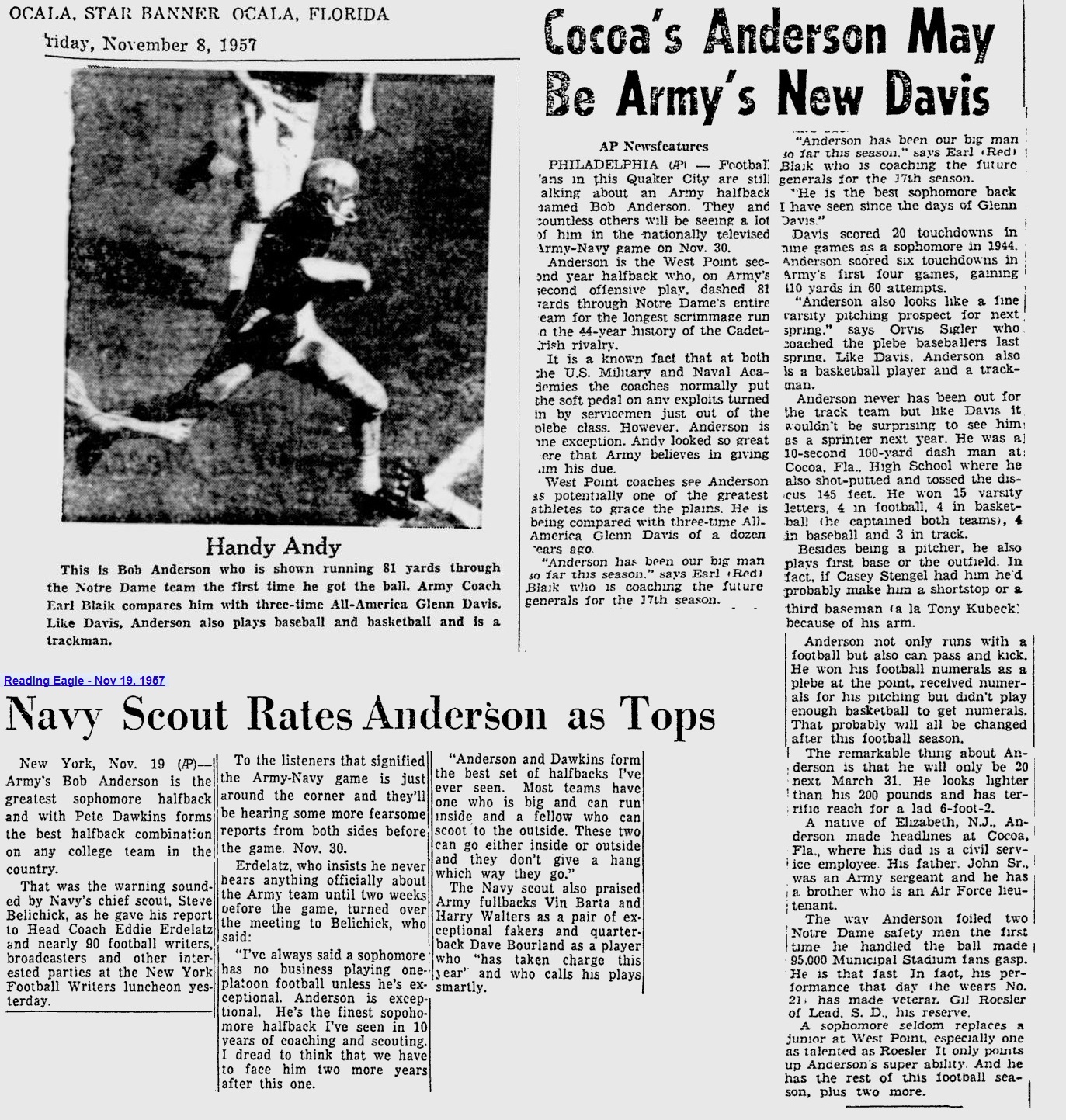
ArmyFB_1957_vsUtah_DeseretNews_Nov111957  ArmyFB_1957_Anderson_OcalaStarBanner_Nov81957ArmyFB_1957_BobAnderson_ReadingEagle_Nov111957
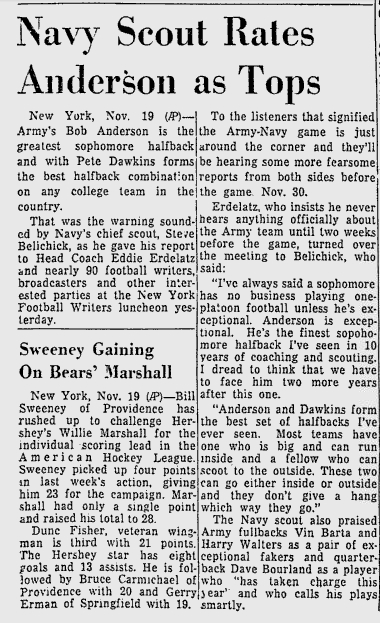
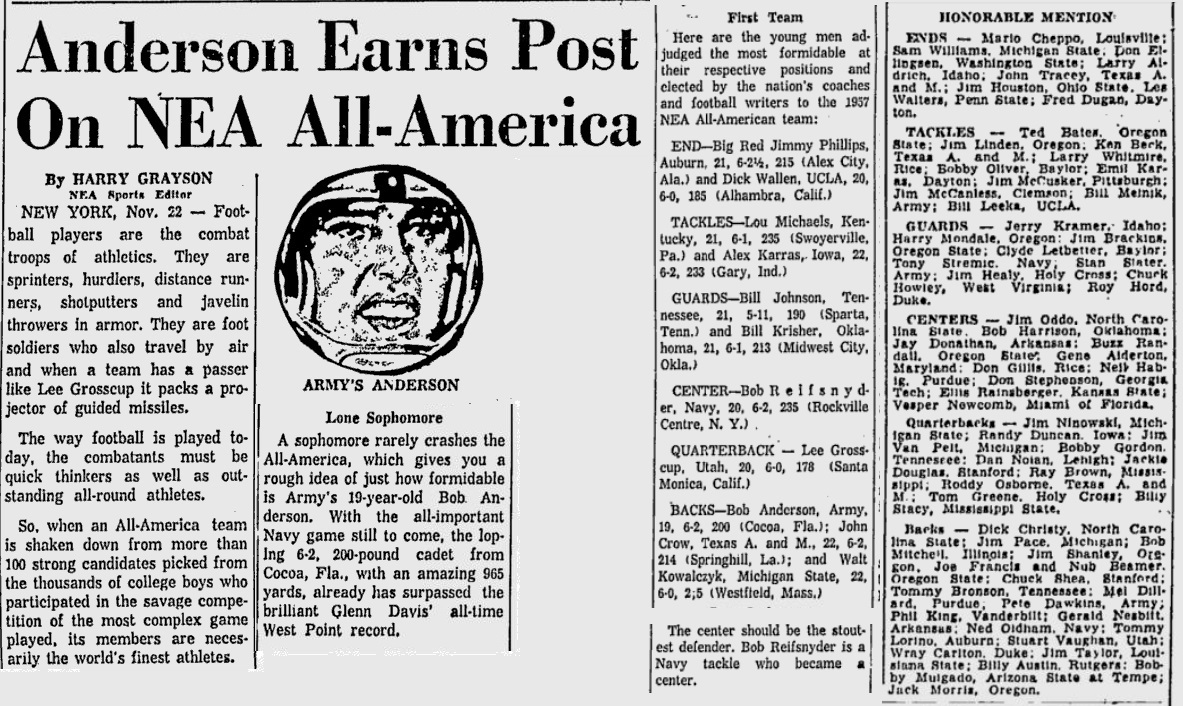
ArmyFB_1957_Anderson-Belichick_MiamiNews_Nov191957

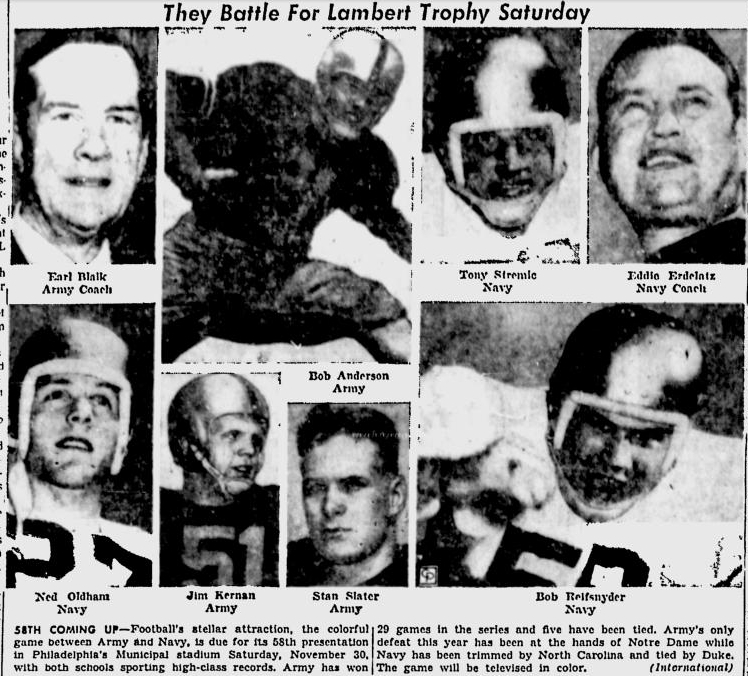
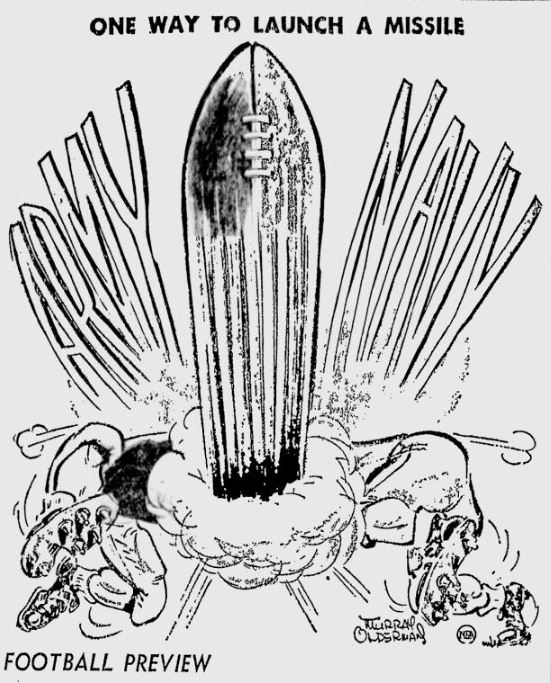
ArmyFB_1957_Anderson-Belichick_MiamiNews_Nov191957 ArmyFB_1957_NEA-All-Americans_MiamiNews_Nov221957 ArmyFB_1957_NEA-All-Americans_MiamiNews_Nov221957 – ArmyFB_1957_vsNavy_WashingtonObserver_Nov261957 ArmyFB_1957_vsNavy_WashingtonObserver_Nov261957 ArmyFB_1957_vsNavy-pre_byMurrayOlderman_TimesDaily-FlorenceAl_Nov271957 ArmyFB_1957_vsNavy-pre_byMurrayOlderman_TimesDaily-FlorenceAl_Nov271957

–

armyfb_1957_vsnavy_miaminews_dec11957
–

–

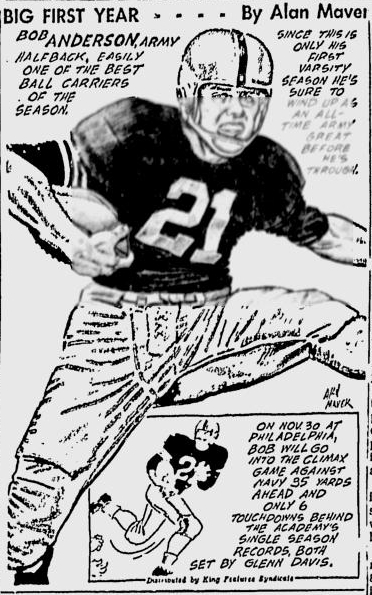
– ArmyFB_1957_BobAnderson_byAlanMaver_WashingtonObserver_Nov301957

ArmyFB_1957_BobAnderson_byAlanMaver_WashingtonObserver_Nov301957
–

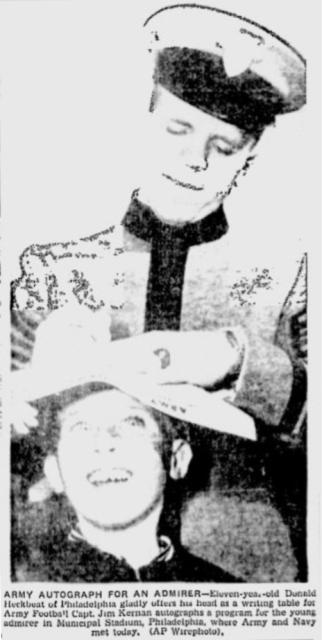
armyfb_1957_jimkernan_timesdaily_nov301957

ArmyFB_1957_JimKernan_TimesDaily_Nov301957
–

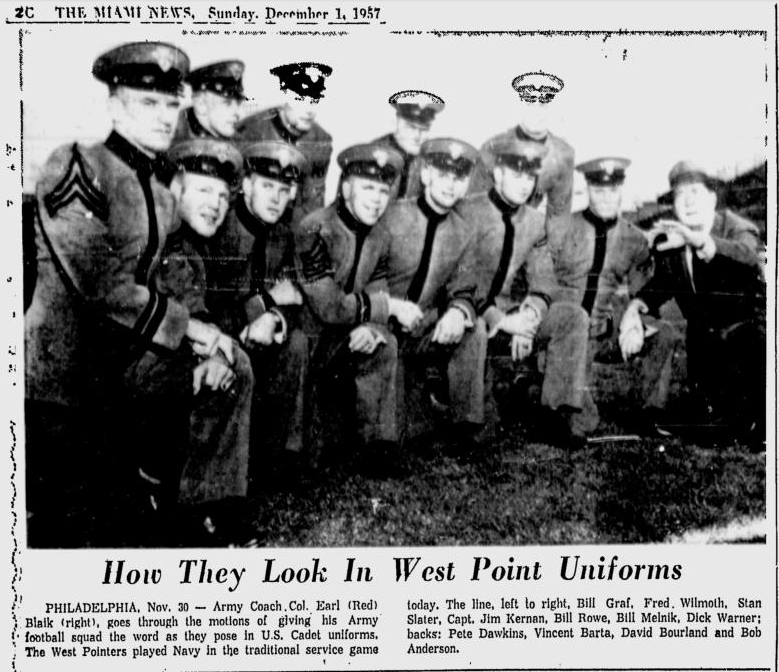
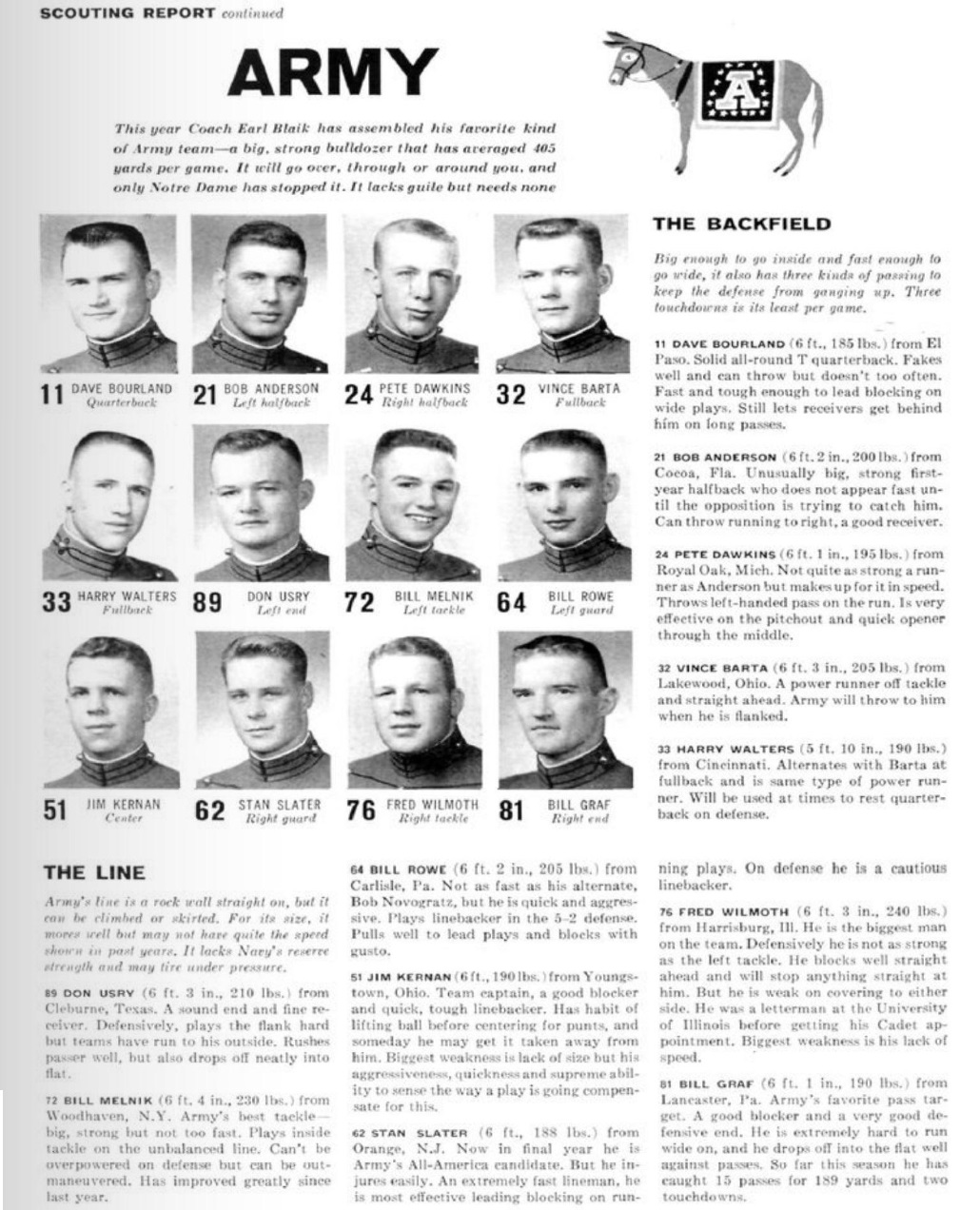
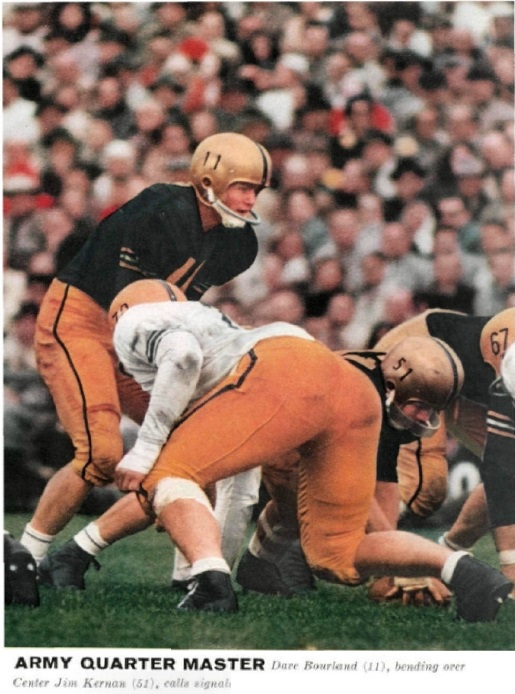
–ArmyFB_1957_Army-starters_MiamiNews_Dec11957 ArmyFB_1957_Army-starters_MiamiNews_Dec11957 – December 02, 1957 Army This year Coach Earl Blaik has assembled his favorite kind of Army team—a big, strong bulldozer that has averaged 405 yards per game. It will go over, through or around you, and only Notre Dame has stopped it. It lacks guile but needs none…. http://sportsillustrated.cnn.com/vault/edb/reader.html?magID=SI&issueDate=19571202&mode=reader_vault – ArmyFB_1957_vsNavy_info_SI_Dec21957 – ArmyFB_1957_vsNavy-backs_SI_Dec21957 – ArmyFB_1957_vsNavy_Players_SI_Dec21957 – ArmyFB_1957_vsNavy_DaveBourland-JimKernan_SI_Dec21957 – news articles etc., provided by Russ “Skip” Grimm – Class of ’76


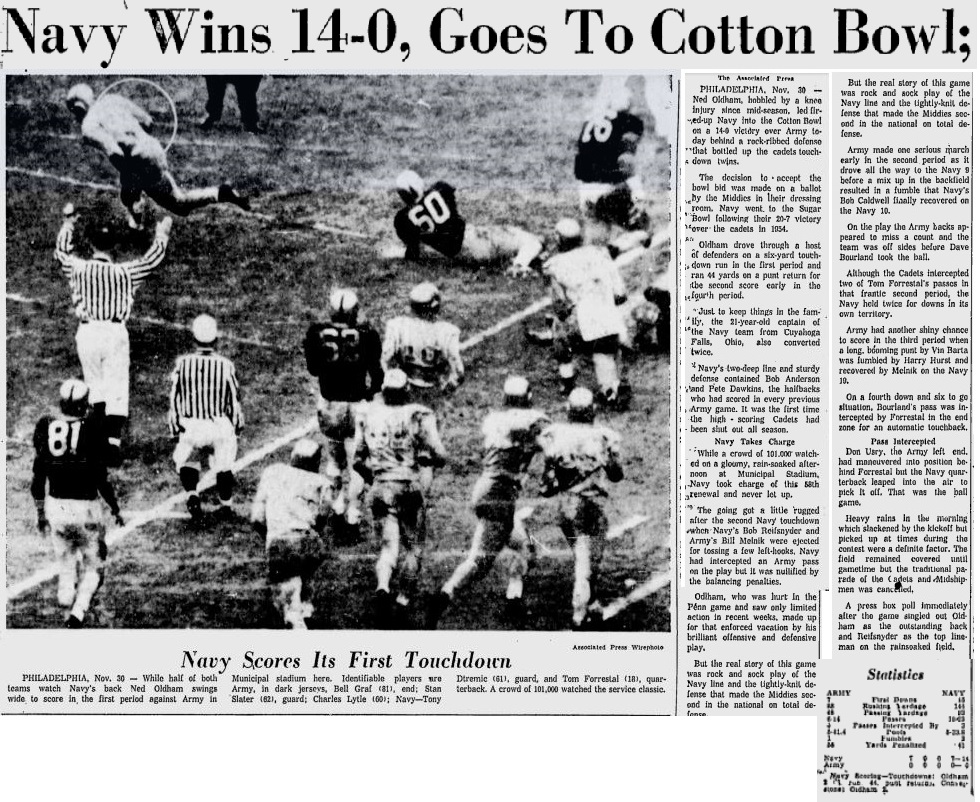
By Rabble Jan 16, 2003 Army vs Navy, 1957* – Rabble takes a look back on the 1957 Army-Navy game. (* title corrected from 1953 to 1957) In 1957, the Army football program was again on the rise as the Black Knights swept to an impressive 7-2 record but the two losses came against Armys two biggest rivals, Notre Dame and Navy. The team was 16 points away from going undefeated that season. A 23-21 loss to the Irish in Philadelphias Municipal Stadium and a 14-0 loss to the Mids . . . . . .to close the season in that same stadium prevented the team from going all the way that year in Blaiks next to last season before his retirement the following year when he produced his last undefeated season at West Point. Only a tie with Pitt that year marked a spectacular 8-0-1 log. Jimmy Powers was a respected columnist of the NY Daily News in the 1950s. The following column was written by him after the loss to Navy that season of 1957. His column was appropriately called THE POWERHOUSE by Jimmy Powers-


THE POWERHOUSE By Jimmy Powers Philadelphia, Nov. 30, 1957 -Ned Oldham was the hero, of course. He scored all the points. But there was more to it than that. Navy was faster, more alert and had more deception in its attack. Navy ran its play crisply and there was no question, as the game wore on, that its diversified attack was just too much for the gallant Cadets to cope with. There were a few penalties for elbowing and piling on but flareups quickly subsided as the lads settled down to their assignments. Navy used a variety of screened pass plays most effectively. Navy’s line switching constantly piled up ball carriers with almost ridiculous ease. The highly publicized Bob Anderson appeared sluggish in contrast to the speedy ends and defensive backs who hauled him down. Tom Forrestal kept the opposition off balance and Bob Reifsnyder played such an outstanding game he provoked a near riot in the final quarter when frustrated Cadets went after him with bare fists. It was an exciting contest despite the drab, spongy, gray skies and cutting wind. And it was a delightfully colorful show to watch “live” as well as on TV. TOUCHDOWN PUNCTUATES PERIOD When Navy appeared in pastel jersey and pale gold numerals, half-drowned viewers amused themselves by trying to identify the exact shade of blue. It definitely was not the familiar rich dark navy blue. It was more of a Mediterranean blue bleached to a robin’s egg hue. It brought on quite a few whistles. I had never seen a touchdown scored in the exact second that ended a quarter, but that’s exactly what happened when Navy marched 72 yards in 19 plays. The play was a peculiar one. Ned Oldham lunged off right tackle as the clock registered 15:00. He appeared to be smothered by several dark shirts scrambling to snatch at him. Oldham kept his feet, pivoted like a man going beserk in a revolving door, and next we knew he was dashing upright across the goal, running well into the end zone with a powerful leg drive. The Middies immediately broke out a gaudily painted banner… “We’ll beat Army black and blue in color.” How right they were. Army came blazing back with Dawkins running wild, but just inside the 10 Navy’s Caldwell leaped upon a loose ball and drew it fiercely to his bosom, a timely recovery. A series of consecutive penalties caused a succession of huddles by the men in the candy-striped shirts and brought down upon their unheeding ears innumerable witticisms from the crowd. Forrestal grew a bit reckless as halftime approached. A long pass was intercepted, but Navy’s line held on the 36 and took over. Army just was riot shaking any man loose for the long gainers that had distinguished its play on this same turf against Notre Dame. As the second quarter wore on, the sky grew darker and, off to our right, the buildings of downtown Philadelphia faded from sight. Beneath us, the gray block of Cadets sat huddled morosely in ponchos. They stirred expectantly as, with 20 seconds on the clock, Army’s golden helmets conferred in a huddle resembling satellites. They whirled back to positions. A long pass was com- pleted. Then came the letdown . . . “Illegal receiver downfield.” EVEN MULES FOUND GOING TOUGH As the soggy athletes trotted off, Navy’s cheering section unfurled another alliterative command . . . “Mash the Mule.” One poor mule started across the green swamp. Following the urgings of its rider, it walked slowly downfield to join its assistant, another equally damp mascot. There was a rather elaborate balf time parade of floats, faintly reminiscent of the early Pasadena or California collegiate school, then the third quarter opened. Army intercepted. a deflected pass, but again its attack fizzled. There was a rhubarb on the 4 when Anderson fumbled and had the ball stolen from him, apparently a fraction of a second after the whistle. The ball was as tenderly cared for as a baby, nursed and covered with a turkish towel. Actually, more than a dozen balls were used, coming out of an assembly line dryer. Once, the wet ball squirted out of Harry Hurst’s hands, but the Navy got it back on an interception, thereby surgically removing goat’s horns from Mister Hurst’s noodle. Then came the cruncher. Ned Oldham took Barta’s punt and made one of the prettiest broken field runbacks in the history of the series. He skidded to his right, reversed, used some tricky toe dancing and change of pace. After 44 thrilling yards, he crossed standing up, kicked the point and thus accounted for all of Navy’s 14. Oldham figured in another interception. Army made a great goal-line stand, but when the lights came on and the rain shrank away to a few drops, you could see the silhouettes of Navy’s third team mirrored in the great lake of water that surrounded the gridiron. When they were whistled in, in clean dry uniforms, to share in the final glory, you knew it was all over.

–

–


Jim Kerner

1939 Team

1939 Army 3-4-2
1939/12/02 Army 0 – Navy 10 L

Coach: William H. “Bill” Wood (c. 1900 – June 7, 1988)
1938-1940
1938 Army 8-2
1939 Army 3-4-2
1940 Army 1-7-1
Overall: 12-13

http://en.wikipedia.org/wiki/William_H._Wood

Howitzer 1940
http://digital-library.usma.edu/cdm/compoundobject/collection/howitzers/id/2357/

–

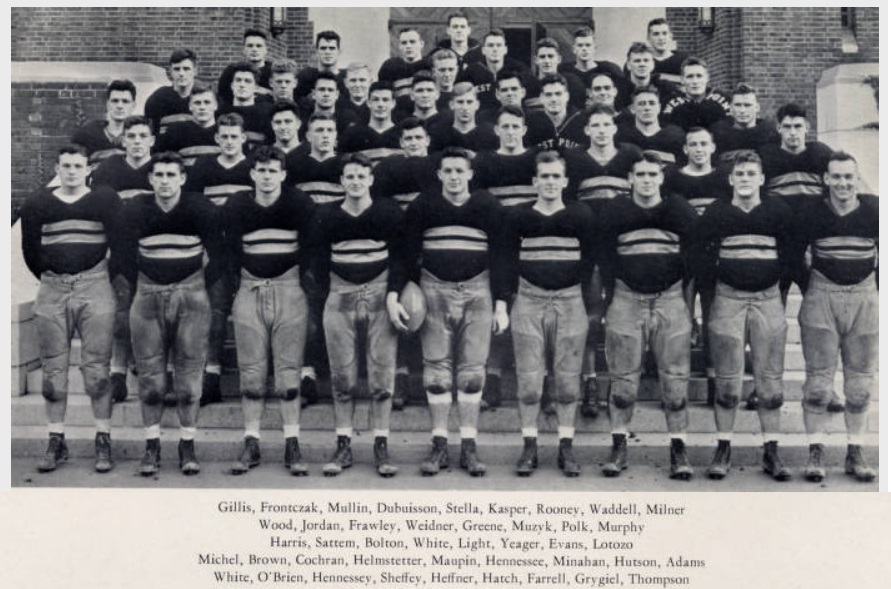
ArmyFB_1939_team

–

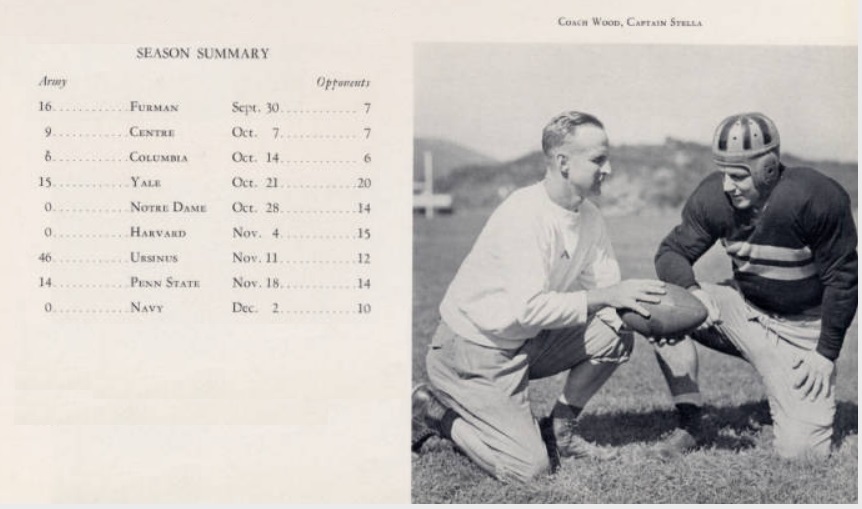
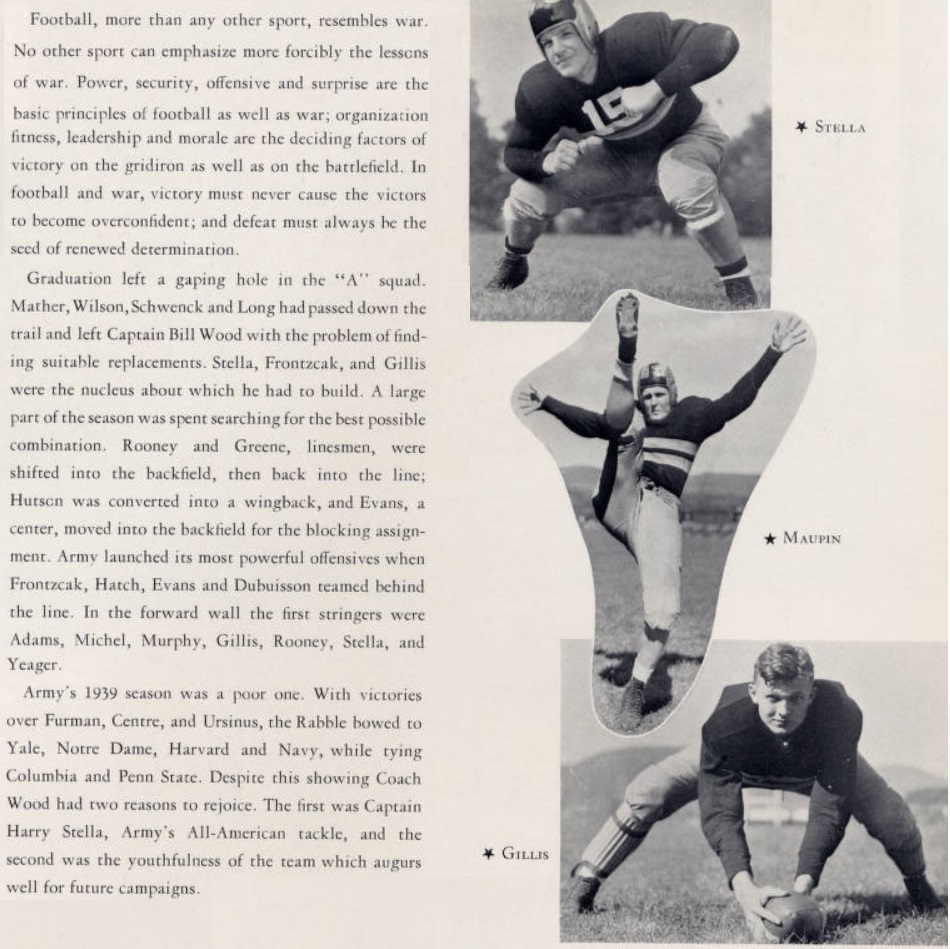
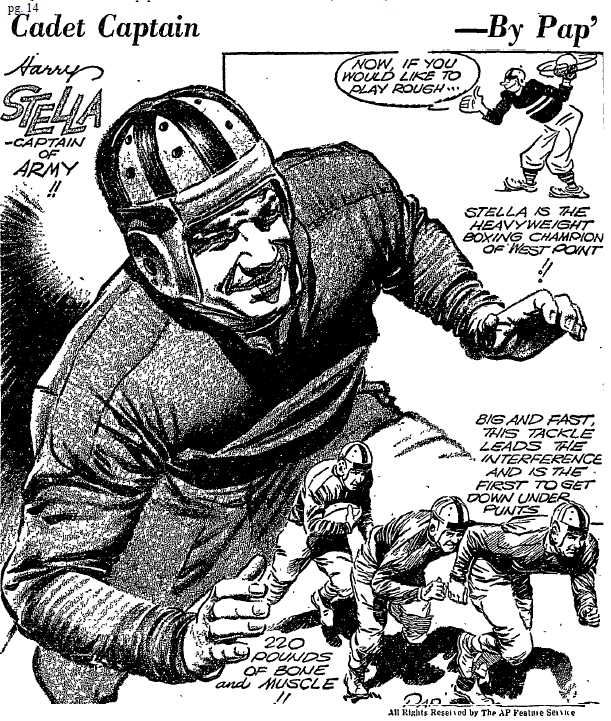
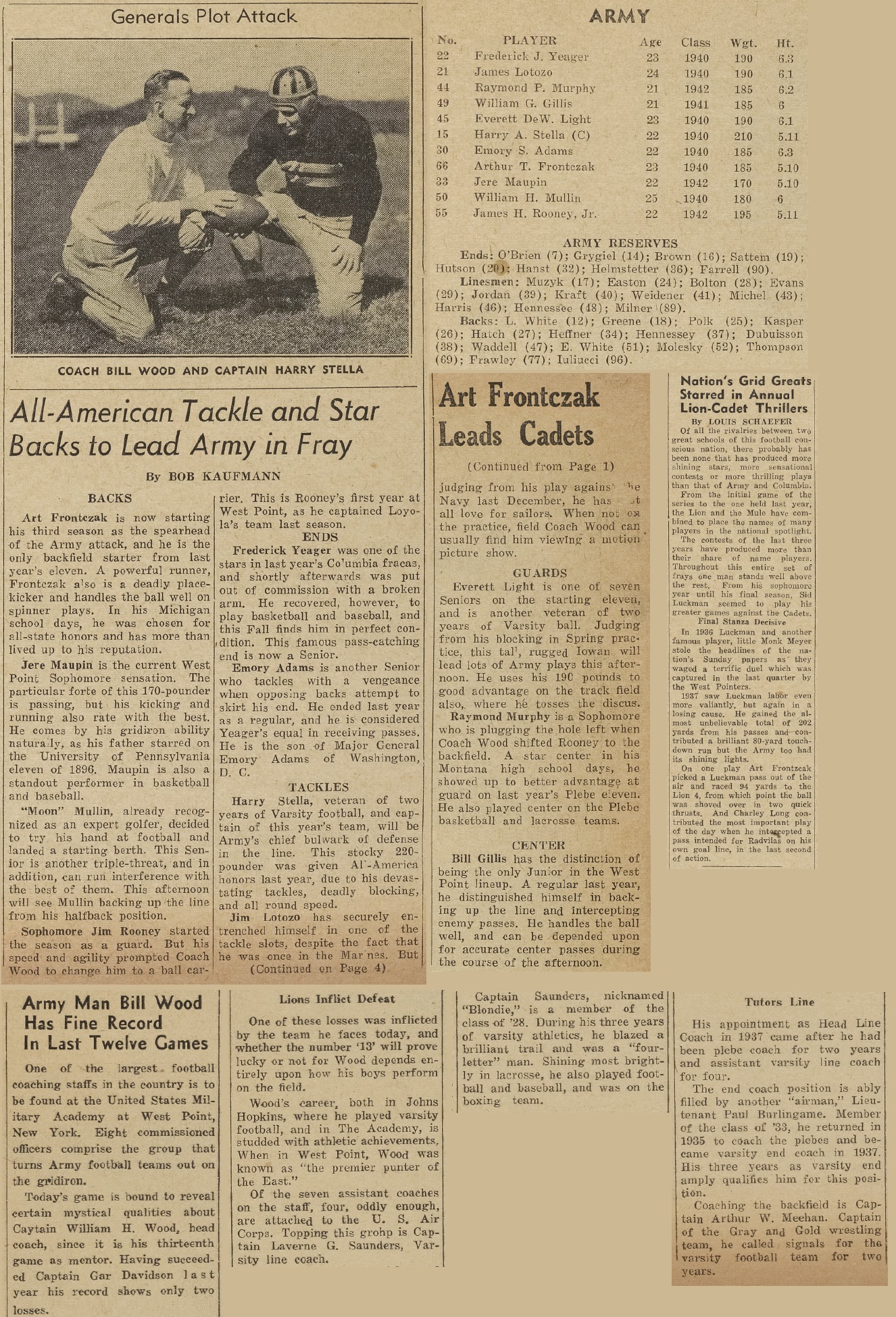
ArmyFB_1939_record_CoachWood_Stella-Captain

–

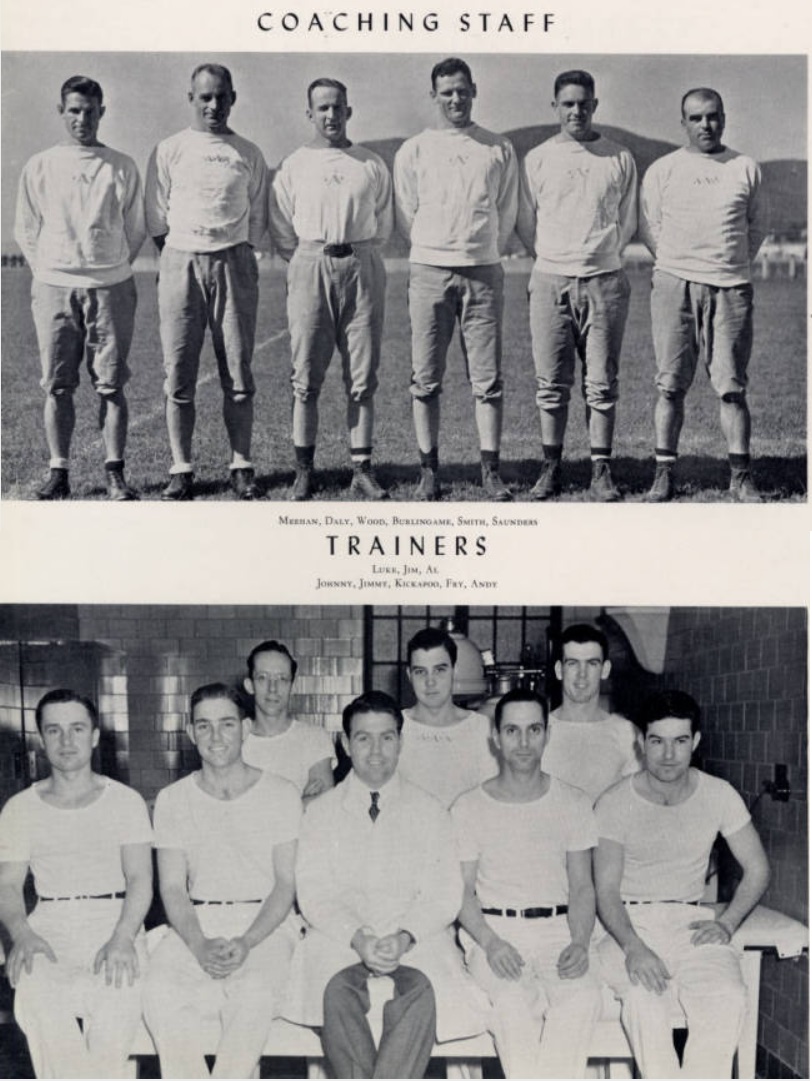
ArmyFB_1939_coaches-trainers

–

ArmyFB_1939_write-up

–

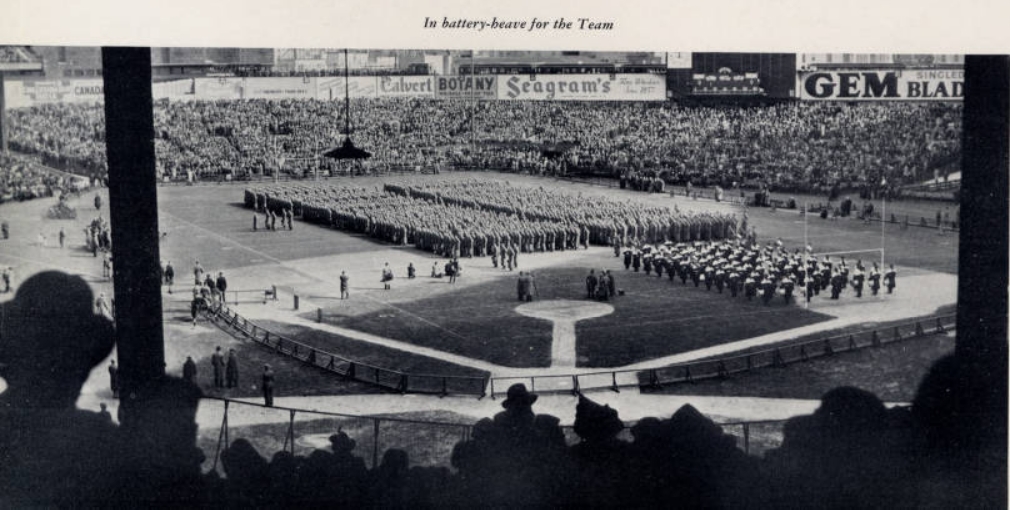
ArmyFB_1939_Corps

–

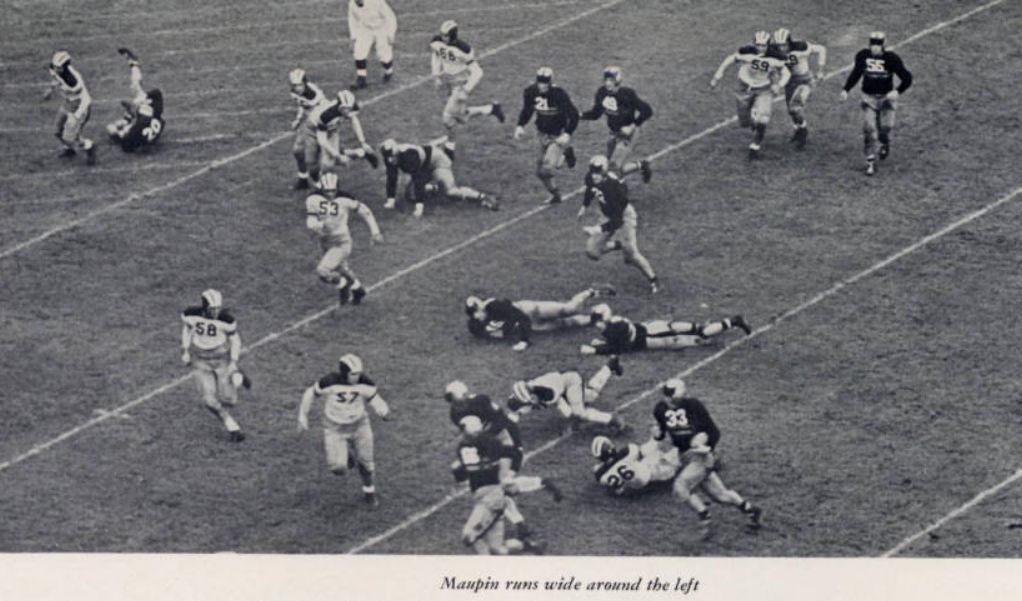
ArmyFB_1939_Maupin-run

–

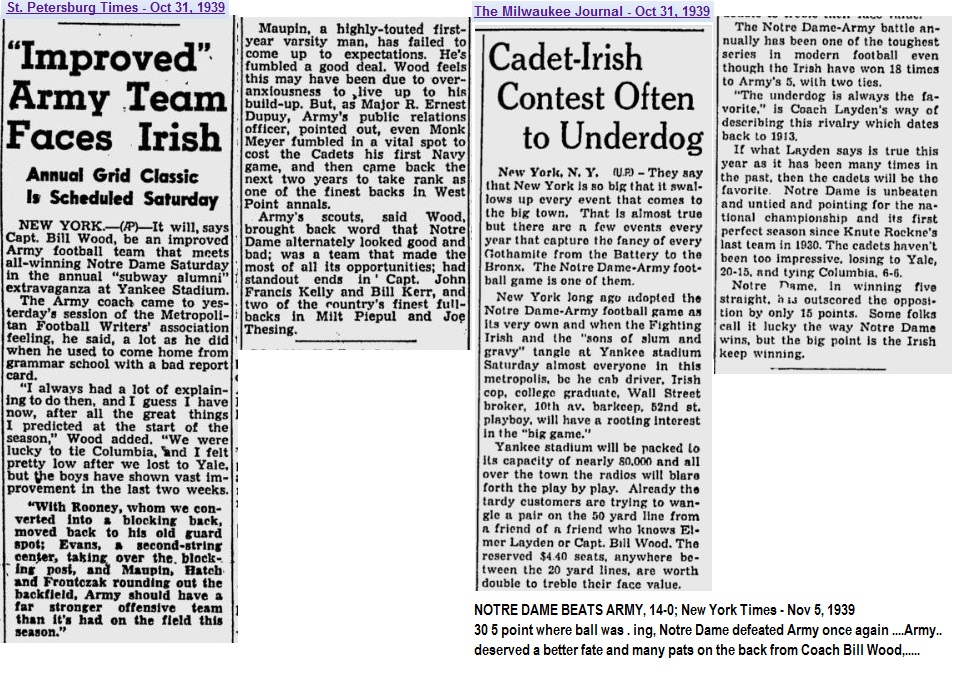
ArmyFB_1939_vsNotreDame

–

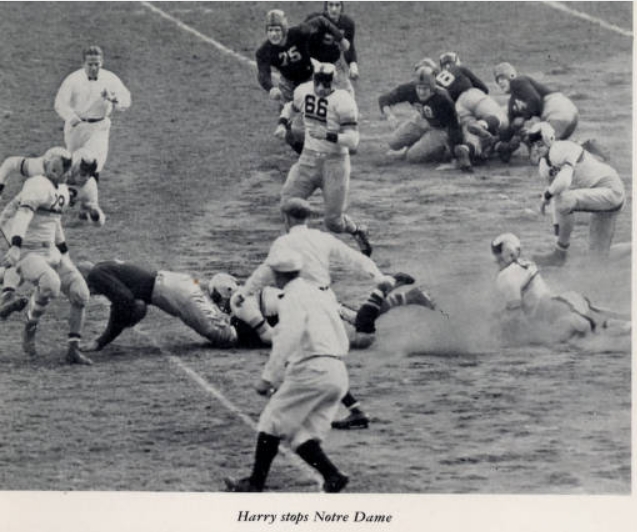
ArmyFB_1939_vsNotreDame_Stella-tackle

–

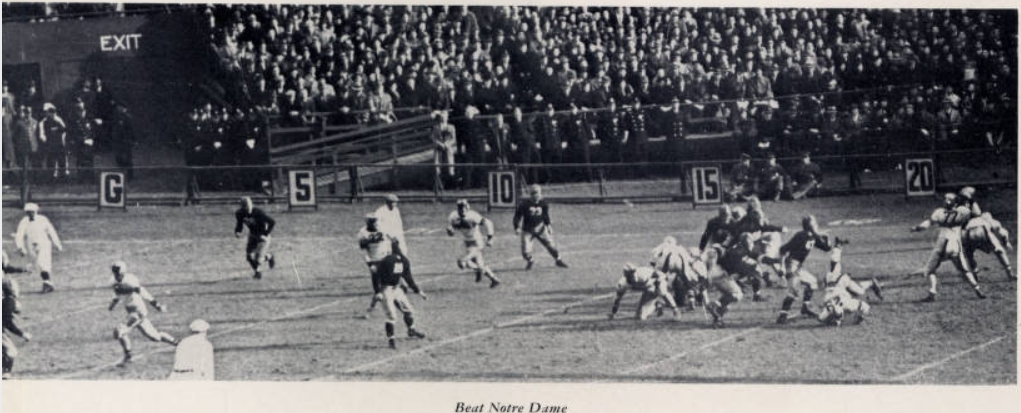
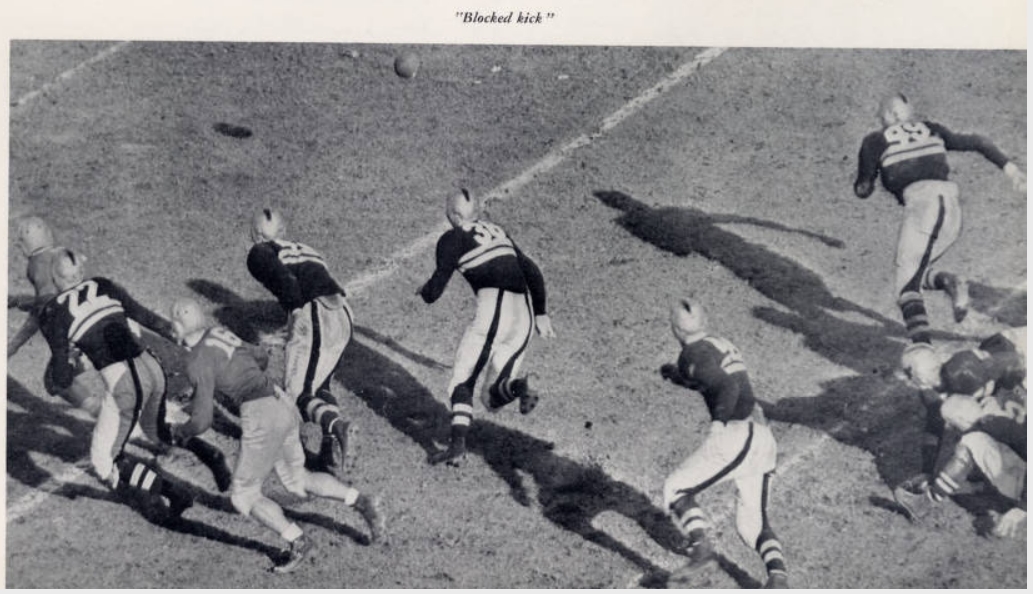
ArmyFB_1939_blocked-kick

–

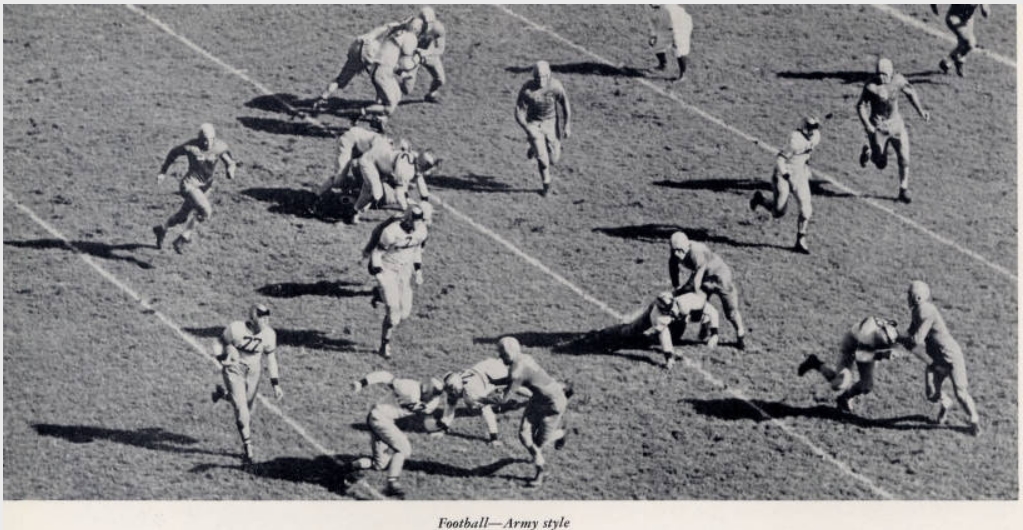
ArmyFB_1939_runwithgoodblocking

–

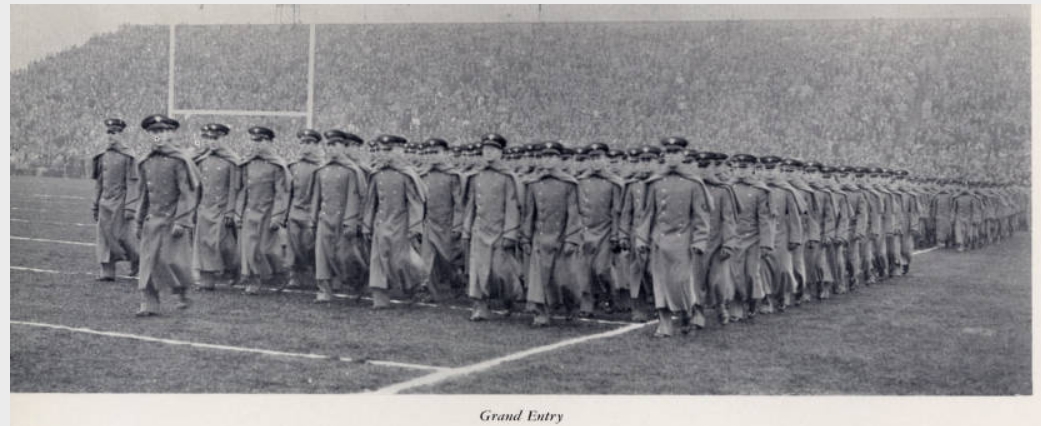
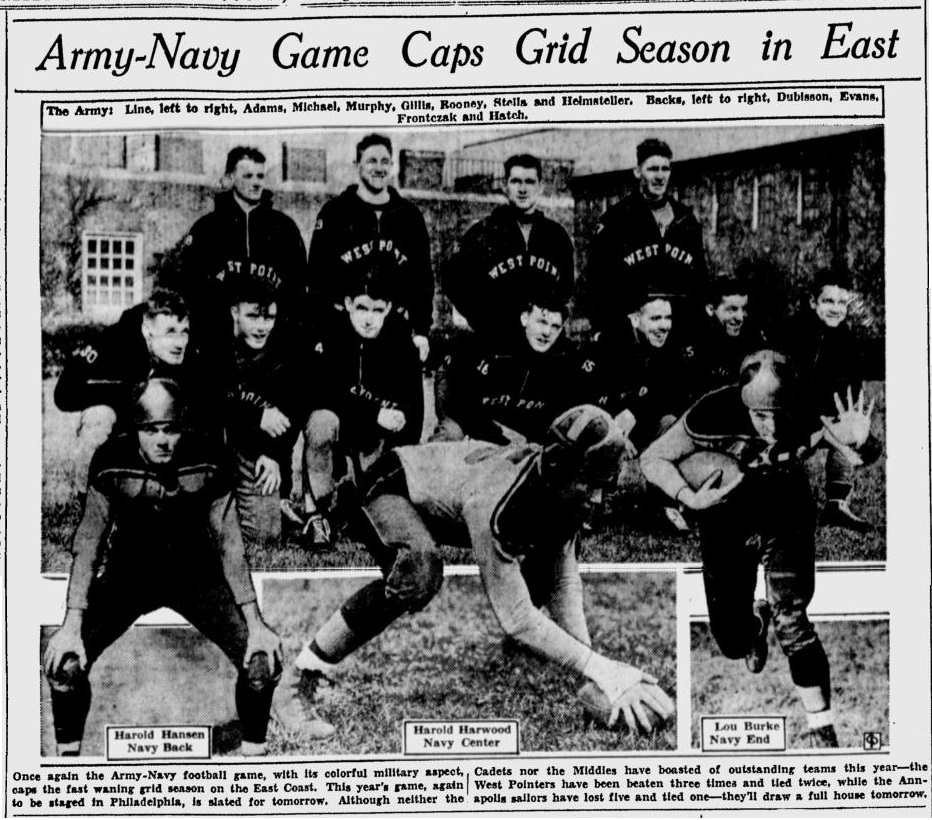
ArmyFB_1939_vsNavy_march-on

–

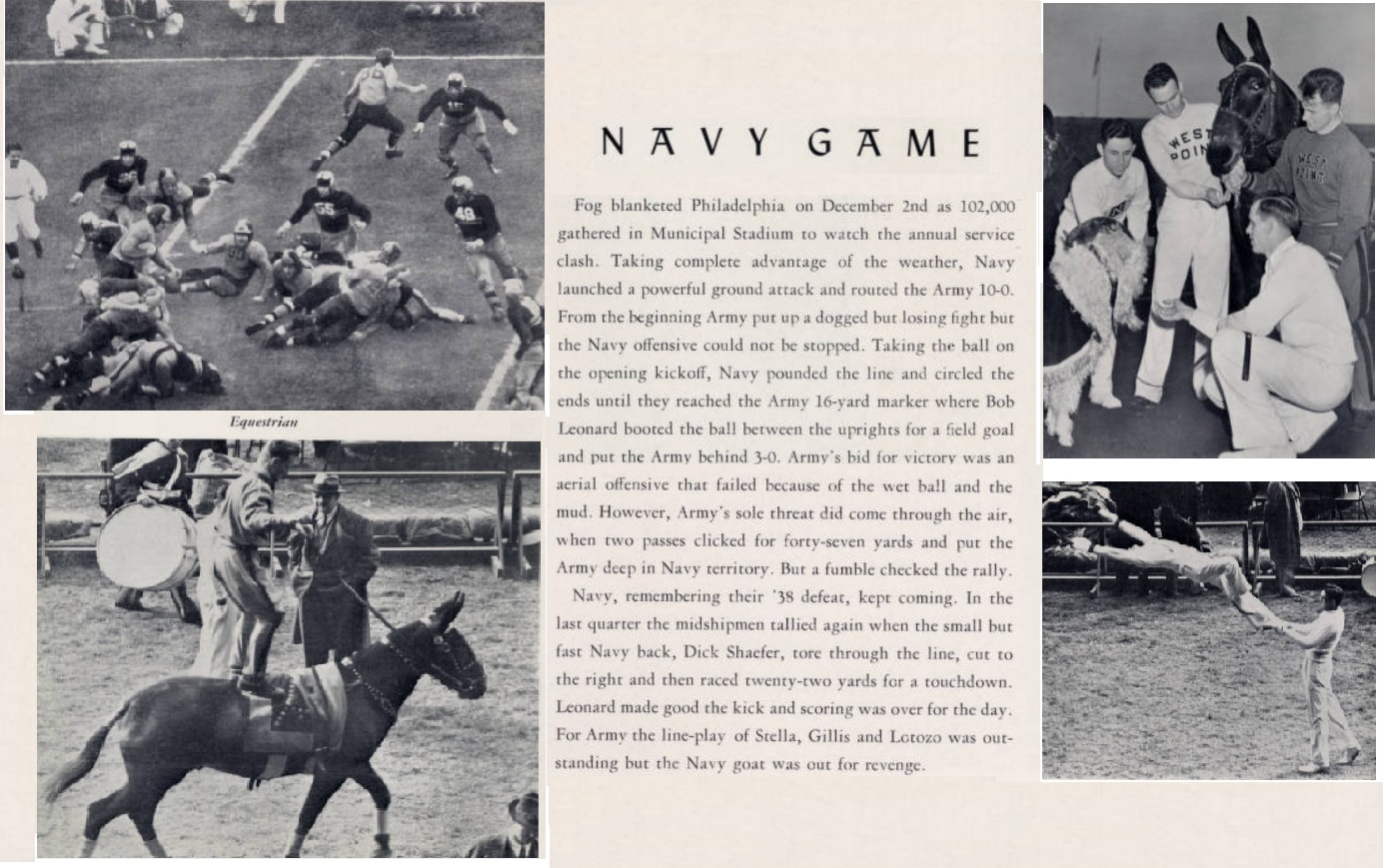
ArmyFB_1939_vsNavy_write-up

–

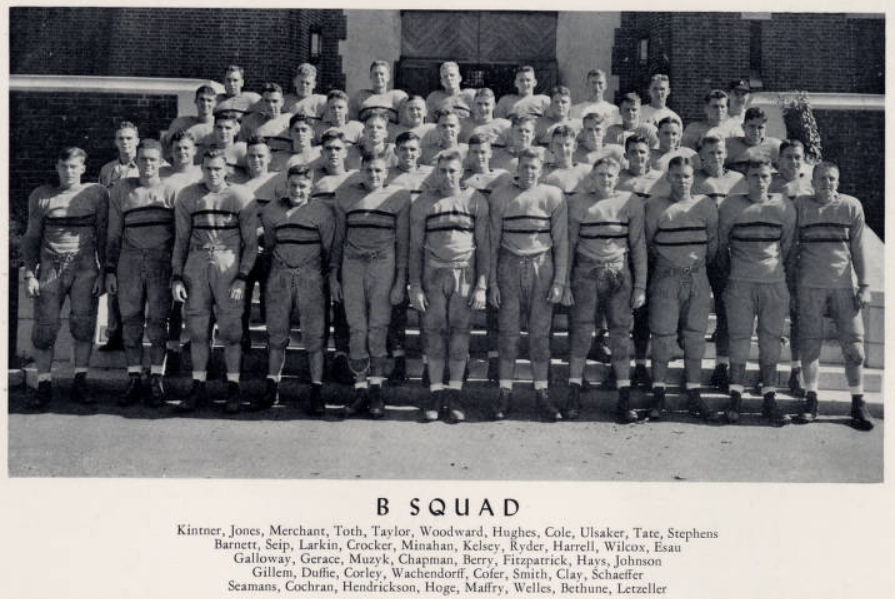
ArmyFB_1939_BSquad

–

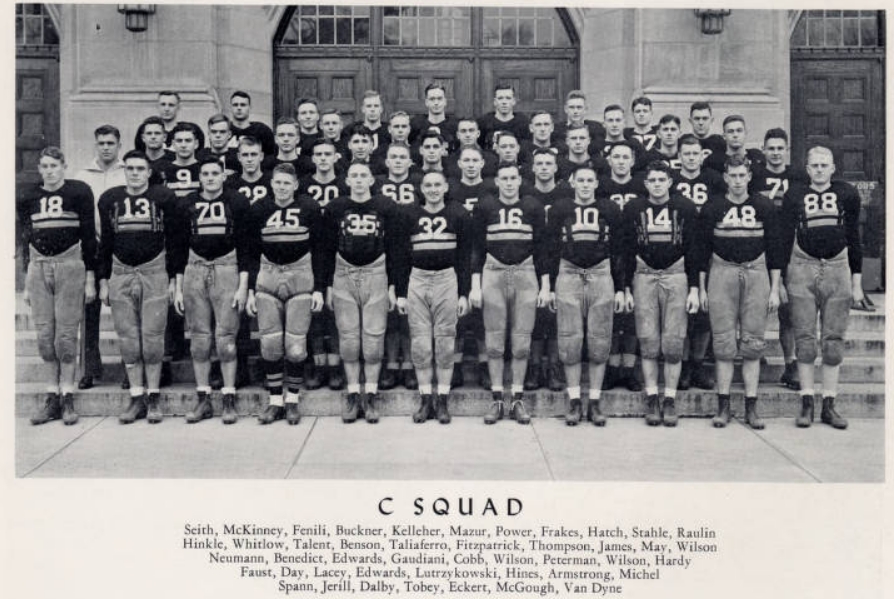
ArmyFB_1939_CSquad

News Articles

–

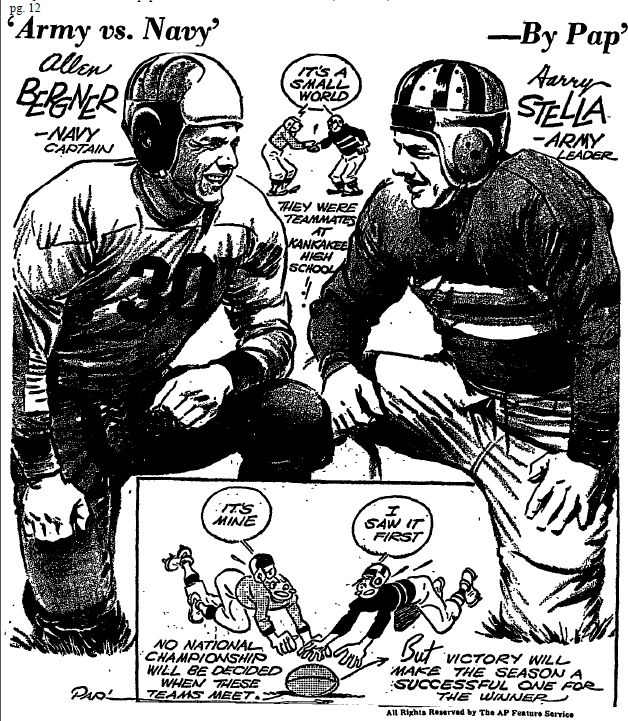
ArmyFB_1939_HarryStella_byPap_CSM_Oct181939

ArmyFB_1939_HarryStella_byPap_CSM_Oct181939

–

ArmyFB_1939_vsColumbia_ColumbiaSpectator_Oct141939

ArmyFB_1939_vsColumbia_ColumbiaSpectator_Oct141939

–

armyfb_1939_vsnotredame_stpetersburgtimes_oct311939
ArmyFB_1939_vsNotreDame_StPetersburgTimes_Oct311939
–
armyfb_1939_vsnavy_berkeleydailygazette_nov301939
ArmyFB_1939_vsNavy_BerkeleyDailyGazette_Nov301939
–

ArmyFB_1939_HarryStella-AllenBergner-Navy_byPap_CSM_Dec21939

ArmyFB_1939_HarryStella-AllenBergner-Navy_byPap_CSM_Dec21939

–

ArmyFB_1939_vsNavy_PrescottEveningCourier_Dec21939-1
–

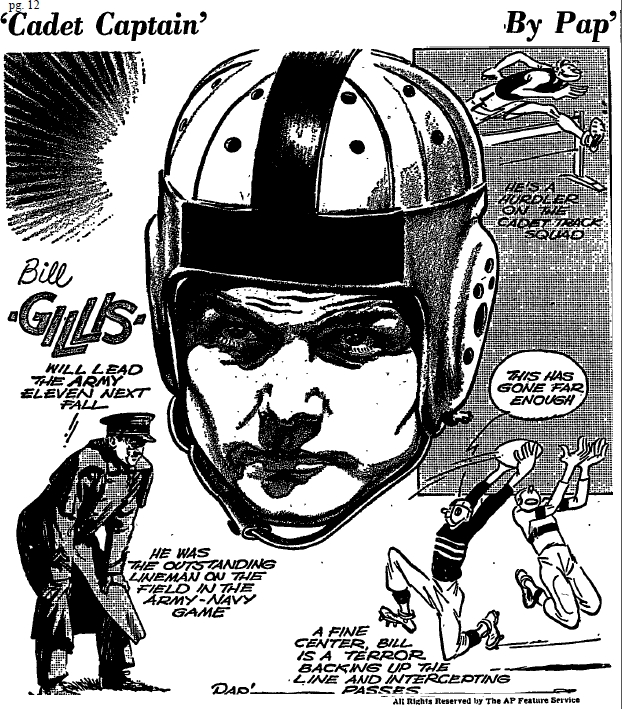
ArmyFB_1939_BillGillis_byPap_CSM_Dec141939

ArmyFB__1939_HarryStella-AllenBergner-Navy_byPap_CSM_Dec21939

–

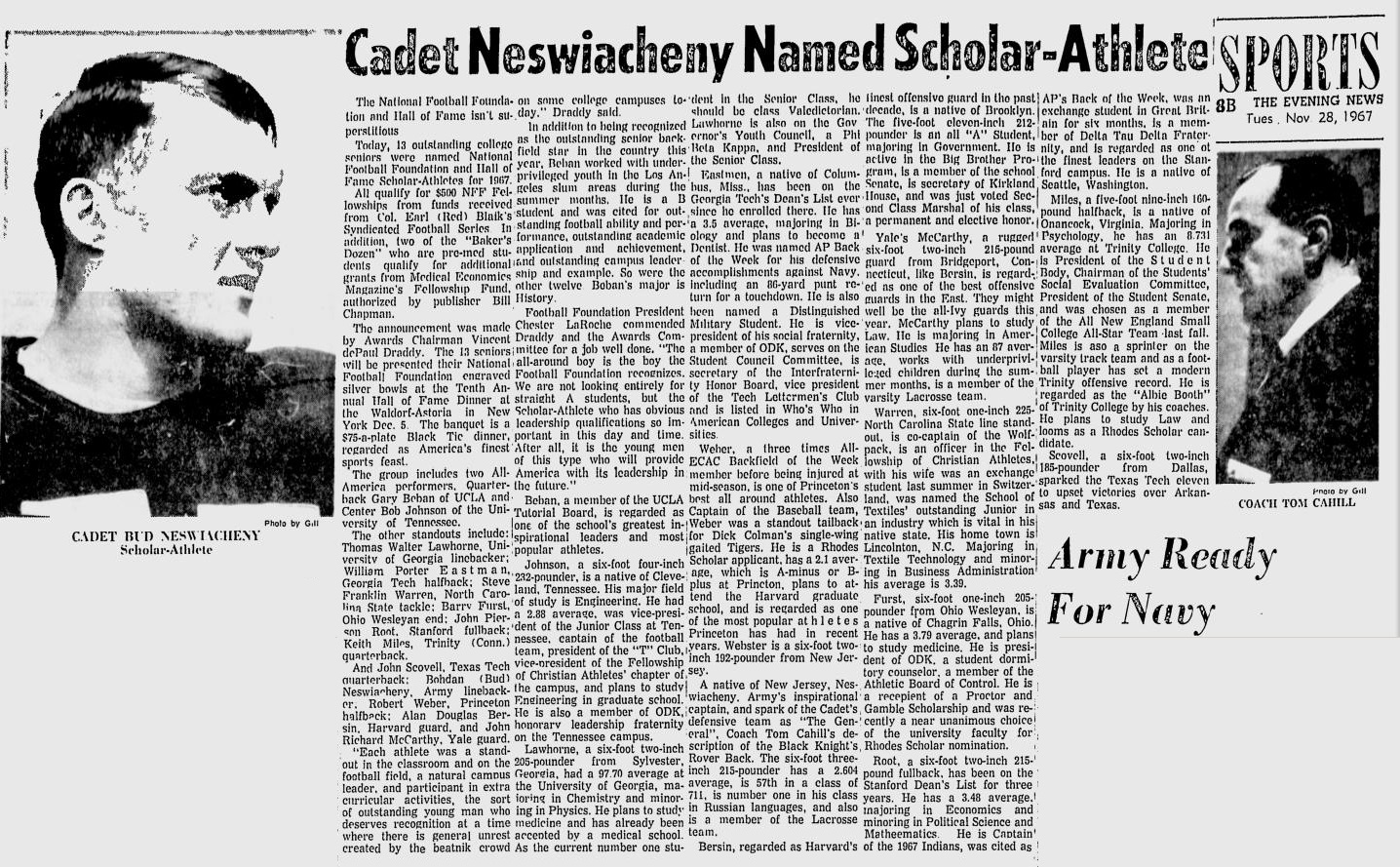
Bud Neswiacheny

–

ArmyFB_1967_BudNeswiacheny_EveningNews_Nov271967

ArmyFB_1967_BudNeswiacheny_EveningNews_Nov271967

–

–

1965 Football Team

1965 Army 4-5-1
1965/11/27 Army 7 – Navy 7 T

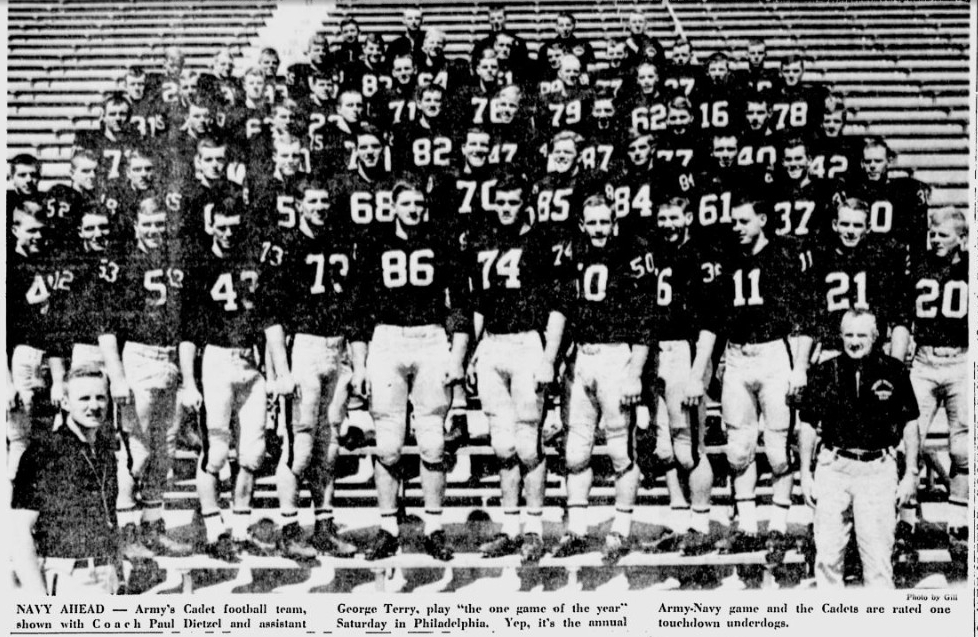
Coach Paul Dietzel 1962-1965
LSU 46-24-3 National Champs 1958
Army 21-18-1
South Carolina 42-53-1
Total: 109-95-5

Army:
1962 Army 6-4

1963 Army 7-3

1964 Army 4-6

1965 Army 4-5-1

Army Totals: 21-18-1

http://en.wikipedia.org/wiki/Paul_Dietzel

–

ArmyFB_1965_team_EveningNews_Nov261965

–


ArmyFB_1965_vsVMI_NewsandCourier_Sep261965

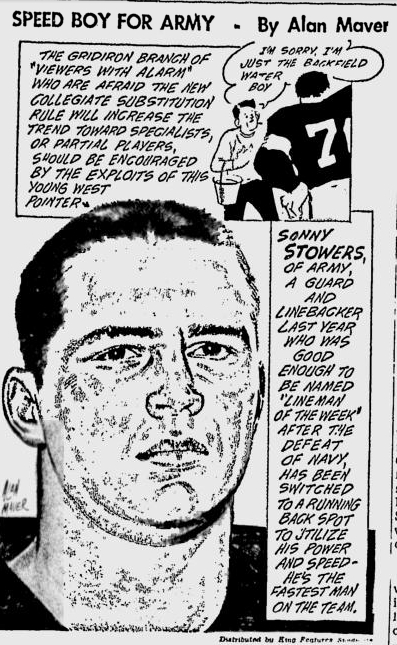
ArmyFB_1965_SonnyStowers_byAlanMaver_NewsDispatch_Sep301965

ArmyFB_1965_SonnyStowers_byAlanMaver_NewsDispatch_Sep301965

–


ArmyFB_1965_vsBC-pre_TheHeights_Oct11965


ArmyFB_1965_vsBC__Oct31965


ArmyFB_1965_vsBC_TheHeights_Oct81965


ArmyFB_1965_vsRutgers_MiamiNews_Oct171965


ArmyFB_1965_vsAirForce_SarasotaHeraldTribune_Nov71965-2


ArmyFB_1965_vsWyoming_EveningNews_Nov151965


ArmyFB_1965_vsNavy_StPetersburg_Nov261965


ArmyFB_1965_Dietzel-Stowers_Cook_ToledoBlade_Nov291965-1


ArmyFB_1965_vsNavy_WashingtonObserver_Nov271965


ArmyFB_1965_SonnyStowers_NewsandCourier_Nov291965


ArmyFB_1965_vsNavy_TheMiamiNews_Nov281965