Category Archives: Army Greats

Charles Meyer

Charles R Monk Meyers

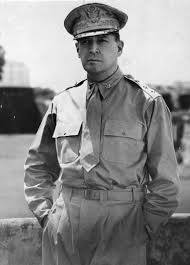
Douglas MacArthur

Awarded the Medal of Honor – Bataan Peninsula 1 April 1942.

It should be noted that General MacArthur’s Father was also awarded the Medal of Honor for Gallantry at Missionary Ridge. See bottom of page

Go to to below link for information on The May 1962 Speech by General MacArthur

http://forwhattheygaveonsaturdayafternoon.com/wp-1962/macarthur-dhc

The Japanese Surrender 1945
http://www.youtube.com/watch_popup?v=vcnH_kF1zXc&feature=player_embedded

MacArthur played Football till injured

General MacArthur’s Duty, Honor, Country speech was recorded for us because Jim Ellis ’62 First Captain and Pete Wuerpel Bde Adjutant ’62 had the foresight to realize perhaps we would want to remember what the General said to us. He spoke to us without notes

What we remember of that day is at the bottom of this page

http://americanrhetoric.com/speeches/douglasmacarthurthayeraward.html

Jim Ellis' arm is to General MacArthur's right.

Jim Ellis’ arm is to General MacArthur’s right.

MacArthur

What we remember of that day in May when he talked to us

This Saturday, 12 May 2007, marks the 45th Anniversary of the presentation of the Thayer Award to General of the Army Douglas MacArthur ’03 and his legendary Duty, Honor, Country acceptance speech, and several graduates have shared their memories of that day. Perhaps the most significant recollection is of the absolute silence of the Corps and other attendees during the speech.

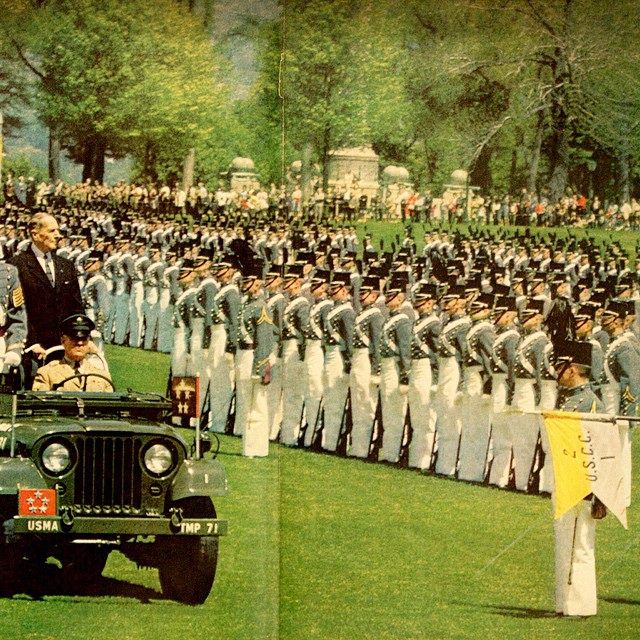
Larry Waters ’62 added that he had never seen the Corps standing so tall on The Plain as when the general trooped the line during the review that preceded the speech.

Denny Benchoff ’62 noted that “you could hear a pin drop” until a man began taking photographs using a camera with a noisy shutter. A general officer sitting nearby reached over to the man, gently touched his hand, and put a finger up to his lips to indicate silence was requested. All this was done without taking his eyes off GEN MacArthur for more than a few seconds.

Duke Meceda ’62 also recalled the silence during the speech but added that the mess hall was silent for at least 15-20 seconds afterwards as well, the effect of the speech was that dramatic. Then the attendees began to applaud.

Pat Canary notes that when Jim Ellis ’62 dismissed the Corps, the silence resumed as the cadets left the mess hall and returned to the barracks. Many seemed to appreciate the fact that the speech was GEN MacArthur’s farewell to West Point.

Perhaps the most comprehensive recollection was provided by Dick Chegar ’62, who served as escort for GEN Anthony McAuliffe ’19 of Bastogne fame. He recalls that Mrs. MacArthur, Mrs. Westmoreland, and their escorts were seated on the poop deck while a number of famous general officers were seated at ten-man tables near the podium on the ground floor. GEN MacArthur was 82 at the time, and this alone caused a sense of drama in the air, almost symbolic of the passing of an era. His opening joke about the doorman at his hotel asking if he had ever been to West Point before caused the mess hall to erupt in laughter, but the mood soon grew serious as MacArthur spoke of distant battlefields and the American soldier’s “patience under adversity, courage under fire, and modesty in victory.” He delivered his speech without notes, and most attendees were acutely aware of his exemplary oratory. About two-thirds of the way through the speech, however, MacArthur hesitated for a moment, turned to his right, and looked directly at his wife Jean. It was as if a ray of light passed between them in that moment. GEN MacArthur then flawlessly continued his speech to completion. Several weeks later, the Cadet First Captain visited GEN MacArthur in New York City and was told that the speech had been written in advance, committed to memory and rehearsed several times. Dick felt that the pause occurred because the next line may have been forgotten for a moment. Many years later, when one of Dick’s captains won the annual General Douglas MacArthur Leadership Award, Dick told him the story about the momentary pause. When the captain later met Mrs. MacArthur at the ceremony, she confirmed her recollection of the glance that passed between them on that day.

Johnny Godwin ’62 was a member of the cadet officer honor guard arrayed on the steps of Washington Hall. He recalls that GEN MacArthur was extremely gracious, stopping to talk and shaking hands with a strong grip.

There was an air of excitement because MacArthur was already a legend at West Point. At the top of the steps, the general turned and said, “I thank you all.”

Neil Nydegger ’62 was impressed by the General’s “sincerity and genuine commitment to the Army and to West Point” and how he had “captured the simple essence of being a soldier.”

Gary Sharp ’62 recalled: — “MacArthur’s well-chosen words and deliberate delivery made an emotional impression on me that I will never forget … being the first in war and possibly the first to die, the loneliness of remote duty, the hardships on a soldier’s family, the fears that all soldiers face in battle, the camaraderie soldiers experience, the pride and honor felt when a soldier’s job has been done well, and the deeply emotional sound of Taps at a soldier’s burial … were all in his speech. If they were not in his exact words, they were in the silences between them. If any soldier ever needs encouragement before or in battle, he only needs to hear or read MacArthur’s words.”

Fred Bothwell ’62, first in his class in English, was impressed with the general’s choice of words like “tocsin” and “mournful murmur of the battlefield,” calling his speech “the most brilliant piece of oratory that I have ever heard.”

Stu Sherard ’62 was moved by the reaction of his roommate, Frank Reasoner, a former Marine sergeant who returned to the Marine Corps after graduation and was killed in action on 12 July 1965 in Viet Nam, receiving the Medal of Honor posthumously. Hard core Marine Reasoner had tears in his eyes several times during the speech.

John Dilley ’62 also recalls that “there was not a dry eye in the house,” but his strongest recollection is of MacArthur’s intoning, “… the Corps, and the Corps, and the Corps.”

Bob Reid ’62 had a similar recollection of being touched deeply and moved to tears, especially by MacArthur’s final allusion to “the Corps.”

Forty-five years later, Bob Cooper ’62 still finds himself quoting MacArthur’s speech to those he meets who are opposed to the war in Iraq: “This does not mean that you are warmongers. On the contrary, the soldier, above all other people, prays for peace, for he must suffer and bear the deepest wounds and scars of war.”

Bill Ross ’62 recalled MacArthur’s sonorous delivery and a more pragmatic aspect: GEN MacArthur, as a former Superintendent, exercised the prerogative normally reserved to heads of state and granted amnesty, permitting Bill to enjoy the beautiful Saturday afternoon without sitting confinement.

John Taylor ’62 recalls that Army’s newly-established Rugby Team, of which he was one of the co-founders, went on that afternoon to beat the leading rugby club in the nation, the New York Rugby Club.

Mike Moore ’62 recalls being photographed presenting a 1962 Howitzer to the general (Mike was the editor) and then flying off to Syracuse to play lacrosse, Army winning by about ten points.

Gus Fishburne ’62 recalls that the baseball and lacrosse teams attended in uniform, standing along the walls of the north wing during the speech.

Tom Eccleston ’62 recalls a very personal and pragmatic result of having heard the speech. After several years of active duty and a tour in Viet Nam, Tom embarked upon a civilian career selling high voltage equipment and was given The Boston Edison Company as a challenge. While attempting to sell some old timers at Boston Edison his company’s equipment, he happened to mention that he had heard MacArthur’s speech. He was then seen as a minor celebrity and received a large contract within the year.

Like many of his classmates, Dave Francis’62 initially was waiting impatiently for lunch to be over so that he could hop into his Austin Healey sports car and drive down to Philadelphia for the weekend: “in the subsequent years, the memory of that weekend in Philadelphia has faded, but the memory of MacArthur’s speech has remained with me.”

Denny Coll ’65, however, was just a Plebe at the time and a member of the football team brought back in uniform and pads from spring practice to hear the speech. He also was a sleep-deprived Plebe who had just had a hearty football training table meal in a very warm, un-air conditioned mess hall. He and some classmates dozed off after the opening minutes of the speech, only to be awakened by the sound of MacArthur’s West Point ring inadvertently striking the podium near the microphone. His recollection of the speech is limited to its moving conclusion: “Today marks my final roll call with you, but I want you to know that when I cross the river my last conscious thoughts will be of The Corps, and The Corps, and The Corps. I bid you farewell.” He then realized that he was a part of history but had missed most of a historic speech.

Others also missed the speech, but for official reasons. Ernest Gus Zenker ’62 had branched Air Defense Artillery and was visiting a Nike missile site in New Jersey that Saturday, along with several Air Defense classmates.

Many more would have missed hearing the speech, however, had it not been for the presence of mind of the First Captain, Jim Ellis. The previous evening he had contacted the Public Information Officer at the time and asked if the speech would be recorded. The PIO office had no plans to do so. Jim then asked his roommate, Pete Wuerpel, the Adjutant, to set up a recorder on the poop deck. All other recordings of the speech owe their genesis to Pete’s reel-to-reel tape .. which he still has. And now you know the rest of the story.

—–

–

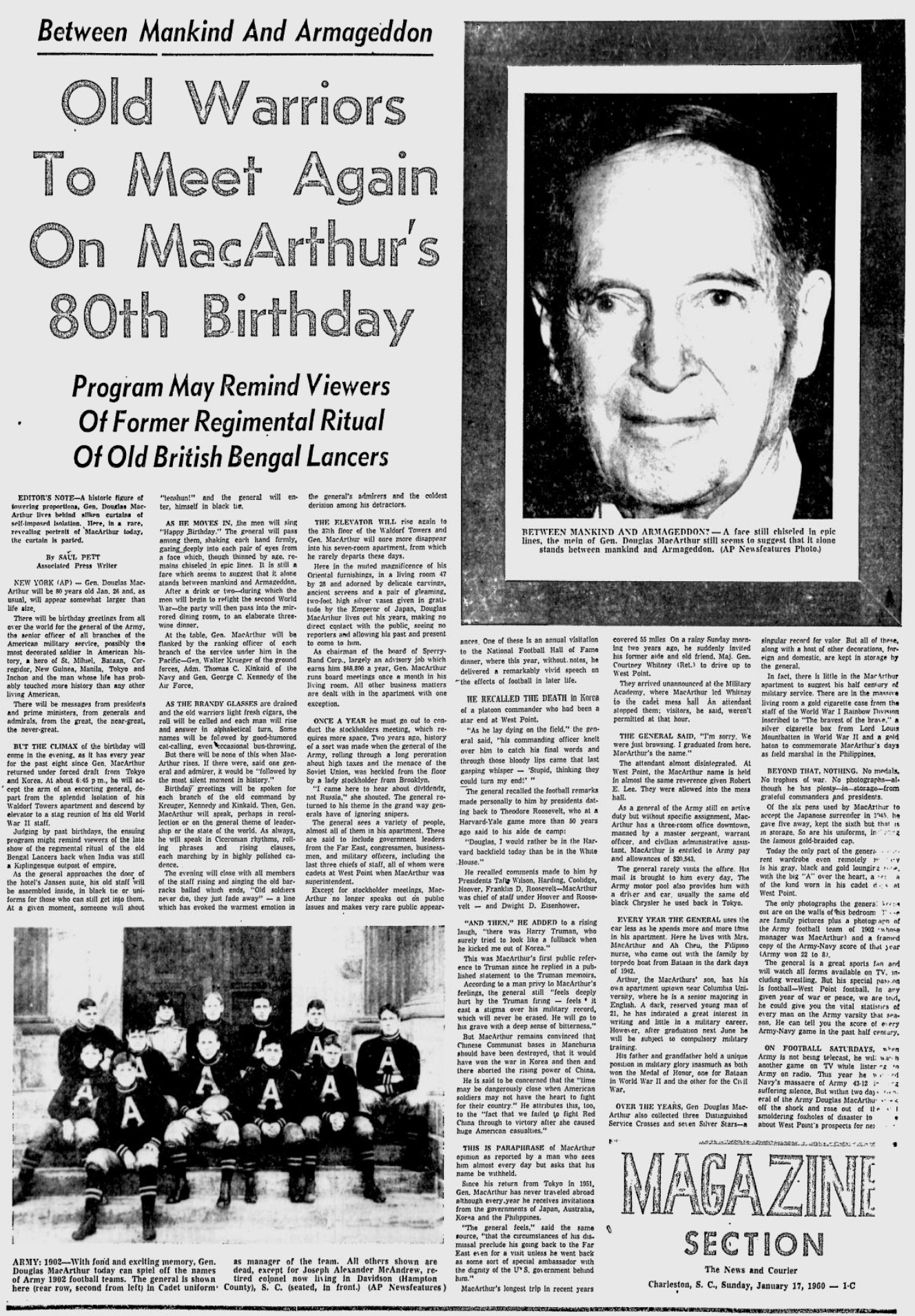
DouglasMacArthur_80thBirthday_NewsandCourier_Jan171960

–

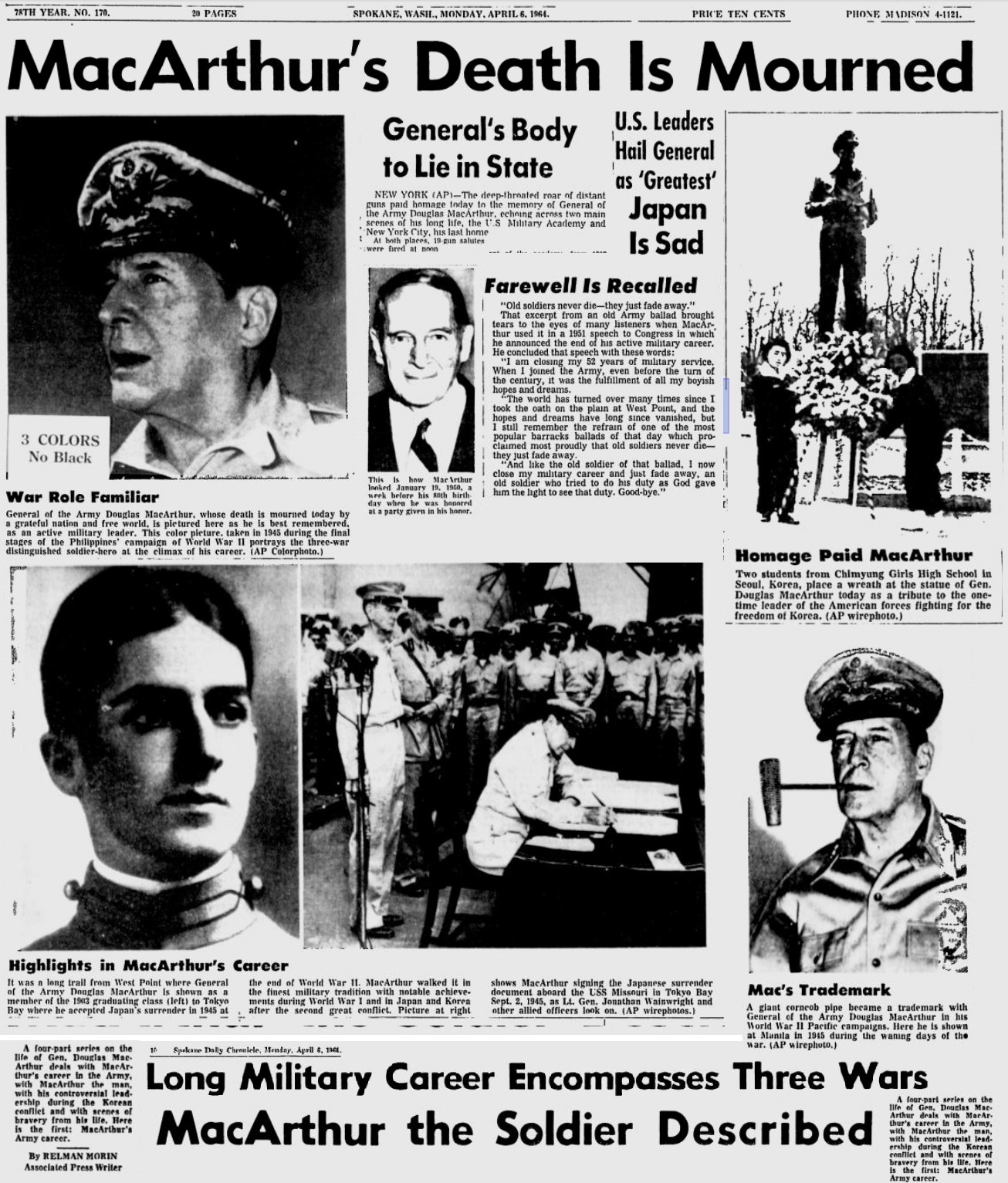
DouglasMacArthur_Death_SpokaneDailyChronicle_Apr61964

The man who won 24 Olympic gold medals for the United States isn’t Michael Phelps or Mark Spitz or even Jesse Owens. In fact, he didn’t compete in any Olympic sport. Yet he swung America’s attention to the importance of the Olympic Games as no other American had ever done — and turned Olympic gold into a rebirth of the American spirit.

He was General Douglas MacArthur.

We usually think of MacArthur as one of the supreme commanders of World War II, liberator of the Philippines and rebuilder of a shattered postwar Japan — and the genius behind one of the greatest military master strokes in history: the landing at Inchon during the Korean War.

But in 1928 MacArthur was president of the U.S. Olympic Committee, and led his country’s team to some of its most glorious moments — and laid the foundations for America’s love affair with the Olympics ever since.

At the time the modern games had only been held seven times since their founding in 1896. Many Americans wondered how much time and money the United States should spend — or waste — on the Olympic effort. So when the president of the U.S. Olympic Committee died suddenly, the other members turned desperately to the former superintendent of West Point and World War I hero, Major General Douglas MacArthur.

He was already famous for his advocacy of sports at West Point; his message to cadets about athletics, “On the field of friendly strife are sown the seeds that . . . bring forth victory,” stands near the West Point football stadium to this day.

MacArthur accepted the job with enthusiasm, and threw himself into the work as if he had been planning a military campaign. He met with coaches, gave inspiring speeches to sponsoring committees, harangued his coaches and his athletes — even supervised their training and workout schedules.

When the team arrived in Holland for the games, the outlook was not bright for our entrants, MacArthur wrote later, but he was determined that the United States should win. He became in effect Coach-in-Chief, attending every practice he could and meeting with athletes to evaluate their performance and motivate them to a higher level. MacArthur admitted he rode them hard: “I stormed and pleaded and cajoled.” He told them that America was the greatest nation in the world and therefore it deserved to have the greatest Olympic team.

We have not come 3,000 miles just to lose gracefully, he thundered, we are here to win, and win decisively.

When the U.S. boxing team’s coach threatened to withdraw from further competition after a blatantly unfair decision, MacArthur stopped him cold. Americans never quit, MacArthur barked. It became the motto for the entire team.

MacArthur’s fierce effort paid off. The United States had won 24 gold medals, more than the next two most-decorated countries, Finland and Germany, put together. The U.S. team had set 17 Olympic records and seven world records. When they returned to the United States, MacArthur wrote up a stirring report for President Coolidge on his team’s performance, and urged that support for the Olympic Committee be put on a more regular basis with a $2 million endowment fund.

Nothing has been more characteristic of the genius of the American people than their genius for athletics. MacArthur told the president. The experience, he said, “has made me proud to be an American.”

One of his old field commanders, General Charles Summerall, wrote to MacArthur: “You have not only maintained the reputation that Americans do not quit, but that Americans know how to win.

MacArthur had turned the Olympic Games into a source of national pride, as well as a national priority. Victory there has remained a symbol of the American spirit — one we need this year, perhaps, more than ever.
Historian Arthur Herman is a senior fellow at the Hudson Institutein

–

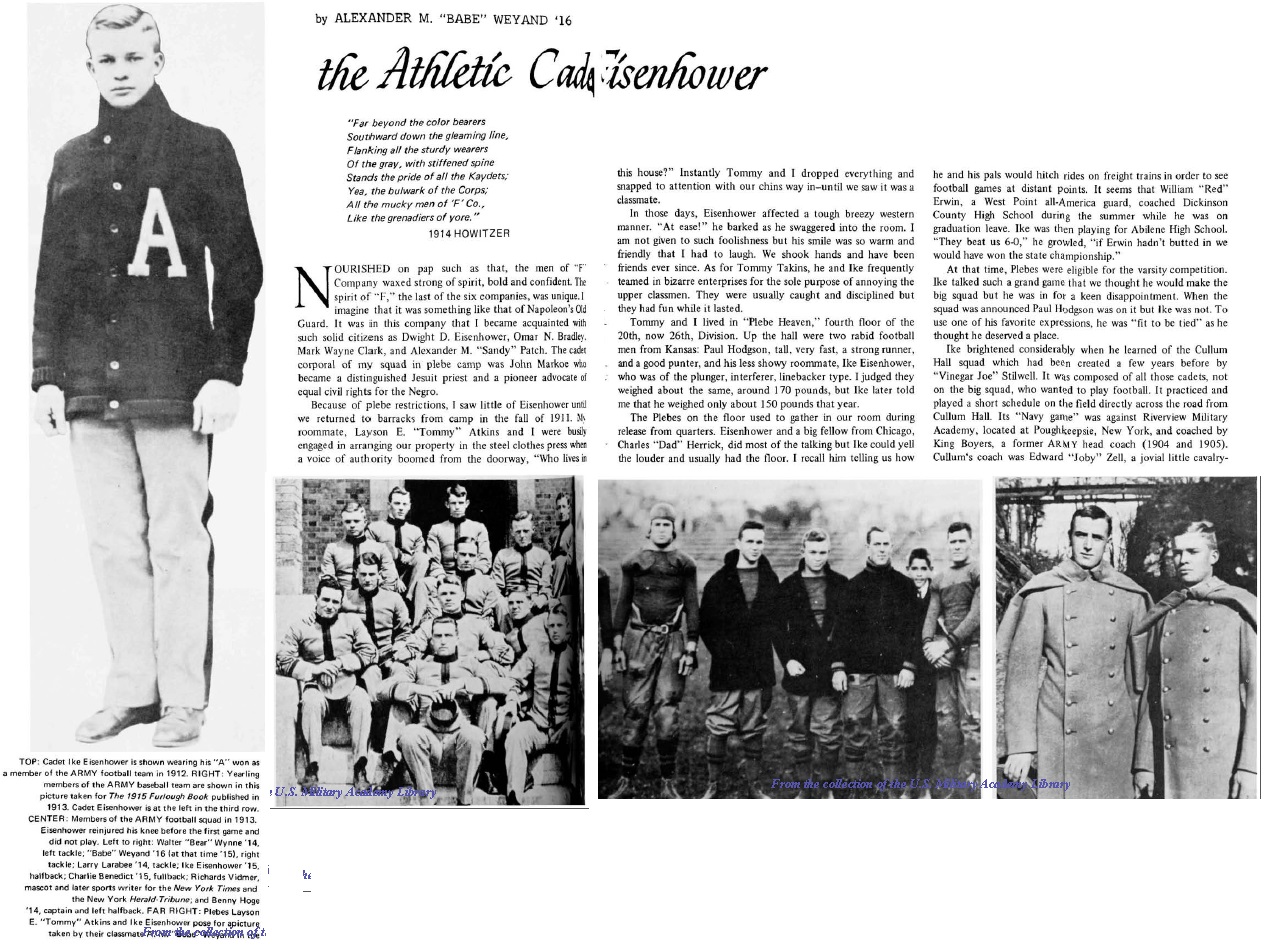
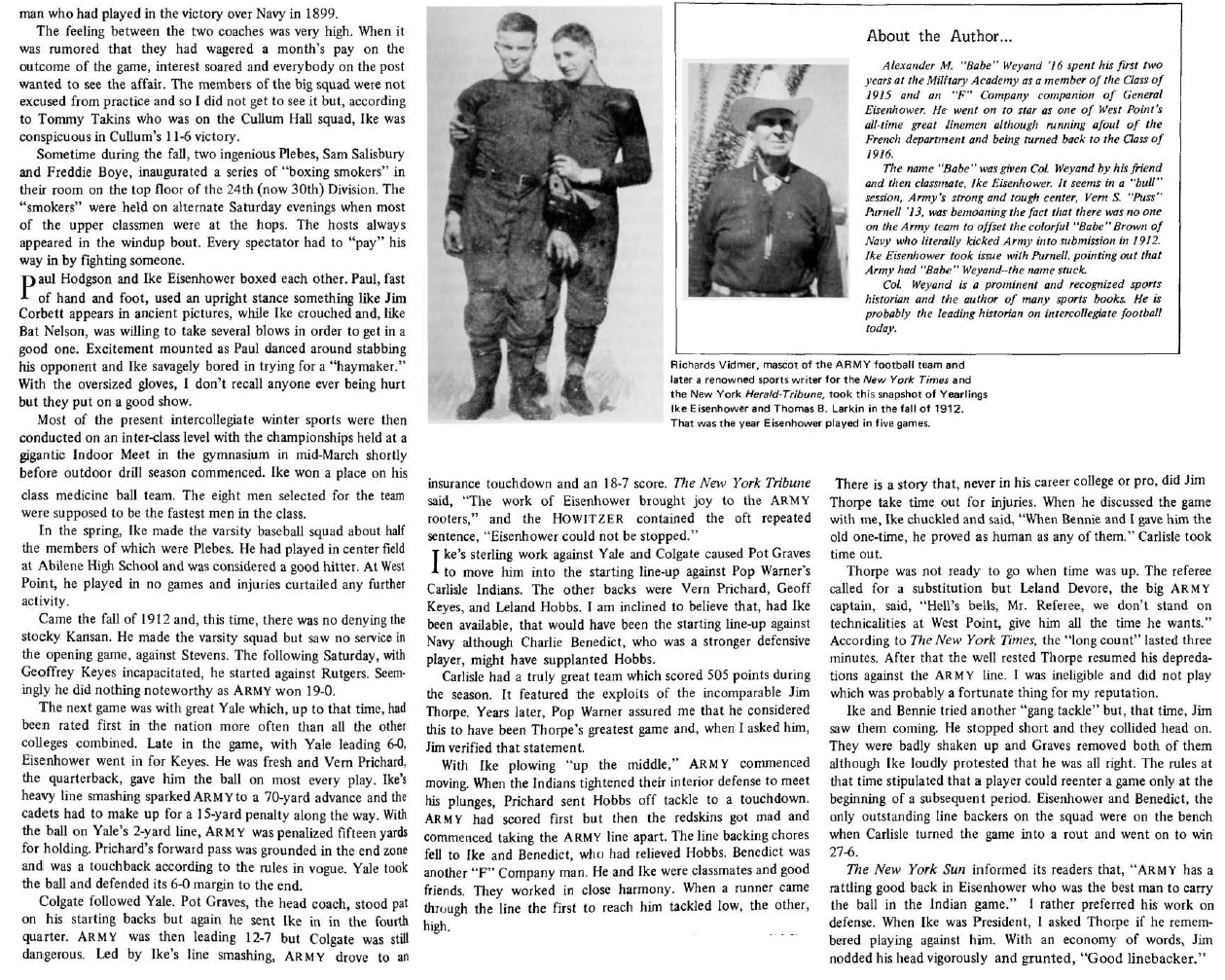
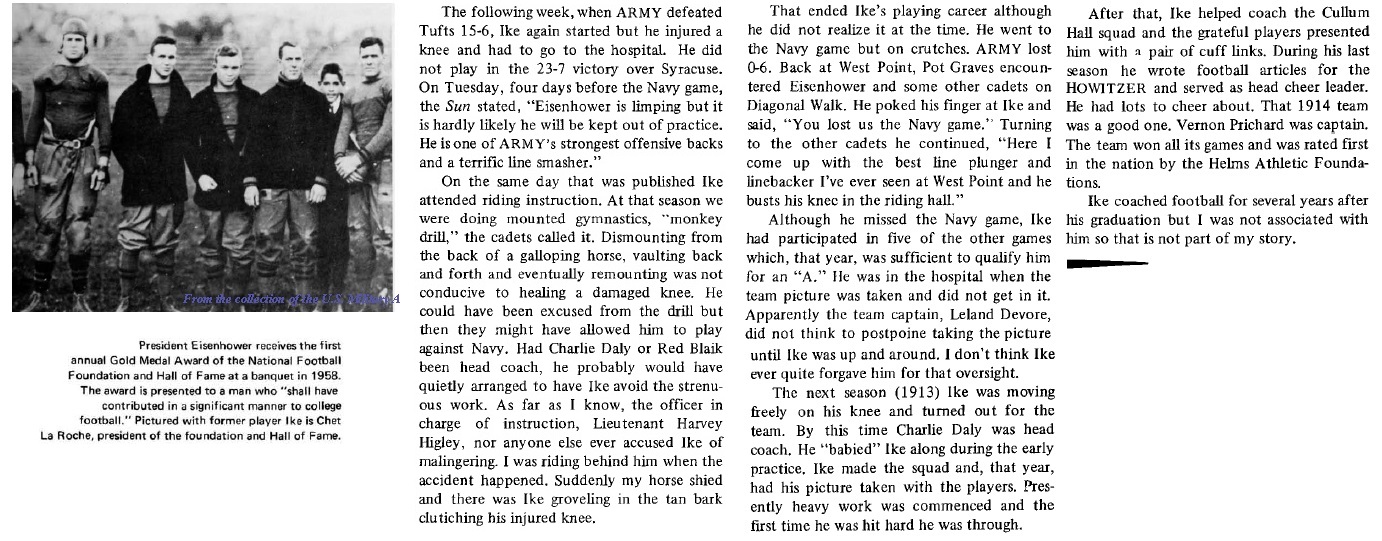
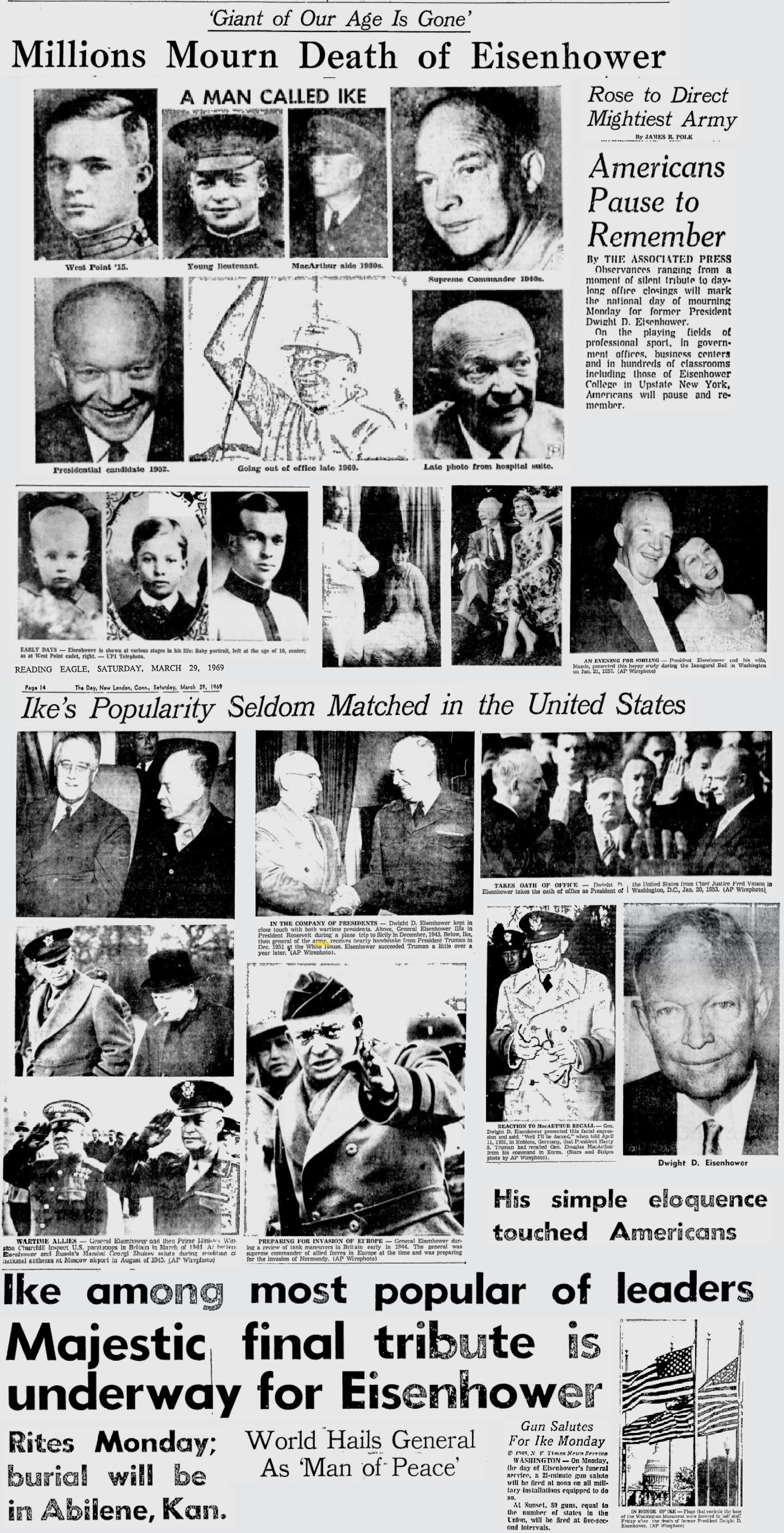
Dwight Eisenhower

Ike

Coach Graves recognition of Eisenhower

Page 255 Link – The way IKE played

–

Eisenhower_Football_AssemblyApr1968_1

–

Eisenhower_Football_AssemblyApr1968_2

–

Eisenhower_Football_AssemblyApr1968_3

Eisenhower_Football_AssemblyApr1968_1-3


—-
–

DwightEisenhower_Death_TheDay_Mar291969
–

Ann Wycoff

awaiting

David Sears

awaiting data

Bert Yancy

awaiting data

Robert Sears

Class of 1939

A 3 Time National Champion

http://www.goarmysports.com/ViewArticle.dbml?DB_OEM_ID=11100&ATCLID=611778

Richard Shea

Dick Shea breaks the tape in his second successive two-mile championship, Penn Relays, 1951.

Dick Shea ’52, captain of Army’s track team, breaks the tape in his third successive two-mile run championship, in the 1952 Penn Relays, Friday, 25 April 1952. Note the muddy track and a victory in difficult weather conditions. (Photo courtesy of the Penn Relays Director).

Dick Shea and runner-up Smith of Penn State, after Dick’s third successive championship two-mile run, Friday, 25 April 1952. (Photo courtesy of the Penn Relays’ Director.).


“Dick Shea” _ArmyTrack1951_byPap_CSM_May221951

Doc Blanchard

ArmyFB_1945_Felix-Doc-Blanchard

Doc Blanchard 1944

3 Army A’s in Football

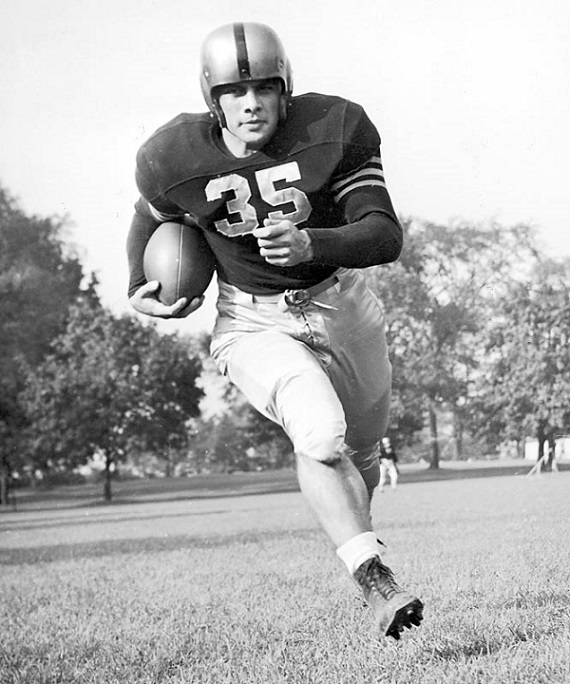
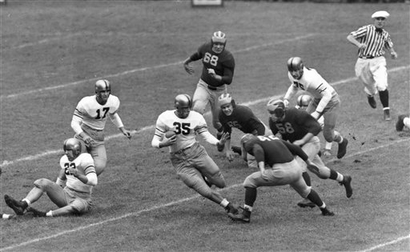
The sporting public first took notice of Blanchard in the 1944 season, when he starred in Army’s 59-0 pasting of Notre Dame, the worst defeat in the school’s history. “Blanchard,” noted one press account, “employed mainly as a decoy in the Army attack, played a spectacular game, bursting half the eardrums of the 74,437 spectators in the third period with a block that made possible [a] scoring return of a punt.” And the New York Times observed Blanchard was “even more poisonous on the defense than he was running the ball.”

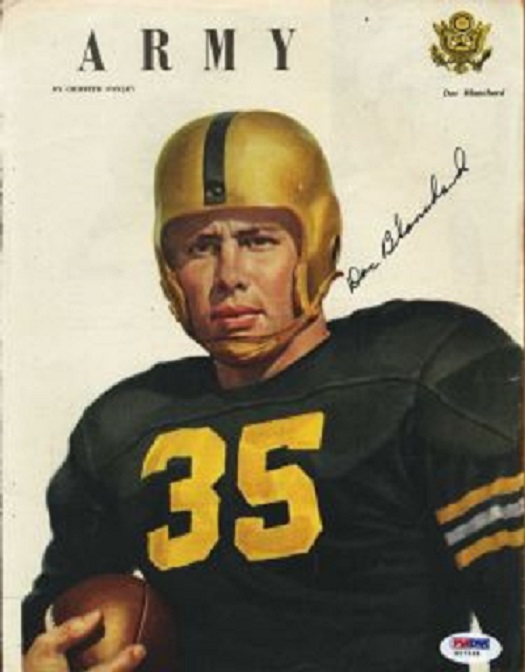
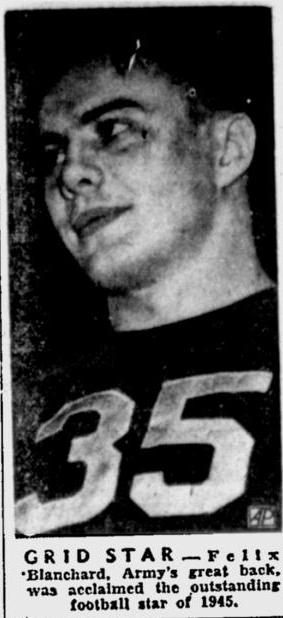
Blanchard’s overall performance stunned Notre Dame coach Ed McKeever who wired back to South Bend: “Have just seen Superman in the flesh. He wears Number 35 and goes by the name of Blanchard.”

Doc Blanchard:
The Army War Machine

by David Pietrusza

Dr. Felix Anthony Blanchard, Sr. bestowed three things to his son, 1945 Heisman Trophy winner, “Doc” Blanchard:

-his name

-his nickname, “Doc”

-his love of football

They were not necessarily in that order.

The senior Blanchard (a hefty 240 pounds) starred at fullback at both Tulane and Wake Forest (under the name “Beaulieu,” so his father wouldn’t know what he was up to) and provided his son and namesake with a lifelong love for football. He took no chances whatsoever on how the boy would turn out, placing miniature footballs in the infant’s crib. At age 2 1/2 young “Little Doc” had gotten the message and was cajoling an aunt into holding a football for him to practice kicking.

In high school Blanchard starred for Bay St. Louis, Mississippi’s St. Stanislaus Prep (the senior Blanchard was team physician for that squad) and played fullback in New Orleans’ Toy Bowl. For a while Little Doc thought of attending Tulane, but finally opted not for Army’s that would come later – but for North Carolina, where his mother’s first cousin, Jim Tatum, coached the freshman squad. At Chapel Hill Blanchard was a terror both on and off the field. “Once,” recalled the team’s trainer, “the knocked out two would-be tacklers on the same play.” On another occasion, he ripped a steam radiator off the floor, when he became annoyed at a hotel manager.

World War II cut short his North Carolina career. In 1943, at the end of his freshman year, Blanchard tried to enlist in the Navy, but was rejected for poor eyesight (as a boy one eye was damaged when another lad literally threw mud in it) and for being overweight. The Army had no such qualms about Blanchard – or about several million other young men for that matter — and he joined that branch of the service as a buck private.

Before long, however, Blanchard gained acceptance to West Point, but before he entered the military academy, his father passed away. The move to West Point was a move he had heartily approved, however. “My dad,” Blanchard recollects, “always thought that to be successful in college athletics the place to go play was in the Northeast, and I think he was probably right.”

The sporting public first took notice of Blanchard in the 1944 season, when he starred in Army’s 59 – 0 pasting of Notre Dame, the worst defeat in the school’s history. “Blanchard,” noted one press account, “employed mainly as a decoy in the Army attack, played a spectacular game, bursting half the eardrums of the 74,437 spectators in the third period with a block that made possible [a] scoring return of a punt.” And the New York Times observed Blanchard was “even more poisonous on the defense than he was running the ball.”

In that contest, Blanchard was deadly not only to the fighting Irish but also to anyone in his path. One official made the mistake of getting in the way of a Blanchard tackle. Doc bowled him over, dislocating one of the poor man’s elbows in the process

“He just happened to be where I was,” says Blanchard in his matter-of-fact manner.

Blanchard’s overall performance stunned Notre Dame coach Ed McKeever who wired back to South Bend: “Have just seen Superman in the flesh. He wears Number 35 and goes by the name of Blanchard.”

God-only-knows what the official with the non-working elbow had to say.

Army Coach Earl “Red” Blaik was never known for his braggadocio, but even he had to admit: “I never saw anybody like Blanchard before….He has the weight of a fullback and the speed of a halfback.”

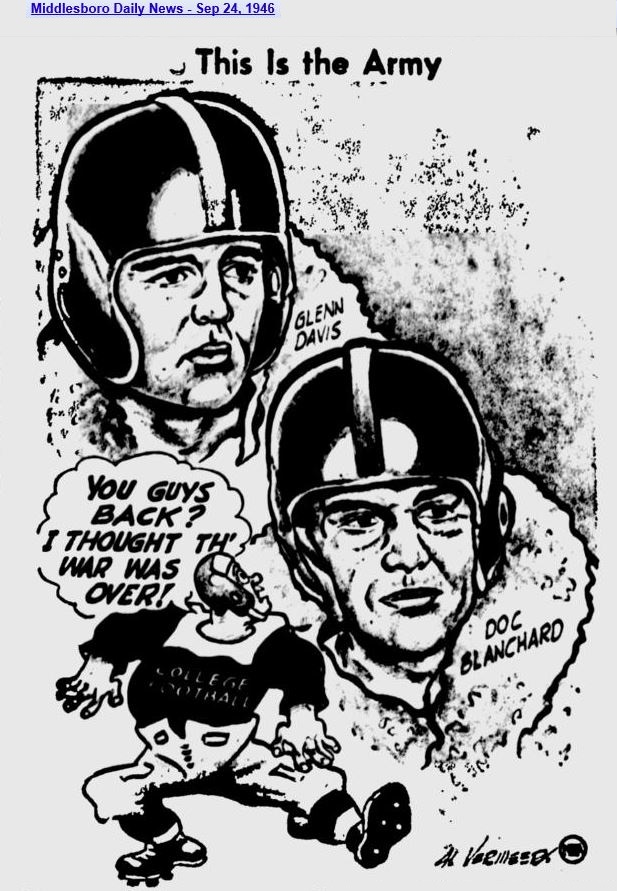
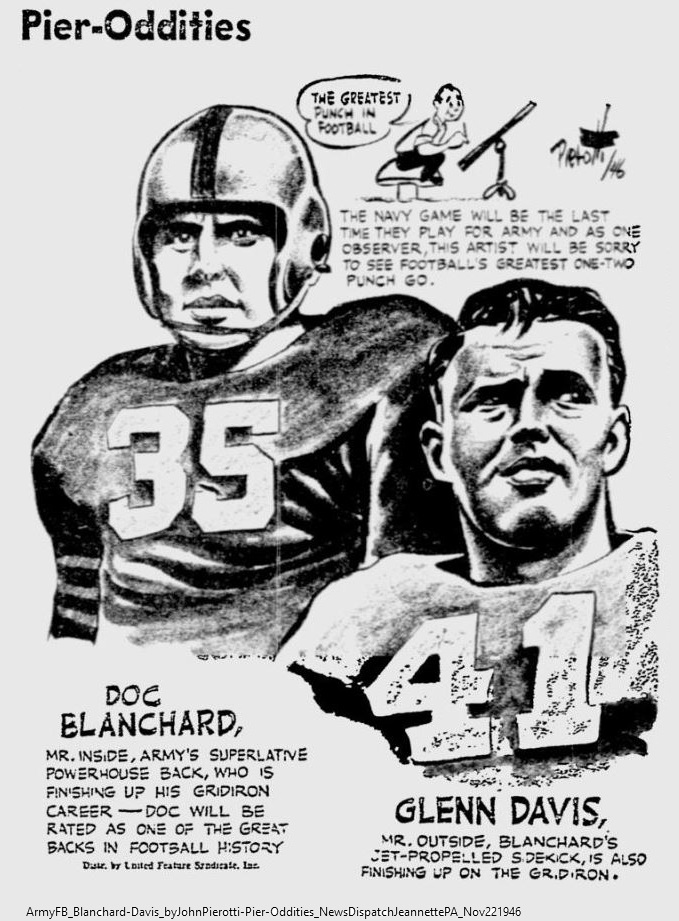
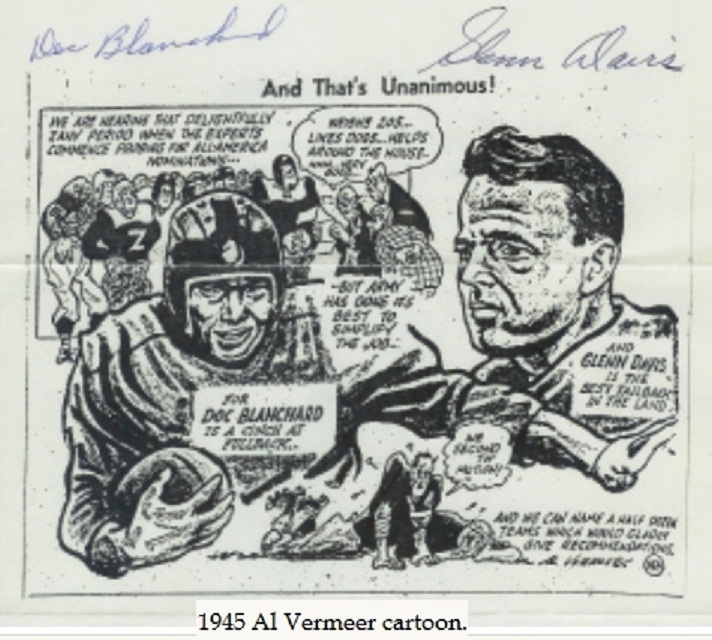
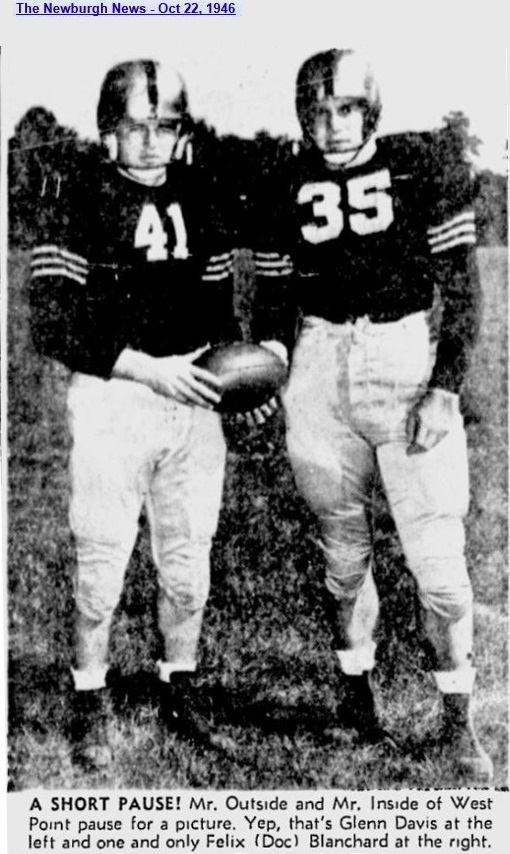
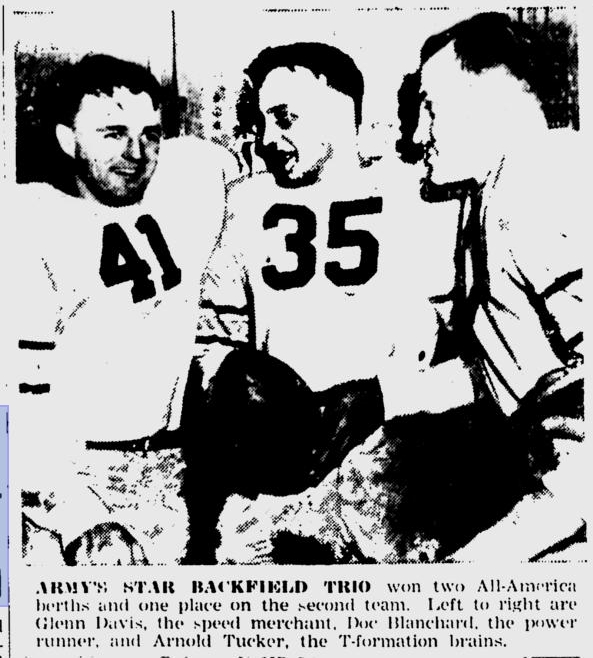
Of course, Doc Blanchard had a little help on that Army team, such as center “Tex Coulter”, tackle Al Nemetz, guard Jack Green and quarterback Arnold Tucker. But most significant, of course, was Glenn Davis. As Blanchard barreled through all opposition, earning the nickname “Mr. Inside,” (a name bestowed on him by the New York Sun’s George Trevor) Davis took a more circuitous route, and became known as “Mr. Outside”.

Their styles emphasized different strengths. I was strong in the “legs,” Blanchard once observed, “I had good acceleration for my size, good quickness. I wasn’t what you would call a speed guy, like Glenn.”

Earl Blaik once explained what made Blanchard unique: “Imagine a big bruising fullback who runs one hundred yards in ten seconds flat, who kicks off into the end zone, who punts fifty yards, who can also sweep the flank as well as rip the middle, who catches laterals or forward passes with sure-fingered skill, and who makes his own interference. That’s Mr. Blanchard.”

“Mr. Inside” and “Mr. Outside” ran roughshod over their opponents. Red Blaik gushed about his Touchdown Twins, “I doubt if any team ever had two such players in the backfield at the same time.”

Army was an absolute powerhouse. In its first six 1945 contests, it outscored opponents 271 to 33. For the season, the Black Knights captured the Lambert Trophy as the best college team in the East.

Army went 27-0-1 in 1944-46, Blanchard’s three seasons at the Point. In 1944 and 1945 the going was so easy, Blaik had plenty of opportunities to use his substitutes – and took every one. Army’s first and second teams averaged just eighteen minutes per game, and even the fourth stringers got plenty of work.

Of course, being a service team in an era when college squads were being stripped of their able-bodied personnel was a decided advantage to the Military Academy. “Sure they had an advantage,” Blanchard readily admits, “They had access to all the people in the service, and all the people that were over 18 were in the service. So they were just drafting people out of the service.”

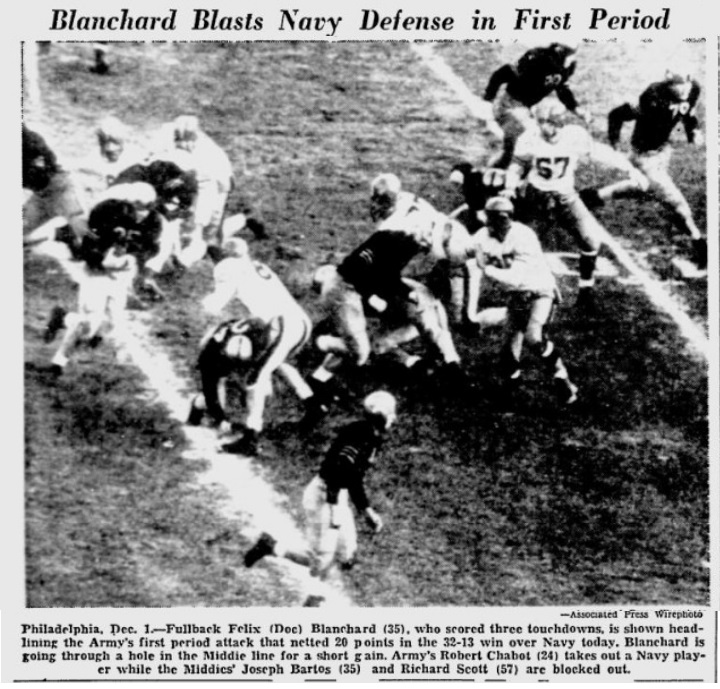
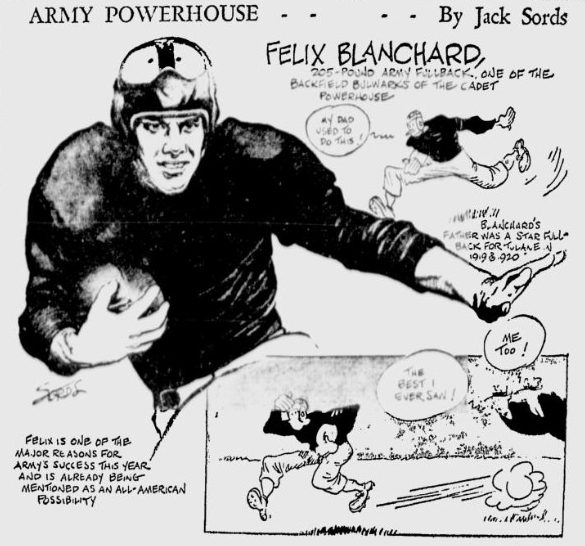
When Army beat Navy 23-7 in 1945, Blanchard (“205 pounds of charging wild buffalo,” as one account of the game described him) allegedly felt a special someone was there to help: his late father. “He was there…,” a sentimental reporter quoted Blanchard as saying, “I could feel him patting me on the back after each play and saying, ‘Hit like your daddy did, son.'”

It’s a good story, a darn good story. There’s only one problem with it: it’s just not a accurate story.

“Well, I’ve read that [story] too,” says Blanchard, “I don’t recall it. I’ll say it’s not exactly true.”

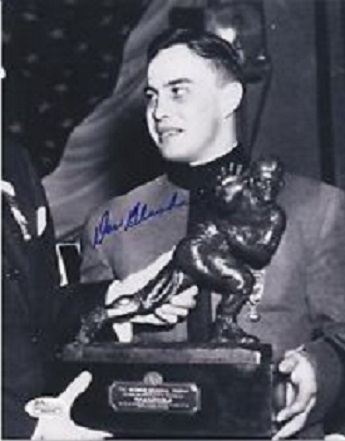
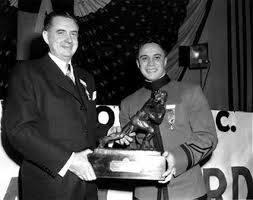
Receiving the 1945 Heisman

Blanchard, however, could have used a little extra assistance in that contest. All season long he had been engaged in a good-natured touchdown rivalry with Davis. Going into the game, the last of the campaign, the Touchdown Twins were, er, identical, tied sixteen-all in that category. Against the Midshipmen, Davis TD’ed twice; Blanchard, three times.

That may have been enough to put him over the top in Heisman balloting. When the votes were announced in December 1945, Blanchard outpointed his teammate 860 to 638. Far back were St. Mary’s Squirmin’ Herman Wedemeyer (152), Alabama’s Harry Gilmer (132), Notre Dame’s Frank Dancewicz (56), Ohio State’s Warren Amling (42), and Indiana’s Pete Pihos (38).

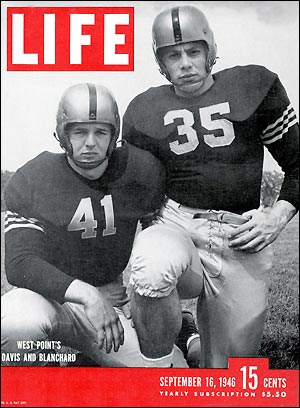
Blanchard was the first junior to win the Heisman (“in those days they sent the news via Western Union; I got a telegram”), and also captured the Maxwell and Touchdown Club trophies as the year’s best college player. He and Davis even jointly made the November 12, 1945 cover of Time magazine. Blanchard, Davis and their teammates, Coulter, Green, and Nemetz, each achieved All-American status.

Temple coach Ray Morrison marvelled at Blanchard’s remarkable 1945 season: “Doc Blanchard was a colossus who, experts insist, is the fullback of all time. Blanchard turned loose more raw power against Army opponents than has been seen since the days of Bronko Nagurski. In addition, Blanchard ran with greater speed and finesse than even the great Nagurski.”

Unlike a major league pitcher who seemingly can recall every pitch he ever threw to every batter, Blanchard doesn’t wallow in past glories. When asked about the most memorable play in his Heisman season, he harrumphs: “You’re stressing me now. Hell, you’re talking to a guy who can’t remember what he had for breakfast. You want me to remember the most memorable play of fifty years ago? C’mon. I don’t have one that I can remember.”

But he does have a few games he savors: “Navy was the big game, although Notre Dame in 1944 was a big time game for us because of the history of the series’ won-lost record and all that stuff.”

And there was a moment in Blanchard’s West Point career that transcended even a Heisman Trophy: being part of the honor guard at President Franklin Roosevelt’s funeral at nearby Hyde Park, New York.

One might think Blanchard’s status as the nation’s premier college football star might have played a part in his selection. It didn’t. It was more a matter of which unit he was assigned to at the Academy. “They picked some people from West Point to go over and attend,” says Blanchard, “The group that I was assigned to went, so I got to go.”

Blanchard’s 1946 senior season was marred by torn knee ligaments he suffered in that campaign’s first game. But he recovered to run for 613 yards (a 5.1 average)and score ten touchdowns and once again be designated an All-American. He finished his career with 38 touchdowns and 1,666 yards rushing. Still on the squad, was Glenn Davis-who after two runner-up finishes – finally captured a Heisman for himself.

Blanchard had his eye on a pro career, but the War Department vetoed that idea. He remained in service until 1969, serving as a fighter pilot in both Korea and Vietnam.

http://www.collegefootball.org/famersearch.php?page=1&submitted=1&school=Army&sortby=school

http://www.sccotton.org/blanchard.htm

http://www.heisman.com/winners/d-blanchard45.html

Football’s Greatest Decade – – by Bernie Mcarty – http://www.la84foundation.org/SportsLibrary/CFHSN/CFHSNv01/CFHSNv01n1b – – see page 5

This writer believes West Point 1945 is the greatest team of all time. The 1944 Army team may actually deserve that title, but it was never tested. Army was also undefeated in 1946, 1948 and 1949.

Army’s top stars during 1945-1949 were the effulgent “Touchdown Twins”, Glenn Davis and Doc Blanchard, Arnold Tucker, Arnold Galiffa, Rip Rowan, Bobby Jack Stuart and Gil Stephenson in the back-field, and up front” Joe Steffy”, Art Gerometta, Jack Green, “Bill Yoemans”, Joe Henry “Tex” Coulter,Al Nemetz, and the sterling end duo of Hank Foldberg and Barney Poole.

In 1945 the Newspaper Enterprise Assoc. simply picked the entire Army team as its All-American team, stating no group of All-Americans could beat the Cadets. Only a world war could have brought together such a collection of players to one institution. But it took the coaching genius of Col. Earl Blaik to mold the players into a cohesive unit. In truth, Navy personnel was equal to Army’s on an individual basis. The Middies never jelled as a team, however.

The 1951 Army outfit might have been as good as the 1945 Cadets, but the infamous cribbing scandal wiped out the team.

–

ArmyFB_1945_Felix-Doc-Blanchard_Army

–

Felix Blanchard

–ArmyFB_1944_DocBlanchard

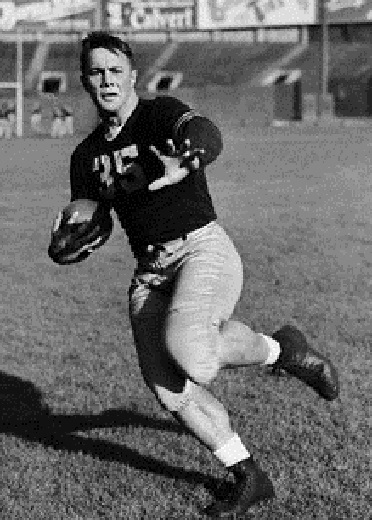
Felix "Doc" Blanchard running the football

–

ArmyFB_1945_vsNavy-Blanchard_YoungstownVindicator_Dec11945

–

ArmyFB_1944-45_Blanchard_PrescottEveningCourier_Jan71945

ArmyFB_1945_Blanchard-Heisman

ArmyFB_1945_Blanchard-Heisman-2

–

ArmyFB_1946_Blanchard-Davis_LIFE-cover

–

as depicted by sport’s cartoonists

ArmyFB_1944_DocBlanchard_byJackSords_PainesvilleTelegraph_Nov61944

–

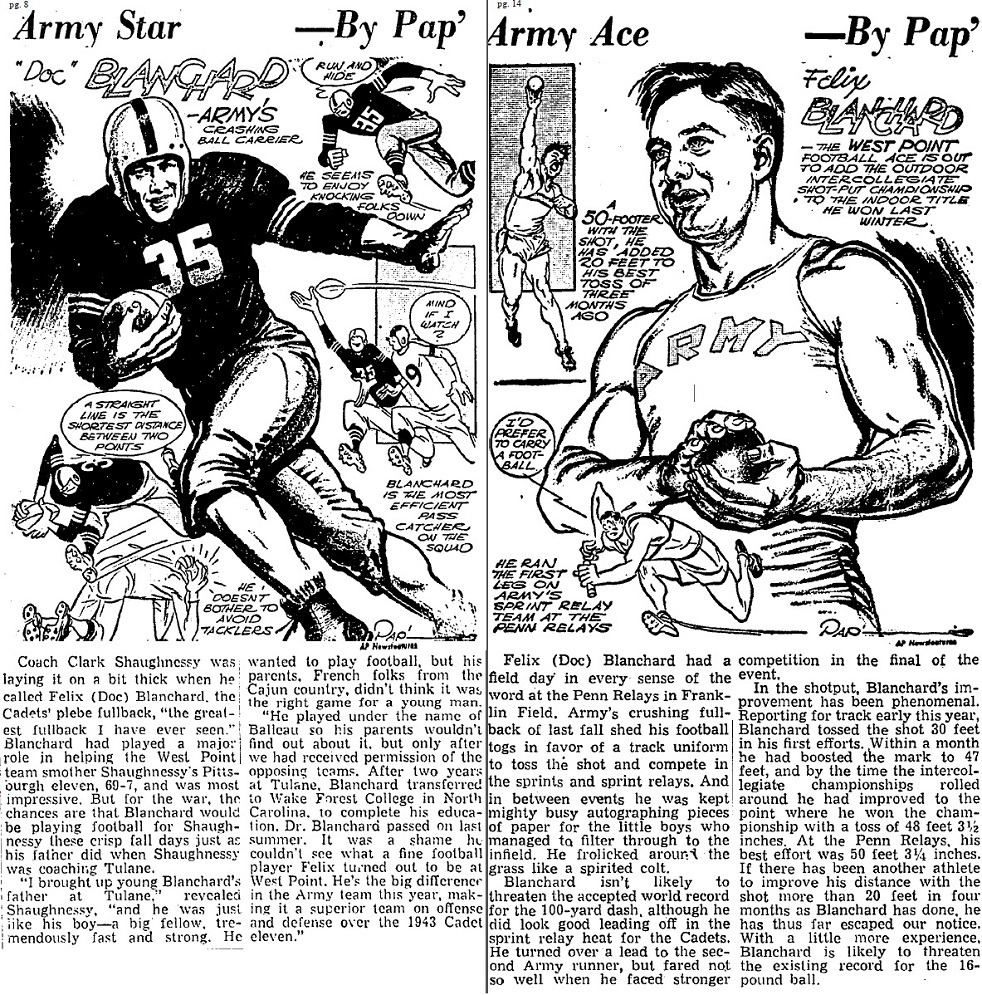
ArmyFB_1944_DocBlanchard_byPap_CSM_Nov151944-May101945

armyfb_1946_blanchard-davis_byalvermeer_middlesborodailynews_sep241946

ArmyFB_1946_Blanchard-Davis_byJohnPierotti-Pier-Oddities_NewsDispatchJeannettePA_Nov221946 (1)

–

ArmyFB_1945_DocBlanchard-GlennDavis_byAlVermeer

armyfb_1946_blanchard-davis_newburghnews_oct221946

armyfb_1946_blanchard-davis-tucker_oxnardpresscourier_dec51946


Awesome reading …. and 1957 was the year I started watching “college football”, as a 12-year-old. This research came about, from reading a letter in “Reminisce” magazine ( January 2007 issue, found stored in my attic). A “Bin” (Vince) Barta, wrote about his Army football days (56/57), and mentioned “Doc” (Felix) Blanchard (Mr. Inside), as having coached Vince for a year. I was stationed in Korat, Thailand, in 67/68, and had the “honor” of fitting L/Col “Doc” Blanchard for his flight gear, to fly “100 Missions over North Vietnam”, in an F-105 fighter. Not the time for a conversation with “Doc”, but I mentioned that I remembered “Mr. Inside”, which brought a smile, and thank you from him. “Doc” did complete his “100 missions” with the 388th TFW, and was promoted to “bird Colonel”, before being re-assigned to Kadena AFB, in Okinawa. Sadly, Felix “Doc” Blanchard has passed on (4/19/2009, at age 84). It’s pretty amazing what reading an article can do, to bring back a memory. If I recall correctly, 1957 was the year that Notre Dame defeated Oklahoma, 7-0, snapping a 47 game winning streak, of “Bud Wilkenson’s Sooners”. “Dick Lynch” scored the touchdown, in what has to be one of the great college football games ever. Nothing like reliving great memories.

–


–


–

–


—

Julie Schellhase

Julie Schellhase-Sevelius

The 2d floor of Arvin Gym is hot as hell in July and August. It mattered little that the morning had been spent running four miles in formation or rolling around on the grass with the sweat pouring off. Each time, walking out on that old hard wood floor provided an instant rejuvenation; an escape from Beast; a brief return to normalcy. She left everything on the court during the ninety minutes they allowed her to play the game she loved. It is with that passion that she gave over the next four years. As a starter Yearling, Cow and Firstie Year, she made her jump shot known.

In The Air – Julie gets above her Competition for another Record breaking Jump Shot


Getting ready for the Game with Coach Pat Harris


Work Area


Julie are these two the 1994 -1995 Season?


George Kirschenbauer

George & Karen Kirschenbauer
George was our Class President for a number of years. Ted Stroup replaced George.

Recuited for Baseball, George lettered in both Football and Baseball– sending a pitch in the spring of 1962 right over Cullum Hall roof.

“Kirschenbauer, Kirschenbauer, I saw George Kirschenbauer hit a home run over the roof of Cullum Hall” Comment by son of Mr. Link (PE Dept.) Spring of 2006, when George’s name was mentioned. The excitement in his voice was as if was May of 1962. What we did made a difference.

thumbnail-2
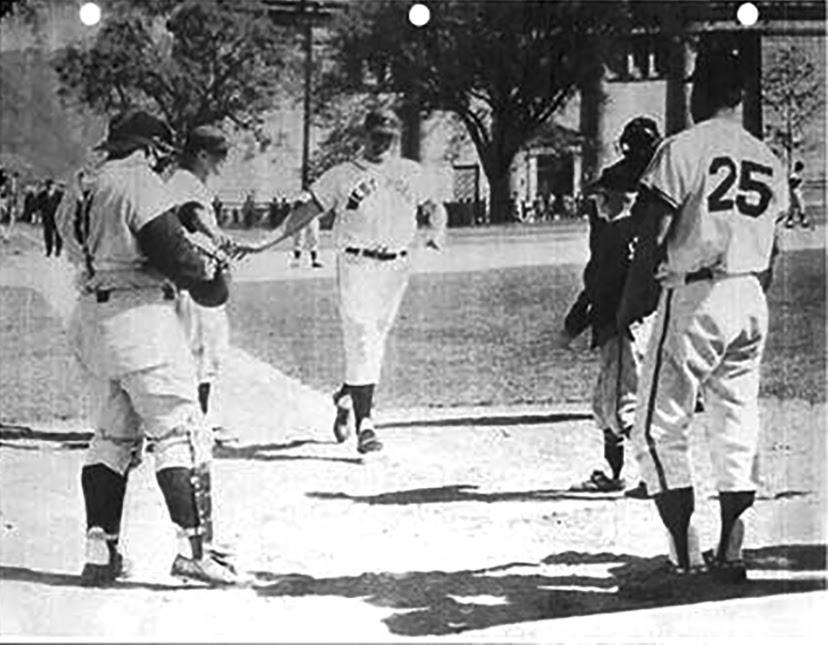
His home run off Yankee Cy Young winner, Bob Turley (Yogi Berra to George as he crossed home plate, “Well son, you’ve seen the last inside fast ball you’re going to see today, so hang on to your hat.”

Start of 59 Season

75 Bill Yost, 73 Bob Odd, 11 Pete King, 45 George Kirschenbauer, 58 Dick Buckner, 65 Harry Miller, 64 Al Vanderbush, 56 Ozzie Oswandel, 40 Russ DeVries, 94 Bob DeVries, 61 Jerry Clements

Joe Caldwell

59 Season Quarterbacks, Tom Blanda on the left, Pete King on the Right and Army’s Quarterback Joe Caldwell Class of 1960 whose name still appears in the record book after all these years.

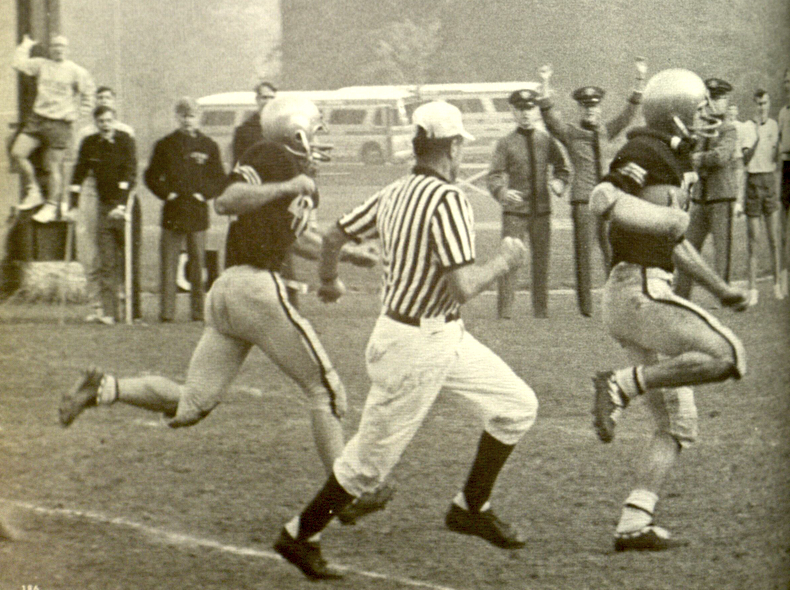
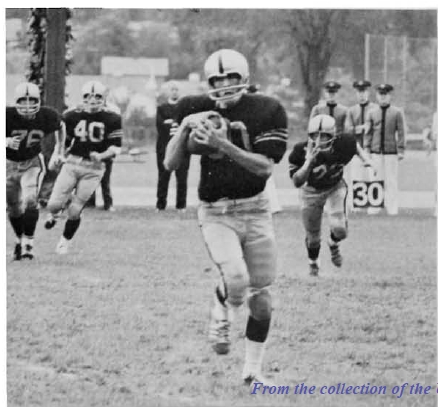
Tom Weber

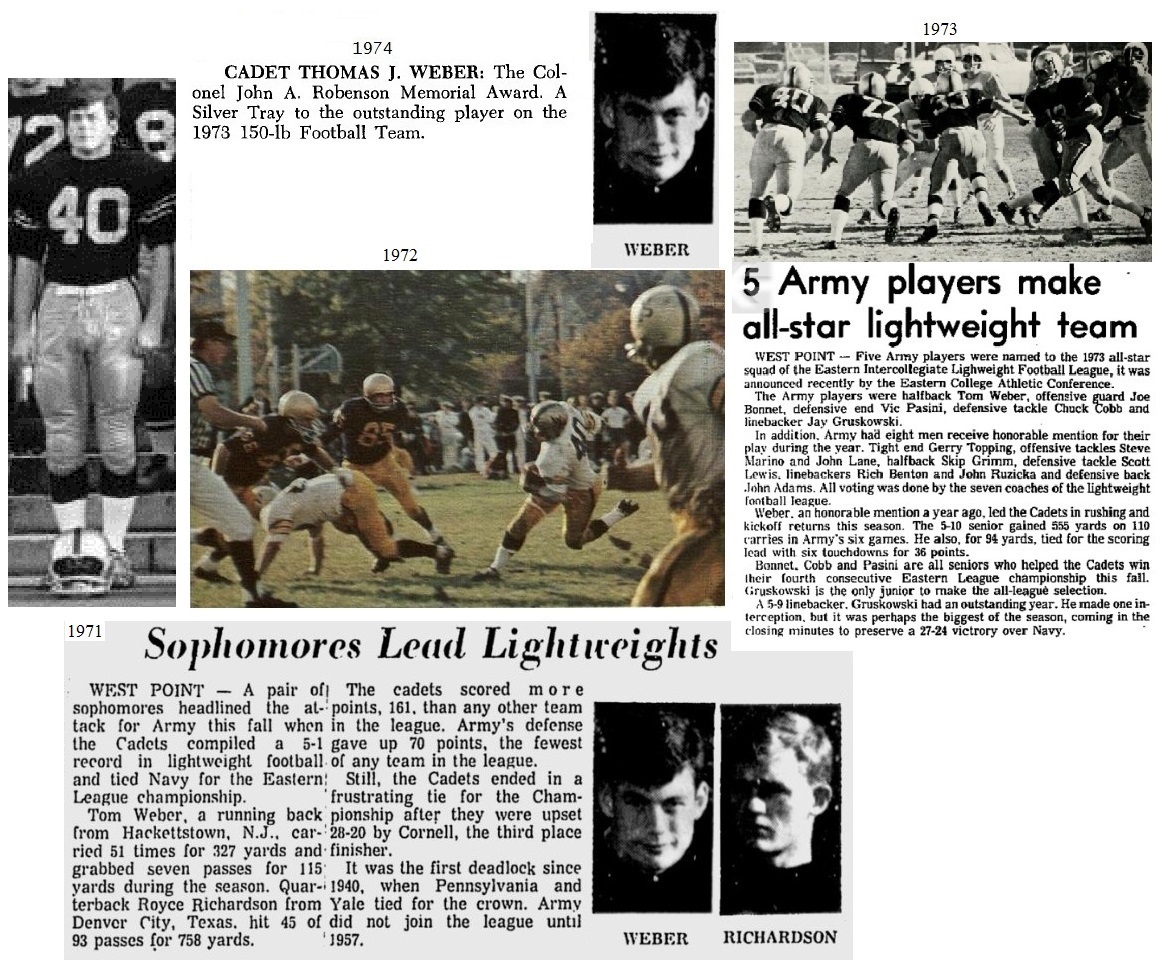
–TomWeber_1974_ArmyLFB-1973_RobensonMVP73

Doug Kim

awaiting data

Bill Moore

awaiting data

Joe Tallman

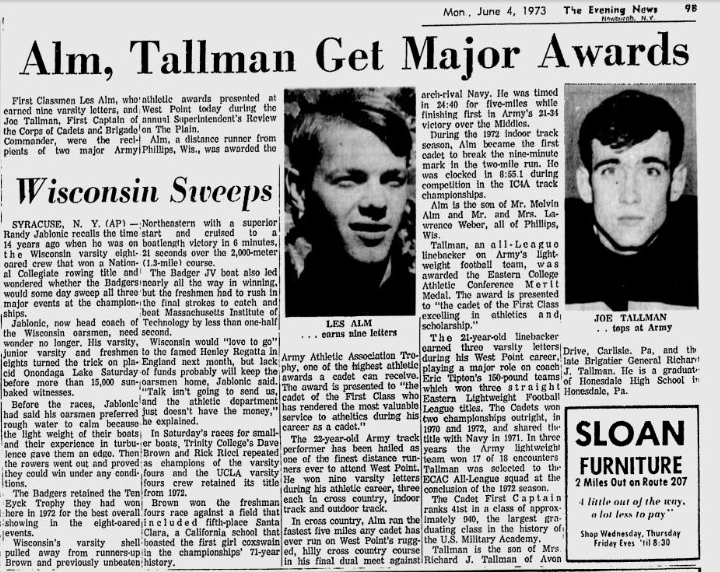
ArmyLFB_1973_060473_Tallman_NewburghEveningNews

Donnie O’Donnell

ArmyLFB_1971_DonnyO'Donnell73-run
–
ArmyLFB_1972_DonnyODonnell_Assembly
–

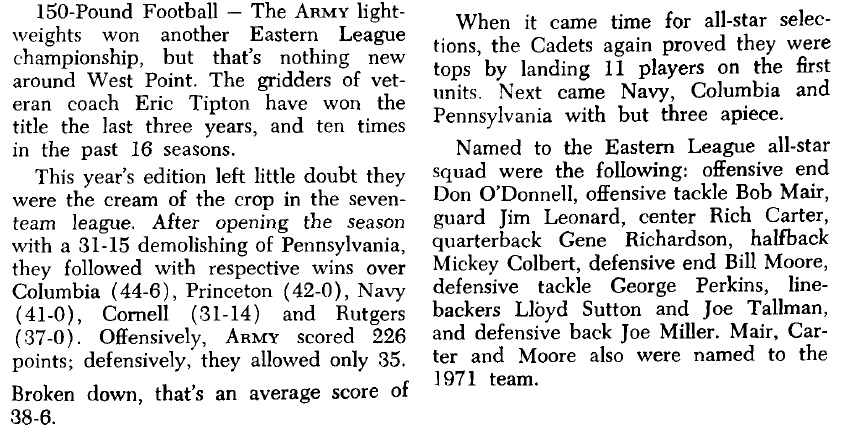
ArmyLFB_1972_Recap-All-League_AssemblyJan73

–

Gene Richardson

–
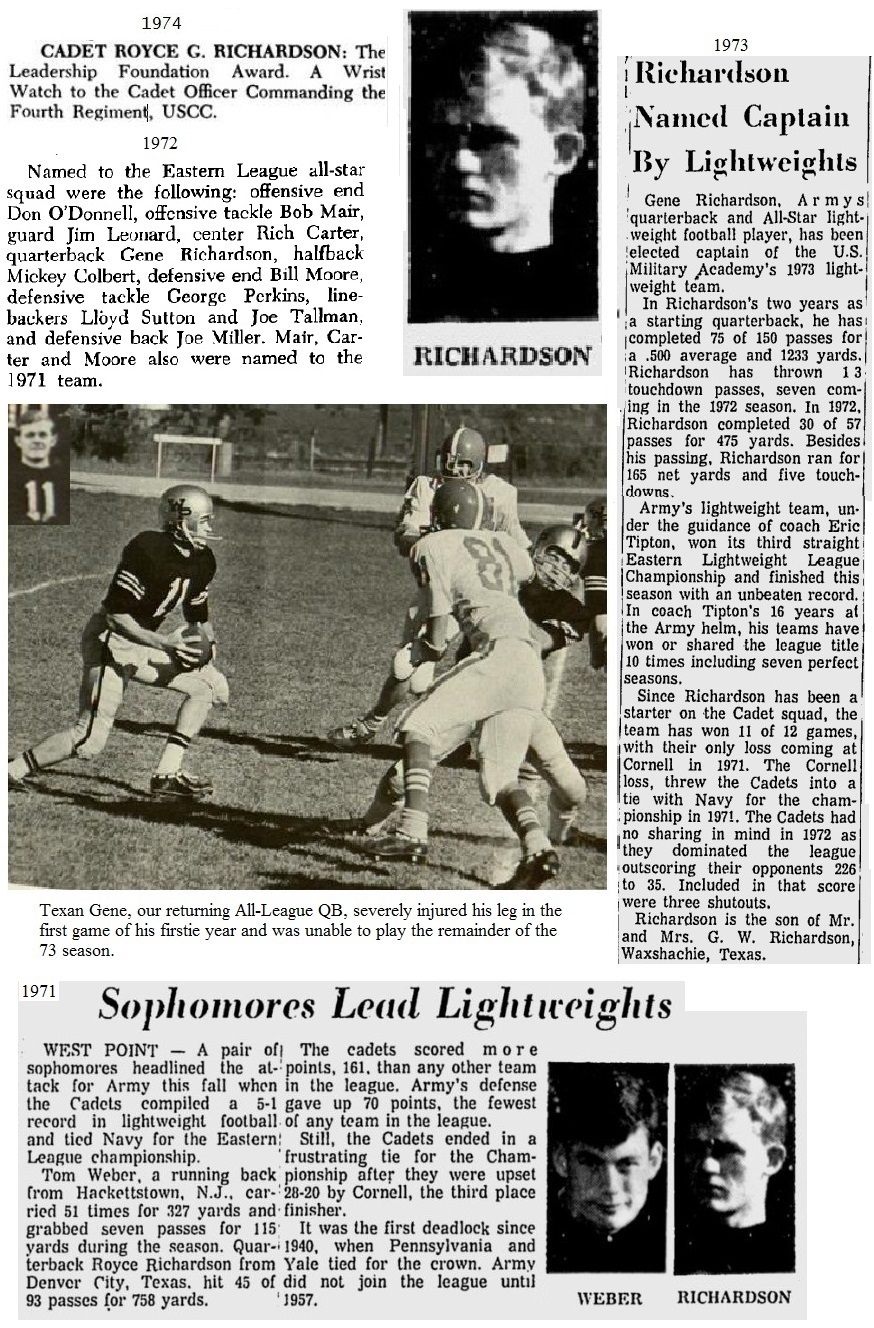
GeneRichardson_1974_ArmyLFB-1973_Captain73_All-League72
–

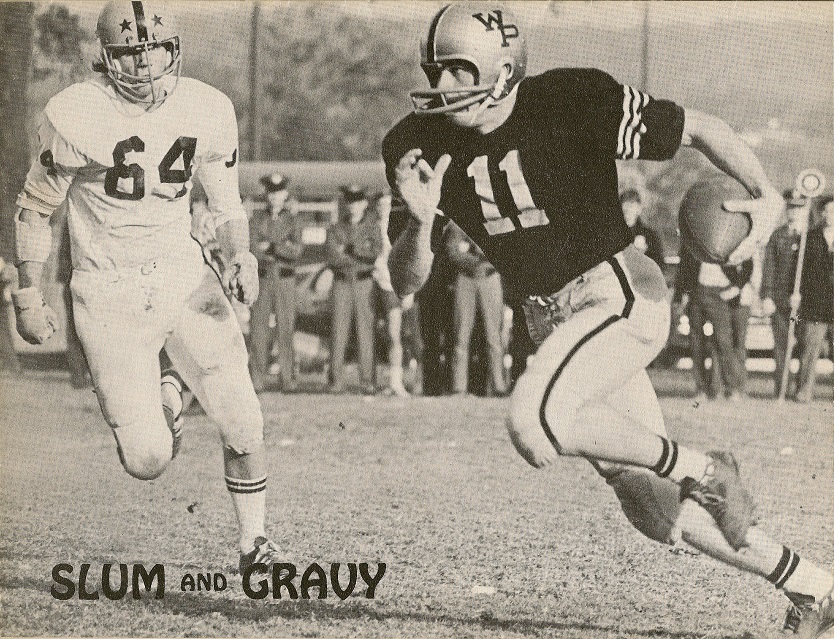
ArmyLFB_1972_111072_SlumnnGravy_Richardson
–

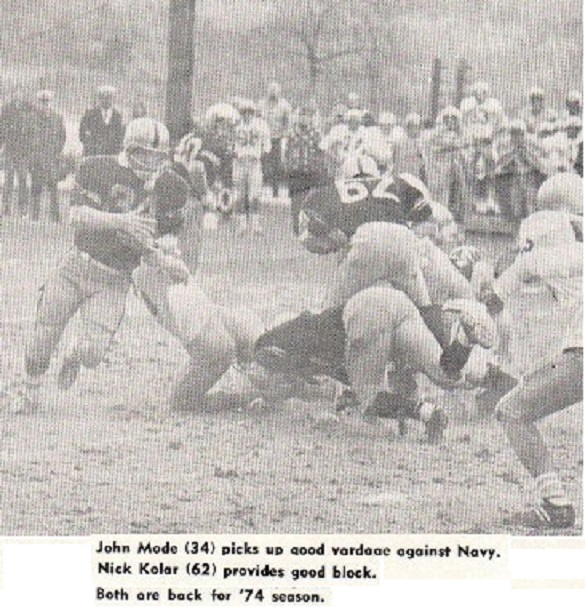
John Mode

–

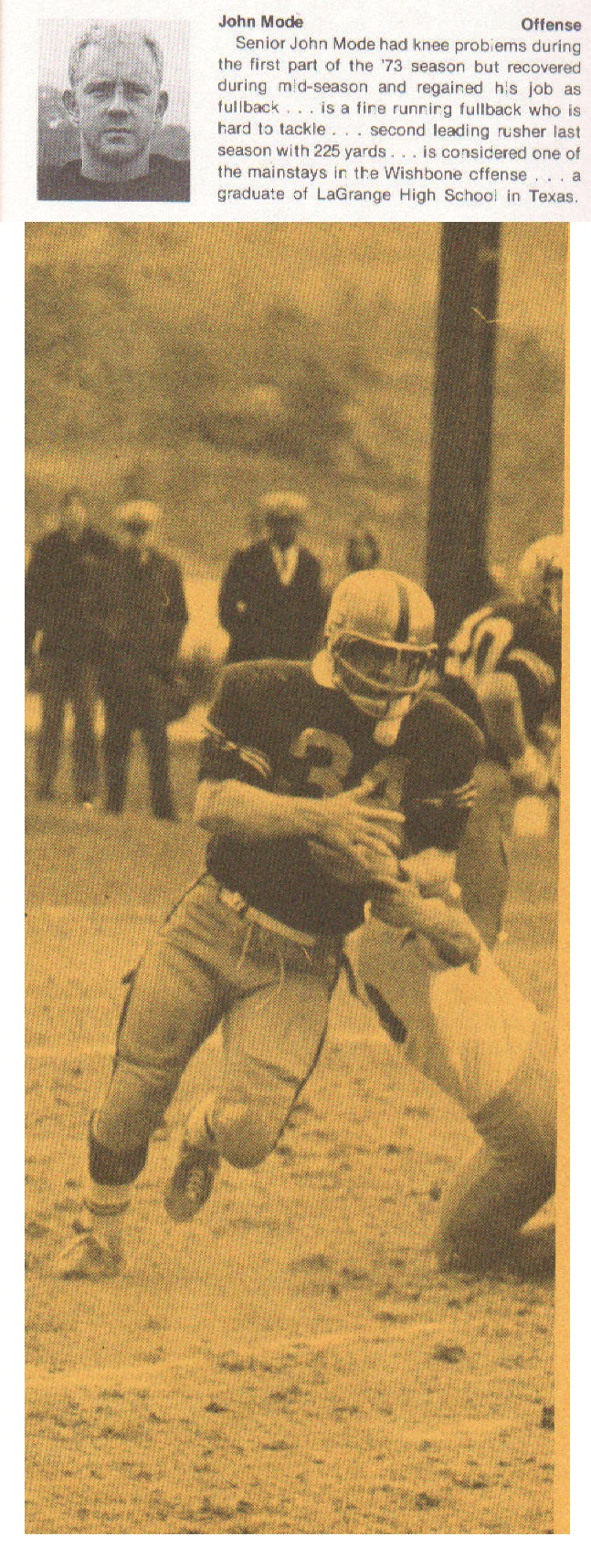
JohnMode_ArmyLFB_1974-program

–
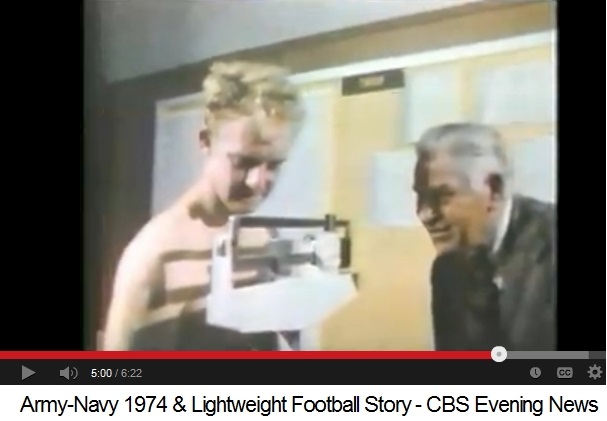
JohnMode-MakingWeight_CBSEveningNews_Nov221974
–

1974-vsCornell_JohnMode-run

–

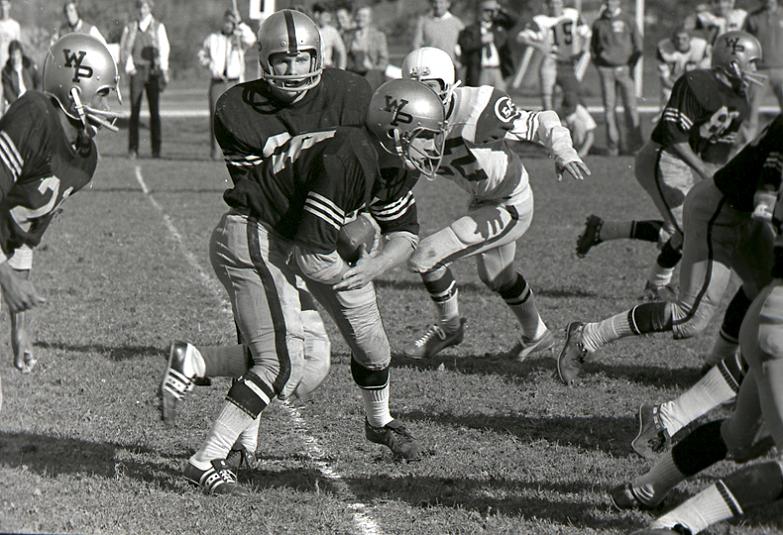
1973-JohnMode-NickKolar_vsNavy

–

Al DeJardin

Al & Kathleen DeJardin 

Basketball and Baseball – Captain of the ’62 Baseball Team – Shortstop

I knew Al and his family. I did not know Al was army great, though I always knew he went to West Point. He managed one of my summer league baseball teams in So Cal. He also as a mainstay coach at my little league growing up as his youngest son was a year younger than me. His older son Bobby was a great Shortstop as well playing for the 1984 #1 nationally ranked Mater Dei HS. He was drafted by the Cubs but opted to play for Loyola Marymount and was drafted in the 8th round by the Yankees where he has a long minor league career making as close as one can to the bigs finishing at AAA. Fun guy with an always friendly demeanor.    richandrews71

The Straw That Stirs the Drink

The 1961-62 basketball team was 10-11 but we will long remember how we beat Navy in the Field House. Stew Sherard had fouled out and the straw that stirred the drink for the Army offense, Al DeJardin, had also been disqualified. No matter. One of the five players we had on the floor was Bob Loupe — can anyone name the others? — and his famous scoop shot in the last few seconds was all we needed. Absolutely unforgettable. Navy did have one more chance, but I think they threw the ball away.

The list of basketball lettermen includes Larry Crane (1960 and 1962 — we would like Larry to tell us about 1961), Al DeJardin (1960 and 1962 — same question), Bob Loupe (1962), and Stew (1960, 1961, and 1962).

Another 2 Sport Man

In scrutinizing the on-line baseball archives, I found no mention of any member of the USMA Class of 1962 or any of the three teams to which that Class contributed other than the list of lettermen: Crane, LT; DeJardin, AR; Eccleston, TF; Fox, RM; Lilley, RJ; McRae, WD; Schmidt, JL

(Photo from Col Red Reeder’s Book – Pointers on Athletes)

Al, if memory serves, played a steady shortstop for Army and earned at least one major A for his service.


Plebe year: received class numerals for corps squad plebe teams in baseball and basketball

Received 6 “Major A” letters during the 3 years of eligibility as shown below:

Yearling year: received a “Major A” in baseball and basketball

Cow year: received a “Major A” in baseball and basketball

Firstie year: received a “Major A” in baseball and basketball (received a gold star on the “A” for beating Navy in basketball)

In April 1963 played in the Pan American Games as a member of the USA Baseball Team. The games were played in Sao Paulo, Brazil. The other teams were Cuba, Mexico, Venezuela and Brazil. Was the starting shortstop and played every inning of all games. We played Cuba in the gold medal game and lost 3-1. We received the “silver medal). The Cuban team had a number of players that had played in our “Major Leagues” but were kept in Cuba once Castro became the leader of Cuba.

Baseball highlights: Playing in Ebbetts Field (Home of the Brooklyn Dodgers) in 1956 and 1957 for the Catholic High School Championship. Won in 1957. Winning the Eastern league title Yearling year, Being selected Captain of the baseball team after the 1961 season, Being selected All Eastern League 2nd team SS Firstie year. Playing in the 1963 Pan American Games for the USA baseball team and receiving the silver medal for a second place finish..v  c

Basketball highlights: Playing against Ohio State @ Ohio State when they were rated #1 in the country, Playing UCLA, West Virginia and U of Washington in a Christmas tournament in Los Angeles, Beating Boston College @ West Point, playing in Madison Square Garden in the NIT and last but certainly not least, the exciting victory over Navy Firstie year with Bob Loupe scoring the winning basket as time was running out.


—