A Narrative History of the West Point Class of 1962 (1858 to 1865)
by Brian McEnany to be Published in 2009
by Brian McEnany to be Published in 2009
Don M. Snider, Ph.D.
Professor of Political Science, Emeritus
Department of Social Sciences, U.S. Military Academy
West Point, New York
In 1998, after a military career in the US Army, five years in Washington DC as Analyst and Director of political-military research at the Center for Strategic and International Studies (CSIS), and three years as the Olin Distinguished Professor of National Security Studies at West Point, Dr. Snider was appointed to the civilian faculty of the U.S. Military Academy. Ten years later, in 2008, as he departed West Point he was advanced to Professor Emeritus, completing fifty years of public service.
His research and lecture interests continue to include: American civil-military relations, the identities and development of the Army officer, and American military professions. He was research director, co-editor, and chapter author for three recent books on the Army as profession: The Future of the Army Profession, 2d Edition (McGraw-Hill, 2005), now a textbook at the Army War College and West Point; Forging the Warrior’s Character: Moral Precepts from the Cadet Prayer, 2d Edition (McGraw-Hill, 2008), also a text at West Point; and forthcoming, American Civil-Military Relations: The Soldier and the State in the New Era (Johns Hopkins University Press, spring, 2009).
Dr. Snider’s other publications include: Dissent and Strategic Leadership of The Military Professions (Army War College, Strategic Studies Institute, 2008); “Intrepidity and Character Development Within the Army Profession” (Strategic Studies Institute, 2008); “Leadership by Example” (Army Magazine, November 2005), “Jointness, Defense Transformation, and the Need for a New Joint Warfare Profession,” (Parameters, Autumn 2003); “Officership: The Professional Practice” (Military Review, Jan-Feb 2003); “The Civil-Military Gap and Professional Military Education” (Armed Forces and Society, Winter 2001, co-author); “America’s Post-Modern Military” (World Policy Journal, Spring 2000); “Army Professionalism, The Military Ethic and Officership in the 21st Century” (Strategic Studies Institute, 1999, co-author); “The Uninformed Debate on Military Culture,” (Orbis, Winter 1999); “Civil-Military Relations and the Ability to Influence,” (Armed Forces and Society, Spring 1999, co-author); “U.S. Civil-Military Relations: Transition or Crisis” (CSIS, 1995, co-editor); “The Gulf War and What We Learned”, (Westview Press, 1992, co-author).
In addition to Congressional testimonies, his publications have appeared in Survival, The Washington Quarterly, Air Power Review, National Security Studies Quarterly, Command, Assembly, Armed Forces Journal International, and the Joint Forces Quarterly; his op/eds have appeared in the New York Times, the Washington Post, the Wall Street Journal.
Early in his military career, Dr. Snider served three combat tours as an infantryman in the Republic of Vietnam. After battalion command in the 7th Infantry Division, he specialized in military strategy and defense policy, serving consecutively as Chief of Plans for Theater Army in Europe, Joint Planner for the Army Chief of Staff, and Federal Executive Fellow at the Brookings Institution. In 1987 he joined the staff of the National Security Council in the White House serving as Director, Defense Policy, in both the Reagan and Bush Administrations. In his final active duty position, he served in the Office of the Chairman, Joint Chiefs of Staff. He then retired from military service in 1990.
Dr. Snider holds a Doctorate in Public Policy from the University of Maryland (1993) and Master’s Degrees in Economics and in Public Policy from the University of Wisconsin (1969). He is a member of The Council on Foreign Relations, New York City, and serves on the Executive Committee of the Inter-University Seminar (IUS) on Armed Forces and Society.
The need for a Cadet Fitness Facility was identified in the early 1980s by Al Rushatz, 62’s All American in both Football & Wrestling. The concept was immediately accepted by the Class and a core group strove toward completion with dedication at our 30th reunion in 1992.
Below the discussion of the events leading to the recording is a short discussion of the painting of the Pictorial of General MacArthur talking to us less than 4 weeks from Graduation. It is again provided by Jim Ellis.
The Farewell – (and I have never felt it was a speech – I always felt that he was talking to us – telling us what he expected from us, of me) is at the end of this page. Continue reading

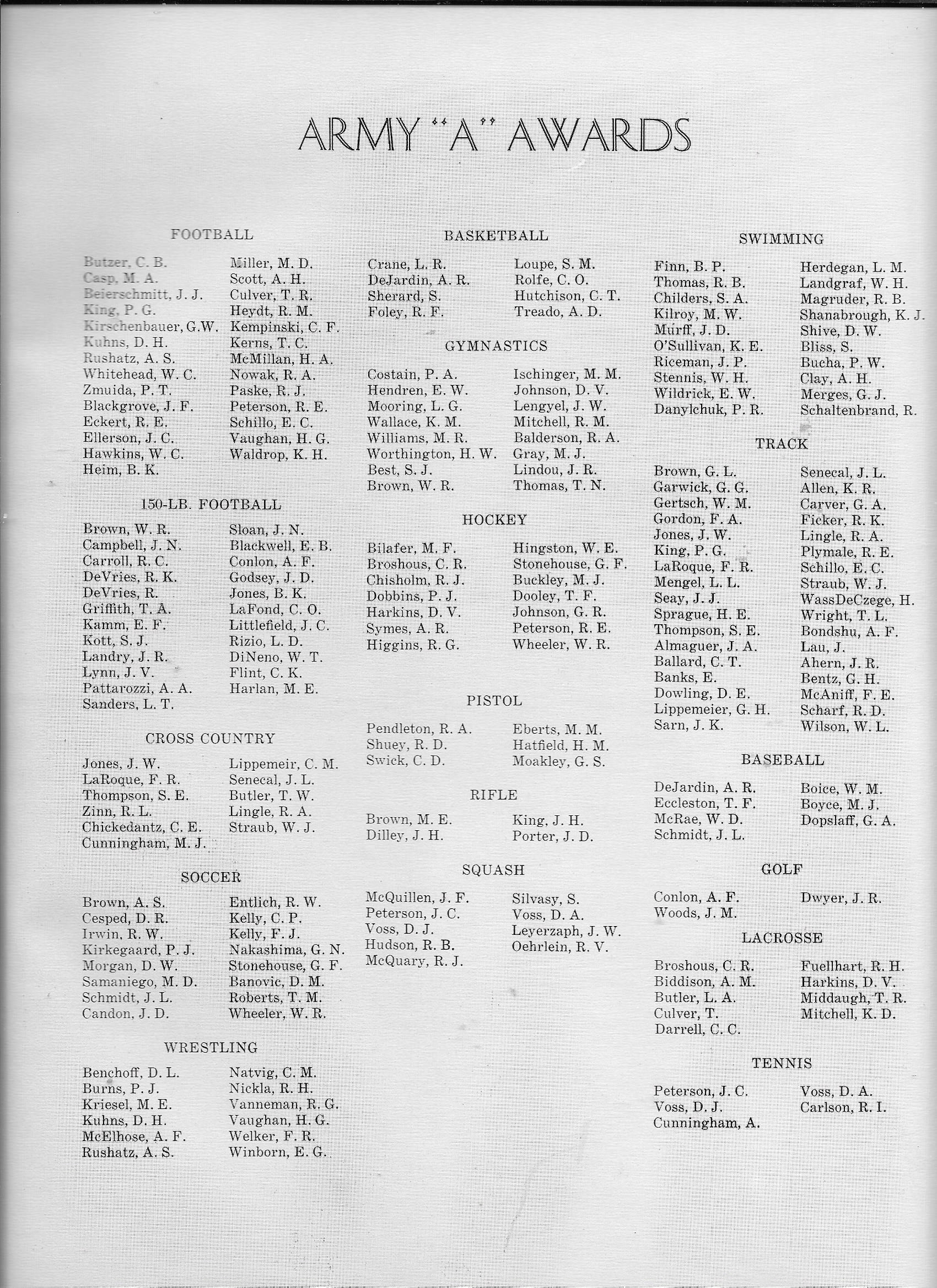
Our Four YearsAthletic Accomplishments of the Class of 62 – written by The Army A’s We Earned
Worth of a Class After 40 years what we gave back to our Nation The Obstacle Coarse then and now
Season after SeasonWe had 3 Years of eligibility |
General Stilwell Our Comm – he gave us
|
Writings by ’62Maggie Dixon 1958 Football Team
Sons of Slum & Gravy
Broke
West Point, a Century Ago 1911-1920: An Amazing Decade”
|
Donated FacilitiesKimsey Athletic Center Additional Writings
Writings by Our Motto |
For our Class
|
3 Year Starter Basketball,5 Academy Records at Graduation, 3 Army A’s
Basketball |
Dominate Athlete of the early 60’s – 6 Army A’s, All American in Football & Wrestling, First PE, The Driving Force in Establishment of the 62 Room.
|
 |
6 Army A’s Football and Wrestling
|
3 Year Starter. Firstie year, Ron Chisholm held opponents to 2.18 goals per game, an Academy record that stood for 46 years before being broken by “Josh Kassel” in the 2007 – 2008 Season. This was the last Academy individual or team record held by the Class of 1962.
|
5 Army A’s Hockey and Lacrosse
|
4 Army A’s Basketball and Baseball
|
3 Army A’s Football and LacrosseFootball and Lacrosse – Caught 10 passes against Michigan, led Team in receiving in 1961, scored twice against Navy in Lacrosse
|
Basketball and Baseball
Al Dejardin
|
4 Army A’s Football and LacrosseKilled in Action 12 August 1965
|
5 Army A’s Hockey and Lacrosse
|
2 Army A’s Football and Track
|
4 Army A’s Football and Baseball |
|
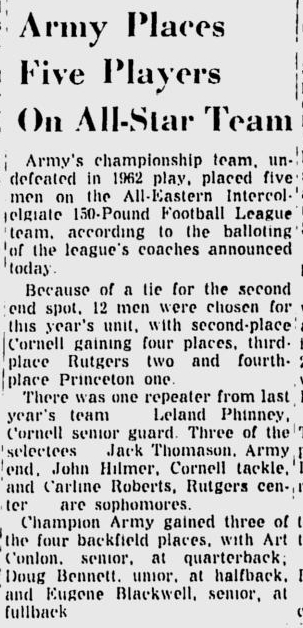
5 Army A’s – Baseball and 150 Football
|
4 Army A’s – Hockey and Lacrosse, Monogram 150 Football
|
5 Army A’s Soccer and Baseball
|
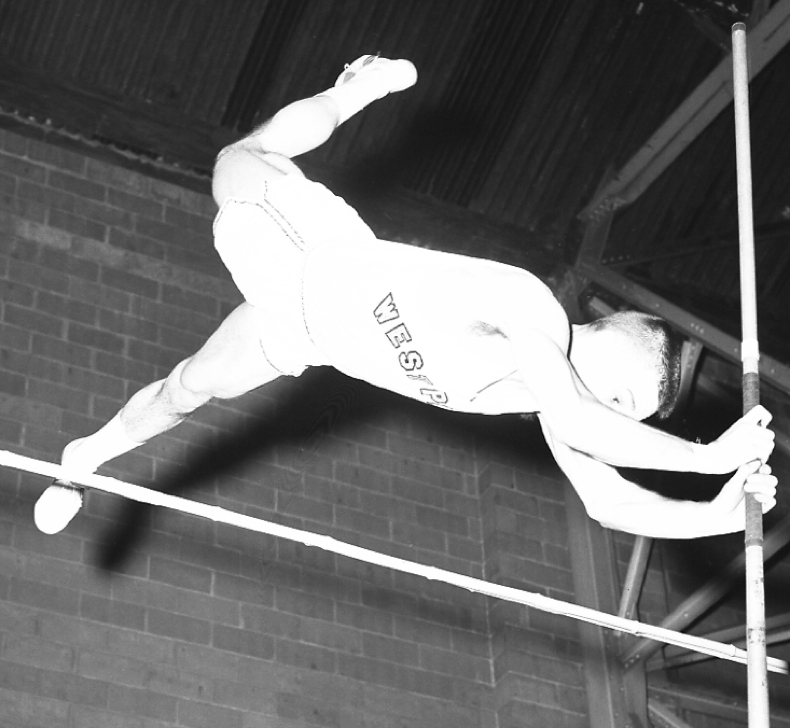
6 Army A’s Track and Cross Country
|
3 Army A’s – Cross Country and Track
|
Wrestling and 150 Football, Brigade Boxing Champion
Killed in Action 12 July 1965 |

|
An Army A Track and Cross CountryGeorge Kirschenbauer |
Olympic Walker – 1964 Olympics3 Army A’s – Cross Country and Track, Trained for Olympics Firstie Year. Did not compete on either Cross Country or Track Teams.
Killed in Action 7 July 1965 |
Click on Photos for newspaper articles NY Times
Winter 59-60 Sports Articles
|
Fall 61 Sports Articles
|
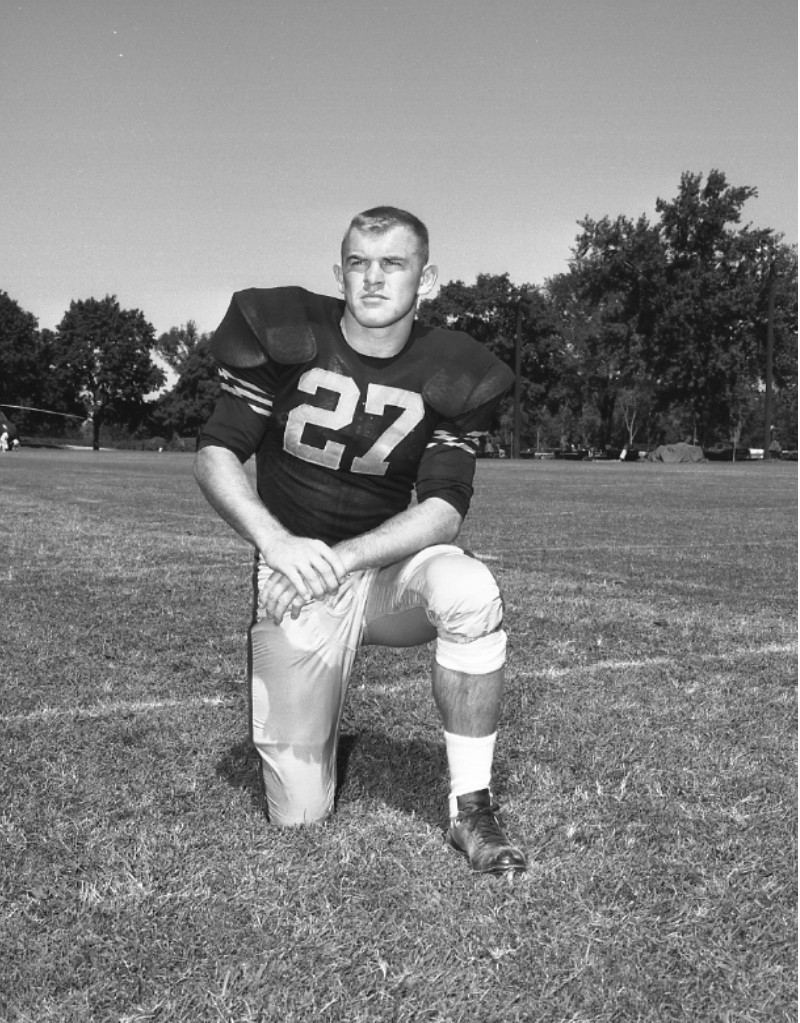 Glen Blumhardt
|
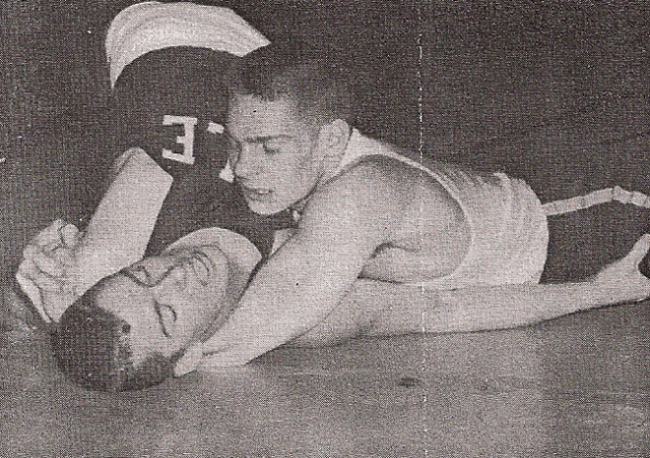 Denny Benchoff |
Ron Zinn sets Record |
Army A
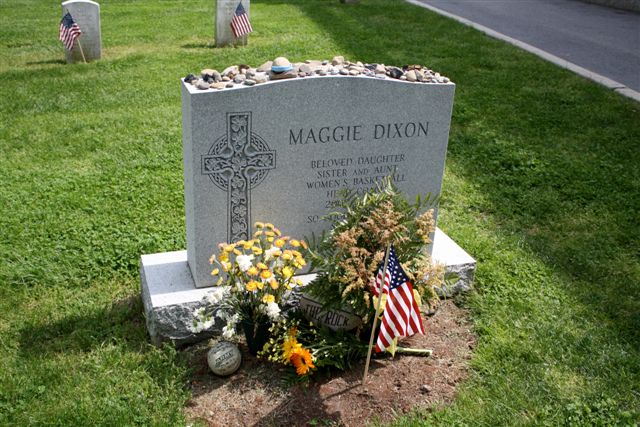
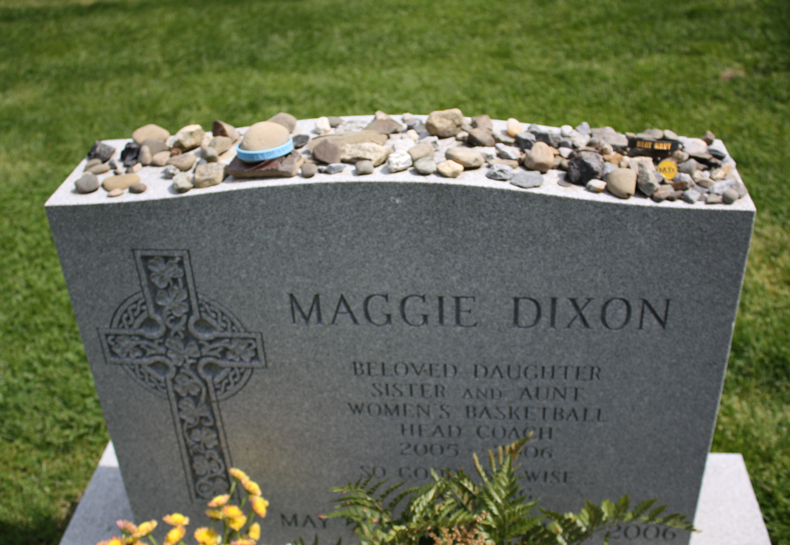
The Stones
They asked the Coach What can we do to remember her? He said gather stones from every where you go and leave them with her.
Lost to Tennesse in NCAA opening round.
Please go to The Stones and Maggie Dixon

Front Row (Sitting Left to Right): Cara Enright, Adrienne Payne, Joanne Carelus, Jen Hansen, Erin Begonia, Margaree “Redd” King, Micky Mallette, Alex McGuire, Anna Wilson, Megan Ennenga
Second Row: Ashley Magnani, Stefanie Stone, Megan Vrabel, Natalie Schmidt, Jillian Busch, Megan Evans, Courtney Wright
Back Row: Col Donna Brazil, Mary Kurnat, Dave Magarity, Craig Madzinski, Maggie Dixon, Jen Fleming, Kelly Flahive, 2LT Rejera Arnold, Sam Smay
A 20-11 Season including winners of the Patriot League Conference Tournament. They went to 2006 NCAA Women’s Division I Basketball Tournament as a 15 seed, where they lost to the University of Tennessee. It was the first March Madness Tornament appearance for any Army basketball team.
Memorial Painting Honoring Turk Griffith for Los Alamos High School Gym – – Bob Wells


Pete Pete King with ball & Bill Whitehead
|
|
|
|
|
|
|
|

West Point meets at the Quarterback
Undefeated 6-0
Beat Navy

–
–

–

–

–

–
–

–

–
–

–
–
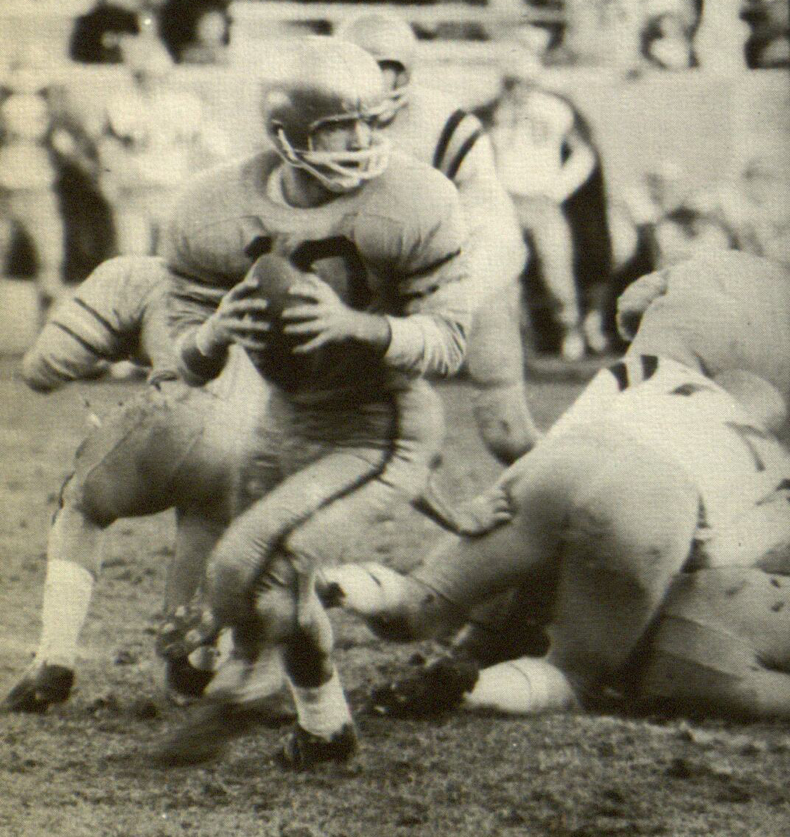
Conlon rolls

and throws
–
–
–
–
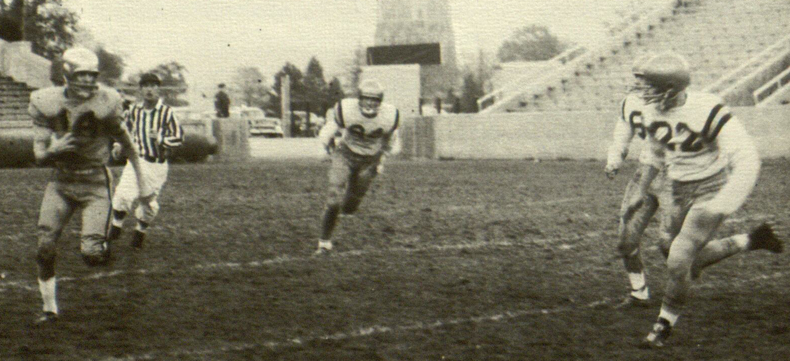
Flint on the move
–

–

–
–
–
–

Richard William Irwin
Nickname : Dick
Class : 1962
Company : L-1
Home Town: Lutherville, Maryland
High School : Milford Mill
Prior College Attendance : Georgia Tech, 1957-58
Date of Entry to Academy : July 1, 1958
Date of Graduation : June 6, 1962
Age at Graduation : 22
Cullum Number : 23912
Cadet Rank & Military Position
Rank : Lieutenant
Position : Platoon Leader
Height
Entry : 5’11”
Graduation : 5″11″
Weight
Entry : 178
Playing weight : 185
Graduation : 185
Teams :
o 1958: C Squad (Plebe) Soccer Team
o 1958-59: Off-season Lacrosse Team
o 1959: Off-season Soccer Team
o 1959: B Squad (JV) Soccer Team
o 1960: Off-season Soccer Team
o 1960: A Squad (Varsity) Soccer Team
o 1961: Off-season Soccer Team
o 1961: A Squad (Varsity) Soccer Team
Soccer Coaches
o Head Coach: “Joe Palone”
o Assistant: “Scotty Adams”
Team Captain :
o 1960 “Kaiser Bazan”
o 1961 Art Brown
Positions Played
o Plebe: Inside Left
o B-Squad: Left Halfback
o A-Squad: Center Halfback & Left Fullback
Award of Army A
o Plebe : 62 numerals
o Yearling: None
o Cow : Major A
o Firstie : Major A
As you can see from the lack of entries directly above, I was a “journeyman” soccer player (usually a starter) on teams that did not compete in any NCAA tournaments. In those days, soccer did not compete in any league, but we did play a lot of the best teams in the northeast and middle-Atlantic states.
Relationship with Tactical Department :
I managed to keep a “healthy distance” between myself and the tactical department for most of my Cadet years except for one month during plebe year when I was room orderly for two weeks during a single month. I went over in demerits and only my soccer team status saved me from walking the area. I recall that I had to serve one weekend of confinement.
The only other “brush” with the tactical department was several weeks before graduation. The Board of Visitors, headed by General of the Army Omar Bradley, were at West Point for their annual visit. On Friday afternoon (two days after we firsties had taken delivery on our new cars) we marched in a Brigade Review for the Board. I was platoon leader of 2nd platoon, L-1, for the parade.
As we passed in review, all went well until “ready front” after passing the reviewing party. Disaster occurred as I brought my saber back up and snapped my head back around. My saber slipped out of my grip and went twirling up in the air out in front of the platoon and fortunately landed pointy end in the turf, and my “tarbucket” (Editor’s note – hat with plume of feathers for Officer Cadets) spun off my head and fell to the ground. I managed to kick the hat out in front of me, removed my saber from its temporary roost in the grass as I marched by, and finally scooped-up my tarbucket which was lying in our direction of march.(Editor’s note – Tarbuckets, especially ones with feathers are deliberately kicked along the field of march by succeeding ranks of Cadets. Tarbuckets with feather are expensive)
As soon as we broke ranks in South Area, I raced up to my room, changed into civilian clothes and ran all the way down to the parking lot across from the Thayer Hotel where my new TR-4 was parked. I was determined not to miss out on a planned weekend leave trip down to Maryland to visit my soon-to-be fiance’, Sharon Lenz. Somehow, although my ineptness had been seen by all, I did not suffer any tangible consequences. ((Editor’s note – If he had not cleared the area, he would have as a minumin been required to report to his Tactical Officier – so the urgency of getting in the car and off Post)
However, the following weekend, when General of the Army Douglas MacArthur received the Thayer Award, I did have a “one-sided” conversation with the Tactical Department. As we were forming up for parade, Major “Dutch” Shultz, our L-1 Tac officer came over to me. After we saluted, he said only the following few words: “Mr. Irwin, you owe me one!” I said: “Yes sir.”
Recreation
Clubs:
o KDET
o Rocket Society
o Yearbook
o Skeet
Intramurals :
o Handball
o Squash
Class Standing : 97 out of 602
Officer Assignment to the Academy
Department : Earth, Space & Graphic Sciences, 1969-72
Coaching Duties
o Head coach, B-Squad Soccer, 1970
o Assistant coach (for Joe Palone), A-Squad Soccer, 1971
Soccer Yearling Cow & Firstie Year, Army A Cow & Firstie Year.
Awaiting data for input.
 Bob & Gail Ord


Football, Wrestling, Honor Committee. CoCO 35th Inf, 25th Div RVN, MACV, MILPERCEN, CO 1st Bde 7th Div, ODCSPER, CS CFA Korea, ADC 7th Div, CG PERSCOM, CG 25th Inf Div, CG USARPAC, Dean School of Intl Grad Studies.


George Thomas Mailey

He learned early to utilize his BROWN BOY as an escape from Cadet Routine. He is remembered as one who “stuck to his guns” – never hesitating to say what he believed. He stood 92d in the Class and went Air Force at Graduation.
GEORGE T. MAILEY 1962
Cullum No. 23908-1962 | April 4, 1964 | Died in Columbus, OH
Interred in St. Mary’s Cemetery, Latrobe, PA
First Lieutenant George Thomas Mailey, a young man from Latrobe, Pennsylvania, who packed a brilliant list of accomplishments into 23 years of life, died Saturday, 4 April, three days before his 24th birthday. He never regained consciousness after suffering a severe head injury in an automobile accident on Good Friday in Columbus, Ohio. He died at 7:55 a.m. in the Riverside Hospital.
Throughout his student days at Latrobe High School, Thomas was known for his athletic ability and for his scholastic achievements. He won eight letters in three sports: football, basketball, and golf. But it took more than athletic ability to gain admission to the Military Academy, and Thomas proved that he had it, for he was on every monthly dean’s list save one in his four years as a cadet.
After his graduation from West Point and with a commission in the Air Force, Thomas was sent to Columbus to study nuclear physics at Ohio State University. He had been a student there for a year and a half at the time of the accident and would have received his master’s degree in August 1964.
Thomas was born on 7 April 1940, the son of Mr. and Mrs. George II. Mailey in, Latrobe, Pennsylvania. He is survived by his parents; his two sisters, Anne and Jane; and one brother, Patrick.

Tom Culver led the team in receptions in 1961 year with 20 catches for 305 yards, 15.3 yards per catch. (And we thought Tom spent his time in the dog house, at least some of us less-informed types did.) These ratings seem to be based on yards per catch. His 55-yard reception from Dick Eckert against Navy helped.
Tom briefly (a couple of years) held the single-game reception record, catching 11 passes in the Michigan game in 1960. A vast coaching/media conspiracy robbed him of this legacy as his number of catches were continually reduced (why, we do not know) until he dropped out of the top few, making way for more well-known and loved receivers.
He played on the basketball team but was dropped for a poor performance in a game in which he did not play.
Tom also earned a letter in lacrosse, scoring several goals against Mt. Washington and Navy.
Many know him for his musical group, the Hot Nuts, that played classical pieces in the Weapons Room while officers were present then went into rock and roll when they departed.
Bird watcher, author, golfer, raconteur: truly a renaissance man.


The guide identifies our letter winners: Phil Costain (2 letters), Warren (Steve?) Foote (1 letter in 1962 but he did not graduate with us; does anyone know why?), Ed Hendren (2), Larry Mooring (1), Ken Wallace (2), Merle Williams (2), and Will Worthington (1). Of those I knew, I always considered them the fittest looking of the fittest.
The guide identifies our letter winners: Phil Costain (2 letters), Warren (Steve?) Foote (1 letter in 1962 but he did not graduate with us; does anyone know why?), Ed Hendren (2), Larry Mooring (1), Ken Wallace (2), Merle Williams (2), and Will Worthington (1). Of those I knew, I always considered them the fittest looking of the fittest.



Cadet will not Lie, Cheat, Steal, or Tolerate Those Who Do

USMA at West Point

We have changed the wording of our Alma Mater to reflect the fact that our Women Graduates have also given their lives serving this Nation.
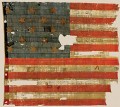
Our Flag in 1812

----- Class of 2012 Motto ------
"For More Than Ourselves"
Thank you Class of 2012 for the Honor of Marching with you The Class of 62 - Can Do

Remember - The Soldiers you will lead Always Come First

Motto -- Duty Honor Country

The Cadets of West Point

They played perhaps Army's Greatest Game. They were the Team that Gave The Most

Washington's Letter recommending the establishment of the Academy and the History of West Point

The Oaths We Take

West Point's Medal of Honor Recipients

Jefferson Hall - the Academy's new Library.

Douglas MacArthur

Vinegar Joe Stilwell cleaning his Thompson -The Walkout -Burma 1942

George Patton

The Monuments of West Point

Kosciuszko Monument - Guarding the Hudson ensuring there is no passage of British Man of War

Forts of the Hudson

So we'll sing our reminiscences of Benny Havens, Oh!

Academic Excellence

Colonel Thayer

West Point

Trophy Point

"L'Ecole Polytechnique Monument", or The French Monument by Cadets

Superintendent's Quarters viewed from Thayer Road

Superintendant was not Happy Black '57

Home of the Dean

Quarters 104

Cadet Chapel

Michie Stadium

Arvin Gym

Kimsey Athletic Center

Holleder Center

Washington Monument

United States Military Academy Band

Cadet Barracks

Rugby Complex

Great Chain

Plain looking toward Washington Hall

Battle Monument

Washington Hall with Cadet Chapel on rocks above

Hudson River

Captured Trophies

Battle Monument

West Point Cemetery

Plain

Cost to this Nation of Differing Views

Trophy Point -- Our Flag

Corps of Cadets Formed in Companies early 1960s

Sending the Army Team off to Beat Navy

Army Mule

Color Guard

Band Box Review Early 1950's in Central Area

Battalion Mass Early 50's

Flirtation Walk

Class of 2008 Class Crest & Motto "No Mission Too Great" Their Commencement "Here am I; Send me."
Thank you Class of 2008 and Please Thank the Men & Women --- the Soldiers you will lead --- The Class of 62.
Duty Honor Country
The '54 Crest

28th Infantry Regiment Black Lion Award is intended to go to the person on his team "who best exemplifies the character of Don Holleder: leadership, courage, devotion to duty, self-sacrifice, and - above all -
an unselfish concern for the team ahead of himself."
"The Army moves as a team, eats as a team, and fights as a team."

The '55 Crest

Don Holleder Remember - The Soldiers you will lead Always Come First

Vann and Holleder

9 Army A's

The '56 Crest

The '57 Crest

Can Do

Gen Van Fleet addressing the Corps prior to the Navy Game

Constructed under supervision of Jay Gould "54 and the Ord Dept from a German Rocket Gun captured at Kasserine Pass. First used in the Duke Game.

COL "Red" Reeder granted the Cheerleaders Corps Squad status to obtain financial support for their spirit-inducing initiatives.

Bob Mischak - - It should be pointed out that Bob was an All American selection, but is not recognized by the Academy as such because of the organization which selected him.

Ubel scores 3 Times against Navy - Vann's facking results in Peter getting tackled - #10 on the ground behind Ubel

Vann to Sisson

Army's B Squad

Vann to Mischak.

Uebel Intercepts

Cody to Don Holleder

Lasley

Frank Hicks

Burd

Bill Purdue

Cody

Meador Mgr

Ron Melnick

Ralph Chesnauskas

Pat Uebel

Tommy Bell

Sisson headed for another score

Peter Vann stuffs the ball in Jerry's gut

Leroy Lunn & Jerry Lodge

Uebel after taking the handoff from Hagan

Attaya - Army's Fullback

Sisson - one of 3 Great Ends
Bob Mischak

Ralph Chesnauskas

Bob Farris

Vann moving out of the pocket

Peter Vann 10, Billy Chance 38, Herdman 68

Ken Kramer

Joe Lapchick

Kirk Cockrell

Lodge going down tosses to Paul Schweikert for score.

Dick Zeigler

Bob FarrisPlayed the 2d half of the Navy Game blind in one eye.
Pat Uebel
Tommy Bell

Peter Vann

Freddie Attaya

Mike Zeigler

Jerry Lodge wearing #67, playing fullback.

Johnny Wing

Lowell Sisson

Norm Stephen

Jack Krause

Dick Ziegler

Jerry Lodge

Leroy Lunn

Norm Stephen

Jerry Lodge

Corps of Cadets for Navy Game
Can Do
"The Army moves as a team, eats as a team, and fights as a team."
The '54 Crest
The '55 Crest
28th Infantry Regiment Black Lion Award is intended to go to the person on his team "who best exemplifies the character of Don Holleder: leadership, courage, devotion to duty, self-sacrifice, and - above all - an unselfish concern for the team ahead of himself."


 What he said to us and why we have it today


 Narrative History of the West Point Class of 1862 “
 West Point Class of 1962
 Bringing Labor & Management together to assure a Stable Future
 By
 62 Room