Category Archives: Army Greats

Joseph W. Stilwell Chronology of Assignments

8/1/23-9/9/23 Leave and travel to Fort Benning, GA

9/10/23-5/29/24 Student, Advanced Officer’s Course, Infantry School, Fort Benning, GA.

5/30/24-5/30/25 Assistant Executive, Fort Benning, GA.

5/31/25-8/21/25 Leave and travel to Fort Leavenworth, KS

8/22/25-6/30/26 Student Officer, Fort Leavenworth, KS.

7/1/26-9/28/26 Leave and travel to Tientsin, China (Sailed on USAT Thomas 8/20/26-9/28/26)

9/29/26-2/22/28 15th Infantry, Tientsin, China.

— 10/1/26-12/15/26, Cdr, Provisional Battalion, 15th Inf.

— 12/6/26-4/30/27, Cdr. 2nd Battalion, 15th Inf.

— 5/1/27-10/31/27, Regimental Executive Officer, 15th Inf.

— 11/1/27-12/23/27, Cdr. Provisional Battalion, 15th Inf.

— 12/24/27-2/22/28, Regimental Executive Officer, 15th Inf.

— (Trip to Korea and Japan, 95/27-9/25/27; Trip to Japan, 9/22/28-10/30/28)

2/22/28-6/30/28 Post Executive Officer, Tientsin, China

7/1/28-4/16/29 Chief of Staff, United States American Forces in China. (Detached Service for one month effective 3/10/29; trip to Korea and Japan 3/10/29-4/1/29)

4/17/29-5/31/29 Enroute to USA (USAT Grant, 4/17/29-5/7/29, to San Francisco and then New York via Panama, 5/14/29-5/31/29).

6/1/29-7/9/29 Leave and travel to Fort Benning, GA.

7/10/29-5/-/30 Instructor in Tactics, Fort Benning, GA.

5/-/30-5/30/33 Chief of First Section (Tactics) and Instructor, Fort Benning, GA.

6/6/33-5/19/35 Reserve Duty at San Diego, CA.

4/20/35-6/4/35 Leave and travel to San Francisco, CA

6/5/35-7/6/35 Enroute to China (USAT Grant, 6/5/35-7/6/35)

7/7/35-5/13/39 Military AttachÃ∞© to China and Siam, Peking, China. (26 field trips within China and Siam)

5/13/39-8/14/39 Leave (Indo-China, Siam, Malay, Java, and Philippines) and enroute to USA (USAT Grant, 7/24/39-8/14/39)

8/16/39-9/23/39 Leave and travel to Fort Sam Houston, TX

9/24/39-10/8/39 Commander, 3rd Brigade, Fort Sam Houston, TX

10/8/39-6/28/40 The Infantry Commander, 2nd Division, Fort Sam Houston, TX.

7/1/40-7/25/41 Commanding General, 7th Division, Fort Ord, CA.

7/25/41-12/23/41 Commanding General, III Corps, Presidio of Monterey, CA.

12/24/41-1/23/42 Washington, DC (Planning North African invasion)

1/23/42-3/4/42 Planning, assembling staff, and enroute to China

3/4/42-10/26/44 Chief of Staff to the Supreme Commander of the China Theater; Commanding General of US Army Forces in the China Theater of Operation, Burma, and India (o/a June 22, 1942 evolved to Commanding General, China-Burma-India Theater); and subsequently Deputy Commander, Southeast Asia Command.

10/26/44-1/22/45 Enroute to the USA, leave, and waiting new assignment per verbal instructions from General Marshall, Army Chief of Staff.

1/24/45-6/21/45 Commanding General, Army Ground Forces.

6/23/45-10/15/45 Commanding General, Tenth Army, Okinawa.2/22/28-6/30/28 Post Executive Officer, Tientsin, China

11/1/45-1/19/46 Washington, DC, War Equipment Board.

1/22//46-2/28/46 Commanding General, Western Defense Command, Presidio of San Francisco, CA.

3/1/46-10/12/46 Commanding General, Sixth Army, Presidio of San Francisco, CA. (Observer, Bikini Atomic Bomb tests 6/25/46-7/31/46)

10/12/46 Died at Presidio of San Francisco; age 63

Sources: Diaries, orders, papers, and notes in the Joseph W. Stilwell Collection, Hoover Institution on War, Revolution and Peace, Stanford, CA, and personal letter in the possession of John Easterbrook. Compiled by John Easterbrook, April 2002.

NOTE: Some time intervals shown between assignments are assumed to be a small number of leave days and/or travel time, and in some cases clearing customs following international travel. Major blocks of leave time are noted. Single day differences were occasionally noted between Stilwell diaries, Stilwell summary notes, and orders. In these cases preference was given to daily diary entries when available.

6/15/04 Graduated from USMA, West Point, NY

6/16/04-9/14/04 Graduation leave and travel to West Coast

9/15/05-11/7/04 Enroute to Camp Jossman, Philippine Islands (USAT Sheridan 10/1/04-10/29/04)

11/7/04-4/8/06 Camp Jossman, Guimaras, Philippine Islands (In the field, Samar, Philippine Islands, 2-3/05), 12th Infantry.

4/9/06-8/21/06 Travel to the US (4/9/06-5/15/06), leave, and travel to West Point

8/22/06-12/18/10 Department of Modern Languages, USMA (Intelligence gathering trip through Guatemala, 6/20/07-8/9/07; Trip through Mexico 6/28/08-8/1/08; Trip to Honduras, Salvador, and Guatemala, 6/25/09-8/4/09)

12/19/10-1/31/11 Travel to West Coast and enroute to Philippine Islands (USAT Sherman, 1/5/11-1/31/11).

2/1/11-2/11/12 Fort William McKinley, Philippine Islands (Company D, 12th Infantry 6/4/11; Leave in Japan and China 9/15/11-12/14/11) Returned to USA with Company D, 12th Infantry.

2/11/12-4/29/13 Presidio of Monterey, CA, Company D, 12th Infantry

4/30/13-5/31/13 Leave

6/1/13-6/27/13 Fort Niagara, NY for tryout for Army Infantry Rifle Team

6/28/13-8/17/13 Leave and travel

8/18/13-6/2/14 Department of English and History, USMA

6/3/14-6/14/14 Travel to Madrid, Spain (Ship Lorraine 6/3/14-6/10/14)

6//15/14-8/6/14 Madrid, Spain for Spanish language course

8/8/14-8/27/14 Travel to USA (RMS Ivernia from Gibralter to Boston 8/8/14-8/20/14) and leave

8/28/14-4/21/15 Department of Modern Languages, USMA

4/22/15-4/26/15 Travel to Madison Barracks, NY

4/27/15-9/27/15 Madison Barracks, NY for “duty with troops” (Companies H, L, and K, 3rd Infantry)

9/28/15-9/30/15 Leave

10/1/15-6/25/16 Department of Modern Languages, USMA

6/12/16-8/12/16 Camp of Instruction, Regular Troops, Plattsburg, NY (Company M, 1st Battalion, Station Training Regiment/8th Training Regiment)

8/12/16-8/24/17 Department of Modern Languages, USMA (with additional duty in Department of Tactics starting in June 1917)

8/25/17-12/18/17 Camp Lee, VA, 80th Division (Brigade Adjutant, Camp Quartermaster, Commandant Quartermaster Training School, Commandant School of Arms and Assistant Chief of Staff G-2).

12/30/17-1/19/18 Enroute to France (USMS New York from NY 1/7/18, arrived Le Harve, France 1/19/18)

1/19/18-2/6/18 General Headquarters, A. E. F., Chaumont, France

2/6/18-2/10/18 Travel to British 30th Division and on to British 58th Division

2/10/18-2/15/18 With British 58th Division, La Fere Sector

2/16/18-2/28/18 Army Schools, Intelligence Course, Langres, France

2/28/18-3/17/18 General Headquarters, A. E. F., Chaumont, France

3/20/18-4/29/18 With French 17th Corps, Verdun Sector

4/30/18-6/5/18 General Headquarters, A. E. F., Chaumont, France

6/6/18-6/15/18 With US 2nd Corps, G-2 Section

6/19/18-1/20/19 Assistant Chief of Staff, G-2, US 4th Corps (Toul Sector; in Battle of St. Mihiel; Temporary Duty 1st Corps, 8/8/18-8/10/18).

1/20/19-6/23/19 Assistant Chief of Staff, G-1, 4th Corps, Army of Occupation, Cochem, Germany

7/5/19-7/15/19 Enroute to the USA (Lorraine)

7/16/19-8/29/19 Leave (one month) and travel to California

8/29/19-5/17/20 Chinese Language Student, University of California, Berkeley, CA.

5/18/20-8/4/20 Leave

8/5/20-9/20/20 Enroute to China (USAT Madawaska to Manila, 8/5/20-8/31/20)

9/20/20-7/8/23 Chinese Language Student, Peking, China

7/8/23-7/31/23 Enroute to USA (USAT Thomas, 7/8/23-7/31/23)

Vinegar Joe Stilwell – 2


Army Sports Hall of Fame Inductees 2004 – 2009

AAA-2010 Sports Hall of Fame Inductees Booklet

Clennie Brundidge

test3

2010 Army Sports Hall of Fame Inductees

Click on each photo for larger photo. Joe Stilwell , Peter Vann and Al Rushatz have a great deal of material on their pages.


Jonathan Aaronsohn

Michael McElrath

Melody Ann Smith

Teresa Sobiesk

The hand written comment was her closing remark at her Induction. It brought many laughs in a room full of former Army Athletes.

George S. Patton

Old Blood and Guts


Comment about Patton’s Football playing – page 256

Link – Patton Played

In July of 1950 across from the Library, the grounds were being
prepared for a new statue. I was in 6th New Cadet Company in Old South Barracks. Every day during Beast Barracks on our way to gorilla drills on the Plain, we could glance and see how the base for the new statue was progressing. Then came the first part of the installation, the gleaming bronze of George Patton in combat gear, field glasses at the ready and a pair of pearl pistols on his hips. He stool tall and trim, a magnificent sight. When it was completed for some reason, the platoon I was in was selected to be Honor Guard for the temporary dedication of Gen George Patton’s statue. I stood in the front ranks of the platoon staring straight ahead but taking upward glances. The ceremony was short. When the Corps returned some time later a formal dedication occurred.


Patton with a friend


In 1952/3 a Colonel in a riding military uniform complete with riding
boots was seen striding with a hitch in his get-along on sidewalk coming up from the Old Riding Hall. My Classmate said; “That is Colonel John K Waters, Patton’s son-in-law. He was captured at Kasserine Pass and was badly wounded in prison camp in a failed liberation.” General Patton never knew his son-in-law was in the German prison camp. After the war General Patton indicated that his only mistake during the campaign was his failure in not sending a larger combat force.


Back then the Riding Hall had not been converted and was stillcomplete
with horse stalls and a riding loop. Two to three times a week Col
Waters would be seen limping back from his ride. Patton was my favorite not just because a classmate’s dad, Gen Grow served under Patton but simply because of the stories I read as a young adult about Patton’s Olympic Medals. I researched Patton’s papers in the library and found a letter written to his Cadet son. Basically it said words to the effect,

“Study history because times may change but the actions and reactions of men never change.”


Looking back, how ironic. Col Waters going past Gen Patton’s statue
while we were constructing a West Point Victory Cannon made from a
German rocket cannon captured at Kasserine Pass. (Editor’s Note the Cannon was first used in the 1953 Army Duke Game)

Written by Jay Gould Class of 1954 – Army Cheer Leader


This is the full text of the speech Gen. Patton made prior to D-Day. The date was 5 June, 1944. Please be advised it is quite profane.

General Patton:

Be seated.

Men, this stuff that some sources sling around about America wanting out of this war, not wanting to fight, is a crock of bullshit.

Americans love to fight, traditionally. All real Americans love the sting and clash of battle.

You are here today for three reasons. First, because you are here to defend your homes and your loved ones. Second, you are here for your own self respect, because you would not want to be anywhere else.

Third, you are here because you are real men and all real men like to fight.

When you, here, everyone of you, were kids, you all admired the champion marble player, the fastest runner, the toughest boxer, the big league ball players, and the All-American football players. Americans love a winner. Americans will not tolerate a loser. Americans despise cowards.

Americans play to win all of the time. I wouldn’t give a hoot in hell for a man who lost and laughed. That’s why Americans have never lost nor will ever lose a war; for the very idea of losing is hateful to an American.

You are not all going to die. Only two percent of you right here today would die in a major battle. Death must not be feared. Death, in time, comes to all men. Yes, every man is scared in his first battle. If he says he’s not, he’s a liar. Some men are cowards but they fight the same as the brave men or they get the hell slammed out of them watching men fight who are just as scared as they are.

The real hero is the man who fights even though he is scared.

Some men get over their fright in a minute under fire. For some, it takes an hour. For some, it takes days. But a real man will never let his fear of death overpower his honor, his sense of duty to his country, and his innate manhood. Battle is the most magnificent competition in which a human being can indulge. It brings out all that is best and it removes all that is base. Americans pride themselves on being He Men and they ARE He Men.

Remember that the enemy is just as frightened as you are, and probably more so. They are not supermen.

All through your Army careers, you men have bitched about what you call ‘chicken shit drilling’. That, like everything else in this Army, has a definite purpose. That purpose is alertness. Alertness must be bred into every soldier. I don’t give a fuck for a man who’s not always on his toes. You men are veterans or you wouldn’t be here. You are ready for what’s to come. A man must be alert at all times if he expects to stay alive. If you’re not alert, sometime, a German son-of-an-asshole-bitch is going to sneak up behind you and beat you to death with a sockful of shit!

There are four hundred neatly marked graves somewhere in Sicily, all because one man went to sleep on the job. But they are German graves, because we caught the bastard asleep before they did.

An Army is a team. It lives, sleeps, eats, and fights as a team. This individual heroic stuff is pure horse shit. The bilious bastards who write that kind of stuff for the Saturday Evening Post don’t know any more about real fighting under fire than they know about fucking! We have the finest food, the finest equipment, the best spirit, and the best men in the world. Why, by God, I actually pity those poor sons-of-bitches we’re going up against. By God, I do.

My men don’t surrender, and I don’t want to hear of any soldier under my command being captured unless he has been hit. Even if you are hit, you can still fight back That’s not just bull shit either. The kind of man that I want in my command is just like the lieutenant in Libya, who, with a Luger against his chest, jerked off his helmet, swept the gun aside with one hand, and busted the hell out of the Kraut with his helmet. Then he jumped on the gun and went out and killed another German before they knew what the hell was coming off. And, all of that time, this man had a bullet through a lung. There was a real man!

All of the real heroes are not storybook combat fighters, either. Every single man in this Army plays a vital role. Don’t ever let up. Don’t ever think that your job is unimportant. Every man has a job to do and he must do it. Every man is a vital link in the great chain.

What if every truck driver suddenly decided that he didn’t like the whine of those shells overhead, turned yellow, and jumped headlong into a ditch? The cowardly bastard could say, ‘Hell, they won’t miss me, just one man in thousands.’ But, what if every man thought that way? Where in the hell would we be now? What would our country, our loved ones, our homes, even the world, be like?

No, Goddamnit, Americans don’t think like that. Every man does his job. Every man serves the whole. Every department, every unit, is important in the vast scheme of this war.

The ordnance men are needed to supply the guns and machinery of war to keep us rolling. The Quartermaster is needed to bring up food and clothes because where we are going there isn’t a hell of a lot to steal. Every last man on K.P. has a job to do, even the one who heats our water to keep us from getting the ‘G.I. Shits’.

Each man must not think only of himself, but also of his buddy fighting beside him. We don’t want yellow cowards in this Army. They should be killed off like rats. If not, they will go home after this war and breed more cowards. The brave men will breed more brave men. Kill off the Goddamned cowards and we will have a nation of brave men.

One of the bravest men that I ever saw was a fellow on top of a telegraph pole in the midst of a furious fire fight in Tunisia. I stopped and asked what the hell he was doing up there at a time like that. He answered, ‘Fixing the wire, Sir.’ I asked, ‘Isn’t that a little unhealthy right about now?’ He answered, ‘Yes Sir, but the Goddamned wire has to be fixed.’ I asked, ‘Don’t those planes strafing the road bother you?’ And he answered, ‘No, Sir, but you sure as hell do!’ Now, there was a real man. A real soldier. There was a man who devoted all he had to his duty, no matter how seemingly insignificant his duty might appear at the time, no matter how great the odds.

And you should have seen those trucks on the rode to Tunisia. Those drivers were magnificent. All day and all night they rolled over those son-of-a-bitching roads, never stopping, never faltering from their course, with shells bursting all around them all of the time. We got through on good old American guts. Many of those men drove for over forty consecutive hours. These men weren’t combat men, but they were soldiers with a job to do. They did it, and in one hell of a way they did it. They were part of a team. Without team effort, without them, the fight would have been lost. All of the links in the chain pulled together and the chain became unbreakable.

Don’t forget, you men don’t know that I’m here. No mention of that fact is to be made in any letters. The world is not supposed to know what the hell happened to me. I’m not supposed to be commanding this Army. I’m not even supposed to be here in England. Let the first bastards to find out be the Goddamned Germans. Some day I want to see them raise up on their piss-soaked hind legs and howl, ‘Jesus Christ, it’s the Goddamned Third Army again and that son-of-a-fucking-bitch Patton’. We want to get the hell over there.’ The quicker we clean up this Goddamned mess, the quicker we can take a little jaunt against the purple pissing Japs and clean out their nest, too. Before the Goddamned Marines get all of the credit.

Sure, we want to go home. We want this war over with. The quickest way to get it over with is to go get the bastards who started it. The quicker they are whipped, the quicker we can go home. The shortest way home is through Berlin and Tokyo. And when we get to Berlin I am personally going to shoot that paper hanging son-of-a-bitch Hitler. Just like I’d shoot a snake!

When a man is lying in a shell hole, if he just stays there all day, a German will get to him eventually. The hell with that idea. The hell with taking it. My men don’t dig foxholes. I don’t want them to. Foxholes only slow up an offensive. Keep moving. And don’t give the enemy time to dig one either. We’ll win this war, but we’ll win it only by fighting and by showing the Germans that we’ve got more guts than they have; or ever will have.

We’re not going to just shoot the sons-of-bitches, we’re going to rip out their living Goddamned guts and use them to grease the treads of our tanks. We’re going to murder those lousy Hun cock suckers by the bushel-fucking-basket. War is a bloody, killing business. You’ve got to spill their blood, or they will spill yours. Rip them up the belly. Shoot them in the guts. When shells are hitting all around you and you wipe the dirt off your face and realize that instead of dirt it’s the blood and guts of what once was your best friend beside you, you’ll know what to do!

I don’t want to get any messages saying, ‘I am holding my position.’ We are not holding a Goddamned thing. Let the Germans do that. We are advancing constantly and we are not interested in holding onto anything, except the enemy’s balls. We are going to twist his balls and kick the living shit out of him all of the time. Our basic plan of operation is to advance and to keep on advancing regardless of whether we have to go over, under, or through the enemy. We are going to go through him like crap through a goose; like shit through a tin horn!

From time to time there will be some complaints that we are pushing our people too hard. I don’t give a good Goddamn about such complaints. I believe in the old and sound rule that an ounce of sweat will save a gallon of blood. The harder WE push, the more Germans we will kill. The more Germans we kill, the fewer of our men will be killed. Pushing means fewer casualties. I want you all to remember that.

There is one great thing that you men will all be able to say after this war is over and you are home once again. You may be thankful that twenty years from now when you are sitting by the fireplace with your grandson on your knee and he asks you what you did in the great World War II, you WON’T have to cough, shift him to the other knee and say, ‘Well, your Granddaddy shoveled shit in Louisiana.’ No, Sir, you can look him straight in the eye and say, ‘Son, your Granddaddy rode with the Great Third Army and a Son-of-a-Goddamned-Bitch named Georgie Patton!'”

Paul McNamara

Paul & Isolde McNamara 

Rugby (Right Wing) Cow & Firstie Years. Paul played in the Old Gray Game following the dedication of the new Anderson Rugby Complex.

Mason Burns

Mason has a very strong arm and has great potential as a future quarterback. He is concentrating on accuracy and consistency and will develop into a great athlete if he continues to work hard. We will be watching his development closely over the next few years.

Selection of Al Rushatz for the Army Sports Hall of Fame

Al’s Nomination Letter written by Dave Phillips is at Al Rushatz

Chris Keuker

Chris & Dixie Sewell

Rifle Team as a Plebe.

First Classmate to go to Vietnam – First Classmate to become a prisoner of War – although not in that order.

Continue reading →

Al Girardi

3 Years Lacrosse

Eugene Vidal

The Team only played one game on September 28th against Mitchel Field Aviators – winning 20 to 0.
Continue reading →

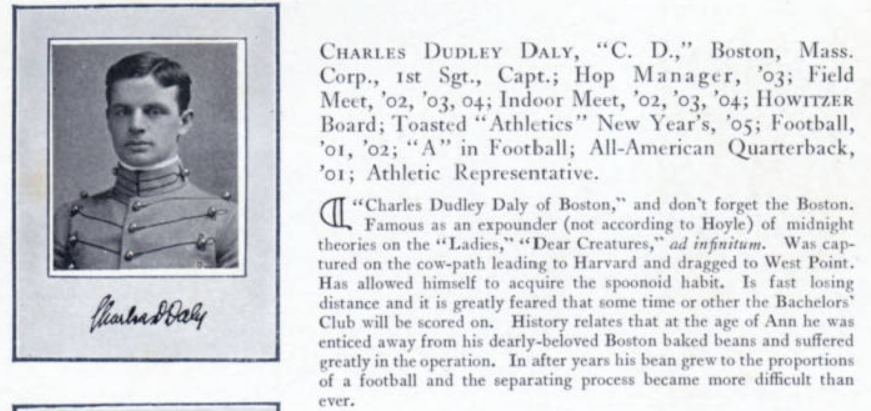
Charles Daly

Charlie Daly

Material from Football Hall of Fame

Position: Quarterback

School: Harvard, Army

High School: Boston, MA (Latin HS)

Years: 1898-1902

Inducted: 1951

Place of Birth: Roxbury, MA

Date of Birth: 10/31/1880

Place of Death: Pacific Grove, CA

Date of Death: 2/12/1959

Height: 5-7

Weight: 152

Charles Daly was a 5-7, 150-pound quarterback who played five years and was a first team All-America four times. He played for Harvard in 1898-1900 and for Army 1901-1902. He was a first team All-America all three of his years at Harvard and at Army in 1901. In his final season, Walter Camp named him as a third team All-America. In his three years at Harvard, the team had a record of 31-1-1. Army, in his two playing years, went 11-2-3. Playing for Harvard in 1900 against Carlisle, he made a 60-yard run and drop-kicked a field goal. Playing for Army against Navy in 1901, he had a 100-yard kick return for a touchdown, a field goal, and an extra point – all of Army’s points in an 11-5 victory.

William Hanna, writing in the New York World Telegram in 1927, called Daly “one of the five greatest quarterbacks of all time.” He graduated from Harvard in 1901. Congressman John H. Fitzgerald of Massachusetts gave Daly an appointment to West Point. Daly was there four years, playing football just two seasons, and graduated 46th in a class of 114.

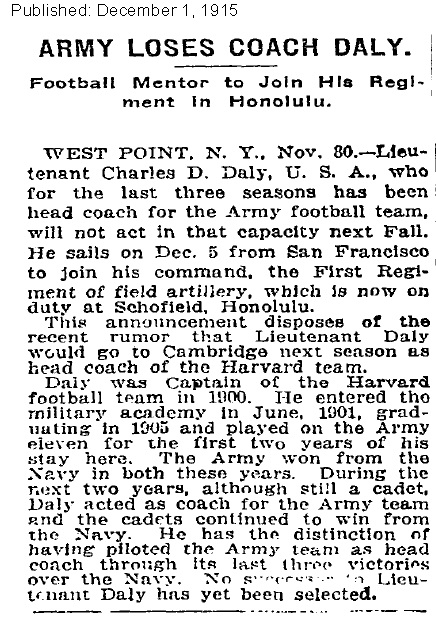
For several years he alternated between the military and business. In 1907 he was assistant football coach at Harvard. In 1910- 1912 he was fire commissioner for the city of Boston. He was Army’s head football coach 1913-1916 and 1919-1922. He had a 58-13-3 record; his 1914, 1916, 1922 teams were undefeated.

In 1922 he helped found the American Football Coaches Association and served as its first president.

Daly was born October 31, 1880, in Roxbury, Massachusetts; he died February. 12, 1959, in Pacific Grove, California. He had three sons who graduated from West Point and two daughters who married West Point graduates.

–

CharlesD.Daly_Classof1905

–

Class of 1905
–

ArmyFB_1915_CoachDaly_NYT_Dec11915

–

Coach Charles Dudley “Charlie” Daly (October 31, 1880 – February 12, 1959)

Army 1913-1916
Army 1919-1922
Overall: 58-13-3

Appeared in the film Daly, of West Point. 1902.

source http://en.wikipedia.org/wiki/Charles_Dudley_Daly

–

Zinn Sets Record

Lee Taylor

Gymnastics Plebe & Yearling Year, Track Yearling Year and Judo Club all 4 Years

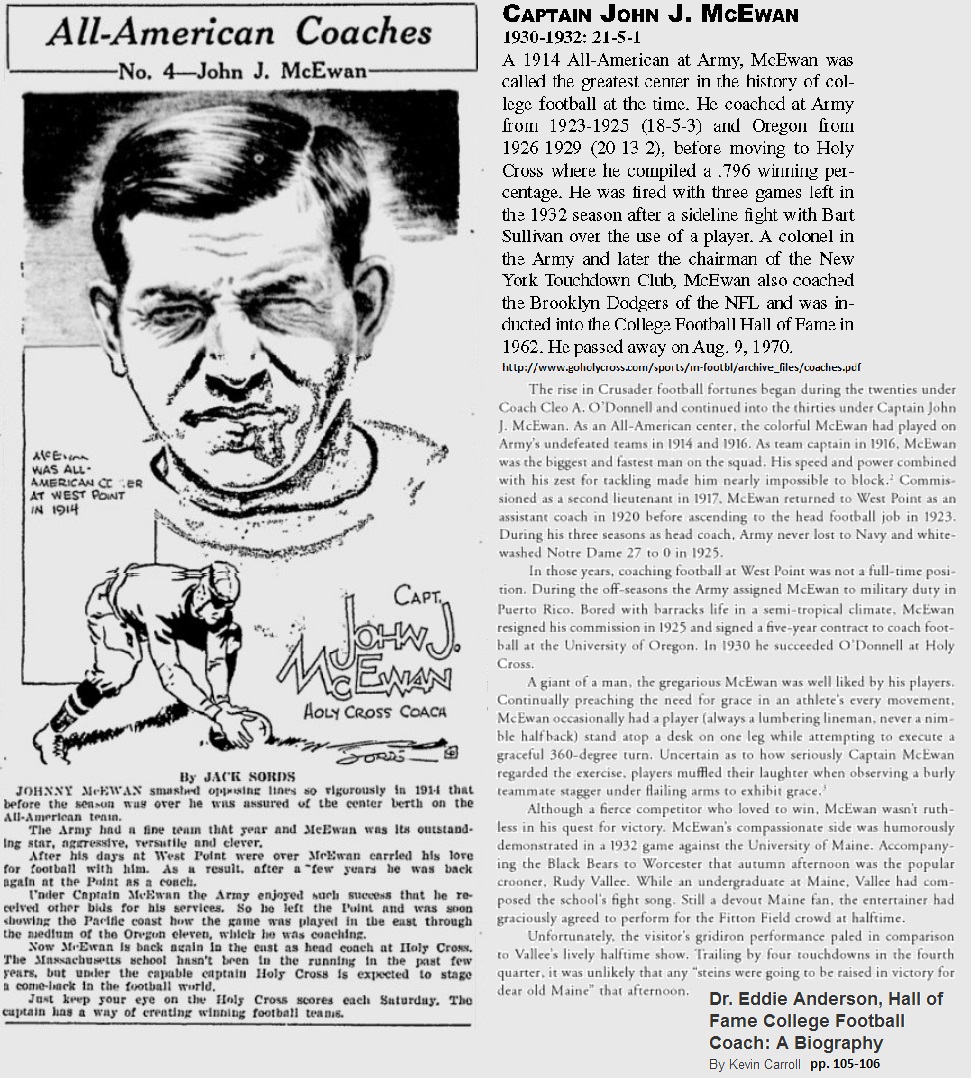
John McEwan

Class of April 1917 – 4 Army A’s in Football as a Center – The Football Teams beat Navy in 1913, 1914, 1915, and in 1916

In the anatomy of a game: football, the rules, and the men who made the game By David M. Nelson — it appears to be the same John and his name is listed as McEwen

http://en.wikipedia.org/wiki/John_McEwan

John McEwan player/coach

John J McEwan

Editors Note – Not sure which orientation is correct.

John J McEwan

College Football Hall of Fame Biography

John McEwan was an innovator among players of the early 1900’s, pioneering the spiral center-snap and introducing a primitive version of the defensive rover-back to Eastern football. Upon graduation from West Point in 1917, McEwan was hailed as the greatest football center the U.S. Military Academy ever had. Walter Camp labeled him first-team All- America in 1914.

As a senior in 1916, McEwan was elected team captain by his Cadet peers. Tim Cohane, longtime sports editor of LOOK MAGAZINE and author of “Gridiron Grenadiers”, described McEwan thusly: “Big Mac, in his prime, weighed from 195 to 205 and stood 6 feet, 4 inches tall. He was built like a heavyweight fighter. His broad shoulders tapered down to slim hips and comparatively thin legs, which brought him frequent but not inactivating knee injuries.” McEwan was unusually fast for a man of his size and became known for his ability to cover large areas of the field while exhibiting a tremendous tackling and blocking prowess. Seven years after his graduation, the Alexandria, Minnesota native returned to West Point as head football coach. During his three coaching seasons, his Army teams rolled to an 18-5- 3 record. He went on to coach Oregon, Holy Cross and the professional Brooklyn Dodgers. He died in 1970.

–

JohnJMcEwan_ArmyFB_andCoach

–