Tag Archives: 1962

Sons of Slum & Gravy

by Bill Mogan

Sons of Slum and Gravy chronicles the coming of age of a child of the 1950’s. William W. (Bill) Mogan shares an engaging personal story that leads him along a path to West Point and the Class of 1962. His experiences there and after graduation cause him to develop a deep and abiding respect and affection for his classmates.

Continue reading →

John Easterbrook

John & Hanh Easterbrook

I was just the basketball manager and only qualified for a black Army A — hardly qualified to be in the company of the true jocks.

My fondest memories were watching Stu Sherard perform. He had the smoothest jump shot I have ever seen, and witnessing him pile up Academy and national records was a real pleasure. He certainly was a very consistent performer.

I will also never forget Bob Loupe scoring the winning basket in our victory over Navy in 1962. After three years of losing to Navy, it was a very emotional win.

I was the official scorer for that game (because Army was the home team) and right after he game was over the Navy scorer told me that he had Navy winning by one point vice Army winning by one point. My book was the official book and was correct; the Navy scorer had failed to record one Army field goal.


John nominated his Grandfather for induction into the Army Sports Hall of Fame Vinegar Joe Stilwell was inducted on the 17th of September 2010

Turk Griffith and I were in the basic officer’s course together at Fort Gordon, GA, and Turk (and others) played on a touch football team. The team was stacked with former college players and had its way with the other teams in the league.

Turk played on the inside of the offensive line and had a much larger varsity college player on his outside. The other teams would frequently complain that Turk was not abiding by the rules and I can vividly remember the referee getting right up on the line to try to catch Turk doing something illegal.

Now I am sure Turk would never do anything outside the rules, but since the referee was shielded from seeing everything by the player to Turk’s outside, Turk was never called for an infraction.

Griffith Hall at Fort Gordon is, of course, named for Turk. It is a BOQ or VOQ and, I am told, has recently been renovated.

Grandson of  Joe Stilwell the Commanding General China Burma India Theater WW II  China_Burma_India_Seal.svg.png
 Added by a Friend – John has traveled to China on a number of occasions and has assisted in 1991 the People’s Republic of China establishment of the Stilwell

Richard Steinke

Lacrosse Manager Plebe and Yearling Year

Don Voss

PY Browning

Philip Y. Browning Jr.  
BG.pngPhilip & Mary Ann Browning 800px-12_Cav_Rgt_DUI.png   220px-75th_Ranger_Regiment_Distinctive_Unit_Insignia.svg copy.png
Co CO 2d of the 12th Cav, 75th Ranger, ADC 71D,

Philip Yeager Browning

PLACE OF BIRTH:
Hawaii

Philip Browning graduated from the U.S. Military Academy at West Point, Class of 1962. He retired as a U.S. Army Brigadier General.

AWARDS BY DATE OF ACTION: 1 of 5


Army Distinguished Service Medal

AWARDED FOR ACTIONS
DURING Peace Time Awards
Service: Army
Rank: Brigadier General
GENERAL ORDERS:

United States Military Academy Register of Graduates

CITATION:

(Citation Needed) – SYNOPSIS: Brigadier General Philip Yeager Browning, Jr., United States Army, was awarded the Army Distinguished Service Medal for exceptionally meritorious and distinguished service in a position of great responsibility to the Government of the United States as Chief of Staff, U.S. Army Caribbean, from 1991 to 1992.

Silver Star

AWARDED FOR ACTIONS
DURING Vietnam War
Service: Army
Rank: Captain
Battalion: 2d Battalion
GENERAL ORDERS:

United States Military Academy Register of Graduates

CITATION:

(Citation Needed) – SYNOPSIS: Captain (Infantry) Philip Yeager Browning, Jr., United States Army, was awarded the Silver Star for conspicuous gallantry and intrepidity in action against the enemy while commanding an Infantry Company of 2d Battalion, 12th Cavalry Regiment, in the Republic of Vietnam.

Defense Superior Service Medal

AWARDED FOR ACTIONS
DURING Peace Time Awards
Service: Army
Rank: Brigadier General
GENERAL ORDERS:

United States Military Academy Register of Graduates

CITATION:

Under the provisions of Department of Defense 1348.33-M, the Secretary of Defense has awarded the Defense Superior Service Medal to Brigadier General Philip Yeager Browning, Jr., United States Army, for exceptionally superior service to the Department of Defense as Chief of Staff, Combined Field Army, Republic of Korea, from 1989 to 1991


Legion of Merit

AWARDED FOR ACTIONS
DURING Peace Time Awards
Service: Army
Rank: Brigadier General
GENERAL ORDERS:

United States Military Academy Register of Graduates

CITATION:

(Citation Needed) – SYNOPSIS: Brigadier General Philip Yeager Browning, Jr., United States Army, was awarded the Legion of Merit for exceptionally meritorious conduct in the performance of outstanding services to the Government of the United States as G1, 7th Infantry Division, and later as G3, from 1978 to 1980 and 1986 to 1989.

Jim McQuillen

Jim & Jeanne McQuillen

The 1961 – 1962 Squash Team had four members from the 62 Class that lettered. Don Voss for 3 years, “Jim Peterson” for 3 years, Jim McQuillen for two years and “Rich Carlson” an Army A Firstie Year.

Squash Team Captain Firstie Year

It was probably the only sport, with a consistent winning record, where no one on the team had ever played the game before going to West Point. The coach recruited Tennis players along with guys that were good athletes that wanted a chance to play a varsity sport. Naturally as a plebe there was the additional motivation of wanting to sit on a training table.

A match consisted of nine individual singles matches and the winning team had to win five or more of the individual matches. Each individual match was determined by the best three out of five 15 points sets/games. On the individual matches that went more than three games conditioning played a big part and was one of the reasons we were able to beat more skilled and experienced players.

Our record for the 1961 – 1962 season was 8 and 5 with the last win being a 6 to 3 win over Navy for the only Squash Victory over Navy in our four years at the Academy. However we were never able to beat Harvard, Yale or Princeton which were loaded with All Americans and people who had been playing the game since they were little kids. Desire and conditioning only went so far.

Don Voss was our best player. He played number one for two years and made the All American Team in 61 and 62. Jim McQuillen played in the 7th position Cow Year but moved up to the number two position Firstie Year. Jim was edged out at the end of the year by a Yearling named “Ritchie Oehrlein”.

Ritchie was on the All American Team in 1964. In 2007 he was inducted into the West Point Sports Hall of Fame for both Squash and Tennis along with his younger brother “Walter Oehrlein” Class of 1965, who won the NCAA squash singles championship in 1965.

“Jim Peterson” played in the 4th or 5th position for most of our Cow and First Class Year and had several critical victories including a key win over Navy. Jim Captained the tennis team our First Class year.

Rich Carlson alternated between the sixth and seventh slot on the team and was a major contributor to our winning record.

Nickname: Jim

Company: L2

Home Town: Bethesda, Md

High Schools:

1954 to 1957: Gonzaga High School, Washington,DC

1957 to 1958: Severn School, Severna Park, MD

Appointed by Senator Case of South Dakota

Date of Entry to Academy; July 1, 1958

Date of graduation: June 6, 1962

Age at graduation: 22

Cullum number: 24160

Class standing: 344 out of 602

Cadet Rank: Sergeant, Squad leader

Height:

Entry: 5’10”

Graduation: 5′ 11 1/2″

Weight:

Entry: 150

Playing weight: 165 to 170

Graduation: 170

Teams:

Squash 4,3,2,1

Captain Firstie Year

Numerals 4, Army A Cow and Firstie Years

Team record 1960 to 1961: 9 wins 6 losses loss to Navy 8 to 1

Team record 1961 to 1962: 8 wins 5 losses, beat Navy 6 to 3

Individual record 1960 to 1961: 11 or 12 wins, 3 or 4 losses which was the best record on the Team

Individual record 1961 to 1962: 7 or 6 wins, 6 or 7 losses

1962 NCAA Tournament; Eliminated in either the second or third round by the runner up in the tournament.

Coach: Leif Nordle, Asst Sgt Millikin

OIC: 1960 to 1961: Maj Geraci

1961 to 1962: Captains Sullivan and Horn

Tennis: 4,3,2

Numerals 4, Monogram 2

Coach: Leif Nordle, Asst: Ron Holmburg

Relationship with Tactical Department:

Two 8 and 8 slugs, first served 8 hours confinement second half of plebe year, second walked the area for 8 hours at Camp Buckner. Otherwise no major problems

Activities;

Pointer Circulation 4,3

Catholic Acolytes 3,2,1

Debate Council admin work 3,2

Ski Club 1

Comissioned: Infantry

Dennis Reimer

Dennis & Mary Jo Reimer Chief of Staff

Two of our Classmates near the end of their Military Careers – One Army Chief of Staff, the other
Commander of The Joint Special Operations Command.

When he was younger and did not know better

From left (standing) are Mike Casp, unknown (ROTC fellow), Denny, Dave Mundt and Mac McRae; kneeling are unknown (ROTC fellow), Don Street, “Tod Bergman” and Jim Heldman.

2011 DISTINGUISHED GRADUATE AWARD

When the 8th Infantry Division Colors were retired, General Reimer would include as part of his signature block

 “Soldiers are our Credentials.”

Throughout his 41 years in the uniform of the United States Army, General Dennis J. Reimer has consistently reflected the values of West Point’s motto: Duty, Honor, Country. He continues that today with his leadership and selfless service for the Academy, the Army and the nation. He is the consummate, quintessential military leader and a dedicated, caring General Officer whose charismatic leadership style, strength of character and powerful vision of how things ought to be has made a compelling difference in shaping the future of the US Army.

General Reimer’s operational experience included command at every level from battery to army. He served two tours in Vietnam, first as an advisor and later with an artillery battalion in the 9th Division. During these tours Denny received the Legion of Merit, a Bronze Star with V, and a Purple Heart among other awards. A student at both Command and General Staff College and the War College, he also taught at Fort Sill and served as the Deputy Assistant Commandant. Promoted to Brigadier General, he became Commanding General, III Corps Artillery. In 1988, Major General Reimer took command of the 4th Infantry Division after serving as the operations officer for the US Combined Forces Command in Korea. His knowledge of Army operations led to his promotion to lieutenant general and assignment as Deputy Chief of Staff for Operations on the Army Staff in 1990. During Operation Desert Shield, he led the planning for the Army’s support of that operation.

Denny’s promotion to full general in 1991 was accomplished by assignment as the Army’s Vice Chief of Staff, where he took on the management of the Army’s internal affairs and the drawdown of its structure and facilities. In 1993, he took command of US Army Forces Command prior to being selected as the 33rd Army Chief of Staff in 1995.

President Clinton, when he nominated General Reimer to be the Chief of Staff, stated that Denny “played a key role in the transformation of the Cold War Army into today’s power projection Army. He brings to the job as Chief of Staff a clear vision of the national security environment that the United States will face through the remainder of the decade and into the next century.”

During his tenure as Chief of Staff of the Army, the Army professionally and effectively deployed and executed desperately needed peacekeeping operations in the Balkans, preventing further bloodshed and genocide. This action by the Army brought a legacy of peace and hope to an entire region and resolved a key lingering source of instability in Europe. Numerous world crises challenged then Chief of Staff Dennis Reimer; however, he always took time to travel back to his beloved West Point to participate in the Plebe’s summer march backs. Then Plebe Major Ducote observed that “General Reimer interacted with countless classmates and set the standard for the type of inspirational leader we should strive to emulate.” He returned numerous times to interact with the Class of 1999 and became affectionately known throughout the class as “our Chief.” Then Commandant of Cadets, General Abizaid commented “Each visit was inspirational and character forming for each cadet. His message of ‘Soldiers are our Credentials’ came from the motto of the 8th Infantry Division, reflected his priorities, and had a lasting impact on the Corps as they viewed service to the Army and nation after graduation.”

After retiring from active service, General Reimer further distinguished himself by returning to his native Oklahoma to become the first Director of the National Memorial Institute for the Prevention of Terrorism in Oklahoma City. In this position, he delivered remarkable insight and programs for communities nationwide and for their emergency responders. Governor Frank Keating remarked “This experience shaped his sensitivity and fundamental understanding of the needs and requirements of our cities and towns across America. His leadership as the Director has left America better prepared to prevent terrorism and to deal with the consequences.”

Denny Reimer’s unique service to the nation in war and peace, combined with his lifelong support of West Point, is in keeping with the highest traditions of the United States Military Academy. He has exemplified the finest values of West Point for more then four decades. Accordingly, the West Point Association of Graduates of the United States Military Academy takes great pride in presenting the 2011 Distinguished Graduate Award to Dennis J. Reimer, Class of 1962.

BG Charles D.W. Canham
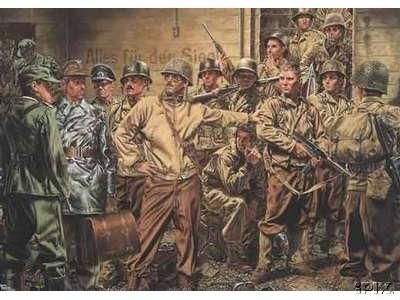
When before surrendering, the German General demanded to see General Canham’s Credentials –
Pointing to the Riflemen accompanying him, General Canham said

“These are my Credentials”

220px-MG_Charles_D.W._Canham                                   a97093e96db3c557ecfb72b65a7d017c


Click to access cmhPub_70-69-1.pdf


Ed Sprague

A Harvard pamphlet published for a duel (Harvard vs. Army) indoor meet, dated 3 Feb ’62 shows Ed holding the Academy record in the 60 yd dash at 6.2 seconds set in 1960. Almaguer, McGinnis, McAniff, and Garwick hold the indoor Mile relay record at 3:16.9 (1961)

Army Navy 1961 – 1962 Winter Sports

Gymnastics is Eastern Conference Champion and Army over Navy in Basketball, Wrestling, Gymnastics, Track & Field, Squash and Pistol while losing only Rifle and Swimming.

Butch Darrell

Charles & Bettina Darrell    
Fritz Stude saw a couple of hoodlums with BB guns – started a Team. West Point got Butch’s Lacrosse stick that Navy learned to fear 10 years later.

Captain of the 1962 Lacrosse Team

Charles Cavendish Darrell

Butch and Ace Adams Army’s Coach in 1962

Butch was a nice guy — but on the Lacrosse Field he gave no Quarter.

My father played lacrosse in the 1932 Olympics in Los Angeles. The Johns Hopkins Team represented the USA against a Canadian Team and won two of three games. Due to the world-wide depression, England and Australia could not make the trip.

My Father Joseph Cavendish Darrell – 4th from right front row, Fritz Stude is next or 5th from right, while the 6th man is Jack Tumbull. Coach Ray Van Orman is 2d row far right and next to him is Jimmy Benson, a long time John Hopkins trainer. Lacrosse was a Demonstration Olympic Sport in 1928 and 1932, but never became an Olympic Team Sport.

My father’s name was Joseph Cavendish Darrell and my uncle’s name was Francis Sterett Darrell. Like the rest of us Darrells they got stuck with weird nicknames- my father was “Cabbage” and my uncle was “Mickey.” I have never been able to get much on the 1932 Johns Hopkins Olympic lacrosse team from google, but Johns Hopkins University periodically publishes an article on that event and I have several of them at home.

The participation medal given to each member of the Lacrosse Demostration Team.

In 1947, the goalie of that Olympic Team, Mr. Fritz Stude, saw a couple of young hoodlums get into trouble and started a team for kids, so they’d have something better to do than shoot out street lights with BB guns and I joined the team at age 8.

One of the players, a couple of years older, was Tom Mitchell. He went on to star at Boys Latin, graduating in 1956. In February 1961, I was down at Navy for exchange week-end.

Late on Saturday afternoon Tom Mitchell, then a Firstie at Navy, barged into my room and said, “Get your stuff Darrell, we’re going to a party with hot women and cold beer!” I don’t remember the hot women, but around 2 AM, Mitchell and I staggered back through Bancroft Hall on our knees.

“Mitchell,” I said, “I can’t believe they let you get away with this. Where did I go wrong? West Point is nothing but a jail.”

That spring Tom Mitchell was the Navy star and won the Turnbull Award as the nation’s best attackman.

Jack Turnbull, one of the all-time great players was later an Air Force Officer killed in Europe during World War II. The award that Tom Mitchell won in 1961 as the nation’s best attackman is named for Jack Turnbull.

In 2006, my father and my uncle Francis Sterett Darrell were inducted into the Boys Latin Athletic Hall of Fame as part of the first group to enter, so even though they had been a rival to my school, I was invited to the ceremony.

I noticed that Tom Mitchell was not on the list, so, not having seen or heard of him since 1961, I nominated him and he was inducted last fall (2008).

He came all the way from Las Vegas and brought several old Navy players and coaches with him to the induction.

Even though we were fierce rivals in 1961, we were bound together by participation in that game.

Jimmy Benson, the long time JHU trainer, was still at Hopkins in 1959, and during my summer leave that year graciously helped me rehab the left knee ACL I had torn against Rutgers that spring. Thanks partly to his efforts and to those of the West Point doctors and trainers, I was after a second knee operation Yearling year, able to play my Cow and Firstie years. Lacrosse was the only thing I did even moderatelly well at West Point, so I am very grateful to have had the opportunity to play.

My brother Kent “Skip” Darrell (ex-64), another one of those goofy nicknames, flunked out of West Point in math at the end of his Plebe year and enrolled at Johns Hopkins. In the 1963 Hopkins-Army game, he scored 4 goals in a 10-9 Hopkins victory. There was an article in the New York Times about it. As a fellow goat, you will be pleased to know that, having flunked out of West Point in Plebe Math, he has been teaching it at St Paul’s School in Baltimore to high schoolers for 37 years! In my humble opinion, he is the best teacher in Maryland.

I can’t think of anything for my Cullum file. Those familiar with my academic and military reputation at West Point would just laugh at any positive remarks about my Cadet days and shout, “Liar!” (Editors Comment – None of us would ever say anything negative about Butch he was and is a great Classmate. For some of us who were with him in the last sections, his attitude eased the pressure to achieve pro status.)

The 1961 Army-Navy Lacrosse game was certainly the highlight of my athletic career, however, so I would appreciate it if you’d add the picture of Coach Adams being thrown into the Severn along with my remarks about it to my “page”.

Coach Ace Adams being chunked into the Severn River after the 1961 Army-Navy Lacrosse game, won by Army 10-8.

This game, played in the Navy-Marine Corps Memorial Stadium, was the first lacrosse game ever to be televised nationally. “Ron Hannon” ’61 seemed to come up with every ground ball and Dick Buckner ’61 hit a Navy defenseman so hard I felt the ground shake.

One of the best lacrosse pictures I’ve ever seen is in our yearbook of “Mac Howard” taking a shot in that game. Rusty Broshous scored two goals when we needed them most. Our victory enabled Army to share the National Championship with Navy- we had dropped a game to Virginia earlier.

As you can guess, we were jubilant. As soon as coach hit the water, we all jumped in after him still in uniform. “Holy Cow (or perhaps words a little stronger)! The tide’s out!” shouted Dave Harkins. We were facing a six foot high sea-wall. Fortunately, our ever-faithful bus driver Jake knew what to do. He retrieved a rope and life-saving ring from Halsey Field House and fished us out one by one.


Al Biddison

Class of 62 – 3 Army A’s in Lacrosse

Bob Carroll

3 Army A’s – 150 Football

Mike Bartelme

Lois Bartelme for Mick  images-1.jpeg images.jpegUSMA Shoulder Patch
A Great Soldier. A wonderful Father and Husband.  101st Airborne, Adv Airborne Bde RVN, 1st Cav, USMA.
He was a member of the Hockey and Soccer Teams Plebe Year. Mike injured an ankle which prevented any further Athletic Competition. He was a Soccer Team Manager his Yearling, Cow and Firstie Years.

Jack Reavill

Jack & Susie Reavill                                 
Football and Lacrosse; 1/20 Arty 63, AdC 65, 6/12 Arty Korea 65, 1/19 Arty 67, 52d Arty Gp RVN 68, HQ CONARC 70, V Corps Arty 77, Co 1/333 FA  79, DC 83, OASOD 84,  OASOPS 84, Ret 88.

Jack with 2d Place Trophy – 6th Grade – he had that knee replaced in 2009

Jack elected Captain of the 1957 RHS Team

Jackson Custer Reavill – Class of 1962

Cadet Company L-2

Home Town: Flat Rock, Illinois

Flat Rock, a town of approximately 450 people, had a grade school but no high school. Jack lettered in both basketball and track during grades 6-8. As a 6th grader, he was a starter on the Flat Rock basketball team that won second place in the Illinois Grade School State-Wide Tournament

High School: Robinson High School (RHS), Robinson, Illinois
Flat Rock students were bussed 15 miles to Robinson High School. Since no transportation was provided by the school system for extra curricular activities, Jack and others hitch hiked their way to Flat Rock after practices.

At RHS, Jack lettered 3 years in both football and basketball and 2 years in track. He was both captain and most valuable player of the football and basketball teams in his senior year. He was All-County, All Conference, and honorable mention All State in both football and basketball his junior and senior years. At the time, Illinois had not divided the schools into classes by size.

Though baseball was not a high school sponsored sport, Jack played Babe Ruth and American Legion baseball and was selected for the league All Star Teams each year.

Jack had previously committed to play football and basketball at DePauw University in Greencastle, Indiana. He also had been designated a 3rd alternate to West Point. During a high school civics trip to Washington, DC in early June of 1958, Jack learned that he had been advanced from 3rd alternate to principle. He entered USMA three weeks later.

Date of Entry to Academy: 2 July 1958

Date of Graduation: 6 June 1962

Age at Graduation: 22

Cullum Number 24,000

Cadet Rank Rank: SGTHeight at Entry: 6′ 1″ and 6′ 2″ at Graduation

Weight at Entry: 205

Playing Weight: Basketball 195; Football 205; Lacrosse 195

Graduation Weight: 205

Teams: Jack was not brought in to USMA to play any sport. After tryouts during Beast Barracks, he was invited to play football, basketball, baseball and track. He later became a “walk on” in football, basketball, and lacrosse.

Basketball (Plebe Year)
Though not a starter on the plebe team, Jack was a role player because of his long range jump shooting accuracy. As a result, he was selected by the varsity coaching staff to act as Navy’s leading scorer during preparations for the Navy basketball game.

B Squad Football (Yearling & Cow Years) and Varsity Football Firstie Year.

Jack Reavill #81 is front row, 4th player from left

Lacrosse Photo Here

1962 Lacrosse Team (Jack Reavill is #34, right most player in 1st row)

North-South Team Picture Here

Reavill is 5th player from left in 2nd row.

Coaches/Assistant Coaches

Basketball – Major Bell

B Squad Football – Tony Bulotta

VarsityFootball – Dale Hall and “Chuck Gottfried”

Lacrosse – Jim Ace Adams

Coach Ace Adams being chunked into the Severn River after the 1961 Army-Navy Lacrosse game, won by Army 10-8.

Team Captains
Football – Mike Casp

Lacrosse – Charles Butch Darrell

Positions Played

Basketball – Guard/Forward

Football – Tight End/Defensive End/Special Teams

Lacrosse – Defense

Athletic Awards

Plebe Year Basketball – Class Numerals

Yearling Year – Football and Lacrosse Monograms

Cow Year – Football and Lacrosse Monograms

Firstie Year – Football Monogram and Lacrosse Army “A”

Team Recognition

National – 1961 Lacrosse Team below and Navy shared National Championship

Lacrosse Team Photo Here

Individual Recognition

1962 Honorable Mention All America Lacrosse Defense Player Firstie Year and defensive starter for the North in the 1962 North-South Lacrosse Game.

West Point Lacrosse Loose Balls Award below was normally won by midfielders or attackers, not members of the defense.
Post Season Play

Started for the North Team in the 1962 North-South Lacrosse Game held at Rutgers University – North Team Lost

While a graduate student at Tulane University in New Orleans, LA, Jack Reavill assisted Dr. Rix Yard, Tulane’s Athletic Director, in establishing the Tulane Lacrosse Club. During 1971-1973 Jack coached-and played on the Tulane club against other university club teams in the Southeast. The Tulane club dominated the Southeast clubs during Jack’s tenure. After Jack’s departure, Tulane joined the Texas Lacrosse League in 1974 and also dominated that league during the years of Tulane’s membership. Jack received commendations from Dr. Yard and the CG, 5th Army for creating an environment that enabled free and open discussions of the Vietnam War and other topics resulting in a better understanding of and appreciation for the respective views of the team members.

Rusty Broshous

Rusty & Barbara Broshous

Rusty earned 5 Army A’s in Hockey and Lacrosse.

Marty Bilafer

Marty earned 3 Army A’s

Paul Dobbins

Paul & Beverly Dobbins

Paul was Captain of the 1962 Hockey Team. He earned 3 Army A’s in Hockey. He also played Lacrosse and Golf.

Albie Symes

Albie earned 4 Army A’s, 3 in Hockey and 1 in 150 Football. He also earned a Monogram in Lacrosse.

Bill Whitehead

3 Army A’s in Football, played B Squad Lacrosse Yearling Year