Tag Archives: Football

Charles R Monk Meyer

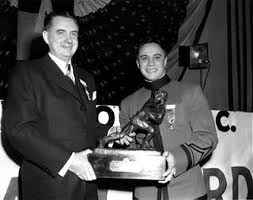
Heisman Trophy runner-up 1935, College Football Hall Of Fame 1987

MonkMeyer_USMA_1937

1935

ArmyFB_1935_MonkMeyer

–

ArmyFB_1935_BillShuler-MonkMeyer_byPap_Nov21935

–

ArmyFB_1935_MonkMeyer_byAlanMaver_SundayMorningStar_Nov31935

ArmyFB_1935_MonkMeyer_byAlanMaver_SundayMorningStar_Nov31935

ArmyFB_1935_All-East_Telegraph_Dec31935

–

All-Americans_1935_UPI_PittsburghPress_Nov291935

–

MonkMeyer-runnerupto-JayBerwanger_Heisman_1935_TelegraphHerald_Dec511935

–

1936

ArmyFB_1936_MonkMeyer_TelegraphHerald_Oct151936

–

ArmyFB_1936_Meyer-run1

–

ArmyFB_1936_MonkMeyer_byPap_CSM_Oct141936

–

ArmyFB_1936_vsNavy_YoungstownVindicator_Nov241936

–

ArmyFB_1936_vsNavy_YoungstownVindicator_Nov251936

–

ArmyFB_1936_vsNavy-pre_TheDay_Nov281936

“Pound for pound, there were few backs more threatening in a broken field than Army’s Monk Meyer.”

–

MonkMeyer-Luzon_1945_DailyTimes_Jun111945

–

CharlesRMonkMeyer_1937_CollegeFootballHoF_GadsdenTimes_Dec81987

–

From Go Army Sports:

Class of 1937
Football/Basketball/Lacrosse

Charles “Monk” Meyer earned a pair of varsity letters in football, three in basketball and one in lacrosse during a stellar athletic career at West Point. He finished second in the initial Heisman Trophy voting to Jay Berwanger of the University of Chicago and retired from the U.S. Army with the rank of Brigadier General.

Meyer received the Silver Anniversary Award from Sports Illustrated in 1961 and collected the Gold Medal Award from the National Football Foundation 1987.

As a standout quarterback, Meyer helped Army to a 28-6 victory over Navy in 1935 at Philadelphia’s Franklin Field and played in the 1937 College All-Star Game. Among Meyer’s single-game highlights was a 172-yard passing performance during a 27-16 victory opposite Columbia and future National Football League Hall of Fame quarterback Sid Luckman in 1936.

Meyer helped Army to six wins in each of his two seasons.

On the hardwood, Meyer earned three varsity letters. He served as team captain in 1937 and contributed to squads that posted a combined 24-18 record, including a pair of wins opposite service academy rival Navy.

Meyer was also a member of Army’s lacrosse team and earned a varsity letter in 1937. The Black Knights finished 9-1 that season and ended the year with a 6-5 victory at Navy. Wins against Hobart, Yale, Syracuse, Penn State and Johns Hopkins also highlighted the campaign.

–

‘Monk’ Meyer: From Allentown and West Point gridiron to heroism on the battlefield
Allentown High alumnus led Army against Notre Dame 75 years ago this week.
November 16, 2010|By Evan Burian
Allentown Morning Call – Nov 16, 2010

When Army and Notre Dame meet for the 50th time on Saturday in the new Yankee Stadium in New York, all the history and lore that surround this colorful collegiate rivalry will spring to life.

“Cheer, cheer for old Notre Dame” with the legendary George Gipp in 1919 and 1920. Notre Dame’s Four Horsemen of 1924 and Grantland Rice’s classic lead to his story on the game, “Outlined against a blue, gray, October sky the Four Horsemen rode again.” And Notre Dame coach Knute Rockne’s inspirational halftime “Win one for the Gipper” pep talk in 1928 that resulted in an upset Irish victory.

“On, Brave Old Army Team” with coach Earl “Red” Blaik’s powerful and undefeated war-time machine led by Doc Blanchard “Mr. Inside” and Glenn Davis “Mr. Outside” of 1944-46. It was when three All-Americans — halfbacks Pete Dawkins, Bob Anderson and Northampton’s Bob Novogratz at guard — led a Black Knight conquest in 1958.

And 75 years ago this year in the 1935 contest, it was Allentown’s Charles “Monk” Meyer of Army whose name was added to this golden honor roll.

Although small in stature at 5-9 and 150 pounds, and looking more like the team’s student manager, “Monk” Meyer was indeed a West Point football star. And like many other Army graduates, he went on to display heroism on the battlefield for his country.

Charles Robert “Monk” Meyer played football, basketball and baseball at Allentown High School for the nationally recognized coach, J. Birney Crum. As a single-wing halfback in 1930, Meyer was the club’s top scorer with 12 touchdowns as he helped the Canaries to a perfect 11-0 season.

The Canary and Blue juggernaut rolled up 338 points that season while giving up only 18. The Morning Call headlined Meyer’s exploits after the Thanksgiving Day triumph over Bethlehem as “Little, But Oh My!”

As the son of Lt. Col. Hermie Meyer and born at West Point, N.Y., on May 1, 1911, “Monk” was tagged by birth and tradition to serve his country with a career in the military.

Monk grew up at various Army bases throughout the nation and even in the Philippines as his father received assignments during his military career. The Meyer family relocated to the Lehigh Valley area in time for Monk to play football, basketball and baseball at Allentown High.

After leaving Allentown High, Meyer prepped at Philadelphia’s Chestnut Hill Academy and entered West Point in 1933 as a player who could run, pass, kick and play defense. For two seasons, 1935 and 1936, the “150-pound Mighty Mite” was the big gun of the Army attack for coach Gar Davidson.

Touchdown pass

In 1935 against Notre Dame before a capacity crowd of 78,114 in Yankee Stadium, it was Meyer’s 41-yard first-quarter TD pass and stellar performance in a 6-6 tie that brought him into the limelight. The press recognition eventually led to his All-American mention and then to his being named runner-up to the University of Chicago’s Jay Berwanger in the first-ever Heisman Trophy vote that year.

However, Meyer’s fondest memory of the season was the stalemate with the Fighting Irish and what happened after the game. Meyer said he was resting by the locker-room door when someone started knocking on it. Opening the door, Meyer was startled to see Notre Dame head coach Elmer Layden, one of the immortal Four Horsemen, along with Irish players.

Layden said, “Hey kid, go get Monk Meyer, we want to congratulate him on the great game he played against us.”

When the stunned Meyer replied that he was Monk Meyer, Layden continued, “Look kid, we’re not fooling around, we want to talk to Monk Meyer.’ “

Meyer then called over some of his teammates to verify to Layden that he indeed was Monk Meyer.

All the astonished Layden could mutter while looking at the smallish Meyer was, “Gee whiz.”

In 1936, Monk had another big day in Yankee Stadium. This time the Army ace outdueled famed Columbia passer and future Chicago Bear Hall of Fame quarterback Sid Luckman as the Black Knights prevailed, 27-16, over the Lions.

A pair of football shoes

In the book, “Coach Birney Crum and Allentown High,” attorney Ray Brennen, Meyer’s Allentown High classmate and lifelong friend, said of him: “He almost didn’t have a football career at Army let alone the resulting fame and honors because he was just one of over a hundred players trying out for the team when he got to West Point and a little guy to boot.

“It was Birney who got Monk a pair of football shoes that fit him properly so he could show his running skills, and it was Birney, while watching practice, who told the Army coaches to take Monk off the fifth team and put him in with the first unit to show them that he could get the job done.”

Meyer graduated from West Point in 1937 and led troops in the Pacific Theater under the overall command of Gen. Douglas MacArthur during World War II and again in Korea, and was wounded twice.

Among the numerous decorations he received were two Silver Stars and, for “extraordinary heroism,” the Distinguished Service Cross. It is the second-highest decoration in the United States, just below the Medal of Honor.

–

Mike Viti

Mike is Class of 2008

Army Firstie fullback Mike Viti gave everything against Navy despite having a high right ankle sprain. (Editors note – see Army Lore Home Page

“The trainers and the doctors looked at it,” Viti said. “Realistically, it was bad, even if I hurt it that much more it wasn’t going to hurt that much more. It probably would have hurt more to stay out. There’s time to let it heal. There’s an off-season, end of a career. If it’s not your senior season and the last game of your career, you don’t go”

http://www.dallasnews.com/sharedcontent/dws/spt/football/nfl/stories/033008dnsponfldraft.32e0e48.html

Norman Schwarzkopf

awaiting data

Glenn Davis


Glenn Davis in 1944 — He played Fullback until Doc Blanchard arrived

The Webster’s dictionary definition of a gentleman barely does justice to Glenn Davis. Ask Joe Shelton ’44, a Firstie in Glenn’s company when Glenn was a Plebe. Ask — —, ’50, a Plebe who went on calls to Glenn’s room when Glenn was a Firstie and was perhaps the most celebrated athlete in America. Ask Joe Steffy ’49, Glenn’s Classmate and Outland Trophy Winner. Each gives the same response when asked about Glenn: a very fine person, a gentleman.
Glenn Davis: a gentleman in the tradition of the 19th century. A genleman as Robert E Lee was a gentleman.

Glenn Davis: “The Real Touchdown Twin”

by David Pietrusza

Despite being dubbed the “Touchdown Twins,” Army’s Glenn Davis and Doc Blanchard were not identical physical specimens. Doc Blanchard, at 6’0″ and 205 pounds, was by far the bigger of the two football legends. The 5’9″, 170 pound Davis, however, may have been the better natural athlete.

At the Point Davis lettered not only in football but in baseball, basketball and track. And he did not just letter. On the diamond the center fielder’s arm was described as “whiplike,” and he was good enough to earn Branch Rickey’s comment that he could fetch a $75,000 bonus. Coming from a man with a reputation for tossing dollars around like man-hole covers, that was high praise indeed.

Even in his full football uniform Glenn Davis could flat out run, covering 100 yards in less than ten seconds Perhaps most impressive though was his performance on the “Master of the Sword” test the Military Academy devised to test the athletic prowess of future officers. Out of a possible 1,000 points on such diverse events as a 300-yard-run, dodge run, vertical jump, parallel bar dips, softball throw, sit-ups, chin-ups, and the standing broad jump, the average cadet scored 540. Davis posted a 926.5 mark, the all-time record.

While Davis was not, however, Doc Blanchard’s physical twin, he was his brother Ralph’s twin. Ralph was named for their father, a southern California bank manager, but it was Glenn who was always known as “Junior.” Why? He was born ninety minutes after his “older” brother.

The Davis twins were nearly inseparable. They double-dated together, played harmless juvenile pranks together, and planned on attending USC together. But instead Congressman Jerry Voorhis (later defeated for re-election by a young war veteran named Richard Nixon) offered Glenn a berth at West Point. Glenn said yes but only if brother Ralph could come along.

No problem, said the Army, bring him along.

Glenn Davis had already distinguished himself as an athlete, being a four-letter man in high school and winning the Knute Rockne trophy as Southern California’s outstanding schoolboy track star. In football he scored 263 points his senior year.

Davis debuted for Army during the 1943 season, running for eight TDs and passed for four more. West Point, which recently had been a football laughingstock, finished with a respectable 7-2-1 mark. It was a decent start for both Davis and his team, but it hardly gave any hint of the true greatness to come.

Football, however, was not the only thing on Davis’ mind in 1943 – or maybe it was. Even though he rose at four each morning to cram in his studies, he still failed math and was in the parlance of the Academy “found” deficient. That meant he was kindly asked to leave the Academy that December to study even harder for re-admission.

Davis succeeded, returning to West Point the next fall but having to repeat his plebe year. That had its benefits. During World War II West Point was graduating classes in three years rather than four. Davis’ lack of numerical expertise gave him another year on the gridiron – and ultimately the Heisman Trophy.

In 1944 Davis came into his own, leading the nation with an average of 11.5 yards per carry and in total scoring with 120 total points. Blanchard and Davis, “Mr. Inside and Mr. Outside,” paced Army to an undefeated and untied season–it’s first since 1916. The Black Knights scored a fearsome 504 points, 56 per game, second only to 1904 Michigan’s 58.9. Army rightfully earned the Lambert Trophy, the Williams Trophy, and the Williamson Plaque.

Davis secured the Maxwell Trophy, the Walter Camp Trophy, and the Helm Foundation Award, but finished second to Ohio State’s Les Horvath for the Heisman.

Speed was his forte, but it was hardly the only weapon in his arsenal. “He also possessed,” Bob Carroll, the founder of the Professional Football Researcher’s Association (PFRA), noted, “a devastating change of pace, a powerful leg drive, and a strong stiff arm.”

Despite his natural ability the grind occasionally wore on Davis. Football required an hour and a half of grueling practice each day -in addition to the three hours of physical education required weekly of each cadet. And, of course, there was the obligation of academics and the specter of another failed math course. “I never used to think about taking a daytime nap,” Davis admitted, “Now I get sleepy every time I see a sofa.”

Army went on to another perfect season in 1945 and at Yankee Stadium defeated Navy for the national championship. Davis’s 49-yard touchdown helped.

For the year Davis scored 108 points and led the nation with 11.5 yards per carry. Such a performance inspired the great Grantland Rice to write in November 1945: “Davis is not only one of the fastest backs that ever lugged a football on any field at any time, but he is also a strong running back who isn’t easy to bring down.”

And those who actually had to face him were even more impressed. “Every time Davis touched the ball,” said Columbia’s Gene Rossides, “it would be like an electric current going through the defending team.”

Yet, it was Doc Blanchard, who led the nation in total scoring and captured the 1945 Heisman. Still when Blanchard accepted his trophy in January 1946, he told the audience: “I’d have voted for Glenn Davis.”

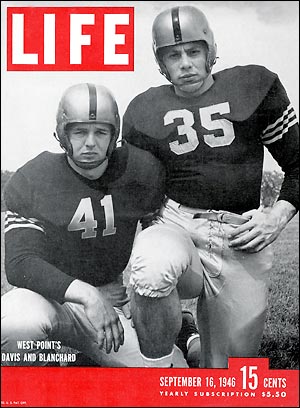
All eyes were on Army’s squad as it began its 1946 season. Both Blanchard and Davis returned for another season. Their teammates elected the “Touchdown Twins” as the first co-captains in Army football history, and they graced the cover of Life magazine.

That was the good news. Just about every other indicator was bad. First and foremost, the nation’s civilian schools now benefitted from demobilization. West Point and Annapolis would no longer have their pick of athletic talent. the competition was getting equalized.

Secondly, after the some acrimonious public wrangling team lost one of its stars, Thomas “Shorty” McWilliams, who was allowed to resign from the Academy.

And against Villanova in the season’s first game, Doc Blanchard hurt his knee and was never again at peak form. Davis had to pick up the slack. Perhaps his greatest moment came against Michigan when he rushed for 105 yards and caught seven passes for an additional 159 yards. Beyond that, he intercepted two passes and even threw a pass for a another touchdown.

Legendary Army coach Earl “Red” Blaik praised him as “the best player I have seen, anywhere, any time.”

Despite increased competition and Blanchard’s ills, 1946 Army squad still remained undefeated; the only blot on its record being a scoreless tie against Notre Dame, which dethroned the Black Knights as national champions.

Red Blaik had no apologies and ranked his 1946 Black Knights as superior than either the 1944 or the 1945 teams. “I reserve the warmest affection and the greatest respect for the 1946 team,” he once wrote, ” which, in the face of adversities, playing the best of college opposition, completely and thoroughly demonstrated its right to be classed as great.” Much as Davis had placed second in 1944 and 1945 for the Heisman, Blaik had come in second for Coach of the Year honors both seasons. In 1946 he captured the award.

And Glenn Davis finally won his Heisman. The glory was now his. Also bestowed on him were the Maxwell Trophy, the Walter Camp Trophy, and the Associated Press designation of Male Athlete of the Year. He might have also garnered the Sullivan Trophy — but in an administrative snafu his name had been left off the ballot

The Heisman vote:

Player                    School           Total

1 Glenn Davis Army 792

2 Charles Trippi Georgia 435

3 Johnny Lujack Notre Dame 379

4 Doc Blanchard Army 267

5 Arnold Tucker Army 257

6 Herman Wedemeyer St. Mary’s 101

7 Burr Baldwin UCLA 49

8 Bobby Layne Texas 45


By the time Davis had hung up his Army spikes he has posted some prodigious numbers:

                   RUSHING            PASS RECEIVING         SCORE

YEAR ATT YDS AVG NO YDS AVG TD TOTAL

1943 95 634 6.7 7 68 9.7 1 48

1944 58 667 *11.5 13 221 17 4 *120

1945 82 944 *11.5 5 213 42.6 0 108

1946 123 712 5.8 20 348 17.4 5 78

Totals 358 2957 8.3 45 850 18.9 10 354


* – Led the nation

In his 38 games for Army Davis had scored 59 touchdowns. Twenty-seven were over 37 yards, with his longest being 87.

The NFL’s Detroit Lions drafted Davis, and both he and Blanchard had wanted to pursue pro football careers after graduating. But the Secretary of the Army refused to allow such activity, and the only football action the duo saw in 1947 was on the set of a low-budget film called The Spirit of West Point. The picture was hardly memorable, but it had its place in football history. During filming, Davis tore cartilage and ligaments in his right knee. They never healed properly.

Red Blaik had once commented about Davis that he was “as bashful as a girl on her first date, even though he is an All-America.” That may have been true, but it did not stop the very eligible bachelor from being seen with a number of Hollywood’s most attractive young starlets. Still in the Army, he dated Ann Blyth and after meeting Elizabeth Taylor at a touch football game on the beach (where else?), they became an item. Just before Davis shipped off for Korea, the couple became engaged (“When I saw that frank, wonderful face, I thought, ‘This is the boy'”), but Taylor proved less reliable than Doc Blanchard and the engagement was off. He was later married briefly to actress Terry Moore before marrying the beautiful Ellen Harriet Lancaster Slack.

After completing his obligatory three-year Army hitch, Davis returned to football, signing with the Los Angeles Rams in 1950 and powering them to 9-3-0 record, good enough for a tie with George Halas’s Chicago Bears. They defeated the Bears 24-14 but fell to the Browns in that year’s Championship Game 30-28.

Davis had lead the Rams in rushing, scoring seven touchdowns, but thought the injury he had suffered during The Spirit of West Point’s filming and the four-year layoff had taken their toll on his skills. “I was as good a player as a senior in high school,” he once modestly said, “as I was with the Rams.” After just one more season in the NFL he called it quits.

For three decades he worked as special events director for the Los Angeles Times, earning the respect of those around him. “West Point,” said one sports writer a half-century ago, “might make an officer out of Glenn Davis, but he’s already a gentleman.”

Here is what was said at his passing

As most of you know, Glenn Davis – Army’s fabled “Mr. Outside” — recently passed away, and was buried adjacent to his revered coach, Red Blaik, at the West Point cemetery on March 18th. It was a bright day, with Glenn’s widow, Yvonne, there as well as a number of the Davis family. Many of Glenn’s teammates were there to bear witness, along with other friends and sports luminaries. Interestingly, Bobby Ross, and the entire West Point football coaching staff — Every one of them — were there, along with Joe Bellino, Navy’s first Heisman award winner.

Pete Dawkins was asked to speak on behalf of the heritage of generations of the Army team.

Glenn Davis’ Funeral
March 18, 2005

It goes without saying that Glenn was a remarkably gifted athlete, whose achievements stand tall in the annals of West Point, and in the history of sport in America. For that, he earned our undying respect, and deep admiration.

But, to me, Glenn was so much more, besides.

Over the past week, his passing caused me to think a lot about, “What makes a life?” – and, “Just what is it that made Glenn’s life so memorable, and so special?”

I’m not at all sure that I’ve found the answer but, in my musings, three remembrances came to stand out, that I thought would be appropriate to share with you today.

First, it’s important to remember that Glenn was not just a great star, he was also a great teammate. Even in the face of the torrent of notoriety – that, weekly, blustered with headlines bulging the wonder of his personal exploits (and often those of Doc Blanchard, “Mr. Inside”, as well) Glenn thought of Steffy and Tucker and Poole and Foldberg .. and all the others, too. And he understood, without any question in his mind, that it was the team – not just the marvel of his personal performance – that brought victory, and truly deserved the accolade of success.

It wasn’t forced, or false, or pretend, or clever, or calculated, or conscious, or contrived. It was Glenn. Given West Point, and the times, it seemed natural, and the right way to think – and behave. But in contrast with so many of our “sports-idols” of today, we can truly relish Glenn’s dignity and quiet humility.

My second reflection is related, in that it was Glenn’s humility that made his prodigious talent “human” – and accessible. During the season of 1946, I was 8 years old. Yet Glenn’s impact on my life was very personal – and powerful. It wasn’t just that he was a star. It wasn’t just that he had “explosive” speed and uncanny balance. It was something more. Glenn had about him a grace… a kind of majesty. A personal aura that touched the spirit of a young 8-year old in Michigan. In a way that I can’t fully explain, it was beguiling. Looking back, I realize that it kindled my youthful imagination, and sparked – for me – the allure of West Point, and the dream of the Army team.

Now, it occurs to me that there was a third distinctive attribute that Glenn shared with all of us who came to know him well: his friendship. I knew him for a little more than 40 years. Many of you here knew him quite a bit longer. The truth is, Glenn and I didn’t see one another all that frequently. Most often, it was in conjunction with some sort of Heisman affair. But it was the kind of friendship where we picked up exactly where we had left off the last time, without missing a single beat.

In more recent times, after he and Yvonne were married, Judi and I — and the two of them — seemed to often find ourselves together at the end of the evening. I look back on those as treasured times. We talked, and laughed, and reminisced, and speculated on times ahead.

I always came away feeling refreshed. Glenn had a disarming directness, and selflessness about him that was very special. He never complained; instinctively dwelled on the positive half of everything; and came up with some of the most unexpected, and insightful, perspectives anyone could ever imagine.

It seems to me that there’s little more you could ask for in a friendship than this.

Last fall, during half-time at the TCU game, a group of us were asked to assemble in Michie stadium, at the 50 yard line of Blaik field. As Glenn was feeling the difficulties of his therapy at that time, he slipped his arm into mine, and asked if I would escort him onto the field. On our way out, he began to apologize for needing my help. I interrupted him in mid-sentence and told him, “Listen to me: Glenn Davis never, ever needs to apologize to me.” In fact, I told him that in all the years I had known him, and been with him – and, in fact, at that very moment – all my eyes ever saw was the strong, fresh, sculptured form of my boyhood idol.

What I said was the absolute truth. And I believe I saw him rise up a little more erect. And stride forward with strength and confidence.

“What is it that makes a good life?” He knew. And, in truth, that was the way he lived.

We miss you, Glenn. All of us do. But, more importantly, we will remember you — long, and well.

Godspeed, good friend.

http://apse.dallasnews.com/contest/2004/writing/over250/over250_columns_first1.html

http://www.heisman.com/sports/m-footbl/spec-rel/031005aaa.html

http://archive.recordonline.com/archive/2004/11/19/losportm.htm

Football’s Greatest Decade – – by Bernie Mcarty –
http://www.la84foundation.org/SportsLibrary/CFHSN/CFHSNv01/CFHSNv01n1b – – see page 5

This writer believes West Point 1945 is the greatest team of all time. The 1944 Army team may actually deserve that title, but it was never tested. Army was also undefeated in 1946, 1948 and 1949.

Army’s top stars during 1945-1949 were the effulgent “Touchdown Twins”, Glenn Davis and “Doc” Blanchard, Arnold Tucker, Arnold Galiffa, “Rip” Rowan, Bobby Jack Stuart and Gil Stephenson in the back-field, and up front Joe Steffy, Art Gerometta, Jack Green, Bill Yoemans, Joe Henry “Tex” Coulter, Al Nemetz, and the sterling end duo of Hank Foldberg and Barney Poole.

In 1945 the Newspaper Enterprise Assoc. simply picked the entire Army team as its All-American team, stating no group of All-Americans could beat the Cadets.

Only a world war could have brought together such a collection of players to one institution. But it took the coaching genius of Col. Earl Blaik to mold the players into a cohesive unit.

In truth, Navy personnel was equal to Army’s on an individual basis. The Middies never jelled as a team, however.

The 1951 Army outfit might have been as good as the 1945 Cadets, but the
infamous cribbing scandal wiped out the team.

–
–
no sound


–


–


–

–

Elmer Oliphant

–

ArmyFB_1918_ElmerOliphant_Assembly_1

–

ElmerOliphant_USMA1918

–

ArmyFB_1914_ElmerOliphant_Assembly_2

–

ArmyFB_1914_ElmerOliphant_Assembly_3

–

ArmyFB_1914_ElmerOliphant_Assembly_4

–

ArmyFB_1914_ElmerOliphant_Assembly_5

–

ArmyFB_1914_ElmerOliphant_MilwaukeeJournal_Aug281914

–

ArmyFB_1914-1918_ElmerOliphant_photo1

–

ArmyFB_1914-1918_ElmerOliphant_photo2

–

ArmyFB_1914-1918_ElmerOliphant_photo3

–

ArmyFB_1914-1918_ElmerOliphant_photo4

–

ArmyFB_1914-1918_ElmerOliphant_MilwaukeeJournal_Nov291936

–

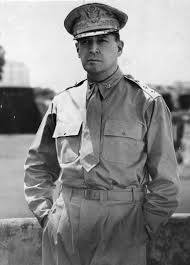
Douglas MacArthur

Awarded the Medal of Honor – Bataan Peninsula 1 April 1942.

It should be noted that General MacArthur’s Father was also awarded the Medal of Honor for Gallantry at Missionary Ridge. See bottom of page

Go to to below link for information on The May 1962 Speech by General MacArthur

http://forwhattheygaveonsaturdayafternoon.com/wp-1962/macarthur-dhc

The Japanese Surrender 1945
http://www.youtube.com/watch_popup?v=vcnH_kF1zXc&feature=player_embedded

MacArthur played Football till injured

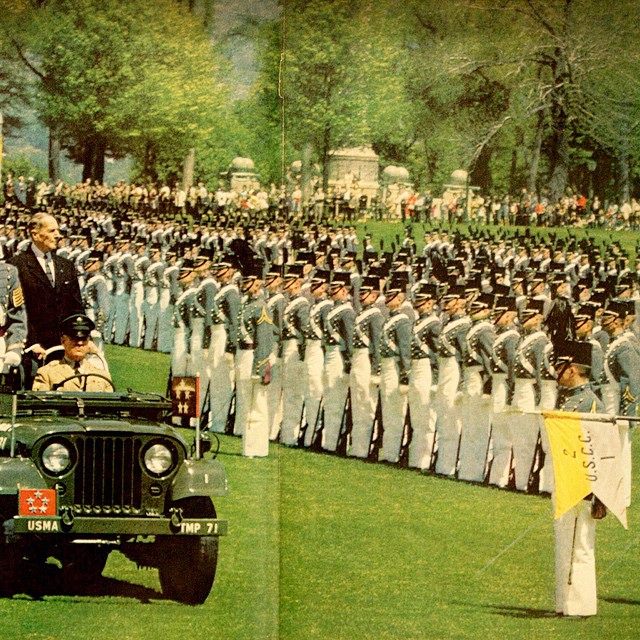
General MacArthur’s Duty, Honor, Country speech was recorded for us because Jim Ellis ’62 First Captain and Pete Wuerpel Bde Adjutant ’62 had the foresight to realize perhaps we would want to remember what the General said to us. He spoke to us without notes

What we remember of that day is at the bottom of this page

http://americanrhetoric.com/speeches/douglasmacarthurthayeraward.html

Jim Ellis' arm is to General MacArthur's right.

Jim Ellis’ arm is to General MacArthur’s right.

MacArthur

What we remember of that day in May when he talked to us

This Saturday, 12 May 2007, marks the 45th Anniversary of the presentation of the Thayer Award to General of the Army Douglas MacArthur ’03 and his legendary Duty, Honor, Country acceptance speech, and several graduates have shared their memories of that day. Perhaps the most significant recollection is of the absolute silence of the Corps and other attendees during the speech.

Larry Waters ’62 added that he had never seen the Corps standing so tall on The Plain as when the general trooped the line during the review that preceded the speech.

Denny Benchoff ’62 noted that “you could hear a pin drop” until a man began taking photographs using a camera with a noisy shutter. A general officer sitting nearby reached over to the man, gently touched his hand, and put a finger up to his lips to indicate silence was requested. All this was done without taking his eyes off GEN MacArthur for more than a few seconds.

Duke Meceda ’62 also recalled the silence during the speech but added that the mess hall was silent for at least 15-20 seconds afterwards as well, the effect of the speech was that dramatic. Then the attendees began to applaud.

Pat Canary notes that when Jim Ellis ’62 dismissed the Corps, the silence resumed as the cadets left the mess hall and returned to the barracks. Many seemed to appreciate the fact that the speech was GEN MacArthur’s farewell to West Point.

Perhaps the most comprehensive recollection was provided by Dick Chegar ’62, who served as escort for GEN Anthony McAuliffe ’19 of Bastogne fame. He recalls that Mrs. MacArthur, Mrs. Westmoreland, and their escorts were seated on the poop deck while a number of famous general officers were seated at ten-man tables near the podium on the ground floor. GEN MacArthur was 82 at the time, and this alone caused a sense of drama in the air, almost symbolic of the passing of an era. His opening joke about the doorman at his hotel asking if he had ever been to West Point before caused the mess hall to erupt in laughter, but the mood soon grew serious as MacArthur spoke of distant battlefields and the American soldier’s “patience under adversity, courage under fire, and modesty in victory.” He delivered his speech without notes, and most attendees were acutely aware of his exemplary oratory. About two-thirds of the way through the speech, however, MacArthur hesitated for a moment, turned to his right, and looked directly at his wife Jean. It was as if a ray of light passed between them in that moment. GEN MacArthur then flawlessly continued his speech to completion. Several weeks later, the Cadet First Captain visited GEN MacArthur in New York City and was told that the speech had been written in advance, committed to memory and rehearsed several times. Dick felt that the pause occurred because the next line may have been forgotten for a moment. Many years later, when one of Dick’s captains won the annual General Douglas MacArthur Leadership Award, Dick told him the story about the momentary pause. When the captain later met Mrs. MacArthur at the ceremony, she confirmed her recollection of the glance that passed between them on that day.

Johnny Godwin ’62 was a member of the cadet officer honor guard arrayed on the steps of Washington Hall. He recalls that GEN MacArthur was extremely gracious, stopping to talk and shaking hands with a strong grip.

There was an air of excitement because MacArthur was already a legend at West Point. At the top of the steps, the general turned and said, “I thank you all.”

Neil Nydegger ’62 was impressed by the General’s “sincerity and genuine commitment to the Army and to West Point” and how he had “captured the simple essence of being a soldier.”

Gary Sharp ’62 recalled: — “MacArthur’s well-chosen words and deliberate delivery made an emotional impression on me that I will never forget … being the first in war and possibly the first to die, the loneliness of remote duty, the hardships on a soldier’s family, the fears that all soldiers face in battle, the camaraderie soldiers experience, the pride and honor felt when a soldier’s job has been done well, and the deeply emotional sound of Taps at a soldier’s burial … were all in his speech. If they were not in his exact words, they were in the silences between them. If any soldier ever needs encouragement before or in battle, he only needs to hear or read MacArthur’s words.”

Fred Bothwell ’62, first in his class in English, was impressed with the general’s choice of words like “tocsin” and “mournful murmur of the battlefield,” calling his speech “the most brilliant piece of oratory that I have ever heard.”

Stu Sherard ’62 was moved by the reaction of his roommate, Frank Reasoner, a former Marine sergeant who returned to the Marine Corps after graduation and was killed in action on 12 July 1965 in Viet Nam, receiving the Medal of Honor posthumously. Hard core Marine Reasoner had tears in his eyes several times during the speech.

John Dilley ’62 also recalls that “there was not a dry eye in the house,” but his strongest recollection is of MacArthur’s intoning, “… the Corps, and the Corps, and the Corps.”

Bob Reid ’62 had a similar recollection of being touched deeply and moved to tears, especially by MacArthur’s final allusion to “the Corps.”

Forty-five years later, Bob Cooper ’62 still finds himself quoting MacArthur’s speech to those he meets who are opposed to the war in Iraq: “This does not mean that you are warmongers. On the contrary, the soldier, above all other people, prays for peace, for he must suffer and bear the deepest wounds and scars of war.”

Bill Ross ’62 recalled MacArthur’s sonorous delivery and a more pragmatic aspect: GEN MacArthur, as a former Superintendent, exercised the prerogative normally reserved to heads of state and granted amnesty, permitting Bill to enjoy the beautiful Saturday afternoon without sitting confinement.

John Taylor ’62 recalls that Army’s newly-established Rugby Team, of which he was one of the co-founders, went on that afternoon to beat the leading rugby club in the nation, the New York Rugby Club.

Mike Moore ’62 recalls being photographed presenting a 1962 Howitzer to the general (Mike was the editor) and then flying off to Syracuse to play lacrosse, Army winning by about ten points.

Gus Fishburne ’62 recalls that the baseball and lacrosse teams attended in uniform, standing along the walls of the north wing during the speech.

Tom Eccleston ’62 recalls a very personal and pragmatic result of having heard the speech. After several years of active duty and a tour in Viet Nam, Tom embarked upon a civilian career selling high voltage equipment and was given The Boston Edison Company as a challenge. While attempting to sell some old timers at Boston Edison his company’s equipment, he happened to mention that he had heard MacArthur’s speech. He was then seen as a minor celebrity and received a large contract within the year.

Like many of his classmates, Dave Francis’62 initially was waiting impatiently for lunch to be over so that he could hop into his Austin Healey sports car and drive down to Philadelphia for the weekend: “in the subsequent years, the memory of that weekend in Philadelphia has faded, but the memory of MacArthur’s speech has remained with me.”

Denny Coll ’65, however, was just a Plebe at the time and a member of the football team brought back in uniform and pads from spring practice to hear the speech. He also was a sleep-deprived Plebe who had just had a hearty football training table meal in a very warm, un-air conditioned mess hall. He and some classmates dozed off after the opening minutes of the speech, only to be awakened by the sound of MacArthur’s West Point ring inadvertently striking the podium near the microphone. His recollection of the speech is limited to its moving conclusion: “Today marks my final roll call with you, but I want you to know that when I cross the river my last conscious thoughts will be of The Corps, and The Corps, and The Corps. I bid you farewell.” He then realized that he was a part of history but had missed most of a historic speech.

Others also missed the speech, but for official reasons. Ernest Gus Zenker ’62 had branched Air Defense Artillery and was visiting a Nike missile site in New Jersey that Saturday, along with several Air Defense classmates.

Many more would have missed hearing the speech, however, had it not been for the presence of mind of the First Captain, Jim Ellis. The previous evening he had contacted the Public Information Officer at the time and asked if the speech would be recorded. The PIO office had no plans to do so. Jim then asked his roommate, Pete Wuerpel, the Adjutant, to set up a recorder on the poop deck. All other recordings of the speech owe their genesis to Pete’s reel-to-reel tape .. which he still has. And now you know the rest of the story.

—–

–

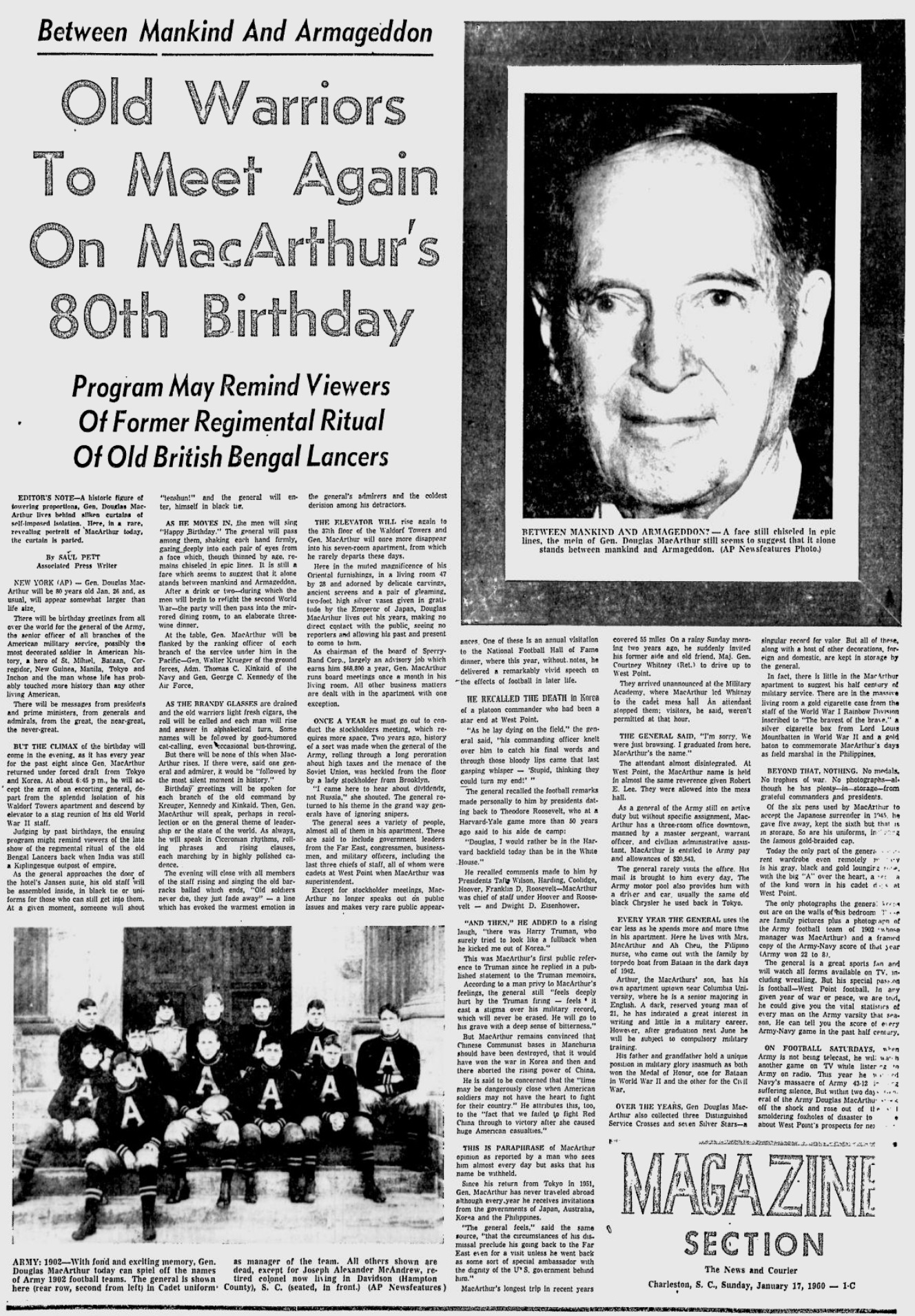
DouglasMacArthur_80thBirthday_NewsandCourier_Jan171960

–

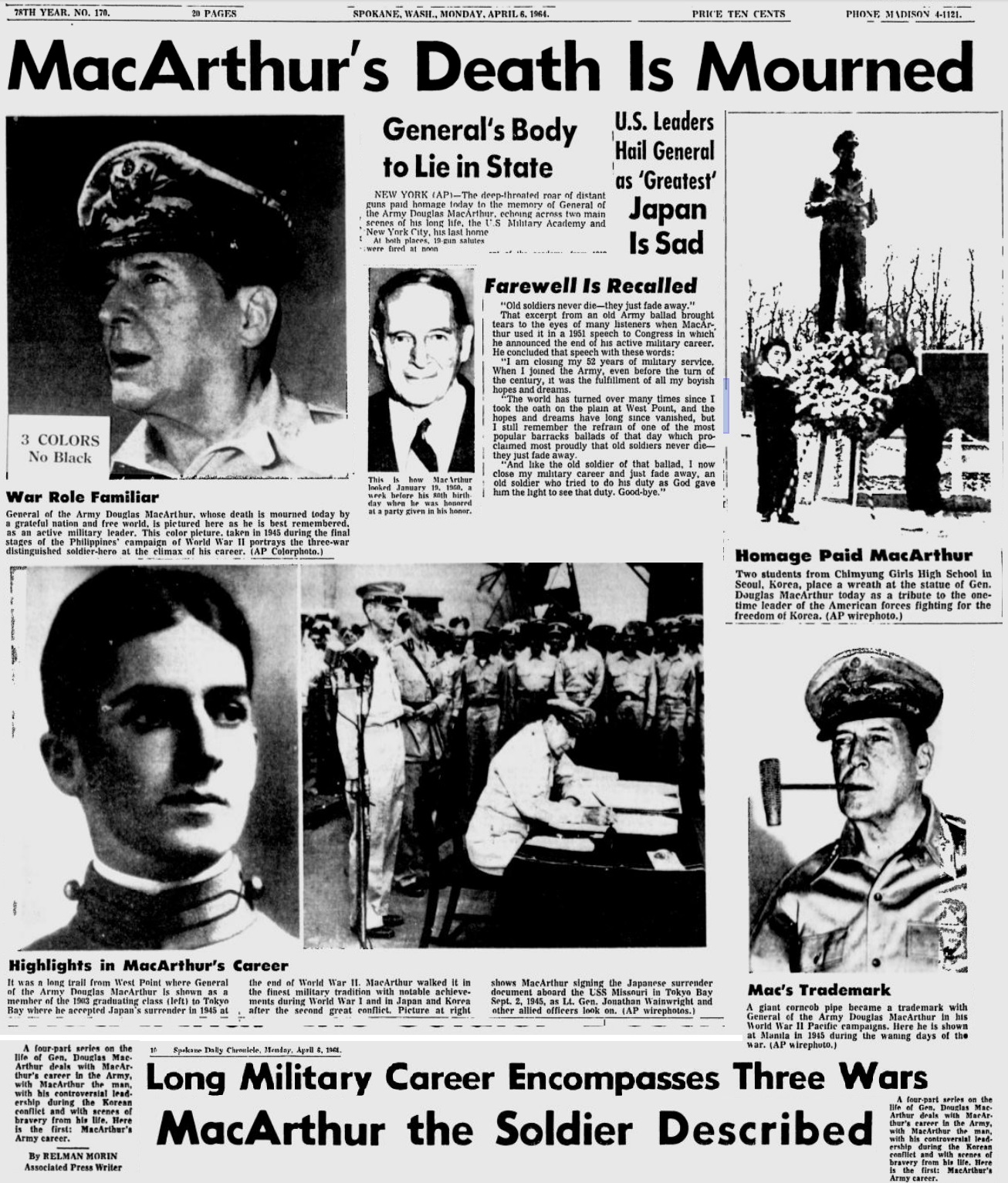
DouglasMacArthur_Death_SpokaneDailyChronicle_Apr61964

The man who won 24 Olympic gold medals for the United States isn’t Michael Phelps or Mark Spitz or even Jesse Owens. In fact, he didn’t compete in any Olympic sport. Yet he swung America’s attention to the importance of the Olympic Games as no other American had ever done — and turned Olympic gold into a rebirth of the American spirit.

He was General Douglas MacArthur.

We usually think of MacArthur as one of the supreme commanders of World War II, liberator of the Philippines and rebuilder of a shattered postwar Japan — and the genius behind one of the greatest military master strokes in history: the landing at Inchon during the Korean War.

But in 1928 MacArthur was president of the U.S. Olympic Committee, and led his country’s team to some of its most glorious moments — and laid the foundations for America’s love affair with the Olympics ever since.

At the time the modern games had only been held seven times since their founding in 1896. Many Americans wondered how much time and money the United States should spend — or waste — on the Olympic effort. So when the president of the U.S. Olympic Committee died suddenly, the other members turned desperately to the former superintendent of West Point and World War I hero, Major General Douglas MacArthur.

He was already famous for his advocacy of sports at West Point; his message to cadets about athletics, “On the field of friendly strife are sown the seeds that . . . bring forth victory,” stands near the West Point football stadium to this day.

MacArthur accepted the job with enthusiasm, and threw himself into the work as if he had been planning a military campaign. He met with coaches, gave inspiring speeches to sponsoring committees, harangued his coaches and his athletes — even supervised their training and workout schedules.

When the team arrived in Holland for the games, the outlook was not bright for our entrants, MacArthur wrote later, but he was determined that the United States should win. He became in effect Coach-in-Chief, attending every practice he could and meeting with athletes to evaluate their performance and motivate them to a higher level. MacArthur admitted he rode them hard: “I stormed and pleaded and cajoled.” He told them that America was the greatest nation in the world and therefore it deserved to have the greatest Olympic team.

We have not come 3,000 miles just to lose gracefully, he thundered, we are here to win, and win decisively.

When the U.S. boxing team’s coach threatened to withdraw from further competition after a blatantly unfair decision, MacArthur stopped him cold. Americans never quit, MacArthur barked. It became the motto for the entire team.

MacArthur’s fierce effort paid off. The United States had won 24 gold medals, more than the next two most-decorated countries, Finland and Germany, put together. The U.S. team had set 17 Olympic records and seven world records. When they returned to the United States, MacArthur wrote up a stirring report for President Coolidge on his team’s performance, and urged that support for the Olympic Committee be put on a more regular basis with a $2 million endowment fund.

Nothing has been more characteristic of the genius of the American people than their genius for athletics. MacArthur told the president. The experience, he said, “has made me proud to be an American.”

One of his old field commanders, General Charles Summerall, wrote to MacArthur: “You have not only maintained the reputation that Americans do not quit, but that Americans know how to win.

MacArthur had turned the Olympic Games into a source of national pride, as well as a national priority. Victory there has remained a symbol of the American spirit — one we need this year, perhaps, more than ever.
Historian Arthur Herman is a senior fellow at the Hudson Institutein

–

Jim Young

Football Coach

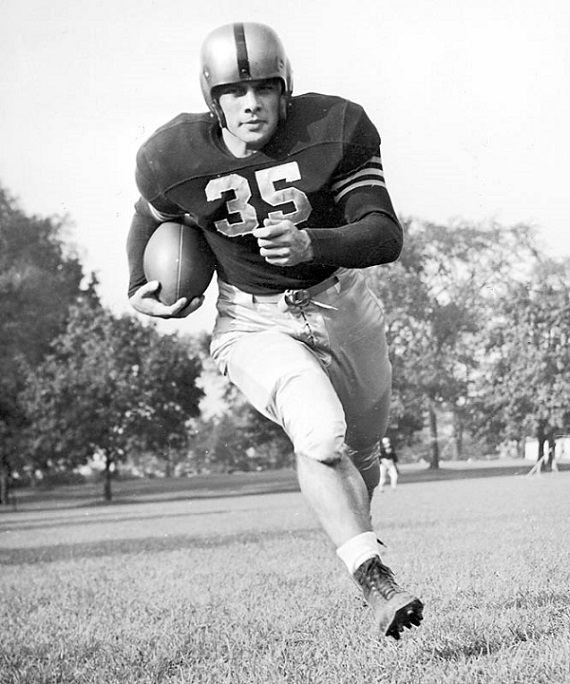
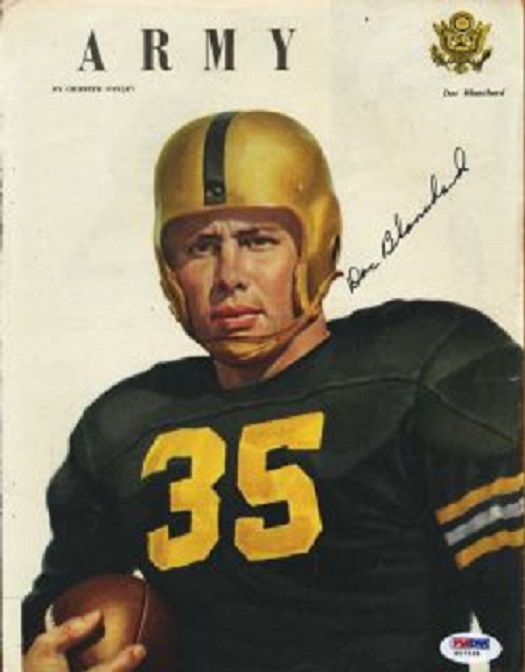
Doc Blanchard

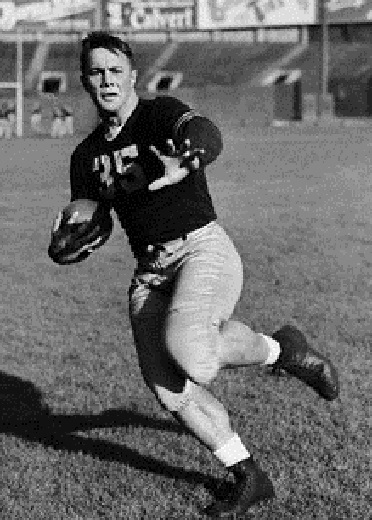
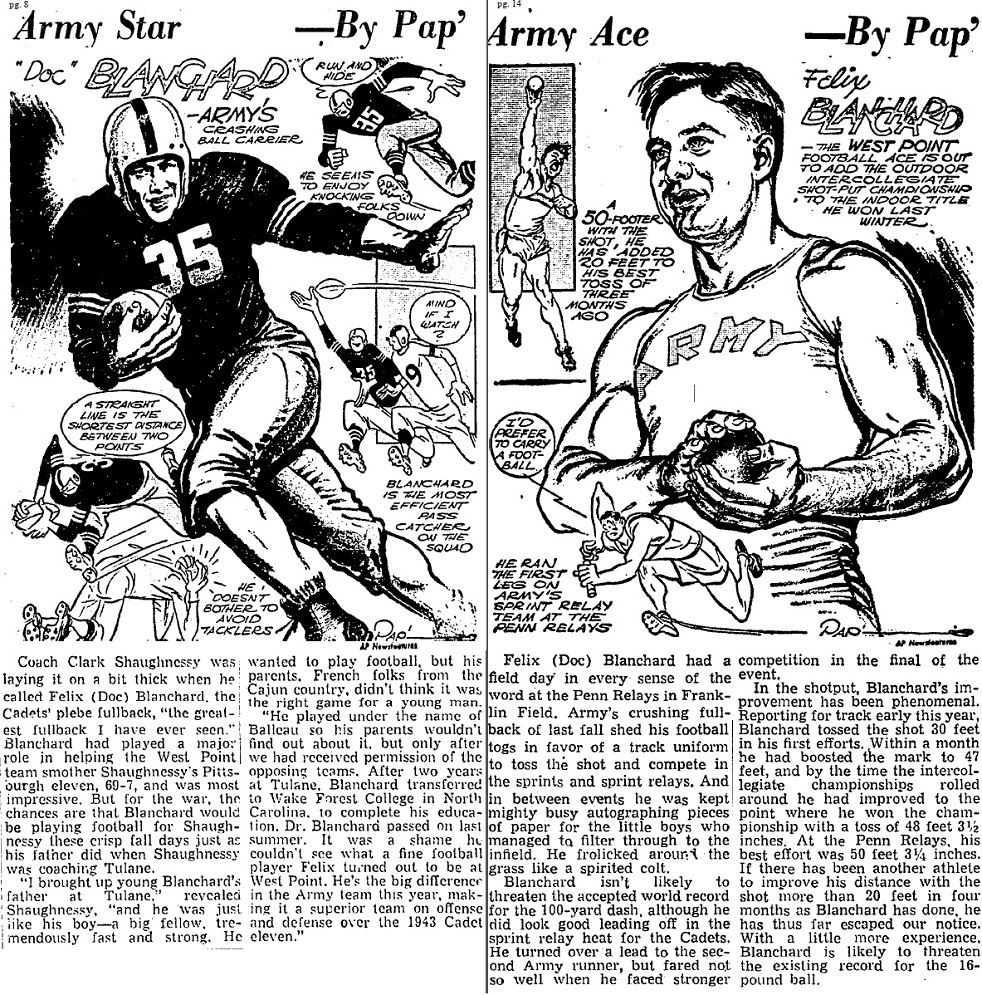
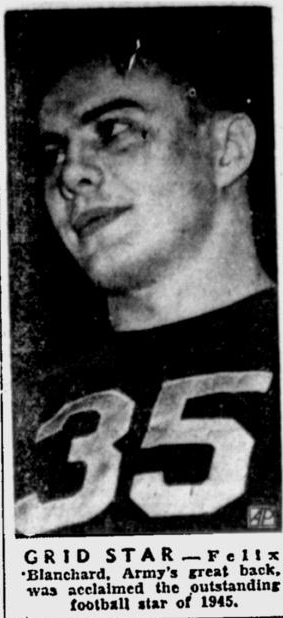
ArmyFB_1945_Felix-Doc-Blanchard

Doc Blanchard 1944

3 Army A’s in Football

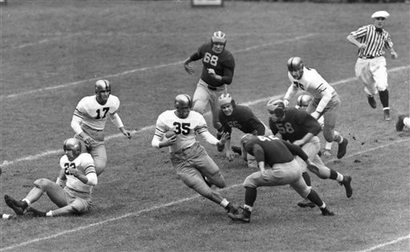
The sporting public first took notice of Blanchard in the 1944 season, when he starred in Army’s 59-0 pasting of Notre Dame, the worst defeat in the school’s history. “Blanchard,” noted one press account, “employed mainly as a decoy in the Army attack, played a spectacular game, bursting half the eardrums of the 74,437 spectators in the third period with a block that made possible [a] scoring return of a punt.” And the New York Times observed Blanchard was “even more poisonous on the defense than he was running the ball.”

Blanchard’s overall performance stunned Notre Dame coach Ed McKeever who wired back to South Bend: “Have just seen Superman in the flesh. He wears Number 35 and goes by the name of Blanchard.”

Doc Blanchard:
The Army War Machine

by David Pietrusza

Dr. Felix Anthony Blanchard, Sr. bestowed three things to his son, 1945 Heisman Trophy winner, “Doc” Blanchard:

-his name

-his nickname, “Doc”

-his love of football

They were not necessarily in that order.

The senior Blanchard (a hefty 240 pounds) starred at fullback at both Tulane and Wake Forest (under the name “Beaulieu,” so his father wouldn’t know what he was up to) and provided his son and namesake with a lifelong love for football. He took no chances whatsoever on how the boy would turn out, placing miniature footballs in the infant’s crib. At age 2 1/2 young “Little Doc” had gotten the message and was cajoling an aunt into holding a football for him to practice kicking.

In high school Blanchard starred for Bay St. Louis, Mississippi’s St. Stanislaus Prep (the senior Blanchard was team physician for that squad) and played fullback in New Orleans’ Toy Bowl. For a while Little Doc thought of attending Tulane, but finally opted not for Army’s that would come later – but for North Carolina, where his mother’s first cousin, Jim Tatum, coached the freshman squad. At Chapel Hill Blanchard was a terror both on and off the field. “Once,” recalled the team’s trainer, “the knocked out two would-be tacklers on the same play.” On another occasion, he ripped a steam radiator off the floor, when he became annoyed at a hotel manager.

World War II cut short his North Carolina career. In 1943, at the end of his freshman year, Blanchard tried to enlist in the Navy, but was rejected for poor eyesight (as a boy one eye was damaged when another lad literally threw mud in it) and for being overweight. The Army had no such qualms about Blanchard – or about several million other young men for that matter — and he joined that branch of the service as a buck private.

Before long, however, Blanchard gained acceptance to West Point, but before he entered the military academy, his father passed away. The move to West Point was a move he had heartily approved, however. “My dad,” Blanchard recollects, “always thought that to be successful in college athletics the place to go play was in the Northeast, and I think he was probably right.”

The sporting public first took notice of Blanchard in the 1944 season, when he starred in Army’s 59 – 0 pasting of Notre Dame, the worst defeat in the school’s history. “Blanchard,” noted one press account, “employed mainly as a decoy in the Army attack, played a spectacular game, bursting half the eardrums of the 74,437 spectators in the third period with a block that made possible [a] scoring return of a punt.” And the New York Times observed Blanchard was “even more poisonous on the defense than he was running the ball.”

In that contest, Blanchard was deadly not only to the fighting Irish but also to anyone in his path. One official made the mistake of getting in the way of a Blanchard tackle. Doc bowled him over, dislocating one of the poor man’s elbows in the process

“He just happened to be where I was,” says Blanchard in his matter-of-fact manner.

Blanchard’s overall performance stunned Notre Dame coach Ed McKeever who wired back to South Bend: “Have just seen Superman in the flesh. He wears Number 35 and goes by the name of Blanchard.”

God-only-knows what the official with the non-working elbow had to say.

Army Coach Earl “Red” Blaik was never known for his braggadocio, but even he had to admit: “I never saw anybody like Blanchard before….He has the weight of a fullback and the speed of a halfback.”

Of course, Doc Blanchard had a little help on that Army team, such as center “Tex Coulter”, tackle Al Nemetz, guard Jack Green and quarterback Arnold Tucker. But most significant, of course, was Glenn Davis. As Blanchard barreled through all opposition, earning the nickname “Mr. Inside,” (a name bestowed on him by the New York Sun’s George Trevor) Davis took a more circuitous route, and became known as “Mr. Outside”.

Their styles emphasized different strengths. I was strong in the “legs,” Blanchard once observed, “I had good acceleration for my size, good quickness. I wasn’t what you would call a speed guy, like Glenn.”

Earl Blaik once explained what made Blanchard unique: “Imagine a big bruising fullback who runs one hundred yards in ten seconds flat, who kicks off into the end zone, who punts fifty yards, who can also sweep the flank as well as rip the middle, who catches laterals or forward passes with sure-fingered skill, and who makes his own interference. That’s Mr. Blanchard.”

“Mr. Inside” and “Mr. Outside” ran roughshod over their opponents. Red Blaik gushed about his Touchdown Twins, “I doubt if any team ever had two such players in the backfield at the same time.”

Army was an absolute powerhouse. In its first six 1945 contests, it outscored opponents 271 to 33. For the season, the Black Knights captured the Lambert Trophy as the best college team in the East.

Army went 27-0-1 in 1944-46, Blanchard’s three seasons at the Point. In 1944 and 1945 the going was so easy, Blaik had plenty of opportunities to use his substitutes – and took every one. Army’s first and second teams averaged just eighteen minutes per game, and even the fourth stringers got plenty of work.

Of course, being a service team in an era when college squads were being stripped of their able-bodied personnel was a decided advantage to the Military Academy. “Sure they had an advantage,” Blanchard readily admits, “They had access to all the people in the service, and all the people that were over 18 were in the service. So they were just drafting people out of the service.”

When Army beat Navy 23-7 in 1945, Blanchard (“205 pounds of charging wild buffalo,” as one account of the game described him) allegedly felt a special someone was there to help: his late father. “He was there…,” a sentimental reporter quoted Blanchard as saying, “I could feel him patting me on the back after each play and saying, ‘Hit like your daddy did, son.'”

It’s a good story, a darn good story. There’s only one problem with it: it’s just not a accurate story.

“Well, I’ve read that [story] too,” says Blanchard, “I don’t recall it. I’ll say it’s not exactly true.”

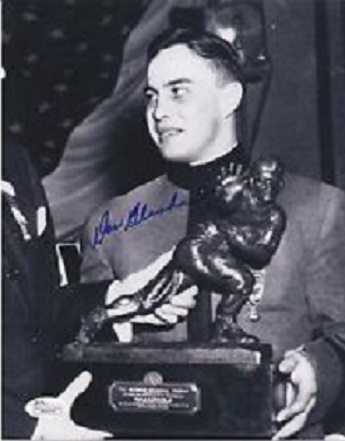
Receiving the 1945 Heisman

Blanchard, however, could have used a little extra assistance in that contest. All season long he had been engaged in a good-natured touchdown rivalry with Davis. Going into the game, the last of the campaign, the Touchdown Twins were, er, identical, tied sixteen-all in that category. Against the Midshipmen, Davis TD’ed twice; Blanchard, three times.

That may have been enough to put him over the top in Heisman balloting. When the votes were announced in December 1945, Blanchard outpointed his teammate 860 to 638. Far back were St. Mary’s Squirmin’ Herman Wedemeyer (152), Alabama’s Harry Gilmer (132), Notre Dame’s Frank Dancewicz (56), Ohio State’s Warren Amling (42), and Indiana’s Pete Pihos (38).

Blanchard was the first junior to win the Heisman (“in those days they sent the news via Western Union; I got a telegram”), and also captured the Maxwell and Touchdown Club trophies as the year’s best college player. He and Davis even jointly made the November 12, 1945 cover of Time magazine. Blanchard, Davis and their teammates, Coulter, Green, and Nemetz, each achieved All-American status.

Temple coach Ray Morrison marvelled at Blanchard’s remarkable 1945 season: “Doc Blanchard was a colossus who, experts insist, is the fullback of all time. Blanchard turned loose more raw power against Army opponents than has been seen since the days of Bronko Nagurski. In addition, Blanchard ran with greater speed and finesse than even the great Nagurski.”

Unlike a major league pitcher who seemingly can recall every pitch he ever threw to every batter, Blanchard doesn’t wallow in past glories. When asked about the most memorable play in his Heisman season, he harrumphs: “You’re stressing me now. Hell, you’re talking to a guy who can’t remember what he had for breakfast. You want me to remember the most memorable play of fifty years ago? C’mon. I don’t have one that I can remember.”

But he does have a few games he savors: “Navy was the big game, although Notre Dame in 1944 was a big time game for us because of the history of the series’ won-lost record and all that stuff.”

And there was a moment in Blanchard’s West Point career that transcended even a Heisman Trophy: being part of the honor guard at President Franklin Roosevelt’s funeral at nearby Hyde Park, New York.

One might think Blanchard’s status as the nation’s premier college football star might have played a part in his selection. It didn’t. It was more a matter of which unit he was assigned to at the Academy. “They picked some people from West Point to go over and attend,” says Blanchard, “The group that I was assigned to went, so I got to go.”

Blanchard’s 1946 senior season was marred by torn knee ligaments he suffered in that campaign’s first game. But he recovered to run for 613 yards (a 5.1 average)and score ten touchdowns and once again be designated an All-American. He finished his career with 38 touchdowns and 1,666 yards rushing. Still on the squad, was Glenn Davis-who after two runner-up finishes – finally captured a Heisman for himself.

Blanchard had his eye on a pro career, but the War Department vetoed that idea. He remained in service until 1969, serving as a fighter pilot in both Korea and Vietnam.

http://www.collegefootball.org/famersearch.php?page=1&submitted=1&school=Army&sortby=school

http://www.sccotton.org/blanchard.htm

http://www.heisman.com/winners/d-blanchard45.html

Football’s Greatest Decade – – by Bernie Mcarty – http://www.la84foundation.org/SportsLibrary/CFHSN/CFHSNv01/CFHSNv01n1b – – see page 5

This writer believes West Point 1945 is the greatest team of all time. The 1944 Army team may actually deserve that title, but it was never tested. Army was also undefeated in 1946, 1948 and 1949.

Army’s top stars during 1945-1949 were the effulgent “Touchdown Twins”, Glenn Davis and Doc Blanchard, Arnold Tucker, Arnold Galiffa, Rip Rowan, Bobby Jack Stuart and Gil Stephenson in the back-field, and up front” Joe Steffy”, Art Gerometta, Jack Green, “Bill Yoemans”, Joe Henry “Tex” Coulter,Al Nemetz, and the sterling end duo of Hank Foldberg and Barney Poole.

In 1945 the Newspaper Enterprise Assoc. simply picked the entire Army team as its All-American team, stating no group of All-Americans could beat the Cadets. Only a world war could have brought together such a collection of players to one institution. But it took the coaching genius of Col. Earl Blaik to mold the players into a cohesive unit. In truth, Navy personnel was equal to Army’s on an individual basis. The Middies never jelled as a team, however.

The 1951 Army outfit might have been as good as the 1945 Cadets, but the infamous cribbing scandal wiped out the team.

–

ArmyFB_1945_Felix-Doc-Blanchard_Army

–

Felix Blanchard

–ArmyFB_1944_DocBlanchard

Felix "Doc" Blanchard running the football

–

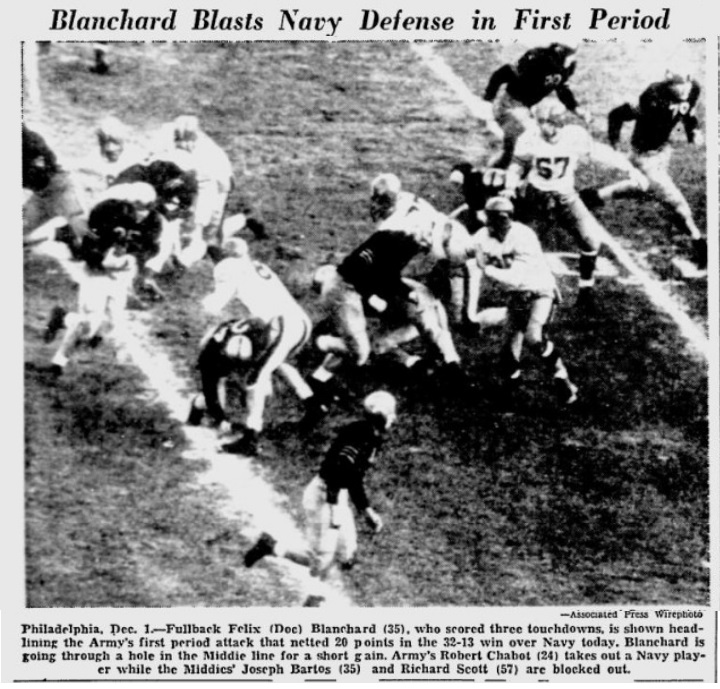
ArmyFB_1945_vsNavy-Blanchard_YoungstownVindicator_Dec11945

–

ArmyFB_1944-45_Blanchard_PrescottEveningCourier_Jan71945

ArmyFB_1945_Blanchard-Heisman

ArmyFB_1945_Blanchard-Heisman-2

–

ArmyFB_1946_Blanchard-Davis_LIFE-cover

–

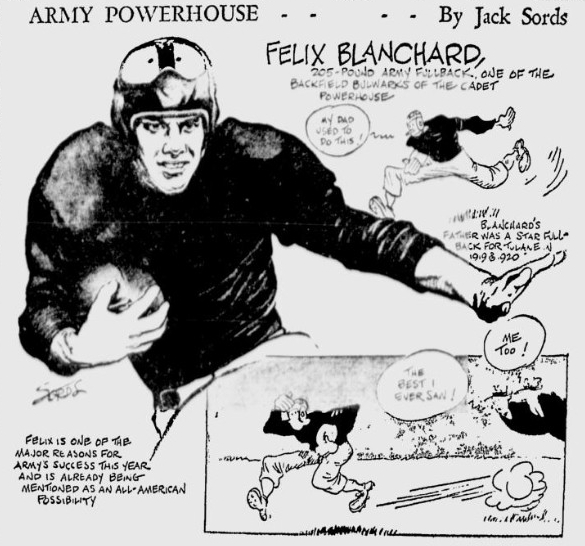
as depicted by sport’s cartoonists

ArmyFB_1944_DocBlanchard_byJackSords_PainesvilleTelegraph_Nov61944

–

ArmyFB_1944_DocBlanchard_byPap_CSM_Nov151944-May101945

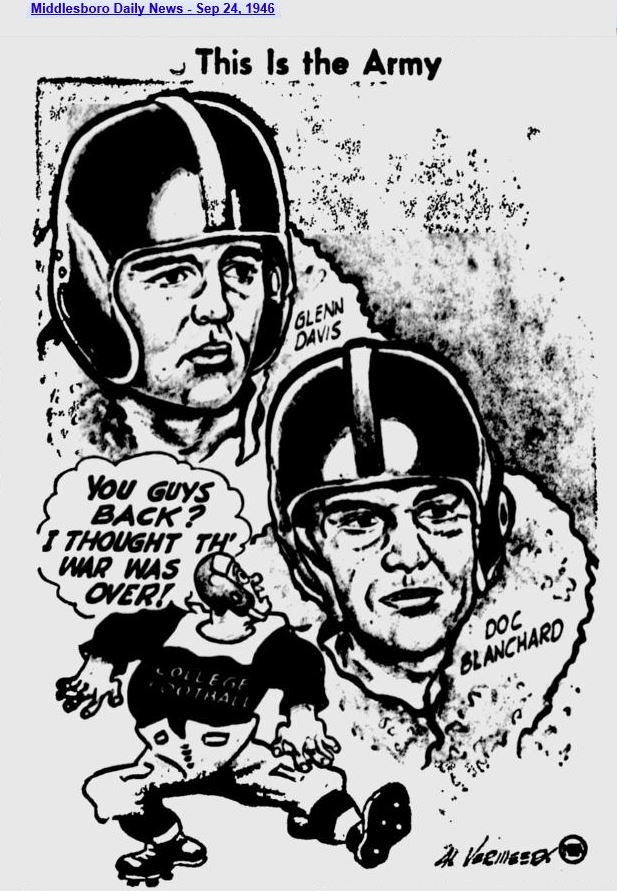
armyfb_1946_blanchard-davis_byalvermeer_middlesborodailynews_sep241946

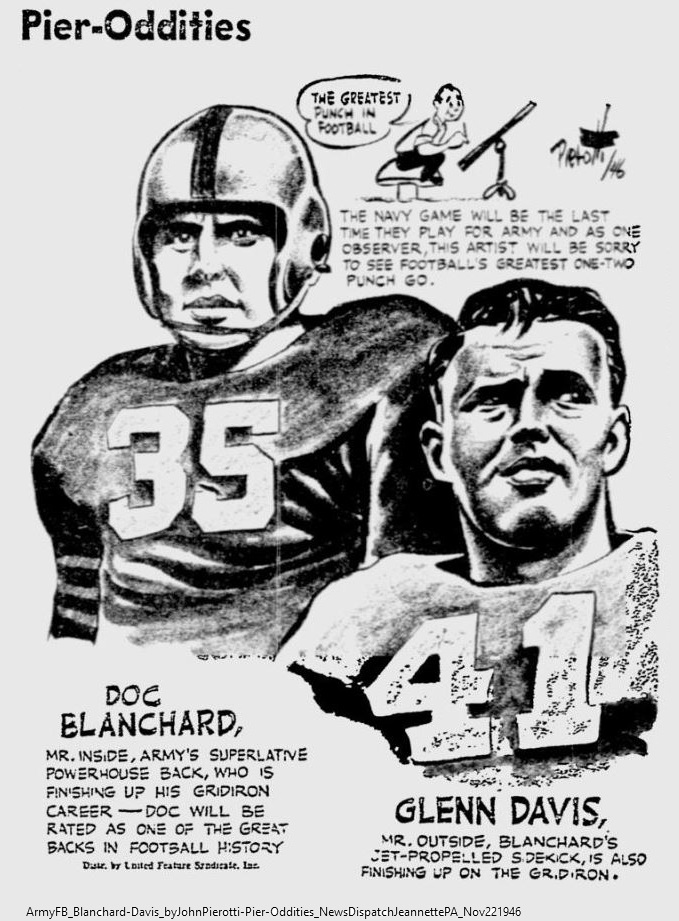
ArmyFB_1946_Blanchard-Davis_byJohnPierotti-Pier-Oddities_NewsDispatchJeannettePA_Nov221946 (1)

–

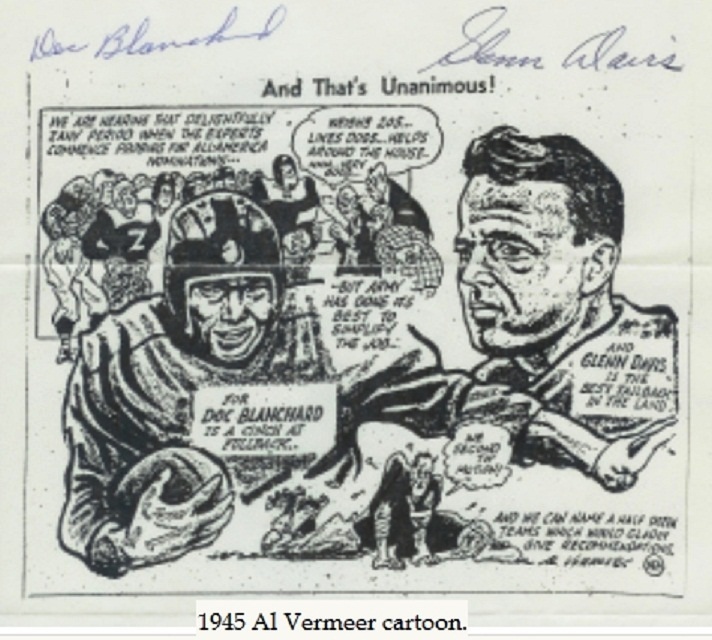
ArmyFB_1945_DocBlanchard-GlennDavis_byAlVermeer

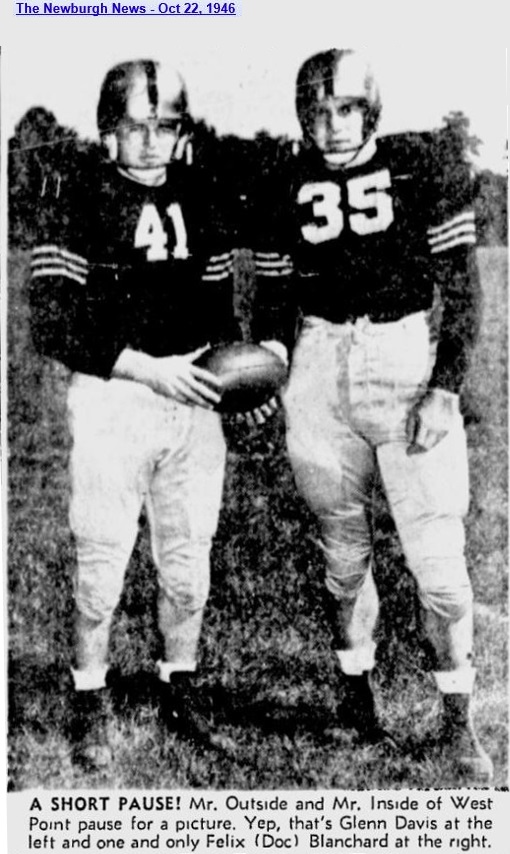
armyfb_1946_blanchard-davis_newburghnews_oct221946

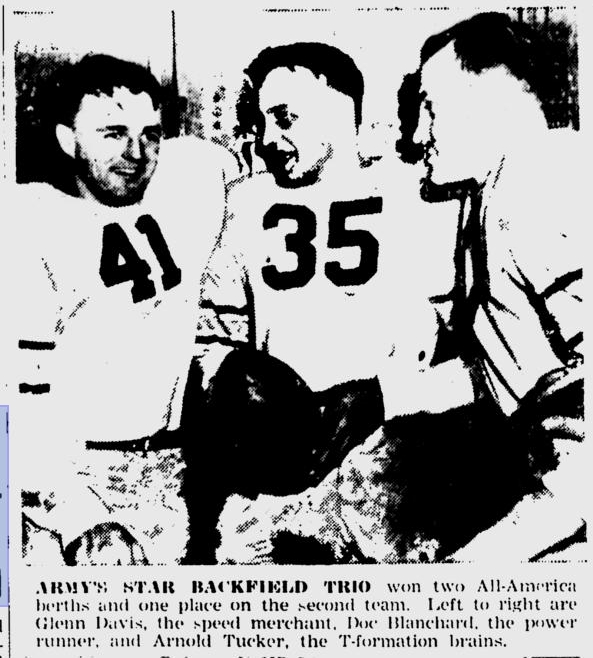
armyfb_1946_blanchard-davis-tucker_oxnardpresscourier_dec51946


Awesome reading …. and 1957 was the year I started watching “college football”, as a 12-year-old. This research came about, from reading a letter in “Reminisce” magazine ( January 2007 issue, found stored in my attic). A “Bin” (Vince) Barta, wrote about his Army football days (56/57), and mentioned “Doc” (Felix) Blanchard (Mr. Inside), as having coached Vince for a year. I was stationed in Korat, Thailand, in 67/68, and had the “honor” of fitting L/Col “Doc” Blanchard for his flight gear, to fly “100 Missions over North Vietnam”, in an F-105 fighter. Not the time for a conversation with “Doc”, but I mentioned that I remembered “Mr. Inside”, which brought a smile, and thank you from him. “Doc” did complete his “100 missions” with the 388th TFW, and was promoted to “bird Colonel”, before being re-assigned to Kadena AFB, in Okinawa. Sadly, Felix “Doc” Blanchard has passed on (4/19/2009, at age 84). It’s pretty amazing what reading an article can do, to bring back a memory. If I recall correctly, 1957 was the year that Notre Dame defeated Oklahoma, 7-0, snapping a 47 game winning streak, of “Bud Wilkenson’s Sooners”. “Dick Lynch” scored the touchdown, in what has to be one of the great college football games ever. Nothing like reliving great memories.

–


–


–

–


—

George Kirschenbauer

George & Karen Kirschenbauer
George was our Class President for a number of years. Ted Stroup replaced George.

Recuited for Baseball, George lettered in both Football and Baseball– sending a pitch in the spring of 1962 right over Cullum Hall roof.

“Kirschenbauer, Kirschenbauer, I saw George Kirschenbauer hit a home run over the roof of Cullum Hall” Comment by son of Mr. Link (PE Dept.) Spring of 2006, when George’s name was mentioned. The excitement in his voice was as if was May of 1962. What we did made a difference.

thumbnail-2
His home run off Yankee Cy Young winner, Bob Turley (Yogi Berra to George as he crossed home plate, “Well son, you’ve seen the last inside fast ball you’re going to see today, so hang on to your hat.”

Start of 59 Season

75 Bill Yost, 73 Bob Odd, 11 Pete King, 45 George Kirschenbauer, 58 Dick Buckner, 65 Harry Miller, 64 Al Vanderbush, 56 Ozzie Oswandel, 40 Russ DeVries, 94 Bob DeVries, 61 Jerry Clements

Joe Caldwell

59 Season Quarterbacks, Tom Blanda on the left, Pete King on the Right and Army’s Quarterback Joe Caldwell Class of 1960 whose name still appears in the record book after all these years.

Dale Kuhns

220px-Military_service_mark_of_the_United_States_Air_Force.svg Dale & Barbara Kuhns 37982964_2135311110081840_3953115868065431552_o.jpg
Ox – appropriate earning 6 Army As- 3 year starter as Football Tackle and Heavy Weight Wrestler.  Drove B52s

Football
Wrestling

76 Tackle Fall of 59

Barry Butzer

Barry & Nancy Butzer

Barry & Nancy Butzer
To get through the line I depended especially on three teammates and Classmates, Mike Casp (our team captain) – at Right Guard, Bill Whitehead – at Center, and Barry Butzer – at Left Guard. They were great Army football players. We lost Mike and Bill in Vietnam. Barry was Killed in a auto accident several years ago – – by Al Rushatz

Guard #60


Earl Blaik

Earl Blaik’s Teams – National Champions in 1944, 45, 46, Winners of the Lambert Trophy in 1944, 45, 46, 53, and in 58. He was selected Coach of the Year in 1946 and College Coach of the Year in 1953.

Col Blaik – the 1953 Win over Navy – ‘The Return to Glory”

Football’s Greatest Decade – – by Bernie Mcarty
http://www.la84foundation.org/SportsLibrary/CFHSN/CFHSNv01/CFHSNv01n1b

This writer believes West Point 1945 is the greatest team of all time. The 1944 Army team may actually deserve that title, but it was never tested. Army was also undefeated in 1946, 1948 and 1949.

Army’s top stars during 1945-1949 were the effulgent “Touchdown Twins”, Glenn Davis and “Doc” Blanchard, Arnold Tucker, Arnold Galiffa, “Rip” Rowan, Bobby Jack Stuart and Gil Stephenson in the back-field, and up front Joe Steffy, Art Gerometta, Jack Green, Bill Yoemans, Joe Henry “Tex” Coulter, Al Nemetz, and the sterling end duo of Hank Foldberg and Barney Poole.

In 1945 the Newspaper Enterprise Assoc. simply picked the entire Army team as its All-American team, stating no group of All-Americans could beat the Cadets.

Only a world war could have brought together such a collection of players to one institution. But it took the coaching genius of Col. Earl Blaik to mold the players into a cohesive unit.

In truth, Navy personnel was equal to Army’s on an individual basis. The Middies never jelled as a team, however.

The 1951 Army outfit might have been as good as the 1945 Cadets, but the
infamous cribbing scandal wiped out the team.

Joe Steffy said Col Blaik remembered 2 plays that stoodout as special. One was the 93 yard touchdown by Rip Rowan in the A-N game.

The other was a touchdown run to win the game against Navy in 1955. RB Pete Lash ran for 30-40 yards to paydirt during which every Navy player had a shot at him, but he run through them all. Joe said that Lash was a walk-on. Small and played high school FB; Joe said he really did not have the attributes of a great player. BUT, he was tenacious and worked harder than anyone on the team. He succeeded in making the starting team his Firstie year. Went on to become a three star general.

Cadet Blaik – probably 1919 Season

Peter Vann ‘s explanation of Lombardi’s Royal “3Fs”; comments about schooling by Vince Lombardi and a letter by Vince’s Son indicating that because of Peter’s success his Dad was able to climb the professional ranks – – is at Peter Vann.

By WILLIAM N. WALLACE (as edited)
Published: May 7, 1989

Col Blaik was the head football coach at the United States Military Academy, his alma mater, for 18 seasons, 1941 to 1958, and directed a series of superb teams. His teams were named national champions in 1944 and 1945.

http://www.coachwyatt.com/blaik1.html

http://www.collegefootball.org/famersearch.php?page=1&submitted=1&school=Army&sortby=school

http://www.medaloffreedom.com/EarlRedBlaik.htm

http://www.collegefootball.org/news.php?id=377

See page 88 —
http://books.google.com/books?id=KkFq1YeRKjsC&pg=PA88&lpg=PA88&dq=joe+steffy&source=web&ots=9j9edGgUg3&sig=oKGdfDWTOn6p9UWsDFDI0EOifxY#PPA86,M1

Col Blaik, Army Football Team and the Corps of Cadets

Col Blaik – Coach and Athletic Director

Three of his players – Doc Blanchard, Glenn Davis and Pete Dawkins – won the Heisman Trophy as the nation’s outstanding collegiate player, while Joe Steffy was the only Outland Trophy Winner. Many of his players were All-America selections.

Although a civilian coach and athletic director in his years at West Point, he was always addressed as Colonel, his retirement rank as a reserve officer.

His darkest time came in 1951, when 5l football players were among 90 cadets dismissed from the Academy for violations of the honor code. One was his son, Robert, the starting quarterback. Col Blaik at the urging of General MacArthur chose to stay on at West Point and rebuild the program. That he did, and by 1953 the Army team again was one of the best.

Mr. Blaik’s record at Army was 121 victories, 33 defeats and 10 ties with five unbeaten seasons. He had only one losing season, 1951.

Mr. Blaik graduated from Miami University in his native Ohio and entered the Academy during World War I. He was an All-America End, receiving a degree in 1920, and was named the best athlete in his class.

He resigned from the Army in 1922 and joined his father in a real-estate business in Dayton. He turned to coaching as an unpaid assistant of George Little, who had been his Miami coach, at Wisconsin in 1925. Mr. Blaik went to Army as an assistant coach in 1927 and became head coach at Dartmouth in 1934. His teams there were unbeaten through 21 games, the first of several such streaks for him.

West Point called in 1941 after a series of losing seasons under officer coaches, and he took command.

Col Blaik brought a cerebral approach to football and was an inventive organizer. He kept his distance from the players and chose wisely in naming assistants. Many of them, including Tom Cahill, Paul Dietzel, Sid Gillman, Herman Hickman, Vince Lombardi, Murray Warmath and Bill Yeoman, became successful head coaches.

Col Blaik – 1947

He could be inspiring. Bob Anderson, a fine running back, told of the time Mr. Blaik called him out of the barracks two nights before the Navy game and took him for a walk. Mr. Blaik told young Anderson he would be the key player against Navy. ”I was ready to run through a wall,” said Bob, who turned out to be the hero in the victory.

Col. Blaik’s teams were in many famous games. In 1935, a Dartmouth team beat Yale for the first time; another of his Dartmouth teams upset Cornell in the famous ”fifth-down game” in 1940. There was the 0-0 tie Army played with Notre Dame in 1946, and the end of a 32-game unbeaten streak in a defeat by Columbia in 1947.

Mr. Cahill, who was Army’s coach from 1966 to 1973, said of “Col” Blaik”: ”His impact on the game was outstanding. No one had greater respect. He was caring and kind to everyone and he felt very strongly about West Point and the Army.”

Coach Earl Red Blaik is survived by two sons, Robert and William. He will be buried at West Point.

By JACK CAVANAUGH
Published: October 1, 1995

There they were, the fabled Mr. Inside, Doc Blanchard, and Mr. Outside, Glenn Davis, standing in front of the grave of their coach, Col. Earl (Red) Blaik, not far from Michie Stadium, where they became perhaps the greatest running tandem in college football history.

West Point

There, too, at the West Point Cemetery stood Barney Poole, who may have been the only player to have been named an all-American at two different schools: the United States Military Academy and the University of Mississippi. Close by were three other former all-Americans: guard Joe Steffy, who lives only 13 miles away in Newburgh, and quarterbacks Doug Kenna and Arnold Tucker.

Fifty years after winning the second of three consecutive national championships on what Blaik proclaimed as his best team ever, Davis, Blanchard, Poole, Steffy, Kenna, Tucker and 41 other players from the 1940’s — the glory days of Army football — were reunited today under a brilliant sky. Among them were 6 retired generals, including Blanchard, and 16 colonels.

In a weekend celebration that began with a reception aboard the 154-foot yacht Taipan on the Hudson River on Friday night, the players, along with five former team managers and three coaches, began the day with the visit to Blaik’s grave. There, Davis and the retired four-star Gen. Bennie Davis, a tackle on Army’s unbeaten 1948 and 1949 teams, laid a wreath beside Blaik’s football-shaped tombstone. Acting as a spokesman for the players, Kenna, the quarterback of the ’44 team, told the morning gathering of about 150 that Blaik was “the most challenging and demanding person I have ever met, but also the most caring person I ever knew.”

From Blaik’s gravesite, the returning players were bused to The Plain, the Academy parade ground, where they stood as guests of honor at the traditional pre-game march of the Corps of Cadets. Later, they were introduced to the near-capacity crowd of 39,069 at halftime of the Army-Rice game, which ended in a 21-21 tie when the Army place-kicker J. Parker kicked a 44-yard field goal as time ran out. As a further tribute to the former players, the current team wore “throwback” jerseys similar to those worn by the great Army teams of the ’40’s.

“It was a wonderful period that I’ll never forget,” said Davis, now 70, who, like the 71-year-old Blanchard, was an all-American on the ’44, ’45 and ’46 teams. “My days at West Point stay with me everywhere I go. And they mean more than anything to me.”

Playing before the introduction of platoon football, the 6-foot, 175-pound Davis led the nation in scoring in 1944 and played safety on defense. The 6-foot, 210-pound Blanchard led the nation in scoring in 1945 and played linebacker. “I averaged 58 minutes in 1946, my last year,” recalled Davis, who also averaged 11.5 yards a carry in 1945 and whose 8.26 yard career rushing average is still a National Collegiate Athletic Association record. Together, Blanchard and Davis scored 97 touchdowns. Blanchard won the Heisman Trophy in 1945 and Davis won it in 1946.

Only a scoreless tie with a Notre Dame team led by Johnny Lujack at Yankee Stadium on Nov. 10, 1946, prevented Army from going unbeaten and untied for three straight seasons. Over that span, the Cadets won 27 games, 13 by shutout, including 59-0 and 48-0 victories over Notre Dame in 1944 and 1945. After losing two games in 1947, following the graduation of Davis, Blanchard, Tucker and Poole, the Cadets went unbeaten over the next 26 games before losing to Navy, 14-2, in the last game of the 1950 season.

For Blanchard and Davis, it marked the first time in more than a decade that they had appeared together at West Point.
It was Steffy, a regular at Army home games, who served as the catalyst for this weekend’s reunion. “We’re not getting any younger, and I thought it would be nice to get as many people as possible back from those teams in the ’40’s,” he said. “And it’s great that so many came back, including a lot who haven’t been at West Point in many years.”

For most, the weekend was as much a tribute to Blaik, a West Point graduate and the Army coach from 1941 through 1958 (when he retired after another unbeaten season), as it was to them.
“He was a super coach and a very nice person,” Steffy said of Blaik, who died in 1989. “He never, ever raised his voice.”

http://www.la84foundation.org/SportsLibrary/CFHSN/CFHSNv01/CFHSNv01n1b

Bob Novogratz

April 3, 2007

Bob Novogratz – Humble on the Hall of Fame

Rob O’Sullivan

GoBlackKnights.com Publisher

Talk about it in The 12th Knight

Most fans of Army football fit a different mold than your typical college sports fan. Sure, there is the desire for a competitive program, and Army fans can be as spirited as any fans in the country. But beneath the surface, most fans of Army Football are fans of West Point first. The history of the Academy, the representation of our troops overseas and in harms way, and the knowledge that at this place, on these grounds, young men and women make one of the noblest choices one can at a very young age ? the decision to commit to service to country.

It may have been said best by David Labensky, when he titled the book of his four year experience with the cadets of West Point, “Absolutely American”.

So goes the story of former Army football player Bob Novogratz, the 1958 Knute Rockne Award winner as the nation’s top offensive lineman, an All-American, and current candidate for induction into the College Football Hall of Fame.

The son of Austrian immigrants, Novogratz grew up in Northamton, PA, outside of Allentown. “I wasn’t a great athlete in high school,” starts the former Army standout, “I attended Blair Academy after graduation, and that year I grew quite a bit. I got bigger and stronger.”

The physical growth of Novogratz, coupled with his performance as a wrestler, had a lot of schools looking his way, including Penn and Virginia. But Novogratz had another influence that pushed him in the direction of West Point. “My father was an immigrant, and became a mill worker. He also drove people to the poles on election day. Through that, he got to know the Prison Warden ? who knew our local congressman, Francis Walters,” explains Novogratz. “Before you knew it, I was taking the test and got an appointment.”

At the time, the decision to go to West Point was not necessarily foremost on Novogratz’s mind. “I had other opportunities ? Penn, Virginia. But there was a lot of pressure from my father,” he begins. “When you say something like that, it does not relay what is really underneath it all. You have to remember, he was an immigrant, and that is why it was so important to him. He worked in the mill, and this was an important opportunity for me from his perspective. At the same time, he was not a very communicative guy, but I knew it was a very big thing to him. Not until later in life did it really occur to me why that was.”

Novogratz, though not recruited to play football, would now find himself on the banks of the Hudson, where he began his West Point career as a wrestler. For a guy that would go on to be the top lineman in the country, his first two years would not seem to lead down that path. However, legendary Army coach Red Blaik saw something in Novogratz, and by the spring of his yearling (sophomore) year, Bob was on the football field.

“Went I entered West Point, I was not recruited to play football,” explains Novogratz. “I had two knee operations in my first two years at the Academy. It wasn’t until the spring of my second year that I started playing. When I got to practice, I was on the very bottom of the ladder; there were thirteen of us competing for the top two starting spots, I was dead last. But I worked my way up.”

So how does a cadet with bad knees who was not recruited end up on Army’s football team, playing for Coach Blaik?

“I had been a wrestler and COL Blaik saw me and said something to the effect that ‘we oughta get that guy out to play football.’ I was talking to my brothers and their friends about it, and decided to go out that spring,” explains Novogratz. “I worked my way up the ladder and started by the next fall. My junior year, I was named to the all east team. We were 7-2 that year; we lost to Notre Dame and Navy. The Notre Dame game was the toughest loss; we were leading the entire game, and they came back and won with a field goal late in the game.”

During that era, players played on both sides of the ball. Though the accolades surrounding Novogratz’s play center around his offensive guard play, you can hear the pride he took in his defensive play as well.

“I was a guard and a linebacker. On the defensive side of the ball, I was making a lot of tackles. In the Penn State and the Notre Dame games, I had a total of 48 tackles. I don’t have the cards with the stats, but I had a lot of tackles. We had a very strong season, but I hurt my ankle before the Navy game and was not at 100%”

Novogratz’s first season was successful. The team had a strong season, and he distinguished himself as an all-east talent. However, the best was yet to come for Bob and the team of which he was a part. 1958 was a return to prominence for the Black Knights.

“The following year (1958) Blaik came out with the “Lonely End” offense. The “Lonely End” was (College Hall of Famer) Bill Carpenter. (College Football Hall of Famer) Bob Anderson had a great season as well. It was the year of (Heisman Trophy Winner, Pete) Dawkins, Anderson, and Carpenter,” Novogratz reflects. “I was the leading tackler that year as linebacker, and I also played offensive guard. The week against Navy, I was the (Sports Illustrated) National Player of the Week. We were undefeated; our record was 8-0-1, and we finished the season ranked third in the country. We were also third in the country for defense. Our other guys were great as well; we had a very well balanced team. In some games, like Notre Dame, I played 56 minutes. Statistics for that type of thing were not kept, but we all played both ways, and we would be on the field for over 50 minutes per game.”

The experience of being on such a talented team brought with it a great sense of camaraderie between Bob and his fellow teammates. “We were very close, especially the linemen, we always hung out and still get together even now, at least every few years. Though I don’t see them a lot, we are in touch.”

The most recent reunion for the 1958 team was in South Bend this past season, when Army visited Notre Dame. The 1958 team was the last Army team to beat Notre Dame at their home stadium.

“The 1958 team all got together at the Notre Dame game. We had the opportunity to tour the College Football Hall of Fame together, and to see the statue of Colonel Blaik. It really looked perfect, and we all enjoyed seeing it together,” explains Novogatz. “At the game itself, I was amazed by how many Army fans were there from all over the country. Pete Dawkins was at the event, and over the years Pete kept in touch with the Fathers and past Presidents of Notre Dame. Father Hesberg, former President of Notre Dame invited Pete up to his box at the game, and Pete brought along a few of his teammates. Father Monk Malloy was also there. Notre Dame has a ton of respect for Army, and that has carried through the years.”

Though he only played football at West Point for two seasons, Novogratz made his mark and became one of the most valuable members of a very talented team. He played some very good foes in those two years, but his two favorite opponents were Navy and Notre Dame.

“My favorite games were against Notre Dame and Navy. When we went to South Bend, in 1958, Notre Dame was one of the top teams in the nation. We went out and beat them on their home turf. The other big thing for me in this game was the following I had watching me. My hometown is a football town, and they all were big Notre Dame Fans; I had 40 people go out to Notre Dame to see the game. In addition, that game was such a big win, and seeing the cadets and Army Fans run onto the field was very exciting,” reflects Novogratz”. “The Navy game was just such a big game. Back in my day, we had a full week of hype. We had a bonfire, and there was stuff going on every night in the mess hall. When the team got ready to go, the Corps would line up, and we would all get on the bus. As the busses left, the whole corps would run after us all the way down to Thayer Gate. After that experience, you are flying high. Nobody has to say more than that, you are ready. In addition to that, I always knew that I had at least 50 sets of eyeballs from my hometown looking at every play; they would come down to see me in Philadelphia.

The 1958 game, Novogratz’s last playing for Army (he would play one more game, the East-West post-season all star game), was a memorable one for him. “It was an intense game. It didn’t start well; we never put the game out of sight. I recovered 3 fumbles in that one, and the hometown folks were happy.”

The 1958 team was Army’s last undefeated team, and it was also the last season legendary head Coach Earl “Red” Blaik would mentor the Black Knights. “Blaik was a serious guy, he didn’t establish a personal relationship with individual players for the most part,” explains Novogratz. “He had a flare for the dramatic. He had the same routine for every away game. One year, he had a problem with the team getting sick, there must have been some bad water on the trip. So from that point forward, we brought our own water to the games – he was somewhat superstitious. He always wore the same hat; before a game we would always go out for a movie and it would always be a shoot ’em up type of movie. Then we would take a walk as a team, and for the big game, he would pull out a telegram from MacArthur or Eisenhower. Like I said, he had a flare for the dramatic. I did not have a close personal relationship with him. In fact, I could remember every word he ever said to me, but we liked him. What made him great was that he brought out the best in us. He was a guy of high moral fiber. He was not a bag of laughs, but it worked. We loved the guy.”

The game in 1958 was different than it is now. In Novogratz’s mind, yesterday’s game seems like it would be more enjoyable than what he sees out there today. “I think the game was a lot more fun to play when I did. You are on the field all the time. Offense, defense, kickoffs, kick returns – you played the whole game. The idea of playing a limited role doesn’t seem as interesting. But the game has changed, things are more specialized now. People are bigger and much more physically capable.”

In terms of the overall experience for Bob at West Point, Football was only a part of it, though an important part. “In those days, you would go from football, to wrestling season, to graduation, then go on leave, then into the military. It all went by so fast. It was a fantastic experience, far beyond anything I had ever imagined. There were so many different parts to it ? the relationships with your fellow cadets, family coming to the games, and then afterwards – getting the honors, the Knute Rockne award.”

For Novogratz, the accolades at the end of the season seemed to have a greater impact on him by what it gave his father, rather than the notoriety it provided him. “My father was working in the mill, and he came down to Washington for the day when the (Knute Rockne) award was presented. At the event reception, I looked over and saw that my father was in a full conversation with (Speaker of the House) Sam Rayburn and (Vice President) Richard Nixon. They spoke for twenty minutes. It was just so exciting. We went to the East-West game in California and met a host of celebrities – Mel Allen, Casey Stengal, Babe Ruth’s wife. It was big stuff for a kid out of a small town in PA.”

Today, Novogratz still has the arms of his teammates around him as they have kicked off a campaign for his induction into the College Football Hall of Fame. He shard the process his supporters have gone through.

“Getting here has really been a combination of things. My teammates started it. After Bob Anderson was inducted, then the team said they would get behind my nomination. At the same time, Dick Stephenson (Class of ’57) talked to the president of the NFFCHOF (National Football Foundation College Hall of Fame), and asked if he could start a Hall of Fame Chapter in the Northern Virginia region. It is not something that was my idea, but it is very flattering. That is where the emphasis came from.”

The support Novogratz has received from a whole host of supporters is something that quite obviously has impacted him, and something he is very appreciative of. “The first year around, we had not done this and we did not know the process. Jack Morrison (Army ’59) pulled together letters from players and coaches from our team and players from other teams and compiled my story. Dick Stephenson sent it out to all of the presidents of the local Hall of Fame chapters. They review the potential candidates and bring in a total of about 75 candidates that are put on the ballot. I made the ballot in 2006. Then there is a vote by all of the members of the Hall of Fame. After the ballot, there is an additional review, and they make a selection of 11-12 guys. The ballot closes this year on April 4th, and they announce the inductees on May 9th.”

Novogratz is humbled by the support and notoriety in the process, and is most appreciative of the support of his peers. “My oldest daughter said it best ? you know, you don’t know how this comes out, but to get all of your friends, teammates, coaches, guys from other schools, other coaches, to come out for you in such a way, that makes it as special. She is absolutely right.”

Though it has been almost 50 years since Novogratz last suited up in an Army uniform, he still follows the team and takes great interest in Army’s success on the gridiron. “I follow the team closely. Every year, I get together with all of the former players for a golf tournament. I go to a game or two each season, and I go to the Football Awards banquet each January,” explains Novogratz. “You have to be disappointed in the progress of the team, even Coach Ross was disappointed. I think he was looking at this past year as the big win. I had the opportunity to meet and talk to Coach Brock at a local sports banquet recently. I think he is the type of guy people that people respond to. There are folks that don’t think we can compete with a pro style offense, but these are professional guys and if it doesn’t work they’ll adjust and do something else. I think Tim Walsh has a great reputation. I guess I am eternally optimistic, but you have to be as an Army Fan. I am still hopeful for the current team – we brought in a lot of good kids that give us a chance to compete. That is what Coach Ross did, he put the infrastructure in place. He filled the Prep School pipeline; he did a very good job recruiting. I think this could be the year that the offense really takes a step. We are going to be better.”

The story of Bob Novogratz does not end with his playing days at West Point. Though drafted by Baltimore in 1958, he decided to maintain his commitment to service to country. He went on to serve in the Army for 30 years, in between earning a Masters degree from the Wharton school. He and his wife have seven successful children who have taken all life has to give. He is what West Point stands for, ensuring that opportunity is available for any individual who wants to work at it and take it.

“My story is of two things,” starts a pensive Novogratz. “It is of encouragement, at prep school and each step along the way; and it is about this country. My father was an immigrant who worked at a mill. I am then given an opportunity and ended up a Colonel with 30 years of service, and now my kids are doing great things. My father, me and my kids, to me it is a great American Story.”

It absolutely is.

GoBlackKnights.com wishes Bob Novogratz all the best as he is considered for induction into the College Football Hall of Fame.


ArmyFB_1958_BobNovogratz_WashingtonPaObserver_Dec41958

Al Rushatz

Al & Lynda Rushatz 145PATCH.JPGUnknown.pngUSMA Shoulder Patch copy.jpg
6 Army A’s  An All American in Football & Wrestling.  Inspirational Guide in Creating the 62′ Room in Arvin Gym. 145th Avn Bn RVN, Def Rep India, 8th Cav RVN, Co 269 Avn Bn, G3 XVIII Abn Cps. DPE USMA.  (Flew Mission after Mission attempting to contact Glen Blumhardt when the Vietnamese Regiment Glen was Advising was over run.  Glen led his RTO out, the only survivors)

Doug Blubaugh – 1960 (160.5 Pounds) Olympic – told me “I would never have won the Gold Medal if it were not for Al Rushatz”. Day after day at the far end of our Wrestling Room Doug and Al would go at it.

Dominate Athlete of the Early 60’s

He came to West Point from the Lehigh Valley of Pennsylvania and, during four years as a cadet, set the standard for athletic prowess and physical development. He was recognized as an All-American in two major Academy sports and earned both the Army Athletic Association Award for most valuable service to athletics during his career as a cadet and the 306th Infantry Award, presented in the name of the late Walter B. Tunick, for excellence in physical education. He put his stamp on cadet physical development during 10 years in the USMA Department of Physical Education, the last six as Deputy Head of the Department. This latter period was marked by unprecedented improvement in cooperation among the Dean, Commandant, and Director of Athletics and such initiatives as the Master Fitness Trainer program and realignment of responsibility for competitive cadet clubs. He conceived of and designed the ’62 Room in the Cadet Gymnasium, lauded by three Superintendents as the finest class gifts of their tenures. During this period, he received a President’s Council on Physical Fitness and Sports Award.


Al up the Middle, #31, Army Football All American

He was a three-year starter in football in an era of shorter careers and seasons, one-platoon football, and competition against the likes of Nebraska, Penn State, and Michigan. Running from the fullback position, he led the team in scoring and rushing two years and graduated seventh in career yards rushing. He was selected by the American Football Coaches Association as an All-American in 1961. He was inducted into the Lehigh Valley Chapter of the National Football Foundation and College Hall of Fame in 2002. He played on offense and defense in the 1962 East-West College All Star game in Buffalo, NY, on June 29, 1962.


Induction into The Army Sports Hall of Fame


62 Captain, 177 Pounds, Army All American Wrestler

Doug Blubaugh Army Assistant Wrestling Coach had this say about Al – – “If it were not for Al Rushatz I would never have won my Olypmic Gold Medal”. When Al was a Plebe & Yearling, Doug practiced against him daily. Doug also stated “Al would have been a National Champion if he had not torn up his knee”


Within days after the Navy football game, he would drop from his 195 pounds football weight to begin the wrestling season at 177 pounds. In three years, he lost but once in dual meets. He was the Eastern Intercollegiate Wrestling Association champion at 177 pounds in 1960. He became Army’s second wrestling All-American with his third place finish in the 1960 NCAA tournament. He was an inspirational team captain First Class Year, drawing fans to matches just to see him compete, while battling crippling injuries.

Unlike most athletic programs, Army’s is effective in supporting the purpose of the institution: the development of leaders of character for careers in the armed forces. This man embodies that concept. He was a hero to his classmates and a role model for all four cadet classes. Nearly every day during his 4 years he either practiced or competed. At graduation he had earned 6 Army A’s and 3 Gold Stars.


The above is the Nomination Letter written by Dave Phillips, below is what Dave’s Nomination Letter accomplished – the recognition Al deserves


The last entry under Credits is the dedication of this site to Al.

http://forwhattheygaveonsaturdayafternoon.com/credits

Al’s contribution to the Football & Wrestling Teams are addressed at

http://forwhattheygaveonsaturdayafternoon.com/wp-1962/class


#31 Surrounded by Middies


The Plaque Given by the Class of 62 – West Point Wrestling Locker Room

Start of 59 Season


One little known fact is that Al played the entire 60 minutes against Syracuse in the 1960 game at Yankee Stadium. I still to this day have fixed in my mind Al coming around right end toward us, getting tripped up at the line, going near horizontal, dropping his free hand to the ground, regaining his balance — off running down the side line.


At his Induction into West Point’s Hall of Fame, he thanked his blockers Bill, Barry and Mike (Center, and 2 Guards – as most of his runs were right up the Gut); mentioning that we had lost all 3 – bill & Mike our Captain – Vietnam and Barry in a car accident.

Army 9 – Syracuse 6


Ernie Davis was to play along side Jim Brown with the Cleveland Browns in 1962. Al was with Ernie for a couple of days at the 1962 East-West College All Star game in Buffalo, NY, on June 29, 1962. Ernie never played in the Game and died shortly thereafter. Al played both offense and defense. He might not played as much if Ernie Davis had not been diagnosed with Leukemia.

Glen Blumhardt

Glen & Ann Blumhardt 

 Football, 2 Army “A”s, Stars. 1st Regimental Comd, Vice President; 325th Airborne Inf, USMA, MACV, 101st Airborne, CO 1/30th Inf, ODCSO USAREUR, ODCSOPS, G3 XVIII Corps. When he and George closed on Mike Ditka, they stopped him in his tracts. As Mike jogged back to the Pittsburg huddle, George and Al helped him to his feet. Spitting out most of 5 teeth, all he could say was “Well at least we stopped him”. Defensive Back of the Week. Believed using a pencil with eraser to do Crosswords was cheating. Pen only. (Al Rushatz flew Mission after Mission attempting to contact Glen when the Vietnamese Regiment Glen was Advising was over run.  Glen led his RTO out.)

Only 2 Years of eligibility due to a year at Wisconsin – 2 Army A’s.

If you can’t figure out where Glen is — extreem right #27 already returning to the ball.

This snapshot of Glen Blumhardt’s life was captured by the 1940 U.S. Census.
When Glen Blumhardt was born about 1937, his father, Emil, was 36 and his mother, Olive, was 38. In 1940, he was 3 years old and lived in Stuntz, Minnesota, with his father, mother, brother, and sister.

GLEN ALGER BLUMHARDT E-1 Glen Mondovi, Wisconsin. As one of the “old men” of the Class of ’62, Glen arrived at USMA after two years of college and a two-year hitch in the Army. Dividing his time between the classroom and the football field there were ups and downs to be shared in both. A “Yankee” with a weakness for North Carolinian southern hospitality, he will be a credit to the Academy and his class. Captain 1; Stars 3; Football 4, 3, 2, Numerals 4, Major A 3, 2; Wrestling 4; Class Committee 3, 2, 1, Vice-President 1; Spanish Club 3; Parachute Club 4; Automobile Committee, Chairman.

BS-V, LM, DSMN CIB

GLEN A. BLUMHARDT 1962

Cullum No. 23889-1962 | February 24, 2019 | Died in Chapel Hill, NC
Interred in Arlington National Cemetery, VA     

Glen Alger Blumhardt was born in Hibbing, MN on August 5, 1936, the youngest child of Emil and Olivia Blumhardt. In l943, the family moved to Mondovi, WI where Glen excelled in academics and sports at Mondovi High School, graduating in l954. 

Recruited for football and basketball, Glen attended the University of Wisconsin – Eau Claire, where he played football. After two years, and in search of warmer climates, Glen enlisted in the Army as a paratrooper and arrived at Fort Bragg, NC as an infantryman in the 325th Airborne Battle Group in the 82nd Airborne Division. Serving in a rifle company, Glen quickly rose to the rank of corporal and was subsequently selected to attend the West Point Prep School.

Glen arrived at the Prep School at Fort Belvoir, VA in the fall of 1957. It is universally understood that all men, regardless of rank or position, pull charge of quarters (CQ). Without exception, Cadet Company Commander Blumhardt assumed the watch one April night in 1958 with the final task of playing ‘reveille’ at sunrise. According to Jim Ellis (then cadet company first sergeant), Blumhardt deviated from protocol and opted to sound First Call with the Everly Brothers’ recent hit “Wake Up Little Susie,” to the delight of his fellow cadet candidates. The senior TAC NCO, known to be somewhat humorless, was not nearly as entertained and summarily relieved Glen of his weekend liberty.

Glen entered USMA where he played football for three years and then assisted from the sidelines as an assistant/position coach his final year, due to eligibility constraints from having played ball at Wisconsin. He also excelled academically, earning stars during Third Class year.

 Respected by his peers and superiors alike, he was elected as class vice president and served as a regimental commander, having the honor of escorting Mrs. Douglas MacArthur during the general’s “Duty, Honor, Country” address to the Corps in May 1962. Glen, along with classmates Jim Ellis, Mike Grebe, and George Kirschenbauer also attended General MacArthur’s birthday celebration at the general’s residence during that same time frame. 

Glen developed many close friendships during the course of his cadet years that lasted the rest of his lifetime; he once remarked about a time when he broke both thumbs playing football and could not use either of his hands saying, “It’s predicaments like these when you truly find out who your friends are.” 

Glen graduated as the “Old Man” of the class at the age of 24 and was commissioned Infantry.

Upon graduation, Glen married his sweetheart, Ann Elaine Barker of Hillsborough, NC at the West Point Cadet Chapel. They honeymooned with Al and Linda Rushatz and then reported to

Fort Benning, GA for Infantry training with many fellow grads. There, he welcomed the birth of his daughter and graduated as the distinguished honor graduate of Ranger School. 

Following Benning, Glen returned to the 82nd Airborne Division. One evening, while watching the Army-Navy Game on television at home, Glen was telephoned by the XVIIIth Corps Commander (Lieutenant General Westmoreland), who was frustrated by the score and wanted Glen to explain what the Army Football Team was doing. Perhaps this call prepared Glen for his next assignment at USMA as the Commandant’s aide de camp. Next, he and Ann traveled across the country to Monterey, CA for language school in preparation for a tour as an advisor in Vietnam.

As a military advisor with the 7th ARVN Regiment, located at the Michelin Rubber Plantation (1965-66), Glen was supported by dear friend and teammate Al Rushatz, piloting aircraft from nearby Phu Loi. Their friendship proved invaluable immediately following the Battle of the Michelin Rubber Plantation, which witnessed the “death of the 7th Regiment” and the loss of many American advisors, as his old friend flew around the clock sorties relaying critical information and support.

While finishing graduate studies in mathematics at RPI in Troy, NY, Glen and Ann welcomed the arrival of their son. Shortly after, Glen returned to Vietnam (1970-71) with the 101st Airborne Division and then transitioned back to USMA where he taught in the Math Department. Glen retired from the Army in 1987 after serving as the XVIII Corps G-3 at Fort Bragg and in various other assignments, including Fort Campbell, KY; Fort Leavenworth, KS; Germany; Carlisle, PA; and Washington, DC.

Glen and Ann retired to Hillsborough, NC, where Ann grew up. Never idle, Glen strived to remain mentally sharp through his continued daily pursuit of mind teasers and crossword puzzles—dedicated until the very end to only writing in ink while jokingly disparaging others for using pencil. He remained physically active as a competitive tennis player and avid snow skier. He developed a successful construction business in the Raleigh area and then retired a second time years later. He continued to foster his friendships, and he and Ann regularly attended annual reunions along with countless mini reunions. They routinely traveled abroad with classmates and, in 2012, Glen explored the Caribbean by way of a small fleet of vessels crewed solely by classmates. Glen’s boat was captained by his old friend and roommate, Bob Krause, and fellow crewmate, Tom Simcox.

Glen remained a loving husband and a devoted father and grandfather. He was gifted with an exceptionally clever wit and a sense of humility; he would not have enjoyed reading this about himself. As he was known to say, “Don’t ever pat yourself on the back—if you are deserving, someone else will do it for you.”

—LTC (R) Glen Blumhardt Jr.  

Donald Walter Holleder


http://www.collegefootball.org/famersearch.php?page=1&submitted=1&school=Army&sortby=school

For the Good of the Team, He took a step back from his All American End Position to Quarterback the Army Team – beating a great Navy Team

As Doc Hinger remembers that day. As the battle progressed I treated wounded soldiers and helped to move them to the edge of the jungle where soldiers from the night defensive position could load them onto Med-Evac ships. During one of these trips a Major who I did not know appeared on the scene with four or five soldiers. He saw that I was a medic and shouted “Come on doc, there are more wounded out there, let’s go get them”. The Major took the point position and led the way up a marshy vee of thigh to waist high grass. He advanced about 75 meters when automatic weapon fire from a tree at the edge of the jungle cut him down. Under covering fire from another soldier I moved to him and began treatment of his multiple chest wounds, but he died in my arms a few seconds later. I learned the next day that the Major was the Operations Officer. I will never forget his valor in his attempt to rescue my wounded comrades. I saw a lot of heroic acts by many soldiers that day, but his disregard for his own safety, to save others lives will live with me forever. That Major was an Army Football All American. As he unselfishly gave to his team, he gave to the Black Lions that day.

Class of 1956 Recognition of Don’s Achievements

http://forwhattheygaveonsaturdayafternoon.com/wp-1956/titans


Black Lion Award

http://web.mac.com/coachhw/coachhw/BlackLionsMovie.html

The Black Lion Award is given in memory of Major Don Holleder, former West Point All-American who died in combat in Vietnam on October 17, 1967 and the brave men of the Black Lions – the 28th Infantry Regiment – who died with him that day.

Any youth, middle school or high school team is invited to participate and present the award. In Don Holleder’s honor, the Army Football Club presents the Black Lions Award annually to a member of the Army football team.

The Black Lion Award is NOT an individual award in the same sense as a Most Valuable Player award, (although it certainly could go to a team’s MVP).

It is intended to go to the player on his team who best personifies team play –

“who best exemplifies the character of Don Holleder: leadership, courage, devotion to duty, self-sacrifice, and – above all – an unselfish concern for the team ahead of himself.”

Enroll your team now – There is no cost to participate in the Black Lion Award. The Black Lion Award program is privately funded and administered and is not affiliated with any commercial enterprise or connected with any branch of the United States armed forces.


Holleder Stadium


Holleder Memorial Stadium


From Wikipedia, the free encyclopedia

Holleder Memorial Stadium was a 20,000 seat football stadium in Rochester, New York.
Located on Ridgeway Avenue, at the south east corner of Mount Read Blvd., it was built in 1949 to serve as the home of Aquinas Institute football.
Originally named Aquinas Stadium, it was renamed in 1974 in memory of former Aquinas and Army quarterback Don Holleder, who was killed in 1967 in an ambush 40 miles outside of Saigon, throwing himself into enemy fire to save fallen comrades.
The first ever football game for the Buffalo Bills of the American Football League was held at the stadium; on August 13, 1960, the Bills won an exhibition game against the Denver Broncos.

Holleder Stadium was the home pitch for professional soccer’s Rochester Lancers, who played at Holleder from 1967-69 as members of the American Soccer League, and 1970-80 while in the NASL. The largest crowd to ever attend a Lancers game at Holleder Stadium was on August 21, 1977, when 20,005 people watched the great Pela lead his Cosmos to a 2-1 victory over the hometown Lancers in the first round of the 1977 NASL playoffs.
Holleder Stadium also hosted the Rochester Flash soccer team, who called Holleder Stadium home in 1981-82 (ASL) and 1984 (USL).

Major Concerts

The Grateful Dead played a concert at Holleder Stadium on September 1, 1979. Journey played a concert at Holleder Stadium on June 5, 1983. The Police played a concert at Holleder Stadium on August 7, 1983.
It was torn down in 1985. An industrial park, named Holleder Technology Park in honor of the historic stadium, now sits on the old site.

Nomination of the ’53 Army Team for West Point’s Sports Hall of Fame

The 13 Page Nomination of the 1953 Army Football Team for West Point’s Sports Hall of Fame is at

http://forwhattheygaveonsaturdayafternoon.com/wp-53/nom-team

The Nomination Letters by the Classes of 1954, 1955, 1957 and 1962 along with separate Nomination Letters by 3 Members of the Class of 1956 who were major contributors to the Team’s Success and Bob Mischak’s Nomination Letter are at

http://forwhattheygaveonsaturdayafternoon.com/wp-letters/bob-class

Don in the center

–

–

–

Joe Steffy


As one of only four, he has attended every Army Home Football game since 1952. He is an Army All American. Page 2 of Army Lore

I remember this story from the Army Lore tought to me as a Plebe in 1958.

As Joe Steffy came up to the line and took his stance, he looked across at his Navy Opponent and said

“On the next play Doc Blanchard is coming through this hole, I don’t know about you, but I am getting out of the way”.

Joe was called to get the exact quote. Joe said “I know exactly what you are going to ask”. When the quote was read, Joe said “It is not true, — It never happened. It was made up by an after dinner speaker”.

Greatness creates Legends.

Joe Steffy came to West Point from Tennessee to join the Class of 1949 and never went home. His athletic accomplishments require no embellishing or spin; they speak for themselves. He set the standard for all who do the dirty work of the interior line.

Army’s only Outland Trophy winner for best lineman in the nation, given the second year of the award’s existence. College Football Hall of Fame inductee, 1986. Army Sports Hall of Fame, 2007. First team All-American, 1946 & 1947. Three-year letterman, opening holes for Mr. Inside and blocking downfield for Mr. Outside. Team captain as a Second Classman, necessitating “below the zone” promotion to Cadet Sergeant because Superintendent Maxwell Taylor insisted the football captain wear stripes. Played on College All-Star team vs. Philadelphia Eagles. Kicked extra points and field goals one year. Played hurt. Member of national championship teams, 1945 & 1946. Beat Navy three years. Varsity letter in track and holder of the Plebe shotput record for 33 years.

The rugged 190-pound wildcat went on to serve in Korea, where he earned a Bronze Star and Purple Heart, coach the Army football team, and run a successful business for many years in nearby Newburgh. His frequent presence at Michie Stadium never fails to inspire hope in the Army faithful. Well done, Joe Steffy.

By Dave Phillips 62’s Scribe & Sports Historian

The 46 National Ranking

Sixty years later, it still bothers Joe Steffy. He and his former Army football teammates, now in their early-80s, still talk about the 1946 season. But this story starts in ’44.

Army went 9-0 that year, winning the national championship, repeating the feat in ’45. Then came 1946: Army vs. Notre Dame at Yankee Stadium. Army had beaten Notre Dame 48-0 and 59-0 the previous two years. The ’46 game featured four current or eventual Heisman Trophy winners, three current or eventual Outland Trophy winners and 23 current or eventual All-Americans.
It ended in a 0-0 tie.

In ’46, Army finished the year 9-0-1: Unbeaten, but not perfect. Even though Steffy begs to differ.

“They didn’t beat us, nobody did,” Steffy says.
Still, the real disappointment came for Army at the end of the season. The Associated Press voters went with Notre Dame at No. 1. Back in those days, though, there was no official coaches’ poll and a host of national polls. Notre Dame was voted tops in five polls, Army in two and the teams were co-champs in three more.
As you can see, even back then, the polls were far from perfect.

“We were still the national champs,” he says. “It’s like the heavyweight champ of the world, you have to beat him to take away the title. They didn’t beat us, I still can’t believe it””

By Justin Rodriguez
Times Herald-Record
December 23, 2007
Edited

1946 Team

http://www.collegefootball.org/famersearch.php?page=1&submitted=1&school=Army&sortby=school

http://www.tshf.net/inductees/steffy.html

http://www.goarmysports.com/ViewArticle.dbml?DB_OEM_ID=11100&ATCLID=611579

http://en.wikipedia.org/wiki/Outland_Trophy

Joseph Benton Steffy, Jr

Class 1949

Company H-1

Home Town Chattanooga, Tennessee

High School Baylor Prep

Prior College Attendance Univ of Tennessee, 1944-45

Football & Track — Freshman year at Tennessee: Joe was an excellent track man throwing discus, javelin and shot put. He was sent to SEC track championship meet in May, 1945 as Tennessee’s one-man track team competing against other SEC teams most of which had 15 to 35 members. Tennessee (read Joe Steffy) came in third for the whole SEC!

Date of Entry to Academy 2 July 1945

Date of Graduation 7 June 1949

Age at Graduation 23

Cullum Number 17333

Cadet Rank

  • Cow Year Corporal/Sergeant

    Fall of Cow Year called to Supe’s office and immediately promoted to Sgt because Supe (Maxwell Taylor) wanted his Football Team Captain to “have stripes.”

  • Firstie Year Sergeant

Cadet Military Position Asst Sqd Ldr/Squad Leader

Height 5′ 11″

Weight

  • Entry 180#
  • Playing Weight 190#
  • Graduation 175#

<p

Teams Football & Track

Football Coach Col Earl Blaik

Football Assistant Coach

Team Mates – Doc Blanchard, Glenn Davis, “Bobby Jack Stewart”, Goble Bryant, “Art Gerimetta”, Dan Folbergh,” Jack Green”

Type of Play

  • One “platoon” Played every phase of the Game
  • Col Blake Believed in Power Plays up the middle
  • Emphasis on running the ball on offense
  • Type of Offense – Standard T-formation
  • Type of Defense – Wide Tackle 6-man line with stunts
  • Coach Blaik was one of first to institute stunts

Positions Played

  • Football Offensive Left Guard; defensive guard & nose guard; place kicker (cow year)

Team Captain

  • Jack Green 1945
  • Doc Blanchard & Glenn Davis 1946
  • Joe Steffy 1947

Originally on 3 year War Program – allowed to play Plebe year

Award of 5 Army A’s with 3 Gold Stars for beating Navy

  • Plebe Football & Track
  • Yearling Football & Track
  • Cow Football
  • Firstie Ineligible for Football

Army’s Football Record during Joe’s 3 Years of eligibility 22-2-3, 29 games, 9 per year

Injuries: Separated shoulder cow year, played with a special device to hold arm down

Track – Held Academy Plebe record for the shot put for 33 years

Team Recognition

National

  • Football 1945: Undefeated National Champs
  • Football 1946: Undefeated National Champs
  • Football 1947: 5-2-2, including defeat of Navy (21-0)

Regional

Lambert Trophy 1946 & 1947

Individual Recognition

Individual Records

  • Plebe Held Plebe shot put record for 33 years

Post Season Play

  • Invited to play in North-South College All-Star game (did not because Academy
    would not give time off)

  • After graduation played in College All-Stars against the Philadelphia Eagles (lost 38-0); played in Eastern All-Stars against NY Giants (won 28-14)

Class Standing 560 of 574

  • Spent last 3 months of 1st class year in Walter Reed
    which did not help academic standing

Turn Out Stars Ordnance Firstie year along with about 100 classmates who thought they could coast through because they were “so proficient!”

Relationship with Tactical Department – Great Plebe Year; so-so Yearling, Cow & Firstie Years

Clubs and Intramurals: Played on company soccer team Firstie year; won regimental championship

Officer Assignment to the Academy

  • Returned form Korea to serve as Assistant Football Coach, 1952-1955

3 Army A’s in Football

Football’s Greatest Decade – – by Bernie Mcarty – http://www.la84foundation.org/SportsLibrary/CFHSN/CFHSNv01/CFHSNv01n1b – – see page 5

This writer believes West Point 1945 is the greatest team of all time. The 1944 Army team may actually deserve that title, but it was never tested. Army was also undefeated in 1946, 1948 and 1949.

Army’s top stars during 1945-1949 were the effulgent “Touchdown Twins”, Glenn Davis and Doc Blanchard, Arnold Tucker, Arnold Galiffa, Rip Rowan, Bobby Jack Stuart and Gil Stephenson in the back-field, and up front” Joe Steffy”, Art Gerometta, Jack Green, “Bill Yoemans”, Joe Henry “Tex” Coulter,Al Nemetz, and the sterling end duo of Hank Foldberg and Barney Poole.

In 1945 the Newspaper Enterprise Assoc. simply picked the entire Army team as its All-American team, stating no group of All-Americans could beat the Cadets. Only a world war could have brought together such a collection of players to one institution. But it took the coaching genius of Col. Earl Blaik to mold the players into a cohesive unit. In truth, Navy personnel was equal to Army’s on an individual basis. The Middies never jelled as a team, however.

The 1951 Army outfit might have been as good as the 1945 Cadets, but the infamous cribbing scandal wiped out the team.

Jim Kays

Prepared to focus 150/Lightweight/Sprint Players to support Jim’s Nomination to the Army Sports Hall of Fame

JAMES L. KAYS

BRIGADIER GENERAL, UNITED STATES ARMY

1941 – 2021  

  As a Quarterback, Coach and Officer Representative, Jim gave 26 years to 150 / Lightweight / Sprint  Football. Jim has always given his time to others and in creating and resolving issues and problems. In the years since 1958, I have never know Jim to ask for anything in response to his help. You, You are the only ones he ever asked. He asked you to give. To give all that you have to the Game he loved.

The 1985 Princeton 150 Game – he gave 26 years to the 150s
When he points that finger, you had better listen

   For the two Plebes Teams he coached against the Hive and Goat Teams, Jim created the Tight Butt Formation, bring linemen in tight to prevent the much larger Upper Class men from breaking into the backfield. During the 19 years, even when Jim was Department Head of the Systems Engineering Department he created, there were two constants. Col. Kays on the sideline and winning Football.

  Jeane was at the Fort Bragg Officers Club Pool on July 3, 1961, when Jimmy met the love of his life. Jimmy was to depend on Jeane for the next 59 years. He graduated 9th in his Classes as an Artillery Officer on June 6, 1962. Just prior to Graduation, Jim stood before an Officers Board to determine his fitness for Commissioning. His medical record implied the knee injury he sustained in the last game of the 1960 season would prevent active duty. Jim stated he had quarterbacked the 150s in the last game of the 1961 season without difficulty and had guided the Team to the win. He further stated that he would attend and graduate from both Ranger and Airborne Schools. Jeane and Jimmy were married on June 10th.

  Jim completed Airborne training without difficulty, but the knee which he blew out required several attempts to complete Ranger School. In 1964 the Ranger Tab was sown on. The first assignment with the 82d was shortened when Jim Volunteered for Military Assistance Command Vietnam, receiving the Bronze Star, Commendation Medal with V and Combat Infantryman Badge. 

  Upon his return he was assigned to USATC, Fort Campbell; Rensselaer Polytechnic Institute; Math. Dept. USMA; back to the Far East with an Arty Bn in Korea; CGSC; ODCSOPS Army General Staff; Rensselaer Polytechnic Institute; Math. Dept. USMA; Director, Operations Research Center, Office of the Dean, USMA where Jim created The Systems Engineering Department, becoming the Department Head. Jim Retired in 1998.

  Jim accepted a position as the Mathematics Department Head, Auburn University, Montgomery. 

Jim was to created one more Systems Engineering Department as Dean, Graduate School of Engineering and Applied Sciences, Naval Post Graduate School.

  As a Professor in the Academy Math Department, Jim became an Assistant Coach with the 150s. His appointment to Plebe Coach in 1970, resulted in those two teams contributing to a record of 29 & 1, beating Navy each year.

  Jim returned to West Point as an Associate Professor in 1978. In 1987 Jim began the process of creating the Systems Engineering Department. He was to become the Head, of the Department and the Director, USMA Operations Research Center.

  There are 3 points of interest relating to USMA Systems Engineering Department. Jim would visit the Army Staff searching for projects for his Cadets. One such one was the Cadet proposal presented to the Army Staff of an all terrain wheeled vehicle similiar to the Humvee. The Army’s Armored Divisions had great success with the Half Track used by the Armored Rifle Battalions during World War II. The Systems Engineering Department was compensated by the Army for Cadet Research, until the Dean became aware of compensation and accepted it for all Departments. 

  Even more significant was the first Accreditation by the Board for Engineering and Technology. The lead evaluator was Dr. Yaco Y. Haime. During the presentation to the Staff and Faculty Dr. Haime indicated that he evaluated programs both in the US and abroad. He went on to say that the Academy’s Systems Engineering Program was the finest he had ever evaluated.

  The 5 year requirement for Instructors impacted an Officer’s Career.  Jim spoke to the Dean. He received a commitment by Branch to release an officer once his replacement was in. Jim discussed with at least one University Department Head to provide an accelerated  program.  Jim’s agreement to release officers early, allowed the length to approach 3.5 years. The Cadets got the Officers Jim wanted.

  Jim rejoined the 150s becoming the Officer Responsible. For 19 years Jim provided continuity for the program, specifically Head Coaches, Larry Henley, (1980-81), Bob Knapp (1982-84), Tim Mingey (1984-86) and Bob Thompson (1986-1998); Jim recruited the assistant coaches from the Academic and Tactical Departments. Many of these assistant coaches were former Army 150 players who sustained and reinforced the 150 / Sprint / Lightweight Culture – dedication to excellence, a winning tradition, and commitment to team. These assistant coaches were the reasons the Army 150 / Lightweight Football Program was one of the most successful at the Academy. The teams during that period won over 80% of their games, won league championships, beat Navy regularly and won several bowl games. The most significant accomplishment of these teams was that they consistently won the Academy’s award to the athletic team with the best combined performance in all areas of cadet development — academics, military aptitude and athletics. 

  The Kays Trophy, awarded annually to the outstanding player in the Eastern Lightweight Football League, was established in honor of Colonel James L. Kays in 1990. 

  As a Department Head, Jim was faced with issues he had little need to address up to that point of his career. At the start of each Academic Year Jim would explain his expectations. Each year he would state Inappropriate Acts would not be tolerated. Each of 2 complaints would be evaluated, but a third would be automatic release. One officer stood in front of Jim twice before he got the message.

  Cadets turned to Jim. One night he received a phone call from a concerned Cadet, requiring him to go to the roof of Cullum Hall to curtail a Spirit Mission. The Young Lady Cadet was clad in only 2 pieces of clothing. The first knock at his back door was by a Cadet who had visited a campus as an exchange student, and as she was unpacking her door was opened and 4 or 5 individuals entered threatening to rape her. The verbal abuse she yelled at them and the threats of bodily harm she would inflict drove them from the room. She packed and returned to West Point. Jim handled the situation giving her some satisfaction. The second knock at his back door was by a Cadet with a complaint against her Team Officer Responsible. Jim again met with the Commandant and was told to investigate the complaint. Jim was able to reach a Graduate in Germany who confirmed the officer’s conduct. The Officer immediately was relieved of duty and departed West Point.

  In 1980 when Jim received his Ph.D. from Rensselaer Polytechnic Institute, he was awarded the 1980 Joaquin B. Diaz Award, presented by Rensselaer Polytechnic Institute annually to a doctoral student in recognition of outstanding academic achievement and research in mathematics. Jim contributed to over 17 Publications and spoke at over 21 Academic Presentations; he was a 1980-1982 Co-principal investigator conducting classified research in underwater acoustics for the Office of Naval Research; and 1985 Who’s Who in Frontier Science and Technology, Who’s Who in America. In 2020, Jim was inducted into the Army Operations Research Society of America Hall of Fame.

  Jim’s Service contribution is represented by his three Army Commendation Medals (one for Valor),  Bronze Star Medal, Meritorious Service Medal w/Oak Leaf Cluster, Legion of Merit and Distinguished Service Medal. The Navy, even the Navy appreciated his contribution by naming him Chair of Naval Systems Engineering in 2008.

  To look at numbers, Jim was a mentor to Cadets, and the 150 / Sprint / Lightweight Football Players of 29 West Point Classes. Take it a step further he was a mentor for the Women and Men he served with, but especially those of the System Engineering Department.

  Six years ago, Jeane realized Jimmy was beginning to fail (Too Many Concussions). Jeane was at his side, caring for him every day. On 6 January, in Jimmy’s last hours, Jeane dressed him in a Beat Navy T-Shirt.

  Sam Mills a linebacker and Assistant Coach gave the Carolina Panthers their Motto – “Keep Pounding” I failed the two times I Nominated Jim. I want you to Keep Pounding year after year until my Classmate, my Roommate, my Friend, the man who dragged me through Academics, (6th from the bottom) is inducted into the Army Sports Hall of Fame.

  When you succeed, I will not speak. Nor will I attend. It is between you and Jim Kays.

Jim earned 2 Army As – Yearling and Cow Years


FIRST  NOMINATION YEARS AGO 
I Nominate James L. Kays, USMA Class of 1962 to the Army Sports Hall of Fame. Jim gave 26 years to Army 150 Lightweight t Football. As a Cadet, Officer Coach and later as Officer Representative, Jim devoted himself to the Program.

Jim’s commitment to 150 Football began in 1958 as a Plebe Quarterback. Later, as an instructor in the Department of Mathematics (1969 – 1971), Jim was an Army 150 assistant coach. In 1970, Jim was assigned by Coach Tipton to be Head Coach of the Plebe Team. As upper classmen the Cadets from his two Plebe Teams contributed to the domination of the league for the next 4 years.

Returning to West Point as Permanent Professor in 1980, Jim rejoined the 150s where he served as Officer Representative for 19 years until his retirement from active duty in the fall of 1998. While providing the continuity for the program’s four different Head Coaches, Larry Henley (1980-81), Bob Knapp (1982-84), Tim Mingey (1984-86) and Bob Thompson (1986-1998); Jim recruited the assistant coaches from the Academic and Tactical Departments. Many of these assistant coaches were former Army 150 players who sustained and reinforced the 150 / Lightweight culture — dedication to excellence, a winning tradition, and commitment to team. These assistant coaches were one of the reasons the Army 150 / Lightweight Football Program was one of the most successful at the Academy. The teams during that period won over 80% of their games, won league championships, beat Navy regularly and won several bowl games. The most significant accomplishment of these teams was that they consistently won the Academy’s award to the athletic team with the best combined performance in all areas of cadet development — academics, military aptitude and athletics.

For 19 years there were two constants in the Army 150 / Lightweight Program – winning football and Colonel Kays on the sideline. The measure of any Army athletic program is the development of future Army Officers. I have no specifics, but I know Jim Kays, and I know that the Cadets he touched during his 26 year commitment went on to serve our nation with distinction.

Summary of Contribution

Cadet Quarterback 1958 – 1960

Class Numerals as Plebe

Army A Yearling & Cow Years

Coaching duties as Firstie due to severe knee injury last game 1960

However, in a snow storm, the last game of the 1961 season, with the team
struggling, Coach Tipton sent in Jim to quarterback the 2d half. 150s won.

Instructor Department of Mathematics 1969 -1972

Assistant Coach 1969, Head Coach of the Plebe Team 1970 & 1971

Plebe Teams won 4 of the 4 games against Goats / Engineers

As upperclassmen his Plebes contributed to the 6 and 1 season in
1971 and the undefeated seasons in 1972, 73 and 1974.

Professor 1980 – 1998
1978 – 1984, Permanent Associate Professor, Dept of Math

1985 – 1987, Permanent Professor, Dept of Math

1988 – 1989, Director, USMA Operations Research Center, Office of the Dean

1989 – 1990, Professor USMA and Head, Dept of Systems Engineering and
Director, USMA Operations Research Center

1990 – 1998, Professor USMA and Head, Dept of Systems Engineering

Officer Representative Army 150 / Lightweight Football 1980 – 1998

The Kays Trophy, awarded annually to the outstanding player in the Eastern Lightweight Football League, was established in honor of Colonel James L. Kays in 1990


Jim’s Resume

Prof James L. Kays

US Naval Postgraduate School, USA

Monterey, California 93943-5117

Education

1980 Ph.D. (Mathematics), Rensselaer Polytechnic Institute

1969 MS (Mathematics), Rensselaer Polytechnic Institute

1962 BS, U.S. Military Academy

Other courses

1996 Government Program Management

1993 Total Quality Management, Colleges and Universities

1988 Simulation and SLAM II

1988 The Extended Simulation System (TESS)

1987 Modeling, Simulation and Gaming of Warfare

1986 Analytic Techniques of Management

Positions

2002- Dean, Graduate School of Engineering and Applied Sciences, NPS

1998-2002 Professor and Head, Department of Mathematics, Auburn University, Montgomery

1990-1998 Professor and Head, Department of Systems Engineering, US Military Academy

He created the Systems Engineering Department, serving as it first Department Head


Click on Dept Crest

1989-1990 Acting Head, Department of Systems Engineering, US Military Academy  

1987-1989 Director, Operations Research Center, Office of the Dean, US Military Academy

1985-1987 Professor of Mathematics, Department of Mathematics, US Military Academy

1978-1985 Associate Professor, Department of Mathematics, US Military Academy

1974-1976 Staff Officer, Operations Directorate, ODCSOPS, Army General Staff, Washington, D.C.

1973-1974 Executive Officer, 1st Battalion, 15th Field Artillery, 2d Infantry Division, Republic of Korea

1969-1972 Instructor, Assistant Professor, Department Mathematics, US Military Academy

1964-1965 Company Commander, Battalion Executive Officer, Brigade S-1, USATC, Fort Campbell, KY

1963-1964 Battery Fire Direction Officer, Executive Officer; Battalion Assistant S-3, 1st Battalion, 320th Field Artillery, 82d Airborne Division, Fort Bragg, NC

Teaching experience

26 years of undergraduate teaching experience in mathematics and systems engineering:

1. Department of Mathematics, USMA (1969-1972, 1978-1987

MA 391 Mathematical Modeling

MA 473 Intermediate Probability and Statistics

MA 208 Introductory Probability and Statistics

MA 492 Applied Combinatorics

MA 152 Multi-variable Calculus

MA 387 Mathematical Analysis

MA 487 Advanced Calculus

MA 151 Single Variable Calculus

MA 162 Multi-variable Calculus

MA 384 Ordinary Differential Equations

MA 484 Partial Differential Equations

MA 485 Complex Analysis

MA 371 Linear Algebra

MA 482 Abstract Algebra

2. Department of Systems Engineering, USMA (1989-1998)

SE 387 Deterministic Models

SE 401 Introduction to Systems Design

SE 489 Advanced Individual Study

SE 381 Engineering Economy

SE 388 Probabilistic Models

SE 453 Advanced Engineering Decision Methods

SE 487 Operations Research I

3. Department of Mathematics, Auburn University Montgomery (1999)

MATH 1100 Finite Mathematics

MATH 1610 Calculus I

MATH 1620 Calculus II

MATH 2670 Elementary Statistics

Publications

“Analysis of Acoustical Effects of Receiver and Source Motions at Short Ranges in a Deep Ocean,” The Journal of the Acoustical Society of America, 66, pp 1120-1130 (1979), senior author.

“Analysis of Acoustical Effects of Relative Receiver-Source Motion at Intermediate Ranges in a Deep Ocean,” The Journal of the Acoustical Society of America, 68, pp 613-627 (1980), senior author.

Ph.D. Dissertation, “Mathematical Analysis of Deep-Ocean Acoustical Effects of Receiver and Source Motions at Short and Intermediate Ranges,” Rensselaer Polytechnic Institute, 1980.

“Short-Range Acoustical Effects of Depth-Varying Source Motion at Short Ranges,” The Journal of the Acoustical Society of America, 69, pp 95-107 (1981), senior author.

“Acoustic Descriptors of Underwater Sound-Source Motion(U),” Proceedings of the 34th Navy Symposium for Underwater Acoustics, Vol. III, pp 460-489 (1982), senior author.

“Preliminary Feasibility Study-RPI TMA Algorithm(U),” RPI Technical Report for the Naval Sea Systems Command, 1982, senior author.

“Three Dimensional Tracking of an Ocean Sound Source by Acoustic Descriptors and a Linear Array(U),” The Journal of Underwater Acoustics, Vol. 33, No. 1, pp 1-14 (1983),
senior author.

“Modeling for the Revised OPMS,” technical report completed for the U.S. Army Personnel Center, 1986.

“SADARM Aim-Point Sensing,” technical report completed for the Deputy Under Secretary of the Army (Operations Research), February 1988.

“On Constructing Interval Scales Using Data Resulting from Categorical Judgments,” technical review and report completed for the Deputy Under Secretary of the Army
(Operations Research), July 1988.

“Impact of 1986 Goldwater-Nichols Act on Army Officer Professional Development,” with M.L. McGinnis, Koopman Prize Finalist, Military Applications Section (MAS), Operations Research Society of America, 1988.

“Computer Simulation Modeling of the United States Army Professional Development Process,” Proceedings, 54th Military Operations Research Society Symposium, Monterey, CA, 1988.

“The Impact of Title IV on Officer Professional Development,” with M. McGinnis, Operations Research Center Technical Report, USMA, 1989.

“Computer Simulation of U.S. Army Officer Professional Development,” with M. McGinnis, Proceedings of the 1994 Winter Simulation Conference.

“A Historical Perspective of Undergraduate Systems Engineering at the United States Military Academy,” with M. McGinnis, Proceedings of the 1995 IEEE International Conference on Systems, Man, and Cybernetics.

“The Installation Status Report,” with T. O’Hara and J. Farr, accepted for publication in the Journal of Infrastructure Systems, American Society of Civil Engineers, 1996.

“Resource Allocation for Army Installation Management,” with E. Lind and J. Farr, Journal of Infrastructure Systems, American Society for Civil Engineers, Vol. 3, No. 4. pp177-182(1997).

Presentations

“Short-Range Sound Transmission between Moving Receivers and Sources in the Deep Ocean,” at the meeting of The Acoustical Society of America, Cambridge, MA, June 1979.

“Deep-Ocean Acoustical Effects of Relative Receiver-Source Motion at Intermediate Ranges,” at the meeting of The Acoustical Society of America, Atlanta, GA, April 1980.

“Deep-Ocean Acoustical Effects of Depth-Varying Source Motion at Short Ranges,” at the meeting of The Acoustical Society of Ameri

ca, Los Angeles, CA, November 1980.

“Acoustic Descriptors of Underwater Soun


d-Source Motion(U),” technical presentation at the Naval Underwater Systems Center, June 1981.

“Acoustic Descriptors of Underwater S

ound-Source Motion(U),” at the 34th Navy Symposium for Underwater Acoustics, San Diego, CA, December 1981.

“Alternatives for Modeling the Revised OPMS,” technical presentation at MILPERCEN, Alexandria, VA, January 1986.

“Operations Research–How Scientific Is It or Should It Be?”, 11th OR/SA Advisory Committee Meeting, College of William and Mary, 17 Marc


h 1988.

“A Study of the Operations Research Curriculum at USMA,” 11th OR/SA Advisory Committee Meeting, College of William and Mary, 17 March 1988.

“The Scientific Method in Operations Research,” Education Colloquium of the Military Operations Research Society, 6 April 1988.

“Operations Research Education at the U.S. Military Academy,” Education Colloquium of the Military Operations Research Society, 6 April 1988.

“Forecasting Personnel Requirements for the U.S. Army,” accepted for presentation at the Eighth International Symposium on Forecasting, Amsterdam, June 1988. (shortage
of government funds prevented attendance)

“An FMS Model for Assessing Personnel Management Policy in the Army,” with CPT Michael L. McGinnis and CPT Scott T. Forster, the national meeting of the Operations Research Society of America, October 1988.

“Forecasting Personnel Requirements for the U.S. Army,” with Dr. Ruth A. Maurer, the national meeting of the Operations Research Society of America, October 1988.

“Operations Research Education at the Undergraduate Level: An Assessment at the U.S. Military Academy,” the national meeting of the Operations Research Society of America, October 1988.

“Impact of 1986 Goldwater-Nichols Act on Army Officer Professional Development,” with M.L. McGinnis, Koopman Prize Finalist, Military Applications Section (MAS), Operations Research Society of America, National Conference, 1988.

“Computer Simulation Modeling of the United States Army Professional Development Process,” with M.L. McGinnis and S. Forster, 54th Military Operations Research Society Symposium, Monterey, CA; Operations Research Society of America, Joint National Conference, 1988.

“An FMS Model for Assessing Personnel Management Policy in the Army,” with M. McGinnis, Operations Research Society of America, National Conference, 1988.

“The Analytical Hierarchy Process Applied to Force Design, Operations Research Society of America, National Conference, 1989.

“Systems Engineering at the United States Military Academy,” National Council on Systems Engineering, National Conference, 1992.

“Professional Development of Operations Research Analysts,” Colloquium, Education Committee, Military Operations Research Society, 1993.

“Lessons Learned from ABET Accreditation Process,” with D. Thomas and J. Farr, Seventeenth Annual American Society of Engineering Management Conference, 1996.

Other conferences

Symposium on Waves on Fluid Interfaces, Mathematics Research Center, University of Wisconsin, October 1982.

1st Army Conference on Applied Mathematics and Computing, George Washington University, Washington, D.C., May 1983.

63d Summer Meeting of the Mathematical Association of America, Albany, NY, August 1983.

Meeting of the Logistics and Operations Research Subcommittee of the Army Mathematics Steering Committee, Concepts Analysis Agency, Bethesda, MD, February 1985.

Army Research Office Workshop on System Reliability, George Washington University, Washington, D.C., March 1985.

Meeting of the Logistics and Operations Research Subcommittee of the Army Mathematics Steering Committee, Lexington, KY, December 1986.

National meeting of the Institute of Management Sciences and The Operations Research Society of America, New Orleans, LA, May 1987.

Meeting of the Military Operations Research Society, Maxwell AFB, AL, May 1987.
National meeting of the Institute of Management Sciences and The Operations Research Society of America, St. Louis, MO, October 1987.

Winter Simulation Conference, Atlanta, GA, December 1987.

National meeting of the Institute of Management Sciences and The Operations Research Society of America, Washington, D.C., April 1988.

Meeting of the Military Operations Research Society, Naval Postgraduate School, June 1988.

Workshop on Soviet Troop Control, ODCSOPS, DA, Washington, D.C., June 1988.

Co-Chairman, Working Group, “ADP Technology for Military OR,” Meeting of the Military Operations Research Society, to be held at Ft Leavenworth, KS, June 1989.

Chair, Technical Session, Military Applications Section, National meeting of the Institute of Management Sciences and The Operations Research Society of America, New York City, NY, October 1989.

Other research and academic activities

2000 Consultant, Center for Business and Economic Development, AUM

1999 Consultant, US Army TRADOC Analysis Center-Monterey

1988 to 1990 Referee for Interfaces

1994-present Associate Editor, Military Operations Research

June 1987 Chairman of Technical Session, Fifth Army Conference on Applied Mathematics and Computing, USMA

1983-1986 Member of doctoral committees for candidates for the Ph.D. in applied mathematics, Rensselaer Polytechnic Institute, Troy, NY

May 1983 Chairman of Technical Session, First Army Conference on Applied Mathematics and Computing, George Washington University

1983-1985 Member and reviewer of manuscripts for the Consortium for Mathematics and its Applications

1980-1982 Co-principal investigator conducting classified research in underwater acoustics for the Office of Naval Research, Contract No. N00014-81-K-0054
Institutional Governance Activities

US Military Academy:

Curriculum Committee, 1980-1984

Officer Representative, Army Lightweight Football, 1981-1998

Click on the above photo

Treasurer, USMA Class of 1962 Educational Fund, 1971-1972, 1979-1985

Vice President, Class of 1962 Educational Fund, 1986-1989

Class Trustee, Association of Graduates, 1982-1983

Chair, Self-Study Committee for Leader Development Coordination, Middle States Accreditation, 1988-1989

Member, Committee to Review Recommendations for Promotion to Professor of Designated Subject, 1986-1988

Chair, Faculty Credentials and Promotion Committee, 1989-1998

Member, Policy Board, US Military Academy, 1994-1996

Member, Admissions Committee, 1994-1998

Chair or member, USMA faculty search committees, 1986-1998

Auburn University Montgomery:

Member, Faculty Senate, 2000-present

President-Elect, Faculty Senate and Council, 2001-2002

Member, Information Technology Advisory Council, 2000-present

Chair, Information Technology Planning Committee, 2000

Extracurricular and Community Activities

Past and Present Professional Societies:

Operations Research Society of America

Chair, Education Committee, Military Operations Research Society, 1991-1992

Military Operations Research Society (member of the Board of Directors, 1989-1993, 1997-1999)

Military Operations Research Society, Vice President for Professional Affairs, 1992-1993

National Council on Systems Engineering

American Society for Engineering Education

Honorary Societies:

The Honorary Society of Phi Kappa Phi

The Scientific Research Society of Sigma Xi

Academic Recognition

1985 Who’s Who in Frontier Science and Technology, Who’s Who in America

1980 Joaquin B. Diaz Award, Rensselaer Polytechnic Institute, presented annually to a doctoral student in recognition of outstanding academic achievement and
research in mathematics

1962 Distinguished Graduate (top 5%), USMA

Military Education

1986 U.S. Army War College

1974 Command and General Staff College

1966 Field Artillery Officer Advanced Course

1964 Ranger School

1962 Airborne School

1962 Field Artillery Officer Basic Course

Military awards, decorations, recognition

Distinguished Service Medal

Legion of Merit

Bronze Star Medal

Meritorious Service Medal w/Oak Leaf Cluster

Army Commendation Medal w/V device and two Oak Leaf Clusters

Combat Infantryman’s Badge

Parachutist Badge

Ranger Tab

General Staff Identification Badge

Below the zone promotions to Major and Lieutenant Colonel

Selected for battalion command, 1976

Distinguished Graduate (top 5%) of:

Field Artillery Basic Course

Field Artillery Advanced Course

Command and General Staff College

https://www.westpoint.edu/academics/academic-departments/systems-engineering/staff-and-faculty


Bill Carpenter

Army’s Lonely End

Bill Carpenter’s Nomination for West Point’s Sports Hall of Fame is at the bottom of this page.

4 Receptions, 93 yards, 1 Touchdown

Combining leadership, athletic ability, and charisma perhaps better than any Army player before or since, Bill Carpenter could easily be the poster boy for Army football. To be sure, I was not present at the creation, so I never witnessed in person the feats of other Army Greats of Carpenter’s stature (except the All Americans Pete Dawkins, Bob Anderson and Bob Novogratz) but I have seen much more than my share of Army games over the years, beginning in 1948, and have followed the careers of many of our greatest athletes. I am firm in my opinion of The Lonely End.

Why not start at the Army football record book where Bill’s name appears frequently?

First, the Teams he played on: 1958 and 1959. They went 12-4-2 against the likes of Boston College, Illinois, Penn State, Duke, Colorado State, Oklahoma, South Carolina, Notre Dame, Virginia, Pitt, Rice, Nebraska, and, of course, Air Force and Navy. Look elsewhere on this website for an explanation of Coach Blaik’s Lonely End offense but the record speaks for itself: two-season (18 games) total yards passing of over 3,000. This mark stood for 17 seasons. Number three nationally and Lambert Trophy winners in 1958.

Then his individual record. First Team Football All-American in 1959 and as a Lacrosse All American in 1960, he earned the Schmeissor Trophy as the outstanding defensive player of the year. It should be noted that he never played lacrosse prior to 1959. He played in North-South Shrine Football Game. Bill led Army in points scored, receptions, and kickoff return yards in 1959. Upon graduation, he held or was tied for the all-time Army records for most 100-yard receiving games, career yards receiving, and single season catches and yards receiving. I may have overlooked other records.

He was a Cadet Battalion Commander.

Naturally, he played both ways.

Bill Carpenter was elected to the College Football Hall of Fame in 1982.

His military career surprised nobody in its success. It can be summarized easily — A Great Commander.

But the forgoing does not begin to explain what he meant to Army Football and the Corps of Cadets. I don’t think today’s Cadets are cognizant of dusty record books and ancient accomplishments even as they watch new records being set in front of their eyes. I know I wasn’t. Only later could what I saw be put in an historical context.

If the tipping point for me to apply to USMA was seeing the Cadet Glee Club on the Ed Sullivan Show, I can only imagine how many athletes considering the Academy were inspired by the sight of this handsome, well-spoken, humble, physically intimidating receiver standing casually 20 yards from the offensive huddle, hands on hips, exuding confidence, getting the play from the quarterback in some mystical manner, catching balls thrown to him, applying crushing downfield blocks; in short, leading his team.

It was thrilling and each of us always felt we would win when the Lonely End Offense was set in motion. He was someone who could rally us.

Did he catch passes against Navy with a separated shoulder? I don’t know. Legend says yes. Did Bud Wilkinson say that Bill Carpenter was the greatest player he ever saw? I don’t know. Did he toss a baked potato from one end of the Corps Squad Section of the Cadet Mess to the Poop Deck? Don’t know. Doesn’t matter.

(editor’s note – 1. It was against Oklahoma, that Bill had his upper arm taped against his side locking it in place, 2. Bill indicated he did not toss a Bake Potato — Greatness just promotes legend.)

His place as an all-time Army Great is secure as his accomplishments become even more impressive with the passage of the seasons.

by Dave Phillips – 62 Scribe & Class Sports Historian

And another Catch

Army Team Captain – Number 87 and members of the 1959 Team from Pennsylvania

William Stanley Carpenter, Jr

http://www.collegefootball.org/famersearch.php?page=1&submitted=1&school=Army&sortby=school

Class 1960

Company M-2

Home Town – Springfield, Pa.

Springfield High School

Date of Entry to Academy
3 July 1956

Date of Graduation
8 June 1960

Age at Graduation – 22

Cullum Number

Cadet Rank

– Corporal Cow Year

– Captain Firstie Year

Cadet Military Position

– Cadet Battalion Commander

Height – 6’2″

Weight – 210

Teams

– Football 4,3,2,1

– Track 4, 3

– Lacrosse 2,1

Coaches / Assistant Coaches

– Football Earl Blaik, Dale Hall

– Lacrosse Ace Adams

Football Team Captain

– Cow Year Pete Dawkins

– Firstie Year Bill Carpenter

Positions Played

– Football End

– Lacrosse Defense

Lettered

– Plebe Numerials Football & Track

– Yearling Monogram Football & Track

– Cow Army A Football & Monogram Lacrosse

– Firstie Army A Football & Lacrosse

Team Recognition

– 1958 Football Lambert Trophy Ranked 3d in the Nation

– 1960 Lacrosse 3 way tie for 1st in the Nation

Individual Recognition

– Football All American 1959

– Lacrosse All American 1960

– 1960 Schmeisser Trophy as Outstanding Lacrosse Defense Player (editors note Bill never played Lacrosse till Spring of 1959)

– NCAA Football Hall of Fame

  • College Football – Army
  • – At Graduation
    Held or was tied for the all-time Army records for most 100-yard receiving games, career yards receiving, and single season catches and yards receiving

    Post Season Play
    – North-South Shrine Game

    Injuries — Jeep accident, missed 1/2 of Yearling Football Season

    Recreation

    – Pistol 4,3,2; Skeet; Ski; Handball; Sunday School Teacher 4,3;
    Portuguese 4

    Class Standing 195 + or minis 4

    Officer Assignment to the Academy

    1970 -73 Senior Infantry Instructor Office Military Instruction

    – Receiver Coach under Tom Cahill

    Bill coached “Joe Albano” Class of 1971 who ended up broking most of Bill’s receiving records

    His last 13 years of service included 33 months as a Brigade Commander, 2 Years as an Assistant Division Commander, 3 years as a Division Commander, 3 years as a Field Army Commander, and 15 months as a Theater J-3. Bill Carpenter never took the time to earn an advanced degree —

    “His Boots Were Always Muddy”

    Bill Carpenter’s actions in Vietnam earned him a recommendation for the Medal of Honor; he was awarded the Distinguished Service Cross.

    http://www.time.com/time/magazine/article/0,9171,899200-1,00.html

    Bill Carpenter was an Army All American in Football and Lacrosse — He Gave as a Cadet and as a Soldier.

    The ties that bind Army Athletes

    In 1952, Cadet Joe Austin of the U.S. Military Academy Lacrosse Team used a six foot stick while playing crease attack. Joe made an all-time West Point record of ten goals in one game and had a career total of eighty goals for three years of play which (when the story was told) was still a school record. He was selected 1st team All-American at attack.

    In 1962, the then Captain Joe Austin of the United States Air Force, was an assistant coach of the Army Lacrosse Team. Bob Fuellhart ’62, the second Lonely End, (following Bill Carpenter) on the Football Team, was playing on the Army Lacrosse Team as a defense man. Bob became very distressed when his favorite stick was broken in scrimmage. Assistant Coach Joe Austin, who had treasured his six foot high scoring attack stick for ten years generously loaned it to Fuellhart.

    The head of the stick was much narrower than we liked for defensive use in those days but Bob felt that it helped his throwing and catching. (Today almost every defense stick has a head of this size which put Bobby much ahead of his time.) Appropriately, Fuellhart became first team All-American at close defense and won the Schmeisser Award as the outstanding defense man of 1962. Bill Carpenter was recipient of the Schmeisser Award in 1960.

    This would seem to be quite a rarity for two players Joe and Bob, in two opposite positions, ten years apart, utilizing the same stick to become outstanding players of their times. Both Joe Austin and Bob Fuellhart were killed in the Vietnam War in the mid 1960’s.

    Joe Austin, awarded 2 Silver Stars, Distinguished Flying Cross, and Purple Heart was first declared missing 19 March 1969, and confirmed Killed In Action 25 May 79.

    Bill Carpenter was nominated for the Medal of Honor received the Distinguished Service Cross.

    Bob Fuellhart, awarded a Silver Star, 2 Bronze Stars (V), and Purple Heart, was Killed in Action 12 Aug 65, the day his daughter was born.

    A Half Century of Lacrosse by William H. (Dinty) Moore III, the long-time Lacrosse Coach at Navy. It was told to Moore by Army Coach Jim (Ace) Adams. Edited by Butch Darrell Captain 1962 Lacrosse Team

    Nomination West Point Sports Hall of Fame

    The purpose of the West Point Sports Hall of Fame is to recognize and honor the Academy’s greatest athletes.

    More than any other college sports hall of fame, the Academy’s should support West Point’s Mission for no other institution in America trains each of its graduates to walk in another’s land.

    The Mission of the United States Military Academy is to provide a cadre of officers dedicated to a career of service to this Nation.

    Attainment of Flag Rank meets that expectation.

    The Corps of Cadets is surrounded by and lives in the shadow of the Academy’s greatest military heroes.

    A Medal of Honor nomination is in that tradition.

    As Cadets we gave —

    As a member of the NCAA Football Hall of Fame; an All American in Football and Lacrosse, earning the Schmeissor Trophy as the outstanding defensive player of the year in Lacrosse; he stands with a very select group of West Point Athletes. Although the records he contributed to have long since been broken, as Football Team Captain against Oklahoma with one arm locked to his side from the elbow up — catching passes, returning kickoffs, and playing defense, exemplifies commitment.

    As soldiers we served —

    A career of dedicated service not only to this nation, but to the soldiers one leads demonstrates to the Corps of Cadets the expectation of each graduate. Attending only the absolutely required military schools, he spent nearly his entire military service leading America’s soldiers. His last 13 years of service included 33 months as a Brigade Commander, 2 Years as an Assistant Division Commander, 3 years as a Division Commander, 3 years as a Field Army Commander, and 15 months as a Theater J-3. His Boots Were Always Muddy.

    Our Nations highest honor for valor —

    Isolated on a hilltop, in command of a rifle company, facing insurmountable odds he led, resulting in his nomination for the Medal of Honor.

    If the Army Sports Hall of Fame does support the Academy — Bill Carpenter, Class of 1960, Army’s Lonely End belongs. He is an example of a great Cadet Athlete and Soldier.

    WORK AREA BELOW THIS POINT

    DSC, 2 SS, BSM, 4 AM, 2 PH, LM, JSCM, 4 CM, DSM, 2 MSM

    Carpenter, a 1960 graduate, played three seasons of varsity football and earned national acclaim as the Black Knights'”Lonely End” when legendary coach Earl “Red” Blaik unveiled his innovative offensive alignment in 1958.

    A first team All-America choice in 1959, Carpenter graduated with an Academy-record 65 career receptions, 20 more than previous standard-bearer and fellow Hall of Famer Glenn Davis (45). Carpenter became the first Army receiver to surpass 1,000 yards receiving with 1,044 yards during his tenure.

    A captain of the 1959 squad, Carpenter set a single-season yardage mark in his final season with 591 yards. He was inducted into the National Football Foundation and College Hall of Fame in 1982, was awarded the Distinguished American of the Year honor by the Walter Camp Football Foundation in 1984 and was presented with the NCAA Silver Anniversary Award a year later.

    Carpenter achieved the rank of Lieutenant General and in 1966 was recommended for the nation’s highest military honors for gallantry and service in Vietnam. He was awarded the Distinguished Service Cross.